 Location :
Orlando, FL, USA
Location :
Orlando, FL, USA +1 (407) 714-1616
 info@biz4group.com

- 3D modelling software development for mental disorder treatment helps translate therapy concepts into interactive experiences without replacing clinical judgment.
- Healthcare organizations increasingly use 3D modelling software development for mental health to improve engagement, structure sessions across clinics and programs.
- Real-world use cases show that teams build 3D visualization software for mental disorder treatment to support exposure therapy, and skill rehearsal under clinician supervision.
- The typical cost to build these platforms falls in the $100,000 to $300,000+ range, depending on scope, compliance readiness, and other factors.
- Long-term success depends on aligning product design, compliance, and monetization early so platforms can evolve into dependable clinical infrastructure.
Mental health care is under pressure to evolve. Clinics are overwhelmed, patients expect more engaging experiences, and traditional tools often fall short when it comes to visualizing what someone is actually feeling. This is where immersive technology starts to enter real conversations inside boardrooms and therapy rooms alike. As interest in 3D modelling software development for mental disorder treatment grows, teams evaluating immersive mental health solutions are starting with practical questions around feasibility, value, and execution, including:
- 3D modeling software for mental health treatment
- Can 3D therapy apps help treat mental disorders
- How to build 3D mental health treatment software
- 3D modeling tools used in therapy and psychology
- Cost to develop 3D mental health therapy software
Healthcare leaders are no longer debating whether immersive technology belongs in mental health. The focus has shifted to when, how, and at what scale it should be introduced.
Here’s what the market forces say about it:
- The global mental health software market is projected to reach USD 6.44 billion by 2033, growing at a CAGR of around 13.87 percent.
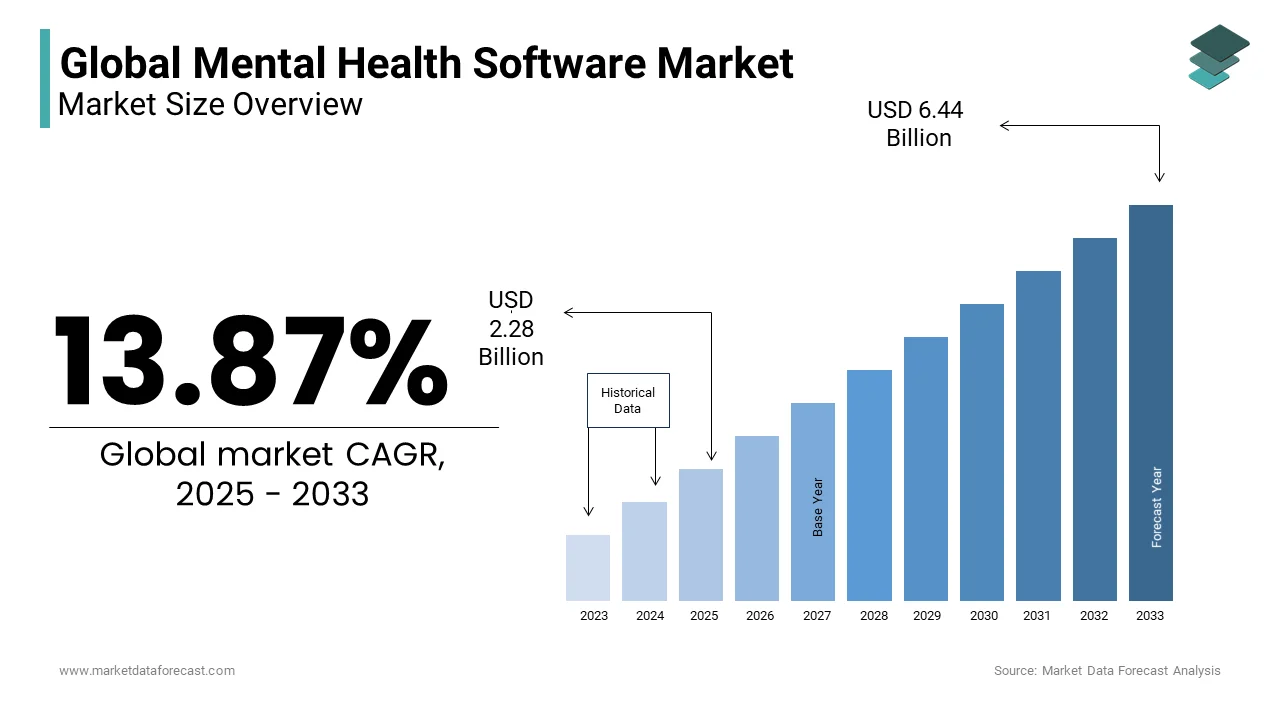
For technology leaders, this validates long-term investment in platforms that support structured therapeutic engagement.
From a product and engineering perspective, this creates both opportunity and responsibility. Teams exploring 3D modelling software development for mental health must balance innovation with safety, usability, and compliance. These conversations increasingly intersect with AI mental health app development, where personalization and analytics enhance clinical workflows without removing human oversight. Selecting the right AI development company becomes a strategic decision tied directly to long-term scalability and trust.
This guide is designed to help decision-makers navigate that landscape. It focuses on how organizations can develop 3D modelling software for mental disorder treatment with clarity around technology choices, development processes, regulatory considerations, and cost structures. Whether you are validating an idea or planning execution, the goal is to help you move forward with confidence and purpose.
What Is a 3D Modelling Software?
3D modelling software development for mental disorder treatment refers to building digital platforms that use three dimensional environments and objects to support structured mental health therapy, assessment, and clinician guided interaction within regulated care settings.
- Focuses on representing therapeutic scenarios, experiences, or constructs in interactive 3D form
- Designed specifically for mental disorder treatment, not general wellness or entertainment
- Supports therapist led and clinically supervised use cases
- Operates as a software product, not a diagnostic or autonomous system
- Can be extended through capabilities like generative AI to enhance personalization while keeping human control intact
At its core, this category exists to give mental health professionals better digital tools, helping translate complex internal experiences into structured, manageable, and clinically meaningful 3D interactions within treatment workflows.
How 3D Modelling Software for Mental Health Works in Practice
At a practical level, 3D modelling software development for mental disorder treatment turns clinical intent into interactive digital experiences. It brings together visual design, structured interaction, and clinician oversight, setting the foundation for how these platforms operate in real settings.
1. Therapeutic Scenarios are Modelled Within Controlled 3D Environments
Clinical concepts are translated into three dimensional spaces that are easy to understand and navigate. These environments are intentionally designed to support therapy goals rather than visual complexity. The focus remains on clarity, safety, and consistency across sessions.
2. Clinician Guided Interaction Drives Every Experience
Therapists determine how and when patients engage with visual elements during a session. Interactions follow predefined structures that support reflection, dialogue, and progression. This makes it possible to build 3D mental health therapy software that aligns with established treatment workflows.
3. Intelligence Layers Support Adaptability without Autonomy
Behind the scenes, logic layers help tailor sessions based on context and progress. Some platforms apply AI assistant app design to support guidance while preserving human control. Others rely on AI automation services to reduce operational friction without influencing therapy decisions.
| Component | Purpose | Value to Treatment |
|---|---|---|
|
3D Environment |
Visual representation of concepts |
Improves understanding and engagement |
|
Interaction Logic |
Manages session flow |
Keeps therapy structured and safe |
|
Clinician Controls |
Enables oversight |
Preserves therapeutic integrity |
|
Intelligence Layer |
Supports adaptation |
Allows personalization at scale |
From a development perspective, these systems require close collaboration between clinicians and engineers. Teams that create 3D modelling solutions for mental health care often prioritize this alignment early, which naturally leads into questions around investment, scope, and long-term value.
Why Invest in 3D Modelling Software Development for Mental Disorder Treatment
For investors and operators alike, 3D modelling software development for mental disorder treatment represents a shift from experimental tooling to durable healthcare infrastructure. Here’s why everyone is investing into its capabilities:
1. It Fits How Care Is Actually Delivered at Scale
Mental health care is moving toward structured, repeatable, and trackable delivery models. Mental health software development using 3D modelling supports this shift by turning abstract therapeutic concepts into consistent digital interactions. That consistency lowers friction for providers and improves adoption across clinical teams.
2. It Creates Defensible Product Depth, Not Surface-Level Features
Most digital mental health products compete on similar workflows and UI patterns. Platforms that build 3D visualization software for mental disorder treatment introduce interaction layers that are harder to replicate quickly. Teams often work with a custom software development company to build this depth through architecture.
3. It Scales Expertise Without Increasing Clinical Risk
The supply of qualified clinicians is not growing fast enough to meet demand. Well-designed systems let therapists extend their reach while maintaining oversight and accountability. Some organizations support this model with AI integration services that improve operations without influencing clinical decisions.
From an investment standpoint, this category favors long-term platform thinking. As organizations decide where to build 3D visualization software for mental disorder treatment, attention naturally shifts toward how these capabilities translate into real clinical use cases and measurable outcomes.
Top Use Cases for 3D Mental Health Therapy Software Platforms
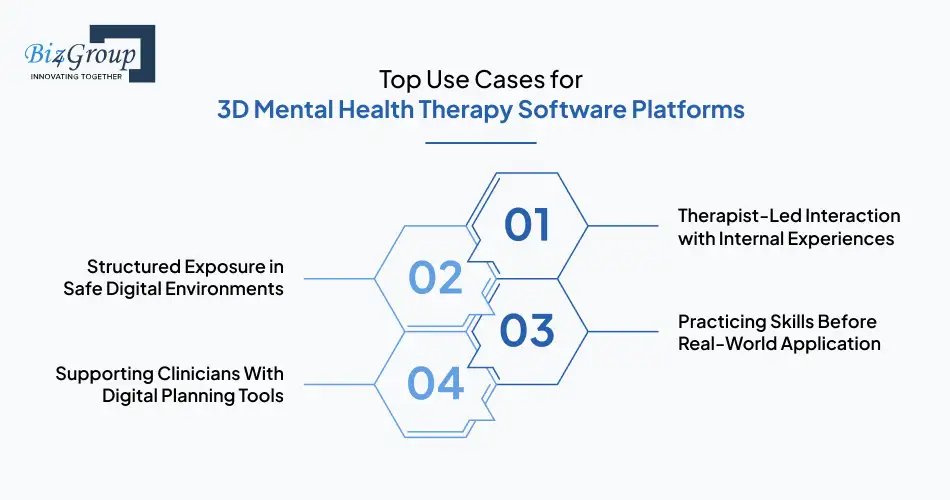
When teams look seriously at 3D modelling software development for mental disorder treatment, they usually want clarity fast. Not theory or buzzwords, but real situations where this software fits into therapy workflows, which brings us to the most common use cases below.
1. Therapist-Led Interaction with Internal Experiences
Some therapy sessions benefit from helping patients engage with experiences that are difficult to express verbally. Controlled 3D environments allow therapists to guide visual and auditory interaction while keeping sessions structured and supervised. This use case commonly appears in custom 3D mental health software development built for clinician-led care.
- Example: A therapist guiding a patient through a 3D avatar to explore and reframe difficult internal experiences.
2. Structured Exposure in Safe Digital Environments
Exposure-based approaches rely on gradual and repeatable progression. 3D environments make it easier to control intensity without changing the therapy setting. Many organizations create 3D mental health therapy software platforms that support this consistency across sessions.
- Example: Adjusting environmental stress levels step by step during guided exposure.
3. Practicing Skills Before Real-World Application
Patients often need a safe space to practice coping or behavioral skills before applying them in daily life. 3D spaces provide realistic scenarios without real-world pressure. This is a focus area in 3D modelling application development for mental health, supported by teams that hire mental health AI app developers to enhance interaction logic responsibly.
- Example: Practicing calming techniques in a simulated high-pressure situation.
4. Supporting Clinicians With Digital Planning Tools
These platforms are not only patient-facing. Therapists also use them to prepare sessions, review scenarios, and align care plans. Some organizations rely on AI consulting services to integrate planning tools into existing workflows, while others apply AI model development to improve adaptability without affecting clinical control.
- Example: Reviewing and adjusting a 3D session setup before meeting a patient.
| Use Case | Primary User | Core Value |
|---|---|---|
|
Internal Experience Interaction |
Therapist and Patient |
Improves engagement and insight |
|
Exposure Therapy |
Patient |
Enables safer progression |
|
Skill Practice |
Patient |
Builds confidence |
|
Session Planning |
Therapist |
Improves consistency |
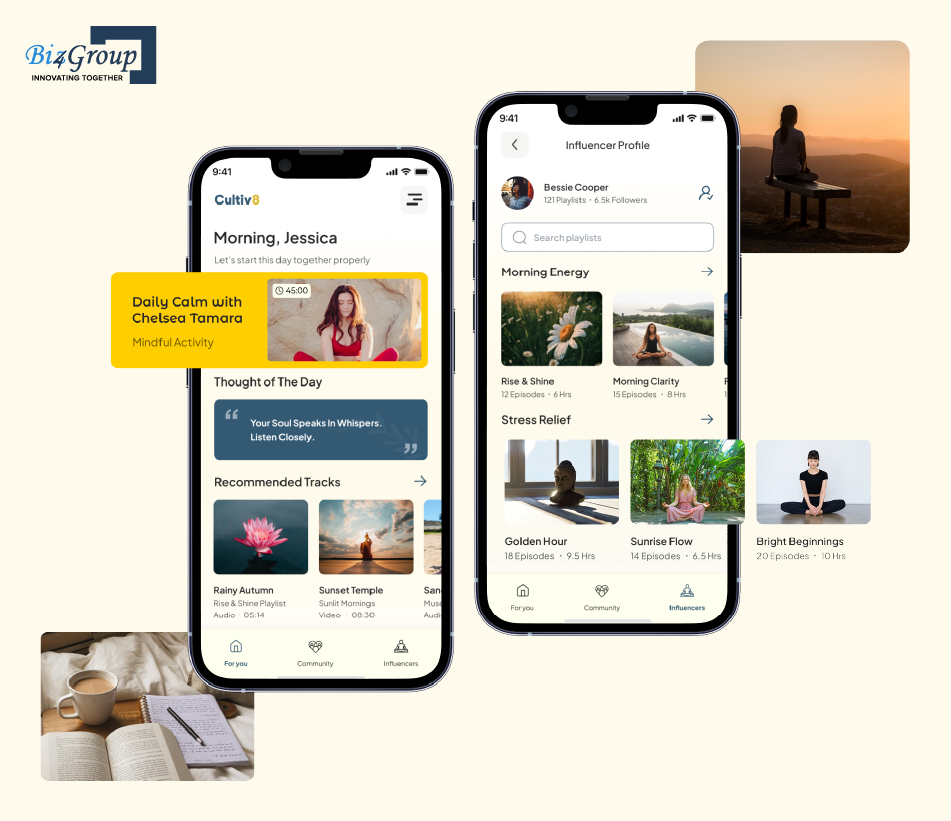
Cultiv8 is a digital wellness platform designed around guided meditation, personalized practices, and reflective engagement, helping users build consistent mental health routines through structured digital experiences. Its emphasis on visualization, interaction, and guided progression aligns naturally with how immersive 3D environments can support therapeutic engagement at scale.
Taken together, the use cases mentioned above show how flexible and grounded these platforms can be when built thoughtfully. As teams evaluate long-term platform strategy, some also align these efforts with enterprise AI solutions to support reporting, scalability, and operational visibility alongside immersive therapy delivery.
Make Engagement Part of the Treatment Plan
See how teams build 3D visualization software for mental disorder treatment to improve session clarity, consistency, and patient participation.
Discuss Your 3D Therapy Use CaseMust-Have Features in 3D Modelling Software Development for Mental Disorder Treatment
When teams move from concept to execution, feature decisions start to matter fast. In 3D modelling software development for mental disorder treatment, core features determine whether a platform feels clinically usable, technically stable, and worth adopting at scale, which is why the fundamentals below deserve close attention:
| Core Feature | What It Supports | Why It Matters |
|---|---|---|
|
Therapist Control Panel |
Session flow and interaction control |
Keeps clinicians in charge at all times |
|
Real-Time 3D Environment Rendering |
Visual representation of therapy contexts |
Makes abstract concepts easier to engage with |
|
Scenario Configuration Tools |
Customization of therapy environments |
Allows flexibility across treatment approaches |
|
Session-Based Access Management |
Role-based permissions |
Protects patient safety and data integrity |
|
Audio and Visual Synchronization |
Coordinated sensory feedback |
Improves realism without overwhelming users |
|
Data Logging and Session History |
Secure session records |
Supports continuity and review |
|
Patient Interaction Controls |
Guided engagement limits |
Prevents unsupervised or unsafe use |
|
Platform Scalability Architecture |
Multi-user and multi-clinic support |
Enables growth without rework |
|
Integration Readiness |
Connectivity with existing systems |
Reduces friction for clinical adoption |
|
Compliance-Aware Design |
Privacy and governance safeguards |
Aligns with healthcare requirements |
For organizations focused on 3D modelling software development for mental health businesses, these features form the baseline. Once the core is solid, teams often explore how to integrate AI into an app in ways that support workflows without changing clinical decision making, which naturally opens the door to more advanced capabilities.
Advanced Capabilities to Consider When You Build Immersive 3D Mental Health Treatment Software
Once the foundation is in place, advanced capabilities define how far a platform can go. In 3D modelling software development for mental disorder treatment, these features shape long-term flexibility, clinical depth, and product maturity:
1. Adaptive Session Logic and Personalization
Advanced platforms adjust session flow based on context rather than rigid scripts. This capability supports teams exploring how to develop 3D modelling software for mental disorder treatment that responds to therapist input in real time. It keeps experiences structured without feeling repetitive across sessions.
2. AI Avatar-Based Interaction Layers
Some therapy models benefit from richer representation inside 3D environments. Carefully designed avatar systems allow guided interaction without assigning autonomy or agency. In selective cases, teams may choose to build a personal avatar chatbot as a controlled interface rather than a conversational agent.
3. Extended Clinician Tooling for Multi-Program Use
As platforms grow, therapists need tools that work across programs and populations. Advanced dashboards support configuration, reuse, and consistency at scale. This becomes critical when organizations build 3D mental health software for therapy providers operating across multiple locations.
4. Intelligent Support Without Clinical Decision Making
Advanced systems often include supportive intelligence that enhances workflows without influencing therapy outcomes. Features tied to AI mental health assistant development can help manage prompts, pacing, or session setup. This keeps the clinician in control while reducing operational overhead.
5. Scalable Architecture for Long-Term Innovation
Innovation slows quickly if systems cannot evolve cleanly. Modular design allows teams to add new therapy models without rebuilding the platform. Many organizations choose to hire AI developers at this stage to support expansion while maintaining technical stability.
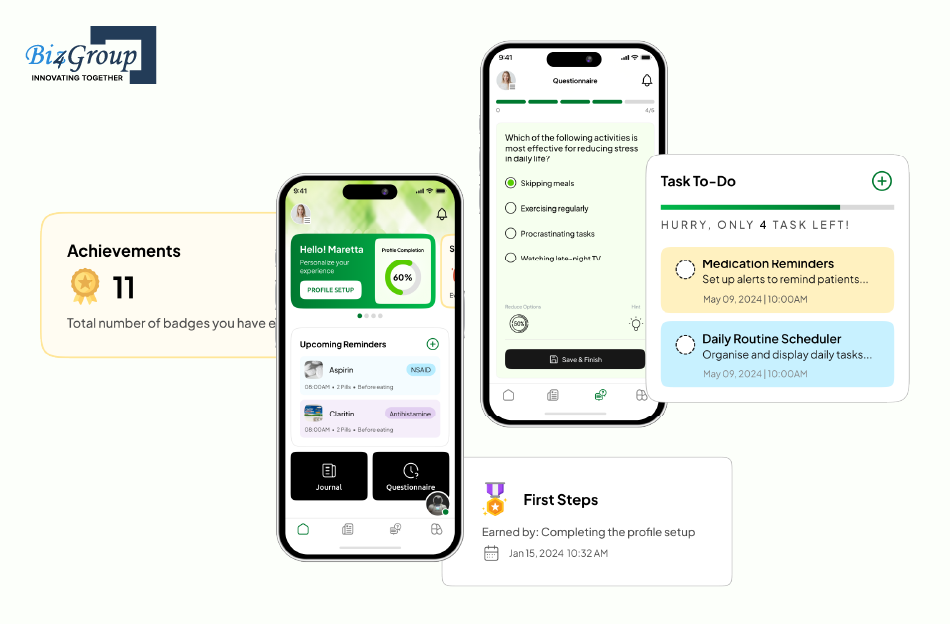
CogniHelp is a cognitive support application built for individuals in early to mid-stages of dementia, focusing on memory exercises, routine reinforcement, and patient-friendly interaction design. The platform highlights how thoughtfully designed digital interfaces can translate clinical goals into accessible, guided experiences, a principle that extends naturally into 3D-based therapeutic systems.
As these capabilities come together, platforms move beyond individual features into cohesive systems. Teams that aim to develop innovative 3D software for mental disorder therapy programs often find that the next set of questions centers on development approach, timelines, and execution strategy rather than feature scope alone.
How to Develop 3D Modelling Software for Mental Disorder Treatment? A Step-by-Step Process
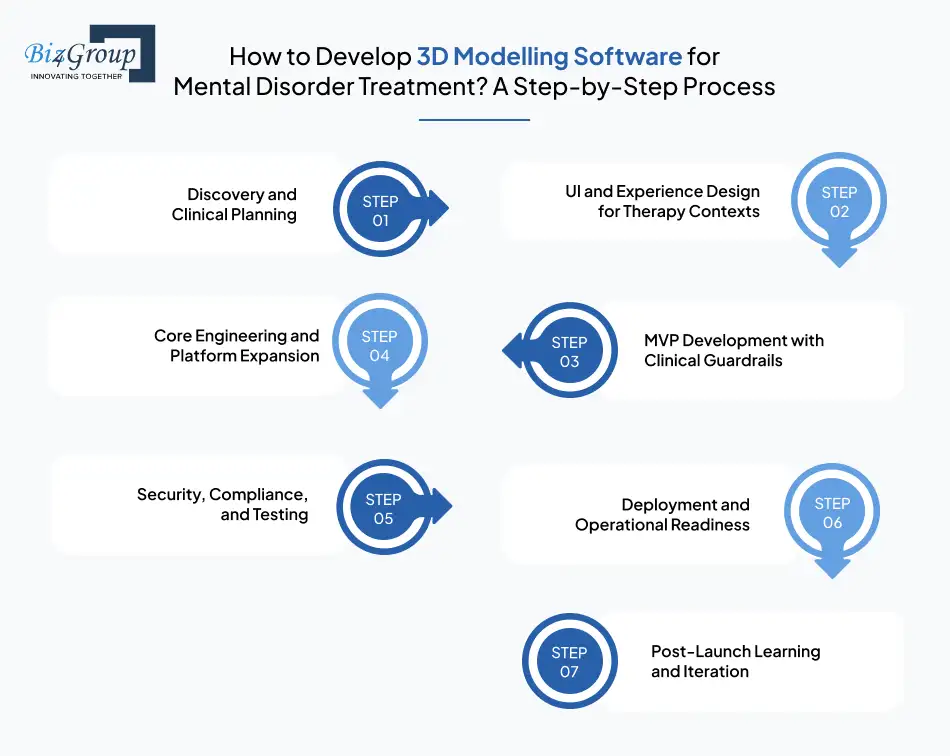
Building in this space requires more intention than speed. In 3D modelling software development for mental disorder treatment, teams move carefully from clinical understanding to scalable execution, ensuring each stage supports real therapy delivery rather than abstract product goals.
1. Discovery and Clinical Planning
This stage focuses on understanding how therapy is delivered in practice and where digital intervention genuinely helps. Product direction is shaped by clinician workflows, patient safety considerations, and measurable outcomes rather than assumptions about engagement or novelty.
- Identify therapy scenarios that benefit from visual interaction
- Define boundaries for clinician control early
- Establish outcome metrics aligned with care delivery
- Align stakeholders on scope and risk
This is where teams begin to create 3D modelling solutions for mental health care grounded in real clinical needs.
2. UI and Experience Design for Therapy Contexts
In mental health software, design directly affects comfort and focus. Interfaces must feel calm and predictable while supporting therapist-led sessions, especially when sensitive topics are involved. This is a defining phase in mental health software development using 3D modelling, and can be easily navigated with an experienced UI/UX development company.
- Map therapy sessions before designing screens
- Test interaction flow with practicing clinicians
- Reduce cognitive load and visual distraction
- Maintain consistency across devices
Also read: Top UI/UX design companies in USA
3. MVP Development with Clinical Guardrails
MVP development services in this space are all about validation, not speed. Teams focus on delivering a small but complete experience that clinicians can actually use, rather than assembling disconnected features that look impressive but fail in practice.
- Select one or two therapy workflows to support
- Prioritize stability and safety over feature count
- Design the backend for future expansion
- Collect early clinician feedback
This approach is common when organizations plan to build 3D visualization software for mental disorder treatment responsibly.
Also read: Top 12+ MVP Development Companies to Launch Your Startup in 2026
4. Core Engineering and Platform Expansion
Once early validation is in place, engineering efforts shift toward robustness and flexibility. Architectural decisions here determine how easily the platform can adapt to new therapy programs, populations, or delivery models.
- Improve performance under real session loads
- Modularize components for reuse and train AI models
- Expand configuration options for clinicians
- Prepare for multi-location deployment
This is typically where custom 3D mental health software development begins to take shape.
5. Security, Compliance, and Testing
Mental health platforms handle sensitive session data, so security and compliance cannot be afterthoughts. Testing focuses on real-world therapy scenarios, access control, and system behavior under stress.
- Implement role-based permissions
- Validate data handling and audit trails
- Test therapy-specific edge cases
- Review compliance continuously
These safeguards are essential when teams create 3D mental health therapy software platforms for clinical use.
Also Read: Software Testing Companies in USA
6. Deployment and Operational Readiness
Deployment planning ensures the software can be introduced without disrupting care delivery. Reliability, onboarding clarity, and operational visibility are prioritized over flashy rollout strategies.
- Prepare cloud infrastructure for scale
- Set up monitoring and alerting
- Create simple onboarding flows
- Support phased rollouts
At this stage, the work transitions into 3D modelling application development for mental health at an operational level.
7. Post-Launch Learning and Iteration
After launch, real usage drives improvement. Continuous iteration ensures the platform remains aligned with evolving therapy needs and clinician expectations rather than drifting toward unused complexity.
- Track therapist usage patterns
- Collect structured feedback regularly
- Refine workflows based on outcomes
- Plan incremental improvements
This feedback loop is what turns a product into long-term clinical infrastructure.
As these steps come together, development becomes less about experimentation and more about execution with intent. When approached thoughtfully, 3D modelling software development for mental disorder treatment creates platforms that clinicians can trust, teams can scale, and organizations can evolve with confidence over time.
Design Software That Clinicians Actually Use
Learn what it takes to approach mental health software development using 3D modelling with the right balance of usability, safety, and control.
Plan a Clinician-First PlatformTechnology Choices for Mental Health Software Development Using 3D Modelling
Once the product vision is clear, technology decisions shape how safely and reliably therapy software operates. For 3D Modelling Software Development for Mental Disorder Treatment, each layer must support immersive interaction, clinician control, and compliance-ready scalability without unnecessary complexity.
| Label | Preferred Technologies | Why It Matters |
|---|---|---|
|
Frontend Framework |
ReactJS, Vue.js |
Therapist and patient interfaces must stay predictable during live sessions. Many teams rely on ReactJS development to keep UI behavior stable when interacting with 3D environments. |
|
Server-Side Rendering & SEO |
NextJS, Nuxt.js |
Clinician dashboards benefit from fast loading and structured routing. Platforms often use NextJS development to support complex therapy workflows without performance drops. |
|
Backend Framework |
NodeJS, Python |
NodeJS development supports live interactions, while Python development manages therapy rules and extensible logic layers. |
|
REST APIs, GraphQL |
Therapy platforms depend on secure data exchange between 3D engines, dashboards, and external systems. Well-designed APIs make integration predictable and auditable across clinical workflows. |
|
|
AI & Data Processing |
TensorFlow, PyTorch |
Advanced platforms analyze session patterns without driving clinical decisions. These tools support insight generation while keeping therapists firmly in control. |
|
3D Engine Integration |
Unity, Unreal Engine |
These engines enable real-time rendering and controlled interaction. They are essential for visualizing therapy environments in a way that feels stable and clinically usable. |
|
Data Storage |
PostgreSQL, MongoDB |
Therapy sessions generate structured records and flexible interaction logs. This combination supports both compliance reporting and ongoing treatment continuity. |
|
Cloud Infrastructure |
AWS, Azure |
Mental health platforms require reliability and controlled scaling. Cloud environments support multi-clinic deployment without interrupting active therapy sessions. |
|
Security & Identity Management |
OAuth 2.0, RBAC |
Strict access control protects patient data and preserves clinician authority. These mechanisms are foundational for regulated mental health environments. |
|
Integration Layer |
WebSockets, Message Queues |
Real-time updates between therapists, patients, and 3D environments must stay synchronized. This layer ensures session state remains consistent and responsive. |
With this technical foundation in place, teams usually move from implementation to oversight. At that stage, 3D modelling software development for mental disorder treatment raises important questions around compliance, regulatory expectations, and how to operate responsibly within clinical environments.
Regulatory and Compliance Considerations in 3D Modelling Software Development for Mental Health
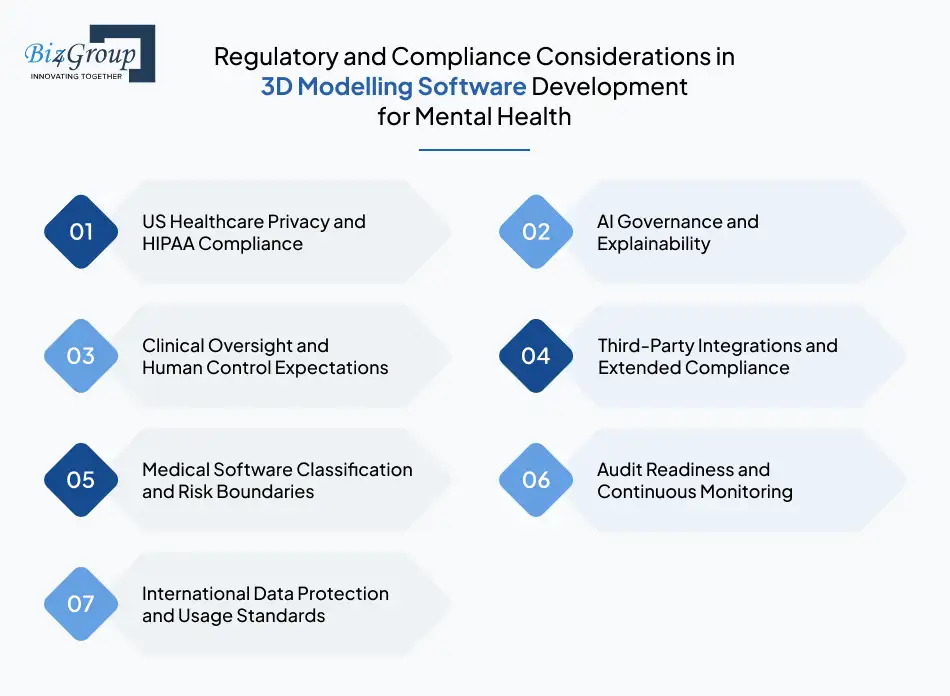
Regulation is not a final checklist here, it is a design constraint from day one. In 3D modelling software development for mental disorder treatment, compliance choices directly shape architecture, data handling, and how safely these platforms operate in clinical environments.
1. US Healthcare Privacy and HIPAA Compliance
Any platform handling identifiable mental health data must comply with HIPAA. This includes encrypted storage, role-based access, and audit logs across therapy sessions. These requirements apply whether software is deployed in clinics or through enterprise healthcare partnerships.
2. AI Governance and Explainability
When intelligence layers are involved, transparency is critical. Systems must explain how prompts or guidance are generated without influencing therapy outcomes. Teams working with an AI product development company often formalize governance to keep these boundaries clear.
3. Clinical Oversight and Human Control Expectations
Regulators and providers expect therapists to remain fully in control of therapy delivery. Software must avoid autonomous diagnosis or treatment behavior. This becomes especially important when teams develop innovative 3D software for mental disorder therapy programs using immersive interaction models.
4. Third-Party Integrations and Extended Compliance
External systems increase compliance surface area. APIs, analytics tools, and messaging layers must follow the same safeguards as core platforms. This becomes more complex when solutions include AI chatbot integration or automated support features.
5. Medical Software Classification and Risk Boundaries
Risk increases as software influences clinical workflows more directly. Clear documentation of intended use helps avoid unintended medical device classification. This matters when teams make 3D modelling software for cognitive and behavioral therapy within structured treatment plans.
6. Audit Readiness and Continuous Monitoring
Compliance does not end at launch. Ongoing monitoring, logging, and access reviews help maintain trust with providers and partners. Some organizations leverage AI document analysis tool development to streamline audits and compliance reporting efficiently.
7. International Data Protection and Usage Standards
For global deployments, regulations like GDPR influence consent, transparency, and user rights. While requirements vary by region, the core principles remain consistent. Many teams address this early when they create 3D therapy software for patient engagement across borders.
Strong compliance foundations ultimately protect scale, partnerships, and credibility. Once regulatory alignment is in place, teams naturally shift focus toward understanding cost structures, investment planning, and what it takes to sustain these platforms over time.
```htmlValidate Before You Scale
Understand how to develop 3D modelling software for mental disorder treatment starting with focused MVPs that reduce risk and support real-world adoption.
Map Your MVP StrategyWhat Is the Cost to Create 3D Modelling Solutions for Mental Health Care?
Cost is usually one of the first questions on the table. For most organizations, 3D Modelling Software Development for Mental Disorder Treatment typically falls in the range of $100,000 to $300,000+. This is a ballpark figure, and actual investment depends heavily on scope, clinical depth, and long-term scalability goals.
Here’s a quick look at the basic categorization:
|
Build Level |
Typical Cost Range (in USD) |
What It Usually Covers |
Best Fit For |
|---|---|---|---|
|
MVP 3D Modelling Solutions for Mental Health Care |
$100,000 to $150,000 |
Core 3D environments, therapist-led controls, built during MVP software development. |
Clinics or startups validating a focused therapy use case |
|
Mid-Level 3D Modelling Solutions for Mental Health Care |
$150,000 to $250,000 |
Multiple therapy scenarios, advanced clinician dashboards, reporting, integrations |
Organizations expanding across programs or providers |
|
Enterprise-Grade 3D Modelling Solutions for Mental Health Care |
$300,000+ |
Scalable architecture, governance controls, multi-location deployment, advanced compliance |
Hospitals, large therapy networks, digital health enterprises |
What matters most is not choosing the biggest build, but the right one. Teams that match scope to real adoption goals avoid wasted spend early while keeping room to grow.
Revenue Opportunities in 3D Modelling Software Development for Mental Health Businesses
Revenue models in this space work best when they mirror how therapy is delivered and scaled. In 3D modelling software development for mental disorder treatment, monetization is less about volume and more about long-term usage, trust, and clinical alignment, which shapes the models below:
1. Subscription Licensing for Clinics and Therapy Providers
Many platforms charge recurring fees based on clinician seats or active therapy programs. This keeps pricing predictable while allowing providers to scale usage gradually. It is a common approach when teams build 3D mental health therapy software for ongoing clinical delivery.
- Example: A clinic pays a monthly subscription per therapist, with access expanding as more programs are added.
2. Enterprise Licensing for Larger Healthcare Organizations
Hospitals and networks often prefer flat enterprise licenses covering multiple locations. These agreements focus on stability, governance, and support rather than per-user pricing.
- Example: A multi-location provider licenses the platform company-wide with rollout support from a software development company in Florida.
3. Program or Module-Based Monetization
Some platforms monetize by offering specific therapy programs or 3D modules as add-ons. This allows providers to start small and expand only when there is demand.
- Example: A core platform is extended with a specialized therapy module supported by computer vision development services.
4. Partnership and White-Label Models
In some cases, the software is licensed as underlying infrastructure rather than a branded product. This model fits organizations that develop 3D modelling software for mental disorder treatment as a platform.
- Example: A digital health brand integrates the software into its ecosystem using business app development using AI.
The strongest revenue strategies usually feel invisible to end users. Once monetization is aligned with care delivery, it's time to focus on development best practices that keep platforms resilient and adaptable.
Align Cost, Scope, and Outcomes Early
Get clarity on how organizations create 3D modelling solutions for mental health care while managing investment, compliance, and long-term value.
Estimate Your Project ScopeBest Practices in 3D Modelling Software Development for Mental Disorder Treatment
Strong products in this space are built through restraint and clarity rather than ambition alone. In 3D modelling software development for mental disorder treatment, the teams that succeed tend to follow grounded practices that respect therapy dynamics while still allowing technology to evolve.
1. Start With Session Reality, Not Feature Ideation
Before screens or environments are defined, teams should observe how therapy actually unfolds. When real session flow informs interaction timing and visual pacing, design decisions feel natural. This often reshapes early planning for mental health software development using 3D modelling in subtle but meaningful ways.
2. Make Oversight Obvious at Every Interaction Point
Control should never be implied or hidden. From environment adjustments to session transitions, the software must make it clear who is guiding the experience. This clarity becomes critical as platforms mature and organizations begin to build 3D visualization software for mental disorder treatment across diverse programs.
3. Use Immersion as a Support Tool, Not a Centerpiece
Visual depth should never compete with therapeutic intent. Predictable interactions and visual calm help keep attention where it belongs. In some designs, an AI conversation app is introduced carefully to support engagement without becoming the focus of the session.
4. Design for Change Without Structural Rework
Therapy programs shift as practices evolve, and platforms need to adapt quietly in the background. Modular systems make it possible to extend functionality over time. This flexibility is a defining strength of custom 3D mental health software development, especially when teams later decide to build AI software to extend workflow support.
5. Keep Intelligence Clearly Bounded and Purpose Driven
If intelligent components are added, their role must remain narrow and transparent. They support structure, not judgment. In practice, you may choose to create mental health AI agent after governance boundaries are firmly established.
Well-applied best practices often go unnoticed by users, and that is exactly the point. With this foundation in place, teams are better positioned to look ahead at how the space may evolve and what future-ready platforms will require next.
Challenges in 3D Modelling Software Development for Mental Health and How to Solve Them
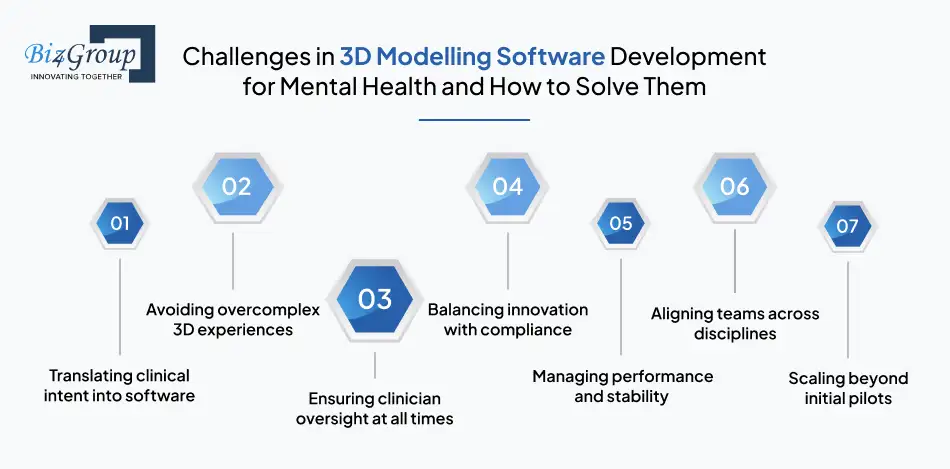
Building immersive therapy platforms is rarely straightforward. In 3D modelling software development for mental disorder treatment, teams face a mix of clinical, technical, and operational hurdles that must be addressed early to avoid long-term friction, which makes the challenges below especially important:
|
Top Challenges |
How to Solve Them |
|---|---|
|
Translating clinical intent into software |
Work closely with therapists to map real session workflows before designing features |
|
Avoiding overcomplex 3D experiences |
Prioritize clarity and control over visual sophistication in therapy environments |
|
Ensuring clinician oversight at all times |
Design role-based controls that keep therapists in charge of session flow |
|
Balancing innovation with compliance |
Treat regulatory requirements as architectural inputs, not afterthoughts |
|
Managing performance and stability |
Optimize 3D assets early and test under real session conditions |
|
Aligning teams across disciplines |
Establish shared language between clinical, design, and engineering teams |
|
Scaling beyond initial pilots |
Build modular architecture that supports growth without rewrites |
Most of these hurdles are not technical dead ends, but coordination problems. When addressed thoughtfully, they often become design advantages. Once challenges are clearly understood, teams are better positioned to think about where this space is heading and how future capabilities may evolve.
The Future of 3D Modelling Software Development for Mental Disorder Treatment
What lies ahead is less about adding sophistication and more about fit. In 3D modelling software development for mental disorder treatment, the future is shaped by how comfortably these platforms settle into clinical operations, funding models, and long-term care strategies.
1. From Early Adoption to Clinical Normalization
The next phase will see these platforms move out of pilot programs and into routine use. As evidence and familiarity grow, organizations will increasingly build 3D visualization software for mental disorder treatment as part of standard therapy infrastructure. Adoption will be driven by trust and repeatability, not novelty.
2. Clearer Industry Boundaries Around AI in Mental Health
As usage expands, expectations around acceptable AI involvement will solidify. Buyers will differentiate between supportive tools and clinical decision making. Some organizations will explore AI virtual mental health coach models cautiously, with procurement teams demanding clear scope definitions.
3. Procurement Becoming More Structured and Outcome-Led
Buying decisions will mature beyond experimentation. Healthcare leaders will evaluate platforms using clearer benchmarks tied to outcomes, risk, and sustainability. This shift favors teams investing in custom 3D mental health software development aligned with long-term operational goals rather than short-term demos.
4. Cost Transparency Driving Smarter Investment Decisions
As more platforms reach scale, cost discussions will become less speculative. Leaders will better understand where money is spent and why. Conversations around mental health AI chatbot development cost will shift toward budgeting clarity rather than exploratory estimates.
5. Platform Longevity Becoming a Strategic Priority
The focus will move from building fast to building durable. Organizations will prefer systems designed to evolve without disruption. This is where decisions to build AI software become part of a broader platform roadmap rather than isolated innovation efforts.
As expectations stabilize, the conversation naturally turns toward who is best equipped to build, support, and evolve these platforms responsibly over time.
Why Choose Biz4Group for 3D Modelling Software Development for Mental Health?
Building in this space takes more than technical skill. It requires comfort working at the intersection of therapy workflows, regulated data, and immersive interaction. Biz4Group brings that balance through hands-on experience building AI-driven mental health platforms that translate care intent into usable software.
Our work on platforms like Cultiv8 and CogniHelp reflects a consistent pattern. We focus on guided interaction, structured engagement, and systems designed to support care delivery without overstepping clinical boundaries. That same thinking carries into complex 3D modelling initiatives.
What sets Biz4Group apart
- Proven experience building AI mental health platforms, not just general wellness and health apps
- Strong understanding of therapist-led workflows and patient engagement design
- Engineering teams that plan for compliance, scalability, and long-term adoption
- Clear communication between clinical intent, product design, and development execution
As one of the top AI development companies in Florida, Biz4Group works closely with healthcare leaders who want thoughtful, durable platforms rather than experimental technology. That makes us a practical partner for organizations looking to move forward with confidence.
Build for Longevity, Not Just Launch
See why leaders choose custom 3D mental health software development to support evolving therapy programs without rebuilding from scratch.
Talk to a 3D Health Tech ExpertFinal Thoughts on 3D Modelling Software Development for Mental Disorder Treatment
Mental health technology works best when it feels intentional, not intimidating. As this space evolves, 3D platforms are proving that thoughtful design, clinician control, and immersive interaction can coexist without overcomplicating care. When built responsibly, these systems help translate therapy goals into experiences that patients can actually engage with.
For decision-makers, the opportunity is all about building platforms that fit clinical workflows, respect compliance boundaries, and scale alongside real adoption. That is where the right AI app development company and a clear understanding of AI in mental health make all the difference.
The takeaway is simple. Build with purpose, plan for longevity, and let technology support care rather than compete with it.
Explore how immersive 3D therapy software fits into your care strategy.
FAQs
What types of mental health conditions are suitable for 3D-based therapy software?
3D-based approaches are commonly used where visualization and guided interaction add value, such as anxiety disorders, trauma-informed therapy, and structured CBT programs. Many providers explore this through 3D modelling application development for mental health to support therapist-led treatment safely.
Can 3D mental health software be used alongside traditional therapy methods?
Yes. These platforms are designed to complement existing care rather than replace it. Clinics often build 3D mental health therapy software to extend in-session work, reinforce techniques, or structure guided interactions under clinician supervision.
How long does it usually take to develop 3D modelling software for mental disorder treatment?
Development timelines vary by scope, but most projects range from six to twelve months. Teams that develop 3D modelling software for mental disorder treatment typically start with a focused MVP before expanding features and programs.
What level of clinical involvement is needed during development?
Clinical input is essential throughout the process, especially during workflow definition and safety validation. This is critical when teams create 3D modelling solutions for mental health care that must align closely with real therapy practices.
How much does it cost to build 3D modelling software for mental disorder treatment?
Most platforms fall within a $100,000 to $300,000+ range, depending on complexity and scale. Costs increase as organizations build immersive 3D mental health treatment software with advanced environments, compliance readiness, and scalability.
What should decision-makers prioritize when evaluating teams for this type of software?
Beyond technical skill, leaders should look for healthcare experience, understanding of therapy workflows, and long-term scalability. These factors matter most in 3D modelling software development for mental health businesses aiming for sustained adoption.
