Location :
Orlando, FL, USA
Location :
Orlando, FL, USA +1 (407) 714-1616
 info@biz4group.com

















Imagine a digital system that doesn’t wait for instructions but instead, understands your business goals, learns from real-time feedback, and takes independent actions to get the job done.
Read More
Have you noticed how quickly enterprise conversations around AI are evolving? A few years ago, most companies were experimenting with AI tools that could assist employees.
Today, leaders are asking a bigger question: Can AI actually run parts of the business on its own?
That shift is exactly why agentic AI for enterprises is becoming a major focus for CIOs, CTOs, and digital transformation leaders.
Traditional AI systems analyze data, generate insights, or recommend actions. Humans still execute the work. Agentic AI changes that model. These systems can plan tasks, make decisions, and execute multi step workflows across enterprise tools with minimal supervision. The goal is not just smarter software. The goal is autonomous operations.
And enterprises are moving quickly in that direction.
According to McKinsey’s 2025 State of AI report, 78% of organizations now use AI in at least one business function, a significant increase in just a few years. The next stage of value creation is expected to come from AI systems that can automate complex operations rather than simply assist employees.
At the same time, another report predicts that by 2028, one third of enterprise software applications will include agentic AI capabilities that can independently complete tasks and coordinate business processes.
Why does this matter to you as a business leader?
Because enterprise teams today face growing operational pressure. Customer expectations keep rising. Data volumes keep expanding. Your teams are often switching between multiple systems just to complete a single workflow.
This is where agentic AI for enterprise automation starts to change the equation.
Instead of automating isolated tasks, enterprise AI agents for business operations can manage entire workflows. They analyze incoming data, decide what action is needed, and execute it across connected systems.
That capability is driving rapid enterprise adoption of agentic AI across industries.
If you have already started exploring AI initiatives, you may also have noticed confusion around terms like AI agents and agentic systems. Understanding the difference between them is important before making technology decisions. A clear breakdown of agentic AI vs AI agents helps clarify how these technologies differ and where they fit in enterprise environments.
So the real question becomes: What exactly is agentic AI for enterprises, and what should leaders consider before investing in it?
Agentic AI for enterprises refers to AI systems that can pursue a defined business goal by planning tasks, making decisions, and executing actions across enterprise software and data sources. Generally, this means agentic AI systems for enterprise workflows can manage processes that normally require multiple tools and human coordination.
Organizations are increasingly deploying enterprise AI agents for business operations to automate processes such as customer service resolution, IT ticket handling, financial reporting, compliance checks, and internal workflow coordination.
|
Capability |
Traditional Enterprise AI |
Agentic AI for Enterprise Automation |
|---|---|---|
|
Output |
Insights, predictions, recommendations |
Actions and completed workflows |
|
Role in workflow |
Supports human decision making |
Executes operational tasks |
|
Automation scope |
Individual tasks |
Multi step business processes |
|
System interaction |
Limited tool interaction |
Works across enterprise systems |
Start with a clear operational goal. The strongest results come from workflows where agentic AI applications for enterprise operations can remove manual coordination or repetitive decisions.
Focus on processes that involve multiple systems, repeated steps, and structured data. These workflows benefit the most from agentic AI for enterprise automation.
AI agents need reliable access to enterprise data sources. Disconnected systems make it difficult for enterprise AI agents for business operations to function effectively.
Many organizations begin with a small implementation to test feasibility before scaling. Running an agentic AI POC development initiative helps confirm the workflow design and integration requirements before broader deployment.
Now that the fundamentals are clear, the next logical question is:
How do these systems actually operate inside enterprise environments and manage real business workflows?
Let’s break down how agentic AI platforms for enterprises work and how agentic AI systems for enterprise workflows execute tasks across tools, data sources, and business processes.
You've seen what agentic AI for enterprises can do. Now imagine what it could automate inside your own workflows.
Talk to Our AI Experts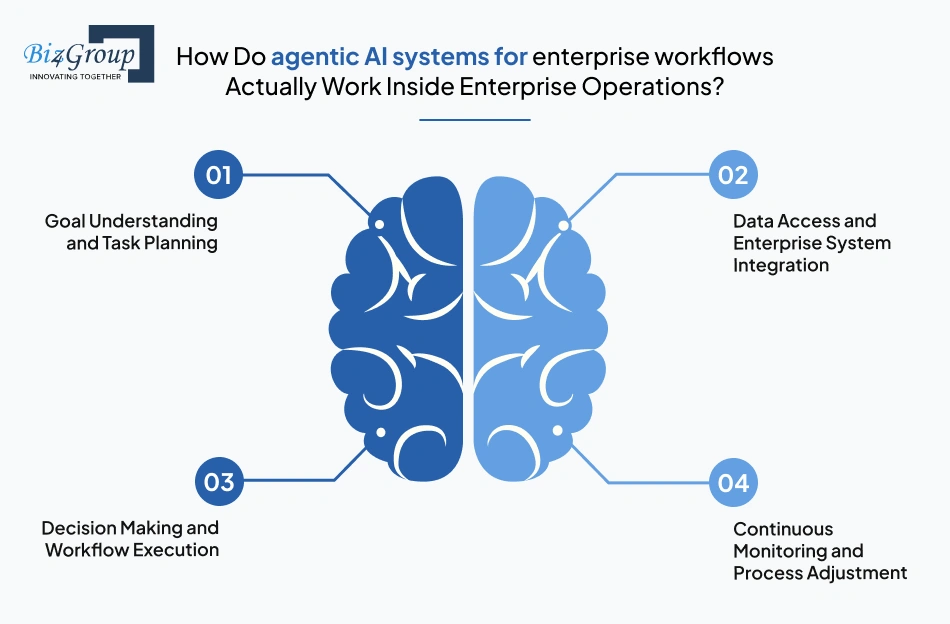
To understand agentic AI for enterprises, it helps to break down how these systems actually operate inside business environments. At a high level, agentic AI platforms for enterprises follow a structured process. They understand a goal, plan tasks, interact with enterprise systems, and complete the workflow.
Below is a simplified view of how these systems typically function.
Every agentic system begins with a defined objective. This could be resolving a customer query, processing invoices, managing HR requests, or handling IT incidents. The system interprets the goal and breaks the workflow into smaller tasks so the process can be executed using agentic AI systems for enterprise workflows. The architecture behind this approach follows many of the same principles used in designing an AI agent for enterprise environments.
Typical planning steps include:
This task planning stage allows enterprise AI agents for business operations to handle workflows that normally involve multiple teams.
Once tasks are defined, the system needs access to enterprise tools and data sources. Through APIs and connectors, agentic AI platforms for enterprises interact with business systems such as CRM platforms, ERP tools, document repositories, and analytics dashboards.
This integration enables agents to:
Proper integrations allow agentic AI applications for enterprise operations to function across multiple business systems.
After retrieving the required data, the system determines the next action needed to move the workflow forward. Instead of waiting for human input at every step, agentic AI for enterprise automation allows the system to evaluate conditions and execute predefined actions.
Common execution tasks include:
This capability enables enterprise AI agents for business operations to complete processes faster and reduce manual coordination.
The final stage involves monitoring progress and adjusting actions when needed. Enterprise agents track workflow outcomes and determine whether additional steps are required to complete the objective.
This feedback loop allows agentic AI systems for enterprise workflows to:
This structured cycle is what allows agentic AI platforms for enterprises to manage complex operational workflows.
But understanding how the system works internally leads to a more practical question.
Where are enterprises actually using agentic AI today, and which industries are seeing the biggest impact?
After understanding how these systems operate, the next question is practical: Where are companies actually using agentic AI in real business environments?
Organizations are deploying agentic AI applications for enterprise operations in workflows that require multiple systems, repeated decision making, and continuous monitoring. These environments benefit the most from agentic AI systems for enterprise workflows because the technology can manage an entire process rather than a single task.
Below are some of the most relevant agentic AI enterprise use cases currently emerging across enterprise operations and industries.
Customer service is one of the most widely adopted areas for agentic AI for enterprise automation. Support teams handle thousands of requests daily, and many of these follow predictable workflows involving customer data, internal documentation, and ticket management systems.
Example:
A customer submits a support request. The agentic system retrieves the customer profile from the CRM, searches the knowledge base for possible solutions, resolves the issue, updates the support ticket, and notifies the customer. Many enterprises implement solutions such as an agentic AI chatbot to automate these service workflows.
Enterprise IT teams constantly monitor infrastructure, applications, and internal systems. Enterprise AI agents for business operations can manage these environments by identifying incidents and triggering remediation workflows.
Example:
An AI system detects a server outage through monitoring tools. It diagnoses the issue, restarts the affected service, logs the incident in the IT system, and alerts the operations team. This is one of the fastest growing agentic AI applications for enterprise operations because IT environments generate large volumes of operational data.
Finance teams manage repetitive workflows such as invoice processing, expense validation, and financial reconciliation. Agentic AI systems for enterprise workflows help automate these structured processes while reducing errors.
Example:
An enterprise AI agent receives vendor invoices, extracts financial data, validates purchase records, updates the ERP system, and flags discrepancies for review. This approach allows organizations to automate financial workflows while improving accuracy and reporting efficiency.
Sales teams rely on CRM platforms, marketing tools, and communication systems to manage leads and opportunities. Enterprise AI agents for business operations can coordinate these workflows automatically.
Example:
An AI system receives a new lead from a marketing campaign, analyzes CRM data, qualifies the lead based on predefined criteria, assigns the lead to a sales representative, and schedules a follow up meeting. This helps organizations streamline revenue operations using agentic AI for enterprise automation.
Supply chains involve multiple systems including inventory management platforms, procurement systems, and logistics tracking tools. Agentic AI platforms for enterprises help coordinate these systems.
Example:
An AI agent monitors inventory levels across warehouses. When stock falls below a defined threshold, the system automatically places a purchase order, updates inventory records, and notifies procurement teams. This capability is particularly useful in large organizations managing complex supply chains.
Many enterprises struggle with delays in data analysis and reporting. Agentic AI applications for enterprise operations can monitor datasets and generate insights automatically.
Example:
An AI agent analyzes daily business data, identifies anomalies in revenue performance, generates a summary report, and sends insights to leadership teams. These capabilities allow organizations to turn operational data into faster business decisions.
HR departments manage recruitment pipelines, employee onboarding, and internal requests. Agentic AI systems for enterprise workflows help streamline these processes.
Example:
An AI system screens incoming resumes, ranks candidates based on job requirements, schedules interviews automatically, and updates the HR management system. Organizations implementing solutions such as agentic AI in HR are improving recruitment efficiency and candidate management.
Legal teams review contracts, track regulatory requirements, and manage compliance documentation. Enterprise agentic AI solutions for decision making can automate these complex workflows.
Example:
An AI agent reviews incoming contracts, extracts key clauses, identifies potential compliance risks, and generates summaries for legal teams. Platforms designed for agentic AI platform for legal services help automate document analysis and compliance monitoring.
Healthcare organizations manage scheduling, documentation, patient coordination, and insurance verification. Agentic AI in healthcare systems enterprise workflows help automate these administrative processes.
Example:
An AI agent receives a patient appointment request, verifies insurance details, checks physician availability, schedules the appointment, and updates the hospital management system. Healthcare providers exploring enterprise adoption often review vendors listed among the top agentic AI development companies for healthcare industry in USA.
Real estate companies manage property listings, buyer inquiries, and transaction coordination. Agentic AI applications for enterprise operations can automate these operational workflows.
Example:
An AI system receives a buyer inquiry, analyzes preferences, suggests suitable properties, schedules property visits, and updates the CRM system. Solutions such as agentic AI for real estate are helping companies manage these processes more efficiently.
These examples demonstrate how agentic AI for enterprises use cases and ROI are already becoming visible across multiple industries and operational functions.
However, identifying use cases is only part of the equation. Enterprise leaders still need to understand one critical factor before investing and that is what measurable business value can agentic AI actually deliver, and how do organizations calculate ROI from these implementations?
If these agentic AI enterprise use cases sound like problems your teams face daily, it might be time to automate the workflow behind them.
Let's TalkFor most enterprise leaders, the biggest question is not whether the technology works. The real question is whether it creates measurable business value.
When implemented in the right workflows, agentic AI for enterprises can generate clear operational and financial returns. Organizations are using agentic AI systems for enterprise workflows to reduce operational costs, improve productivity, scale services, and accelerate decision making.
Below are the key areas where enterprises are measuring ROI from enterprise agentic AI solutions.
Enterprises evaluate ROI by comparing operational improvements before and after implementing agentic AI applications for enterprise operations. The goal is to identify measurable changes in efficiency, cost, and service performance.
Common ROI metrics include:
Organizations often begin by testing smaller workflows before scaling larger deployments. Many companies start by building and validating pilot solutions before they build agentic AI systems across multiple enterprise processes.
One of the fastest financial benefits comes from reducing operational overhead. By automating repetitive processes, agentic AI for enterprise automation removes the need for manual coordination across teams and systems.
Common cost savings areas include:
Enterprises implementing agentic AI applications for enterprise operations often see significant efficiency gains in departments that manage large volumes of repetitive workflows.
Another major source of ROI is improved workforce productivity. Instead of spending time managing routine tasks, employees can focus on higher value activities. Enterprise AI agents for business operations help teams complete workflows faster by coordinating tasks across multiple systems.
Productivity improvements typically include:
These improvements allow organizations to scale internal operations without significantly increasing workforce size.
Beyond efficiency improvements, agentic AI for enterprises can help organizations scale operations and increase revenue opportunities. When workflows are automated and decision cycles become faster, businesses can serve more customers without increasing operational complexity.
Examples of revenue impact include:
These outcomes allow enterprises to grow while maintaining operational efficiency.
The long term value of agentic AI systems for enterprise workflows extends beyond cost savings. These systems enable organizations to operate with greater speed, visibility, and decision accuracy.
Strategic benefits often include:
Organizations implementing large scale automation often combine technologies such as AI automation services with enterprise agentic AI solutions to manage complex operational environments.
These benefits show why enterprises are actively exploring the potential of agentic AI for enterprises use cases and ROI across multiple business functions.
However, as organizations expand adoption, another important consideration emerges of how do enterprises ensure governance, security, and compliance when deploying agentic AI systems across critical business workflows?
As enterprises scale agentic AI for enterprises, governance and compliance become critical considerations. These systems can interact with enterprise data, make operational decisions, and trigger actions across business platforms. Without proper oversight, organizations risk security issues, regulatory violations, and loss of control over automated workflows.
This is why enterprises deploying agentic AI systems for enterprise workflows establish clear governance frameworks that define how AI agents operate, what decisions they can make, and how their actions are monitored. Strong governance ensures that automation improves efficiency without introducing operational or compliance risks.
Below are the key governance areas organizations must address when implementing enterprise agentic AI solutions.
Enterprises need clear governance policies that define how enterprise AI agents for business operations interact with systems and data. Governance frameworks outline decision boundaries, approval workflows, and monitoring mechanisms for automated processes. This ensures that agentic systems operate within predefined business rules while maintaining accountability. Organizations often align these frameworks with broader digital transformation strategies that include enterprise AI solutions across departments.
Because agentic AI applications for enterprise operations rely on enterprise data, security and privacy protections must be built into the system from the start. Enterprises must ensure that agents access only authorized datasets and comply with privacy regulations such as data protection laws or industry specific standards. Proper access controls, encryption policies, and audit logs help organizations maintain secure operations while scaling agentic AI for enterprise automation.
One challenge of agentic AI systems for enterprise workflows is maintaining visibility into automated decisions. Enterprises must implement monitoring systems that track how agents process information and what actions they take. Logging, explainability tools, and real time monitoring dashboards help organizations maintain oversight. This allows leadership teams to trust automated processes while still maintaining control over critical business operations.
Industries such as healthcare, banking, and legal services operate under strict regulatory frameworks. When deploying enterprise agentic AI solutions for decision making, organizations must ensure that automated workflows comply with industry regulations. This often requires additional safeguards such as audit trails, documentation standards, and compliance validation processes. Enterprises working in regulated sectors often rely on specialized development expertise such as conversational AI consulting and development services to ensure their systems meet regulatory requirements.
As organizations implement these governance practices, enterprise adoption of agentic AI becomes more scalable and reliable. Strong governance frameworks allow companies to expand automation across business operations while maintaining security, transparency, and regulatory compliance.
However, even with governance in place, some organizations still struggle to successfully deploy agentic systems.
Also Read: HIPAA Compliant AI App Development for Healthcare Providers
Building agentic AI systems for enterprise workflows requires strong architecture, governance, and integration. Let's design it the right way.
Schedule a Free Consultation CallMany organizations start exploring agentic AI for enterprises with high expectations. However, not every implementation succeeds. The most common failures occur when enterprises adopt the technology without clearly defining workflows, data readiness, or system integrations.
Successful agentic AI systems for enterprise workflows require proper planning, governance, and alignment with business operations. When these factors are overlooked, projects may struggle to deliver the expected results.
The table below highlights common challenges enterprises face during enterprise adoption of agentic AI and practical ways to address them.
|
Common Challenge |
Why It Happens |
How Enterprises Can Solve It |
|---|---|---|
|
Unclear business objectives |
Organizations adopt agentic AI for enterprise automation without identifying the specific workflow they want to improve. This leads to experiments that lack measurable impact. |
Start by identifying high impact workflows where agentic AI applications for enterprise operations can remove manual coordination or repetitive decisions. Define clear success metrics before implementation. |
|
Poor data accessibility |
Enterprise data often exists across disconnected systems, making it difficult for enterprise AI agents for business operations to access reliable information. |
Establish strong system connectivity using AI integration services so agents can access relevant enterprise data and execute workflows effectively. |
|
Lack of workflow design |
Some implementations focus on building AI models but ignore the overall workflow structure required for agentic AI systems for enterprise workflows. |
Define the operational process first and design the agent architecture around that workflow. Many enterprises follow structured approaches similar to designing an AI agent build scalable systems. |
|
Limited internal expertise |
Enterprises may lack experience in building or managing enterprise agentic AI solutions. This can slow development and lead to poorly implemented systems. |
Organizations often collaborate with specialized partners or hire AI developers with experience in building enterprise AI systems. |
|
Scaling challenges |
Early pilots may work well but struggle when expanded across departments. This often happens when infrastructure and automation layers are not designed for scale. |
Enterprises build scalable architectures such as an agentic AI workflow automation system for business to manage workflows across enterprise platforms. |
Addressing these challenges early allows organizations to deploy agentic AI for enterprises more successfully and scale automation across multiple business functions.
As enterprises overcome these implementation challenges, the next step becomes clear on how can organizations build and deploy scalable agentic AI solutions that transform enterprise operations?
Building agentic AI for enterprises requires more than just deploying models. Enterprises need systems that connect workflows, automate operations, and integrate with existing business platforms. That is where experienced development partners become critical.
As an agentic AI development company, Biz4Group focuses on building scalable AI platforms that automate workflows, improve decision making, and help businesses unlock measurable value from automation. From early strategy and architecture design to system deployment and integration, the goal is to help organizations implement reliable enterprise AI solutions that support long-term digital transformation.
To better understand how this works in practice, here is an example of a real project developed by Biz4Group.
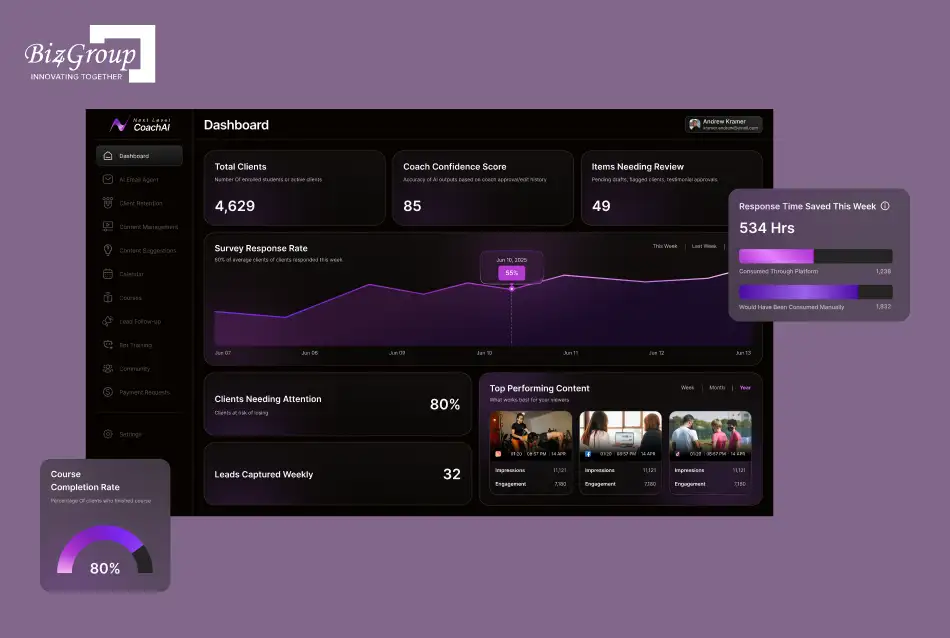
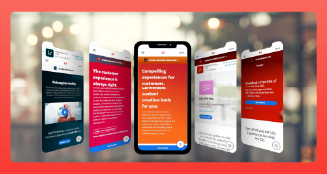
Next Level Coach AI platform was designed to help coaches, educators, and digital content creators automate routine business tasks while maintaining personalized engagement with their clients.
The challenge was clear. Many professionals spend large amounts of time managing communication, creating content, and following up with clients. Instead of focusing on delivering value, they often get stuck handling operational tasks. The platform addresses this by using multiple AI agents that coordinate activities across communication, lead management, and performance tracking.
By automating these processes, the platform allows professionals to manage client interactions more efficiently and scale their services without increasing manual workload.
This project demonstrates how agentic AI systems for enterprise workflows can coordinate multiple operational tasks using intelligent automation. Instead of managing communication, content, and engagement separately, organizations can create unified platforms that streamline operations and improve productivity.
From strategy to deployment, Biz4Group helps enterprises turn automation ideas into scalable enterprise AI solutions.
Contact UsThe shift toward agentic AI for enterprises is redefining how organizations automate operations and make decisions. Instead of relying on isolated tools, businesses are now building agentic AI systems for enterprise workflows that can coordinate tasks, connect systems, and execute processes with minimal human intervention.
For enterprises, the real value lies in identifying the right workflows and implementing solutions that deliver measurable impact. That requires the right strategy, strong architecture, and experienced development support.
With years of experience delivering scalable enterprise AI solutions, Biz4Group helps organizations design and deploy intelligent systems tailored to real business needs. Companies evaluating investments often start by understanding the agentic AI development cost or exploring trusted partners such as the top agentic AI development companies in USA before moving forward.
Because the future of enterprise operations will not just be automated. It will be agentic.
Agentic AI for enterprises refers to AI systems that can autonomously plan tasks, make decisions, and execute workflows to achieve business objectives. Unlike traditional AI tools that only generate insights, agentic systems can interact with enterprise software, access data, and complete multi-step operations across departments. These systems help organizations automate complex workflows and improve operational efficiency.
Some of the most common agentic AI enterprise use cases include customer service automation, IT incident management, finance operations, HR recruitment workflows, and supply chain coordination. These systems manage multi-step processes that involve data analysis, decision making, and task execution across enterprise platforms. Enterprises often deploy them to streamline operations and reduce manual workload.
Agentic AI for enterprise automation improves productivity by handling repetitive and data-intensive tasks across business systems. By automating routine workflows such as document processing, ticket resolution, or reporting, employees can focus on strategic work rather than operational tasks. Many organizations report faster workflow completion and improved efficiency after implementing agentic AI systems.
Enterprises measure ROI from agentic AI implementations using metrics such as operational cost reduction, productivity improvements, faster process cycle times, and revenue growth. Companies also track improvements in customer response times and workflow efficiency. In many cases, organizations begin with pilot projects before scaling agentic AI across larger operations.
Industries with complex workflows and large data volumes benefit the most from agentic AI applications for enterprise operations. This includes sectors such as finance, healthcare, logistics, retail, and enterprise IT operations. These industries often rely on AI systems to automate decision making, manage operational workflows, and analyze business data at scale.
The most common challenges include data integration issues, governance concerns, unclear ROI expectations, and lack of internal expertise. Enterprises must also address security, compliance, and system monitoring before deploying autonomous workflows at scale. Strong governance frameworks and structured implementation strategies help organizations reduce these risks.
For many large organizations, investing in agentic AI for enterprises can deliver long-term value by improving efficiency, enabling automation, and creating scalable operations. As these systems become more capable, they are expected to handle a growing share of enterprise decisions and workflows. Businesses that adopt agentic AI strategically often gain competitive advantages through faster decision making and improved operational agility.

with Biz4Group today!
Our website require some cookies to function properly. Read our privacy policy to know more.