Location :
Orlando, FL, USA
Location :
Orlando, FL, USA +1 (407) 714-1616
 info@biz4group.com


















Imagine a digital system that doesn’t wait for instructions but instead, understands your business goals, learns from real-time feedback, and takes independent actions to get the job done.
Read More

AI agents are no longer limited to a single function inside a product. They now operate across workflows, systems, and decision points at the same time.
As adoption grows, execution starts spreading across tools and teams. What begins as a few task-specific agents quickly turns into a distributed setup. Without structure, it becomes difficult to track what is running and how outcomes are controlled. This is where the real challenge appears. Not adoption, but coordination.
So how do businesses bring structure to this growing complexity?
Well, AI agent marketplaces are emerging as the solution as these platforms bring multiple AI agents together into a single environment. Instead of scattered execution, businesses gain visibility and control over how AI agents operate across workflows.
However, building such a platform is not easy as it requires a clear workflow structure, defined agent behavior, and controlled execution from the start. Before we delve into how to develop an AI agent marketplace platform for businesses let's take look at market momentum shaping the need:
With this momentum growing teams are not just adopting AI agents; they are also figuring out how to manage them in a structured way across systems. AI agent marketplace development addresses this by organizing how agents are discovered, deployed, and managed within a single environment.
This guide to build AI agents marketplace for digital platforms walks you through the transition step by step, keeping the approach practical and aligned with how real-world implementation is supported by a custom software development company.
Let’s dive in.
An AI agents marketplace is a centralized platform where pre-built AI agents are listed, discovered, deployed, and monetized within a structured environment. It allows businesses to access ready-to-use agents that can be integrated into their systems to execute specific tasks or support multi-step workflows without building them internally. This approach is becoming a key part of AI agents marketplace development as companies move toward modular and reusable automation.
At its core, the platform is designed around a few essential building blocks:
You will typically find three different types of agents within these platforms:
This structure makes it easier to build AI agents ecosystem platform capabilities in a flexible and scalable way.
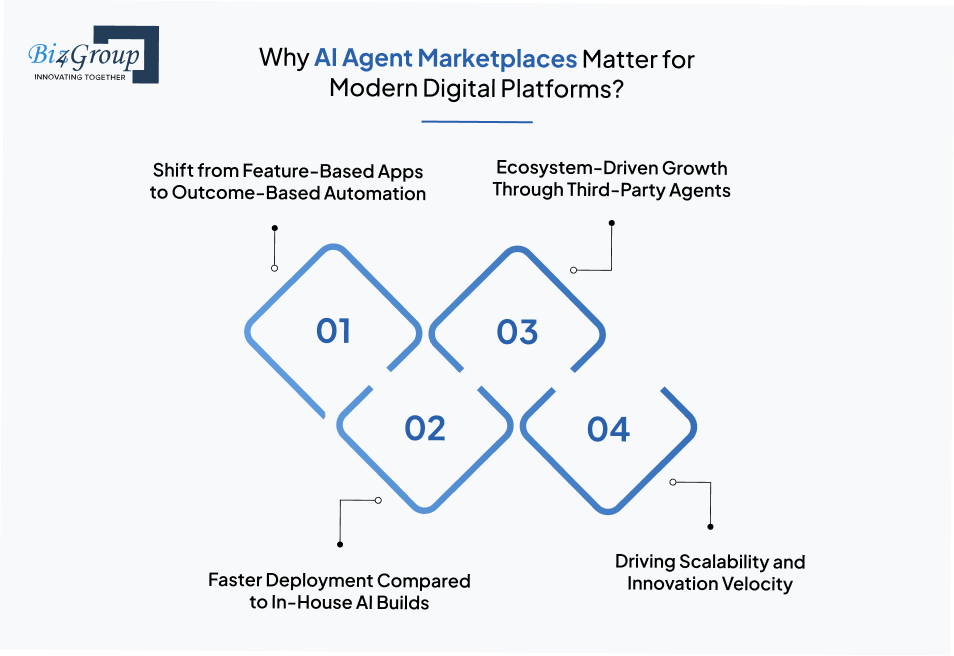
AI agent marketplaces are changing how modern digital platforms deliver AI automation. As more agents are used across workflows, platforms need a structured way to manage how tasks are completed. Without this structure, execution becomes difficult to control and scale. This is why businesses are shifting toward marketplace models that support faster deployment, outcome-driven automation, and continuous ecosystem growth.
Traditional platforms focus on adding more features over time. That approach often leads to complexity without improving results. AI agent marketplaces change this by focusing on outcomes. Instead of using multiple automation tools, you rely on agents that complete tasks from start to finish. This makes automation more direct and easier to manage.
Building AI systems internally takes time, resources, and constant iteration. With an AI agent marketplace development, businesses can provide access to ready-to-use agents and enable faster deployment across workflows. This reduces delays and helps teams move forward without long development cycles.
A marketplace model allows external developers to publish specialized agents that solve very specific problems. This means your platform does not depend only on internal teams for new capabilities. Each new agent adds a focused function that can be used immediately without rebuilding existing systems. Over time, this creates a structured ecosystem where capabilities grow in depth, not just in number.
Scaling a platform is no longer about adding more features to a single system. It is about adding new agents that can be used independently or combined when needed. This approach keeps the core platform stable while allowing continuous expansion. AI agents marketplace development makes it easier to introduce new capabilities without disrupting what is already working.
Instead of expanding a single system repeatedly, this model allows platforms to grow through smaller, focused additions. It creates a more flexible structure where progress happens without slowing down existing operations.
Also Read: AI Agent Ideas to Automate Your Business
These platforms show how different directions are being taken in practice. This range helps clarify what works when defining the best approach to develop AI agents marketplace platform strategies across different business environments.
Let's structure how your agents actually execute across workflows and systems
Talk to Our ExpertsBuilding a scalable AI agents marketplace requires more than just listing agents. It requires a modular and distributed architecture that can support a large number of agents and continuous execution across systems. The platform must handle real-time interactions and dynamic workloads across multiple users without breaking execution flow.
At a high level, the architecture is divided into multiple interconnected layers. Each layer is responsible for a specific function within the ecosystem. This structure keeps responsibilities clear and allows the platform to scale without constant restructuring.
This is where the actual work happens. AI agents are responsible for executing tasks based on defined inputs and goals.
This layer manages how work moves across agents. It ensures tasks are assigned correctly and completed in the right order.
This layer organizes how agents are made available and selected. It ensures that the right agent can be used at the right time.
This layer connects agents with real business environments, so tasks can be executed using actual data.
Complex tasks often require more than one agent working together. The platform allows agents to interact and pass tasks when needed.
A well-structured platform keeps execution smooth while allowing continuous expansion. This is what makes AI agents marketplace practical for long-term scale and helps you develop scalable AI agent marketplace platform capabilities without adding complexity.
Different stakeholders interact with an AI agent marketplace in different ways, depending on their goals. The value is not limited to one group. It spreads across businesses, developers, and users who rely on automation in daily operations.
An AI agents marketplace does not serve a single role. It connects different participants in a way that keeps the platform active, useful, and continuously evolving.
Different platforms are already defining how AI agents are structured, accessed, and positioned across real-world environments. Each AI agent marketplace mentioned below reflects a distinct direction, which helps you see how these are evolving in practice.
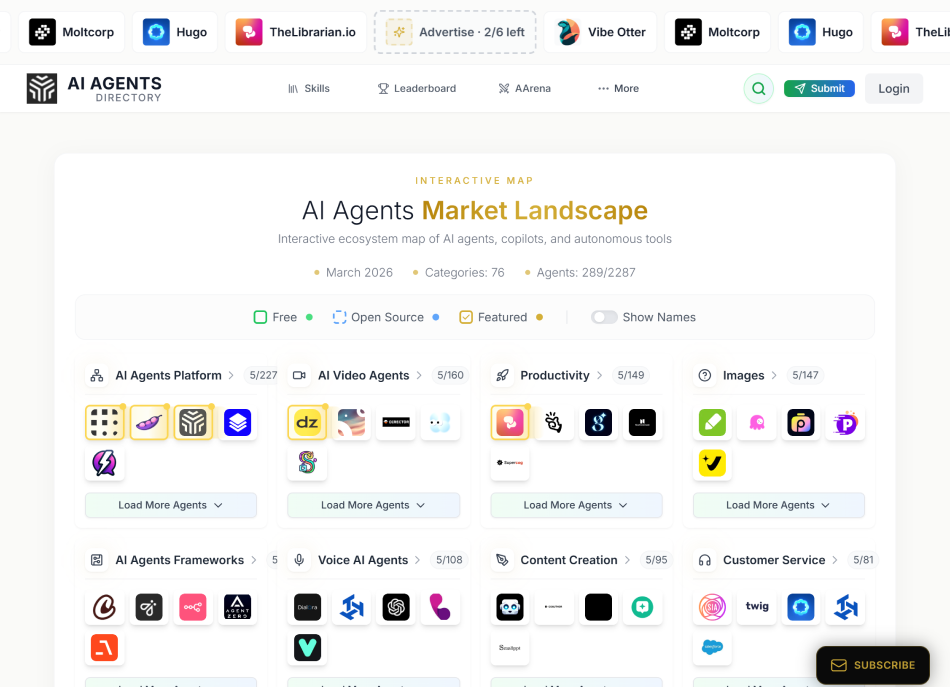
AI Agents Directory acts as a centralized listing platform where a wide range of agents are organized for easy access. It focuses on making agents discoverable across multiple categories without limiting them to a single domain.
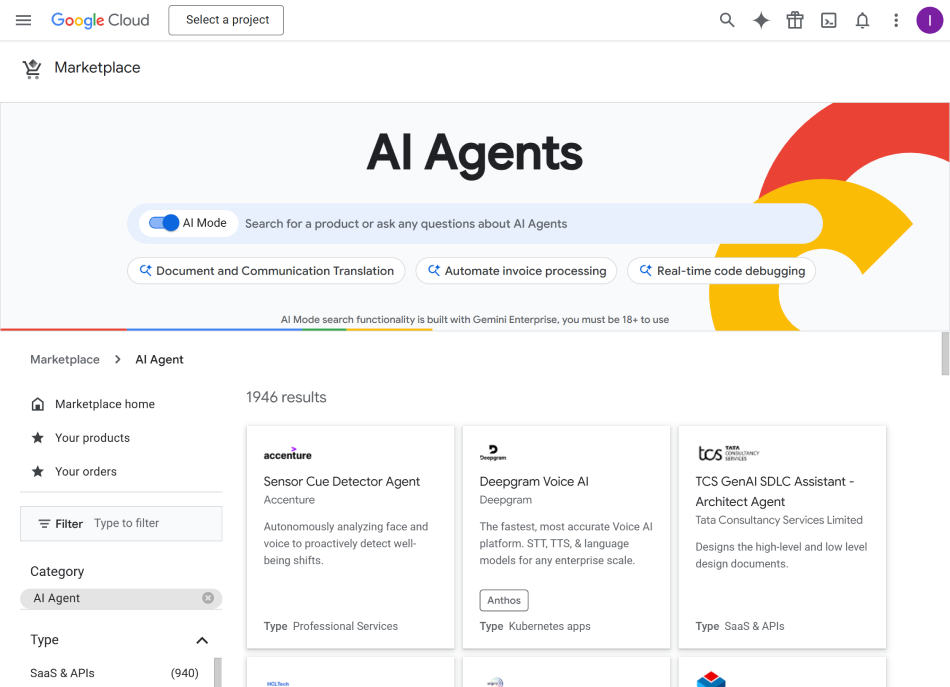
Google’s marketplace is integrated within its cloud ecosystem, offering access to AI-driven solutions aligned with its services. It is designed for users already working within Google’s environment.
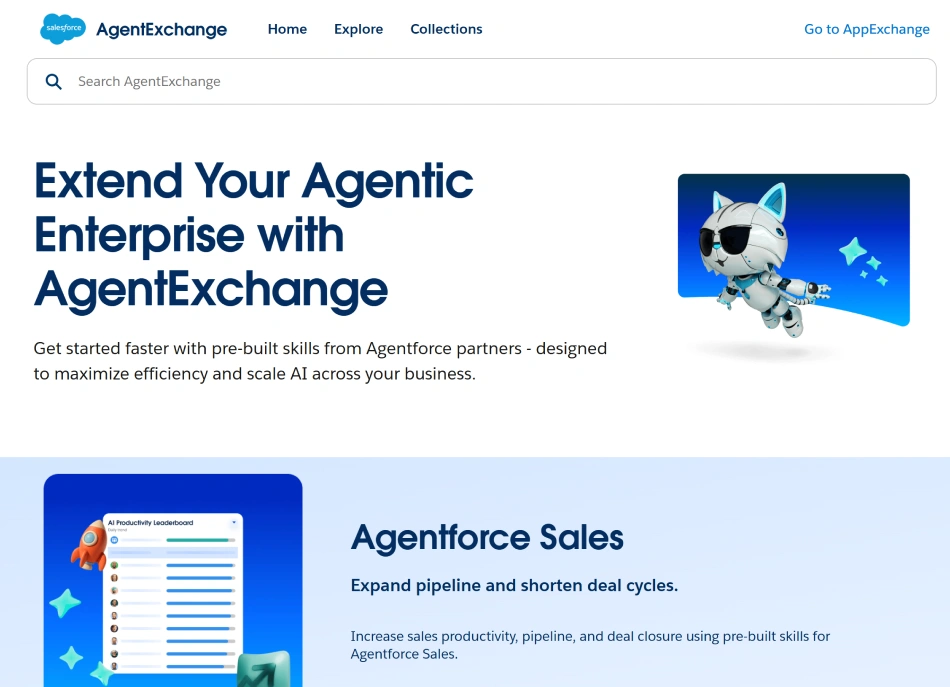
AgentExchange is built around business workflows connected to CRM and operational systems. It supports structured task execution within enterprise environments.
Also Read: Artificial Intelligence in CRM
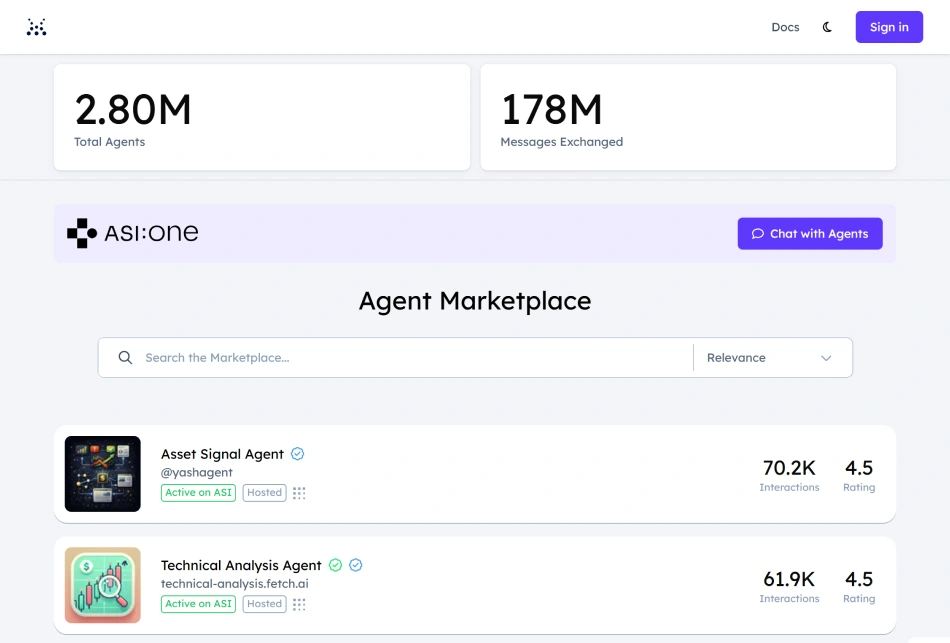
AgentVerse supports a more flexible and open ecosystem where agents can interact and operate with a higher level of independence. It reflects a different direction in how agents are structured.
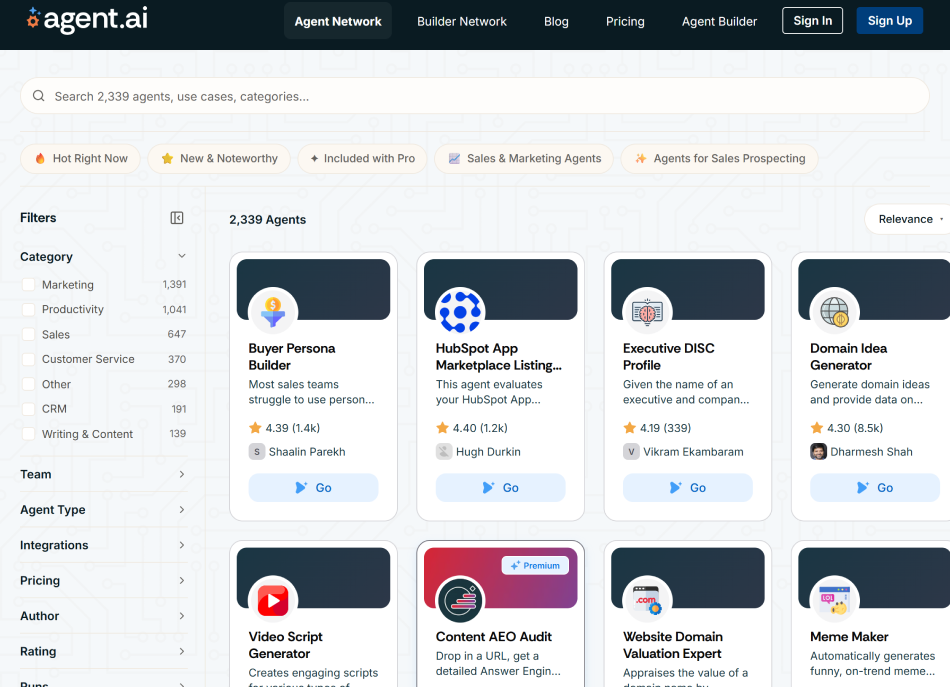
AgentAI is integrated within HubSpot’s platform, focusing on business functions related to marketing and customer engagement. It keeps agents aligned with existing workflows.
These platforms show how different directions are being taken in practice. This range helps clarify what works when defining the best approach to develop AI agents marketplace platform strategies across different business environments.
These platforms show how different directions are being taken in practice. This range helps clarify what works when defining the best approach to develop AI agents marketplace platform strategies across different business environments.
Let's map what your marketplace should actually look like for your product
Start the ConversationA well-structured platform depends on clearly defined features that keep agent access, execution, and control organized. Each feature should support how agents are discovered, managed, and used without adding unnecessary complexity.
These features define how the platform operates on a day-to-day level. A well-structured setup keeps agent usage organized, controlled, and easy to scale, which is essential to develop enterprise AI agents marketplace platform.
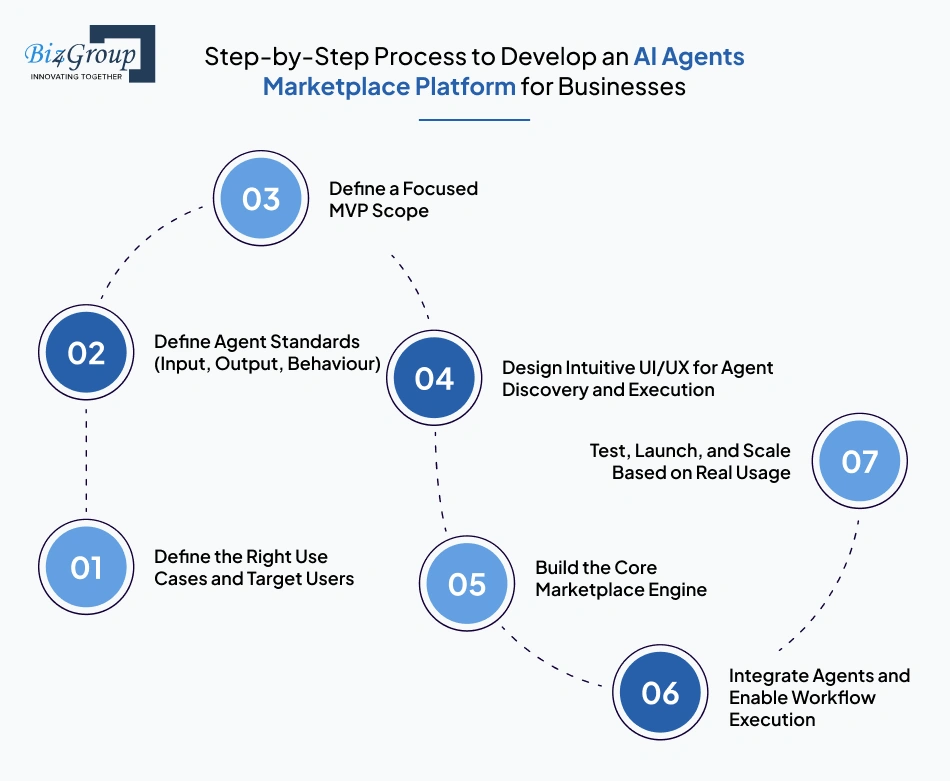
A structured roadmap keeps execution clear and prevents unnecessary rework as the platform evolves. The process to develop enterprise AI agents marketplace platform capabilities depends on defining each step with clarity and keeping scope controlled from the start.
Also Read: Top MVP Development Companies in USA
Also Read: Top UI/UX Design Companies in USA
A clear execution roadmap reduces confusion and keeps development aligned with real needs. This approach supports enterprise AI agents marketplace development for technology companies that want to scale without disrupting existing workflows.
A well-defined stack ensures that each part of the platform handles a clear responsibility. This becomes critical in AI agents marketplace development where agents, workflows, and data must work together without breaking execution flow.
|
Architecture Layer |
Recommended Technology |
Purpose |
|---|---|---|
|
Frontend Layer |
Handles user interaction, agent discovery, and execution flow while keeping navigation fast and easy to understand |
|
|
Backend Layer |
Node.js / Python (FastAPI) |
Manages APIs, user requests, and coordination between agents, workflows, and external systems |
|
API Gateway Layer |
AWS API Gateway / Kong |
Controls incoming requests, routes them to correct services, and ensures secure and stable communication across the platform |
|
Agent Execution Layer |
Python (Celery, async workers) |
Runs agent tasks in isolated environments, manages background jobs, and ensures reliable execution without blocking other processes |
|
Orchestration Layer |
LangChain / AutoGen |
Controls how agents interact, manages task sequencing, and enables multi-step workflows across multiple agents |
|
AI Model Layer |
Powers agent intelligence through natural language understanding and response generation |
|
|
Agent Memory Layer |
Redis / Vector DB |
Stores short-term and long-term context so agents can maintain continuity across tasks and interactions |
|
Model Management Layer |
MLflow / Weights & Biases |
Tracks model versions, manages updates, and ensures consistency when models are improved or replaced |
|
Integration Layer |
REST APIs / Webhooks |
Connects agents with CRM, ERP, and other business systems so they can perform real actions using live data |
|
Database Layer |
PostgreSQL |
Stores structured data such as users, agent configurations, transactions, and system settings |
|
Vector Database |
Pinecone / Weaviate |
Stores embeddings for semantic search and context retrieval to improve agent response relevance |
|
Messaging & Queue Layer |
Redis / RabbitMQ |
Manages task distribution, queues agent execution, and supports multiple agents running at the same time |
|
Authentication Layer |
OAuth 2.0 / JWT |
Secures platform access, manages user roles, and ensures controlled usage of agents |
|
Monitoring & Evaluation Layer |
Prometheus / Langfuse |
Tracks performance, monitors agent outputs, and evaluates response quality over time |
|
Cloud Infrastructure |
AWS / Azure / GCP |
Provides scalable compute, storage, and deployment environment to support growing workloads |
This stack ensures that agents can execute tasks, interact with systems, and maintain context without disrupting workflows. It creates a strong foundation to make AI agents marketplace for enterprises that need both stability and flexibility.
This stack ensures that agents can execute tasks, interact with systems, and maintain context without disrupting workflows. It creates a strong foundation to make AI agents marketplace for enterprises that need both stability and flexibility.
We help translate stack decisions into real working platforms without overcomplication
Discuss Your Platform Plan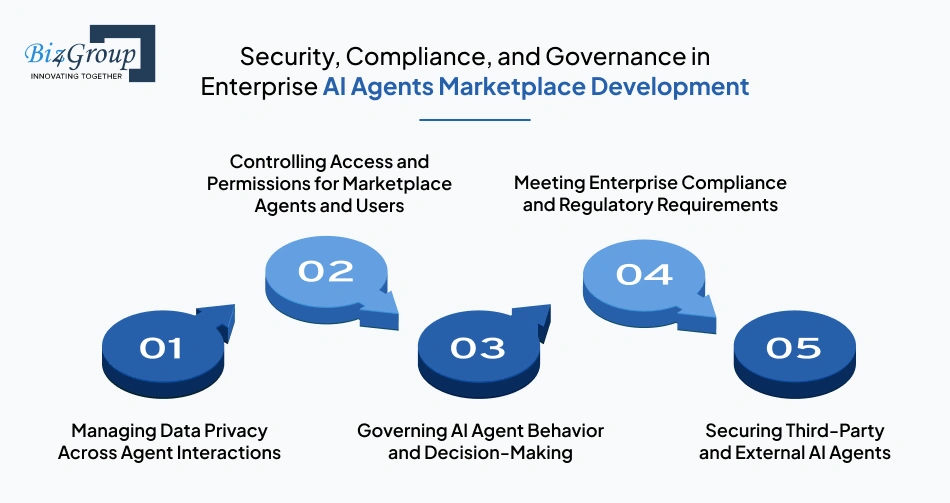
AI agents operate across systems, data, and workflows without constant human control. This creates a need for clear boundaries and oversight. Without governance, agents can act inconsistently or access unintended data. Strong controls help maintain reliability, especially when platforms scale and involve multiple participants.
AI Agents often interact with sensitive business and user data during execution. Data should be accessed only when required and limited to specific tasks. Isolation between agents prevents unnecessary exposure. This becomes essential when you build AI agent marketplace with API integrations across multiple systems and data sources.
Clear access control ensures users and AI agents operate within defined limits. Role-based permissions help restrict who can use, modify, or manage AI agents. Agent-level controls prevent misuse or unintended actions. This structure becomes important when SaaS companies make AI agents marketplace for business automation across different teams.
AI agents should follow defined rules for how they respond and make decisions. Monitoring and logging help track behavior across workflows. Human oversight can be applied where needed to maintain control. This is especially relevant during AI model integration, where consistency and predictability must be maintained.
Enterprise environments require alignment with standards such as GDPR, SOC2, or should be HIPAA compliant based on industry needs. These frameworks guide how data is handled and stored. Compliance readiness helps ensure that AI agents for business leaders can operate within regulated environments without creating additional risk.
Also Read: HIPAA Compliant AI App Development for Healthcare Providers
External agents introduce additional uncertainty if not properly controlled. Each AI agent should be validated before using and restricted within defined limits. Continuous monitoring helps ensure they behave as expected. This approach is critical when businesses make an AI agents marketplace for automation solutions with external contributions.
A structured governance approach ensures AI agents operate within clear limits while maintaining consistency across workflows. This becomes essential in AI agents marketplace development, where multiple agents, users, and systems interact and require controlled execution without increasing operational risk.
The overall cost to develop an AI agents marketplace platform usually falls between $40,000 and $250,000+, depending on scope, complexity, and level of automation. Early-stage platforms stay focused, while enterprise systems require deeper integration and structured execution.
|
Development Level |
Estimated Cost Range |
Scope |
|---|---|---|
|
MVP Level AI Agent Marketplace |
$40,000 – $80,000 |
Covers basic agent listing, execution, and limited workflows to validate platform direction |
|
Mid-Level AI Agent Marketplace |
$80,000 – $150,000 |
Includes multi-agent workflows, integrations, and improved control over execution |
|
Advanced Level AI Agent Marketplace |
$150,000 – $250,000+ |
Supports enterprise-grade scalability, complex workflows, and structured governance |
The total cost is shaped by how your platform handles agents, workflows, and real system interactions. Each decision around execution depth and control directly changes development effort and long-term complexity.
A controlled scope with clear execution boundaries keeps development predictable. This becomes critical when you create scalable AI agents marketplace for enterprises without expanding effort beyond what is actually required.
A controlled scope with clear execution boundaries keeps development predictable. This becomes critical when you create scalable AI agents marketplace for enterprises without expanding effort beyond what is actually required.
Let's break down your exact scope so you avoid overbuilding or underplanning
Get Cost Clarity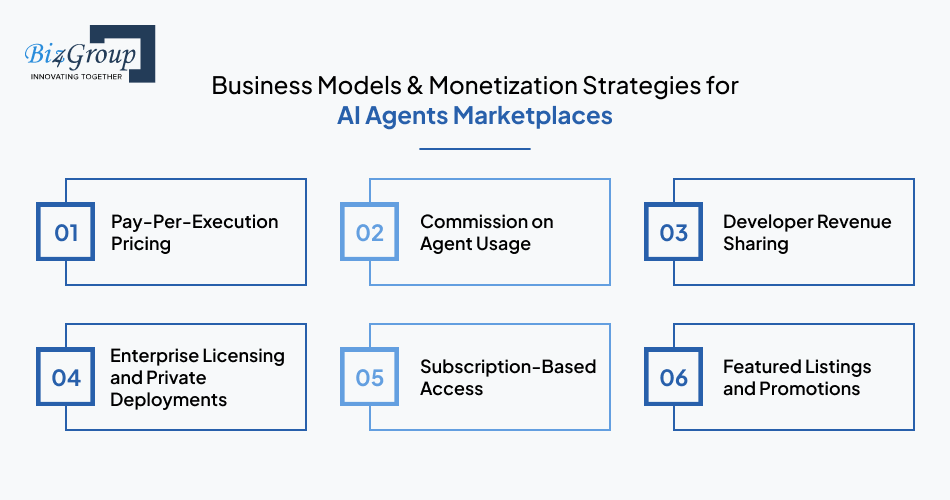
Revenue in an AI agents marketplace does not rely on a single pricing model. It evolves through multiple streams that align with usage, platform access, and enterprise demand. This becomes critical during AI agents marketplace development, where monetization directly impacts scalability.
This model charges users based on how often an agent runs or completes a task. It aligns cost directly with value delivered, making it practical for automation-heavy environments.
The platform earns a percentage whenever an agent is used or subscribed to. This creates a direct link between marketplace activity and revenue generation without requiring fixed pricing commitments.
Developers earn a share of revenue generated by their agents. This model encourages continuous contribution and improves overall marketplace quality over time.
Organizations can license the platform for internal use with controlled access. This model supports enterprise-specific requirements and private environments.
Users pay a recurring fee to access the platform and its capabilities. This model provides predictable revenue while supporting teams that create AI agents marketplace with subscription model aligned to user access patterns.
Developers can pay to improve visibility of their agents within the marketplace. This model supports discovery while creating an additional revenue stream for the platform.
To understand the earning potential, consider a simple year-two scenario where the platform has gained steady users and active agents.
In this scenario, total yearly revenue can reach around $4M to $4.5M by year two.
From an ROI point of view, the initial investment in building the AI agents marketplace typically ranges between $40,000 and $250,000+. With consistent usage and early enterprise adoption, many platforms recover this cost within 12 to 18 months.
As more users and AI agents join, revenue grows faster than costs. The platform does not need to spend equally more to support each new user, which improves margins over time.
A strong marketplace does not depend on one income source. It combines usage revenue, subscriptions, and enterprise deals to create stable and scalable growth. A well-structured monetization approach balances usage-based revenue with predictable income streams. Combining execution pricing, subscriptions, and enterprise deals helps maintain steady growth while adapting to different user segments and evolving marketplace demand.
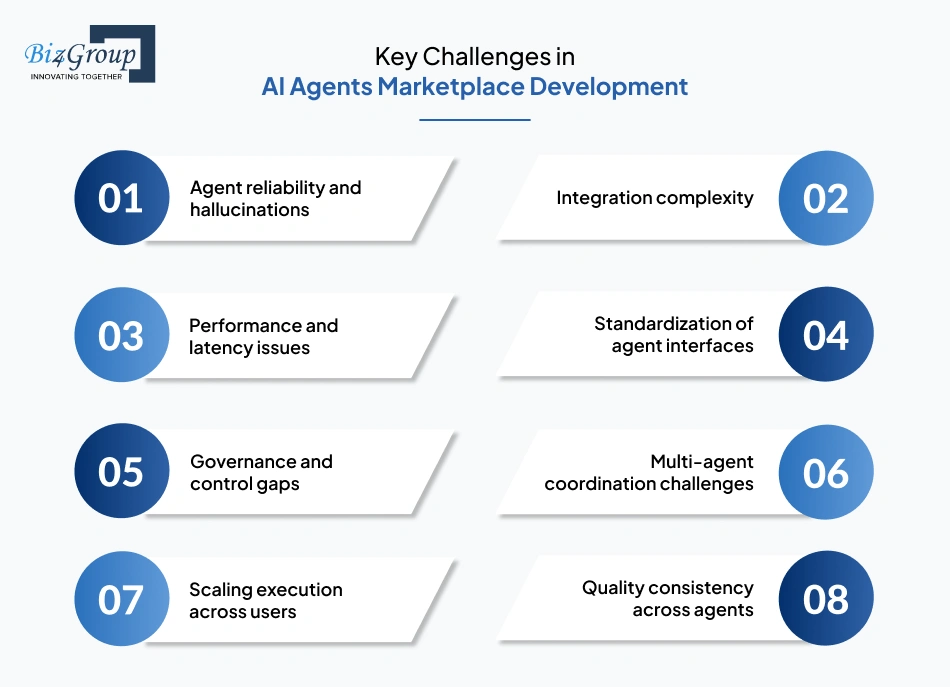
Real-world execution brings practical challenges that go beyond planning. These issues appear when you create AI agent marketplace for automation solutions and start handling real workflows, users, and system interactions at scale.
|
Challenge |
Practical Solution |
|---|---|
|
Agent reliability and hallucinations |
Define clear task boundaries and validate outputs before execution. Add feedback loops to improve response quality and reduce incorrect results over time. |
|
Integration complexity |
Start with limited system connections and expand gradually. Work with an AI development company to standardize how agents interact with external tools and avoid inconsistencies. |
|
Performance and latency issues |
Optimize execution flow by reducing unnecessary steps. Prioritize faster response handling for time-sensitive tasks to maintain smooth operations. |
|
Standardization of agent interfaces |
Define consistent input and output formats for all agents. This keeps interactions predictable when multiple agents operate within the same workflow. |
|
Governance and control gaps |
Establish clear rules for how agents operate and interact. Maintain visibility into actions without disrupting execution flow. |
|
Multi-agent coordination challenges |
Limit dependencies between agents in early stages. Introduce coordinated workflows gradually once execution patterns become stable. |
|
Scaling execution across users |
Expand usage in controlled phases. Monitor performance and adjust execution flow as demand increases. |
|
Quality consistency across agents |
Set baseline performance standards for all agents. Continuously review outputs to maintain reliability across different tasks. |
Addressing these challenges early helps teams build AI software that remains stable as usage grows. This ensures AI agent marketplace development stays controlled and scalable without introducing unnecessary execution risks.
Clear measurement helps you understand how agents perform in real workflows and how the platform evolves over time. Tracking the right metrics ensures AI agents marketplace development stays aligned with actual usage and execution quality.
These metrics provide a clear view of how the platform performs beyond initial launch. This helps teams build AI agents marketplace for businesses that remain stable, usable, and aligned with real operational needs.
These metrics provide a clear view of how the platform performs beyond initial launch. This helps teams build AI agents marketplace for businesses that remain stable, usable, and aligned with real operational needs.
We align your platform with metrics that actually reflect execution quality
Align Your StrategyThe next phase of AI agent marketplaces will move beyond simple access to agents and focus on how they operate together. The shift will center on coordination, specialization, and independent execution across evolving business environments.
Future marketplaces will move toward structured collaboration where groups of agents work as coordinated units. Instead of fixed workflows, agents will dynamically share tasks based on context, allowing each AI model to contribute to different stages of execution.
Workflows will evolve into self-driven systems where agents initiate and complete processes without manual triggers. These systems will adapt continuously, becoming a core layer in enterprise AI solutions that operate with minimal human oversight.
AI agent marketplaces will become more focused on specific industries with agents aligned to domain requirements. This shift will influence how businesses develop AI agents marketplace platform strategies around specialized workflows and regulatory expectations.
AI agents will begin interacting directly with other agents to exchange data and complete tasks. These interactions will move beyond execution, enabling independent decision-making between agents without requiring user involvement.
The future will focus on how agents coordinate and operate independently rather than how they are accessed. This shift will push businesses to rethink AI agent marketplace development as a long-term operational layer rather than a distribution platform.
At Biz4Group LLC, we approach AI agents marketplace development with a strong focus on how your product and workflows actually operate. As an AI agent development company, we work closely with your team to understand where agents fit naturally, so the platform grows around real usage instead of assumptions.
Our experience comes from building AI-driven platforms and automation systems that integrate into existing business environments. We focus on keeping execution practical, so agents work within your current setup without creating friction or forcing major changes. This hands-on execution has placed us among top AI development companies in Florida that focus on practical delivery rather than experimental builds.
We emphasize customization, scalability, and integration clarity at every stage. This helps ensure the platform can expand as usage grows while keeping workflows stable. When teams plan to hire AI developers for long-term ownership, we support that transition, so the platform remains consistent and maintainable.
Our AI agents marketplace development services are designed to stay aligned with business needs as they evolve, especially when you aim to develop an AI agents marketplace platform for businesses without overcomplicating the system.
AI agent marketplaces are quickly becoming a practical way to organize and scale automation across business workflows. Instead of managing isolated tools, you get a structured system where tasks are handled more efficiently. This shift is why many teams now work with an AI product development company to move forward with clarity.
As platforms evolve, the focus will move toward more coordinated and independent agent execution. This makes it important to plan AI agents marketplace development with a long-term view, especially if you aim to build an AI agents marketplace for SaaS companies that can grow without constant restructuring.
At Biz4Group LLC, we keep the approach grounded in real execution. If you are exploring this direction, it may be worth taking a moment to discuss with us how it fits into your current product strategy.
Agent onboarding should follow defined input, output, and behavior standards. Without this, each agent behaves differently, which breaks workflow consistency. A structured onboarding process ensures every new agent fits into existing execution patterns without rework.
Most teams try to support too many use cases early. This leads to unclear workflows and unstable execution. A focused approach with limited agents and controlled workflows helps maintain clarity and avoids unnecessary complexity.
Quality depends on continuous validation and feedback. Agents should be monitored based on task completion consistency, not just outputs. Regular review cycles help maintain reliability as more agents are added.
Start with clearly defined task boundaries. Each agent should handle a specific responsibility. Avoid chaining too many agents together early, as this increases failure points and makes execution harder to manage.
The cost usually ranges between $40,000 and $250,000+, depending on workflow complexity, number of agents, and integration depth. A focused MVP remains on the lower end, while enterprise-grade platforms require higher investment.
The decision depends on how often workflows repeat and how many systems are involved. If multiple tools are required to complete tasks, a marketplace approach helps centralize execution instead of extending existing systems further.

with Biz4Group today!
Our website require some cookies to function properly. Read our privacy policy to know more.