Location :
Orlando, FL, USA
Location :
Orlando, FL, USA +1 (407) 714-1616
 info@biz4group.com


















Imagine a digital system that doesn’t wait for instructions but instead, understands your business goals, learns from real-time feedback, and takes independent actions to get the job done.
Read More

If you’ve ever tried to build a fitness product that sticks with users, you know that tracking calories isn’t just a feature; it’s a core habit maker. But traditional calorie counting is tedious for users and often inaccurate. That’s why AI calorie tracker app development is becoming a strategic must-have for fitness startups that want real engagement and long-term growth.
Here’s the reality on the ground right now:
The shift is part of a broader move toward AI automation services, where fitness platforms use intelligence to eliminate manual effort, personalize experiences, and scale user engagement without increasing operational overhead.
Now, think about this from a founder’s perspective: more people are willing to track what they eat, but they quickly abandon apps that demand constant effort. What fitness leaders need today is not another calorie counter. They need to develop intelligent calorie tracking systems that:
In this guide, we walk you through why AI calorie tracker app development isn’t a luxury anymore when built with the support from an AI fitness app development company in the USA . It becomes a practical way to build products that users rely on, and businesses can scale
Let’s dive in.
An AI calorie tracker app is a fitness application that uses artificial intelligence to simplify how users log food, track calories, and understand nutrition patterns. Instead of relying only on manual entry, these apps analyze food inputs using data models, AI automation, and pattern recognition to deliver more accurate and personalized results. For fitness startups, AI calorie tracker app development is helping products feel supportive and intuitive. Teams build AI powered calorie tracker apps that reduce effort, personalize guidance, and scale smoothly.
This combination allows startups to create calorie tracking experiences that feel intuitive, adaptive, and easy to use for everyday users.
Also Read: How to Develop an AI Nutrition App: Steps, Cost & Features
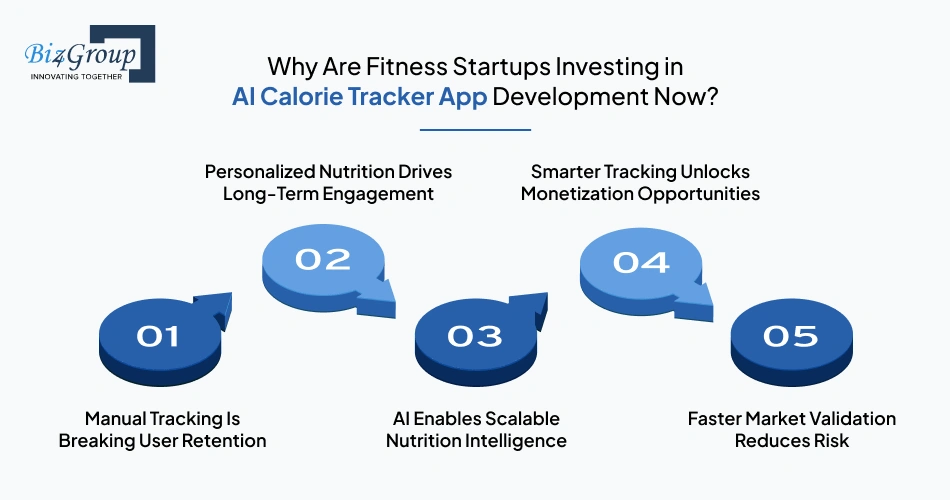
Fitness startups are investing in AI calorie tracking for one simple reason: traditional calorie logging no longer supports growth. Users expect AI apps to reduce effort, adapt to behavior, and deliver insights automatically. AI calorie tracker app development helps startups meet these expectations while improving retention, scalability, and monetization without increasing operational complexity.
Startups are investing in AI calorie tracker app development because manual logging no longer supports consistent usage. High drop-off rates signal that traditional input-heavy tracking AI models fail early. AI-driven automation reduces dependency on user effort, making the product viable for long-term adoption and growth.
Fixed calorie goals and rule-based plans no longer differentiate fitness products. Startups are investing in AI because AI health tracking app development enables adaptive nutrition logic based on real user behavior, making sustained engagement and competitive positioning possible.
Hiring dietitians or support teams does not scale. AI allows startups to deliver consistent calorie insights to thousands of users simultaneously, following the same principles used in AI business app development to automate intelligence without increasing human overhead.
AI-driven calorie insights support premium subscriptions, personalized plans, and partner integrations. Startups that develop scalable AI calorie tracking app solutions can monetize insights rather than just features, creating predictable recurring revenue models.
With proven frameworks to build an AI app, startups can test calorie tracking concepts early, validate accuracy and engagement, and iterate before committing to full-scale development, significantly lowering product and investment risk.
Fitness startups are investing now because AI-powered calorie tracking aligns user expectations with business realities. It reduces friction, improves retention, scales efficiently, and creates monetization paths that traditional calorie apps simply cannot support anymore.
Before adding advanced intelligence or premium experiences, fitness startups need to get the fundamentals right. Strong AI calorie tracker app development starts with features that solve everyday tracking problems reliably and consistently. When teams build AI powered calorie tracking apps for fitness startups, these features form the non-negotiable foundation that supports long-term engagement and scalability.
|
Core Feature |
Why It Matters for Fitness Startups |
|---|---|
|
Automated Food Logging |
Reduces manual entry by allowing users to log meals through text, images, or barcode scans, making daily tracking faster and less frustrating. |
|
Accurate Calorie & Nutrition Estimation |
Ensures calorie counts and macros are reliable enough for users to trust the app for goal tracking and progress decisions. |
|
Personalized Calorie Goals |
Adjusts daily calorie targets based on user goals, activity levels, and habits instead of fixed, generic limits. |
|
Meal & Portion Recognition |
Identifies common foods and portion sizes to improve accuracy without requiring users to weigh or measure everything. |
|
Progress Tracking & Insights |
Shows trends over time so users can understand how eating patterns affect results, not just daily totals. |
|
Behavior-Based Nudges |
Encourages consistency through reminders, streaks, and smart prompts designed using principles from effective AI assistant app design. |
|
Health & Fitness Data Integration |
Connects calorie data with workouts, wearables, and activity metrics, a capability commonly expected in modern AI fitness software development platforms |
|
Scalable Backend Architecture |
Supports growing user bases and data volume, which is essential when teams validate core calorie tracking features early and scale them responsibly through a structured MVP-first wellness platform approach |
Startups that focus on these essentials are better positioned to develop AI calorie tracker app for long-term user engagement without over-engineering early versions. Strong fundamentals also make it easier to evolve into advanced personalization, monetization, and analytics later.
Once the core foundation is in place, differentiation comes from how intelligently the app responds to users over time. Advanced capabilities are what separates a basic tracking tool from an AI product that users depend daily.
In AI calorie tracker app development, these features are not about adding novelty; they are about creating deeper personalization, smarter interactions, and long-term value.
|
Advanced Feature |
How It Differentiates the App |
|---|---|
|
Context-Aware Nutrition Recommendations |
Adjusts calories and meal suggestions based on time of day, workout intensity, previous meals, and user behavior instead of static rules. |
|
Predictive Eating Insights |
Anticipates likely food choices and calorie intake patterns by analyzing historical behavior and trends using predictive analytics, helping users plan meals instead of reacting after logging. |
|
Adaptive Portion Learning |
Learns individual portion habits over time, improving accuracy without repeated inputs. |
|
Conversational Nutrition Guidance |
Enables interactive calorie guidance through chat-style interactions, often supported by intelligent AI chatbot integration. |
|
Dynamic Goal Adjustment |
Automatically recalibrates calorie targets based on progress trends, plateaus, or lifestyle changes. |
|
Personalized Habit Scoring |
Translates calorie consistency into easy-to-understand scores that motivate behavioral change beyond raw numbers. |
|
Cross-Platform Nutrition Intelligence |
Applies calorie insights consistently across mobile apps, wearables, and connected fitness platforms through robust AI integration services and cross platform app development. |
|
Premium Personalization Layers |
Supports advanced subscription features such as personalized meal strategies or adaptive nutrition plans, a common focus in custom AI calorie tracker app development. |
Advanced features are where fitness startups move from utility to differentiation. They help teams develop AI calorie tracking applications that feel proactive, personal, and intelligent rather than reactive. For startups evaluating AI calorie tracker app development services, investing in the right advanced features early can define whether the product blends in or stands out in an increasingly crowded fitness app market.
Also Read: AI Chatbot Development for Gyms and Fitness Trainers
Advanced AI features only matter when they improve accuracy, reduce friction, and support real user habits.
Review Feature StrategyThese platforms show how AI calorie tracker app development translates into real, production-ready products. Each app reflects a different approach to solving food logging, accuracy, and long-term engagement using AI where it improves user experience. For founders looking to create AI calorie counting apps or evaluate what “good” looks like in the market, these examples highlight how core and advanced capabilities come together in practice.
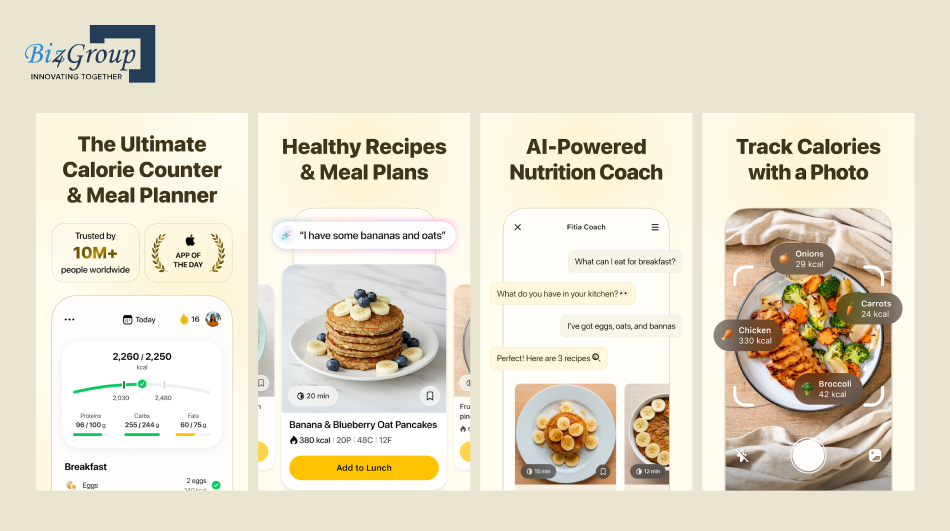
Fitia focuses on structured, goal-driven nutrition tracking with a strong emphasis on macronutrient balance. Its experience is built around making calorie tracking feel purposeful rather than overwhelming.
Fitia demonstrates how teams can develop AI calorie tracking applications that stay focused on measurable outcomes instead of feature overload.
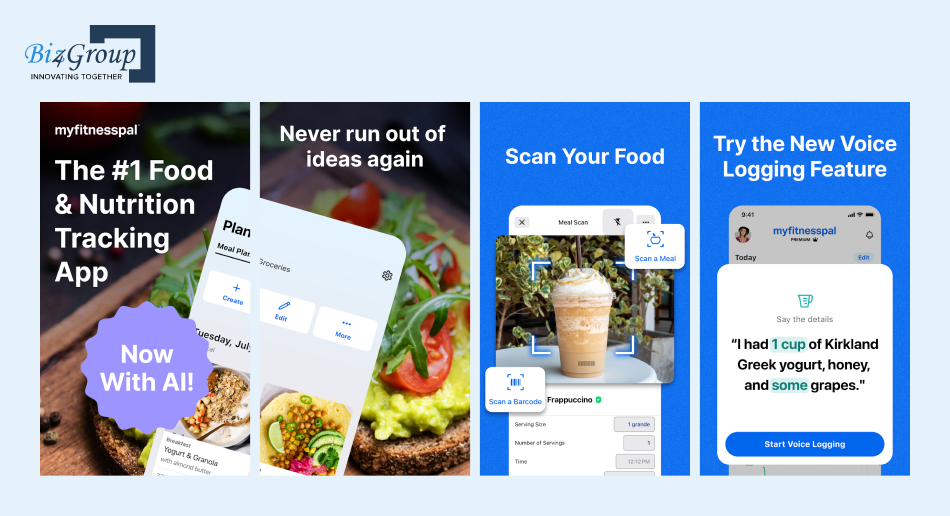
MyFitnessPal is one of the most mature calories tracking platforms, known for refining food logging at scale. Its evolution shows how long-term data can improve accuracy and usability.
It’s a strong reference point for startups planning custom AI calorie tracker app development with long-term data intelligence in mind.
Also Read: Develop a Fitness App like MyfitnessPal
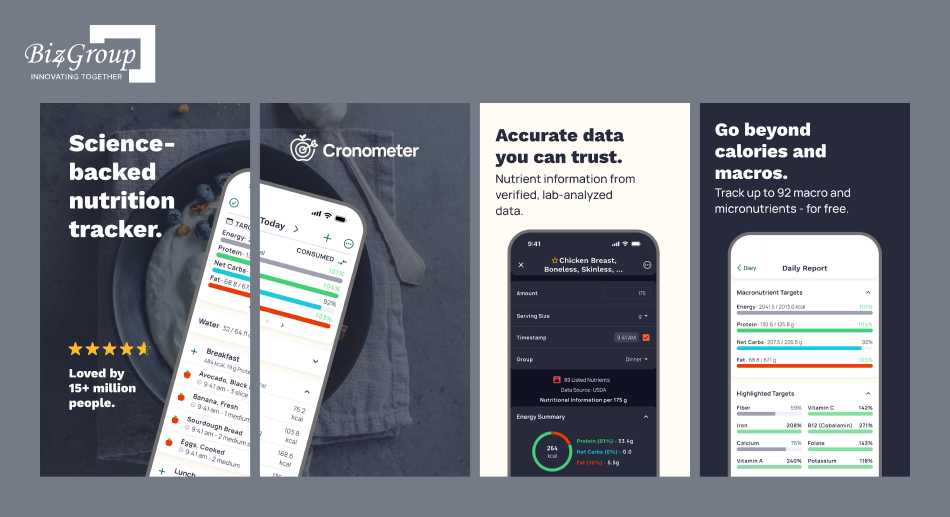
Cronometer is built for users who care deeply about nutrition precision. It goes beyond calories to deliver micronutrient-level insights.
Cronometer shows how to create AI driven food and calorie tracking apps that appeal to users seeking depth and trust in nutrition data.
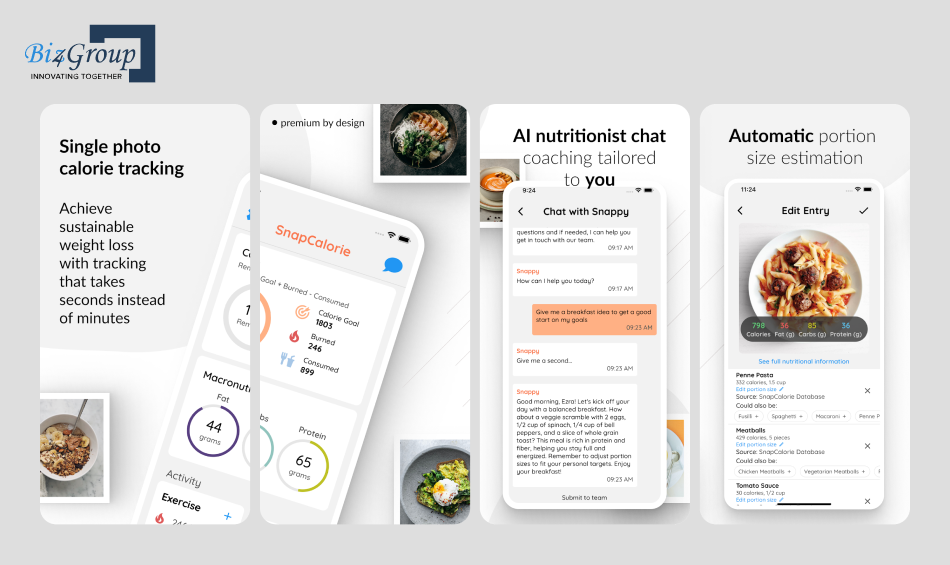
SnapCalorie takes a friction-first approach by minimizing manual input through visual recognition.
This enterprise AI model shows how startups can replace manual logging by building AI-powered calorie tracker apps focused on speed and convenience.
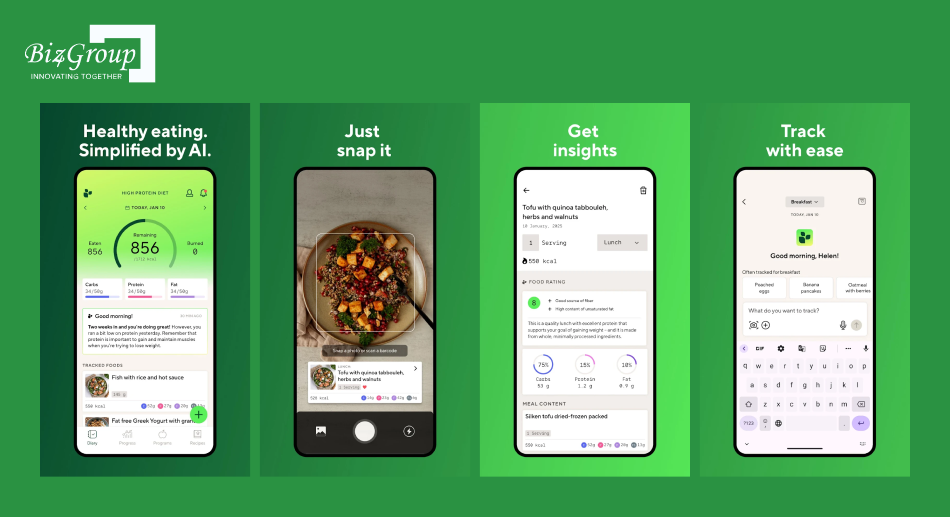
Lifesum blends calorie tracking with lifestyle guidance, focusing on habit formation rather than numbers alone.
Lifesum illustrates how calorie tracking becomes more effective when paired with lifestyle context.
Together, these platforms reinforce a clear pattern: successful calorie tracking apps don’t rely on raw data alone. They combine accuracy, AI automation, and personalization to create experiences users return to daily. For fitness startups evaluating AI calorie tracker app solutions, these examples provide practical benchmarks for building products that scale, engage, and endure.
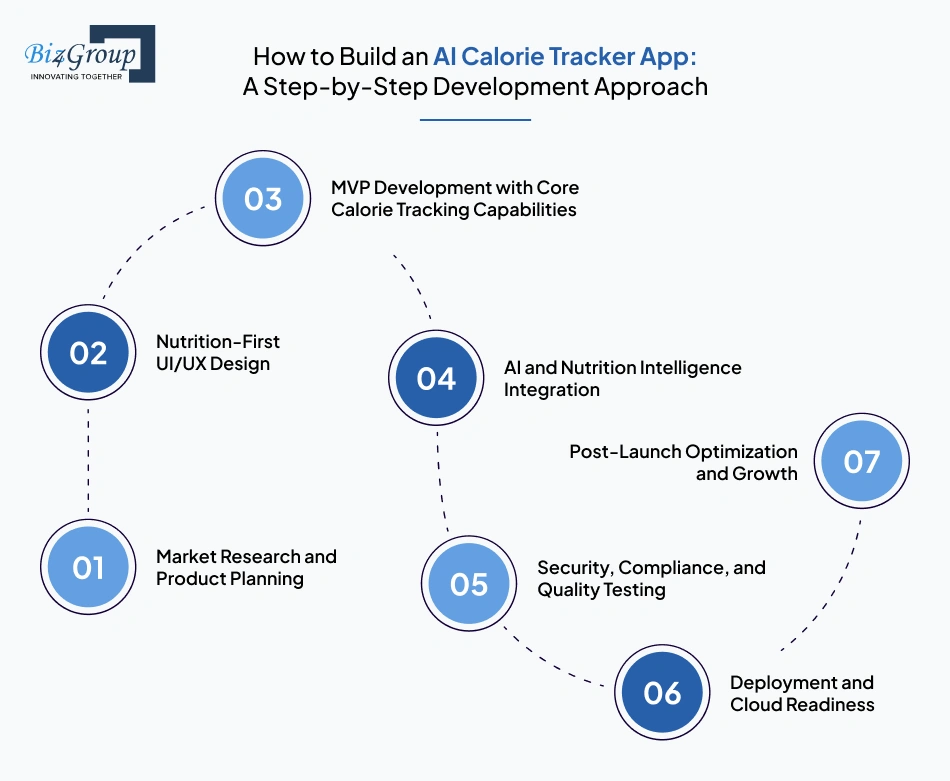
Developing an AI calorie tracker app is not about assembling features quickly. It requires a disciplined, step-by-step approach focused on food logging behavior, calorie accuracy, and habit consistency.
This roadmap reflects how experienced mobile app development services execute AI calorie tracker app development with clarity, precision, and long-term product stability in mind. AI calorie tracker app development with clarity, precision, and long-term product stability in mind.
AI calorie tracking must reflect how people actually eat, log, and quit tracking. This phase focuses on understanding real food logging behavior rather than ideal nutrition plans.
This step ensures that the app is designed around real calorie tracking behavior, not assumptions.
A calorie tracker succeeds only when logging feels effortless. This phase focuses on reducing the effort required to log food while keeping calorie insights clear and actionable. A specialized UI/UX design company approaches calorie tracking through behavior science, ensuring users can log meals quickly without cognitive overload.
Good UI/UX design directly impacts whether users log meals daily or abandon the app.
Also read: Top 15 UI/UX Design Companies in USA
The MVP validates whether users consistently log meals, not whether the app feels advanced. This phase focuses on building only what is required to test daily calorie tracking behavior. Teams using MVP development services prioritize accuracy and reliability over feature volume.
This step helps teams validate the calorie tracking experience before scaling.
Also read: Top 12+ MVP Development Companies to Launch Your Startup
AI is introduced only after basic tracking behavior is validated. This phase focuses on improving calorie accuracy and reducing manual effort using real food data. Many teams rely on generative AI app development to enhance food recognition and adaptive calorie estimation without increasing user input.
This step turns basic tracking into intelligent calorie assistance.
Calorie tracking apps handle sensitive health and nutrition data. This phase ensures accuracy, reliability, and data protection before launch. Many teams work with an external software testing company to validate real-world usage scenarios.
Trust is built when users see consistent, reliable tracking.
AI calorie tracker apps experience usage spikes driven by lifestyle changes and fitness goals. This phase ensures the infrastructure supports growth without affecting tracking performance or data accuracy.
Stable deployment ensures uninterrupted tracking during critical usage periods.
Launch marks the beginning of refinement. This phase focuses on improving calorie tracking accuracy and usability based on real user behavior. Growth decisions are driven by data, not assumptions.
Sustained success depends on continuous improvement, often supported by teams that hire AI developers experienced in nutrition and fitness data systems.
Also Read: How to Hire an AI App Developer in USA for Your Business?
Building an AI calorie tracker app requires discipline at every stage. When each step focuses strictly on calorie tracking behavior, accuracy, and habit formation, the result is a product users trust and rely on daily, not just another fitness app.
Early product and architecture decisions determine whether calorie tracking stays reliable as users and data grow.
Plan Your BuildA scalable calorie tracking product depends on a technology stack that can handle real-time user input, accurate nutrition analysis, and long-term personalization without performance bottlenecks. In AI calorie tracker app development, the stack must support continuous meal logging, intelligent calorie computation, and growing user data volumes.
Many fitness startups work with a custom software development company to architect this balance correctly, ensuring the product remains stable, secure, and adaptable as it evolves.
|
Layer |
Technologies Used |
Role in AI Calorie Tracker App |
|---|---|---|
|
Frontend (Web / App) |
React.js, Next.js |
ReactJS development supports data-heavy calorie dashboards, meal logs, and progress views. NextJS development improves performance and routing for fast, responsive user experiences. |
|
Mobile Layer |
React Native / Native iOS & Android SDKs |
Enables consistent and reliable calorie tracking flows across mobile devices where most food logging occurs. |
|
Backend Services |
Node.js, Python development |
NodeJS development supports real-time meal logging and scalable request handling through API development. Python development powers food recognition, nutrition logic, and personalization workflows. |
|
API Layer |
Express.js, FastAPI |
Handles secure API development for food input, calorie calculations, user data exchange, and integrations with fitness platforms. |
|
Food Recognition Layer |
Image recognition models, food classifiers |
Identifies food items and ingredients from images or inputs, forming the core intelligence behind AI automated calorie tracking. |
|
Portion Estimation Layer |
Computer vision models, statistical estimation |
Estimates portion sizes accurately, which directly impacts calorie precision and user trust in daily tracking. |
|
Nutrition Intelligence Layer |
Nutrition databases, rule-based engines |
Converts recognized foods into calories and macro values using structured nutrition datasets and validation logic. |
|
Personalization Engine |
Behavior modeling, recommendation logic |
Learns user habits over time to adjust calorie goals and insights, enabling adaptive and long-term engagement. |
|
Database |
PostgreSQL, MongoDB |
Stores user profiles, meal history, calorie logs, and personalization data required for long-term tracking and insights. |
|
Caching Layer |
Redis |
Reduces latency and infrastructure cost by caching frequently accessed food and nutrition data, keeping the app fast at scale. |
|
Cloud Infrastructure |
AWS, Azure, GCP |
Provides scalable compute and storage for AI workloads, ensuring reliability as user activity grows. |
|
Security & Access Control |
OAuth 2.0, JWT, API gateways |
Protects sensitive health and nutrition data through secure authentication and controlled access. |
|
DevOps & Deployment |
Docker, Kubernetes |
Enables stable deployments and seamless scaling as calorie tracking usage increases. |
|
Monitoring & Analytics |
Performance and usage monitoring tools |
Tracks system health, accuracy trends, and usage patterns to maintain reliability in production environments. |
This technology stack reflects how production-grade calories, nutrition, and fitness apps are built today. When combined with disciplined full stack development, this architecture allows fitness startups to evolve features, improve accuracy, and scale user engagement without frequent rework or performance bottlenecks.
A scalable calorie tracking product depends on how well the stack supports AI accuracy, performance, and long-term growth.
Review My Tech StackAs calorie tracking apps become more intelligent and data-driven, they also carry greater responsibility. In AI calorie tracker app development, security, privacy, and compliance are foundational decisions that directly impact user trust, platform credibility, and the ability to scale fitness products responsibly.
AI-driven calorie tracking apps handle sensitive food habits and health-related data every day. To build AI powered calorie tracker apps that users trust, teams must implement strong encryption, role-based access control, and secure APIs that protect data as user volume and feature depth increase.
Privacy expectations are rising across fitness and wellness platforms. When teams develop intelligent calorie tracking systems, privacy-by-design practices such as data minimization, transparent consent, and defined retention policies ensure users retain control over how their nutrition data is stored and used.
Calorie tracking apps increasingly operate within regulated wellness and health-adjacent environments. Fitness startups using AI calorie tracker app development services must account for data protection laws, accessibility standards, and audit readiness to avoid compliance risks as they expand into new markets.
Responsible AI use goes beyond infrastructure. Working with an experienced AI development company helps teams define governance practices for data usage, model behavior, logging, and updates, ensuring AI-driven calorie tracking remains predictable, explainable, and compliant as systems evolve.
Security, privacy, and compliance are not obstacles to innovation, rather they are enablers of long-term growth. Startups that treat these areas seriously during AI calorie tracker app development build products users trust, partners support, and regulators approve creating a stronger foundation for scale and sustainability.
Also Read: AI Healthcare App Development
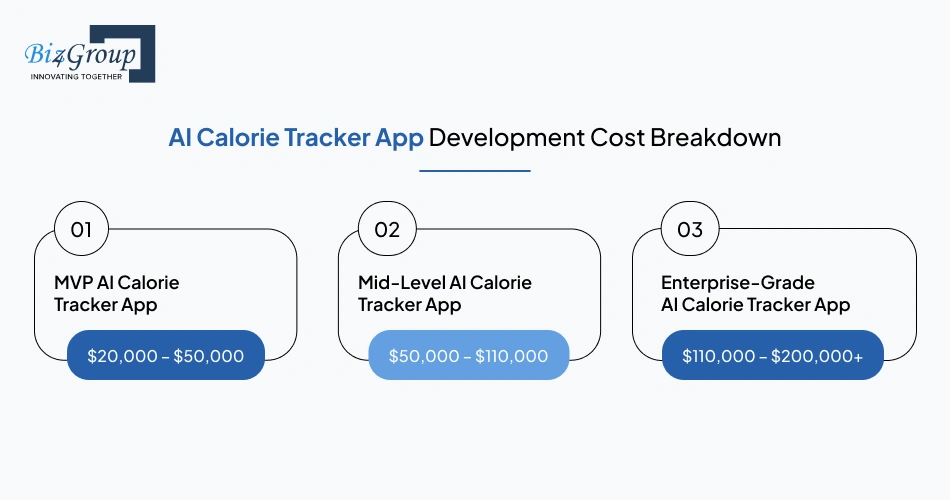
Planning the costs early helps fitness startups make confident product decisions instead of reacting to surprises later. AI calorie tracker app development cost estimate typically falls within $20,000 to $200,000+. It depends on how accurate the tracking needs to be, how personalized the experience is, and how well the product must scale as users grow.
|
App Type |
Estimated Cost Range (USD) |
What It Typically Includes |
|---|---|---|
|
MVP AI Calorie Tracker App |
$20,000 – $50,000 |
Core calorie logging, basic food recognition, pre-trained AI models, limited personalization, simple UI, and essential API integrations to validate the idea quickly. |
|
Mid-Level AI Calorie Tracker App |
$50,000 – $110,000 |
Improved food and portion recognition, personalized calorie goals, behavior-based insights, wearable integration, scalable backend, and refined user experience. |
|
Enterprise-Grade AI Calorie Tracker App |
$110,000 – $200,000+ |
Custom or fine-tuned AI models, advanced personalization, high-scale infrastructure, strong security and compliance layers, analytics, and long-term optimization. |
In simple terms, cost rises with intelligence, scale, and reliability. When planned correctly, investment in AI calorie tracker app development directly supports stronger retention, better user trust, and long-term business value rather than short-term experimentation.
Also Read: AI Fitness App Development Cost
Understanding how accuracy, personalization, and scale affect cost helps teams invest with clarity and confidence.
Get Cost ClarityMonetization works best when it grows naturally from how users experience value. In AI calorie tracker app development, revenue does not come from charging for tracking itself. It comes from charging for better outcomes, deeper personalization, and sustained results by monetizing an AI app.
Below are the most practical monetization models used in AI-powered calorie tracking products today.
Subscriptions remain the strongest model when AI delivers ongoing value. Instead of locking basic tracking, startups monetize personalization. Common subscription drivers include:
Many apps keep tracking free but charge for intelligence. Users pay when insights start influencing results. Premium layers often include:
Some calorie tracking apps monetize based on usage intensity rather than fixed plans. This works well for users who log frequently or rely heavily on AI features. Examples include:
AI calorie tracking apps generate structured nutrition insights that can support partnerships with fitness platforms, wellness programs, or healthcare providers. These partnerships commonly unlock:
Monetization decisions influence architecture, feature prioritization, and long-term scalability. Teams that treat revenue as part of product design not afterthought are better positioned to grow. Many startups work with an experienced AI product development company to align monetization logic with user behavior and technical capabilities.
In AI calorie tracker app development, most challenges surface after launch when real users log imperfect data, expect accuracy, and rely on insights daily. For teams delivering AI calorie tracker app solutions for fitness startups, anticipating these challenges early helps avoid rework, user drop-offs, and credibility issues later. Many of these risks are manageable when the product is designed with the same discipline used to build AI software that must perform reliably in real-world conditions.
|
Challenge |
How to Address It |
|---|---|
|
Inconsistent food input from users |
Design flexible input methods and train models to handle incomplete, varied, or imperfect food descriptions without breaking the experience. |
|
Inaccurate calorie or portion estimation |
Combine AI predictions with nutrition databases and continuous feedback loops to improve accuracy over time. |
|
User trust erosion due to errors |
Provide transparent explanations, editable entries, and gradual learning instead of presenting AI output as infallible. |
|
Scaling AI performance with user growth |
Separate AI workloads from core app services and plan infrastructure to handle spikes without slowing tracking or insights. |
|
High development and iteration costs |
Start with focused use cases and expand AI integrations costs gradually instead of building everything at once. |
|
Balancing personalization with privacy |
Limit unnecessary data collection and use anonymized patterns to drive insights without exposing sensitive user details. |
Addressing these challenges deliberately allows fitness startups to move faster, retain users longer, and build calorie tracking systems that improve with use instead of breaking under it. Teams that invest in custom AI calorie tracker app development services early are better equipped to handle data variability, accuracy expectations, and scaling pressure.
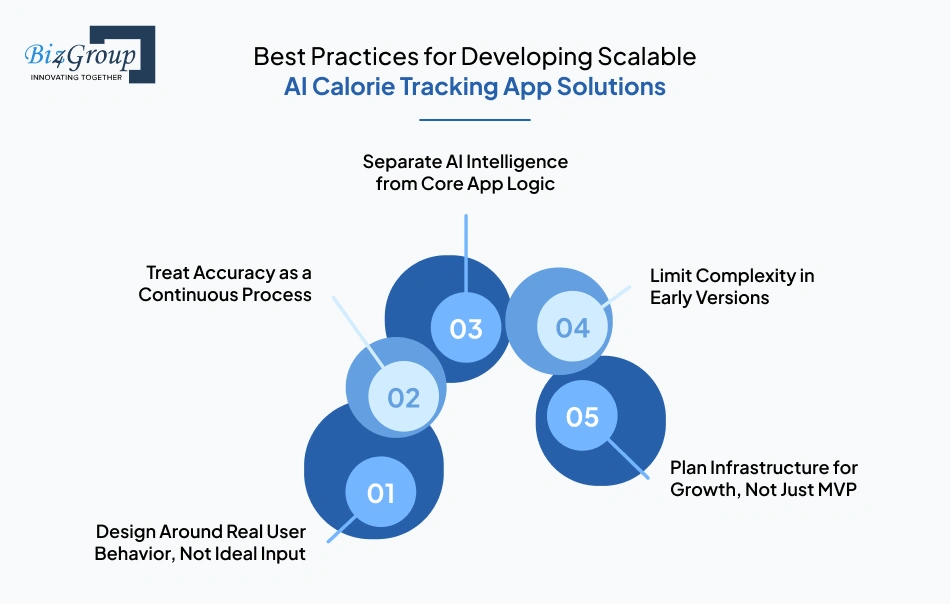
Scalability does not happen by accident. In AI calorie tracker app development, it is the result of deliberate design choices made early, especially around data handling, personalization logic, and system architecture. Fitness startups that plan for scale from day one avoid costly rebuilds as usage grows and expectations rise.
Users log food inconsistently and often imperfectly. When teams develop AI calorie tracking applications, systems should tolerate incomplete entries, corrections, and variability without breaking accuracy or usability. Designing for real behavior improves trust and long-term engagement.
Calorie estimation improves over time, not at launch. To build AI powered calorie tracker apps, teams should implement feedback loops, editable entries, and ongoing model refinement instead of assuming static accuracy from day one.
Scalable systems isolate AI workloads from core tracking functions. This approach helps teams develop scalable AI calorie tracking app solutions that handle growth without slowing down logging, insights, or daily user interactions.
Trying to solve every nutrition scenario upfront increases risk and cost. Focused use cases help startups create AI driven food and calorie tracking apps that can expand intelligently based on real usage data rather than assumptions.
Early infrastructure decisions affect future performance. When teams plan scalability alongside accuracy, AI calorie tracker app development becomes easier to extend into advanced personalization, analytics, and premium features without rework.
Scalable calorie tracking products succeed because they adapt gracefully as users, data, and expectations grow. Fitness startups that apply these practices consistently are better positioned to deliver reliable experiences and sustain long-term product growth without technical bottlenecks.
The choice of right development partner is often the difference between a calorie tracker that looks good on paper and one users actually rely on every day. AI calorie tracker app development demands require a deep understanding of fitness user behavior, nutrition data, and how AI systems evolve over time in real products.
Biz4Group LLC brings that balance of product thinking and execution. With hands-on experience in building AI-driven fitness and wellness platforms, our teams understand what it takes to design calorie tracking solutions that stay accurate, scalable, and user-friendly as adoption grows.
This experience is rooted in years of work across the fitness domain, including intelligent tracking, personalization logic, and data-driven engagement models commonly required in AI calorie tracker app solutions for fitness startups.
What sets Biz4Group apart is not just AI capability, but:
Portfolio Spotlight: To see how these principles come together in real fitness products, let's look at how we have built AI-driven platforms that balance personalization, scalability, and long-term user engagement.
Quantum Fit: Quantum Fit is a data-driven fitness platform built to personalize user journeys based on behavior, goals, and activity patterns. We focused on designing intelligent logic that adapts workouts and recommendations as users progress, supported by a scalable architecture. This project highlights how fitness platforms can evolve intelligently over time without relying on static rules or manual adjustments.
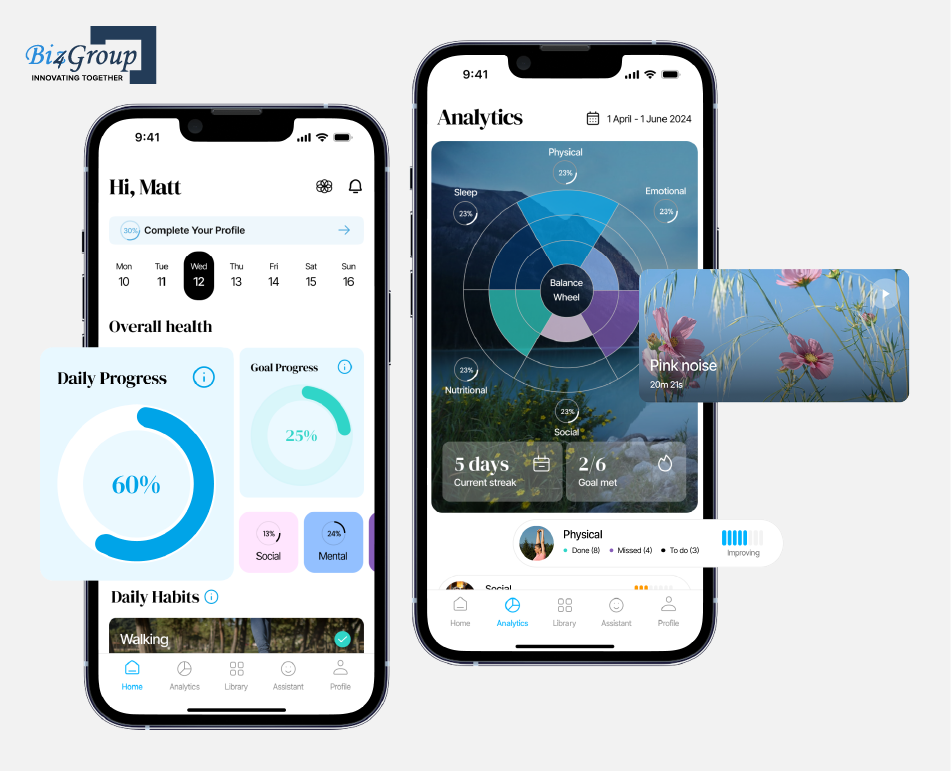
AI Workout App: It is a personalized fitness platform designed to adapt workout recommendations based on user goals, preferences, and performance. We supported the project by building the intelligence layer, scalable backend, and adaptive logic that allows workouts to evolve over time. This ensures that the app remains responsive, reliable, and engaging as user activity grows.
Thus, we approach AI calorie tracker app development as a long-term product capability, helping fitness startups build reliable, scalable solutions that strengthen user trust, engagement, and growth over time.
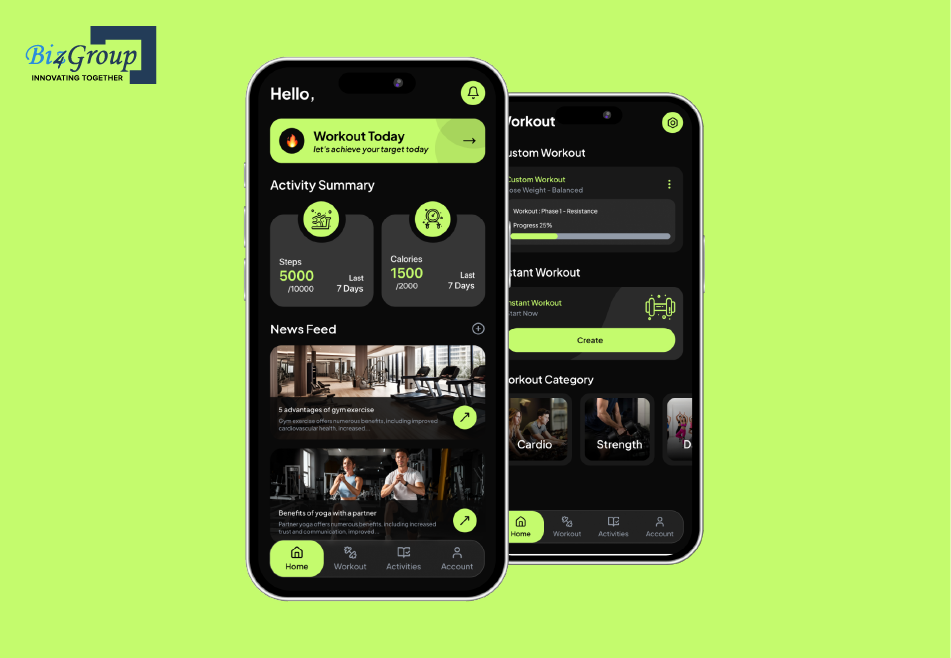
AI calorie tracking has become a serious product responsibility, not an optional feature. Users trust these apps with daily decisions, routines, and health goals. That makes AI calorie tracker app development a matter of precision, reliability, and long-term thinking the same priorities applied by top AI development companies in Florida building production-ready health platforms. The real work is not in adding intelligence quickly, but in shaping systems that stay accurate, adapt naturally, and remain dependable as usage grows.
For fitness startups, this means approaching calorie tracking as a capability that evolves over time. A well-planned AI calorie tracker app solution for fitness startups focuses on clarity, consistency, and trust because those are the factors that keep users engaged without forcing habits.
If you’re planning to build an AI-powered calorie tracking experience, book a strategy call today as clarity now can save time, cost, and rework for you later.
AI calorie tracker app development reduces manual logging, improves accuracy over time, and adapts to real user behavior. Unlike static trackers, AI-based systems learn from usage patterns and deliver more relevant, personalized calorie insights.
Accuracy depends on data quality, food recognition models, and continuous learning. Well-designed AI-powered calorie tracking apps improve reliability over time by combining AI predictions with user corrections and nutrition databases.
Timelines vary by scope, but most teams take several months to develop an AI calorie tracking application that includes food recognition, personalization, and scalable infrastructure, especially when accuracy and user trust are priorities.
Key cost drivers include AI model complexity, personalization depth, scalability needs, third-party integrations, and compliance requirements. The level of accuracy and long-term growth planning also significantly affect development cost.
Yes. AI calorie tracker app solutions for fitness startups are designed to adapt to user habits over time, making tracking feel less repetitive and more useful, which directly supports retention and daily engagement.
Startups should look for experience in fitness and health-focused AI products, scalability planning, and a clear understanding of user behavior. The best partners balance technical execution with product and business goals.

with Biz4Group today!
Our website require some cookies to function properly. Read our privacy policy to know more.