Location :
Orlando, FL, USA
Location :
Orlando, FL, USA +1 (407) 714-1616
 info@biz4group.com


















Imagine a digital system that doesn’t wait for instructions but instead, understands your business goals, learns from real-time feedback, and takes independent actions to get the job done.
Read More
One day, while reviewing routine telemedicine workflows, you come across recurring friction points where patient engagement remains inconsistent. Follow-ups require manual efforts and support teams' struggle to keep pace as virtual visits continue to scale.
You ask yourself a question. What if every patient interacting with your platform had access to a 24/7 assistant that never sleeps and never needs a break? And then a bigger question: Could you Develop AI chatbot for telemedicine platforms that improve outcomes while generating measurable ROI?
That moment is where Telemedicine AI Chatbot Development steps into strategic focus. Here what you should know:
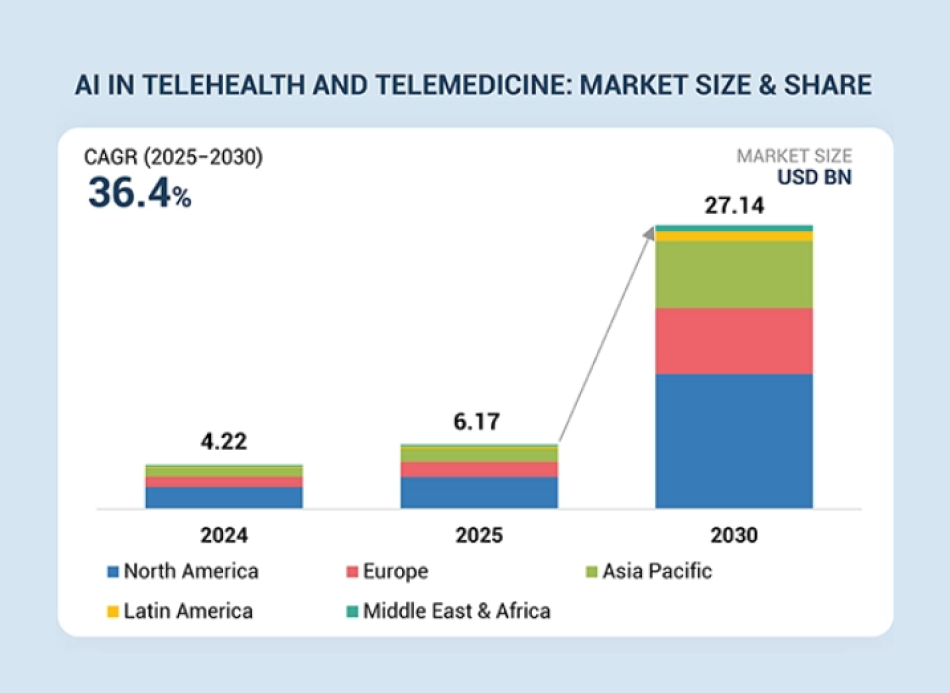
For you as a founder, CIO, or healthcare operations leader, that means two things. First, the window to lead with intelligent patient engagement remains wide open. Second, the stakes for delivering virtual care with impact have never been higher.
In this guide, we’ll explain what telemedicine AI chatbots really are, how intelligent solutions work, why healthcare businesses should invest in telemedicine AI chatbot development services, which features matter most, and how an AI chatbot development company in USA with a strong suite in AI healthcare solutions can help you build scalable systems that integrate with your care ecosystem.
Let’s dive in.
An AI chatbot for telemedicine works as a digital assistant between patients and virtual care services. It handles common questions and routine interactions that would otherwise need direct involvement from medical staff. When implemented through Telemedicine AI Chatbot Development, this capability becomes part of the overall virtual care workflow, not just an add-on tool.
At a functional level, these chatbots are designed to assist with tasks such as:
To function effectively within virtual care environments, AI-powered telemedicine chatbots are built using robust AI integration services. These integrations connect conversational intelligence with telemedicine platforms, clinical systems, and patient data workflows. This reflects standard chatbot development for the healthcare industry, where scalability, compliance, and alignment with clinical workflows define how such chatbots operate in real-world care settings.
Also Read: How to Develop an AI Telemedicine App: Features, Tech Stack, and Strategy
Intelligent AI chatbots for telemedicine are built around a simple idea. Every patient interaction can become a moment of support when guided by the right system. Through Telemedicine AI Chatbot Development, these interactions form a continuous loop that supports monitoring, engagement, and timely clinical response.
The process begins with patient conversations across chat or voice interfaces. The chatbot collects symptoms, care-related concerns, and follow-up inputs before or after virtual visits.
These exchanges feel conversational to patients while quietly reducing manual intake of work for care teams. Over time, they create a consistent stream of contextual data that supports virtual care delivery.
Once inputs are captured, the chatbot interprets them using natural language understanding and predictive logic. Through structured AI model development, it recognizes intent, tracks symptom changes, and identifies early risk signals that may require attention.
For monitoring to remain reliable, conversational intelligence must operate alongside clinical data systems. Many organizations build telemedicine AI chatbots with EHR and EMR integration so interactions align with structured medical records.
This alignment becomes especially important as conversational systems interact with clinical data models commonly discussed in AI EMR/EHR software development initiatives across healthcare organizations.
Each interaction feeds back into the system. Over time, the chatbot refines how it responds to patient behavior, updates care guidance and aligns with evolving telemedicine protocols. This ongoing learning helps the system remain relevant as treatment pathways change and virtual care models mature.
When predefined thresholds are crossed, such as worsening symptoms or missed follow-ups, the telemedicine AI chatbot triggers alerts. These notifications reach patients or clinicians at the right moment, supporting timely intervention. This approach helps reduce unnecessary virtual visits while ensuring that higher-risk cases receive appropriate attention.
|
Step |
Function |
Value to Telemedicine Teams |
|---|---|---|
|
Patient Interaction |
Collects real-time care inputs |
Improves engagement and continuity |
|
Data Interpretation |
Applies clinical context and patterns |
Supports early risk awareness |
|
System Integration |
Syncs conversations with medical records |
Maintains data consistency |
|
Continuous Learning |
Adapts to care pathways |
Improves relevance over time |
|
Alerts and Escalation |
Flags care concerns promptly |
Enables timely intervention |
Together, these workflows show how telemedicine chatbots move from simple conversations to dependable care support. As seen across AI chatbot integration in various industries, success depends on thoughtful design, reliable data flow, and continuous learning tailored to real operational needs.
Create AI chatbots that monitor patients, respond in real time, and support care beyond live consultations.
Build My Telemedicine AI Chatbot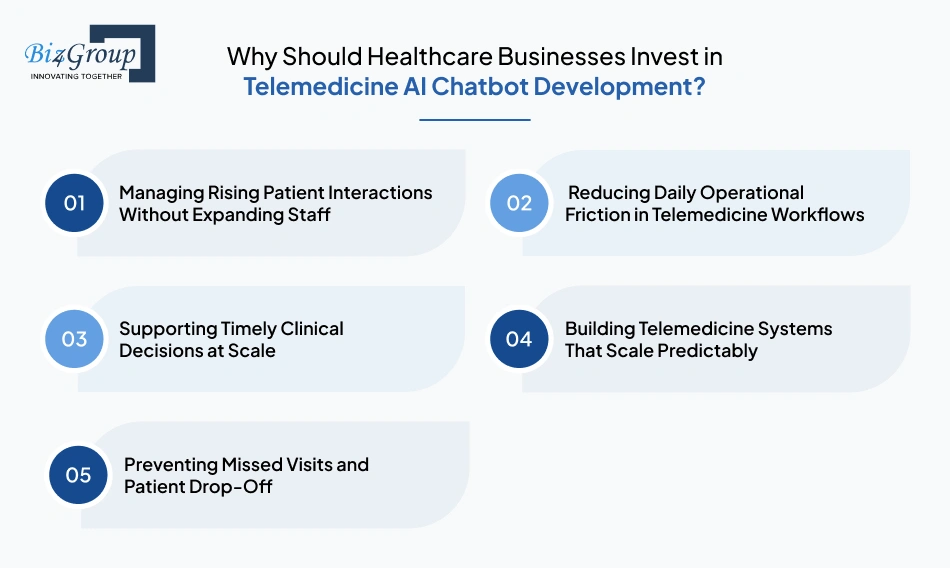
Healthcare businesses invest in telemedicine AI chatbot development because virtual care demand is growing faster than teams, budgets, and operational capacity. Without automation, scaling telemedicine often leads to higher costs, slower response times, and inconsistent patient experiences. An AI chatbot helps stabilize operations while telemedicine programs expand.
Virtual care increases patient touchpoints before, during, and after consultations. Handling every message manually is not sustainable. A telemedicine chatbot works as an AI virtual assistant, supporting patients continuously without increasing staffing pressure.
This allows care teams to focus on clinical work instead of routine communication.
Telemedicine operations rely heavily on coordination. Scheduling, intake, and follow-ups consume time across teams. By using AI automation services, healthcare organizations reduce repetitive workload that slows virtual care delivery.
The investment helps maintain smooth operations as visit volumes increase.
As patient interactions grow, identifying which cases need attention becomes harder. Telemedicine chatbots structure ongoing conversations so care teams can act faster without constant monitoring.
This improves care responsiveness without adding clinical overhead.
Healthcare businesses need telemedicine systems that grow without constant rework or rising costs. This is where enterprise AI solutions play a role by supporting consistent workflows across departments and locations.
Investment here reduces long-term operational risk as virtual care scales.
Missed appointments and incomplete follow-ups directly impact care outcomes and revenue. Telemedicine chatbots help keep patients engaged and informed throughout their care journey.
This protects both patient continuity and operational efficiency.
Long-Term Investment Perspective
Healthcare organizations invest in telemedicine AI chatbot development to create a stable foundation for virtual care delivery. Over time, this supports broader AI virtual healthcare assistant development, where patient engagement, operational efficiency, and care coordination remain consistent as demand grows.
The investment is not about adding new technology. It is about keeping telemedicine reliable, scalable, and manageable as virtual care becomes a permanent part of healthcare delivery.
Also Read: The True Cost of Implementing AI in Healthcare : Investment, ROI, and Integration Strategies
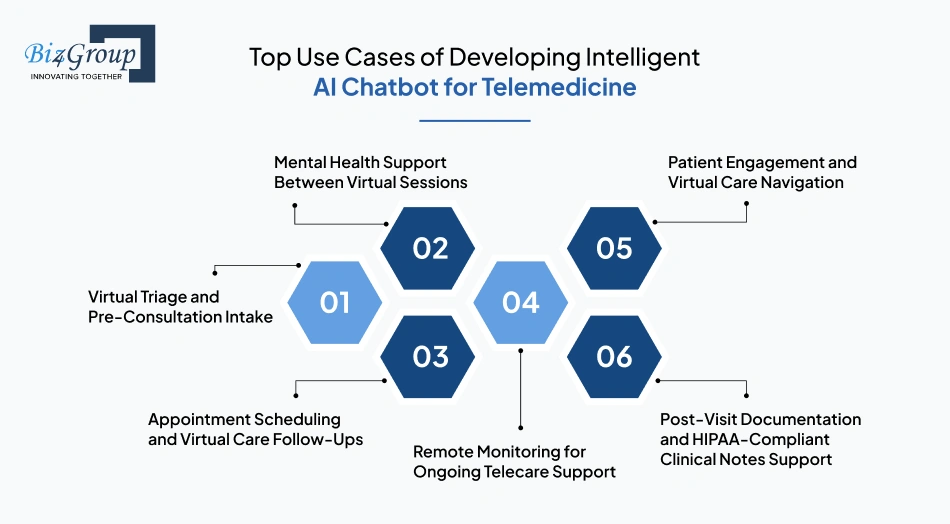
As virtual care platforms mature, Telemedicine AI Chatbot Development is increasingly embedded within broader AI-powered healthcare applications that supports triage, monitoring, patient engagement, and documentation across telemedicine workflows. The following use cases show how these intelligent chatbots address specific clinical and operational needs inside telemedicine platforms, enabling scalable interaction without physical presence.
Telemedicine consultations depend on accurate patient context before the session begins. AI chatbots collect symptoms, urgency indicators, and basic medical details in advance, helping clinicians start virtual visits prepared and focused rather than spending time on intake.
Example: A telemedicine platform may use an AI chatbot to guide patients through symptom questions and route them to appropriate virtual care pathways before scheduling a consultation.
Tele-mental health care often requires engagement outside scheduled appointments. AI chatbots support continuity through emotional check-ins and AI mood tracking app development. This helps patients reflect on their mental health while giving clinicians a longitudinal context between virtual sessions.
Example: A telemedicine setup that includes a virtual mental health AI coach can use chatbots to capture daily emotional inputs that complement teletherapy sessions without replacing clinician involvement.
Managing appointments at scale is a recurring challenge in telemedicine. AI chatbots automate scheduling, rescheduling, and follow-up communication, reducing missed visits and reinforcing care instructions after virtual consultations.
Example: Patients can confirm appointments, receive reminders, and access post-visit guidance through chatbots without relying on manual coordination.
Telemedicine relies heavily on patient-reported data outside of live consultations. AI chatbots enable structured check-ins for symptoms, adherence, and recovery progress, allowing care teams to identify potential issues early without continuous live monitoring.
Example: A telemedicine provider may use chatbots to collect regular symptom updates from patients managing ongoing conditions and flag changes for clinical review.
After virtual visits, patients often need clarity on the next steps. AI chatbots guide patients through follow-ups, referrals, and care plans, helping maintain engagement across the digital care journey.
Example: Many platforms make telemedicine AI chatbot solutions for patient engagement to ensure patients stay connected beyond a single virtual interaction.
Documentation after virtual visits can slow clinicians and introduce compliance risk. AI chatbots assist by capturing structured post-visit inputs and organizing clinical summaries while supporting HIPAA-compliant AI healthcare apps that protect sensitive patient data within telemedicine workflows.
Example: A telemedicine provider may prompt clinicians with brief post-visit questions through a chatbot, enabling faster documentation without exposing protected health information.
These use cases show that telemedicine chatbots succeed when designed for real workflows, not generic automation. Healthcare organizations often rely on a custom software development company to translate these use cases into compliant, scalable, and clinically relevant telemedicine solutions.
Also Read: Developing an AI Chatbot for Chronic Disease Management: Features and Cost
Design AI chatbots that support triage, engagement, and follow-ups across everyday virtual care workflows.
Create My Telemedicine AI ChatbotFor telemedicine chatbots to work in real care environments, features must support how virtual care is delivered. Telemedicine AI Chatbot Development is not about adding intelligence for its own sake. It is about building dependable capabilities that fit naturally into AI chatbot development patterns already used across healthcare applications, where conversation, workflow integration, and data protection must operate together without friction.
|
Feature |
Why It Matters |
|---|---|
|
Intelligent Symptom Intake |
Collects structured patient inputs before virtual visits, giving clinicians context early and reducing time spent on manual intake during teleconsultations. |
|
Natural Language Understanding |
Enables patients to describe symptoms in everyday language while accurately interpreting intent and context. Depending on conversation depth, this understanding may rely on traditional NLP models or LLM’s, thus making choices between NLP vs LLM critical for safe and reliable telemedicine interactions. |
|
Appointment Scheduling Automation |
Simplifies booking, rescheduling, and reminders at scale, similar to how an AI scheduling assistant manages calendars and reduces no-shows in high-volume telemedicine workflows. |
|
Connects AI with patient records, ensuring continuity of care across virtual visits, follow-ups, and long-term treatment plans. |
|
|
Secure Patient Authentication |
Verifies identity before sensitive interactions, protecting access to personal health information in distributed telemedicine environments. |
|
Context-Aware Follow-Ups |
Delivers personalized reminders and care instructions after visits, supporting engagement when care continues beyond live consultations through virtual healthcare assistants. |
|
Clinical Escalation Logic |
Identifies responses that require clinician attention, enabling timely intervention without relying on constant manual monitoring. |
|
Compliance and Data Security Controls |
Safeguards patient data throughout conversations, supporting safe deployment in regulated telemedicine systems where privacy and trust are critical. |
These features shape how a telemedicine chatbot performs in everyday care delivery. When healthcare teams integrate AI into an app with these capabilities in place, the result is a system that supports clinicians, protects patient data, and scales virtual care without adding operational strain.
Once core features are stable, advanced intelligence allows chatbots to support more nuanced and proactive virtual care. Telemedicine AI Chatbot Development at this stage focuses on adaptability, context awareness, and foresight rather than simple automation. These capabilities help virtual care platforms respond to patient needs that evolve over time, often without direct clinician intervention at every step.
|
Capability |
Why It Matters |
|---|---|
|
Predictive Patient Risk Identification |
Uses predictive analytics to identify early warning signals from patient behavior and reported data, helping care teams intervene before issues escalate in remote care settings. |
|
Emotion-Aware Conversations |
Applies sentiment analysis to detect stress, frustration, or disengagement, allowing chatbots to respond more empathetically and flag patients who may need additional support. |
|
Contextual, Adaptive Dialogues |
Functions like an AI conversation app that maintains context across sessions, ensuring patients do not repeat information and interactions feel continuous across telemedicine visits. |
|
Wearable and Remote Device Data Integration |
Connects chatbot conversations with insights from wearable app development initiatives, enabling more informed monitoring without increasing patient effort. |
|
Dynamic Response Generation |
Uses generative AI to deliver personalized explanations, guidance, and follow-ups that adapt as patient needs and conditions change over time. |
|
Cross-Program Intelligence Scaling |
Enables organizations to develop intelligent telemedicine chatbot system components that adapt across specialties, care programs, and patient populations without constant redesign. |
These advanced capabilities expand what telemedicine chatbots can support beyond basic workflows. When applied thoughtfully, they help virtual care platforms become more responsive, patient-aware, and scalable, while keeping clinical oversight and safety at the center of digital care delivery, like how agentic AI in healthcare is redefining intelligent care models.
Also Read: How to Develop an AI-Based Telehealth Automation System: Step-by-Step Guide
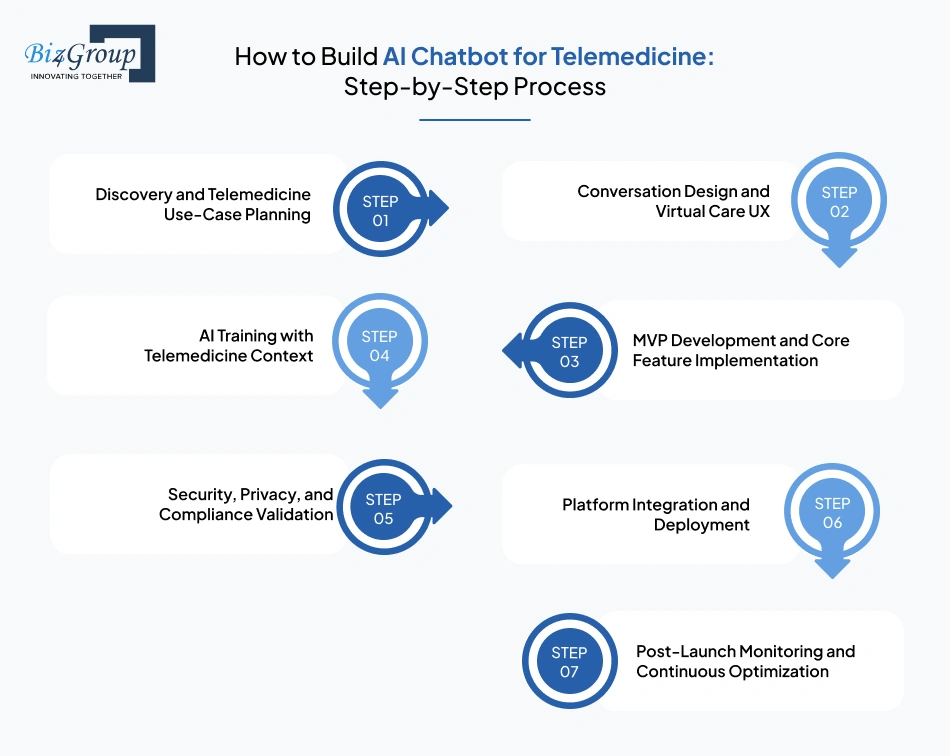
Building a telemedicine chatbot requires aligning clinical workflows, virtual care operations, and patient experience into one coherent system. Telemedicine AI Chatbot Development works best when each phase is approached methodically, with a clear focus on safety, usability, and scalability.
The first step is understanding where a chatbot genuinely improves virtual care, rather than attempting to automate everything. Telemedicine environments demand clarity around scope and clinical responsibility from the start.
In telemedicine, the chatbot often becomes the first touchpoint for patients. Thoughtful design ensures conversations feel simple, supportive, and easy to follow.
Also read: Top UI/UX Design Companies in USA
Rather than building a full-featured system upfront, start with a focused version that proves value in real telemedicine scenarios. This approach minimizes risk while enabling faster validation.
Also read: Top 12+ MVP Development Companies in USA
AI intelligence must reflect how patients actually communicate during virtual visits. Training should focus on understanding intent, context, and urgency within telemedicine conversations.
This phase focuses on safeguarding sensitive health data and maintaining secure, auditable clinical documentation, especially in environments where teams develop HIPAA- compliant AI medical transcription software to support regulated healthcare records.
Also Read: 15+ Software Testing Companies in USA in 2026
A telemedicine chatbot cannot operate in isolation. Integration ensures continuity of care across virtual visits and backend systems.
Launch is only the beginning. Continuous monitoring ensures the chatbot remains effective as telemedicine programs evolve.
This step-by-step process mirrors how successful telemedicine platforms move from concept to dependable execution. Each phase reduces risk, improves adoption, and ensures the chatbot becomes a reliable part of virtual care delivery rather than a disconnected automation tool.
Also Read: AI Telehealth Chatbot PoC Development: An Expert Insights
The technology choices determine how well your chatbot supports patients, integrates with systems, and scales securely. For leaders evaluating Telemedicine AI Chatbot Development, the focus should stay on stability, compliance, and long-term usability. This is especially important when planning custom telemedicine chatbot development services for clinics, hospitals, or virtual care platforms.
|
Frontend Framework |
React.js, Angular |
ReactJS development and Angular development enable responsive user interfaces for patients and providers. |
|
Server-Side Rendering & Performance |
Next.js |
NextJS development enables fast rendering of patient portals and virtual care pages. |
|
Backend Framework |
Node.js, Python |
NodeJS development enables real-time workflow handling and Python development enables AI logic execution and data processing. |
|
Conversational AI & NLP |
Dialogflow, Rasa |
It allows accurate natural language understanding for patient interactions. |
|
API Development & Integration |
REST, FHIR APIs |
These integrations enable secure data exchange with EHRs and healthcare systems. |
|
Database Management |
PostgreSQL |
It enables secure storage of structured patient data and interactions. |
|
Security & Authentication |
OAuth 2.0, JWT, SSL/TLS |
The implementation enables secure authentication and encrypted communications for patient data safety. |
|
Cloud Deployment |
AWS, Azure, Google Cloud |
It enables scalable, compliant hosting, and high availability. |
|
Monitoring & Analytics |
Power BI, Grafana |
The implementation enables tracking operational metrics and chatbot usage performance. |
This stack includes only what is required to support real telemedicine workflows. It allows teams to build AI chatbot for virtual care services without technical overengineering. This foundation supports secure, scalable telemedicine delivery as care demand grows.
Choose the right technology stack to ensure your chatbot stays secure, scalable, and reliable as care demand grows.
Talk to an AI Healthcare Expert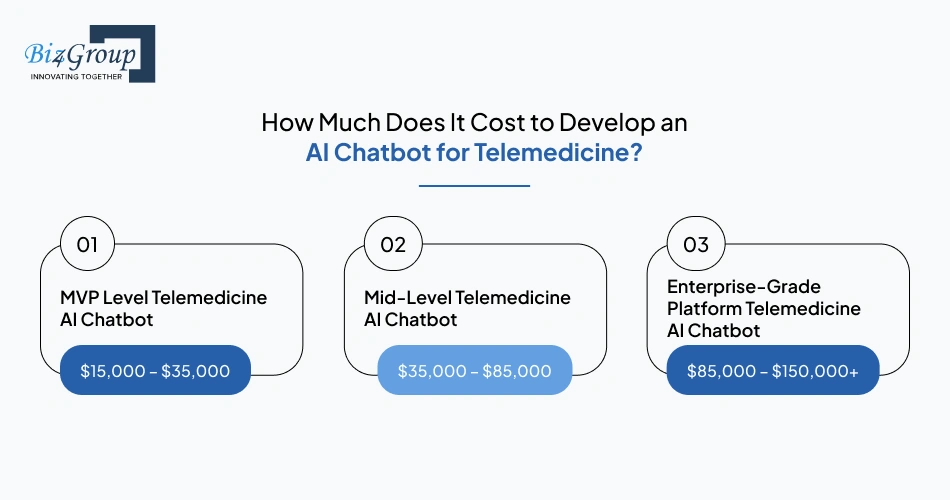
The cost of Telemedicine AI Chatbot Development typically ranges between $15,000 and $150,000+. This investment depends on feature scope, compliance needs, AI depth, and integrations.
To help healthcare organizations plan realistically, the cost structure can be viewed across three common implementation levels.
Each level reflects a different stage of telemedicine maturity, from early validation to enterprise-wide deployment, with scope and complexity increasing accordingly.
|
Version |
Ideal For |
Key Features |
Estimated Cost Range (USD) |
|---|---|---|---|
|
MVP Level Telemedicine AI Chatbot |
Startups and clinics validating virtual care workflows |
Basic patient chat, appointment booking, FAQs, simple triage flows, and admin controls built during MVP software development |
$15,000 – $35,000 |
|
Mid-Level Telemedicine AI Chatbot |
Telemedicine providers scaling virtual care operations |
NLP-based chatbot, multi-department routing, EHR integration, appointment management, analytics dashboard, and rule-based care guidance |
$35,000 – $85,000 |
|
Enterprise-Grade Platform Telemedicine AI Chatbot |
Hospitals and large digital health platforms |
Advanced AI-driven triage, care coordination workflows, multilingual support, HIPAA-compliant infrastructure, system integrations, and cloud scalability |
$85,000 – $150,000+ |
Cost planning works best when scope decisions are defined early and aligned with growth goals. With the right approach, Telemedicine AI Chatbot Development becomes predictable rather than risky. For teams evaluating telemedicine AI chatbot solutions for startups and healthcare providers, our guide on AI medical chatbot development cost offers added budgeting clarity.
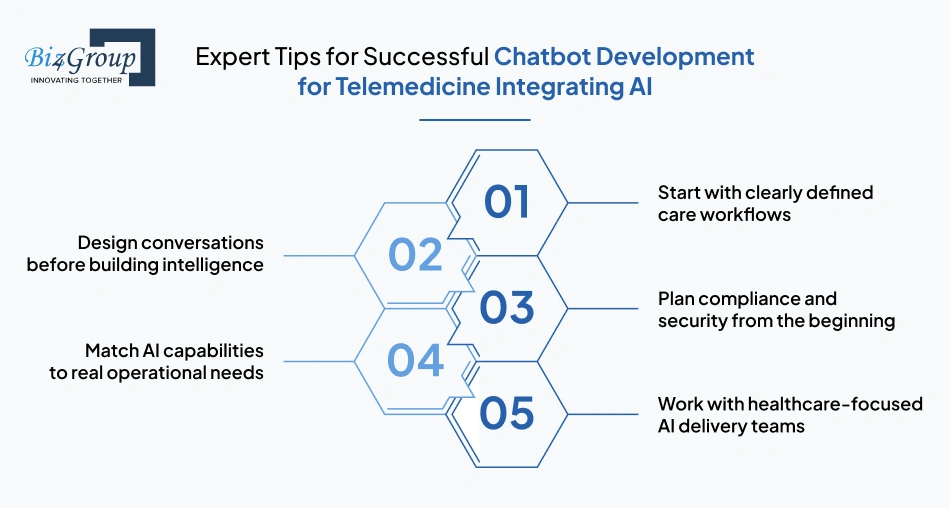
Building a reliable telemedicine chatbot requires more than adding AI to chat workflows. This section shares practical guidance to help leaders approach Telemedicine AI Chatbot Development thoughtfully, especially when planning custom telemedicine chatbot development that balances patient experience, compliance, and long-term scalability.
Effective implementations begin by mapping real patient journeys before applying AI. This helps teams create telemedicine AI chatbot solutions that support triage, scheduling, and follow ups without disrupting established clinical or operational workflows.
Strong AI assistant app design prioritizes clarity, tone, and predictable outcomes. Well planned conversations reduce patient confusion and ensure AI supports care delivery responsibly within healthcare chatbot development for telemedicine environments.
Regulatory requirements should guide architecture decisions early. Teams that embed compliance into design can build AI chatbot for virtual care services that scale confidently without repeated audits, rework, or delayed deployments.
Not every use case requires advanced intelligence. Practical Telemedicine AI Chatbot Development focuses first on intent handling and workflow automation, allowing organizations to introduce deeper AI capabilities only when operational readiness supports it.
As scope expands, it becomes important to hire AI developers with healthcare experience. The right expertise helps manage integration complexity, timelines, and risk while delivering dependable virtual care solutions.
Also Read: Top 10 Mistakes to Avoid While Developing AI Chatbot for Your Business
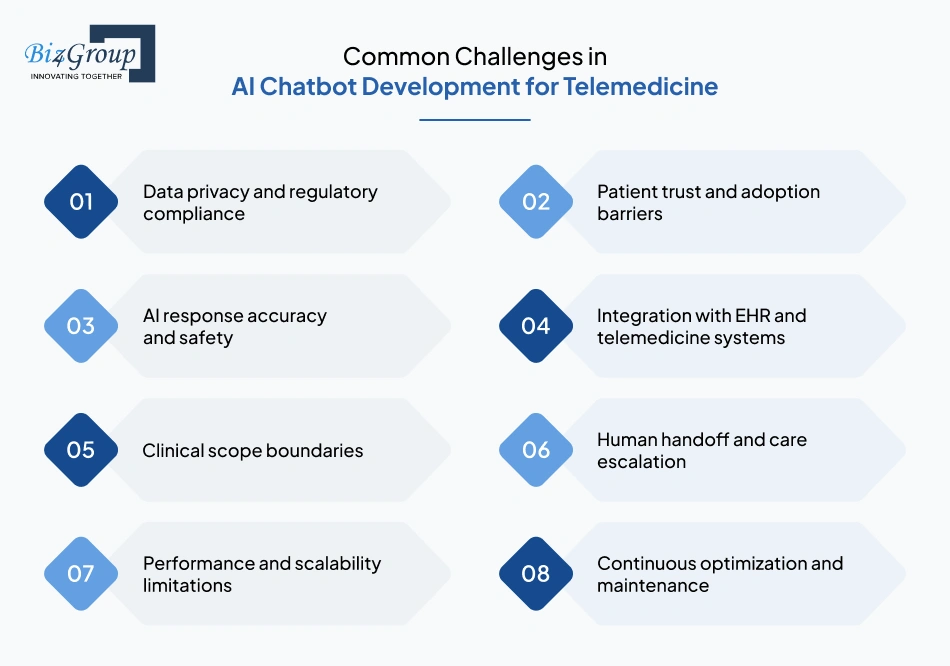
When teams start building telemedicine chatbots, challenges show up sooner than expected. In Telemedicine AI Chatbot Development, these issues often surface around clinical safety, system integration, and delivery choices.
Many teams also compare build models with options like outsourcing AI healthcare software development while making early technical and compliance decisions. This prevents these challenges from becoming a dealbreaker:
|
Top Challenges |
How to Solve Them |
|---|---|
|
Data privacy and regulatory compliance |
Design privacy-first systems with encryption, access controls, and audit logs. Insights from a healthcare conversational AI guide help balance compliance requirements without compromising chatbot performance. |
|
Patient trust and adoption barriers |
Use clear language, empathetic responses, and transparent handoffs to clinicians to build confidence in virtual care interactions. |
|
AI response accuracy and safety |
Apply controlled decision logic, verified datasets, and clear escalation thresholds, especially in symptom-led interactions similar to those seen in AI chatbot development for medical diagnosis use cases. |
|
Integration with EHR and telemedicine systems |
Use standardized APIs and structured workflows. Partnering with teams experienced in AI medical web development supports smoother interoperability across healthcare systems. |
|
Clinical scope boundaries |
Clearly define what the chatbot can and cannot handle, ensuring it supports care delivery without crossing into medical decision-making. |
|
Human handoff and care escalation |
Design escalation logic that routes patients to clinicians at the right moment to maintain safety and workflow continuity. |
|
Performance and scalability limitations |
Build cloud-ready architectures that handle usage spikes without degrading live telemedicine services. |
|
Continuous optimization and maintenance |
Monitor interactions regularly and refine chatbot behavior as care protocols and patient expectations evolve. |
Every challenge listed here is manageable with the right planning approach. Teams that address these risks early are better positioned to build AI chatbot for virtual care services that clinicians and patients can rely on consistently.
The next phase of Telemedicine AI Chatbot Development is less about adding automation and more about building dependable systems. As virtual care matures, healthcare leaders are rethinking how they can build AI software that clinicians trust, and patients feel comfortable using at scale.
Telemedicine chatbots will operate under clearer validation frameworks. Explainable responses, traceable decisions, and defined accountability will become standard expectations as chatbot development for healthcare industry use cases move closer to regulated clinical environments.
Future chatbots will integrate more tightly with EHRs, scheduling tools, and care coordination platforms. This shift will push teams to create AI-driven telehealth chatbot platform architectures that function as part of everyday telemedicine workflows. fits into broader virtual care operations.
Chatbots will increasingly track engagement, follow ups, and care for continuity. These insights will help providers create telemedicine AI chatbot solutions that connect virtual interactions with measurable care outcomes while supporting value-focused telemedicine models.
AI models use cases will evolve beyond fixed flows toward adaptive conversations. This will allow teams to build AI chatbot for virtual care services that respond intelligently based on patient history, interaction context, and care progression.
Telemedicine chatbots will begin supporting predictive use cases such as demand forecasting and proactive outreach. This capability will help healthcare organizations plan resources more effectively without increasing staffing pressure or compromising care delivery quality.
As telemedicine chatbots are moving toward greater accountability, deeper integration, and predictive support. Teams that prepare for these shifts early will build AI systems that scale responsibly while strengthening trust across virtual care delivery.
Selecting the right partner for telemedicine AI chatbot development means working with a team that understands both healthcare realities and AI execution. Biz4Group LLC is recognized among top chatbot development companies in USA for building healthcare-focused AI systems where patient interaction, data sensitivity, and system reliability must work together seamlessly.
That experience shows up in the healthcare AI systems we have already built. The projects mentioned below highlight the real considerations that come with patient-facing AI, where accuracy, security, and ease of use are not optional but expected.
Select Balance reflects our work on conversational AI Chatbot that helps users make informed wellness choices. Through guided questions, the chatbot understands individual health needs and offers personalized supplement recommendations. The experience is designed to feel simple and supportive, helping users navigate health decisions with clarity and confidence.
Truman reflects our work on a generative AI chatbot built for more adaptive health interactions. The AI driven wellness chatbot adjusts conversations based on user inputs and context, offering personalized health guidance and recommendations through a structured, avatar-led experience that supports deeper ongoing engagement.
Beyond these projects, we as a healthcare software development company focus on building healthcare AI systems that remain supportive, compliant, and scalable over time. Alongside our expertise in AI chatbot development, we emphasize practical intelligence and patient-first design grounded in real healthcare environments allowing us to deliver excellence rooted in experience.
Also Read: Healthcare Software Product Development: Expert Insights by Biz4Group
Work with a healthcare-focused AI team experienced in building secure, scalable, patient-facing systems.
Start My Telemedicine AI ChatbotTelemedicine today is about more than virtual consultations. It is about staying connected between visits, responding at the right moment, and supporting care teams without increasing workload. When done right, Telemedicine AI Chatbot Development becomes a practical layer that quietly improves access, continuity, and patient confidence.
At Biz4Group, we approach this work with a deep understanding of healthcare realities. As an AI product development company, we deliver telemedicine AI chatbot development services that fit real workflows, respect data sensitivity, and scale alongside growing virtual care programs.
If you are exploring how AI chatbots can strengthen your telemedicine strategy, a short conversation can help clarify the path forward. Choosing the best AI chatbot company to develop telemedicine AI chatbots often begins with understanding the problem before building the solution.
Telemedicine AI Chatbot Development focuses on building intelligent conversational systems that support triage, scheduling, follow-ups, and care coordination. These chatbots help healthcare teams deliver responsive virtual care while reducing manual effort across telemedicine platforms.
To develop AI chatbots for telemedicine platforms, organizations must align clinical workflows, patient experience goals, and data privacy requirements early. Effective healthcare chatbot development for telemedicine ensures secure integration with existing systems and supports real-world care delivery.
When teams build AI-powered telemedicine chatbots, core capabilities include intelligent triage, natural conversation flow, secure data handling, and workflow integration. These elements help make telemedicine AI chatbot solutions for patient engagement more reliable and trusted.
To develop HIPAA compliant telemedicine AI chatbots, security must be embedded at every layer. This includes encrypted communication, controlled access, audit trails, and compliant cloud infrastructure when building AI chatbot systems for virtual care services.
Custom telemedicine chatbot development allows startups and healthcare providers to design solutions around their specific care models. Many choose to create AI-driven telehealth chatbot platforms that scale over time while adapting to changing clinical and operational needs.
Selecting the best AI chatbot company to develop telemedicine AI chatbots involves assessing healthcare experience, compliance expertise, and integration capability. The right partner can build scalable AI chatbot systems for telemedicine services that align with long-term virtual care goals.

with Biz4Group today!
Our website require some cookies to function properly. Read our privacy policy to know more.