 Location :
Orlando, FL, USA
Location :
Orlando, FL, USA +1 (407) 714-1616
 info@biz4group.com

- White-label custom AI HOA management platform development gives PropTech founders and property management businesses more flexibility, ownership control, and faster market entry compared to traditional HOA software licensing models.
- A strong white-label HOA management software solution should already include resident portals, payment systems, maintenance workflows, document management, AI communication tools, and multi-community support.
- Building an HOA platform completely from scratch can cost anywhere between $180K and $800K+, while white-label development significantly reduces both launch timelines and infrastructure costs.
- Founders evaluating how to create branded HOA management software without building from scratch should prioritize scalability, security, ownership clarity, API flexibility, and future AI expansion before selecting a development partner.
- Biz4Group LLC helps startups and enterprises build scalable HOA SaaS ecosystems through AI-powered automation, flexible architecture, secure infrastructure, and deep experience in PropTech software development.
What happens when a PropTech founder spends 14 months and nearly half a million dollars building HOA software, only to discover the market has already moved ahead?
According to the Foundation for Community Association Research, the country is expected to reach nearly 377,000 community associations in 2026, representing close to 80 million residents. That growth is creating a serious demand for faster and more efficient white-label custom AI HOA management platform development.
Businesses are now asking that instead of building every module from the ground up, can they launch faster with a prebuilt AI-ready framework they fully own and brand? This has accelerated interest in white-label AI HOA management platform development, especially among SaaS startups trying to reduce runway pressure while entering the HOA technology market.
The timing also makes sense from an operational standpoint. According to reports, nearly 44% of US homes listed for sale in 2025 included HOA fees, up from 34% in 2019.
Property management businesses are handling more communities, more resident requests, and far more documentation than before. That is why many companies now search for a white-label custom AI HOA management software development approach that already includes automation for billing, maintenance coordination, resident communication, and compliance tracking.
In fact, many founders openly say, “we want to launch HOA management software quickly but building from scratch is too expensive and time-consuming.”
They are not looking for generic software subscriptions. They want a scalable product under their own brand. They want ownership, customization, and speed without sacrificing long-term growth potential.
So, let’s break down how white-label AI HOA platforms actually work, what you should own, and what separates a scalable SaaS product from a repackaged demo.
Understanding the Basics of White-Label Custom AI HOA Management Platform Development
Most founders entering the HOA technology market ask the same thing first... What exactly are you getting with a white-label platform?
In simple terms, development of white-label custom AI HOA management platform means building your branded HOA software on top of a prebuilt SaaS foundation that already includes core workflows, AI capabilities, user management, and scalable infrastructure.
You are not purchasing a shared HOA software subscription. You are launching your own product. Your branding, workflows, pricing model, integrations, dashboards, and customer experience remain unique to your business.
The development company provides the technical foundation. You control how the platform evolves.
That distinction matters because many founders searching for a white-label HOA management software solution are actually comparing three very different models.
|
Model |
What You Get |
Ownership Level |
Customization |
Launch Speed |
|---|---|---|---|---|
|
Off-the-shelf HOA software |
Shared SaaS access |
No ownership |
Limited |
Fast |
|
White-label AI HOA platform |
Branded customizable system |
Partial or full ownership |
High |
Faster |
|
Full custom build |
Built entirely from scratch |
Full ownership |
Complete |
Slowest |
For founders planning long-term SaaS growth, white-label development creates a middle ground between speed and flexibility.
So How Does It Actually Work?
A modern HOA platform already includes reusable backend systems such as:
- Resident management
- Payment processing
- Maintenance workflows
- AI communication systems
- Admin dashboards
- Role-based permissions
- Document handling
- Reporting modules
Instead of rebuilding those systems from zero, the platform gets customized around your business model.
This approach is becoming increasingly popular among founders who say, “we are planning to offer HOA management software as a SaaS product and need a white-label AI solution to reduce development time and cost.” And honestly, the logic is hard to ignore.
If the core infrastructure already exists, your team can spend more time improving customer acquisition, product positioning, and operational workflows instead of rebuilding payment systems or resident portals from scratch.
Core Components That Should Already Exist in the Base Platform
A reliable white-label SaaS solutions for AI-driven HOA community management systems setup should already include the operational backbone required to support both HOA managers and residents.
Here is what serious SaaS founders typically expect before customization even begins:
|
Component |
Why It Matters |
|---|---|
|
Resident Portal |
Handles requests, payments, notices, and communication |
|
HOA Accounting System |
Automates dues tracking, invoices, and financial reporting |
|
AI Communication Layer |
Supports automated responses and resident engagement |
|
Maintenance Management |
Tracks tickets, approvals, and vendor coordination |
|
Document Management |
Organizes bylaws, contracts, forms, and compliance files |
|
Admin Dashboard |
Gives HOA operators centralized operational visibility |
|
Notification Engine |
Sends alerts for payments, violations, and announcements |
|
Multi-Tenant Architecture |
Supports multiple HOA communities under one platform |
White-Label Does Not Mean “Template Software”
This is where many buyers get confused.
A serious white-label HOA management software development integrating AI approach should allow deep customization across:
- Workflows
- User roles
- Automation rules
- AI behavior
- UI components
- Analytics
- Integrations
- Dashboards
If every client receives the exact same interface with different logos, that is not a scalable SaaS foundation. That is a reskinned demo product.
A properly structured platform should allow your business to:
- Target specific HOA segments
- Support custom onboarding flows
- Configure automation logic
- Integrate external tools
- Scale independently over time
This flexibility becomes especially important for companies planning to create premium SaaS offerings for larger HOA portfolios.
White-Label AI HOA Platforms vs Traditional HOA Software
The difference becomes clearer when you compare the business model itself.
|
Traditional HOA Software |
White-Label AI HOA Platform |
|---|---|
|
Vendor controls roadmap |
You control product direction |
|
Shared customer environment |
Dedicated branded platform |
|
Limited integrations |
Flexible API ecosystem |
|
Monthly subscription dependency |
Long-term ownership potential |
|
Generic workflows |
Custom workflows |
|
Minimal AI capabilities |
Configurable AI automation |
|
Difficult to resell |
Built for SaaS growth |
That is one reason many companies researching AI HOA management software development now prioritize ownership and customization before feature lists.
The next question becomes even more important. Why are so many founders deciding to launch HOA platforms right now instead of waiting another year?
Why Building a White-Label AI HOA Management Platform Makes Sense in Today’s Market
The HOA software market is changing quickly. More communities are moving toward digital operations. Residents expect faster communication. HOA operators want fewer manual tasks and better visibility across multiple properties.
At the same time, the business opportunity behind HOA technology has become difficult to ignore.
According to Fortune Business Insights, the global property management market was valued at USD 26.55 billion in 2025 and is projected to grow to USD 52.21 billion by 2032. That momentum is one reason many founders are actively exploring white-label AI HOA platform development for SaaS founders and startups instead of spending years building infrastructure from zero.
Why the HOA SaaS Market Looks Attractive Right Now
This market naturally supports recurring revenue. Every HOA community requires ongoing operations such as:
- Resident communication
- Billing
- Maintenance coordination
- Document management
- Compliance tracking
That creates long-term SaaS demand instead of one-time transactions.
|
Market Driver |
Impact on SaaS Businesses |
|---|---|
|
Expanding HOA communities |
Larger customer base |
|
Manual HOA operations |
More automation opportunities |
|
Rising resident expectations |
Demand for better UX |
|
AI adoption in real estate |
Faster software modernization |
|
Multi-property management growth |
Need for centralized systems |
Many businesses entering this market want branded platforms they can monetize, expand, and customize over time. That is why many founders openly say, “we are managing multiple HOA communities and want to deploy a white-label AI HOA platform under our own brand.”
AI Expectations Have Changed Buyer Behavior
A few years ago, HOA software mainly focused on accounting tools and resident databases. That expectation has changed significantly.
Today’s property operators increasingly expect:
- Automated homeowner communication
- Smart maintenance workflows
- AI-powered support systems
- Faster document retrieval
- Centralized operational dashboards
- Resident self-service capabilities
This growing demand is pushing many businesses toward AI-powered white-label HOA management system for scaling property tech businesses instead of traditional software systems with limited automation.
For example, companies investing in AI automation services are reducing repetitive administrative work while improving response times for residents and management teams.
Why Speed Matters More Than Ever
Founders entering the PropTech market face a difficult balancing act.
Move too slowly and market demand shifts.
Build too much infrastructure too early and development costs start eating into growth capital.
That is exactly why many entrepreneurs now say, “we are a proptech startup and want to build a branded HOA software product using a white-label AI platform.”
The white-label approach gives SaaS founders a faster path toward:
- MVP validation
- Early customer onboarding
- Operational testing
- Product-market fit
- Recurring revenue generation
|
Traditional Product Build |
White-Label HOA Platform Launch |
|---|---|
|
Heavy backend setup |
Prebuilt operational systems |
|
Longer engineering cycles |
Faster deployment timelines |
|
Higher upfront investment |
More controlled development spending |
|
Slower feedback loops |
Earlier market validation |
|
Delayed revenue generation |
Faster monetization opportunities |
This shift explains why more founders are evaluating HOA software as a product opportunity instead of viewing it solely as an internal operations tool.
And naturally, that raises the next major question... How expensive does building an HOA platform actually become once development starts from scratch?
The HOA SaaS Market Is Growing Fast. Will Your Product Arrive Too Late?
Nearly 80 million Americans now live in HOA communities. Every delayed quarter gives faster-moving platforms a larger market share.
Launch HOA Platform NowWhat is the Cost of Building a White-Label AI HOA Management Platform vs Starting from Zero?
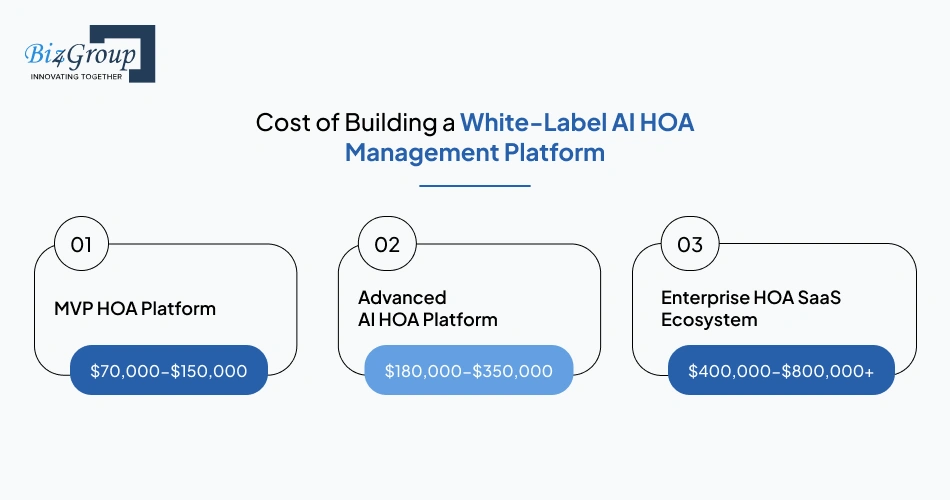
This is usually the point where founders pause and start recalculating their entire roadmap.
The idea sounds exciting at first. Launch a branded HOA SaaS platform. Add AI automation. Scale across hundreds of communities.
Then the development estimates arrive.
And suddenly, the timeline stretches past a year while the budget starts looking more like a Series A investment than an MVP launch.
That is why many founders researching how to develop white-label custom AI HOA management platform solutions begin comparing development economics before writing a single line of code. Because the cost gap between building from scratch and launching on a white-label foundation is massive.
Typical Cost Ranges Based on Product Stage
The cost depends heavily on:
- Feature depth
- AI capabilities
- Infrastructure requirements
- Customization level
- Integrations
- Scalability goals
Here is what realistic US-based development costs typically look like.
|
Product Stage |
Estimated Cost Range |
Typical Timeline |
What’s Usually Included |
|---|---|---|---|
|
MVP HOA Platform |
$70,000-$150,000 |
3 to 5 months |
Resident portal, payments, admin dashboard, ticketing |
|
Advanced AI HOA Platform |
$180,000-$350,000 |
6 to 10 months |
AI workflows, automation, analytics, mobile apps |
|
Enterprise HOA SaaS Ecosystem |
$400,000-$800,000+ |
10 to 18 months |
Multi-tenant architecture, enterprise integrations, advanced AI, compliance systems |
These numbers increase further if the product requires:
- Custom AI model training
- Multi-region deployment
- Advanced reporting systems
- Enterprise-grade security
- Third-party ecosystem integrations
That is one reason many founders now say, “we want to launch HOA management software quickly but building from scratch is too expensive and time-consuming.” And honestly, they are not wrong.
Where Most Development Budgets Actually Go
Many founders underestimate how many systems must work together behind the scenes before an HOA platform becomes commercially usable.
The visible interface is only one part of the product.
|
Cost Driver |
Estimated Impact on Budget |
|---|---|
|
Backend architecture |
20% to 30% |
|
Frontend and mobile apps |
15% to 20% |
|
AI integrations and automation |
15% to 25% |
|
Cloud infrastructure setup |
10% to 15% |
|
Security and compliance |
8% to 12% |
|
QA testing and deployment |
10% to 15% |
|
API integrations |
5% to 10% |
This is especially true for founders pursuing building a white-label AI HOA management platform capable of supporting multiple HOA communities simultaneously.
The complexity increases quickly once the platform must handle:
- Concurrent users
- Financial workflows
- Resident communication
- Vendor coordination
- Large document databases
- AI-powered automation
The Hidden Costs Founders Often Miss
This is where many early budgets fail. The initial development estimate usually covers the visible product. It rarely captures the long-term operational costs attached to scaling the platform.
Many founders budgeting for building a white-label AI HOA management platform only calculate development hours and UI design. The real operational expenses usually appear after launch.
|
Hidden Cost Area |
Typical Cost Range |
What Founders Often Miss |
|---|---|---|
|
Infrastructure scaling |
$2,000 to $15,000+ monthly |
Higher server usage as communities grow |
|
AI usage and API consumption |
10% to 22% of operational cost |
LLM requests, automation workflows, AI search |
|
Security and compliance |
$15,000 to $60,000 annually |
Encryption, audits, monitoring, access controls |
|
Ongoing product maintenance |
15% to 25% of initial build cost yearly |
Bug fixes, updates, compatibility management |
|
Third-party integrations |
$5,000 to $40,000+ |
Payment systems, communication APIs, accounting tools |
|
Performance optimization |
$10,000 to $50,000+ |
Database tuning, caching, load balancing |
|
UX and onboarding improvements |
$8,000 to $35,000 |
Workflow redesign and resident usability improvements |
These costs become even more noticeable once the platform starts supporting:
- Large HOA portfolios
- High resident activity
- AI-heavy workflows
- Enterprise-level reporting
- Document-heavy operations
That is one reason many founders turn toward AI product development services early in the scaling phase instead of waiting until operational inefficiencies begin affecting customer retention.
Starting From Scratch vs White-Label Development
Once real financial planning begins, the difference between greenfield development and white-label deployment becomes much clearer.
|
Factor |
Building From Scratch |
White-Label HOA Development |
|---|---|---|
|
Initial investment |
$180K to $800K+ |
$70K to $250K |
|
Launch timeline |
10 to 18 months |
8 to 16 weeks |
|
Engineering team dependency |
High |
Moderate |
|
Infrastructure setup cost |
20% to 30% of total budget |
Often partially prebuilt |
|
AI integration cost |
$40K to $150K+ separately |
Frequently included in foundation |
|
Early operational risk |
High |
Lower |
|
MVP launch speed |
Slower |
Faster |
|
Revenue generation timeline |
Delayed by development cycle |
Earlier monetization potential |
|
Maintenance burden |
Fully internal |
Shared or partially supported |
|
Product ownership flexibility |
Full |
Depends on agreement structure |
For many founders evaluating white-label custom AI HOA management software development, the decision often comes down to financial efficiency rather than technical capability alone.
The goal is not avoiding customization. The goal is avoiding unnecessary redevelopment of systems that already exist and can be configured faster.
What Founders Usually Want to Know Before Committing
Most buyers evaluating HOA platform development eventually ask practical questions like:
- How quickly can the platform start onboarding paying customers?
- What features are mandatory for launch versus later expansion?
- How much AI functionality should exist during MVP stage?
- Will scaling costs become difficult to manage later?
- Does the platform support future customization?
- How much internal engineering bandwidth will this require?
And increasingly, they also ask, “I am planning to launch a proptech SaaS product and looking for US-based companies that can provide a white-label AI HOA management platform with full customization and branding support.”
That question shows that founders no longer want software vendors. They want technical partners capable of accelerating launch timelines while reducing development risk.
So, naturally, the next step becomes understanding what features and systems should already exist before customization even begins.
Also read: How much does it cost to develop AI HOA management software?
Why Burn $500K Before Your First Paying Customer?
Many founders reduce initial development costs by 40% to 60% through white-label deployment and reach revenue faster.
Let’s Talk NumbersWhat Should Already Be Built into a White-Label AI HOA Management Platform?
No founder wants to spend months rebuilding features that already exist across mature SaaS ecosystems. That is exactly why modern turnkey AI HOA management platform for startups and enterprises models focus on prebuilt operational systems first and customization second.
The foundation should already support day-to-day HOA operations before branding and advanced configurations even begin.
Core Modules That Should Exist Before Customization
A serious white-label HOA management software development integrating AI setup should already include:
- Resident onboarding and profile management
- HOA dues and payment management
- Maintenance request handling
- Vendor coordination workflows
- Document and compliance storage
- Community announcements and notices
- Role-based admin dashboards
- Violation and compliance tracking
- Multi-property management support
- AI-powered resident communication systems
- Analytics and reporting dashboards
- Notification and reminder systems
Many SaaS founders entering this market now prioritize platforms capable of supporting AI HOA self service resident portal development because residents increasingly expect faster and more independent digital interactions.
Features That Matter Most in Modern HOA SaaS Platforms
Features alone do not define platform quality. The real value comes from how efficiently those features reduce operational workload while improving resident experience.
|
Feature |
Operational Value |
Business Impact |
|---|---|---|
|
AI homeowner assistant |
Reduces support workload |
Faster resident response times |
|
Automated payment reminders |
Improves dues collection |
Better cash flow consistency |
|
Smart maintenance routing |
Speeds ticket handling |
Lower operational delays |
|
AI-powered document search |
Faster compliance access |
Reduced admin effort |
|
Resident self-service portal |
Fewer manual requests |
Improved resident satisfaction |
|
Vendor workflow automation |
Simplifies coordination |
Faster issue resolution |
|
Real-time notifications |
Improves communication |
Better community engagement |
|
Dashboard analytics |
Tracks operational trends |
Better decision-making |
|
Mobile accessibility |
Supports on-the-go access |
Higher user adoption |
|
Multi-community controls |
Centralized management |
Easier portfolio scaling |
This growing demand for operational automation is also pushing many founders toward solutions capable of helping them build a 24/7 AI homeowner support bot for HOA communities without requiring large internal support teams.
Portfolio Spotlight: AI-based Modern Property Management Application
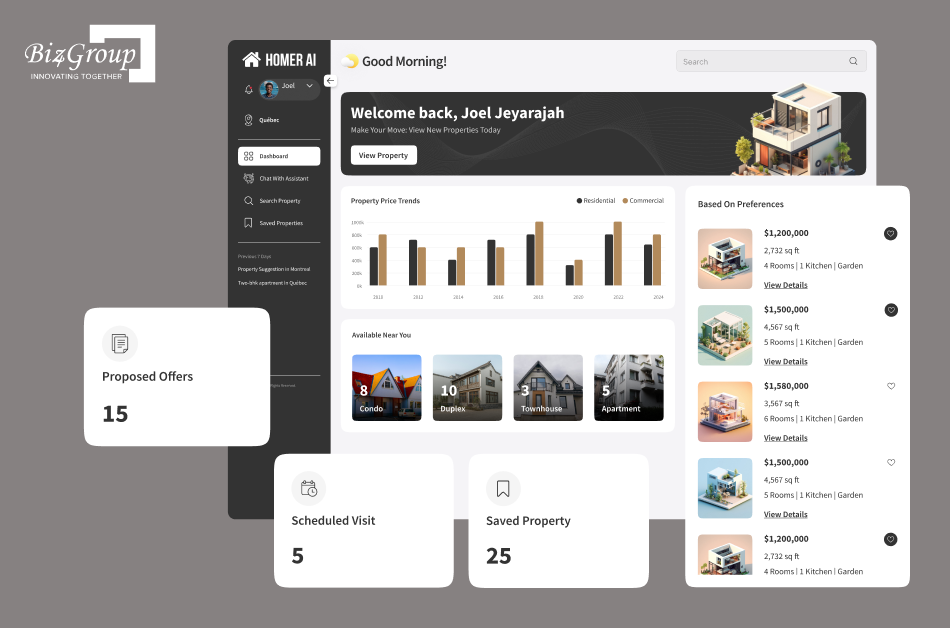
Biz4Group developed a conversational AI-powered property management platform designed to simplify interactions between buyers and sellers through intelligent automation.
Key capabilities included:
- Buyer and seller account management
- AI-guided property discovery
- Smart preference collection
- Automated scheduling workflows
- Real-time interaction handling
Projects like these reflect how modern HOA SaaS platforms are evolving beyond static dashboards toward conversational and workflow-focused user experiences.
Businesses exploring enterprise AI solutions increasingly expect these kinds of intelligent operational systems to exist directly inside the platform instead of functioning as disconnected third-party add-ons.
A strong foundation matters. But long-term success depends on something equally important... How much of the platform can actually be customized once development begins?
How Customizable Should a White-Label HOA Management Platform Be?
This is where many white-label platforms quietly fail.
Some systems look customizable during the sales demo but become restrictive once real business requirements enter the picture. That creates a serious problem for SaaS founders trying to scale under their own brand.
A properly structured customizable white-label HOA management platform development integrating AI approach should allow businesses to control both the customer experience and operational workflows without rebuilding the platform core repeatedly.
Customization should extend far beyond logos and color schemes.
What Should Be Fully Customizable?
The platform should support business-level flexibility across operations, workflows, and user experiences.
|
Area |
Why Customization Matters |
|---|---|
|
Branding and UI |
Creates product differentiation |
|
Resident workflows |
Supports unique operational processes |
|
Dashboard layouts |
Improves usability for different user roles |
|
Payment logic |
Supports different HOA fee structures |
|
Automation rules |
Reduces manual operational work |
|
Notification systems |
Matches communication preferences |
|
AI assistant behavior |
Aligns with resident support strategy |
|
Reporting structures |
Supports custom business insights |
|
User permissions |
Controls operational access |
|
Third-party integrations |
Expands platform functionality |
This flexibility becomes especially important for companies saying, “we are looking for a white-label AI HOA management system that can be customized and scaled for our clients.”
Because scaling multiple HOA communities usually requires operational variation across:
- Billing workflows
- Resident communication
- Compliance processes
- Vendor coordination
- Reporting requirements
What Should NEVER Be Hardcoded?
This is one of the most important technical questions founders should ask before signing any agreement. Hardcoded systems create long-term limitations that become expensive later.
Here are the biggest red flags:
1. Fixed Workflow Logic
If maintenance approvals, payment flows, or resident onboarding cannot be modified easily, scaling becomes difficult.
2. Locked Communication Systems
The platform should allow businesses to:
- Modify notification rules
- Integrate communication tools
- Configure AI support behavior
Rigid communication systems quickly become operational bottlenecks.
3. Static Database Structures
HOA operations evolve constantly. The architecture should support future feature expansion without requiring database rebuilds.
4. Closed API Ecosystems
A modern HOA SaaS product should connect easily with:
- Accounting systems
- Payment gateways
- CRM tools
- Communication platforms
- Document management systems
This is one reason many founders prioritize strong AI integration services during platform planning.
5. Single-Tenant Infrastructure
A scalable HOA SaaS product should support multiple communities efficiently. If the system architecture treats every customer as a separate deployment, operational costs increase rapidly.
Flexibility Matters More Than Feature Count
Many buyers compare platforms based on how many features exist on launch day. Experienced founders usually focus on something else.
How easily can the platform evolve over the next three years?
That distinction matters because HOA technology requirements change constantly as:
- Portfolios expand
- Resident expectations grow
- Operational workflows become more automated
- AI adoption increases
The strongest platforms are designed for continuous adaptation. That is why many businesses evaluating custom AI HOA software development vs. off-the-shelf solutions increasingly prioritize modular architecture over large feature checklists.
Customization Should Support Growth, Not Slow It Down
The goal of white-label development is not endless modification. It is controlled flexibility.
Founders should be able to:
- Launch quickly
- Customize strategically
- Scale efficiently
- Expand features over time
... without rebuilding the platform every time the business evolves.
And once customization requirements become clear, the next major question becomes technical. What kind of architecture and technology stack can actually support that level of scalability and flexibility long term?
Hardcoded Software Becomes Expensive Faster Than Most Founders Expect
Hardcoded Software Becomes Expensive Faster Than Most Founders Expect
Build Smart with Biz4GroupBest Tech Stack for White-Label Custom AI HOA Management Platform Development
A scalable HOA SaaS platform needs far more than a polished frontend.
The architecture must support multiple communities, secure financial workflows, real-time communication, and growing resident activity. That is why serious founders planning white-label custom AI HOA management software development usually focus heavily on architecture decisions early in the process.
Especially when the platform is expected to support thousands of users across multiple HOA communities.
Recommended Tech Stack for Modern HOA SaaS Platforms
|
Layer |
Recommended Technologies |
Purpose |
|---|---|---|
|
Frontend |
React.js, Next.js |
Fast and responsive UI |
|
Backend |
Node.js, NestJS |
Scalable backend services |
|
Mobile Apps |
Flutter, React Native |
Cross-platform mobile support |
|
Database |
PostgreSQL, MongoDB |
Structured and flexible data handling |
|
Cloud Infrastructure |
AWS, Azure, Google Cloud |
Scalable hosting and deployment |
|
AI Layer |
OpenAI APIs, LangChain |
Automation and conversational AI |
|
Authentication |
OAuth 2.0, JWT |
Secure login and access control |
|
Payments |
Stripe, Plaid |
HOA dues and transaction management |
|
Notifications |
Twilio, Firebase |
SMS, email, and push notifications |
|
File Storage |
AWS S3, Cloudflare R2 |
Secure document management |
|
Analytics |
Power BI, Metabase |
Operational reporting and insights |
This stack allows founders to create platforms capable of supporting AI-powered workflows, mobile accessibility, secure resident operations, and enterprise scalability.
Key Architecture Components That Matter Most
A modern create white-label AI HOA management software strategy should include:
- Multi-tenant SaaS architecture for managing multiple HOA communities efficiently
- Modular backend services for easier feature expansion
- API-first infrastructure for third-party integrations
- Role-based access control for admins, residents, vendors, and managers
- AI orchestration layer for automation workflows and intelligent communication
- Cloud-native deployment for scalability and uptime management
- Encrypted document storage for contracts and HOA records
- Event-driven notification systems for alerts and reminders
- Audit logging for compliance tracking and operational transparency
- Scalable database architecture for handling growing resident and transaction data
Many founders now enter the market saying, “I want to offer HOA management software under my brand using a ready-made AI-powered white-label system.” But scalability depends heavily on whether the platform architecture was designed for long-term SaaS growth from the beginning.
The next step after architecture becomes execution. How does the actual development process move from idea to launch-ready HOA SaaS platform?
How to Launch White-Label AI HOA Management Platform for Property Management Businesses
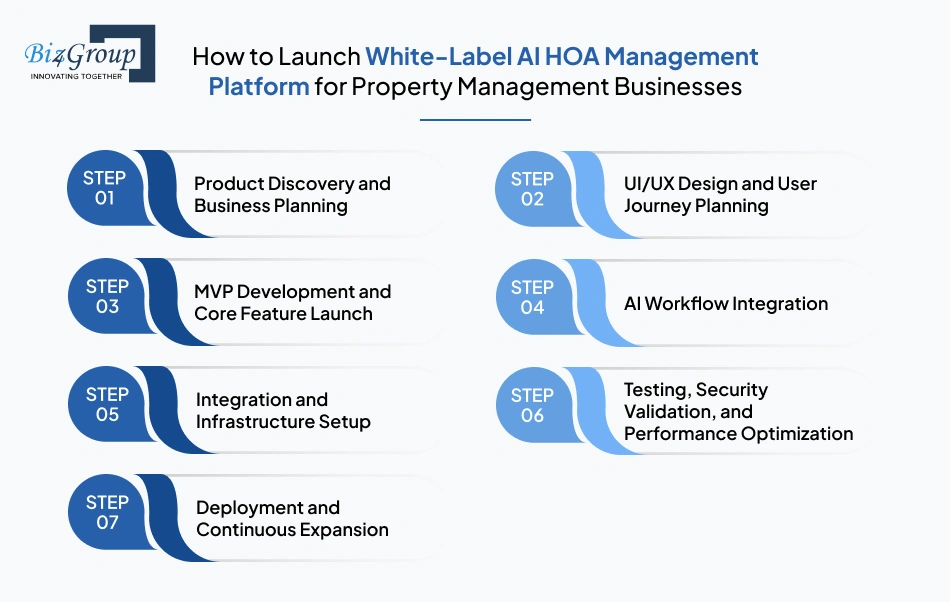
A successful HOA SaaS launch rarely begins with coding. It begins with clarity.
The planning stage becomes especially important for businesses saying, “I am planning to enter the proptech market and need a white-label AI HOA solution for fast deployment.” Because fast deployment only works when the product roadmap stays focused.
Here is how most successful development of white-label custom AI HOA management platform projects move from idea to launch.
Step 1. Product Discovery and Business Planning
This phase defines:
- Target users
- HOA workflow requirements
- SaaS pricing model
- Feature priorities
- Launch goals
The focus stays on identifying what the platform actually needs during early release versus future expansion.
|
Key Deliverables |
Why It Matters |
|---|---|
|
User flow mapping |
Improves operational clarity |
|
Feature prioritization |
Prevents overbuilding |
|
Community workflow analysis |
Aligns platform with HOA operations |
|
SaaS monetization planning |
Supports long-term revenue strategy |
Step 2. UI/UX Design and User Journey Planning
The user experience directly affects adoption. Residents, HOA managers, vendors, and admins all interact differently with the platform. That is why many founders work closely with a UI/UX design company before development begins.
This stage typically includes:
- Dashboard wireframes
- Onboarding flows
- Resident portal layouts
- Mobile responsiveness planning
- Workflow simplification
Also read: Top 15 UI/UX design companies in USA
Step 3. MVP Development and Core Feature Launch
This phase focuses on releasing the smallest commercially usable version of the product.
The MVP usually includes:
- Resident portal
- Admin dashboard
- Payment workflows
- Maintenance requests
- Communication systems
- Basic AI functionality
Founders exploring MVP development services often prioritize faster validation instead of waiting for enterprise-scale feature completion.
|
MVP Goal |
Expected Outcome |
|---|---|
|
Faster launch |
Early market feedback |
|
Reduced development spending |
Better capital efficiency |
|
Real user testing |
Product validation |
|
Earlier customer onboarding |
Faster traction |
Also read: Top 12+ MVP development companies in USA
Step 4. AI Workflow Integration
This is where operational automation begins entering the platform. Depending on business goals, AI systems may support resident communication, automated reminders, workflow routing, support ticket classification, and document intelligence.
Many businesses planning white-label custom AI HOA management platform development now prioritize AI functionality early because automation directly impacts operational efficiency.
In some cases, companies also prepare future workflows to:
- Build a 24/7 AI homeowner support bot for HOA communities
- Automate resident communication
- Reduce manual support overhead
Step 5. Integration and Infrastructure Setup
Once the core workflows are functional, external systems are connected. This stage may include:
- Payment gateway integration
- Accounting software connections
- Cloud deployment setup
- CRM integration
- Document management systems
Businesses planning to develop an automated HOA document retrieval system usually expand infrastructure requirements significantly during this phase.
Step 6. Testing, Security Validation, and Performance Optimization
Before launch, the platform undergoes:
- Functional testing
- User acceptance testing
- Security validation
- Performance optimization
- Cross-device compatibility checks
This phase helps identify workflow failures, security gaps, scalability concerns, and user experience friction. Especially in HOA SaaS environments where operational reliability directly affects resident trust.
Step 7. Deployment and Continuous Expansion
The launch is not the finish line. Most successful HOA SaaS products continue evolving through:
- Feature additions
- AI enhancements
- Workflow optimization
- Customer feedback
- Operational analytics
Many founders eventually decide to hire AI developers as platform adoption grows and automation requirements become more advanced.
And once the platform starts handling resident data, financial workflows, and legal documentation, another major factor becomes impossible to ignore... How secure is the platform, and who actually owns the technology behind it?
Twelve Months for an MVP in 2026? That’s a Long Wait
While traditional builds stretch toward 12 to 18 months, reusable AI SaaS components can reduce launch timelines dramatically.
Get on a Call TodaySecurity Standards Every White-Label AI HOA Platform Should Support
Security and ownership are usually the deciding factors for serious SaaS founders.
A platform may look impressive during the demo stage. But if ownership terms remain unclear or security standards are weak, scaling becomes risky very quickly.
This becomes especially important for founders saying, “I want to find a reliable US based company that provides white-label HOA software with AI automation features.”
Core Security Standards Every HOA SaaS Platform Should Support
|
Security Area |
Why It Matters |
|---|---|
|
End-to-end encryption |
Protects resident and payment data |
|
Role-based access controls |
Limits unauthorized access |
|
Multi-factor authentication |
Adds login security |
|
Secure cloud infrastructure |
Improves uptime and disaster recovery |
|
Audit logs |
Tracks operational activity |
|
API security protocols |
Protects third-party integrations |
|
Automated backups |
Prevents data loss |
|
Compliance monitoring |
Supports operational transparency |
A strong SaaS HOA management software white-label solutions provider should already include these standards within the platform architecture instead of treating them as optional upgrades.
Ownership Questions Founders Should Clarify Early
Ownership confusion creates long-term operational problems. Before signing any agreement, founders should understand exactly what they control.
|
Ownership Area |
Questions to Clarify |
|---|---|
|
Source code ownership |
Will you own the codebase fully or partially? |
|
Licensing rights |
Can the platform be resold under your brand? |
|
Platform portability |
Can another team continue development later? |
|
Infrastructure ownership |
Who controls hosting and cloud accounts? |
|
AI workflow ownership |
Are custom automations transferable? |
|
Third-party dependency |
Which services remain vendor-controlled? |
Many founders evaluating white-label custom AI HOA management software development now prioritize ownership discussions before feature discussions. That shift reflects how seriously SaaS buyers view long-term scalability and operational independence.
Security Risks Founders Should Avoid
Not every white-label platform supports enterprise-level growth. Common red flags include:
- Shared databases across clients
- Unclear licensing agreements
- Limited admin controls
- Weak encryption standards
- Restricted API access
- Vendor-locked infrastructure
- Undocumented backend systems
These limitations often create expensive migration problems later. That is one reason many founders researching how to create branded HOA management software without building from scratch now evaluate technical transparency as carefully as pricing.
Portfolio Spotlight: Real Estate Contract Management Tool
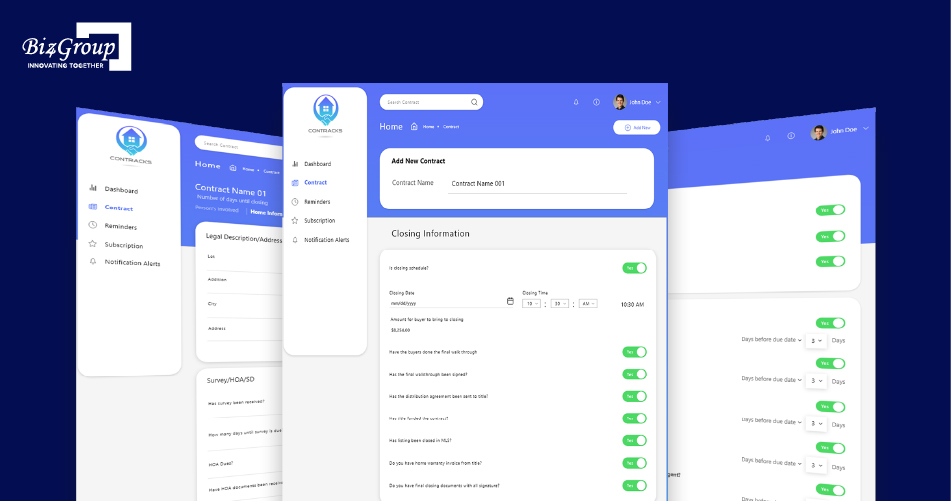
Biz4Group developed a real estate contract management platform designed to simplify complex document workflows while maintaining enterprise-level operational security.
Key operational capabilities included:
- Multi-party contract workflows
- Secure Stripe payment integration
- Centralized notification management
- Smart contract search functionality
- AI-based document intelligence
- Role-specific access controls
One of the biggest operational advantages came from reducing the manual workload attached to document-heavy real estate processes while improving workflow visibility across stakeholders.
Projects like these reflect what modern HOA SaaS buyers increasingly expect from platforms handling. Especially for companies saying, “we are managing property operations and want to find US-based AI software companies that can develop white-label HOA management platforms with automation for resident support, billing, and maintenance workflows.”
Because long-term SaaS growth depends heavily on both operational reliability and ownership clarity.
And before selecting any development partner, founders should know exactly what questions separate experienced technology partners from generic software vendors.
What to Ask a White-Label Custom AI HOA Management Platform Development Partner?
Choosing the wrong development partner can delay launch timelines, increase operational costs, and create long-term technical limitations. That is why experienced founders evaluate development companies far beyond pricing presentations.
Especially when the goal involves create white-label AI HOA management software that can scale into a long-term SaaS business.
Here are some of the most important questions worth asking before making a decision.
|
Question |
Why It Matters |
|---|---|
|
Have you built HOA or PropTech platforms before? |
Industry experience lowers workflow mistakes |
|
What parts of the platform are configurable after launch? |
Determines future flexibility |
|
How do you handle platform upgrades and scaling? |
Impacts long-term SaaS growth |
|
Can the platform support custom AI workflows later? |
Prevents AI limitations during expansion |
|
What reporting and analytics capabilities exist? |
Supports operational visibility |
|
How do you approach performance optimization? |
Affects user experience as communities grow |
|
What post-launch support structure do you provide? |
Reduces operational downtime |
|
How transparent is the development roadmap? |
Improves project clarity and planning |
Many founders entering this market are effectively asking, “I need a company that can provide a customizable AI HOA management platform for my business.” That is why technical transparency matters far more than flashy demos.
A Quick Way to Filter Serious Development Partners
Before shortlisting any company, evaluate whether they can explain:
- Architecture decisions clearly
- AI implementation realistically
- Scaling limitations honestly
- Launch timelines practically
- Operational workflows in detail
Experienced SaaS founders also compare vendors against industry benchmarks like the top 10 AI HOA management software development companies in USA before selecting a long-term technology partner.
The strongest development companies usually communicate like product builders, not software resellers. And that distinction becomes very clear once you start discussing real platform strategy instead of feature lists alone.
So where does Biz4Group fit into this picture?
One Wrong Development Decision Can Delay Growth by Years
More than 70% of software rebuilds happen because businesses outgrow poor architecture and limited scalability.
Talk to HOA SaaS SpecialistsBiz4Group LLC: A USA-Based Company Building Modern White-Label AI HOA Management Platforms
Launching an HOA SaaS platform requires product thinking, operational understanding, AI expertise, scalable architecture, and the ability to turn a business vision into a commercially usable platform without wasting months on avoidable engineering problems.
That is where Biz4Group stands apart.
Biz4Group LLC is a USA-based technology company specializing in AI-powered software, SaaS platforms, enterprise applications, and custom digital ecosystems for startups, enterprises, and fast-growing businesses. Over 20 years, the company has built platforms across PropTech, healthcare, legal, eCommerce, automation, and enterprise AI operations.
What makes Biz4Group particularly effective in the HOA and real estate technology space is its ability to combine
- scalable SaaS engineering,
- AI workflow automation,
- operational usability,
- enterprise-grade infrastructure,
- long-term product scalability
... into one connected product strategy.
Building a successful HOA SaaS platform involves balancing technical execution with business practicality. Biz4Group approaches projects from both angles.
As a leading real estate AI software development company, Biz4Group has already delivered intelligent workflow platforms, AI-powered automation systems, document-heavy enterprise solutions, and conversational AI applications designed for modern property operations.
Why Businesses Choose Biz4Group LLC
1. Product-first development mindset
Biz4Group builds platforms around business outcomes, not feature overload. Every workflow, dashboard, and automation layer is designed to support usability, scalability, and long-term operational efficiency.
2. Strong experience in AI and automation
The company has delivered AI-powered platforms across multiple industries, giving clients access to practical automation systems instead of experimental AI implementations.
3. Real SaaS scalability expertise
Biz4Group understands how to structure platforms that can support growing user bases and expanding operational demands.
4. Transparent and collaborative development
Businesses work directly with experienced strategists, designers, architects, and engineers throughout the development lifecycle.
5. Flexible customization capabilities
The company develops modular systems that support future expansion instead of locking businesses into rigid software structures.
Many founders entering the market today are effectively saying, “I am planning to launch a proptech SaaS product and looking for US-based companies that can provide a white-label AI HOA management platform with full customization and branding support.”
That requirement aligns directly with how Biz4Group approaches product development.
Not as a software reseller. Not as a template provider.
But as a technical co-builder helping businesses launch scalable digital products under their own brand.
If your goal is to launch a branded HOA SaaS platform faster, reduce development risk, and build a scalable product with long-term ownership flexibility, this AI development company is positioned to help you move from concept to launch with clarity and confidence.
So, without wasting any more time, talk to Biz4Group about your white-label AI HOA platform vision and get a practical roadmap today.
To Summarize...
The HOA technology market is moving toward smarter, faster, and more scalable digital operations. Property management businesses and PropTech founders want platforms that can launch quickly, automate operations intelligently, and evolve alongside their business goals. That shift is exactly why white-label custom AI HOA management platform development has become such a strong opportunity in the SaaS and real estate technology space.
For founders evaluating how to launch white-label AI HOA management platform for property management businesses, the biggest advantage often comes down to speed and flexibility. Instead of spending years rebuilding operational systems from scratch, businesses can launch branded HOA platforms using prebuilt AI-ready infrastructure while focusing their energy on customer acquisition, workflow innovation, and product differentiation.
That is where Biz4Group delivers real value. As a trusted USA-based software development company, Biz4Group helps startups, enterprises, and property technology businesses build scalable HOA SaaS ecosystems backed by AI automation, flexible architecture, secure infrastructure, and practical product strategy. The company approaches every platform as a long-term business product instead of a short-term software build.
So if you are thinking, “we are a property management company and want to launch our own branded HOA software quickly using a white-label AI platform,” this may be the right time to move from planning to execution.
Connect with Biz4Group and start building a branded AI-powered HOA platform designed for growth, ownership, and faster market entry.
FAQs
1. Can a white-label HOA platform support both web and mobile applications?
Yes. Most modern HOA SaaS platforms are developed with responsive web architecture and cross-platform mobile support. This allows residents, HOA managers, vendors, and administrators to access the system through browsers, Android apps, and iOS apps without requiring separate operational workflows.
2. How long does white-label AI HOA management platform development usually take?
A traditional HOA platform built completely from scratch may take anywhere between 10 to 18 months depending on complexity. A white-label approach significantly reduces that timeline because the core infrastructure already exists. Biz4Group can deliver a functional MVP within 2 to 4 weeks using reusable architecture components that reduce both development time and implementation costs.
3. Can I add new AI features after the platform launches?
Yes. A properly structured white-label HOA platform should support future AI expansion without requiring major system rebuilds. Businesses often add features later such as AI-based resident assistants, predictive maintenance workflows, intelligent reporting, smart violation detection, and automated communication systems as their customer base grows.
4. Is white-label HOA software suitable for startups with limited technical teams?
Absolutely. Many PropTech startups use white-label platforms specifically because they do not want to spend months building backend infrastructure internally. The model allows founders to launch faster while focusing more on growth, onboarding, sales, partnerships, and operational strategy instead of managing large engineering teams early on.
5. Can a white-label HOA platform support multiple revenue models?
Yes. Businesses can structure the platform around different monetization strategies including monthly SaaS subscriptions, per-community pricing, enterprise licensing, premium feature tiers, onboarding fees, transaction fees, or hybrid pricing models depending on the target market.
6. Why are founders choosing white-label HOA platforms instead of buying existing HOA software licenses?
Founders choosing white-label platforms usually want stronger branding control, product ownership flexibility, deeper customization, and long-term SaaS growth opportunities. Traditional HOA software licenses are often designed for internal operational use, while white-label platforms are structured for businesses planning to launch and scale their own software products.
