Location :
Orlando, FL, USA
Location :
Orlando, FL, USA +1 (407) 714-1616
 info@biz4group.com


















Imagine a digital system that doesn’t wait for instructions but instead, understands your business goals, learns from real-time feedback, and takes independent actions to get the job done.
Read More

What happens when a policyholder calls your insurance support line right after an accident and expects immediate guidance?
Claim communication is often the first real interaction a customer has with an insurer during a stressful situation. The way that interaction is handled shapes customer confidence and operational efficiency across the entire claim process. Insurance leaders are now rethinking how claim conversations are managed through intelligent voice systems powered by conversational AI.
The industry shift is also reflected in market momentum.
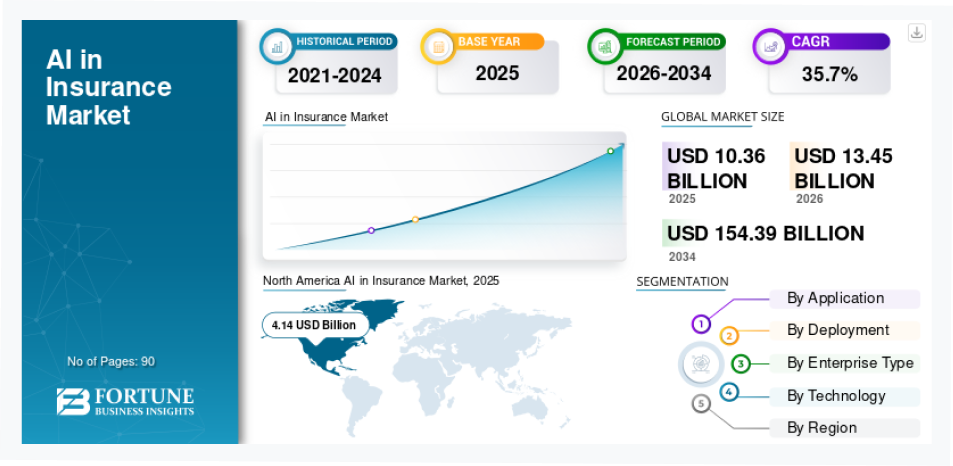
These trends show that insurers are actively investing in technologies that improve operational responsiveness and customer communication. This is where AI IVR system development for insurance claim operations becomes relevant. Instead of relying on rigid call menus, insurers can introduce voice systems that understand customer intent and guide claim interactions naturally.
This guide will help you understand how insurers can create a smart IVR system for insurance claim management, from structuring voice workflows to designing effective claim conversations and deploying scalable support systems. It also explains how an experienced AI product development company supports implementation by aligning voice automation with real insurance operations.
Insurance providers manage a high volume of policyholder calls related to claims and policy services. AI IVR system development for insurance claim environments focuses on creating voice systems that understand natural speech instead of relying on rigid call menus. These platforms enable conversational voice automation so customers can speak naturally during support interactions. The system also connects with internal insurance workflows to access policy and claim data while guiding callers through automated claim communication. This approach allows insurers to deliver structured claim assistance while supporting AI automation initiatives across customer service operations.
An AI IVR platform operates through several layers that capture voice input, interpret language, and generate responses. Here take a look:
Also Read: How to Develop ASR System like Whisper AI
Together, these architectural layers form the foundation that enables conversational voice systems to operate reliably within insurance environments while supporting scalable and structured claim communication.
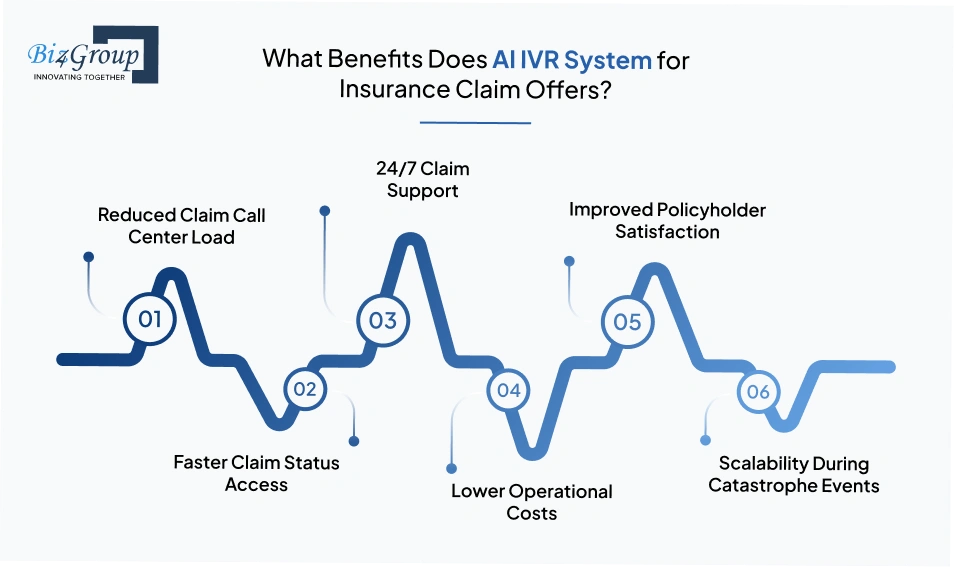
Insurance claim departments handle thousands of customer calls that often involve routine updates and simple claim questions. An intelligent voice system helps insurers manage this volume more efficiently. As organizations invest in AI IVR system development for insurance claim environments, the operational impact becomes visible in service efficiency.
Insurance companies that adopt intelligent voice support quickly notice improvements in both operational efficiency and customer communication. These benefits help insurers handle growing claim volumes while maintaining reliable support for policyholders.
Insurance claim support requires clear communication and fast responses for policyholders. Companies that want to make AI IVR platform for insurance claim automation focus on capabilities that simplify claim interactions while maintaining reliable service. When combined with strong enterprise AI integrations, voice interactions become a structured support channel rather than a simple call menu.
|
Feature |
What the Feature Does |
|---|---|
|
Claim Reporting via Voice |
Allows policyholders to report an incident using spoken instructions during a call. The system records claim details such as policy number, incident description, and location so insurers can begin claim documentation immediately. |
|
Claim Status Tracking |
Enables callers to check the progress of their insurance claim without waiting for a support agent. The IVR system retrieves current claim updates and communicates the status clearly during the call. |
|
Policyholder Authentication |
Verifies the identity of the caller before providing claim information. The system confirms policy numbers or personal details to ensure sensitive claim data is shared only with authorized policyholders. |
|
Smart Call Routing |
Directs complex claim situations to the most appropriate support representative. When automated responses cannot resolve a request, the call is transferred to the correct claims department. |
|
Document Submission Guidance |
Provides clear instructions for submitting claim documents such as photos, invoices, or reports. The system guides policyholders on where and how to send the required information for claim processing. |
|
Multilingual Support |
Allows the IVR system to communicate with policyholders in multiple languages. This helps insurers support diverse customer groups and ensure claim instructions remain clear and accessible. |
|
Callback Options |
Gives callers the option to request a return call when agents are busy. This prevents long waiting times and helps maintain a smoother claim support experience. |
|
Escalation to Agents |
Transfers the call to a human representative when the situation requires detailed assistance. An AI voice agent handles routine conversations first and then escalates complex requests to the claims team. |
|
Claim Update Notifications |
Provides automated voice updates about claim milestones such as document verification or claim approval. These notifications keep policyholders informed without requiring repeated calls to the insurer. |
|
Incident Information Capture |
Collects important claim details directly from the caller during the conversation. An insurance AI agent records information that helps claims teams review incidents faster. |
|
Call Summary Logging |
Generates a structured summary of each interaction and stores it in the insurer’s support system. This record helps customer service teams understand previous conversations when follow-up assistance is required. |
Together, these capabilities help insurers develop intelligent IVR for insurance customer support while maintaining structured communication during claim interactions. Well-designed features play a central role in AI IVR system development for insurance claim environments by ensuring claim support remains accessible, organized, and reliable.
Insurance claim support becomes more effective when voice systems move beyond simple interaction handling and begin interpreting conversations intelligently. Organizations that make an automated IVR system for insurance claim processing focus on AI capabilities that help systems understand callers, anticipate claim needs, and respond with more contextual accuracy during real conversations.
|
AI Capability |
What the Capability Does |
|---|---|
|
Contextual Conversation Understanding |
Interprets the meaning of a caller’s statement based on the full conversation rather than isolated phrases. The system recognizes context across multiple responses, so interactions remain coherent during longer claim discussions. |
|
Predictive Claim Assistance |
Uses historical claim patterns and caller information to anticipate what assistance a policyholder may need next. This capability applies predictive analysis to guide conversations toward relevant claim actions or information requests. |
|
Voice Biometrics Authentication |
Confirms caller identity through unique voice characteristics. This method strengthens claim security and helps insurers verify policyholders without requiring multiple manual identity questions during the call. |
|
Sentiment Detection |
Recognizes emotional signals within the caller’s voice such as stress or frustration. By applying sentiment analysis, the system can adjust responses or escalate conversations when the interaction indicates a sensitive claim situation. |
|
Fraud Detection Signals |
Identifies unusual claim conversation patterns that may require additional verification. The system monitors voice responses and interaction patterns to flag potential risk indicators for review by the insurer’s investigation team. |
|
AI Learning from Call Interactions |
Continuously improves understanding of real customer conversations by learning from previous interactions. This allows insurers to build scalable AI IVR software for insurance call centers that adapts to changing claim communication patterns. |
|
Dynamic Dialogue Optimization |
Adjusts conversation flow based on the caller’s responses and interaction behavior. The system refines how questions are asked so claim conversations remain clear, efficient, and aligned with the caller’s request. |
These intelligence-driven capabilities elevate the role of voice automation within insurance operations. As insurers expand AI IVR system development for insurance claim environments, advanced AI capabilities help transform routine call handling into more responsive and context-aware claim communication.
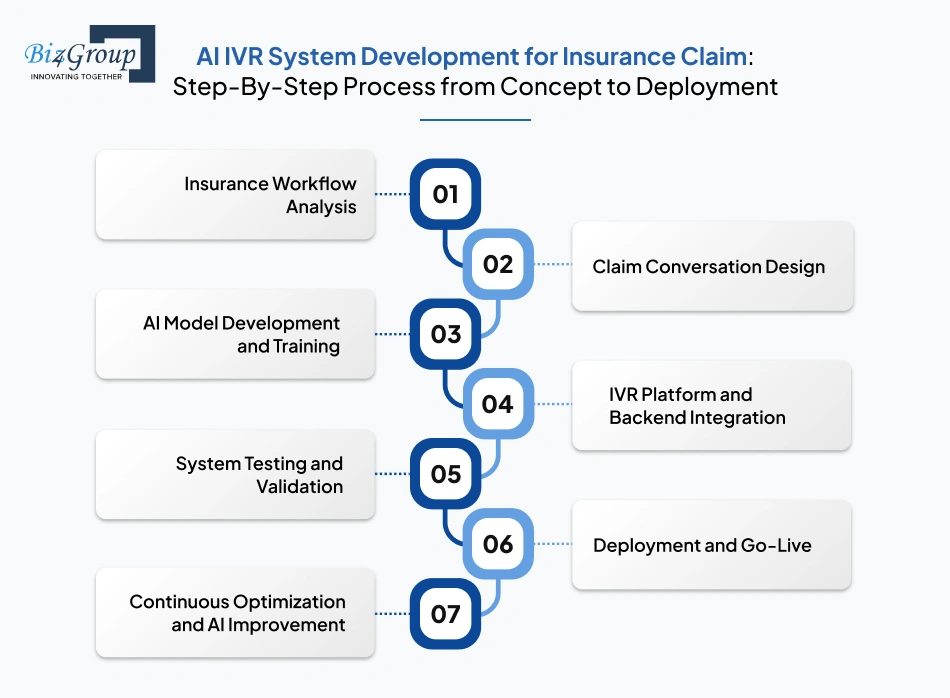
If you're trying to understand how to create an AI powered IVR for insurance claim processing, start by mapping real claim interactions and support workflows. These foundations help shape a reliable Insurance customer support IVR system for policyholder communication.
Also Read: Top MVP Development Companies in USA
Also Read: Top Software Testing Companies in USA
A structured development approach ensures insurers can confidently create smart IVR system for insurance claim management while maintaining reliable communication with policyholders. Following these stages helps transform claim workflows into a stable automated voice support system.
Discuss your claim workflows and build a production ready IVR system designed for insurance operations
Talk To Our TeamInsurance companies rely on multiple technology layers to develop AI IVR system for insurance claim processing, from telephony infrastructure and speech recognition engines to backend integrations. The technology stack below enables the IVR platform to process voice inputs, understand claim-related requests, and connect conversations directly with insurance claim management systems.
|
Architecture Layer |
Technologies / Tools |
Purpose in AI IVR System |
|---|---|---|
|
Telephony & Call Routing Layer |
Twilio, Genesys Cloud, Amazon Connect, Asterisk |
Receives policyholder calls, manages IVR menus, and routes claim inquiries to AI automation or live agents |
|
Voice Processing (Speech-to-Text / ASR) |
Google Speech-to-Text, Amazon Transcribe, Azure Speech AI |
Converts caller speech into structured text so AI services can process claim requests |
|
Natural Language Understanding |
Rasa NLU, Dialogflow CX, spaCy, OpenAI APIs |
Identifies caller intent such as reporting an accident or checking claim status |
|
Dialogue Management Engine |
Rasa Core, Dialogflow CX, Microsoft Bot Framework |
Controls conversation flow and determines the next prompt based on claim interaction context |
|
AI / Machine Learning Layer |
Python, TensorFlow, PyTorch, Hugging Face |
Powers intent classification, entity extraction, and language understanding for insurance terminology |
|
Backend & API Integration Layer |
Node.js, Python (FastAPI, Flask), Java (Spring Boot) |
Connects IVR workflows with claim management platforms, CRM systems, and policy databases |
|
Text-to-Speech (TTS) Layer |
Amazon Polly, Google Text-to-Speech, Azure Speech |
Generates natural voice responses that communicate claim updates or instructions to callers |
|
Authentication & Security Layer |
OAuth, JWT, Twilio Verify, Voice Biometrics APIs |
Verifies policyholder identity and protects sensitive policy and claim information |
|
Data Storage Layer |
PostgreSQL, MongoDB, Redis |
Stores conversation history, claim interaction logs, and session data for operational insights |
|
Integration / Middleware Layer |
Apache Kafka, MuleSoft, RabbitMQ |
Enables real-time communication between IVR services and legacy insurance claim systems |
|
Analytics & Monitoring Layer |
ELK Stack, Datadog, Prometheus, Grafana |
Tracks automation rates, call completion metrics, and system performance |
|
Admin Dashboard & Management Interface |
Allows operations teams to monitor calls, adjust conversation flows, and analyze IVR performance |
|
|
DevOps & Deployment Layer |
Docker, Kubernetes, Jenkins, GitHub Actions |
Supports automated deployments, scaling, and infrastructure reliability |
|
Cloud Infrastructure Layer |
AWS, Microsoft Azure, Google Cloud Platform |
Hosts telephony services, AI processing components, and secure data storage environments |
Selecting the right technology stack ensures reliability, scalability, and seamless integration with claim systems, enabling organizations to build AI IVR system for insurance companies that improves claim handling efficiency and customer communication.
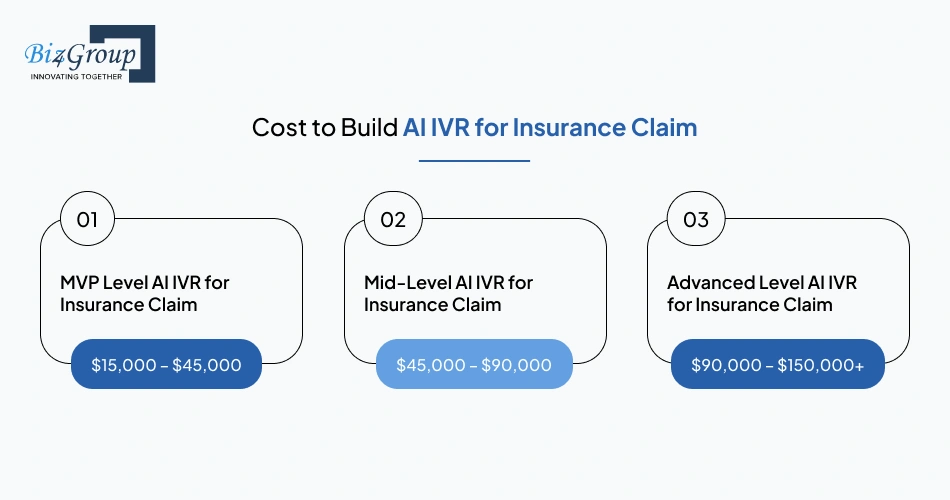
Insurance companies planning AI IVR system development for insurance claim operations often want to understand the investment required before moving forward. The cost typically ranges from $15,000 to $150,000+, depending on system scope, operational complexity, and how deeply the voice system connects with insurance workflows.
|
Development Level |
Estimated Cost Range |
Scope |
|---|---|---|
|
MVP Level AI IVR for Insurance Claim |
$15,000 – $45,000 |
Basic voice interaction handling simple claim inquiries and limited backend connectivity. Suitable for insurers validating automated claim communication. |
|
Mid-Level AI IVR for Insurance Claim |
$45,000 – $90,000 |
Supports broader claim workflows, improved voice understanding, and deeper integration with claim management systems. |
|
Advanced Level AI IVR for Insurance Claim |
$90,000 – $150,000+ |
Enterprise scale system supporting large call volumes, complex claim workflows, and full operational alignment with insurance support environments. |
A realistic investment plan helps insurers create smart IVR system for insurance claim management that aligns with operational requirements. Careful planning ensures the system supports real claim interactions while maintaining reliability and scalability.
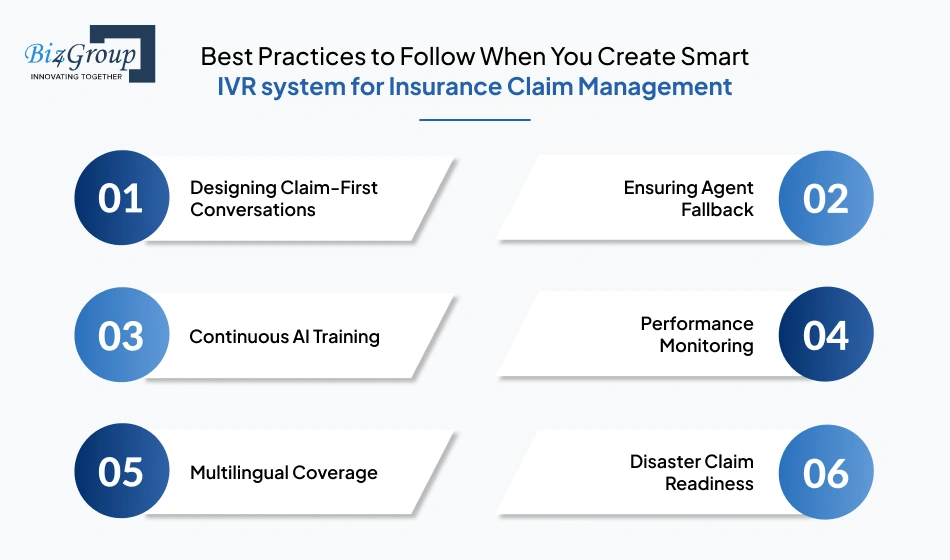
Insurance claim interactions often happen during stressful situations for policyholders. A well-planned approach helps insurers maintain clarity, responsiveness, and consistency in voice support. Organizations investing in AI powered IVR development for insurance claims should focus on practical strategies that strengthen reliability and customer experience across everyday claim conversations.
Claim conversations should reflect how policyholders actually describe incidents and request assistance. Structuring dialogue around real claim scenarios ensures the AI conversation remains natural. This approach strengthens insurance call automation IVR development by aligning voice interactions with real support needs.
Automated conversations should always allow a smooth transition to human support when necessary. Some claim situations require personal guidance or detailed clarification. Providing quick agent access ensures that AI IVR system development for insurance claim environments maintain trust during sensitive claim interactions.
Voice systems improve when conversation data is reviewed regularly. Ongoing AI model development allows the system to understand evolving claim questions and communication patterns. Continuous learning helps insurers maintain reliable performance across different types of claim conversations.
Monitoring IVR performance helps insurers identify areas where claim communication can be improved. Tracking interaction outcomes and caller behavior provides insights into system effectiveness. These insights support long term improvements when organizations create AI IVR solution for insurance claims.
Insurance companies often serve customers from diverse language backgrounds. Supporting multiple languages ensures claim instructions remain clear for all policyholders. Multilingual communication helps insurers provide consistent claim support across wider customer groups.
Natural disasters and large accident events can generate sudden spikes in claim calls. Preparing the IVR system for these situations ensures service remains available during high demand. Many insurers work with an experienced AI development company to maintain operational stability during crisis events.
Following these practical recommendations helps insurers maintain reliable voice interactions during claim communication. These strategies strengthen AI IVR system development for insurance claim initiatives by ensuring claim conversations remain clear, responsive, and dependable for policyholders.
Let's design voice interactions that actually match how your policyholders report and track claims
Schedule A Consultation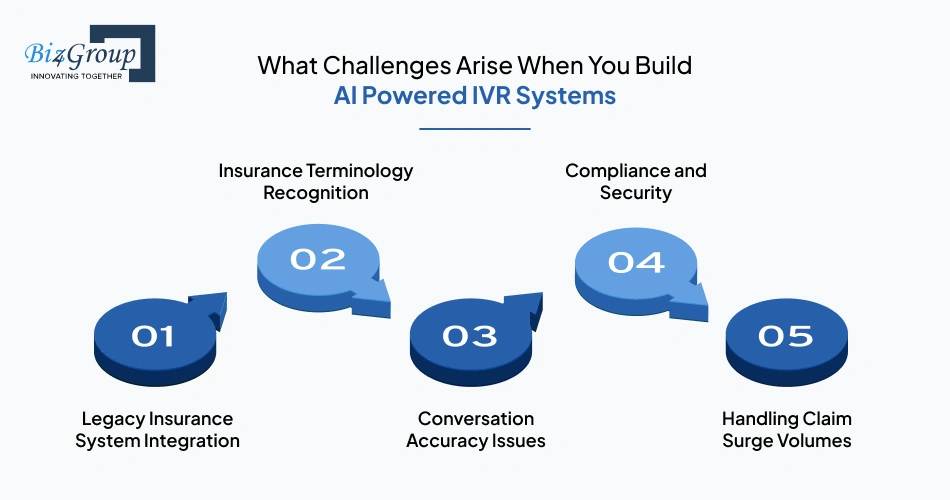
Insurance companies adopting voice automation quickly realize that implementation involves several operational and technical challenges. During Insurance claim IVR system development, teams must align customer communication, internal systems, and compliance requirements while maintaining reliable service for policyholders.
Many insurers still operate on older claim management platforms that were not designed for modern voice systems. During AI IVR system development for insurance companies, connecting new voice interfaces with legacy databases can create delays, compatibility issues, and inconsistent data access.
Solution: A practical approach is to introduce integration layers that allow the IVR platform to communicate with older systems safely. Many insurers rely on experienced teams that provide AI consulting services to map legacy workflows and ensure reliable data exchange.
Insurance conversations often include specialized terms related to policies, coverage types, and claim processes. Without proper training, voice systems may misunderstand how customers describe incidents, which can affect AI IVR system development for insurance claim environments.
Solution: Training language models with real insurance call data helps the system recognize common claim expressions and policy terminology. Teams that hire AI developers with domain knowledge can refine language understanding, so voice interactions remain accurate and consistent.
Policyholders may describe claim incidents in different ways depending on the situation. This variation can make it difficult for the system to interpret requests consistently, especially during early phases of Insurance claim IVR system development.
Solution: Continuous conversation testing and refinement improves how the system interprets customer speech. Reviewing real call interactions allows teams to adjust responses and strengthen voice understanding before expanding the system across larger customer groups.
Insurance claim conversations often involve sensitive personal and policy information. Voice systems must ensure that this data remains protected during interactions while meeting regulatory standards required in insurance operations.
Solution: Strong authentication methods and secure data handling processes help maintain compliance. When organizations build AI voice bot IVR for insurance claims, they typically implement secure identity verification and controlled data access across claim interactions.
Natural disasters or large accident events can create sudden spikes in claim related calls. Without preparation, these surges can overwhelm support systems and disrupt claim communication.
Solution: Scalable infrastructure allows voice systems to manage large call volumes without service interruption. Careful capacity planning ensures the IVR system can support thousands of simultaneous claim conversations during peak demand periods.
Addressing these challenges early helps insurers maintain reliable voice interactions and operational stability. A well-planned approach ensures AI IVR system development for insurance claim environments can support real claim communication while adapting to operational complexities.
Insurance leaders evaluating voice automation often look for a partner who understands both insurance operations and enterprise technology environments. At Biz4Group LLC, we work closely with insurers to design reliable voice systems that support real claim communication needs while aligning with existing operational workflows.
Working with insurance workflows requires practical domain understanding. Our team approaches each project with strong experience in designing an AI insurance software solution that aligns voice interactions with real claim communication used in insurance operations.
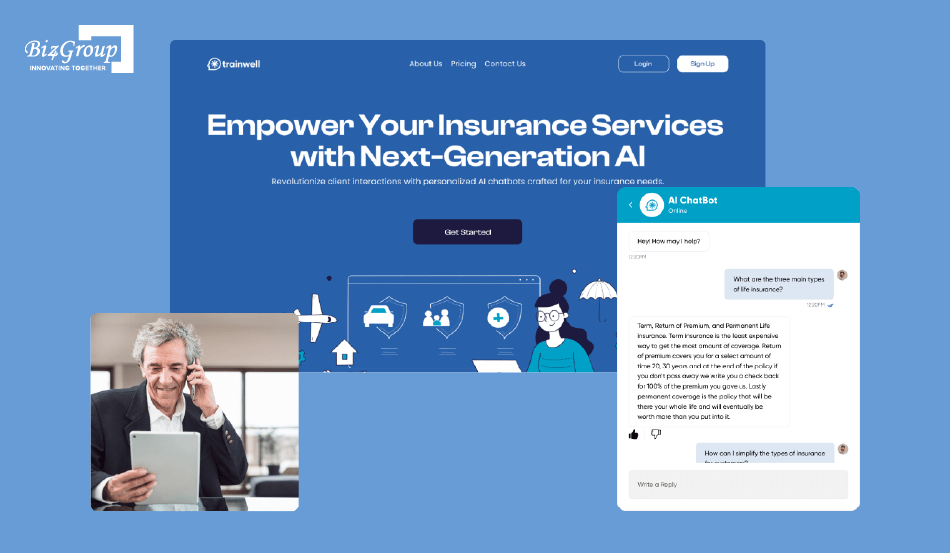
Insurance AI is a generative AI chatbot built to support insurance agent training and knowledge access. It was introduced to replace frequent Zoom training sessions and long documentation by giving agents instant answers to policy and operational questions during daily workflows.
Key Features
Experience gained from developing systems like Insurance AI strengthens our ability to design domain-aligned solutions for insurance communication workflows.
Looking for teams experienced in Insurance IVR system development? Our engineers focus on creating stable voice systems that support automated claim communication. This experience positions us among the top AI IVR system development companies in USA working with enterprise insurers.
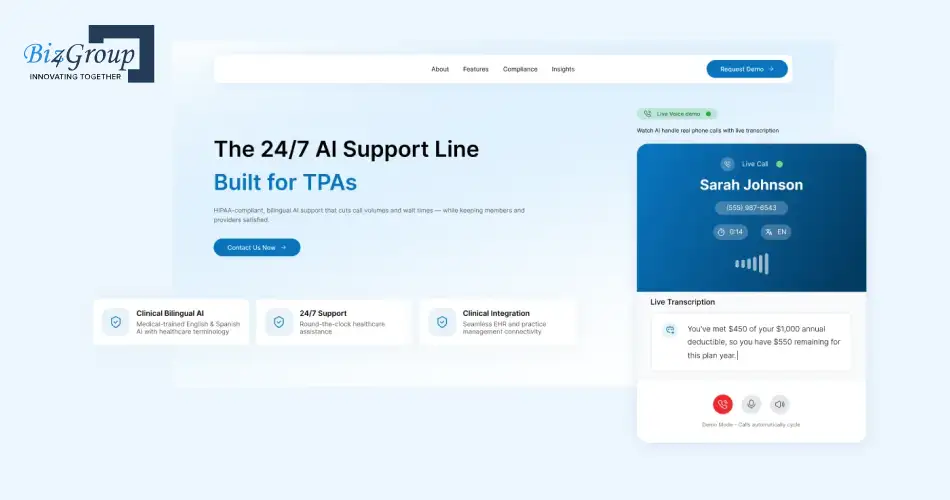
We developed an AI IVR platform for healthcare insurance sector that handles policy inquiries, service requests, and claim-related conversations through automated voice interactions.
This project reflects our ability to design conversational systems that capture claimant information accurately.
Insurance systems rarely operate in isolation. Our team connects voice platforms with policy systems, claim platforms, and customer databases, so your automated insurance claim IVR communicates with real operational data.
Every insurance organization operates differently. Instead of relying on fixed templates, we design flexible AI powered IVR for insurance companies that adapt to specific claim processes and communication patterns used within each organization.
Voice automation must operate reliably within large customer support environments. Our teams help insurers deploy scalable Insurtech SaaS product and AI IVR solution platforms while ensuring the system remains stable across high claim interaction volumes.
Insurance companies implementing AI IVR system development for insurance claim initiatives benefit from partners who understand both technology and insurance operations. Our goal is to help insurers introduce voice automation that fits naturally into their existing claim communication processes.
Share your claim support challenges and we'll help design a system insurers and policyholders both trust
Get In TouchInsurance claims are often stressful moments for policyholders, and the way insurers handle communication during these interactions shapes customer trust. When claim support relies only on traditional call center processes, delays and repeated inquiries quickly increase operational pressure. Organizations working with top AI development company increasingly address this challenge through structured voice automation designed specifically for claim communication.
A well-implemented system supports automated claim reporting, instant claim status updates, and guided assistance during policyholder calls. This shift allows insurers to maintain responsive support while reducing operational strain across service teams. Successful AI IVR system development for insurance claim initiatives focus on aligning voice interactions with real claim workflows rather than generic automation.
If you're planning to develop an AI IVR system for insurance claims, Let’s connect with our team at Biz4group LLC would be glad to discuss how it can support your claim operations.
Before starting AI IVR system development for insurance claim workflows, insurers should evaluate existing claim communication patterns, call center volumes, and system integrations. A successful implementation requires alignment with claim workflows, policy databases, and customer support operations. Decision makers should also assess scalability requirements so the system can support claim surges during catastrophe events.
The timeline to develop AI IVR system for insurance claim processing usually ranges from 8 to 20 weeks depending on system complexity. Projects involving basic claim status interactions move faster, while enterprise deployments with deep claim platform integration and advanced voice capabilities require longer development and testing cycles.
The cost of AI IVR system development for insurance claim generally ranges between $15,000 and $150,000 depending on project scope. Basic implementations with limited integrations fall toward the lower range, while enterprise solutions with advanced automation, system integrations, and scalable infrastructure fall toward the higher end of the investment spectrum.
AI powered IVR development for insurance claims helps insurers automate routine claim inquiries such as status updates and policy verification. This reduces pressure on support teams while ensuring policyholders receive quick responses. As a result, insurance call center automation improves operational efficiency without increasing staffing requirements.
Yes. Many startups and Insurtech platforms now build scalable AI IVR software for insurance call centers to support growing customer bases. Cloud infrastructure and modular integrations allow new insurers to launch automated claim support systems that scale as claim volumes increase.
A well-designed AI voice bot IVR for insurance claims allows policyholders to report incidents, request claim updates, and receive guidance through voice interactions. This approach helps insurers maintain consistent communication during the claim process while improving accessibility for customers who prefer voice support.

with Biz4Group today!
Our website require some cookies to function properly. Read our privacy policy to know more.