Location :
Orlando, FL, USA
Location :
Orlando, FL, USA +1 (407) 714-1616
 info@biz4group.com


















Imagine a digital system that doesn’t wait for instructions but instead, understands your business goals, learns from real-time feedback, and takes independent actions to get the job done.
Read More

Why do teams still struggle to find the right information even when their systems are full of data? Enterprise knowledge today sits across tools, documents, and systems, but it rarely comes together when teams need clarity. This creates friction that slows down execution and makes even simple decisions harder than they should be. As:
This gap is not about missing data; it is about how that data is actually used. So, the solution lies in an AI knowledge system that connects, interprets, and delivers information in context instead of leaving it scattered across systems. That shift is already visible:
This growing adoption is pushing organizations to move beyond experimentation and focus on AI knowledge system development for businesses as a structured initiative. Teams now work with an experienced AI product development company to prioritize the development of AI internal knowledge system for companies that fit real workflows.
This blog breaks down how the shift works and what it takes to implement AI knowledge management system effectively. Let's dive in
An AI knowledge system is a system that ingests, organizes, retrieves, and reasons over data to make information usable in context. It does not just store data but connects it in a way that allows meaningful interpretation. It works across structured, unstructured, and semi-structured data, enabling the system to understand different formats within a unified framework.
In a business context, this system operates across enterprise data sources such as internal tools, documents, databases, and communication records. It brings these inputs into a structured environment where information can be accessed and interpreted based on context. At a high level, it includes data ingestion, indexing, retrieval, and reasoning layers.
Unlike traditional knowledge bases that rely on static storage and manual lookup, it interprets queries and connects related information to provide context-aware outputs. If the difference feels subtle at first, the real clarity comes when you look at how both systems behave side by side in practical scenarios
|
Aspect |
Traditional Knowledge Systems |
AI Knowledge Systems |
|---|---|---|
|
Information Behavior |
Information remains static unless manually updated or reorganized |
Information evolves in relevance based on context and usage patterns |
|
Response Approach |
Provides multiple sources for users to interpret on their own |
Delivers direct, context-linked responses based on query intent |
|
Dependency on Users |
Requires users to understand system structure to locate information |
Reduces dependency on system knowledge by interpreting user input directly |
|
Handling Ambiguity |
Struggles with vague or incomplete queries |
Interprets unclear queries by identifying intent and context |
|
Knowledge Continuity |
Does not retain context across interactions |
Maintains continuity by linking current queries with prior context |
|
Decision Support Readiness |
Requires manual effort to combine information before use |
Presents information in a way that aligns with immediate usage needs |
|
Adaptation to Usage |
Does not adjust based on how users interact with the system |
Learns from interaction patterns to refine how information is surfaced |
|
Cross-System Awareness |
Operates within limited boundaries of stored content |
Works across connected data environments to provide unified understanding |
|
Consistency of Output |
Output may vary depending on how users search and interpret results |
Maintains consistency in responses by standardizing how information is presented |
This distinction highlights how systems shift from passive reference points to active knowledge interpretation layers within business environments. Now let's look at how this system turns data into insights.
Turn your information into something your teams can actually use daily
Fix This Now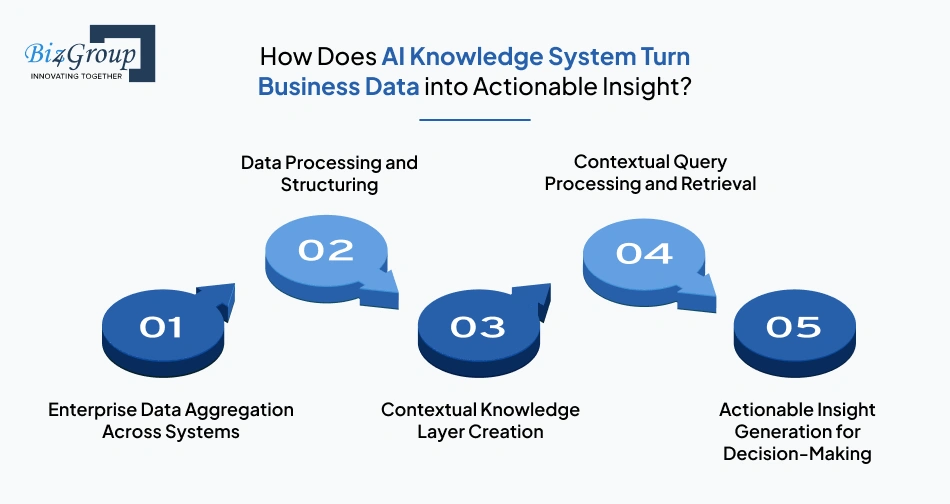
Enterprise data does not become useful just by storing it in one place. It needs to move through a structured flow where raw inputs are prepared, connected, and shaped into something decision ready as you develop enterprise AI knowledge system.
At this stage, the system gathers data from multiple enterprise sources without altering it. This includes CRM platforms, ERP systems, internal tools, documents, emails, and support logs.
Data remains fragmented at this stage and is not yet prepared for interpretation.
Also Read: Artificial Intelligence in CRM
Once data is collected, it needs to be cleaned and organized for further use. This step removes inconsistencies and prepares the data in a format that systems can understand.
The system prepares data for understanding, but no relationships or insights are formed yet.
Here, processed data is connected into a unified structure. The system begins to understand how different data points relate to each other across systems.
This step transforms isolated data into connected knowledge without retrieving or presenting it yet.
At this stage, users interact with the system using natural language queries. The system interprets intent and retrieves the most relevant information based on meaning.
Retrieval focuses on accessing the right information without generating outputs or summaries.
This is where the system converts retrieved knowledge into structured outputs. It combines information from different sources and presents it in a usable format.
At this stage, data becomes decision-ready and supports business actions without presenting raw information.
A structured pipeline ensures that data flows from raw inputs to meaningful outputs without confusion. This approach keeps AI knowledge system development for businesses aligned with how decisions are actually made inside enterprise environments.
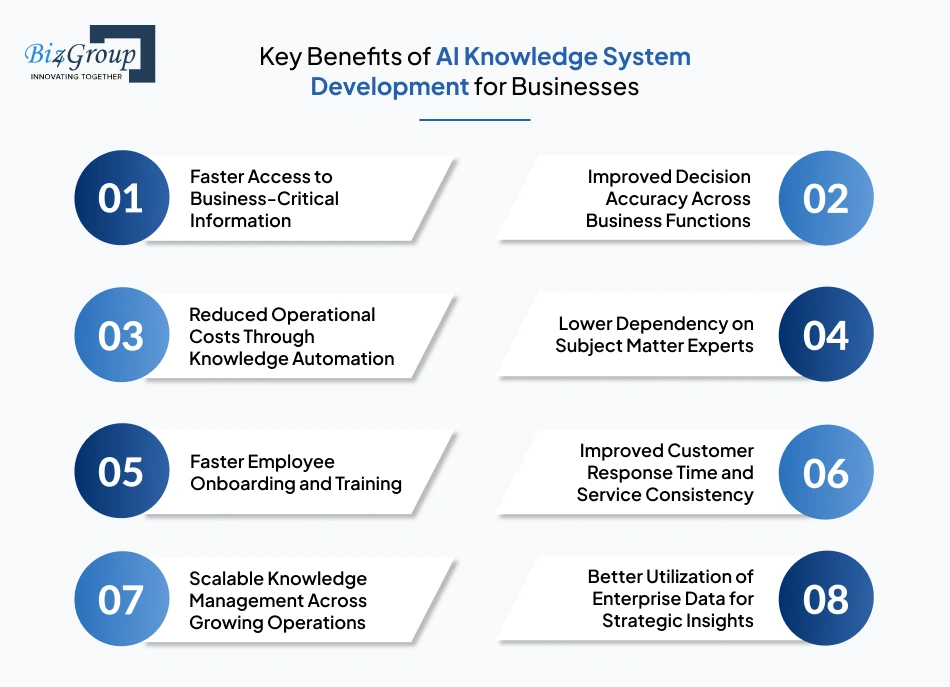
Enterprises deal with increasing data complexity across systems, teams, and workflows. Traditional systems fail to deliver timely insights when information is scattered. AI knowledge systems create measurable operational and financial impact by improving how information is accessed and applied.
Below we have listed the key benefits of building an AI knowledge system for you:
AI knowledge system development for businesses enables organizations to move beyond passive data storage. When businesses make AI knowledge system for business operations, they create a structured environment where information directly supports execution, cost control, and long-term growth.
When information lives across multiple tools, teams often struggle to find what they need at the right time. A centralized AI knowledge system changes how information is accessed and used daily. These core features define how an effective AI knowledge system actually works behind the scenes and helps in knowledge management without adding complexity for users.
A centralized system must connect with tools like CRM platforms, cloud storage, internal databases, and communication channels. This layer continuously pulls data from different sources and organizes it in one place. It removes dependency on manual uploads and ensures that business knowledge stays consistent, complete, and ready for use.
Search should go beyond matching exact words and focus on understanding the intent behind each query. This allows users to find relevant information even when they phrase questions differently. It becomes especially useful when dealing with large volumes of internal content where traditional keyword-based search often fails.
This feature retrieves information directly from internal business data and presents it in a clear, usable format. It ensures responses are grounded in company knowledge instead of generic outputs. Teams can rely on the system for accurate answers without needing to manually verify information from multiple sources every time.
Business data often exists in formats like PDFs, emails, and spreadsheets that are difficult to search. This feature extracts key information and organizes it into structured content. It allows the system to understand and categorize documents properly, making them easier to retrieve and use across different business functions.
Access to information must be controlled based on user roles within the organization. This feature ensures that employees only see data relevant to their responsibilities. It helps maintain confidentiality while still enabling smooth access to required knowledge, which is essential for both security and efficient operations.
Information becomes more useful when connections between different data points are clearly defined. This feature links documents, processes, and entities to show how they relate to each other. It helps users understand context instead of viewing information in isolation, making knowledge more meaningful and easier to navigate.
Business information changes frequently, and outdated data can lead to poor decisions. This feature keeps the system updated by syncing continuously with source platforms. It ensures that users always access the latest available information without needing to check multiple systems or worry about outdated records.
Organizations handle more than just text-based information in daily operations. This feature allows the knowledge system to process and store images, audio files, and other formats alongside written content. It ensures that all types of business knowledge are captured and made accessible within a single unified system.
Users should be able to interact with the system without learning complex commands or search techniques. This feature allows them to ask questions in simple language and receive clear responses. It makes knowledge access faster and more intuitive, especially for non-technical users across different departments.
Also Read: AI Chatbot Integration in Various Industries
Understanding how knowledge is used helps improve the system over time. This feature tracks user behavior, search patterns, and content gaps within the system. It provides visibility into what information is frequently accessed and where improvements are needed to make the system more effective for business use.
When these features work together, the system becomes more than just a storage layer. It turns scattered information into something structured and usable. This is where AI knowledge system development for businesses starts delivering consistent, reliable access to organizational knowledge at scale.
The real difference shows when features start solving real problems
Make It WorkOnce the core system starts organizing and retrieving information reliably, the next layer focuses on how intelligently that information is used. This is where AI knowledge brain development for businesses begins to shape how systems respond, adapt, and guide decisions in real time.
A feature helps the system perform a task, while a capability defines how intelligently that task is executed. This shift turns a passive system into one that actively understands context, anticipates needs, and responds with more relevance.
|
Capability |
What It Enables |
|---|---|
|
Contextual Reasoning |
Understands the meaning behind queries based on user role, past interactions, and business context. It allows the system to respond with more relevant and situation-aware outputs instead of generic answers. |
|
Predictive Insights |
Uses historical patterns and behavior trends to surface what information may be needed next. In many cases, this aligns with how predictive analysis helps anticipate business needs before users explicitly ask for information. |
|
Automated Summarization |
Converts lengthy documents, reports, or communication threads into concise summaries. It helps users quickly grasp important details without going through large volumes of content manually. |
|
Intent Detection |
Identifies the actual purpose behind a user query, even when phrased casually or indirectly. This improves how accurately the system responds, especially in conversational interactions across different teams. |
|
Continuous Learning (Feedback Loops) |
Improves responses over time by learning from user interactions and corrections. The system gradually refines how it retrieves and presents information based on real usage patterns. |
|
Sentiment Understanding |
Interprets tone and context in communication data such as feedback or internal discussions. This works alongside sentiment analysis to help the system better understand underlying intent in qualitative data. |
|
Knowledge Gap Identification |
Detects missing or underused information within the system. It highlights areas where knowledge needs to be updated or expanded, ensuring the system remains relevant and complete over time. |
|
Proactive Recommendations |
Suggests relevant documents, actions, or insights based on user behavior and context. This reduces the need for repeated searches and helps teams stay aligned with ongoing tasks and decisions. |
|
Workflow Awareness |
Recognizes how knowledge fits within business processes and ongoing tasks. It ensures that information is surfaced at the right moment within workflows, not just when users actively search for it. |
These capabilities move the system beyond storing and retrieving information. They introduce a layer where knowledge becomes responsive, adaptive, and context aware. This is where AI knowledge system development for businesses shifts from basic organization to truly intelligent enterprise support.
Looking at the AI capabilities individually gives clarity, but their real impact becomes visible when they work together in a single system.
Biz4Group LLC developed a document-focused system called PDF Consultant AI which allows users to upload files and interact with them directly through queries, without navigating entire documents manually. The system:

This aligns closely with how contextual reasoning, intent detection, and automated summarization operate together in real environments, where the system focuses on understanding and responding rather than simply retrieving information.
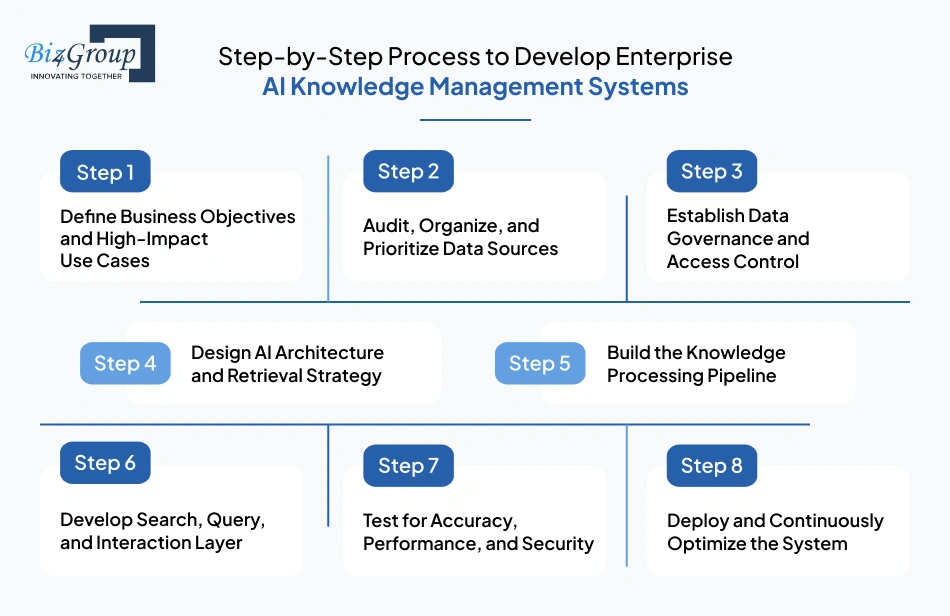
Enterprise systems do not become intelligent by layering AI on top of scattered data. A clear process helps your team move from scattered data to a working system without confusion. The steps below provide a practical roadmap for AI knowledge system development for businesses, ensuring the system feels reliable, structured, and aligned with real operational workflows from the start.
Start by identifying where knowledge gaps slow decisions or operations. This step ensures your system is not built around technology, but around actual business needs. It sets direction for the entire AI knowledge system development for businesses.
Key activities include:
Most enterprises already have data, but it is scattered and inconsistent. This step focuses on identifying what data exists, where it lives, and how useful it is. The goal is to prepare reliable inputs for the system.
Key activities include:
Without proper control, even the best system can create risk. This step ensures that data is secure, accessible only to the right users, and compliant with internal policies.
Key activities include:
This step defines how your system will process and retrieve knowledge. It focuses on making information accessible in context, not just searchable. A strong foundation here avoids rework later.
Key activities include:
Also Read: Top UI/UX Design Companies in USA
The pipeline is where raw data becomes usable knowledge. It processes, structures, and prepares data so the system can understand and retrieve it effectively. This is where you make AI driven knowledge base system functional.
Key activities include:
Also Read: Top MVP Development Companies in USA
This is the user-facing layer where people interact with the system. It should feel natural and intuitive, allowing users to ask questions and get direct answers instead of searching through documents.
Key activities include:
Before deployment, the system must be reliable. This step ensures that responses are accurate, fast, and secure under real-world conditions.
Key activities include:
Deployment of the AI knowledge system is not the end. The system must evolve as business data and usage patterns change. Continuous improvement ensures long-term value.
Key activities include:
A structured approach ensures your system evolves from a simple repository into a reliable intelligence layer. With the right execution, you can build an AI powered knowledge management platform that supports decisions, operations, and long-term business growth.
A system’s effectiveness depends on how well its components work together behind the scenes. While building AI systems to turn business data into insights, these decisions often align closely with full stack development choices that shape scalability and performance.
|
Architecture Layer |
Recommended Technology |
Purpose |
|---|---|---|
|
Data Storage Layer |
AWS S3, Azure Blob Storage, Google Cloud Storage |
Stores structured and unstructured data in a centralized location, ensuring all business information remains accessible and ready for processing across different systems. |
|
Data Processing Layer |
Python, Apache Spark, Pandas |
Processes incoming data, removes inconsistencies, and prepares it for indexing so the system can use it effectively without duplication or errors. |
|
Integration Layer |
Node.js (Express), Django REST Framework |
Supports API development to connect enterprise tools like CRM and ERP systems, ensuring smooth and continuous data flow between platforms. |
|
AI Model Layer |
OpenAI API, Hugging Face Transformers |
Enables the system to understand queries and generate accurate responses based on internal data, making interactions more natural and context aware. |
|
Search & Retrieval Layer |
Pinecone, Weaviate, FAISS |
Stores embeddings and enables fast semantic retrieval, allowing the system to find relevant information even when queries are phrased differently. |
|
Backend Layer |
Node.js, Python (FastAPI) |
Manages system logic, handles requests, and ensures communication between all layers works smoothly without delays. |
|
Frontend Layer |
Provides a clean and simple interface where users can interact with the system, search knowledge, and receive responses easily. |
|
|
Security Layer |
AWS IAM, OAuth 2.0, JWT |
Controls user access and protects sensitive business data, ensuring secure interactions across the system. |
|
Monitoring & Analytics Layer |
Datadog, Prometheus, Google Analytics |
Tracks system performance, usage patterns, and issues, helping teams maintain reliability and improve the system continuously. |
This layered setup supports AI knowledge base development for companies by ensuring every component works together without creating bottlenecks or complexity. A well-defined stack allows the system to scale without breaking existing workflows. It also makes future improvements easier to implement.
One of the first questions decision-makers raise is how much investment is needed to build an AI-driven knowledge system for their organization. The answer depends on data complexity, integration scope, intelligence level, and how widely the system is used across teams.
In most cases, the cost of implementation falls between $30,000 and $150,000+, especially when planning to make scalable AI knowledge systems for business growth. The final investment increases as the system expands in capability and operational coverage.
The table below outlines how development costs typically vary based on system scope and maturity level.
|
Development Level |
Estimated Cost Range |
Scope |
|---|---|---|
|
MVP Level AI Knowledge System |
$30,000 – $60,000 |
Covers basic data ingestion, simple search, and limited integrations. Suitable for validating core functionality with minimal automation and controlled datasets. |
|
Mid-Level AI Knowledge System |
$60,000 – $100,000 |
Includes better data structuring, improved retrieval accuracy, multiple integrations, and a user-friendly interface for broader team usage. |
|
Advanced Level AI Knowledge System |
$100,000 – $150,000+ |
Supports complex data environments, advanced intelligence capabilities, deeper integrations, and scalability required for AI knowledge system development for enterprises. |
Several factors influence the final cost, and each one adds complexity based on how your system is designed and deployed across business operations.
|
Cost Driver |
What It Involves |
Estimated Cost Impact |
|---|---|---|
|
Data Volume & Complexity |
Large volumes of unstructured data require more effort to clean, organize, and prepare before use. Complex datasets increase processing time and overall development effort. |
$5,000 – $20,000+ |
|
The choice of model affects accuracy, response quality, and cost. AI model selection also impacts how much customization and fine-tuning is required for business-specific use cases. |
$10,000 – $30,000+ |
|
|
Integration Scope |
Connecting with CRMs, ERPs, and internal systems increases effort. The AI integration cost grows with the number of systems and the level of real-time data synchronization required. |
$10,000 – $40,000+ |
|
User Interface Complexity |
A simple interface costs less, while interactive dashboards and conversational interfaces require more design and development work. |
$5,000 – $15,000+ |
|
Security & Access Control |
Implementing secure access, user roles, and compliance layers adds additional development effort, especially for enterprise environments handling sensitive data. |
$5,000 – $20,000+ |
Beyond initial development, there are ongoing and often overlooked costs that can impact long-term budgeting and system sustainability.
Managing the cost of the development does not mean limiting capabilities. It involves making practical decisions that balance performance, scalability, and long-term usability.
A clear cost structure helps set realistic expectations before development begins. It also supports better planning as the system evolves over time. Strong execution ensures AI knowledge system development for businesses remains efficient, scalable, and aligned with long-term enterprise goals.
Every dollar should move you closer to better decisions, not more complexity
Get Cost Estimate Now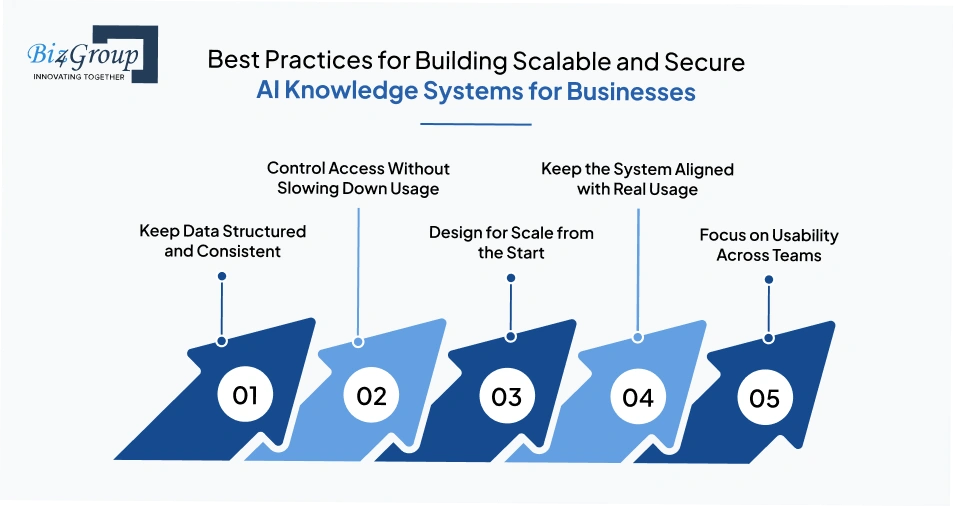
As systems grow in capability and data volume, maintaining consistency and control becomes more challenging. Without the right approach, even well-built systems can become difficult to manage over time.
Many teams ask the same question at this stage: how can we build AI knowledge systems from internal data without creating complexity or risk? The answer lies in a few focused practices that keep the system reliable, usable, and ready to scale as needs grow. Take a look:
These practices ensure the system remains structured, secure, and adaptable as it evolves. A well-planned approach keeps the system reliable as it grows across teams and use cases. It ensures long-term usability without constant rework, strengthening the overall value of AI knowledge system development for businesses.
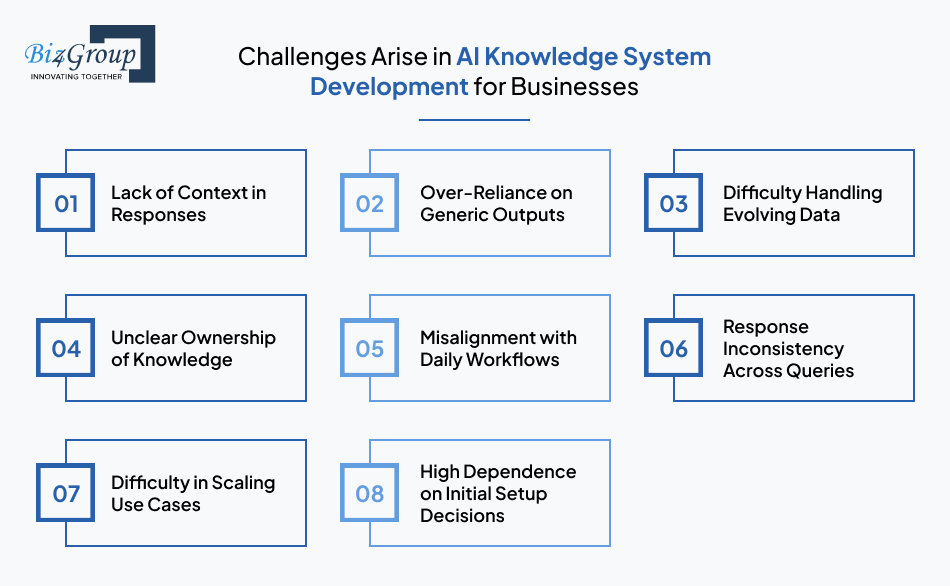
As systems move from planning to actual usage, a different set of issues starts to surface. These are not about features or setup, but about how the system behaves under real conditions.
If you’re also wondering what tends to break or slow down when teams, try to build an AI knowledge management system for companies in real environments. Then the table below outlines the most common execution challenges along with practical ways to address them early.
|
Challenge |
What It Means in Practice |
How to Solve It |
|---|---|---|
|
Lack of Context in Responses |
The system answers correctly but misses business context, making responses feel incomplete or hard to act on. |
Improve how internal data is structured and linked, so responses reflect real workflows and not just isolated information. |
|
Over-Reliance on Generic Outputs |
The system starts producing answers that sound correct but do not reflect company-specific knowledge. |
Ground responses strictly in internal data and limit open-ended generation to maintain relevance and control. |
|
Difficulty Handling Evolving Data |
As business data changes, the system struggles to stay aligned with the latest information. |
Set up regular data refresh cycles and ensure updates reflect across the system without manual rework. |
|
Unclear Ownership of Knowledge |
No defined responsibility for maintaining data leads to outdated or conflicting information. |
Assign clear ownership for different data domains, so updates remain consistent and accountable over time. |
|
Misalignment with Daily Workflows |
The system exists, but teams continue using old tools because it does not fit naturally into their workflow. |
Align the system with existing processes so it becomes part of daily work instead of an additional step. |
|
Response Inconsistency Across Queries |
Similar questions return slightly different answers, reducing user trust in the system. |
Standardize how information is retrieved and ensure consistency in how responses are generated. |
|
Difficulty in Scaling Use Cases |
Expanding from one use case to multiple teams creates gaps in performance and usability. |
Roll out new use cases in phases and validate each before expanding further across the organization. |
|
High Dependence on Initial Setup Decisions |
Early design choices limit flexibility, making future changes difficult or expensive. |
Keep the architecture flexible and involve experienced teams when you build AI software to avoid rigid structures. |
These challenges often appear when teams try to develop AI knowledge system for businesses beyond initial use cases, where real-world usage exposes gaps that are not visible during planning. Addressing these challenges keeps the system aligned with how teams actually work. It also ensures long-term reliability as usage expands, which is critical for sustainable AI knowledge system development for businesses.
As systems mature, expectations are shifting from information access to decision support. The next phase focuses on systems that can act, adapt, and evolve with minimal human input.
So, what will define the next generation of AI-driven knowledge systems over the coming years? The following trends highlight how these systems are expected to evolve beyond current capabilities and reshape how businesses use knowledge.
Future knowledge systems will move beyond answering queries and begin suggesting actions based on context and patterns. Instead of waiting for input, they will guide teams during workflows, helping them take faster and more informed decisions without constant manual evaluation.
AI Knowledge systems will no longer depend heavily on manual updates or structured pipelines. They will continuously refine themselves by learning from new data, interactions, and outcomes, ensuring that information remains current without requiring constant human intervention or oversight.
Knowledge systems using AI will begin to understand how work actually happens across teams. Instead of retrieving isolated information, they will retain context around tasks, decisions, and workflows, allowing them to provide responses that align closely with real business scenarios.
Independent AI agents will handle how information moves across systems and teams. With support from skilled AI developers, these agents will manage updates, trigger actions, and ensure knowledge reaches the right place without users needing to search for it actively.
Future systems will extend beyond internal tools and connect with external platforms and partners. This will allow knowledge to flow across multiple environments, supported by AI automation tools that maintain consistency and relevance across different systems and use cases.
These shifts reflect a move toward systems that act as active participants in business operations. As expectations evolve, AI knowledge system development for businesses will focus on intelligence that not only supports decisions but also shapes how work gets done.
Stay ahead by building systems designed for how work will evolve
Stay AheadFinding the right partner often decides how smoothly your system performs after launch. Many teams struggle here and ask the same thing: how do you identify the best company to develop AI knowledge management systems without relying on surface-level claims or generic capabilities?
The factors listed below will help you evaluate potential partners with more clarity and confidence.
Look beyond portfolios and focus on how the company has handled complex business data environments.
A strong partner should understand how systems connect across your existing tools.
A technically strong system still fails if teams do not use it daily.
The system should grow as your data and teams expand.
Working with a single responsible partner avoids fragmented execution.
The right partner should align closely with how your business operates, not just what the system is expected to do. A thoughtful selection process ensures AI knowledge system development for businesses stays structured, scalable, and aligned with long-term operational needs.
Also Read: Top AI Development Companies in USA
At this point, you already know what to look for in a development partner. But when you actually start evaluating options, the real question becomes clearer who can build an AI knowledge system for businesses that works reliably in real environments, not just in demos? This is exactly where we stand out.
With Biz4Group LLC the focus stays on making systems usable from day one. We approach every project by understanding how your teams actually access and use information, not just how the system should function on paper.
As an experienced AI development company, we stay involved beyond initial delivery. The goal is not just to launch a system, but to ensure it continues to perform as your data grows, and workflows evolve.
Our approach to AI business knowledge system development services stays grounded in how businesses operate, not just how systems are designed. That consistent involvement is one of the reasons why we're recognized among top AI development companies for delivering solutions that remain reliable beyond the initial launch.
What matters is how it works after launch, not how it looks before
Build It RightAI knowledge system development for businesses changes how organizations use information in daily operations. Instead of searching across tools, teams start working with structured knowledge that supports decisions as they happen. A capable software development company ensures this shift is practical and aligned with how teams actually operate.
During the development process, focus should not be on adding more tools, but on making existing knowledge work better. This is exactly where Biz4Group LLC aligns with organizations that want systems built around real usage, not assumptions. The goal is to ensure knowledge flows naturally across teams without friction.
If your priority is to move from scattered data to structured intelligence, the next step is clear. It is time to create AI knowledge platform for your organization that actually supports how your business operates. Let’s connect.
The timeline usually ranges from 8 to 20 weeks depending on system complexity, data readiness, and integration scope. A focused MVP can be delivered faster, while enterprise-level systems require more time for data alignment, testing, and optimization.
The overall cost typically falls between $30,000 and $150,000+, depending on the number of integrations, data complexity, and intelligence levels required. Costs increase as systems scale across departments and support more advanced use cases.
The process starts with identifying key data sources, followed by structuring and connecting them into a centralized system. The focus should remain on making internal data usable, searchable, and aligned with actual business workflows.
You can work with specialized teams or agencies that have experience in enterprise data systems and AI integration. It is important to choose developers who understand how to handle real business data, not just build isolated AI features.
Successful implementation depends on gradual integration rather than full replacement. Systems are usually introduced alongside existing tools, ensuring teams can continue working without interruption while the knowledge system becomes part of daily workflows.
Enterprises should focus on data quality, system scalability, and alignment with business workflows. Clear ownership of data and a phased rollout approach help ensure the system remains reliable and usable as it expands across teams.

with Biz4Group today!
Our website require some cookies to function properly. Read our privacy policy to know more.