Location :
Orlando, FL, USA
Location :
Orlando, FL, USA +1 (407) 714-1616
 info@biz4group.com










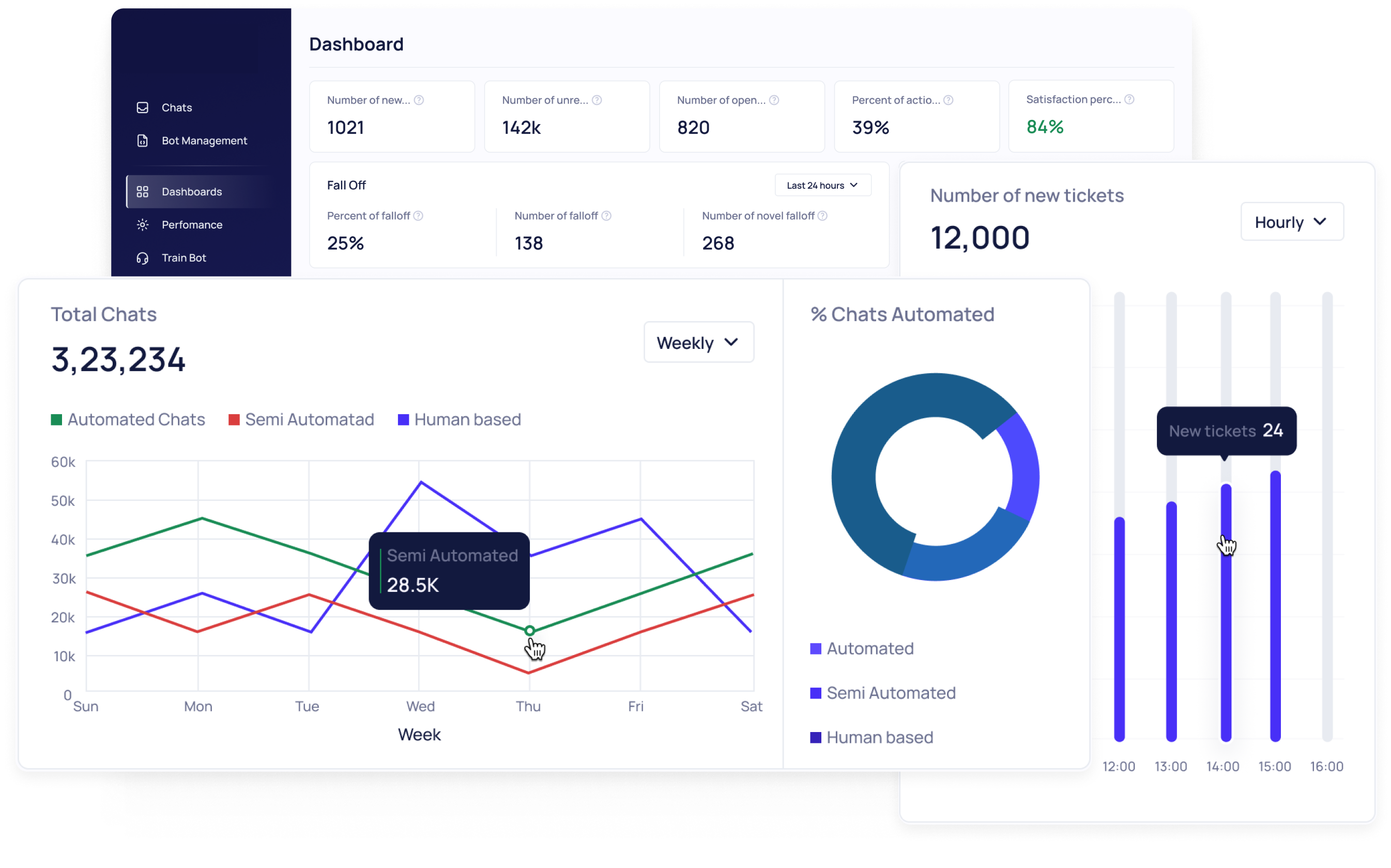







Imagine a digital system that doesn’t wait for instructions but instead, understands your business goals, learns from real-time feedback, and takes independent actions to get the job done.
Read More
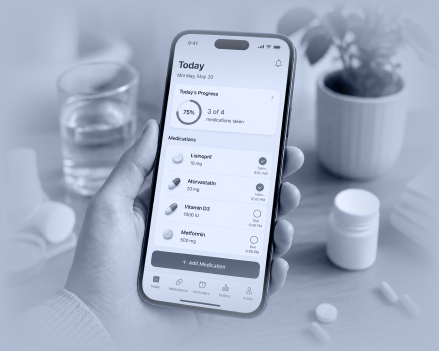
Why are patients still missing critical doses even when digital reminders already exist?
Medication non-adherence is not a small operational gap. It is a daily breakdown in care delivery that affects outcomes, workflows, and long-term treatment success. In real-world settings, patients forget doses, delay medications, or simply lose track of complex schedules. Here what the research has to say:
For healthcare providers, this creates a visibility gap as doctors and caregivers cannot confirm medication adherence as per prescription after patients leave the clinic. The lack of real-time tracking results in missed or incorrect doses, higher readmissions, confusion in multi-drug schedules, and delayed intervention by caregivers.
This is where an AI medication adherence app changes the approach entirely. Instead of relying on static reminders, the system learns patient behavior and enable care teams to track adherence remotely and intervene before small gaps turn into serious health risks.
For healthcare organizations, this shift is becoming a strategic priority as they are already thinking along these lines:
If you are exploring this direction, the challenge goes beyond building an app. It requires systems aligned with workflows, secure data handling, and development support from a HIPAA compliant AI healthcare solution provider.
With all that on the table, in this guide you will see what goes into building these systems, what features drive compliance, and how healthcare organizations are turning adherence into a measurable, scalable outcome.
Many healthcare teams jump into medication adherence app development using AI without clearly defining what the product should actually do. Before we move deeper, let's understand what sits at the core of such solutions.
An AI medication adherence app is a digital system that helps patients follow their prescribed medication schedules more consistently. It goes beyond basic reminders by adapting to patient behavior and providing timely support based on real usage patterns.
Instead of sending fixed alerts, the app learns how patients respond and adjusts accordingly. In practical terms, it becomes a bridge between patients and care teams. It ensures that medication routines are followed while giving providers better visibility into adherence.
Here’s what an AI medication adherence app typically does:
So how does the AI medication adherence app actually play out in a real patient scenario? To keep it simple, the app follows a connected flow that supports patients and keeps care teams informed:
To make the system reliable and usable, the app depends on a few core components working together in sync:
|
Component |
What It Does |
Why It Matters |
|---|---|---|
|
Patient Profile Layer |
Captures medication details, routines, and preferences |
Enables personalized reminders and better adherence tracking |
|
Medication Schedule Engine |
Structures dosage timing and frequency |
Keeps daily medication plans clear and organized |
|
Reminder & Notification System |
Sends alerts based on timing and behavior |
Helps patients take medications consistently |
|
Adherence Tracking Module |
Records taken, missed, or delayed doses |
Gives visibility into patient compliance patterns |
|
Caregiver & Provider Alerts |
Notifies when adherence drops or risks appear |
Supports timely intervention and care coordination |
|
Analytics & Insights Layer |
Analyzes adherence trends over time |
Helps improve outcomes and decision-making |
Each component plays a specific role, but their real value comes from how well they work together. Weak coordination between these parts can directly impact patient adherence and overall system effectiveness.
At first glance, both may seem similar. The difference becomes clear when you look at how they respond to patient behavior over time.
|
Area |
Traditional Reminder Apps |
AI Medication Adherence App |
|---|---|---|
|
Reminder Logic |
Fixed time-based alerts |
Adapts based on patient behavior and response |
|
Personalization |
Same reminders for all users |
Adjusts timing and frequency per patient |
|
Adherence Tracking |
Limited or manual input |
Automatically tracks taken, missed, or delayed doses |
|
Intervention |
No real escalation system |
Triggers alerts for caregivers or providers when needed |
|
Patient Engagement |
One-way notifications |
Continuous interaction based on usage patterns |
|
Insights |
Minimal visibility |
Provides actionable adherence insights over time |
This shift is important because patient behavior is not static. Systems that adapt to real usage patterns are more effective in improving long-term medication adherence.
Each of these fundamentals shapes how the system performs in real care environments. Once these basics are clear, it becomes easier to plan features, workflows, and scalability for AI medication adherence app development.
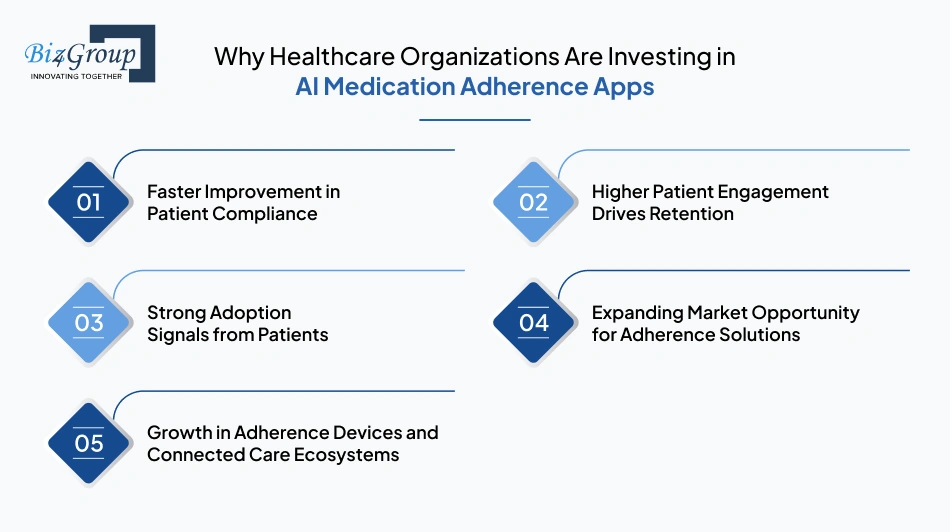
Medication adherence is no longer just a clinical concern. It directly impacts revenue, operational efficiency, and long-term patient retention. Healthcare organizations now treat adherence as a measurable business metric. This shift is driving interest in building scalable medication adherence app for hospitals and clinics that improve both care outcomes and financial performance.
Healthcare systems are seeing measurable gains when adherence is actively managed. Structured interventions have shown a 35% increase in adherence rates within 90 days, making it easier to improve outcomes without increasing operational burden.
This directly reflects in care delivery and performance metrics through:
Patient engagement plays a key role in long-term treatment success. Digital adherence solutions show that patient engagement improves by almost 30%, which strengthens patient-provider relationships.
This improvement creates measurable business value with:
Adoption is often a barrier in digital health, but adherence tools show strong patient willingness. Surveys indicate that over 60% of patients are willing to use tech-based reminders and monitoring, making these solutions easier to scale.
This reduces friction during implementation by:
The demand for adherence solutions continues to grow as healthcare systems focus on measurable outcomes. The global medication adherence market is projected to reach $4.77 billion in 2026 and grow to $7.35 billion by 2030 at a CAGR of 11.4%.
This growth signals strong investment potential with:
Adherence is not limited to mobile apps. It is expanding into connected devices and monitoring systems. The medication adherence devices market will grow from $3.62 billion in 2026 to $4.58 billion by 2030, reflecting steady demand for integrated solutions.
This opens new business avenues for healthcare organizations by:
These factors show that adherence is becoming a core investment area for healthcare organizations. The opportunity extends beyond patient care and into measurable business outcomes, making AI medication adherence app development a strategic priority.
Improve outcomes faster with AI-driven adherence systems built for measurable impact
Start Building Smarter Adherence SystemFeature selection defines whether the solution actually improves adherence or just adds another layer of reminders. Many teams aim to develop smart medication tracking app with AI alerts and analytics, but the real value comes from choosing features that fit patient routines and care workflows.
For business leaders asking, “I am planning to create a medication reminder app with AI features but need guidance on features”. The focus should stay on practical capabilities that support patient management, improve consistency, and give care teams clear visibility into adherence.
|
Feature |
What It Does |
|---|---|
|
Medication Schedule Management |
Structures dosage timing, frequency, and duration into a simple daily plan that patients can follow without confusion |
|
Smart Reminder System |
Sends alerts at the right time and adjusts reminders based on how patients respond over time |
|
Adherence Tracking |
Captures whether medications are taken, missed, or delayed and builds a clear adherence record |
|
Predictive analysis Engine |
Uses past behavior patterns to identify when a patient is likely to miss a dose and adjusts alerts accordingly |
|
Personalized Notification Logic |
Adapts reminder timing and frequency based on individual habits instead of sending fixed notifications |
|
Caregiver & Provider Alerts |
Notifies caregivers or care teams when adherence drops so they can take timely action |
|
Multi-Medication Support |
Handles multiple prescriptions together and simplifies complex schedules for chronic patients |
|
Refill & Prescription Alerts |
Tracks medication supply and reminds patients before they run out to avoid gaps in treatment |
|
Patient Reporting Dashboard |
Displays adherence trends and daily medication status in a way that is easy to understand |
|
Integration with Wearables |
Connects with devices with reliable wearable integration services to capture activity or routine signals that influence medication timing |
|
Behavioral Insights Layer |
Analyzes patient routines and engagement patterns to improve long-term adherence consistency |
|
Support for medical diagnosis Workflows |
Aligns medication tracking with treatment plans so care decisions stay connected to actual patient behavior |
These features work together to support both patients and care teams without adding unnecessary complexity. When planned correctly, they create a system that improves consistency, visibility, and outcomes, making medication adherence app development integrating AI more practical and scalable.
A reliable system is shaped by how well the architecture supports real-world usage. It should handle continuous data flow, secure patient information, and maintain stability as usage grows across patients and providers.
This becomes more important when systems must support real-time adherence tracking, provider visibility, and integrations without slowing performance or creating gaps.
At this point, many healthcare teams start thinking along practical lines, such as we want end-to-end development of an AI medication adherence platform for hospitals and clinics. To move in that direction, it is important to understand how the core system layers come together.
A production-ready system works best through a layered structure where each layer owns a clear responsibility and stays connected to others.
This layered structure keeps the system stable as patient volume increases, and care workflows expand.
Once the architecture is clear, the next step is understanding how the right technologies support each layer in real-world implementation. Many teams at this stage aim to build AI medication adherence app that can scale across patients and providers while maintaining performance, security, and reliability.
AI and Intelligence Layer
|
Category |
Frameworks and Tools |
Purpose |
|---|---|---|
|
ML Frameworks |
TensorFlow, PyTorch |
Predictive analysis for adherence patterns and risk detection |
|
Data Processing |
Python (Pandas, NumPy) |
Prepares and processes patient adherence data |
|
Streaming Analytics |
Apache Kafka |
Handles real-time adherence updates and alert triggers |
Mobile Application Layer (Patient Side)
|
Category |
Frameworks and Tools |
Purpose |
|---|---|---|
|
Cross-Platform |
React Native, Flutter |
Supports mobile app development across iOS and Android |
|
Native Support |
Swift, Kotlin |
Enables device-level performance and OS-specific features |
|
Notifications |
Firebase Cloud Messaging, APNs |
Delivers real-time reminders and alerts |
|
Local Storage |
SQLite, Realm |
Stores schedules and adherence data for offline access |
Web Application Layer (Provider & Admin Side)
|
Category |
Frameworks and Tools |
Purpose |
|---|---|---|
|
Web Frontend |
Provider dashboards for adherence tracking and reporting |
|
|
UI Frameworks |
Material UI, Tailwind CSS |
Builds consistent and responsive user interfaces |
Backend and API Layer
|
Category |
Frameworks and Tools |
Purpose |
|---|---|---|
|
Backend |
Node.js, Python (FastAPI, Django) |
Manages business logic and system coordination |
|
APIs |
REST, GraphQL |
Handles API development for secure data exchange |
|
Authentication |
OAuth 2.0, JWT |
Secures user access and identity management |
Also Read: A Complete Guide to OpenAI API Integration for AI Applications
Data Management and Infrastructure
|
Category |
Frameworks and Tools |
Purpose |
|---|---|---|
|
Databases |
PostgreSQL, MongoDB |
Stores patient data, medication schedules, and adherence logs |
|
Cache Layer |
Redis |
Improves response speed for dashboards and alerts |
|
Cloud |
AWS, Azure, GCP |
Provides scalable infrastructure and secure storage |
Deployment and Scalability Tools
|
Category |
Frameworks and Tools |
Purpose |
|---|---|---|
|
Containerization |
Docker |
Ensures consistent deployment environments |
|
Orchestration |
Kubernetes |
Scales services based on system load |
|
Monitoring |
Prometheus, Grafana |
Tracks system performance and reliability |
Integration and Interoperability Layer
|
Category |
Frameworks and Tools |
Purpose |
|---|---|---|
|
Healthcare APIs |
HL7, FHIR |
Connects healthcare platforms with EHR systems and clinical data sources |
|
Third-Party Integration |
Stripe (payments), Twilio (SMS) |
Supports external services and communication workflows |
Also Read: Your Guide on AI EHR App Development for Hospitals and Clinics
Security and Compliance Layer
|
Category |
Frameworks and Tools |
Purpose |
|---|---|---|
|
Encryption |
AES-256, TLS |
Protects sensitive patient data in transit and at rest |
|
Access Control |
Role-Based Access Control (RBAC) |
Restricts system access based on user roles |
|
Audit Logging |
ELK Stack (Elasticsearch, Logstash, Kibana) |
Maintains activity logs for compliance and monitoring |
Architecture defines how the system holds together under real-world usage, while the tech stack determines how reliably it performs as demand grows. When both align with actual care workflows, development of AI medication adherence app becomes more structured, scalable, and easier to manage through full stack development.
Also Read: Why to Choose the Full Stack Development for Modern Business
Turn your idea into a scalable system that performs reliably across real healthcare workflows
Design My Scalable System Now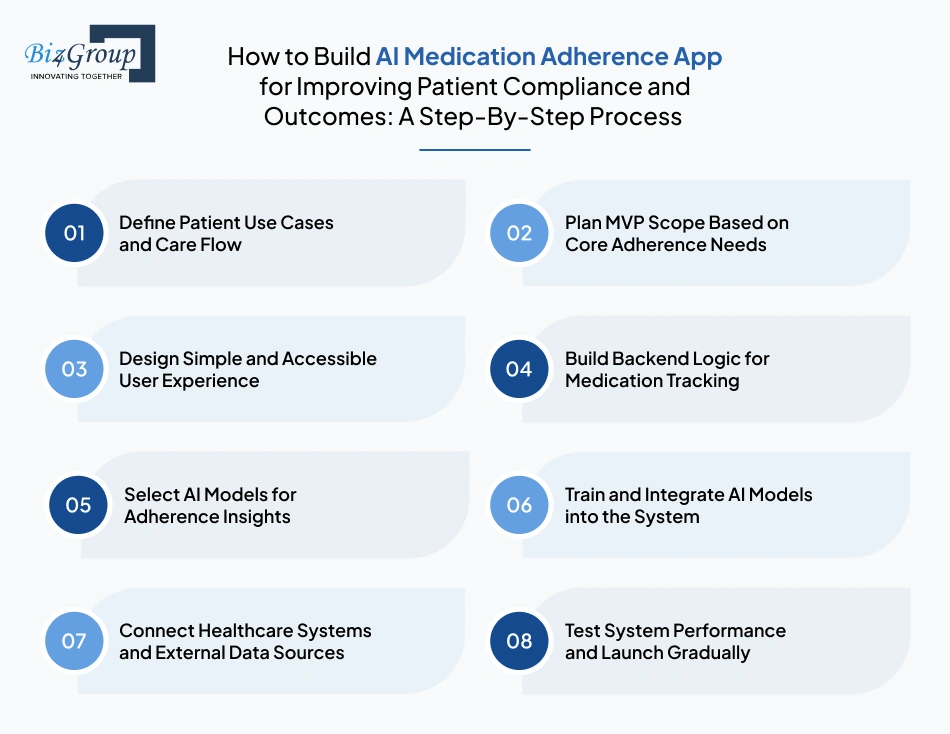
Turning the idea into a working system requires a structured approach. Many business leaders reach a point where they clearly think, I want to build an AI medication adherence app to help patients take medicines on time and improve health outcomes but how to do it. Well, the next step is understanding how to move from concept to execution without missing critical steps.
Start by identifying who will use the system and how it fits into daily care routines. This step ensures that the product solves real adherence challenges instead of adding complexity.
Focus areas:
A focused first version helps validate the idea without overbuilding. This is where MVP development services help translate the concept into a usable product.
Focus areas:
Also Read: Top MVP Development Companies in USA
Patient usability directly affects adherence success. A UI/UX design company can help ensure the system is easy to use for all patient groups.
Focus areas:
Also Read: Top UI/UX Design Companies in USA
The backend forms the foundation that manages schedules, reminders, and adherence data. It should support real-time updates without delays.
Focus areas:
AI should support real patient behavior, not just add complexity. Teams need to select AI models that can identify patterns in adherence.
Focus areas:
Once models are selected, they need to be trained on relevant data and connected with system workflows. This step ensures AI outputs are usable in real time.
Focus areas:
To function in real environments, the system must connect with existing healthcare platforms. EHR/EMR integrations allow access to prescription data and patient records.
Focus areas:
Before full rollout, the system should be tested with real users to ensure reliability and usability. Continuous improvement helps refine outcomes after launch.
Focus areas:
Also Read: Top 15+ Software Testing Companies in USA
A clear step-by-step process helps turn a complex idea into a practical system. Each stage focuses on real patient behavior and care workflows, making AI medication adherence app development more structured, outcome-driven, and ready for long-term scale.
Trust in healthcare products starts before patients even use the system. The moment your platform begins handling medication data, patient records, and adherence behavior, compliance becomes part of the foundation. It directly impacts how data is collected, stored, shared, and used across care workflows.
When teams start thinking about an AI-powered healthcare app for reducing missed medication doses and hospital readmissions, compliance is not something to address later. It shapes how the system is designed from the beginning.
Let’s break down the key areas you need to address.
Also Read: HIPAA-Compliant AI Healthcare Software Development
Compliance is supported by strong security practices. These requirements ensure that patient data remains protected across all system layers with:
AI introduces additional responsibility because decisions are influenced by data patterns. AI app development for medication adherence must remain transparent and reliable with:
Compliance is not just about meeting regulations. It ensures that patient trust, data security, and system reliability remain intact as the product scales. This is what makes AI medication adherence app development sustainable in real healthcare environments.
Build systems that protect patient data while staying aligned with healthcare regulations from day one
Make My Platform Compliance Ready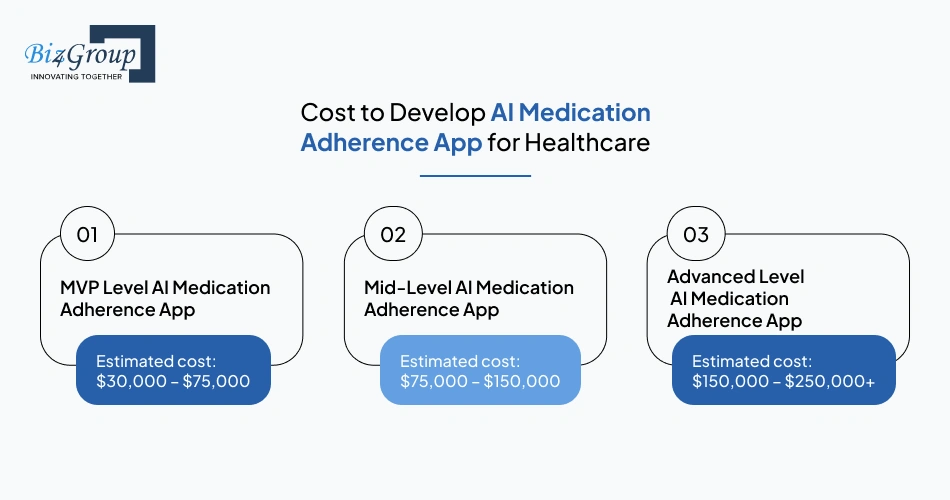
Cost planning depends on how the product is scoped, how advanced the AI capabilities are, and how deeply it integrates with healthcare systems. When teams move toward developing AI medication adherence app for healthcare and chronic disease management, the investment typically ranges between $30,000 to $250,000+ depending on complexity and scale.
|
Development Level |
Estimated Cost Range |
Scope |
|---|---|---|
|
MVP Level AI Medication Adherence App |
$30,000 – $75,000 |
Basic medication tracking, reminders, simple adherence logging, limited provider visibility |
|
Mid-Level AI Medication Adherence App |
$75,000 – $150,000 |
Advanced reminders, adherence analytics, caregiver alerts, initial AI capabilities, basic integrations |
|
Advanced Level AI Medication Adherence App |
$150,000 – $250,000+ |
Full AI-driven adherence insights, predictive alerts, deep integrations, scalable infrastructure, advanced dashboards |
The total cost is not fixed. It changes based on how each component is designed and implemented.
AI model development directly impacts cost based on complexity and accuracy requirements. Basic models may add $10,000–$25,000, while advanced predictive systems increase cost by $30,000–$60,000 depending on data handling and training cycles.
AI integrations costs increase when models are connected across reminders, alerts, and analytics. This can add $15,000–$40,000 depending on how deeply AI is embedded into workflows and real-time decision layers.
Connecting with EHR systems or enabling remote patient monitoring workflows adds complexity. Integration efforts can cost $10,000–$35,000 depending on API availability, data consistency requirements, and security layers.
The overall AI app development cost increases with multi-platform support and backend scalability. A simple setup may cost $20,000, while advanced architecture with real-time tracking can reach $70,000 or more.
Meeting healthcare compliance requirements adds structured cost layers. Security implementation, encryption, and audit systems can increase cost by $10,000–$30,000 depending on system sensitivity.
|
Hidden Costs |
Estimated Cost Impact |
|---|---|
|
Ongoing cloud infrastructure and data storage |
$500 – $3,000 per month |
|
AI model retraining and optimization |
$5,000 – $20,000 annually |
|
Third-party API usage (notifications, integrations) |
$200 – $2,000 per month |
|
Maintenance and updates |
15% – 25% of initial development cost annually |
Cost depends on how you balance features, AI capabilities, and integrations. A structured approach helps control investment while ensuring scalability. This makes AI medication adherence app development more predictable, efficient, and aligned with long-term healthcare outcomes.
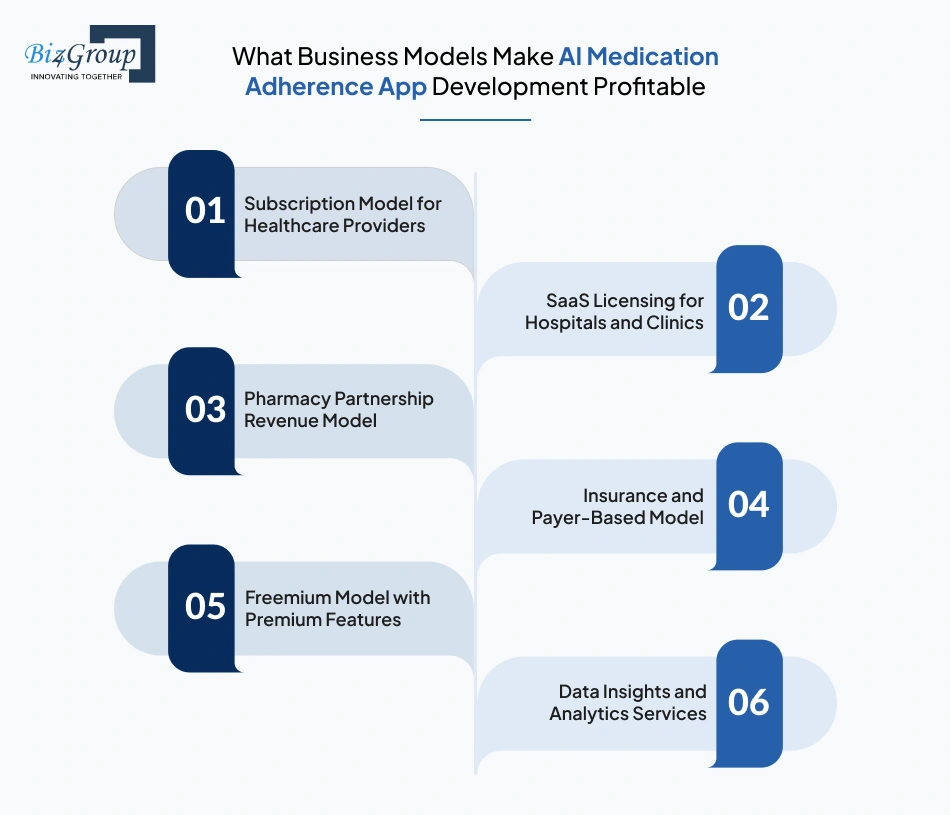
Revenue generation depends on how well the product aligns with healthcare workflows and who actually benefits from improved adherence. Many teams looking to build AI medication adherence app for improving patient outcomes start by understanding how value translates into recurring revenue across providers, patients, and healthcare partners.
Healthcare providers pay a monthly or annual fee to use the platform for patient adherence tracking. Pricing is usually based on the number of patients or active users. This creates predictable recurring revenue while allowing providers to scale usage as patient volume grows over time.
For example: A clinic manages 2,000 chronic patients and pays $5 per patient/month.
If adherence improves and reduces follow-ups, the clinic saves operational time while you maintain predictable recurring revenue.
Hospitals and clinics license the platform as AI solutions are integrated into their systems. Revenue comes from enterprise contracts that include access, support, and customization. This model works well for large healthcare organizations that need centralized adherence monitoring across multiple departments and patient groups.
For example: A hospital signs an annual contract for system-wide usage.
Total annual deal value: $180,000
Large hospital networks can scale this across locations, increasing contract size significantly.
Pharmacies benefit from improved refill rates when patients follow medication schedules. By partnering with pharmacies, the platform generates revenue through referral fees or service agreements. This model aligns incentives, as better adherence directly increases prescription refill consistency and pharmacy revenue streams.
For example: A pharmacy chain improves refill adherence using your platform.
Monthly added revenue: $75,000
Even a 5–10% revenue share gives you $3,750–$7,500/month.
Insurance providers invest in adherence solutions to reduce treatment gaps and avoid costly complications. Revenue comes from contracts where payers fund the platform to improve patient outcomes. This model works well in value-based care environments where better adherence leads to measurable cost savings.
For example: An insurance company covers 10,000 patients with chronic conditions.
This creates strong ROI justification for payers.
A basic version is offered free to patients, while advanced features such as personalized insights or caregiver alerts are paid. This helps drive user adoption first and then converts engaged users into paying customers. It works best in direct-to-consumer or hybrid healthcare models.
For example: Let’s say you onboard 50,000 users on a free plan.
This makes monthly revenue: $20,000,
and annual revenue: $240,000
Higher engagement directly increases conversion and revenue.
Healthcare organizations often need adherence insights to improve care strategies. The platform can offer analytics services that provide reports on patient behavior and treatment patterns. Revenue comes from selling these insights to providers, pharma companies, or care management teams for better decision-making.
For example: A pharma company pays for adherence insights.
With 5 clients, annual revenue: $250,000+
Each model connects adherence improvement with measurable business value. Revenue grows when the platform aligns with provider needs, patient behavior, and healthcare economics, making AI medication adherence app development a sustainable and scalable investment opportunity.
Turn adherence into a revenue stream with models aligned to real healthcare economics
Plan My Revenue Model Now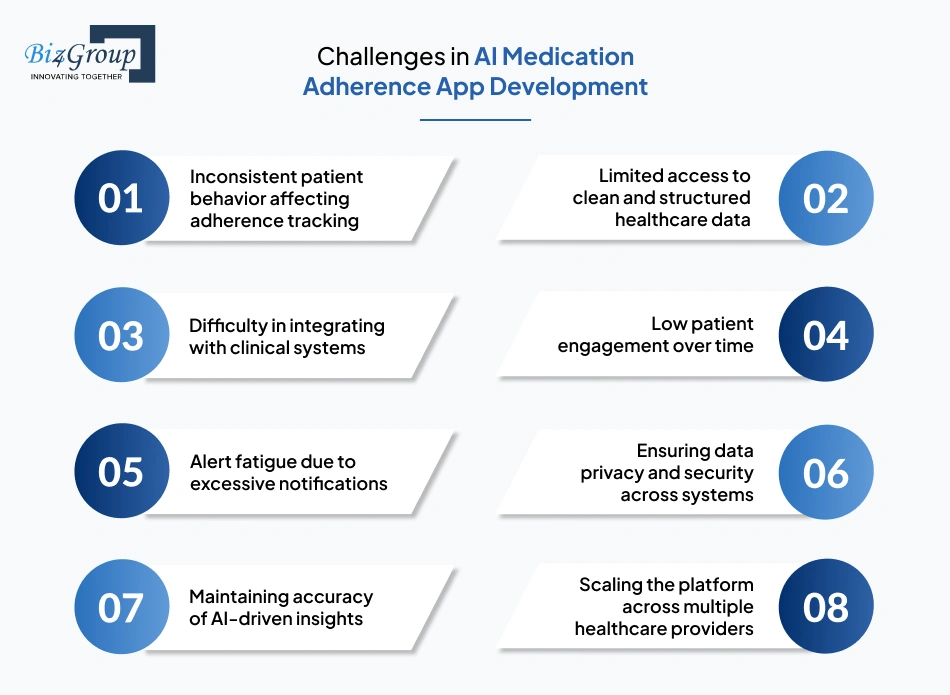
Real-world implementation is where most complexity appears. While AI improves medication adherence in healthcare apps and patient monitoring systems, turning that into a stable product requires solving practical challenges around data, behavior, and system integration.
To move forward confidently, it helps to understand not just the challenges but how they can be handled in real development scenarios.
|
Challenge |
How to Overcome It |
|---|---|
|
Inconsistent patient behavior affecting adherence tracking |
Use adaptive reminder logic that adjusts based on patient response patterns instead of fixed schedules. Continuously refine engagement strategies using real usage data to improve consistency over time. |
|
Limited access to clean and structured healthcare data |
Work with healthcare AI app developers who can design systems that normalize incoming data from multiple sources and maintain consistency before it is used for tracking or analysis. |
|
Difficulty in integrating with clinical systems |
Plan early to integrate AI with EHR/EMR systems using standard healthcare APIs, so medication data remains accurate and synced across platforms without manual intervention. |
|
Low patient engagement over time |
Introduce personalized reminders, simple user flows, and behavior-based nudges that align with daily routines to keep patients consistently engaged without overwhelming them. |
|
Alert fatigue due to excessive notifications |
Implement smart alert control that limits unnecessary notifications and prioritizes only critical reminders based on adherence risk and patient activity. |
|
Ensuring data privacy and security across systems |
Build strong encryption, controlled access, and secure authentication layers from the start, so sensitive patient data remains protected throughout the system lifecycle. |
|
Maintaining accuracy of AI-driven insights |
Continuously monitor system outputs and update models based on real-world data to ensure predictions remain relevant and reliable over time. |
|
Scaling the platform across multiple healthcare providers |
Design a flexible architecture that supports multiple users, locations, and workflows without affecting system performance or data consistency. |
Addressing these challenges early helps avoid delays and performance issues later. A practical approach to solving real-world problems makes AI medication adherence app development more stable, scalable, and aligned with actual healthcare workflows.
Finding the right development partner is often the most critical decision in the entire journey. It is not just about building a working system. It is about delivering a solution that fits healthcare workflows, handles patient data responsibly, and scales with real-world usage.
At this stage, many teams start evaluating their options based on practical needs and start asking:
This is where Biz4Group LLC comes into focus as a reliable execution partner.
We are an experienced AI app development company based in the USA with strong experience in building healthcare-focused solutions. The team focuses on aligning technology with real patient behavior and clinical workflows to ensure the product performs effectively in real environments.
A clear example of this capability can be seen in our work with CogniHelp.
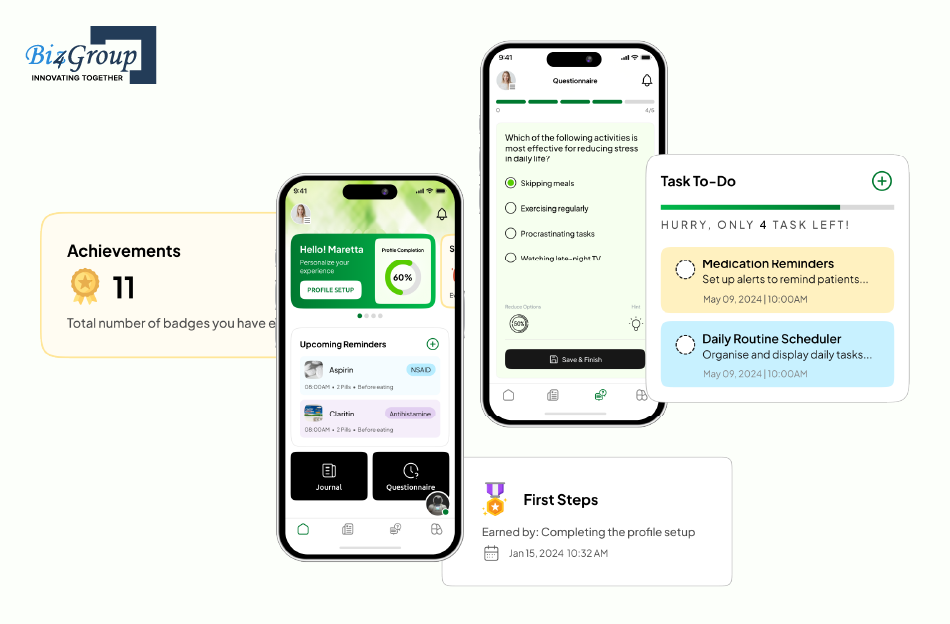
CogniHelp is an AI-powered mobile application designed to support early to mid-stage dementia patients by assisting with everyday cognitive tasks, memory retention, and social interactions. It offers personalized reminders, voice-based journaling, cognitive exercises, and real-time engagement tools that help patients stay oriented and independent while also supporting caregivers with actionable insights.
This kind of AI-driven assistance highlights how intelligent systems can improve routine adherence, which directly aligns with medication adherence solutions in healthcare.
Working with the right partner defines how successfully your product performs in real environments. With its experience and execution approach, Biz4Group stands as a strong choice for AI medication adherence app development aligned with healthcare needs.
Work with a team that understands healthcare workflows and delivers systems that actually perform
Build With Experts Who DeliverMedication adherence is not just a clinical concern. It is a measurable factor that directly impacts outcomes, operational efficiency, and long-term patient engagement. With the right approach, AI product development services can help turn everyday patient behavior into structured, trackable actions that improve consistency without adding complexity.
As healthcare systems evolve, the focus is shifting toward solutions that fit naturally into patient routines and provider workflows. That is where working with Biz4Group LLC makes a difference. Their experience in business app development using AI helps translate real healthcare needs into scalable, usable systems that deliver value over time.
The opportunity here is not just about technology. It is about creating systems that patients actually use, and providers can rely on. That is what defines the success of AI medication adherence app development and compliance in chronic disease patients.
If you are exploring this direction and want to move forward with clarity, connect with us to take the next step.
AI improves adherence by analyzing patient behavior patterns and adjusting reminders based on real usage. Instead of fixed alerts, it identifies when patients are likely to miss doses and delivers timely nudges that align with daily routines.
Yes, by ensuring patients follow prescribed medication plans after discharge. Continuous adherence tracking and timely alerts allow care teams to intervene early, which helps prevent complications that often lead to avoidable readmissions.
Startups often struggle with integrating clinical data, maintaining patient engagement, and aligning the system with real workflows. Scaling across multiple providers and ensuring consistent performance also becomes a key operational challenge.
The cost typically ranges from $30,000 to $250,000+, depending on features, AI capabilities, and integrations. Simpler MVP versions cost less, while advanced platforms with predictive analytics and system integrations require higher investment.
A basic version can take 3 to 5 weeks, while a more advanced platform with AI features and integrations may take 6 to 12 weeks, depending on complexity and development scope.
AI goes beyond reminders by predicting adherence risks, personalizing engagement strategies, and providing actionable insights to care teams. This helps create a proactive system that supports both patients and providers in real time.

with Biz4Group today!
Our website require some cookies to function properly. Read our privacy policy to know more.