Location :
Orlando, FL, USA
Location :
Orlando, FL, USA +1 (407) 714-1616
 info@biz4group.com


















Imagine a digital system that doesn’t wait for instructions but instead, understands your business goals, learns from real-time feedback, and takes independent actions to get the job done.
Read More

Have you ever wondered why hospitals collect enormous amounts of patient data but still struggle to use it during actual patient care?
If you manage healthcare technology systems, this situation probably feels familiar. Doctors finish consultations and then spend valuable time documenting notes. Nurses jump between systems just to locate patient history. Administrators sit on large volumes of healthcare data but still struggle to turn it into useful insights.
This growing gap is exactly why many healthcare organizations are investing in AI EHR app development.
Traditional electronic health record systems were designed mainly to store information. They were never built to analyze clinical data, support doctors in real time, or automate documentation. As healthcare data grows, these limitations become more visible.
According to the World Economic Forum, the healthcare sector now generates nearly 30% of the world’s total data volume, making it one of the fastest growing data ecosystems in the world.
At the same time, clinicians spend more time documenting than treating patients. Another report stated that physicians spend almost 2 hours on administrative tasks for every hour of patient care.
Because of this pressure, hospitals are exploring AI EHR app development for hospitals and clinics to make their systems more intelligent and efficient.
Instead of acting as passive databases, modern EHR platforms can summarize clinical notes, analyze patient history instantly, and surface insights that help doctors make faster decisions.
Healthcare leaders looking to develop AI EHR system app for healthcare organizations are not simply upgrading their software. They want systems that truly support clinical workflows.
Many innovators begin by understanding the broader landscape of AI healthcare app development and how intelligent technologies are reshaping digital health infrastructure.
But building such a system requires careful planning. To build AI powered EHR application for hospitals and build intelligent EHR app for healthcare, organizations must rethink how medical data is captured, processed, and delivered to clinicians in real time.
So where should you begin?
Let’s start by understanding what an AI powered EHR system really is and why healthcare experts are actively moving toward it.
AI EHR app development focuses on building electronic health record systems that can process and interpret healthcare data instead of only storing it.
Traditional EHR platforms act as digital filing systems. They capture patient information, prescriptions, reports, and treatment history, but they rarely assist doctors during clinical decisions.
When healthcare organizations develop AI EHR system app for healthcare organizations, the system begins to assist medical teams directly.
These platforms can:
Hospitals that build AI powered EHR application for hospitals are turning their record systems into clinical support platforms rather than simple storage tools.
This is why many healthcare organizations are upgrading their infrastructure with modern AI EMR/EHR software that can manage patient data and assist clinicians at the same time.
Hospitals exploring AI EHR app development for hospitals and clinics are usually trying to solve specific operational problems.
Key reasons include:
For healthcare leaders, AI EHR app development is not only about automation. It is about building systems that help medical teams work faster, make informed decisions, and deliver better patient care.
The next step is understanding where these systems create the most impact inside hospitals and clinics.
Let’s discuss how intelligent EHR systems can simplify clinical workflows and unlock real value from your patient data.
Talk to Our Experts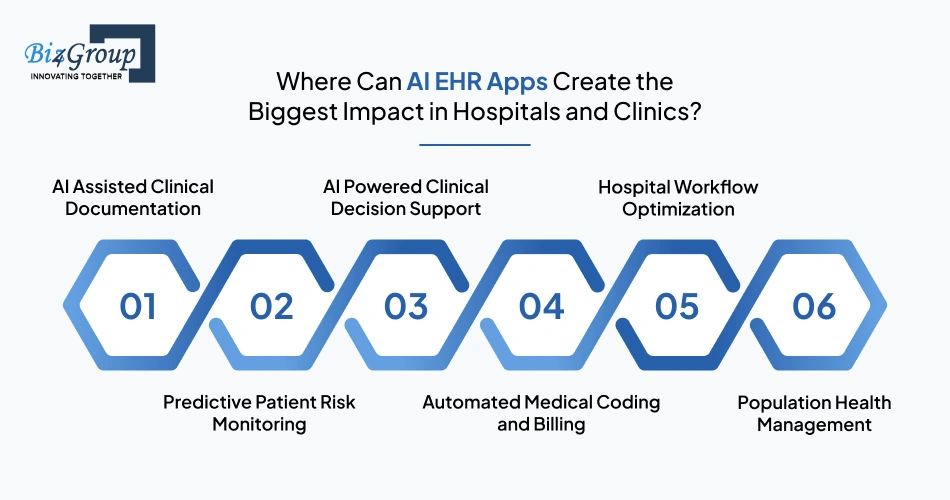
Hospitals exploring AI EHR app development for hospitals and clinics are usually trying to solve real operational problems. Clinical teams deal with heavy documentation, fragmented records, and delayed insights during patient care.
When organizations make AI based EHR app for healthcare providers, they introduce systems that actively assist doctors, nurses, and administrators instead of simply storing data.
Below are the areas where AI EHR app development delivers the most measurable impact.
Clinical documentation analysis consumes a large part of a doctor’s day. Physicians often spend significant time entering patient notes, updating records, and organizing visit summaries. Hospitals that build intelligent EHR app for healthcare can automate parts of this process. The system captures information during consultations and converts it into structured clinical records.
Key features
Hospitals collect a large amount of patient information through tests, medical history, and treatment records. Most traditional EHR systems store this information but do not analyze it. Organizations that develop AI EHR system app for healthcare organizations can use predictive models to identify possible health risks before complications occur.
Key features
Doctors often need to review multiple data points before making treatment decisions. Searching through patient history, lab results, and medications can take time during consultations. Hospitals that build AI powered EHR application for hospitals can provide clinical insights directly inside the record system.
Key features
Medical coding and billing processes are complex and time consuming. Errors in documentation can delay claims or create compliance issues. Healthcare organizations adopting AI EHR app development can automate coding by analyzing clinical documentation and extracting relevant billing information.
Key features
Hospitals operate through complex workflows that involve multiple departments, staff members, and patient interactions. Inefficiencies in scheduling, data sharing, or task management can slow down care delivery. When organizations build a modern AI EHR app solution for healthcare providers, they can streamline healthcare workflow operational processes across departments.
Key features
Healthcare providers increasingly need to monitor patient populations rather than individual cases. Public health initiatives, chronic disease management, and preventive care all require large scale data analysis. Hospitals investing in AI EHR app development can analyze trends across patient populations and identify patterns that support preventive healthcare strategies.
Key features
These use cases show how AI EHR app development transforms record systems into platforms that actively support patient care.
To enable these capabilities, hospitals must design EHR platforms with the right set of features. Let’s look at the core features every AI powered EHR application should include.
Hospitals investing in AI EHR app development are not simply upgrading record systems. They are building digital platforms that manage patient data, support clinicians, and connect multiple healthcare systems together.
For healthcare organizations planning to develop AI EHR system app for healthcare organizations, certain capabilities form the foundation of the platform. These core features ensure the system can manage patient records, support clinical workflows, and maintain strict healthcare data security.
Healthcare providers that build AI powered EHR application for hospitals typically implement the following essential platform features.
Every EHR platform relies on a centralized patient record database. This system stores patient demographics, medical history, prescriptions, lab results, imaging reports, and treatment records in a structured format. Hospitals implementing AI EHR app development for hospitals and clinics need patient record systems that allow quick retrieval of medical information across departments. A well-designed AI medical record management system ensures clinicians can access complete patient history during consultations.
Clinical documentation is one of the most important features of an EHR system. Hospitals that make AI based EHR app for healthcare providers include documentation tools that simplify how physicians record patient encounters. This module captures consultation notes, treatment summaries, and clinical observations directly inside the EHR platform. AI assistance can help structure medical notes and organize documentation, so records remain consistent across the system.
Electronic prescription management allows doctors to generate and manage prescriptions directly from the EHR platform. This feature connects physicians, pharmacies, and patient records within a single system. Hospitals that build intelligent EHR app for healthcare use e-prescription modules to reduce medication errors and maintain accurate prescription history within patient records.
Modern healthcare environments rely on multiple software systems including laboratory systems, pharmacy platforms, imaging tools, and insurance systems. Organizations investing in AI EHR app development must ensure the platform can exchange data using standards such as HL7 and FHIR. These integrations allow hospitals to synchronize patient information across different systems.
Healthcare organizations often plan how to integrate AI with EHR/EMR systems so intelligent capabilities can work alongside existing healthcare infrastructure.
Healthcare systems involve many different users including physicians, nurses, administrators, and technicians. Each role requires access to different parts of the system. Hospitals that develop AI EHR system app for healthcare organizations include role-based access controls to ensure only authorized users can access specific patient data. This feature protects sensitive information while maintaining operational efficiency.
Security is a critical requirement in any healthcare system. Hospitals building EHR platforms must comply with healthcare regulations such as HIPAA compliance. Organizations that build AI powered EHR application for hospitals implement encryption, secure authentication, and data protection mechanisms to safeguard patient information. These controls ensure healthcare data remains protected across the entire system.
Healthcare organizations rely heavily on reporting and analytics to monitor performance, patient outcomes, and operational efficiency. When hospitals invest in AI EHR app development for hospitals and clinics, analytics modules allow administrators to analyze treatment outcomes, track hospital operations, and identify healthcare trends using patient data.
These core features form the technical foundation of any modern EHR platform. Once these modules are in place, healthcare organizations can extend the system with more advanced capabilities powered by intelligent data processing.
Now, let's explore the advanced features that are shaping the future of AI driven EHR platforms.
Once the core platform is in place, hospitals begin extending their systems with advanced capabilities. These features help healthcare organizations extract deeper insights from patient data and improve clinical workflows.
Healthcare providers investing in AI EHR app development for hospitals and clinics often add advanced modules that assist clinicians with diagnosis support, patient monitoring, and intelligent automation.
Organizations planning enterprise AI EHR app development for healthcare providers usually prioritize the following advanced capabilities.
|
Advanced Feature |
What It Does |
Why It Matters for Hospitals |
|---|---|---|
|
Generative Clinical Documentation |
Converts doctor patient conversations into structured medical notes within the EHR system. It can summarize consultations, organize clinical observations, and prepare visit documentation. |
Reduces documentation workload for physicians and allows them to focus more on patient care rather than manual note taking. |
|
Predictive Patient Risk Analytics |
Uses historical patient data, lab reports, and clinical history to identify patterns that may indicate potential health risks. |
Helps hospitals detect complications early and intervene before conditions worsen. |
|
AI Driven Diagnostic Support |
Reviews patient history, symptoms, and test results to assist clinicians in evaluating possible diagnoses. |
Supports doctors with additional data insights when reviewing complex medical cases. |
|
Voice Enabled EHR Interaction |
Allows clinicians to access patient records, update notes, or retrieve information using voice commands. |
Makes it easier for doctors to interact with the EHR system during consultations without interrupting clinical workflows. |
|
Medical Imaging Analysis Integration |
Connects the EHR platform with imaging systems to analyze scans such as X rays, MRIs, and CT scans. |
Helps radiologists and clinicians review imaging insights faster and integrate results directly into patient records. |
|
Population Health Intelligence |
Analyzes data from large patient groups to identify health trends, disease risks, and preventive care opportunities. |
Helps healthcare organizations improve preventive care strategies and manage chronic conditions across patient populations. |
|
Operational Workflow Intelligence |
Monitors hospital operations including patient flow, resource utilization, and department performance. |
Helps administrators optimize hospital workflows and reduce operational bottlenecks. |
Hospitals looking to build a modern AI EHR app solution for healthcare providers typically implement these advanced capabilities after the core system is stable and integrated with existing healthcare infrastructure.
Many organizations partner with an experienced AI healthcare software development company to design these advanced systems and ensure they meet clinical, operational, and regulatory requirements.
Building such platforms requires a clear development roadmap, which is exactly what we will break down in the following section.
Our team can help you design a scalable system with the right architecture, integrations, and AI capabilities.
Build Your AI EHR Solution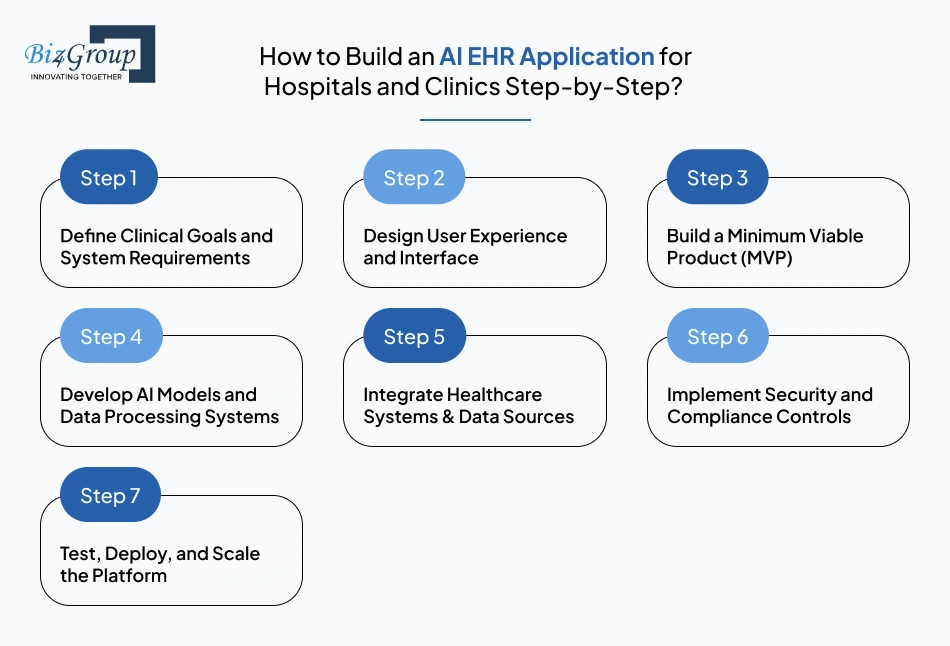
Building a healthcare platform requires careful planning. Hospitals investing in AI EHR app development must design systems that handle patient data securely, support clinical workflows, and scale across departments or facilities. Organizations that develop AI EHR system app for healthcare organizations usually follow a structured development process. Each stage ensures the platform meets healthcare regulations, integrates with hospital systems, and delivers real value to clinicians.
Below are the key steps healthcare organizations follow when planning AI EHR app development for hospitals and clinics.
Every successful healthcare platform begins with a clear understanding of clinical workflows and operational goals. Hospitals must identify which problems they want the system to solve, whether it is reducing documentation workload, improving patient monitoring, or organizing medical records. This stage also helps organizations define the scope of the platform before they build AI-powered EHR applications for hospitals.
Key activities usually include:
Doctors and nurses interact with EHR systems constantly throughout the day. If the interface is complex or slow, it quickly affects clinical productivity. Hospitals investing in AI EHR app development focus heavily on intuitive interface design. A well planned system allows clinicians to access patient records quickly, update notes easily, and navigate between modules without delays. Organizations often work with specialists in UI/UX design to ensure the platform supports real clinical workflows.
Important design considerations include:
Developing the entire platform at once can be risky and expensive. Many healthcare organizations start with a focused version of the system that includes the most essential capabilities. This approach allows hospitals to test features, gather feedback from clinicians, and validate workflows before expanding the platform. Building an early version through MVP development helps organizations launch faster while reducing development risk.
Typical MVP features include:
AI capabilities require reliable data processing and well-trained models. Hospitals planning enterprise AI EHR app development for healthcare providers must design systems that can analyze patient records, clinical notes, and diagnostic reports. Organizations often collaborate with specialists in AI model development to create models that support predictive analytics, clinical documentation assistance, and patient risk monitoring.
Core development tasks include:
Hospitals operate many different digital systems including laboratory platforms, pharmacy systems, imaging tools, and billing software. When organizations build intelligent EHR app for healthcare, integration ensures patient data flows smoothly between these systems. Proper integration helps doctors access a complete view of patient history within the EHR platform.
Common integration tasks include:
Healthcare platforms must protect sensitive patient data. Security architecture is a critical stage when hospitals make AI based EHR app for healthcare providers. Organizations must implement encryption, authentication, and strict access controls to meet regulatory requirements such as HIPAA.
Security measures usually include:
Before launching the platform across the hospital network, extensive testing is required. This stage ensures the system works reliably under real clinical conditions. Hospitals that build a modern AI EHR app solution for healthcare providers test system performance, validate integrations, and gather feedback from healthcare staff before expanding deployment.
Final deployment steps usually include:
Following these steps helps healthcare organizations build scalable and secure platforms while reducing risks during AI EHR app development.
Understanding the development process also helps hospital leaders estimate the resources and investment required to build these systems.
Hospitals investing in AI EHR app development need a technology stack that supports large patient datasets, strong security, and seamless system integration. Organizations planning to develop AI EHR system app for healthcare organizations typically combine cloud infrastructure, AI frameworks, secure databases, and interoperability standards.
The table below outlines the technologies commonly used in AI EHR app development for hospitals and clinics.
|
Technology Layer |
Technologies Commonly Used |
Why It Matters for AI EHR Systems |
|---|---|---|
|
Frontend Development |
React.js, Angular, Vue.js |
These frameworks help build responsive dashboards where clinicians can access patient records, medical notes, and analytics quickly. |
|
Backend Development |
Backend frameworks handle system logic, manage healthcare data processing, and support communication between different hospital systems. |
|
|
AI and Machine Learning |
TensorFlow, PyTorch, Scikit-learn |
These tools support predictive analytics, clinical documentation assistance, and patient risk detection in AI EHR app development. |
|
Database Management |
PostgreSQL, MongoDB, MySQL |
Healthcare systems store large volumes of structured and unstructured medical data. Reliable databases ensure fast access to patient records. |
|
Cloud Infrastructure |
AWS, Microsoft Azure, Google Cloud |
Cloud platforms allow hospitals to scale systems, store healthcare data securely, and support high availability across departments. |
|
Healthcare Interoperability |
HL7, FHIR APIs |
These standards allow the EHR system to exchange patient data with labs, pharmacies, imaging systems, and external healthcare providers. |
|
Security Technologies |
OAuth 2.0, SSL encryption, multi-factor authentication |
Security layers protect patient records and ensure compliance with healthcare regulations such as HIPAA. |
|
Flutter, React Native, Swift, Kotlin |
These technologies support AI EHR mobile app development, so doctors and healthcare staff can access records securely from mobile devices. |
A strong technology stack is the backbone of AI EHR app development because it determines scalability, security, and integration of capability across healthcare systems.
Understanding these technical components also helps organizations estimate the investment required to build AI powered EHR application for hospitals.
Also Read: Next JS Development Company
One of the first questions healthcare leaders ask is the investment required for AI EHR app development for hospitals and clinics. The cost of building such platforms depends on system complexity, AI capabilities, integrations, and security requirements.
In most cases, organizations planning to develop AI EHR system app for healthcare organizations can expect development costs to range between $35,000 and $250,000+. Smaller systems with basic features fall on the lower end, while enterprise platforms with advanced AI modules, integrations, and compliance controls require higher investment.
The final cost can vary depending on hospital size, required features, and the development approach used to build AI powered EHR application for hospitals.
|
Feature / Module |
Estimated Cost Range |
Why It Impacts Development Cost |
|---|---|---|
|
Patient Record Management System |
$8,000 – $25,000 |
Core system for storing and organizing patient data across departments. |
|
AI Assisted Clinical Documentation |
$12,000 – $40,000 |
Requires voice processing, natural language models, and structured medical documentation. |
|
Clinical Decision Support Module |
$15,000 – $45,000 |
Uses medical datasets and AI models to support diagnosis insights and treatment recommendations. |
|
E-Prescription Management |
$5,000 – $15,000 |
Connects physicians with pharmacy systems and maintains prescription history. |
|
Healthcare System Integration (HL7 / FHIR APIs) |
$10,000 – $35,000 |
Enables interoperability between lab systems, pharmacy platforms, and imaging systems. |
|
AI Patient Risk Prediction Models |
$20,000 – $60,000 |
Requires training models using historical healthcare data. |
|
Security and Compliance Systems |
$10,000 – $30,000 |
Includes encryption, authentication, and HIPAA compliance implementation. |
|
Healthcare Analytics Dashboard |
$8,000 – $20,000 |
Helps administrators monitor hospital performance and patient trends. |
|
Mobile Access for Clinicians |
$7,000 – $25,000 |
Supports AI EHR mobile app development and allows clinicians to access records remotely. |
Hospitals planning enterprise AI EHR app development for healthcare providers often implement these modules gradually instead of building everything at once.
Several variables influence the investment required to build intelligent EHR app for healthcare systems.
Large hospitals require multi department systems, advanced analytics, and extensive integrations, which increases development effort.
Organizations planning to make AI based EHR app for healthcare providers with predictive analytics, documentation automation, and clinical insights will require additional model training and infrastructure.
Connecting EHR platforms with lab systems, pharmacy software, imaging systems, and billing platforms adds integration complexity.
Healthcare systems must meet regulations such as HIPAA, which requires secure data storage, encryption, and strict access control.
Hospitals investing in EHR mobile app development integrating AI for clinicians may require additional development for mobile apps and secure access.
Healthcare organizations often underestimate some long-term costs when planning AI EHR app development.
Training predictive models requires clean medical datasets and continuous model improvement.
Large healthcare datasets require secure cloud storage and computing resources.
Hospitals must maintain the platform regularly to ensure security updates, performance improvements, and compliance.
Third party systems such as labs and pharmacy software may require ongoing API updates.
Hospitals can reduce development risks and costs by following practical strategies while planning to build a modern AI EHR app solution for healthcare providers.
Launching a smaller system first helps hospitals validate workflows and gather feedback before scaling the platform.
Healthcare organizations should initially implement core modules such as patient records, documentation tools, and interoperability.
Cloud based platforms reduce infrastructure costs while allowing hospitals to scale gradually.
Working with teams experienced in AI healthcare development company helps hospitals avoid costly architectural mistakes and ensure compliance.
Healthcare organizations planning AI EHR app development for hospitals and clinics benefit from understanding these cost components before starting development. Proper planning helps avoid unexpected expenses and ensures the system delivers real clinical value.
Share your requirements and we’ll help estimate the scope, features, and investment needed for your healthcare platform.
Get a Cost Estimate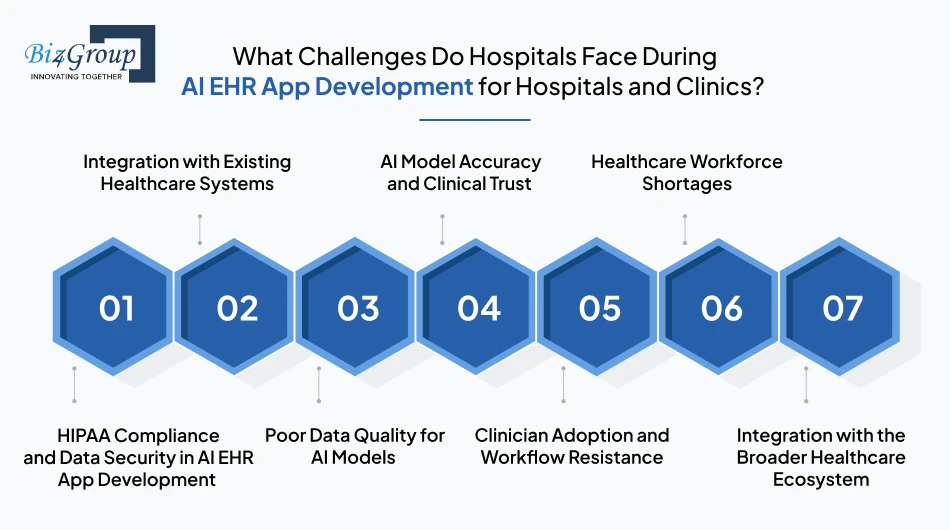
Hospitals planning AI EHR app development must address technical, regulatory, and operational challenges early to ensure the platform works reliably in real clinical environments.
|
Challenge in AI EHR App Development |
Why It Happens |
Practical Solution |
|---|---|---|
|
HIPAA Compliance and Data Security in AI EHR App Development |
Hospitals store highly sensitive patient data. Systems built during AI EHR app development for hospitals and clinics must protect records from unauthorized access and data breaches. |
Use encrypted storage, secure authentication, role based access control, and regular compliance audits to ensure HIPAA compliance. |
|
Integration with Existing Healthcare Systems |
When organizations develop AI EHR system app for healthcare organizations, the platform must connect with lab systems, pharmacy platforms, and imaging software that may run on older infrastructure. |
Implement HL7 and FHIR based APIs to connect legacy hospital systems with modern EHR platforms. |
|
Poor Data Quality for AI Models |
Hospitals that make AI based EHR app for healthcare providers often deal with fragmented or inconsistent patient records collected across departments. |
Standardize medical data formats, clean historical datasets, and implement data validation pipelines before training AI models. |
|
AI Model Accuracy and Clinical Trust |
When hospitals build intelligent EHR app for healthcare, clinicians must trust the insights generated by predictive models and analytics tools. |
Train models using diverse datasets and keep clinicians involved in validating recommendations before using them in patient care. |
|
Clinician Adoption and Workflow Resistance |
Poorly designed systems can disrupt clinical workflows. Hospitals implementing AI EHR app development for hospitals and clinics must ensure the system fits daily medical operations. |
Work with experienced teams or hire healthcare AI app developers who understand healthcare workflows and usability requirements. |
|
Healthcare Workforce Shortages |
Hospitals building systems to build AI powered EHR application for hospitals often struggle with limited clinical staff and operational resources. |
Automation tools and platforms such as AI healthcare staffing app solutions help optimize staff scheduling and workload distribution. |
|
Integration with the Broader Healthcare Ecosystem |
EHR platforms must connect with pharmacy systems and medication management tools when hospitals build a modern AI EHR app solution for healthcare providers. |
Connecting prescription workflows with systems like an AI pharmacy app helps maintain accurate medication records and improve care coordination. |
Proper planning and experienced development support help healthcare organizations overcome these challenges and build scalable systems through AI EHR app development.
Healthcare organizations planning AI EHR app development for hospitals and clinics need a development partner that understands both healthcare technology and AI driven systems. Building these platforms requires expertise in data security, clinical workflows, system integrations, and scalable infrastructure.
Biz4Group, a leading AI healthcare software development company in USA, helps hospitals, clinics, and healthtech companies develop AI EHR system app for healthcare organizations that are secure, scalable, and designed around real clinical workflows. The team supports the entire journey from defining requirements and designing user-friendly systems to building AI-powered features and integrating hospital infrastructure.
With strong experience in enterprise AI EHR app development for healthcare providers, Biz4Group helps organizations:
Organizations evaluating who can build an AI EHR app for healthcare organizations often compare development partners before making a decision.
With the right strategy and technology partner, hospitals can successfully implement AI EHR app development and transform how patient data supports clinical care.
Partner with Biz4Group to build secure, scalable, and intelligent EHR systems designed for modern healthcare organizations.
Start Your ProjectHealthcare organizations are rapidly adopting AI EHR app development to turn patient data into actionable insights and improve clinical efficiency. Hospitals investing in AI EHR app development for hospitals and clinics are building systems that reduce documentation workload, support smarter decisions, and streamline healthcare operations.
To develop an AI EHR system app for healthcare organizations, the platform must combine secure infrastructure, intelligent features, and seamless integration with existing hospital systems.
With deep expertise in healthcare technology, Biz4Group helps organizations build AI powered EHR applications for hospitals that are secure, scalable, and designed around real clinical workflows.
Build the kind of healthcare system your clinicians actually enjoy using.
AI EHR app development involves building electronic health record platforms that combine traditional patient record management with artificial intelligence. These systems can analyze medical data, automate documentation, detect risk patterns, and support clinical decision making. When hospitals develop AI EHR system app for healthcare organizations, the platform can organize patient data and deliver insights directly during consultations.
Hospitals are adopting AI EHR app development for hospitals and clinics to reduce physician documentation workload, improve patient data analysis, and enhance clinical decision support. AI enabled EHR systems to analyze patient records, identify health risks, and help doctors access relevant information faster during treatment.
The cost to build AI powered EHR application for hospitals usually ranges from $35,000 to $250,000+ depending on system complexity, integrations, AI features, and compliance requirements. Enterprise systems that include predictive analytics, advanced integrations, and mobile access typically require higher investment.
Hospitals planning to build intelligent EHR app for healthcare platforms typically include features such as patient record management, AI assisted clinical documentation, clinical decision support, e-prescription management, interoperability with lab and pharmacy systems, and healthcare analytics dashboards. These features help healthcare providers manage patient data efficiently and improve treatment workflows.
The timeline to develop AI EHR system apps for healthcare organizations depends on feature complexity and integrations. A basic platform or MVP may take 4 to 6 months, while enterprise healthcare systems with AI capabilities, integrations, and compliance requirements can take 9 to 15 months or longer.
Hospitals that make AI based EHR app for healthcare providers must follow strict healthcare security standards. This typically includes HIPAA compliant data storage, encrypted data transmission, role-based access control, multi-factor authentication, and regular compliance audits to protect sensitive patient information.
Healthcare organizations usually partner with specialized healthcare technology companies that understand clinical workflows, interoperability standards, and AI infrastructure. These development teams help hospitals build a modern AI EHR app solution for healthcare providers that is scalable, secure, and compliant with healthcare regulations.

with Biz4Group today!
Our website require some cookies to function properly. Read our privacy policy to know more.