Location :
Orlando, FL, USA
Location :
Orlando, FL, USA +1 (407) 714-1616
 info@biz4group.com

















Imagine a digital system that doesn’t wait for instructions but instead, understands your business goals, learns from real-time feedback, and takes independent actions to get the job done.
Read More
 AI Summary Powered by Biz4AI
Why are some hospitals able to prioritize critical patients faster even when emergency departments are under constant pressure?
The answer lies in how efficiently patient symptoms are assessed before clinical resources are assigned. Delays at the triage stage affect much more than waiting times they influence patient flow, resource allocation, and the speed at which high-risk cases receive attention.
This is where AI triage nurse software is becoming a practical investment for healthcare organizations looking to strengthen frontline decision-making.
A NEJM AI study analyzing 174,648 emergency department visits found that AI-assisted triage improved the identification of patients requiring critical care from 78.8% to 83.1%, reinforcing the value of intelligent clinical decision support during patient intake.
For hospitals, healthcare startups, telehealth providers, and digital health organizations, adopting AI triage goes beyond automating symptom collection. It creates measurable operational improvements that directly impact care delivery, including:
So, if you're evaluating AI triage nurse software development, understanding the technology is only one part of the decision. Choosing the right architecture, clinical workflow, compliance strategy, and AI development company determines whether the solution can support real healthcare operations at scale.
And this guide is designed to fulfill that purpose. Let's dive in.
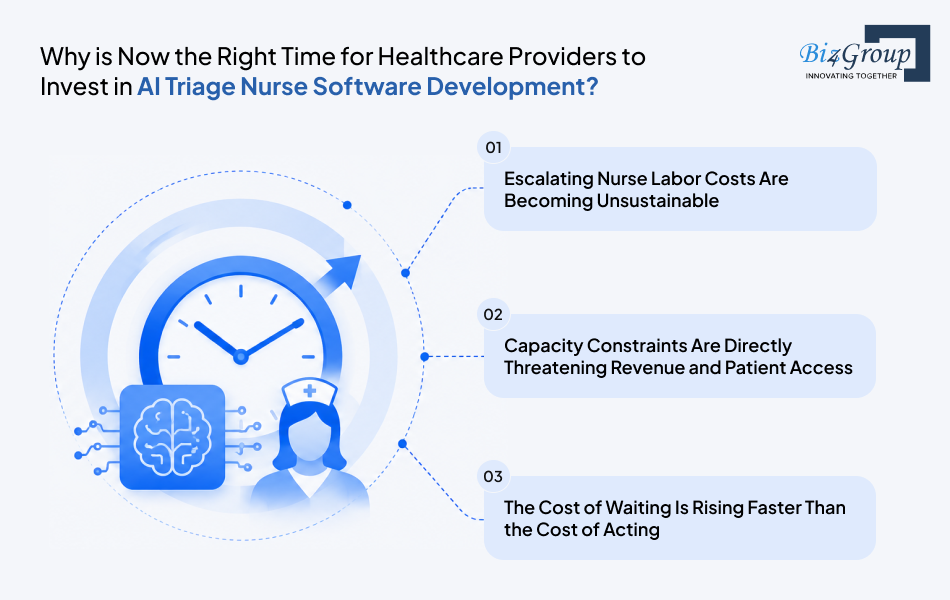
Because the cost of waiting keeps climbing while the pressure on staff, beds, and budgets shows no sign of easing. Take a look:
Hospitals are spending more every year just to keep the same number of nurses. Vacancies stay high, turnover remains stubborn, and replacing one bedside nurse now costs over sixty thousand dollars. That money disappears into overtime and agency fees instead of patient care with:
When emergency departments run over capacity, patients wait longer, some leave without being seen, and downstream revenue quietly walks out the door. Volume pressure is not slowing down, especially among older adults who need more complex care and:
Organizations that move first lock in operational gains while others still debate. The global AI based triage tools market is projected to grow from USD 104.97 million in 2025 to USD 290.10 by 2035 at a CAGR of 10.7 percent, with hospital-based triage expected to hold 37% share. Delaying only raises the price of catching up later and:
Health systems already using these tools are seeing concrete results.
Mount Sinai Health System reports that its AI triage solution achieves more than 95% triage accuracy, performs 85% faster than traditional telephone triage, and directs 95% of patients to more clinically appropriate resources. Those numbers turn the business case from theory into proven operational relief.
The pressures are real, the market is expanding, and the systems that act now position themselves to control costs rather than keep reacting to them.
AI triage nurse software is a clinical decision support system that collects a patient's symptoms, medical history, chief complaint, and risk factors to determine the likely urgency of the case and recommend the most appropriate level of care.
Rather than simply recording information, it follows evidence-based triage protocols to identify red-flag symptoms, assign an acuity level, and guide patients toward emergency care, urgent care, primary care, virtual consultation, or self-care when appropriate.
You'll find these systems supporting patient intake in hospitals, emergency departments, telehealth services, after-hours nurse advice lines, and healthcare call centers where fast, standardized assessments are essential.
Also Read: How to Develop AI-Powered Patient Management Software
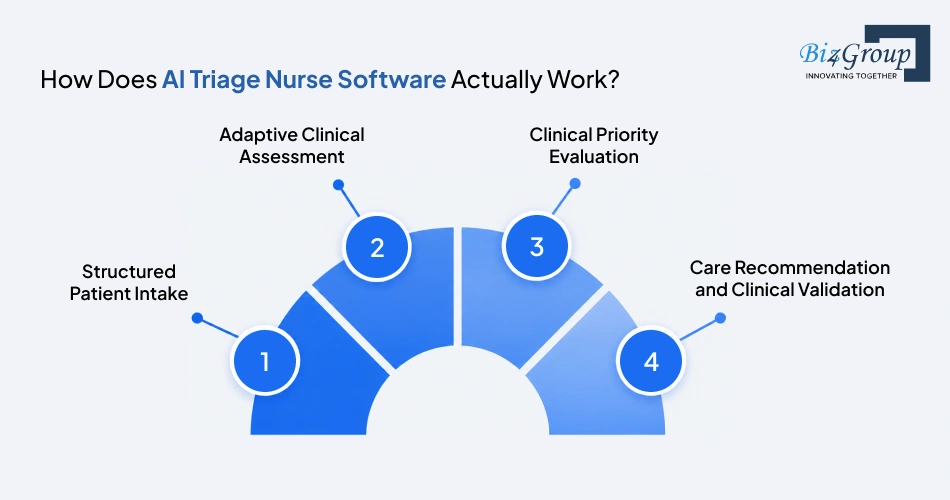
Every AI triage nurse workflow follows a structured clinical pathway designed to collect the right information, evaluate patient urgency consistently, and support faster care decisions. Here's how the process typically works:
The workflow begins by capturing the patient's presenting complaint along with symptoms, demographic details, existing medical conditions, current medications, and allergies. All relevant health information is captured through digital forms, chat interfaces, chatbot voice assistants, or patient portals.
Instead of collecting excessive information upfront, the system focuses on building a structured clinical profile that provides the context needed for an accurate triage assessment.
Based on the initial information, the platform dynamically adjusts its assessment by asking evidence-based follow-up questions rather than following a fixed questionnaire.
Each response helps identify symptom severity, duration, associated conditions, and potential red-flag indicators while filtering out questions that add little clinical value.
This adaptive approach reduces unnecessary data collection and keeps the assessment focused on clinically relevant information.
Once sufficient information is collected, the decision engine evaluates the complete assessment against standardized triage protocols, clinical guidelines, and predefined decision rules.
Rather than producing a medical diagnosis, the system estimates the patient's acuity level, identifies potential clinical risks, and determines how urgently medical attention may be required.
This standardized evaluation supports consistent patient prioritization across hospitals, emergency departments, telehealth services, and nurse call centers.
The platform generates a recommended care pathway, such as emergency department referral, urgent care, primary care scheduling, virtual consultation, or self-care guidance, together with the reasoning behind the recommendation.
Before any clinical action is taken, a nurse or physician reviews the assessment, validates the suggested priority, and modifies the recommendation whenever professional judgment or additional clinical findings require a different course of action.
This human oversight ensures the software functions as a clinical decision support tool while licensed healthcare professionals remain responsible for the final care decision.
The AI triage nurse for hospitals follows a patient assessment workflow, but its consistency comes from a few core functional layers working together. Take a look:
|
Aspect |
Traditional Nurse Triage |
AI Triage Nurse Software |
|---|---|---|
|
Initial Assessment |
Performed manually by a nurse |
Conducted through a standardized digital assessment |
|
Question Consistency |
Varies by clinical experience |
Same evidence-based questions for similar cases |
|
Availability |
Limited to staff availability |
Available 24/7 across care settings |
|
Assessment Capacity |
Restricted by nursing workforce |
Handles high volumes of routine assessments simultaneously |
|
Patient Prioritization |
Based on individual clinical judgment |
Standardized urgency estimation with clinician review |
|
Nurse Workload |
More time spent on routine screening |
Greater focus on complex and high-risk cases |
|
Scalability |
Requires additional staff as demand grows |
Expands assessment capacity without proportional staffing growth |
|
Final Clinical Decision |
Nurse determines next steps |
Nurse or clinician validates and finalizes recommendations |
AI triage nurse software brings structure, consistency, and clinical support to the earliest stage of patient care. Understanding these fundamentals makes it easier to evaluate how the software delivers value across different healthcare environments.
Every healthcare workflow is different let's map AI triage around yours not the other way around
Discuss Your Triage Strategy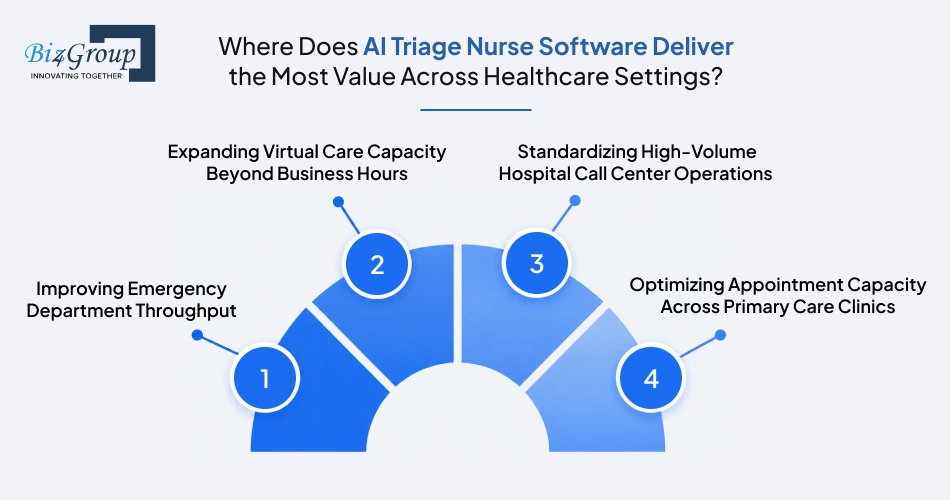
AI triage nurse software delivers the most value in emergency departments, telehealth and after-hours care where it standardizes patient prioritization, expands assessment capacity, and reduces the operational load on clinical staff without adding headcount. Let's look at them in detail:
Emergency departments face the greatest pressure when ambulance arrivals, walk-in patients, and high-acuity cases compete for immediate attention.
Delays in initial triage create waiting room congestion, inconsistent patient prioritization, and slower treatment decisions.
AI triage nurse software for emergency rooms supports intake immediately after registration or alongside nurse-led assessment, helping maintain consistent triage queues and better utilize emergency nursing capacity.
Healthcare organizations can strengthen ED operations by:
Also Read: How to Develop an AI ER Triage Chatbot?
After-hours services and virtual care programs are expected to remain accessible even when clinician availability is limited.
Large volumes of routine symptom enquiries can quickly consume on-call capacity, making it difficult to prioritize cases that genuinely require immediate attention.
AI triage nurse for telehealth provides a structured first point of contact that supports continuous service availability while ensuring only clinically appropriate cases reach on-call teams.
Healthcare organizations can:
Also Read: How to Develop an AI Telehealth Automation System in 2026
Hospital call centers and nurse advice lines handle thousands of inbound conversations that demand consistent clinical guidance regardless of shift, location, or staffing levels.
Variation in initial assessments can increase average handle time, create long call queues, and affect the consistency of advice delivered.
AI triage nurse automation standardizes the first stage of every interaction, giving nursing teams structured clinical context before live conversations begin.
Healthcare organizations can:
Primary care and outpatient clinics depend on efficient scheduling to keep physicians, specialists, and nursing teams fully utilized throughout the day.
Manual symptom sorting and appointment routing often consume valuable administrative time while increasing the number of unnecessary same-day visits.
AI triage software supports pre-visit assessment before scheduling decisions are made, helping clinics allocate appointments more effectively while keeping daily operations organized.
Healthcare organizations can:
Also Read: Build AI Scheduling Assistant App: Cost & Key Features
Every healthcare setting faces a different operational challenge, but the objective remains the same: helping clinical teams prioritize the right patients, allocate resources more effectively, and keep care delivery running consistently as demand continues to grow.
The right feature set determines whether AI triage becomes a dependable operational system or simply another digital tool. When evaluating AI triage nurse software, healthcare leaders should focus on capabilities that strengthen clinical consistency, improve workforce productivity, and support long-term organizational growth.
These features shape the quality of every triage decision by ensuring assessments remain structured, complete, and clinically consistent before professional review begins.
|
Feature |
Purpose |
|---|---|
|
Structured Symptom Assessment |
Capture patient symptoms using a consistent assessment format. |
|
Chief Complaint Capture |
Record the primary reason for seeking medical care. |
|
Adaptive Follow-up Questions |
Collect additional information based on previous responses. |
|
Red-Flag Symptom Identification |
Detect presentations requiring immediate clinical attention. |
|
Clinical Urgency Assessment |
Estimate patient priority using standardized clinical guidance. |
|
Care Level Recommendation |
Recommend the appropriate care pathway for clinical review. |
The greatest operational value comes from reducing repetitive work while allowing nursing teams to concentrate on clinically complex assessments and higher-priority decisions.
|
Feature |
Purpose |
|---|---|
|
Digital Pre-Triage Intake |
Complete routine assessments before nurse review. |
|
Assessment Queue Management |
Prioritize cases according to clinical urgency. |
|
Case Escalation |
Route high-priority cases for immediate review. |
|
Nurse Review Workspace |
Present structured assessments for rapid validation. |
|
Assessment Status Tracking |
Track every case throughout the triage process. |
|
Clinical Reassessment Support |
Update patient priority when new information becomes available. |
Healthcare leaders need continuous visibility into triage operations to maintain consistency, identify bottlenecks, and make informed staffing and workflow decisions.
|
Feature |
Purpose |
|---|---|
|
Live Triage Dashboard |
Monitor assessment activity in real time. |
|
Work Queue Monitoring |
Track pending assessments across clinical teams. |
|
Priority Alert Management |
Notify staff when urgent cases require attention. |
|
Operational Exception Tracking |
Highlight assessments needing manual review. |
|
Workflow Performance Reports |
Measure daily triage performance and operational trends. |
|
Supervisor Review Console |
Support oversight of triage quality and operational activity. |
Consistent triage depends on standardized governance that allows organizations to manage workflows while giving clinical teams appropriate operational flexibility.
|
Feature |
Purpose |
|---|---|
|
Clinical Protocol Management |
Maintain approved triage protocols across the organization. |
|
Department Workflow Configuration |
Configure workflows for different clinical services. |
|
Role-Based Access Control |
Assign permissions according to staff responsibilities. |
|
Decision Override Management |
Allow clinicians to review and modify recommendations. |
|
Assessment Audit History |
Maintain a complete history of every assessment. |
|
Organization-Wide Configuration |
Standardize operational settings across facilities. |
As healthcare organizations expand, the software should support growing patient volumes, additional facilities, and larger clinical teams without disrupting standardized triage operations.
|
Feature |
Purpose |
|---|---|
|
Multi-Facility Management |
Standardize triage across multiple locations. |
|
Multi-Department Support |
Support different clinical departments from one platform. |
|
High-Volume Assessment Handling |
Maintain performance during demand surges. |
|
Centralized Administration |
Manage enterprise-wide triage operations efficiently. |
|
Configurable Assessment Workflows |
Adapt assessments to organizational requirements. |
|
Enterprise Performance Monitoring |
Track operational performance across the health system. |
Every feature during AI triage nurse software development should strengthen a different part of the triage operation. Together, these capabilities help healthcare organizations build a platform that remains reliable, scalable, and operationally efficient as clinical demand continues to grow.
AI triage nurse software integrates with EHR and telehealth platforms through a sequential connection process: system discovery, standard-based data mapping, secure authentication, sandboxed exchange, clinical data validation, phased activation, and continuous monitoring.
The integration process begins by identifying the EHR, telehealth, and scheduling platforms already in use, along with their supported interoperability standards (FHIR or HL7).
The platform maps data exchange using FHIR R4 for modern EHRs, HL7 v2 for legacy systems, or SMART on FHIR for platforms like Epic and Oracle Health.
Connection access is established through OAuth 2.0 or SMART on FHIR protocols, with role-based permissions and encrypted transmission channels applied to every data exchange.
The connection is built and tested within the EHR vendor's sandbox environment, where data mapping errors and sync issues are identified before any live patient data moves through the system.
Once technically functional, the integration is validated to confirm assessment summaries, urgency levels, and patient records sync accurately inside the EHR interface without duplication or conflict.
The integration goes live within a single department or facility first, allowing real clinical data flow to be observed before activation expands across additional sites.
Once active, the connection is monitored on an ongoing basis for sync failures, API changes, and vendor-side updates that could affect data flow.
This sequence allows AI triage nurse software to function as a connected layer within existing healthcare infrastructure rather than a standalone system, to keep patient information consistent across every connected platform.
A successful integration is defined by the quality of information exchanged, not simply by establishing a connection. Platforms such as Epic, Oracle Health (Cerner), and other FHIR- or HL7-compatible EHRs can securely exchange structured clinical information with AI nurse triage software so every assessment builds on existing patient records instead of starting from scratch.
|
Information Retrieved from the EHR |
Information Returned to the EHR |
|---|---|
|
Patient demographics |
Triage assessment summary |
|
Medical history |
Reported symptoms |
|
Active medications |
Clinical urgency level |
|
Allergy records |
Recommended care pathway |
|
Problem list |
Assessment outcome and disposition |
|
Previous encounters |
Assessment timestamp |
|
Scheduled appointments |
Clinical review notes (where applicable) |
The strongest healthcare integrations with EHR's make AI triage feel like a natural extension of existing healthcare systems. When patient information flows seamlessly between clinical platforms, healthcare teams spend less time managing data and more time making informed care decisions.
Also Read: How to Integrate AI with EHR/EMR Systems to Transform Healthcare Operations?
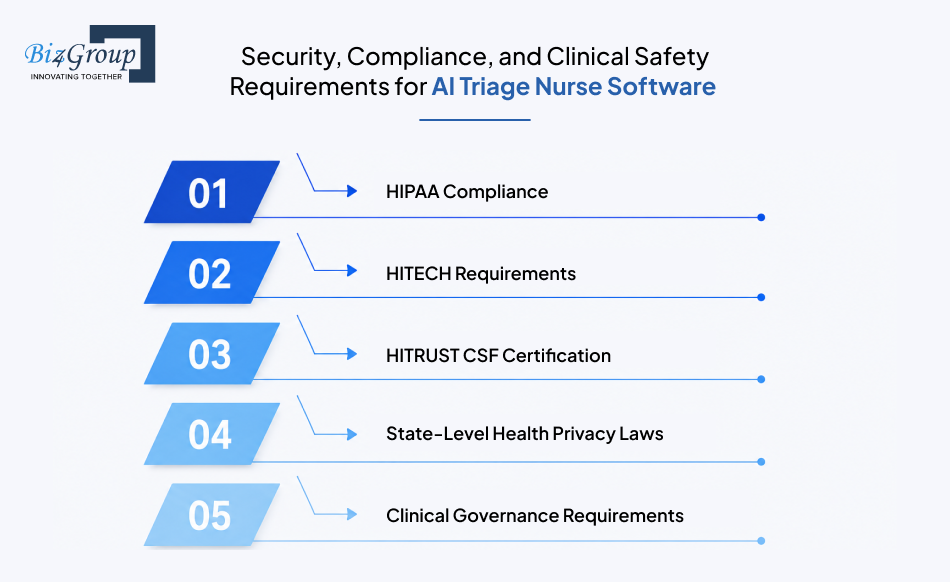
Every healthcare organization deploying AI triage nurse software must satisfy HIPAA, HITECH, HITRUST CSF, and FDA Clinical Decision Support requirements, along with applicable state health privacy laws, before the platform can operate inside a regulated clinical environment.
HIPAA governs how PHI and ePHI are protected throughout the assessment lifecycle, from patient intake to clinician review. This requires role-based access using the minimum necessary access principle for every clinical and administrative role, along with identity verification and session timeout controls for users handling sensitive data.
It also requires immutable audit trails that capture every record access, assessment change, and clinician override. Protection must remain built into the workflow itself rather than added as a separate documentation step, so clinical teams aren't slowed down by compliance requirements running alongside patient care.
HITECH extends HIPAA's requirements around breach notification, security risk assessments, and enforcement, and applies directly to how AI triage platforms handle PHI during storage, transmission, and third-party integration.
Organizations need documented record retention policies, audit readiness processes, and compliance reporting that can be produced on demand during a regulatory review, not assembled after the fact.
HITRUST CSF is a certifiable security framework, not a set of guidelines. It combines HIPAA Security Rule requirements, NIST controls, ISO 27001, and SOC 2 Trust Service Criteria into a single control set that gets scored and verified by an independent assessor.
Health systems and health plans increasingly require HITRUST certification from software vendors before signing a contract, since it removes the need for separate HIPAA and SOC 2 audits during procurement.
For AI triage nurse software handling PHI across multiple EHR integrations, HITRUST certification has moved from a differentiator to a baseline expectation among enterprise healthcare buyers.
State-specific privacy statutes can add requirements around patient consent, data disclosure, and retention beyond what HIPAA and HITECH already require, depending on where the software is deployed and which states the healthcare organization operates in.
Regulatory compliance alone doesn't guarantee safe clinical use. Every recommendation the software generates needs to stay reviewable by a nurse or physician before it influences patient care, with clinical protocols kept under version control and a documented approval history.
When a clinician overrides a recommendation, that override needs to be logged along with the reasoning, and recommendation accuracy needs to go through periodic clinical validation and outcome monitoring rather than a one-time review at launch. This is what keeps final clinical accountability with licensed healthcare professionals instead of the software itself.
Meeting all requirements together, rather than treating HIPAA as the only benchmark, determines whether AI triage nurse HIPAA compliant software can be procured, deployed, and trusted inside enterprise healthcare environments.
Also Read: HIPAA Compliant AI App Development for Healthcare Providers
Build an AI triage platform designed for clinical confidence regulatory readiness and long-term operational reliability
Talk Through Your Compliance Goals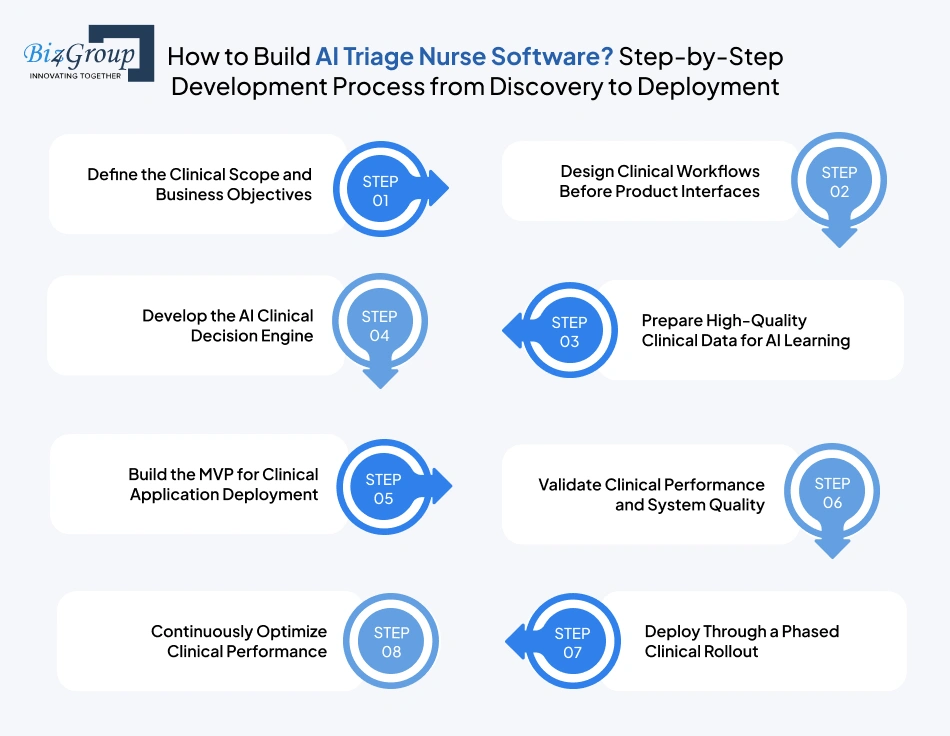
Building AI triage nurse software requires a structured development process that begins with defining clinical requirements and progresses through workflow design, clinical data preparation, AI decision development, validation, deployment, and continuous improvement.
Each stage lays the foundation for the next, helping healthcare organizations reduce implementation risks while delivering a clinically dependable solution.
Every successful AI triage nurse software development initiative starts by establishing exactly what the platform should accomplish before any product decisions are made. This stage defines the clinical scope, operational objectives, target care settings, patient population, triage protocols, and success metrics that guide the entire project.
Working with a partner experienced in AI integration services also helps identify existing healthcare systems, workflow dependencies, and organizational constraints before development begins.
Clinical workflows should always be finalized before interface design begins. Every assessment, escalation, clinician review, and documentation step must fit naturally into existing healthcare operations without introducing unnecessary manual work.
An experienced UI/UX design company translates these workflow requirements into intuitive experiences that support clinicians, operational teams, and administrators while preserving familiar working patterns.
Also Read: Top UI/UX Design Companies in USA
Reliable recommendations depend on reliable clinical data. Before training AI models, healthcare organizations should prepare representative datasets using de-identified historical triage encounters, approved clinical guidelines, symptom libraries, disposition records, and standardized medical terminology.
Careful data preparation improves model consistency while reducing bias, incomplete assessments, and conflicting clinical interpretations during later validation.
Once validated clinical data is available, AI model development focuses on generating explainable triage recommendations that align with approved organizational protocols. The objective is to produce clinically consistent guidance, defined escalation pathways, and transparent decision logic that healthcare professionals can review confidently throughout the assessment process.
A reliable decision engine only delivers value once it becomes part of a working clinical application. Most healthcare organizations start with MVP development services to launch core assessment workflows first, rather than building the full enterprise platform in one release.
This approach lets clinical teams validate workflow efficiency, usability, and operational readiness with real users before expanding scope. The MVP converts approved clinical workflows into a usable solution that supports daily healthcare operations starting from the first release.
Also Read: Top MVP Development Companies in USA
Clinical validation should confirm that the software performs reliably under real healthcare conditions before it reaches production. Along with functional verification, organizations should evaluate workflow accuracy, recommendation consistency, usability, and overall system stability.
Many healthcare providers collaborate with experienced software testing companies to strengthen quality assurance before deployment.
Healthcare organizations typically introduce new clinical software through a controlled rollout instead of a system-wide launch. Starting with a pilot department allows implementation teams to measure adoption, identify workflow gaps, and refine operational processes before expanding across additional facilities or clinical services.
Deployment establishes the operational baseline, but long-term success depends on continuous improvement. Clinical protocols evolve; patient volumes change, and organizational priorities shift over time.
Regular reviews help ensure the platform continues to support consistent clinical decisions while adapting to new healthcare requirements and operational expectations.
Every stage in the development process contributes to a dependable AI triage platform. Following a structured roadmap helps healthcare organizations move from clinical planning to production with greater confidence, stronger governance, and a solution that remains effective as healthcare needs continue to evolve.
Choosing the right foundation matters more than most people admit. So, which AI technologies are best for building AI triage nurse software?
Well, the ones that stay accurate under pressure, play nicely with hospital systems, and do not force you to rebuild everything six months later. Here is the best tech stack for AI triage nurse software that actually works in production.
|
Layer |
Recommended Technologies |
Why It Matters |
|---|---|---|
|
Frontend / User Interface |
React.js or Next.js, Tailwind CSS, WebSockets |
ReactJS development delivers fast, accessible chat and form experiences for both patients and clinicians. NextJS development adds server-side rendering and stronger performance for high-traffic triage portals. |
|
API & Backend Services |
Node.js or Python (FastAPI), GraphQL/REST |
NodeJS development handles high volumes of concurrent triage sessions efficiently. Python development powers the heavier clinical logic and AI orchestration while keeping the backend modular. |
|
AI / Intelligence Layer |
Python, Hugging Face Transformers, clinical fine-tuned LLMs, RAG |
Converts free-text symptoms into structured meaning, applies clinical logic, and generates urgency scores and recommendations. |
|
Knowledge & Protocol Layer |
Vector database, structured clinical protocol store |
Keeps approved triage protocols and medical knowledge separate, versioned, and easily updatable without retraining models. |
|
Data Storage |
PostgreSQL (encrypted), Redis |
Stores structured interaction data, session state, and audit records securely and with high performance. |
|
Integration & Interoperability |
FHIR R4, HL7 v2, SMART on FHIR, API gateways |
Enables standards-based, bidirectional data exchange with Epic, Cerner, Athena, and telehealth platforms through API development |
|
Authentication & Identity |
OAuth 2.0, OpenID Connect, SSO (Okta / Azure AD) |
Provides secure, role-based access for clinicians and supports single sign-on inside existing hospital identity systems. |
|
Messaging & Event Layer |
Kafka or RabbitMQ (optional but recommended) |
Handles asynchronous events such as escalations, notifications, and high-volume intake without blocking the main application. |
|
Cloud & Infrastructure |
AWS (HIPAA-eligible) or Azure (HITRUST), Kubernetes, Docker |
Delivers scalable, compliant hosting with auto-scaling for peak ED or after-hours demand. |
|
Security, Logging & Observability |
AES-256 encryption, centralized audit logs, Prometheus + Grafana, SIEM integration |
Meets HIPAA technical safeguards, enables full traceability, and gives operations teams real-time system health visibility. |
|
DevOps & CI/CD |
GitHub Actions / GitLab CI, Terraform |
Ensures reliable, repeatable deployments and faster, safer updates to models and protocols. |
This stack keeps the system modular. You can upgrade the AI models or swap cloud providers later without rewriting the entire application. It also aligns with the security, integration, and clinical safety requirements covered earlier, so the technical foundation supports both compliance and day-to-day reliability.
Developing AI triage nurse software typically costs between $40,000 and $350,000+, depending on the product scope, clinical complexity, workflow requirements, regulatory needs, and enterprise capabilities.
Understanding the AI triage nurse software development cost breakdown becomes much easier when you evaluate the project by development stage rather than looking at a single budget estimate.
|
Development Level |
Estimated Cost Range |
Scope |
|---|---|---|
|
MVP Level AI Triage Nurse Software |
$40,000–$100,000 |
Symptom assessment, triage recommendations, nurse review, basic admin panel, limited EHR support. |
|
Mid-Level AI Triage Nurse Software |
$100,000–$200,000 |
Multi-role workflows, configurable protocols, reporting, telehealth support, and operational dashboards. |
|
Advanced Level AI Triage Nurse Software |
$200,000–$350,000+ |
Multi-facility deployment, enterprise workflows, advanced analytics, extensive interoperability, centralized administration. |
The final investment depends on several healthcare-specific decisions made before and during development. Let's take a look:
Supporting a single care setting requires significantly less effort than designing workflows for emergency departments, telehealth, primary care, and nurse advice lines together. Every additional workflow introduces new assessment paths, review stages, and operational requirements.
Estimated Cost Impact: +$15,000–$25,000
Most healthcare providers adapt triage protocols to match internal clinical policies instead of relying on standard frameworks. Organization-specific assessment rules, escalation criteria, pediatric pathways, and specialty workflows require additional configuration and clinical validation.
Estimated Cost Impact: +$20,000–$40,000
Connecting the platform with EHRs, patient portals, appointment scheduling, laboratory systems, and telehealth platforms requires additional implementation effort. The overall AI integrations cost increases as more clinical systems participate in the same workflow.
Estimated Cost Impact: +$15,000–$35,000
Preparing reliable clinical data involves organizing de-identified triage records, validating medical terminology, labeling assessment outcomes, and training AI models with representative healthcare datasets. Better data preparation directly improves recommendation quality and increases development effort.
Estimated Cost Impact: +$10,000–$30,000
Healthcare software requires extensive validation before production deployment. Clinical reviews, protocol verification, documentation assessments, pilot evaluations, and regulatory readiness activities all contribute to the final project budget.
Estimated Cost Impact: +$15,000–$25,000
The decision engine becomes more expensive as organizations introduce multi-condition assessments, specialty-specific triage pathways, pediatric workflows, chronic disease protocols, and organization-defined escalation rules beyond standard symptom prioritization.
Estimated Cost Impact: +$20,000–$45,000
Beyond the core development scope, healthcare organizations should also account for supporting investments such as UI/UX design cost, cloud infrastructure, third-party licensing, staff training, and long-term maintenance when planning the overall project budget.
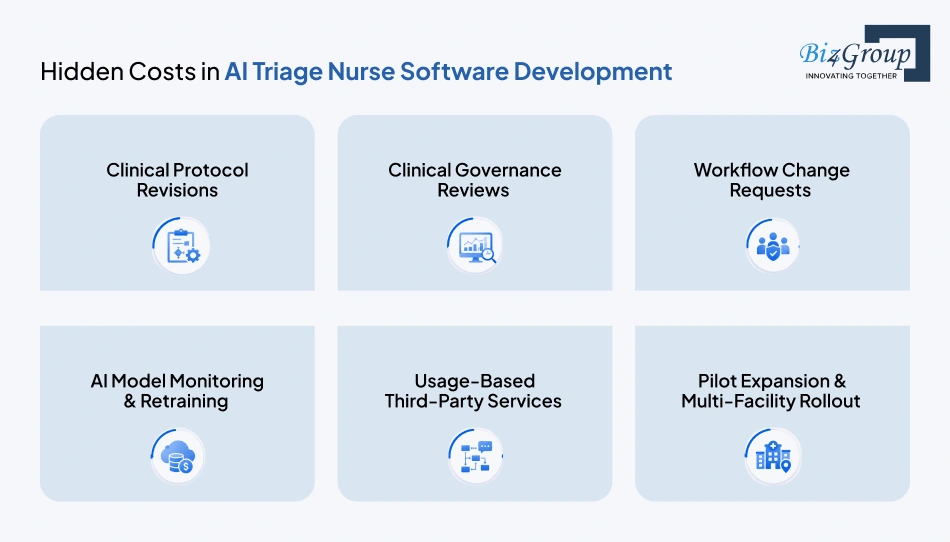
|
Hidden Cost |
What It Is |
Estimated Cost Impact |
|---|---|---|
|
Clinical Protocol Revisions |
Updating triage protocols after reviews from physicians, nursing leaders, and clinical governance committees. |
+$5,000–$15,000 |
|
Clinical Governance Reviews |
Additional effort for policy approvals, clinical documentation updates, audit preparation, and governance sign-offs. |
+$5,000–$10,000 |
|
Workflow Change Requests |
Refining intake workflows, clinician dashboards, approval paths, and operational processes after pilot feedback. |
+$10,000–$15,000 |
|
AI Model Monitoring & Retraining |
Refining clinical recommendations, retraining models with validated data, and adapting to updated clinical protocols after deployment. |
+$5,000–$10,000 |
|
Usage-Based Third-Party Services |
Ongoing charges for AI APIs, clinical terminology databases, SMS, voice services, and communication platforms as usage increases. |
+$5,000–$15,000 annually |
|
Pilot Expansion & Multi-Facility Rollout |
Expanding from a pilot site to additional departments, hospitals, or healthcare facilities with new workflow configuration and validation. |
+$10,000–$20,000 |
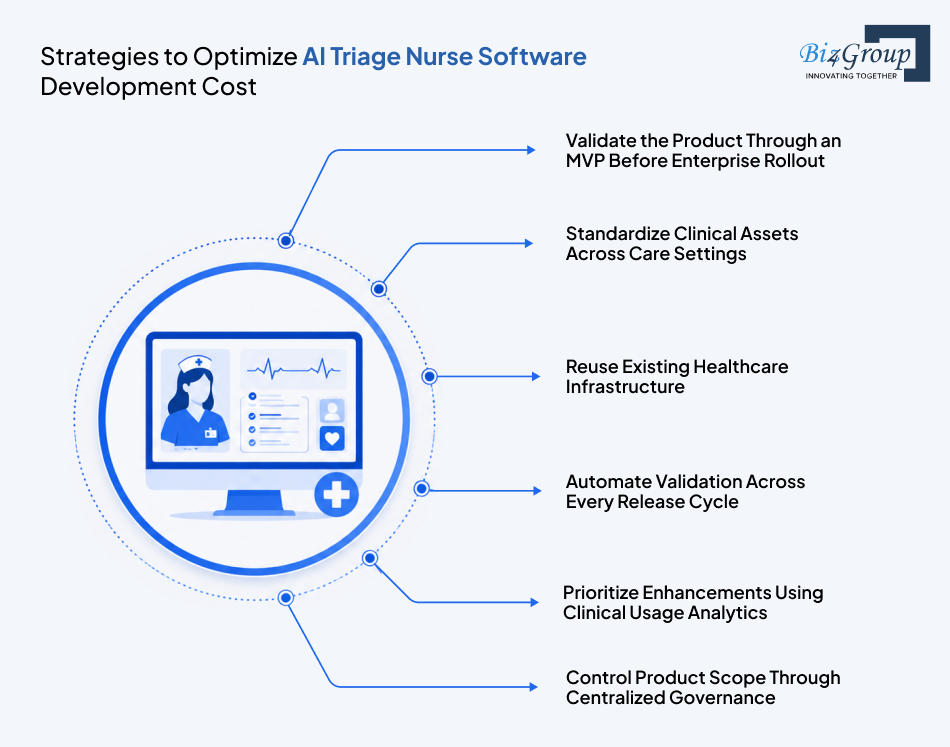
Optimizing development costs starts with making smarter implementation decisions, not reducing clinical capabilities. The right product strategy, governance model, and rollout approach help healthcare organizations control budgets while delivering a scalable and clinically dependable platform.
Rather than investing in a full-scale platform from day one, many healthcare organizations begin with AI MVP software development to validate clinical workflows, triage protocols, and user adoption. Early feedback reduces unnecessary development while ensuring future investments are backed by real operational needs.
Estimated Cost Savings: 15%–25%
Reusing approved symptom questionnaires, disposition rules, assessment templates, and clinical protocols across multiple care settings eliminates duplicate configuration and validation work. A standardized clinical foundation also makes future expansion faster and more cost-efficient.
Estimated Cost Savings: 10%–18%
Instead of rebuilding services that already exist, connect with established identity management, patient communication, scheduling, notification, and terminology services. This allows development teams to focus on clinical capabilities that create measurable operational value.
Estimated Cost Savings: 8%–15%
Clinical workflows evolve throughout development, making repeated validation unavoidable. Automating regression testing, workflow verification, and release validation reduces manual effort, shortens testing cycles, and catches issues before they become expensive production fixes.
Estimated Cost Savings: 10%–18%
Product roadmaps should be driven by clinician adoption, workflow analytics, triage utilization patterns, and operational KPIs rather than assumptions. Investing in features that healthcare teams actively use prevents unnecessary development and improves long-term ROI.
Estimated Cost Savings: 10%–20%
A centralized governance process ensures new feature requests; workflow changes, and departmental requirements are evaluated against organization-wide priorities before entering development. This prevents scope creep while keeping the product roadmap focused and financially sustainable.
Estimated Cost Savings: 12%–20%
Cost optimization begins long before development starts. Healthcare organizations that prioritize structured planning, disciplined execution, and evidence-driven product decisions consistently achieve stronger outcomes without compromising clinical quality or long-term scalability.
Get a realistic roadmap tailored to your clinical workflows priorities and long-term product vision
Request a Cost Consultation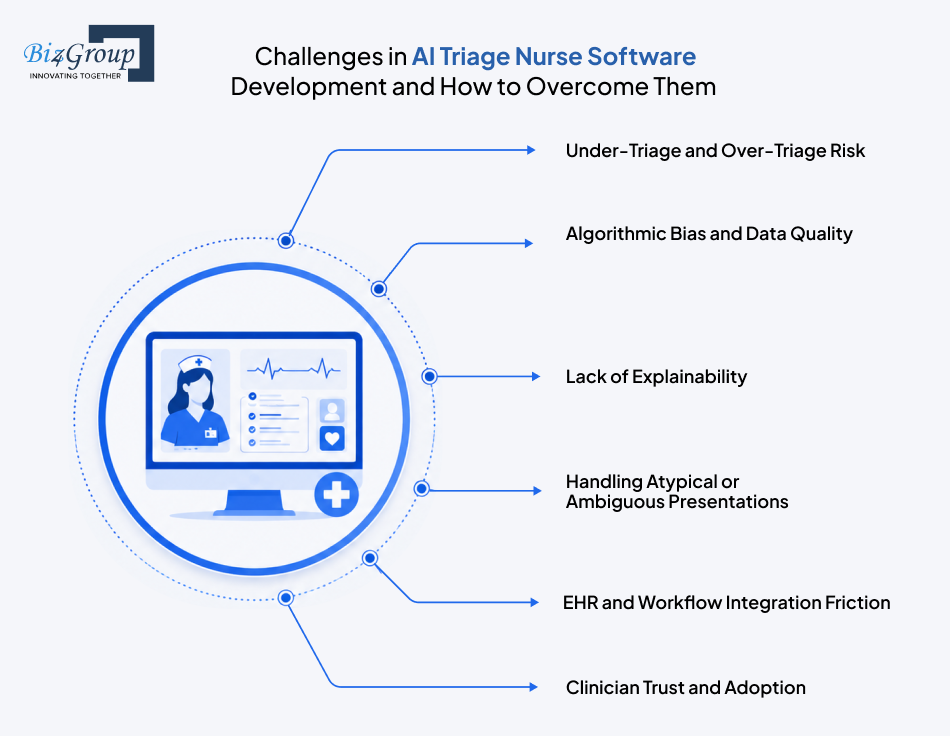
AI triage projects run into problems that go beyond writing code, ranging from clinical risk during development to trust and adoption after deployment. Many of these get caught early by involving clinical leaders, operations teams, and IT together through structured AI consulting services before development starts, but a few challenges are specific enough to triage that they need their own approach.
Challenge: The core risk in any triage system is getting the acuity level wrong in either direction, under-triage misses a genuine red flag, while over-triage flags routine cases as urgent when they aren't.
Impact: A missed red flag delays care for a patient who actually needs it and creates real liability exposure, while constant over-flagging wastes ED capacity and trains staff to tune out alerts altogether, which defeats the purpose of having the system in the first place.
Solution: The decision engine should be tested against a large set of historical triage cases, including rare and edge-case presentations, before it ever touches a live patient. Borderline cases should also be routed to a clinician for review rather than resolved automatically, so the system stays cautious exactly where it matters most.
Challenge: AI triage is only as reliable as the data it's trained and validated on, and research on AI-driven triage consistently flags data quality issues and algorithmic bias as major barriers to adoption, not edge-case concerns.
Impact: If training data skews toward certain age groups, demographics, or care settings, accuracy quietly drops for underrepresented patient populations, which raises real equity concerns and erodes clinician trust the moment it's discovered in production.
Solution: Datasets should be audited for population balance before deployment, with recommendation accuracy monitored across different patient groups after go-live, not just tracked in aggregate where these gaps tend to disappear from view.
Challenge: Systems that produce a recommendation without showing how they arrived at it tend to get resisted by clinical staff, and research on clinical decision support consistently shows that systems lacking explainability struggle with adoption regardless of how accurate they are.
Impact: Without visible reasoning, clinicians either reject the recommendation outright or, just as risky, start accepting it uncritically because they can't evaluate it, which is where automation bias creeps in during high-volume shifts.
Solution: The interface should show the reasoning behind every recommendation, not just a score. Teams that hire AI developers with healthcare domain expertise tend to get this right earlier, since building explainable clinical logic is different from building explainable logic for most other industries.
Challenge: Protocol-driven systems are built around standard symptom patterns, so they tend to struggle the moment a case doesn't map cleanly to a known pathway, overlapping conditions, vague symptom reporting, or presentations that don't fit any single protocol well.
Impact: Forcing the system to output a low-confidence recommendation in these situations is worse than not having one at all, since it can send a patient down the wrong care pathway with false confidence attached to it.
Solution: The safer approach is an explicit fallback path that routes ambiguous cases straight to a nurse instead of pushing the system to guess.
Challenge: Reviews of clinical decision support implementations repeatedly cite system integration as one of the persistent barriers to adoption, alongside data privacy and clinician acceptance, since a triage tool that doesn't fit naturally into existing EHR and documentation workflows creates extra work instead of removing it.
Impact: Clinicians asked to switch between systems or re-enter information they already documented elsewhere will route around the tool rather than use it, no matter how accurate its recommendations are.
Solution: Integration should be validated as part of the rollout itself, confirming triage summaries appear inside the existing EHR interface and that clinicians aren't duplicating documentation across systems.
Challenge: Even a clinically accurate system won't get used consistently if clinicians experience it as replacing their judgment rather than supporting it, and industry-wide adoption reflects this gap: a 2025 clinician survey found that only 16% currently use AI tools to help make clinical decisions.
Impact: Low adoption means the investment simply doesn't deliver the operational gains it was built for, no matter how well the underlying model performs in testing.
Solution: Involving clinical staff directly in pilot programs and usability reviews before wider rollout goes a long way here and keeping override authority visible and easy to use matters just as much, since it's what makes the system feel like something clinicians control rather than something working around them.
Most AI triage projects succeed because they solve organizational challenges alongside technical ones. Strong governance, clear ownership, and continuous clinical collaboration keep development moving in the right direction while supporting long-term operational success.
Both approaches can improve clinical operations, but they create very different long-term outcomes. The decision isn't simply about getting AI triage into production. It's about deciding who will shape the platform as clinical priorities, care delivery models, and organizational goals continue to evolve over the coming years.
Licensing is a practical choice for organizations that need a proven solution quickly and don't expect significant changes to their clinical workflows in the near future. Instead of managing product ownership, healthcare teams can focus on operational adoption while the vendor maintains the platform. The convenience, however, comes with strategic compromises that should be understood before making a long-term commitment.
Healthcare organizations rarely stand still. Clinical pathways change, new specialties are introduced, hospitals expand, and operational priorities shift over time. A custom platform allows those changes to become part of the product instead of waiting for another company's release cycle. Rather than adapting your organization to fit a commercial platform, the platform grows alongside your clinical and operational strategy.
The build-versus-buy decision becomes much clearer when leadership teams evaluate their long-term operating strategy instead of comparing software products. The following questions often reveal which direction best supports future organizational goals.
The answers to these questions often provide more clarity than any feature comparison because they reflect the organization's long-term operating model rather than its immediate implementation needs.
The right AI development partner should combine AI expertise with a strong understanding of healthcare operations, clinical workflows, and the realities of delivering enterprise-grade healthcare software.
With that being said, one name that tops up the list is Biz4Group LLC.
It brings those capabilities together by combining hands-on experience in AI triage nurse software development with a deep understanding of how healthcare organizations operate beyond the technology itself.
As a HIPAA-compliant AI healthcare software development company in USA, the team focuses on building solutions that align with real clinical workflows, operational goals, and long-term digital transformation strategies.
Our healthcare experience includes:
AI triage nurse software delivers its greatest value when it aligns with the way healthcare organizations actually operate. Throughout this guide, we've looked beyond the technology to understand the strategic decisions that shape a successful implementation from selecting the right development approach and planning realistic investments to preparing for long-term growth and operational change. Those decisions determine whether the platform simply supports today's needs or continues creating value as clinical priorities evolve.
That is why choosing the right technology partner matters just as much as choosing the right product strategy. At Biz4Group LLC, we combine healthcare domain expertise with proven AI automation services to deliver custom AI solutions that fit real clinical workflows and long-term business goals.
If you're planning to invest in AI triage nurse software, connect with our team to discuss how we can help turn your vision into a scalable healthcare solution.
The overall investment depends on factors such as organizational size, clinical scope, workflow complexity, and enterprise requirements. While smaller implementations usually focus on core triage capabilities, large health systems often require broader operational functionality. Most custom projects typically fall between $40,000 and $350,000+, with the final investment determined during project discovery and solution planning.
Most healthcare organizations should expect a timeline of 2 to 8+ weeks, depending on project scope and implementation strategy. An MVP can often be delivered much sooner, while enterprise platforms supporting multiple facilities, specialties, and operational workflows require additional planning, validation, and phased deployment before production rollout.
Yes. Enterprise platforms can be designed to support multiple hospitals, clinics, or care networks while allowing each facility to maintain its own triage protocols, operational workflows, user roles, and reporting requirements. This gives health systems centralized oversight without forcing every location to follow identical operational processes.
Success should be measured through operational and clinical KPIs rather than software usage alone. Common indicators include door-to-provider time, triage consistency, patient routing accuracy, clinician adoption, workload distribution, operational efficiency, and improvements in patient flow across the organization.
Yes. A well-planned custom platform should support long-term growth without requiring a complete rebuild. As organizations introduce new specialties, expand into additional facilities, or redesign care pathways, the platform can evolve alongside those operational changes while maintaining a consistent user experience.
Beyond technical expertise, evaluate whether the partner understands healthcare operations, clinical workflows, enterprise implementation, regulatory environments, and long-term product evolution. Reviewing healthcare case studies, AI project experience, and post-deployment support capabilities often provides a clearer picture than comparing technical capabilities alone.

Our website require some cookies to function properly. Read our privacy policy to know more.