 Location :
Orlando, FL, USA
Location :
Orlando, FL, USA +1 (407) 714-1616
 info@biz4group.com

- AI wealth management software development helps FinTech startups automate portfolio decisions, improve investor personalization, and scale advisory workflows with stronger product efficiency.
- Startups can develop AI wealth management platform solutions across robo advisory, retirement planning, HNW servicing, direct indexing, and advisor copilot use cases.
- A strong platform combines core architecture, key features, compliance controls, and scalable workflows to support secure investor growth and reporting readiness.
- The cost to develop AI wealth management software typically ranges between $30,000–$300,000+, depending on MVP scope, portfolio intelligence depth, integrations, and premium advisory requirements.
- Key challenges include recommendation relevance, workflow adoption, compliance traceability, performance during market surges, and wealth-domain execution expertise.
- Partnering with Biz4Group LLC helps startups move faster with secure delivery, scalable workflows, and market-ready execution for premium wealth products.
What happens when a fast-growing FinTech startup acquires users quickly, but its advisory operations still depend on fragmented data, delayed portfolio insights, and manual decision workflows? That friction is exactly where opting for AI wealth management software becomes a strategic growth move.
As investor expectations shift toward personalized guidance at scale, startups are under pressure to build platforms that turn complex financial signals into timely actions. The market momentum already validates this shift. As wealth firms continue investing in intelligent advisory infrastructure, the global market is projected to grow from USD 6.28 billion in 2025 to USD 18.77 billion by 2033, supported by a 14.7% CAGR, with technology-led advisory adoption acting as a core growth driver.
In practical terms, this creates a clear product opportunity for founders thinking about what is needed to create AI-powered wealth management software solutions? The answer starts with building software that can unify client profiling, portfolio logic, and decision support into one scalable product layer.
That opportunity becomes even more relevant in North America, which accounted for 37.0% of the global market share, signaling stronger demand for platforms built around advisory intelligence and compliance-ready experiences.
To make wealth management software development integrating AI commercially viable, fintech startups should align early around:
- investor onboarding and risk profiling workflows
- portfolio recommendation and rebalancing logic
- compliance-aware reporting foundations
- advisor-facing intelligence dashboards
- scalable product architecture supported by AI wealth management software development services
Now, this sets the perfect foundation for understanding how the platform actually works and what makes it scalable. Let's read together.
Understanding the Basics of AI Wealth Management Software Development for FinTech Startups
Before moving into architecture, cost, or compliance, it is important to first clarify what you are actually building.
In AI wealth management software development, the real product is not just an investing dashboard. It is an intelligence-driven platform that reads investor behavior, aligns recommendations with goals, and helps FinTech startups scale advisory workflows with more precision.
What Is AI Wealth Management Software?
At its core, AI wealth management software helps digital advisory platforms turn investor data into portfolio actions. It studies factors like risk appetite, financial goals, market signals, and behavioral patterns to support smarter investing journeys.
During the development of AI wealth management software, the focus should stay on decision support, personalization, and scalable investor servicing.
How Does AI Wealth Management Software Actually Work?
To simplify the flow, every intelligent advisory platform follows a clear operating path:
- Investors complete onboarding, financial goals, and risk preference inputs
- The platform structures this data into usable investor profiles
- AI models evaluate allocation opportunities and portfolio fit
- Market data and user activity continuously refine recommendations
- Advisors or end users review the suggestions before execution
This connected flow is what makes fintech in wealth management more scalable and user-centric for growing startups.
Core Components of AI Wealth Management Software?
Every scalable platform relies on a few tightly connected building blocks:
Component |
What It Does |
Why It Matters |
|---|---|---|
Investor Profiling Layer |
Captures goals, risk, and behavior |
Builds personalization accuracy |
Portfolio Engine |
Generates allocation logic |
Drives recommendation workflows |
Market Data Layer |
Pulls live and historical signals |
Keeps decisions context-aware |
Advisory Dashboard |
Displays insights and actions |
Improves usability for teams |
Compliance Layer |
Maintains audit-ready workflows |
Supports trust and governance |
Each layer should work together smoothly, because weak coordination directly affects product reliability.
Traditional Wealth Advisory Vs AI Wealth Management Platforms
To understand the shift clearly, let's look at how platform logic changes the advisory experience.
Aspect |
Traditional Advisory |
AI Wealth Platforms |
|---|---|---|
Client Profiling |
Periodic manual review |
Continuous profile updates |
Portfolio Guidance |
Advisor-led decisions |
Data-backed recommendations |
Personalization |
Limited by time |
Dynamic at scale |
Rebalancing |
Scheduled checks |
Event-driven adjustments |
Service Reach |
Team capacity dependent |
Startup-scale growth ready |
This shift is exactly why startups are accelerating AI wealth management software development as part of their digital advisory strategy.
Where Does AI Fit in the Bigger Wealth Management Ecosystem
The intelligence layer becomes more valuable when it connects with the wider wealth product ecosystem used by startups and advisory firms.
- Robo advisory platform use AI to automate portfolio suggestions based on investor goals and risk appetite.
- Retirement and goal planning tools help users map savings behavior to long-term milestones like retirement, education, or home ownership.
- Tax optimization workflows support smarter selling and allocation decisions to reduce avoidable tax impact.
- Digital private banking platforms use intelligent insights to serve high-net-worth clients with personalized advisory experiences.
- Family office intelligence systems help manage complex portfolios, multi-generational assets, and reporting needs in one place.
- Advisor productivity dashboards surface client insights, portfolio alerts, and action priorities so teams can respond faster.
Quick Recap Before We Move Ahead
Before we step into use cases and platform design, let's keep these fundamentals in mind:
- the software turns investor data into guided portfolio actions
- platform workflows follow a structured recommendation cycle
- multiple system layers must work together for reliability
- AI supports advisory scale through better personalization
- ecosystem fit determines long-term product expansion opportunities
With this foundation clear, the next step is understanding where startups are creating the highest business value with these platforms.
Know The Workflow Before You Scale?
Turn wealth logic into a product roadmap investors and advisors actually trust
Contact UsWhy FinTech Startups Are Building AI Wealth Management Platforms Today?
What happens when client expectations rise faster than advisory teams can scale? That pressure is now shaping AI wealth management software development across the startup ecosystem.
The real opportunity is not just smarter investing. It is about solving growth bottlenecks around personalization, service speed, and operational capacity, which is exactly why businesses should create AI wealth management software with workflow intelligence built into the product foundation.
The strongest drivers behind this shift are operational scale, client expectations, monetization, and market confidence. Here take a look:
1. Advisory Capacity Is Reaching Its Limit
The first driver is simple: advisory teams need to serve more clients without slowing down service quality.
That is why automation is becoming a product priority. More than 88% of advisors reported direct time savings, while over 65% increased client capacity after introducing AI-powered workflows.
For fintech startups, this opens clear opportunities to:
- increase advisor coverage without hiring at the same pace
- reduce portfolio servicing delays
- automate repetitive follow-ups
- improve response time during market volatility
2. Personalization Is Becoming a Product Expectation
The next shift is happening at the investor experience level.
Today, 98% of advisers say new HNW portfolios include customization, and 62% expect direct indexing usage to grow over the next three years. That means static investment journeys are losing relevance for premium wealth products.
This is pushing fintech startups to support:
- goal-based investing workflows
- custom portfolio baskets
- tax-aware allocations
- personalized premium servicing layers
3. The Investment Momentum Is Already Here
The strongest market confidence signal is the rise in AI budgets across advisory firms.
With 95% of firms expecting to increase AI investment, the fintech ecosystem is clearly moving toward intelligent wealth workflows. The value becomes even more practical when nearly 70% of advisors report measurable productivity gains within the first 3 months.
Here is what these signals actually mean for FinTech startups entering the wealth management space today:
Market Driver |
Startup Impact |
|---|---|
Advisory automation |
Higher client servicing capacity |
Portfolio customization |
Better investor retention |
Direct indexing growth |
Premium monetization opportunities |
Rising AI budgets |
Faster product adoption confidence |
Early productivity gains |
Faster ROI validation |
4. Premium Revenue Models Are Expanding Faster
Another strong reason fintech startups are moving towards AI wealth management software now is revenue depth.
As advisory products mature, firms are looking beyond basic AUM fees toward premium services powered by intelligence and personalization.
This opens room to monetize through:
- direct indexing subscriptions
- premium HNW advisory tiers
- tax optimization services
- goal-based premium planning journeys
A Quick Strategic Reality Check
The real question is not whether the market need AI wealth management platforms. It is whether your startup can turn personalization, automation, and scalable advisory capacity into a product advantage before these capabilities become a baseline expectation across digital wealth platforms.
With that on table now, let's look at where AI wealth management software delivers real value.
How Much Revenue Are You Delaying?
Every quarter you wait increases servicing costs and lowers first-mover advisory ROI
Schedule A Strategy CallHigh Value Use Cases of AI Wealth Management Software Development for FinTech Startups
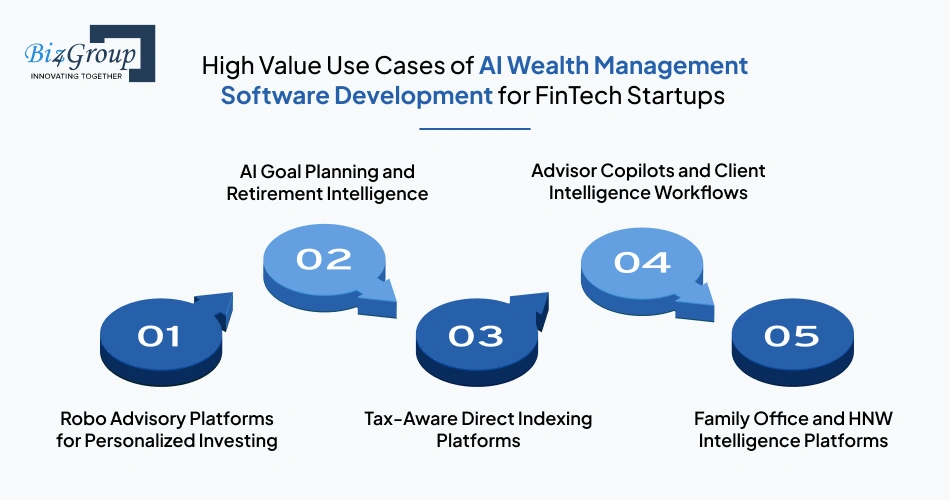
What are fintech startups actually productizing once the market demand is clear? This is where AI wealth management software development moves from strategy into real product use cases.
The strongest opportunities come from solving highly specific advisory workflows, especially when building an AI wealth management software with real-time analytics becomes central to investor decisions and portfolio actions.
1. Robo Advisory Platforms for Personalized Investing
One of the highest-value use cases is robo advisory built around dynamic investor journeys. These platforms convert profile inputs, financial goals, and market behavior into guided allocation paths that feel tailored from the first interaction.
This use case commonly includes:
- automated onboarding and risk discovery
- personalized portfolio suggestions
- periodic rebalancing workflows
- goal-based investment tracking
2. AI Goal Planning and Retirement Intelligence
Another strong fintech startup use case focuses on long-term wealth planning. Here, wealth management software development using AI supports milestone-led investing journeys tied to retirement, education, or lifestyle goals.
The AI wealth management software layer usually supports:
- savings trajectory forecasting
- retirement corpus simulations
- milestone-based contribution nudges
- life-event financial planning flows
3. Tax-Aware Direct Indexing Platforms
A growing use case is direct indexing built around tax sensitivity and personalized asset baskets. This is where AI automation tools help convert investor preferences into scalable portfolio customization workflows.
This usually covers:
- custom stock basket creation
- tax-loss harvesting triggers
- preference-led exclusions
- ESG or thematic basket logic
Also Read: 10 AI Automation Use Cases for Enterprises to Scale Faster
4. Advisor Copilots and Client Intelligence Workflows
This use case focuses on productivity for advisory teams. With generative AI in wealth management, startups are building copilots that surface portfolio actions, meeting prep insights, and client-specific recommendations in real time.
These workflows often include:
- client briefing summaries
- portfolio drift alerts
- next-best advisory actions
- automated meeting note generation using generative AI
Also Read: Top Generative AI Development Companies in USA
5. Family Office and HNW Intelligence Platforms
For premium investor segments, fintech startups are using AI to simplify complex wealth structures. These platforms organize multi-asset visibility and reporting into a single advisory workspace.
AI in wealth management software focuses on:
- consolidated family portfolio views
- private asset tracking
- liquidity event planning
- succession reporting workflows
The real opportunity in these use cases is not how many workflows AI can support, but which advisory journey your fintech startup can turn into a focused, revenue-ready product. The stronger the use-case clarity at this stage, the easier it becomes to shape a scalable platform around real investor needs and market demand.
What Key Features are Required to Develop AI Wealth Management Software for FinTech Startups?
Features decide whether a wealth product feels truly intelligent in day-to-day investor and advisor workflows. Even with strong models and data layers, adoption weakens when the product lacks action-ready capabilities. If your goal is to create intelligent wealth management platform experiences that users trust, the focus should stay on features that improve personalization, decision speed, and advisory usability.
Here is a practical breakdown of the core features every startup-ready platform should include.
Feature |
Description |
Business Impact |
|---|---|---|
Intelligent Risk Profiling |
Maps investor goals, risk appetite, and behavior into portfolio suitability logic |
Improves personalization and onboarding quality |
Real-Time Portfolio Monitoring |
Tracks allocation drift, performance shifts, and investor activity live |
Improves responsiveness and retention |
Personalized Recommendation Engine |
Converts market and investor signals into action-ready suggestions |
Drives portfolio engagement |
Goal-Based Planning |
Maps investments to retirement, education, and life milestones |
Increases long-term user stickiness |
Automated Reporting |
Generates investor-ready summaries and advisor review reports |
Reduces manual workload |
Forecasts portfolio scenarios, cash flow needs, and progress trends |
Supports proactive advisory actions |
|
Conversational Advisory Assistant |
Uses AI chatbot development capabilities for portfolio queries and investor guidance |
Improves self-service engagement |
Advisor Copilot Workflows |
Supports meeting prep, next-best actions, and client summaries using an AI agent for wealth management |
Boosts advisor productivity |
Secure Document Vault |
Stores KYC files, statements, and tax records safely |
Strengthens compliance trust |
Multi-Custodian Integrations |
Connects brokerages, banks, and portfolio systems |
Expands product usability |
Scalable Cloud Support |
Handles growing investor activity and advisory workflows |
Supports long-term scale |
The real value of these features comes from how well they connect across investor journeys, advisor actions, and portfolio workflows. When structured around real usage patterns, they help startups develop AI wealth management platform products that feel practical, scalable, and ready for premium advisory growth.
Architecture and Tech Stack to Build AI Wealth Management Software for FinTech Startups
A strong platform architecture is what separates an MVP from a product that can handle real investor scale. In AI wealth management software development, the backend must support portfolio intelligence, live advisory workflows, and secure data movement without slowing decision speed.
It becomes even more critical when building a scalable AI wealth management software that needs to support growing AUM, multiple advisor roles, and personalized investor journeys.
Let's break down how the core system layers come together in a production-ready wealth platform.
Core Architecture of AI Wealth Management Software
A production-ready wealth platform works best through a layered structure where every layer owns a clear responsibility and stays connected to the others.
- Investor Data Ingestion Layer: Captures onboarding records, KYC data, linked account feeds, and transaction activity from banks, brokerages, and custodians.
- Portfolio Intelligence Layer: Handles allocation logic, risk scoring, rebalancing triggers, and goal alignment based on investor behavior and live market context.
- Recommendation Engine: Converts portfolio signals and behavioral activity into personalized actions, alerts, and next-best advisory suggestions.
- Workflow and Automation Layer: Runs client nudges, review cycles, reporting workflows, and task movement through connected API development
- Advisor and Investor Application Layer: Powers dashboards, action panels, performance reports, and client-ready portfolio visibility.
- Compliance and Audit Layer: Maintains suitability checks, action traceability, advisory decision logs, and regulator-ready audit records.
- Integration and Security Layer: Connects custodians, payment rails, CRM systems, and external market feeds while protecting access through encryption and role-based controls.
This layered structure keeps the platform stable as investor activity, compliance complexity, and advisory workflows continue to expand.
Tech Stack to Develop AI Wealth Management Software for FinTech Startups
Once the architecture is clear, the focus shifts to the technologies that keep portfolio intelligence, data movement, and advisory workflows stable as the platform grows.
The right technology mix defines how reliably these architecture layers perform at scale across investor workflows and advisory operations. Take a look:
AI and Machine Learning Stack
Category |
Frameworks and Tools |
Why It Matters |
|---|---|---|
ML Frameworks |
TensorFlow, PyTorch, Scikit-learn |
Portfolio scoring and recommendation logic |
Streaming Analytics |
Kafka, Spark Streaming |
Real-time portfolio updates and alerts |
NLP Models |
Transformers, Sentence-BERT |
Client sentiment and advisor intelligence |
Frontend, Backend, and API Technologies
Category |
Frameworks and Tools |
Why It Matters |
|---|---|---|
Frontend |
Investor and advisor dashboards |
|
Backend |
Workflow logic and system coordination |
|
APIs |
REST, GraphQL, FastAPI |
Secure data movement and service orchestration |
Also Read: Adopt An API-First Architecture For Business Agility
Data Management and Infrastructure
Category |
Frameworks and Tools |
Why It Matters |
|---|---|---|
Databases |
PostgreSQL, MongoDB |
Portfolio, investor, and workflow data |
Cache Layer |
Redis |
Faster reads for alerts and dashboards |
Cloud |
AWS, Azure, GCP |
Scalable compute and secure storage |
Deployment and Scalability Tools
Category |
Frameworks and Tools |
Why It Matters |
|---|---|---|
Containerization |
Docker |
Consistent deployment environments |
Orchestration |
Kubernetes |
Scaling advisory workloads |
Monitoring |
Prometheus, Grafana |
System reliability and observability |
Advanced AI Capabilities
Category |
Frameworks and Tools |
Why It Matters |
|---|---|---|
LLM Orchestration |
LangChain, LlamaIndex |
Advisor copilots and client query workflows |
Generative Models |
GPT through OpenAI API |
Portfolio narratives and meeting summaries |
Adaptive Intelligence |
Reinforcement Learning |
Dynamic rebalancing and learning loops |
Architecture decides how reliably the platform runs. The tech stack decides how well it performs under growing investor and advisor demand. When both are aligned, your wealth product becomes easier to scale, easier to govern, and far more ready for real-world FinTech growth.
Is Your Backend Ready For AUM?
Strong architecture today prevents costly wealth workflow bottlenecks tomorrow
Talk to our AI ExpertsHow to Build AI Wealth Management Software for Startups: A Step-By-Step Process from Discovery to Deployment
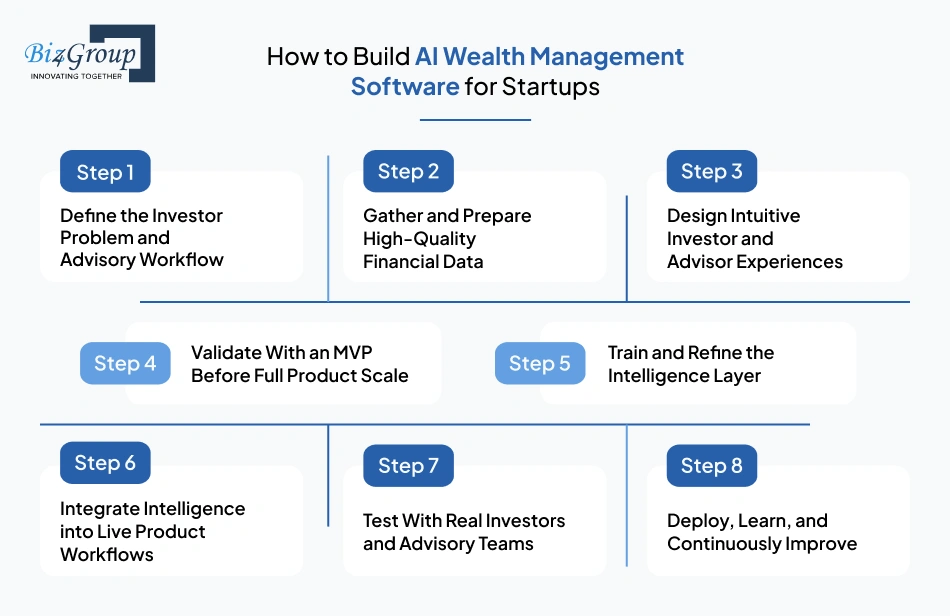
A scalable product rarely starts with code. It starts with workflow clarity, investor journey mapping, and early validation of where intelligence should create real advisory value. If you are evaluating how to create AI investment management software for fintech startups, then a structured roadmap reduces product risk, shortens feedback loops, and makes it far easier to scale with confidence.
Here is a practical roadmap followed by high-growth FinTech product teams.
Step 1. Define the Investor Problem and Advisory Workflow
Start with a sharp use-case definition. Focus on the exact investor journey or advisory gap the product must solve before you build AI wealth management software around it.
This usually starts with:
- onboarding friction and drop-offs
- weak portfolio personalization
- delayed advisor actions
- limited goal-based investing support
Step 2. Gather and Prepare High-Quality Financial Data
The intelligence layer will only be as strong as the data feeding it. This step focuses on investor history, portfolio records, market feeds, and behavioral inputs.
The preparation stage should cover:
- normalized investor profiles
- clean transaction histories
- labeled portfolio outcomes
- risk and suitability records
Step 3. Design Intuitive Investor and Advisor Experiences
Even a powerful platform fails if the product feels difficult to use. That is why early collaboration with a strong UI/UX design company becomes essential for onboarding, dashboards, and action workflows.
This stage usually focuses on:
- clean investor dashboards
- advisor workflow visibility
- minimal action friction
- clear portfolio explanations
Also Read: Top UI/UX Design Companies in USA
Step 4. Validate With an MVP Before Full Product Scale
The smartest route is early validation through MVP development services that test workflow adoption, personalization logic, and advisory usability before scaling.
A focused building of MVP software phase helps you validate:
- onboarding completion rates
- recommendation relevance
- advisor workflow fit
- retention signals
Also Read: Top MVP Development Companies in USA
Step 5. Train and Refine the Intelligence Layer
This is where the product starts learning from real investor patterns. A well-trained AI model should continuously improve portfolio suggestions, alerts, and investor nudges.
The model stage usually includes:
- portfolio scoring logic
- rebalancing predictions
- goal progress forecasting
- investor behavior learning
Step 6. Integrate Intelligence into Live Product Workflows
The intelligence layer should fit naturally into daily advisory and investor journeys. The goal here is to integrate AI models into real portfolio decisions, nudges, and dashboards without disrupting usability.
This stage typically covers:
- action-ready alerts
- client meeting prep flows
- advisor copilots
- portfolio drift triggers
Step 7. Test With Real Investors and Advisory Teams
Before launching, validate the product with actual usage scenarios. A trusted software testing company can help ensure workflow stability, portfolio logic reliability, and advisory usability.
Focus testing on:
- workflow accuracy
- user interaction clarity
- alert timing relevance
- real-world advisory feedback
Step 8. Deploy, Learn, and Continuously Improve
Deployment is where real product intelligence begins. Once live, teams should collect feedback, fine tune LLM's, and improve decision logic as investor behavior evolves.
This continuous phase should include:
- model monitoring
- personalization upgrades
- feedback-driven retraining
- workflow optimization
Also Read: Top Open Source LLMs for Business Growth in 2026
The strongest wealth products are not the ones that launch fastest, but the ones that validate early, learn continuously, and keep improving investor workflows as advisory expectations evolve.
Also Read: Build an AI Fintech App in 2026 Step-by-Step Guide
Compliance and Regulatory Framework for AI Wealth Management Software Development
Trust is earned long before investors see portfolio performance. The moment you create AI-driven portfolio management tool workflows that handle financial data, compliance becomes part of the product foundation. In AI wealth management software development, regulation is not a legal afterthought. It directly shapes onboarding, portfolio actions, audit visibility, and long-term investor confidence.
Let's break down the key compliance and security areas your startup should address.
Key Regulatory Standards You Must Follow
- SEC and FINRA Requirements
- Applies to advisory workflows, portfolio recommendations, and investor communications in the U.S.
- Requires suitability checks, recordkeeping, supervision, and transparent disclosures.
- GDPR and Data Privacy Rules
- Essential when handling investor data from EU users.
- Focuses on consent, data access rights, minimization, and explainable data usage.
- AML and KYC Frameworks
- Critical for onboarding and fraud prevention.
- Ensures identity verification, source-of-funds checks, and suspicious activity monitoring.
- SOC 2 and Cloud Security Controls
- Important for platforms using cloud-hosted advisory workflows and AI integration services.
- Strengthens trust around data security, vendor governance, and service reliability.
- Regional Financial Compliance Rules
- Requirements change across markets and must be planned early for global expansion.
- This becomes especially important for startups extending into private banking or a financial forecasting platform
Also Read: Develop AI Financial Coaching App: Features & Cost Guide
Core Security Requirements in Wealth Platforms
- Data Encryption: Protect investor and portfolio data both at rest and in transit.
- Role-Based Access Controls: Restrict access for advisors, compliance teams, and operations users based on responsibility.
- Audit Trails and Activity Monitoring: Track every recommendation, rebalance action, and advisor workflow for accountability.
- Secure Cloud and Custodian Integrations: Protect linked accounts, market feeds, and payment rails with controlled access.
- Model Governance Logs: Maintain visibility into recommendation decisions, retraining cycles, and version updates.
AI-Specific Compliance Challenges
- Model Explainability: Investors and advisors should understand why portfolio actions are suggested.
- Bias and Suitability Risks: Recommendation logic must avoid skewed outcomes across investor profiles.
- Continuous Validation: A product remains trustworthy only when portfolio logic is reviewed against changing market behavior.
The real compliance edge comes from embedding governance directly into onboarding, portfolio recommendations, audit logs, and investor communications from the start. That is how startups create AI-powered wealth management solutions that stay regulator-ready, protect investor trust, and scale safely as advisory workflows become more complex.
Will Your Product Pass Investor Trust?
Compliance gaps surface late and fixing them early protects growth momentum
Connect With USHow Much Does It Cost to Develop Intelligent Wealth Management Software Using AI?
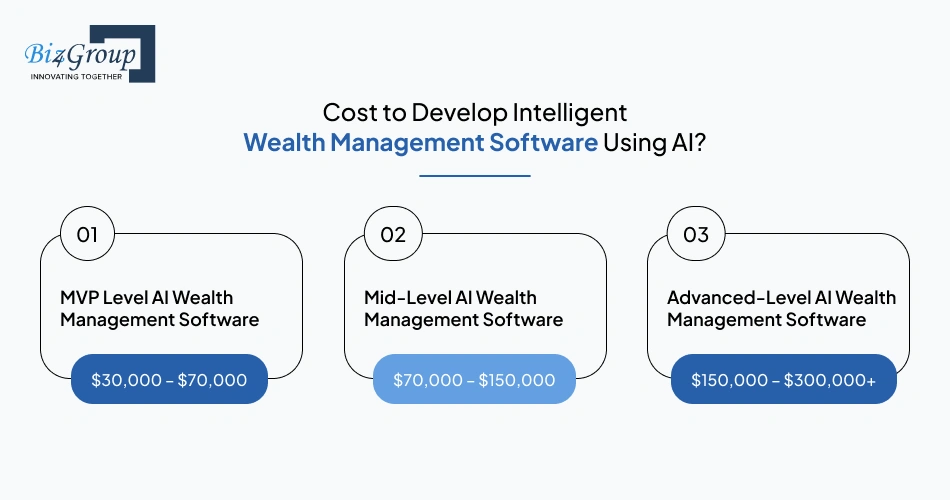
Budget clarity becomes much easier once the product scope is tied to advisory workflows, investor journeys, and intelligence depth. In most startup scenarios, the cost to develop AI wealth management software typically falls between $30,000–$300,000+, depending on whether the product starts as an MVP, a growth-stage platform, or a full advisory ecosystem with advanced portfolio intelligence.
Here is a practical cost breakdown based on common development stages.
Development Tiers |
Estimated Cost Range |
Scope |
|---|---|---|
MVP Level AI Wealth Management Software |
$30,000 – $70,000 |
Investor onboarding, risk profiling, portfolio recommendations, basic dashboards |
Mid-Level AI Wealth Management Software |
$70,000 – $150,000 |
Goal-based investing, advisor dashboards, rebalancing workflows, reporting, moderate AI integrations cost |
Advanced-Level AI Wealth Management Software |
$150,000 – $300,000+ |
HNW servicing, direct indexing, tax optimization, LLM copilots, enterprise-grade compliance |
The right budget decision depends less on features and more on how deeply intelligence is embedded into investor and advisor workflows. A lean MVP helps validate demand faster, while advanced platforms fit startups targeting premium HNW advisory workflows, direct indexing, and scalable investor servicing models where long-term AI wealth management software development cost directly supports stronger recurring revenue growth.
Challenges in AI Wealth Management Software Development and How to Overcome Them
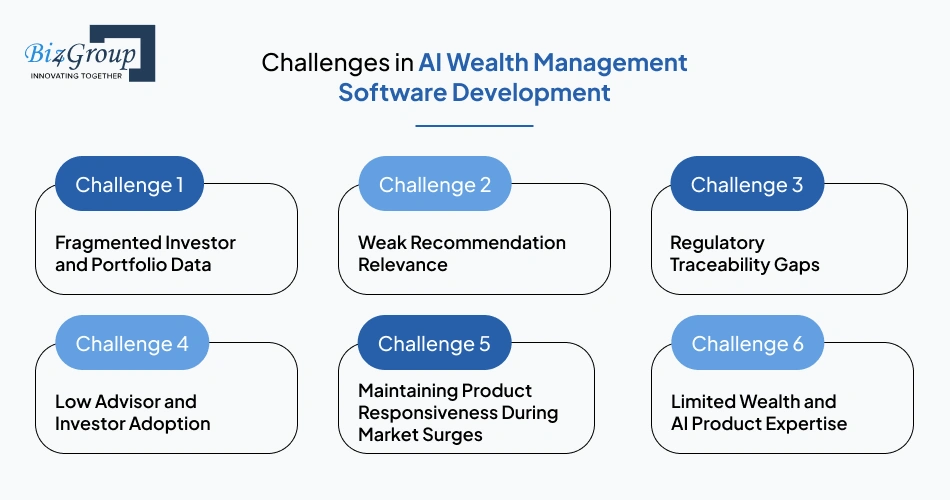
Every strong wealth product idea comes with execution risks that show up only when real investor workflows, portfolio logic, and advisory expectations start interacting at scale. Even the cost to develop AI wealth management software can rise quickly when these challenges are not identified early, which is why solving them upfront directly protects product quality and launch speed.
Let's walk through the most common challenges and how to handle them effectively.
Challenge 1: Fragmented Investor and Portfolio Data
Portfolio intelligence depends on clean and connected financial data. In reality, investor records, transaction histories, and custodian feeds are often scattered across multiple systems, which weakens recommendation quality.
How to overcome this:
- unify investor profiles across data sources
- normalize transaction and portfolio records
- validate feeds before recommendation workflows
- improve data quality through live feedback loops
Challenge 2: Weak Recommendation Relevance
Even a stable platform loses trust if portfolio suggestions feel generic or mistimed. This becomes a major issue when teams build AI software without enough real investor behavior signals.
How to overcome this:
- train on diverse investor personas
- refine suitability scoring continuously
- improve timing through behavior triggers
- validate recommendations with advisor feedback
Challenge 3: Regulatory Traceability Gaps
Every portfolio action, rebalance alert, and advisory suggestion must remain explainable. Missing traceability can slow approvals and reduce trust in premium wealth workflows.
How to overcome this:
- maintain recommendation decision logs
- store model and rule version history
- track advisor overrides
- automate audit-ready reporting
Challenge 4: Low Advisor and Investor Adoption
Even powerful products struggle when daily workflows feel unfamiliar. Adoption drops quickly if dashboards, alerts, or portfolio actions do not fit naturally into advisory routines.
How to overcome this:
- simplify dashboard actions
- reduce portfolio review friction
- improve alert readability
- collect continuous workflow feedback
Challenge 5: Maintaining Product Responsiveness During Market Surges
When markets move sharply, investor logins, portfolio reviews, and advisory actions rise together. If the product slows during these moments, trust drops quickly and user engagement weakens.
How to overcome this:
- prioritize high-frequency investor actions
- optimize portfolio refresh cycles
- reduce dashboard response delays
- collaborate with an experienced AI development company to test performance during peak market activity
Challenge 6: Limited Wealth and AI Product Expertise
A strong product needs both intelligent decision logic and real advisory workflow understanding. Delays often happen when teams lack product specialists who understand investor behavior, suitability, and wealth servicing journeys.
How to overcome this:
- align engineers with advisory product experts
- validate workflows with wealth specialists
- hire fintech software developers who can expand delivery around finance and wealth management workflows
Also Read: How to Hire an AI App Developer in USA for Your Business?
The real advantage comes when startups treat these challenges as product design checkpoints instead of late-stage blockers. That is how teams build AI software for private wealth management companies with stronger user trust, smoother adoption, and advisory workflows that stay reliable as the product grows.
Are Hidden Risks Slowing Your Launch?
Fix adoption and workflow blockers before they become product-level failures
Contact UsWhy Trust Biz4Group LLC in the USA for AI Wealth Management Software Development for FinTech Startups?
AI wealth management software demands much more than strong engineering. It requires a deep understanding of advisory workflows, investor trust, regulatory discipline, and product scalability under real market behavior.
That is exactly where Biz4Group LLC brings practical execution strength, especially for fintech startups focused on developing a cloud-based AI wealth management platforms that need to scale personalization and portfolio intelligence from day one.
As a U.S. based fintech software development solution provider, we work closely with FinTech founders, digital advisory startups, and wealth innovators to turn product ideas into market-ready platforms. Our focus stays on building products that align with investor journeys, compliance expectations, and long-term growth goals rather than isolated feature development.
We help fintech startups:
- validate the right wealth use cases before product investment
- shape advisory workflows investors and teams actually adopt
- architect platforms ready for scale and premium HNW expansion
- integrate intelligence into dashboards, alerts, and portfolio workflows
- practical AI automation services aligned with wealth workflows
What makes us one of the top companies that develop AI wealth management software is our ability to combine product thinking with delivery precision. From onboarding journeys to portfolio logic our teams bring deep execution experience across secure wealth products, intelligent automation, and scalable cloud delivery.
Let us convince you through our real-world implementation in fintech ecosystem
Project Spotlight: Worth Advisors Financial Planning and Client Management Platform
To show what practical execution looks like, consider our work with Worth Advisors, where we developed a modern financial planning and client management system tailored for real advisory workflows. The product was designed to simplify how clients share financial information and how advisors turn that data into structured planning reports.
Wrapping Up
AI-led wealth platforms are steadily changing how startups scale personalization, portfolio intelligence, and advisory execution. As this AI wealth management software development guide for startups has shown, success depends on aligning the right use case, scalable architecture, compliance discipline, and realistic cost planning from day one. Working with a trusted custom software development company also helps ensure the product evolves around real investor journeys rather than disconnected feature ideas.
The bigger differentiator is execution quality. If your next move is to create AI investment management software that supports trust, scale, and premium advisory workflows, every product decision must stay tied to real user behavior and long-term growth readiness. That is where Biz4Group LLC helps FinTech founders turn validated wealth use cases into market-ready products that can adapt, perform, and grow with changing investor expectations.
So, the next step is simple: turn the right wealth use case into a product that scales with investor expectations, evolving advisory models, and long-term FinTech growth. Schedule a strategy call.
FAQ's
1) What is the typical timeline to build AI wealth management software for a startup MVP?
For most FinTech startups, an MVP timeline usually ranges from 2 to 4 weeks, depending on onboarding workflows, portfolio logic, advisor dashboards, and real-time market integrations. Products with investor profiling and basic recommendation engines move faster, while premium advisory layers increase the timeline.
2) What is the overall cost range for AI wealth management software development?
The overall budget for AI Wealth Management Software Development generally falls between $30,000 and $300,000+, depending on whether the product starts as an MVP, mid-scale advisory platform, or enterprise-grade HNW wealth solution with personalization and reporting workflows.
3) What data sources improve portfolio intelligence in AI wealth platforms?
The most valuable data sources include transaction history, linked brokerage feeds, investor risk behavior, market data streams, portfolio performance records, and macroeconomic indicators. The better these data streams connect, the stronger the recommendation quality becomes.
4) How can startups monetize an AI-powered wealth management platform beyond AUM fees?
High-growth startups often expand monetization through premium HNW tiers, direct indexing subscriptions, tax optimization modules, advisor copilots, goal-based premium planning, and white-label enterprise offerings for RIAs or wealth firms.
5) What KPIs should founders track after they develop AI wealth management platform products?
The most useful post-launch KPIs include onboarding completion, recommendation acceptance rate, portfolio retention, advisor productivity lift, client engagement frequency, AUM growth velocity, and premium tier conversion.
6) What is needed to create AI-powered wealth management solutions that investors actually trust?
Investor trust depends on explainable recommendations, stable advisory workflows, clear portfolio visibility, secure document handling, audit-ready reporting, and personalization that improves over time without creating unpredictable portfolio actions.
