 Location :
Orlando, FL, USA
Location :
Orlando, FL, USA +1 (407) 714-1616
 info@biz4group.com

- Build auto parts inventory software that tracks stock in real time and prevents shortages across dealerships, warehouses and distributor networks.
- Auto parts inventory software development focuses on SKU accuracy part compatibility handling and controlled stock movement aligned with demand.
- Custom inventory systems reduce manual reconciliation, improving fulfillment speed, and replacing spreadsheet-based processes across automotive operations environments.
- Modern inventory platforms support multi location visibility automated replenishment audit ready history and consistent execution across supply chain workflows.
- Auto parts inventory software development cost typically ranges from $30,000 to $250,000+, depending on SKU volume, locations, integrations, and complexity.
- Biz4Group LLC builds custom auto parts inventory software designed for scale accuracy and reliable execution within real automotive environments.
Imagine walking into a dealership or warehouse only to find the part you need is out of stock or worse duplicates gathering dust while demand spikes elsewhere. That's the day-to-day reality for many automotive businesses managing thousands of SKUs, multiple locations, and fast-moving customer orders.
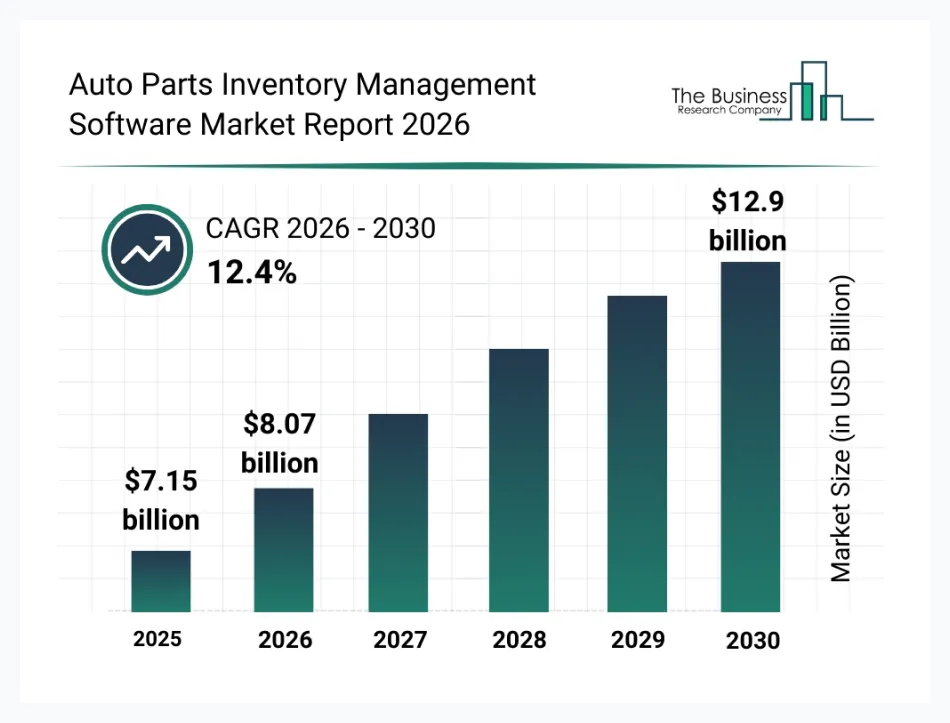
This is precisely why auto parts inventory software development has moved from a nice-to-have to a cornerstone of modern automotive operations. The market for such systems isn't small; it was valued at more than $7 billion in 2025 and is expected to grow to nearly $13 billion by 2030, driven by supply chain complexity and demand for real-time visibility.
You're building systems that solve real problems:
- Keep stock where and when it's needed
- Reduce dead inventory and stockouts
- Support fast order fulfillment across dealers and warehouses
And that's where auto parts inventory software development services and custom solutions come in helping automotive teams automate, track, and optimize inventory without piecing together spreadsheets and disconnected tools.
Whether you aim to:
- develop automotive inventory management platforms tailored to your workflows,
- build inventory software for auto parts distributors with multi-channel sales,
- or create auto parts stock management software that scales across locations,
your business requires systems built around operational reality, not generic templates.
In this guide, we'll look at what such systems do, why they matter, and how a custom software development company can help you move from inventory chaos to control without adding manual headaches.
Understanding AI Auto Parts Inventory Software in Modern Automotive Operations
In day-to-day automotive operations, inventory decisions happen constantly. Parts arrive, move, get consumed, returned, or transferred across locations. Auto parts inventory software development focuses on managing this movement accurately while keeping operations aligned with real demand.
AI-powered inventory systems work quietly in the background to support these operations by using live data instead of manual assumptions. They are designed to handle high SKU counts, frequent stock movement, and location-based inventory responsibilities.
In practical terms, these systems help businesses:
- Maintain real-time visibility of parts across locations
- Adjust stock levels based on actual usage patterns
- Coordinate replenishment without manual follow-ups
- Keep inventory data consistent across operational teams
When businesses invest in custom auto parts inventory software development, they support complex workflows that standard tools cannot handle reliably. With AI automation integrated into inventory processes, routine stock decisions happen automatically while teams stay focused on operational execution rather than constant reconciliation.
How AI Auto Parts Inventory Management Software Works Across the Supply Chain
Inventory across automotive supply chains moves fast and rarely in straight lines. Let's look at how auto parts inventory software supports daily part movement, stock decisions, and coordination across dealerships, warehouses, and distributors without adding operational friction.
1. Transaction-Level Inventory Capture
The system records every inventory movement at the moment it occurs, including receipts, transfers, issues, and returns. This live capture ensures stock data stays accurate across operational touchpoints without waiting for manual reconciliation.
2. Usage Pattern Learning Through Operations
Through ongoing AI model development, the software learns how parts are consumed across service jobs, sales orders, and regional demand. These patterns shape inventory decisions based on actual operational behavior, not static forecasts.
3. Automated Replenishment Coordination
Reorder actions trigger automatically when inventory thresholds are reached. Purchase orders and internal transfers are aligned with real usage, reducing delays caused by manual follow-ups or disconnected supplier communication.
4. Supply Chain Visibility and Execution
The system connects inventory activity across suppliers, warehouses, and distribution points. This coordination supports smoother fulfillment and enables teams to create auto parts inventory solutions for supply chain optimization based on real inventory flow, not assumptions.
Across the supply chain, inventory decisions depend on timing and accuracy. When software works inside daily stock movement instead of around it, teams gain consistency in execution without slowing down parts flow or fulfillment operations.
Also Read: AI in Logistics & Supply Chain
See Inventory Flow Clearly
Bring accuracy and coordination into daily stock movement across dealerships, warehouses, and distributor operations.
Talk to ExpertsKey Inventory Challenges Faced by Dealerships, Warehouses, and Distributors
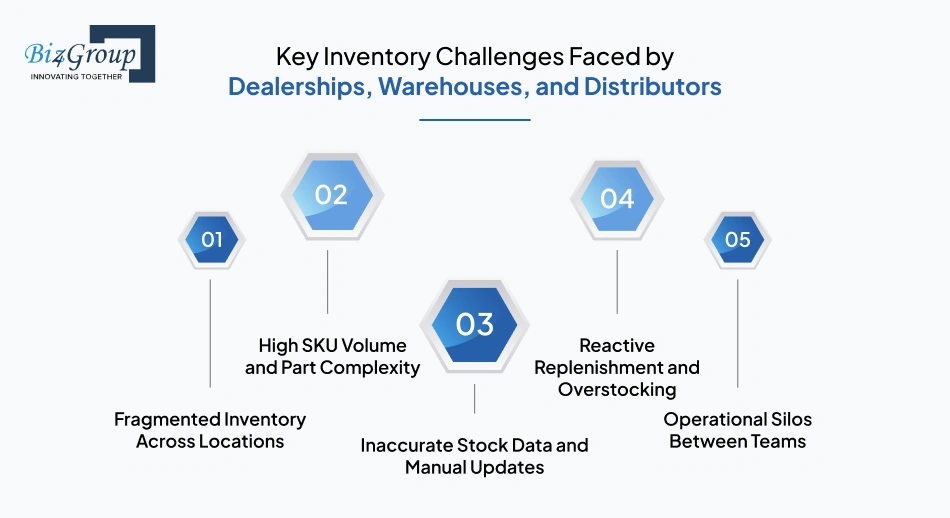
Inventory challenges in automotive businesses rarely come from one source. They build up through daily operations, growing SKU counts, and disconnected processes. These issues are exactly what AI inventory software development for automotive industry aims to address at an operational level.
1. Fragmented Inventory Across Locations
Dealerships, warehouses, and distributors often manage stock across multiple physical locations. Without a unified system, teams struggle to see where parts actually sit, leading to delays, excess transfers, and missed fulfillment opportunities.
2. High SKU Volume and Part Complexity
Automotive inventory includes thousands of similar parts with fitment, compatibility, and usage differences. Managing this complexity manually increases errors, slows part lookup, and creates confusion during ordering and replenishment cycles.
3. Inaccurate Stock Data and Manual Updates
Inventory data frequently falls out of sync due to delayed updates, manual entries, and disconnected tools. These gaps make it difficult to trust stock numbers during service jobs, bulk orders, or distributor commitments.
4. Reactive Replenishment and Overstocking
Many teams reorder parts only after shortages appear or overstock based on assumptions. Without structured demand signals, working capital gets tied up in slow-moving inventory while fast-moving parts remain unavailable.
5. Operational Silos Between Teams
Inventory decisions often happen in isolation across sales, service, and warehouse teams. With guidance from AI consulting services, businesses can align workflows and develop custom auto parts inventory software for automotive businesses that support shared visibility and accountability.
These challenges surface quietly but compound over time. When inventory systems fail to reflect real operations, teams spend more effort correcting problems than moving parts efficiently through daily automotive workflows.
Top Use Cases of AI Auto Parts Inventory Software Across Business Models
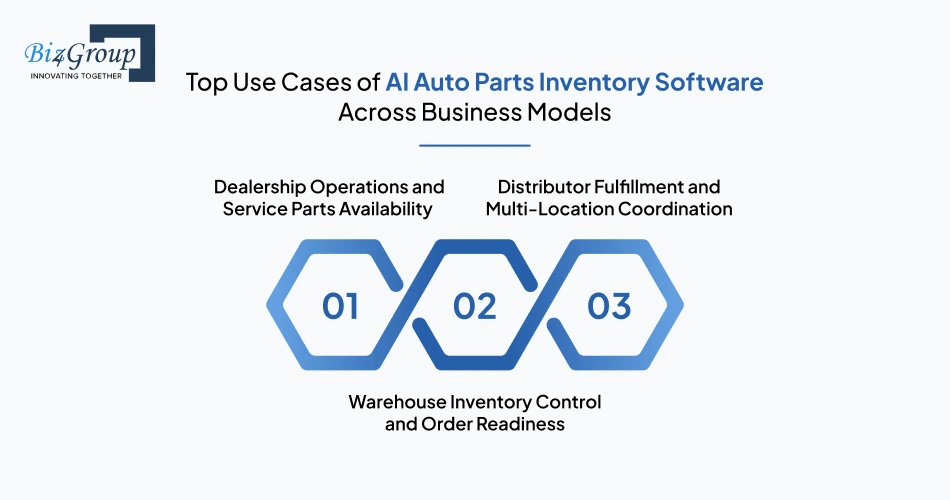
Auto parts inventory behaves differently across dealerships, warehouses, and distribution networks. This section shows how auto parts inventory software development supports real operational use cases, aligning stock movement, availability, and fulfillment with how each business model actually functions.
1. Dealership Operations and Service Parts Availability
Dealerships rely on parts being available the moment service work begins, which makes tight coordination between inventory and dealership management software critical. Systems built to create auto parts inventory solutions for dealerships support this by:
- Reserving parts against active service jobs
- Tracking fast-moving service components
- Preventing duplicate ordering across departments
2. Warehouse Inventory Control and Order Readiness
In high-volume environments, warehouse auto parts inventory software development focuses on keeping stock accurate and ready for dispatch. Practical use cases include:
- Managing bin-level inventory movement
- Supporting batch picking and cycle counts
- Keeping inbound and outbound flows aligned
3. Distributor Fulfillment and Multi-Location Coordination
Distributors depend on consistent execution across regions where the same part may exist in multiple depots. Inventory systems support this by controlling stock allocation, regional fulfillment priorities, and transfer timing without relying on manual coordination.
- Balancing stock across distribution points to meet regional demand
- Coordinating bulk orders alongside dealer-specific fulfillment
- Supporting consistent execution as order volume and regional activity increase through enterprise AI solution.
These use cases emerge from daily operational pressure, not theoretical needs. When inventory software aligns with how each business model works, teams gain reliability in execution without slowing down parts movement or fulfillment cycles.
Why Businesses Invest in Custom AI Auto Parts Inventory Software Development?
As inventory complexity grows, businesses invest in AI auto parts inventory software development to regain control over stock movement, capital allocation, and service continuity without increasing manual effort.
Market Snapshot
To understand why inventory systems are becoming a priority, it helps to look at where the auto parts market is heading and how that growth reshapes inventory responsibility.
- The U.S. auto parts market is projected to exceed USD 200 billion by 2035, driven by aging vehicle fleets, longer ownership cycles, and sustained demand across the aftermarket.
- Higher volume means larger SKU catalogs, faster stock turnover, and more capital tied up in inventory.
These conditions are pushing businesses to invest in auto parts inventory software development to support growth without increasing inventory risk or working capital strain.
Pain Points of Manual Inventory Handling and System-Led Control
Market growth creates opportunity, but that opportunity becomes harder to capture when inventory operations rely on manual coordination, fragmented data, and reactive decisions that struggle to hold up as volume, locations, and SKU counts increase.
| What Happens in Day-to-Day Inventory Handling | What Investing in AI Inventory Systems Changes |
|---|---|
|
Stock levels are tracked manually across tools |
Inventory updates stay consistent across locations |
|
Parts are ordered based on assumptions |
Replenishment aligns with actual usage patterns |
|
Service teams discover shortages mid-job |
Parts are reserved before service work begins |
|
Overstock builds up in slow-moving items |
Inventory stays closer to real demand |
|
Transfers depend on calls and emails |
Stock movement follows defined workflows |
|
Inventory discrepancies surface during audits |
Stock data remains reliable during daily operations |
|
Inventory workload grows with business volume |
Operations scale without adding manual overhead |
When handled manually, inventory absorbs time, capital, and attention that should be spent on execution. Structured inventory systems shift that burden away from people and into processes that can scale without friction.
Business Value of Investing in AI Auto Parts Inventory Software Development
Businesses invest in inventory systems to address specific financial and operational pressures that surface as inventory scale and complexity increase.
- Improves working capital control by aligning inventory levels with actual part usage and service demand patterns.
- Reduces revenue loss caused by service delays when required parts are unavailable at the right time.
- Lowers inventory carrying costs by limiting overstock of slow-moving and rarely used components.
- Increases confidence in inventory data used for financial forecasting, audits, and procurement planning.
- Limits operational overhead by reducing time spent on reconciliations, emergency purchases, and manual stock corrections.
- Supports predictable scaling as transaction volume, locations, and SKU complexity increase without proportional cost growth.
As operations scale, financial discipline depends on systems that reduce uncertainty. Many organizations choose to develop auto parts inventory management software to keep inventory predictable, auditable, and aligned with real operational demand.
Regain Control Over Inventory
Replace manual inventory handling with systems built for scale, accuracy, and operational consistency.
Get Started NowMust-Have Features in AI Auto Parts Inventory Software
Effective inventory systems succeed or fail based on everyday usability. In auto parts inventory software development, must-have features are those that support daily stock movement, accuracy, and coordination without forcing teams to change how they already work.
| Feature | Why This Feature Matters in Daily Operations |
|---|---|
|
Real-Time Inventory Updates |
Ensures stock levels reflect actual receipts, issues, transfers, and returns as they occur across operational locations. |
|
SKU and Part Compatibility Mapping |
Keeps similar parts organized by fitment and usage, reducing selection errors during service, sales, and fulfillment activities. |
|
Location-Based Stock Visibility |
Shows where parts are stored across warehouses, dealerships, and yards, enabling quicker fulfillment and internal transfers. |
|
Automated Reorder Point Management |
Triggers restocking actions based on actual usage thresholds rather than manual tracking or assumptions. |
|
Inventory History and Movement Logs |
Provides clear records of stock changes to support audits, investigations, and reconciliation workflows. |
|
Role-Based Access Controls |
Limits inventory actions by responsibility, helping teams maintain accountability without slowing down operations. |
|
Integration-Ready Inventory Data |
Supports auto parts inventory tracking systems that connect smoothly with purchasing, service, and order fulfillment workflows. |
|
Bin-Level and Sub-Location Tracking |
Tracks exact storage positions within warehouses reducing picking errors and speeding up fulfillment during high-volume operations. |
|
Inventory Reservation and Allocation Control |
Reserves parts against service jobs or confirmed orders, preventing double allocation and last-minute shortages during fulfillment. |
|
Transfer and Inter-Location Movement Management |
Controls stock transfers between locations with traceable movement records, approval rules, and accurate in-transit inventory visibility. |
|
Exception and Discrepancy Handling |
Flags mismatches between expected and actual stock levels, enabling faster investigation and correction before operational impact grows. |
Built-in inventory features reduce daily friction and keep stock accurate across dealerships, warehouses, and distributors. With AI integration services teams maintain operational rhythm while inventory systems support consistent execution.
Advanced Capabilities That Differentiate Modern AI Auto Parts Inventory Platforms
As operations scale, inventory systems must handle more than basic stock tracking. In auto parts inventory software development, advanced capabilities support higher SKU volumes, faster movement, and tighter coordination across locations without disrupting established workflows.
They reflect the same production-grade principles used when teams build AI software to operate continuously under high delivery pressure.
| Advanced Capability | How It Supports Real Inventory Operations |
|---|---|
|
Demand-Aware Stock Planning |
Adjusts replenishment quantities using actual consumption patterns from service jobs, orders, and returns rather than static reorder rules. |
|
Cross-Location Inventory Balancing |
Shifts stock between locations based on usage pressure, reducing internal transfer delays and preventing localized shortages. |
|
Part Lifecycle Visibility |
Tracks parts from receipt through usage, return, or write-off, helping teams manage aging inventory and reduce dead stock. |
|
Exception-Based Inventory Alerts |
Flags unusual movements, sudden demand spikes, or delayed receipts, so teams act early without monitoring dashboards constantly. |
|
Supplier Performance Tracking |
Links inventory availability to supplier lead times and fulfillment consistency, improving purchasing decisions over time. |
|
Scalable Inventory Governance |
Maintains consistent inventory rules as locations, users, and transaction volume grow without manual reconfiguration. |
Advanced capabilities matter when inventory pressure increases. Platforms that extend beyond basic tracking allow teams to build auto parts inventory tracking systems that stay reliable under volume growth, operational complexity, and multi-location execution demands.
How to Develop Auto Parts Inventory Software: A Step-by-Step Process
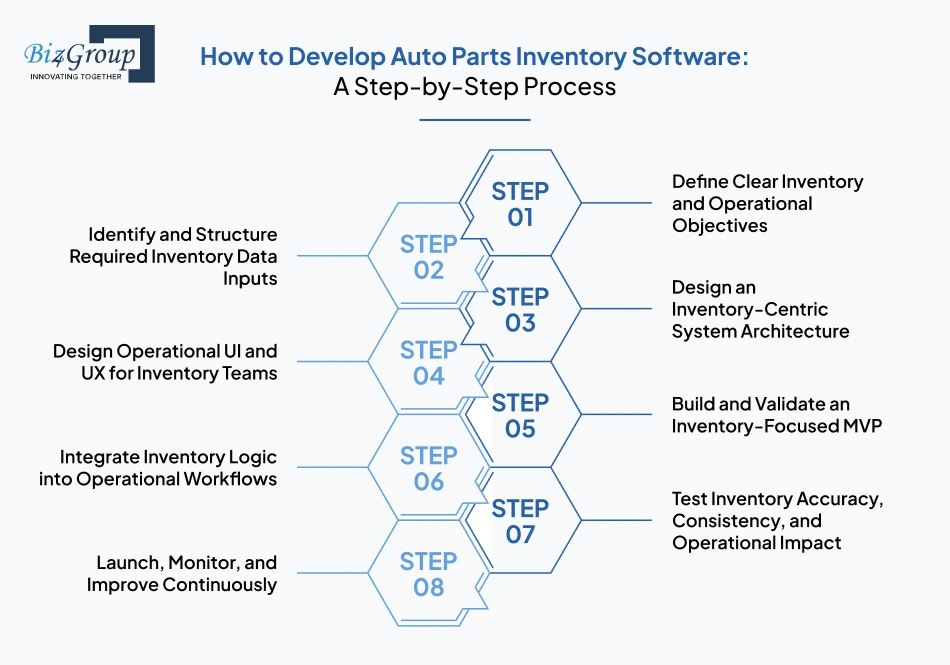
Auto parts inventory software development requires a structured approach that focuses on stock accuracy, operational consistency, and long-term reliability as SKU volume, locations, and transaction flow scale across automotive supply chains.
The following steps outline how teams should approach development, from defining inventory objectives to deploying systems
Step 1: Define Clear Inventory and Operational Objectives
Before any coding begins, teams establish clear development boundaries so inventory logic is built for correct scope and behavior.
- Inventory scope: Clearly define supported locations, inventory types, and transaction flows so developers can set clear boundaries for system modules.
- Stock rules: Specifies critical, slow-moving, and buffer stock conditions, so inventory logic can be implemented consistently across the codebase.
- Automation rules: Defines which inventory actions run automatically, allowing developers to implement rule-based triggers inside inventory services.
Step 2: Identify and Structure Required Inventory Data Inputs
Once objectives are clear, development moves toward defining the data structures required to represent inventory accurately across the system.
- Core identifiers: Define SKU, part compatibility, and location schemas, so developers model inventory entities consistently across databases and services.
- Transaction records: Design data structures for receipts, transfers, adjustments, and returns to process inventory movement accurately.
- Update logic: Implement clear increment and decrement rules so concurrent inventory transactions update stock balances correctly.
Step 3: Design an Inventory-Centric System Architecture
With data foundations in place, developers design the system structure that controls how inventory logic is executed and scaled.
- Inventory modules: Create dedicated services for stock calculation and availability logic to prevent conflicts with other system components.
- Layer separation: Separate inventory logic from ordering and fulfillment layers to simplify development and future code changes.
- Extension readiness: Design architecture flexible enough to integrate AI models later without rewriting core inventory logic.
Step 4: Design Operational UI and UX for Inventory Teams
After backend structure is defined, attention shifts to designing interfaces that expose inventory functionality clearly to end users.
- Stock screens: UI/UX design define inventory screens. Partnering with a skilled UI and UX design company help display stock levels, shortages, and track movements using backend inventory APIs.
- Task flows: Design inventory actions around receiving, transfers, and adjustments to match how users interact with the system.
- Role views: Implement role-based views so developers control data visibility through permissions and interface logic.
Also Read: Top 15 UI/UX Design Companies in USA
Step 5: Build and Validate an Inventory-Focused MVP
With designs finalized, development begins on a working version that validates inventory logic before expanding system complexity.
- Core build:MVP software development implements essential inventory tracking, movement logic, and availability calculations without advanced optimizations.
- Logic testing: Validate inventory workflows using realistic data to confirm correct behavior before expanding features.
- Early validation:MVP development services help teams validate inventory workflows with users before committing full-scale development.
Also Read: Top 12+ MVP Development Companies
Step 6: Integrate Inventory Logic into Operational Workflows
Once core inventory features are built, connect them with surrounding systems to enable end-to-end functionality.
- Ordering connection: Integrate inventory availability logic with purchasing modules, so stock data drives reorder decisions programmatically.
- Fulfillment wiring: Connect inventory updates with fulfillment systems to keep stock levels synchronized during order processing.
- System sync: Implement event-based or API-driven synchronization to keep inventory data consistent across connected platforms.
Step 7: Test Inventory Accuracy, Consistency, and Operational Impact
Before production release, verify inventory behavior under realistic conditions to catch calculation or synchronization issues.
- Movement testing: Test stock updates under frequent transactions to verify inventory calculations behave correctly under load.
- Data checks: Validate inventory consistency across locations and systems by comparing expected and actual stock records.
- Load simulation: Simulate high transaction volumes to confirm system stability before production deployment.
Also Read: Software Testing Companies in USA
Step 8: Launch, Monitor, and Improve Continuously
After deployment, development continues through controlled updates based on real system behavior and usage patterns.
- Production release: Deploy inventory services and interfaces into live environments with validated logic and integrations.
- Issue tracking: Monitor stock mismatches and system errors to identify logic or data handling issues.
- Incremental updates: Add new inventory rules, locations, and features through controlled development iterations.
Following this structured approach helps teams create inventory management systems for auto parts distributors. This helps them to integrate AI models directly into daily operations, maintain accurate stock visibility, and remain reliable as automotive inventory complexity increases.
Build AI Auto Parts Inventory the Right Way
Plan, validate, and deploy inventory systems designed to support real automotive operations at a scale.
Start Your BuildTechnology Stack Required for the Development of Auto Parts Inventory Management Platforms
Behind reliable inventory operations sits a carefully planned system foundation. In auto parts inventory software development, architecture decisions define how accurately stock moves, updates, and scales across dealerships, warehouses, and distribution environments without creating operational friction.
| Architecture Layer | Technology Used | Purpose |
|---|---|---|
|
Inventory Operations Frontend |
React / Next.js |
Supports inventory dashboards through ReactJS development and NextJS development, giving teams fast access to stock levels, transfers, and adjustments across daily workflows. |
|
Backend Inventory Services |
Node.js |
Handles NodeJS development for inventory logic, movement validation, location rules, and coordination between purchasing, fulfillment, and warehouse operations. |
|
Inventory Data Processing |
Python |
Uses Python development to process stock movement data, normalize SKUs, and maintain accurate inventory state across frequent operational updates. |
|
Integration and Communication Layer |
REST APIs |
Enables API development to connect inventory systems with ERP, supplier platforms, service systems, and distributor order pipelines reliably. |
|
Inventory Data Storage |
PostgreSQL / Cloud Databases |
Stores structured inventory records, movement history, and audit data required for operational accuracy and traceability. |
|
Access and Security Layer |
Role-Based Controls |
Ensures inventory actions follow operational responsibility boundaries while maintaining accountability across users and locations. |
When architecture supports real inventory movement and scale, teams can make auto parts inventory software for multi-location businesses. This helps them to stay stable as locations grow, transaction volume increases, and operational complexity rises across automotive supply chains.
Regulatory and Compliance Considerations in Auto Parts Inventory Software Development
Regulatory requirements quietly shape how inventory systems operate every day. In auto parts inventory software development, compliance influences how data is stored, accessed, shared, and audited across dealerships, warehouses, and distributor networks.
1. Data Protection and Access Control
Inventory platforms handle supplier data, pricing details, and operational records that require protection. Systems should support:
- Role-based access to limit who can view or change inventory data
- Secure storage for sensitive operational and vendor information
- Activity logs that record inventory changes and user actions
These controls help teams develop auto parts inventory management software that stays compliant without slowing daily operations.
2. Audit Readiness and Inventory Traceability
Regulatory and internal audits often require clear inventory records. Software must maintain:
- Historical logs for stock movement and adjustments
- Clear documentation for write-offs, returns, and transfers
- Time-stamped records that support reviews and dispute resolution
3. Supplier, Tax, and Trade Compliance
Inventory systems interact with suppliers and cross-border operations. Compliance considerations include:
- Accurate documentation for imported parts
- Alignment with regional tax reporting requirements
- Consistent records for supplier contracts and fulfillment terms
Compliance works best when built into inventory workflows from the start. Clear controls and traceability reduce operational risk while keeping inventory systems dependable as regulatory expectations evolve alongside automotive supply chains.
Build Compliance into AI Auto Parts Inventory
Design inventory systems with audit-ready controls and data protection built into daily workflows.
Talk to SpecialistsAI Auto Parts Inventory Software Development Cost Breakdown
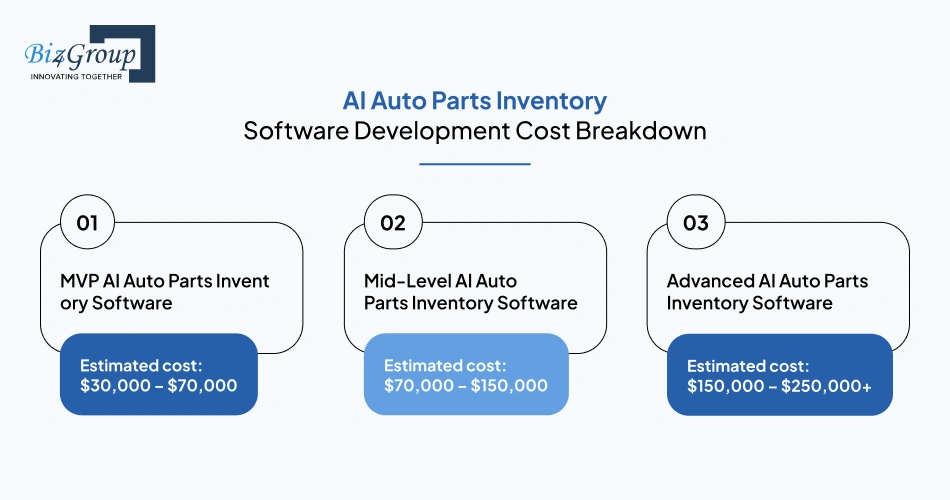
In AI auto parts inventory software development, cost is shaped by how much operational responsibility the system carries across inventory movement, accuracy, and scale. In practice, development typically ranges from $30,000 to $250,000+, depending on SKU value, locations, and integration depth.
| Development Level | Estimated Cost Range | What This Typically Covers |
|---|---|---|
|
MVP AI Auto Parts Inventory Software |
$30,000 – $70,000 |
Basic stock tracking, SKU listing, single-location inventory control, and simple reorder alerts. |
|
Mid-Level AI Auto Parts Inventory Software |
$70,000 – $150,000 |
Multi-location stock visibility, part compatibility handling, automated restocking, and integration with core operational systems. |
|
Advanced AI Auto Parts Inventory Software |
$150,000 – $250,000+ |
Enterprise-scale inventory control, cross-location stock balancing, audit-ready records, and support for complex distributor networks. |
Key Factors That Influence the Cost to Build an Auto Parts Inventory Management Software
The cost of auto parts inventory software is driven by how much operational control the system must take on. When inventory accuracy, movement, and coordination increase, development scope rises with it. These six factors have the strongest impact on cost.
- SKU Complexity: Managing a limited parts catalog is straightforward, but costs increase as SKU volume grows. Auto parts require structured identification, fitment logic, and usage constraints to avoid ordering and service errors.
- Multi-Location Inventory: Single-location inventory systems remain simple. Multi-location environments require transfer logic, in-transit visibility, and location-based availability, which significantly expands system responsibility and cost.
- Audit-Ready Accuracy: Basic systems track current stock only. Audit-ready platforms store detailed movement history, approvals, and adjustments, increasing data depth and validation effort across inventory workflows.
- Replenishment AI Automation: Manual inventory decisions reduce system complexity. Automated reorder points, reservations, and allocation rules require reliable triggers, exception handling, and testing, raising development effort.
- AI Integrations Costs: Standalone inventory tools cost less to build. Tight AI integration with DMS, ERP, suppliers, and service systems adds synchronization that increase
- Scalable Architecture: Systems built only for current needs cost less upfront. Designing inventory software that supports growth in SKUs, locations, and transaction volume requires stronger architecture and planning.
Cost varies based on inventory responsibility, not feature count. Clear decisions around scale, accuracy, and integration prevent scope creep and keep development aligned with real operational priorities.
Also Read: AI Software Development Cost
Monetization and Business Models for AI Auto Parts Inventory Softwares
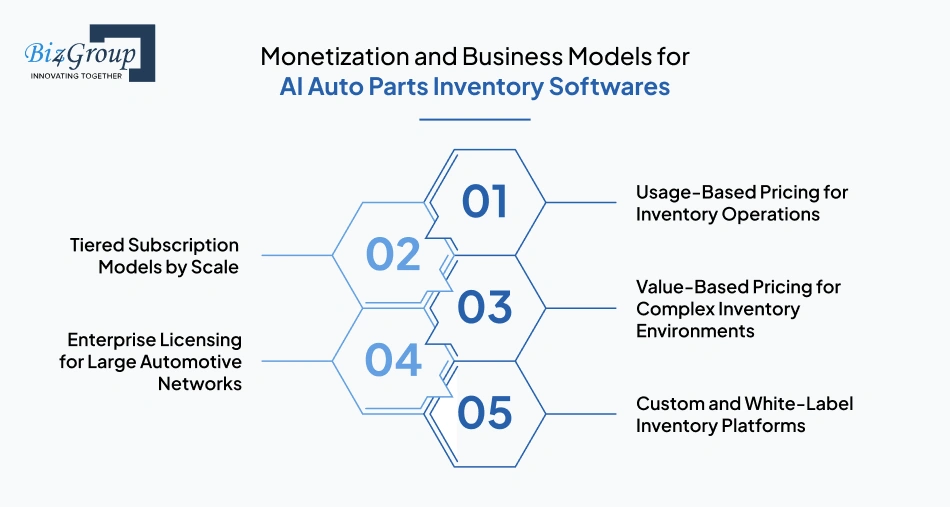
When businesses invest in auto parts inventory software development, monetization needs to reflect how deeply the system is embedded into daily inventory operations. Because inventory platforms run continuously across locations, SKUs, and workflows, pricing models work best when aligned with operational usage and scale.
1. Usage-Based Pricing for Inventory Operations
Many inventory platforms use usage-based pricing tied to how actively the system is used. Costs are influenced by:
- Number of SKUs managed
- Inventory movement volume
- Locations and operational touchpoints covered
This model works well for businesses with fluctuating demand and seasonal inventory cycles.
2. Tiered Subscription Models by Scale
Some providers offer subscription plans based on operational size. Businesses pay a fixed recurring fee based on:
- SKU count thresholds
- Number of active locations
- Depth of inventory functionality and reporting
This approach provides predictable costs while supporting steady growth, alongside broader automotive eCommerce operations.
3. Value-Based Pricing for Complex Inventory Environments
In advanced setups, pricing reflects how critical the system is to operations rather than raw usage. Costs are shaped by:
- Inventory value under management
- Supply chain complexity
- Dependency on accurate stock execution
This model suits distributors and large networks where inventory reliability directly impacts revenue.
4. Enterprise Licensing for Large Automotive Networks
Large distributors and dealer groups often prefer enterprise licensing. Pricing typically depends on:
- Number of warehouses and dealerships
- Integration depth with existing systems
- Governance and support requirements
Enterprise licenses support long-term deployments with stable operational control.
5. Custom and White-Label Inventory Platforms
Some organizations choose tailored or white-label platforms designed around their workflows. Revenue in these models comes from:
- Custom development engagements
- Licensing agreements
- Ongoing enhancements to build auto parts inventory tracking systems that evolve with operations
Inventory platforms monetize best when pricing reflects daily operational reliance and scale. Sustainable business models evolve alongside inventory workflows and broader automotive eCommerce platform development. The inventory accuracy directly supports ordering, fulfillment, and long-term operational growth.
Also Read: 65+ Software Ideas for Entrepreneurs and Small Businesses
Common Mistakes Businesses Make When Building Auto Parts Inventory Software
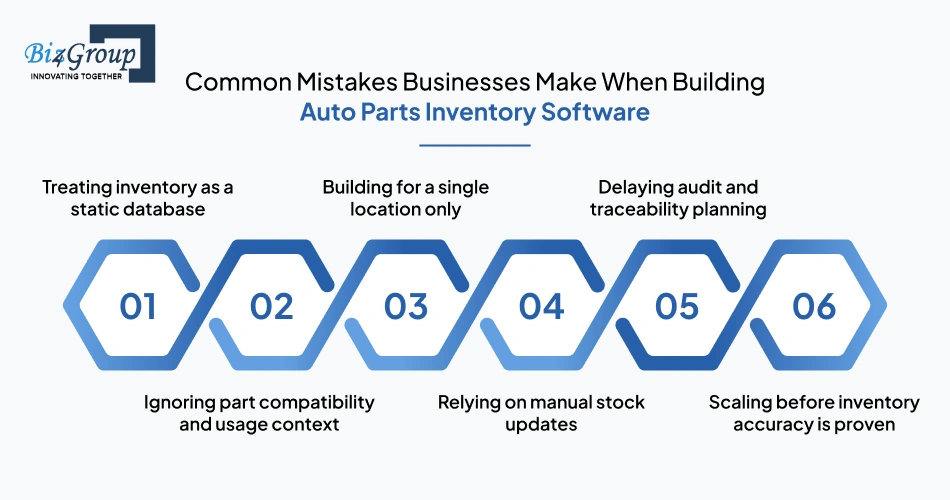
AI auto parts inventory software rarely breaks overnight. Most issues begin with small build-time decisions that ignore how parts actually move. In auto parts inventory software development, these mistakes slowly create gaps that disrupt accuracy, control, and daily operations.
| Common Mistake | How to Avoid It |
|---|---|
|
Treating inventory as a static database |
Design systems around stock movement, adjustments, returns, and transfers that happen continuously during operations. |
|
Ignoring part compatibility and usage context |
Structure SKUs with fitment and usage rules before teams develop auto parts inventory management software workflows. |
|
Building for a single location only |
Plan inventory logic that supports transfers, visibility, and control across multiple operational locations. |
|
Relying on manual stock updates |
Capture inventory changes directly from operational actions instead of after-the-fact reconciliation. |
|
Delaying audit and traceability planning |
Store detailed inventory history from the beginning to support reviews, disputes, and compliance needs. |
|
Scaling before inventory accuracy is proven |
Validate stock data reliability in live operations before expanding SKU volume or locations. |
These mistakes rarely appear during early demos but surface under real pressure. Addressing them early, often with guidance from an experienced AI development company, helps inventory systems remain stable as scale, volume, and operational complexity increase.
Why Choose Biz4Group for AI Auto Parts Inventory Software Development Services?
At Biz4Group LLC, we build inventory systems that support real automotive operations, not ideal workflows on paper. As a USA-based software development company, we help dealerships, warehouses, and distributors bring control and consistency into complex inventory environments.
The following points highlight how our development approach supports reliable inventory execution at scale.
1. Inventory Experience
- Our strength comes from combining practical engineering with hands-on experience across automotive platforms and e-commerce
- We have delivered systems that manage large SKU catalogs, multi-location stock movement, and distributor-level inventory execution without breaking daily operations.
2. Accuracy and Scale
- When it comes to auto parts inventory software development, we understand that accuracy, traceability, and scalability matter more than feature lists.
- Every system we build reflects how parts actually move, get consumed, transferred, and replenished across automotive businesses.
3. Workflow Knowledge
Our AI developers understand real inventory workflows, distributor operations, and location-based stock challenges that automotive businesses face every day.
4. Full Ownership
We manage projects from discovery through deployment, keeping inventory logic, integrations, and scale requirements aligned throughout the development process.
5. Proven Delivery
Our AI portfolios show consistent execution across data-heavy platforms where accuracy matters, and operational pressure leaves no room for shortcuts.
6. Client Validation
Clients stay involved through regular reviews and validation checkpoints, ensuring inventory workflows are tested and refined before scaling begins.
7. Custom Builds
We avoid templates and build systems around real operations, especially when businesses need to build inventory software for auto parts distributors with unique workflows and constraints.
As an experienced AI product development company, Biz4Group LLC helps automotive businesses move from inventory confusion to operational clarity. If you're ready to build inventory software that grows with your operations, we're ready to build it with you.
Build AI Inventory That Scales
Partner with a team that builds inventory systems aligned with real automotive operations.
Connect With Us Today!Final Thoughts: Building a Scalable Auto Parts Inventory System
Reliable auto parts inventory systems are designed to keep daily stock movement predictable rather than simply tracking part counts. Auto parts inventory software development helps businesses control replenishment, availability, and inventory flow as operations grow more complex.
As a Florida-based software development company, Biz4Group LLC applies disciplined engineering to systems that must perform consistently in real automotive environments. Moving from concept to deployment is rarely straightforward. Managing expanding SKU catalogs, multiple locations, supplier coordination, and inventory accuracy requires careful planning.
Well-designed systems reduce stockouts, limit excess inventory, and support steady fulfillment without increasing manual effort. Over time, consistency in inventory execution becomes a dependable operational advantage. We help automotive businesses develop inventory management platforms built for accuracy, scalability, and long-term reliability. The focus remains on systems that continue to perform as inventory demands evolve.
If you're ready to invest in auto parts inventory software that supports growth and operational confidence, we're ready to build it with you.
Frequently Asked Questions (FAQ’s)
1. How long does auto parts inventory software development usually take for dealerships and distributors?
Auto parts inventory software development timelines typically range from 10–14 weeks for an MVP to 5–7 months for enterprise systems supporting multiple locations, complex SKUs, and distributor-level workflows.
2. What problems do auto parts inventory software development services solve that ERPs cannot?
Auto parts inventory software development services address SKU complexity, part compatibility, multi-location stock movement, and real-time inventory accuracy that standard ERPs often handle poorly without heavy customization.
3. When should dealerships create auto parts inventory solutions instead of using off-the-shelf tools?
Dealerships usually create auto parts inventory solutions when stockouts, duplicate ordering, service delays, or poor visibility across locations start impacting service operations and customer satisfaction.
4. What is included in warehouse auto parts inventory software development?
Warehouse auto parts inventory software development typically includes bin-level tracking, bulk inventory movement, picking workflows, supplier coordination, and accurate stock reconciliation across inbound and outbound operations.
5. Why do distributors prefer custom auto parts inventory software development for large networks?
Distributors choose custom auto parts inventory software development to support regional warehouses, dealer networks, complex fulfillment rules, and inventory transfers that generic inventory tools cannot manage reliably at scale.
6. Can businesses develop automotive inventory management platforms for multi-location operations?
Yes, businesses can develop automotive inventory management platforms that provide shared stock visibility, controlled transfers, and consistent inventory rules across multiple warehouses, dealerships, and distribution centers.
