 Location :
Orlando, FL, USA
Location :
Orlando, FL, USA +1 (407) 714-1616
 info@biz4group.com

- Enterprise AI assistants like CoCounsel streamline legal, tax, audit, and accounting workflows by supporting research, document review, and compliance-driven professional tasks efficiently.
- Organizations planning to develop an AI assistant like CoCounsel for legal work must prioritize workflow alignment, secure data handling, and task-based intelligence over generic chatbot functionality.
- Core success depends on domain-trained capabilities, structured outputs, explainable responses, and seamless integration into existing professional systems used daily by regulated teams.
- Estimated development cost ranges from $40,000 to $200,000+, depending on scalability requirements, compliance readiness, integrations, and ongoing operational AI integration costs.
- Teams aiming to build enterprise AI assistant like CoCounsel for legal teams should begin with MVP validation before scaling features across departments and professional service operations.
- Biz4Group LLC, ranked among top AI legal software development companies in USA, supports enterprises with practical execution experience, helping organizations translate complex workflows into scalable assistants trusted by legal and professional teams.
A missed clause in a contract, an overlooked compliance update, or hours lost reviewing filings can directly impact business outcomes. Legal, tax, audit, and accounting teams work in environments where accuracy matters as much as speed. This pressure is exactly why organizations are moving toward intelligent assistants built specifically for professional workflows rather than general-purpose tools.
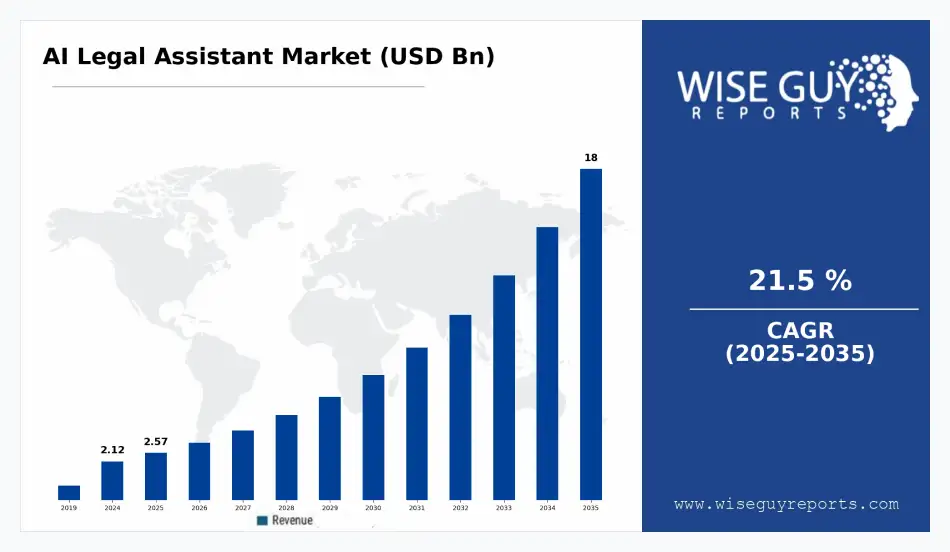
Market signals clearly reflect this shift. The legal AI assistant market is projected to reach USD 18 billion by 2035, showing how rapidly professional services are adopting AI-driven systems.
Instead of replacing expertise, modern assistants extend it. They help professionals review information faster, surface risks earlier, and support decision-making without disrupting existing processes.
Key forces driving adoption include:
- Rising regulatory complexity across legal and financial operations
- Increasing document volumes across contracts, audits, and tax filings
- Demand for faster turnaround without expanding team size
- Growing reliance on generative AI to analyze structured and unstructured documents
- Enterprise adoption of AI automation to reduce repetitive knowledge work
As firms evaluate how to develop an AI assistant like CoCounsel for legal work, the focus is shifting toward domain-trained systems that understand professional context. An enterprise AI Assistant today acts less like a chatbot and more like a digital analyst embedded into daily workflows.
This guide explains how organizations can develop AI legal assistants like CoCounsel while meeting the expectations of regulated professional environments.
What is CoCounsel and How Does it Work?
Legal and professional teams rely on careful analysis, structured research, and precise documentation every day. Understanding how CoCounsel operates helps organizations see how intelligent assistants can support real workflows instead of adding another standalone tool.
What Is CoCounsel?
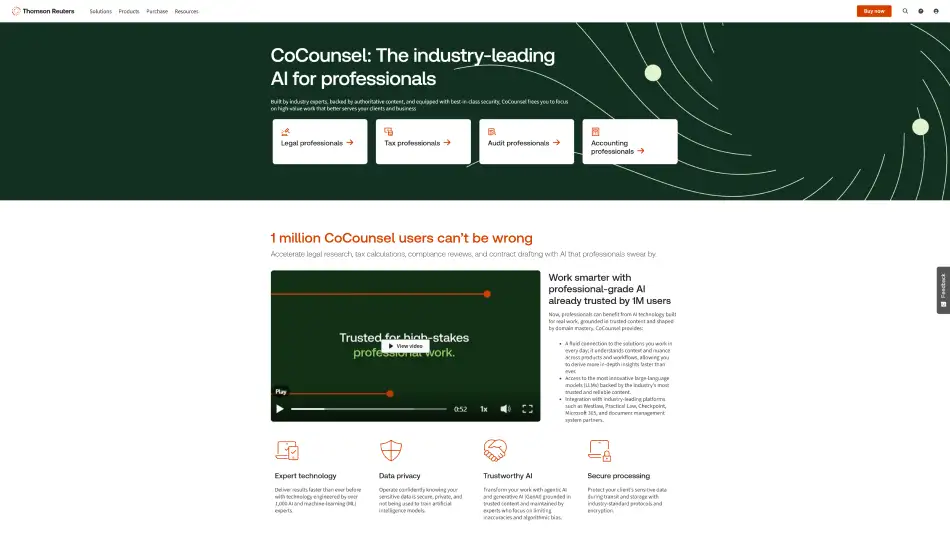
CoCounsel is an AI-powered professional assistant designed to support legal work by helping teams review documents, conduct research, and analyze information faster. It works as a task-focused system that assists professionals during real assignments rather than casual conversations.
Organizations planning to develop an AI assistant like CoCounsel for legal work often focus on building structured assistance that fits naturally into daily professional workflows. The assistant becomes useful because it understands work context and delivers outputs aligned with professional expectations.
How Does CoCounsel Work?
- Task-Based Interaction: Users assign specific professional tasks such as reviewing contracts or summarizing case materials. The assistant interprets the objective and follows structured reasoning steps to generate organized and usable outputs.
- Document Processing and Understanding: The system reads uploaded files, breaks content into logical sections, and identifies relevant information. This allows professionals to work with large document sets without manually reviewing every page.
- Context-Aware Legal Research: The system analyzes trusted knowledge sources and presents findings aligned with the user’s query while maintaining relevance to ongoing work context.
- Workflow Alignment Through AI Integration: Instead of operating separately, the assistant connects with internal tools and databases. Thoughtful AI integration ensures research, drafting, and review tasks happen within familiar professional environments.
- Evidence-Linked Responses: Outputs include references tied to analyzed materials, helping professionals validate conclusions quickly. This builds trust and supports responsible adoption across regulated legal and compliance workflows.
- Continuous Workflow Improvement: Organizations integrate AI gradually, allowing the assistant to adapt to usage patterns while maintaining strict data boundaries and consistent operational logic suited for professional service environments.
A well-designed assistant succeeds because it supports how professionals already work. Teams investing in AI assistant development like CoCounsel for legal professionals aim to enhance productivity while preserving accuracy, accountability, and professional judgment.
Why Organizations Are Investing in Enterprise AI Assistants for Legal, Tax, Audit, and Accounting Operations
Professional service teams are facing increasing workloads while expectations for accuracy and turnaround continue to rise. Organizations are investing in intelligent assistants to support complex analytical work without disrupting established operational structures.
Enterprise adoption is no longer experimental; it is becoming part of long-term operational planning.
Market Snapshot
- The AI in legal services market is projected to grow from USD 14.45 billion in 2025 to USD 156.22 billion by 2035, expanding at a 27% CAGR, signaling sustained enterprise adoption.
- North America leads the global AI legal services market, supported by a high concentration of large law firms, a strong legal technology ecosystem, and early adoption across corporate legal departments and enterprise teams.
These numbers reflect a broader shift toward structured technology adoption across professional environments.
1. Increasing Volume of Knowledge-Heavy Work
Legal, tax, and audit teams process large amounts of structured and unstructured information daily. Manual review alone cannot scale with growing workloads, prompting firms to create AI powered legal assistant like CoCounsel systems that support ongoing analysis.
- Document volumes continue growing across compliance, contracts, and financial reporting
- Professionals spend significant time locating relevant information before analysis begins
- Firms invest in systems that assist work execution rather than replace expertise
2. Pressure To Maintain Accuracy Under Tight Deadlines
Professional environments operate under strict accountability where errors carry financial and legal consequences. Organizations invest in enterprise AI solutions to introduce structured support layers that help teams manage deadlines without compromising review quality.
- Regulatory timelines continue shortening across industries
- Teams must validate outputs consistently across departments
- Leadership seeks controlled automation within sensitive workflows
3. Shift Toward Embedded Digital Workflows
Firms are moving away from disconnected software tools toward integrated operational systems. A Legal AI agent becomes part of daily workflows, helping professionals work within familiar platforms rather than switching between multiple research or review tools.
- Centralized workflows improve operational visibility
- Integrated systems reduce process fragmentation
- Technology investments now prioritize workflow continuity
4. Need For Scalable Expertise Across Teams
Organizations often struggle to scale specialized knowledge across growing client demands. When teams build AI assistant like CoCounsel for legal research, they aim to replicate structured research support that junior analysts typically provide during intensive workloads.
- Expertise gaps appear during peak operational cycles
- Firms require consistent research support across teams
- Leadership invests in systems that extend professional capacity responsibly
5. Long-Term Digital Transformation Strategies
Enterprise leaders increasingly view intelligent assistants as foundational infrastructure rather than temporary tools. An AI virtual assistant supports ongoing modernization initiatives where organizations gradually integrate digital intelligence into compliance, advisory, and audit operations.
- Technology roadmaps now include intelligent assistants as core components
- Investment decisions align with multi-year transformation goals
- Firms prioritize sustainable operational scalability
Organizations investing today are not reacting to trends. They are building structured operational support that aligns professional expertise with scalable digital assistance, preparing teams for increasingly complex regulatory and analytical workloads ahead.
Is Your Firm Scaling or Stalling?
If your workflows still rely on manual review cycles, it may be time to rethink your operational model.
Talk To Our AI Strategy TeamKey Use Cases Across Legal, Tax, Audit, and Accounting Teams
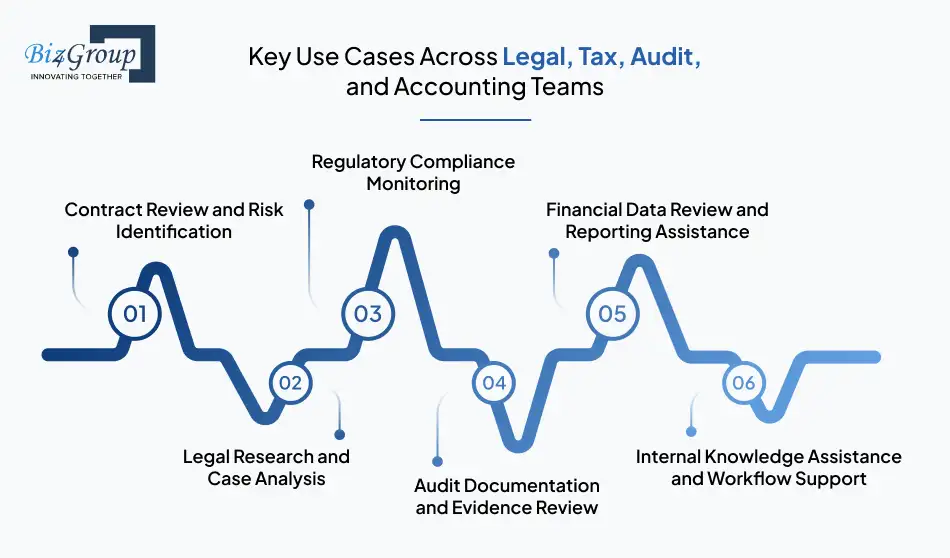
Enterprise assistants deliver the most value when they support real professional tasks performed daily by legal, tax, audit, and accounting teams. The following use cases reflect how platforms similar to CoCounsel operate inside practical workflows.
1. Contract Review and Risk Identification
- Clause Extraction: Automatically identifies key clauses such as indemnity, liability, and termination terms across lengthy agreements, helping legal teams focus directly on critical review areas.
- Risk Flagging: Detects unusual wording or missing provisions that may introduce compliance or financial risks during contract evaluation.
- Contract Summarization: Produces structured summaries that allow attorneys to understand agreement intent quickly before deeper legal analysis begins.
2. Legal Research and Case Analysis
- Precedent Discovery: Searches trusted legal databases and surfaces relevant cases aligned with research queries, supporting teams planning to develop an AI assistant like CoCounsel for legal work.
- Research Summaries: Converts large research outputs into concise insights that assist lawyers during drafting and argument preparation.
- Citation Validation: Verifies references against source material to maintain research accuracy and reduce manual cross-checking effort.
3. Regulatory Compliance Monitoring
- Policy Review Support: Reviews internal policies against updated regulations to identify gaps requiring attention.
- Compliance Document Analysis: Scans filings and disclosures to ensure required information is present before submission.
- Update Tracking: Highlights regulatory changes impacting tax reporting or legal obligations across jurisdictions.
4. Audit Documentation and Evidence Review
- Evidence Classification: Organizes audit documents into structured categories, simplifying auditor access during reviews.
- Anomaly Detection: Identifies inconsistencies across financial records that may require deeper investigation.
- Workpaper Summaries: Generates concise explanations of supporting evidence to assist auditors during reporting stages.
5. Financial Data Review and Reporting Assistance
- Statement Analysis: Reviews financial documents to detect inconsistencies or missing disclosures during reporting preparation.
- Narrative Draft Support: Assists accountants in preparing structured explanatory notes aligned with financial data.
- Data Consistency Checks: Validates numerical alignment across multiple reports to reduce reconciliation errors.
6. Internal Knowledge Assistance and Workflow Support
- Knowledge Retrieval: Acts as an internal assistant that answers workflow questions using approved organizational documents through controlled AI chatbot integration within enterprise systems.
- Voice-Based Task Support: Teams may extend functionality into an AI chatbot voice assistant interface for hands-free queries during reviews or collaborative working sessions.
- Process Guidance: Provides step-by-step assistance based on internal playbooks, supporting Legal AI assistant software development like CoCounsel aligned with organizational workflows.
These use cases demonstrate how intelligent assistants function as task-oriented professional tools. Organizations pursuing custom AI assistant development like CoCounsel for law firms typically prioritize workflow-specific capabilities that directly support daily operational responsibilities across regulated professional environments.
Core Capabilities Required to Develop an AI Assistant Similar to CoCounsel
The development of an enterprise-grade assistant requires more than adding conversational AI to software. Professional environments demand structured intelligence that understands documents, workflows, and compliance expectations while supporting how legal, tax, audit, and accounting teams actually operate.
|
Core Capability |
What It Enables in Professional Workflows |
|---|---|
|
Document Intelligence Engine |
Reads contracts, filings, and financial records while identifying important sections, helping professionals review large documents without manual scanning. |
|
Context-Aware Task Understanding |
Interprets user intent based on assigned work tasks instead of isolated prompts, enabling structured assistance aligned with real professional activities. |
|
Secure Knowledge Retrieval |
Searches approved internal and external sources while maintaining strict access controls required for regulated professional environments. |
|
Legal And Financial Research Support |
Assists research workflows by organizing findings clearly, a key requirement when organizations develop an AI assistant like CoCounsel for legal work. |
|
Structured Output Generation |
Produces summaries, reports, and analysis in predictable formats that match how legal and audit teams document outcomes. |
|
Workflow Integration Layer |
Connects with document systems, compliance tools, and enterprise platforms so the AI assistant app operates inside existing workflows rather than outside them. |
|
Role-Based Access Control |
Ensures different teams access only permitted data, supporting confidentiality requirements across legal, tax, and audit operations. |
|
Audit Trail and Explainability |
Maintains activity logs and traceable outputs so professionals can validate how results were generated during reviews or compliance checks. |
|
Domain-Specific Training Framework |
Allows organizations to train the assistant using internal policies and professional datasets when they build enterprise AI assistant like CoCounsel for legal teams. |
|
Multi-Document Reasoning |
Analyzes relationships across multiple files simultaneously, helping identify inconsistencies or dependencies across contracts and financial materials. |
|
Compliance-Aware Processing |
Applies predefined validation logic aligned with regulatory standards, supporting firms that develop AI assistant like CoCounsel for tax and audit firms. |
|
Human Review and Feedback Loop |
Enables professionals to refine outputs and guide system improvement without disrupting operational workflows. |
|
Scalable Cloud Architecture |
Supports increasing document volumes and concurrent users while maintaining performance and reliability expectations. |
|
User Interaction Interface |
Provides an intuitive workspace through a legal AI app interface where professionals assign tasks and review structured outputs easily. |
A successful assistant is defined by how well it supports professional decision-making rather than technical complexity. Organizations building such systems focus on reliability, workflow alignment, and controlled intelligence that professionals can confidently depend on every day.
Advanced Capabilities That Differentiate Enterprise AI Assistants for Legal Professionals
Enterprise assistants move beyond basic automation when they begin supporting judgment-driven professional work. Advanced capabilities allow the system to assist complex analysis, maintain context across tasks, and operate reliably within regulated legal and financial environments.
|
Advanced Capability |
How It Strengthens Professional Workflows |
|---|---|
|
Multi-Step Legal Reasoning |
Handles layered tasks such as reviewing documents, identifying risks, and preparing structured outputs in sequence. This helps organizations develop an AI assistant like CoCounsel for legal work that mirrors real analytical processes. |
|
Context Memory Across Sessions |
Retains task history and document context so professionals continue work without repeating instructions, improving continuity during long research or audit cycles. |
|
Predictive Analysis for Risk Identification |
Uses historical patterns and structured evaluation logic to highlight potential compliance or contractual risks early. It allows professionals to focus attention where review effort matters most. |
|
Domain-Trained AI Model Customization |
Organizations refine an AI model using internal policies, case materials, and regulatory frameworks to align outputs with firm-specific standards and professional expectations. |
|
Cross-Document Relationship Mapping |
Connects insights across multiple files to identify inconsistencies between contracts, financial reports, or regulatory submissions during complex reviews. |
|
Conversational Workflow Execution |
Functions as a conversational AI agent that accepts natural instructions while executing structured backend tasks. It aligns with legal and audit workflows rather than casual dialogue interactions. |
|
Evidence-Linked Response Generation |
Produces outputs supported by traceable references so professionals can validate reasoning quickly during legal or compliance evaluations. |
|
Secure Collaboration Support |
Enables multiple team members to review outputs, add feedback, and maintain controlled access within shared professional environments. |
|
Adaptive Research Intelligence |
Learns preferred research patterns and organizes findings accordingly, supporting teams that develop AI assistant like CoCounsel for tax audit and accounting firms managing recurring analytical tasks. |
|
Unified Conversation Interface |
Presents research, document review, and task execution within a single AI conversation app workspace, allowing professionals to interact naturally while maintaining structured operational control. |
Advanced capabilities transform an assistant from a productivity tool into operational infrastructure. Organizations that build scalable AI assistant like CoCounsel for professional services focus on intelligence that supports professional reasoning while maintaining trust, accuracy, and workflow consistency.
Enterprise AI Assistant Development Like CoCounsel: Step-by-Step Development Process
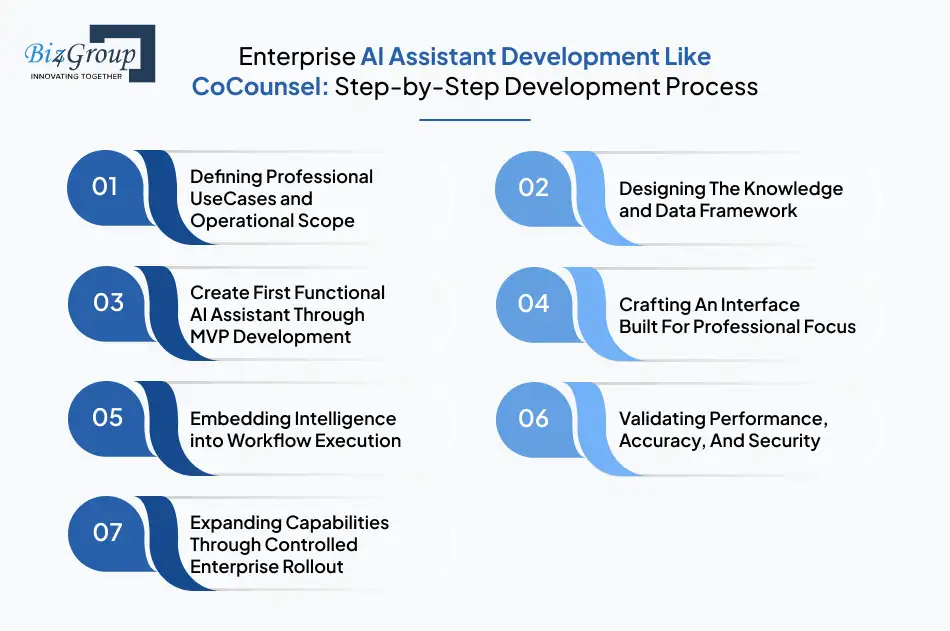
Building an enterprise AI assistant requires structured execution that mirrors how professionals think, research, and review information. Successful AI assistant like CoCounsel evolve through validated stages where usability, trust, and workflow alignment guide every development decision.
1. Defining Professional Use Cases and Operational Scope
Development starts by defining exactly what work the assistant will support. Legal and financial professionals rely on structured processes, so clarity at this stage prevents unnecessary feature expansion later.
- Identify high-value workflows such as research, document review, and compliance analysis
- Map how teams interact with knowledge sources during daily tasks
- Define measurable outcomes the assistant should improve
Clear scope ensures the platform solves operational problems instead of becoming a generic AI tool.
2. Designing The Knowledge and Data Framework
An enterprise assistant depends on how information is organized behind the interface. The system must understand documents, internal knowledge, and permissions before intelligence is introduced.
- Structure document repositories and internal knowledge bases
- Define access roles across departments and teams
- Prepare secure environments for sensitive professional data
This stage creates the foundation required to develop an AI assistant like CoCounsel for legal work responsibly.
3. Create First Functional AI Assistant Through MVP Development
Early development focuses on proving workflow usefulness rather than building a complete system immediately. MVP development companies allow teams to validate how professionals actually interact with the assistant.
- Release core capabilities such as document understanding and research assistance
- Observe real user behavior during pilot usage
- Improve workflows through iterative MVP development cycles
Validated learning at this stage reduces long-term development risk.
Also Read: AI-based Custom MVP Software Development
4. Crafting An Interface Built For Professional Focus
Enterprise assistants succeed when professionals can work without friction. Working alongside an experienced UI/UX design company helps ensure usability aligns with professional expectations.
- Design simple task-oriented dashboards
- Present outputs in structured professional formats
- Reduce clicks and navigation effort during workflows
Interfaces must support concentration during research and analysis rather than introduce complexity.
Also Read: Top UI/UX design companies in USA
5. Embedding Intelligence into Workflow Execution
Instead of placing intelligence as a separate feature, development teams integrate AI models directly into task execution layers where assistance naturally occurs.
- Enable contextual document understanding during reviews
- Provide guided responses through conversational workflows
- Support structured queries similar to professional interactions inside a legal AI chatbot.
This approach allows intelligence to assist work without interrupting it.
6. Validating Performance, Accuracy, And Security
Professional environments require reliability before adoption expands. Testing focuses on ensuring outputs remain consistent under real operational conditions.
- Simulate heavy document workloads and concurrent users
- Validate response accuracy against professional benchmarks
- Collaborate with a trusted companies to confirm stability and security readiness
Strong validation builds user confidence early.
Also Read: 15+ Software Testing Companies in USA
7. Expanding Capabilities Through Controlled Enterprise Rollout
Deployment happens gradually so organizations can adapt workflows safely. Feedback gathered during early adoption guides platform refinement.
- Introduce the assistant across selected teams first
- Monitor usage patterns and workflow efficiency
- Expand functionality based on validated performance insights
Phased rollout helps the AI assistant app mature into dependable operational infrastructure.
A disciplined development process transforms an AI assistant from a promising concept into trusted professional infrastructure. Organizations that prioritize workflow alignment, validation, and gradual scaling build AI assistants professionals rely on daily rather than occasionally.
Also Read: How to Build an Agentic AI Assistant from Scratch
Ready To Turn Blueprint into Platform?
A roadmap only works when execution follows discipline. Let's discuss how to convert your assistant strategy into a secure, enterprise-ready system.
Start Your Assistant Build ConversationTechnology Stack Required for AI Assistant Development in Regulated Industries
Enterprise AI assistants like Cocounsels operating in legal, tax, audit, and accounting environments rely on carefully structured technology layers. Each layer must support security, reliability, and controlled intelligence while handling sensitive professional data responsibly.
|
Architecture Layer |
Recommended Technology |
Purpose |
|---|---|---|
|
User Interface Layer |
React, TypeScript |
Enables responsive professional dashboards through ReactJS development, allowing users to review documents, assign tasks, and interact with assistant outputs efficiently. |
|
Server-Side Rendering Layer |
Next.js |
Supports secure rendering workflows using NextJS development, improving performance while maintaining structured access control required in regulated enterprise environments. |
|
Application Backend Layer |
Node.js, Express |
Manages workflow execution and business logic through NodeJS development, ensuring stable communication between interface components, databases, and intelligent processing services. |
|
AI Processing Layer |
Python, FastAPI |
Handles document understanding and reasoning tasks using Python development, enabling scalable model orchestration for research analysis, summarization, and contextual task execution. |
|
AI Model Integration Layer |
OpenAI APIs, Azure AI Services |
Connects intelligence services through structured API development, allowing assistants to securely process prompts, documents, and workflow instructions within enterprise environments. |
|
Document Storage Layer |
AWS S3, Azure Blob Storage |
Stores contracts, filings, and audit records securely while supporting controlled retrieval required for compliance-focused professional workflows. |
|
Vector Database Layer |
Pinecone, Weaviate |
Enables semantic search across legal and financial documents, helping assistants retrieve contextually relevant information during research and analysis tasks. |
|
Relational Database Layer |
PostgreSQL, MySQL |
Maintains structured metadata such as user roles, permissions, task history, and workflow states across enterprise operations. |
|
Authentication And Access Control |
OAuth 2.0, Azure AD |
Enforces role-based authentication and identity management to protect confidential professional data across departments and regulated environments. |
|
Monitoring And Logging Layer |
ELK Stack, Datadog |
Tracks system activity, performance metrics, and usage behavior to maintain transparency and operational reliability required by enterprise governance standards. |
|
Cloud Infrastructure Layer |
AWS, Microsoft Azure |
Provides scalable hosting environments capable of handling enterprise workloads while supporting compliance certifications and regional data governance requirements. |
Organizations aiming to develop an AI assistant like CoCounsel for legal work rely on tightly connected layers rather than isolated tools. Successful AI legal assistant product development like CoCounsel depends on balanced full stack development that ensures intelligence, security, and usability operate together within regulated professional ecosystems.
Data Privacy, Compliance, and Security Requirements for AI Legal Assistant Software Development

Legal, tax, audit, and accounting environments operate under strict confidentiality expectations. Enterprise assistants must handle sensitive documents responsibly while maintaining transparency, access control, and regulatory alignment across every interaction involving professional data.
1. Secure Data Isolation
Enterprise AI assistants like CoCounsel must separate organizational data environments to prevent cross-client exposure. Dedicated storage boundaries ensure confidential case materials remain isolated, supporting organizations that create custom AI assistant like CoCounsel for regulated legal environments.
2. Role-Based Access Governance
Access permissions should reflect professional hierarchy and responsibilities. Attorneys, auditors, and analysts must only view authorized information, reducing internal data risks while maintaining accountability required in regulated professional operations.
3. Encryption Across Data Lifecycle
Sensitive information requires protection during upload, storage, and processing stages. Strong encryption practices safeguard contracts, filings, and financial records, supporting AI legal assistant development like CoCounsel for productivity improvement without compromising confidentiality.
4. Auditability And Activity Tracking
Every interaction must remain traceable through structured logs. Audit trails help organizations verify how outputs were generated, supporting compliance reviews and internal governance requirements common across enterprise legal environments.
5. Regulatory Compliance Alignment
Assistants must align with regional data regulations such as GDPR, SOC 2, and industry governance policies. Compliance readiness becomes essential when enterprises develop an AI assistant like CoCounsel for legal work handling regulated documentation.
6. Controlled Model Training Practices
Professional data should never be reused for external model training without authorization. Teams that hire AI developers for enterprise AI assistants like CoCounsel typically enforce strict policies preventing unintended data exposure through learning processes.
7. Human Oversight and Output Validation
Enterprise AI assistants must support human review before final decisions. Maintaining professional oversight ensures AI-generated insights assist judgment while preserving accountability standards required across legal and financial operations.
Trust determines adoption in professional environments. Strong privacy controls and compliance alignment transform intelligent assistants into dependable infrastructure, enabling organizations to scale securely while maintaining the confidentiality expectations central to regulated professional work.
Also Read: How to Build an AI Legal Consultation Platform
Can Your Assistant Pass an Audit?
Let's review how your planned assistant architecture aligns with enterprise-grade privacy and governance standards.
Schedule A Compliance Readiness CallCost Breakdown for Developing a Scalable AI Assistant for Professional Services
Enterprise AI assistants similar to CoCounsel require investment aligned with workflow intelligence, compliance readiness, and scalability expectations. Organizations planning to develop an AI assistant like CoCounsel for legal work typically invest between $40,000 and $200,000+, depending on capability depth and enterprise deployment scope.
|
Development Level |
Estimated Cost Range |
What It Covers |
|---|---|---|
|
MVP Level AI Assistant like CoCounsel |
$40,000 – $70,000 |
Basic document understanding, limited research workflows, simple interface, foundational security controls, and early validation capabilities. |
|
Mid-Level AI Assistant like CoCounsel |
$70,000 – $120,000 |
Workflow automation, role-based access, enterprise integrations, scalable infrastructure, improved reasoning accuracy, and operational stability. |
|
Advanced Enterprise AI Assistant like CoCounsel |
$120,000 – $200,000+ |
Multi-team deployment, compliance automation, audit logging, advanced intelligence workflows, high-volume document processing scalability. |
What Actually Shapes Your Investment
- Depth of professional workflows supported across legal, tax, or audit teams
- Compliance and data governance requirements for regulated environments
- Volume of documents processed and stored securely
- Number of enterprise integrations required with internal systems
- Level of reasoning accuracy expected from assistant outputs
- Infrastructure scalability for concurrent enterprise users
- Long-term AI integration costs associated with model usage and processing workloads
Where Smart Planning Keeps Costs Under Control
- Strategic decisions early in the project significantly influence long-term investment efficiency.
- Begin with clearly defined professional use cases instead of broad automation ambitions. Focused scope reduces redesign cycles and ensures resources are invested only in workflows professionals actively depend on every day.
- Release a focused MVP before expanding intelligence layers. Early validation helps teams understand adoption patterns and prevents unnecessary spending on advanced capabilities that may not align with operational realities.
- Reuse existing enterprise systems such as authentication, storage, and document repositories whenever possible. Leveraging current infrastructure lowers engineering complexity and reduces deployment timelines without compromising performance or security expectations.
- Plan compliance architecture from the start when teams make AI legal assistant like CoCounsel with compliance features. Retrofitting governance later often increases engineering effort and significantly raises total implementation costs.
A realistic cost strategy balances capability growth with operational value. Enterprise teams succeed when investment follows validated usage patterns, ensuring the assistant scales alongside professional workloads instead of becoming an expensive experimental tool.
Also Read: How Much Does It Cost to Build a Legal AI Chatbot?
Know The Cost Before the Commitment
Smart investment begins with clarity, not assumptions. Get a realistic cost discussion aligned with your workflow complexity and compliance scope.
Request A Detailed Cost EstimateMonetization and Business Models for Enterprise AI Assistants
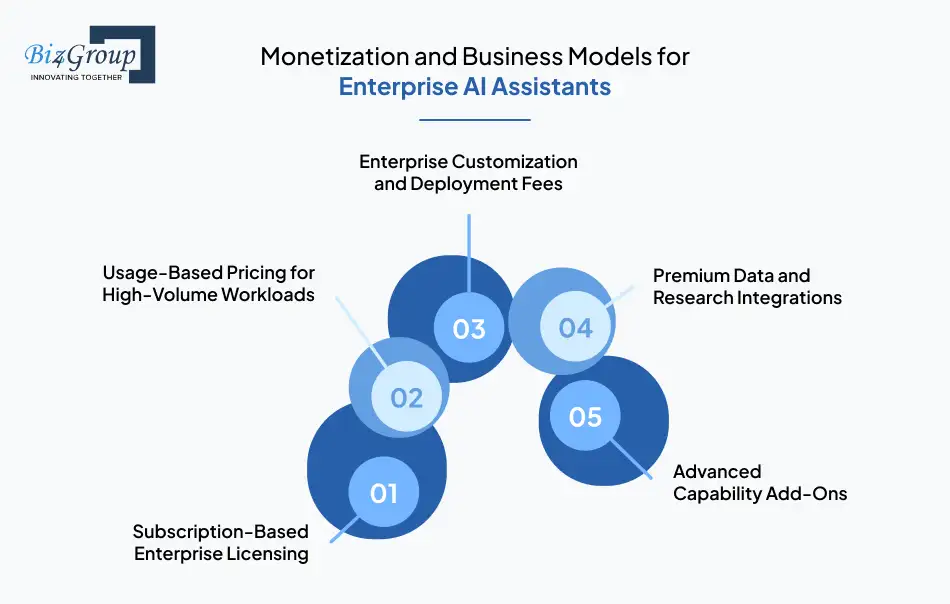
Enterprise AI assistants like CoCounsel generate revenue by aligning pricing directly with professional usage rather than software access alone. AI assistants comparable to CoCounsel monetize through structured enterprise licensing models that reflect how legal and financial teams consume analytical work support daily.
1. Subscription-Based Enterprise Licensing
Most revenue comes from recurring subscription plans structured around organizational usage. Firms pay predictable fees tied to professional productivity rather than one-time software purchases.
- Per-user or per-seat pricing for attorneys, auditors, or analysts
- Tiered plans based on document volume or feature access
- Annual enterprise contracts providing stable recurring revenue
Organizations aiming to develop an AI assistant like CoCounsel for legal work typically adopt subscription models because professional teams rely on continuous access.
2. Usage-Based Pricing for High-Volume Workloads
Enterprise clients often handle fluctuating workloads. Usage-based billing allows platforms to generate additional revenue when processing demand increases.
- Charges linked to document analysis volume or research queries
- Pricing aligned with large litigation, audit, or compliance cycles
- Flexible scaling without forcing permanent license upgrades
This structure supports firms that create enterprise grade AI assistant like CoCounsel for legal professionals serving variable operational needs.
3. Enterprise Customization and Deployment Fees
Large organizations require workflow alignment and system configuration before adoption. Providers monetize through onboarding and customization services tied to enterprise implementation.
- Workflow configuration aligned with internal processes
- Secure deployment setup across departments
- Integration with document and compliance systems
These engagements often extend into ongoing AI consulting services as enterprises refine operational usage.
4. Premium Data and Research Integrations
Advanced assistants generate revenue through access to specialized legal and financial knowledge sources embedded into the platform experience.
- Licensed legal databases or proprietary research datasets
- Industry-specific compliance intelligence modules
- Advanced research capabilities offered as premium add-ons
This model strengthens value for teams seeking to create AI legal productivity assistant like CoCounsel with domain-specific intelligence.
5. Advanced Capability Add-Ons
Vendors introduce premium features that expand assistant functionality for mature enterprise users.
- Advanced analytics and workflow automation modules
- Collaboration and audit tracking capabilities
- Enhanced reporting and enterprise governance controls
Add-on pricing allows platforms to grow revenue alongside customer maturity without forcing unnecessary upgrades.
AI assistants like CoCounsel succeed commercially because monetization aligns with professional outcomes. Revenue grows as organizations deepen adoption, making these platforms long-term operational investments rather than short-lived software purchases.
Also Read: 65+ Software Ideas for Entrepreneurs and Small Businesses
Common Challenges When Building AI Assistants for Regulated Professional Environments
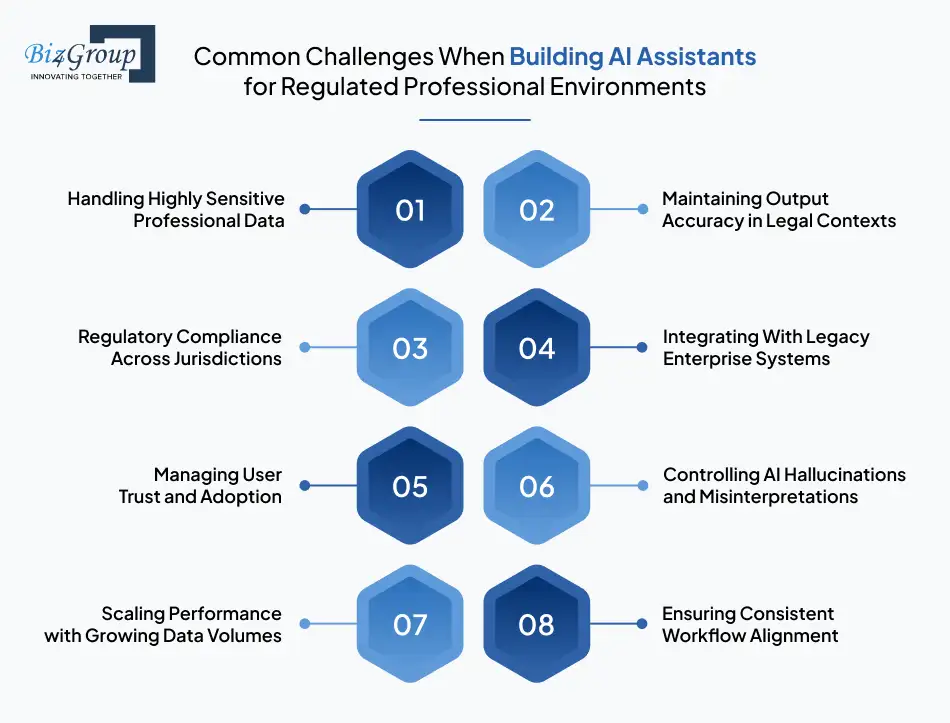
Enterprise AI assistants operating in legal, tax, audit, and accounting environments face challenges tied to trust, accuracy, and regulatory expectations. Addressing these realities early helps organizations create systems professionals can confidently rely on during critical work.
|
Challenge |
Solution |
|---|---|
|
Handling Highly Sensitive Professional Data |
Implement strict encryption, role-based access controls, and isolated environments to protect confidential organizational and client information. |
|
Maintaining Output Accuracy in Legal Contexts |
Combine domain-trained models with human review workflows to validate outputs before professional decisions rely on generated insights. |
|
Regulatory Compliance Across Jurisdictions |
Align system architecture with GDPR, SOC 2, and regional compliance standards from initial design stages onward. |
|
Integrating With Legacy Enterprise Systems |
Use structured APIs and phased integration strategies to connect existing document systems without disrupting operational workflows. |
|
Managing User Trust and Adoption |
Provide transparent outputs with traceable sources so professionals understand how conclusions are generated and verified. |
|
Controlling AI Hallucinations and Misinterpretations |
Restrict responses to verified data sources and implement validation layers that prevent unsupported or speculative outputs. |
|
Scaling Performance with Growing Data Volumes |
Design scalable cloud infrastructure capable of processing large document workloads without slowing professional workflows. |
|
Ensuring Consistent Workflow Alignment |
Continuously refine workflows using real user feedback to maintain relevance across evolving professional processes. |
Organizations that develop an AI assistant like CoCounsel for legal work succeed by addressing operational risks alongside technical challenges. Careful planning allows AI assistant development like CoCounsel for legal professionals to deliver dependable support within highly regulated environments.
Avoid Mistakes Others Already Made
Talk with a team that understands legal-grade accuracy, accountability, and operational adoption challenges.
Discuss Your Implementation RisksWhy Choose Biz4Group LLC for Development of Enterprise AI Assistant like CoCounsel
Enterprise legal teams evaluating AI assistants like CoCounsel look for clarity in execution and reliability in everyday use. As a legal software development company, we focus on aligning technology decisions with how legal professionals review information, manage risk, and validate outcomes during routine work.
1. Grounding AI Assistance in Legal Workflows
- Legal work depends on structured reasoning and careful review.
- We begin by understanding how teams research matters, analyze documents, and collaborate internally, so solutions support existing practices instead of reshaping them unnecessarily.
- This helps organizations develop an AI assistant like CoCounsel for legal work in a way that feels practical and usable from day one.
2. Compliance and Stability as Practical Priorities
- Legal environments require predictable system behavior and responsible handling of sensitive information.
- Biz4Group LLC’s approach emphasizes controlled data usage and traceable responses, helping teams make AI legal assistant like CoCounsel with compliance features while maintaining operational confidence.
3. Execution Supported by Real Delivery Experience
We maintain clear visibility across planning and validation, so expectations remain aligned throughout execution. Our portfolio reflects experience working on complex platforms where reliability and usability matter as much as technical capability.
4. Long-Term Product Thinking
Our decisions are guided by sustainable usability. Our experience as an AI product development company helps ensure assistants evolve alongside legal operations rather than requiring repeated reinvention.
At Biz4Group LLC, our role is to guide organizations toward practical adoption by aligning workflows, compliance expectations, and execution discipline, helping legal teams introduce AI assistance confidently while maintaining reliability as operational demands evolve.
Conclusion
Enterprise legal teams do not need experimental tools. They need dependable systems that understand research workflows, document review pressures, and compliance responsibilities. Working with an experienced AI development company allows you to translate those operational realities into a structured assistant platform professionals can confidently rely on.
If your organization plans to develop an AI assistant like CoCounsel for legal work, the focus should remain on usability, governance alignment, and scalable architecture. Long-term success comes from designing intelligence that supports professional judgment rather than replacing it. Teams looking to create enterprise grade AI assistant like CoCounsel for legal professionals must approach the initiative as a product strategy, not a short-term technology experiment.
If you are evaluating how to move forward, let’s have a practical conversation. Connect with our team to discuss your workflow goals, compliance needs, and how we can help you build a dependable enterprise AI assistant tailored to your professional environment.
FAQs
1. What does it take to develop an AI assistant like CoCounsel for legal work inside an enterprise environment?
Developing a CoCounsel-style assistant requires workflow mapping, secure document intelligence, and compliance-ready architecture. Law firms and enterprises must align the assistant with research, review, and collaboration processes before focusing on advanced AI capabilities.
2. How is AI assistant development like CoCounsel for legal professionals different from building a general AI chatbot?
A legal assistant must understand structured legal tasks, maintain document context, and provide traceable outputs. Unlike generic chat tools, it operates as a task-driven system supporting professional accountability and regulated workflows.
3. What core capabilities are required to build an AI assistant like CoCounsel for legal research?
Key capabilities include document analysis, contextual research retrieval, citation validation, role-based access control, and workflow memory. These features allow professionals to move from information search to actionable insights faster.
4. How can law firms approach custom AI assistant development like CoCounsel for law firms without disrupting existing workflows?
Successful implementations integrate into current document systems and review processes. Starting with targeted use cases such as contract analysis or research assistance helps teams adopt the assistant gradually without operational disruption.
5. What compliance considerations are involved when organizations develop AI assistant like CoCounsel for tax audit and accounting firms?
Platforms must include audit trails, data isolation, encryption, and regulatory alignment. Compliance readiness ensures sensitive financial and legal information remains protected while enabling controlled AI-driven productivity improvements.
6. What factors influence the cost and timeline to build scalable AI assistant like CoCounsel for professional services?
Scope complexity, compliance requirements, integrations, and document volume significantly affect investment and timelines. Enterprise teams typically begin with an MVP phase before expanding into a fully scalable assistant platform.
