 Location :
Orlando, FL, USA
Location :
Orlando, FL, USA +1 (407) 714-1616
 info@biz4group.com

- AI healthcare compliance tracker app development shifts you from reactive audits to real-time compliance monitoring, reducing penalties and operational risk.
- Core capabilities like automated audit trails, centralized dashboards, and AI healthcare risk management app development enable proactive oversight across departments.
- Strong security is non-negotiable. You must build secure AI healthcare compliance monitoring software with encryption, access control, and continuous logging.
- A phased roadmap helps you develop a scalable AI compliance tracking platform for healthcare organizations while managing cost, integrations, and AI complexity.
- With Biz4Group, you gain a partner focused on secure architecture, regulatory alignment, and scalable AI healthcare compliance tracker app development built for long-term growth.
Have you felt like compliance is always one step ahead of you? No matter how many policies, spreadsheets, or internal audits you run, something new surfaces every quarter.
You’re not imagining it.
Healthcare compliance in 2025 looks very different from what it did even three years ago. Expectations are higher. Oversight is tighter. Documentation must be continuous, not occasional.
According to a report, 22% of healthcare organizations have adopted domain-specific AI tools, reflecting how quickly providers are modernizing operations to manage regulatory complexity.
At the same time, compliance teams report increased scrutiny around audit trails, access logs, and proof of internal controls. Regulators now expect structured reporting and verifiable documentation rather than informal tracking.
So here’s the real question.
Can your current system confidently handle that level of oversight?
Spreadsheets and disconnected tools were never designed for this environment. They create blind spots. They slow down audits. They increase the likelihood of missed regulatory updates.
When you invest in AI healthcare compliance tracker app development, you shift from reacting to audits to staying ready every day. Instead of scrambling to gather documentation, your team can monitor activity in real time and catch issues before they escalate.
The real value comes from building systems that connect departments, standardize reporting, and surface risks early. As you develop AI healthcare compliance tracking software, you gain visibility across workflows that were previously siloed. And when you build AI compliance monitoring app for healthcare providers, compliance becomes embedded into daily operations rather than treated as a separate administrative burden.
This is not about adding another dashboard. It is about building a secure, intelligent compliance backbone that reduces risk and supports sustainable growth.
Partnering with an experienced AI healthcare software development company ensures your system is architected correctly from day one, aligned with healthcare regulations, and built to scale with your organization.
In the next section, let’s unpack why healthcare compliance has become so complex and why the timing to act is critical.
Is Your Organization Ready for AI Healthcare Compliance Tracker App Development in Today’s Regulatory Landscape?
Healthcare compliance is no longer periodic. It is continuous. Regulations evolve faster, audits are more detailed, and documentation must be readily available at any moment. If your current system depends on manual tracking or disconnected tools, the risk multiplies as you grow.
Here is what is driving the urgency behind AI healthcare compliance tracker app development:
- Expanding federal and state regulations that require structured reporting
- Multi-system data environments with limited centralized visibility
- Increasing third-party vendor and integration risks
- Higher expectations for real-time audit trails and documentation
- Investor and enterprise demand for compliance transparency
When you develop AI healthcare compliance tracking software, you move from reactive audits to ongoing oversight.
When you build AI powered compliance tracking app for health tech startups, you create compliance infrastructure that supports growth instead of slowing it down. And when hospitals develop AI audit tracking software for hospitals, they reduce manual workload while improving accountability.
Operational modernization is already reshaping healthcare. Initiatives like AI in healthcare administration automation show how intelligent systems are streamlining core processes. Compliance should be part of that transformation.
The question is simple.
Are you prepared to manage tomorrow’s regulatory demands with yesterday’s tools?
Still Relying on Manual Compliance in a Real-Time Regulatory World?
Regulations are accelerating and your systems should too, so let's build structured AI-driven oversight before the next audit creates pressure.
Talk to Our AI Healthcare ExpertsWhat Business Outcomes Can You Expect from AI Healthcare Compliance Tracker App Development?
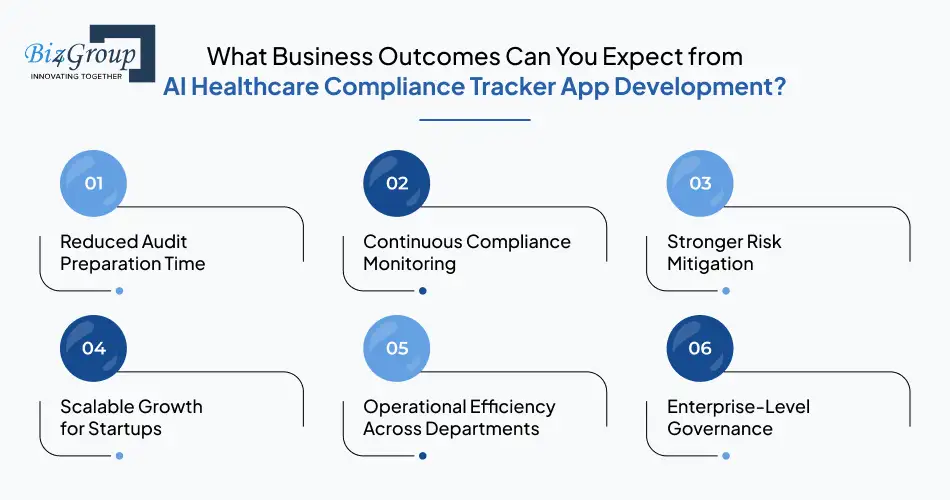
When you invest in AI healthcare compliance tracker app development, you are not just adding automation. You are building a structured system that protects revenue, reputation, and operational stability.
Here are the business outcomes that matter most.
1. Reduced Audit Preparation Time
Audit cycles consume leadership attention and internal bandwidth. Teams scramble to gather logs, verify policies, and reconcile documentation. When you develop AI healthcare compliance tracking software, reporting workflows stay updated in real time. Documentation is centralized, structured, and ready when regulators ask for it. This significantly reduces preparation time and internal disruption.
2. Continuous Compliance Monitoring
Most compliance gaps happen between formal reviews. Manual systems simply cannot monitor activity around the clock. With structured AI healthcare compliance tracker app development, monitoring becomes ongoing. The system evaluates user access, policy adherence, and workflow exceptions in real time. This proactive oversight prevents small issues from escalating.
3. Stronger Risk Mitigation
Risk visibility is often fragmented across departments. Compliance leaders may lack a unified view of exposure. Through AI healthcare risk management app development, anomalies and policy deviations are surfaced early. This strengthens internal controls and reduces the likelihood of financial penalties or reputational damage.
4. Scalable Growth for Startups
For health tech startups, compliance maturity directly impacts investor confidence and enterprise deals. When you build AI powered compliance tracking app for health tech startups, compliance becomes embedded into your growth strategy. Instead of slowing expansion, regulatory readiness supports partnerships and funding conversations.
5. Operational Efficiency Across Departments
Compliance should not operate in isolation. It must integrate with administration, HR, billing, and clinical workflows. Modern AI compliance software reduces repetitive manual checks and centralizes oversight. Broader automation initiatives, such as those supported through AI automation services, show how intelligent systems streamline operations. Compliance can follow the same path.
6. Enterprise-Level Governance
Large hospital systems require oversight across facilities, vendors, and data environments. With enterprise grade AI healthcare compliance tracker app development, leadership gains centralized dashboards, structured access control, and consistent reporting standards. This creates accountability at scale and supports long term regulatory alignment.
The real advantage is clarity. You gain measurable control over compliance risk while building infrastructure that grows with your organization.
Now, let’s address the foundation that makes all of this possible, security and regulatory safeguards.
Can You Build Secure AI Healthcare Compliance Monitoring Software Without Compromising Data Integrity?
Security is the first concern every hospital executive and CTO raises. And rightly so. You are dealing with protected health information, financial data, internal audit records, and credentialing details. A compliance platform that is not secure creates more risk than it solves.
Strong AI healthcare compliance tracker app development must begin with regulatory alignment and data protection at the architectural level, not as an afterthought.
1. Regulatory-First Architecture
Your system must be designed around healthcare regulations from day one. That includes HIPAA, HITECH, CMS reporting standards, and state-level privacy rules. When you approach healthcare regulatory compliance app development using AI, compliance logic is embedded into workflows, not layered on top later.
Key considerations include:
- Mapping policies directly to system rules
- Automated documentation for regulatory reporting
- Built-in audit readiness across modules
- Alignment with HIPAA administrative safeguards
Building a truly HIPAA compliant AI system requires structured access controls, encrypted storage, and verified audit logging mechanisms.
2. End-to-End Data Encryption and Access Control
Healthcare compliance platforms must secure data both in transit and at rest. Encryption standards should apply across databases, APIs, and integrations. When you build secure AI healthcare compliance monitoring software, zero-trust principles and role-based permissions become essential.
Security foundations should include:
- AES-256 encryption for stored data
- TLS protocols for data transmission
- Role-based access control by department
- Multi-factor authentication for privileged users
These controls protect sensitive information while maintaining operational flexibility.
3. Continuous Audit Trails and Monitoring
Regulators expect traceability. You must know who accessed what data, when, and why. With structured AI healthcare compliance tracker app development for regulatory reporting, every action is automatically logged and time-stamped. This creates defensible documentation without manual effort.
Critical capabilities include:
- Automated access logs
- Immutable audit records
- Real-time anomaly alerts
- Centralized reporting dashboards
This reduces audit stress and strengthens internal accountability.
4. Secure Integration with Existing Systems
Hospitals operate on interconnected ecosystems. Your compliance platform must integrate with EHRs, billing software, HR systems, and third-party vendors without exposing vulnerabilities. When you develop enterprise grade AI healthcare compliance tracker solutions, secure API gateways and controlled data exchange frameworks are required.
Integration safeguards should cover:
- Token-based authentication for APIs
- Vendor access monitoring
- Data segmentation by department
- Secure cloud or hybrid infrastructure
Security cannot slow innovation. It must enable it safely. If compliance monitoring is going to run continuously, security must be continuous as well.
Next up, let’s define the core capabilities your AI healthcare compliance tracker app development initiative must include to deliver real operational value.
What Core Features Define Successful AI Healthcare Compliance Tracker App Development?
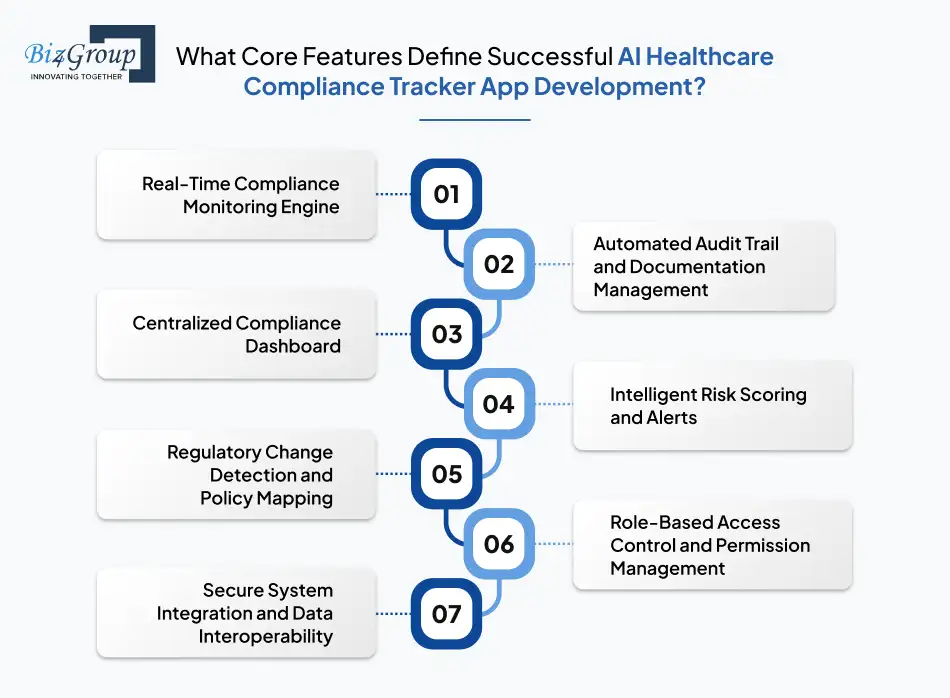
If you are investing in AI healthcare compliance tracker app development, the features you prioritize will determine whether your system becomes a strategic asset or just another dashboard. The goal is not complexity. The goal is clarity, automation, and structured oversight that reduces risk while supporting growth.
Here are the must-have core features every hospital and health tech startup should include.
1. Real-Time Compliance Monitoring Engine
A strong system must continuously evaluate operational data against regulatory requirements. This is the backbone when you develop AI healthcare compliance tracking software. Instead of waiting for periodic reviews, the platform monitors access logs, documentation status, and policy adherence in real time. This allows your compliance team to detect gaps early and respond before regulators do.
2. Automated Audit Trail and Documentation Management
Audit readiness should not require weeks of preparation. A well-designed platform automatically logs user activity, policy updates, and compliance checks. Through structured AI healthcare compliance tracker app development for regulatory reporting, every action is recorded with timestamps and traceability. This reduces internal stress and strengthens your audit posture.
3. Centralized Compliance Dashboard
Leadership needs visibility at a glance. A centralized dashboard consolidates compliance status across departments, facilities, and vendors. When you create a healthcare compliance management platform using AI, you give executives a unified view of risk levels, pending tasks, and reporting timelines. This supports informed decision making without digging into scattered systems.
4. Intelligent Risk Scoring and Alerts
Compliance data alone is not enough. It must be interpreted. With structured AI healthcare risk management app development, the system analyzes behavior patterns and flags anomalies automatically. Instead of static rule-based alerts, you gain contextual insights that prioritize high-risk issues first.
5. Regulatory Change Detection and Policy Mapping
Healthcare regulations evolve frequently. Manually tracking changes increases the risk of non-alignment. When you create an AI-driven compliance management system for hospitals, regulatory updates can be mapped to internal workflows and policies. This ensures your organization adapts quickly without operational confusion.
6. Role-Based Access Control and Permission Management
Not every user should access every dataset. Proper access governance is fundamental when you build secure AI healthcare compliance monitoring software. Role-based permissions ensure that clinical staff, administrators, compliance officers, and executives each see only what is relevant to them. This strengthens security while maintaining operational efficiency.
7. Secure System Integration and Data Interoperability
Your compliance tracker must connect seamlessly with EHRs, billing systems, HR tools, and third-party vendors. Successful AI healthcare compliance tracker app development includes secure API frameworks and structured data exchange. Broader modernization efforts, such as those supported through AI integration services, demonstrate how critical secure interoperability is for healthcare systems.
These core features create the foundation. Without them, advanced capabilities cannot function reliably.
What If Your Compliance System Could Think Ahead?
Monitoring is helpful but predictive, AI-powered compliance gives you real-time risk visibility and smarter decision control.
Let's TalkHow Can You Differentiate with Advanced Capabilities in AI Healthcare Compliance Tracker App Development?
Core features keep you compliant. Advanced capabilities give you an edge. If you are serious about long term resilience, your AI healthcare compliance tracker app development strategy should go beyond tracking and reporting. It should anticipate risk, automate decisions, and continuously improve itself.
Below is a structured view of high-impact advanced features that elevate your platform from operational to strategic.
|
Advanced AI Feature |
What It Does |
Why It Matters for Hospitals & Startups |
|---|---|---|
|
Uses historical compliance data, access behavior, and workflow patterns to forecast potential violations. |
Helps you act before a breach or audit finding occurs, strengthening risk reduction efforts when you create an AI driven healthcare compliance app for risk reduction. |
|
|
NLP-Based Regulatory Intelligence |
Scans regulatory updates, policy documents, and compliance notices using natural language processing. |
Automatically flags changes that impact your operations, making it easier to create an AI driven compliance management system for hospitals that adapts quickly. |
|
Automated Evidence Collection |
Gathers required documentation, access logs, and activity trails automatically for audits. |
Reduces manual effort and supports structured AI healthcare compliance tracker app development for regulatory reporting. |
|
AI-Driven Anomaly Detection |
Identifies unusual user behavior, access spikes, or policy deviations using machine learning models. |
Strengthens oversight when you build AI compliance monitoring app for healthcare providers, especially across large hospital networks. |
|
Smart Policy Mapping Engine |
Links internal policies to regulatory requirements and flags misalignment instantly. |
Supports dynamic governance when you develop enterprise grade AI healthcare compliance tracker solutions. |
|
Self-Learning Risk Prioritization |
Continuously improves alert accuracy based on previous compliance outcomes and team responses. |
Reduces alert fatigue and ensures your team focuses only on high-impact risks. |
|
Conversational Compliance Assistant |
Embedded AI chatbot that answers compliance-related queries from internal teams. |
Improves accessibility and operational clarity, similar to how an internal AI chatbot enhances knowledge management. |
|
Agent-Based Task Automation |
Deploys autonomous AI agents to trigger workflows such as documentation reminders or escalation protocols. |
Enables next-level automation through structured agentic AI development, turning compliance into a semi-autonomous function. |
|
Executive Compliance Forecasting Dashboard |
Provides predictive insights into audit risk, regulatory gaps, and future exposure levels. |
Gives leadership measurable foresight instead of reactive reporting, strengthening board-level governance. |
|
Cross-System Behavioral Analytics |
Monitors patterns across EHR, billing, HR, and third-party integrations. |
Critical when you develop a scalable AI compliance tracking platform for healthcare organizations operating in complex ecosystems. |
Advanced capabilities transform compliance from a cost center into a control center.
Instead of asking, “Are we compliant today?” You begin asking, “Where could we face risk next quarter?”
That shift in perspective is where real competitive advantage begins.
Now, we will walk through the step-by-step process to execute AI healthcare compliance tracker app development without costly mistakes.
How to Execute AI Healthcare Compliance Tracker App Development Step by Step Without Costly Mistakes?
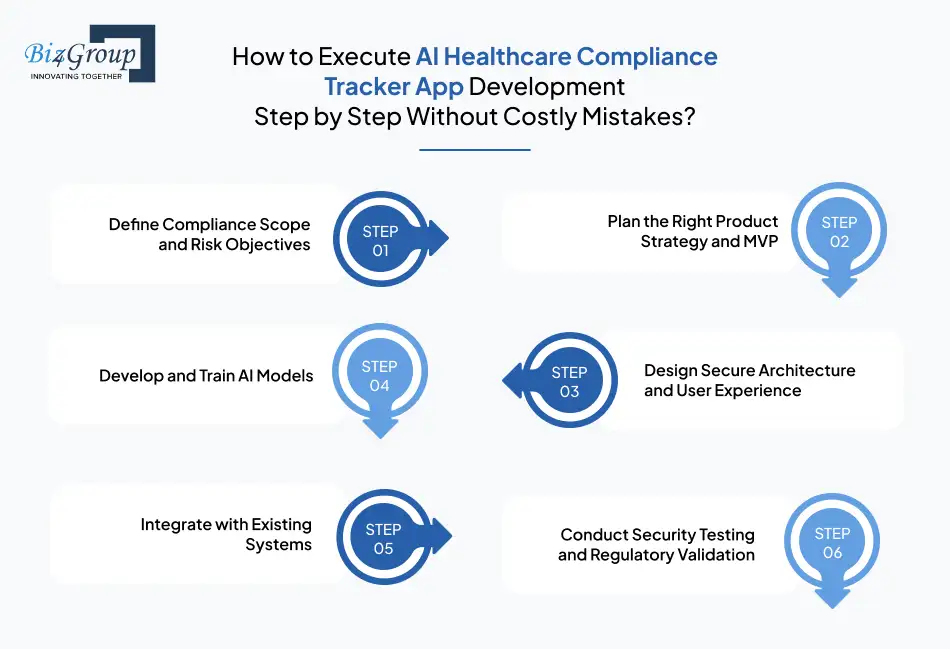
Building a compliance platform requires more than technical execution. It demands regulatory understanding, structured planning, and secure architecture from day one.
If you want your AI healthcare compliance tracker app development initiative to succeed, follow a disciplined process.
Step 1: Define Compliance Scope and Risk Objectives
Start by identifying which regulations apply to your organization. Map federal, state, and industry-specific requirements to operational workflows. When you clearly define risk exposure, you create direction for your AI healthcare risk management app development strategy.
Key actions:
- Conduct compliance gap assessment
- Identify reporting requirements
- Define risk categories by department
- Document current audit challenges
Step 2: Plan the Right Product Strategy and MVP
Do not build everything at once. Begin with a focused rollout that solves the highest-risk compliance problems first. A structured MVP development approach allows you to validate workflows, gather feedback, and refine features before scaling into enterprise grade AI healthcare compliance tracker app development.
Key actions:
- Prioritize high-impact modules
- Define measurable success metrics
- Launch pilot within one department
- Collect compliance team feedback
Step 3: Design Secure Architecture and User Experience
Compliance platforms must be secure, but they must also be usable. If the interface is confusing, adoption suffers. Strong UI/UX design ensures compliance officers, administrators, and executives can easily navigate dashboards, alerts, and reports while maintaining data protection standards.
Key actions:
- Implement role-based access controls
- Design executive-level dashboards
- Simplify audit documentation workflows
- Ensure mobile and remote accessibility
Step 4: Develop and Train AI Models
Once architecture is defined, begin building AI models that monitor access logs, detect anomalies, and evaluate policy alignment. When you develop AI healthcare compliance tracking software, models should be trained using historical operational data to improve alert accuracy and reduce false positives.
Key actions:
- Train anomaly detection models
- Configure risk scoring logic
- Integrate regulatory rule engines
- Test model outputs against real audit scenarios
Step 5: Integrate with Existing Systems
Your compliance platform must connect securely with EHRs, billing tools, HR systems, and third-party vendors. Effective AI integration services ensure your AI healthcare compliance tracker app development aligns with existing workflows without disrupting operations.
Key actions:
- Implement secure API gateways
- Enable encrypted data exchange
- Validate system interoperability
- Monitor integration performance
Step 6: Conduct Security Testing and Regulatory Validation
Before deployment, perform penetration testing, vulnerability assessments, and compliance validation checks. When you build secure AI healthcare compliance monitoring software, testing must confirm encryption standards, audit logging accuracy, and regulatory alignment.
Key actions:
- Run security audits
- Validate audit trail accuracy
- Perform access control testing
- Confirm HIPAA compliance measures
Step 7: Deploy, Monitor, and Continuously Improve
Deployment is not the finish line. Compliance evolves, and so must your system. Continuous monitoring and updates ensure your develop scalable AI compliance tracking platform for healthcare organizations remains aligned with regulatory changes.
Key actions:
- Monitor system performance metrics
- Update regulatory mappings
- Retrain AI models periodically
- Gather compliance team feedback
Following this structured roadmap reduces implementation risk and accelerates adoption.
Now, let’s break down the ideal tech stack required to support enterprise level AI healthcare compliance tracker app development.
What Is the Ideal Tech Stack for AI Healthcare Compliance Tracker App Development in the US?
Choosing the right technology stack determines whether your platform is secure, scalable, and audit-ready. When you invest in AI healthcare compliance tracker app development, your tech stack must support regulatory controls, AI processing, real-time monitoring, and enterprise-grade performance.
Below is a structured overview of the recommended stack components for building secure and scalable compliance solutions.
|
Layer |
Recommended Technologies |
Why It Matters for Healthcare Compliance |
|---|---|---|
|
Frontend (User Interface) |
React, Angular, Vue.js |
Enables responsive dashboards for compliance officers and executives. Strong frontend frameworks support real-time alerts, risk visualizations, and centralized reporting. |
|
UI/UX Layer |
Structured compliance dashboards, role-based layouts |
A well-designed interface ensures usability across departments. Strong design, guided by expert UI/UX design, improves adoption and reduces operational confusion. |
|
Backend Framework |
Provides scalable API infrastructure and secure processing logic required for developing AI healthcare compliance tracking software initiatives. |
|
|
AI & Machine Learning |
Python, TensorFlow, PyTorch, Scikit-learn |
Powers anomaly detection, predictive risk modeling, and automated compliance scoring within your AI healthcare risk management app development strategy. |
|
Natural Language Processing |
spaCy, OpenAI models, transformer-based models |
Enables regulatory document scanning and automated policy mapping when you create AI driven compliance management system for hospitals. |
|
Database Layer |
PostgreSQL, MongoDB, encrypted cloud storage |
Securely stores structured compliance records, audit logs, and user activity data with encryption at rest. |
|
Cloud Infrastructure |
AWS (HIPAA-eligible services), Microsoft Azure Health, Google Cloud Healthcare API |
Supports secure hosting, scalability, and redundancy for building secure AI healthcare compliance monitoring software projects. |
|
API & Integration Layer |
REST APIs, GraphQL, OAuth 2.0 |
Ensures secure integration with EHR, HR, billing, and third-party systems through structured AI integration services. |
|
Security Framework |
AES-256 encryption, TLS 1.3, role-based access control, multi-factor authentication |
Protects protected health information and ensures regulatory alignment during AI healthcare compliance tracker app development for regulatory reporting. |
|
DevOps & Monitoring |
Docker, Kubernetes, CI/CD pipelines, real-time monitoring tools |
Enables controlled deployments, scalable environments, and performance tracking for enterprise grade systems. |
|
Enterprise AI Layer |
Custom model orchestration, compliance-specific AI modules |
Supports expansion into broader enterprise AI solutions as compliance monitoring scales across facilities and regions. |
The goal is not just to assemble technologies. It is to build an architecture that supports:
- Continuous monitoring
- Secure interoperability
- Predictive analytics
- Enterprise scalability
- Regulatory alignment
When designed correctly, your stack becomes the foundation for long-term, sustainable AI healthcare compliance tracker app development.
Next, let’s break down the cost structure so you can plan your investment realistically and avoid budget surprises.
What Does AI Healthcare Compliance Tracker App Development Cost and What Should You Budget For?
Let’s address the question every executive asks early in the process. What does AI healthcare compliance tracker app development actually cost?
For most hospitals and health tech startups, the investment typically ranges between $20,000 to $150,000+, depending on scope, feature depth, AI capabilities, security requirements, and integration complexity. The final number varies based on whether you are building a focused MVP or a full-scale enterprise platform with predictive analytics and automated regulatory reporting.
If you plan to develop AI healthcare compliance tracking software with advanced risk detection and multi-system integrations, costs will naturally move toward the higher end.
Let’s break it down clearly.
Cost Breakdown by Feature in AI Healthcare Compliance Tracker App Development
|
Feature Category |
Estimated Cost Range |
What Impacts the Cost |
|---|---|---|
|
Core Compliance Dashboard |
$8,000 – $20,000 |
UI complexity, reporting layers, role-based access |
|
Audit Trail & Documentation Engine |
$10,000 – $25,000 |
Log automation, storage structure, regulatory mapping |
|
Real-Time Monitoring Engine |
$15,000 – $35,000 |
Data ingestion volume, alert logic complexity |
|
AI Risk Scoring & Predictive Models |
$20,000 – $50,000 |
Model training data, tuning cycles, anomaly detection depth |
|
Regulatory Change Detection |
$12,000 – $30,000 |
NLP capability, update automation logic |
|
Secure Integrations (EHR, HR, Billing) |
$10,000 – $40,000 |
API complexity, number of connected systems |
|
Enterprise Security & Validation |
$10,000 – $25,000 |
Encryption standards, testing, compliance audits |
If you aim to build an AI powered healthcare compliance tracker app with cross-system behavioral analytics and forecasting dashboards, AI modeling becomes a major cost driver.
Key Factors Affecting AI Healthcare Compliance Tracker App Development Cost
1. Scope and Product Strategy
Are you launching a pilot or building a system for multiple facilities? A phased approach using custom MVP development allows you to validate high-risk modules before scaling into enterprise-level deployment.
2. AI Model Complexity
Rule-based alerts are relatively affordable. Predictive, self-learning systems require more time and structured training. When you create an AI healthcare compliance management system with audit automation, model refinement and testing significantly influence the budget.
3. Security and Compliance Requirements
Healthcare systems require encryption, secure cloud architecture, audit validation, and structured access control. If your platform must support multi-location oversight, it evolves into broader enterprise AI solutions, increasing architectural depth and cost.
4. Integration with Legacy Systems
Hospitals often operate on fragmented, older systems. When you develop a scalable AI compliance tracking platform for healthcare organizations, secure API orchestration and middleware layers increase technical complexity and cost.
Hidden Costs in AI Healthcare Compliance Tracker App Development
Many organizations underestimate secondary expenses.
These may include:
- Data migration and normalization
- Third-party compliance certifications
- AI model retraining over time
- Cloud hosting and storage expansion
- Ongoing regulatory update implementation
- Internal staff onboarding
Structured validation processes such as how Biz4Group delivers product audit services help prevent expensive post-launch corrections.
How to Optimize Cost Without Compromising Compliance
Cost control is about smart planning, not cutting safeguards.
Build Modular Architecture
Design scalable custom software so features can expand over time without rebuilding the entire system.
Treat It as a Strategic AI Product
Approach your platform as a long-term AI product with staged growth, not a one-time build.
Work with Experienced Healthcare AI Teams
When you hire AI developers who understand regulatory environments, you reduce rework, misalignment, and security risks.
The real financial question is not whether AI healthcare compliance tracker app development costs $20,000 or $150,000.
The real question is how much regulatory exposure and operational disruption cost without it.
Curious What AI Healthcare Compliance Tracker App Development Would Cost You?
Every hospital and startup has different risk exposure and integration needs, so let's map your compliance goals to a practical budget and rollout plan.
Get Your Custom Cost EstimateWhat Challenges Will You Face in AI Healthcare Compliance Tracker App Development and How Can You Solve Them?
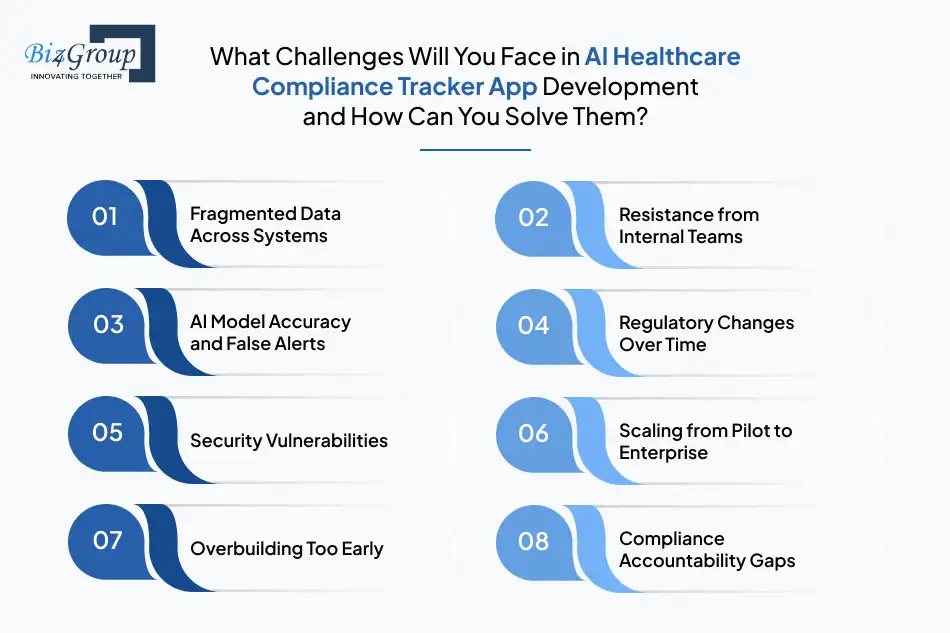
Every hospital and health tech startup encounters friction when implementing AI healthcare compliance tracker app development. The difference between a stalled project and a scalable compliance platform lies in how early you anticipate these challenges and how strategically you solve them.
Below is a practical breakdown of the most common obstacles and the solutions that keep your initiative on track.
|
Challenge |
Why It Happens |
Strategic Solution |
|---|---|---|
|
Fragmented Data Across Systems |
Hospitals operate across EHRs, billing tools, HR platforms, and third-party vendors. Data silos make it difficult to develop AI healthcare compliance tracking software that has full visibility. |
Implement secure API orchestration and centralized data pipelines. Structured integration supported by experienced teams ensures clean data flow and unified oversight. |
|
Resistance from Internal Teams |
Compliance officers and administrators may fear automation will complicate workflows or replace manual control. |
Introduce phased rollouts and strong onboarding. Clear dashboard design and training improve adoption. Broader modernization trends discussed in healthcare AI trends show how teams adapt when benefits are visible. |
|
AI Model Accuracy and False Alerts |
Poorly trained models create alert fatigue, reducing trust in the system. |
Use historical operational data for model training. Continuously refine detection logic to ensure your AI healthcare risk management app development delivers meaningful, high-priority alerts. |
|
Regulatory Changes Over Time |
Healthcare regulations evolve frequently, creating risk of outdated workflows. |
Build dynamic policy-mapping engines when you create AI driven compliance management system for hospitals so updates can be reflected without system overhaul. |
|
Security Vulnerabilities |
Handling protected health information increases cyber risk. |
Design systems with encryption, access control, and structured validation. Engage an experienced AI development company that understands regulated environments. |
|
Scaling from Pilot to Enterprise |
What works for one department may fail across multiple facilities. |
Start with controlled deployment, then expand into enterprise-level architecture. Structured enterprise AI solutions ensure governance consistency across locations. |
|
Overbuilding Too Early |
Organizations sometimes attempt to launch full-scale platforms without validating assumptions. |
Begin with core modules and expand iteratively. Treat your platform as a structured AI app with measurable milestones, not an oversized one-time build. |
|
Compliance Accountability Gaps |
Even with tools in place, unclear ownership can create internal confusion. |
Assign role-based accountability and implement AI-driven workflow triggers. Advanced automation through an intelligent AI agent can help enforce documentation deadlines and escalation processes. |
No compliance platform is built without obstacles.
However, when you approach AI healthcare compliance tracker app development with structured planning, experienced technical guidance, and phased execution, these challenges become manageable. The organizations that succeed are not the ones without obstacles.
They are the ones that plan for them.
Why Choose Biz4Group for AI Healthcare Compliance Tracker App Development?
When you invest in AI healthcare compliance tracker app development, you are not just hiring a development team. You are choosing a long-term technology partner who understands healthcare regulations, enterprise architecture, and AI engineering at scale.
At Biz4Group, we help hospitals and health tech startups build compliance platforms that are secure, scalable, and audit-ready from day one.
Here’s what sets us apart:
- Strong experience working in regulated healthcare environments where security and compliance are non-negotiable
- Proven ability to design secure architectures that protect sensitive health data without slowing operations
- Deep understanding of regulatory reporting workflows and audit preparedness
- Scalable system design that supports multi-location hospitals and fast-growing startups
- Structured development approach that reduces implementation risk and protects your investment
Our philosophy aligns with the principles behind modern AI compliance software, where automation, governance, and data protection must work together seamlessly.
Compliance is not a feature. It is an infrastructure.
If you are planning to develop AI healthcare compliance tracking software that strengthens oversight, reduces risk exposure, and supports long-term growth, Biz4Group brings the technical expertise and healthcare focus required to build it correctly the first time.
Ready to Build Compliance Infrastructure That Actually Scales?
Security, regulatory alignment, and long-term architecture should work together seamlessly, and we're ready to build that foundation with you.
Contact UsFinal Thoughts!
Healthcare compliance is becoming more continuous, more complex, and more scrutinized every year. Manual tracking and reactive audits are no longer enough. That is why AI healthcare compliance tracker app development is no longer optional for hospitals and health tech startups that want stability and long-term growth.
A well-designed system gives you real-time visibility into regulatory exposure, structured audit documentation, and proactive risk alerts. Instead of reacting to findings, your organization operates with confidence and control. When you develop enterprise grade AI healthcare compliance tracker solutions, compliance becomes part of your operational backbone rather than a periodic exercise.
At Biz4Group, we help healthcare leaders design secure, scalable compliance platforms that align with US regulations and enterprise-level security expectations. The goal is simple: reduce risk, simplify oversight, and build infrastructure that grows with you.
Regulations will evolve. Your compliance strategy should evolve with them.
Let’s connect and build your AI healthcare compliance tracker.
FAQ
1. What Is AI Healthcare Compliance Tracker App Development and Why Does It Matter?
AI healthcare compliance tracker app development refers to building intelligent systems that automate oversight of regulatory requirements, audit documentation, and risk reporting across hospitals and health tech platforms. It matters because modern regulations require continuous monitoring, not periodic checks, and organizations that develop AI healthcare compliance tracking software gain structured, real-time compliance visibility instead of relying on manual processes.
2. How Does AI Improve Healthcare Compliance Compared to Manual Systems?
AI systems analyze large volumes of operational data and detect patterns humans can miss. When you build an AI compliance monitoring app for healthcare providers, the platform reduces manual effort in policy monitoring, generates continuous audit trails, and flags deviations automatically. This proactive approach strengthens AI healthcare risk management app development strategies and keeps organizations audit-ready with less administrative overhead.
3. What Regulations Should a Compliance Tracker App Support in AI Healthcare Compliance Tracker App Development?
Your AI healthcare compliance tracker app development initiative must align with major US regulatory frameworks like HIPAA, CMS reporting standards, and applicable state privacy laws. It should also support encrypted data handling, role-based access control, and structured audit logging. These safeguards are essential when you build secure AI healthcare compliance monitoring software for hospitals and health tech startups.
4. How Long Does It Take to Develop AI Healthcare Compliance Tracking Software?
The timeline for AI healthcare compliance tracker app development depends on scope, integrations, and AI complexity. A focused MVP can launch within 2 to 4 weeks, while enterprise-level solutions that develop scalable AI compliance tracking platform for healthcare organizations typically take 6 to 8 weeks. Phased execution ensures faster time to value while maintaining regulatory alignment.
5. What Are the Common Challenges in AI Healthcare Compliance Tracker App Development?
Organizations often face fragmented data systems, regulatory change management issues, AI model accuracy concerns, and internal adoption resistance. When you create an AI driven compliance management system for hospitals, strategic planning, secure integrations, and structured governance models help overcome these barriers and support long-term scalability.
6. How Do You Ensure Security When You Build Secure AI Healthcare Compliance Monitoring Software?
Security begins at the architectural level during AI healthcare compliance tracker app development. Encryption for data in transit and at rest, strong authentication, immutable audit trails, and continuous monitoring are essential. These controls ensure protected health information remains secure while supporting regulatory reporting requirements.
7. What Is the ROI of Investing in AI Healthcare Compliance Tracker App Development?
The return on investment from AI healthcare compliance tracker app development comes from reduced audit preparation time, lower risk of penalties, and streamlined operational oversight. Organizations that develop enterprise grade AI healthcare compliance tracker solutions benefit from improved reporting accuracy, stronger governance, and measurable risk reduction across departments.
