 Location :
Orlando, FL, USA
Location :
Orlando, FL, USA +1 (407) 714-1616
 info@biz4group.com

- Healthcare AI trends in 2026 show a clear shift from experimentation to enterprise adoption, with AI now embedded across clinical and administrative workflows.
- AI trends in the healthcare industry increasingly focus on workflow integration, reliability, and measurable outcomes rather than standalone tools.
- Clinical and administrative AI trends in healthcare are delivering value through documentation support, decision assistance, intake automation, and case management.
- How healthcare leaders budget for AI initiatives depends on clear cost drivers, phased investments, and realistic timelines for value realization.
- Why healthcare organizations are budgeting for AI comes down to efficiency, risk reduction, and long-term operational resilience.
- Biz4Group LLC helps healthcare organizations turn AI trends into scalable, compliant, and results-driven solutions that create lasting business impact.
Across boardrooms and budget meetings, conversations about healthcare AI trends are no longer speculative. They are practical, urgent, and tied directly to margins, staffing, and patient expectations.
The question many executives face today is not whether AI belongs in healthcare, but how quickly organizations can operationalize it without losing control of costs or compliance.
Rising pressure makes 2026 feel different. According to McKinsey, AI has the potential to create up to $100 billion annually in value across the healthcare sector by improving clinical outcomes and operational efficiency. This scale of opportunity explains why healthcare AI trends 2026 are shaping strategic planning conversations across hospitals, clinics, and health systems nationwide.
What is changing most is intent. Earlier adoption focused on pilots and innovation labs. Today, AI trends in the healthcare industry are driven by workforce shortages, revenue leakage, and rising administrative complexity.
Leaders want tools that:
- shorten documentation cycles
- improve access, and
- deliver measurable financial outcomes
This shift leads to a critical realization. Executives increasingly view intelligent automation as essential infrastructure, not discretionary spend. That mindset explains why AI is becoming a standard budget line in healthcare, planned alongside staffing, IT, and compliance.
So, without further ado, let us get into the core of why this moment matters so much for healthcare leaders.
Why 2026 Is a Tipping Point for Healthcare AI Adoption Trends?
Healthcare organizations have always moved carefully when adopting new technology. Patient safety, compliance, and long approval cycles demand it. Yet 2026 stands apart because the pressures facing the industry have converged in a way that leaves little room for delay. Healthcare AI adoption trends are accelerating not because of hype, but because existing systems are struggling to keep up.
Several forces are pushing leaders toward action at the same time.
- Chronic workforce shortages across clinical and administrative roles
- Rising operating costs and shrinking margins
- Increased patient demand for faster, more personalized experiences
- Greater availability of mature, enterprise ready AI solutions
Unlike earlier years, AI tools entering healthcare today are built to integrate with real workflows. They support staff rather than disrupt them. This shift explains why healthcare AI trends 2026 focus less on experimentation and more on deployment at scale.
Consider how healthcare adoption compares with broader business use. Around 78% of organizations now deploy AI in at least one business function, up sharply from 55% just a year earlier.
Take a look at how fast strategic AI adoption is moving:
|
What Adoption Looks Like |
Percentage |
|---|---|
|
Organizations using AI in any business function |
78% |
|
Large enterprises expected to use AI at scale by 2026 |
Over 80% |
|
Physicians using healthcare AI tools |
66% |
|
Hospitals using AI for care and workflow efficiency |
80% |
Another critical change lies in leadership mindset. Board members, CFOs, and COOs now evaluate AI trends in the healthcare industry through tangible business outcomes rather than theoretical possibilities. They ask direct questions:
- Will this reduce manual workload?
- Will it improve throughput?
- Will it protect margins over time?
2026 represents the year when delaying AI adoption creates more risk than moving forward. Organizations that act early gain efficiency and resilience. Those that wait face higher costs and growing operational strain.
What Exactly is Changing in Healthcare AI Trends?
At a system level, 2026 marks a shift in how healthcare leaders evaluate technology. The focus has moved away from individual tools and toward enterprise-wide capabilities.
Healthcare executives increasingly describe AI as part of core infrastructure. These AI innovation trends in healthcare systems stand out because they influence long-term planning rather than short-term efficiency gains.
Key system level shifts include:
- AI platforms replacing point solutions
- Centralized data strategies to support multiple AI use cases
- Governance models designed before deployment
- AI investments tied to measurable outcomes
This evolution explains why artificial intelligence trends in healthcare now mirror how organizations adopt electronic health records or revenue platforms, with a strong emphasis on stability and scalability.
The Move from Tools to Capabilities
Instead of asking which AI tool to buy, leadership teams now ask broader questions.
- Can this AI capability scale across departments?
- Will it integrate with existing clinical and operational systems?
- Can it be governed consistently across locations?
- Does it reduce long-term operational risk?
These questions define healthcare AI trends 2026 at the enterprise level.
|
Earlier Adoption Model |
2026 System-Level Model |
|---|---|
|
Standalone AI tools |
Unified AI platforms |
|
Department-led pilots |
Executive-led initiatives |
|
Short-term efficiency gains |
Long-term operational resilience |
|
Limited oversight |
Built-in governance frameworks |
Why These Trends Matter Now
System wide adoption reduces fragmentation and creates compounding value. A single AI capability can support:
- care delivery
- operations
- analytics
- compliance
... when designed correctly.
This holistic view drives AI trends in the healthcare industry toward platforms that grow with organizational needs rather than one-off solutions.
This section sets the foundation. Next, we will explore how these system level trends translate into real impact within clinical workflows, where time, accuracy, and patient outcomes are on the line.
2026 Is Already Being Budgeted For
Over 80% of organizations plan to scale AI in the next 12 months. The real risk is waiting until budgets are locked.
Book a Strategy Call TodayTop 5 AI Trends Transforming Clinical Workflows in Healthcare Delivery
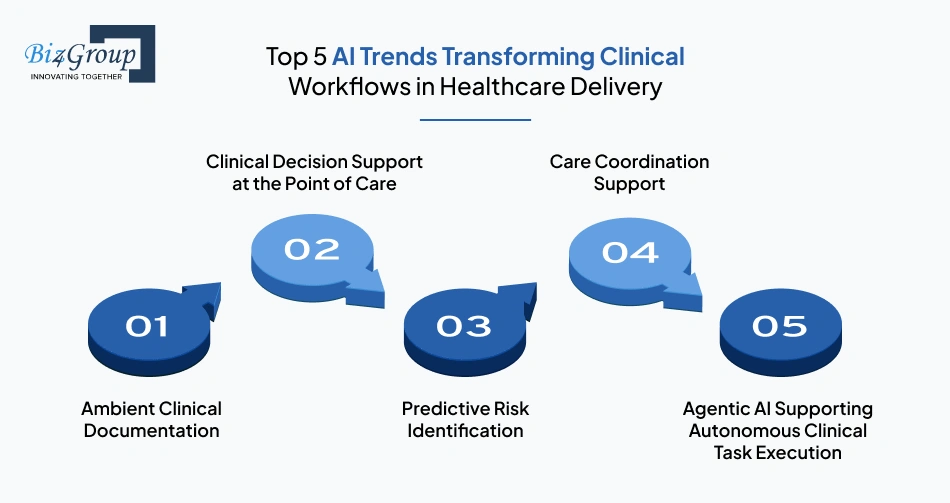
Clinical teams face a daily balancing act. Deliver high quality care, document everything accurately, and do it all with fewer resources. In 2026, AI trends transforming clinical workflows in healthcare focus on reducing this friction without compromising safety or clinical judgment.
Rather than replacing clinicians, modern AI supports them quietly in the background. The emphasis is on time recovery, accuracy, and decision confidence.
Where AI Is Making the Biggest Clinical Impact
Clinical adoption has become targeted and intentional. These trends reflect areas where measurable value shows up quickly.
1. Ambient Clinical Documentation
AI listens during patient encounters and generates structured notes automatically. Clinicians review and finalize instead of typing from scratch. This reduces after-hours charting and improves record quality.
Over time, these systems adapt to individual documentation styles, improving accuracy and consistency across providers. This also supports better downstream data usage for reporting, analytics, and care planning.
Also read: How to build an AI medical scribe software?
2. Clinical Decision Support at the Point of Care
AI surfaces relevant insights during consultations. Examples include medication considerations, risk indicators, and guideline reminders based on patient context.
These systems help reduce cognitive load by prioritizing the most relevant information at the right moment. Clinicians retain full control while benefiting from faster access to evidence-based insights.
Also read: How to build a clinical decision support app for mental health using AI?
3. Predictive Risk Identification
Advanced models in predictive analytics analyze patient history and patterns to flag potential deterioration, readmission risk, or care gaps earlier in the care journey.
By identifying risks sooner, care teams can intervene before conditions escalate. Predictive analytics also supports population health planning by highlighting trends across patient groups.
4. Care Coordination Support
AI helps align care teams by summarizing patient status across visits, departments, and providers, improving continuity and handoffs.
Automated summaries reduce information loss during transitions of care. This enables smoother collaboration across multidisciplinary teams and supports more consistent patient experiences.
Also read: How to build custom healthcare software like ChronicCareIQ?
5. Agentic AI Supporting Autonomous Clinical Task Execution
Agentic AI systems go beyond recommendations by autonomously performing predefined clinical tasks under human oversight. These systems can initiate follow-ups, coordinate next steps, and manage routine clinical actions based on evolving patient context.
By operating within clearly defined boundaries, agentic AI reduces delays in care workflows and ensures critical actions are not missed. This trend reflects growing interest in AI agents that act, adapt, and collaborate across clinical systems.
Also read: How to build agentic AI in healthcare?
These AI trends transforming clinical workflows in healthcare show a clear pattern. AI works best when embedded into existing workflows rather than layered on top.
What Clinicians Value Most From AI
Feedback from healthcare organizations points to a consistent set of expectations.
- Less time spent on documentation
- Fewer clicks and manual data entry
- Clear, explainable insights
- Minimal disruption to patient interaction
This explains why AI driven healthcare transformation trends prioritize usability and trust over complexity.
Project Spotlight: CSO
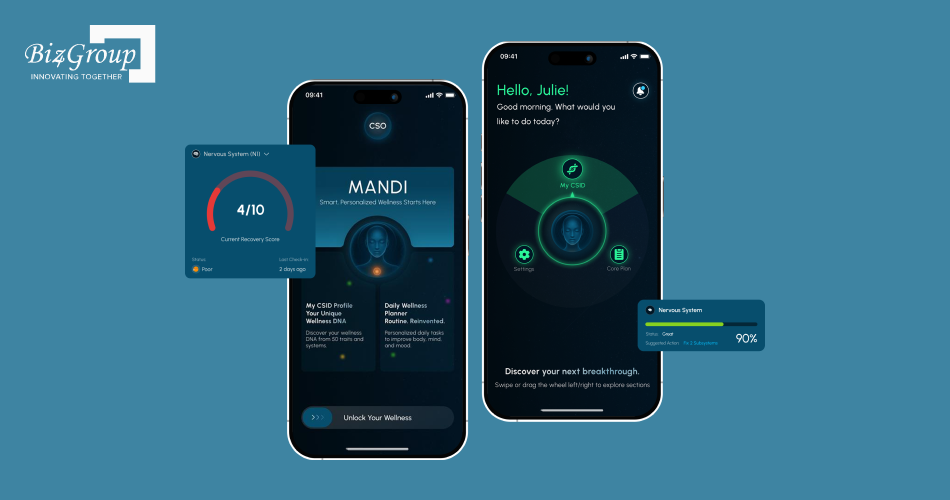
Biz4Group partnered on CSO, an AI powered wellness platform that demonstrates how inference-based intelligence can support personalized health insights without crossing into diagnosis. Through conversational AI interactions and emotional intelligence, the platform continuously maps user patterns and adapts recommendations over time.
While non-clinical by design, CSO reflects a broader clinical trend.
AI can:
- observe
- summarize, and
- support decision making
... without replacing human expertise.
This same principle now guides clinical workflow AI across healthcare systems.
Measuring Clinical Value
Healthcare leaders increasingly track outcomes tied to clinical AI adoption.
|
Clinical Metric |
Impact Area |
|---|---|
|
Documentation time |
Reduced clinician burnout |
|
Decision support usage |
Improved care consistency |
|
Early risk detection |
Fewer adverse events |
|
Care coordination |
Better patient experience |
As clinical adoption matures, organizations that invest thoughtfully gain more than efficiency. They create care environments where clinicians can focus on patients rather than screens.
In the next section, we will explore how administrative AI delivers equally strong gains behind the scenes, often with even faster financial returns.
Top 5 Administrative AI Trends in Healthcare Organizations Reshaping Operations
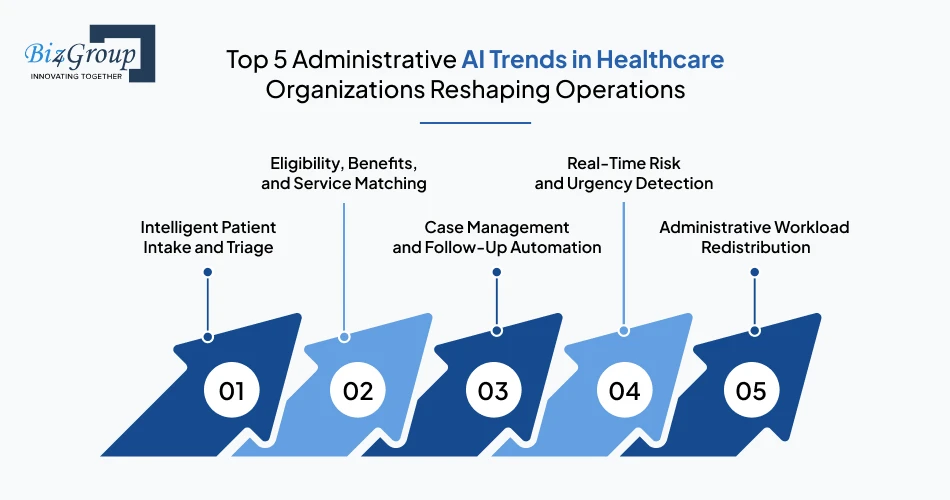
Behind every patient interaction sits a complex web of administrative processes. Scheduling, eligibility checks, documentation, case management, and follow-ups consume enormous time and resources. In 2026, administrative AI trends in healthcare organizations focus on simplifying these workflows while improving accuracy and response speed.
Unlike clinical adoption, administrative AI often delivers visible returns faster. This explains why many organizations prioritize these initiatives early in their transformation roadmaps.
Core Administrative AI Trends Gaining Momentum
The following trends define how AI is reshaping non-clinical operations across healthcare systems in 2026. Each one addresses a specific operational bottleneck that healthcare organizations have struggled with for years.
1. Intelligent Patient Intake and Triage
AI powered intake systems collect information through structured conversations instead of static forms. By understanding intent, urgency, and context, these systems ensure users reach the right department faster.
For example, patients describing symptoms like chest pain or breathing difficulty can be routed immediately to urgent care workflows, while routine inquiries are directed to scheduling or support teams.
Also read: How to develop AI-enabled patient triage software?
2. Eligibility, Benefits, and Service Matching
Administrative AI evaluates complex eligibility rules in real time by analyzing user inputs, location, and program requirements. AI can automate 70% of healthcare administrative tasks, eliminating manual verification loops and helping patients receive accurate guidance without repeated calls or follow-ups.
In practice, this allows systems to instantly determine eligibility for insurance coverage, government programs, or specific care services based on real-time data.
3. Case Management and Follow-Up Automation
AI systems track cases across multiple interactions and timeframes. They prompt follow-ups, flag stalled cases, and maintain continuity even when staff changes occur, helping organizations manage high volumes without losing oversight.
For instance, AI can automatically remind care coordinators when documentation is pending or when a patient has not completed a required step in their care journey.
Also read: How can AI help you automate your healthcare center?
4. Real-Time Risk and Urgency Detection
Language analysis models monitor conversations for signs of distress, crisis, or time-sensitive needs. When urgency is detected, the system escalates the case immediately, ensuring rapid response while reducing reliance on manual monitoring.
Examples include detecting language patterns linked to mental health crises or housing instability and alerting staff before the situation worsens.
Also read: How to develop an AI fall detection software for hospitals and elderly care?
5. Administrative Workload Redistribution
Routine tasks such as data collection, status updates, and basic inquiries shift from human staff to AI systems. This redistribution allows administrative teams to focus on complex decision making, sensitive conversations, and coordination tasks that require human judgment.
These administrative AI trends in healthcare organizations demonstrate how AI acts as an operational backbone rather than a front-facing novelty.
Also read: AI remote patient monitoring app development guide
What Sets Administrative AI Apart in 2026
Administrative adoption differs in one important way. Leaders demand reliability and governance from day one.
Key expectations include:
- High accuracy in intent recognition
- Clear escalation paths to human teams
- Secure data handling aligned with compliance standards
- Transparent performance monitoring
This focus aligns closely with AI-driven healthcare transformation trends that emphasize trust and operational stability.
Project Spotlight: AI Chatbot for Homeless and Veterans
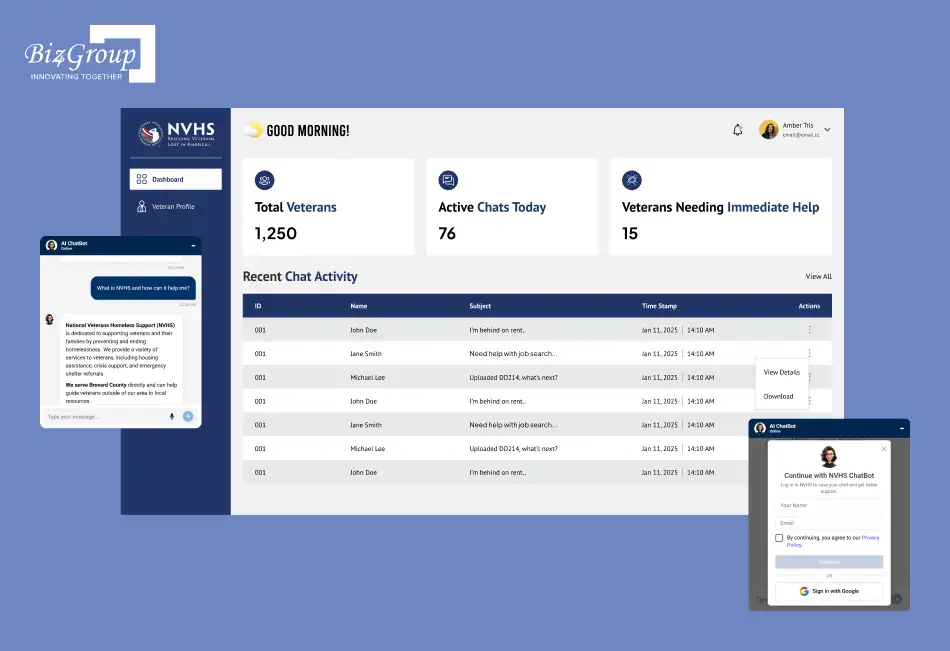
A strong illustration of these trends is Biz4Group’s work on an AI powered chatbot that supports homeless and at-risk veterans across the United States. The platform engages users through voice or text, gathers context over multiple interactions, and matches individuals with appropriate housing, healthcare, legal, or financial support programs.
What makes this project particularly relevant to administrative AI trends is its design for real-world complexity. The system:
- identifies crisis signals in real time
- alerts administrators through a dashboard
- maintains continuity through secure chat history tracking
Rather than replacing case workers, the AI strengthens their ability to respond quickly and consistently.
This approach reflects how administrative AI trends in healthcare organizations are evolving. AI handles intake, routing, and prioritization, while human teams deliver judgment, empathy, and resolution.
Measuring Administrative Impact
Healthcare organizations increasingly track operational improvements tied to administrative AI.
|
Operational Metric |
Outcome |
|---|---|
|
Case resolution time |
Faster access to services |
|
Staff workload |
Reduced burnout |
|
Intake accuracy |
Fewer errors and rework |
|
Response to urgent cases |
Improved safety and trust |
Administrative AI has moved beyond back-office automation. It now plays a central role in access, equity, and efficiency.
A Quick Snapshot of Clinical and Administrative AI Trends in Healthcare
|
Area |
Clinical AI Trends |
Administrative AI Trends |
|---|---|---|
|
Primary Objective |
Support clinicians and improve care delivery efficiency |
Streamline operations and reduce administrative burden |
|
Core Use Cases |
Ambient documentation, decision support, risk prediction |
Intake automation, eligibility checks, case management |
|
Workflow Integration |
Embedded directly into patient encounters and EHR workflows |
Integrated across portals, dashboards, and service systems |
|
Human Involvement |
Clinicians review and validate AI outputs |
Staff oversee escalations and complex cases |
|
Value Timeline |
Medium-term clinical and experience gains |
Faster operational and financial returns |
|
Risk Sensitivity |
High focus on accuracy and explainability |
High focus on reliability and governance |
|
Scalability |
Gradual expansion across specialties |
Rapid scaling across departments |
|
Leadership Ownership |
CMOs, clinical directors |
COOs, administrators, operations leaders |
This table creates a clear transition point. Next, we will connect these trends to financial strategy and explain why AI has secured a permanent place in healthcare budgets.
Two Paths. Very Different and Solid Outcomes.
Healthcare teams using AI report up to 40% workload reduction. The rest are hiring to keep up.
Talk to Biz4Group's AI Experts TodayWhy AI Is Becoming a Standard Budget Line in Healthcare Organizations?
For years, artificial intelligence lived in innovation budgets. Small pilots, limited scope, and short timelines defined early adoption.
That model no longer fits the realities healthcare leaders face today.
In 2026, why AI is becoming a standard budget line in healthcare comes down to one simple truth. Core operations depend on it.
Healthcare systems now treat AI like staffing, cybersecurity, or electronic records. It supports day-to-day functioning rather than experimental exploration. This shift reflects broader healthcare AI investment trends that prioritize stability and long-term value over novelty.
The Financial Logic Behind the Shift
Executives increasingly align AI spending with specific operational outcomes. These drivers consistently appear in budgeting discussions.
1. Sustained Cost Pressure
Rising labor costs and administrative overhead force organizations to seek structural efficiency. AI enables process redesign rather than incremental savings.
2. Workforce Constraints
Vacancies across clinical and administrative roles are persistent. Budgeting for AI helps maintain service levels without relying solely on hiring.
A defining healthcare AI budgeting trend is the move away from capital-heavy projects toward predictable operating expenses.
|
Budget Model |
Characteristics |
|---|---|
|
Pilot-based funding |
Short-term, limited accountability |
|
Project-based investment |
Defined scope, delayed ROI |
|
Operating budget allocation |
Continuous optimization and measurable outcomes |
When AI becomes part of operating budgets, leadership teams evaluate it using the same rigor applied to staffing or infrastructure.
What This Signals to Healthcare Leaders
This budget shift sends a clear message. AI initiatives must deliver measurable value year after year. They must scale across departments and adapt to changing needs. That expectation is reshaping how vendors are selected, how solutions are designed, and how success is measured.
Understanding why healthcare organizations are budgeting for AI helps leaders move forward with clarity.
In the next section, we will explore how healthcare executives structure these budgets and decide where to allocate AI investments in 2026.
Typical Cost Ranges Leaders Expect
Healthcare AI implementation costs vary widely based on complexity and deployment scope. Verified benchmarks help leaders set realistic expectations.
|
AI Solution Type |
Estimated Cost Range |
Context |
|---|---|---|
|
Entry-level administrative AI |
$50,000-$100,000 |
AI chatbots, intake automation, scheduling assistants for counselors |
|
Mid-complexity AI solutions |
$150,000-$300,000 |
Predictive models, decision support, workflow optimization |
|
$300,000+ |
Multi-system AI integration, advanced analytics, cross-department use |
Many leaders also budget for ongoing operational costs that can range from 20-40% of initial development, due to data preparation, staff training, compliance, and model retraining.
Core Cost Drivers That Shape AI Budgets
Understanding what drives AI costs helps leaders plan realistically and avoid surprises.
|
Cost Driver |
Why It Impacts Budget |
|---|---|
|
Use case complexity |
Clinical and multi-step workflows require deeper logic and testing |
|
Data readiness |
Cleaning, structuring, and validating healthcare data takes time |
|
Integration requirements |
Connecting with EHRs, CRMs, or legacy systems increases effort |
|
Customization level |
Tailored workflows cost more than configurable templates |
|
User volume |
Higher usage drives infrastructure and performance costs |
These drivers explain why two AI projects with similar goals can have very different budgets.
By accounting for these early, leaders avoid budget overruns and maintain alignment with healthcare AI investment trends that prioritize predictability.
Practical Cost Optimization Techniques Used in 2026
Healthcare leaders increasingly apply cost control strategies that reduce waste without limiting impact.
Common approaches include:
- Starting with a single high-impact workflow before scaling
- Reusing AI components across departments instead of rebuilding
- Phased rollouts aligned with budget cycles
- Selecting platforms that support modular expansion
- Avoiding over-customization during initial deployments
These techniques allow organizations to balance innovation with financial discipline while staying aligned with how healthcare leaders budget for AI initiatives today.
This structured approach to budgeting sets the stage for the next critical conversation. Once costs and allocations are clear, leaders turn their focus to sustainability, governance, and measurable outcomes. That is exactly what we will explore in the next section.
Your AI Budget Can Either Save Millions or Waste Them
Smart budgeting separates high-ROI AI programs from expensive experiments. Most leaders get it wrong the first time.
Let's Talk NumbersMeasuring ROI of Healthcare AI Adoption Trends
Once budgets are approved, attention quickly shifts to outcomes. In 2026, successful AI programs are judged less by technical sophistication and more by sustained business value. Healthcare AI adoption trends now center on measurable returns, realistic timelines, and continuous improvement.
Leaders no longer accept vague promises of efficiency. They expect clarity on what improves, by how much, and within what timeframe.
Typical ROI Timelines Leaders Expect
AI investments are planned with realistic payoff horizons. Based on enterprise healthcare deployments, executives often see returns within predictable windows.
|
AI Use Case Category |
Expected ROI Timeline |
|---|---|
|
Administrative automation |
3 to 6 months |
|
Scheduling and intake optimization |
4 to 8 months |
|
Clinical documentation support |
6 to 12 months |
|
Predictive analytics and decision support |
9 to 18 months |
Administrative AI often delivers faster ROI due to high volumes and repeatable workflows. Clinical use cases take longer but compound value over time.
Common ROI Benchmarks Used in 2026
Healthcare organizations increasingly rely on benchmarks rather than assumptions when evaluating success.
Some widely tracked outcomes include:
- 20-40% reduction in administrative task time
- 15-30% improvement in response or turnaround times
- 10-25% decrease in documentation-related clinician workload
- Measurable reductions in overtime and contract staffing costs
These benchmarks help leaders compare performance across departments and guide future investments.
Key KPIs You Should Track
Rather than tracking everything, mature organizations focus on a focused KPI set aligned with the original business case.
Operational KPIs
- Average processing time per task
- Case resolution or completion rates
- Volume handled per staff member
Financial KPIs
- Cost per transaction or interaction
- Labor hours saved
- Revenue leakage reduction
Adoption and Usage KPIs
- Active user rates
- Workflow completion with AI assistance
- Manual override frequency
Tracking these KPIs consistently allows leadership teams to validate whether healthcare AI adoption trends are translating into tangible value.
How ROI Improves Over Time
AI systems typically deliver incremental gains rather than one-time improvements. As models learn from usage and workflows stabilize, efficiency compounds.
Healthcare leaders often observe:
- Higher accuracy after the first few months of tuning
2. Broader adoption as staff trust increases
3. Expanded use cases built on the same AI foundation
This compounding effect is why AI investments are evaluated over multiple years rather than single budget cycles.
With ROI and KPIs clearly defined, healthcare leaders are better positioned to scale AI responsibly. In the next section, we will address the common risks, mistakes, and best practices that organizations must consider to protect these gains and avoid costly missteps.
Managing Risks in Healthcare AI Adoption Trends Across Systems
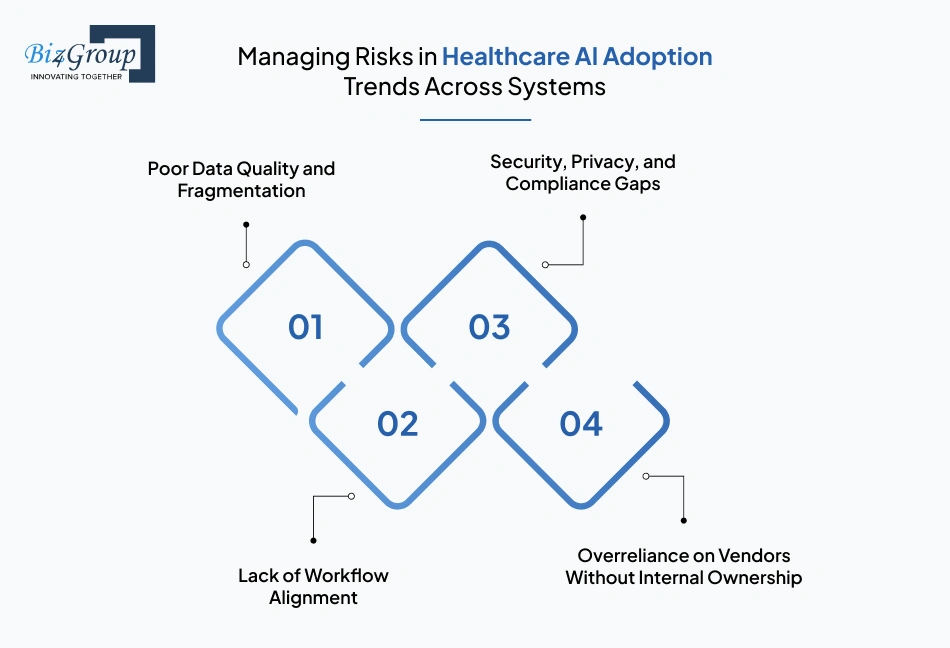
Even with strong budgets and clear ROI goals, many healthcare AI initiatives struggle due to avoidable missteps. In 2026, leaders recognize that managing risk is not about slowing innovation. It is about protecting patients, staff, and long-term value while scaling responsibly.
1. Poor Data Quality and Fragmentation
AI systems depend on clean, consistent data. Fragmented data sources and inconsistent inputs can reduce accuracy and trust.
How to address it:
- Standardize data inputs before AI deployment
- Identify a single source of truth for critical workflows
- Validate data pipelines regularly to prevent drift
2. Lack of Workflow Alignment
AI tools that sit outside daily workflows struggle to gain adoption, even if the technology is sound.
How to address it:
- Embed AI directly into existing systems and processes
- Minimize additional steps or interfaces for users
- Involve frontline staff early in design decisions
3. Security, Privacy, and Compliance Gaps
Healthcare data carries strict regulatory obligations. Failure to address privacy and security can expose organizations to legal and reputational risk.
How to address it:
- Ensure AI systems follow HIPAA requirements for data handling and access control
- Limit data exposure through role-based permissions
- Use encryption for data in transit and at rest
4. Overreliance on Vendors Without Internal Ownership
Some organizations outsource AI entirely without building internal understanding, creating dependency and risk.
How to address it:
- Maintain internal oversight and decision authority
- Require transparency into AI logic and performance
- Document workflows and decision rules clearly
Best Practices for Responsible Healthcare AI Adoption
Healthcare leaders who consistently succeed with AI adoption follow a set of practical best practices that balance innovation with accountability.
- Define clear success criteria before deployment
2. Align AI initiatives with organizational strategy
3. Build privacy and compliance considerations into early planning
4. Monitor performance regularly and adjust based on real usage
5. Scale gradually while preserving quality and trust
By addressing risks early and applying proven best practices, organizations protect their AI investments and create a foundation for sustainable growth.
The Fastest AI Wins Come from Getting It Right Early
Most AI failures stem from avoidable mistakes. The right partner helps you skip the costly learning curve.
Get in Touch with the Right PartnerHow Biz4Group LLC Leads Healthcare AI Trends Adoption in the USA
Biz4Group LLC is a USA-based software development and consulting company built for one purpose. Helping businesses turn emerging technology into measurable business value.
What sets Biz4Group apart is not just technical capability. It is the ability to understand healthcare as a system and deliver exceptional AI healthcare software solutions. Regulations, workflows, patient expectations, and financial pressures all come together in complex ways. Biz4Group designs AI solutions that respect this complexity while simplifying day-to-day operations.
The team at Biz4Group stays ahead of healthcare AI trends by working directly at the intersection of innovation and execution. Biz4Group focuses on where AI delivers sustained value. Our portfolio reflects hands-on experience across healthcare use cases. This practical experience allows Biz4Group to anticipate challenges before they appear and guide clients through adoption with confidence.
Why Businesses Choose Biz4Group LLC USA
- Proven experience delivering healthcare-focused AI development solutions
- Strong understanding of HIPAA aligned architectures and data handling
- Custom development tailored to real workflows
- Transparent communication and outcome-driven project planning
- Scalable solutions designed for long-term growth
- Cross-functional expertise across clinical, administrative, and consumer health systems
The pace of change in healthcare demands partners who can move fast without losing precision. Biz4Group combines agility with discipline, enabling organizations to adopt AI in ways that strengthen operations today while preparing for what comes next.
As healthcare AI adoption accelerates across the USA, organizations need more than ideas. They need execution partners who understand the stakes.
We are the execution partners that bring clarity, experience, and confidence to every engagement.
Let’s build something brilliant together. Let’s talk.
Wrapping Up
Healthcare AI has reached a point where discussion has shifted from possibility to priority. As 2026 approaches, organizations across the healthcare ecosystem are aligning technology decisions with operational realities. Workforce shortages, cost pressure, and rising patient expectations are shaping how leaders view artificial intelligence.
The most successful organizations are not chasing trends. They are adopting AI with intent, clarity, and accountability. By focusing on practical use cases, realistic budgeting, and outcome-driven adoption, healthcare leaders position their organizations to operate more efficiently while improving care experiences.
This is where Biz4Group LLC stands apart. With deep healthcare expertise and a strong track record of delivering AI app and web solutions that work in real-world environments, Biz4Group helps organizations move from strategy to execution with confidence. By aligning technology with business goals, compliance requirements, and long-term growth plans, Biz4Group enables healthcare leaders to adopt AI responsibly and effectively.
The future of healthcare belongs to organizations that act decisively today. If you are ready to turn healthcare AI trends into measurable results, partner with Biz4Group LLC and start building solutions that create lasting impact.
FAQs
Can small and mid-sized healthcare organizations adopt AI effectively?
Yes. Many AI solutions today are modular and scalable, making them accessible to clinics, specialty practices, and regional health systems. Starting with a focused use case allows smaller organizations to adopt AI without large upfront investments.
How do healthcare leaders decide between building custom AI or buying existing tools?
The decision depends on workflow complexity and differentiation needs. Off-the-shelf tools work well for standardized processes, while custom AI is better suited for unique workflows, integration requirements, or competitive differentiation.
What internal teams should be involved in healthcare AI initiatives?
Successful adoption typically involves clinical leadership, operations, IT, compliance, and finance teams. Early collaboration ensures AI solutions align with workflow realities and organizational priorities.
How can organizations ensure AI solutions remain useful over time?
Long-term value comes from designing AI systems that can adapt to changing workflows and data inputs. Regular performance reviews, user feedback, and incremental enhancements help maintain relevance as organizational needs evolve.
Are patients comfortable interacting with AI in healthcare settings?
Patient acceptance continues to grow when AI tools are intuitive, transparent, and supportive. Clear communication about how AI assists care or access builds trust and encourages engagement.
How does AI impact staff roles rather than replacing them?
In practice, AI redistributes workload rather than removing roles. Routine and repetitive tasks shift to AI, allowing staff to focus on complex decision-making, coordination, and patient-facing responsibilities.
What should healthcare organizations look for in a long-term AI technology partner?
Organizations benefit from partners with healthcare domain expertise, a strong understanding of compliance requirements, and experience delivering scalable solutions. Long-term support, transparency, and alignment with business goals are equally important.
