Location :
Orlando, FL, USA
Location :
Orlando, FL, USA +1 (407) 714-1616
 info@biz4group.com

 AI Summary Powered by Biz4AI
- A proprietary sportsbook platform gives operators control over their betting engine, market logic, risk rules, integrations, settlement workflows, and technology roadmap.
- Custom betting engine architecture connects sports data, market management, odds validation, bet processing, risk controls, player accounts, wallets, and settlement into one coordinated betting workflow.
- A custom sportsbook platform can build its core betting logic in-house while integrating specialized services such as sports data, KYC, AML, payments, and geolocation.
- The estimated cost to build a proprietary sportsbook platform ranges from $40,000 to $300,000+, with the final budget influenced by betting-engine complexity, sports coverage, integrations, live betting, compliance, scalability, and post-launch requirements.
- Biz4Group LLC brings sportsbook development experience through projects such as PredictEX, Quick Start Bets, and Handshake, combining real-time sports data, betting workflows, scalable architecture, and user-focused product development.
Building a sportsbook is easy to describe and difficult to engineer.
A user sees a list of games, odds, a bet slip, and an account balance. Behind that simple interface sits a network of data feeds, betting rules, risk controls, settlement logic, payments, compliance services, and real-time infrastructure.
That is where a proprietary sportsbook platform changes the equation.
Instead of depending on a vendor's core betting system, the operator owns the platform logic and decides how markets, bets, risk rules, integrations, and product features should work.
This guide explains how to build a proprietary sportsbook platform from the architecture up. You will see what belongs inside the platform, how a custom betting engine processes a wager, which services should be built or integrated, what technology can support the system, and what the development process looks like.
What Makes a Sportsbook Platform Truly Proprietary?
A sportsbook platform is truly proprietary when the operator owns and controls the core technology responsible for its betting product, business rules, and platform roadmap.
That ownership usually centers on the betting engine, market management, risk logic, settlement workflows, APIs, and operator controls. The platform can still use third-party services for sports data, KYC, payments, geolocation, cloud infrastructure, and other specialized functions.
In simple terms, proprietary means control over the core, not ownership of every line of code.
A useful distinction looks like this.
|
Proprietary Platform |
White-Label Platform |
|---|---|
|
Operator controls core betting logic |
Provider controls core betting logic |
|
Architecture can be designed around the business |
Architecture is largely predefined |
|
Custom integrations can shape the platform |
Integrations depend on provider capabilities |
|
Product roadmap stays with the operator |
Roadmap depends partly on the vendor |
|
Core technology can evolve with business needs |
Changes may require vendor involvement |
|
Higher development responsibility |
Lower initial development responsibility |
This model is particularly relevant when an operator has specific betting rules, unusual markets, specialized risk requirements, or a long-term plan to own its technology.
It also creates more technical responsibility. A proprietary sportsbook needs strong architecture from the start because the operator becomes responsible for the systems that determine how bets are accepted, managed, settled, and recorded.
That is why the first architectural question should not be "Which framework should we use?" It should be "Which parts of the sportsbook need to belong to us?"
What Are the Core Components of a Proprietary Sportsbook Platform?
A proprietary sportsbook platform typically consists of several connected layers that handle data, betting, accounts, transactions, administration, and user interaction.
The important point is that these components have different jobs. A betting engine should not be treated as a wallet. A PAM should not be treated as a risk engine. An odds feed should not be confused with the logic that decides whether a bet can be accepted.
Here is the platform at a high level.
|
Platform Component |
Primary Responsibility |
|---|---|
|
Sports data layer |
Events, scores, statistics, market and odds data |
|
Data ingestion layer |
Receiving, validating, and normalizing external feeds |
|
Betting engine |
Market rules, bet validation, acceptance, and bet state |
|
Risk management |
Limits, exposure, liability, and trading controls |
|
PAM |
Accounts, player profiles, balances, and activity |
|
Wallet and payments |
Deposits, withdrawals, and financial transactions |
|
Settlement engine |
Results, payouts, and market closure |
|
API layer |
Communication between platform services and applications |
|
User interface |
Web or mobile betting experience and bet slip |
|
Operator dashboard |
Trading, risk, users, markets, and platform controls |
The layers work together, but they should not become one giant application.
A modular structure makes it easier to change a payment provider without rewriting the betting engine. It also allows new sports, markets, or interfaces to be introduced without destabilizing unrelated services.
For example, a sportsbook may start with football and basketball and later add tennis, hockey, or cricket. A well-planned architecture should accommodate that expansion through modular data and market models.
This is also where Biz4Group's sports product experience becomes relevant. Its sportsbook portfolio includes platforms built around live sports data, betting workflows, user experiences, and administrative functionality.
The lesson is straightforward. A custom sportsbook is a system of specialized services, not one oversized application.
How Does Proprietary Sportsbook Platform Architecture Work?
A proprietary sportsbook architecture moves sports data through several processing layers before that information reaches the bettor and eventually becomes part of a settled transaction.
The typical flow looks like this.
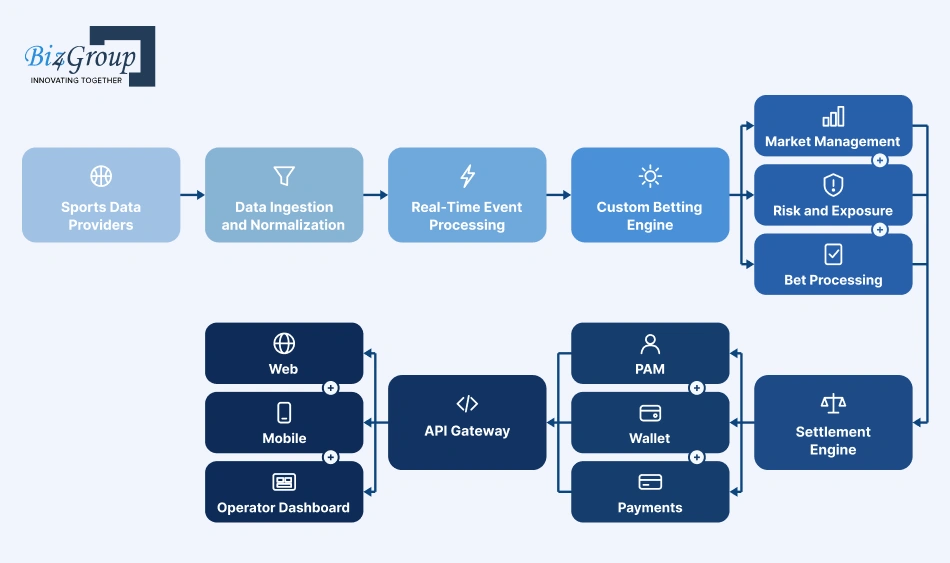
Sports Data Providers → Data Ingestion and Normalization → Real-Time Event Processing → Custom Betting Engine → Market Management + Risk and Exposure + Bet Processing → Settlement Engine → PAM + Wallet + Payments → API Gateway → Web + Mobile + Operator Dashboard
The first stage is the sports data layer.
External providers send information about fixtures, teams, players, scores, markets, and odds. The ingestion layer receives those feeds and converts provider-specific formats into an internal data model.
This normalization step matters because two providers may represent the same event differently.
Once standardized, the information can move through real-time processing services. Market states can change. Odds can update. Events can begin or end. Those changes need to reach the betting engine and user interfaces quickly.
The betting engine then applies the rules that determine whether a wager can proceed.
A bet may be rejected because a market is suspended, the odds have changed, the player's balance is insufficient, a stake limit has been exceeded, or a risk rule has been triggered.
After a bet is accepted, the transaction moves through the appropriate account and wallet workflows. When the official result becomes available, the settlement engine determines the outcome and updates the player's account.
The API layer connects these backend capabilities with the web application, mobile application, and operator dashboard.
PredictEX Shows Why This Architecture Needs Strong Real-Time Foundations
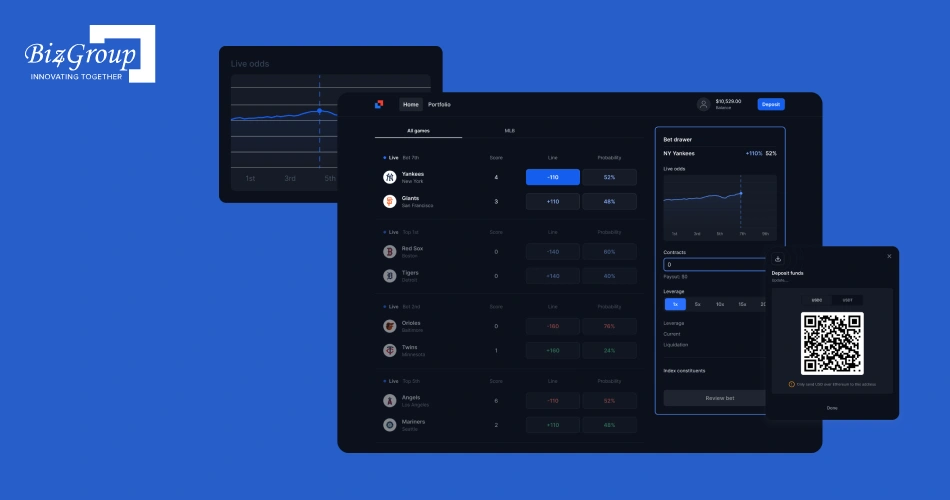
Biz4Group's PredictEX provides a useful real-world example of this kind of environment. The platform integrates official Sportradar data through real-time sockets and uses Next.js on the frontend with Node.js, C#, Go, and Python across the backend. It also uses Zustand for synchronized frontend data management.
The value of this example is not the specific technology list. It is the engineering pattern.
A sportsbook needs data to arrive quickly, move predictably through the system, and remain synchronized across the user experience. A proprietary architecture gives the operator control over how those services are designed and connected.
What Happens Inside a Custom Betting Engine?
A custom betting engine governs the complete lifecycle of a wager, from market validation and odds checks to acceptance, risk controls, and settlement. It is the core of proprietary betting engine development because it turns the operator's betting rules into executable platform logic.
How Does Market Management Work?
Market management determines what users can bet on and what state each market currently holds. The engine can create, open, suspend, modify, and close markets based on incoming event information and operator rules.
For live betting, this becomes especially important.
A goal, injury, penalty, timeout, or other match event can change the state of a market within seconds. The engine needs to react before accepting another wager against outdated conditions.
How Does Odds Validation Work?
Odds validation checks whether the price displayed to the bettor is still valid when the wager reaches the acceptance stage.
Imagine a bettor sees 2.10 odds and confirms the bet. The odds have moved to 1.95 a moment later.
The engine needs a predefined response. It may reject the wager, request confirmation of the updated price, or follow another rule configured by the operator.
This is also where the distinction between an odds engine and a betting engine matters.
An odds engine can generate, calculate, or distribute prices. The betting engine decides whether a specific wager can be accepted under the current market conditions.
For operators planning their architecture, real-time odds engine architecture provides a useful technical extension to this topic.
How Does Bet Validation Work?
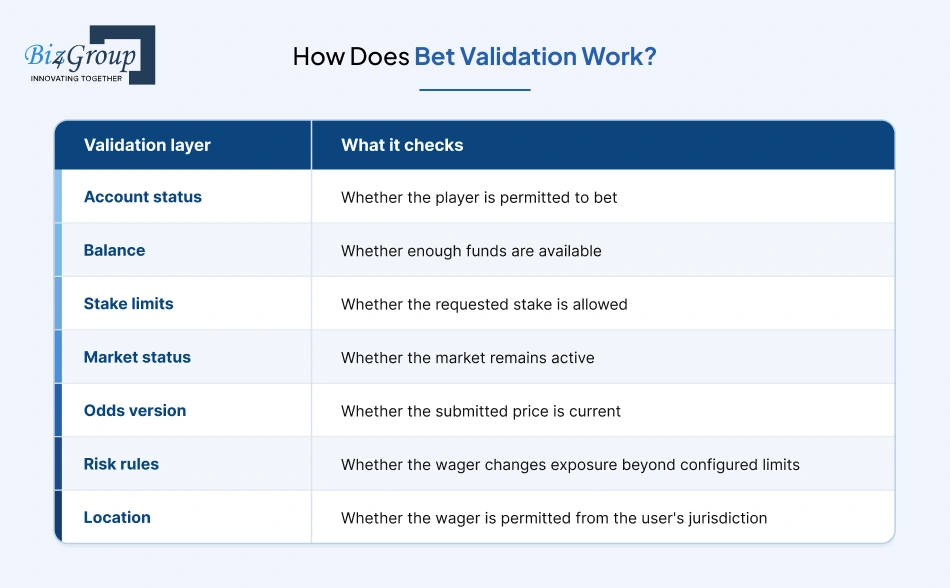
Before acceptance, the engine can check several conditions.
|
Validation layer |
What it checks |
|---|---|
|
Account status |
Whether the player is permitted to bet |
|
Balance |
Whether enough funds are available |
|
Stake limits |
Whether the requested stake is allowed |
|
Market status |
Whether the market remains active |
|
Odds version |
Whether the submitted price is current |
|
Risk rules |
Whether the wager changes exposure beyond configured limits |
|
Location |
Whether the wager is permitted from the user's jurisdiction |
The sequence matters.
A bet should not become an accepted transaction when one of its underlying conditions has already become invalid.
What Does Quick Start Bets Show About Real-Time Betting?
Quick Start Bets is a useful Biz4Group example of the real-time demands behind sports betting products.
The NHL-focused platform delivers live odds, player and team statistics, historical game data, bet tracking, and an interactive dashboard. Its architecture uses persistent WebSocket connections for live odds and a normalization layer to standardize information received from multiple data providers. The project was delivered from design through development in four months.
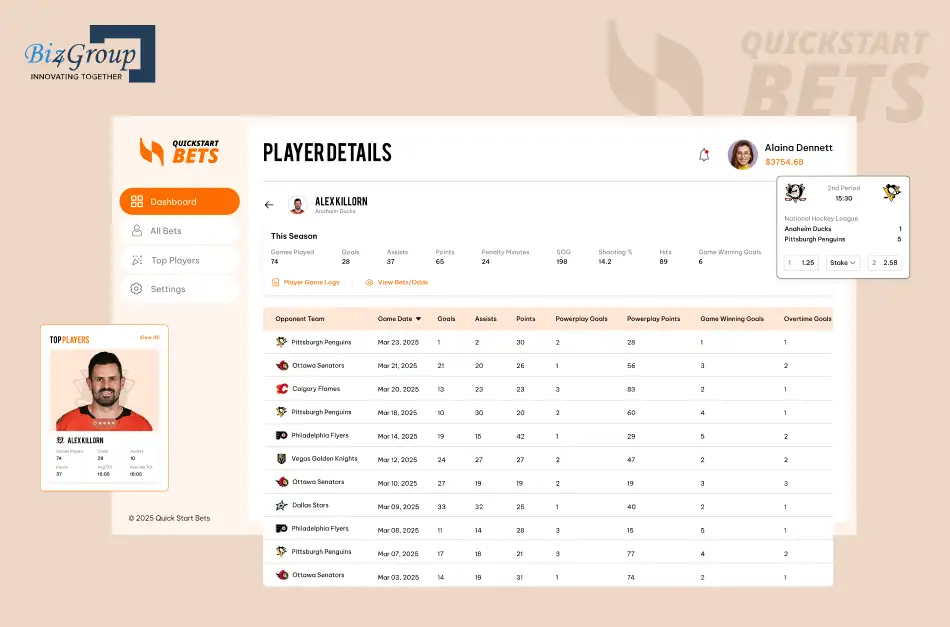
That example highlights an important point for a custom betting engine. Speed alone is not enough. The platform also needs consistent data. When multiple sources provide different formats, the system needs to normalize those inputs before they reach downstream services.
How Does Bet State Management Work?
Every wager needs a defined lifecycle.
A simplified model is:
Created → Validated → Accepted → Open → Settled
A rejected wager may stop during validation. A suspended or cancelled market may trigger another state transition.
The important requirement is traceability.
The system should be able to show what happened to a wager, when it happened, and which rule or event caused the change.
How Does the Engine Manage Risk?
Every accepted wager changes the operator's exposure.
The risk management module can monitor:
- Player-level limits
- Market exposure
- Event-level exposure
- Liability
- Stake restrictions
- Configured suspension thresholds
These rules should be configurable through operator tools. That lets trading and risk teams adjust limits without changing the underlying application code for every new requirement.
How Does Settlement Complete the Wager?
Settlement begins when the official result becomes available.
The settlement engine determines whether a wager won, lost, pushed, voided, or requires another outcome based on the market rules. It then calculates the applicable payout and updates the player's account.
A well-designed settlement service should also maintain reconciliation and audit records. If a result is corrected later, the system needs a controlled process for handling that correction.
That complete lifecycle is what separates a real betting engine architecture from a simple betting interface.
Your Odds Won't Wait. Will Your Engine?
Live betting can turn seconds into missed markets. Let's design an engine that keeps pace.
Call Our Sportsbook ExpertsWhich Sportsbook Components Should You Build In-House or Integrate?
A proprietary sportsbook does not require the operator to build every supporting service internally. The practical approach is to own the business logic that differentiates the product and integrate mature services where specialized providers already exist.
A useful decision framework looks like this.
|
Component |
Build or Integrate? |
Why |
|---|---|---|
|
Betting engine |
Build |
Core proprietary business logic |
|
Risk rules |
Build or customize |
Closely tied to operator requirements |
|
Market management |
Build |
Provides product control |
|
Sports data |
Integrate |
Requires specialized feeds and rights |
|
KYC and AML |
Integrate |
Specialized compliance infrastructure |
|
Payments |
Integrate |
Multiple payment ecosystems may be required |
|
Geolocation |
Integrate |
Requires specialized location services |
|
Cloud infrastructure |
Use managed services |
Avoid unnecessary infrastructure ownership |
|
Analytics |
Build or integrate |
Depends on reporting and product needs |
The decision becomes easier when you divide the platform into two categories.
Core differentiators should belong to the operator.
These may include betting rules, risk logic, market configuration, settlement behavior, product workflows, and proprietary user experiences.
Specialized infrastructure can often come from external providers.
Sports data, payment processing, identity verification, geolocation, and selected cloud services fall into this group.
This approach also keeps development budgets under control.
For example, an operator may spend its engineering budget creating a flexible betting engine while using a licensed sports data provider instead of attempting to build a global sports data collection network from scratch.
The same principle applies to compliance.
Integrating an established KYC provider can give the platform access to identity verification workflows while the sportsbook retains control over when and how those verification results affect account permissions.
That is what makes proprietary betting engine development practical for startups and established operators alike.
What Technology Stack Supports a Custom Sportsbook Platform?
A custom sportsbook technology stack should support four demanding workloads at the same time. It needs to process real-time sports data, handle transactional betting activity, serve responsive interfaces, and scale during traffic spikes.
There is no universal stack for every operator. The right combination depends on the platform's sports coverage, betting model, traffic expectations, and integration requirements.
Which Technologies Fit Each Platform Layer?
|
Platform layer |
Common technology choices |
Primary role |
|---|---|---|
|
Web frontend |
React, Next.js |
Betting interface, markets, bet slip, dashboards |
|
Mobile apps |
Ionic, React Native, native iOS/Android |
Mobile betting experience |
|
Backend services |
Node.js, Go, C#, Python |
APIs, business logic, data processing |
|
Real-time communication |
WebSockets, event-driven messaging |
Live odds and event updates |
|
Database |
MySQL, PostgreSQL, MongoDB |
Accounts, bets, statistics, configuration |
|
Cache |
Redis |
Fast access to frequently changing data |
|
API layer |
REST, WebSockets |
Service and client communication |
|
Cloud |
AWS, Azure, Google Cloud |
Hosting, scaling, networking, storage |
|
Monitoring |
Cloud-native monitoring, logging, alerts |
Performance and service health |
|
Containerization |
Docker, Kubernetes |
Service deployment and scaling |
The stack should be selected around workloads, not trends.
A high-volume live odds service may need a different implementation from an account service. A reporting module may prioritize data flexibility, while the betting engine may prioritize deterministic processing and transaction consistency.
What Does Handshake Show About the Frontend and Application Layer?
Biz4Group's Handshake project takes a different approach.
It is a social betting application built around real-time game scores, upcoming schedules, one-on-one and group betting, chat, push notifications, and user interaction. The project uses Ionic 5 for cross-platform development and a MERN-based architecture.
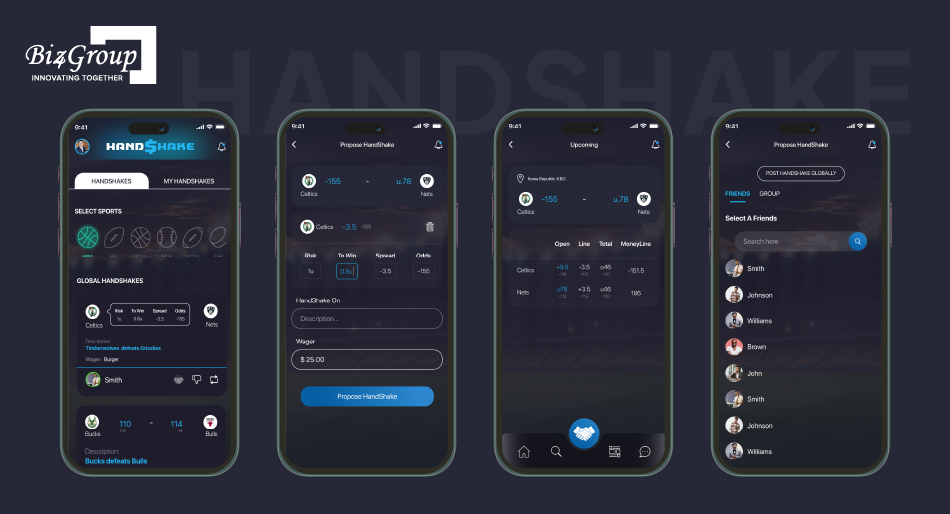
Handshake also demonstrates why sportsbook interfaces need careful product design. A betting platform can contain substantial backend complexity, but the user still needs to find a game, understand the available wager, place a bet, and track its status without getting lost in the interface.
Which Technology Choices Matter Most for Real-Time Betting?
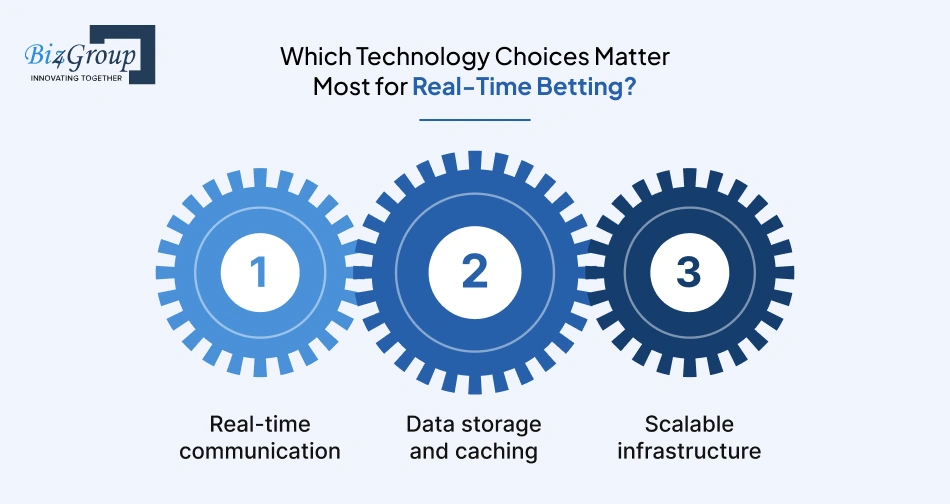
Three areas deserve particular attention.
Real-time communication keeps odds, scores, and market states synchronized.
Data storage and caching determine how quickly the platform can retrieve frequently changing information.
Scalable infrastructure helps the system handle sudden traffic increases during major sporting events.
A useful reference point comes from current sportsbook data infrastructure. Stats Perform says its betting data products support more than 15 sports and 500,000 events annually, while Sportradar continues to provide live odds and standardized data services for sportsbook operators.
That reinforces a practical architecture principle. You can own your betting engine while integrating specialized sports data. Proprietary does not mean rebuilding the entire sports data ecosystem.
What Are the Steps to Build a Proprietary Sportsbook Platform?
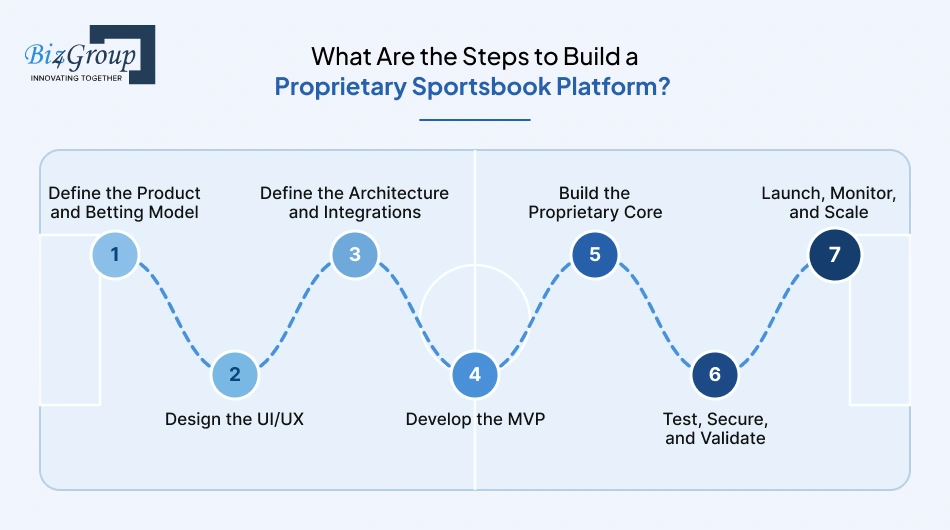
A custom sportsbook development process can be organized into seven stages, starting with product definition and ending with a monitored production launch.
Step 1. Define the Product and Betting Model
Start by deciding what the sportsbook will actually offer.
Define:
- Sports and leagues
- Pre-match and live betting
- Market types
- Bet types
- Target jurisdictions
- Player account model
- Web and mobile requirements
- Operator workflows
This creates the functional boundary for the project. A detailed scope also helps determine whether you need a lean sports betting app MVP or a broader enterprise platform.
Step 2. Design the UI/UX
The next step should be turning betting requirements into clear user journeys. Map the major flows.
Registration → Verification → Sports selection → Event page → Market selection → Bet slip → Confirmation → Bet history
The same exercise should be done for operator workflows.
Login → Market management → Risk controls → User management → Reporting → Settlement review
Wireframes and prototypes can expose confusing workflows before development begins. This is one reason a UI/UX development company should be onboarded before large-scale engineering.
Also read: Top 15 UI/UX design companies in USA
Step 3. Define the Architecture and Integrations
Now design the technical foundation.
Map the:
- Betting engine
- Data ingestion
- Market services
- Risk management
- PAM
- Wallet
- Settlement
- APIs
- Admin services
- External integrations
At this stage, select sports data, KYC, AML, payment, geolocation, and other required providers. The architecture should also define how services communicate and what happens when a dependency becomes unavailable.
Step 4. Develop the MVP
Build the smallest version that can validate the core sportsbook workflow.
Strong MVP development services may include:
- Account registration
- Core sports
- Selected markets
- Odds display
- Bet slip
- Bet placement
- Basic wallet
- Bet history
- Operator dashboard
- Essential reporting
The objective is to validate the product flow before adding every sport, market, integration, and advanced risk feature.
Also read: Top 12+ MVP development companies in USA
Step 5. Build the Proprietary Core
Once the MVP scope is established, development can move deeper into the platform's proprietary capabilities.
This includes:
- Custom betting engine
- Market management
- Risk rules
- Settlement logic
- Account workflows
- Wallet integrations
- APIs
- Operator controls
This is where the platform starts becoming distinctly proprietary.
Step 6. Test, Secure, and Validate
Sportsbook testing needs to cover both normal and unusual conditions.
Test odds changes during bet placement. Test suspended markets. Test duplicate requests. Test failed payments. Test high-concurrency traffic. Test delayed data. Test settlement corrections.
Security testing should also cover authentication, authorization, APIs, data access, payment flows, and administrative functions.
Regulatory requirements should be validated for each intended market before launch.
Step 7. Launch, Monitor, and Scale
Production launch is the start of continuous platform development.
Monitor:
- Data-feed health
- Bet acceptance
- Transaction latency
- Settlement queues
- API errors
- Infrastructure usage
- Database performance
- User activity
Then use those signals to decide what needs to be improved, expanded, or redesigned.
This seven-step structure also makes the custom sportsbook development process easier to estimate because each stage has a defined output.
What Could Your Sportsbook Return?
Before you fund the build, map the features, costs, and revenue paths that can shape your ROI.
Calculate My Sportsbook ROIWhat Security and Compliance Requirements Should the Architecture Support?
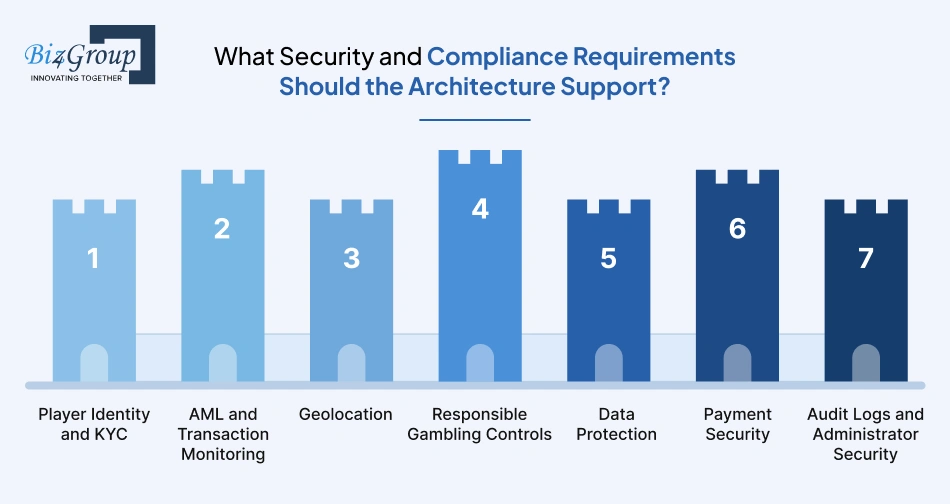
A proprietary sportsbook should treat security and compliance as architecture requirements from the beginning, because account controls, payments, identity, location, and responsible gambling rules affect how core services interact.
The exact requirements depend on the jurisdiction and license model.
For US operators, state-level requirements can differ across licensing, account registration, geolocation, taxation, and operational controls. Biz4Group's 2026 overview of US sports betting regulations highlights these differences and the importance of designing platforms around the specific states in which they will operate.
Player Identity and KYC
The platform should connect user registration with identity verification workflows. Account status should influence what a user can do.
For example, an unverified account may have restrictions that disappear after successful verification, depending on the applicable rules.
AML and Transaction Monitoring
The financial layer needs controls for monitoring deposits, withdrawals, account activity, and suspicious transaction patterns. The platform should also maintain records that support required investigations and reporting.
Geolocation
Geolocation determines whether a user is physically located in an allowed jurisdiction. This becomes especially important for operators serving multiple US states.
The geolocation service should connect with account and betting permissions so location checks are part of the transaction flow.
Responsible Gambling Controls
The platform may need configurable controls for limits, exclusions, account restrictions, and other responsible gambling requirements. These should connect to the player account system and betting engine.
Data Protection
Personal information, account records, payment information, and betting history need appropriate access controls and protection. Sensitive information should be encrypted where appropriate, and access should follow defined roles.
Payment Security
Payment integrations should be designed around the applicable security and compliance requirements. The sportsbook should also maintain clear transaction records so deposits, withdrawals, reversals, and adjustments can be reconciled.
Audit Logs and Administrator Security
Every important administrative action should be traceable. That includes changes to markets, risk limits, user permissions, settlements, and other sensitive configurations.
Role-based access helps ensure that employees only access the functions required for their responsibilities.
The goal is simple. Compliance should influence the architecture before launch, not appear as a checklist after the core platform has already been built.
How Does a Proprietary Sportsbook Compare with a White-Label Platform?
A proprietary sportsbook gives the operator greater control over its core technology, while a white-label sportsbook reduces the amount of technology the operator needs to develop and maintain internally.
The difference becomes clearer when the two models are placed side by side.
|
Area |
White-Label |
Proprietary |
|---|---|---|
|
Core betting logic |
Provider controlled |
Operator controlled |
|
Customization |
Within provider capabilities |
Designed around operator needs |
|
Integrations |
Provider ecosystem |
Operator-defined |
|
Product roadmap |
Partly vendor-dependent |
Operator-driven |
|
Architecture |
Predefined |
Custom-designed |
|
Development responsibility |
Lower |
Higher |
|
Initial development effort |
Lower |
Higher |
|
Platform ownership |
Depends on agreement |
Core technology belongs to the operator |
White-label can make sense for businesses that prioritize speed to market and have limited initial customization requirements.
A proprietary sportsbook can make sense when the business needs deeper control over its betting rules, product roadmap, integrations, risk logic, or long-term technology direction.
There is also a middle path.
Some operators begin with a white-label platform and later move toward custom technology as their requirements become more specific.
The right model depends on what the business needs to own, how quickly it needs to launch, and how much development responsibility it can support.
What Does It Cost to Build a Proprietary Sportsbook Platform?
A proprietary sportsbook platform can cost approximately $40,000 to $300,000+ to build, depending on its sports coverage, betting-engine complexity, interfaces, integrations, compliance scope, and scalability requirements.
For budgeting purposes, the table below uses a $150,000 representative project budget. Actual projects can shift significantly depending on scope.
What Are the Main Cost Drivers?
|
Cost driver |
Share of $150K budget |
Illustrative allocation |
|---|---|---|
|
Custom betting engine and market logic |
22% |
$33,000 |
|
Backend, APIs, PAM, wallet, and settlement |
16% |
$24,000 |
|
UI/UX and web or mobile interfaces |
13% |
$19,500 |
|
Sports data and real-time integrations |
10% |
$15,000 |
|
Risk management and trading controls |
8% |
$12,000 |
|
QA, load testing, and performance testing |
7% |
$10,500 |
|
Cloud, DevOps, security, and deployment setup |
6% |
$9,000 |
|
Direct development subtotal |
82% |
$123,000 |
The betting engine receives the largest allocation because it contains the platform's core proprietary logic. The backend allocation covers the services that connect accounts, transactions, APIs, settlement, and platform workflows.
UI/UX and client applications also deserve a meaningful share. A complex sportsbook needs a clear betting journey across screens and devices.
Data integration costs vary according to provider, coverage, market depth, and technical requirements. Current sportsbook technology providers continue to emphasize the importance of real-time data and odds infrastructure for live betting environments.
What Hidden Costs Should Operators Include?
Hidden costs should be planned inside the total budget, not treated as an afterthought.
|
Hidden or launch cost |
Share of $150K budget |
Illustrative allocation |
|---|---|---|
|
Security audit and penetration testing |
4% |
$6,000 |
|
Compliance and certification preparation |
3% |
$4,500 |
|
Third-party API setup and initial subscriptions |
3% |
$4,500 |
|
Infrastructure and monitoring during launch |
3% |
$4,500 |
|
Documentation, training, and handover |
2% |
$3,000 |
|
Contingency for integration and launch fixes |
3% |
$4,500 |
|
Hidden and launch subtotal |
18% |
$27,000 |
These figures are planning allocations, not vendor quotations.
Sports data licensing can vary considerably by provider and coverage. Payment providers may also introduce transaction-related expenses. KYC, AML, geolocation, monitoring, and other external services can create recurring charges after launch.
That is why an initial $150,000 development estimate should not be interpreted as the lifetime cost of operating a sportsbook.
A useful way to think about the full $40,000 to $300,000+ range is this:
|
Project type |
Typical scope |
Indicative development range |
|---|---|---|
|
Lean proprietary MVP |
Limited sports, selected markets, web-first experience |
$40K-$80K+ |
|
Growth-stage custom platform |
Multiple sports, live betting, custom engine, integrations |
$80K-$180K+ |
|
Enterprise sportsbook |
Broad sports coverage, advanced risk, web + mobile, high-scale infrastructure |
$180K-$300K+ |
The final estimate should come after requirements, architecture, integrations, and target jurisdictions have been defined.
Also read: Sports betting app development cost in 2026
$300K+ Sounds Big. Your Scope Decides Everything.
Get a custom estimate based on your sports, markets, integrations, and betting-engine requirements.
Get My Custom EstimateWrapping Up
You can build a proprietary sportsbook successfully by choosing a development partner that understands the betting workflow, real-time data environment, backend architecture, integrations, and product experience as one connected system.
This is where Biz4Group's sports betting portfolio provides useful evidence. Sportsbook development needs a reliable data foundation. It needs a betting engine that can enforce business rules. It needs infrastructure that can handle real-time activity. It needs an interface that makes complex betting workflows easy to understand. And it needs an architecture that can grow as the operator adds markets, users, sports, jurisdictions, and integrations.
Biz4Group LLC brings these areas together through its work as a sports betting app development company, supporting businesses across sportsbook architecture, real-time data, betting workflows, secure payments, compliance, and scalable infrastructure.
If you have a sportsbook concept that requires ownership of the betting engine and platform architecture, the next step is to map the product requirements, technical boundaries, integrations, and development budget before writing the first production module.
Have a proprietary sportsbook concept? Talk to Biz4Group about your betting engine and platform architecture. Get in touch
FAQs
1. Can a proprietary sportsbook support multiple betting currencies?
Yes. A proprietary sportsbook can be designed to support multiple currencies through a configurable wallet and transaction architecture. The implementation needs to account for currency conversion, transaction records, payment-provider capabilities, settlement calculations, and applicable market requirements.
2. Can a proprietary sportsbook support both web and mobile applications?
Yes. A shared backend and API layer can support multiple client applications. Web, iOS, and Android interfaces can consume the same core betting, account, wallet, and market services while providing platform-specific experiences.
3. Who owns the source code of a proprietary sportsbook?
Source-code ownership depends on the development agreement and intellectual-property terms. Operators planning a proprietary platform should define ownership, licensing rights, repository access, documentation, third-party dependencies, and post-project access before development begins.
4. Can a proprietary sportsbook add new sports after launch?
Yes. A modular architecture can allow new sports and markets to be introduced without rebuilding the entire platform. The data model, market configuration, betting rules, frontend components, and settlement logic should be designed with expansion in mind.
5. Can a proprietary sportsbook support exchange betting?
Yes. An exchange model can be supported, but it requires a different set of workflows from traditional sportsbook betting. The platform needs mechanisms for user-to-user offers, matching, exposure management, market states, and settlement.
6. What happens when a sportsbook loses its sports data feed?
The platform should have defined feed-health and fallback procedures. Depending on the architecture, the sportsbook may suspend affected markets, switch to another provider, continue using validated cached information for limited functions, or wait for the primary feed to recover. The exact behavior should be defined as part of the platform's reliability and market-suspension design.
7. How should sportsbook operators monitor the health of the betting engine?
Operators should monitor transaction latency, rejected bets, market states, feed health, service errors, settlement queues, wallet transactions, infrastructure utilization, and other critical events. Dashboards and alerts should make unusual behavior visible before it becomes a larger incident.
8. Can a proprietary sportsbook be expanded into an iGaming platform?
Yes. A sportsbook can become part of a broader iGaming ecosystem if the architecture is designed with shared account, wallet, identity, payment, compliance, and reporting services. The additional casino or gaming products should remain modular so their specific business logic does not interfere with the sportsbook engine.