Location :
Orlando, FL, USA
Location :
Orlando, FL, USA +1 (407) 714-1616
 info@biz4group.com

















Imagine a digital system that doesn’t wait for instructions but instead, understands your business goals, learns from real-time feedback, and takes independent actions to get the job done.
Read More

If you’ve ever wondered how market giants like FanDuel and DraftKings process massive volumes of bets in seconds while generating accurate odds and predictions, you’re not alone.
The global sports betting industry continues to surge, with market revenue expected to surpass $185 billion by 2030 according to a report from Grand View Research.
With this rapid growth, many investors and product leaders are asking one crucial question... What is the cost to build an enterprise AI sports betting platform that can compete at scale?
Technology has reshaped betting platforms over the past few years. Real-time analytics, predictive models, and automated risk management systems now define modern sportsbooks. Businesses planning to enter this market often begin with one challenge. Understanding the enterprise AI sports betting platform development cost before committing resources.
Here’s a quick insight. Depending on features, AI capabilities, and infrastructure needs, the cost to develop enterprise AI sports betting software can range anywhere between $30,000 and $250,000+.
So, the real question for decision makers becomes clear. How much does it cost to build scalable enterprise AI sports betting platform that balances performance, compliance, and profitability? The answer depends on architecture, integrations, and long-term scalability.
This guide breaks down every major expense for you. Let’s begin with the basics.
Launching a sportsbook can look straightforward on the surface. Fans open the app, check the odds board, place a wager, and track results during the game. Behind that experience sits a sophisticated technology platform handling live odds feeds, betting markets, player analytics, and risk management systems.
This is why evaluating the cost to build an enterprise AI sports betting platform becomes a crucial step before development begins. Businesses that plan their investment early gain a clear understanding of budget requirements, timelines, and expected returns.
Before building a sportsbook platform, executives typically evaluate several business questions.
These decisions directly affect the enterprise AI sports betting platform development cost and the overall investment strategy.
For example, a platform focusing on NFL, NBA, and MLB betting markets requires a very different budget than a niche betting product targeting one league. The same applies to platforms that introduce AI-based predictions or player performance analytics.
Sports betting platforms operate in a highly competitive and regulated industry. A structured budget protects companies from common risks such as:
Early financial planning also helps businesses determine whether they should begin with a smaller MVP version of the sportsbook or move directly toward an enterprise grade platform. Some companies validate their product idea through a sports betting website MVP before expanding into a full-scale sportsbook ecosystem.
A well-defined investment plan gives product teams a roadmap for building the sportsbook in phases.
The initial release might focus on core sportsbook features such as:
Later phases can introduce advanced features including predictive analytics, automated trading tools, and bettor behavior analysis. These capabilities rely heavily on AI automation and advanced data processing systems.
Breaking the platform roadmap into phases helps businesses control spending while still building a competitive product.
Companies that carefully evaluate the budget estimate of enterprise sports betting platform development often move faster in the long run. They enter the market with a clear understanding of their investment scope, operational requirements, and growth potential.
For executives and investors, this early planning stage answers a critical question... How much capital should be allocated to build a sportsbook capable of handling high betting volumes and delivering accurate odds across multiple sports?
Once that foundation is established, the next step involves calculating a realistic development estimate. The following section explains a practical framework for estimating the cost to develop enterprise AI sports betting software using key platform variables.
Also read: How much does it cost to develop an AI sports betting software?
Over $121B was wagered in the U.S. in a single year. Entering this market without a cost strategy is like placing a blind bet.
Book a Strategy Call with Biz4Group TodayEstimating the cost to develop enterprise AI sports betting software can feel overwhelming at first. A sportsbook platform includes many moving parts. Odds engines, player analytics, risk management tools, payment systems, and live game data pipelines all contribute to the total investment.
To simplify budgeting, many product teams rely on a practical estimation model that breaks the project into major cost components. This approach provides a quick view of the development budget of enterprise AI sports betting platform before detailed planning begins.
Below is a simple framework often used when estimating the budget required to create enterprise AI sports betting systems.
Estimated Platform Cost
(Base Platform Development + AI Systems + Infrastructure Setup + Integrations + Compliance Setup) × Platform Complexity
This formula provides a starting point for calculating the total investment to develop enterprise AI sports betting software. Each part of the formula represents a different cost category.
|
Variable |
What It Represents |
|---|---|
|
Base Platform Development |
Core sportsbook functionality such as betting markets, user accounts, wallet systems, and bet slip processing |
|
AI Systems |
Predictive models, betting recommendations, risk analysis algorithms, and player behavior analytics |
|
Infrastructure Setup |
Cloud hosting, data pipelines, real-time event processing, and scalability configuration |
|
Integrations |
Sports data APIs, odds providers, payment gateways, identity verification services |
|
Compliance Setup |
Licensing support, geolocation checks, responsible gambling tools, and regulatory safeguards |
|
Platform Complexity |
Multiplier based on supported sports, betting markets, AI depth, and scalability needs |
These variables together determine the enterprise grade AI sports betting software development expenses.
Let us look at a realistic example.
Imagine a company building a mid-scale enterprise sportsbook covering NFL, NBA, and MLB betting markets with predictive analytics and live odds.
|
Cost Component |
Estimated Investment |
|---|---|
|
Base platform development |
$40,000 |
|
AI analytics models |
$30,000 |
|
Infrastructure setup |
$20,000 |
|
Third party integrations |
$15,000 |
|
Compliance setup |
$10,000 |
Base Cost Total = $115,000
If the platform includes moderate complexity features such as live betting markets and predictive analytics, a complexity multiplier of 1.3 may apply.
Final Estimated Cost: $115,000 × 1.3 = $149,500
This estimate fits well within the typical $30,000 to $250,000+ range seen across enterprise sportsbook platforms.
A formula-based approach gives executives a structured view of the enterprise AI sports betting platform infrastructure cost before development begins.
It helps teams:
Once a rough estimate is calculated, the next step is to examine the real drivers behind those numbers.
In the following section, we break down the cost factors to build enterprise AI sports betting platform and explain how architecture, AI capabilities, integrations, and platform scale influence the final investment.
Also read: How much does it cost to build an AI sports prediction website?
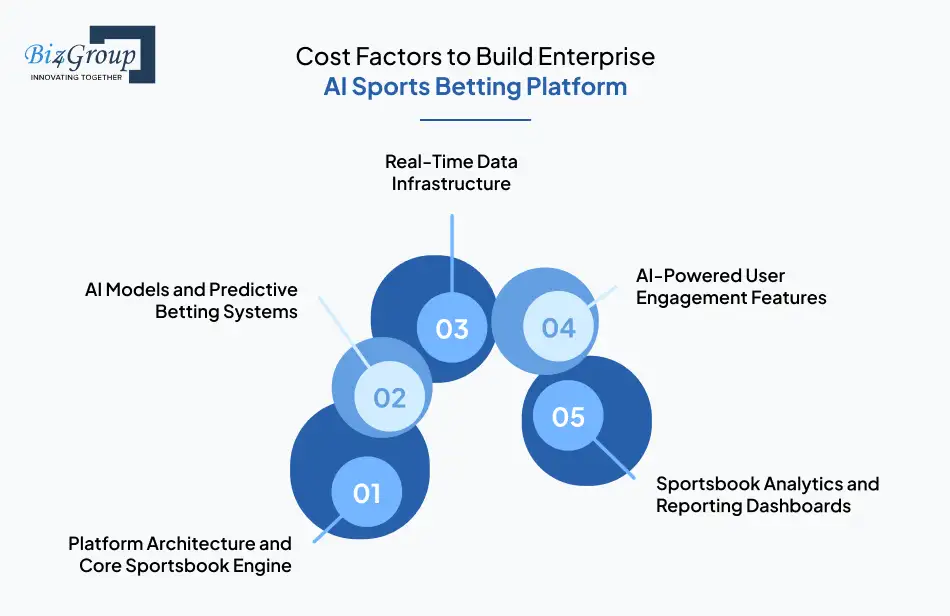
After estimating a rough budget, the next step is understanding what truly drives the enterprise AI sports betting platform development cost.
Most enterprise sportsbooks fall within the $30,000 to $250,000+ investment range. The exact number depends on the depth of betting markets, supported sports leagues, and the level of artificial intelligence integrated into the system.
Smaller sportsbooks often start with an MVP level product while large operators build full-scale platforms capable of handling thousands of bets per minute.
The table below summarizes the most common investment ranges.
|
Platform Level |
Estimated Cost |
Typical Scope |
|---|---|---|
|
MVP sportsbook platform |
$30,000 to $70,000 |
Core betting markets, basic odds board, simple analytics |
|
Mid-scale sportsbook |
$70,000 to $150,000 |
Multiple sports, live betting markets, deeper analytics |
|
Enterprise AI sportsbook |
$150,000 to $250,000+ |
AI models, large scale infrastructure, multi league support |
These numbers reflect the enterprise AI sports betting platform development cost for building a production ready system. The final price depends on several cost drivers explained below.
The sportsbook engine forms the backbone of the platform. This system must process thousands of wagers during peak events such as the Super Bowl or March Madness. Platforms like DraftKings and FanDuel rely on robust backend architecture to maintain real-time betting activity.
Typical features developed in this stage include:
Estimated Cost
|
Component |
Cost Range |
|---|---|
|
Core sportsbook backend |
$12,000 to $40,000 |
|
Bet processing engine |
$5,000 to $15,000 |
|
Wallet and payment modules |
$4,000 to $12,000 |
Total estimated investment: $21,000 to $67,000
This layer determines the foundation of the build enterprise AI sports betting platform cost breakdown.
Modern sportsbooks rely on data analytics to improve odds accuracy and bettor engagement. AI models analyze historical team data, betting patterns, and player performance.
These models support:
Many platforms integrate AI-powered betting assistants that suggest wagers based on data insights. Businesses exploring these capabilities often deploy systems similar to a sports betting AI agent that analyzes match statistics and betting markets in real-time.
Estimated Cost
|
AI Capability |
Cost Range |
|---|---|
|
predictive betting models |
$10,000 to $35,000 |
|
bettor behavior analytics |
$6,000 to $20,000 |
|
recommendation engine |
$5,000 to $15,000 |
Total AI development investment: $21,000 to $70,000
These capabilities significantly influence the enterprise grade AI sports betting software development expenses.
Sportsbooks depend heavily on live game data and betting odds. Without fast and reliable data streams, the betting experience suffers.
Platforms integrate sports data APIs from providers such as
These APIs deliver live scores, player stats, match events, and betting odds. A little insight... top US betting apps rely on multiple sports data providers to maintain real-time betting accuracy.
Infrastructure development typically includes real-time event streaming, live odds synchronization, game statistics ingestion, and match event processing.
Estimated Cost
|
Data Infrastructure Component |
Cost Range |
|---|---|
|
live data ingestion system |
$5,000 to $15,000 |
|
odds synchronization engine |
$4,000 to $12,000 |
|
real-time event processing |
$3,000 to $10,000 |
Total infrastructure cost: $12,000 to $37,000
Also read: Why enterprise sports data APIs like SportRadar matter more than features?
Enterprise sportsbooks compete for user attention through interactive features that improve bettor engagement.
Examples include
Estimated Cost
|
Engagement Feature |
Cost Range |
|---|---|
|
AI betting assistant |
$4,000 to $12,000 |
|
conversational chatbot |
$3,000 to $10,000 |
|
personalized betting insights |
$4,000 to $12,000 |
Total engagement feature investment: $11,000 to $34,000
These tools enhance the overall experience while influencing the budget estimate of enterprise sports betting platform.
Operators require advanced dashboards to track betting activity, manage risk exposure, and analyze bettor behavior.
Administrative dashboards typically include
These analytics systems help operators understand how betting markets perform across different sports seasons.
Estimated Cost
|
Analytics Module |
Cost Range |
|---|---|
|
admin analytics dashboard |
$4,000 to $12,000 |
|
betting activity reporting |
$3,000 to $8,000 |
|
performance analytics tools |
$3,000 to $7,000 |
Total analytics development cost: $10,000 to $27,000
|
Development Component |
Estimated Cost Range |
|---|---|
|
Sportsbook Engine |
$21,000 to $67,000 |
|
AI Prediction Systems |
$21,000 to $70,000 |
|
Real-Time Data Infrastructure |
$12,000 to $37,000 |
|
Engagement AI Features |
$11,000 to $34,000 |
|
Analytics Dashboards |
$10,000 to $27,000 |
Estimated Total: $30,000 to $250,000+
This breakdown highlights how different features influence the cost to build scalable enterprise AI sports betting platform.
Understanding these cost drivers gives businesses clarity when planning sportsbook development. The next step is to analyze the actual development stages and how each phase contributes to the development budget of enterprise AI sports betting platform.
Also read: How enterprise-grade sports APIs power $10M+ betting app valuations
Live odds feeds, AI predictions, real-time wagering. Each feature can shift your sportsbook budget dramatically. Curious what your exact platform would cost?
Let's Talk Numbers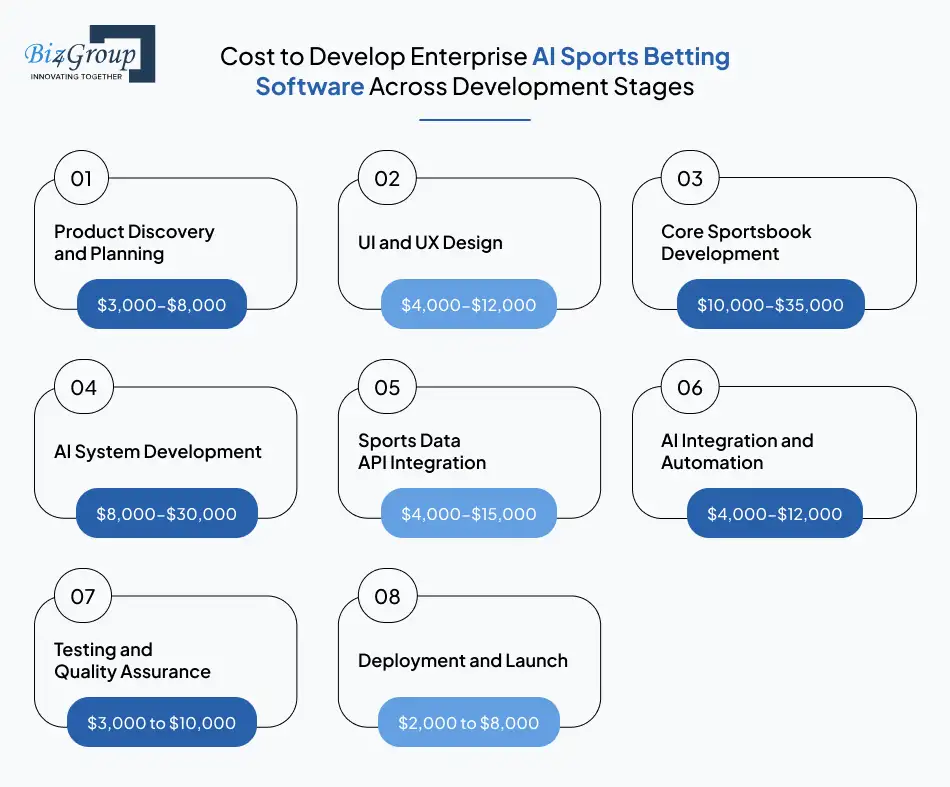
Understanding the development budget of enterprise AI sports betting platform requires looking at the project phase by phase. While the total development budget lies somewhere in the $30,000 to $250,000+ range, each stage contributes differently to the final cost to develop enterprise AI sports betting software.
The table below shows a realistic build enterprise AI sports betting platform cost breakdown based on development phases.
|
Development Phase |
Key Activities |
Estimated Cost |
|---|---|---|
|
Product Discovery and Planning |
Market research, sportsbook requirements, platform roadmap, betting market selection |
$3,000-$8,000 |
|
Betting interface design, odds board layout, bet slip experience, mobile optimization |
$4,000-$12,000 |
|
|
Core Sportsbook Development |
User accounts, wallet systems, betting engine, odds board, bet settlement systems |
$10,000-$35,000 |
|
AI System Development |
Predictive models, bettor analytics, recommendation algorithms, risk analysis tools |
$8,000-$30,000 |
|
Sports Data API Integration |
Integration of SportRadar, Genius Sports, Sports.io APIs for live scores and odds |
$4,000-$15,000 |
|
AI Integration and Automation |
AI model deployment, automated betting insights, betting assistant features |
$4,000-$12,000 |
|
Testing and Quality Assurance |
Performance testing, live odds validation, betting scenario testing |
$3,000 to $10,000 |
|
Deployment and Launch |
Cloud deployment, production environment setup, platform optimization |
$2,000 to $8,000 |
This structured approach helps companies understand the enterprise AI sports betting platform development cost before starting development.
Insight: Businesses entering the market often begin with MVP development to validate the product idea and gradually expand into a full sportsbook ecosystem.
To understand how these development phases translate into a real product, consider one of Biz4Group’s sportsbook platforms.
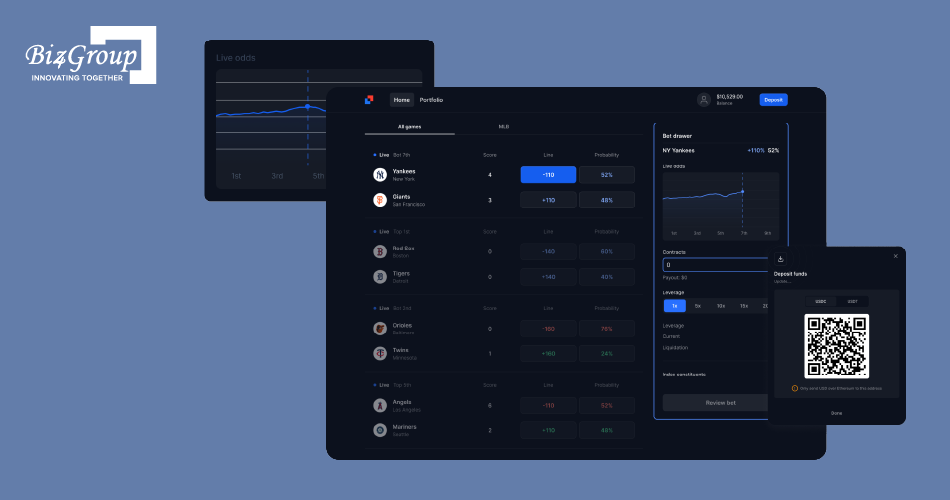
Biz4Group built a real-time sports betting platform for major global leagues including MLB, CFB, and NFL. The system was designed to handle high volumes of betting activity while maintaining accurate live game data.
Key highlights of the platform include:
This project demonstrates how structured development phases translate into a scalable enterprise sportsbook capable of supporting real-time betting activity.
Also read: How much does it cost to develop an AI sports betting app like Rithmm?
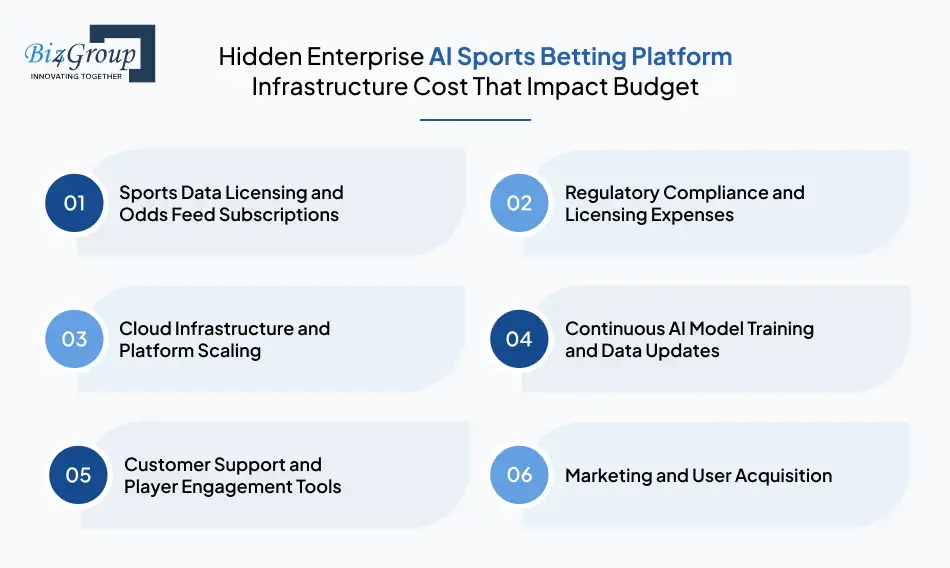
Many companies estimate the cost to build an enterprise AI sports betting platform based on development alone. The actual investment often grows after launch due to operational requirements that support a live sportsbook.
These hidden expenses can significantly influence the total investment to develop enterprise AI sports betting software. Understanding them early helps businesses prepare realistic financial projections.
Here is a quick overview of these costs:
|
Cost Category |
Estimated Range |
|---|---|
|
Sports Data Subscriptions |
$48,000 to $180,000 annually |
|
Regulatory Compliance |
$13,500 to $64,000 |
|
Cloud Infrastructure |
$18,000 to $240,000 annually |
|
AI Model Maintenance |
$12,000 to $120,000 annually |
|
Customer Support Systems |
$48,000 to $198,000 annually |
|
Marketing and Acquisition |
$5,000 to $100,000+ |
A sportsbook cannot function without reliable match data and betting odds. Live betting markets require second by second updates during games.
Most operators subscribe to multiple sports data providers to maintain accuracy across leagues such as the NFL, NBA, MLB, and NHL.
Typical subscription costs include
Many operators choose multiple providers because of the challenges discussed in why most betting apps fail at real-time match accuracy. Accurate data feeds prevent delayed odds or incorrect betting markets.
Annual cost estimate: $48,000 to $180,000
Sports betting platforms must follow strict regulatory requirements across different states. Compliance includes identity verification, location tracking, and responsible gambling systems.
Regulatory preparation often includes
Businesses entering the U.S. betting market must also evaluate sports betting regulations across US states, since each jurisdiction operates under different rules.
Typical compliance investment:
Total regulatory preparation cost: $13,500 to $64,000
Enterprise sportsbooks require scalable cloud infrastructure to handle peak betting events. Traffic spikes often occur during playoffs, championship games, and major tournaments.
Infrastructure costs usually include
Monthly infrastructure cost
Annual infrastructure investment: $18,000 to $240,000
Companies building enterprise AI solutions often allocate significant resources toward scalable infrastructure that supports high user traffic.
AI models require continuous updates to remain accurate. Betting predictions depend on historical match data, player statistics, and betting market behavior.
Typical AI maintenance activities include
Monthly AI optimization cost
Annual AI optimization investment: $12,000 to $120,000
Many sportsbooks explore how platforms use AI for sports betting to refine wagering predictions.
Sportsbook platforms must support bettors during live games, betting disputes, and payment issues. Customer support systems often include chat platforms, help desk tools, and automated responses.
Typical support infrastructure costs
Annual customer support cost: $48,000 to $198,000
Platforms that invest in generative AI often automate large parts of customer interaction while improving response speed.
Attracting bettors requires strong marketing strategies. Many sportsbooks partner with affiliate websites, sports influencers, and betting communities to drive traffic.
Typical marketing channels include
Also read: A guide to building a sports betting affiliate website
Typical marketing budget
Understanding these hidden costs helps businesses calculate a realistic long-term budget estimate of enterprise sports betting platform before launching their sportsbook.
Sports data licenses, compliance tools, cloud scaling. Many sportsbooks underestimate these and overspend later.
Get a Custom Quote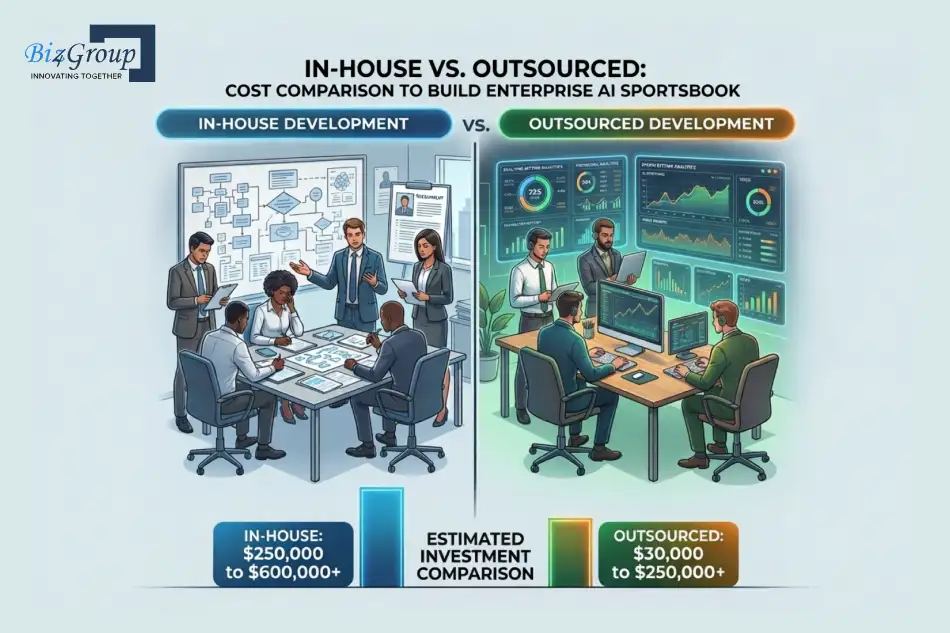
One of the biggest decisions that affects the cost to build scalable enterprise AI sports betting platform involves choosing between in-house development and outsourcing to a specialized team.
The table below compares both approaches and highlights how they influence the cost to develop enterprise AI sports betting software.
|
Factor |
In-House Development |
Outsourced Development |
|---|---|---|
|
Talent acquisition |
Requires hiring data scientists, AI engineers, backend developers, and UI designers. |
External teams already have experienced engineers. Businesses can hire AI developers with sportsbook experience without long recruitment cycles |
|
Development team salaries |
Salaries for a full sportsbook team including AI engineers, backend developers, and product managers can cost $35,000 to $120,000 per month depending on team size |
Outsourcing teams typically work on project-based contracts. Development budgets often fall between $30,000 and $250,000+ depending on platform complexity |
|
Technology expertise |
Internal teams may need time to understand sportsbook algorithms, betting markets, and odds engines |
Experienced vendors already specialize in sportsbook platforms and AI product development services |
|
Time to launch |
Recruiting and onboarding delays often extend development timelines to 10 to 14 months |
Established teams deliver platforms faster with timelines around 4 to 8 months |
|
Infrastructure planning |
Internal teams must design architecture, DevOps pipelines, and infrastructure from scratch |
Outsourcing partners often provide ready frameworks for enterprise sportsbook architecture |
|
Risk management |
Inexperienced teams may struggle with betting logic, odds management, and compliance requirements |
Specialized vendors already understand sportsbook risk models and platform scalability |
|
Budget flexibility |
Fixed salaries and infrastructure commitments increase long-term operational expenses |
Outsourced development offers flexible pricing models and milestone-based payments |
|
Development Model |
Estimated Cost Range |
|---|---|
|
In-house sportsbook development |
$250,000 to $600,000+ |
|
Outsourced sportsbook development |
$30,000 to $250,000+ |
This comparison highlights why outsourcing has become a preferred option when estimating the development budget of enterprise AI sports betting platform.
Some businesses reduce initial investment further by launching a sports betting app MVP before expanding to a full sportsbook ecosystem.
Also read: How to develop a white-label sports betting platform?
Outsourcing often becomes the better option when businesses want to
For startups, gaming companies, and sports media brands entering the betting industry, outsourcing development allows them to focus on product strategy and user acquisition while experts handle the technical implementation.
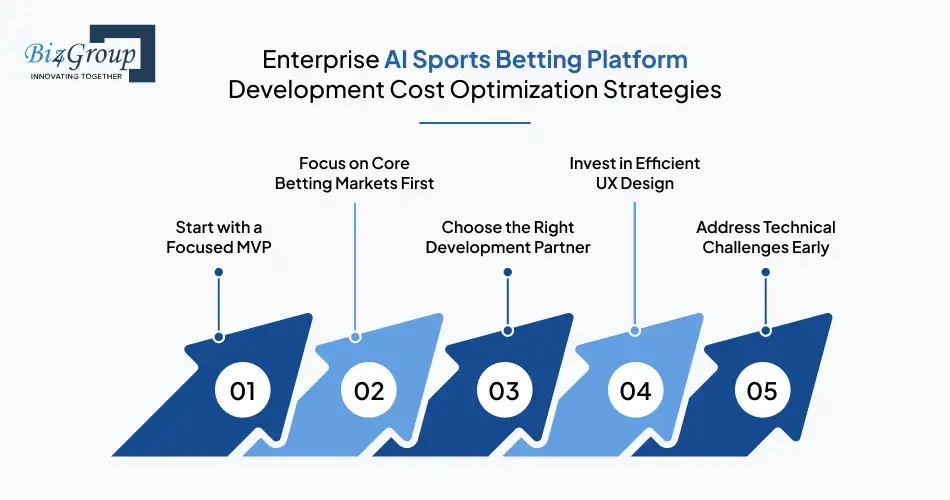
Building a sportsbook platform requires careful financial planning. While the cost to build scalable enterprise AI sports betting platform can reach six figures, businesses can apply smart development strategies to control expenses.
The goal is not to cut corners. Instead, it is about optimizing the development budget of enterprise AI sports betting platform while maintaining performance, security, and scalability.
Below are several proven approaches used by sportsbook operators.
Launching a fully loaded sportsbook from day one increases the enterprise AI sports betting platform development cost significantly.
Many successful betting platforms start with a smaller feature set that focuses on core wagering markets.
Typical MVP features include
This approach allows businesses to validate user demand before expanding into advanced features such as AI betting recommendations or multi league analytics.
Estimated Savings: Launching with an MVP can reduce initial development investment by 35-50%.
Also read: Top 12+ MVP development companies in USA
Adding every league and betting market from the start increases development complexity.
Instead, platforms often begin with high demand leagues such as
Expanding gradually helps control the budget estimate of enterprise sports betting platform while keeping infrastructure manageable. It also allows operators to analyze user behavior before investing in additional sports markets.
Estimated Savings: Limiting the platform to major leagues during launch can reduce development scope by 20-30%.
Working with an experienced software development company significantly reduces technical risks and development delays.
Sports betting platforms require expertise in
Choosing the top AI sports betting software development company can shorten timelines and optimize the build enterprise AI sports betting platform cost breakdown.
Estimated Savings: Experienced sportsbook development teams can reduce development time by 25-40%.
Also read: Top 14 sports betting software development companies in the USA
User experience strongly influences bettor retention. Poor interface design often leads to abandoned bets or low user engagement.
A well structured sportsbook interface ensures
A clean interface improves engagement without significantly increasing the enterprise grade AI sports betting software development expenses.
Estimated Savings: An optimized betting interface can reduce redesign and usability correction costs by 10-20%.
Also read: Top 15 UI/UX design companies in USA
Sports betting platforms often face technical hurdles such as
Understanding the challenges in modern sports betting app development early allows development teams to design solutions before those issues increase project costs.
Estimated Savings: Identifying technical risks can prevent major infrastructure revisions later, reducing potential rework costs by 15-25%.
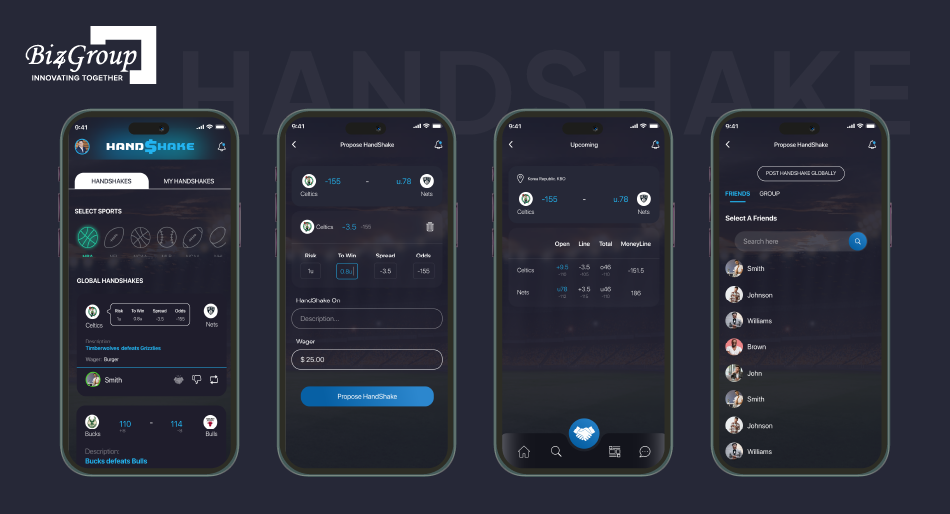
Cost optimization strategies often become clearer when looking at real projects.
With its exceptional AI app development services, Biz4Group developed a social betting app for sports enthusiasts who enjoy wagering with friends or communities.
Instead of building a traditional sportsbook with hundreds of betting markets, the platform focused on engagement-driven features.
Key highlights include
The project demonstrates how narrowing the initial feature scope can significantly reduce the budget required to create enterprise AI sports betting systems without compromising innovation.
Cost optimization strategies help businesses launch sportsbooks efficiently while keeping development investment within a manageable range.
The right development strategy can reduce sportsbook development costs by 30–50% while still delivering enterprise performance.
Talk to Biz4Group's Sportsbook Experts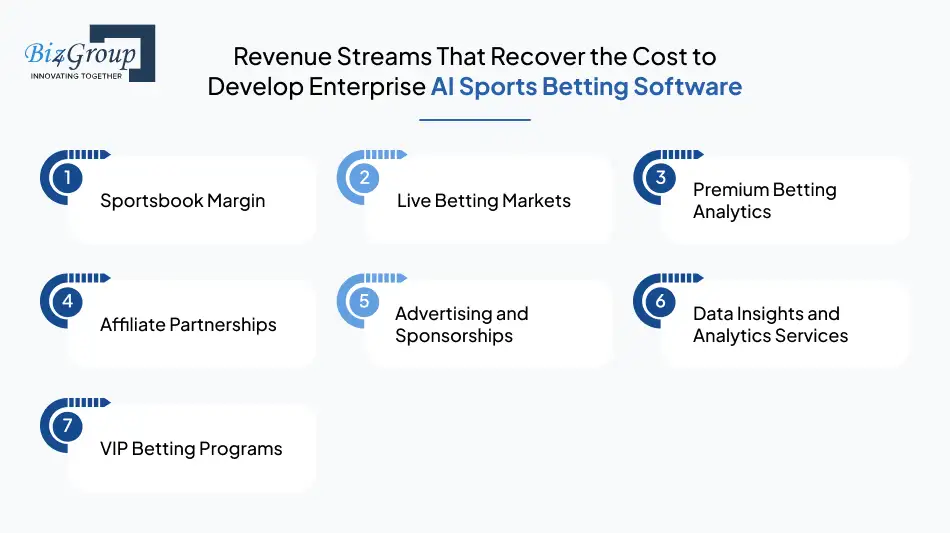
Once businesses understand the cost to build an enterprise AI sports betting platform, the next logical question focuses on revenue. How does a sportsbook generate enough income to recover the investment and sustain long-term growth?
Enterprise sportsbooks generate revenue through multiple channels. These monetization strategies help operators recover the total investment to develop enterprise AI sports betting software while expanding their betting ecosystem.
The table below highlights the most common revenue streams used by modern sportsbooks.
|
Monetization Model |
How It Works |
Revenue Potential |
|---|---|---|
|
Sportsbook Margin |
The platform earns a percentage of every bet placed through the built-in sportsbook margin on moneyline, spread, and over under bets |
5-10% of total betting handle |
|
Live Betting Markets |
In game wagering during live matches such as NFL or NBA games increases betting activity and transaction volume |
Can increase betting volume by 25-40% during major games |
|
Premium Betting Analytics |
Platforms offer advanced analytics dashboards, predictive insights, and player performance data through subscription plans |
$10-$50 per user monthly depending on feature depth |
|
Affiliate Partnerships |
Sports media websites and betting communities promote the platform in exchange for commissions on new bettors |
$50-$300 per referred user depending on region |
|
Advertising and Sponsorships |
Sports brands, betting partners, and fantasy platforms pay to advertise within the sportsbook platform |
$5,000-$50,000 annually depending on user base |
|
Data Insights and Analytics Services |
Platforms monetize anonymized betting trends and player behavior analytics for sports analysts and media companies |
$10,000-$100,000 annually depending on data volume |
|
VIP Betting Programs |
High value bettors receive exclusive betting limits, rewards, and promotional offers to increase wagering activity |
VIP bettors often generate 20-40% of total sportsbook revenue |
These monetization strategies play a major role in offsetting the enterprise AI sports betting platform development cost. Platforms that combine multiple revenue streams often recover their development budget of enterprise AI sports betting platform faster than those relying solely on sportsbook margins.
Also read: How do AI sports betting apps like FanDuel make money?
Understanding the cost to build an enterprise AI sports betting platform is only one part of the equation. The real advantage comes from choosing the right technology partner who knows how to optimize that investment while building a platform capable of competing with top sportsbooks.
This is where Biz4Group LLC stands out.
Biz4Group LLC is a USA-based sports betting app development company that specializes in enterprise software engineering, artificial intelligence platforms, and complex digital ecosystems. Our approach focuses on building platforms that perform well under real sportsbook conditions. That includes handling thousands of concurrent wagers during live games, processing real-time sports data, and maintaining accurate betting markets across multiple leagues.
Our engineers specialize in building resilient data ecosystems through advanced sports betting API integration services, enabling sportsbooks to process live match events and betting odds with precision.
Most importantly, we focus on building platforms that scale. Whether the goal is launching a niche sportsbook focused on one league or developing a multi-sport enterprise betting ecosystem, our architecture ensures the platform grows without unnecessary infrastructure costs.
Our clients often highlight several reasons for partnering with us.
Our portfolio includes advanced sportsbook systems, social betting platforms, and real-time analytics dashboards that support thousands of users simultaneously. These experiences allow us to anticipate technical challenges and design solutions before they affect project timelines or budgets.
For organizations evaluating the budget required to create enterprise AI sports betting systems, working with an experienced partner significantly reduces development risks while ensuring the final product remains competitive in the market.
We are the experienced partner you need. Let’s build something extraordinary together.
Understanding the cost to build an enterprise AI sports betting platform requires more than a rough development estimate. A modern sportsbook operates as a complex digital ecosystem that combines real-time data feeds, AI based predictions, secure payment systems, and scalable infrastructure capable of handling thousands of wagers during major games.
For most organizations entering the betting industry, the investment typically falls between $30,000 and $250,000+, depending on the scope of the platform. Factors such as supported leagues, predictive analytics, live betting markets, and platform scalability directly influence the development budget of enterprise AI sports betting platform.
This is where experienced technology partners make a significant difference. Biz4Group LLC, a seasoned AI development company, has helped businesses build scalable sportsbook platforms that combine real-time betting engines, AI powered analytics, and enterprise grade architecture. Our team focuses on delivering solutions that balance performance, reliability, and cost efficiency so businesses can enter the sports betting market with confidence.
If you are planning to launch a sportsbook and want a clear roadmap for the cost to develop enterprise AI sports betting software, the Biz4Group team is ready to help.
Reach out today and let’s turn your sportsbook vision into a powerful AI-driven platform built for the next generation of betting.
Each additional league introduces new data feeds, betting markets, statistics pipelines, and odds calculations. Supporting one or two leagues may require minimal infrastructure changes, but expanding to multiple leagues like NFL, NBA, MLB, NHL, and NCAA significantly increases data processing requirements. Adding several leagues can increase the enterprise sportsbook platform budget by $8,000 to $30,000 depending on the level of analytics and betting markets offered.
Scalability determines how well a sportsbook handles traffic spikes during major events such as playoffs or championship games. Platforms designed for higher concurrency require load balancing systems, scalable databases, and distributed infrastructure. Building a scalable system from the beginning can add $10,000 to $40,000 to the development budget but prevents expensive infrastructure upgrades later.
Yes. Live betting or in game wagering requires real-time odds updates, rapid bet validation, and event based data processing. These systems must process game events within seconds while adjusting odds dynamically. Implementing live betting capabilities can add $7,000 to $25,000 to the development investment depending on the number of sports and betting markets supported.
Sports betting platforms rarely remain static. New betting markets, user engagement features, and performance upgrades are added regularly. Businesses often allocate 15-25% of the initial development budget annually for feature upgrades and platform enhancements.
Supporting both mobile apps and web platforms increases development scope because separate interfaces and optimization layers are required. Developing cross-platform functionality may add $8,000 to $30,000 depending on the number of platforms and device compatibility requirements.
Yes. Social betting features such as leaderboards, peer challenges, community wagering groups, and public betting pools require additional backend logic and real-time interaction systems. Implementing these features typically adds $4,000 to $15,000 to the sportsbook development cost depending on the level of social engagement built into the platform.

with Biz4Group today!
Our website require some cookies to function properly. Read our privacy policy to know more.