 Location :
Orlando, FL, USA
Location :
Orlando, FL, USA +1 (407) 714-1616
 info@biz4group.com

- Building a Telehealth app like Teladoc Health is about designing real healthcare workflows, compliance, and scale, not just video consultations.
- Platforms that succeed with telehealth app development like Teladoc focus on specific care models first, then expand features and intelligence as adoption grows.
- Market momentum is strong, with telehealth adoption accelerating across the US due to provider shortages, cost pressures, and changing patient expectations.
- The cost to build a telehealth app like Teladoc Health typically falls in the USD 30,000 to USD 250,000+ range, depending on MVP scope, and compliance depth.
- Long term value comes from monetization models like subscriptions, enterprise licensing, and provider enablement.
- Teams that develop telehealth applications like Teladoc Health successfully prioritize architecture, interoperability, and regulatory alignment to avoid costly rebuilds later.
Open your calendar from five years ago and compare it to today. In person appointments were once the default. Now virtual visits quietly fill schedules across devices, time zones, and specialties. That shift did not happen overnight, and it is not slowing down. This is the context behind building a Telehealth app like Teladoc Health and why decision makers keep circling the same questions:
- How to build a telehealth app like Teladoc Health?
- How to create a virtual doctor consultation app?
- What are the features needed for a telemedicine app like Teladoc Health?
- Can AI be used in telehealth apps?
- What is the cost to develop a telehealth app?
The scale behind telehealth app development like Teladoc is hard to ignore once you look at the numbers:
- In the United States, the telehealth market is projected to grow at nearly 24 percent annually through 2030, according to Grand View Research.
- Globally, telehealth and telemedicine are expected to expand to USD 180.86 billion by 2030, based on data from ScienceSoft.
This growth curve explains why early conversations with an AI app development company now happen alongside product discovery, not after it.
For founders, CTOs, and product leaders, this conversation is rarely theoretical. Provider shortages continue to stretch care teams thin. Patients expect access that feels instant and intuitive. Compliance requirements keep evolving. All of it lands on the same roadmap. This is where practical thinking around AI healthcare solutions starts influencing long term architecture and operational decisions, not just feature wish lists.
If your team is evaluating how to develop telehealth applications like Teladoc Health, the goal is not imitation. It is clarity. Clarity on what makes virtual care scalable, compliant, and trusted, and where it makes sense to develop AI telemedicine app capabilities that support real business outcomes. This blog will break everything down in a way that keeps both technology and strategy grounded in reality.
Understanding Telehealth Apps Like Teladoc Health
Apps like Teladoc Health are digital care platforms where patients and clinicians connect securely, on demand, and at scale. The focus stays on access, continuity of care, and operational efficiency, not just video calls.
- A centralized platform for virtual doctor consultations and follow ups
- Secure patient onboarding, scheduling, and medical data handling
- Real time communication between patients and licensed providers
- Care workflows designed around compliance and clinical accuracy
- A foundation that allows teams to integrate AI into an app over time
For teams exploring building a Telehealth app like Teladoc Health, this means designing a system that balances patient experience, provider efficiency, and long term scalability from day one.
How do Virtual Healthcare Apps Like Teladoc Health Operate?
At a practical level, building a Telehealth app like Teladoc Health is about orchestrating multiple workflows into one dependable system. Each layer supports the next, and understanding this flow helps teams make smarter architectural decisions early on.
1. Patient Access and Onboarding
Everything begins with how users enter the platform. Secure registration, identity checks, and basic medical context set the stage for telehealth app development like Teladoc without adding unnecessary friction. Poor onboarding almost always leads to early drop offs.
2. Provider Availability and Routing
Once patients are inside the system, intelligent routing connects them with the right clinicians based on specialty, availability, and location constraints. This layer becomes essential when teams aim to build virtual healthcare apps like Teladoc that can handle growing demand smoothly.
3. Consultation and Care Delivery
Consultations take place through secure video, audio, or chat interfaces. Documentation, prescriptions, and follow ups remain within the same workflow, which is critical when teams create telemedicine platforms like Teladoc that feel consistent and clinically reliable.
4. Data Handling and Administrative Workflows
Every interaction produces sensitive data that must be processed, stored, and audited correctly. This is where AI in healthcare administration automation helps reduce manual workload around notes, scheduling, and compliance tasks while keeping systems aligned.
|
Operation |
What It Handles |
Why It Matters |
|---|---|---|
|
Patient Layer |
Onboarding, profiles, appointments |
Supports adoption & continuity |
|
Provider Layer |
Scheduling, consultations, notes |
Maintains clinical efficiency |
|
Platform Layer |
Security, data flow, compliance |
Enables scalability and trust |
When teams plan to develop telehealth applications like Teladoc Health, this operating structure becomes the reference point. It quietly influences how features are prioritized, how costs evolve, and what the next strategic decisions should focus on.
Thinking About Building What Teladoc Built?
Before building a Telehealth app like Teladoc Health, it helps to validate workflows, compliance, and scale assumptions early.
Explore Your Telehealth App IdeaWhy Businesses Invest in Telehealth App Solutions Like Teladoc Health?
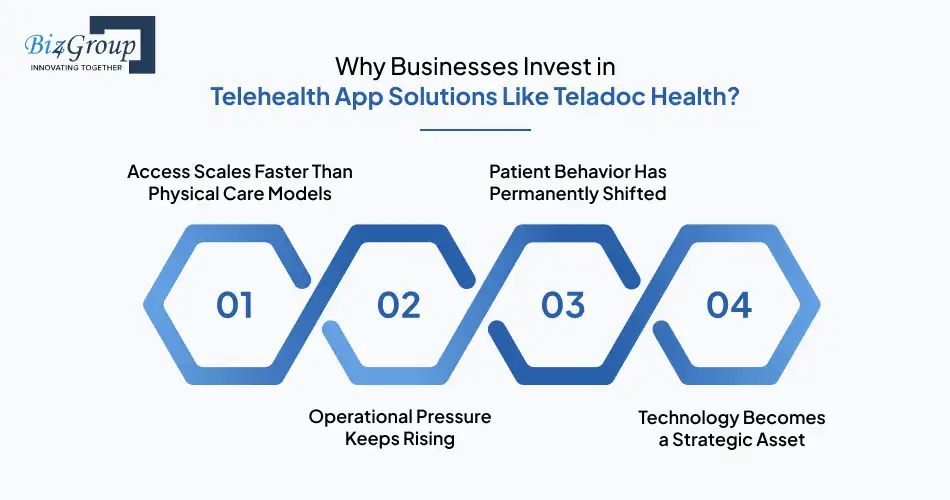
For most leadership teams, building a Telehealth app like Teladoc Health is not a leap of faith. It is a response to how care delivery, patient behavior, and operational pressure are already changing inside their organizations.
1. Access Scales Faster Than Physical Care Models
Virtual care allows organizations to reach more patients without adding clinics or stretching staff thin. That flexibility is a core reason many teams explore telehealth app development like Teladoc as part of long-term growth planning rather than short term innovation.
2. Operational Pressure Keeps Rising
Care teams are buried under scheduling, documentation, and coordination tasks that do not improve outcomes. Platforms that quietly embed AI automation services help reduce that load, which frees clinicians to focus on care instead of process.
3. Patient Behavior Has Permanently Shifted
Patients are no longer impressed by virtual care. They expect it. Organizations that build virtual healthcare apps like Teladoc tend to meet patients where they already are, instead of asking them to adapt to outdated delivery models.
4. Technology Becomes a Strategic Asset
As platforms mature, data, workflows, and insights compound in value. This is where enterprise AI solutions start shaping how care is delivered, measured, and optimized over time, rather than acting as isolated features.
When teams decide to develop telehealth applications like Teladoc Health, the next question is rarely about whether it will be used. It is about how those platforms show up in real clinical and operational scenarios, which brings us to actual use cases.
Common Use Cases for Telehealth App Solutions Like Teladoc Health
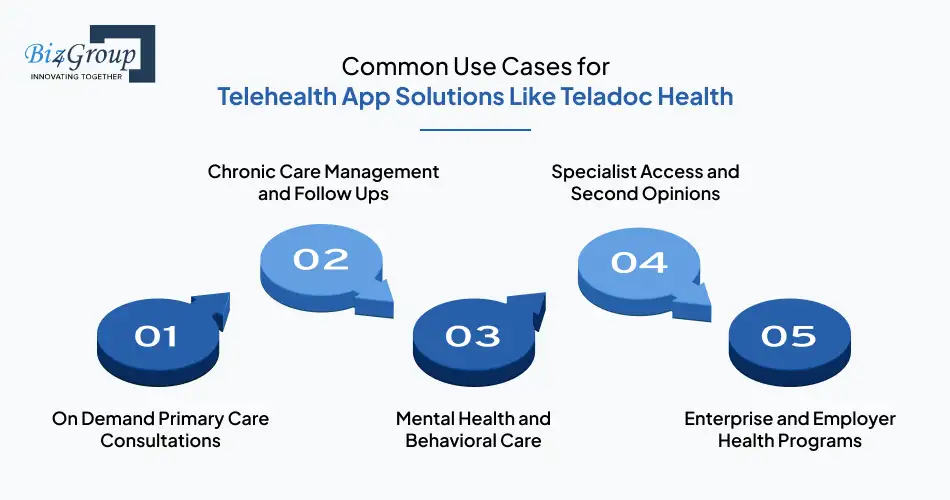
When teams evaluate building a Telehealth app like Teladoc Health, they usually start by mapping real care scenarios to product decisions. These platforms succeed because they solve specific, repeatable problems across patients, providers, and healthcare organizations, which shows up clearly in the use cases below.
1. On Demand Primary Care Consultations
Virtual visits allow patients to connect with licensed clinicians without long wait times or travel. This use case often drives early adoption when teams create telemedicine platforms like Teladoc focused on speed, access, and everyday care needs.
- Example: A patient schedules a same day virtual visit for flu symptoms and receives a treatment plan within minutes.
2. Chronic Care Management and Follow Ups
Ongoing conditions require consistent touchpoints rather than occasional visits. Many organizations rely on telehealth app development services like Teladoc Health to support regular check ins, medication reviews, and care continuity outside clinics.
- Example: A diabetes patient completes monthly virtual follow ups to review vitals and adjust care plans.
3. Mental Health and Behavioral Care
Privacy, accessibility, and flexibility make virtual care a strong fit for mental health services. This is where thoughtful AI chatbot integration often supports intake, scheduling, and early screening workflows.
- Example: A user books recurring therapy sessions and completes pre visit assessments digitally.
4. Specialist Access and Second Opinions
Telehealth removes geographic barriers to specialized care. Teams that build digital healthcare consultation apps use this model to extend expertise without expanding physical networks.
- Example: A rural patient consults a specialist located in another state for a second opinion.
5. Enterprise and Employer Health Programs
Organizations adopt virtual care to support employee wellness at scale. This frequently involves guidance from AI consulting services and careful AI assistant app design to keep interactions intuitive for large user groups.
- Example: A large employer offers virtual doctor access as part of its employee benefits program.
|
Use Case |
Primary Value |
Typical Outcome |
|---|---|---|
|
Primary Care |
Faster access |
Reduced wait times |
|
Chronic Care |
Continuity |
Better long-term outcomes |
|
Mental Health |
Privacy and flexibility |
Higher engagement |
|
Specialist Care |
Broader reach |
Improved access |
|
Employer Programs |
Scalability |
Lower care costs |
Semuto is a personalized healthcare recommendation platform that guides users toward relevant health apps and services based on individual needs. It highlights how discovery, personalization, and decision support can be embedded into telehealth ecosystems to simplify user journeys before a doctor interaction even begins.
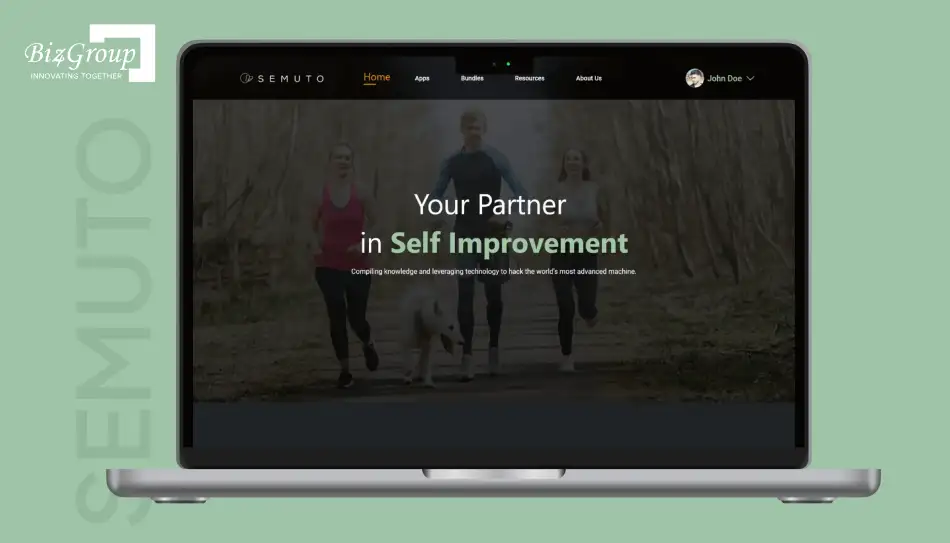
As teams plan custom telehealth app development like Teladoc Health, these use cases help clarify which features matter most and which workflows deserve deeper attention. That naturally brings the conversation to the capabilities required to support them effectively.
Core Features for Telehealth App Development Like Teladoc Health
When teams begin building a Telehealth app like Teladoc Health, feature decisions shape everything that follows. These core capabilities form the foundation of reliable virtual care and influence how patients, providers, and operations experience the platform:
|
Core Feature |
What It Enables |
|---|---|
|
Secure User Authentication |
Ensures patient and provider identities are verified and protected |
|
Patient Profile Management |
Centralizes medical history, preferences, and visit records |
|
Appointment Scheduling |
Supports real time availability and flexible booking |
|
Video and Audio Consultations |
Enables secure, compliant virtual visits |
|
In App Messaging |
Allows follow ups and non-urgent communication |
|
Clinical Documentation |
Captures notes, prescriptions, and visit summaries |
|
Facilitates digital prescription handling and tracking |
|
|
Billing and Payments |
Manages consultation fees and reimbursements |
|
Compliance and Security Controls |
Supports regulatory and data protection requirements |
|
Platform Administration Panel |
Gives teams visibility into users, workflows, and system health |
Teams often work with AI integration services at this stage to ensure these features connect smoothly without creating operational friction.
Once these fundamentals are in place, it becomes far easier to develop online doctor consultation app Teladoc Health workflows that feel cohesive. That opens the door to advanced capabilities that push efficiency and experience further.
Are These the Right Features for Your Platform?
Telehealth app development like Teladoc works best when features match real care models, not assumptions.
Validate My Feature StrategyAdvanced Features in Custom Telehealth App Development Like Teladoc Health
Once the fundamentals are stable, building a Telehealth app like Teladoc Health becomes less about access and more about intelligence, efficiency, and scale. These advanced capabilities are where platforms begin to differentiate and support complex care delivery.
1. Smart Triage and Patient Routing
Advanced platforms assess symptoms, urgency, and care history before assigning providers. This is often shaped through AI model development to improve accuracy while reducing unnecessary clinician workload.
2. Conversational Intake and Virtual Assistance
Automated intake flows help collect context before a visit begins. Many teams rely on an AI chatbot development company to design experiences that feel natural without replacing clinical judgment.
3. Clinical Decision Support Systems
Data driven insights assist providers during consultations without dictating outcomes. This layer becomes critical when teams aim to create remote healthcare platform like Teladoc Health that supports consistent care quality at scale.
4. Predictive Care and Follow Up Automation
Patterns across visits can highlight risks and prompt proactive outreach via predictive analytics. These systems often evolve through generative AI models that learn from anonymized care data over time.
5. Advanced Security and Compliance Intelligence
Beyond baseline safeguards, platforms monitor access behavior and data usage continuously. This is especially important for teams exploring how to create a HIPAA compliant telehealth app like Teladoc Health as they grow across regions.
Dr Ara is an AI powered athletic health platform designed to help users assess injuries, understand recovery paths, and make informed decisions without immediate in person visits. The product reflects how intelligent triage and remote guidance can sit at the core of scalable telehealth platforms focused on faster care access.

As organizations plan to make a telehealth app for on demand doctor consultations like Teladoc Health, these advanced features shape how the platform performs under real world pressure. Now, let’s talk about the process required to bring all of this together, step by step.
How to Develop Telehealth Applications Like Teladoc Health: A Step-by-Step Process
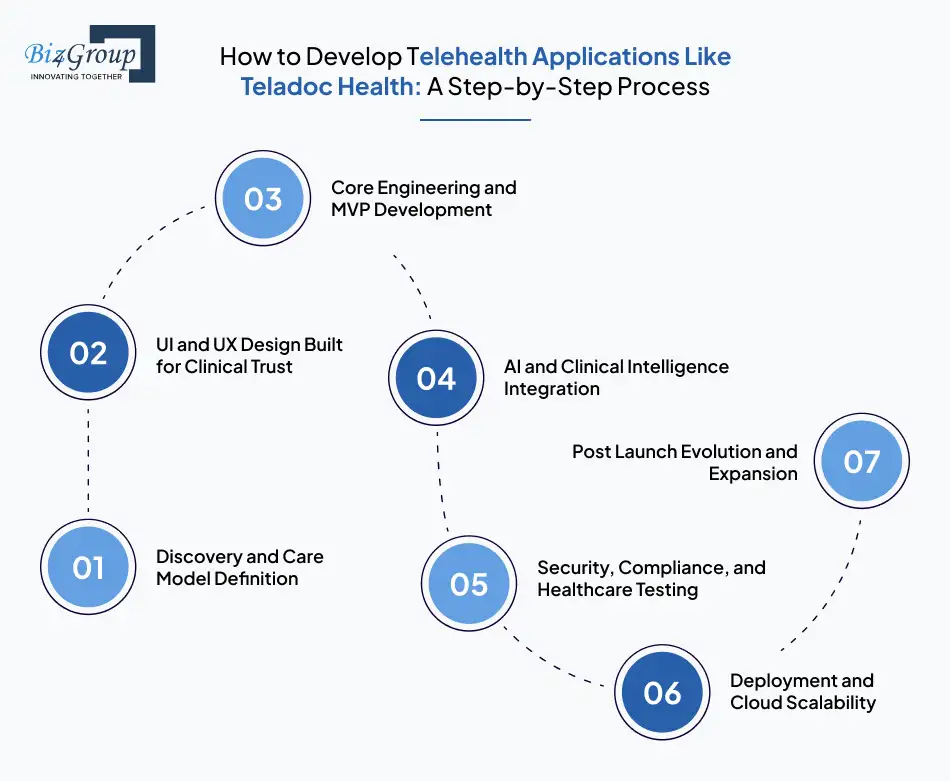
When the goal is building a Telehealth app like Teladoc Health, the process cannot be generic or rushed. It has to reflect how large scale virtual care platforms are planned, regulated, and adopted in real US healthcare environments. Each step below mirrors decisions serious product teams actually face.
1. Discovery and Care Model Definition
Everything starts with deciding what kind of virtual care you are truly enabling. Teams exploring telehealth app development like Teladoc quickly realize that clarity around care models prevents overbuilding and misalignment later.
- Identify priority services such as primary care, mental health, or chronic care
- Define how patients enter the system and how providers deliver care digitally
- Align early with licensing, reimbursement, and compliance requirements
- Set success metrics tied to care delivery, not just app usage
2. UI and UX Design Built for Clinical Trust
Virtual care depends heavily on confidence and clarity. Patients need reassurance, and providers need efficiency. This is where many teams offering custom telehealth app development services like Teladoc Health partner with a seasoned UI/UX design company.
- Design patient journeys that reduce anxiety and confusion
- Create provider interfaces that support fast, focused consultations
- Test workflows across demographics and care scenarios
- Ensure accessibility and consistency across devices
Also read: Top 15 UI/UX Design Companies in USA: 2026 Guide
3. Core Engineering and MVP Development
Platforms like Teladoc Health did not launch fully formed. They started with MVP development services that delivered reliable care. Teams aiming to build virtual healthcare apps like Teladoc benefit from validating fundamentals before scaling.
- Implement scheduling, secure consultations, and documentation first
- Prioritize stability, uptime, and compliance over visual complexity
- Architect backend services to support future growth
- Keep workflows simple enough for real clinical adoption
Also Read: Top 12+ MVP Development Companies to Launch Your Startup in 2026
4. AI and Clinical Intelligence Integration
At scale, efficiency matters as much as access. This is where telehealth app solutions like Teladoc Health for startups and healthcare enterprises begin layering intelligence into workflows without disrupting care delivery.
- Support symptom intake and routing with structured logic
- Assist clinicians with documentation and follow up workflows
- Continuously train AI models using consultation outcomes
- Maintain transparency so AI supports decisions responsibly
5. Security, Compliance, and Healthcare Testing
Trust is earned through consistency. Teams building regulated healthcare platforms must treat compliance as an ongoing practice, not a one time milestone, especially when they develop telehealth applications like Teladoc Health.
- Validate HIPAA compliance across storage and data transmission
- Enforce role based access controls for all user types
- Stress test video and messaging under peak demand
- Maintain audit trails for accountability and traceability
Also Read: Software Testing Companies in USA
6. Deployment and Cloud Scalability
Virtual care usage is rarely predictable. Platforms must handle steady daily traffic and sudden surges with equal reliability. This is a core expectation when evaluating the best company to build telehealth apps like Teladoc Health.
- Deploy on cloud infrastructure designed for healthcare workloads
- Enable CI and CD pipelines for controlled releases
- Monitor performance, latency, and session stability
- Prepare onboarding workflows for new providers and regions
7. Post Launch Evolution and Expansion
Teladoc Health scaled by expanding services gradually, not rebuilding from scratch. Teams following this path focus on continuous improvement rather than one time launches.
- Introduce new care programs based on real usage
- Optimize workflows using patient and provider feedback
- Retrain AI systems with updated clinical data
- Track metrics tied to care quality, retention, and cost efficiency
When teams commit to this process, they move beyond simply launching an app and toward delivering sustainable virtual care. For organizations planning telehealth app solutions like Teladoc Health for startups and healthcare enterprises, the next logical step is choosing the right technology foundation to support that scale.
Architecture Decisions Matter More Than Features
Build virtual healthcare apps like Teladoc by getting the foundation right before complexity creeps in.
Discuss My Telehealth ArchitectureIdeal Tech Stack to Build Digital Healthcare Consultation Apps
When building a Telehealth app like Teladoc Health, the tech stack must support real time care delivery, strict compliance, and constant evolution. Each layer below exists for a specific reason tied to scale, reliability, and healthcare workflows:
|
Label |
Preferred Technologies |
Why It Matters |
|---|---|---|
|
Frontend Framework |
ReactJS, TypeScript |
ReactJS development enables fast, responsive patient and provider interfaces, while TypeScript reduces errors across complex consultation flows. |
|
Server-Side Rendering & SEO |
NextJS, Vercel |
NextJS development improves initial load performance and visibility for patient entry points without compromising security. |
|
Backend Framework |
NodeJS, Python |
NodeJS development handles concurrent sessions efficiently, while Python development supports healthcare logic and data heavy operations. |
|
NodeJS, REST, GraphQL |
A dedicated API layer keeps patient, provider, and admin systems loosely coupled and easier to scale. |
|
|
AI & Data Processing |
TensorFlow, PyTorch |
These frameworks support intelligent routing, risk signals, and workflow optimization at scale. |
|
Video & Real Time Communication |
WebRTC, Secure Media Servers |
Reliable real time sessions are critical for a Teladoc style consultation experience under load. |
|
Data Storage & Management |
PostgreSQL, MongoDB |
Structured clinical data and flexible interaction data need different storage strengths. |
|
Authentication & Access Control |
OAuth 2.0, JWT |
Role based access is essential for HIPAA aligned patient, provider, and admin workflows. |
|
Cloud Infrastructure |
AWS, Azure |
Elastic infrastructure supports unpredictable demand spikes without degrading care delivery. |
|
Monitoring & Observability |
CloudWatch, Prometheus |
Continuous monitoring helps catch performance or stability issues during live consultations. |
|
Compliance & Audit Logging |
Encrypted Logs, Secure Storage |
Detailed audit trails are necessary for regulatory reviews and operational transparency. |
This stack reflects how Teladoc style platforms are actually engineered, not just diagrammed. With these layers in place, teams can plan growth with fewer surprises. That clarity becomes especially important when evaluating cost, scope, and timelines for building a Telehealth app like Teladoc Health across different stages.
Cost to Build a Telehealth App Like Teladoc Health at Different Stages
When teams discuss building a Telehealth app like Teladoc Health, cost is always part of the conversation. Most platforms fall within a broad USD 30,000 to USD 250,000 plus range, depending on scope and scale. This is a ballpark figure, shaped heavily by how features, compliance, and growth plans come together:
|
Development Stage |
What’s Included |
Typical Cost Range |
|---|---|---|
|
MVP-level Telehealth App Like Teladoc Health |
Core consultations, scheduling, basic security, limited integrations built during MVP software development |
USD 30,000 to USD 70,000 |
|
Mid-Scale Telehealth App Like Teladoc Health |
Expanded features, stronger compliance controls, provider dashboards |
USD 70,000 to USD 150,000 |
|
Enterprise Level Telehealth App Like Teladoc Health |
Advanced workflows, analytics, integrations, scalability layers |
USD 150,000 to USD 250,000 plus |
Teams that create telemedicine platforms like Teladoc often see costs rise as they add compliance depth, operational tooling, and performance optimizations. This is also where working with a custom software development company helps keep scope decisions aligned with long term value rather than short term savings.
Once cost expectations are clear, attention usually shifts toward how these platforms generate revenue and justify investment over time.
Monetization Models for Telehealth App Solutions Like Teladoc Health
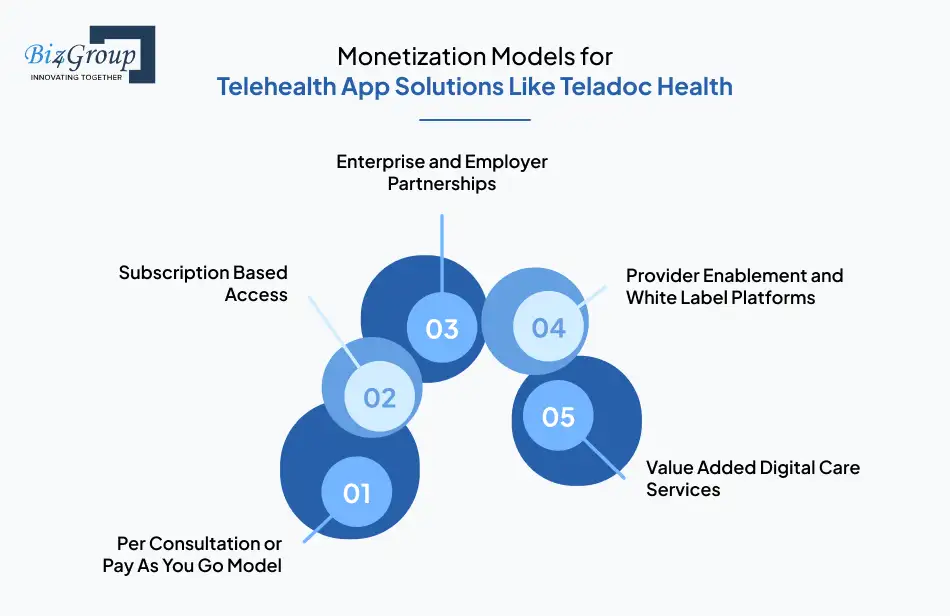
Revenue planning becomes real once building a Telehealth app like Teladoc Health moves from concept to execution. Sustainable platforms align monetization with patient behavior, provider workflows, and long term operational realities.
1. Per Consultation or Pay As You Go Model
This model charges users for each completed virtual visit and works best for on demand care. It is often chosen early when teams build digital healthcare consultation apps focused on convenience and speed.
- Example: A patient books a same day virtual visit for an acute issue and pays a fixed consultation fee, with pricing varying by provider type and visit duration.
2. Subscription Based Access
Subscriptions bring predictable revenue while encouraging consistent engagement. Managing this model at scale typically depends on custom healthcare software development to handle plans, access rules, and renewals reliably.
- Example: Users subscribe to a monthly care plan that includes unlimited primary care visits and discounted access to specialists.
3. Enterprise and Employer Partnerships
Organizations license telehealth platforms to support workforce health programs. This approach is common in telehealth app development services like Teladoc Health built for population level access.
- Example: A large employer offers virtual doctor consultations as an employee benefit, with pricing tied to total workforce size and service coverage.
4. Provider Enablement and White Label Platforms
Some platforms generate revenue by enabling clinics to offer virtual care under their own brand. This model often appears when teams develop online doctor consultation app Teladoc Health style solutions for provider networks.
- Example: A regional clinic pays a recurring platform fee to deliver branded virtual consultations using shared infrastructure.
5. Value Added Digital Care Services
Beyond consultations, platforms monetize operational tools and automation layers. These capabilities frequently leverage AI conversation app workflows and AI medical web development to improve efficiency.
- Example: Providers pay for automated follow up messaging, care reminders, and performance dashboards that reduce manual coordination.
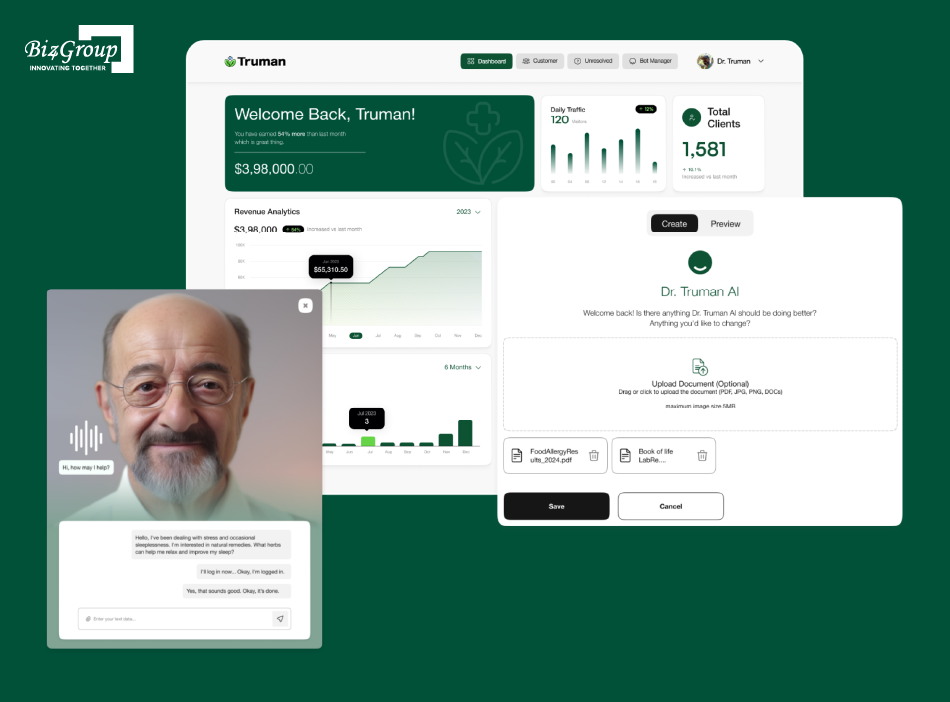
Truman is an AI enabled wellness platform offering personalized health insights, supplement guidance, and ongoing engagement through intelligent recommendations. It demonstrates how long term health management and continuous interaction models complement virtual consultations in modern telehealth platforms.
As these monetization models take shape, teams naturally turn their attention to how they are implemented and maintained over time. That brings the focus to the practices that keep telehealth platforms reliable, compliant, and scalable.
Does Your Business Model Actually Scale?
Custom telehealth app development like Teladoc Health requires monetization choices that survive real usage, not spreadsheets.
Review My Revenue ApproachBest Practices for Custom Telehealth App Development Like Teladoc Health
When teams commit to building a Telehealth app like Teladoc Health, execution quality matters as much as vision. The difference between adoption and abandonment often comes down to a few disciplined practices that shape how the platform is built and scaled.
1. Design Around Real Clinical Workflows
Virtual care must reflect how providers actually work, not how product teams imagine they do. This becomes especially important when teams aim to create remote healthcare platform like Teladoc Health across multiple specialties. Working with a software development company in Florida that understands healthcare workflows helps reduce friction during live consultations and follow ups.
2. Treat Compliance as a Continuous Process
Compliance is not a milestone you cross once. Teams building regulated platforms must bake security, auditability, and access control into every release, especially when thinking about how to create a HIPAA compliant telehealth app like Teladoc Health. Ongoing reviews help prevent gaps as features and integrations grow.
3. Scale Intelligence Without Disrupting Care
Advanced automation should support care delivery quietly. Many platforms introduce intelligence gradually through business app development using AI, focusing on routing, documentation, and operational efficiency rather than visible complexity. The goal is to reduce workload without changing how clinicians practice.
4. Plan for Operational Growth Early
Telehealth demand can spike unpredictably. Teams often hire AI developers early to ensure architecture decisions support long term scale without costly rewrites. This foresight keeps performance stable as usage expands and services grow.
When organizations make a telehealth app for on demand doctor consultations like Teladoc Health, these practices help keep the platform resilient as complexity increases. Naturally, this brings attention to the challenges teams face while applying them in real world conditions.
Challenges in Telehealth App Development Like Teladoc Health and Solutions
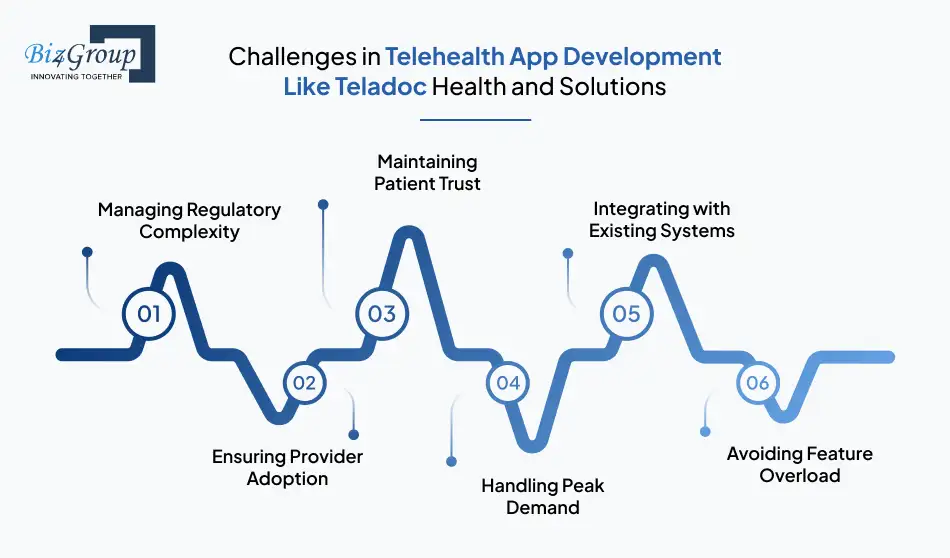
Even with a strong plan, building a Telehealth app like Teladoc Health comes with practical hurdles that surface only at scale. These challenges are about how healthcare, regulation, and user behavior intersect in the real world:
|
Top Challenges |
How to Solve Them |
|---|---|
|
Managing Regulatory Complexity |
Design compliance into architecture from day one, with continuous audits instead of one-time checks. |
|
Ensuring Provider Adoption |
Build workflows around real clinical routines and reduce clicks during live consultations. |
|
Maintaining Patient Trust |
Prioritize data security, transparency, and consistent experience across every interaction. |
|
Handling Peak Demand |
Use cloud infrastructure and load testing to prepare for sudden spikes in virtual visits. |
|
Integrating with Existing Systems |
Plan integrations with EHRs, billing, and reporting tools do not become bottlenecks later. |
|
Avoiding Feature Overload |
Focus on outcomes first and expand features only when usage data supports the decision. |
Teams that approach these hurdles early tend to avoid costly rewrites and stalled adoption. Choosing the best company to build telehealth apps like Teladoc Health often comes down to who understands these challenges before they appear. With obstacles addressed, it’s time to explore how virtual care platforms will evolve in the years ahead.
Planning for Today or the Next Five Years?
Telehealth app solutions like Teladoc Health for startups and healthcare enterprises demand long term thinking from day one.
Plan for Scalable Telehealth GrowthThe Future of Telehealth App Solutions Like Teladoc Health
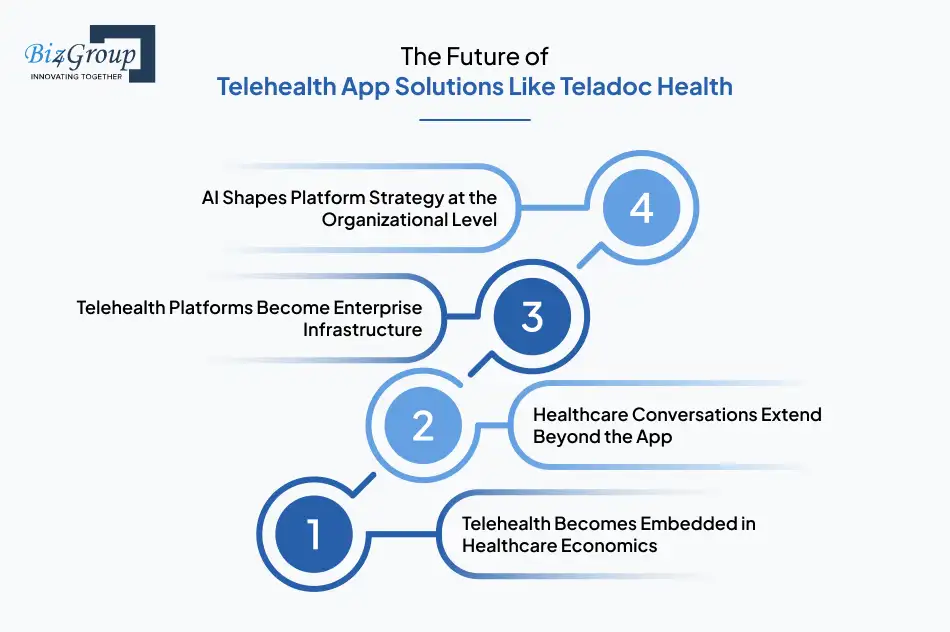
The future of building a Telehealth app like Teladoc Health is being shaped less by feature depth and more by how platforms position themselves within the broader healthcare ecosystem. What comes next is about alignment with policy, scale, and long term care delivery models.
1. Telehealth Becomes Embedded in Healthcare Economics
Virtual care platforms are increasingly evaluated on outcomes, cost efficiency, and continuity of care. This evolution pushes telehealth app development like Teladoc toward deeper alignment with value based care and payer driven models rather than visit based growth alone.
2. Healthcare Conversations Extend Beyond the App
Patient engagement is moving into continuous, guided interactions across care journeys. This shift is driving renewed focus on chatbot development for healthcare industry that supports navigation, education, and adherence outside live consultations. These systems act as connectors, not replacements.
3. Telehealth Platforms Become Enterprise Infrastructure
Virtual care is now part of employer, insurer, and public health strategies. This is accelerating demand for telehealth app solutions like Teladoc Health for startups and healthcare enterprises that can support large populations, reporting requirements, and operational oversight at scale.
4. AI Shapes Platform Strategy at the Organizational Level
AI decisions are no longer isolated technical choices. Many healthcare leaders are planning roadmaps alongside partners such as the top AI development companies in Florida to ensure platforms are built with long term intelligence, governance, and scalability in mind.
As these shifts continue, the real question becomes less about what to build and more about who should build it and guide its evolution responsibly.
Why Biz4Group LLC Is the Best Choice to Build Telehealth Apps Like Teladoc Health?
When it comes to building a Telehealth app like Teladoc Health, the real challenge is knowing what breaks once real patients, real providers, and real regulations are involved. Biz4Group’s perspective comes from building healthcare platforms that have already faced those realities.
AI Platforms like Dr Ara, Semuto, and Truman were created to support different moments in the healthcare journey, from early guidance and discovery to ongoing engagement. That range matters. It reflects how modern telehealth platforms are rarely just about video calls, but about connected experiences that evolve over time.
- Experience building healthcare products people continue to use
- Comfort working where AI, regulated data, and UX intersect
- Clear judgment on where intelligence adds value and where it complicates care
- Engineering decisions made for scale, not surface level demos
As an AI development company, Biz4Group approaches telehealth with a builder’s mindset. The focus stays on platforms that perform under pressure, adapt to growth, and still feel intuitive long after launch.
Not Sure What to Build First?
Many teams pause here when they want to develop telehealth applications like Teladoc Health without overbuilding.
Get a Clear Development RoadmapWrapping Up the Journey to Build Virtual Healthcare Apps Like Teladoc
Telehealth platforms do not succeed because they launch fast. They succeed because they are designed to survive real world healthcare chaos. Regulations shift. Patient behavior changes. Providers push back. The platforms that last are built with intention, not assumptions.
That is exactly what building a Telehealth app like Teladoc Health demands, along with the perspective of an experienced AI product development company that has already navigated these realities.
Still Mapping This Out in Your Head? Let’s turn that thinking into a clear, grounded telehealth product plan.
Talk Through Your Idea With our AI Experts
FAQs on Building a Telehealth App Like Teladoc Health
1. How long does it take to build a telehealth app like Teladoc Health?
The timeline depends on scope, compliance depth, and care models. A focused MVP can take 4 to 6 months, while a scalable platform takes longer. Teams planning telehealth app development like Teladoc usually phase delivery to validate workflows early.
2. What does it cost to build a telehealth app like Teladoc Health?
The cost typically ranges between USD 30,000 and USD 250,000 plus, depending on features, integrations, and scale. Organizations that create telemedicine platforms like Teladoc often start lean and expand as adoption and compliance needs grow.
3. Do telehealth apps like Teladoc Health need to be HIPAA compliant from day one?
Yes, compliance is not optional. Data storage, access control, and communication must align with healthcare regulations from the start. Teams exploring how to create a HIPAA compliant telehealth app like Teladoc Health usually design compliance into architecture rather than adding it later.
4. Can telehealth apps like Teladoc Health support multiple specialties?
Absolutely. Modern platforms are built to support primary care, mental health, chronic care, and specialty consultations. When teams build virtual healthcare apps like Teladoc, modular design helps expand into new specialties without rebuilding the core system.
5. Is AI necessary when building a telehealth app like Teladoc Health?
AI is not mandatory, but it becomes valuable as usage scales. It helps with routing, documentation, and operational efficiency. Many teams that develop telehealth applications like Teladoc Health introduce AI gradually rather than all at once.
6. Can startups build telehealth platforms that compete with Teladoc Health?
Yes, but not by copying features. Startups succeed by focusing on specific care gaps and scaling responsibly. This approach aligns well with telehealth app solutions like Teladoc Health for startups and healthcare enterprises that prioritize clarity over complexity.
