Location :
Orlando, FL, USA
Location :
Orlando, FL, USA +1 (407) 714-1616
 info@biz4group.com



















Imagine a digital system that doesn’t wait for instructions but instead, understands your business goals, learns from real-time feedback, and takes independent actions to get the job done.
Read More

What happens when a sportsbook that launched quickly starts growing faster than the platform supporting it? Many operators face that exact moment. Early traction brings more users, more wagers, and more expectations from bettors who demand real-time experiences.
Meanwhile, the global sports betting market continues to surge. Industry data shows the market reached about $119 billion in 2025 and is expected to exceed $125 billion in 2026, driven by online platforms, mobile adoption, and digital payment systems.
In a market expanding at this pace, operators increasingly evaluate white label to custom sports betting software development to maintain performance, flexibility, and control.
White label platforms often help sportsbooks enter the market quickly. They provide ready-made infrastructure and simplified compliance.
However, that early convenience becomes a limitation once the platform begins scaling.
At this stage many operators begin planning how to migrate from white label to custom sports betting software development so they can own their technology stack and improve long-term margins.
The industry itself reflects this shift toward platform ownership. Analysts estimate the global sports betting market generated more than $155 billion in 2025 and could reach over $256 billion by 2030. In such a competitive landscape, custom sports betting platform development for operators becomes a powerful way to build unique betting experiences, integrate advanced analytics, and deliver faster product innovation.
The transition, however, requires careful planning. Leaders exploring how to migrate from white label to custom sports betting software development need a clear strategy that balances cost, technology, and risk.
Which is why this blog is here. So, without any further ado, let's begin with the basics.
Every sportsbook operator enters the market with one question in mind. How quickly can we launch and start accepting bets?
White label platforms provide an answer to that question. They offer ready-made sportsbook infrastructure that operators can license and deploy with minimal technical development.
For startups and early-stage operators, this approach reduces the barriers to entry.
Many businesses begin their journey here before considering white label to custom sports betting software development as they grow.
A white label sportsbook is a pre-built betting platform owned by a technology provider. Operators license the platform and run their sportsbook under their own brand. The vendor manages the underlying infrastructure.
In most cases, the provider controls the betting engine, risk management tools, data integrations, and compliance framework. Operators focus on branding, marketing, and user acquisition while the vendor handles the technology layer.
For the ones building a white-label sports betting platform, this structure explains why many operators adopt the model during their early stages.
White label systems come with several integrated modules that allow sportsbooks to launch quickly.
|
Component |
Role in the Platform |
|---|---|
|
Betting Engine |
Handles wagers, odds calculation, and bet settlements |
|
Sports Data Integration |
Pulls real-time scores, statistics, and match updates |
|
Player Management |
Manages user accounts, balances, and betting history |
|
Payment Processing |
Supports deposits and withdrawals |
|
Risk Management |
Protects the platform against abnormal betting patterns |
|
Admin Dashboard |
Allows operators to monitor platform performance |
Behind these modules lies a centralized architecture controlled by the vendor. Operators receive access through a branded frontend interface.
Real-time data plays a critical role in this environment. Leading sportsbooks rely on multiple data sources to ensure accurate betting markets. Platforms that integrate diversified data feeds often achieve stronger uptime and reliability.
Also read: Why top US betting apps rely on multiple sports data providers?
Launching a sportsbook from scratch requires significant engineering investment. White label solutions reduce that burden. Operators gain several early advantages.
Faster Launch Timelines
A sportsbook can enter the market in weeks instead of spending months on development.
Lower Upfront Investment
Technology infrastructure already exists, which reduces initial development costs.
Built-In Compliance Support
Licensing frameworks, security protocols, and operational infrastructure often come packaged with the platform.
Early Product Validation
White label platforms help entrepreneurs to test their market demand before committing to full scale development.
Insight: Early-stage operators frequently combine this strategy with MVP development approaches to validate betting products and refine user experiences.
Also read: Top 12+ MVP development companies in USA
Despite the benefits, white label platforms are not fully independent systems. Operators rely on the vendor for key infrastructure elements such as:
This vendor dependency eventually shapes the long-term technology roadmap.
As sportsbooks expand and user expectations evolve, operators often realize that scaling innovation becomes difficult within a shared infrastructure model. This realization is usually the first step toward evaluating white label vs custom sportsbook software development and planning the transition to a fully controlled platform.
The next section explores those structural limitations in greater detail and explains why many operators eventually move toward custom development.
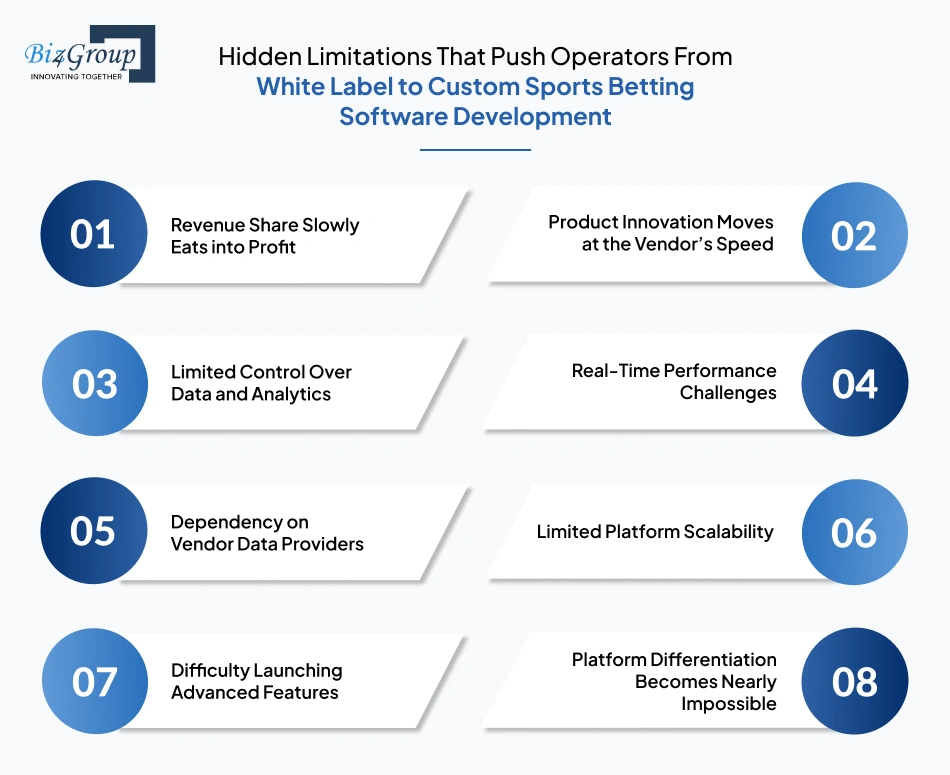
White label platforms help operators launch quickly. That advantage is real. But growth changes everything.
As sportsbooks scale, the same platform that enabled the launch begins to reveal structural limitations. These limitations often trigger the shift toward white label to custom sports betting software development.
Below are the most common challenges operators encounter.
White label vendors usually charge revenue share. Sometimes it ranges between 20% and 40%. At the start, this feels manageable. As betting volume grows, the numbers become harder to ignore.
Imagine a sportsbook generating millions in wagers each month. A large share of the profit flows back to the platform provider.
That is when many operators begin exploring the transition from white label to custom sportsbook development.
Modern bettors expect innovation. Features like AI driven predictions, dynamic odds, and real-time insights are becoming standard. But white label operators rarely control the product roadmap.
Need to integrate AI based betting insights? You must wait for the vendor.
Want to launch predictive models or automation tools? The platform provider decides the timeline.
Many sportsbooks now integrate enterprise AI solutions to power predictive betting analytics and intelligent decision systems.
Without direct infrastructure access, advanced experimentation becomes difficult. Even simple improvements may require vendor approval.
Data drives modern betting platforms. Operators want access to user behavior, betting patterns, and risk signals.
White label platforms often restrict how deeply operators can analyze their data.
That raises a critical question. Can you optimize your sportsbook without full visibility into user behavior?
Advanced operators increasingly rely on AI integration to analyze betting patterns and improve platform intelligence. Without that capability, data becomes an underutilized asset.
Sports betting thrives on speed. Odds change in seconds. Game events trigger instant betting decisions. If the platform architecture cannot process live updates quickly, the user experience suffers.
Many operators discover this when handling large betting volumes during major games.
Platforms used by leaders such as DraftKings, FanDuel, and BetMGM rely on extremely low latency systems. White label infrastructure often struggles to maintain that level of performance at scale.
Also read: Why most betting apps fail at real-time match accuracy (and how top apps fix it)
Sports data feeds power the entire betting ecosystem. Odds engines rely heavily on providers such as SportRadar and Genius Sports.
White label vendors often control which data providers are used. Operators cannot easily add or switch data feeds. That raises an important concern.
What happens if your sportsbook needs faster data feeds or deeper analytics? Many operators learn why enterprise sports data APIs like SportRadar matter more than features when evaluating sportsbook infrastructure.
Control over data pipelines becomes a key motivation behind white label vs custom sports betting software development comparison.
Early traffic looks manageable. Then a major tournament arrives. User activity spikes. Thousands of bets flow in within seconds.
White label platforms often run on shared infrastructure. Performance bottlenecks appear quickly during peak events.
Operators that plan global expansion frequently begin designing enterprise grade sports API architectures to support high traffic systems. That type of architecture rarely exists inside traditional white label systems.
Modern sportsbooks increasingly use AI to personalize betting experiences. Examples include predictive odds modeling, player behavior analytics, and automated betting recommendations.
Operators experimenting with AI automation gain stronger insights into betting patterns and fraud detection systems. These innovations are difficult to deploy inside vendor-controlled ecosystems.
Ask yourself this. If dozens of sportsbooks use the same platform, how different can the product really be?
Many white label sportsbooks end up offering identical betting interfaces.
The same markets.
The same odds displays.
The same user experience.
Large platforms such as DraftKings and BetMGM invest heavily in custom technology to avoid this problem.
Operators seeking differentiation often start planning how to build custom sports betting platform after white label limitations. Some go even further. They experiment with conversational betting assistants and predictive analytics through sports betting AI agent technologies.
White label platforms solve the launch challenge. They rarely solve the scaling challenge. That realization leads many operators to ask the next question. How exactly does a white label platform differ from custom sports betting software?
If your sportsbook is scaling, that vendor cut grows with every wager. Discover what owning your platform could mean for your margins.
Contact Biz4Group TodayEvery sportsbook operator eventually faces a strategic choice. Should the platform remain on a white label system or transition to full ownership?
At first glance both approaches appear capable of supporting betting operations. The differences become clearer as the platform grows. Revenue models change. Technology flexibility becomes critical. Product innovation starts shaping market leadership.
This is where the white label vs custom sports betting software development comparison becomes essential for operators evaluating long-term scalability.
The table below outlines the most important distinctions between the two models.
|
Factor |
White Label Sportsbook Platform |
Custom Sports Betting Software Development |
|---|---|---|
|
Platform Ownership |
Technology controlled by vendor. Operators run the brand but not the infrastructure. |
Full platform ownership. Operators control architecture, features, and integrations. |
|
Launch Time |
Fast deployment. Platforms can launch in weeks using pre-built infrastructure. |
Development takes longer because the system is built from scratch. |
|
Customization |
Limited customization. Core betting features and UI structures remain vendor controlled. |
Complete flexibility. Operators can build unique betting models, dashboards, and user experiences. |
|
Data Access |
Vendor often controls deep platform data and analytics pipelines. |
Full data ownership with advanced analytics and AI experimentation capabilities. |
|
Technology Innovation |
Innovation depends on the provider's roadmap and release cycles. |
Operators can integrate new technologies to create unique betting capabilities. |
|
Infrastructure Scalability |
Shared infrastructure may create performance limitations during high traffic events. |
Operators can build enterprise AI sports betting platforms designed for large scale betting ecosystems. |
|
Multi-Platform Expansion |
Adding new betting products or regions may require vendor approval. |
Operators can expand the platform architecture and even develop multi-tenant AI sports betting platforms to serve multiple brands. |
|
Feature Innovation |
Adding advanced capabilities like predictive insights or recommendation engines can be restricted. |
Custom systems allow operators to experiment with advanced technologies. |
|
Cost Range |
Typical setup costs range from $10,000 to $100,000+ depending on vendor and market scope. |
Development may range from $30,000 to $200,000+ depending on features and architecture. |
|
ROI Potential |
Revenue share agreements often reduce long-term profitability. |
Higher long-term ROI since operators keep platform revenue and control monetization strategies. |
The takeaway from this comparison is straightforward. White label platforms help sportsbooks launch quickly. Custom platforms help them scale, innovate, and build sustainable revenue models.
For operators planning custom sports betting platform development for operators, understanding these differences helps determine the right moment to move beyond vendor-controlled infrastructure.
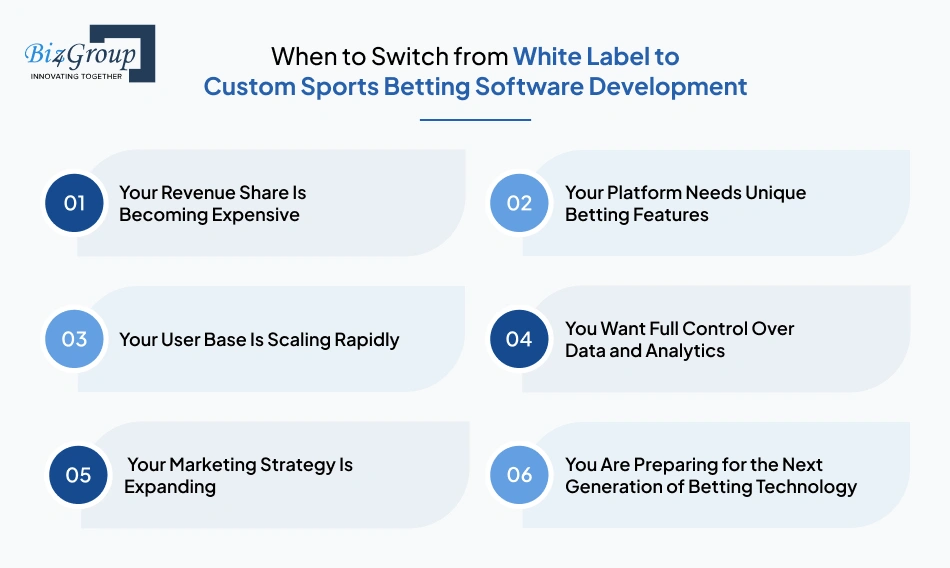
Every sportsbook reaches a turning point. At the beginning, white label platforms help operators enter the market quickly. They remove the technical burden and allow founders to focus on user acquisition.
As the platform grows, priorities begin to change. Product innovation, platform ownership, and long-term profitability start becoming more important than launch speed.
This is when many operators begin evaluating when to switch from white label to custom sportsbook platform infrastructure.
Below are the most common signals that indicate the right time to consider migrating from white label to custom sports betting software development.
Revenue share agreements feel manageable during early stages. Growth changes the equation. If your sportsbook is generating strong monthly betting volume, a significant portion of profits may still go to the vendor.
Operators often reach a point where the numbers raise an obvious question. Why continue sharing revenue when the platform already has traction?
This financial pressure is one of the most common reasons operators begin planning the transition from white label to custom sportsbook development.
Modern bettors expect innovation. Basic sportsbook functionality no longer creates differentiation. Platforms now compete on features such as predictive analytics, live insights, and personalized betting recommendations.
Operators experimenting with advanced features often explore ways to use AI for sports betting to generate predictive odds and behavioral insights.
Many white label platforms cannot support these types of innovations because the vendor controls the product roadmap.
When feature experimentation becomes a priority, custom sports betting platform development for operators becomes the logical next step.
Growth creates technical pressure. High traffic events such as playoffs or championship games place heavy demand on sportsbook infrastructure.
White label systems often operate on shared architecture. That can limit performance during peak betting windows.
Operators experiencing rapid growth frequently begin planning white label to custom sports betting software development so they can control infrastructure scalability and performance optimization.
Data drives modern betting platforms. User behavior analysis, betting patterns, and fraud detection all rely on data access.
When operators start exploring predictive analytics or automated decision engines, vendor-controlled platforms become restrictive.
Custom platforms allow operators to experiment with new capabilities such as advanced AI product development for intelligent betting systems.
This level of control becomes essential for sportsbooks focused on long-term growth.
Early sportsbooks often focus on user acquisition through advertising and partnerships. Growth opens new opportunities.
Many platforms expand into ecosystem strategies that include content driven traffic channels such as a sports betting affiliate website that attracts bettors through predictions, statistics, and game analysis.
As marketing ecosystems expand, operators often need deeper integration with analytics systems and betting infrastructure. Custom platforms provide the flexibility required to support these complex growth strategies.
Sports betting technology continues to evolve quickly. AI-driven betting models, predictive algorithms, and conversational betting interfaces are becoming part of the ecosystem.
Platforms experimenting with predictive systems often incorporate machine learning or generative AI to improve betting insights and user engagement.
White label systems rarely provide the freedom required to build and test these innovations. Operators planning the future of their platforms often move toward custom architecture long before these technologies become mainstream.
Recognizing these signals early helps operators avoid growth bottlenecks. Once these indicators start appearing, the next step becomes clear. It is time to evaluate the strategic advantages that custom sports betting software development for enterprise operators can deliver.
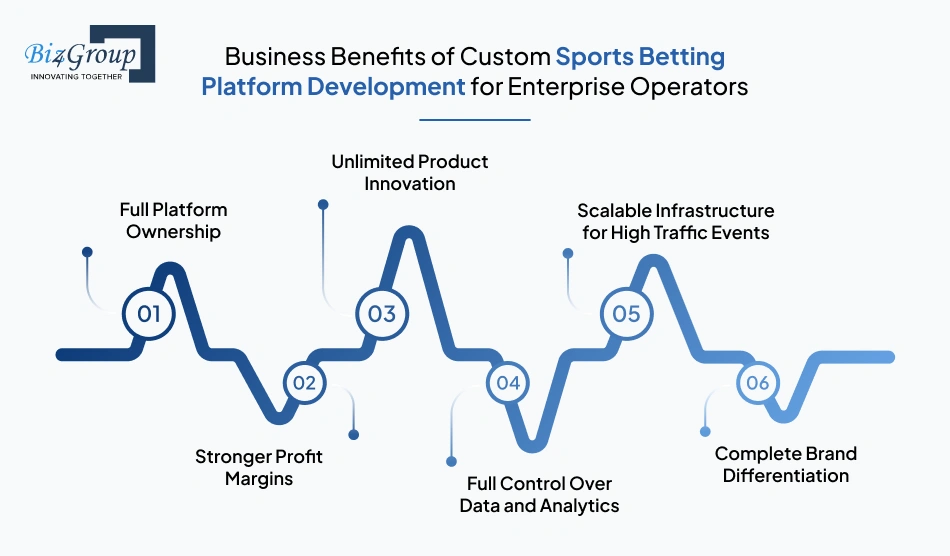
Moving from a vendor-controlled platform to full ownership changes how a sportsbook operates. The shift affects revenue, product innovation, user experience, and long-term scalability.
For operators evaluating the transition from white label to custom sportsbook development, the benefits go far beyond technical flexibility. The move unlocks opportunities that vendor platforms rarely support.
Below are the most important advantages operators gain through custom sports betting platform development for operators.
Owning the platform changes the entire business model. Operators control the technology stack, infrastructure, integrations, and development roadmap.
This means decisions about platform improvements happen internally rather than through vendor negotiations.
Benefits include:
Ownership creates a foundation for sports betting software development for enterprise operators that need long-term stability and scalability.
Revenue share agreements disappear once the platform becomes fully owned. Instead of paying large percentages to a vendor, operators keep a larger portion of betting revenue.
That change dramatically improves long-term profitability.
Many sportsbooks begin exploring white label to custom sports betting software development once they reach strong betting volume because the financial upside becomes clear.
More control over revenue also allows operators to experiment with new monetization strategies.
White label platforms usually follow a fixed roadmap. Custom platforms allow experimentation.
Operators can build features that match their audience and market strategy.
Examples include:
Innovation becomes continuous rather than vendor dependent. This flexibility helps sportsbooks stand out in a highly competitive industry.
Data is one of the most valuable assets in sports betting. Custom platforms provide complete access to betting behavior, player engagement, and risk patterns.
This allows operators to:
With full data access, platforms can develop advanced analytics that guide business decisions and product improvements.
Major sports events create sudden spikes in betting activity. Super Bowl games, playoffs, and international tournaments can generate massive traffic surges. Custom platforms allow operators to design infrastructure that handles these spikes without performance issues.
Scalable architecture supports:
This level of performance becomes critical for operators planning global growth.
Many white label sportsbooks look similar. They use identical layouts, betting markets, and feature sets. Custom development allows operators to build a unique identity.
This includes:
Differentiation becomes a great advantage in crowded betting markets.
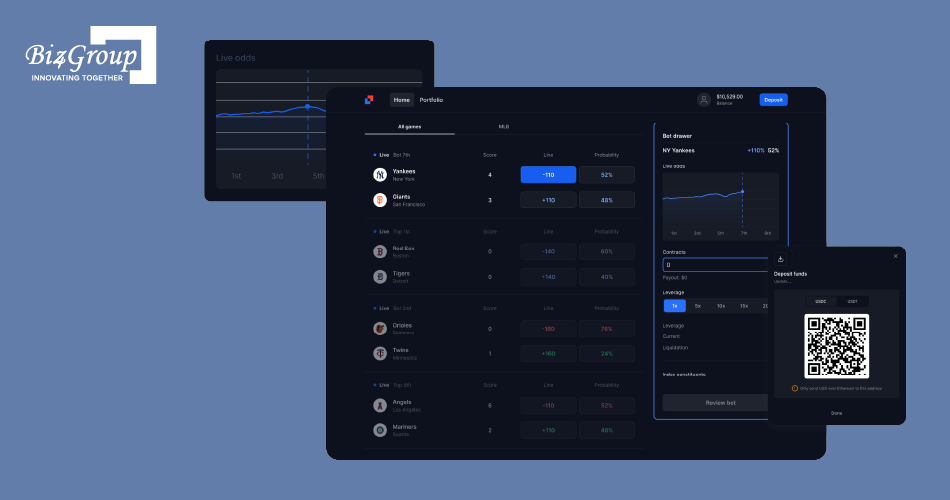
Biz4Group designed a platform to support real-time betting experiences across major sports leagues. The platform required a highly scalable architecture capable of processing large volumes of live data.
Key capabilities of the platform include:
This platform demonstrates what becomes possible when operators move beyond vendor-controlled systems and invest in white label to custom sports betting software development.
Custom architecture allowed the platform to support large scale data synchronization, dynamic pricing models, and advanced prediction capabilities that traditional white label systems rarely support.
For operators planning long-term growth, these benefits make custom development an attractive strategy. The next challenge, however, involves understanding the practical obstacles that arise during the migration process.
Custom platforms allow operators to launch new betting features faster, keep more revenue, and scale without vendor restrictions.
Build Smart with Biz4Group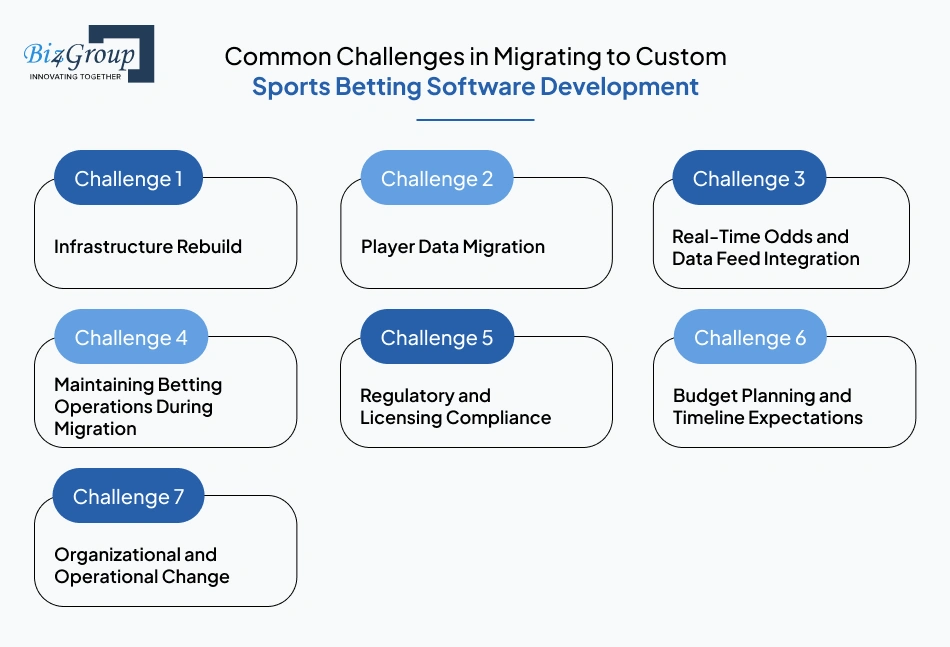
Moving from a white label platform to a fully owned sportsbook system is a strategic decision. It unlocks control, flexibility, and long-term profitability.
At the same time, the transition requires careful planning.
Operators migrating from white label to custom sports betting software development often discover that the process touches almost every part of the business.
Understanding these challenges early helps operators plan a smoother transition from white label to custom sportsbook development.
Below are the most common challenges sportsbooks encounter during the migration journey.
White label platforms operate on vendor-controlled architecture. When operators move to custom systems, the entire infrastructure must be designed from the ground up.
This includes core sportsbook components such as:
Each component must support real-time betting activity.
For example, sportsbooks handling NFL or NBA games must process thousands of wagers per minute during peak moments. Any delay in odds updates or bet confirmations can frustrate bettors and affect user trust.
Infrastructure planning becomes the foundation of sports betting software development for enterprise operators.
User data is one of the most sensitive parts of the migration process.
Sportsbooks store large volumes of player information such as:
Transferring this information safely requires careful validation. A single error could result in incorrect balances or lost betting history.
A well-planned migration strategy often involves running the old and new systems in parallel for a limited period before completing the full transition.
Odds accuracy defines the credibility of a sportsbook. Platforms rely on real-time sports data providers for live scores, player statistics, and betting market updates. During custom sports betting platform development for operators, integrating reliable data feeds becomes a priority.
Popular providers in the U.S. market include SportRadar, Genius Sports, and Sports.io. Each provider delivers high frequency updates during live events.
Integration challenges often include:
Even minor delays can create arbitrage opportunities for bettors, which increases risk exposure.
Sportsbooks cannot afford downtime. Games continue every day across leagues such as the NFL, NBA, MLB, NHL, and NCAA.
During migration, operators must ensure that bettors can still:
To avoid disruption, many sportsbooks deploy staged rollouts. Some betting markets remain on the existing platform while new features move to the custom system.
This phased approach reduces operational risk during the white label to custom sports betting software development transition.
Sports betting operates under strict regulatory oversight. Each jurisdiction enforces its own compliance requirements.
Examples include:
Operators expanding into multiple states must adapt their platforms to different regulatory frameworks. Failure to meet compliance standards can lead to penalties or licensing issues.
Custom platforms must therefore include compliance modules that support responsible betting controls and reporting systems.
Migration projects require significant investment. Custom sportsbook development involves engineering teams, infrastructure costs, and ongoing testing.
Operators planning cost to move from white label to custom sportsbook development must evaluate several factors.
These include:
The timeline for migration can vary widely depending on platform scope. The table below illustrates a typical comparison between white label systems and custom development requirements.
|
Factor |
White Label Platform |
Custom Sportsbook Platform |
|---|---|---|
|
Infrastructure Setup |
Vendor managed |
Operator designed architecture |
|
Development Effort |
Minimal |
Full engineering process |
|
Platform Control |
Limited vendor control |
Complete ownership |
|
Customization |
Restricted |
Fully customizable |
|
Migration Complexity |
Not applicable |
Requires careful transition planning |
Technology changes often require internal adjustments. Teams that previously relied on vendor support must adapt to managing their own platform.
New responsibilities may include:
Operators transitioning toward sports betting software development for enterprise operators typically expand their technology teams and product leadership.
This internal transformation helps sportsbooks fully leverage the advantages of custom platforms.
Despite these challenges, many operators successfully complete the transition. With proper planning, the migration process becomes manageable and highly rewarding.
Also read: Challenges in modern sports betting app development
A poorly planned platform transition can interrupt betting operations. The right development partner keeps your sportsbook running while the new platform is built.
Talk to Biz4Group’s Sportsbook Experts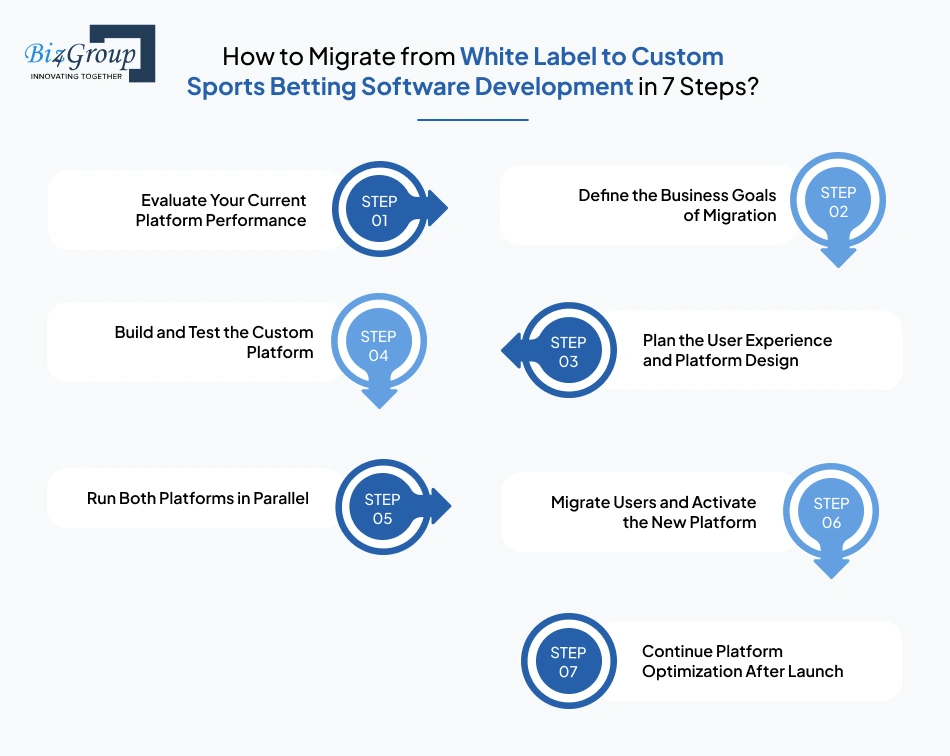
Moving away from a vendor platform requires a structured plan. A rushed transition can interrupt betting activity, affect user trust, and delay platform growth.
Successful operators treat the migration as a phased transformation. Each stage prepares the sportsbook for the next step while keeping betting operations stable.
Below is a practical roadmap that many operators follow when planning how to migrate from white label to custom sports betting software development.
Start with a clear assessment of the existing platform. Operators need to understand what works well and what creates friction. This evaluation often includes betting volume trends, user engagement metrics, and product limitations.
Questions operators commonly ask during this stage include:
These insights help define the scope of custom sports betting platform development for operators.
Migration should solve real business challenges. Operators usually identify a set of strategic objectives before starting the transition.
Common goals include:
Clear goals ensure the transition from white label to custom sportsbook development stays aligned with long-term business growth.
A migration offers an opportunity to rethink the entire betting experience. User expectations in sports betting continue to evolve. Bettors want fast navigation, intuitive bet slips, and clear game insights.
A professional UI/UX design company focuses on elements such as:
Design improvements can significantly increase user retention and betting activity.
Also read: Top 15 UI/UX design companies in USA
Once the design and requirements are finalized, development begins. Operators gradually build their custom sportsbook while the white label system continues handling active bets. Testing becomes essential during this stage.
Key validation activities often include:
Running these tests early helps identify usability issues before the platform goes live.
Most sportsbooks avoid switching platforms overnight. Instead, they operate both systems simultaneously for a limited period.
This approach allows operators to:
Gradual rollout also ensures bettors experience minimal disruption during the migrate from white label to custom sports betting software development process.
Once the custom platform is stable, operators begin moving users to the new system. This phase usually happens in stages.
Early access may be given to a limited group of bettors before the platform is opened to the entire user base.
This controlled rollout allows operators to monitor:
Once the migration proves stable, the white label system can be retired completely.
Migration does not end when the new platform goes live. The real advantage of sports betting software development for enterprise operators appears after launch. Operators can continuously improve the platform based on real user data.
Post launch optimization often includes:
Choosing the top AI sports betting software development company becomes crucial for sustained growth.
Also read: Top 14 sports betting software development companies in the USA
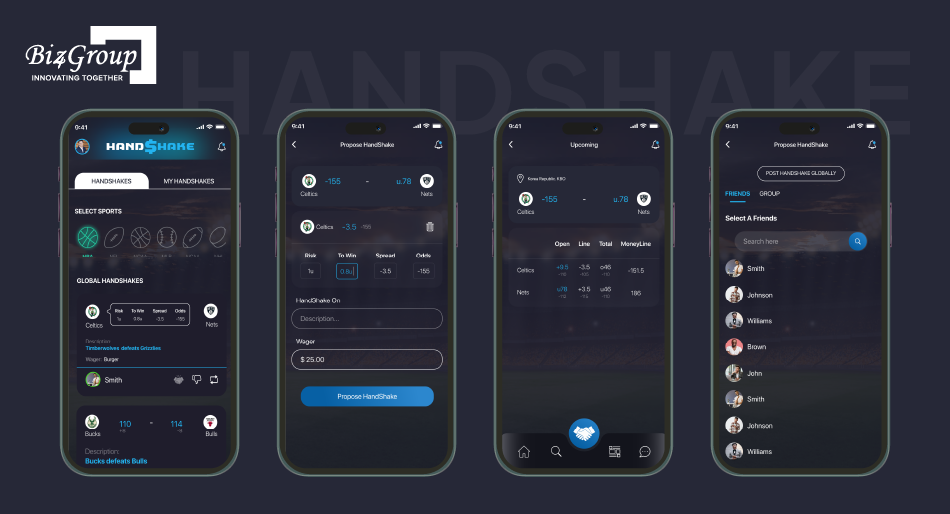
Using its exceptional AI app development services, Biz4Group developed a unique sports betting platform focused on social wagering experiences. The platform was designed to make betting more interactive and community-driven.
Key highlights of the platform include:
User experience played a major role in the platform's design. The interface allows bettors to easily challenge friends, propose wagers, and settle outcomes through a simple and engaging workflow.
This project demonstrates how custom sports betting platform development for operators can introduce entirely new betting experiences that go beyond traditional sportsbook models.
With a clear migration process in place, operators can transition from vendor-controlled platforms to fully owned ecosystems.
With the right development team, a functional sportsbook MVP can be launched in weeks while your existing platform keeps running.
Book a Strategy Call NowOnce operators decide to move forward with white label to custom sports betting software development, platform architecture becomes the backbone of the entire system.
Modern sportsbooks process massive volumes of real-time data.
Odds updates. Player statistics. Bet settlements. User transactions. Everything happens within seconds.
A scalable architecture ensures that betting activity remains fast, stable, and reliable even during high traffic events like the Super Bowl or March Madness.
Below are the core architectural layers commonly used in custom sports betting platform development for operators.
This layer directly influences bettor engagement. Fast page loads and responsive interfaces improve wagering activity.
|
Component |
Role in Sportsbook Platform |
Tools or Frameworks |
|---|---|---|
|
Web Interface |
Displays betting markets, odds boards, and user dashboards for bettors |
Next.js, React |
|
Mobile Betting Interface |
Allows bettors to place wagers and track games through mobile devices |
React Native, Flutter |
|
Bet Slip Experience |
Enables quick wager placement and bet tracking |
Vue.js, Angular |
|
Real-Time UI Updates |
Refreshes live odds and match data during active games |
WebSockets, Socket.IO |
The backend services ensure smooth bet placement, accurate odds management, and stable transaction processing.
|
Component |
Role in Sportsbook Platform |
Tools or Frameworks |
|---|---|---|
|
Betting Engine |
Processes wagers, calculates odds, and settles bets |
Node.js, Java, Go |
|
Player Account Management |
Handles user accounts, balances, and betting history |
Spring Boot, Express.js |
|
Transaction Processing |
Manages deposits, withdrawals, and wallet systems |
Python, Java |
|
Notification Systems |
Sends alerts for odds changes, game updates, and bet results |
Kafka, RabbitMQ |
Real-time data feeds power the betting experience. Accurate updates are essential for sportsbooks competing with platforms like DraftKings and FanDuel.
|
Component |
Role in Sportsbook Platform |
Tools or Frameworks |
|---|---|---|
|
Sports Data Integration |
Collects match data, scores, and player statistics from providers |
REST APIs, GraphQL |
|
Live Odds Updates |
Ensures betting markets update instantly during live events |
WebSockets, SSE |
|
Data Normalization |
Converts data from multiple providers into a unified structure |
Python pipelines, ETL frameworks |
|
Event Streaming |
Handles high frequency updates during active matches |
Apache Kafka, Redis Streams |
This layer allows operators to analyze user behavior and optimize platform performance over time.
|
Component |
Role in Sportsbook Platform |
Tools or Frameworks |
|---|---|---|
|
User Data Storage |
Stores bettor profiles, account balances, and betting activity |
MySQL, PostgreSQL |
|
Historical Betting Data |
Maintains records for odds history and betting outcomes |
MongoDB, Cassandra |
|
Performance Analytics |
Tracks user behavior, wagering patterns, and platform metrics |
Elasticsearch, BigQuery |
|
Reporting Dashboards |
Provides operators with operational insights |
Tableau, Power BI |
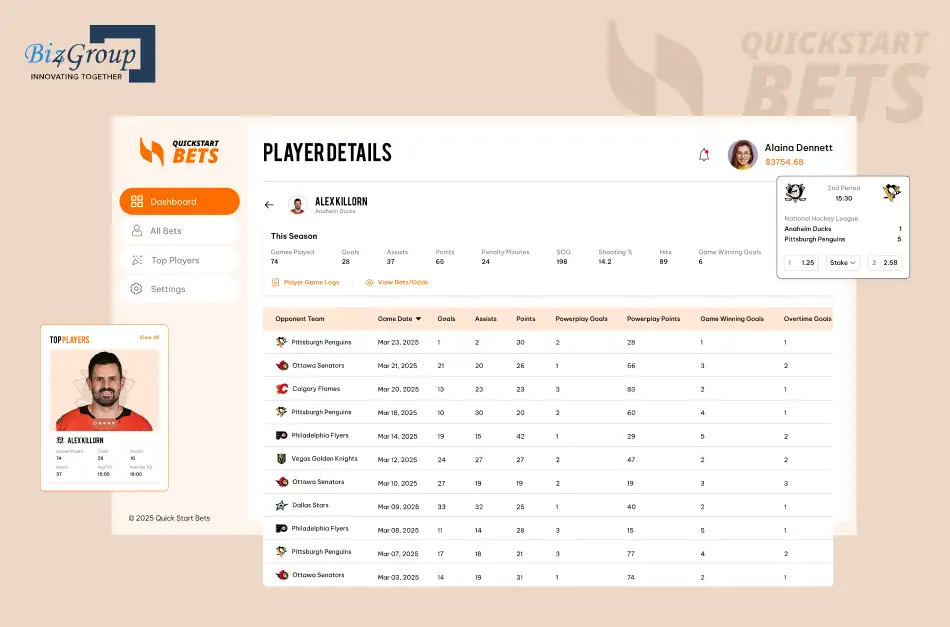
Quick Start Bets is a high-performance sports analytics platform designed to give NHL fans real-time insights into betting opportunities. The platform focuses on making complex sports data easier to understand while helping users make informed betting decisions.
Key capabilities of the Quick Start Bets platform include:
The platform combines several powerful elements.
Quick Start Bets also addresses one of the biggest challenges in sports analytics platforms... Delivering accurate real-time data.
To solve this challenge, the platform implemented persistent WebSocket connections to keep odds updates synchronized with live game events. A normalization layer standardizes incoming data from multiple sources while caching mechanisms reduce API latency.
The result is a system that delivers fast updates, clear analytics, and a smooth user experience for sports fans who want deeper insights into NHL betting trends.
Architecture plays a major role in determining whether a sportsbook can scale successfully. However, technology decisions alone do not determine success. Operators also need to evaluate financial investment and long-term profitability when planning white label to custom sports betting software development.
Financial planning plays a major role in the decision to migrate from vendor platforms. Operators evaluating white label to custom sports betting software development usually start with one question... How much will the platform actually cost?
A typical custom sportsbook development project can range between $30,000-$200,000+, depending on platform complexity, feature depth, and scalability requirements.
In comparison, most white label sportsbook solutions cost between $10,000-$100,000+ for initial setup. However, the difference lies in long-term ownership. White label systems usually involve ongoing revenue share agreements that reduce profitability as betting volume grows.
Custom platforms require a higher upfront investment. Yet they remove vendor dependency and allow operators to capture more revenue over time.
To understand this investment clearly, it helps to break down the major cost drivers involved in custom sports betting platform development for operators.
Every sportsbook project has unique requirements. Platform complexity, feature depth, and integration scope all influence development investment.
The table below outlines the primary cost drivers that impact the overall cost to move from white label to custom sportsbook development.
|
Cost Driver |
What It Covers |
Estimated Cost Contribution |
|---|---|---|
|
Platform Development |
Building the core sportsbook platform including betting workflows, dashboards, and user interfaces |
$12,000-$60,000 |
|
Betting Engine Development |
Creating wagering logic, bet settlement processes, and odds management systems |
$5,000-$35,000 |
|
Real-Time Data Integrations |
Connecting sports data feeds, live scores, and odds updates |
$4,000-$25,000 |
|
Payment and Wallet Systems |
Deposits, withdrawals, wallet management, and transaction tracking |
$3,000-$20,000 |
|
User Account Systems |
Player profiles, betting history, and engagement tools |
$2,000-$15,000 |
|
Platform Testing and QA |
Testing betting flows, user experience, and system reliability |
$2,000-$12,000 |
Each of these components contributes to the overall development effort.
A small regional sportsbook may fall near the lower end of the range.
A large enterprise platform with advanced betting features will move closer to the higher end.
Beyond development costs, operators should also account for operational expenses that appear during the transition from white label to custom sportsbook development. These costs are often overlooked during early planning but can influence the final budget.
Moving player accounts, betting history, and wallet balances requires careful validation and staging. Migration preparation can cost roughly $2,000-$10,000, depending on platform scale.
Sportsbooks rely on premium sports data providers to deliver accurate game updates and betting markets. Data licensing agreements typically range between $5,000-$20,000 annually, depending on the leagues covered.
Managing a custom platform requires dedicated product oversight, analytics monitoring, and operational management. Early operational setup may cost $3,000-$15,000 during the initial rollout phase.
After launch, operators frequently introduce new betting features and user engagement tools. Continuous improvement budgets often range between $5,000-$25,000 annually depending on the rate of product innovation.
Recognizing these hidden costs helps operators build a realistic financial plan before starting sports betting software development for enterprise operators.
Also read: How much does it cost to develop an AI sports betting app like Rithmm?
While custom platforms require higher upfront investment, the long-term ROI often outweighs the initial cost.
White label platforms operate on revenue share models. Vendors typically collect 20%-40% of sportsbook revenue, which can significantly reduce profitability as betting volume increases.
Custom platforms remove that revenue share model. Operators retain full control over platform earnings. This difference creates several long-term financial advantages.
When comparing white label vs custom sports betting software development comparison, the financial difference becomes clear over time.
White label systems prioritize faster market entry.
Custom platforms prioritize sustainable profitability and long-term growth.
Also read: How do AI sports betting apps like FanDuel make money?
For operators planning to scale their sportsbooks, understanding the financial impact of migrating from white label to custom sports betting software development helps guide investment decisions.
The next factor operators must evaluate involves regulatory and compliance requirements that shape sportsbook platforms across different jurisdictions.
Also read: How much does it cost to develop AI sports betting software?
Custom sportsbook platforms require investment, but long-term ROI often outpaces white label models once betting volume scales.
Let’s Talk NumbersRegulation shapes every sportsbook platform. Licensing, player protection, and financial monitoring all operate under strict oversight.
When operators rely on a vendor platform, many compliance responsibilities are handled by the provider. The situation changes once a company begins white label to custom sports betting software development.
Ownership of the platform also means ownership of regulatory accountability.
Operators must ensure their systems support the legal and operational standards required by each jurisdiction where the sportsbook operates. This becomes particularly important in the United States where betting laws differ across states.
Understanding these requirements early helps operators avoid compliance issues during the transition from white label to custom sportsbook development.
When planning custom sports betting platform development for operators, several regulatory components must be built into the platform from the start.
These areas ensure that sportsbooks protect users and maintain transparent operations.
Each of these controls protects both the operator and the bettor.
|
Compliance Component |
Purpose in the Sportsbook Platform |
Example Tools or Technologies |
|---|---|---|
|
Identity Verification |
Confirms bettor identity and prevents underage access |
KYC verification APIs |
|
Geolocation Monitoring |
Ensures bets are placed from approved regions |
GeoComply style location systems |
|
Anti Money Laundering Monitoring |
Tracks suspicious financial transactions |
Risk monitoring systems |
|
Responsible Gambling Controls |
Allows deposit limits, self exclusion, and betting limits |
Player protection modules |
|
Audit and Reporting Tools |
Maintains transparent records for regulators |
Compliance reporting dashboards |
These systems form the backbone of sports betting software development for enterprise operators operating in regulated markets.
The U.S. sports betting market is fragmented. Each state regulates sportsbooks independently.
Some states allow full online betting. Others limit wagering to specific casinos or require partnerships with licensed operators. This creates operational challenges for platforms expanding nationally.
Operators must adapt to:
A sportsbook launching in multiple jurisdictions must ensure the platform can adapt quickly to these regulatory variations.
Managing regulatory requirements requires both legal and technical expertise.
Many operators strengthen their technology teams when moving toward white label to custom sports betting software development. Dedicated engineers help maintain secure systems while compliance specialists monitor regulatory requirements.
Platforms introducing advanced analytics or AI driven betting insights may also expand their engineering teams and hire AI developers to build intelligent monitoring tools and automated compliance reporting systems.
This approach helps operators maintain regulatory compliance while continuing to innovate.
Regulatory readiness should be considered from the earliest stages of platform development.
Without proper compliance infrastructure, sportsbooks risk:
Strong compliance frameworks protect the platform while enabling safe expansion into new betting markets.
For operators investing in custom sports betting platform development for operators, regulatory readiness becomes an advantage rather than a barrier. Now, onto the right choice of engineers for your migration.
Also read: Sports betting regulations across US states
The decision to move from white label to custom sports betting software development is a transformation. That transformation requires a technology partner with deep experience in betting ecosystems, real-time data platforms, and enterprise-grade digital products.
Biz4Group LLC has built that reputation.
Headquartered in the USA, Biz4Group is a technology driven company specializing in scalable digital platforms for startups, enterprises, and fast-growing operators. For 20+ years, we have helped businesses across industries launch high performance platforms with real-time data systems, intelligent automation, and advanced digital experiences.
Through our expertise as a sports betting app development company, we help operators design and build platforms capable of handling high traffic betting events, live game updates, and advanced analytics systems.
Our development teams specialize in sports betting API integration services, enabling sportsbooks to connect seamlessly with real-time sports data providers, payment gateways, and analytics systems that power modern betting ecosystems.
For operators planning custom sports betting platform development for operators, these capabilities provide a strong foundation for building scalable platforms that perform under pressure.
Several factors make Biz4Group a preferred technology partner for sports betting software development for enterprise operators.
Deep Industry Understanding
Sports betting platforms require more than general software development expertise. Our teams understand betting workflows, wagering behavior, and real-time sports data environments.
Scalable Product Architecture
From early-stage startups to enterprise operators, we design platforms that support growth. Our systems are built to scale as user traffic, betting activity, and platform complexity increase.
Advanced Technology Integration
Our experience in AI, automation, and data analytics allows us to introduce intelligent capabilities that enhance sportsbook platforms and improve decision making.
Product First Development Approach
Every project begins with a clear product strategy. Instead of focusing only on code, we focus on building platforms that solve real business challenges.
Long-Term Partnership Mindset
Many of our client relationships extend well beyond initial platform launches. We support continuous platform improvement, feature expansion, and innovation as businesses grow.
Operators planning white label to custom sports betting software development need partners who understand both technology and the sports betting industry.
As a seasoned AI development company, Biz4Group brings that combination of expertise.
If you are planning to move beyond vendor-controlled platforms and build a scalable sportsbook infrastructure, Biz4Group can help turn that vision into reality.
The sports betting industry is evolving rapidly. Platforms that once helped operators launch quickly are no longer enough to sustain long-term growth. White label systems serve an important purpose during early stages, but as sportsbooks expand, the need for control, innovation, and scalability becomes unavoidable. This is why many operators eventually begin planning white label to custom sports betting software development to take ownership of their technology and revenue streams.
Migrating from a vendor-controlled platform to a custom sportsbook requires careful planning. Operators must evaluate timing, costs, infrastructure needs, and operational risks before making the transition. Better margins, full data ownership, improved user experiences, and the freedom to innovate are all outcomes that make custom sports betting platform development for operators a powerful long-term investment.
For businesses exploring this transition, working with the right technology partner makes all the difference. Biz4Group LLC, a USA-based software development company, has helped businesses design scalable digital platforms that handle real-time data, high user engagement, and complex operational workflows. Our experience in sports betting software development for enterprise operators allows us to guide operators through every stage of the migration journey, from product strategy to platform launch.
If your sportsbook is ready to move beyond vendor limitations and build a platform designed for long-term success, now is the time to act.
Connect with Biz4Group today and start building a custom sports betting platform that gives you complete control, stronger margins, and the flexibility to innovate.
Yes, many operators adopt a phased migration strategy rather than replacing the entire platform at once. Certain modules such as user engagement features, analytics dashboards, or betting interfaces can move to a custom system first while the existing platform continues handling live wagers. This gradual approach allows operators to test the new environment, monitor performance, and transition users smoothly without disrupting ongoing betting activity.
No. With proper planning, user accounts, betting histories, wallet balances, and loyalty data can be securely transferred to the new platform. The key objective during migration is maintaining continuity for bettors. If executed correctly, users may not even notice the transition except for improvements in platform performance and new features.
Many custom sportsbook platforms take several months to fully develop and launch because they require extensive feature development and testing. Biz4Group, however, can deliver a functional MVP in 2-4 weeks by leveraging reusable development components and proven frameworks. This approach significantly reduces both development time and cost while allowing operators to validate their platform quickly.
Yes. Custom sportsbook systems are designed to support a wide range of sports leagues including NFL, NBA, MLB, NHL, NCAA events, soccer leagues, esports tournaments, and more. Operators can expand betting markets over time by adding new sports categories, player props, and live betting options based on user demand and regional popularity.
Data analytics helps operators understand bettor behavior and platform performance. By analyzing user activity, sportsbooks can identify popular betting markets, detect unusual wagering patterns, and optimize promotions or odds strategies. Advanced analytics also helps platforms improve user engagement by delivering insights and personalized betting experiences.
Operators should evaluate several factors when selecting a development partner. Industry experience, understanding of betting workflows, ability to integrate sports data providers, and expertise in scalable platform development are all important. A reliable partner should also provide long-term technical support, platform optimization, and the ability to evolve the system as the betting market continues to grow.

with Biz4Group today!
Our website require some cookies to function properly. Read our privacy policy to know more.