 Location :
Orlando, FL, USA
Location :
Orlando, FL, USA +1 (407) 714-1616
 info@biz4group.com

- The cost to develop AI healthcare assistant typically ranges from USD 20,000 to USD 150,000, depending on scope, compliance needs, and long-term scalability plans.
- Most of the budget is driven by AI complexity, integrations, security, and how early teams plan for growth, which directly impacts the AI healthcare assistant development cost.
- Teams that break work into phases and prioritize core workflows upfront manage the cost of AI healthcare assistant development far better than those who build everything at once.
- With healthcare, AI expenditure is growing rapidly as providers look to reduce operational load and improve patient access, making cost planning more important than ever.
- Hidden costs like AI tuning, compliance updates, and infrastructure scaling often surprise teams who only budget for launch.
- Profitability depends less on upfront spend and more on how well the assistant reduces manual work, improves workflows, and scales without constant rebuilds.
AI in healthcare usually stops being exciting right around the time someone asks for numbers. The idea makes sense, the use cases sound solid, but budgets do not move on enthusiasm alone. Most teams quickly realize that the cost to develop AI healthcare assistant is not a single number. It often spans from USD 20,000 on the low end to USD 150,000 on the higher side, which is exactly why early discussions tend to circle back to the same practical concerns.
- What is the cost to develop AI healthcare assistant?
- How much for building an AI medical assistant?
- What’s the budget for AI health assistant software?
- Is AI healthcare assistant expensive to build?
- What is the pricing to develop AI doctor assistant app?
These are fair questions, especially as more healthcare organizations start allocating real budgets to AI healthcare solutions instead of treating them as experiments.
According to Grand View Research, the global artificial intelligence in healthcare market is expected to grow to more than USD 505.59 billion by 2033, a jump largely driven by AI powered software and virtual assistants that directly affect AI healthcare assistant development cost.
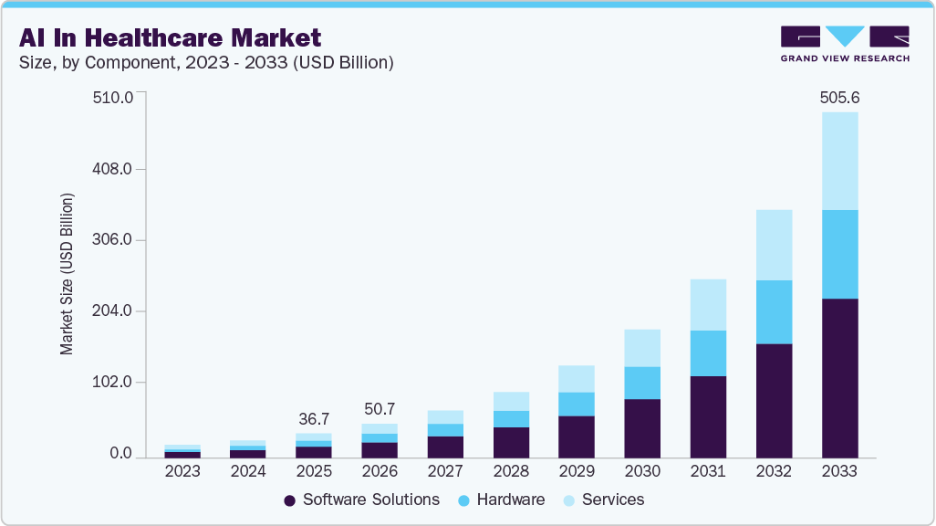
For teams preparing to build AI software, getting clarity on costs early helps avoid surprises later. When expectations are grounded, AI health assistant app development becomes a structured planning exercise instead of a guessing game that drags on longer than it should.
Practical Formula to Calculate the Cost to Develop AI Healthcare Assistant
Once a healthcare AI idea moves past brainstorming, the conversation usually shifts fast. Someone asks how long it will take, someone else asks how much it will cost, and suddenly everyone wants a number they can trust. This is where the cost to develop AI healthcare assistant becomes less abstract and more practical. Instead of guessing, teams benefit from a simple way to connect effort with budget.
General Cost Estimation Formula for AI Healthcare Assistant Development Cost
Total Development Cost = (Total Development Hours × Hourly Rate) + Healthcare Specific Expenses
This formula is straightforward because it needs to be. Development hours cover the actual work of building and testing the assistant. Healthcare specific expenses reflect the reality of working with patient data and regulated systems. Many teams use this approach, often with input from a custom software development company, to keep early cost discussions realistic and easy to explain.
Together, these pieces form a clearer develop AI healthcare assistant cost breakdown that can evolve as the scope becomes clearer.
How to Use the Formula to Estimate Build AI Healthcare Assistant Cost
Start by listing the total development hours. For an AI healthcare assistant, this usually includes more than people expect at first. Teams often plan time for:
- Defining healthcare appropriate conversation flows
- Setting up secure backend systems
- AI model development to handle medical language properly
- Integrating the assistant with existing tools
- Testing for stability, accuracy, and compliance
- Making adjustments based on early usage and feedback
Once those hours are outlined, they are multiplied by the hourly rate of the team doing the work. This creates the base number most teams use when discussing build AI healthcare assistant pricing internally.
From there, additional costs tend to surface naturally. Compliance steps, infrastructure needs, and ongoing support all add up over time. Some organizations rely on AI automation services to reduce manual work, while others bring in AI consulting services to check decisions before scaling. Accounting for these early makes it easier to create AI healthcare assistant cost estimate models that feel grounded instead of optimistic.
Plan Before Costs Spiral
Understand the cost to develop AI healthcare assistant before features and assumptions inflate your budget.
Get My AI Healthcare Cost BreakdownDetailed Breakdown of AI Healthcare Assistant Development Cost
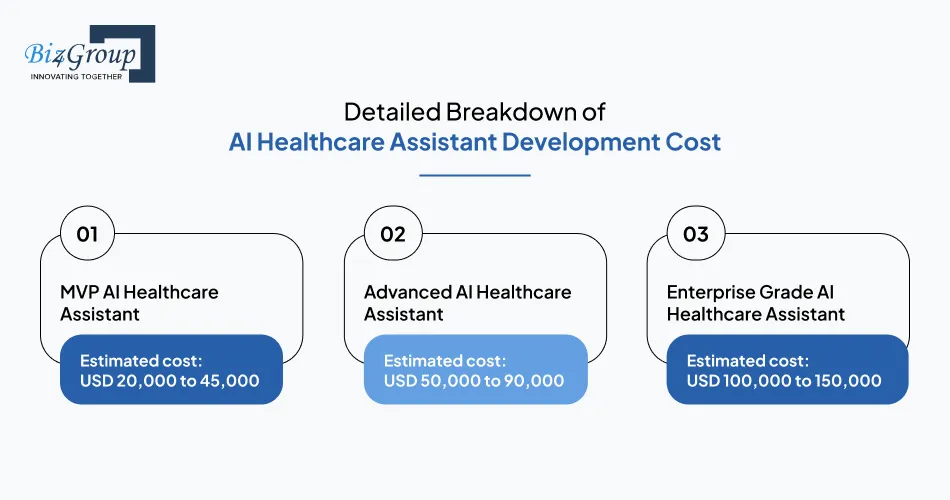
Building an AI healthcare assistant is rarely a single budget line item. The cost to develop AI healthcare assistant typically falls between USD 20,000 and USD 150,000, depending on how advanced the assistant needs to be, how much clinical context it handles, and how well it is prepared to scale over time. Teams that aim for simple task automation stay closer to the lower end, while assistants designed to support clinical workflows, patient engagement, and operational efficiency move higher very quickly.
Lighter implementations that focus on appointment handling or basic patient queries usually cost less. More advanced assistants that support care coordination, medical context awareness, and ongoing learning push the overall AI medical assistant development cost upward as complexity increases.
Here is a high level snapshot of how costs usually distribute based on build maturity.
|
Build Level |
Scope |
Estimated Cost Range |
|---|---|---|
|
MVP AI Healthcare Assistant |
Basic conversations, scheduling support, limited workflows |
USD 20,000 to 45,000 |
|
Advanced AI Healthcare Assistant |
Context aware conversations, secure data handling, integrations |
USD 50,000 to 90,000 |
|
Enterprise Grade AI Healthcare Assistant |
Scalable architecture, compliance readiness, advanced AI |
USD 100,000 to 150,000 |
What often gets underestimated is how early technical choices affect long term spend. Decisions around data structure, conversational depth, and system design determine whether the assistant can grow smoothly or needs costly rework later. Teams that work with a custom software development company early often avoid surprises when expectations expand after launch.
Below is a more detailed look at where the investment usually goes once development starts:
|
Development Stage |
Typical Range |
Notes |
|---|---|---|
|
Discovery and Planning |
USD 3,000 to 8,000 |
Use case definition, workflow mapping, feasibility checks |
|
UI and UX Design |
USD 4,000 to 12,000 |
Patient friendly flows, accessibility, trust focused design |
|
AI Logic and Model Work |
USD 8,000 to 40,000 |
Intent handling, response accuracy, learning workflows |
|
Backend and Database |
USD 6,000 to 20,000 |
Secure data handling, system logic, user management |
|
Integrations |
USD 5,000 to 25,000 |
Scheduling systems, records, third party services |
|
Security and Compliance |
USD 7,000 to 30,000 |
Data protection, access controls, audit readiness |
|
Infrastructure and Cloud |
USD 2,000 to 8,000 |
Hosting, monitoring, scalability setup |
|
Testing and Quality Assurance |
USD 3,000 to 10,000 |
Functional testing, security checks, reliability |
|
Post Launch Support |
15 to 25 percent annually |
Updates, monitoring, improvements |
Costs also vary based on how conversational the assistant needs to be. Some teams treat it like an AI conversation app with limited context, while others rely on AI chatbot development company expertise to support healthcare specific interactions. Each step toward deeper intelligence and reliability adds to healthcare AI assistant development pricing, but it also improves adoption and long-term value.
At scale, the virtual healthcare assistant cost reflects not just development effort, but how thoughtfully the product is designed to grow alongside clinical and operational needs.
Portfolio Spotlight
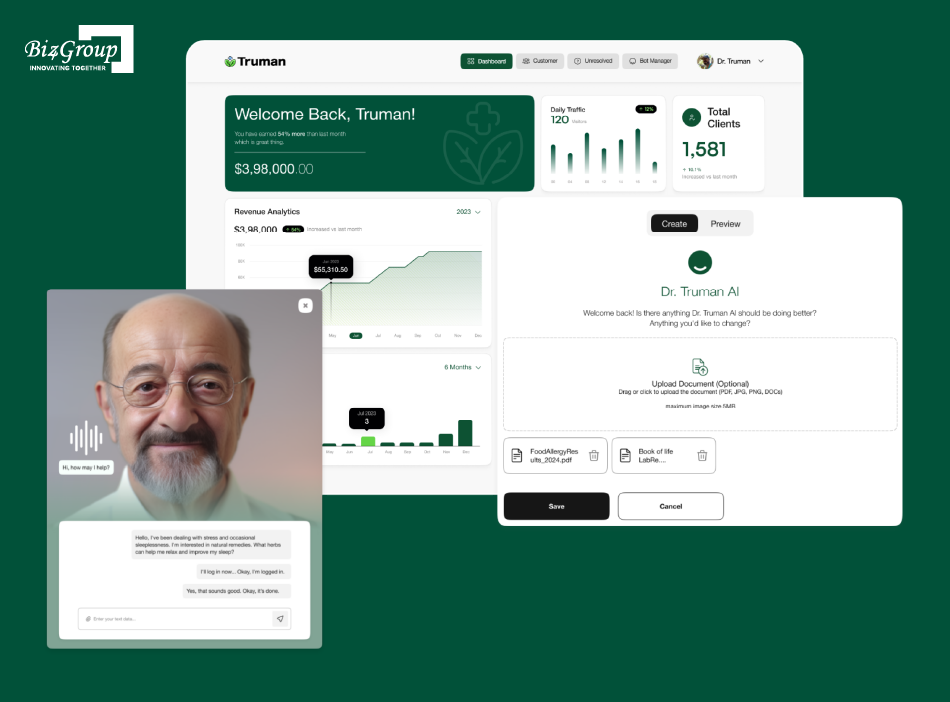
Truman is an AI driven healthcare assistant built to support patient engagement through structured conversations, guided workflows, and secure data management. Its design reflects real world considerations around conversational depth, system reliability, and regulatory requirements that often surface during AI healthcare assistant development.
Turn Budget Guesswork into Clarity
Map real requirements, risks, and AI healthcare assistant development cost drivers early.
Create My Cost EstimateKey Factors That Influence Cost to Develop AI Healthcare Assistant
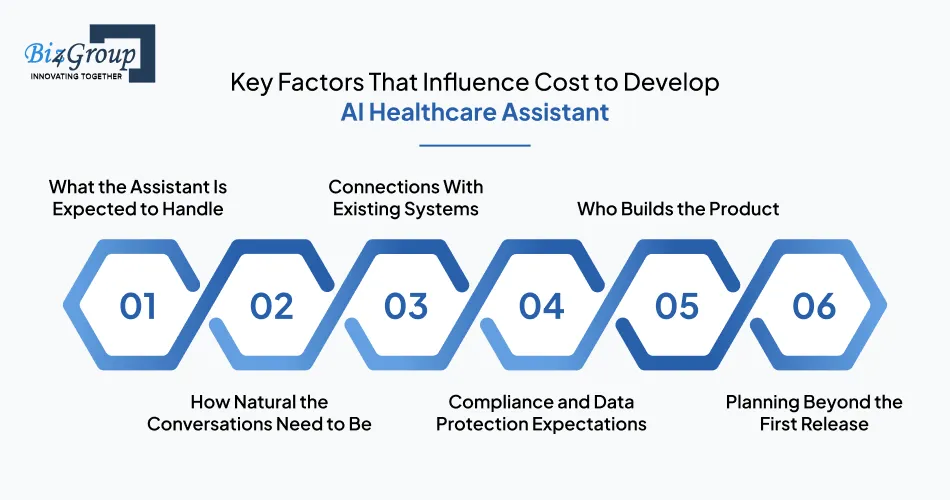
When budget discussions start, most teams want a straight answer. The reality is that the cost to develop AI healthcare assistant is shaped by a handful of everyday decisions that add up over time. These are not abstract technical choices. They are practical calls about scope, workflow, and priorities that quietly determine how much effort and money the build will take.
Here are the factors that usually make the biggest difference.
1. What the Assistant Is Expected to Handle
Everything starts with scope. An assistant that answers basic questions or helps with scheduling is far simpler than one involved in care coordination or patient guidance. As responsibilities increase, so does the custom AI healthcare assistant development cost, mostly because more logic, testing, and edge cases come into play.
2. How Natural the Conversations Need to Be
Some assistants only need to respond to direct questions. Others need to follow context, remember previous interactions, and handle medical intent carefully. The more natural the conversation needs to feel, the more time goes into planning and refinement. This is where thoughtful AI assistant app design can improve usability, but it also adds to development effort.
3. Connections With Existing Systems
Most healthcare environments already rely on multiple tools. When you integrate AI into an app that works alongside scheduling systems, patient portals, or internal platforms, complexity increases. Each integration adds planning, coordination, and testing time, which directly affects overall cost.
4. Compliance and Data Protection Expectations
Healthcare data brings stricter rules. Decisions around data storage, access control, and audit readiness influence both development time and infrastructure needs. This is a major reason the AI healthcare assistant development cost for hospitals and clinics is often higher than for smaller or early stage projects.
5. Who Builds the Product
Experience matters more than most teams expect. Teams familiar with healthcare and AI tend to make better early decisions and avoid rework. Some organizations choose to hire AI developers with healthcare experience, while others rely on external partners. Either way, the team structure you choose has a clear impact on speed and budget.
6. Planning Beyond the First Release
Assistants built only for launch often become expensive to maintain. Thinking ahead about updates, monitoring, and growth helps keep costs predictable. Teams that plan carefully are better positioned to build HIPAA compliant AI healthcare assistant in a budget that stays under control as usage grows.
Taken together, these factors explain why costs vary so much between projects that seem similar at first glance. Understanding them early makes budgeting feel far more manageable and far less surprising later on.
Build Smart, Not Expensive
Learn how teams control cost of AI healthcare assistant development through phased planning.
Plan My AI Healthcare AssistantHidden Costs in AI Healthcare Assistant Development Cost
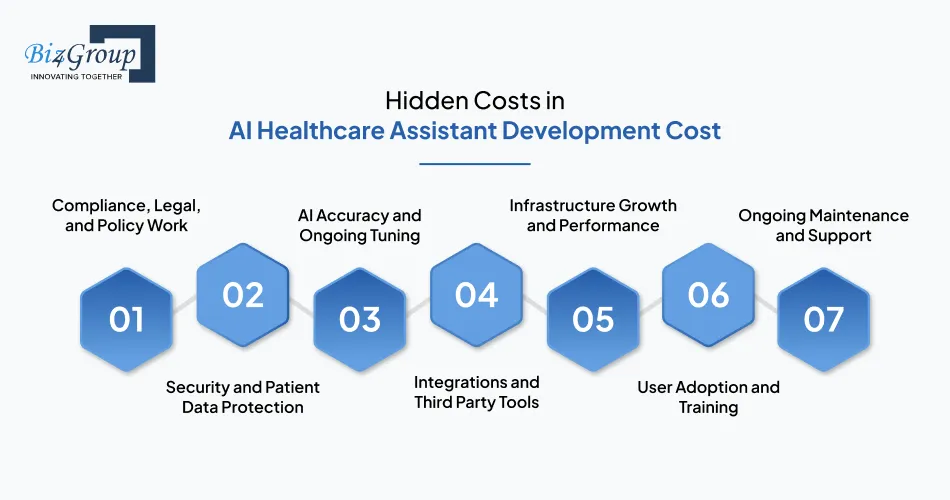
When teams first talk numbers, they usually focus on what is easy to see. Features, timelines, and development hours feel concrete. What often changes the final math are the costs that show up later. For anyone trying to understand the cost to develop AI healthcare assistant, these hidden expenses are usually what stretch budgets after the project is already moving.
They do not hit all at once. They appear gradually as the assistant starts handling real users, real data, and real healthcare workflows.
Here are the hidden costs teams most often run into.
1. Compliance, Legal, and Policy Work
Healthcare rules evolve, and products evolve with them. As features change, policies and documentation usually need updates too. Legal reviews are rarely a one time task. Over time, this quietly adds to the custom AI healthcare assistant development cost, especially when scope expands.
- Typical cost range: USD 5,000 to 15,000 upfront, plus USD 4,000 to 10,000 per year
- Impact: Compliance work can add 10 to 18 percent to long term cost
2. Security and Patient Data Protection
Protecting patient data takes more than basic security. As usage grows, teams add monitoring, access controls, and response processes. These layers grow with the product, which is why AI healthcare assistant development cost for startups often increases after launch.
- Typical cost range: USD 8,000 to 25,000 upfront, plus USD 5,000 to 12,000 annually
- Impact: Security can account for 8 to 15 percent of total spend
3. AI Accuracy and Ongoing Tuning
AI does not stay perfect once it goes live. As more real world scenarios show up, responses need refining. Teams using generative AI often find that accuracy and tone require regular attention, turning refinement into an ongoing cost.
- Typical cost range: USD 5,000 to 18,000 per year
- Impact: AI tuning usually adds 5 to 10 percent to yearly budgets
4. Integrations and Third Party Tools
Most assistants rely on outside services for messaging, analytics, or scheduling. These tools often charge based on usage. Work tied to AI integration services also grows as systems change or new connections are added.
- Typical cost range: USD 900 to 3,500 per month
- Impact: Third party services can make up 6 to 10 percent of ongoing costs
5. Infrastructure Growth and Performance
Early infrastructure costs stay modest. As usage increases, systems need to support more activity without slowing down. Teams focused on AI in healthcare administration automation often see hosting and performance costs rise as adoption spreads.
- Typical cost range: USD 600 per month early, rising to USD 4,000 or more
- Impact: Infrastructure usually represents 7 to 12 percent of long term spend
6. User Adoption and Training
Healthcare teams need to understand how to use AI tools correctly. That means onboarding materials, training, and support. These efforts are often underestimated when teams first create scalable AI healthcare assistant solutions cost estimate models.
- Typical cost range: USD 4,000 to 15,000 per month during growth
- Impact: Adoption efforts can account for 10 to 20 percent of early stage costs
7. Ongoing Maintenance and Support
Once the assistant is live, the work continues. Bugs get fixed, updates roll out, and performance gets tuned. Many teams lean on an AI app development company to manage this without overloading internal staff.
- Typical cost range: 15 to 25 percent of initial build cost per year
- Impact: Maintenance costs grow as the product matures
Quick Reference: Common Hidden Cost Areas
|
Category |
Estimated Range |
Notes |
|---|---|---|
|
Compliance and Legal |
USD 5K to 15K |
Ongoing reviews |
|
Security |
USD 8K to 25K plus annual |
Data protection |
|
AI Refinement |
USD 5K to 18K yearly |
Accuracy updates |
|
Integrations |
USD 900 to 3.5K monthly |
External tools |
|
Infrastructure |
USD 600 to 4K monthly |
Scaling needs |
|
Adoption |
USD 4K to 15K monthly |
Training and onboarding |
|
Maintenance |
15 to 25 percent yearly |
Long term support |
These costs matter most when teams think beyond launch. Factoring them in early gives a more honest picture of ownership and helps teams approach AI healthcare assistant development cost with fewer surprises once real usage begins.
Portfolio Spotlight
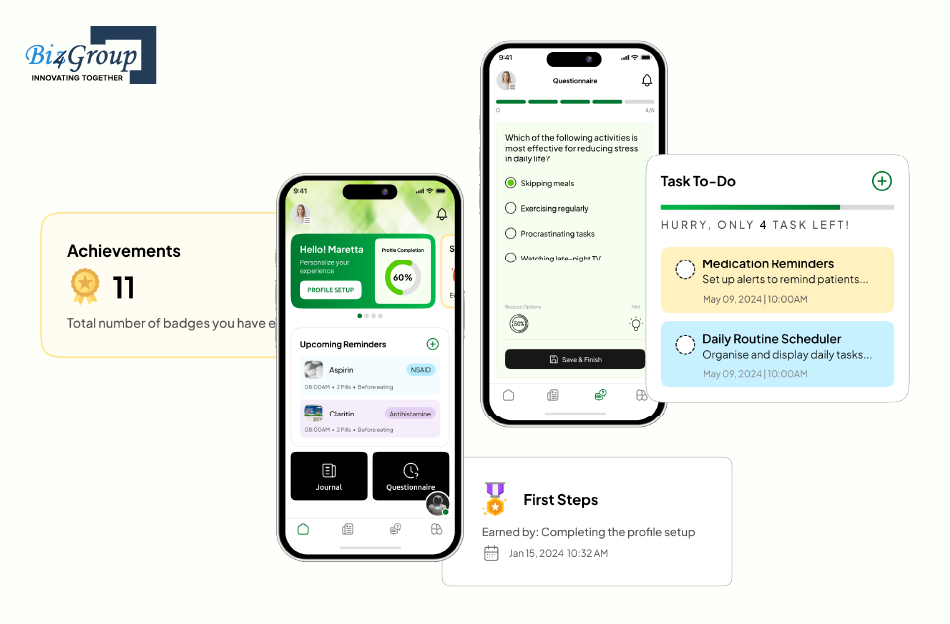
Cognihelp is an AI based healthcare support system focused on conversational interaction, monitoring, and adaptive response logic. The platform illustrates how ongoing AI refinement, data handling, and post launch evolution become part of long term ownership considerations in healthcare focused AI builds.
Avoid Hidden Cost Surprises
See what actually drives long term spend beyond launch and affects build AI healthcare assistant pricing.
Review My Cost RisksWays to Control AI Healthcare Assistant Development Cost
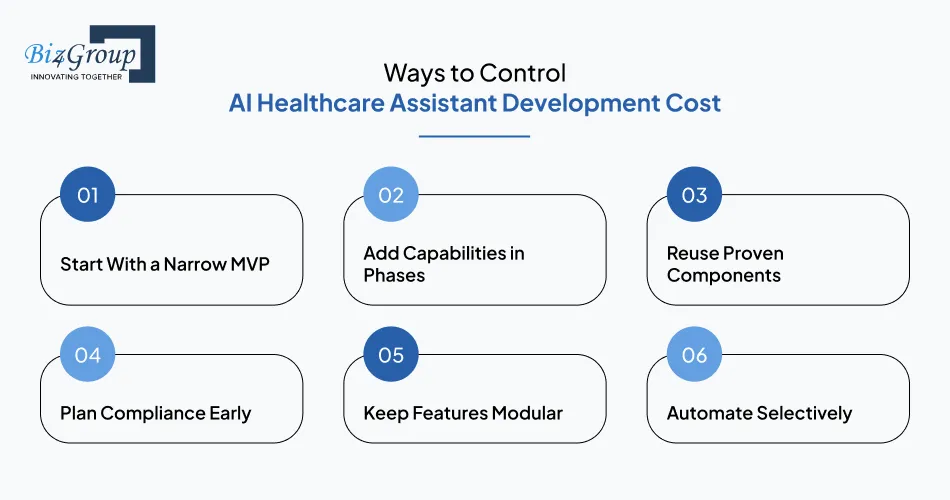
Most teams do not overspend because they are careless. They overspend because too much gets built too early. When planning is deliberate, the cost to develop AI healthcare assistant stays under control without cutting corners on safety, usability, or long term value. The key is not speed. It is sequencing. Build what is needed now and earn the right to build more later.
Teams that manage budgets well tend to follow a few practical habits that keep complexity from creeping in too soon.
|
Strategy |
Why It Helps Control Cost |
How Teams Apply It |
|---|---|---|
|
Start With a Narrow MVP |
Limits early scope |
Teams launch with core tasks like appointment support or basic patient queries |
|
Add Capabilities in Phases |
Reduces upfront effort |
Simple logic comes first, with smarter behavior added once usage is clear |
|
Reuse Proven Components |
Cuts custom build time |
Foundations from custom healthcare software development shorten timelines |
|
Plan Compliance Early |
Avoids rework later |
Privacy and security needs are addressed during architecture planning |
|
Keep Features Modular |
Makes changes cheaper |
Conversation logic and integrations are built as separate pieces |
|
Automate Selectively |
Lowers ongoing effort |
Targeted AI chatbot integration reduces manual work as volume grows |
What really keeps budgets steady is restraint. Teams that resist the urge to build everything at once usually spend less overall. This approach also makes the develop AI healthcare assistant cost breakdown easier to manage because each phase has a clear purpose and outcome.
Another cost lever is focus. Experience from chatbot development for healthcare industry projects shows that a small set of well-designed workflows often deliver more value than a long feature list. Many organizations apply lessons from business app development using AI to stay aligned with real operational needs instead of hypothetical use cases.
Clear sequencing also keeps pricing discussions grounded. When scope grows in steps, conversations around AI healthcare assistant pricing stay predictable instead of shifting with every new idea.
In the long run, these choices make the cost of AI healthcare assistant development easier to forecast and far less stressful to manage as the product evolves.
Phase Wise Breakdown of Cost to Develop AI Healthcare Assistant
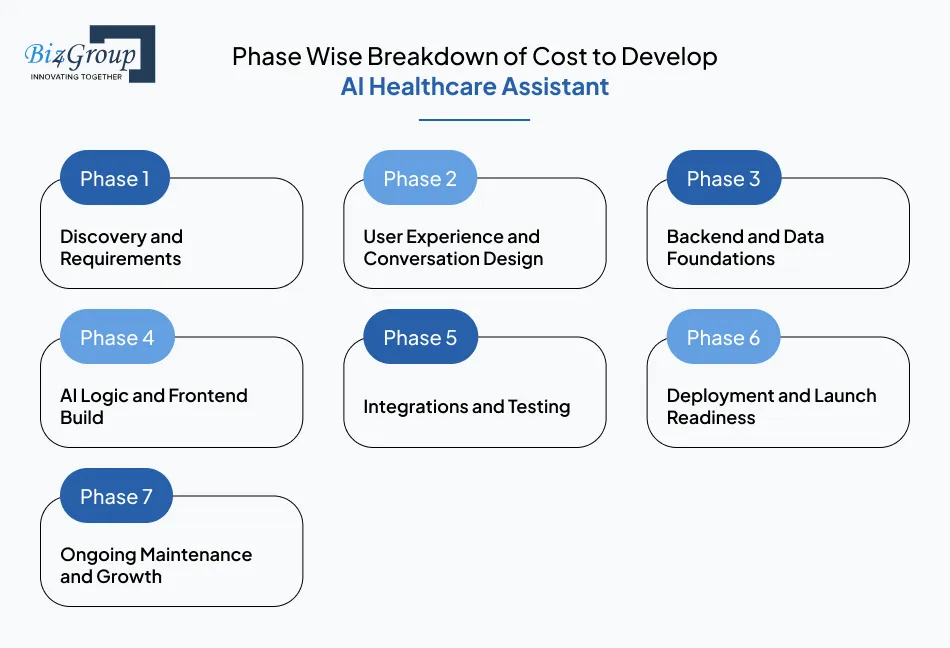
Building an AI healthcare assistant usually happens in stages. Each stage answers a different question and comes with its own type of cost. Looking at the work this way makes the cost to develop AI healthcare assistant easier to understand, especially for leaders who want visibility into how budgets grow over time instead of being surprised by one large number.
Here is how investment typically unfolds as the product takes shape.
1. Discovery and Requirements
This is where teams pause before committing to a build. The focus is on clarifying goals, defining early use cases, and deciding what should not be built yet. Many assumptions get tested here, which helps avoid waste later.
- Typical cost range: USD 3,000 to 8,000
This stage often sets the foundation for a realistic create AI healthcare assistant cost estimate, since scope is still flexible and decisions are easier to reverse.
2. User Experience and Conversation Design
Once direction is clear, attention shifts to how people will actually use the assistant. Conversation flows, prompts, and basic screens are designed with clarity in mind. This work is less about visuals and more about making the UI/UX design feel simple and intuitive.
- Typical cost range: USD 5,000 to 15,000
When done well, this phase helps control downstream effort and keeps the overall AI medical assistant development cost from creeping up due to repeated redesigns.
Also Read: Top 15 UI/UX Design Companies in USA: 2026 Guide
3. Backend and Data Foundations
This phase handles the systems users never see but rely on every day. Databases, APIs, authentication, and data handling logic are built to support healthcare workflows securely with MVP development services.
- Typical cost range: USD 8,000 to 30,000
For many organizations, this is where long term healthcare AI assistant development pricing starts to take shape, especially when compliance and reliability are non negotiable.
Also Read: Top 12+ MVP Development Companies to Launch Your Startup in 2026
4. AI Logic and Frontend Build
Here, the assistant becomes tangible. Conversation handling, response logic, and user facing components come together. The more context aware and adaptive the assistant needs to be, the more you need to train the AI models.
- Typical cost range: USD 15,000 to 55,000
This stage usually represents the largest share of the overall virtual healthcare assistant cost, since intelligence and usability converge here.
5. Integrations and Testing
Most healthcare assistants do not operate alone. They connect with scheduling systems, internal tools, or external platforms. Integrations are built and tested under realistic conditions to ensure stability.
- Typical cost range: USD 6,000 to 22,000
Careful testing at this stage helps avoid issues that can later inflate the custom AI healthcare assistant development cost through fixes and rework.
Also Read: Software Testing Companies in USA
6. Deployment and Launch Readiness
Launching is not just about going live. Hosting, monitoring, and early performance checks are set up to support real usage without disruption.
- Typical cost range: USD 2,000 to 7,000
This phase helps ensure the assistant performs reliably from day one.
7. Ongoing Maintenance and Growth
After launch, the assistant continues to evolve. Responses improve, new features are added, and compliance needs change over time. This phase is ongoing and often underestimated.
- Typical cost range: 15 to 25 percent of the initial build cost per year
For larger organizations, this is where the AI healthcare assistant development cost for hospitals and clinics becomes most visible as usage scales.
Cost Breakdown by Phase
|
Phase |
Focus |
Estimated Cost |
|---|---|---|
|
Discovery |
Goals and scope |
USD 3K to 8K |
|
Design |
User flows and conversations |
USD 5K to 15K |
|
Backend |
Data and security |
USD 8K to 30K |
|
AI and Frontend |
Logic and interfaces |
USD 15K to 55K |
|
Integrations |
Stability and testing |
USD 6K to 22K |
|
Deployment |
Hosting and monitoring |
USD 2K to 7K |
|
Maintenance |
Ongoing improvements |
15 to 25 percent yearly |
Breaking development into phases helps teams stay grounded. It shows where flexibility exists, where costs tend to rise, and how the investment grows step by step, making long term planning around cost feel far more manageable and predictable.
Portfolio Spotlight
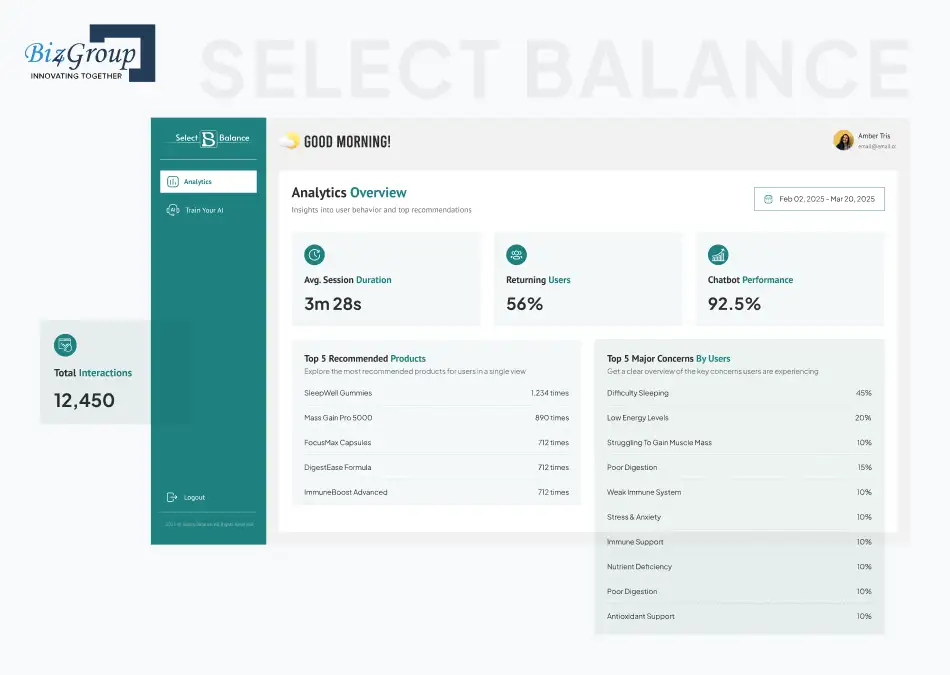
Select Balance is a digital health platform that uses AI to deliver personalized guidance while maintaining a scalable backend architecture. The product highlights how early architectural choices and phased capability rollout influence development effort as functionality expands over time.
Scale Without Rebuilding Everything
Plan with growth in mind and keep custom AI healthcare assistant development cost predictable.
Design My Scalable AI AssistantBudgeting Mistakes That Increase AI Healthcare Assistant Development Cost
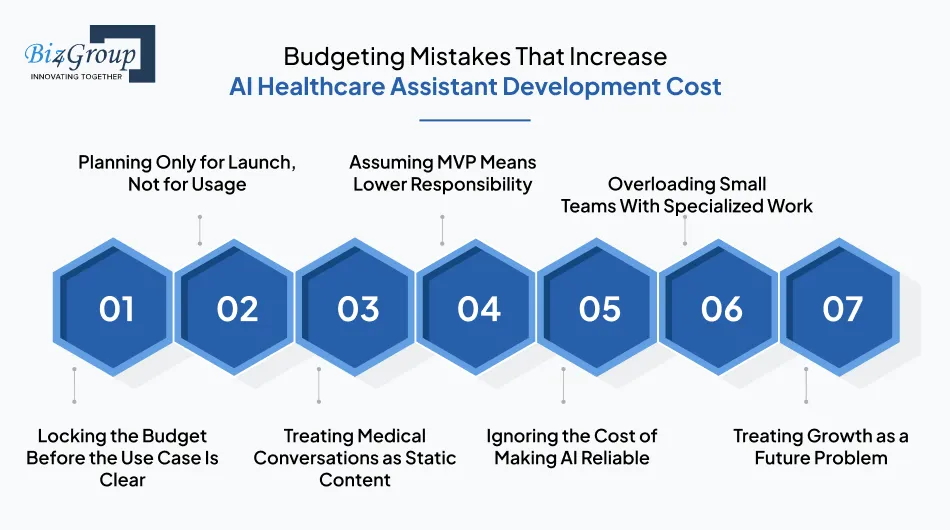
Budget issues rarely come from bad intent. They usually come from underestimating how different healthcare AI really is. Early on, the cost to develop AI healthcare assistant can feel manageable because the product still looks simple on paper. As soon as real workflows, real data, and real users enter the picture, weak assumptions start showing up as added cost.
Here are the budgeting mistakes that tend to cause the most trouble.
1. Locking the Budget Before the Use Case Is Clear
One of the biggest mistakes is fixing a budget while the problem is still loosely defined. Teams move fast to get approvals, but unclear scope almost always leads to change requests later. This makes it much harder to build HIPAA compliant AI healthcare assistant in a budget, because compliance decisions depend on how the assistant is actually used.
2. Planning Only for Launch, Not for Usage
Many estimates focus on getting the assistant live. Very few account for what happens once people start using it daily. As adoption grows, workflows expand and expectations change. This gap shows up quickly in AI healthcare assistant development cost for startups, where early traction can outpace the original plan.
3. Treating Medical Conversations as Static Content
Healthcare conversations are dynamic. They change based on user input, context, and edge cases. Teams that budget as if responses will stay fixed often underestimate the effort needed to adjust tone, clarity, and safety over time. This is where guidance similar to a healthcare conversational AI guide becomes useful, even if it was not planned for initially.
4. Assuming MVP Means Lower Responsibility
An MVP still handles sensitive information. Skipping steps like validation, logging, or monitoring may save money early, but it usually creates expensive clean up work later. This is often why teams struggle when revisiting what is the cost of developing an AI Healthcare Assistant after the first release.
5. Ignoring the Cost of Making AI Reliable
AI performance is not set and forget. Accuracy, consistency, and reliability improve with ongoing effort. Budgets that do not include this work tend to fall apart when teams try to create scalable AI healthcare assistant solutions cost estimate models that extend beyond version one.
6. Overloading Small Teams With Specialized Work
Healthcare AI brings unique challenges that general software teams may not have faced before. When teams stretch beyond their experience, progress slows and rework increases. This is often where specialized support in AI medical web development prevents long term cost creep.
7. Treating Growth as a Future Problem
Growth usually arrives faster than expected. New features, deeper integrations, and compliance updates rarely wait. Teams that do not plan for this end up reacting instead of building deliberately, which drives costs up over time.
Most of these mistakes are avoidable. When teams plan for real usage, evolving requirements, and long term ownership from the start, the AI healthcare assistant development cost for startups becomes far easier to predict and control instead of feeling unpredictable later.
How Monetization Decisions Affect Cost of AI Healthcare Assistant Development
Monetization is not something you figure out after the product is built. It quietly shapes how the system is designed from the start. For most teams, the cost to develop AI healthcare assistant is directly influenced by how access is sold, managed, and measured. The earlier those decisions are made, the easier it is to avoid rework and keep budgets from drifting later.
When monetization is clear upfront, things like permissions, billing logic, and reporting are built into the product instead of being patched in after launch. That single choice can make a noticeable difference in overall effort and planning confidence.
Below is how common monetization models affect development cost:
|
Monetization Model |
How It Works |
Best Fit |
Cost Impact |
|---|---|---|---|
|
Subscription Based |
Monthly or annual access to the assistant |
Patient facing or clinician tools |
Adds cost for billing, user tiers, and access controls |
|
Freemium With Paid Features |
Core access is free, advanced features are paid |
Early validation and growth |
Adds cost for feature gating and usage tracking |
|
Pay Per Use |
Charges per interaction, task, or workflow |
Transaction driven use cases |
Adds cost for metering and audit trails |
|
B2B Licensing |
Platform licensed to hospitals or providers |
Provider and enterprise use |
Adds cost for multi user management and reporting |
Each model brings its own technical needs. Subscriptions and freemium setups require reliable billing and permission logic. Usage based pricing adds complexity around tracking and limits. B2B licensing often pushes architecture toward scale and isolation, which starts to resemble patterns seen in enterprise AI solutions.
Monetization also affects how conversations are handled. When access is tied to plans or usage, conversations need to be logged, limited, or extended based on entitlement. Teams are often surprised to see how much this influences the overall AI healthcare assistant development cost, especially once real usage patterns emerge.
The key is alignment. When revenue strategy and system design evolve together, teams avoid late changes that drive up effort. In practice, thoughtful monetization choices make the cost of AI healthcare assistant development more predictable and far easier to manage as the product grows.
Is It Profitable to Develop an AI Healthcare Assistant?
At first glance, the numbers can feel heavy. Between engineering work, compliance needs, and AI setup, the cost to develop AI healthcare assistant is not something most teams take lightly. Profitability, though, is usually less about what you spend upfront and more about what that spend unlocks once the assistant is actually in use.
Here is how teams usually look at whether the investment pays off:
1. Reducing Day to Day Operational Load
Many teams start here. An AI healthcare assistant can take on repetitive tasks like intake questions, scheduling, reminders, or basic follow ups. Once those tasks are automated, staff spend less time on routine work. Over time, this is where the develop AI healthcare assistant cost breakdown starts to show real operational value.
2. Solving One Problem Really Well
Assistants that try to do everything rarely show strong returns early. Teams see better results when the assistant is built around a specific workflow and does it well. In some cases, carefully scoped capabilities like AI chatbot development for medical diagnosis can add value, as long as responsibility and limitations are clearly defined.
3. Consistent Usage Lowers Ongoing Costs
Profitability improves when people actually use the assistant. Clear conversations and predictable responses reduce confusion and repeat support requests. Teams that focus on usability often see smoother adoption, which helps balance early build AI healthcare assistant pricing against lower support and maintenance effort later.
4. Growing Without Rebuilding Everything
A well planned assistant should be able to grow without constant rewrites. Adding users or expanding features should not mean starting over. Teams that think ahead during development, sometimes with help from a software development company in Florida, often protect margins better as usage increases.
5. Looking Beyond Immediate Revenue
Most teams do not judge success in the first few months. Instead, they look at signs like time saved, fewer manual processes, and steady adoption. When those indicators move in the right direction, it becomes easier to create AI healthcare assistant cost estimate models that reflect long term value instead of short term expense.
Profitability is not automatic, but it is realistic. When the assistant is built with clear goals and room to grow, the build AI healthcare assistant pricing starts to feel like a smart investment rather than a risky one.
Get a Realistic Cost Range
Understand where your idea fits within the cost to develop AI healthcare assistant spectrum.
Estimate My AI Healthcare BudgetHow Biz4Group Optimizes Cost to Develop AI Healthcare Assistant
Most teams come to Biz4Group when cost starts feeling unpredictable. They are not looking to build everything at once. They want to understand how to keep the cost to develop AI healthcare assistant steady as real requirements begin to surface.
Here is how Biz4Group approaches that challenge:
1. Defining What Actually Matters First
Before development starts, Biz4Group helps teams narrow down what the assistant truly needs to do at launch. Features that add complexity without clear value are intentionally deferred. This keeps the AI medical assistant development cost tied to real use cases instead of assumptions.
2. Building in Phases With Clear Checkpoints
Rather than committing to everything upfront, development is broken into phases. Core workflows are validated early, and expansion happens only when it makes sense. This gives teams control over spend and keeps decisions grounded.
3. Designing Systems That Are Easy to Adjust
Healthcare needs change, and the system is built to handle that. Modular design and clean data flow reduce rework when updates are needed, helping stabilize healthcare AI assistant development pricing over time.
4. Handling Compliance Early to Avoid Surprises
Security and privacy are addressed from the start, not added later. This prevents last minute changes that often drive up the virtual healthcare assistant cost once the product is already live.
As one of the top AI development companies in Florida, Biz4Group helps teams make smart tradeoffs early, so costs stay aligned with value as the assistant grows.
Wrapping Up the Cost of AI Healthcare Assistant Development
If you made it this far, you already know there is no magic number when it comes to building an AI healthcare assistant. The cost is shaped by choices. What you build first, what you postpone, how seriously you treat compliance, and whether you design for growth or just for launch.
Most teams do not overspend because they aim too high. They overspend because they rush. When planning is thoughtful, the budget stops feeling like a moving target and starts feeling manageable. With the right mindset and the right AI development company, the cost becomes something you can plan around, not stress over.
In the end, it is not about building more AI. It is about building the right AI, at the right pace, for the right reason.
Want a realistic cost estimate for your AI healthcare assistant?
Talk to our team and get clarity before you commit.
FAQs on Cost to Develop AI Healthcare Assistant
1. What is the typical cost range to develop an AI healthcare assistant?
The overall investment usually falls between USD 20,000 and USD 150,000, depending on scope, complexity, and compliance needs. Simpler assistants focused on scheduling or FAQs sit on the lower end, while advanced systems with clinical context and integrations move higher. This range helps set expectations when evaluating what is the cost of developing an AI Healthcare Assistant early on.
2. How does compliance affect the cost of building an AI healthcare assistant?
Compliance directly impacts architecture, security, and testing effort. Requirements around data handling, access control, and audits add both time and cost, especially for regulated environments. This is why teams planning AI healthcare assistant development cost for hospitals and clinics often budget more than early stage consumer focused builds.
3. Is it cheaper to build an AI healthcare assistant for a startup compared to an enterprise?
In most cases, yes. Startups usually launch with a narrower scope and fewer integrations, which keeps early costs lower. That said, decisions made early still affect long term spend. Planning realistically for AI healthcare assistant development cost for startups helps avoid sharp cost increases as the product grows.
4. What features increase the cost of an AI healthcare assistant the most?
Advanced conversational logic, deep system integrations, and scalability planning tend to add the most cost. Features that require continuous learning or contextual awareness also raise effort. These elements are usually the biggest drivers in any develop AI healthcare assistant cost breakdown.
5. How do ongoing maintenance and updates impact total cost over time?
The initial build is only part of the picture. AI tuning, infrastructure scaling, and compliance updates continue after launch and often account for 15 to 25 percent of the initial cost each year. These factors are essential to consider when estimating the long term cost of AI healthcare assistant development.
6. Can the development cost be reduced without sacrificing quality?
Yes, when scope is phased and complexity is introduced gradually. Starting with core workflows and expanding based on real usage helps control spend while maintaining reliability. This approach is often used when teams plan build HIPAA compliant AI healthcare assistant in a budget without compromising safety or performance.
