Location :
Orlando, FL, USA
Location :
Orlando, FL, USA +1 (407) 714-1616
 info@biz4group.com

- The AI healthcare fraud detection software development cost typically ranges from $40,000 to $300,000+, depending on features, AI complexity, and compliance requirements.
- The cost to create AI fraud detection software for healthcare providers is influenced by key factors such as AI model type, data volume, integrations, and real-time processing needs.
- Businesses must plan the budget required to build AI healthcare fraud detection software with predictive analytics carefully, as advanced AI features significantly impact overall investment.
- Hidden costs such as data preparation, cloud infrastructure, model retraining, and compliance can increase the total cost estimation of AI healthcare fraud detection software if not considered early.
- Choosing between custom, off-the-shelf, or hybrid solutions directly affects long-term ROI, scalability, and the overall pricing to develop AI-powered healthcare fraud detection system for enterprises.
- Cost optimization strategies like MVP development, pre-trained AI models, and phased rollout can reduce development expenses by 20% to 50% without compromising quality.
- Partnering with experienced companies like Biz4Group LLC helps businesses build scalable, compliant, and cost-efficient AI fraud detection systems for healthcare within a defined budget.
Is your healthcare organization losing revenue to undetected fraud while still relying on outdated systems that cannot keep up with modern threats?
Healthcare fraud is evolving fast, and so is the need for intelligent, scalable, and compliant solutions. Businesses today are actively searching for answers to one key question: how much does it cost to develop AI healthcare fraud detection software from scratch that is both effective and compliant with regulations like HIPAA?
For decision-makers, CTOs, healthcare startups, and insurance providers, understanding the AI healthcare fraud detection software development cost is no longer optional. It is a strategic necessity. Whether you are building a custom healthcare fraud detection software solution or evaluating vendors who can deliver within a fixed budget, cost clarity directly impacts your ROI, scalability, and time to market.
In most cases, the cost estimation of AI healthcare fraud detection software ranges between $40,000 to $300,000+, depending on complexity, AI capabilities, compliance requirements, and integrations with existing healthcare systems.
Organizations are increasingly asking: we need to develop AI healthcare fraud detection software with compliance features, which companies can do this within a fixed budget? The answer lies in understanding cost drivers, development approaches, and optimization strategies before starting the project.
This guide breaks down everything you need to know, from cost factors and feature impact to smart budgeting and cost-saving strategies, so you can make informed decisions without overspending.
Why Now is the Perfect Time for Healthcare Businesses to Invest in AI Fraud Detection Software: A Market Overview
Healthcare fraud continues to drain billions from the industry every year, while traditional rule-based systems struggle to detect evolving fraud patterns. Static rules cannot adapt to new behaviors, which allows sophisticated fraud schemes to pass through unnoticed. This gap is pushing healthcare organizations to rethink how fraud detection systems are built and deployed.
AI is changing this landscape by enabling real-time analysis, predictive modeling, and behavioral tracking. Instead of relying on fixed rules, AI systems learn from historical and live data, making them far more effective at identifying unusual patterns and preventing fraud before it happens.
A key indicator of this shift is market growth. The global healthcare fraud analytics market is projected to reach $8.97 billion by 2031, growing rapidly as organizations increase their investment in AI healthcare fraud detection software development.
Several strong market drivers are accelerating adoption:
- Growth in digital healthcare data
Electronic health records, insurance claims, and telehealth platforms are generating large volumes of complex data - Increasing regulatory pressure
Compliance requirements demand better transparency, auditability, and secure data handling - Shift toward real-time fraud prevention
Organizations are prioritizing proactive detection instead of post-incident investigation
AI-powered fraud detection systems can process vast datasets instantly, identify anomalies with higher accuracy, and significantly reduce false positives. This directly impacts operational efficiency by lowering manual review efforts and speeding up claim processing.
For businesses evaluating AI healthcare fraud detection software development pricing, this is an important moment. Technology maturity, cloud infrastructure, and pre-trained AI models are making it more feasible to control the cost to create AI fraud detection software for healthcare providers while still achieving strong performance.
If you are exploring investment in AI healthcare fraud detection software development and looking for companies that can deliver high ROI with optimized development costs, the current market offers a clear advantage. Early adopters are already improving fraud detection accuracy, reducing losses, and building scalable systems that adapt to future risks.
Also Read: AI Document Fraud Detection Software Development: Technologies, Tools, and Best Practices
Why is Budgeting Essential While Developing an AI Healthcare Fraud Detection Software?
Why do many AI healthcare fraud detection projects exceed their expected costs, and how can you build a cost-efficient solution without compromising compliance or detection accuracy? Budgeting is essential because AI healthcare fraud detection software involves complex layers such as medical claims data processing, machine learning models, and strict regulatory compliance that go beyond traditional healthcare applications.
In many cases, AI implementation can increase total project costs by 30% to 60% due to model training, real-time data analysis, and secure cloud infrastructure. Understanding these cost drivers early helps healthcare providers and insurers avoid unexpected expenses and plan a more controlled investment.
The cost to create AI fraud detection software for healthcare providers depends heavily on how clearly requirements are defined from the beginning. It is not limited to building dashboards or workflows. It includes fraud pattern detection models, claims data analysis pipelines, integration with EHR and billing systems, and compliance features such as HIPAA-ready security frameworks. Without structured budgeting, organizations risk overspending on unnecessary features or missing critical fraud detection capabilities.
Key elements to include in your AI healthcare fraud detection software budget:
- Fraud detection features such as anomaly detection and risk scoring
- AI capabilities for claims analysis and behavioral tracking
- Healthcare data processing, labeling, and model training
- Cloud infrastructure for real-time fraud monitoring
- Compliance and security requirements such as HIPAA
- Integration with EHR, claims, and billing systems
- Continuous monitoring, model updates, and system scaling
For businesses asking, I am looking for developers who can build AI healthcare fraud detection software with essential features at a lower cost, starting with a focused MVP, using pre-trained healthcare AI models, and leveraging cloud infrastructure can significantly reduce initial costs while maintaining scalability and compliance.
AI Healthcare Fraud Detection Software Cost Calculator: Get Your Instant Project Estimate
When planning to build an AI-driven fraud detection system, one of the first questions is how to accurately estimate the cost to make AI fraud detection software for healthcare providers before starting development. A structured cost calculator helps businesses understand investment requirements early and provides clarity around AI healthcare fraud detection software development pricing.
In most cases, the development cost ranges between $40,000 and $300,000+, depending on feature complexity, AI capabilities, compliance requirements, and scalability goals.
A cost calculator simplifies this process by combining development effort, AI model complexity, infrastructure costs, and compliance needs into a clear estimation model. This approach helps healthcare providers, insurers, and startups evaluate the investment in AI healthcare fraud detection software development before committing to full-scale execution.
Key Factors Used in Cost Calculation:
- Type of solution such as claims fraud detection, billing anomaly detection, or real-time monitoring systems
- Number and complexity of features including dashboards, alerts, and risk scoring
- Level of AI functionality such as anomaly detection, predictive analytics, and behavioral tracking
- Compliance requirements such as HIPAA and data security frameworks
- Third-party integrations with EHR systems, billing platforms, and APIs
- Development team location and hourly rates
- Project timeline and delivery expectations
Basic Cost Estimation Formula:
A commonly used model is:
Total Cost = (Development Hours × Hourly Rate) + AI Model Cost + Infrastructure Cost + Compliance Cost
This formula gives a practical way to estimate the AI healthcare fraud detection software development cost before detailed planning.
Example Cost Calculation
Let us assume a mid-level AI healthcare fraud detection system with the following requirements:
- Development hours: 1,000 hours
- Average hourly rate: $40 per hour
- Cloud infrastructure and data pipeline setup: $10,000
- AI model development and integration: $15,000
- Compliance and security implementation: $10,000
Applying the formula:
Total Cost = (1,000 × $40) + $10,000 + $15,000 + $10,000
Total Cost = $40,000 + $35,000
Estimated Final Project Cost = $75,000
This example shows how a cost calculator can provide a quick and realistic estimate. Businesses can adjust variables such as AI complexity, compliance level, or feature scope to explore different pricing scenarios.
Build Your AI Fraud Detection System Within Budget
Get a tailored cost estimate and discover how to reduce development expenses without compromising performance.
Get Free Cost EstimateWhy Use a Cost Calculator Before AI Healthcare Fraud Detection Software Development?
If you are asking, I want to estimate the investment required to build AI healthcare fraud detection software, is there a cost calculator or tool that can give me an instant project estimate based on my requirements, the answer is yes. A structured calculator is one of the most effective starting points.
It helps you:
- Estimate total investment before development begins
- Compare cost against expected ROI
- Identify essential features for your budget
- Reduce financial risk and avoid cost overruns
- Decide whether to start with an MVP or a full-scale solution
Understanding how AI healthcare fraud detection system development costing works allows you to plan smarter, control costs, and move forward with confidence.
What is the Cost to Develop an AI Healthcare Fraud Detection Software: Quick Cost Summary
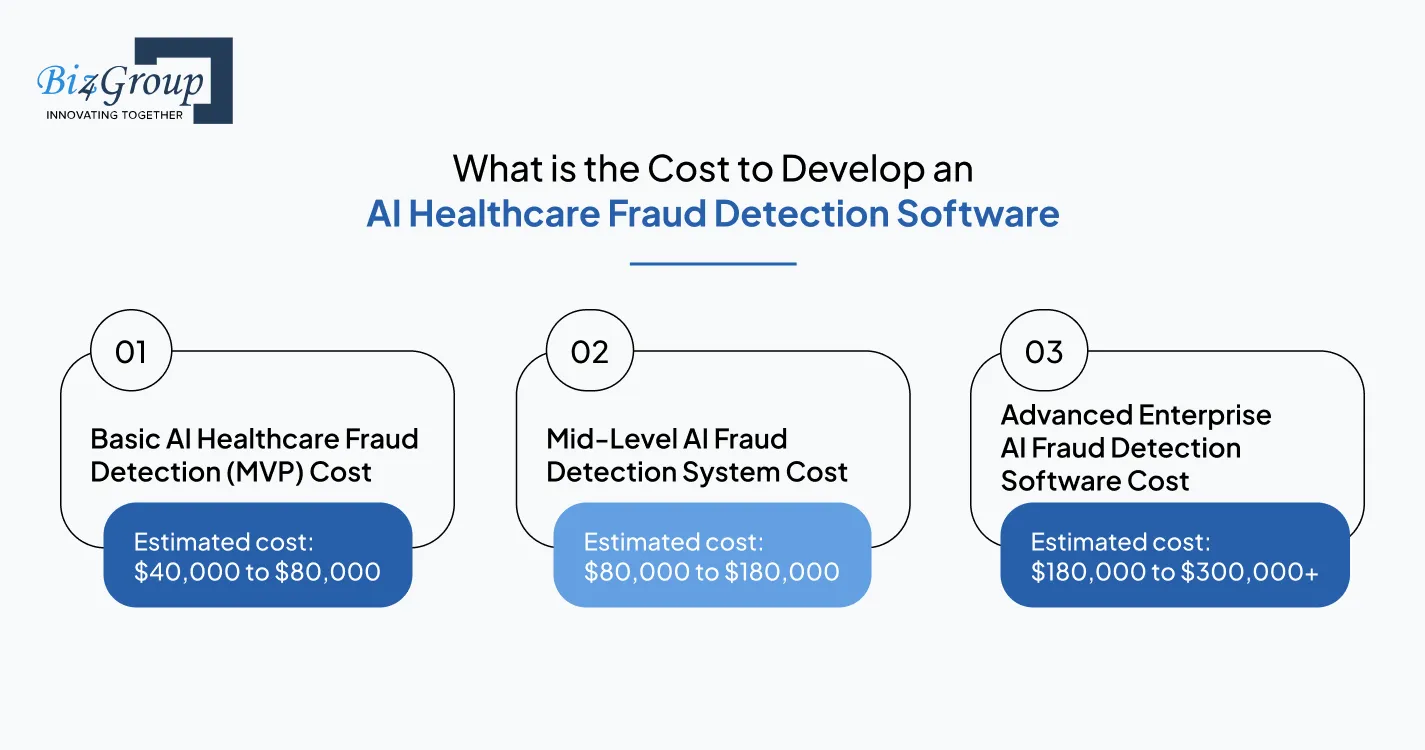
The cost to create AI fraud detection software for healthcare providers typically ranges between $40,000 and $300,000+, depending on system complexity, AI capabilities, compliance requirements, and integration needs. The AI healthcare fraud detection software development cost varies significantly based on whether you are building a basic MVP, a mid-level analytics system, or a full-scale enterprise solution.
AI-driven healthcare fraud systems require investment in machine learning models, claims data processing, real-time monitoring, and regulatory compliance. Businesses must decide early whether they need a lightweight system for quick deployment or an advanced platform designed for large-scale fraud prevention and long-term scalability.
Below is a quick cost summary based on different development tiers.
Quick Cost Breakdown by Software Type
1. Basic AI Healthcare Fraud Detection (MVP) Cost
Estimated Cost: $40,000 to $80,000
Typical features:
- Claims anomaly detection
- Basic rule-based + ML models
- Simple risk scoring system
- Dashboard for monitoring
- Cloud-based deployment
This level focuses on validating an AI product idea and launching quickly with essential fraud detection features.
2. Mid-Level AI Fraud Detection System Cost
Estimated Cost: $80,000 to $180,000
Common features:
- Predictive fraud analytics
- Behavioral pattern detection
- Integration with EHR and billing systems
- Automated alerts and reporting
- Role-based dashboards
This tier is suitable for healthcare providers and insurers looking to improve fraud detection accuracy and operational efficiency.
3. Advanced Enterprise AI Fraud Detection Software Cost
Estimated Cost: $180,000 to $300,000+
Advanced capabilities:
- Custom AI and deep learning models
- Real-time fraud detection at scale
- Large healthcare data pipelines
- Multi-system integrations
- Advanced compliance and security frameworks
Enterprise solutions require higher investment due to customization, scalability, and strict regulatory requirements.
AI Healthcare Fraud Detection Software Cost Overview Table
|
Software Type |
Estimated Cost Range |
Key Features Included |
Ideal For |
|---|---|---|---|
|
Basic AI Fraud Detection MVP |
$40,000 to $80,000 |
Anomaly detection, risk scoring, dashboards |
Startups and pilot projects |
|
Mid-Level AI Fraud System |
$80,000 to $180,000 |
Predictive analytics, integrations, alerts |
Healthcare providers and insurers |
|
Enterprise AI Fraud Detection Software |
$180,000 to $300,000+ |
Custom AI models, real-time detection, compliance |
Large healthcare organizations |
If you are asking, what is the estimated cost to develop AI healthcare fraud detection software, this breakdown provides a clear starting point. The final AI healthcare fraud detection software development pricing depends on feature depth, AI sophistication, and compliance scope.
Choosing the right development tier early helps control costs, align with business goals, and ensure a strong return on your funding in AI healthcare fraud detection software development.
Why AI Healthcare Fraud Detection Software Costs Differ from Traditional Healthcare Fraud Detection Software?
AI-powered healthcare fraud detection systems are more expensive than traditional solutions because they are built to learn, adapt, and improve over time. Traditional systems rely on fixed rules and manual checks, while AI-based platforms process large volumes of healthcare data, identify hidden patterns, and detect fraud in real time. This shift from static logic to intelligent automation increases both development effort and long-term operational costs.
In many cases, the cost estimation of AI healthcare fraud detection software can be 30% to 70% higher than conventional systems due to advanced data processing, model training, and infrastructure requirements.
Traditional Healthcare Fraud Detection vs AI-Driven Systems
Traditional systems typically include:
- Rule-based claim validation
- Manual fraud review processes
- Static dashboards and reports
- Limited automation workflows
These systems are easier to build and maintain but struggle to detect complex or evolving fraud patterns.
AI-driven fraud detection systems include:
- Intelligent anomaly detection
- Predictive fraud identification
- Behavioral pattern analysis
- Real-time claims monitoring
- Automated risk scoring
These advanced capabilities increase the overall cost to build AI-based healthcare fraud detection systems.
Key Components That Increase Development Costs:
1. Intelligent Model Development
AI systems require training models on healthcare claims, billing data, and usage patterns. This process involves research, testing, and continuous improvement.
2. Healthcare Data Preparation
High-quality datasets are essential. Data collection, cleaning, labeling, and validation add significant effort to development.
3. Predictive and Real-Time Analytics
AI platforms analyze both historical and live data to detect fraud early. This requires more sophisticated engineering and processing capabilities.
4. Continuous Learning and Optimization
AI models must be updated regularly to keep up with new fraud tactics, which introduces ongoing costs.
5. Scalable Processing Infrastructure
Handling large-scale healthcare data in real time requires cloud-based systems, data pipelines, and high-performance computing environments.
Infrastructure and Architecture Differences
Traditional fraud detection tools operate on basic application servers and databases. AI-enabled systems require more advanced architecture, including:
- Continuous data ingestion pipelines
- Model training and inference layers
- Real-time analytics engines
- Scalable cloud environments
These additional layers directly impact the pricing of AI-powered healthcare fraud detection software development.
The higher investment reflects the value AI delivers through improved detection accuracy, reduced false positives, and faster response times. For organizations planning to build advanced fraud detection systems, this difference in cost supports stronger long-term outcomes and operational efficiency.
Ready to Stop Healthcare Fraud with AI?
Work with experts to develop a scalable, compliant AI fraud detection solution for healthcare that maximizes ROI.
Book an AppointmentAI Healthcare Fraud Detection Software Development Cost: 7 Factors to Consider in 2026
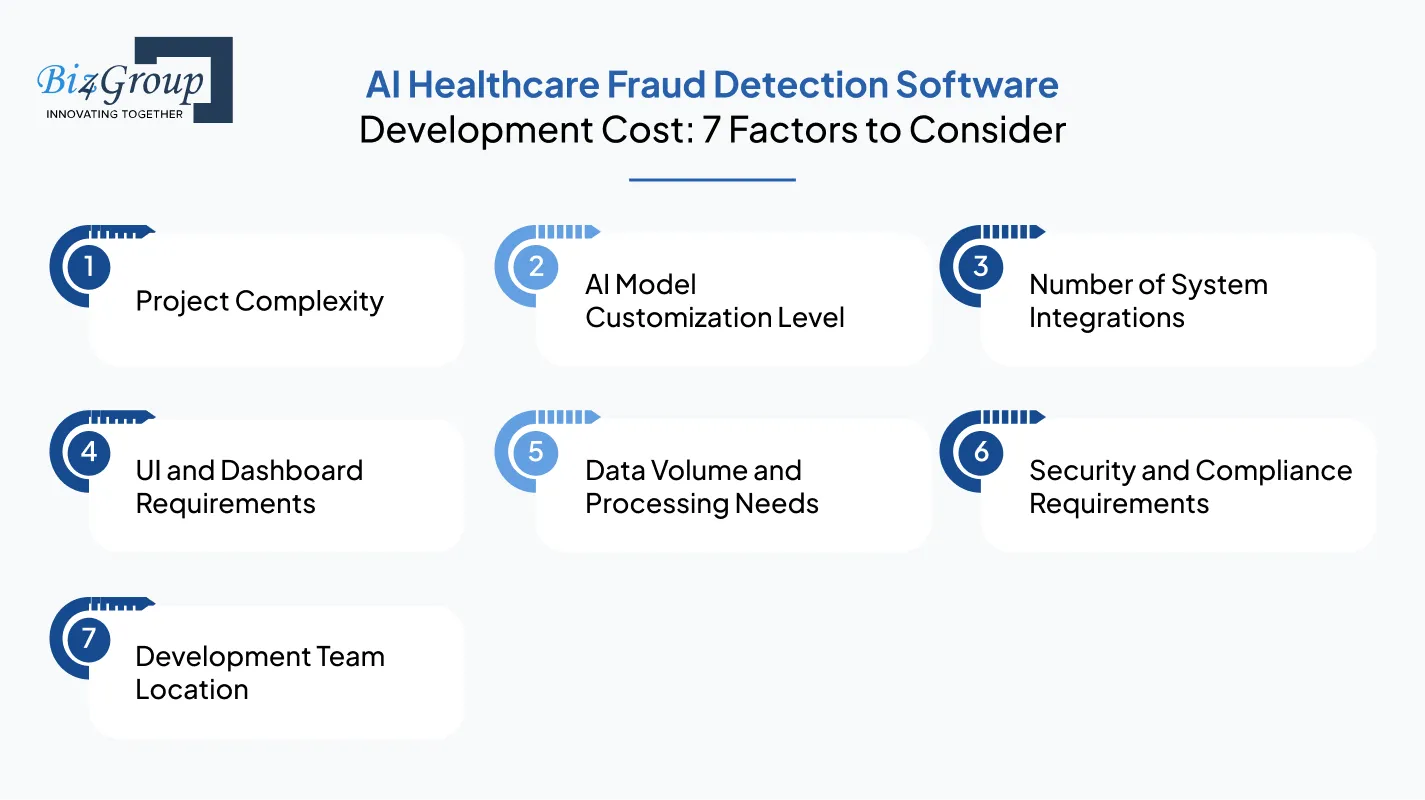
The cost of building AI-powered healthcare fraud detection software varies based on technical complexity, compliance requirements, and system scope. If you are thinking, we have a project to create AI-powered healthcare fraud detection software and are looking for companies that fit our budget range, understanding these cost factors will help you align your requirements with realistic pricing between $40,000 and $300,000+.
Businesses that evaluate these factors early can shortlist AI healthcare software development companies more effectively, avoid budget overruns, and ensure better ROI.
Below are the seven key factors that influence development cost in 2026.
1. Project Complexity
The overall scope of the system plays a major role in determining cost. A basic fraud detection tool with limited features costs significantly less than a full-scale enterprise platform with real-time analytics and multi-system integration.
Estimated cost impact:
- Basic systems: $40,000 to $80,000
- Mid-level platforms: $80,000 to $180,000
- Enterprise-grade systems: $180,000 to $300,000+
Higher complexity increases backend architecture, testing, and deployment effort.
2. AI Model Customization Level
The type of AI models used directly affects development pricing. Pre-trained models are more affordable, while custom-built models require more time and resources.
Estimated cost impact:
- Pre-trained AI integration: $10,000 to $25,000
- Semi-custom models: $25,000 to $60,000
- Fully custom AI development: $60,000 to $120,000+
Custom models are often required for detecting complex healthcare fraud patterns.
3. Number of System Integrations
Healthcare fraud detection systems often need to connect with EHR systems, claims processing platforms, billing software, and third-party APIs.
Estimated cost impact:
- Basic integrations (2 to 3 systems): $10,000 to $25,000
- Moderate integrations (4 to 8 systems): $25,000 to $60,000
- Advanced ecosystem integrations: $60,000 to $100,000+
Each integration adds development, testing, and maintenance effort.
4. UI and Dashboard Requirements
User interfaces for fraud monitoring, reporting, and investigation workflows impact both usability and cost.
Estimated cost impact:
- Standard dashboards: $8,000 to $20,000
- Custom dashboards with analytics: $20,000 to $50,000
- Advanced interactive dashboards: $50,000 to $80,000+
More advanced interfaces require additional frontend development and user testing.
Also Read: Top 15 UI/UX Design Companies in USA
5. Data Volume and Processing Needs
AI fraud detection systems rely on large volumes of healthcare data, including claims, billing records, and patient information.
Estimated cost impact:
- Small-scale data systems: $5,000 to $15,000
- Medium-scale data pipelines: $15,000 to $40,000
- Large-scale real-time processing systems: $40,000 to $90,000+
Handling large datasets requires scalable infrastructure and optimized pipelines.
6. Security and Compliance Requirements
Healthcare systems must meet strict compliance standards such as HIPAA, along with advanced security measures.
Estimated cost impact:
- Basic security setup: $10,000 to $20,000
- Advanced compliance implementation: $20,000 to $50,000
- Enterprise-grade security architecture: $50,000 to $90,000+
Compliance adds significant development effort but is essential for deployment.
7. Development Team Location
The cost of hiring developers varies based on geographic location and expertise.
Estimated cost impact:
- Offshore teams: $25 to $50 per hour
- Nearshore teams: $50 to $90 per hour
- Onshore teams: $100 to $200+ per hour
Choosing the right team can help balance cost and quality.
AI Healthcare Fraud Detection Software Cost Factors Overview
|
Cost Factor |
What It Includes |
Average Cost Impact |
Why It Increases Cost |
|---|---|---|---|
|
Project Complexity |
Features, workflows, analytics systems |
$40,000 to $180,000 |
More features require more development effort |
|
AI Model Type |
Pre-trained vs custom models |
$10,000 to $120,000+ |
Model training and optimization add complexity |
|
Integrations |
EHR, claims systems, APIs |
$10,000 to $100,000+ |
Each integration requires development and testing |
|
UI and Dashboards |
Monitoring tools and reports |
$8,000 to $80,000+ |
Advanced UI requires design and engineering effort |
|
Data Infrastructure |
Data pipelines and processing |
$5,000 to $90,000+ |
Large datasets need scalable systems |
|
Security and Compliance |
HIPAA, encryption, audits |
$10,000 to $90,000+ |
Compliance increases implementation effort |
|
Team Location |
Offshore vs onshore teams |
$25 to $200+ per hour |
Labor cost varies by region |
Evaluating these seven factors helps businesses estimate development costs more accurately and choose the right development partner. It also allows you to match your project scope with companies that can deliver within your budget while maintaining performance, scalability, and compliance.
Cost of AI Healthcare Fraud Detection Software Development Based on Different Types
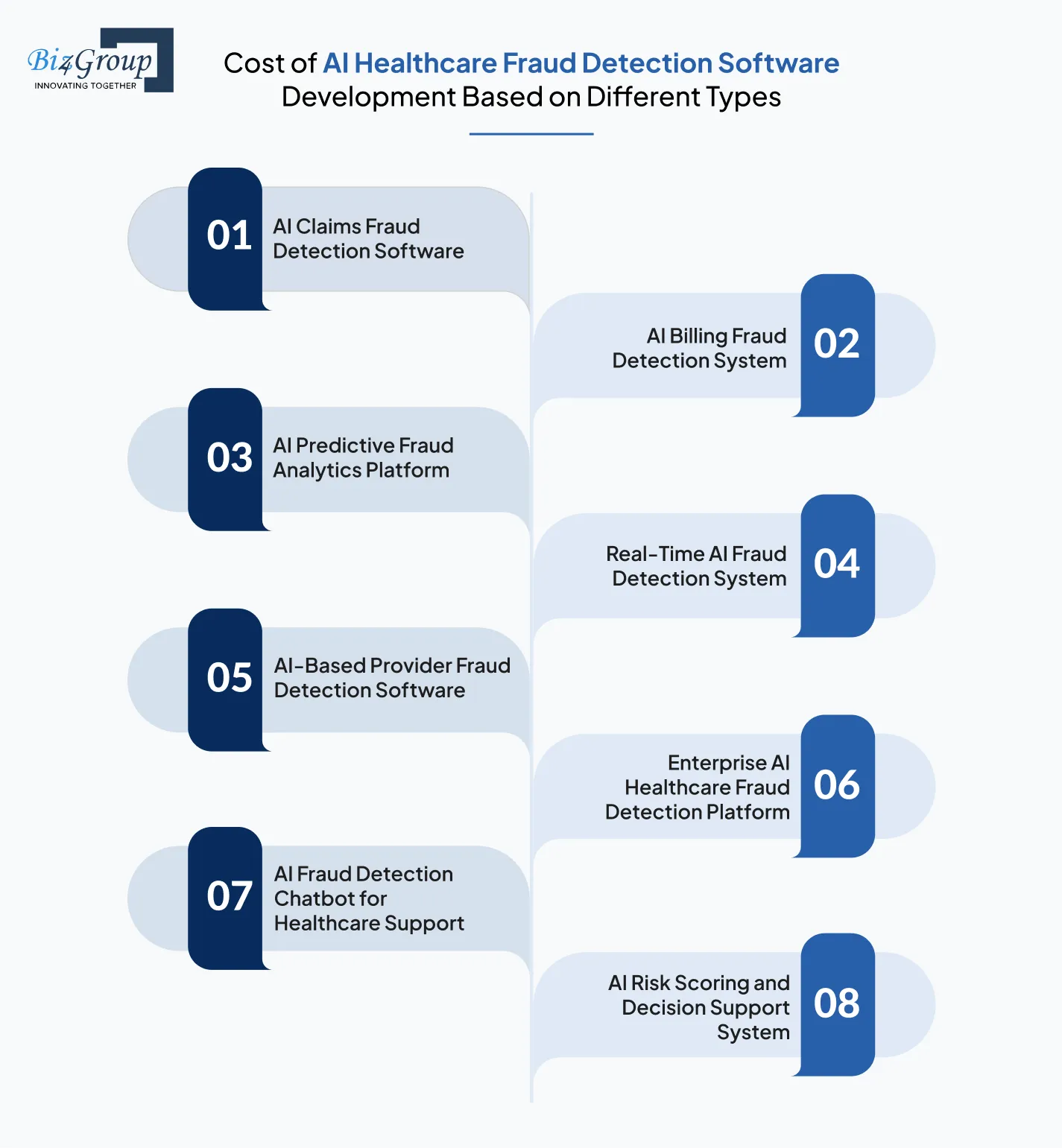
The cost of building AI healthcare fraud detection software varies based on the type of solution, level of intelligence, and healthcare use case. Each system requires a different combination of AI models, data processing, compliance layers, and integrations. As AI capabilities increase, both development effort and infrastructure requirements also increase.
Below is a breakdown of different types of AI healthcare fraud detection software and their estimated cost ranges in 2026.
1. AI Claims Fraud Detection Software
Estimated Cost: $40,000 to $100,000
This type focuses on detecting fraudulent insurance claims using anomaly detection and rule-based AI models.
Typical features:
- Claims pattern analysis
- Basic anomaly detection
- Risk scoring engine
- Fraud alerts dashboard
Costs increase with real-time processing and integration with multiple claims systems.
Also Read: AI Medical Claim Processing Software Development
2. AI Billing Fraud Detection System
Estimated Cost: $50,000 to $120,000
Designed to identify irregularities in medical billing, coding errors, and overcharging.
Typical features:
- Billing anomaly detection
- Code validation using AI
- Automated flagging system
- Reporting dashboards
Higher costs are driven by integration with billing platforms and compliance requirements.
3. AI Predictive Fraud Analytics Platform
Estimated Cost: $80,000 to $180,000
This system uses historical healthcare data to predict fraudulent activities before they occur.
Typical features:
- Predictive modeling
- Risk forecasting
- Behavioral analysis
- Data visualization tools
Advanced analytics and large datasets increase infrastructure and model complexity.
Also Read: The Ultimate Guide to Predictive Analytics Software Development
4. Real-Time AI Fraud Detection System
Estimated Cost: $100,000 to $220,000
Built for instant fraud detection during claims processing or transactions.
Typical features:
- Real-time data processing
- Instant fraud alerts
- Stream processing pipelines
- API integrations
Costs rise due to high-performance infrastructure and low-latency processing requirements.
5. AI-Based Provider Fraud Detection Software
Estimated Cost: $90,000 to $200,000
Focuses on identifying fraudulent activities by healthcare providers through behavioral analysis.
Typical features:
- Provider behavior tracking
- Pattern recognition across claims
- Network analysis
- Compliance monitoring
Complex data relationships and large datasets increase development effort.
6. Enterprise AI Healthcare Fraud Detection Platform
Estimated Cost: $180,000 to $300,000+
A comprehensive solution designed for large healthcare organizations and insurers.
Typical features:
- Custom AI models
- Multi-system integrations
- Large-scale data pipelines
- Advanced compliance frameworks
- Real-time and predictive fraud detection
Enterprise platforms require higher investment due to scalability, customization, and strict regulatory needs.
7. AI Fraud Detection Chatbot for Healthcare Support
Estimated Cost: $40,000 to $90,000
Conversational AI tools that assist in fraud reporting and initial screening.
Typical features:
- Fraud reporting automation
- NLP-based interaction
- Case logging and routing
- Integration with backend systems
Costs depend on the level of AI training and customization.
8. AI Risk Scoring and Decision Support System
Estimated Cost: $70,000 to $150,000
Helps healthcare organizations prioritize high-risk cases using AI-driven scoring.
Typical features:
- Risk scoring algorithms
- Decision support dashboards
- Case prioritization
- Integration with fraud workflows
Advanced scoring models and integrations increase cost.
Overview Table of AI Healthcare Fraud Detection Software Development Cost by Type
|
Software Type |
Typical Use Case |
Estimated Cost |
Key AI Features Included |
|---|---|---|---|
|
AI Claims Fraud Detection |
Detect fraudulent insurance claims |
$40,000 to $100,000 |
Anomaly detection, risk scoring |
|
AI Billing Fraud Detection |
Identify billing errors and fraud |
$50,000 to $120,000 |
Code validation, anomaly detection |
|
Predictive Fraud Analytics Platform |
Forecast fraud risks |
$80,000 to $180,000 |
Predictive modeling, behavioral analysis |
|
Real-Time Fraud Detection System |
Instant fraud detection |
$100,000 to $220,000 |
Real-time analytics, alerts |
|
Provider Fraud Detection Software |
Monitor provider behavior |
$90,000 to $200,000 |
Pattern recognition, network analysis |
|
Enterprise Fraud Detection Platform |
Large-scale fraud prevention |
$180,000 to $300,000+ |
Custom AI models, compliance |
|
AI Fraud Detection Chatbot |
Fraud reporting and support |
$40,000 to $90,000 |
NLP, automation |
|
AI Risk Scoring System |
Case prioritization |
$70,000 to $150,000 |
Risk scoring, decision support |
Choosing the right type of AI healthcare fraud detection system is essential for accurate cost planning. Each category aligns with different business goals, from basic fraud detection to enterprise-level automation. Understanding these options helps organizations match their requirements with the right investment level and build scalable solutions efficiently.
Phases-Wise Cost Breakdown of AI Healthcare Fraud Detection Software Development
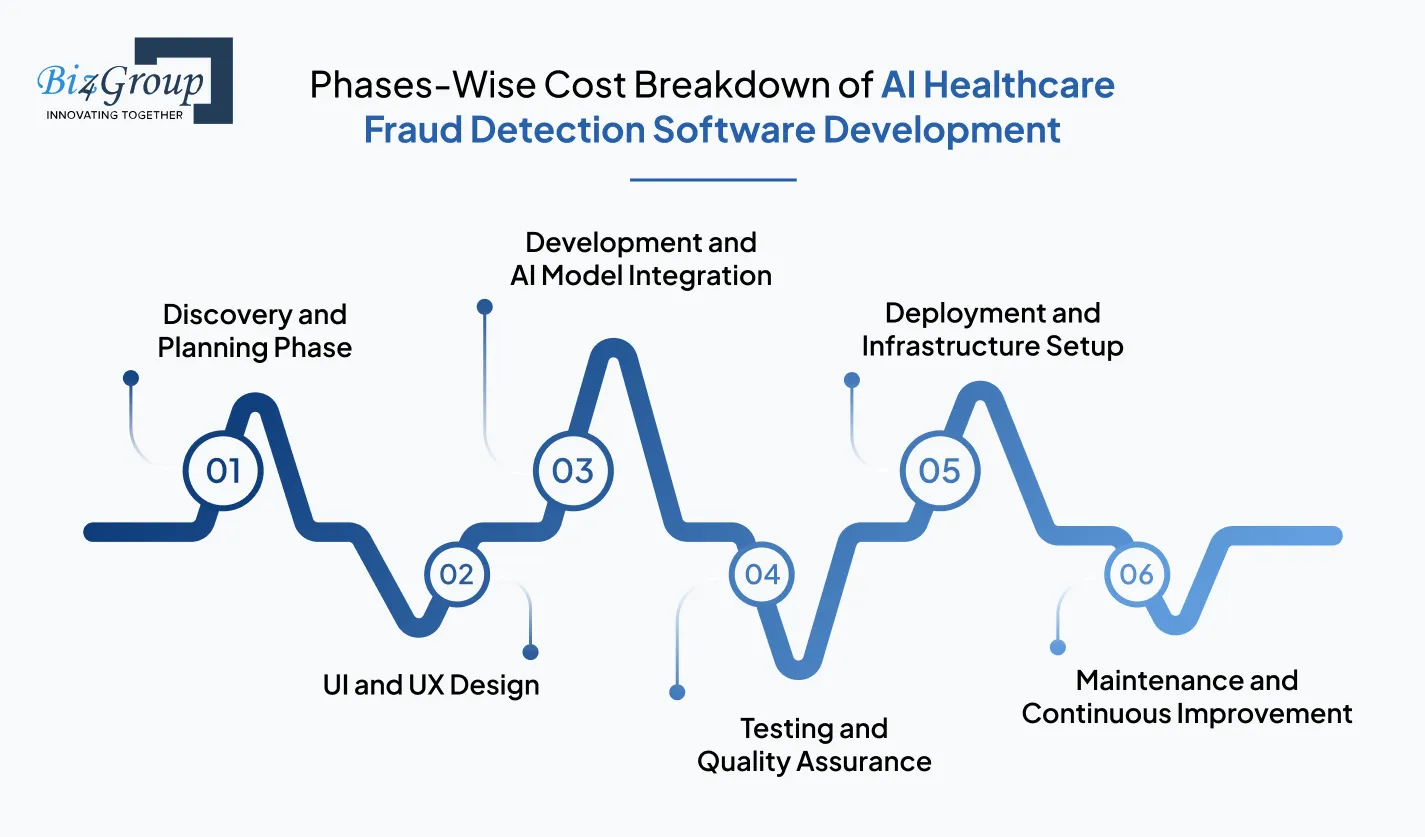
The total investment required to build AI healthcare fraud detection software is distributed across multiple development phases, each contributing a specific portion to the overall budget.
Unlike traditional healthcare systems, AI-based fraud detection requires additional effort in data engineering, model training, and compliance implementation. Understanding this phase-wise breakdown helps businesses plan budgets more accurately and avoid unexpected cost escalations during development.
Below is a detailed breakdown of each stage involved in building AI healthcare fraud detection software within the typical range of $40,000 to $300,000+.
1. Discovery and Planning Phase
Estimated Cost: $5,000 to $20,000
This is the foundation stage where business goals, fraud detection requirements, and technical feasibility are defined. Teams identify key fraud scenarios such as claims fraud, billing irregularities, and provider-level anomalies. This phase also includes compliance planning, data source identification, and system architecture design.
A well-structured discovery phase helps reduce long-term risks, ensures accurate cost estimation, and prevents scope creep during later stages of development.
2. UI and UX Design
Estimated Cost: $8,000 to $30,000
This phase focuses on designing intuitive dashboards and interfaces for fraud analysts, administrators, and compliance teams. A professional UI/UX design company handles wireframes, prototypes, and user journey mapping for features such as fraud alerts, case management, and reporting tools.
Costs increase when advanced data visualization, role-based access, and interactive dashboards are required to handle complex healthcare data efficiently.
3. Development and AI Model Integration
Estimated Cost: $40,000 to $150,000+
This is the most resource-intensive phase, where the core system is built. It includes backend development, database setup, API integrations, and implementation of AI models for fraud detection.
Key components developed in this phase include:
- Fraud detection algorithms and anomaly detection models
- Claims and billing data processing pipelines
- Risk scoring and alert generation systems
- Integration with EHR, claims, and billing platforms
The cost increases significantly when custom AI models, real-time fraud detection, and large-scale data processing are involved.
4. Testing and Quality Assurance
Estimated Cost: $10,000 to $30,000
This phase ensures the system performs accurately, securely, and reliably. It includes functional testing, performance testing, and validation of AI model accuracy. Special attention is given to reducing false positives and ensuring fraud detection precision.
Compliance testing, security audits, and data protection checks also add to the overall cost, especially for healthcare-specific regulations.
5. Deployment and Infrastructure Setup
Estimated Cost: $5,000 to $20,000
In this phase, the software is deployed to production environments using cloud or on-premise infrastructure. It includes configuring servers, setting up data pipelines, and ensuring system scalability and availability.
Costs vary depending on infrastructure complexity, hosting provider, and whether real-time processing capabilities are required.
6. Maintenance and Continuous Improvement
Estimated Cost: $10,000 to $50,000 per year
AI healthcare fraud detection systems require ongoing maintenance to remain effective. This includes retraining models with new data, updating fraud detection rules, and optimizing system performance.
Additional activities include monitoring system accuracy, scaling infrastructure as data volume increases, and ensuring continuous compliance with evolving healthcare regulations.
AI Healthcare Fraud Detection Software Development Phase Cost Overview
|
Development Phase |
Typical Activities |
Estimated Cost Range |
Why Cost Varies |
|---|---|---|---|
|
Discovery and Planning |
Requirements analysis, fraud use cases, architecture design |
$5,000 to $20,000 |
Complexity of fraud scenarios and compliance scope |
|
UI and UX Design |
Dashboards, prototypes, user flows, reporting tools |
$8,000 to $30,000 |
Level of visualization and customization required |
|
Development and AI Integration |
Backend, AI models, integrations, data pipelines |
$40,000 to $150,000+ |
AI complexity and system scale |
|
Testing and QA |
Performance testing, model validation, compliance checks |
$10,000 to $30,000 |
Depth of testing and regulatory requirements |
|
Deployment |
Infrastructure setup, cloud configuration, scalability |
$5,000 to $20,000 |
Hosting environment and system complexity |
|
Maintenance |
Model updates, optimization, scaling, monitoring |
$10,000 to $50,000 yearly |
Data growth and evolving fraud patterns |
Turn Your AI Healthcare Fraud Detetction Idea into Reality
From MVP to enterprise solutions, build cost-efficient AI fraud detection software for healthcare sector with the right strategy.
Talk to ExpertsHidden Costs in AI Healthcare Fraud Detection Software Development You Should Know About
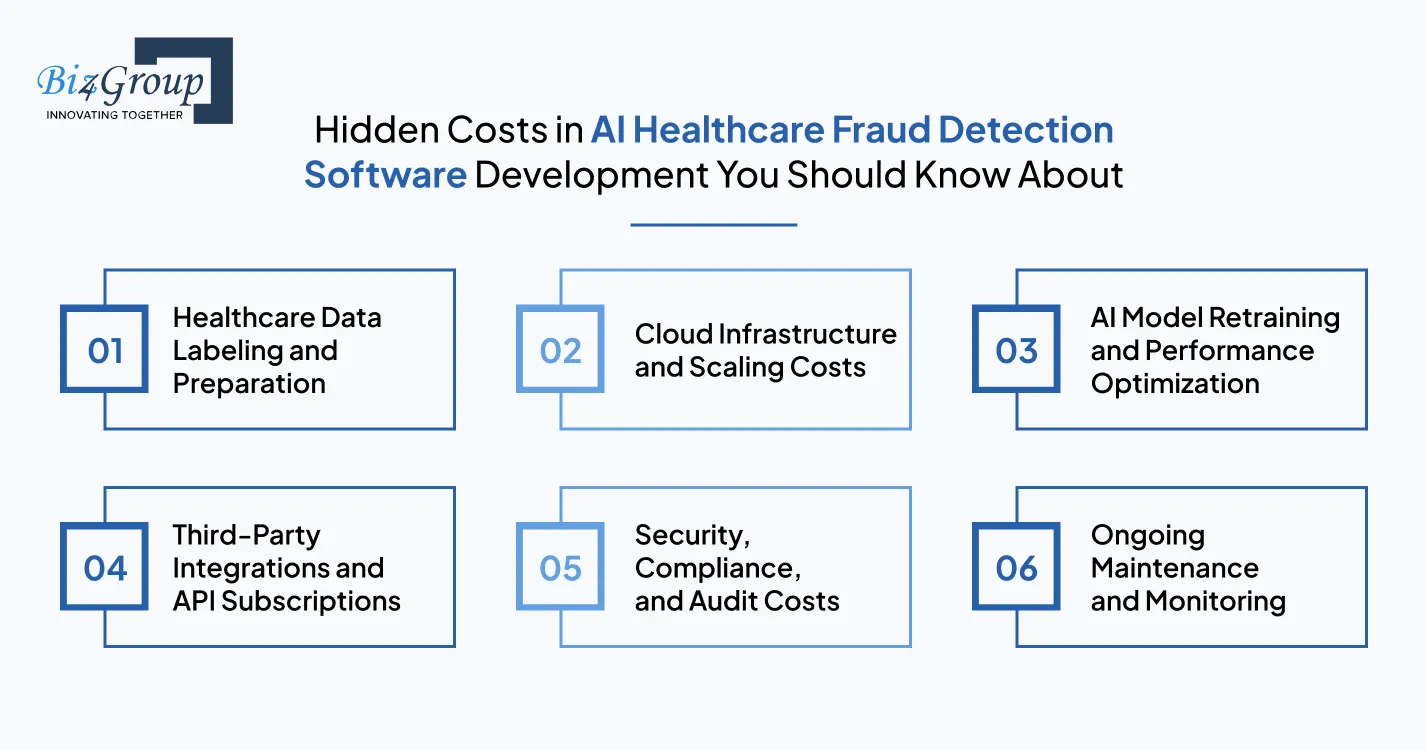
The total investment required to build AI healthcare fraud detection software often goes beyond initial development estimates. Many businesses focus on core features, AI models, and integrations, but overlook ongoing operational and compliance-related expenses that can significantly increase the overall budget.
Understanding these hidden costs is essential for accurate cost estimation of AI healthcare fraud detection software and for avoiding unexpected financial pressure after deployment.
Below are some commonly overlooked cost factors that impact the total investment range of $40,000 to $300,000+.
1. Healthcare Data Labeling and Preparation
Estimated Cost Impact: $5,000 to $40,000+
AI fraud detection systems rely on high-quality healthcare datasets such as claims, billing records, and patient data. Preparing this data involves cleaning, structuring, labeling, and validating it for model training.
This process is time-consuming and often underestimated, especially when dealing with sensitive and complex healthcare data.
2. Cloud Infrastructure and Scaling Costs
Estimated Cost Impact: $500 to $6,000 per month
AI systems require scalable cloud infrastructure to process large volumes of healthcare data in real time. As the number of users and transactions increases, storage, compute power, and GPU usage also grow.
These costs increase gradually and can become a major long-term expense.
3. AI Model Retraining and Performance Optimization
Estimated Cost Impact: $5,000 to $25,000 annually
Fraud patterns evolve over time, which means AI models must be retrained regularly to maintain accuracy. Continuous optimization is required to reduce false positives and improve detection efficiency.
Ignoring this cost can lead to decreased system performance and missed fraud cases.
4. Third-Party Integrations and API Subscriptions
Estimated Cost Impact: $300 to $4,000 per month
AI healthcare fraud detection systems often rely on third-party services such as data providers, analytics tools, identity verification systems, and external APIs.
These subscription-based services introduce recurring costs that are often not fully considered during initial planning.
5. Security, Compliance, and Audit Costs
Estimated Cost Impact: $8,000 to $30,000
Healthcare applications must comply with strict regulations such as HIPAA. This requires encryption, access control, audit logs, and periodic security assessments.
Compliance-related costs are essential but frequently underestimated in early budgeting stages.
6. Ongoing Maintenance and Monitoring
Estimated Cost Impact: 15% to 25% of initial development cost annually
Maintenance includes system updates, bug fixes, infrastructure optimization, and continuous monitoring of AI model performance.
AI systems require more frequent updates compared to traditional software, making this a significant recurring expense.
Hidden Cost Overview Table
|
Hidden Cost Category |
Typical Activities |
Estimated Cost Impact |
Why It Is Often Overlooked |
|---|---|---|---|
|
Data Preparation |
Cleaning, labeling, structuring healthcare data |
$5,000 to $40,000+ |
Not included in initial estimates |
|
Cloud Scaling |
Storage, compute, real-time processing |
$500 to $6,000/month |
Costs grow with usage |
|
Model Retraining |
Updating AI models with new fraud patterns |
$5,000 to $25,000/year |
Assumed as one-time effort |
|
Third-Party APIs |
Data services, analytics tools, integrations |
$300 to $4,000/month |
Subscription costs underestimated |
|
Security and Compliance |
HIPAA compliance, audits, encryption |
$8,000 to $30,000 |
Mandatory but often delayed |
|
Maintenance |
Monitoring, updates, optimization |
15% to 25% yearly |
Ongoing operational requirement |
Accounting for these hidden costs early helps businesses plan more accurately, control long-term expenses, and ensure sustainable investment in AI healthcare fraud detection software development.
Custom AI Healthcare Fraud Detection Software Cost vs. Off-the-Shelf Solutions: Which Saves You More?
When businesses evaluate fraud detection solutions, a common question arises: we are comparing custom AI healthcare fraud detection software with off-the-shelf solutions, which option saves more cost in the long run and offers better value for our investment?
The answer depends on how you balance upfront investment with long-term scalability, compliance, and performance. Understanding the pricing to develop AI-powered healthcare fraud detection system for enterprises helps clarify which approach delivers better ROI over time.
Custom AI Healthcare Fraud Detection Software
Estimated Cost Range: $80,000 to $300,000+
Custom-built solutions are designed specifically for enterprise healthcare environments, supporting complex fraud detection workflows, regulatory compliance, and large-scale data processing.
Benefits include:
- Tailored fraud detection models for higher accuracy
- Full control over data, security, and compliance frameworks
- Seamless integration with EHR, claims, and billing systems
- Scalable architecture for growing data and users
- Long-term cost efficiency due to reduced dependency on third-party tools
Challenges:
- Higher initial investment
- Longer development timeline
- Requires experienced development partner
Off-the-Shelf AI Healthcare Fraud Detection Software
Estimated Cost Range: $10,000 to $60,000 annually (subscription-based)
Off-the-shelf platforms offer ready-to-use fraud detection features with limited customization. These solutions are suitable for organizations looking for quick deployment with minimal upfront cost.
Benefits include:
- Lower initial investment
- Faster time to deployment
- Reduced development effort
- Pre-configured features
Limitations:
- Limited flexibility for enterprise-level customization
- Ongoing subscription costs that increase over time
- Restricted AI capabilities compared to custom systems
- Dependency on vendor for updates and scalability
Hybrid Approach (Custom + Off-the-Shelf)
Estimated Cost Range: $40,000 to $150,000
A hybrid model combines pre-built solutions with custom AI enhancements. Businesses can use existing platforms for basic functionality and add custom modules for advanced fraud detection.
Advantages:
- Lower initial cost than full custom development
- Faster deployment with room for customization
- Flexible scaling strategy
- Better control over critical features
Custom vs Off-the-Shelf Cost Comparison
|
Criteria |
Custom AI Solution |
Off-the-Shelf Solution |
Hybrid Model |
|---|---|---|---|
|
Initial Investment |
High ($80,000 to $300,000+) |
Low (Subscription-based) |
Moderate ($40,000 to $150,000) |
|
Long-Term Cost |
Lower over time |
Higher due to recurring fees |
Balanced |
|
Customization |
Full enterprise-level control |
Limited |
Partial |
|
AI Capabilities |
Advanced and scalable |
Basic detection |
Moderate |
|
Compliance Flexibility |
High |
Limited |
Moderate |
|
Scalability |
High |
Restricted |
Flexible |
|
ROI Potential |
High |
Moderate |
Balanced |
Which Option Saves More in the Long Run?
For enterprises focused on long-term value, custom AI healthcare fraud detection software often delivers better ROI despite higher upfront cost. It eliminates recurring subscription fees, provides better fraud detection accuracy, and ensures compliance at scale.
Off-the-shelf solutions may appear cost-effective initially, but ongoing subscription costs and limited flexibility can increase total spending over time.
A hybrid approach works well for organizations that want to control initial investment while gradually building advanced capabilities.
For businesses evaluating the pricing to develop AI-powered healthcare fraud detection system for enterprises, the most cost-efficient choice depends on your growth plans. If your goal is scalability, compliance, and long-term savings, custom development offers the strongest value.
How to Reduce AI Healthcare Fraud Detection Software Development Costs Without Sacrificing Quality?
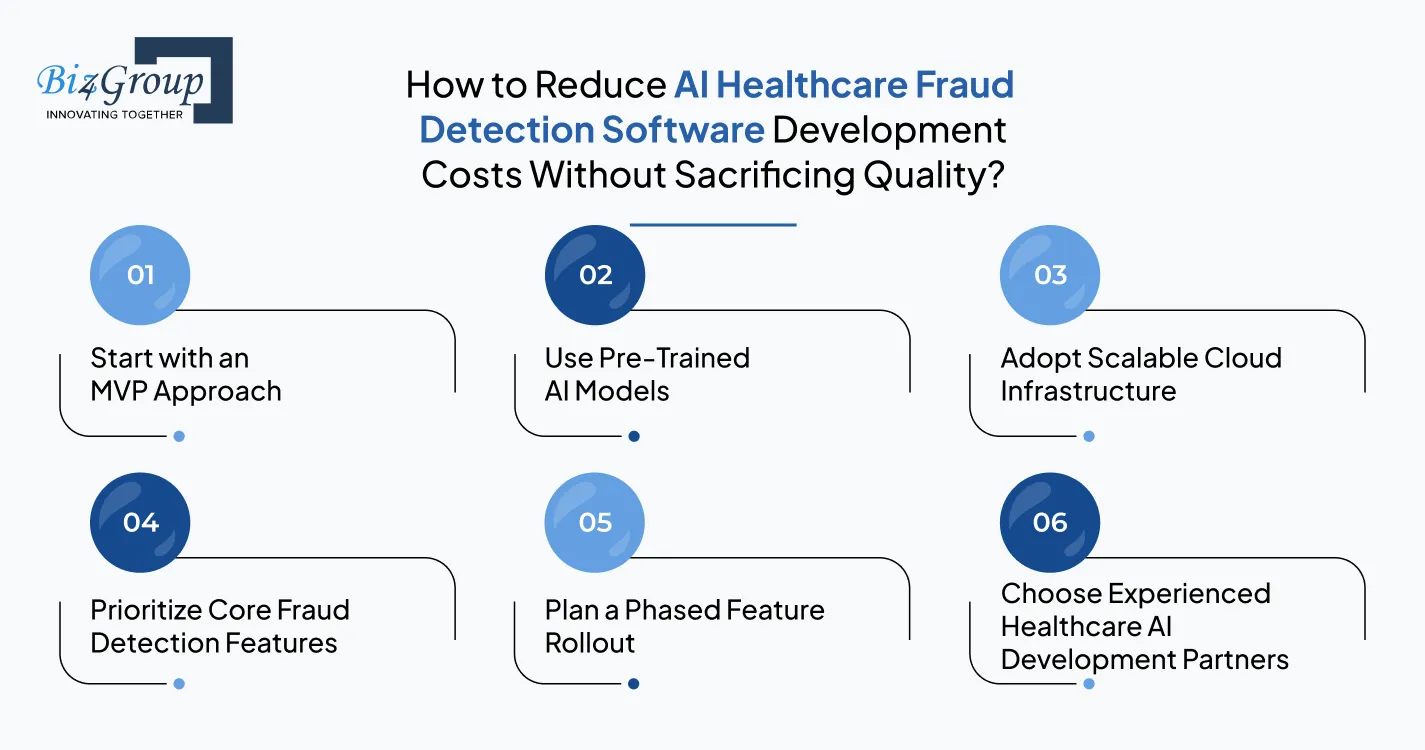
Reducing the AI healthcare fraud detection software development cost does not mean compromising performance, compliance, or accuracy. With the right strategy, businesses can optimize budgets while still building scalable and high-performing fraud detection systems. In many cases, organizations can reduce the cost to make AI fraud detection software for healthcare industry by 20% to 50% through smart planning and technology choices.
Below are proven strategies to control the budget required to build AI healthcare fraud detection software with predictive analytics without affecting quality.
1. Start with an MVP Approach
Estimated Cost Savings: 20% to 40%
Begin with a minimum viable product that includes essential features such as claims anomaly detection, basic risk scoring, and a monitoring dashboard. This reduces initial development effort and helps validate the system before scaling.
An MVP approach keeps the initial investment low while allowing gradual addition of advanced AI capabilities.
Also Read: Top MVP Development Companies to Launch Your Startup
2. Use Pre-Trained AI Models
Estimated Cost Savings: 15% to 35%
Building AI models from scratch requires significant time and resources. Using pre-trained models or APIs for fraud detection, anomaly detection, and data analysis reduces development time and cost.
Examples include:
- Pre-built anomaly detection models
- Fraud risk scoring APIs
- Natural language processing for claims analysis
This approach helps lower development expenses without compromising core functionality.
3. Adopt Scalable Cloud Infrastructure
Estimated Cost Savings: 10% to 25% (long-term)
Using cloud platforms allows businesses to pay only for the resources they use. Auto-scaling and serverless architectures reduce unnecessary infrastructure costs while supporting real-time fraud detection.
Efficient cloud usage plays a key role in managing long-term operational expenses.
4. Prioritize Core Fraud Detection Features
Estimated Cost Savings: 15% to 30%
Avoid building unnecessary features in the early stages. Focus on high-impact capabilities such as anomaly detection, predictive analytics, and real-time alerts.
Prioritizing essential features ensures better budget control and faster deployment.
5. Plan a Phased Feature Rollout
Estimated Cost Savings: 10% to 20%
Instead of building a full-scale system at once, release features in phases. Start with core fraud detection functionality and gradually add advanced analytics, automation, and integrations.
This approach spreads investment over time and reduces financial risk.
6. Choose Experienced Healthcare AI Development Partners
Estimated Cost Savings: 15% to 25%
Working with experienced developers helps avoid costly mistakes, delays, and rework. Skilled teams understand healthcare compliance, AI model optimization, and efficient system architecture.
Choosing the right partner improves development efficiency and reduces overall project cost.
Cost Reduction Strategies Overview
|
Strategy |
How It Reduces Cost |
Estimated Savings |
|---|---|---|
|
MVP Development |
Limits initial feature scope |
20% to 40% |
|
Pre-Trained AI Models |
Reduces model development effort |
15% to 35% |
|
Cloud Infrastructure |
Optimizes resource usage |
10% to 25% |
|
Feature Prioritization |
Avoids unnecessary development |
15% to 30% |
|
Phased Rollout |
Spreads cost over time |
10% to 20% |
|
Experienced Team |
Minimizes errors and rework |
15% to 25% |
Strategic planning, smart technology choices, and phased development allow businesses to significantly reduce the budget required to build AI healthcare fraud detection software with predictive analytics while maintaining performance, scalability, and compliance.
How can Biz4Group LLC Help to Optimize Your AI Healthcare Fraud Detection Software Development Cost?
Managing the AI healthcare fraud detection software development cost requires the right balance between advanced AI capabilities, compliance, and budget control. Many healthcare projects exceed expected costs due to poor planning, unnecessary features, or inefficient AI implementation. This is where an experienced AI healthcare software development company like Biz4Group LLC helps organizations build cost-efficient and scalable solutions.
If you are asking, we are looking for a development partner to create AI healthcare fraud detection software at a reasonable cost, any recommended companies, Biz4Group stands out by focusing on optimized development strategies, compliance-ready systems, and long-term scalability.
Key Ways Biz4Group Optimizes Development Costs:
1. Strategic MVP Planning
Biz4Group identifies essential fraud detection features such as anomaly detection, claims analysis, and risk scoring to build a focused MVP. This reduces initial investment and accelerates time to market while keeping the system scalable.
2. AI Integration Optimization
The team carefully selects between pre-trained AI models and custom-built solutions based on project needs. This approach, often delivered through advanced AI integration solutions, minimizes unnecessary development effort and helps control the cost of building AI fraud detection software for the healthcare industry.
3. Accurate Cost Estimation and Budget Planning
Biz4Group provides detailed cost breakdowns based on system complexity, AI capabilities, integrations, and compliance requirements. This helps businesses plan the budget required to build AI healthcare fraud detection software with predictive analytics without unexpected expenses.
4. Feature Prioritization Framework
By focusing on high-impact features such as real-time fraud detection and predictive analytics, Biz4Group ensures better ROI while avoiding over-engineering and unnecessary costs.
5. Scalable Cloud Infrastructure Setup
Optimized cloud architecture allows efficient data processing and real-time fraud monitoring while reducing long-term infrastructure expenses.
6. Compliance-First Development Approach
Healthcare fraud detection systems must meet strict standards such as HIPAA. Biz4Group integrates compliance and security from the beginning, preventing costly rework later.
Also Read: HIPAA-Compliant AI Healthcare Software Development
7. Future-Ready Architecture
The company designs flexible systems that support future AI enhancements, preventing the need for expensive redevelopment as business needs grow.
Relevant AI Healthcare Project Experience:
Biz4Group has hands-on experience building AI-driven healthcare solutions that require data analysis, personalization, and scalable architecture.
This platform uses AI to analyze health data, provide personalized insights, and track performance, demonstrating expertise in handling complex healthcare datasets.
This solution features an AI-powered virtual health companion, showcasing capabilities in AI personalization, user engagement, and healthcare data management.
Real Impact on Cost Optimization
In similar AI healthcare projects, Biz4Group has helped clients:
- Reduce development costs by optimizing AI model selection
- Accelerate time to market with MVP-first strategies
- Build scalable systems that support long-term growth
- Maintain compliance without increasing unnecessary costs
Selecting the right development partner is critical for controlling costs and ensuring success. Biz4Group ranked among top AI healthcare software development companies, helps businesses build powerful fraud detection systems that balance performance, compliance, and cost efficiency.
Reduce Your Healthcare AI Fraud Detection Costs Today
Build a compliant, high-performance fraud detection system without overspending on development.
Start Your Healthcare AI ProjectConclusion
The AI healthcare fraud detection software development cost in 2026 typically ranges between $40,000 and $300,000+, depending on system type, AI capabilities, integrations, compliance requirements, and scalability goals. From basic fraud detection MVPs to enterprise-grade platforms with predictive analytics and real-time monitoring, pricing varies based on the depth of intelligence and infrastructure involved.
As AI continues to reshape the healthcare industry, providers, insurers, and healthcare tech companies are increasing their investment in AI healthcare fraud detection software development to reduce financial losses, improve claim accuracy, and strengthen compliance. Building such systems requires a clear understanding of cost factors, hidden expenses, development phases, and the right software type for your business needs.
Careful planning plays a key role in controlling the cost to create AI fraud detection software for healthcare providers. Businesses that adopt MVP-first strategies, use pre-trained AI models, prioritize essential fraud detection features, and partner with experienced development teams can significantly reduce costs while maintaining quality and performance.
Choosing between custom, off-the-shelf, or hybrid solutions also impacts long-term ROI. Organizations that align their technology decisions with business goals are better positioned to build scalable, compliant, and cost-efficient fraud detection systems.
So, If you are planning to build an AI-powered healthcare fraud detection solution and want to estimate costs or explore development options, book an appointment with Biz4Group AI experts to achieve faster deployment, optimized investment, and long-term success.
FAQs
1. How much does it cost to develop AI healthcare fraud detection software from scratch?
The cost to build AI healthcare fraud detection software from scratch typically ranges between $40,000 and $300,000+, depending on AI complexity, compliance requirements, integrations, and system scalability.
2. What factors affect AI healthcare fraud detection software development pricing?
Several factors influence pricing, including AI model complexity, healthcare data volume, system integrations, compliance requirements such as HIPAA, real-time processing needs, and the experience level of the development team.
3. What is the budget required to build AI healthcare fraud detection software with predictive analytics?
For systems that include predictive analytics, behavioral analysis, and real-time fraud detection, the budget usually falls between $80,000 and $250,000+, depending on feature depth and infrastructure requirements.
4. How can I reduce the cost to create AI fraud detection software for healthcare providers?
You can reduce costs by starting with an MVP, using pre-trained AI models, prioritizing essential features, adopting cloud infrastructure, and working with experienced development companies that offer optimized pricing strategies.
5. Is custom AI healthcare fraud detection software more cost-effective than off-the-shelf solutions?
Custom solutions require higher upfront investment but often provide better long-term value due to scalability, advanced AI capabilities, and reduced dependency on subscription-based platforms.
6. Which companies can build AI healthcare fraud detection software within a fixed budget?
Experienced AI healthcare software development companies, such as Biz4Group LLC, offer tailored solutions with cost optimization strategies, helping businesses develop fraud detection systems within a defined budget while maintaining performance and compliance.