Location :
Orlando, FL, USA
Location :
Orlando, FL, USA +1 (407) 714-1616
 info@biz4group.com

- AI accounts receivable automation software development for healthcare helps providers reduce AR days, automate collections, and improve cash flow.
- Modern AI AR platforms use machine learning payment prediction, denial detection, and intelligent follow-up automation to accelerate reimbursements.
- Successful AI healthcare accounts receivable software development depends on HIPAA compliance, secure integrations, and scalable healthcare infrastructure.
- The cost of development of AI accounts receivable automation software for healthcare typically ranges from $20,000 to $150,000+ based on features and integrations.
- Biz4Group specializes in AI accounts receivable automation system healthcare solutions with intelligent workflows, EHR integrations, and scalable revenue cycle automation.
How many unpaid claims are sitting in your AR queue right now that nobody has followed up on properly?
Not because your team is careless. Because manual AR processes simply cannot keep up anymore.
Billing teams across healthcare organizations are overloaded with denial follow-ups, payer calls, payment posting, and aging claims that continue growing faster than staff can resolve them. Meanwhile, cash flow slows down, reimbursements get delayed, and revenue that should already be collected stays stuck in the system.
And the financial impact is massive.
According to the American Hospital Association, nearly 15% of healthcare claims face initial denial, creating billions in delayed reimbursements and administrative rework every year.
Another industry report estimates providers lose more than $260 billion annually from denied or delayed claims collections.
So, what happens when your billing team cannot scale any further?
This is exactly why healthcare organizations are investing in AI accounts receivable automation software development for healthcare.
Instead of relying on manual work queues and disconnected systems, providers are starting to create AI accounts receivable automation software healthcare teams can use to automate follow-ups, identify denial risks earlier, prioritize high-value claims, and reduce days in AR without increasing administrative overhead.
Technologies like AI healthcare workflow automation are already helping providers remove repetitive billing bottlenecks and improve collections performance with far less manual effort.
For organizations struggling with rising AR days and inconsistent collections, AI healthcare accounts receivable software development is becoming less of an upgrade and more of an operational requirement.
But what exactly does an AI-powered healthcare AR automation system do differently that traditional billing software cannot?
What Is AI Accounts Receivable Automation Software for Healthcare and Why Are Providers Building It Now?
Let's now know what this is.
AI accounts receivable automation software development for healthcare focuses on building intelligent systems that automate claim follow-ups, denial management, payment posting, collections prioritization, and cash flow tracking across the healthcare revenue cycle.
Instead of relying on billing teams to manually review claims, track payer responses, and prioritize collections work, AI-powered systems continuously analyze AR data and automate repetitive actions using machine learning, predictive analytics, and workflow automation.
A modern AI accounts receivable automation system healthcare platform can:
- Identify unpaid and high-risk claims automatically
- Prioritize collections based on claim value and denial probability
- Trigger payer follow-ups without manual intervention
- Detect recurring denial patterns
- Forecast reimbursement delays
- Improve cash flow visibility in real time
Many providers are also combining these capabilities with systems like AI medical billing software to automate larger portions of revenue cycle operations instead of handling billing and AR separately.
So, Why are Healthcare Organizations Suddenly Investing Heavily in These Platforms Now?
1. Claim Volumes Are Outgrowing Manual Billing Operations
Billing teams are already overloaded with denials, aging claims, payer calls, and payment posting tasks. As patient volumes increase, manual workflows become harder to manage consistently. That’s why providers are starting to create AI accounts receivable automation software healthcare teams can use to automate repetitive collections work and reduce operational pressure.
2. Delayed Follow-Ups Are Increasing Revenue Leakage
When claims are not followed up on quickly, reimbursement delays grow longer and collection opportunities start disappearing. This is where AI healthcare accounts receivable software development helps providers reduce days in AR by automatically prioritizing high-value claims and triggering faster follow-up actions.
3. Denial Management Is Becoming More Complex
Payer rules change constantly, and denial rates continue rising across healthcare organizations. Manual denial handling slows billing teams down and increases administrative costs significantly. AI-powered systems can identify denial trends earlier, categorize recurring issues, and automate follow-up workflows before claims age further.
4. Healthcare Providers Need Real-Time Financial Visibility
Most traditional billing systems only provide reports after collection problems already exist. AI-driven AR platforms continuously monitor unpaid balances, payer behavior, and reimbursement trends in real time. That visibility helps providers make faster operational and financial decisions with fewer blind spots.
5. Healthcare Organizations Are Expanding Automation Across Operations
Providers are no longer limiting automation to clinical workflows alone. Administrative and financial operations are becoming major automation priorities due to rising operational costs and staffing shortages. This shift is increasing demand for technologies like AI in healthcare administration automation, especially across billing and revenue cycle management.
6. Manual AR Processes Are No Longer Sustainable at Scale
Healthcare AR workflows have become too complex and high-volume for spreadsheets, static work queues, and manual payer follow-ups to handle efficiently. Organizations looking to build AI accounts receivable system for healthcare providers are doing it to improve collections speed, reduce operational bottlenecks, and stabilize cash flow without continuously increasing billing headcount.
But how exactly do these AI-powered AR systems automate collections, prioritize claims, and improve reimbursement outcomes behind the scenes?
Still Letting Denials Slow Down Your Cash Flow?
Healthcare claim denial rates crossed 11% industry-wide in 2026, creating major revenue delays for providers.
Talk to Our Healthcare AI ExpertsHow Does an Intelligent AI Healthcare AR Automation Platform Actually Work Behind the Scenes?
An intelligent AR automation platform works by continuously analyzing claims, payer activity, denial trends, and payment behavior to automate collections workflows across the healthcare revenue cycle.
Instead of waiting for billing teams to manually review aging claims, the system identifies problems early, prioritizes collection opportunities, and triggers the next best action automatically.
This is what allows providers to develop an intelligent AI healthcare AR automation platform that automatically follows up on unpaid claims and accelerates collections without depending entirely on manual billing operations.
1. Intelligent Claim Prioritization
Not every unpaid claim carries the same financial urgency. AI systems analyze claim value, denial history, payer response behavior, and aging risk to determine which accounts require immediate action. This helps providers create AI accounts receivable automation software for healthcare providers that cuts AR days and improves cash flow by ensuring billing teams focus on claims with the highest recovery potential first.
Key capabilities include:
- High-value claim scoring
- Aging risk detection
- Payer-specific prioritization
- Claim recovery probability analysis
This approach is becoming a core part of creating an AI AR automation system that prioritizes follow up on the highest value claims to accelerate cash collections across healthcare organizations.
2. Machine Learning Payment Prediction
AI models use historical claims and payment data to predict how likely a claim is to get reimbursed and how long the payment process may take. This helps providers forecast collections more accurately and identify claims requiring faster intervention before reimbursement delays increase further.
Core functions include:
- Payment delay prediction
- Reimbursement probability scoring
- Cash flow forecasting
- Historical payment trend analysis
This is one of the biggest reasons organizations are investing in building an AI healthcare AR automation software with machine learning payment prediction and intelligent follow up prioritization capabilities.
3. Automated Claim Follow-Ups
Manual payer follow-ups consume a huge amount of billing staff time. AI automation platforms reduce this workload by automatically triggering reminders, status checks, escalation workflows, and follow-up actions based on claim conditions. This is a critical part of developing an AI accounts receivable platform that reduces healthcare provider AR days through intelligent claim follow up automation.
Automation workflows often include:
- Payer portal status checks
- Automated follow-up reminders
- Escalation triggers
- Claim resubmission workflows
Many healthcare organizations combine these capabilities with broader AI automation services to streamline repetitive operational workflows across departments.
4. Denial Pattern Detection
Denied claims often follow recurring patterns tied to payer rules, coding issues, missing documentation, or authorization problems. AI systems analyze denial data continuously to identify these patterns early. This allows billing teams to resolve root causes faster instead of repeatedly reacting to the same denial issues manually.
AI-driven denial management helps with:
- Denial trend analysis
- Root cause identification
- Payer behavior tracking
- Automated denial categorization
Organizations investing in AI medical coding automation system solutions are also reducing coding-related denial risks earlier in the revenue cycle.
5. Real-Time AR Analytics and Cash Flow Forecasting
Traditional AR reports usually show problems after revenue delays already exist. AI-powered analytics platforms provide real-time visibility into collections performance, unpaid balances, denial rates, and reimbursement trends. This is why many providers are focusing on building a custom AI accounts receivable system for healthcare providers with real time AR analytics and cash flow forecasting capabilities.
Real-time analytics typically include:
- AR aging dashboards
- Collection performance tracking
- Denial trend monitoring
- Cash flow forecasting
These insights help providers make faster operational and financial decisions using live AR data instead of static reporting.
6. Workflow Automation Across Billing Systems
AI AR platforms integrate with EHRs, billing software, payer portals, and clearinghouses to automate workflows across disconnected systems. This reduces the dependency on manual coordination between multiple billing tools. This level of integration is becoming essential in healthcare accounts receivable management software development integrating AI, especially for organizations managing large claim volumes across multiple systems.
Integrated workflow automation usually supports:
- EHR and billing system synchronization
- Clearinghouse integration
- Automated task routing
- Centralized claim tracking
Solutions like AI EMR/EHR software are becoming increasingly important because intelligent AR automation depends heavily on real-time healthcare data access and interoperability.
But if these systems continuously process sensitive patient, payer, and financial data, how do healthcare organizations keep everything secure and HIPAA compliant?
Can You Build AI Accounts Receivable Automation Software for Healthcare Without Violating HIPAA?
Healthcare AR platforms handle highly sensitive patient, insurance, and financial data every single day. That includes protected health information (PHI), payment records, claim histories, denial details, and payer communications.
So, before organizations invest in development of AI accounts receivable automation software for healthcare, one major concern comes up immediately: can AI automation remain fully compliant with healthcare regulations?
The answer is yes, but only when security, compliance, and data governance are built into the platform architecture from the beginning.
1. HIPAA-Compliant Data Handling
Every platform built through AI accounts receivable automation software development for healthcare must follow strict HIPAA guidelines to protect patient information during data collection, storage, transmission, and processing. Healthcare organizations investing in HIPAA compliant AI systems are prioritizing encryption, secure APIs, role-based access controls, and continuous monitoring to reduce compliance risks across revenue cycle workflows.
2. End-to-End Data Encryption
AI AR automation platforms continuously exchange sensitive healthcare and financial data between EHR systems, billing platforms, payer portals, and cloud infrastructure. Without proper encryption, this information becomes vulnerable during transmission and storage. To support secure AI healthcare accounts receivable software development, organizations implement encrypted databases, tokenized patient identifiers, secure API layers, and end-to-end encryption protocols throughout the platform infrastructure.
3. Role-Based Access Control
Not every employee should have access to all billing and patient information. Role-based access control helps organizations restrict data visibility based on user responsibilities inside the revenue cycle process. This becomes especially important when providers create AI accounts receivable automation software healthcare teams use across multiple billing departments, payer workflows, and administrative roles.
4. Audit Trails and Activity Monitoring
Healthcare organizations need complete visibility into how claims and patient financial data are being accessed, modified, or processed inside AI systems. Audit trails help track every action performed across the platform. These monitoring systems record workflow changes, automated decisions, payment updates, and user activity, helping organizations maintain compliance accountability while supporting secure AI accounts receivable automation system healthcare operations.
5. Secure Cloud Infrastructure
Most modern intelligent accounts receivable software healthcare development projects rely on cloud infrastructure to support scalability, automation, and real-time analytics. However, healthcare organizations cannot rely on standard cloud environments alone. Secure healthcare cloud architecture requires HIPAA-ready hosting, intrusion monitoring, backup recovery systems, network isolation, and strict identity access management policies to protect financial and patient data continuously.
6. Secure Integration With Healthcare Systems
AI AR platforms rely heavily on integrations with EHRs, clearinghouses, billing software, payer systems, and payment gateways. Every integration point creates potential security risks if APIs and data exchanges are not properly secured. Organizations investing in AI integration services are focusing on secure API authentication, encrypted interoperability layers, and controlled synchronization across healthcare systems.
7. Explainable AI and Decision Transparency
Healthcare providers cannot rely on black-box AI models when reimbursement and collections decisions directly affect financial outcomes. Teams need visibility into why claims are prioritized, flagged, or escalated by the system. This is especially critical when organizations develop an intelligent AI healthcare AR automation platform that automatically follows up on unpaid claims and accelerates collections, because billing teams must understand how automation decisions are generated.
8. Compliance Monitoring and Risk Management
Compliance is not a one-time setup. AI healthcare platforms require continuous monitoring to identify vulnerabilities, suspicious activity, policy violations, and evolving regulatory risks. This is becoming increasingly important in healthcare accounts receivable management software development integrating AI, where systems continuously process large volumes of patient and financial data across multiple workflows.
Once security and compliance are fully handled, the next challenge becomes building features that actually reduce AR days, improve collections performance, and remove operational bottlenecks across the revenue cycle.
Which Features Actually Matter in AI Accounts Receivable Automation Software Development for Healthcare?
Building a successful AR automation platform is not just about automating reminders or generating billing reports. The real value comes from intelligent features that actively reduce AR days, improve collections efficiency, and remove repetitive operational work from billing teams.
That’s why organizations investing in AI accounts receivable automation software development for healthcare are focusing heavily on features that improve decision-making, automate claim actions, and increase reimbursement speed across the revenue cycle.
|
Feature |
How It Works |
Business Impact |
|---|---|---|
|
Intelligent Claim Prioritization |
AI analyzes claim value, payer history, denial probability, and aging risk to identify which claims require immediate attention. |
Helps providers create AI accounts receivable automation software for healthcare providers that cuts AR days and improves cash flow by focusing billing efforts on high-recovery claims first. |
|
The system automatically triggers reminders, payer portal checks, escalation workflows, and claim status tracking without manual intervention. |
Reduces repetitive administrative work and accelerates collections through continuous follow-up automation. |
|
|
Machine Learning Payment Prediction |
AI models analyze historical reimbursement data to predict payment timelines, collection probability, and potential delays. |
Supports building an AI healthcare AR automation software with machine learning payment prediction and intelligent follow up prioritization for more accurate cash flow forecasting. |
|
AI continuously monitors denial trends across payers, claim types, procedures, and coding patterns to identify recurring issues. |
Helps billing teams resolve denial root causes faster and reduce repeated reimbursement losses. |
|
|
Automated Denial Management |
The platform categorizes denials automatically, routes cases to the correct teams, and triggers resubmission or appeal workflows. |
Improves denial resolution speed while lowering manual processing effort significantly. |
|
Real-Time AR Analytics |
Dashboards continuously monitor AR aging, collection rates, unpaid balances, and reimbursement performance across the organization. |
Enables providers to make faster financial decisions using live operational data instead of delayed reports. |
|
Cash Flow Forecasting |
AI predicts future reimbursement trends based on historical collections activity, payer behavior, and claim status patterns. |
Supports building a custom AI accounts receivable system for healthcare providers with real time AR analytics and cash flow forecasting capabilities. |
|
Payer Behavior Analysis |
The platform tracks payer response times, denial frequency, reimbursement patterns, and approval behavior across insurers. |
Helps organizations optimize follow-up strategies and reduce reimbursement delays. |
|
Automated Payment Posting |
AI extracts payment information from ERAs, EOBs, and payer documents to automate payment reconciliation workflows. |
Reduces manual posting errors and improves billing team productivity. |
|
Patient Balance Collection Automation |
The system automates payment reminders, patient communication, balance tracking, and payment follow-up workflows. |
Improves patient collections while reducing administrative workload for staff. |
|
Workflow Automation Across Systems |
AI integrates with EHRs, billing software, clearinghouses, and payer portals to automate cross-platform workflows. |
Removes operational silos and improves revenue cycle coordination across departments. |
|
Task Routing and Smart Work Queues |
Claims and denials are automatically assigned based on urgency, claim type, payer complexity, or staff specialization. |
Reduces delays caused by static queues and manual task distribution. |
|
NLP-Based Document Processing |
Natural language processing extracts and analyzes information from payer correspondence, denial letters, and claim documents automatically. |
Improves processing speed while reducing manual document review efforts. |
|
Role-Based Access Management |
Access permissions are controlled based on user roles across billing, coding, collections, and finance teams. |
Helps maintain secure and compliant revenue cycle operations. |
|
Audit Trails and Compliance Monitoring |
Every action, workflow update, payment change, and AI-driven decision is recorded automatically for compliance tracking. |
Supports secure AI accounts receivable automation system healthcare operations and simplifies audits. |
Many healthcare organizations are also combining these capabilities with broader solutions like AI automation for healthcare center initiatives to streamline financial, operational, and administrative workflows together instead of treating AR automation as a standalone process.
But once the feature set is finalized, how do you actually develop an AI-powered AR automation platform that integrates with healthcare systems and performs reliably at scale?
How Much Staff Time Is Lost in Manual AR Follow-Ups Every Week?
AI-powered collections workflows help healthcare providers reduce repetitive billing work and accelerate reimbursements.
Build Smarter AR AutomationHow to Develop an AI Accounts Receivable System for Healthcare Providers That Actually Reduces AR Days
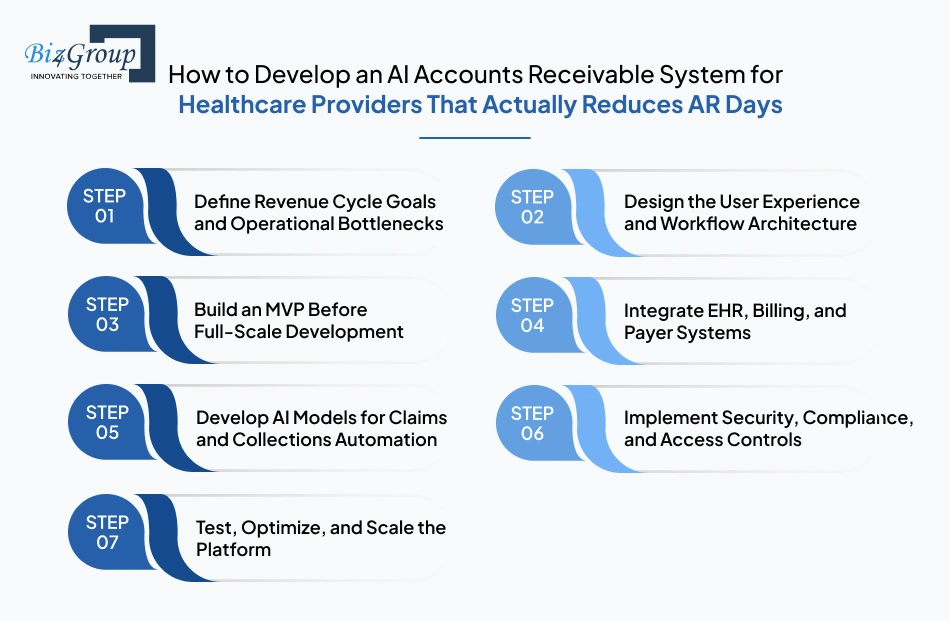
Building an AI-powered AR platform is not only about adding automation to existing billing workflows. The system must handle healthcare-specific claim complexity, payer behavior, compliance requirements, real-time analytics, and intelligent follow-up orchestration without slowing operations down.
That’s why successful AI accounts receivable automation software development for healthcare requires a structured development approach focused on scalability, interoperability, security, and workflow intelligence from day one.
Step 1: Define Revenue Cycle Goals and Operational Bottlenecks
Before development starts, healthcare organizations need to identify where revenue leakage is actually happening. Some providers struggle with denial resolution, while others face delays in payment posting, payer follow-ups, or patient collections. This stage helps define the KPIs the platform should improve, such as reduced AR days, faster reimbursements, lower denial rates, or improved cash flow visibility.
Key focus areas include:
- Current AR workflow analysis
- Denial trend identification
- Billing team inefficiencies
- Revenue leakage mapping
This is usually where organizations realize they need systems capable of solving problems like: "How to build an AI accounts receivable system for healthcare providers that reduces days in AR from 60 to under 30 days".
Step 2: Design the User Experience and Workflow Architecture
Healthcare billing teams already work with multiple systems every day. If the platform feels complicated or disconnected, adoption becomes difficult regardless of how advanced the AI is. That’s why workflow simplicity, dashboard clarity, and task visibility play a major role during development. Many organizations invest heavily in UI/UX design to ensure billing teams can manage claims, denials, and collections efficiently from a centralized interface.
Development planning usually includes:
- Workflow mapping
- Dashboard wireframing
- Billing user journey design
- Multi-role interface planning
Step 3: Build an MVP Before Full-Scale Development
Launching a full enterprise AR automation platform immediately increases development complexity, integration risks, and implementation costs significantly. Most healthcare organizations start with an MVP development approach focused on core automation capabilities like claim prioritization, denial tracking, and automated follow-ups before scaling into advanced AI workflows.
Typical MVP features include:
- Claim status tracking
- Basic denial automation
- AR aging dashboards
- Follow-up reminders
This helps organizations validate workflows, measure ROI early, and improve automation logic before larger deployment phases.
Step 4: Integrate EHR, Billing, and Payer Systems
AI AR automation platforms depend heavily on real-time healthcare data. Without integration between EHRs, billing software, clearinghouses, and payer portals, automation accuracy drops significantly. This stage focuses on building secure interoperability layers that allow the platform to exchange claims, reimbursement, denial, and patient balance data continuously across systems.
Core integrations often include:
- EHR/EMR platforms
- Clearinghouse systems
- Billing software
- Payer portals
Step 5: Develop AI Models for Claims and Collections Automation
This is where the intelligence layer gets built. AI models are trained using historical claims, denial patterns, payer behavior, reimbursement timelines, and collections activity. The system learns how to prioritize claims, predict payment delays, identify denial risks, and automate next-best actions across the AR workflow.
AI model development usually includes:
- Payment prediction models
- Denial classification models
- Follow-up prioritization logic
- Cash flow forecasting models
This stage is critical when organizations want to develop an intelligent AI healthcare AR automation platform that automatically follows up on unpaid claims and accelerates collections.
Step 6: Implement Security, Compliance, and Access Controls
Healthcare AR systems process sensitive patient and financial data continuously. Security and compliance controls must be embedded into the platform architecture before deployment begins. This includes HIPAA compliance, encrypted data handling, audit logging, secure APIs, role-based permissions, and continuous monitoring systems.
Compliance implementation generally covers:
- PHI encryption
- Role-based access control
- Audit trail monitoring
- Secure cloud infrastructure
Organizations working with an experienced AI healthcare software development company often reduce compliance risks significantly during this phase.
Step 7: Test, Optimize, and Scale the Platform
Once the platform is functional, teams continuously test automation accuracy, AI predictions, workflow performance, and integration reliability before full deployment across operations. As claims data grows, AI models improve continuously through retraining and workflow optimization, helping providers automate larger portions of the revenue cycle over time.
Optimization areas usually include:
- AI model accuracy
- Workflow performance
- Denial resolution speed
- Collections efficiency tracking
This phase becomes especially important for organizations focused on building a custom AI accounts receivable system for healthcare providers with real time AR analytics and cash flow forecasting capabilities.
But what technologies, frameworks, and infrastructure actually power these AI healthcare AR automation platforms behind the scenes?
What’s the Best Tech Stack for AI Accounts Receivable Automation Software Development for Healthcare?
Choosing the right technology stack directly impacts how scalable, secure, and intelligent your AR automation platform becomes. Since healthcare AR systems process large volumes of claims, payer data, patient balances, and reimbursement workflows in real time, the architecture must support automation, interoperability, compliance, and AI processing together.
Many healthcare organizations planning AI accounts receivable automation software development for healthcare are not just evaluating technologies anymore. They are trying to solve a much bigger operational problem: "Which US based technology companies have successfully built and deployed AI accounts receivable automation systems that are currently being used by real healthcare providers to reduce their days in AR improve cash collections and eliminate the manual billing processes that consume enormous amounts of staff time?"
The answer often depends on selecting a tech stack that can support intelligent automation, real-time analytics, healthcare interoperability, and secure claims processing without creating additional workflow complexity.
|
Technology Layer |
Recommended Technologies |
Role in AI Healthcare AR Automation |
|---|---|---|
|
Frontend Development |
React.js, Next.js, TypeScript |
Used to build responsive dashboards, AR analytics panels, denial management screens, and billing workflows with fast performance and real-time UI updates. Many healthcare organizations work with React JS development services and a Next JS development company to create scalable enterprise-grade interfaces. |
|
Backend Development |
Node.js, Python, FastAPI, Express.js |
Handles workflow automation, API orchestration, claims processing logic, user management, and AI service coordination. Providers often rely on a Node JS development company and a Python development company for scalable backend infrastructure and AI integration. |
|
AI/ML Frameworks |
TensorFlow, PyTorch, Scikit-learn, XGBoost |
Used for payment prediction, denial detection, intelligent claim prioritization, reimbursement forecasting, and follow-up automation models. These frameworks support building an AI healthcare AR automation software with machine learning payment prediction and intelligent follow up prioritization. |
|
Database Management |
PostgreSQL, MongoDB, MySQL, Redis |
Stores claims data, payment records, denial histories, patient balances, workflow logs, and real-time analytics information securely. |
|
Cloud Infrastructure |
AWS, Microsoft Azure, Google Cloud |
Supports secure hosting, scalability, disaster recovery, AI processing, encrypted storage, and healthcare-grade compliance management across operations. |
|
HL7, FHIR APIs, X12 EDI |
Enables secure integration with EHRs, billing software, payer systems, clearinghouses, and healthcare data exchanges. This layer is critical in healthcare accounts receivable management software development integrating AI. |
|
|
Workflow Automation Engines |
Apache Airflow, Camunda, Temporal |
Automates payer follow-ups, denial escalation workflows, claim routing, task scheduling, and collections orchestration across departments. |
|
Real-Time Analytics Tools |
Power BI, Tableau, Apache Kafka |
Supports live AR dashboards, denial trend tracking, reimbursement analytics, and cash flow forecasting capabilities. |
|
Document Processing & OCR |
AWS Textract, Google Document AI, Tesseract OCR |
Extracts payment data from EOBs, ERAs, denial letters, and payer correspondence automatically to reduce manual processing work. |
|
Authentication & Security |
OAuth 2.0, JWT, MFA, RBAC |
Protects sensitive patient and financial data using secure authentication, access controls, and identity management systems. |
|
API Management |
GraphQL, REST APIs, API Gateway |
Enables secure communication between billing systems, payer portals, EHR platforms, and AI automation services. |
|
DevOps & Deployment |
Docker, Kubernetes, GitHub Actions, Jenkins |
Supports continuous deployment, infrastructure scaling, automated testing, and workflow reliability across healthcare environments. |
|
Monitoring & Compliance Tools |
Datadog, Splunk, ELK Stack |
Tracks system performance, workflow activity, audit logs, security monitoring, and compliance reporting continuously. |
The right technology stack does more than support automation. It directly impacts how efficiently healthcare providers can scale collections workflows, reduce AR days, and improve reimbursement outcomes without increasing operational overhead.
But before moving into development, one question still remains: how much does it actually cost to build an AI-powered healthcare AR automation platform?
How Much Does AI Accounts Receivable Automation Software Development for Healthcare Cost?
The cost of AI accounts receivable automation software development for healthcare usually ranges between $20,000 to $150,000+, depending on the platform complexity, AI capabilities, healthcare integrations, workflow automation depth, and compliance requirements.
A lightweight MVP focused on claim tracking and automated follow-ups costs significantly less than an enterprise-grade platform with machine learning prediction, denial automation, payer integrations, and real-time analytics.
For many healthcare organizations, the bigger concern is not just the development budget. It’s whether the investment will actually reduce AR days, improve collections performance, and recover lost revenue consistently.
That’s why providers are increasingly asking: "Our healthcare organization recently completed a revenue cycle assessment that revealed we are leaving approximately 8 million dollars in collectible revenue uncollected annually because our manual AR follow up process cannot keep up with the volume of claims requiring attention and we need an AI automation system that ensures every collectible dollar is pursued systematically?"
The answer depends heavily on the platform architecture, automation scope, AI capabilities, and integration strategy built into the system.
Estimated Cost Breakdown for AI Accounts Receivable Automation Software Development for Healthcare
|
Feature / Module |
Estimated Cost Range |
Purpose |
|---|---|---|
|
AR Dashboard & Reporting System |
$5,000 – $12,000 |
Builds real-time AR aging dashboards, denial tracking systems, reimbursement visibility, and collection monitoring tools. |
|
Intelligent Claim Prioritization |
$8,000 – $18,000 |
Uses AI to score claims based on denial probability, claim value, aging risk, and payer behavior patterns. |
|
Automated Claim Follow-Up Workflows |
$7,000 – $20,000 |
Automates payer reminders, escalation workflows, claim tracking, and repetitive follow-up actions. |
|
Machine Learning Payment Prediction |
$10,000 – $25,000 |
Supports building an AI healthcare AR automation software with machine learning payment prediction and intelligent follow up prioritization capabilities. |
|
Denial Detection & Management System |
$8,000 – $22,000 |
Detects recurring denial patterns, categorizes denials automatically, and improves resolution workflows. |
|
Patient Collection Automation |
$5,000 – $15,000 |
Automates payment reminders, patient balance notifications, and collection communication workflows. |
|
Real-Time Cash Flow Forecasting |
$8,000 – $18,000 |
Enables providers to forecast reimbursements and monitor financial performance using live AR data. |
|
EHR/EMR Integration |
$10,000 – $30,000 |
Connects the platform with EHRs, billing systems, and healthcare interoperability layers securely. |
|
Payer Portal & Clearinghouse Integration |
$8,000 – $25,000 |
Supports automated claims synchronization and payer communication across systems. |
|
OCR & Document Processing |
$6,000 – $15,000 |
Extracts data from EOBs, ERAs, denial letters, and payer documents automatically. |
|
HIPAA Compliance & Security Layer |
$10,000 – $20,000 |
Implements encrypted data handling, audit logs, access controls, and compliance infrastructure. |
|
AI Analytics & Reporting Engine |
$7,000 – $18,000 |
Generates predictive reimbursement insights, denial analytics, and collection performance reporting. |
Healthcare organizations investing in building a custom AI accounts receivable system for healthcare providers with real time AR analytics and cash flow forecasting usually fall toward the higher end of the cost range due to advanced AI modeling and interoperability requirements.
Factors Affecting AI Healthcare Accounts Receivable Software Development Cost
Several factors directly influence the total cost of AI healthcare accounts receivable software development:
- Complexity of AI and machine learning models
- Number of EHR, billing, and payer integrations
- Workflow automation depth across AR operations
- HIPAA compliance and security architecture requirements
- Real-time analytics and forecasting capabilities
- Multi-provider or multi-location support
- Custom dashboard and workflow requirements
- Scalability and cloud infrastructure planning
- Claims processing volume and payer complexity
- Third-party healthcare API dependencies
Healthcare organizations investing in advanced enterprise AI solutions often require larger infrastructure and interoperability planning budgets during development.
Hidden Costs in AI Accounts Receivable Automation System Healthcare Platforms
Many providers underestimate long-term operational costs while planning development of AI accounts receivable automation software for healthcare.
Common hidden expenses include:
- AI model retraining and optimization
- API maintenance and integration updates
- Cloud infrastructure scaling costs
- Security monitoring and compliance audits
- Storage expansion for healthcare data
- Workflow updates for payer rule changes
- DevOps and ongoing system maintenance
- Licensing costs for healthcare APIs and AI tools
These operational costs become more noticeable as claim volume and automation complexity grow.
Cost Optimization Strategies for AI Accounts Receivable Automation Software Healthcare Platforms
Healthcare organizations can reduce development costs significantly by approaching implementation strategically instead of building every feature at once.
The most effective optimization approaches include:
- Starting with an MVP before enterprise scaling
- Prioritizing high-impact AR workflows first
- Using modular architecture for future expansion
- Integrating existing billing systems instead of replacing them
- Leveraging cloud-native healthcare infrastructure
- Automating repetitive high-volume tasks initially
- Using pre-trained AI models where applicable
Many providers also work with experienced teams offering AI product development company expertise to reduce implementation risks and accelerate deployment timelines.
Build vs Buy Comparison for AI Accounts Receivable Automation Software for Healthcare
|
Criteria |
Build Custom AI AR Platform |
Buy Off-the-Shelf Software |
|---|---|---|
|
Workflow Flexibility |
Fully customizable around provider-specific collections workflows |
Limited workflow customization |
|
AI Capabilities |
Custom AI models trained on operational and claims data |
Generic automation features |
|
Healthcare Integrations |
Flexible EHR, billing, and payer integrations |
Restricted interoperability |
|
Scalability |
Designed for long-term operational growth |
Scaling limitations based on vendor infrastructure |
|
Compliance Control |
Greater control over HIPAA and security architecture |
Compliance depends on vendor standards |
|
Long-Term Cost Efficiency |
Higher upfront investment but lower recurring dependency costs |
Lower initial cost but ongoing licensing fees |
|
Operational Ownership |
Full ownership of workflows, automation, and data |
Vendor-controlled functionality |
|
Deployment Timeline |
Longer implementation timeline |
Faster initial deployment |
This is why many healthcare organizations evaluating create AI accounts receivable automation software healthcare solutions eventually move toward custom development when scalability, workflow control, and automation performance become business-critical priorities.
But even with the right budget, technology stack, and development strategy, healthcare organizations still face major implementation challenges during deployment and scaling.
Is Revenue Leakage Costing More Than AI Automation?
Hospitals spent nearly $25.7 billion trying to overturn denied claims recently.
Get Your Custom Cost EstimateWhat Challenges Do Companies Face During AI Accounts Receivable Automation Software Development for Healthcare?
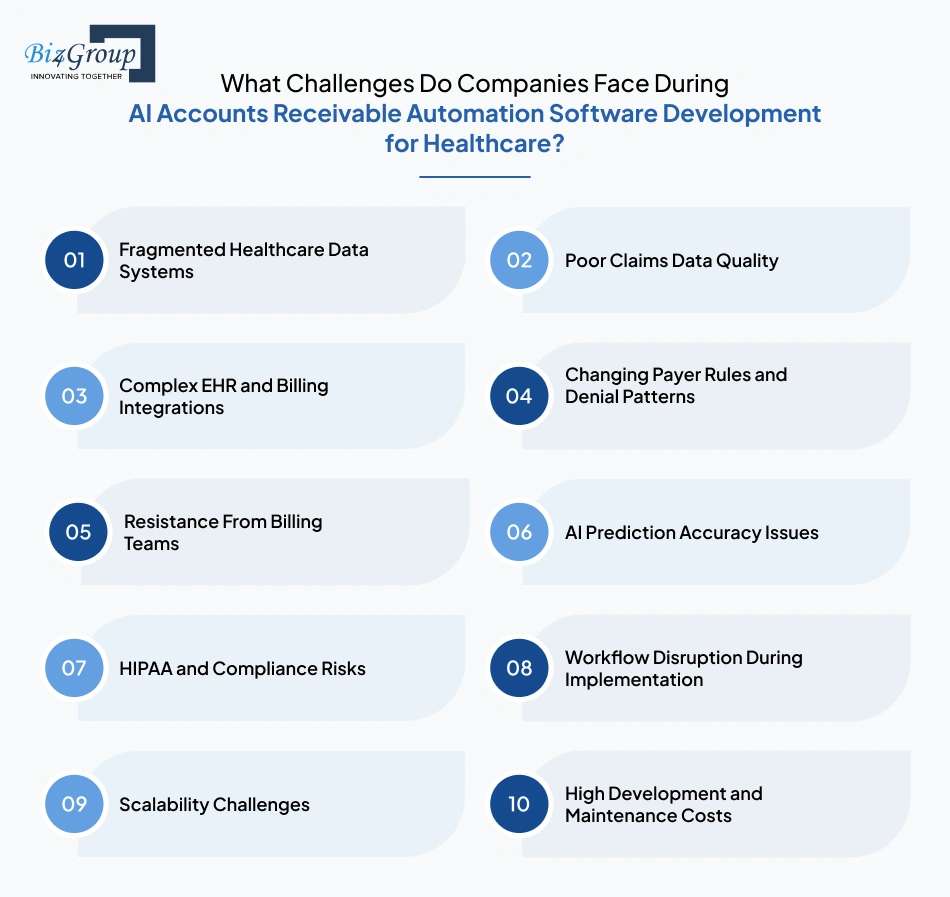
Building an AI-powered AR automation platform is not only a technical project. Healthcare organizations also have to deal with fragmented systems, inconsistent claims data, payer complexity, compliance risks, and operational adoption challenges during implementation.
This becomes even more complex for providers trying to develop an intelligent AI healthcare AR automation platform that automatically follows up on unpaid claims and accelerates collections across large-scale billing operations.
The good news is that most of these challenges can be solved with the right architecture, integrations, workflow planning, and AI development strategy from the beginning.
|
Challenge |
Why It Happens |
How to Solve It |
|---|---|---|
|
Fragmented Healthcare Data Systems |
Claims, patient records, billing workflows, and payer data are often spread across disconnected EHRs, clearinghouses, and legacy billing systems. This limits real-time visibility and automation accuracy. |
Build centralized interoperability layers using secure APIs, HL7, and FHIR integrations to synchronize claims and reimbursement data across systems. |
|
Poor Claims Data Quality |
AI models depend heavily on historical claims data. Incomplete records, inconsistent coding, duplicate entries, and missing payer information reduce prediction accuracy significantly. |
Clean and standardize claims data before model training. Continuous data validation and preprocessing improve AI performance over time. |
|
Complex EHR and Billing Integrations |
Every healthcare organization uses different billing platforms, EHR systems, and payer workflows, making integrations technically challenging. |
Use modular integration architecture and experienced healthcare interoperability teams to reduce implementation complexity. |
|
Changing Payer Rules and Denial Patterns |
Payer policies change frequently, which affects claim approvals, denial behavior, and reimbursement timelines continuously. |
Train AI models continuously using updated claims and denial data to adapt workflows dynamically. |
|
Resistance From Billing Teams |
Billing teams often worry that automation may disrupt existing workflows or replace manual responsibilities completely. |
Design systems that assist billing teams instead of replacing them. Focus automation on repetitive tasks while keeping human oversight for complex claims. |
|
AI Prediction Accuracy Issues |
AI models can produce weak recommendations when training data is limited or workflows are poorly designed. |
Start with focused automation use cases first and continuously retrain models using real reimbursement outcomes. |
|
HIPAA and Compliance Risks |
AI AR platforms process sensitive patient and financial data continuously, increasing security and compliance responsibilities. |
Implement encrypted infrastructure, role-based access controls, audit logs, and continuous compliance monitoring from the start. |
|
Workflow Disruption During Implementation |
Migrating from manual workflows to intelligent automation can temporarily slow operations if deployment is poorly planned. |
Roll out automation in phases using pilot workflows before full deployment across departments. |
|
Scalability Challenges |
As claim volume increases, poorly optimized systems struggle with processing speed, workflow orchestration, and real-time analytics performance. |
Use cloud-native infrastructure and scalable AI architecture capable of handling growing reimbursement workloads efficiently. |
|
High Development and Maintenance Costs |
Custom AI healthcare systems require ongoing model optimization, infrastructure scaling, integration maintenance, and compliance management. |
Start with high-impact automation modules first and scale strategically over time to optimize long-term ROI. |
This is why many providers looking to build AI accounts receivable system for healthcare providers choose experienced healthcare AI teams instead of trying to manage complex automation architecture internally.
Organizations often hire AI developers with healthcare interoperability, compliance, and revenue cycle automation expertise to reduce implementation risks and accelerate deployment timelines.
And once healthcare organizations understand how to overcome these operational and technical challenges, the next question becomes clear: which development partner can actually build a scalable AI healthcare AR platform that delivers measurable financial outcomes?
Why Choose Biz4Group for AI Accounts Receivable Automation Software Development for Healthcare?
Healthcare AR automation is not just about deploying AI models. It requires deep understanding of payer workflows, denial management, healthcare interoperability, compliance architecture, and revenue cycle operations.
As an experienced AI development company, Biz4Group builds custom AI accounts receivable automation software development for healthcare solutions focused on reducing AR days, accelerating collections, automating follow-ups, and improving financial visibility across healthcare organizations.
Our team specializes in:
- Intelligent claim prioritization
- AI-driven denial management
- Automated payer follow-ups
- Real-time AR analytics
- HIPAA-compliant workflow automation
- EHR and billing system integrations
We help providers develop an intelligent AI healthcare AR automation platform that automatically follows up on unpaid claims and accelerates collections without disrupting existing billing operations.
That healthcare-focused expertise is one reason Biz4Group is recognized among the top AI healthcare software development companies in USA for enterprise AI and healthcare automation solutions.
Ready to Reduce AR Days Without Expanding Billing Teams?
Biz4Group builds scalable AI healthcare accounts receivable software development solutions tailored for complex healthcare billing operations.
Contact UsWrapping Up!
Manual AR workflows are no longer enough to handle rising claim volumes, denial complexity, and growing reimbursement delays across healthcare organizations.
Providers investing in AI accounts receivable automation software development for healthcare are reducing AR days, improving collections efficiency, automating repetitive billing tasks, and gaining better control over cash flow through intelligent automation.
Many healthcare leaders are now actively asking: "I am looking for an experienced development team that can build a custom AI accounts receivable automation software for our healthcare organization that automatically follows up on unpaid claims identifies denial patterns posts payments accurately and collects patient balances without requiring manual intervention from our billing staff?"
That’s exactly where execution matters.
At Biz4Group, we build healthcare AI solutions designed around real operational challenges, not generic automation workflows. From intelligent claim prioritization and denial management to secure interoperability and real-time AR analytics, our team helps healthcare organizations build scalable platforms that deliver measurable financial outcomes.
If your billing team is still spending more time chasing claims than collecting revenue, it may be time to build a smarter revenue cycle operation with AI at the center.
FAQ
1. How can AI reduce days in AR for healthcare providers?
AI systems reduce AR days by automatically prioritizing high-value claims, triggering faster payer follow-ups, detecting denial risks earlier, and eliminating repetitive manual billing tasks. This helps healthcare organizations improve reimbursement speed and collections consistency without continuously increasing billing staff.
2. Can AI automate healthcare claim follow-ups and denial management completely?
AI can automate a large portion of repetitive AR workflows including claim tracking, payer reminders, denial categorization, escalation workflows, and payment posting. However, complex payer disputes and appeals may still require human oversight depending on the reimbursement scenario.
3. How much does it cost to create AI accounts receivable automation software healthcare providers can scale?
The cost of AI accounts receivable automation software development for healthcare generally ranges between $20,000 to $150,000+ depending on AI complexity, healthcare integrations, workflow automation depth, compliance requirements, and analytics capabilities. Enterprise platforms with predictive AI and advanced interoperability typically require larger investment.
4. What are the biggest challenges in healthcare accounts receivable management software development integrating AI?
The biggest challenges usually involve fragmented healthcare data, EHR interoperability, payer workflow complexity, denial variability, compliance management, and AI prediction accuracy. Successful implementation depends heavily on clean claims data, scalable infrastructure, and healthcare-specific workflow design.
5. Can AI accounts receivable automation software integrate with Epic, Cerner, and existing billing systems?
Yes. Most modern AI accounts receivable automation system healthcare platforms integrate with EHRs, billing systems, clearinghouses, and payer portals using HL7, FHIR APIs, and secure interoperability layers. Real-time integration is critical for accurate automation and reimbursement tracking.
6. How long does AI healthcare accounts receivable software development take?
A basic MVP usually takes around 8 to 14 weeks depending on workflow scope, healthcare integrations, and automation requirements. Larger enterprise systems with machine learning prediction, denial intelligence, and advanced workflow orchestration may take several months to deploy fully.
7. Which companies can build custom AI accounts receivable systems for healthcare providers?
Healthcare organizations should choose development partners with expertise in healthcare AI, HIPAA compliance, EHR integrations, and revenue cycle automation. Companies like Biz4Group specialize in AI accounts receivable automation software development for healthcare, helping providers build scalable AR automation platforms tailored to complex healthcare billing workflows.