 Location :
Orlando, FL, USA
Location :
Orlando, FL, USA +1 (407) 714-1616
 info@biz4group.com

- AI healthcare workflow automation software development enables healthcare organizations to streamline clinical and administrative workflows using intelligent, data-driven systems.
- To develop AI healthcare workflow automation software, businesses must focus on workflow mapping, data strategy, AI models, and seamless system integration.
- Key features such as workflow orchestration, NLP processing, predictive analytics, and interoperability are essential to create AI-powered healthcare workflow solutions.
- Cost typically ranges from $50,000-$200,000+ depending on complexity, integrations, and AI capabilities when building scalable AI automation systems for healthcare operations.
- Biz4Group LLC stands out as a trusted partner to design, develop, and scale AI-driven healthcare workflow automation solutions tailored to real business needs.
Why do you think hospitals are still struggling with delays, manual paperwork, and disconnected systems even after years of digital adoption?
According to McKinsey & Company, nearly 36% of healthcare activities can be automated, potentially saving billions in operational costs. Yet, many organizations lack the right approach to AI healthcare workflow automation software development, leaving efficiency gains untapped and teams overwhelmed.
Healthcare businesses are actively exploring how to develop AI healthcare workflow automation software that can handle repetitive administrative tasks while supporting clinical decisions.
The challenge is not awareness. It is execution. Many systems fail due to poor integration, lack of scalability, or unclear development strategies. This creates friction instead of reducing it.
Now the focus has shifted. Organizations want to build AI systems for healthcare workflow automation that adapt in real time, connect with EHRs, and deliver measurable outcomes. From patient scheduling to care coordination, the demand for intelligent workflows is growing rapidly. Reports from Deloitte highlight that AI adoption in healthcare continues to accelerate as providers seek faster, data-backed decisions.
So how do you move from idea to implementation? More importantly, how do you create automated healthcare workflows using AI that actually work in real-world environments? This guide answers those questions with a development-first perspective.
So, without further ado, let’s begin with the basics.
Understanding the Basics of AI Healthcare Workflow Automation Software Development
Before writing a single line of code, it is important to understand what actually powers modern healthcare automation systems. Many organizations attempt to automate workflows but end up replicating old inefficiencies in digital form. What matters is when intelligence is added to automation.
What Defines AI Healthcare Workflow Automation?
At its core, it refers to designing systems that can:
- Interpret healthcare data in real time
- Make context-aware decisions
- Trigger actions across multiple systems
- Continuously improve with new data
Unlike traditional systems, these workflows evolve. They learn patterns, detect anomalies, and respond dynamically.
A quick way to think about it:
| Aspect | Traditional Automation | AI-Powered Automation |
|---|---|---|
|
Logic |
Rule-based |
Adaptive and learning-based |
|
Data Handling |
Structured only |
Structured + unstructured |
|
Decision Making |
Static |
Context-aware |
|
Scalability |
Limited |
Highly scalable |
Healthcare organizations exploring how AI healthcare process automation software development works often realize that success depends on how well these elements are connected.
Core Building Blocks of AI Workflow Systems
To build intelligent workflow automation systems for hospitals, you need more than AI models. You need a well-orchestrated system.
Here are the essential components:
- Data Ingestion Layer
This is where everything begins. Data flows in from:
- EHR systems
- Medical devices
- Patient apps
- Third-party APIs
Clean and structured data directly impacts model accuracy.
- AI Processing Layer
This layer powers intelligence:
- NLP for clinical notes
- Machine learning for predictions
- Recommendation engines for treatment or product suggestions
This is where many teams integrate conversational capabilities through AI chatbot development to enable real-time patient and provider interactions.
- Workflow Orchestration Engine
Think of this as the brain of the system. It:
- Defines workflow logic
- Connects different modules
- Automates multi-step processes
For example:
A patient submits symptoms → AI analyzes → system suggests next steps → appointment gets scheduled automatically.
- Integration Layer
Healthcare systems rarely operate in isolation. To create AI-powered healthcare workflow solutions, seamless integration with
- EHR systems
- Billing platforms
- Telehealth tools
... is critical.
Many organizations underestimate this layer, even though it often determines project success.
- User Interaction Layer
This is where users experience the system. It includes:
- Dashboards for administrators
- Mobile apps for patients
- Voice and chat interfaces
Well-designed interaction layers ensure adoption across both clinical and non-clinical users.
Where AI Makes the Real Difference
A common question businesses often ask... “How is AI actually improving workflows, not complicating them?”
Here’s the answer:
- It reduces decision latency
- It eliminates repetitive manual steps
- It improves accuracy over time
- It connects fragmented systems into a unified flow
A growing body of research shows that AI can automate 70% of healthcare administrative tasks when implemented with the right data pipelines and workflow orchestration.
Quick Reality Check Before You Start
If you are planning to develop AI healthcare workflow automation software, consider this:
- Automation without intelligence leads to bottlenecks
- AI without integration leads to silos
- Poor data leads to poor outcomes
Successful systems balance all three.
A Thought to Carry Forward
Many healthcare leaders approach development with this mindset:
"We are looking for a company to develop an AI healthcare workflow automation system for our hospital operations."
The real question is not whether to build it.
The real question is how to build it right the first time.
In the next section, we will break down why healthcare organizations are rapidly shifting toward AI-driven automation and what is pushing this transformation forward.
Why Develop AI Healthcare Workflow Automation Software Today?
Healthcare systems are under pressure from every direction. Rising patient volumes, operational inefficiencies, and increasing costs are forcing organizations to rethink how work gets done. This is exactly why many leaders are choosing to build AI systems for healthcare workflow automation today rather than delay adoption.
Market Momentum You Cannot Ignore
Recent data highlights how quickly the shift is happening:
- The AI healthcare market is expected to reach USD 505.59 billion by 2033.
- The healthcare automation market is projected to expand from $51.54 billion in 2026 to $119.19 billion by 2035.
- Around 85% to 90% of hospitals are expected to adopt AI-driven solutions by 2026.
These numbers reflect a clear direction. Healthcare is moving toward intelligent automation at scale.
Why Healthcare Organizations Are Acting Now
Instead of broad generalizations, here is a structured look at the core drivers pushing adoption:
| Challenge | Impact on Operations | How AI Solves It |
|---|---|---|
|
Workforce shortages |
Delays in care and burnout |
Automates repetitive tasks and reduces workload |
|
Disconnected systems |
Data silos and inefficiencies |
Connects workflows across platforms |
|
Rising operational costs |
Reduced margins |
Optimizes processes and reduces manual effort |
|
Slow decision-making |
Delayed patient care |
Enables real-time insights and actions |
To create AI automation for healthcare operations and processes, organizations are focusing on solving these exact bottlenecks rather than adding more tools.
The Shift from Experimentation to Execution
A few years ago, AI in healthcare was mostly experimental. Today, it is a priority. Here is how the mindset has changed:
| Then | Now |
|---|---|
|
Pilot projects |
Full-scale deployment |
|
Isolated AI tools |
Integrated workflow systems |
|
Proof of concept focus |
ROI-driven implementation |
Healthcare leaders are no longer asking whether AI works. They are asking how to build intelligent workflow automation systems for hospitals that integrate with their existing infrastructure.
What Buyers Are Actively Searching For
In real conversations, decision-makers are very specific about their needs:
- End-to-end workflow automation across clinical and administrative processes
- Seamless integration with EHRs and internal systems
- Scalable systems that grow with the organization
This often translates into requests like, “We need a vendor who can build and integrate AI workflow automation into our existing healthcare systems.”
To meet these expectations, many organizations are investing in enterprise AI solutions that allow them to scale automation across departments without creating silos.
A Practical Perspective for Decision Makers
If you are evaluating whether to invest now, here is a grounded comparison:
| Approach | Result |
|---|---|
|
Delaying automation |
Increased inefficiencies and competitive lag |
|
Automating isolated tasks |
Limited ROI and fragmented workflows |
|
Building AI-driven systems |
Unified, scalable, and efficient operations |
For organizations planning to develop AI healthcare workflow automation software, timing plays a critical role. Healthcare automation is no longer a future initiative. It is a present requirement driven by operational realities. The real opportunity lies in building systems that are not only automated but also intelligent, connected, and scalable.
In the next section, we will explore real-world use cases where AI is actively transforming healthcare workflows and delivering measurable outcomes.
Still Waiting While 90% of Hospitals Go AI?
The gap between early adopters and late movers is widening fast. Where do you stand?
Build Smart with Biz4GroupTop Use Cases to Create AI-Powered Healthcare Workflow Automation Solutions
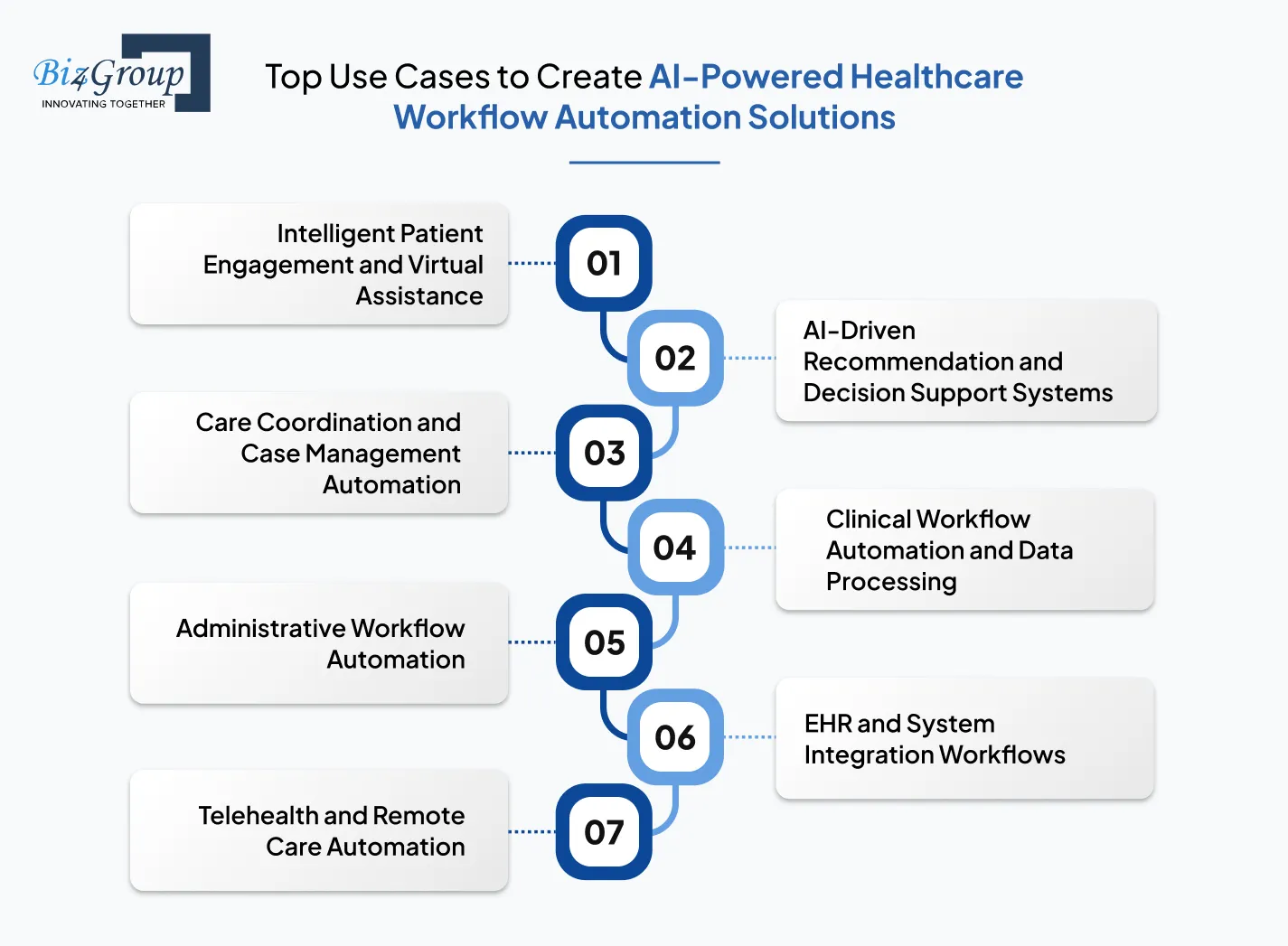
Understanding use cases is where strategy turns into execution. Healthcare organizations planning to create automated healthcare workflows using AI often start by identifying areas with the highest inefficiencies and impact.
Below are the most practical and high-value implementations seen across modern healthcare systems.
1. Intelligent Patient Engagement and Virtual Assistance
Patient interaction is one of the most resource-intensive areas in healthcare. AI transforms this by enabling continuous, personalized engagement without increasing staff workload.
Organizations that develop AI tools for hospital workflow automation are increasingly prioritizing conversational interfaces that handle patient queries, guidance, and follow-ups.
Project Spotlight: AI Avatar for Personalized Wellness
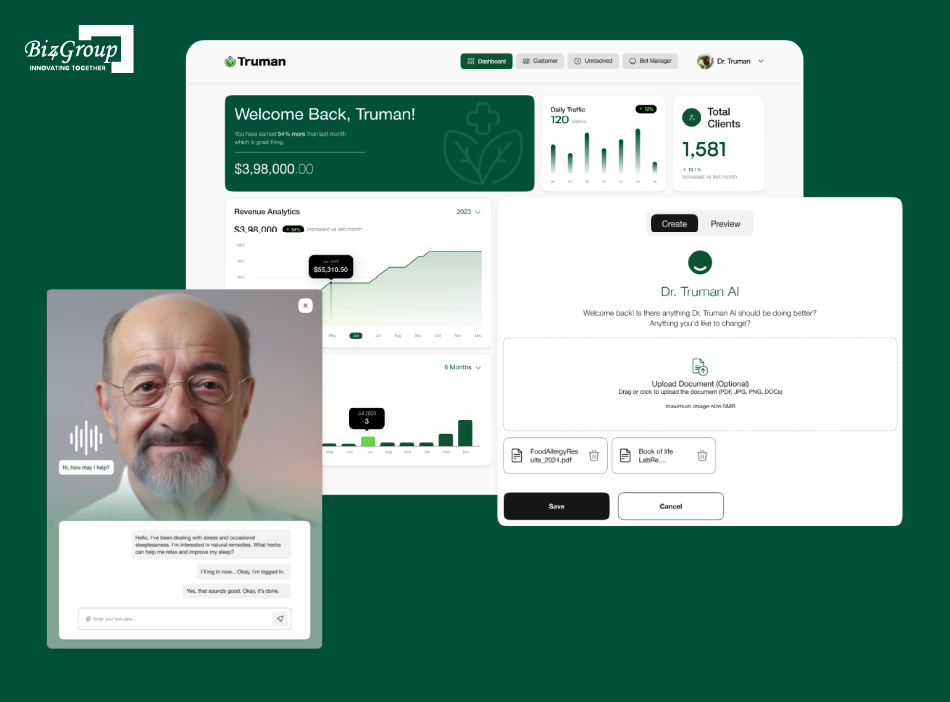
Biz4Group created an AI avatar for personalized wellness. This solution demonstrates how conversational AI can redefine patient engagement.
- AI-powered avatar delivering personalized health consultations
- Real-time interaction with users for health advice
- Integrated product recommendations based on individual health data
- Seamless transition from consultation to purchase within the platform
The system connects patient interaction, recommendation logic, and transaction workflows into a single automated experience.
Also read: How to develop an AI avatar for clinical management?
2. AI-Driven Recommendation and Decision Support Systems
Healthcare decisions often require analyzing multiple variables. AI simplifies this by delivering real-time, context-aware recommendations.
This is a core area when organizations aim to build AI systems for healthcare workflow automation that support both patients and providers.
Project Spotlight: AI Chatbot for Supplement Recommendations
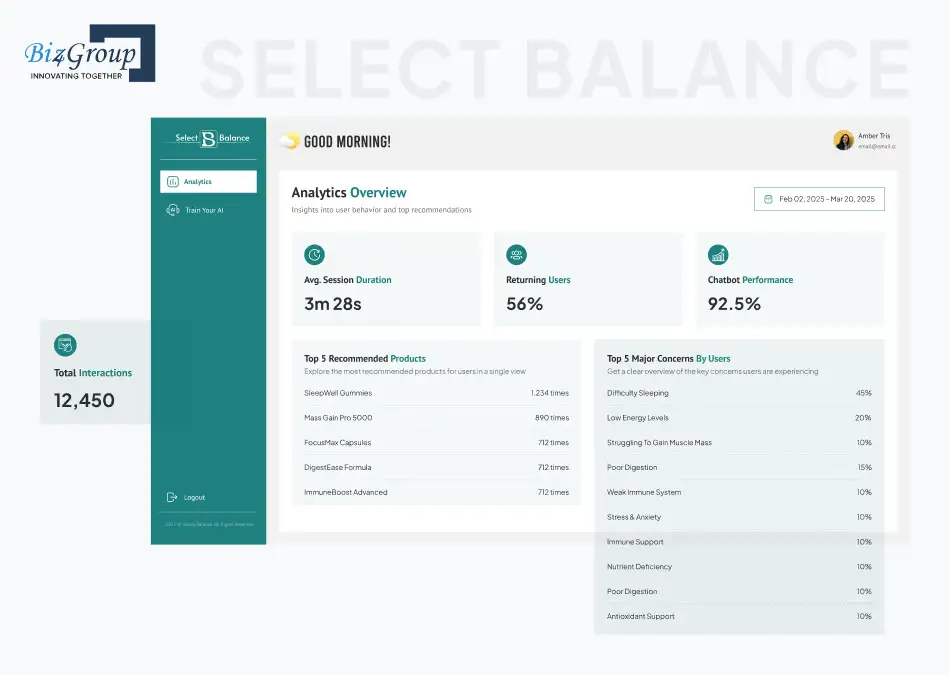
This AI chatbot for personalized supplement recommendations by Biz4Group is a strong example of how recommendation engines can automate decision workflows.
- Guided quiz and conversational input to understand user health needs
- Real-time product matching using a structured PostgreSQL database
- Dynamic follow-up questions to refine recommendations
- Admin panel for continuous training and improvement of AI logic
This system showcases how intelligent workflows can be built around data retrieval and real-time processing.
3. Care Coordination and Case Management Automation
Managing patient journeys across multiple touchpoints can be complex. AI simplifies this by orchestrating workflows based on patient data, eligibility, and urgency.
Healthcare providers looking to build intelligent workflow automation systems for hospitals are focusing heavily on this area.
Project Spotlight: AI Chatbot for Veteran Support
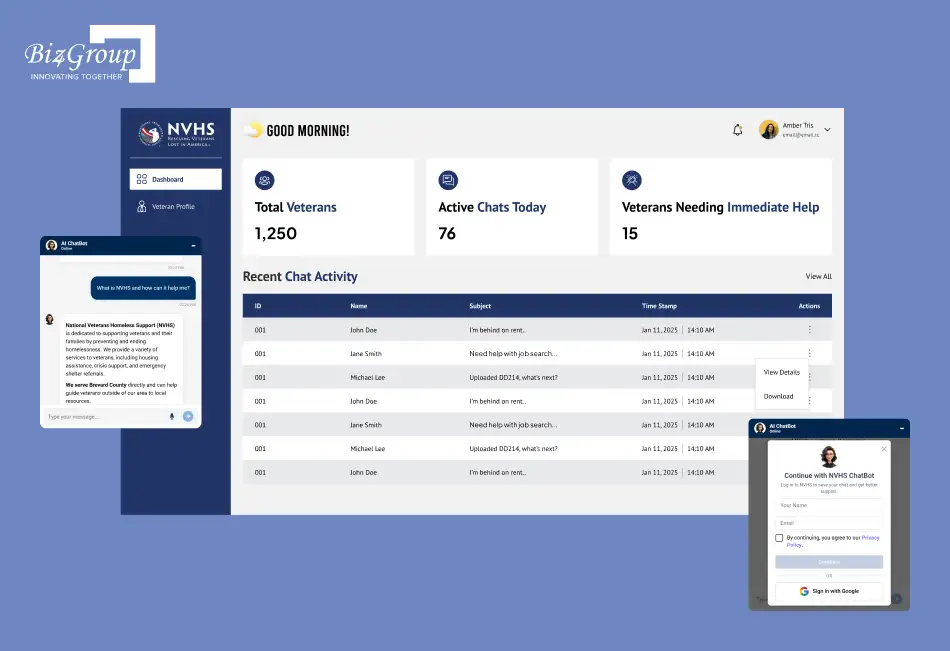
Biz4Group developed an AI chatbot for homeless and at-risk veterans. This project highlights how AI can automate multi-step care coordination workflows.
- Personalized action plans based on eligibility and location
- Real-time crisis detection and alert mechanisms
- Voice and text interaction for accessibility
- Admin dashboard for monitoring and case management
The system connects data ingestion, decision-making, and response workflows into a unified experience.
Also read: How to develop an AI fall detection software for hospitals and elderly care?
4. Clinical Workflow Automation and Data Processing
Clinical environments generate massive amounts of data. AI helps process and utilize this data efficiently. Healthcare systems that develop AI-based clinical workflow automation solutions often focus on:
- Automating clinical documentation
- Extracting insights from unstructured medical data
- Supporting diagnosis and treatment planning
This is closely tied to advancements in AI healthcare analytics software, where data becomes actionable in real time.
Also read: How to build an AI medical scribe software?
5. Administrative Workflow Automation
Administrative processes remain one of the biggest bottlenecks in healthcare operations. Organizations aiming to create AI automation for healthcare operations and processes are using AI to streamline:
- Appointment scheduling and rescheduling
- Billing and insurance claims processing
- Patient onboarding and documentation
Solutions like AI medical claim processing software are helping reduce errors and accelerate reimbursements.
6. EHR and System Integration Workflows
Disconnected systems create inefficiencies and delays. AI enables seamless integration and data flow across platforms. To build AI-driven healthcare workflow systems, integration with EHR and other systems is essential.
- Automated data synchronization across platforms
- Real-time updates to patient records
- Interoperability using standardized protocols
Modern systems often rely on AI EMR/EHR software to ensure accurate and timely data exchange.
7. Telehealth and Remote Care Automation
The rise of remote care has introduced new workflow challenges. AI helps automate and optimize these processes. Healthcare providers planning to develop AI healthcare workflow automation software are increasingly investing in:
- Automated virtual consultations
- AI-assisted patient triage
- Remote monitoring workflows
These capabilities are often built into solutions like AI-based telehealth automation system, enabling scalable remote care delivery.
Each of these use cases represents a different layer of healthcare operations. The real value emerges when they are connected into a unified system. Many organizations begin by asking how to scale automation across departments. The answer lies in combining these use cases into a cohesive strategy powered by AI automation.
In the next section, we will break down the core features required to build such systems and how they translate into real-world performance.
Also read: AI patient portal development explained
Key Features to Develop AI Healthcare Workflow Automation Software
To successfully develop AI healthcare workflow automation software, features must go beyond basic automation. Each component should contribute to intelligence, scalability, and seamless operations across healthcare systems.
Below is a structured breakdown of the core features required to build AI-driven healthcare workflow systems that perform reliably in real-world environments.
| Feature | What It Is | What It Does |
|---|---|---|
|
Intelligent Workflow Orchestration Engine |
A centralized engine that manages and executes workflows across systems |
Automates multi-step processes, triggers actions, and ensures tasks move seamlessly from one stage to another |
|
NLP-Based Data Processing |
Natural Language Processing models designed to interpret clinical and conversational data |
Extracts insights from medical notes, patient inputs, and unstructured data for faster decision-making |
|
AI-Powered Recommendation Engine |
Machine learning models that analyze patient data and context |
Delivers personalized treatment suggestions, product recommendations, or next-step actions |
|
Real-Time Analytics Dashboard |
A dynamic interface for monitoring workflows and system performance |
Provides actionable insights, alerts, and performance tracking for administrators and clinicians |
|
Multi-Channel Interaction Layer |
Interfaces across chat, voice, mobile apps, and web platforms |
Enables patients and providers to interact with the system through preferred communication channels |
|
EHR/EMR Integration Module |
Integration layer that connects with healthcare record systems |
Ensures seamless data exchange, synchronization, and real-time updates across platforms |
|
Predictive Analytics Engine |
AI models trained on historical and real-time data |
Anticipates patient risks, workflow bottlenecks, and operational inefficiencies |
|
Role-Based Access Control |
Security framework that manages user permissions and data access |
Protects sensitive healthcare data and ensures compliance with regulatory standards |
|
Automated Task Management System |
AI-driven task allocation and tracking mechanism |
Assigns tasks, prioritizes workloads, and reduces manual intervention across departments |
|
Interoperability Framework (FHIR/HL7) |
Standardized protocols for healthcare data exchange |
Enables smooth communication between different healthcare systems and applications |
|
Continuous Learning System |
Feedback-driven AI model improvement loop |
Enhances accuracy and performance over time based on new data and user interactions |
|
Workflow Customization Engine |
Configurable module to design and modify workflows |
Allows healthcare organizations to tailor automation based on specific operational needs |
Why These Features Matter
When organizations aim to create AI-powered healthcare workflow solutions, these features ensure:
- Systems adapt instead of breaking under complexity
- Workflows remain connected across departments
- AI delivers measurable outcomes, not theoretical value
Features define how well your system performs under real-world pressure. The goal is not to add more components, but to ensure each feature contributes to a cohesive, intelligent workflow.
In the next section, we will explore how these features come together within the system architecture and technology stack.
Systems with Strong AI Features Improve Efficiency by Up to 40%
The difference between a good system and a game-changer lies in how those features are engineered and connected.
Book a Strategy Call TodayArchitecture and Tech Stack for AI Healthcare Workflow Automation Software Development
To build AI systems for healthcare workflow automation, technology decisions must support scalability, compliance, and real-time processing. A well-designed stack ensures your system performs reliably across complex healthcare environments.
Below is a practical breakdown of the technology stack followed by how the architecture comes together.
Core Technology Stack for AI Healthcare Workflow Systems
AI and Machine Learning Layer
| Technology | What It Is | What It Does |
|---|---|---|
|
TensorFlow / PyTorch |
Open-source machine learning frameworks |
Builds and trains predictive models for diagnostics, recommendations, and workflow automation |
|
NLP Models (BERT, GPT) |
Language processing models |
Interprets clinical notes, patient queries, and unstructured healthcare data |
|
Computer Vision Models |
Image processing AI systems |
Analyzes medical imaging and visual data for clinical workflows |
Backend Development Layer
| Technology | What It Is | What It Does |
|---|---|---|
|
Python (Django, FastAPI) |
Backend development frameworks |
Handles APIs, business logic, and AI model integration |
|
Node.js |
Event-driven backend runtime |
Supports real-time workflows and scalable microservices architecture |
|
Microservices Architecture |
Modular backend structure |
Enables independent deployment and scaling of different workflow components |
Data and Storage Layer
| Technology | What It Is | What It Does |
|---|---|---|
|
PostgreSQL |
Relational database system |
Stores structured healthcare data such as patient records and workflows |
|
MongoDB |
NoSQL database |
Handles unstructured and semi-structured healthcare data |
|
Data Lakes (AWS S3, Azure Blob) |
Centralized storage systems |
Stores large volumes of raw healthcare data for AI processing |
Integration and Interoperability Layer
| Technology | What It Is | What It Does |
|---|---|---|
|
FHIR APIs |
Healthcare data exchange standard |
Enables secure and standardized communication between systems |
|
HL7 Protocols |
Messaging standard in healthcare |
Facilitates data exchange between legacy systems |
|
API Gateways |
Middleware layer |
Manages communication between internal and external systems |
Cloud and DevOps Layer
| Technology | What It Is | What It Does |
|---|---|---|
|
AWS / Azure / GCP |
Cloud platforms |
Provides scalable infrastructure and managed AI services |
|
Docker / Kubernetes |
Containerization tools |
Enables scalable deployment and orchestration of applications |
|
CI/CD Pipelines |
Automated deployment workflows |
Ensures faster and reliable updates to the system |
Frontend and Interaction Layer
| Technology | What It Is | What It Does |
|---|---|---|
|
React / Angular |
Frontend frameworks |
Builds responsive dashboards and user interfaces |
|
Mobile Frameworks (Flutter, Swift) |
Mobile app development tools |
Enables patient and provider access on mobile devices |
|
Voice and Chat Interfaces |
Conversational UI systems |
Supports real-time interaction for patients and clinicians |
System Architecture for AI Healthcare Workflow Automation
To create AI-powered healthcare workflow solutions, the architecture must connect all components into a unified system. Below is how a typical architecture is structured:
- Data ingestion layer collects information from EHR systems, APIs, and patient applications
- Data preprocessing layer cleans, normalizes, and prepares structured and unstructured data
- AI model layer processes inputs using NLP, machine learning, and predictive analytics
- Workflow orchestration engine manages task sequencing, decision logic, and automation triggers
- Integration layer connects with EHR, billing systems, telehealth platforms, and third-party tools
- Security layer enforces encryption, access control, and compliance protocols
- Application layer delivers user interfaces such as dashboards, mobile apps, and conversational interfaces
A strong architecture supported by the right technology stack determines whether your system performs efficiently or struggles under complexity. For teams aiming to build intelligent workflow automation systems for hospitals, investing time in architecture planning early can prevent costly rework later.
In the next section, we will walk through the step-by-step development process to bring these systems to life.
How to Create Intelligent Healthcare Process Automation Using AI in 7 Steps?
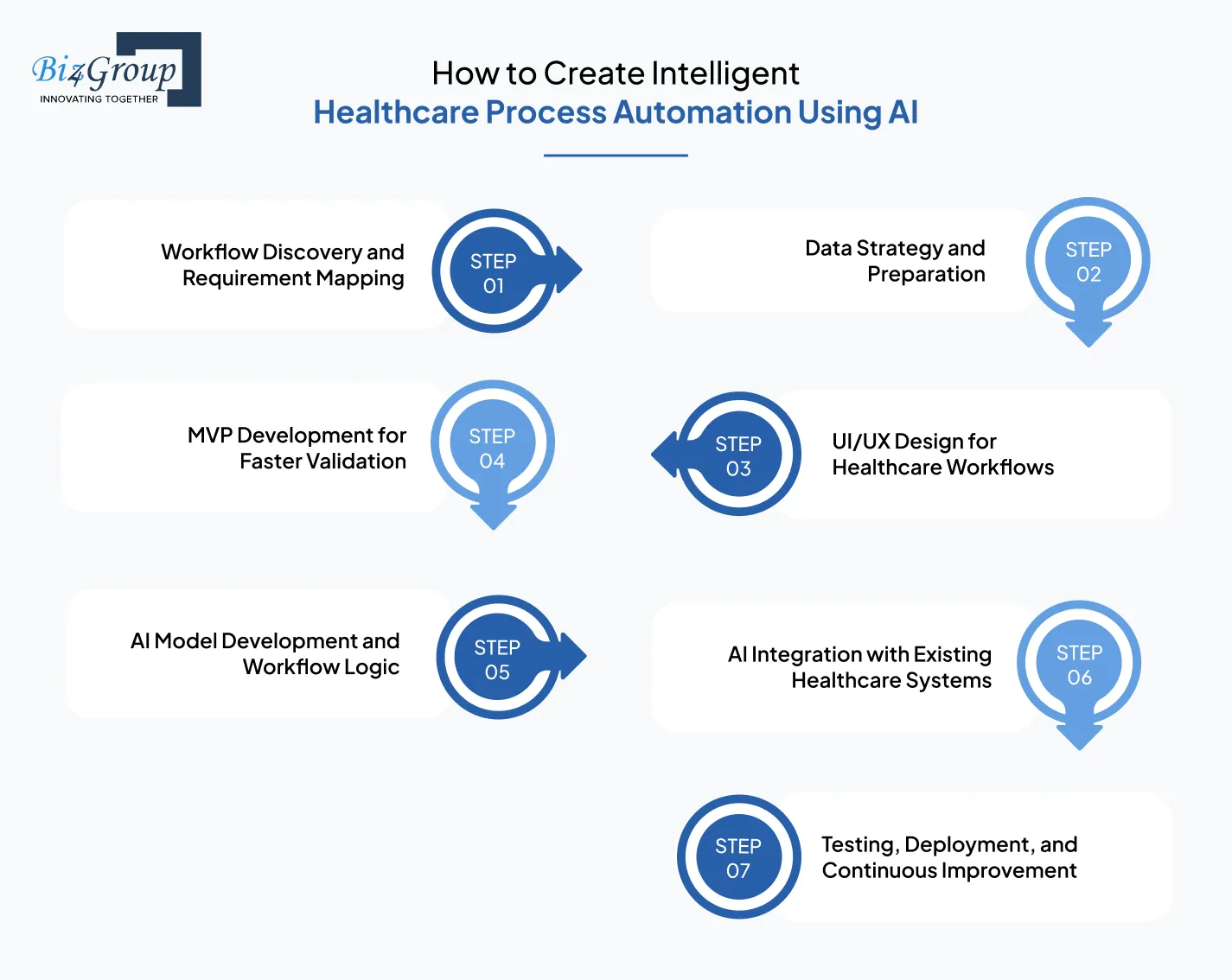
Building a successful system requires more than technical execution. It demands a structured approach that aligns business goals with real-world healthcare workflows. If you are planning to develop AI healthcare workflow automation software, the following 7-step process ensures clarity, scalability, and long-term success.
Step 1. Workflow Discovery and Requirement Mapping
Every strong system begins with understanding the problem. This step focuses on identifying:
- Existing workflow gaps
- Manual bottlenecks
- High-impact automation opportunities
Teams aiming to create AI automation for healthcare operations and processes must map workflows across departments such as patient intake, billing, and care coordination. A clear discovery phase prevents costly redesign later.
Step 2. Data Strategy and Preparation
AI systems rely on data quality more than anything else. At this stage:
- Data sources are identified
- Structured and unstructured data is organized
- Data pipelines are defined
For organizations planning to build AI systems for healthcare workflow automation, this step determines how accurate and reliable the system will be.
Step 3. UI/UX Design for Healthcare Workflows
Adoption depends heavily on how the system feels to use. Healthcare systems are used by:
- Doctors
- Nurses
- Administrative staff
- Patients
This is where investing in UI/UX design becomes critical. Interfaces must be intuitive, fast, and aligned with real-world workflows. A well-designed interface reduces resistance and improves efficiency across teams.
Also read: Top 15 UI/UX design companies in USA
Step 4. MVP Development for Faster Validation
Instead of building everything at once, successful teams start with a focused version of the product. Through MVP development, organizations can:
- Validate core workflows
- Test AI capabilities
- Gather real user feedback
This step is essential for those looking to build intelligent workflow automation systems for hospitals without overinvesting upfront. It also helps refine features before scaling.
Also read: Top 12+ MVP development companies in USA
Step 5. AI Model Development and Workflow Logic
This is where intelligence is introduced into the system. Key activities include:
- Training NLP models for healthcare data
- Building recommendation engines
- Defining workflow decision logic
Organizations that want to develop AI-based clinical workflow automation solutions must ensure models are accurate, explainable, and aligned with real use cases.
Step 6. AI Integration with Existing Healthcare Systems
A powerful system is only useful if it connects with existing infrastructure. Through AI integration, the solution is connected with:
- EHR systems
- Billing platforms
- Internal tools
This step is critical for organizations that want to build an end-to-end solution rather than isolated features. Seamless integration ensures workflows remain uninterrupted.
Step 7. Testing, Deployment, and Continuous Improvement
The final step focuses on making the system production-ready. It includes:
- Functional and performance testing
- Real-world scenario validation
- Continuous monitoring and improvement
Organizations investing in AI product development often treat this as an ongoing cycle rather than a one-time phase. AI systems improve over time, so iteration is key.
So, when organizations ask, “I am looking to build an end-to-end AI healthcare workflow automation system, including integration with EHR and internal tools.”
The answer lies in following a structured development process like this.
Each step builds on the previous one, ensuring the final system is not only functional but scalable and reliable.
In the next section, we will explore compliance requirements and how to build systems that meet strict healthcare regulations.
Also read: How can AI help you automate your healthcare center?
70% of AI Projects Fail Due to Poor Execution. Will Yours?
Having an idea is common. Executing it with the right process and expertise is what sets successful systems apart.
Call Us NowCompliance Requirements for AI Healthcare Workflow Automation Software Development
Compliance is not a final step. It is built into the foundation of any system designed for healthcare. If you plan to develop AI healthcare workflow automation software, regulatory alignment ensures your solution remains secure, trustworthy, and legally viable across regions.
Below are the key compliance areas every healthcare AI system must address.
Data Privacy and Protection
- Ensure patient data is encrypted both at rest and in transit
- Implement strict access controls based on user roles
- Store and process data following regional privacy laws such as HIPAA and GDPR
- Maintain data anonymization where required for AI model training
HIPAA Compliance (US Healthcare Systems)
- Safeguard Protected Health Information through secure storage and transmission
- Maintain audit logs for all data access and system interactions
- Implement Business Associate Agreements when working with third-party vendors
- Ensure secure authentication mechanisms for users
Also read: HIPAA-compliant AI healthcare software development
Interoperability Standards
- Follow FHIR protocols for modern healthcare data exchange
- Use HL7 standards to support legacy system communication
- Ensure consistent data formats across all integrated platforms
- Enable real-time synchronization between systems
AI Model Governance and Transparency
- Maintain documentation for how AI models make decisions
- Ensure explainability in clinical decision-support systems
- Regularly audit models for bias and accuracy
- Establish monitoring systems for model performance over time
Security and Risk Management
- Conduct regular vulnerability assessments and penetration testing
- Implement multi-factor authentication for system access
- Monitor system activity for suspicious behavior
- Establish incident response protocols for data breaches
Data Integrity and Auditability
- Maintain detailed logs of workflow execution and system actions
- Ensure traceability of decisions made by AI systems
- Enable rollback and error tracking mechanisms
- Support compliance audits with structured reporting
Regulatory Compliance Across Regions
- Align with GDPR for European data handling
- Follow regional healthcare data regulations where applicable
- Adapt compliance frameworks based on deployment geography
- Ensure cross-border data transfer policies are clearly defined
Compliance often determines whether a solution can be deployed or not. Building it into your development process from day one ensures smoother approvals, faster adoption, and reduced risk.
In the next section, we will break down the cost of developing AI healthcare workflow automation software and what factors influence the overall investment.
How Much Does It Cost to Develop AI Healthcare Workflow Automation Software?
Understanding the investment required helps organizations plan realistically and avoid budget overruns. On average, the cost to develop AI healthcare workflow automation software ranges between $50,000-$200,000+, depending on complexity, integrations, and AI capabilities.
Here is a quick breakdown of cost levels based on system scope:
| Level | What It Includes | Estimated Cost |
|---|---|---|
|
MVP |
Core workflow automation, limited AI features, basic integrations |
$50,000-$80,000 |
|
Advanced System |
Multiple workflows, AI models, integrations with EHR and third-party tools |
$80,000-$150,000 |
|
Enterprise-Grade Platform |
End-to-end automation, advanced AI, scalability, compliance-ready systems |
$150,000-$200,000+ |
Organizations planning to build AI systems for healthcare workflow automation should align their budget with long-term scalability, not short-term savings.
Key Cost Drivers in Development
The total cost depends on several moving parts. Each component contributes differently to the overall investment.
| Cost Driver | What It Covers | Estimated Impact |
|---|---|---|
|
Feature Complexity |
Number and sophistication of workflows, dashboards, automation logic |
$10,000-$40,000 |
|
AI Model Development |
NLP models, predictive analytics, recommendation engines |
$15,000-$50,000 |
|
Integrations |
EHR, billing systems, APIs, third-party platforms |
$10,000-$30,000 |
|
UI/UX Design |
User interfaces for patients, doctors, and admins |
$5,000-$20,000 |
|
Data Infrastructure |
Databases, pipelines, storage systems |
$10,000-$25,000 |
|
Testing and QA |
Performance, accuracy, and usability testing |
$5,000-$15,000 |
|
Deployment and DevOps |
Cloud setup, scaling, monitoring systems |
$5,000-$20,000 |
For organizations looking to create AI-powered healthcare workflow solutions, these drivers define both the scope and quality of the final product.
Hidden Costs You Should Plan For
Beyond the obvious expenses, there are several hidden costs that often catch teams off guard. Accounting for these early helps avoid delays and budget overruns.
One major factor is data preparation and cleaning, which can cost anywhere between $5,000-$15,000 depending on data quality. AI systems rely heavily on clean, structured data, and preparing it often requires significant effort.
Another overlooked area is model retraining and optimization. Post-deployment improvements can add an additional $5,000-$20,000 over time as models evolve with new data.
Compliance and security enhancements also introduce ongoing costs, typically ranging from $5,000-$25,000 depending on regulatory requirements and audit needs.
Finally, user training and onboarding can cost around $3,000-$10,000, especially for large healthcare teams adopting new systems.
Organizations planning to build intelligent workflow automation systems for hospitals should treat these as essential investments rather than optional expenses.
How to Optimize Development Costs?
Managing costs effectively does not mean cutting corners. It means making smarter decisions during development.
- Start with an MVP to validate workflows before scaling, which can reduce initial investment by 30%-40%
- Prioritize high-impact workflows instead of automating everything at once
- Reuse existing infrastructure and APIs where possible to save $10,000-$25,000
- Choose scalable architecture early to avoid costly rebuilds later
- Continuously monitor performance to prevent expensive post-deployment fixes
For teams aiming to create AI automation for healthcare operations and processes, cost optimization comes from strategic planning rather than reducing scope blindly.
The cost of development reflects the value your system delivers. A well-built solution improves efficiency, reduces operational overhead, and scales with your organization.
Instead of focusing only on upfront investment, the real question should be, what kind of system are you building, and how well will it perform over time?
Also read: True cost of implementing AI in healthcare
AI Can Reduce Operational Costs by Up to 30%. What's Your ROI Plan?
Your investment should not sit idle. It should actively reduce costs and improve performance across workflows.
Let's Talk NumbersChallenges in AI Healthcare Workflow Automation Software Development (And How to Solve Them)
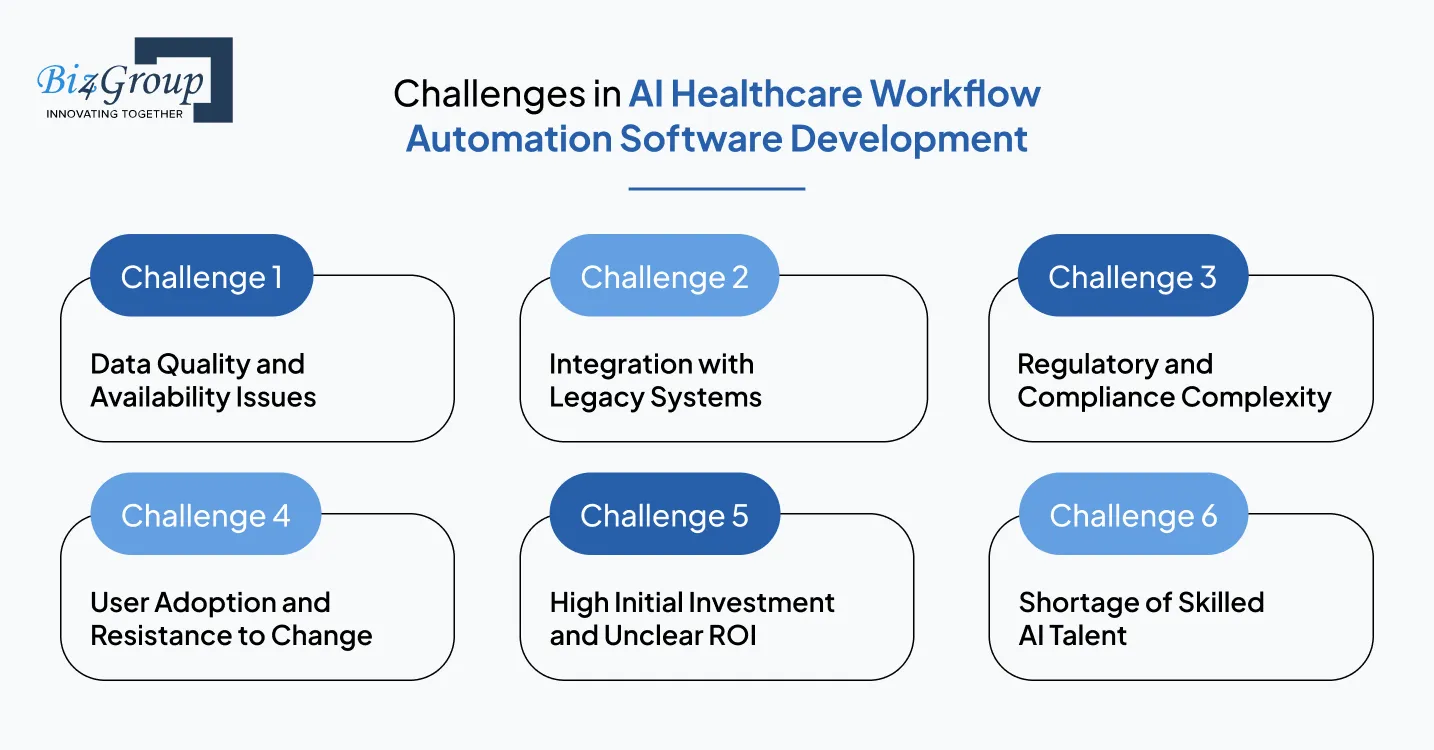
While the benefits are clear, developing healthcare automation systems comes with its own set of challenges. Organizations planning to build AI systems for healthcare workflow automation often face technical, operational, and adoption-related hurdles.
Understanding these challenges early helps in designing systems that perform reliably in real-world environments.
Challenge 1. Data Quality and Availability Issues
AI systems are only as good as the data they rely on. In healthcare, data is often incomplete, inconsistent, or scattered across multiple systems. This creates difficulties when teams try to develop AI-based clinical workflow automation solutions that depend on accurate insights.
Solutions
- Standardize data formats across systems before development
- Use data cleaning and preprocessing pipelines early
- Implement continuous data validation mechanisms
Challenge 2. Integration with Legacy Systems
Healthcare organizations often operate on outdated infrastructure that does not easily connect with modern AI systems. This becomes a major blocker when trying to create AI-powered healthcare workflow solutions that require seamless data exchange.
Solutions
- Use API-based integration layers to bridge systems
- Adopt interoperability standards like FHIR and HL7
- Gradually modernize systems instead of replacing everything at once
Challenge 3. Regulatory and Compliance Complexity
Strict healthcare regulations make development more challenging. Any system handling sensitive data must meet multiple compliance standards. This directly impacts teams working on AI healthcare automation platform development.
Solutions
- Incorporate compliance requirements from the initial design phase
- Conduct regular audits and security assessments
- Implement strong access control and encryption protocols
Challenge 4. User Adoption and Resistance to Change
Even the most advanced system can fail if users do not adopt it. Healthcare professionals are often hesitant to switch from familiar workflows. This becomes a challenge when organizations attempt to build intelligent workflow automation systems for hospitals.
Solutions
- Focus on intuitive design and usability
- Provide proper training and onboarding for staff
- Involve end-users during the development process
Challenge 5. High Initial Investment and Unclear ROI
Many organizations hesitate due to upfront costs and uncertainty around returns. This slows down decision-making and implementation. It is a common concern when teams plan to develop AI healthcare workflow automation software at scale.
Solutions
- Start with a phased approach using MVP development
- Focus on high-impact workflows first
- Track performance metrics to demonstrate ROI early
Challenge 6. Shortage of Skilled AI Talent
Building advanced systems requires specialized expertise in AI, healthcare, and software development. Finding the right talent can be difficult. This often delays projects aimed at building scalable AI automation systems for healthcare operations.
Solutions
- Partner with experienced teams or vendors
- Choose to hire AI developers with healthcare domain expertise
- Evaluate vendors carefully using resources like top 15 AI healthcare software development companies in USA
Challenges are part of any complex system development. What matters is how early they are identified and how effectively they are addressed. Organizations that proactively solve these challenges are better positioned to create scalable, reliable, and high-performing AI systems.
In the next section, we will explore future trends shaping AI healthcare workflow automation and what lies ahead for this rapidly evolving space.
Future Trends in AI Healthcare Workflow Automation Software Development
Healthcare automation is entering a new phase where systems are becoming more autonomous, predictive, and deeply integrated into everyday operations. Organizations planning to build AI systems for healthcare workflow automation need to stay ahead of these shifts to remain competitive.
Below are the key trends shaping the next generation of healthcare workflows.
1. Generative AI in Clinical and Administrative Workflows
Generative AI is expanding beyond chat-based interactions. It is now being used to generate clinical summaries, automate documentation, and assist in decision-making.
Healthcare providers are increasingly adopting generative AI capabilities to reduce documentation burden and improve workflow speed. This trend is especially impactful in areas like medical scribing and patient communication.
2. Rise of Agentic AI Systems in Healthcare
Agentic AI introduces systems that can independently plan, decide, and execute multi-step workflows. These systems go beyond automation by actively managing processes.
Organizations exploring agentic AI development are building systems that can coordinate care pathways, trigger actions, and adapt to changing patient conditions in real time.
Also read: How to build agentic AI in healthcare?
3. Hyperautomation Across Healthcare Operations
Hyperautomation combines AI, machine learning, and workflow orchestration to automate entire processes rather than individual tasks.
Hospitals aiming to create AI automation for healthcare operations and processes are adopting hyperautomation to connect clinical, administrative, and financial workflows into a unified system. This results in faster execution, fewer errors, and improved operational efficiency.
4. Real-Time Predictive Workflow Systems
Healthcare systems are moving toward predictive automation where decisions are made before issues arise.
AI models are being trained to:
- Predict patient risks
- Identify workflow bottlenecks
- Optimize resource allocation
This enables organizations to build intelligent workflow automation systems for hospitals that are proactive rather than reactive.
5. Voice-First and Conversational Interfaces
Voice-enabled systems are becoming more common in healthcare environments where hands-free interaction is critical.
Doctors and staff can:
- Update records using voice commands
- Access patient data instantly
- Trigger workflows without manual input
This trend is transforming how users interact with systems built through AI healthcare automation platform development.
6. Personalized and Context-Aware Workflows
Future systems will adapt workflows based on patient history, preferences, and real-time data.
Instead of static processes, organizations will create AI-powered healthcare workflow solutions that adjust dynamically to each patient’s needs. This leads to better patient outcomes and more efficient care delivery.
The future of healthcare automation is not about adding more tools. It is about building systems that think, adapt, and act intelligently. Organizations that embrace these trends early will be better positioned to lead in a rapidly evolving healthcare landscape.
In the next section, we will explore why choosing the right development partner plays a critical role in turning these innovations into real-world solutions.
AI Healthcare Market Is Crossing $50 Billion. Are You Building or Watching?
The next wave of innovation is already reshaping healthcare. The question is whether you are part of it.
Talk to Biz4Group's ExpertsWhy Choose Biz4Group LLC in USA for AI Healthcare Workflow Automation Software Development
Building healthcare automation systems demands a deep understanding of healthcare workflows, regulatory expectations, and real-world operational challenges.
This is where Biz4Group LLC stands apart.
As a trusted AI healthcare software development company, Biz4Group has consistently delivered complex, scalable, and high-performing AI solutions for startups, enterprises, and healthcare innovators across the USA. The focus has always been on solving real problems, not building surface-level automation.
From intelligent patient engagement systems to advanced workflow orchestration platforms, the team brings together expertise in AI, software engineering, and healthcare domain knowledge. This combination allows businesses to develop AI healthcare workflow automation software that performs reliably in real-world environments.
What truly differentiates Biz4Group as an AI development company is its ability to turn ideas into production-ready systems. Whether it is conversational AI, recommendation engines, or end-to-end workflow automation, every solution is designed with scalability, usability, and performance in mind.
Why Businesses Choose Biz4Group LLC
Choosing the right development partner can define the success of your entire project. Businesses across the globe continue to partner with Biz4Group for several reasons.
- Strong expertise in building AI-driven healthcare systems tailored to real operational needs
- Proven experience in developing conversational AI, recommendation engines, and workflow automation platforms
- Ability to integrate seamlessly with existing healthcare systems including EHRs and internal tools
- Focus on scalable architecture that supports long-term growth and expansion
- Transparent communication and agile development approach that keeps clients involved at every stage
- Dedicated team of AI engineers, designers, and healthcare technology experts
Healthcare workflows are dynamic. Regulations change, patient expectations shift, and technology continues to advance. Biz4Group ensures that the systems it builds are flexible enough to adapt to these changes without requiring constant rework.
The team’s experience across diverse healthcare use cases allows businesses to move faster, reduce risks, and achieve results with confidence.
If you are planning to build a system that truly transforms your healthcare operations, the choice of partner matters more than the technology itself. Biz4Group combines expertise, experience, and execution to help you create AI-powered systems that are not only functional but future-ready.
Wrapping Up
Healthcare systems are evolving rapidly, and automation has become a necessity rather than an option. Throughout this guide, we explored how to develop AI healthcare workflow automation software that goes beyond basic task automation and delivers real operational impact. From understanding core components to building scalable architectures and implementing real-world use cases, the focus remains on creating systems that are intelligent, connected, and efficient.
Organizations that invest in building scalable AI automation systems for healthcare operations are already seeing improvements in efficiency, accuracy, and patient experience. The key lies in approaching development strategically, choosing the right technologies, and ensuring seamless integration across workflows. When done right, AI-driven automation transforms how healthcare operates at every level.
This is where Biz4Group LLC brings a clear advantage. As an experienced US-based software development company, Biz4Group helps healthcare businesses turn complex ideas into scalable, high-performing solutions tailored to real-world needs.
If you are ready to move from planning to execution, now is the time to take action and build a system that drives measurable results.
FAQs
1. Can AI workflow automation work with existing hospital systems?
Yes, modern AI systems are designed to integrate with existing infrastructure such as EHRs, billing platforms, and internal tools. The key lies in using APIs and interoperability standards that allow seamless data exchange without disrupting current operations.
2. What type of data is required to build AI healthcare automation systems?
AI systems typically require a mix of structured and unstructured data, including patient records, clinical notes, medical histories, and operational data. High-quality, well-organized data plays a major role in system performance and accuracy.
3. Is AI healthcare workflow automation suitable for small clinics or only large hospitals?
AI automation can be tailored for organizations of all sizes. Small clinics often start with focused use cases such as appointment scheduling or patient communication, while larger hospitals implement full-scale workflow automation across departments.
4. How do AI systems handle errors or incorrect predictions in healthcare workflows?
AI systems are designed with feedback loops and monitoring mechanisms. When errors occur, they are logged, analyzed, and used to improve future performance. Many systems also include human-in-the-loop validation for critical decisions.
5. Can AI workflow automation improve patient engagement and satisfaction?
Yes, AI enables faster responses, personalized communication, and streamlined processes, which collectively enhance patient experience. Features like real-time assistance and automated follow-ups contribute to higher satisfaction levels.
6. How scalable are AI healthcare workflow automation systems?
AI-based systems are highly scalable when built with the right architecture. They can handle increasing data volumes, additional workflows, and growing user bases without significant performance issues, making them suitable for long-term use.
