 Location :
Orlando, FL, USA
Location :
Orlando, FL, USA +1 (407) 714-1616
 info@biz4group.com

 AI Summary Powered by Biz4AI
- Crisis intervention workflow development for mental health apps creates a structured process for identifying, escalating, and managing high-risk situations.
- A complete crisis workflow includes risk detection, clinical review, 988 Lifeline integration, and duty-to-warn response protocols.
- To build HIPAA-compliant crisis workflow for mental health platforms, organizations must address privacy, documentation, and emergency disclosure requirements.
- The cost to develop crisis intervention system in mental health app projects typically ranges from $40,000 to $300,000+, depending on features, compliance needs, and integrations.
- Biz4Group helps healthtech companies build secure, scalable, and compliance-focused mental health platforms with advanced AI and crisis response capabilities.
Imagine this scenario.
A user opens your mental health app at 1:30 AM and types:
"I don't think I can do this anymore."
What happens next?
Does your platform recognize the message as a potential crisis? Does it route the conversation to a clinician? Does it connect the user with the 988 Suicide & Crisis Lifeline? Can it document every action taken while maintaining HIPAA compliance?
Most mental health startups cannot answer yes to all four. Not because the founders didn't care, but because crisis intervention workflow development for mental health apps rarely makes it onto the product roadmap until something forces the issue like a compliance audit, an investor review, or a critical incident.
By then, adding it means rebuilding infrastructure that was never designed to support it.
That expectation isn't hypothetical. According to the U.S. Department of Health and Human Services, the 988 Suicide & Crisis Lifeline received more than 8 million contacts in 2025 alone, including calls, texts, chats, and videophone interactions. The scale of those interactions highlights a growing demand for crisis support systems that can respond quickly, safely, and appropriately.
For founders and healthcare innovators, this raises an important question:
If millions of people are seeking crisis support through digital channels, should your platform be prepared to handle those situations as well?
For most organizations, the answer is yes.
Whether you're building a teletherapy solution, behavioral health platform, or AI-powered wellness product, crisis intervention workflow development for mental health apps has become a critical part of product strategy. Users expect support. Providers expect accountability. Regulators expect compliance.
At the same time, development teams face complex implementation challenges.
- How do you develop a crisis intervention system in a mental health app without creating unnecessary legal risk?
- How do you build a HIPAA-compliant mental health app workflow development strategy that balances user privacy with emergency response requirements?
- Should your platform include 988 integration, clinical escalation pathways, geolocation services, or AI-driven risk detection?
These decisions can significantly impact user safety, operational efficiency, and regulatory exposure.
The challenge becomes even greater as organizations invest more heavily in AI in mental health. AI can help identify concerning behavioral patterns, flag high-risk conversations, and support earlier intervention. But detection alone is not enough. If a system identifies risk and no structured response follows, the underlying problem remains unsolved.
That's why organizations are increasingly prioritizing AI-enabled crisis intervention app development, clinical review workflow development for mental health apps, and developing scalable mental health app workflow for high-risk user monitoring as part of their long-term product roadmap.
The bigger question isn't whether your platform should have a crisis response system.
It's whether that system can reliably identify risk, trigger the right actions, involve the appropriate stakeholders, and remain compliant when every decision matters.
So, what exactly is crisis intervention workflow development for mental health apps, and why has it become a core requirement for modern behavioral health platforms?
What Happens If a Crisis Alert Appears in Your App Tomorrow?
Many mental health platforms are built for engagement. Far fewer are built for intervention.
Contact Our ExpertsWhat Is Crisis Intervention Workflow Development for Mental Health Apps?
Crisis intervention workflow development for mental health apps is the process of building a structured response system that determines what happens when a user may be experiencing a mental health emergency.
Instead of relying on ad hoc decision-making, the workflow defines how high-risk situations are identified, assessed, escalated, and documented. The goal is simple: ensure that users receive appropriate support while maintaining clinical accountability and compliance requirements.
When a user expresses suicidal ideation, self-harm intent, threatens violence, or shows other high-risk behavioral signals, the workflow determines:
- Risk Detection: How the risk is identified, whether through AI analysis, clinician review, self-reported assessments, or flagged conversations.
- Case Ownership: Who reviews the situation and within what timeframe.
- Escalation Rules: When intervention becomes necessary and who should be involved.
- Support Activation: Whether the user is routed to crisis resources, clinical reviewers, 988 support, or emergency services.
- Documentation: How actions are recorded to support compliance, clinical accountability, and audit requirements.
In short, crisis intervention workflow development for mental health apps creates a repeatable process for handling high-risk situations rather than leaving critical decisions to inconsistent manual processes.
Without a defined workflow, two clinicians, moderators, or support teams on the same platform may respond to identical situations differently. That inconsistency creates both user safety risks and organizational liability risks.
Why Are Mental Health Platforms Prioritizing This Now?
This is not a new problem. What has changed is the environment in which mental health platforms operate.
Therapy sessions, behavioral assessments, and crisis conversations that once happened inside clinics increasingly happen through apps, often outside business hours and often without a provider actively present. When a crisis surfaces in that environment, the platform itself frequently becomes the first point of response.
Many platforms were not originally designed with that level of responsibility in mind.
Several shifts are accelerating the need for structured crisis workflows:
- Expansion of Virtual Mental Healthcare: More patient interactions now occur digitally, increasing the likelihood that high-risk situations will emerge within app environments rather than clinical settings.
- Earlier Risk Detection Through Technology: Organizations investing in AI mental health app development can identify risk signals earlier through language analysis, behavioral patterns, and session activity. Once risk is detected, however, the absence of a response workflow becomes a much larger problem.
- Increasing Compliance Requirements: Crisis response workflows may be influenced by HIPAA requirements, state-specific duty-to-warn obligations, emergency disclosure exceptions, and documentation expectations.
- Higher Standards During Vendor Evaluation: Healthcare organizations, enterprise buyers, and clinical partners increasingly evaluate HIPAA-compliant mental health app workflow development capabilities during vendor selection rather than after implementation.
- Greater Focus on Operational Risk: Crisis management is no longer viewed solely as a clinical responsibility. It directly affects product decisions, compliance exposure, patient safety, and organizational risk.
Understanding why these workflows matter is only the starting point. The bigger question is: what actually happens behind the scenes when a platform identifies a user who may be at risk?
So, How Does a Crisis Intervention Workflow in Mental Health Apps Actually Work?
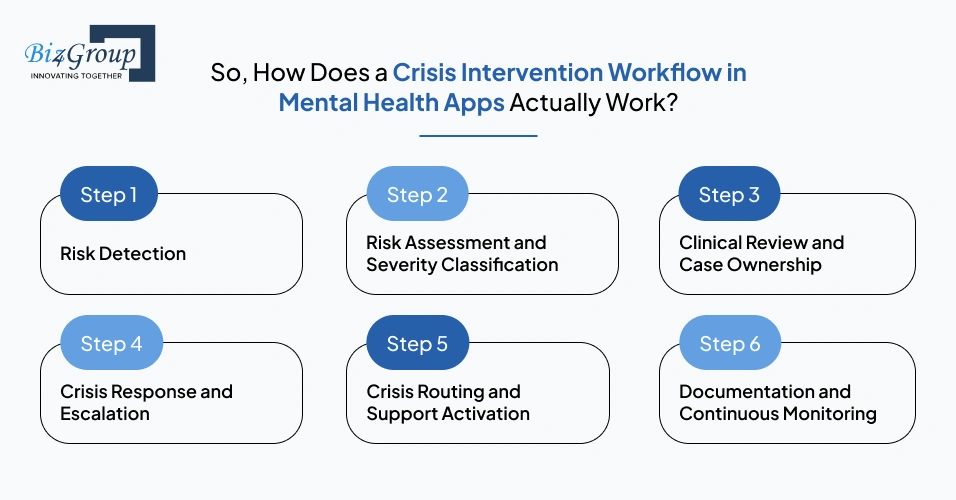
A crisis workflow is not a single feature.
It is a sequence of decisions, actions, and escalation pathways that determine how your platform responds when a user may be at risk.
To understand how to create mental health app crisis response workflow, let's walk through what typically happens from the moment a risk signal appears until support is delivered.
Step 1: Risk Detection
Every workflow begins with identifying signals that may indicate a crisis situation. These signals may come from users directly, clinician observations, behavioral patterns, assessments, or automated systems. Organizations focused on developing high-risk session management in mental health apps usually combine multiple detection methods rather than relying on one source.
Typical detection signals include:
- Messages indicating self-harm or suicidal thoughts
- Abnormal session behavior or usage patterns
- High-risk questionnaire responses
- Clinician or moderator flags
- Behavioral signals identified through AI models
Step 2: Risk Assessment and Severity Classification
Not every high-risk signal requires the same response. Once risk is identified, the workflow determines how serious the situation may be and what type of intervention should follow.
Most platforms categorize risk into severity tiers such as:
- Low risk requiring monitoring
- Moderate risk requiring follow-up
- High risk requiring human review
- Imminent danger requiring emergency escalation
Step 3: Clinical Review and Case Ownership
High-risk situations should not remain in automated queues indefinitely. A structured review process determines who becomes responsible for evaluating the case and what timeframe should be followed.
Typical review workflows include:
- Assigning cases to clinicians or reviewers
- Creating escalation queues
- Establishing review SLAs
- Recording reviewer decisions
- Triggering secondary escalation when needed
Organizations building a clinical decision support app for mental health using AI often use this layer to combine automation with human oversight.
Step 4: Crisis Response and Escalation
Once a case is reviewed, the workflow determines what intervention should occur. The goal is to match the response to the severity of the situation rather than applying the same escalation process to every user.
Common escalation actions include:
- Connecting users to crisis resources
- Activating clinician outreach
- Escalating to supervisors
- Routing users to emergency support
- Initiating emergency intervention protocols
Step 5: Crisis Routing and Support Activation
When immediate support is required, platforms need predefined response pathways. This is where building mental health app crisis response system with 988 lifeline API integration and emergency workflows become operational rather than theoretical.
Support activation workflows may include:
- Connecting users with 988 support services
- Routing cases to crisis counselors
- Triggering emergency dispatch procedures
- Initiating geolocation-based support workflows
- Delivering crisis-specific resources inside the app
Step 6: Documentation and Continuous Monitoring
The workflow does not end when intervention occurs. Post-crisis documentation and monitoring are necessary for continuity, compliance, and future risk assessment. Teams focused on developing scalable mental health app workflow for high-risk user monitoring often build systems that continuously evaluate risk after the initial event.
Typical post-crisis activities include:
- Recording intervention actions
- Maintaining audit logs
- Tracking repeated high-risk events
- Monitoring recovery indicators
- Scheduling follow-up actions
A crisis workflow is only effective when every stage works together.
The next challenge is making sure this entire system operates within legal, clinical, and privacy requirements.
Can You Build a HIPAA-Compliant Crisis Workflow for Mental Health Platforms Without Creating Legal Risks?
Building crisis workflows for mental health platforms is not only a technical challenge. It is also a compliance challenge.
Many teams assume HIPAA alone determines how crisis situations should be handled. In reality, build HIPAA-compliant crisis workflow for mental health platforms initiatives often require organizations to navigate overlapping federal regulations, state-specific obligations, emergency disclosure rules, and clinical documentation requirements.
The goal is not simply staying compliant.
The goal is building workflows that allow teams to respond quickly during high-risk situations without creating additional legal or operational risk.
1. HIPAA Requirements
When organizations begin HIPAA-compliant mental health app workflow development, the first question is usually straightforward: "Can we intervene during a crisis without violating HIPAA?"
In many cases, yes.
HIPAA allows disclosures in specific situations involving serious and imminent threats to health or safety. However, crisis workflows must clearly define when protected health information can be accessed, who can access it, what data can be shared, and how actions should be documented. Without predefined rules, teams often create inconsistent responses during emergencies.
2. Duty-to-Warn Obligations
Many organizations ask: "We are a healthtech startup creating a mental health platform and need to build a duty-to-warn workflow following Tarasoff obligations for high-risk sessions. What does that actually mean?"
Duty-to-warn obligations generally originate from state-level interpretations of the Tarasoff doctrine and vary significantly across jurisdictions. Some states impose mandatory reporting obligations, while others permit disclosures under certain conditions. Because these rules differ geographically, mental health app duty-to-warn workflow development often requires configurable escalation pathways rather than a single standardized process.
3. Emergency Disclosure Rules
Crisis workflows frequently require teams to make decisions under time pressure. HIPAA includes provisions that allow disclosures when organizations believe doing so may prevent or lessen a serious and imminent threat. However, those decisions should not depend entirely on individual judgment.
Workflows should define what qualifies as emergency disclosure, who authorizes it, what information can be shared, and how decisions are recorded to reduce compliance risk.
4. Documentation Requirements
A common mistake during developing crisis intervention system in mental health app projects is focusing heavily on detection while underestimating documentation. Crisis events create compliance, operational, and clinical records that often require detailed tracking. Organizations should define how risk assessments, escalations, disclosures, reviewer decisions, and follow-up actions are captured throughout the workflow.
Poor documentation creates problems long after the crisis itself has ended.
5. Geolocation and Privacy Controls
Many founders ask: "We are developing a mental health app and want to implement geolocation-based emergency dispatch for crisis situations without violating HIPAA. Is that possible?"
Yes, but only with careful workflow design. Developing geolocation-based emergency dispatch system for mental health apps without violating HIPAA requires organizations to determine when location access is requested, whether consent is required, how location data is stored, and when that information should be deleted.
Collecting location data continuously simply because it may become useful later creates unnecessary privacy exposure.
6. State-Level Compliance Variability
Organizations operating across multiple states face another challenge. A workflow that works in one jurisdiction may not satisfy reporting obligations or disclosure requirements elsewhere. This becomes especially important for telehealth platforms, therapist marketplaces, and nationwide behavioral health products.
Because of this, many teams build crisis workflows with configurable rules that allow clinical, legal, and compliance teams to adapt escalation logic based on geography.
7. Compliance Governance and Oversight
Compliance is not only about regulations. It is also about governance. Organizations investing in AI ethics in mental health app initiatives increasingly recognize that crisis workflows require ongoing oversight, reviewer accountability, audit mechanisms, and clearly defined ownership.
Knowing the rules is important. The harder question is this: what does a crisis intervention workflow actually look like when implemented inside a real mental health platform?
What Does a Real Crisis Intervention Workflow Look Like Inside Modern Mental Health Apps?
Mental health platforms do not all manage crisis situations the same way.
The workflows required for therapist marketplaces, AI wellness apps, peer support communities, and behavioral health platforms can vary significantly. What remains consistent is the need for structured systems that determine how risk is identified, escalated, and managed when users require intervention.
1. Teletherapy Platforms
Teletherapy platforms frequently manage live interactions between patients and clinicians, which means crisis situations may emerge during active sessions. Organizations looking to create mental health app crisis response workflow systems for teletherapy environments often prioritize escalation speed and clinician visibility because high-risk events can emerge while care is actively being delivered.
These platforms require escalation pathways that support clinical review, crisis intervention, documentation, and emergency response while minimizing disruption to care delivery.
Example
Talkspace publicly states that its platform is not designed for emergency situations and directs users experiencing crises toward emergency resources and crisis hotlines. This highlights an important operational reality: teletherapy products need clearly defined escalation pathways because not every crisis can be managed inside a therapy session.
2. AI-Powered Mental Health Applications
Organizations building AI-enabled crisis intervention app development workflows often face a unique challenge: automated systems may identify concerning behavior before humans do.
Teams asking “we are planning to add AI-assisted crisis intervention features to our mental health app and need guidance on compliance and workflow design” quickly discover that identifying risk is only one part of the workflow. Intervention logic, escalation pathways, and human review systems become equally important.
Example
Woebot publicly communicates limitations around crisis support and routes users toward emergency resources when severe distress indicators appear. This demonstrates why organizations building AI mental health first aider support solutions increasingly require predefined escalation pathways rather than relying entirely on automated conversations.
3. Clinical Assessment and Early Screening Platforms
Assessment-focused platforms collect large volumes of screening data, symptom questionnaires, and behavioral information. Teams working on developing crisis intervention system in mental health app initiatives often discover that assessment workflows can quickly become intervention workflows when high-risk responses are detected.
These systems require escalation mechanisms that support intervention before formal treatment even begins.
Example
PHQ-9 assessments, commonly used throughout digital behavioral health platforms, include suicide-related screening questions. Many organizations use elevated PHQ-9 responses to trigger additional screening, clinician review, or intervention workflows rather than treating assessments as passive data collection.
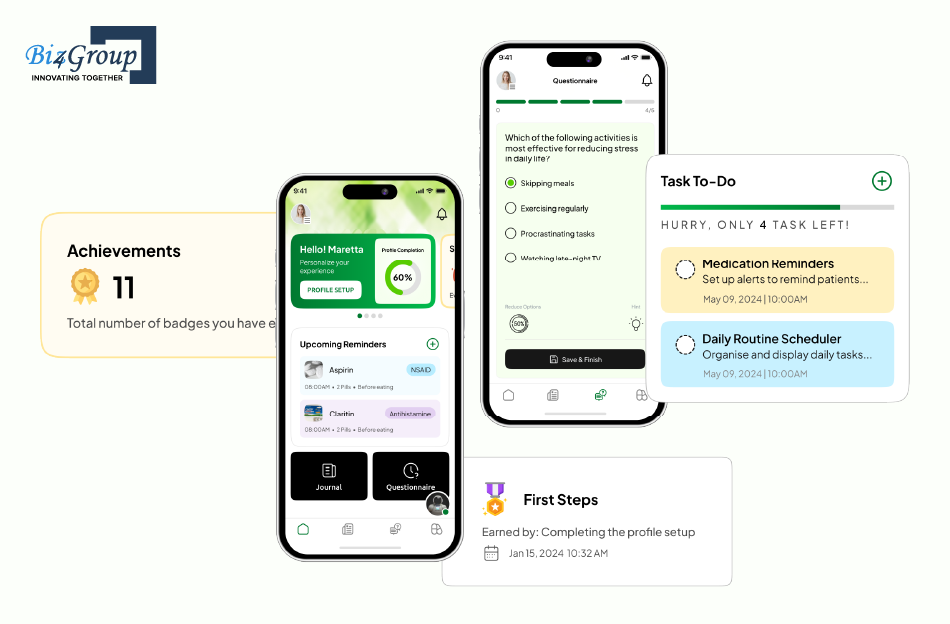
A strong example of how assessment data can evolve into actionable intervention workflows is CogniHelp, a cognitive wellness application developed by Biz4Group for individuals in the early-to-mid stages of dementia. The platform was designed to help monitor cognitive health through daily interactions, personalized assessments, journaling, and behavioral tracking rather than relying solely on periodic clinical evaluations.
While CogniHelp is not a crisis intervention platform, it demonstrates a key principle behind clinical review workflow development for mental health apps: identifying meaningful changes in user behavior before those changes become more serious health concerns. Through continuous engagement and cognitive monitoring, the system creates opportunities for earlier review, intervention, and caregiver involvement when concerning patterns emerge.
Key Highlights:
- AI-powered cognitive performance monitoring that tracks changes in user behavior and cognitive capabilities over time.
- Personalized quizzes and assessments designed around individual user profiles and historical interactions.
- Daily journaling and voice-to-text functionality that helps capture behavioral and emotional signals continuously.
- AI-driven emotional check-ins using GPT-powered conversational interactions to better understand user sentiment and wellbeing.
- Reminder systems that encourage medication adherence, routine completion, and consistent engagement with the platform.
- Caregiver visibility into cognitive and emotional trends, enabling more informed care planning and earlier intervention opportunities.
This type of architecture is increasingly relevant for organizations interested in developing scalable mental health app workflow for high-risk user monitoring, where continuous observation, behavioral analysis, and timely escalation often matter as much as the initial assessment itself.
4. Peer Support and Community Platforms
Community-driven platforms introduce a different challenge because crisis situations may appear inside posts, comments, group conversations, or anonymous interactions.
These environments often require developing scalable mental health app workflow for high-risk user monitoring because manual moderation becomes increasingly difficult as user activity grows.
Example
Reddit has publicly implemented suicide prevention interventions that allow users to report concerning posts, triggering outreach resources and crisis support messaging. This reflects how community-driven platforms increasingly integrate structured intervention mechanisms into moderation workflows.

A relevant example of community-driven engagement is Cultiv8, a spiritual meditation and wellness platform developed by Biz4Group. The application combines guided meditation experiences, personal journaling, spiritual content, and community discussions within a single environment designed to encourage reflection and meaningful user engagement.
While Cultiv8 is not a crisis intervention platform, it highlights a challenge that many peer-support and wellness communities face: users often discuss deeply personal experiences, emotional struggles, and life challenges within community spaces. As engagement grows, organizations need structured processes to manage user interactions responsibly and identify situations that may require additional support or escalation.
Key Highlights:
- Guided meditation sessions and customizable meditation experiences.
- Personal journaling capabilities that encourage self-reflection and emotional expression.
- Community forums and discussion boards that enable peer interaction and engagement.
- Personalized recommendations based on user interests and activity.
- Daily inspirational content and ongoing engagement features.
- Cross-platform architecture supporting scalable user experiences across devices.
For organizations focused on developing scalable mental health app workflow for high-risk user monitoring, platforms like Cultiv8 illustrate why community-driven experiences should be designed with clear engagement, moderation, and escalation strategies as user participation expands.
5. Wellness and Self-Guided Mental Health Apps
Many wellness products are not designed as crisis intervention tools, yet users frequently engage with them during periods of emotional distress. Teams building these systems often ask, “we are unsure how to implement a crisis intervention workflow in our mental health app without violating HIPAA regulations”, particularly when users begin disclosing crisis situations inside non-clinical experiences.
Example
Headspace publicly provides crisis resources and emergency guidance within its support systems, acknowledging that users may require support beyond meditation content and self-guided exercises. Teams building a mental wellness app like Headspace frequently encounter similar product decisions.
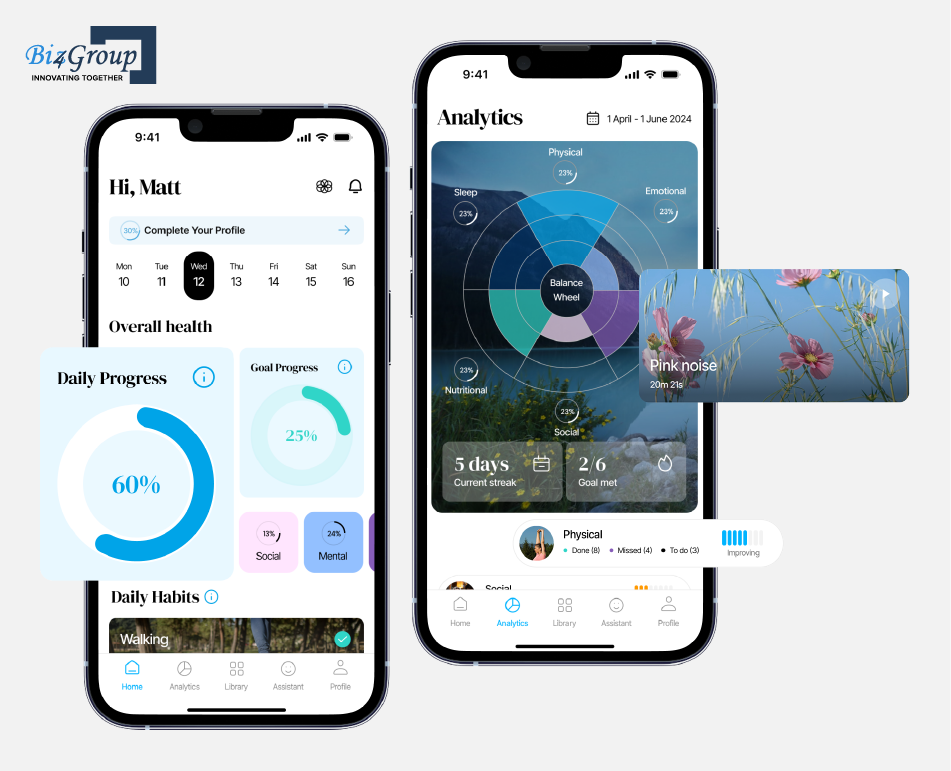
A strong example within the wellness and self-guided health space is Quantum Fit, an AI-powered personal development platform developed by Biz4Group. The application helps users improve across six interconnected wellness dimensions: physical, mental, spiritual, nutritional, social, and sleep health through personalized guidance, habit tracking, and continuous progress monitoring.
While Quantum Fit is not a crisis intervention platform, it demonstrates how wellness applications can move beyond passive content consumption and create structured user journeys centered around behavioral improvement. This is particularly relevant for organizations exploring developing mental health platform workflow to ensure safety, compliance, and emergency responsiveness, as long-term engagement and behavioral monitoring often provide the foundation for identifying concerning changes in user wellbeing.
Key Highlights:
- AI-powered goal setting and habit tracking that adapts to individual user needs and progress.
- Personalized development plans covering physical, mental, spiritual, nutritional, social, and sleep wellness.
- Interactive AI chatbot designed to provide guidance, motivation, and ongoing engagement.
- Progress analytics and dashboards that help users visualize growth and maintain consistency.
- Adaptive recommendations that evolve based on user behavior, goals, and activity patterns.
- Reminder systems and behavioral reinforcement mechanisms that encourage sustained participation and healthy habits.
For teams building wellness products, Quantum Fit highlights an important lesson: users often engage with self-guided platforms during periods of stress, burnout, or personal difficulty. The more visibility a platform has into user behavior, engagement patterns, and wellness trends, the easier it becomes to design workflows that support proactive intervention when additional support may be needed.
6. Enterprise Behavioral Health Platforms
Enterprise mental health products frequently operate across multiple employers, providers, insurance networks, and geographic regions. Organizations focused on developing mental health platform workflow to ensure safety, compliance, and emergency responsiveness often prioritize standardized escalation logic because workflow inconsistency creates operational risk at scale.
Example
Large employer-sponsored behavioral health programs frequently combine therapy networks, coaching services, employee assistance programs, and crisis support systems into unified care pathways because employers increasingly expect documented escalation procedures and measurable safety practices.
Real-world implementations make one thing clear: crisis workflows are only effective when the underlying product capabilities support them.
The next question is understanding which features actually make these systems operational inside modern mental health platforms.
Know Where Your Platform Fits in the Crisis Response Spectrum?
The right workflow depends on your users, care model, and compliance requirements.
Discuss Your Use CaseWhich Features Are Essential When You Develop Crisis Intervention System in Mental Health App?
A common misconception is that crisis intervention requires only a panic button or a link to the 988 Lifeline.
In reality, effective crisis intervention workflow development for mental health apps requires multiple interconnected systems working together. Risk detection, escalation management, clinical oversight, emergency response, and documentation all play a role in ensuring users receive appropriate support when high-risk situations arise.
The table below outlines the core features organizations should consider when planning HIPAA-compliant mental health app workflow development initiatives.
|
Feature |
Purpose |
Why It Matters |
|---|---|---|
|
Risk Detection Engine |
Identifies potential crisis situations using assessments, clinician flags, user-reported concerns, behavioral indicators, and AI analysis. |
Early identification allows intervention before situations escalate into emergencies. |
|
AI-Powered Risk Analysis |
Evaluates conversations, journal entries, questionnaires, and behavioral patterns to identify warning signs. |
Supports AI-enabled crisis intervention app development by helping teams recognize risks that may otherwise go unnoticed. |
|
High-Risk Session Management |
Flags and prioritizes sessions involving suicidal ideation, self-harm concerns, threats of violence, or severe emotional distress. |
Essential for organizations looking to develop high-risk session management in mental health apps. |
|
Risk Severity Classification |
Categorizes incidents into different risk levels based on predefined criteria. |
Helps determine whether monitoring, clinical review, crisis intervention, or emergency escalation is required. |
|
Clinical Review Workflow |
Routes high-risk cases to designated clinicians, reviewers, or supervisors for evaluation. |
A foundational component of clinical review workflow development for mental health apps. |
|
Case Assignment and Ownership |
Assigns responsibility for reviewing and managing high-risk events. |
Prevents incidents from remaining unresolved or being overlooked. |
|
Escalation Management System |
Defines when and how cases should be escalated based on severity and risk indicators. |
Creates consistency across crisis response operations. |
|
988 Lifeline Integration |
Connects users with crisis support resources when intervention is needed. |
Critical for organizations planning to build 988 lifeline integration in mental health platform environments. |
|
Emergency Contact Management |
Stores and manages approved emergency contacts for crisis situations. |
Supports faster intervention during urgent scenarios. |
|
Geolocation-Based Emergency Response |
Enables location-assisted emergency workflows when appropriate. |
Supports geolocation for crisis response in mental health apps while facilitating emergency coordination. |
|
Emergency Dispatch Support |
Provides workflows that help coordinate emergency response activities when imminent danger is identified. |
Important for teams developing geolocation-based emergency dispatch system for mental health apps without violating HIPAA. |
|
Crisis Resource Recommendation Engine |
Presents relevant crisis hotlines, emergency services, support resources, and intervention options. |
Ensures users receive immediate access to appropriate support pathways. |
|
Secure Messaging and Outreach |
Allows clinicians, support teams, and crisis coordinators to communicate securely with users. |
Facilitates intervention while maintaining privacy standards. |
|
Documentation and Audit Logs |
Records every assessment, review, escalation, disclosure, and intervention action. |
Supports compliance, accountability, and legal defensibility. |
|
Duty-to-Warn Workflow Controls |
Supports state-specific disclosure and escalation processes when threats are identified. |
Helps organizations address mental health app duty-to-warn workflow development requirements. |
|
Consent and Authorization Management |
Tracks user permissions related to disclosures, location access, and emergency communication. |
Reduces privacy and compliance risks. |
|
Continuous Risk Monitoring |
Monitors users following a crisis event to identify recurring or escalating concerns. |
Essential for developing scalable mental health app workflow for high-risk user monitoring. |
|
Care Team Dashboard |
Provides clinicians and administrators with visibility into active cases, escalations, and intervention history. |
Improves operational efficiency and oversight. |
|
AI Governance Controls |
Establishes rules for AI decision-making, review requirements, and escalation thresholds. |
Organizations exploring AI ethics in mental health app initiatives increasingly view governance as a core safety requirement. |
|
Human Oversight Framework |
Ensures qualified reviewers remain involved in high-risk decisions. |
Addresses concerns raised in discussions around will AI replace therapists by reinforcing the importance of human judgment in crisis response. |
Not every platform requires every feature on day one.
A self-guided wellness application may prioritize risk detection, crisis resources, and escalation workflows, while a teletherapy platform may require advanced clinical review systems, duty-to-warn controls, and emergency response capabilities.
The key is aligning feature selection with your care model, compliance obligations, and user risk profile rather than treating crisis intervention as a one-size-fits-all implementation.
Once you've identified the features your platform requires, the next step is determining how to design, build, and integrate them into a scalable crisis intervention workflow that can operate reliably under real-world conditions.
How Do You Approach Crisis Intervention Workflow Development for Mental Health Apps?
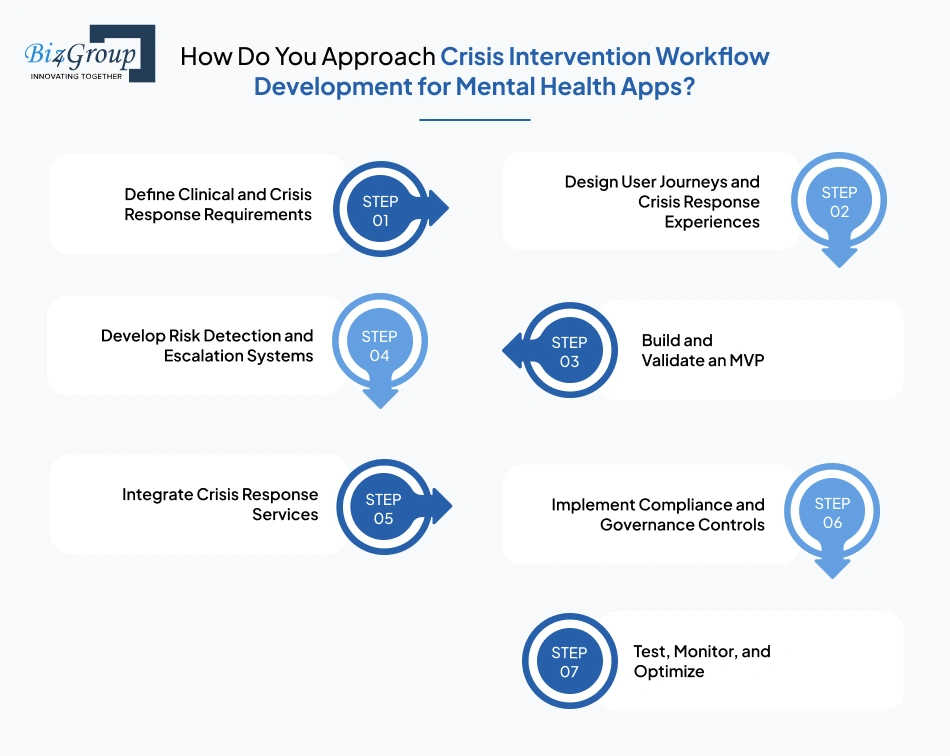
Building a crisis response system requires more than adding emergency features to an app. To successfully develop crisis intervention system in mental health app environments, organizations need a structured process that aligns clinical requirements, compliance obligations, and technical implementation.
Step 1: Define Clinical and Crisis Response Requirements
Every successful workflow starts with clear requirements. Teams must determine how risk will be identified, who will review high-risk cases, when escalation is required, and how interventions will be documented. This stage also helps answer one of the most common questions healthtech founders ask: "how to develop a crisis intervention workflow in mental health app with HIPAA compliance" without creating unnecessary friction for users or care teams.
Key activities include:
- Defining high-risk scenarios
- Mapping escalation pathways
- Establishing intervention protocols
- Identifying review requirements
- Determining documentation standards
Step 2: Design User Journeys and Crisis Response Experiences
Users experiencing distress should be able to access support quickly and intuitively. This stage focuses on designing crisis-specific experiences that guide users toward the right resources while reducing confusion during critical moments. Teams focused on developing mental health platform workflow to ensure safety, compliance, and emergency responsiveness often invest heavily in UI/UX design to make crisis interactions simple and accessible.
Key activities include:
- Mapping crisis user flows
- Designing support screens
- Creating escalation interfaces
- Building clinician dashboards
- Conducting accessibility reviews
Step 3: Build and Validate an MVP
Rather than developing every feature at once, many organizations start with a focused set of crisis response capabilities. This allows teams to validate workflows, gather feedback, and refine the system before scaling. A phased approach using MVP development often reduces risk while accelerating time to market.
Key activities include:
- Building core workflows
- Implementing basic escalation logic
- Creating intervention pathways
- Integrating support resources
- Validating user journeys
Step 4: Develop Risk Detection and Escalation Systems
Once the foundation is established, teams can build the mechanisms responsible for identifying and managing high-risk situations. This is a critical stage for organizations looking to develop high-risk session management in mental health apps. The focus is on ensuring that potential risks are identified quickly and routed through the appropriate escalation process.
Key activities include:
- Implementing risk detection logic
- Building severity assessment models
- Creating escalation workflows
- Configuring notifications
- Assigning case ownership
Step 5: Integrate Crisis Response Services
A crisis workflow becomes more effective when connected to external support systems such as crisis hotlines, communication tools, and emergency response services. Many organizations reach this stage while asking: "we are building a mental health app and want to develop a crisis intervention workflow that integrates the 988 Suicide & Crisis Lifeline while remaining HIPAA-compliant." The answer often depends on how escalation rules, crisis routing, and documentation workflows are designed.
Key activities include:
- Integrating crisis support services
- Connecting communication channels
- Configuring emergency response workflows
- Managing referrals
- Testing intervention pathways
Step 6: Implement Compliance and Governance Controls
Compliance should be built into the workflow from the start rather than added after development. This stage focuses on privacy, access management, auditability, and governance controls that support HIPAA-compliant mental health app workflow development. Organizations looking to build HIPAA-compliant crisis workflow for mental health platforms typically address these requirements alongside technical development.
Key activities include:
- Configuring access controls
- Implementing audit logs
- Managing user consent
- Defining retention policies
- Supporting compliance reporting
Step 7: Test, Monitor, and Optimize
A crisis intervention workflow should evolve as user needs, regulations, and operational requirements change. Regular testing helps ensure the system remains effective, compliant, and scalable over time. Ongoing monitoring also helps identify workflow gaps, escalation delays, and opportunities for improvement.
Key activities include:
- Conducting workflow testing
- Reviewing intervention outcomes
- Monitoring performance metrics
- Gathering stakeholder feedback
- Optimizing workflows
Building the workflow is one challenge. Ensuring it can scale securely, process high-risk events reliably, and support compliance requirements is another. That brings us to the technology stack powering modern crisis intervention systems.
What Technology Stack Is Required to Build a HIPAA-Compliant Crisis Workflow for Mental Health Platforms?
The technology stack behind a crisis intervention system must do more than support standard app functionality. It needs to process high-risk events in real time, maintain compliance, support clinical workflows, and scale reliably as user volume grows.
Organizations pursuing crisis intervention workflow development for mental health apps typically build their architecture around the following technology layers:
|
Technology Layer |
Recommended Technologies |
Purpose |
|---|---|---|
|
Frontend (Web Platform) |
React, Next.js |
Delivers responsive patient, clinician, and administrator interfaces. Organizations often work with a React JS development services provider or a Next JS development company to build scalable healthcare portals. |
|
Mobile Application Layer |
Flutter, React Native, Native iOS, Native Android |
Supports user access to therapy sessions, crisis resources, assessments, and emergency response features across devices. |
|
Backend Services |
Node.js, Python, .NET |
Handles workflow orchestration, escalation logic, user management, and API communication. Teams frequently rely on a Node JS development company or a Python development company for healthcare-grade backend development. |
|
Database Layer |
PostgreSQL, MongoDB, MySQL |
Stores user profiles, assessments, intervention records, audit logs, and workflow data securely. |
|
AI & Risk Detection Engine |
OpenAI, Claude, Gemini, TensorFlow, PyTorch |
Powers sentiment analysis, behavioral monitoring, risk detection, and AI-assisted intervention workflows. |
|
Clinical Workflow Engine |
Custom Rules Engine, BPMN Workflow Systems |
Automates case assignment, clinical review routing, escalation management, and intervention tracking. |
|
Communication Services |
Twilio, SendGrid, Firebase Cloud Messaging |
Supports SMS alerts, email notifications, push notifications, and emergency communications. |
|
988 & Crisis Support Integrations |
REST APIs, Secure Middleware Services |
Enables connections with crisis support resources and external intervention systems. |
|
Geolocation Services |
Google Maps API, Mapbox, Geolocation APIs |
Supports location-based emergency response workflows and crisis intervention scenarios. |
|
Authentication & Access Control |
OAuth 2.0, OpenID Connect, Auth0, Okta |
Protects sensitive health data and enforces role-based access permissions. |
|
Audit Logging & Monitoring |
Datadog, Splunk, ELK Stack |
Tracks system activity, intervention history, compliance records, and operational performance. |
|
Cloud Infrastructure |
AWS, Microsoft Azure, Google Cloud Platform |
Provides scalability, availability, security controls, and healthcare-compliant infrastructure. |
|
Security & Compliance Layer |
Encryption Services, IAM, SIEM Solutions |
Supports HIPAA safeguards, access management, threat monitoring, and data protection requirements. |
The right technology stack depends on your platform's care model, compliance obligations, and feature requirements. A wellness application may require a lighter architecture, while organizations focused on building mental health app crisis response system with 988 lifeline API integration, clinical review workflow development for mental health apps, or developing scalable mental health app workflow for high-risk user monitoring often need more advanced infrastructure and workflow automation capabilities.
Choosing technology is only one part of the equation. The next question most founders ask is: how much does crisis intervention workflow development for mental health apps actually cost?
What Is the Cost of Crisis Intervention Workflow Development for Mental Health Apps?
One of the most common questions founders ask is: "We are looking for companies that can develop HIPAA-compliant crisis intervention workflows for mental health apps. How much should we expect to invest?"
The answer depends on the complexity of your platform, the level of compliance required, the number of integrations involved, and whether you're building entirely custom workflows or leveraging existing infrastructure.
For most organizations, crisis intervention workflow development for mental health apps typically falls between $40,000 and $300,000+. A lightweight wellness application with basic escalation workflows will sit at the lower end of the range, while enterprise-grade platforms with AI-driven risk detection, clinical review systems, 988 integrations, geolocation-based emergency response, and compliance controls can require significantly larger investments.
The best way to estimate cost is by understanding which features you plan to implement.
Feature-Wise Cost Breakdown for Crisis Intervention Workflow Development for Mental Health Apps
|
Feature / Module |
Estimated Cost Range |
Why It's Important |
|---|---|---|
|
Risk Detection Engine |
$5,000 - $15,000 |
Identifies potential crisis situations before they escalate into emergencies. |
|
AI-Powered Risk Analysis |
$10,000 - $35,000 |
Helps detect behavioral patterns, sentiment shifts, and warning signs that may be missed through manual monitoring alone. |
|
High-Risk Session Management |
$5,000 - $15,000 |
Ensures users exhibiting severe distress are prioritized for review and intervention. |
|
Clinical Review Workflow Development for Mental Health Apps |
$8,000 - $25,000 |
Enables clinicians and reviewers to assess, escalate, and document high-risk cases consistently. |
|
Escalation Management System |
$5,000 - $12,000 |
Routes users to the appropriate support pathway based on risk severity. |
|
988 Lifeline Integration |
$3,000 - $10,000 |
Provides immediate access to crisis support services during urgent situations. |
|
Crisis Resource Recommendation Engine |
$2,000 - $8,000 |
Connects users with relevant support resources when intervention is needed. |
|
Geolocation for Crisis Response in Mental Health Apps |
$8,000 - $20,000 |
Helps facilitate location-based emergency response when appropriate and legally permissible. |
|
Emergency Dispatch Support Workflow |
$10,000 - $25,000 |
Supports emergency intervention processes for situations involving imminent risk. |
|
Duty-to-Warn Workflow Development |
$5,000 - $15,000 |
Helps organizations manage disclosure obligations and escalation requirements in applicable jurisdictions. |
|
Documentation & Audit Logging |
$4,000 - $12,000 |
Creates a defensible record of assessments, interventions, and compliance-related actions. |
|
Consent & Privacy Management |
$3,000 - $10,000 |
Supports HIPAA compliance and ensures proper handling of sensitive user information. |
|
Continuous Risk Monitoring |
$8,000 - $20,000 |
Helps identify recurring or escalating concerns after an initial intervention. |
|
Care Team Dashboard |
$5,000 - $15,000 |
Gives clinicians and administrators visibility into active cases and workflow status. |
|
AI Governance & Oversight Controls |
$8,000 - $25,000 |
Ensures AI-assisted decisions remain transparent, reviewable, and aligned with organizational policies. |
Actual costs vary based on workflow complexity, compliance requirements, existing infrastructure, third-party integrations, and customization needs.
What Factors Influence the Cost of HIPAA-Compliant Mental Health App Workflow Development?
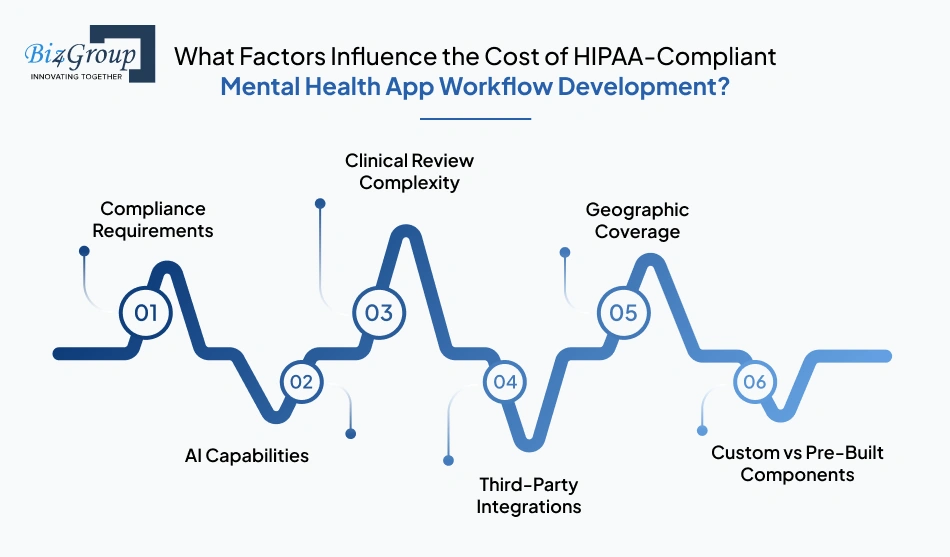
Several variables can significantly impact the cost of build HIPAA-compliant crisis workflow for mental health platforms initiatives:
- Compliance Requirements: HIPAA controls, audit logging, consent management, and documentation workflows increase development scope.
- AI Capabilities: Organizations pursuing AI-enabled crisis intervention app development often invest in additional infrastructure, monitoring, model testing, and governance controls.
- Clinical Review Complexity: The more sophisticated the review process, the more development effort is required for routing, approvals, escalation logic, and case management.
- Third-Party Integrations: Integrations involving 988 support services, communication platforms, EHR systems, identity providers, and emergency response services increase implementation costs.
- Geographic Coverage: Platforms operating across multiple states often require configurable workflows to support varying compliance obligations and escalation requirements.
- Custom vs Pre-Built Components: Fully custom workflows generally cost more but offer greater flexibility and control.
What Hidden Costs Are Often Overlooked During Crisis Intervention Workflow Development?
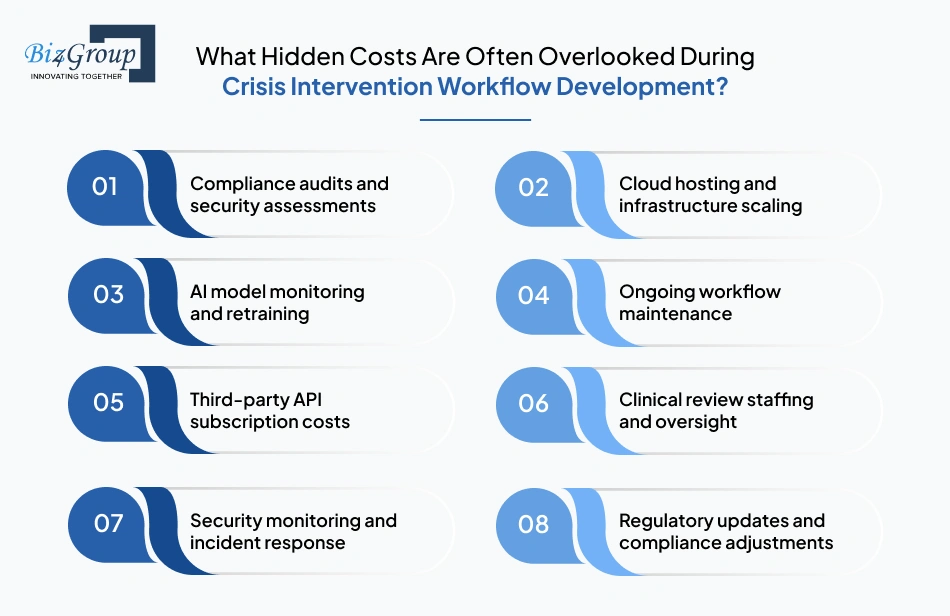
Many organizations budget for development but underestimate ongoing operational expenses.
Common hidden costs include:
- Compliance audits and security assessments
- Cloud hosting and infrastructure scaling
- AI model monitoring and retraining
- Ongoing workflow maintenance
- Third-party API subscription costs
- Clinical review staffing and oversight
- Security monitoring and incident response
- Regulatory updates and compliance adjustments
These costs become especially important for organizations focused on developing scalable mental health app workflow for high-risk user monitoring.
How Can You Optimize the Cost of Develop Crisis Intervention System in Mental Health App Projects?
Cost optimization does not mean removing essential safety features. It means prioritizing investments strategically.
Some effective approaches include:
- Launching with a phased roadmap instead of building every feature at once
- Starting with an MVP and expanding based on validated requirements
- Using proven cloud infrastructure rather than custom hosting environments
- Prioritizing high-risk workflows before advanced automation
- Leveraging existing integrations where appropriate
- Building governance controls early to avoid expensive redesigns later
Organizations working with an AI product development company often use phased implementation strategies to balance cost, compliance, and scalability.
Buy vs Build: Which Approach Works Best for Crisis Intervention Workflow Development for Mental Health Apps?
|
Consideration |
Build In-House |
Buy Existing Solution |
|---|---|---|
|
Customization |
Full control over workflows and compliance logic |
Limited by vendor capabilities |
|
Development Cost |
Higher upfront investment |
Lower initial cost |
|
Time to Market |
Longer implementation timeline |
Faster deployment |
|
Scalability |
Fully customizable |
Dependent on vendor roadmap |
|
Compliance Flexibility |
Easier to adapt workflows to organizational requirements |
May require workarounds |
|
Integration Flexibility |
Full control over integrations and architecture |
Often restricted by platform limitations |
|
Long-Term Ownership |
Complete ownership of technology and data |
Ongoing vendor dependency |
|
Competitive Differentiation |
Higher |
Lower |
For organizations building highly specialized behavioral health products, custom development often provides greater flexibility. This is especially true when workflows involve clinical review workflow for high-risk sessions in mental health platforms like BetterHelp and Talkspace, AI-assisted interventions, or complex escalation requirements.
On the other hand, organizations with limited budgets or aggressive timelines may benefit from leveraging existing components before gradually expanding functionality.
Many teams evaluating costs eventually reach a different question:
Should we build these systems internally, or partner with an experienced healthcare technology team that has already solved many of these challenges?
That decision often has a greater impact on project success than technology itself.
Planning Features Before Planning the Budget?
A quick consultation can help you avoid expensive development mistakes later.
Get a Custom Cost EstimateWhat Challenges Should You Expect During Crisis Intervention Workflow Development for Mental Health Apps?
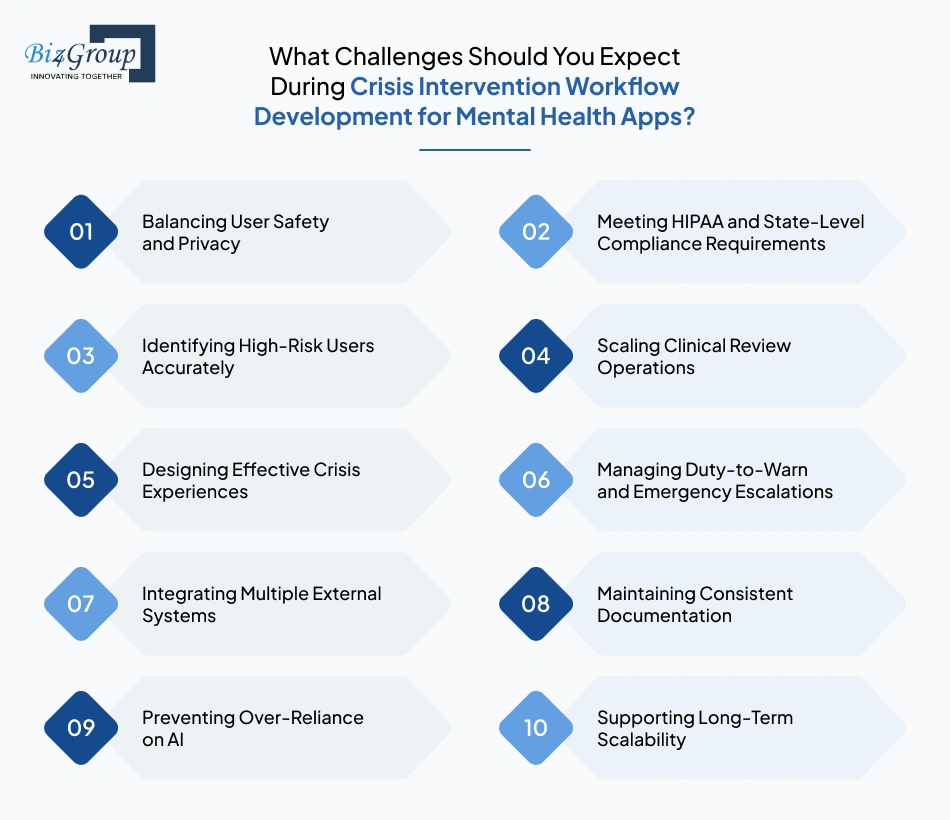
Building a crisis response system is not simply a development exercise. Organizations must balance user safety, compliance obligations, clinical workflows, privacy requirements, and technical scalability at the same time.
Whether you're planning to develop crisis intervention system in mental health app environments or build HIPAA-compliant crisis workflow for mental health platforms, understanding the common challenges early can help avoid costly mistakes later.
|
Challenge |
Why It Happens |
How to Address It |
|---|---|---|
|
Balancing User Safety and Privacy |
Crisis situations may require intervention, but organizations must also protect sensitive user information and respect privacy rights. |
Establish clear escalation policies, consent workflows, and emergency disclosure procedures before launch. |
|
Meeting HIPAA and State-Level Compliance Requirements |
Crisis workflows are influenced by HIPAA, duty-to-warn obligations, emergency disclosure exceptions, and state-specific regulations. |
Involve legal, compliance, and clinical stakeholders early when designing workflow logic and escalation rules. |
|
Identifying High-Risk Users Accurately |
False positives can overwhelm reviewers, while false negatives may leave vulnerable users without support. |
Combine AI-assisted detection with human review processes and ongoing model evaluation. |
|
Scaling Clinical Review Operations |
As user volume grows, manual review queues can become difficult to manage efficiently. |
Implement structured review workflows, prioritization systems, and technologies similar to modern AI healthcare workflow automation software solutions. |
|
Designing Effective Crisis Experiences |
Users experiencing distress may struggle with complex navigation, unclear instructions, or excessive steps. |
Follow established best practices in mental health app design and prioritize simplicity during crisis interactions. |
|
Managing Duty-to-Warn and Emergency Escalations |
Reporting obligations vary across jurisdictions, making it difficult to apply a single workflow to every user. |
Build configurable escalation pathways that can adapt to different legal and operational requirements. |
|
Integrating Multiple External Systems |
Crisis workflows often depend on communication tools, location services, support providers, and healthcare infrastructure. |
Design modular architectures that simplify integrations and reduce dependencies between systems. |
|
Maintaining Consistent Documentation |
Crisis interventions generate records that may be reviewed by compliance teams, clinicians, auditors, or legal stakeholders. |
Automate documentation wherever possible and establish standardized reporting requirements. |
|
Preventing Over-Reliance on AI |
AI can help identify risk signals, but it should not make critical intervention decisions independently. |
Implement oversight frameworks and governance controls similar to those used in an AI governance platform. |
|
Supporting Long-Term Scalability |
What works for a few hundred users may fail when supporting thousands of active users and high-risk events. |
Design workflows, infrastructure, and review systems with future growth requirements in mind from the start. |
Many of these challenges are manageable when addressed early. The organizations that struggle most are often those that treat crisis intervention as a feature rather than a core operational capability.
The next question, then, is choosing the right development partner to help you design, build, and scale a crisis intervention workflow that aligns with your product goals, compliance requirements, and long-term growth plans.
Why Choose Biz4Group for Crisis Intervention Workflow Development for Mental Health Apps?
If you're asking, "we want end-to-end development of crisis intervention features in mental health apps and need guidance on compliance, geolocation, and clinical review systems," choosing the right technology partner becomes just as important as choosing the right technology stack.
Biz4Group brings experience in building AI-powered health and wellness platforms such as CogniHelp, Quantum Fit, and Cultiv8, giving us practical insight into user monitoring, intelligent workflows, personalized experiences, and scalable healthcare-focused applications.
As an experienced AI development company, we help organizations build secure, scalable, and compliant digital health solutions through advanced AI integration services, intelligent AI automation services, and enterprise-grade enterprise AI solutions.
Whether you're building a new platform or enhancing an existing one, our team can help accelerate crisis intervention workflow development for mental health apps with the right blend of healthcare expertise, AI capabilities, and product engineering experience.
Ready to Build a Safer Mental Health Platform?
Turn crisis response, compliance, and user safety into a competitive advantage.
Talk to Our TeamWrapping Up!
Effective crisis intervention workflow development for mental health apps is no longer just a compliance consideration. It has become a critical part of delivering safe, reliable, and responsible digital mental healthcare.
Whether you're looking to build HIPAA-compliant crisis workflow for mental health platforms, implement 988 support, or develop high-risk session management in mental health apps, the goal remains the same: ensuring users receive the right level of support when they need it most.
The challenge is not adding more features. The challenge is creating a system where risk detection, clinical review, escalation, compliance, and intervention work together seamlessly.
The mental health platforms that earn long-term trust will be the ones prepared for the moments that matter most. Build the workflow thoughtfully, and you're not just building a feature.
FAQ
1. How do you develop a crisis intervention workflow in a mental health app with HIPAA compliance?
The process starts with defining how risks are identified, reviewed, escalated, and documented. A compliant workflow should include access controls, audit logs, consent management, crisis response protocols, and clear escalation pathways. Organizations pursuing crisis intervention workflow development for mental health apps should address compliance requirements during planning rather than after development.
2. Can a mental health app integrate the 988 Suicide & Crisis Lifeline?
Yes. Organizations can build 988 lifeline integration in mental health platform environments through crisis routing, emergency support pathways, and referral workflows. However, integration should be part of a broader crisis response strategy rather than a standalone feature. Users still need appropriate risk assessment, escalation management, and documentation processes.
3. How can AI be used in AI-enabled crisis intervention app development?
AI can help identify potential warning signs through sentiment analysis, behavioral monitoring, conversation analysis, and risk scoring. However, AI should support decision-making rather than replace clinical judgment. Most successful AI-enabled crisis intervention app development initiatives combine automated detection with human review and oversight.
4. How do mental health apps handle duty-to-warn and Tarasoff obligations?
Duty-to-warn requirements vary by state and jurisdiction. During mental health app duty-to-warn workflow development, organizations typically create configurable escalation workflows that support clinical review, documentation, emergency disclosures, and reporting requirements when threats of harm are identified.
5. Can you implement geolocation for crisis response in mental health apps without violating HIPAA?
Yes, but it requires careful planning. Organizations focused on developing geolocation-based emergency dispatch system for mental health apps without violating HIPAA should establish clear consent policies, define when location data can be accessed, limit unnecessary data collection, and document emergency response procedures appropriately.
6. What is the cost of crisis intervention workflow development for mental health apps?
The cost typically ranges from $40,000 to $300,000+, depending on workflow complexity, AI capabilities, clinical review systems, compliance requirements, 988 integration, and emergency response functionality. Organizations building enterprise-grade solutions generally require larger investments than wellness applications with basic crisis workflows.
7. What should I look for in a company that develops HIPAA-compliant crisis intervention workflows for mental health apps?
Look for experience in healthcare technology, compliance-focused development, AI implementation, workflow automation, and secure infrastructure design. If you're evaluating vendors because you need a company that can build a scalable, HIPAA-compliant mental health app workflow for high-risk user monitoring, ask about their experience with clinical workflows, crisis escalation systems, auditability, and healthcare integrations before making a decision.
