 Location :
Orlando, FL, USA
Location :
Orlando, FL, USA +1 (407) 714-1616
 info@biz4group.com

- Develop a mental wellness app like Headspace by focusing on mindfulness, meditation, sleep, and focus through habit-driven, self-guided digital experiences.
- Mental wellness app development like Headspace emphasizes calm UX design, personalized content pathways, and structured routines that support long-term engagement rather than clinical intervention.
- Businesses increasingly develop mindfulness apps like Headspace to serve both individual users and enterprise wellness initiatives, using scalable and privacy-conscious platforms.
- Key features include guided onboarding, meditation and sleep libraries, progress tracking, and subscription-based access models.
- The cost to develop a mental wellness application like Headspace typically ranges from $30,000 to $250,000+, depending on feature depth, AI-powered personalization, and scalability requirements.
What if your next product didn’t just answer a trend but became part of how millions manage stress, improve focus, sleep better, and build healthier mental habits every day?
That’s the core opportunity to develop mental wellness app like Headspace, and here’s what you need to know.
- According to NAMI’s report, in the United States, over 23% of adults, about 61.5 million people, experience a mental health condition each year making a substantial addressable audience for digital solutions.
- The MHA report states that three in four employees agreed that workplace stress impacts their sleep, and poor workplace environments magnify this effect. their sleep, and poor workplace environments magnify this effect.
- As per Root Analysis report the mental health apps market size was estimated to be around USD 8.5–8.53 billion in 2025 and is projected to potentially reach well over USD 33 billion by 2035 as demand intensifies.
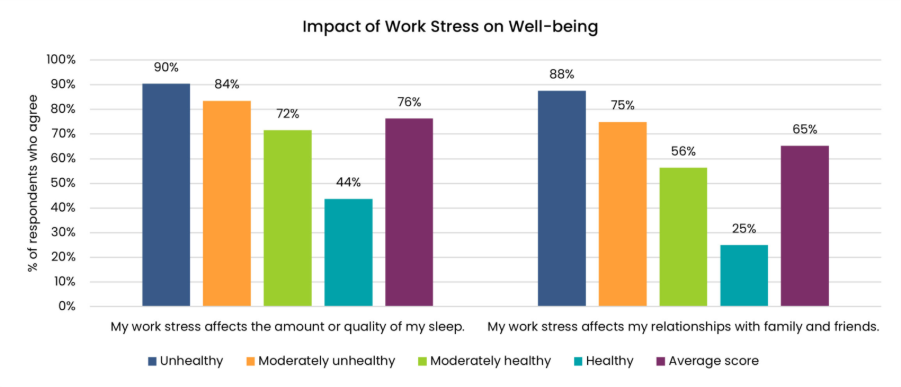
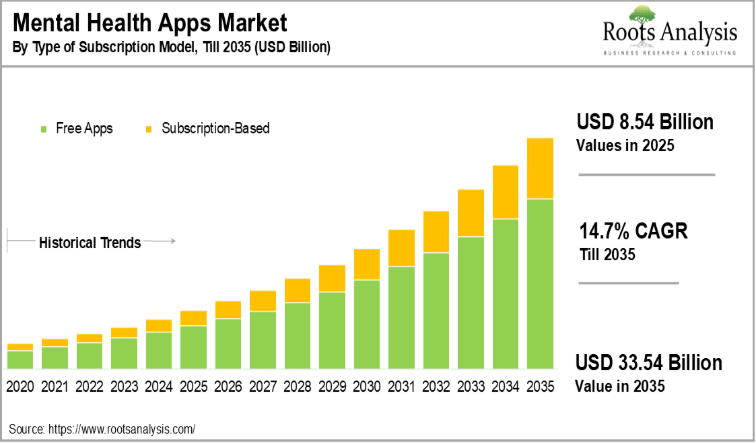
This kind of demand doesn’t just validate interest, it creates momentum. For founders and product leaders shaping digital wellness strategies, choosing to develop mental wellness app like Headspace is a moment of intent. You’re not experimenting with content; you’re designing a product grounded in habit formation, subscription economics, enterprise wellness adoption, and scalable digital delivery.
Every decision, from experience design to platform architecture, affects long-term engagement. It takes experienced mental wellness app developers to personalize user journeys and sustain engagement. When applied responsibly, modern AI healthcare solutions help wellness platforms evolve with users.
In the sections ahead, we’ll break down how to develop a mental wellness application like Headspace: covering platform mechanics, features, technology, monetization, and privacy considerations that shape real-world adoption. Let’s go!
What Is Headspace App and Why Do Users Trust Mindfulness Apps Like It?
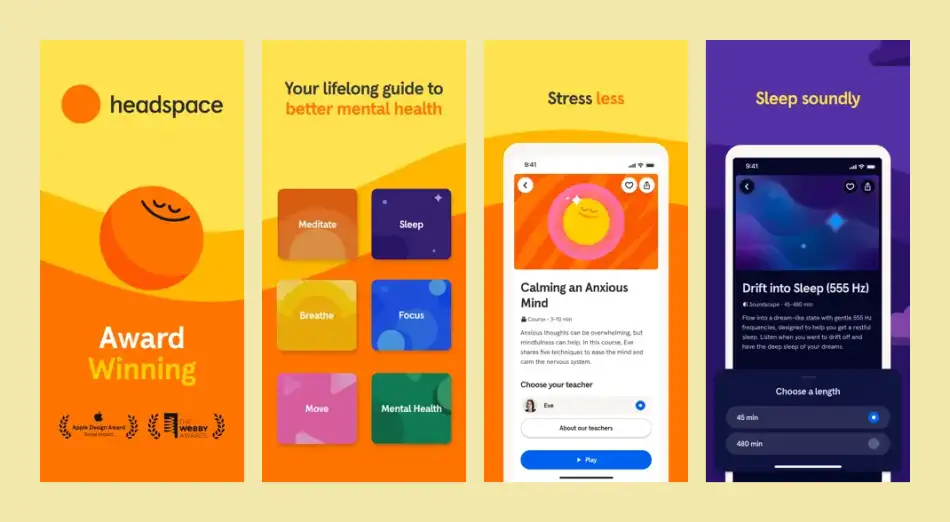
At its foundation, Headspace is a self-guided mental wellness platform centred on mindfulness, meditation, focus, and sleep. It removes the complexity often associated with mental health tools and replaces it with short, structured experiences that users can return to daily. This clarity is what teams aim to replicate when they create a meditation and wellness app like Headspace for long-term daily use.
What drives trust is how intentionally the platform is constructed. Sessions are predictable in length, progress is clearly communicated, and the interface avoids overstimulation. Over time, this same clarity also allows teams to thoughtfully integrate AI into an app,enhancing personalization and recommendations in ways that support user comfort rather than disrupt it. Users know what to expect each time they open the app, which reduces friction and builds confidence in the experience.
From a product and business perspective, this trust is reinforced through:
- a content system built around daily routines, not one-off consumption
- a subscription model aligned with long-term habit formation
- a non-clinical positioning that lowers stigma and broadens adoption
- a privacy-conscious design that respects personal wellbeing data
For founders exploring how to develop mental wellness app like Headspace, the takeaway is clear: trust isn’t created through feature volume. It’s earned through clarity of purpose, consistency of experience, and a product architecture that supports long-term behavioural change.
How a Mental Wellness App Like Headspace Works ?
A mental wellness app may feel calm and intuitive on the surface but delivering that experience consistently requires a carefully designed system working quietly in the background. When users begin their journey, every interaction is shaped by intentional product logic rather than complexity which is essential when teams create a meditation and wellness app like Headspace.
|
Core Functions |
What Happens |
Why it Matters |
|
User Onboarding |
Captures user intent such as stress relief, focus, or sleep goals |
Sets the foundation for relevant experiences from day one |
|
Content Personalization |
Curates meditation, focus, and sleep sessions into structured journeys |
Drives habit formation and sustained engagement |
|
Content Delivery |
Streams sessions reliably with predictable behaviour across devices |
Builds user trust through consistency and stability |
|
Subscription & Access |
Manages plans, renewals, and content entitlements automatically |
Keeps revenue predictable without disrupting UX |
|
Engagement Tracking |
Tracks streaks, session completion, and routine consistency |
Enables smarter recommendations and long-term retention |
1. Intent-Driven User Onboarding
The experience starts with a lightweight onboarding flow that captures why a user is there for example: better sleep, stress relief, improved focus, or emotional balance. Instead of long questionnaires, the platform relies on short prompts that feel approachable.
In modern AI mental health app development, this early intent mapping becomes the foundation for adaptive experiences that improve as user behaviour evolves.
2. Personalized Content Pathways
Unlike therapy platforms that connect users to professionals, mindfulness apps connect users to content journeys. Based on onboarding inputs and early engagement, the system curates meditation sessions, focus exercises, and sleep routines into structured paths.
Over time, these pathways adjust subtly, ensuring recommendations feel supportive rather than overwhelming.
3. Consistent and Secure Content Delivery
Reliability is critical, so sessions must load quickly, resume smoothly, and behave predictably across devices. While wellness apps are non-clinical, users still expect their data to be handled responsibly.
Many platforms rely on AI automation services to manage background processes such as session delivery, engagement nudges, and system monitoring. This helps in keeping the experience seamless without disrupting the calm interface.
4. Subscription and Access Management
Most mental wellness apps operate on subscription models designed for continuity. Behind the scenes, automated billing, renewals, and access controls ensure users always understand their plan while businesses benefit from predictable revenue without friction.
5. Engagement Signals and Feedback Loops
Rather than clinical outcomes, wellness platforms track engagement indicators, session completion, streaks, and routine consistency. These signals inform future recommendations and reminders, helping the app evolve into a more personalized, habit-supporting system over time. This feedback-driven approach is essential when teams create mental wellness app for habit building and focus like Headspace.
In essence, a Headspace-style mental wellness app succeeds through clarity, repetition, and intelligent automation. Users may never see the system at work, but they feel its impact every time they return.
For entrepreneurs looking to apply these principles beyond a single feature set, developing effective mental health solutions starts with intentional system design, clear user outcomes, and technology choices that support long-term engagement.
Why Are Businesses Investing to Develop a Mental Wellness App Like Headspace?
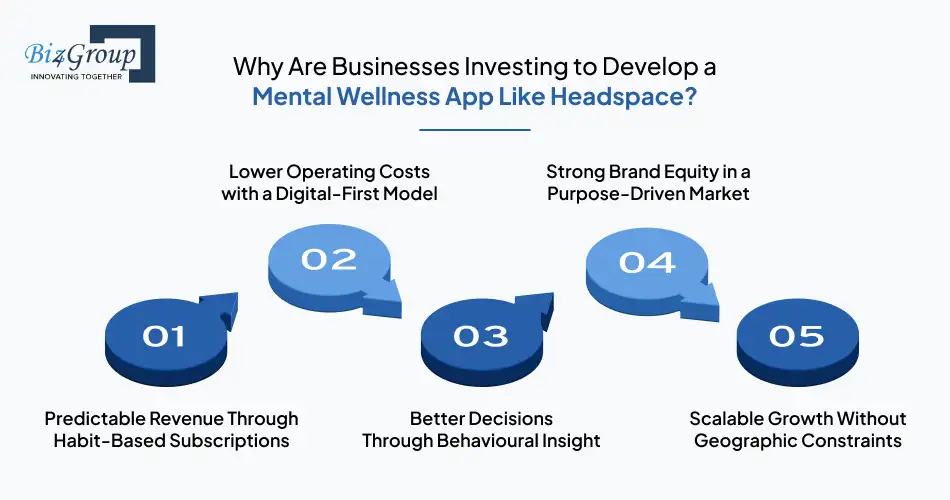
Once the product vision is clear, the next step is understanding the business upside. To develop mental wellness app like Headspace isn’t just a feel-good initiative; it’s a structured digital product that, when executed well, delivers measurable commercial value.
1. Predictable Revenue Through Habit-Based Subscriptions
Mental wellness is rooted in daily routines rather than one-time interactions, making it ideal for recurring revenue models.
- Subscription plans create steady, forecastable income
- Long-term engagement improves customer lifetime value
- Tiered access supports monetization as user commitment grows
For businesses looking to build a meditation and mindfulness app like Headspace, this predictability becomes stronger when platforms apply enterprise AI solutions to analyse engagement patterns and continuously refine retention strategies at scale.
2. Lower Operating Costs with a Digital-First Model
A digitally delivered platform scales more efficiently than traditional, service-heavy wellness programs.
- No dependency on physical infrastructure or in-person delivery
- Additional users add minimal marginal cost
- Core workflows become easier to standardize and optimize
This efficiency is a key reason organization invest in mental wellness app development like Headspace, often by partnering with a custom software development company,that designs architecture for scalability and long-term maintainability.
3. Better Decisions Through Behavioural Insight
Every interaction inside a mental wellness platform generates meaningful data.
- Engagement trends reveal which routines users return to consistently
- Usage patterns inform feature prioritization and roadmap planning
- Decisions shift from assumptions to evidence-based iteration
This data-driven mindset is central to mental health and wellness app development like Headspace, where retention depends on understanding user behaviour, not guesswork.
4. Strong Brand Equity in a Purpose-Driven Market
Mental wellness products operate at the intersection of performance and trust.
- Users associate consistent support with brand credibility
- A non-clinical positioning lowers barriers to adoption
- Purpose-driven platforms strengthen long-term brand perception
For leaders aiming to develop a mental wellness application like Headspace for business growth, brand trust becomes a strategic asset, not just a marketing outcome.
5. Scalable Growth Without Geographic Constraints
A well-architected platform expands through technology, not logistics.
- New markets can be supported through localization
- Additional wellness use cases can be layered onto the same core system
- Growth remains controlled and sustainable
This flexibility is critical for enterprises that build mental wellness app like Headspace for corporate wellness programs across distributed teams.
Core Features You Need to Build a Meditation and Wellness App Like Headspace
Once the platform logic is clear, the next step is defining the user-facing capabilities that shape daily engagement when you build a mental wellness mobile application like Headspace. These features are designed to reduce friction, encourage consistency, and make mental wellness feel approachable rather than overwhelming.
Below is a refined feature set that reflects what users expect from a scalable, Headspace-style mental wellness application.
|
Features |
What It Enables for Users |
|
Guided Onboarding Experience |
Helps users identify goals such as stress relief, better sleep, or focus improvement through short, calming prompts that set the tone for the entire experience |
|
Meditation & Mindfulness Library |
Offers structured meditation programs and single-session practices tailored to different emotional and mental states |
|
Focus & Productivity Sessions |
Supports deep work and mental clarity through time-bound focus sessions designed for professional and academic routines |
|
Sleep & Relaxation Content |
Provides guided audio experiences that help users unwind, fall asleep faster, and improve sleep quality over time |
|
Progress Visibility |
Allows users to track streaks, milestones, and consistency, reinforcing motivation without pressure |
|
Routine Reminders |
Encourages daily practice through gentle, optional nudges aligned with user preferences |
|
Offline Content Access |
Ensures uninterrupted access to sessions, supporting use during travel or low-connectivity environments |
|
Privacy & Data Protection Controls |
Safeguards personal wellness data using secure storage and access controls aligned with healthcare-adjacent standards such as HIPAA expectations, even in non-clinical use cases |
|
Contextual Session Guidance |
Helps users choose relevant sessions based on mood, time availability, or recent activity |
Values added by these features
- They define what users experience, not how the system operates
- They support long-term habit building, which is critical for mental wellness adoption
- They balance personalization with privacy-conscious design
- They help businesses build a mental wellness mobile application like Headspace that feels calm, predictable, and trustworthy
This is also where thoughtful AI assistant app design plays a supporting role, guiding users toward relevant content without disrupting the mindfulness experience. As platforms mature, some teams extend this layer further through AI mental health assistant development to enable more responsive session suggestions and emotional check-ins, while still preserving non-clinical boundaries.
Advanced AI-Driven Capabilities in a Mental Wellness App Like Headspace
Advanced mental wellness apps like Headspace rely on intelligent capabilities that work quietly in the background. These features enhance personalization, habit consistency, and emotional safety at scale, without disrupting the calm, self-guided experience users expect from mindfulness platforms.
1. Emotion-Aware Session Recommendations
In mature mental wellness platforms like Headspace, session recommendations evolve based on how users engage with content over time, not on explicit mood reporting or conversational input.
- Signals such as session feedback, short reflections, or voice tone during guided practices can be analysed to detect mood trends.
- This allows the platform to guide users toward relevant sessions without forcing emotional disclosure. Approaches inspired by sentiment analysis help balance emotional awareness with user comfort.
2. Adaptive Meditation and Mindfulness Programs
Advanced mindfulness apps evolve meditation programs over time by adjusting session length, pacing, and progression based on user consistency rather than serving fixed content paths.
- AI can subtly adapt session length, pacing, or progression paths based on engagement behaviour, while preserving the structure user's trust.
- This balance between adaptability and predictability is central to modern AI meditation app development, where personalization strengthens habit formation without distracting from the mindfulness experience.
3. Proactive Habit Support and Engagement Nudges
Habit continuity in mindfulness platforms like Headspace depends on detecting disengagement early and adjusting the experience before routines break down.
- In wellness platforms, disengagement often starts quietly. Predictive models can identify early signals such as skipped sessions or declining consistency. Insights driven by predictive analytics help shift retention from reactive fixes to preventative design.
- This enables the app to respond proactively, by adjusting reminders or suggesting lighter practices.
4. Scalable Personalization Across the Wellness Journey
Personalization in a mental wellness app must remain consistent as users move between meditation, sleep, focus, and relaxation experiences.
- As platforms mature, multiple intelligence layers, sentiment signals, predictive insights, and autonomous responses, must work in unison. This requires careful orchestration between models and data pipelines.
- Leveraging AI integration services ensures these systems operate cohesively rather than as isolated capabilities.
- At the core of this intelligence lies robust AI model development, where learning mechanisms are designed for emotional safety, transparency, and long-term reliability.
5. Intelligent, Non-Intrusive Wellness Guidance
Intelligent wellness guidance adapts the experience itself rather than prompting users for emotional input or behavioural action.
- By observing behavioural patterns such as reduced session frequency, shortened engagement, or breaks in routine consistency, the system identifies moments where users may benefit from a lighter or more flexible practice approach.
- Instead of issuing instructions, the app responds by adjusting session length, pacing, or reminder timing, allowing users to remain connected to their practice without pressure or therapeutic expectations.
In a Headspace-style mental wellness app, advanced intelligence succeeds only when it stays invisible to the user. For teams looking to develop a mental wellness app like Headspace, disciplined use of AI is what enables scale, consistency, and long-term engagement without compromising the calm, self-guided experience users expect.
Build Intelligent Mental Wellness Experiences That Scale
Create an AI-powered mental wellness app like Headspace that personalizes calmly, adapts responsibly, and supports long-term habit formation.
Launch my AI Mental Wellness AppRoadmap to Develop a Mindfulness App Like Headspace: From Idea to Launch
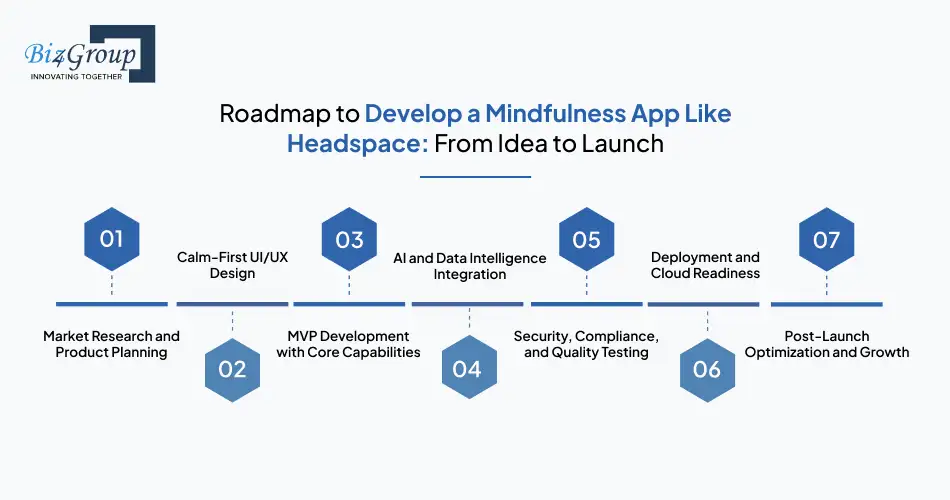
When organizations develop a mental wellness app like Headspace, the process extends far beyond a one-time build. This roadmap reflects how experienced mobile app development services approach mental wellness platforms with a focus on habit formation, architectural clarity, and long-term user trust rather than rapid feature delivery.
1. Market Research and Product Planning
A mindfulness app must align with real emotional moments, not ideal routines. This phase focuses on understanding when users seek calm and why habits break. Teams analyse daily stress triggers and motivation drop-offs to shape product direction and:
- Identify core user intent tied to stress, focus, or sleep patterns
- Analyse competitor journeys to uncover experience gaps
- Define KPIs around habit consistency and session completion
- Validate privacy expectations early to establish trust
2. Calm-First UI/UX Design
A calm interface reduces cognitive load and supports repeat usage. Mindfulness experiences require emotional safety before visual sophistication. A specialized UI/UX design company approaches wellness design through behaviour science ensuring that every interaction should feel predictable and reassuring. You should:
- Design low-pressure onboarding with minimal inputs
- Prototype meditation and progress flows for emotional comfort
- Test accessibility and tone across user stress levels
- Maintain visual consistency to reinforce familiarity
Also read: Top 15 UI/UX Design Companies in USA
3. MVP Development with Core Capabilities
The MVP validates daily adoption, not feature depth. This phase tests whether users return without external motivation. Teams using MVP development services focus on reliability and speed to learning to:
- Build core modules for content, reminders, and progress tracking
- Keep personalization rules simple and flexible
- Ensure responsiveness across mobile and tablet devices
- Prepare backend systems for future analytics and AI
Also read: Top 12+ MVP Development Companies to Launch Your Startup
4. AI and Data Intelligence Integration
Intelligence adds value only after usage patterns stabilize. This stage relies on responsibly training AI models with real engagement data. AI should enhance relevance without feeling intrusive or judgmental. Transparency builds confidence in recommendations to:
- Personalize sessions using behaviour and completion trends
- Adapt reminders based on real usage patterns
- Build learning loops for continuous improvement
- Keep AI outputs supportive and explainable
5. Security, Compliance, and Quality Testing
Trust is critical in mental wellness platforms so stability and data protection must be evident before launch. Many teams engage external software testing company for unbiased validation. Testing reflects real-world usage scenarios by:
- Validating privacy controls and secure data storage
- Test performance across devices and network conditions
- Verify reminders, content delivery, and offline access
- Ensure system stability under load
6. Deployment and Cloud Readiness
Mindfulness apps experience unpredictable demand patterns. Infrastructure must scale quietly without user disruption. Cloud readiness supports growth while reducing operational risk and AI automation enables faster, safer updates to:
- Use elastic cloud infrastructure for variable traffic
- Implement CI/CD pipelines for controlled releases
- Monitor system health and engagement metrics
- Prepare for future content and partner expansion
7. Post-Launch Optimization and Growth
Launch begins the learning cycle as user behaviour evolves as habits form or fade while feedback and analytics guide continuous improvement. Growth decisions should protect emotional consistency by
- Collecting ongoing user feedback and engagement data
- Expanding content based on sustained interest
- Refining AI recommendations over time
- Tracking retention, streaks, and satisfaction
To build a mindfulness app like Headspace, success depends on discipline across every stage, from early discovery to post-launch refinement. When each phase is executed with intention, the result isn’t just a functional app, it’s a mental wellness
Turn Your Wellness App Roadmap into a Launch-Ready Product
Develop a mindfulness app like Headspace with a clear, phase-driven execution plan built for engagement, privacy, and scale.
Review My App IdeaChoosing the Right Tech Stack for Custom Mental Wellness App Development Like Headspace
In mental wellness platforms, technology isn’t just about powering features, it quietly defines reliability, responsiveness, and trust. That’s why selecting the right stack is foundational when you build a scalable, Headspace-style mental wellness application.
|
Technology Layer |
Preferred Technologies |
Why It Works for Mental Wellness Apps |
|
Frontend Framework |
ReactJS |
Enables smooth, responsive interfaces that feel stable and predictable—essential for daily-use mindfulness apps. Experienced ReactJS development ensures performance consistency as content libraries grow. |
|
Server-Side Rendering & Performance |
NextJS |
Improves load speed and SEO while maintaining secure rendering. Leveraging NextJS development supports global reach without sacrificing performance. |
|
Backend Framework |
NodeJS, Python |
Handles concurrent users, session tracking, and personalization logic efficiently. Teams skilled in NodeJS development and Python development can scale backend systems reliably. |
|
API Layer |
REST, GraphQL |
Enables seamless communication between frontend, backend, AI services, and third-party tools. Flexible APIs support future feature expansion without rework. |
|
Database Management |
MongoDB, PostgreSQL |
Supports secure storage of user preferences, progress, and content interactions. Flexible schemas allow personalization logic to evolve over time. |
|
Cloud Infrastructure |
AWS, Google Cloud |
Provides elastic scaling, uptime stability, and secure data handling—critical for apps with fluctuating daily usage patterns. |
|
AI & Data Processing |
TensorFlow, PyTorch |
Powers personalization models, engagement prediction, and adaptive content logic while supporting responsible AI growth. |
|
Authentication & Security |
OAuth 2.0, JWT |
Ensures secure user authentication and session management, reinforcing trust in wellness-focused environments. |
|
Media & Audio Delivery |
WebRTC, Cloud Media Services |
Supports smooth audio delivery for guided sessions, even across variable network conditions. |
|
Analytics & Monitoring |
Firebase, Mixpanel |
Tracks engagement patterns, session completion, and retention trends to guide ongoing optimization. |
Each layer of this stack brings your Headspace-like app closer to a reliable, scalable, and patient-safe digital experience. This is where Fullstack Development plays a critical role, translating architecture into cost-effective, well-orchestrated execution across frontend, backend, and infrastructure.
What Does It Cost to Develop a Mental Wellness Application Like Headspace?
The cost to build an AI app for mental wellness which is like Headspace depends less on a fixed formula and more on how the product evolves over time. At a high level, development budgets usually fall between $30,000 and $250,000+. This range is a ballpark estimate and varies based on scope, technology depth, and long-term growth goals.
|
App Version |
Estimated Cost (USD) |
What’s Included |
|
MVP (Minimal Viable Product) |
$30,000 – $60,000 |
Covers core mindfulness content delivery, guided onboarding, basic reminders, progress tracking, and admin controls. Ideal for validating product–market fit through custom MVP software development before scaling further. |
|
Mid-Level Wellness Platform |
$60,000 – $100,000 |
It has expanded content libraries, personalization logic, subscription management, and analytics dashboards. Also has early-stage AI-driven recommendations to support engagement. |
|
Enterprise-Grade Solution |
$100,000 – $250,000+ |
Designed for advanced personalization, multi-region deployment, scalable cloud infrastructure, HIPAA-aligned data protection, predictive engagement analytics, and automation across user journeys. |
The cost to develop mental wellness app like Headspace reflects how intentionally teams design the product to grow. The goal isn’t to spend more, it’s to invest wisely, ensuring each phase strengthens habit formation, user trust, and sustainable business growth.
Also Read: MVP Development for AI Mental Health App: From Idea to Pilot Launch
Build on a Tech Foundation Designed for Trust and Scale
Ensure your mental wellness app is engineered for reliability, performance, and future personalization from day one.
Develop My Mental Wellness AppBusiness Model: Is It Profitable to Develop a Mindfulness App Like Headspace?
A mental wellness platform may be rooted in wellbeing, but long-term success depends on a business model that scales sustainably. When you develop a mental wellness app like Headspace, profitability comes from aligning daily user habits with recurring value without disrupting trust or simplicity.
1. Freemium Access with Premium Mindfulness Programs
Lowering the barrier to entry builds trust and habitual usage. A freemium model allows users to explore basic meditation sessions, breathing exercises, or focus tools at no cost.
Make premium upgrades, then unlock structured programs, deeper personalization, or advanced sleep and productivity content.
2. Subscription-Based Revenue Model
Subscriptions in a mental wellness app like headspace, offer a scalable path to sustainable growth without relying on transactional usage. Monthly and annual plans provide predictable revenue while encouraging consistency in user practice.
Tiered pricing of the app can be structured around content depth, session variety, or personalization level.
3. Corporate Wellness & B2B Licensing
At an organizational level, anonymized insights powered by AI mood tracking app can help employers understand overall engagement and stress patterns without accessing individual user data, making the platform more valuable for enterprise wellness programs.
This model is especially relevant for organizations looking to build mental wellness app like Headspace for corporate wellness programs without compromising employee privacy.
Also Read: How to Build AI Mental Health App for Corporate Wellness Programs?
4. Pay-Per-Program or Limited-Time Access
Some users prefer flexibility over long-term commitments. Offering one-time purchases for specific meditation packs, focus challenges, or sleep programs caters to users hesitant about subscriptions while still generating incremental revenue.
This model helps the investors and business owners complements subscriptions rather than replacing them.
5. AI-Driven Premium Add-Ons
Optional AI-powered features, such as adaptive session recommendations, habit insights, or personalized wellness nudges; can be offered as paid enhancements. When designed responsibly, these tools increase engagement without overwhelming users.
Some platforms also explore contextual recommendations through AI chatbot integration to guide users toward relevant premium content or wellness resources.
Also Read: How to Create an AI Mental Health Chatbot?
6. Digital Wellness Marketplace
A curated in-app marketplace adds another monetization layer. Users can purchase meditation packs, guided routines, or digital self-care toolkits aligned with their goals. This approach fits naturally within mindfulness ecosystems where content depth drives perceived value.
When revenue models support user wellbeing rather than interrupt it, mental wellness platforms like headspace achieve both impact and sustainability.
Compliance, Security & Privacy in Mental Health and Wellness App Development Like Headspace

When you develop a mental wellness app like Headspace user trust, safety, and regulatory readiness are foundational. Even though Headspace-style platforms are non-clinical and self-guided, they still handle sensitive behavioural and wellness data. This makes compliance, privacy, and ethical technology practices critical to long-term adoption and enterprise partnerships.
1. Privacy Laws and User Consent Practices
In the United States, compliance goes beyond federal guidelines. States like California, Virginia, and Colorado enforce privacy laws that require clear consent, transparent data use disclosures, and user rights such as deletion or correction.
For a Headspace-style platform that collects wellness preferences, session engagement, and habit data, transparent consent flows are essential to fairness and regulatory alignment.
2. Secure Data Transmission & Infrastructure Controls
Every interaction whether tracking progress, storing meditation history, or processing reminders must be protected in motion and at rest. End-to-end encryption, secure APIs, and controlled access layers reduce exposure risk.
Implementing these safeguards early is significantly easier when working with software development company in Florida experienced in US-centric compliance environments and privacy-first system design.
3. Ethical Use of AI in Mental Wellness
AI increasingly supports personalization in mindfulness apps, but it must be governed responsibly. When applied to recommendations, engagement insights, or behavioural pattern recognition, AI systems should be explainable, bias-tested, and privacy-aware.
Thoughtful implementation of AI in mental health ensures intelligence enhances user wellbeing without introducing opacity or risk.
4. Accessibility and Inclusive Design Standards
Mental wellness platforms must be usable by people with diverse physical, sensory, and cognitive needs. Adhering to ADA and WCAG standards; such as screen reader support, and adaptable text sizes improves inclusivity while strengthening overall product quality and compliance readiness.
5. Data Retention and Responsible Deletion
Wellness data should follow a clearly defined lifecycle. Establish policies for how long user data is retained, when it is anonymized, and how it is securely deleted. Automating these processes minimizes legal exposure while reinforcing user trust, especially for long-term subscribers.
For a mental wellness app like Headspace, compliance and privacy are not constraints rather they are trust accelerators. Secure systems, ethical AI practices, inclusive access, and transparent data governance signal credibility to users and enterprises alike.
Best Practices for Custom Mental Wellness App Development Services Like Headspace
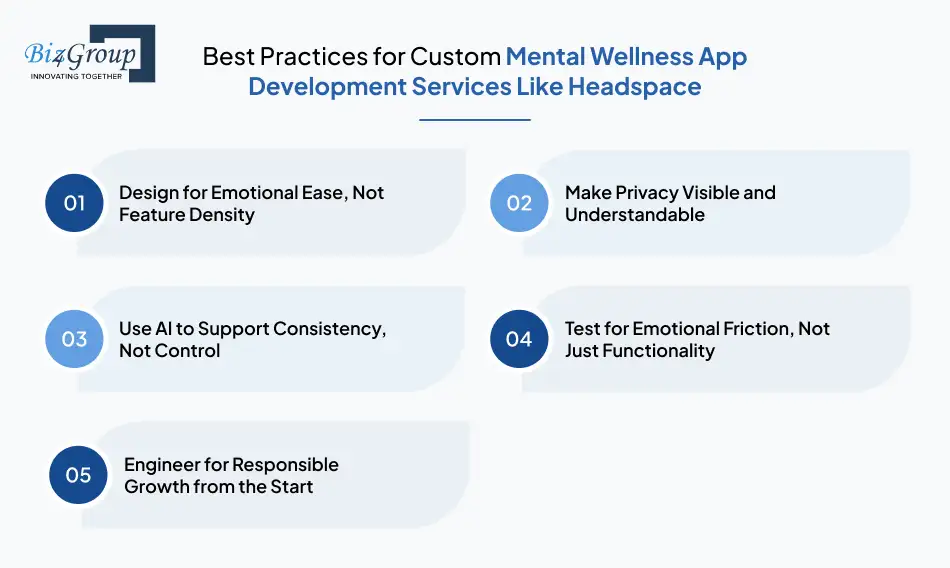
The most effective platforms are built with empathy baked into both experience and engineering. Below are five best practices that consistently separate trusted wellness products from short-lived experiments.
1. Design for Emotional Ease, Not Feature Density
Mental wellness apps should feel restorative, not demanding. Minimal interfaces, predictable navigation, and calm visual language help users feel comfortable returning daily.
Designing for emotional ease means reducing cognitive load and avoiding overstimulation, principles often reinforced through thoughtful mental health app design best practices rather than purely functional UI decisions.
2. Make Privacy Visible and Understandable
Security should never feel hidden or abstract. Users are more likely to trust a platform when privacy protections are communicated clearly in plain language. Transparent data practices explained through onboarding cues or settings reassure users that their personal wellness data is handled responsibly, not silently harvested.
3. Use AI to Support Consistency, Not Control
AI plays a supporting role in mindfulness platforms not a directive one. When designed responsibly, AI can guide users through reflective prompts, habit reinforcement, or adaptive routines without replacing mindfulness practices.
Some platforms explore this balance by learning how to build a virtual mental health coach that complements meditation rather than overrides it.
4. Test for Emotional Friction, Not Just Functionality
Real-user testing helps uncover emotional friction; moments where language, pacing, or flow feels stressful rather than supportive. Observing reactions to reminders, streaks, or progress feedback often reveals deeper insights than standard QA cycles. This step is critical when designing experiences meant to support daily mental wellbeing.
5. Engineer for Responsible Growth from the Start
Scalability should never compromise user trust. Teams that follow disciplined growth principles, often emphasized by AI development companies in Florida are better positioned to scale while maintaining reliability and compliance.
For execution-heavy phases, some founders also evaluate whether to hire mental health app developers in the USA for domain familiarity and regulatory alignment.
When custom mental wellness app development like Headspace is guided by empathy, clarity, and responsible technology choices, products earn long-term trust not just downloads.
Common Challenges and How to Avoid Them When You Build a Mental Wellness App Like Headspace
Even strong mental wellness concepts can lose traction if execution overlooks user psychology or long-term product strategy. When you build a mental wellness app like Headspace, these common pitfalls often determine whether the app becomes a daily habit or fades after initial curiosity.
|
Common Pitfall |
How to Avoid It |
|
Designing Without Emotional Context |
Mindfulness apps rely on emotional safety. Regular user feedback, tone testing, and behavioural analysis help ensure content, reminders, and pacing feel supportive rather than intrusive. |
|
Treating Privacy as a Backend Concern |
Users trust wellness apps with deeply personal data. Privacy-first architecture, clear consent flows, and secure data handling should be built into the product from day one—not added later. |
|
Overbuilding Features Too Early |
Adding too many tools at launch can overwhelm users. Start with a focused core experience and expand gradually as engagement patterns become clear. This phased approach is often emphasized in business app development using AI to balance cost and value. |
|
Misusing AI Personalization |
AI should guide, not dominate, the experience. Poorly implemented automation can feel impersonal. Learning how to integrate AI into an app responsibly helps keep personalization subtle and user controlled. |
|
Ignoring Long-Term Engagement Signals |
Many wellness apps see drop-offs after the first few weeks. Predictive insights and adaptive nudges, often inspired by mental wellness AI agents used in engagement systems—can help maintain consistency without pressure. |
|
Underestimating Cost-to-Value Balance |
Cutting corners early may reduce quality and trust. A smarter approach focuses on scalable foundations that lower long-term costs while improving personalization and reliability. |
|
Neglecting Post-Launch Evolution |
Mental wellness apps are not static products. Continuous content refreshes, feature refinement, and performance optimization are essential to sustaining daily usage and credibility. |
Avoiding these pitfalls isn’t about adding more complexity, it’s about making intentional choices. When mental wellness app development like Headspace prioritizes emotional design, responsible AI, and scalable execution, platforms are far more likely to earn long-term user trust.
The Future of Meditation and Mindfulness Apps Like Headspace
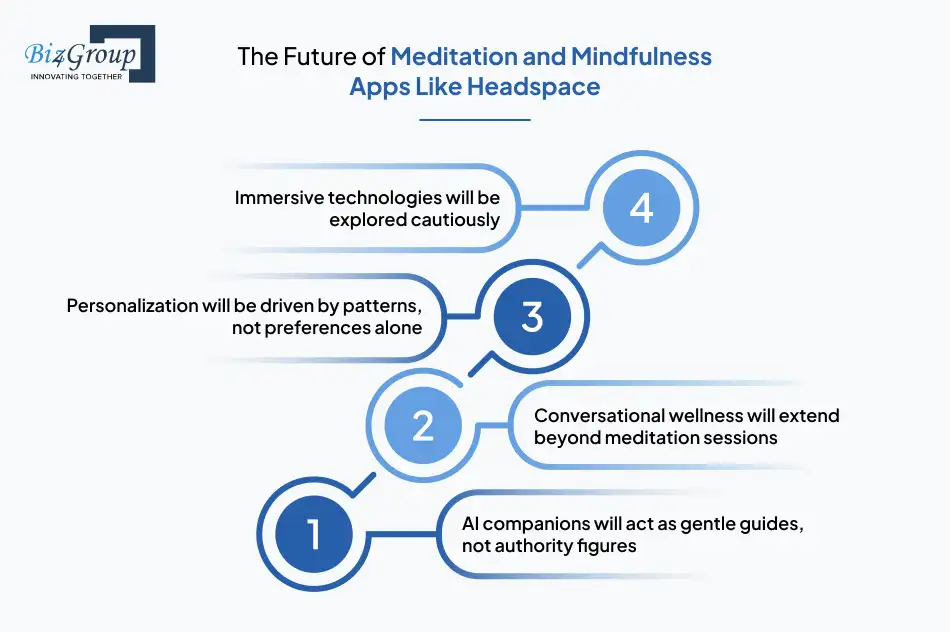
Meditation and mindfulness apps are entering a new phase; one where static content libraries evolve into adaptive, intelligent wellness ecosystems. As expectations grow, the future of apps like Headspace will depend on how quietly and responsibly technology supports habit-building, emotional awareness, and long-term engagement.
Here’s what’s shaping the next generation of mental wellness platforms:
AI companions will act as gentle guides, not authority figures
Future platforms will increasingly incorporate a virtual mental health coach to provide reflective prompts, consistency cues, and session guidance. This direction aligns with the broader discussion around the rise of AI companions, where AI supports presence and routine without replacing mindfulness practices.
Conversational wellness will extend beyond meditation sessions
Lightweight chat-based interactions will help users reflect, check in emotionally, or choose the right session without friction. As these experiences mature, understanding the AI chatbot cost for mental health becomes essential for founders planning scalable, long-term engagement features.
Personalization will be driven by patterns, not preferences alone
Rather than relying solely on user-selected goals, future apps will adapt to usage rhythms, time of day, and consistency trends, offering relevance without asking users to constantly reconfigure their experience.
Immersive technologies will be explored cautiously
Augmented experiences may emerge in areas like guided breathing environments or focus rituals, but adoption will be deliberate. Insights from augmented reality development highlight why mindfulness apps must balance immersion with emotional safety and accessibility.
Platforms that blend ethical AI, thoughtful design, and selective innovation will create experiences that feel supportive, not overwhelming when they develop mental wellness app like Headspace. For businesses investing in mental wellness, the opportunity lies in building technology that quietly earns trust, while adapting to how people and care for their mental wellbeing.
Why Work with Biz4Group to Develop a Mental Wellness App Like Headspace?
Starting a mental health platform is not just a technical undertaking; it’s an emotional responsibility. Finding the best company to develop a mental wellness app like Headspace helps ensure emotional design, AI integration, and scalability are balanced from concept through rollout.
At Biz4Group LLC, this understanding shapes how we approach mental wellness app development from the ground up. Our work consistently sits at the intersection of human-centred design, applied AI, and scalable engineering, helping brands translate care into technology without losing empathy along the way.
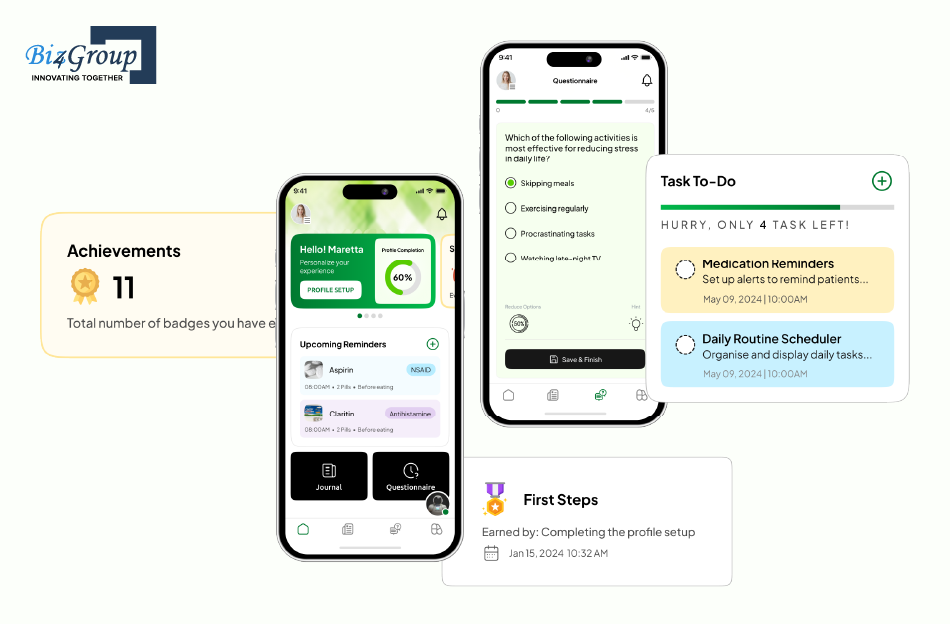
One example is AI-based Solution for Dementia Patients, where our teams built an AI-driven system to support cognitive engagement and daily interaction for early- to mid-stage dementia patients. The challenge wasn’t automation; it was designing assistance that felt supportive rather than intrusive. That same sensitivity is essential when building mindfulness apps where trust and emotional safety matter as much as functionality. that felt supportive rather than intrusive. That same sensitivity is essential when building mindfulness apps where trust and emotional safety matter as much as functionality.
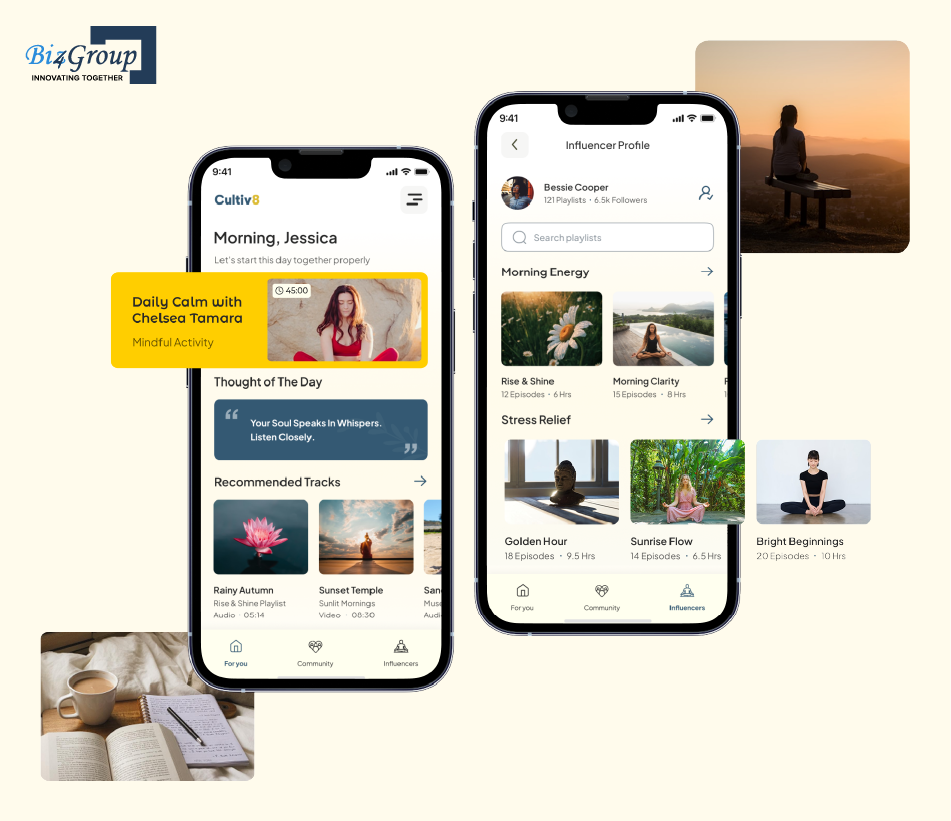
In the wellness space, Cultiv8 reflects our experience with meditation-focused, non-clinical platforms. The app was designed around spiritual exploration, guided reflection, and habit consistency. It demonstrates how thoughtful UX and structured content architecture can support long-term engagement without overwhelming users; an approach closely aligned with Headspace-style mindfulness experiences.
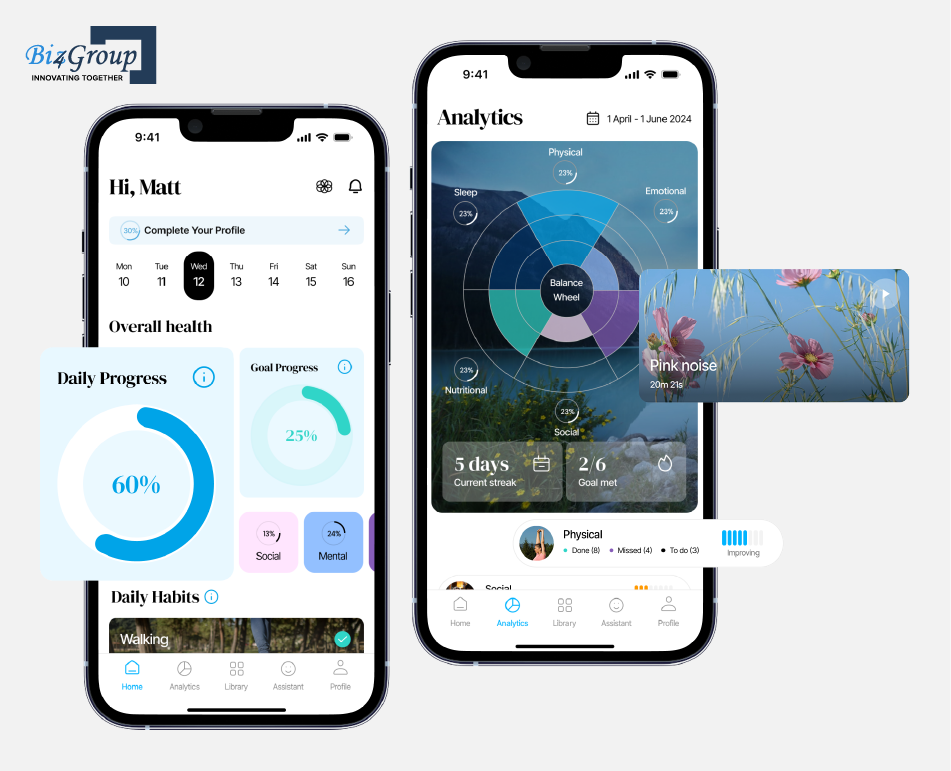
We’ve also worked on platforms like Quantum Fit, where AI-driven personal development tools adapt to user behaviour over time. While focused on growth rather than meditation, the underlying personalization logic and engagement design mirror the same principles required to build intelligent, habit-forming mental wellness products.
What differentiates us, is not just the ability to build AI-powered systems, but the ability to apply AI with restraint. Whether it’s conversational interfaces, adaptive guidance, or behavioural insights, our teams design intelligence to support consistency not control it. This perspective is informed by deep work in areas such as mental health AI assistants and emotionally aware digital experiences.
As an experienced AI app development company in the USA, we combine strategic thinking with execution discipline; ensuring mental wellness platforms are secure, scalable, and emotionally aligned from the first prototype to enterprise rollout. At Biz4Group LLC trust is never compromised and scalability is built in quietly by our experience in custom healthcare software development .
Develop a Mental Wellness Platform Users Trust and Return To
Work with a team that understands habit formation, emotional design, and responsible AI in mental wellness products.
Discuss My Mental Wellness App IdeaFinal Thoughts: Building a Scalable Mental Wellness App Like Headspace
To develop mental wellness app like Headspace is ultimately an empathy practice, not engineering. Users won’t remember how sophisticated your backend is; they’ll remember whether the experience feels calm and supportive when they open the app during moments of stress or reflection.
The next generation of mindfulness apps will be created by teams that treat mental wellness as a long-term commitment, not a short-term opportunity. The real challenge is learning how to build AI software that adapts responsibly, technology that learns from user behaviour without turning wellness into automation or control.
This is where execution becomes just as important as vision. We support founders through disciplined AI product development services that balance intelligence with emotional design. This approach helps ensure that AI enhances the experience without overshadowing empathy or user trust.
Schedule a consultation with us to start designing a mental wellness app like Headspace built to heal, connect, and last.
Frequently Asked Questions
1. How should I approach planning before developing a mindfulness app like Headspace?
Begin by defining the core mental habit your app supports, such as focus, meditation, or sleep. Validate whether users can realistically repeat the experience daily. Early testing should focus on routine formation, not just initial interest.
2. What separates a successful mental wellness app from the rest of the market?
Successful apps prioritize emotional comfort, consistency, and simplicity. Calm interfaces, predictable session flows, and clear progress cues build trust. Feature-heavy apps often fail when they overwhelm users instead of supporting habits.
3. What investment range should I expect for building a Headspace-like app?
Costs generally range from $30,000 to $250,000+, depending on scope and scalability. MVPs sit at the lower end, while platforms with personalization, subscriptions, and analytics require higher investment.
4. How is AI used in mindfulness apps without making them feel clinical?
AI works best behind the scenes by recommending sessions and adjusting routines. It helps personalize experiences without drawing attention to itself. When applied carefully, AI supports mindfulness rather than distracting from it.
5. Do non-clinical wellness apps still need strong privacy and compliance measures?
Yes, because users share sensitive emotional data even outside therapy contexts. Strong encryption, transparent data practices, and consent-driven design are essential. Trust is critical for long-term engagement.
6. How long does it take to launch a production-ready mindfulness app?
A focused MVP can typically be launched within 3 to 5 months while ore advanced platforms with personalization and subscriptions take 6 to 9 months. Timelines for the app development completely depends on design depth and iteration cycles.
