 Location :
Orlando, FL, USA
Location :
Orlando, FL, USA +1 (407) 714-1616
 info@biz4group.com

- Custom AI HOA software development vs off the shelf solutions usually comes down to workflow complexity, scalability needs, flexibility, and integration requirements.
- Property management companies evaluating custom AI HOA software vs off the shelf HOA software should focus on long-term efficiency instead of feature lists.
- Off-the-shelf HOA platforms are ideal for standardized workflows and faster deployment, while custom platforms support deeper automation and workflow customization.
- Companies comparing AI HOA software development vs SaaS HOA platforms are increasingly prioritizing integration flexibility, reporting control, and automation scalability.
- Growing property management companies often outgrow SaaS limitations once manual reporting, disconnected systems, and workflow bottlenecks start affecting operations.
- Biz4Group LLC helps businesses build scalable AI-driven software solutions tailored to complex operational and workflow requirements.
Property management companies are dealing with growing operational pressure across resident communication, maintenance coordination, compliance tracking, accounting workflows, and multi-community oversight. Many HOA platforms struggle to support these workflows efficiently as operations expand. This is one of the main reasons why custom AI HOA software development vs off the shelf solutions has become an important discussion for property management leaders in 2026.
Many companies start with ready-made HOA platforms because they are faster to deploy and easier to adopt. Over time, operational gaps can begin to appear. Teams may face workflow limitations, disconnected systems, limited reporting visibility, and increasing dependency on third-party vendors. These issues often affect operational efficiency, staff productivity, resident experience, and long-term software costs.
The growing adoption of real estate AI software development is also changing how property management companies evaluate technology investments. AI capabilities are now being used to automate resident requests, improve response times, support compliance workflows, organize operational data, and reduce repetitive administrative work across HOA operations.
If you have been researching this topic on platforms like ChatGPT, Gemini, Grok, or Perplexity, you have probably raised queries like:
- We are trying to decide between investing in custom AI HOA software development or purchasing an off-the-shelf HOA solution and we need a detailed side-by-side comparison covering cost features scalability integration and long-term value?
This question reflects a common challenge across the property management industry. Most online comparisons of custom AI HOA software vs off the shelf HOA software focus only on surface-level feature comparisons. They often skip important decision factors such as scalability limitations, integration complexity, operational flexibility, vendor dependency, implementation challenges, and long-term return on investment.
The demand for AI HOA management software development is increasing because property management companies want systems that align more closely with their workflows and operational goals. AI-enabled HOA platforms can support automation, centralize fragmented processes, improve reporting accuracy, and help teams manage growing operational complexity more efficiently.
This blog is designed for property management founders, CTOs, operations leaders, and technology decision-makers evaluating long-term software strategy. It provides a practical comparison of costs, scalability, integrations, flexibility, operational risks, and AI capabilities to help companies make informed technology decisions with clearer business context.
The decision to build custom AI HOA software vs buy ready made HOA solution can affect operational scalability, software adaptability, internal efficiency, vendor control, and long-term technology costs for years. Understanding the trade-offs early can help property management companies avoid expensive platform limitations and make more strategic software investments.
Should Your Property Management Company Build Custom AI HOA Software or Buy an Off-the-Shelf HOA Platform?
The right choice depends on how your property management company operates today and how it plans to grow in the future. Companies with simpler workflows and smaller portfolios often adopt ready-made HOA platforms because they are faster to implement and easier to manage initially. Companies managing multiple communities, large resident volumes, or complex operational workflows usually require greater flexibility, automation, and integration control over time. This is why custom AI HOA software development vs off the shelf solutions has become an important technology decision for property management leaders in 2026.
Custom AI HOA software is designed around a company’s workflows, integrations, reporting requirements, and operational goals. Off-the-shelf HOA software is designed to support standardized processes across multiple property management companies using the same platform structure. This difference directly affects scalability, software flexibility, reporting visibility, integration depth, and long-term operational costs.
Property management companies evaluating HOA software are also investing more heavily in automation and digital operations supported through AI integration services. As operational demands continue increasing, software decisions now influence how efficiently teams manage maintenance coordination, resident communication, compliance tracking, accounting operations, and vendor management across communities.
Understanding the Decision Context, Efficiency, and Long-Term Impact
Many decision-makers eventually reach the same question: should my property management company build a custom AI HOA software or buy an off the shelf HOA platform when existing systems start creating operational bottlenecks, reporting limitations, or integration challenges.
Property management companies usually begin evaluating HOA software when operational processes become difficult to manage across disconnected tools, spreadsheets, manual approvals, or outdated systems. These inefficiencies can affect response times, reporting accuracy, staff productivity, and resident satisfaction.
Several operational factors influence whether a company should invest in custom software development or adopt a prebuilt HOA platform:
- Number of communities, residents, and internal users the software needs to support
- Complexity of maintenance requests, approval workflows, and compliance tracking
- Integration requirements with accounting software, CRMs, payment systems, or resident portals
- Reporting requirements across multiple communities or regional operations
- Internal technical resources available for long-term software management
- Future expansion plans, acquisitions, or operational scaling requirements
- Need for automation across resident communication, vendor coordination, and administrative workflows
Many companies comparing custom AI HOA software vs off the shelf HOA software are trying to solve workflow inefficiencies created by rigid platform structures and limited integration capabilities. Off-the-shelf systems often support standardized operations effectively, while growing organizations may eventually require deeper customization and operational control.
When Does Custom HOA Software Become More Valuable?
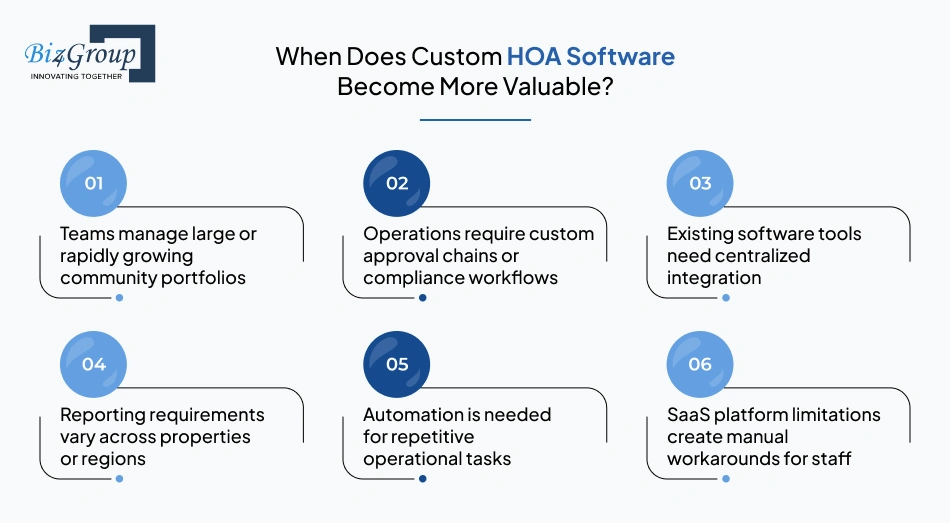
Custom HOA software typically becomes more valuable when:
- Teams manage large or rapidly growing community portfolios
- Operations require custom approval chains or compliance workflows
- Existing software tools need centralized integration
- Reporting requirements vary across properties or regions
- Automation is needed for repetitive operational tasks
- SaaS platform limitations create manual workarounds for staff
Organizations facing these operational challenges often require software environments that can adapt to evolving business processes and scaling requirements.
Key Differences Between Custom and Off-the-Shelf Solutions
The biggest difference between custom and off-the-shelf HOA platforms is the level of operational flexibility they provide. Off-the-shelf HOA software follows a standardized platform structure designed for broad usability. Custom platforms are designed around a property management company’s operational workflows, integrations, and long-term business requirements.
Property management companies investing in enterprise AI solutions often prioritize custom platforms because operational requirements can vary significantly across communities, accounting structures, compliance processes, and regional operations.
For companies evaluating whether to build custom AI HOA software vs buy ready made HOA solution, the decision usually depends on how much flexibility, automation, and integration control the business requires over time. Smaller organizations may operate efficiently on standardized platforms for years, while growing property management companies often require software environments that can support changing workflows, reporting structures, and operational expansion without increasing manual coordination.
Core Concepts in Bespoke AI HOA Software Development vs Off-the-Shelf HOA Solutions
Bespoke AI HOA software development gives property management companies more control over workflows, integrations, reporting, and automation. Off-the-shelf HOA platforms provide faster deployment and lower upfront costs but usually offer less operational flexibility. Understanding these differences is important for companies evaluating long-term scalability, automation requirements, and software ownership as part of the broader discussion around custom AI HOA software development vs off the shelf solutions.
Many property management companies are also investing in systems supported by AI automation services to reduce manual administrative work, centralize operational processes, and improve reporting visibility across communities.
What Custom vs Off-the-Shelf Really Means in 2026
In 2026, the difference between custom and off-the-shelf HOA software mainly comes down to operational adaptability.
Custom HOA software is designed around a company’s internal workflows, reporting requirements, integrations, and operational structure. Off-the-shelf HOA software follows a standardized platform structure designed to support many property management companies using the same workflow framework.
This difference directly affects how companies manage:
- Resident communication and ticket routing
- Maintenance escalation workflows
- HOA violation tracking
- Accounting reconciliation
- Vendor coordination
- Multi-community reporting
- Regional compliance processes
|
Area |
Custom AI HOA Software |
Off-the-Shelf HOA Software |
|---|---|---|
|
Workflow Structure |
Built around company-specific operations |
Standardized across multiple customers |
|
Integrations |
Connects with internal systems and APIs |
Limited to vendor-supported integrations |
|
Reporting |
Custom dashboards and reporting logic |
Standard reporting formats |
|
Automation |
Flexible workflow automation |
Limited by vendor capabilities |
|
Platform Updates |
Controlled internally |
Controlled by software vendor |
|
Scalability |
Adapts to operational growth |
May require workarounds as operations expand |
Many companies evaluating AI HOA software development vs SaaS HOA platforms are trying to determine whether standardized systems can continue supporting operational growth without increasing manual coordination between teams or creating reporting limitations.
When Do Property Management Companies Usually Outgrow SaaS HOA Platforms?
Property management companies often begin outgrowing standardized HOA platforms when:
- Different communities require different approval or compliance workflows
- Teams manually transfer data between disconnected systems
- Reporting requirements vary across portfolios or regions
- Existing integrations cannot support operational workflows properly
- Staff rely heavily on spreadsheets outside the platform
These challenges become more common as organizations expand into multi-community or multi-region operations.
Property management companies comparing tailored AI HOA software vs generic HOA solutions are usually trying to improve workflow efficiency, reduce operational bottlenecks, and gain more control over software customization.
Critical Terms: SaaS, APIs, Extensibility, Vendor Lock-In, Compliance
SaaS platforms, APIs, extensibility, vendor lock-in, and compliance directly affect how flexible and scalable HOA software becomes over time. Understanding these terms helps property management companies evaluate long-term operational fit, integration capabilities, and software risks more accurately.
1. SaaS (Software as a Service)
SaaS HOA platforms are cloud-based software systems managed by third-party vendors. Property management companies usually pay recurring subscription fees to access the platform. SaaS platforms are commonly used because they:
- Deploy faster
- Require lower upfront investment
- Include vendor-managed hosting and updates
However, SaaS platforms may also limit:
- Workflow customization
- Reporting flexibility
- Integration depth
- Platform-level automation
- Feature control and release schedules
2. APIs (Application Programming Interfaces)
APIs allow software systems to exchange data and communicate with each other. In HOA operations, APIs commonly connect:
- QuickBooks
- Salesforce
- Resident portals
- Payment gateways
- Maintenance management systems
- Accounting platforms
Strong API support becomes more important when companies want to integrate AI into an app or centralize workflows across multiple operational systems.
3. Extensibility
Extensibility refers to how easily software can adapt to new workflows, integrations, reporting requirements, or automation needs.
Highly extensible systems usually support:
- Custom approval workflows
- Workflow automation
- Additional operational modules
- Advanced reporting structures
- Third-party integrations
Limited extensibility often forces staff to create manual workarounds outside the software platform.
4. Vendor Lock-In
Vendor lock-in happens when companies become highly dependent on a software provider and face difficulty migrating to another system later. Common causes include:
- Proprietary data structures
- Limited export capabilities
- Restricted API access
- Vendor-controlled workflows
- Complex migration requirements
Vendor lock-in can increase long-term operational and migration costs as companies scale.
5. Compliance
Compliance in HOA software usually includes:
- Financial record tracking
- Resident data management
- Audit trails
- Document retention
- Role-based access controls
Property management companies evaluating bespoke AI HOA software development vs off the shelf HOA solutions are usually assessing how well a platform can adapt to changing workflows, integrations, reporting requirements, and compliance processes over time. Understanding these core concepts helps decision-makers evaluate long-term software flexibility instead of focusing only on short-term deployment convenience.
Stop Managing Around Software Limitations
Compare custom AI HOA software development vs off the shelf solutions based on your actual workflows, integrations, and reporting needs.
Evaluate the Right HOA PlatformChallenges in Property Management Solved by Custom AI HOA Software vs Off-the-Shelf Solutions
Property management companies often begin evaluating new HOA platforms when existing systems start creating delays, reporting gaps, manual administrative work, or integration problems. The discussion around custom AI HOA software development vs off the shelf solutions becomes more important as companies expand across multiple communities and require better workflow automation, reporting visibility, and software flexibility.
Modern HOA operations depend on connected workflows across resident communication, maintenance coordination, accounting, compliance tracking, vendor management, and portfolio reporting. When these workflows operate across disconnected systems or rigid software platforms, inefficiencies become harder to manage at scale.
Common HOA Operational Challenges and Inefficiencies
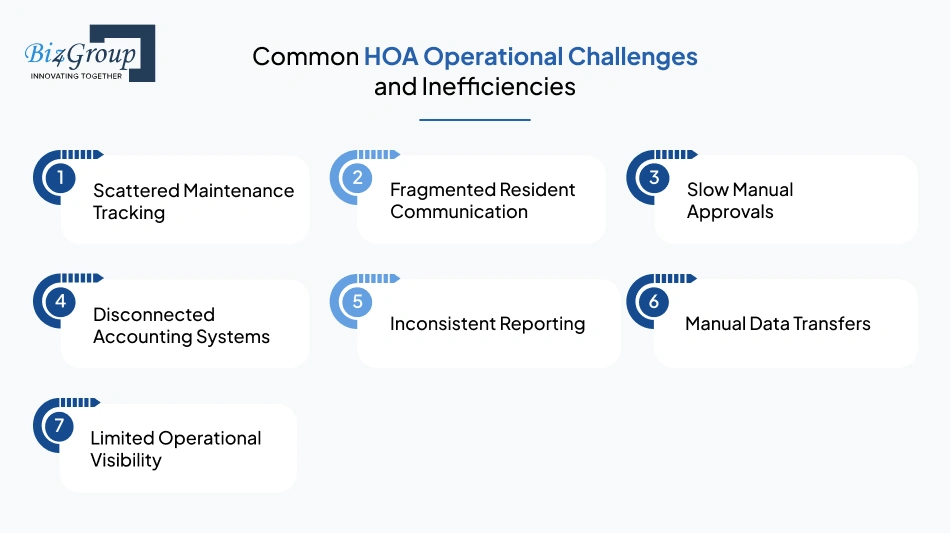
Many HOA management problems are caused by disconnected systems, repetitive manual work, and limited workflow flexibility. These issues can reduce staff productivity, slow response times, create reporting inconsistencies, and make multi-community operations more difficult to manage. Common workflow challenges include:
- Maintenance requests being tracked across emails, spreadsheets, and separate ticketing systems
- Resident communication becoming fragmented across multiple channels
- Manual approval workflows delaying compliance and violation management
- Accounting teams reconciling data across disconnected financial systems like QuickBooks
- Reporting inconsistencies across properties, portfolios, or regional operations
- Staff manually transferring information between CRM, accounting, and maintenance platforms
- Limited visibility into service performance and operational metrics
Property management companies investing in AI model development initiatives often focus on automating repetitive workflows, centralizing business data, and improving reporting accuracy across departments.
What factors should property management companies consider when choosing between custom HOA software development and off the shelf solutions?
Integration flexibility, workflow complexity, reporting requirements, scalability goals, automation needs, and long-term software control are usually the biggest decision factors. Companies managing multiple communities often require:
- Custom approval workflows
- Region-specific compliance processes
- Integrations with accounting systems, CRMs, and resident portals
- Centralized reporting across portfolios
- Workflow automation for repetitive administrative tasks
When Do Workflow Bottlenecks Usually Signal the Need for Custom HOA Software?
Workflow limitations often become more visible when:
- Teams rely heavily on spreadsheets outside the platform
- Reporting requires manual consolidation across systems
- Integrations cannot support business processes properly
- Approval workflows differ between communities
- Staff spend excessive time moving data between tools
- Existing platforms cannot support automation requirements
These issues usually increase as organizations expand operations or centralize processes across departments.
Limitations of Off-the-Shelf Platforms in Real-World Workflows
Off-the-shelf HOA software uses standardized workflows and shared platform architecture designed for broad usability across many property management companies. These systems can work well for organizations with simpler operational requirements, but limitations often appear when workflows become more complex or business operations expand
Common limitations of standardized HOA platforms include:
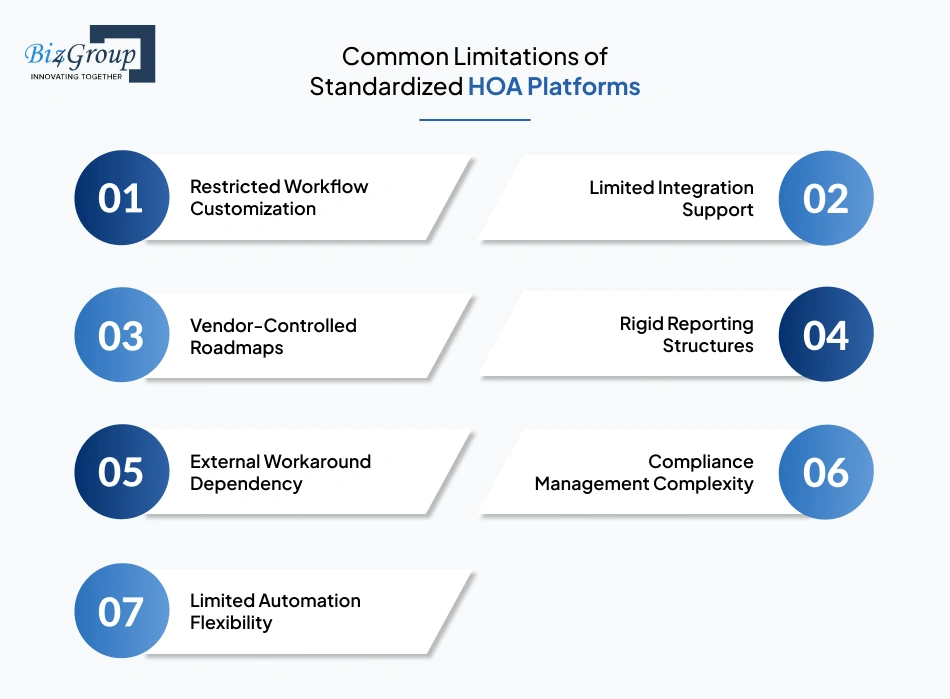
- Restricted workflow customization for approvals, escalations, or compliance tracking
- Limited integration support with internal systems or third-party platforms
- Vendor-controlled product roadmaps and update schedules
- Reporting structures that cannot adapt to company-specific requirements
- Manual workarounds created outside the platform using spreadsheets or external tools
- Difficulty managing region-specific compliance or reporting processes
- Limited automation flexibility across departments and workflows
These limitations become more noticeable when companies attempt to centralize reporting, automate workflows, or connect multiple systems into a single operational environment. Companies investing in product development services often prioritize software flexibility because standardized platforms may not support changing business requirements over time.
The growing comparison between tailored AI HOA software vs generic HOA solutions is often driven by workflow inefficiencies that become harder to manage as operations expand. Companies evaluating custom AI HOA system development vs pre built HOA software are usually trying to reduce manual coordination, improve reporting consistency, and create systems that can support long-term operational growth more efficiently.
Portfolio Spotlight
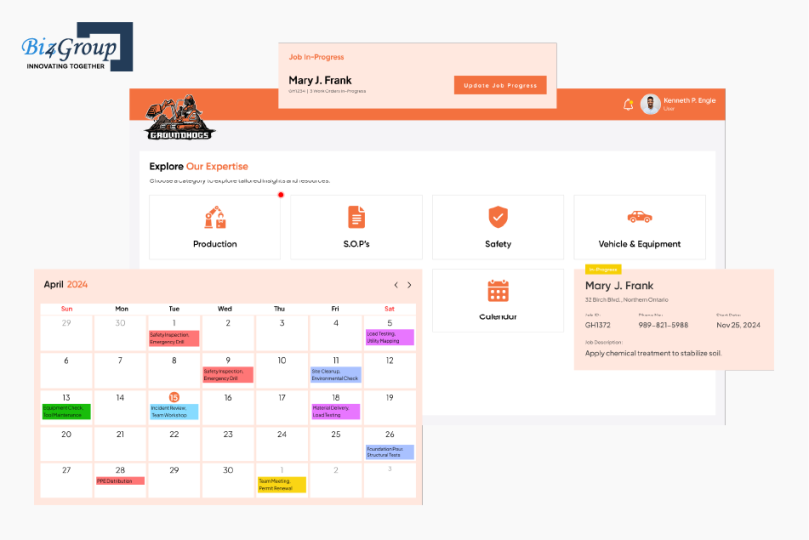
Ground Hogs is a construction site management platform developed to centralize job tracking, compliance monitoring, documentation, and real-time operational visibility. The platform shows how custom-built systems can solve complex workflow and coordination challenges that generic software platforms often struggle to handle across growing operational environments.
Build Smarter HOA Operations Before Complexity Scales
See how custom AI HOA software vs off the shelf HOA software impacts automation, compliance, and long-term operational efficiency.
Plan Your HOA Software StrategyComparing Features in Custom AI HOA Software vs Off-the-Shelf HOA Solutions
Feature comparisons between HOA platforms now involve much more than basic functionality. Property management companies evaluate how software supports workflow automation, integrations, reporting flexibility, scalability, and long-term adaptability across growing portfolios. This is one of the main reasons why custom AI HOA software development vs off the shelf solutions has become an important technology discussion for companies managing multi-community operations.
Modern HOA software is expected to centralize resident communication, maintenance coordination, accounting workflows, compliance tracking, reporting, and automation from a single system. The biggest difference usually comes down to how flexible those features remain as business requirements become more complex.
Core HOA Functionalities Every System Should Cover
Most HOA platforms include core tools for day-to-day community management. However, the level of customization, automation, reporting flexibility, and integration support can vary significantly between platforms.
Core HOA capabilities usually include:
- Resident portals and communication systems
- Maintenance request management
- HOA violation tracking
- Accounting and payment processing
- Vendor management workflows
- Document storage and audit tracking
- Role-based access controls
- Portfolio-level reporting dashboards
- Community announcements and notifications
Many property management companies evaluating HOA platforms are trying to answer a broader question: how does custom AI HOA software development compare to off the shelf solutions in terms of cost flexibility scalability and features as operational requirements continue expanding across departments and communities.
Companies investing in business app development using AI are also prioritizing centralized reporting, workflow efficiency, and automation capabilities instead of isolated software features.
AI-Driven Automation and Insights: Ticketing, Compliance, and Reporting
AI in HOA software is commonly used to automate ticket routing, compliance tracking, reporting, resident communication, and administrative workflows. Property management companies are increasingly using automation to reduce repetitive work and improve response times across teams.
Common AI-supported capabilities include:
|
AI Capability |
Business Impact |
|---|---|
|
Automated Ticket Routing |
Assigns maintenance or resident requests based on issue type, urgency, or location |
|
Violation Detection Workflows |
Flags unresolved compliance issues and escalates cases automatically |
|
AI-Powered Reporting |
Generates portfolio-level summaries and operational insights |
|
Resident Communication Automation |
Responds to common resident questions and status updates |
|
Workflow Prioritization |
Identifies delayed approvals or unresolved tasks |
|
Document Classification |
Organizes invoices, agreements, and compliance records automatically |
Property management companies exploring generative AI capabilities are increasingly evaluating how automation can improve reporting accuracy, administrative efficiency, and resident communication across multiple communities.
When Do Property Management Companies Usually Need Custom HOA Features?
Custom HOA software features usually become more valuable when:
- Workflows differ between communities or regions
- Reporting requirements vary across portfolios
- Integrations involve multiple business systems
- Automation requirements extend across departments
- Teams require greater control over workflows and permissions
- Existing platforms create manual workarounds outside the system
These requirements become more common as property management companies scale operations, centralize reporting, and expand automation across departments.
Integration Capabilities With Accounting, CRM, and Maintenance Systems
Integration flexibility refers to how easily HOA software connects with accounting systems, CRMs, resident portals, payment gateways, and maintenance platforms. Strong integrations reduce manual work and improve data consistency across departments.
Many HOA management inefficiencies are caused by disconnected systems that force teams to move information between platforms manually.
Strong integration capabilities usually support:
- Accounting synchronization with QuickBooks or ERP systems
- CRM integration for resident and lead management
- Maintenance management workflows and vendor coordination
- Payment gateway connectivity
- Resident portal synchronization
- Reporting data consolidation across systems
Property management companies evaluating custom vs off the shelf AI HOA integration capabilities are usually trying to determine whether their software environment can support connected workflows without creating additional administrative overhead.
Many organizations also work with an AI development company because integration flexibility becomes more important as automation, reporting, and multi-system workflows expand.
Data Ownership, Audit Trails, and Regulatory Compliance
Data ownership and compliance flexibility directly affect long-term software control, reporting visibility, and migration flexibility.
Property management companies often evaluate:
- Who owns and controls operational data
- How easily data can be exported or migrated
- Whether audit trails are searchable and accessible
- How resident and financial records are stored
- Whether compliance workflows can adapt to regional requirements
Custom platforms usually provide greater control over data structures, reporting logic, workflow permissions, and integrations. Off-the-shelf platforms may restrict how data is exported, structured, or shared across systems.
These considerations become more important for organizations managing large portfolios, region-specific compliance requirements, or complex reporting structures.
At-a-Glance Feature Comparison Table
|
Feature Area |
Custom AI HOA Software |
Off-the-Shelf HOA Software |
|---|---|---|
|
Workflow Customization |
High flexibility |
Limited customization |
|
AI Automation |
Configurable workflow automation |
Vendor-controlled AI features |
|
Integrations |
Built around internal systems |
Limited to supported integrations |
|
Reporting |
Custom dashboards and reporting logic |
Standardized reports |
|
Compliance Workflows |
Adaptable to business requirements |
Restricted by platform structure |
|
Data Ownership |
Greater control over data and exports |
Vendor-managed data structures |
|
Scalability |
Designed around growth requirements |
May require workarounds at scale |
|
Feature Expansion |
Flexible module development |
Dependent on vendor roadmap |
Feature depth becomes more important as property management operations expand across communities, departments, and reporting systems. Companies evaluating custom AI HOA system development vs pre built HOA software are usually trying to determine whether their platform can continue supporting automation, integrations, reporting accuracy, and workflow efficiency without creating additional manual processes over time.
Portfolio Spotlight
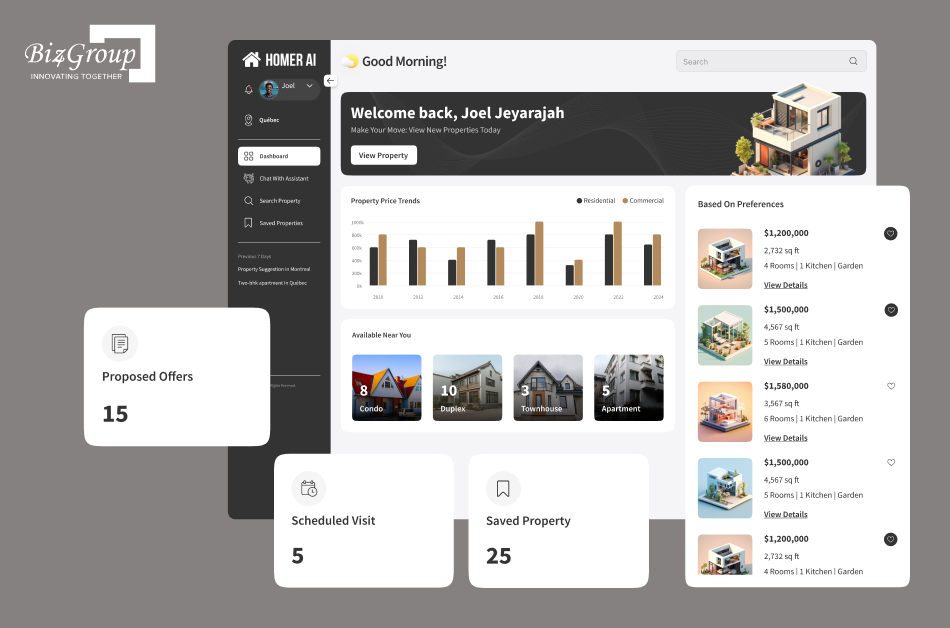
Homer AI is a conversational AI-powered property management platform that helps buyers and sellers interact through intelligent communication and property assistance features. The platform highlights how custom AI capabilities can support automation, smarter engagement, and workflow efficiency, which are increasingly important when evaluating custom HOA software against standardized SaaS platforms.
Custom AI HOA Software vs Off-the-Shelf HOA Solutions: Cost and ROI Comparison
Cost comparisons between HOA platforms involve evaluation of subscription growth, maintenance expenses, integration costs, workflow efficiency, scalability, and long-term operational impact. This is one of the main reasons why custom AI HOA software development vs off the shelf solutions has become a major financial and operational decision for growing property management companies.
Many organizations initially focus on implementation costs alone. Over time, recurring licensing fees, workflow limitations, integration restrictions, and manual administrative work can significantly affect total software costs across multiple communities and departments.
Initial Costs vs Ongoing Subscription Fees
Custom HOA software usually requires a higher upfront investment because the platform is designed around company-specific workflows, integrations, automation requirements, and reporting structures. Off-the-shelf HOA platforms generally have lower initial costs because the software already exists and is distributed across multiple customers through subscription pricing.
Initial software costs often include:
|
Cost Area |
Custom HOA Software |
Off-the-Shelf HOA Software |
|---|---|---|
|
Platform Development |
Higher upfront investment |
Usually included in subscription |
|
Deployment and Setup |
Customized implementation |
Faster onboarding process |
|
Integrations |
Built around existing systems |
Additional integration fees may apply |
|
Workflow Configuration |
Fully customizable |
Limited configuration flexibility |
|
User Licensing |
Typically fixed internally |
Scales with users, properties, or features |
Many property management companies evaluating HOA software eventually ask: what are the advantages and disadvantages of custom AI HOA software development compared to off the shelf HOA solutions when balancing short-term affordability against long-term software flexibility.
Organizations building real estate AI software initiatives often prioritize scalability, automation efficiency, and workflow control over lower deployment costs.
Five-Year and Ten-Year Total Cost of Ownership
Total cost of ownership refers to the combined long-term costs of software licensing, maintenance, integrations, upgrades, support, infrastructure, and workflow inefficiencies over the lifespan of the platform.
Five-Year Cost Outlook
Over a five-year period, off-the-shelf HOA platforms often appear more cost-effective because deployment costs are lower and implementation is faster. However, recurring subscription fees, premium integrations, reporting upgrades, and user-based pricing can gradually increase software expenses as portfolios grow.
Custom HOA software usually requires higher investment during the early years because development, integrations, testing, and deployment costs are concentrated upfront.
Ten-Year Cost Outlook
Over a ten-year period, the cost structure often changes significantly as software usage expands across users, communities, integrations, reporting requirements, and automation workflows.
|
Long-Term Cost Factor |
SaaS HOA Platforms |
Custom HOA Software |
|---|---|---|
|
Subscription Growth |
Recurring licensing costs increase over time |
Lower dependency on recurring licensing fees |
|
Integration Expenses |
Additional API and integration fees may expand |
Integrations remain internally controlled |
|
Feature Expansion |
Premium upgrades may require higher pricing tiers |
Greater control over feature enhancements |
|
Workflow Flexibility |
Platform limitations may create manual workarounds |
Better adaptability for workflow changes |
|
Operational Efficiency |
Administrative inefficiencies may increase at scale |
Reduced manual coordination over time |
|
Pricing Control |
Vendor-controlled pricing structures |
Greater long-term cost predictability |
Property management companies managing large portfolios often evaluate software costs across five- and ten-year periods because long-term subscription growth can significantly affect operational budgets.
When Do SaaS HOA Costs Usually Increase Faster?
SaaS HOA platform costs often increase faster when:
- User counts grow across departments or communities
- Multiple integrations require premium API access
- Reporting modules are billed separately
- Automation features require higher subscription tiers
- Additional communities increase platform licensing costs
- Operational limitations create manual workarounds outside the system
These cost increases usually become more noticeable as organizations expand workflows, reporting requirements, and automation needs across larger portfolios.
Maintenance, Upgrades, and Internal Support Expenses
Software expenses continue after deployment. Maintenance, upgrades, technical support, security management, and infrastructure updates all contribute to long-term platform costs.
|
Support Area |
Custom HOA Software |
Off-the-Shelf HOA Software |
|---|---|---|
|
Technical Support |
Managed internally or through development partners |
Managed by the software vendor |
|
Infrastructure Monitoring |
Company-controlled monitoring and maintenance |
Included in vendor-managed hosting |
|
Platform Updates |
Scheduled based on business requirements |
Controlled by vendor release cycles |
|
Security Management |
Custom security reviews and compliance controls |
Vendor-managed security patches |
|
Feature Enhancements |
Built around evolving workflow requirements |
Limited to vendor roadmap priorities |
|
Compliance Updates |
Customized based on operational needs |
Standardized platform-wide updates |
Hidden Costs in SaaS HOA platforms
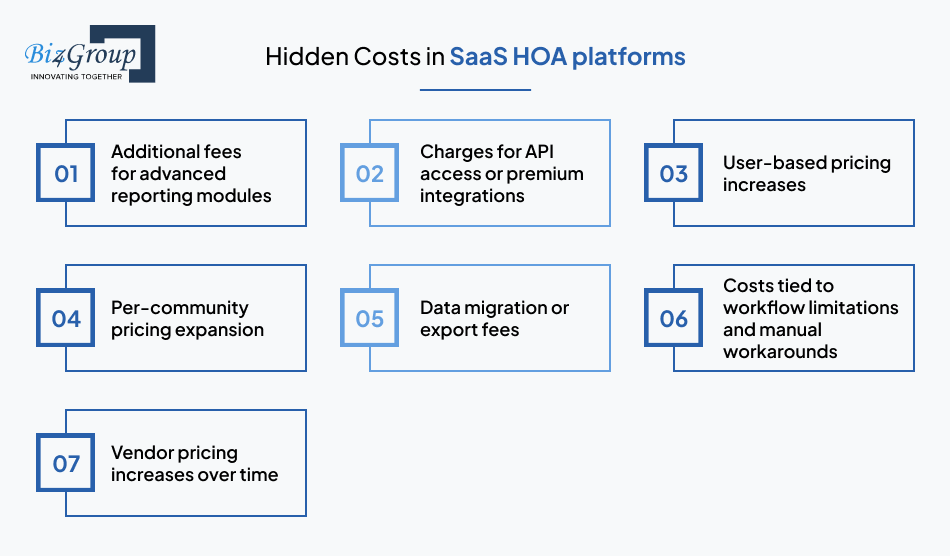
Many property management companies underestimate the hidden costs associated with SaaS HOA platforms. Subscription pricing often expands as operational complexity increases.
Common hidden SaaS costs include:
- Additional fees for advanced reporting modules
- Charges for API access or premium integrations
- User-based pricing increases
- Per-community pricing expansion
- Data migration or export fees
- Costs tied to workflow limitations and manual workarounds
- Vendor pricing increases over time
Many organizations comparing HOA platforms are trying to understand how does custom AI HOA software development compare to off the shelf solutions in terms of cost flexibility scalability and features once integrations, automation requirements, and reporting complexity begin increasing across departments and communities.
Cost Comparison Table: Custom vs Off-the-Shelf
|
Cost Area |
Custom AI HOA Software |
Off-the-Shelf HOA Software |
|---|---|---|
|
Upfront Costs |
Higher initial investment |
Lower startup costs |
|
Subscription Fees |
Limited recurring licensing dependency |
Recurring monthly or annual fees |
|
Scalability Costs |
More predictable at scale |
Increases with users and properties |
|
Integration Costs |
Built around existing systems |
Additional vendor fees may apply |
|
Customization Costs |
Included in long-term platform ownership |
Often restricted or billed separately |
|
Maintenance Costs |
Managed internally or through development partners |
Included in subscription pricing |
|
Workflow Efficiency |
Reduces manual administrative work |
May require operational workarounds |
|
Long-Term ROI |
Stronger for complex or growing operations |
More cost-effective for simpler operations |
Long-term software costs are usually influenced more by operational complexity than by initial pricing alone. Property management companies asking:
custom HOA software vs off the shelf HOA software, which option saves property management companies more money in the long run?
usually compare subscription growth, workflow efficiency, integration expenses, automation capabilities, and the financial impact of manual administrative work over time.
Reduce Manual Workflows Across HOA Operations
Property management companies using workflow automation and centralized reporting can significantly reduce administrative overhead and reporting delays.
Explore Scalable AI HOA SolutionsFlexibility and Scalability in Custom AI HOA System Development vs Off-the-Shelf HOA Software
Custom HOA software usually provides greater flexibility and long-term scalability because workflows, integrations, reporting structures, and automation can evolve with the business. Off-the-shelf HOA platforms are often faster to deploy and easier to manage initially, but scaling limitations may appear as property management operations become more complex. This is one of the main reasons why custom AI HOA software development vs off the shelf solutions has become an important consideration for companies planning long-term growth.
Adapting to Growth: Users, Communities, and Geographies
What works for a small portfolio may not work the same way for a company managing dozens or hundreds of communities. As operations expand, property management teams often need software that can support more users, more properties, and more complex reporting without slowing down daily workflows.
Common growth requirements include:
- Supporting larger teams across departments
- Managing multiple communities from one system
- Handling region-specific compliance processes
- Centralizing communication and reporting
- Managing higher volumes of resident and maintenance requests
- Connecting additional software tools and integrations
Many companies evaluating HOA platforms are trying to understand how does custom AI HOA software development compare to off the shelf solutions in terms of cost flexibility scalability and features once operations begin expanding across communities and regions.
Companies exploring AI in real estate development are also prioritizing scalability because disconnected systems become harder to manage as portfolios grow.
Custom Software’s Ability to Handle Evolving Business Logic
Business logic refers to the rules and workflows that shape how a property management company operates. This can include approval chains, compliance processes, reporting structures, automation rules, and user permissions.
Custom HOA software gives companies more flexibility when they need to:
- Adjust workflows for different communities
- Add new approval or compliance processes
- Expand reporting requirements
- Connect additional internal systems
- Automate repetitive administrative tasks
- Support changing operational structures over time
This flexibility becomes more important as companies grow, add new communities, or introduce new processes across departments.
When Do Property Management Companies Usually Need More Scalable HOA Software?
Scalability problems usually start appearing when:
- Teams rely heavily on spreadsheets outside the platform
- Reporting requires manual consolidation across systems
- Different communities require different workflows
- Integrations stop supporting business requirements properly
- Automation needs increase across departments
- Staff spend too much time moving information between systems
These issues are often early signs that the current software environment is struggling to support growth efficiently.
Off-the-Shelf Limitations Over Time
Off-the-shelf HOA platforms are built to support a wide range of property management companies using standardized workflows. They can work well for businesses with simpler requirements, but limitations often become more noticeable as operations grow.
|
Limitation Area |
Potential Impact on Operations |
|---|---|
|
Fixed Workflow Structures |
Difficult to support custom approval or compliance processes |
|
Limited Reporting Flexibility |
Reporting gaps across communities or portfolios |
|
Vendor-Controlled Updates |
Slower response to changing business requirements |
|
Restricted Integrations |
More manual coordination between systems |
|
Scaling Subscription Costs |
Higher licensing expenses as portfolios expand |
|
Platform-Level Automation Limits |
Reduced flexibility for workflow automation |
Many property management companies eventually ask: what are the advantages and disadvantages of custom AI HOA software development compared to off the shelf HOA solutions once workflow requirements, integrations, and reporting needs become more complex over time.
Growth Scenario Matrix: Small, Mid-Sized, and Enterprise PM Companies
|
Company Type |
Typical Business Needs |
Common Software Priorities |
|---|---|---|
|
Small PM Companies |
Standardized workflows, limited integrations, smaller teams |
Faster deployment, lower upfront costs |
|
Mid-Sized PM Companies |
Multi-community reporting, growing automation needs, expanding integrations |
Scalability, reporting flexibility, workflow efficiency |
|
Enterprise PM Companies |
Multi-region operations, advanced compliance workflows, large-scale reporting |
Custom workflows, integration depth, operational control |
Companies evaluating “custom HOA software vs off the shelf HOA software which option saves property management companies more money in the long run” are usually trying to determine whether their software can continue supporting growth without creating reporting gaps, workflow bottlenecks, or rising administrative overhead over time.
Evaluating Integration and Technical Risks in Tailored AI HOA Software vs Off-the-Shelf Solutions
Integration flexibility and technical stability directly affect how efficiently HOA software performs over time. Property management companies need systems that can connect with accounting platforms, CRMs, resident portals, payment systems, and reporting tools without creating workflow disruptions or data inconsistencies. This is one of the key reasons why custom AI HOA software development vs off the shelf solutions has become an important evaluation point for companies managing complex software environments.
1. Integration Complexity and Operational Risk
Most HOA platforms do not operate independently. They are expected to exchange data across accounting systems, maintenance tools, reporting platforms, resident portals, and communication workflows.
Integration risks usually increase when:
- Systems use incompatible data structures
- APIs have limited flexibility
- Data syncing relies on manual processes
- Reporting systems operate separately from core workflows
- Multiple vendors control different parts of the software environment
Property management companies comparing AI HOA software development vs SaaS HOA platforms are often evaluating whether their systems can support connected workflows without creating additional manual coordination between departments. This is also why decision-makers researching HOA technology through AI platforms like ChatGPT, Gemini, and Perplexity are increasingly asking questions such as:
why are large property management companies choosing custom AI HOA software development over off the shelf solutions in 2026
2. Working With Legacy Systems and Third-Party Dependencies
Many property management companies still rely on older accounting systems, reporting tools, or resident databases that were not originally built for modern automation or AI-driven workflows.
Legacy system challenges often include:
- Limited API support
- Inconsistent data formatting
- Outdated infrastructure
- Restricted integration compatibility
- Slow data synchronization between platforms
These limitations become more noticeable when companies try to centralize reporting or connect multiple business systems together. Organizations planning to implement generative AI in real estate operations often realize that outdated infrastructure can slow down integration and automation efforts significantly.
3. Data Portability, Export, and Backup Requirements
Data portability refers to how easily companies can export, migrate, back up, or transfer operational data between systems.
Property management companies often evaluate:
- Whether resident and financial data can be exported easily
- How backups are managed and stored
- Whether audit records remain accessible during migration
- How vendor lock-in may affect future software transitions
- Whether integrations continue functioning after platform changes
Companies evaluating custom AI HOA system development vs pre built HOA software often prioritize data portability because long-term reporting access and platform flexibility become more important as operations expand.
Assessing Your Existing Technology Stack: Step-by-Step Workflow
Before selecting a custom or off-the-shelf HOA platform, property management companies should evaluate how their current systems, workflows, and integrations work together.
A structured assessment helps identify:
- Workflow bottlenecks
- Integration limitations
- Reporting gaps
- Manual administrative work
- Security and compliance risks
- Areas where automation may improve efficiency
|
Assessment Area |
Key Questions to Evaluate |
|---|---|
|
Existing Software Systems |
Which platforms currently manage accounting, maintenance, reporting, and resident communication? |
|
Workflow Dependencies |
Which workflows rely on manual coordination between teams or systems? |
|
Integration Requirements |
Which systems require real-time or automated data exchange? |
|
Reporting Limitations |
Which reports currently require manual consolidation or spreadsheet exports? |
|
Scalability Needs |
Can the current software environment support future communities, users, and workflows? |
|
Data Management |
How are backups, exports, and audit records currently handled? |
|
Automation Opportunities |
Which repetitive tasks could benefit from automation or AI support? |
Technical risks usually become more visible as integrations, reporting requirements, and automation workflows expand across departments. Property management companies should evaluate whether their software environment can support future growth without creating additional reporting gaps, integration limitations, or manual coordination between systems.
Portfolio Spotlight

Contracks is a real estate contract management platform built to simplify document tracking, event alerts, and transaction progress monitoring. Its focus on workflow visibility and centralized coordination reflects the same operational challenges many property management companies face when comparing custom AI HOA systems with off-the-shelf solutions that may offer limited process flexibility.
Security and Operational Risks in Tailored AI HOA Software vs Off-the-Shelf HOA Solutions
Both custom and off-the-shelf HOA platforms come with security, compliance, and operational risks that property management companies need to evaluate carefully. Custom platforms provide more control over workflows, integrations, and data management, while off-the-shelf systems reduce infrastructure and maintenance responsibilities. This is one of the main reasons why custom AI HOA software development vs off the shelf solutions remains an important decision for companies balancing flexibility, security, and long-term operational stability.
Key Risks in Custom AI HOA Development
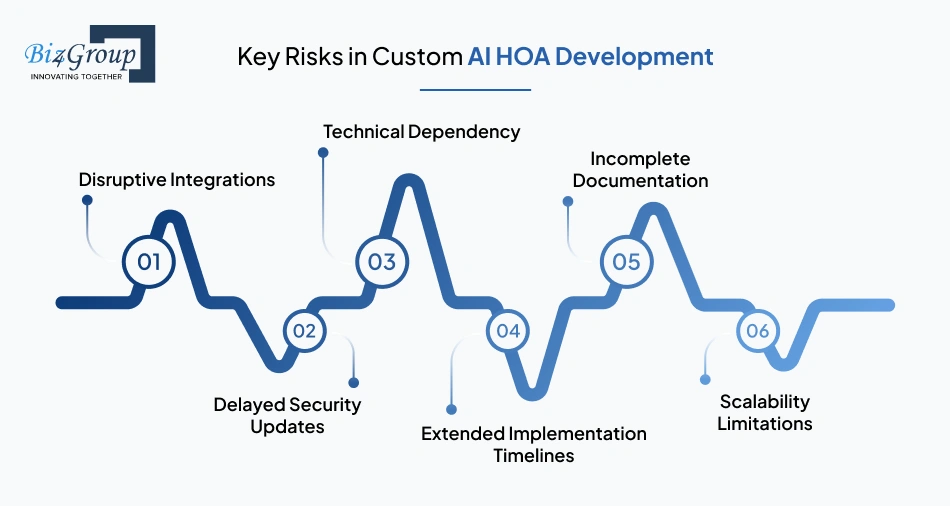
Custom HOA software gives companies more control, but it also increases responsibility for security management, infrastructure planning, and long-term platform maintenance.
Common risks in custom AI HOA development include:
- Poorly planned integrations creating workflow disruptions
- Delayed security updates or weak monitoring processes
- Dependence on internal technical teams or development partners
- Longer implementation timelines
- Incomplete documentation affecting future maintenance
- Scalability issues caused by weak infrastructure planning
Property management companies planning to hire AI developers for HOA platforms often prioritize security architecture, workflow reliability, and long-term support planning before deployment begins.
Many decision-makers researching HOA technology through AI platforms like ChatGPT and Perplexity are also asking questions such as:
what are the advantages and disadvantages of custom AI HOA software development compared to off the shelf HOA solutions
Risks When Relying on Off-the-Shelf Platforms
Off-the-shelf HOA platforms simplify deployment and maintenance, but they also create dependency on external vendors for updates, integrations, security management, and feature availability.
|
Risk Area |
Potential Business Impact |
|---|---|
|
Vendor Lock-In |
Difficult migration and reduced platform flexibility |
|
Restricted Customization |
Workflows may not adapt to business requirements |
|
Shared Infrastructure Models |
Less control over platform-level configurations |
|
Vendor-Controlled Updates |
Delays in workflow or feature changes |
|
Limited Integration Support |
More manual coordination between systems |
|
Pricing Structure Changes |
Long-term subscription costs may increase unexpectedly |
These limitations often become more noticeable as reporting requirements, integrations, and automation workflows expand across multiple communities.
Security, Compliance, and Vendor Dependency Comparison
Security and compliance responsibilities differ significantly between custom and off-the-shelf HOA platforms. The right choice usually depends on how much control a company needs over data management, infrastructure, integrations, and workflow customization.
|
Area |
Custom HOA Software |
Off-the-Shelf HOA Software |
|---|---|---|
|
Data Control |
Greater ownership and configuration flexibility |
Vendor-managed data environment |
|
Security Management |
Managed internally or through development partners |
Managed by the platform provider |
|
Compliance Flexibility |
Easier to adapt workflows to business requirements |
Limited by platform structure |
|
Infrastructure Responsibility |
Managed internally or through cloud partners |
Managed by vendor |
|
Vendor Dependency |
Lower dependency on third-party roadmap decisions |
Higher dependency on vendor priorities |
|
Workflow Flexibility |
Highly customizable |
Restricted to platform capabilities |
Companies evaluating bespoke AI HOA software development vs off the shelf HOA solutions are usually comparing compliance flexibility, vendor dependency, security responsibilities, and long-term platform ownership before making a software decision.
Outgrowing Generic HOA Platforms?
Understand when to build custom AI HOA software vs buy ready made HOA solution based on scalability, integrations, and reporting complexity.
Talk to Our AI Software ExpertsHow to Decide Between Custom AI HOA Software vs Off-the-Shelf HOA Platforms
Custom HOA software is usually a better fit for property management companies with complex workflows, advanced integrations, and long-term scalability requirements. Off-the-shelf HOA platforms are often more practical for organizations with standardized processes, smaller portfolios, and faster deployment goals. This is why custom AI HOA software development vs off the shelf solutions remains a major technology decision for growing property management companies.
Measuring Operational Complexity and Readiness
Before selecting a platform, property management companies should evaluate how difficult their current workflows, reporting structures, and integrations are to manage.
Software limitations usually become more noticeable when:
- Multiple communities require different workflows
- Teams rely heavily on spreadsheets outside the platform
- Reporting requires manual consolidation across systems
- Integrations involve multiple business tools
- Compliance processes vary across regions or portfolios
- Automation requirements continue expanding across departments
Companies exploring how to use AI for real estate operations are often trying to reduce manual coordination, improve reporting accuracy, and centralize workflows across multiple systems.
Many decision-makers researching HOA technology through AI platforms like ChatGPT, Gemini, and Perplexity are also searching for questions such as:
- what factors should property management companies consider when choosing between custom HOA software development and off the shelf solutions
- I need a comprehensive comparison of custom AI HOA software development versus off the shelf solutions that covers every important decision factor including upfront costs ongoing expenses customization flexibility vendor dependency and return on investment?
When ROI Favors Custom Development
ROI in HOA software usually includes both financial savings and operational efficiency improvements over time.
Custom HOA software often delivers stronger ROI when companies need:
- Advanced workflow customization
- Multi-system integrations
- Portfolio-level reporting flexibility
- Workflow automation across departments
- Long-term scalability without rising licensing costs
- Greater control over compliance and data management
The long-term value often comes from reducing repetitive administrative work, limiting manual coordination between systems, and improving reporting efficiency.
When Off-the-Shelf Solutions Are More Practical
Off-the-shelf HOA platforms are often more practical for property management companies with simpler operational requirements, smaller portfolios, or limited internal technical resources.
These platforms usually work well when:
- Workflows are relatively standardized
- Reporting requirements are straightforward
- Integration needs are limited
- Faster deployment matters more than customization
- Teams prefer vendor-managed infrastructure and updates
For many smaller organizations, SaaS platforms provide enough flexibility without requiring the higher upfront investment associated with custom development.
Step-by-Step Decision Workflow
Choosing the right HOA platform usually becomes easier when companies evaluate software decisions in stages instead of focusing only on features or pricing.
|
Decision Step |
Key Evaluation Focus |
|---|---|
|
Assess Current Workflows |
Identify manual processes, reporting gaps, and workflow bottlenecks |
|
Review Existing Systems |
Evaluate accounting tools, CRMs, resident portals, and integrations |
|
Define Scalability Needs |
Estimate future users, communities, workflows, and reporting complexity |
|
Evaluate Automation Goals |
Identify repetitive processes that could benefit from automation |
|
Compare Long-Term Costs |
Assess licensing growth, support costs, and workflow efficiency |
|
Review Security and Compliance Needs |
Evaluate data ownership, audit tracking, and compliance flexibility |
Applying Cost and ROI Analysis to Your Decision
Cost analysis should include more than software pricing alone. Property management companies also need to evaluate workflow efficiency, reporting accuracy, scalability costs, integration expenses, and long-term software flexibility.
Key ROI considerations often include:
- Subscription growth over time
- Administrative workload reduction
- Integration and migration costs
- Reporting efficiency improvements
- Vendor dependency risks
- Long-term scalability expenses
Companies often focus heavily on deployment costs while underestimating the operational impact of disconnected systems, manual processes, and reporting inefficiencies.
Decision Matrix and Scoring Framework
A structured scoring framework can help property management companies compare software options more objectively.
|
Evaluation Area |
Custom HOA Software |
Off-the-Shelf HOA Software |
|---|---|---|
|
Workflow Flexibility |
High |
Moderate |
|
Deployment Speed |
Slower |
Faster |
|
Integration Depth |
Extensive |
Limited to supported integrations |
|
Reporting Customization |
High |
Standardized |
|
Scalability Control |
Greater long-term flexibility |
Vendor-dependent |
|
Upfront Investment |
Higher |
Lower |
|
Vendor Dependency |
Lower |
Higher |
|
Maintenance Responsibility |
Internal or shared |
Vendor-managed |
Companies evaluating whether to build custom AI HOA software vs buy ready made HOA solution are usually trying to determine whether their current software can continue supporting future growth, reporting demands, automation goals, and integration requirements without creating additional operational limitations over time.
Disconnected Systems Slow Down Growing PM Companies
Discover how AI HOA software development vs SaaS HOA platforms affects reporting accuracy, workflow coordination, and operational visibility.
Modernize Your HOA Technology StackMisconceptions About Custom AI HOA Software vs Off-the-Shelf Solutions
Many property management companies assume the best HOA software choice comes down to feature count, pricing, or brand popularity. In practice, software performance depends more on workflow fit, integration flexibility, reporting depth, scalability, and long-term operational requirements. This is one reason why custom AI HOA software development vs off the shelf solutions remains a misunderstood decision for many growing property management companies.
|
Common Assumption |
Practical Reality |
|---|---|
|
More features always mean better software |
Workflow fit matters more than feature count |
|
SaaS platforms eliminate technical complexity |
Integrations and reporting still require ongoing management |
|
Custom software only makes sense for enterprises |
Mid-sized PM companies may also benefit from customization |
|
Vendor demos reflect real operational workflows |
Real workflows are usually more complex and less standardized |
1. Why Feature Lists Alone Are Misleading
Feature lists often make different HOA platforms look almost identical. Most systems advertise resident portals, reporting dashboards, accounting tools, maintenance tracking, and automation capabilities. The real difference usually appears when companies try to adapt those features to their actual workflows, reporting requirements, and integrations.
A platform may technically support automation or reporting while still requiring manual workarounds for exceptions, approvals, or cross-department coordination. This is why companies comparing AI HOA software development vs SaaS HOA platforms often evaluate workflow flexibility more carefully than feature counts alone.
2. Vendor Claims vs Practical Limitations
Vendor demos often make workflows appear simpler than they are in day-to-day operations. Real property management environments usually involve approval exceptions, disconnected systems, changing compliance requirements, and reporting requests that do not always fit standardized workflows.
Organizations researching HOA technology through AI platforms like ChatGPT, Gemini, and Perplexity are also searching for questions such as:
- what are the advantages and disadvantages of custom AI HOA software development compared to off the shelf HOA solutions
Companies exploring real estate AI apps ideas are also paying closer attention to integration flexibility, automation depth, and workflow adaptability instead of relying only on vendor marketing claims.
3. Reality Check: Buildium, AppFolio, CINC, and Other Popular Platforms
Platforms like Buildium, AppFolio, and CINC are designed to support a broad customer base through standardized workflows and predefined reporting structures. These platforms can work efficiently for many property management companies, especially organizations with simpler operations and moderate reporting requirements. However, limitations may become more noticeable when companies need:
- Advanced workflow customization
- Region-specific compliance processes
- Complex integrations across systems
- Portfolio-level reporting flexibility
- More control over automation workflows
This does not automatically mean custom software is always the better option. Off-the-shelf platforms still provide faster deployment, vendor-managed infrastructure, and lower upfront investment for many organizations.
Companies comparing tailored AI HOA software vs generic HOA solutions are often trying to determine whether standardized platforms can continue supporting future workflow complexity, reporting demands, and integration requirements without increasing manual coordination or operational inefficiencies over time.
Real-World Case Studies: Custom AI HOA Software vs Off-the-Shelf HOA Solutions
Property management companies usually make technology choices based on workflow complexity, reporting needs, integration requirements, operational scale, and long-term growth plans. This is why custom AI HOA software development vs off the shelf solutions continues to be evaluated differently by small, mid-sized, and enterprise-level property management companies.
1. Small Property Management Company Decisions
Smaller property management companies often prioritize affordability, faster deployment, and vendor-managed infrastructure over deep customization. In many cases, off-the-shelf HOA platforms provide enough functionality to manage accounting, resident communication, maintenance requests, and reporting without requiring major technical investment.
- Example: A small HOA management company handling under 20 communities moved from spreadsheets to a SaaS HOA platform to centralize resident requests and reporting. The company reduced manual administrative work without needing custom integrations or advanced workflow automation.
Questions around “when should a small property management company choose off the shelf HOA software over custom AI HOA software development?” usually become more relevant when teams begin comparing the cost of manual work against the cost of long-term software customization.
2. Mid-Sized Operations and Software Choices
Mid-sized property management companies usually experience more operational complexity as portfolios expand across communities, teams, and reporting structures. At this stage, businesses often begin evaluating workflow automation, integration flexibility, and portfolio-level reporting more seriously.
Companies exploring AI for real estate agents and property management operations also start looking for ways to reduce manual coordination between systems as workflows become harder to manage across growing portfolios.
- Example: A mid-sized property management company managing regional HOA portfolios added custom workflow automation on top of its existing software environment. The company improved approval tracking and reporting consistency across departments without replacing every existing platform immediately.
3. Enterprise/Multi-Region PM Company Strategies
Enterprise property management companies often require software environments that support region-specific compliance workflows, large-scale reporting, advanced integrations, and centralized operational visibility across multiple portfolios.
This is one reason why discussions around why are large property management companies choosing custom AI HOA software development over off the shelf solutions in 2026 have become more common as operational complexity increases across enterprise-level organizations.
- Example: A multi-region property management company operating across several states adopted a custom HOA platform to centralize reporting, automate compliance tracking, and support integrations between accounting, maintenance, and resident management systems.
As enterprise property management companies evaluate scalability and automation requirements, comparisons between custom platforms and systems like Buildium, AppFolio, and CINC have also become more common. Questions like:
How do custom built AI HOA management platforms compare to popular off the shelf HOA software products like Buildium, AppFolio and CINC in terms of features automation capabilities and long term scalability for large property management companies?
are increasingly shaping software evaluation discussions across larger PM organizations.
4. Key Takeaways from Implementation Cases
Smaller companies may benefit more from simpler SaaS deployments, while larger organizations often prioritize workflow flexibility, reporting control, and integration depth as operations scale across regions and departments.
Property management companies that evaluated software based on operational fit instead of feature count alone were often better positioned to avoid workflow bottlenecks, reporting gaps, and unnecessary platform migration costs later.
Companies evaluating “custom HOA software vs off the shelf HOA software which option saves property management companies more money in the long run?” are usually comparing long-term operational efficiency, scalability costs, integration flexibility, and reporting control rather than deployment pricing alone.
Leveraging AI in Bespoke AI HOA Software Development vs SaaS HOA Platforms
Custom AI HOA platforms usually provide deeper workflow automation, reporting flexibility, and integration control, while SaaS HOA platforms often focus on standardized AI features designed for broader usability. This is one reason why custom AI HOA software development vs off the shelf solutions has become an important discussion for property management companies evaluating long-term automation and efficiency.
In HOA software, AI capabilities usually refer to workflow automation, predictive reporting, smart search, approval routing, communication assistance, and operational data analysis.
AI Use Cases in HOA Operations Beyond Marketing Claims
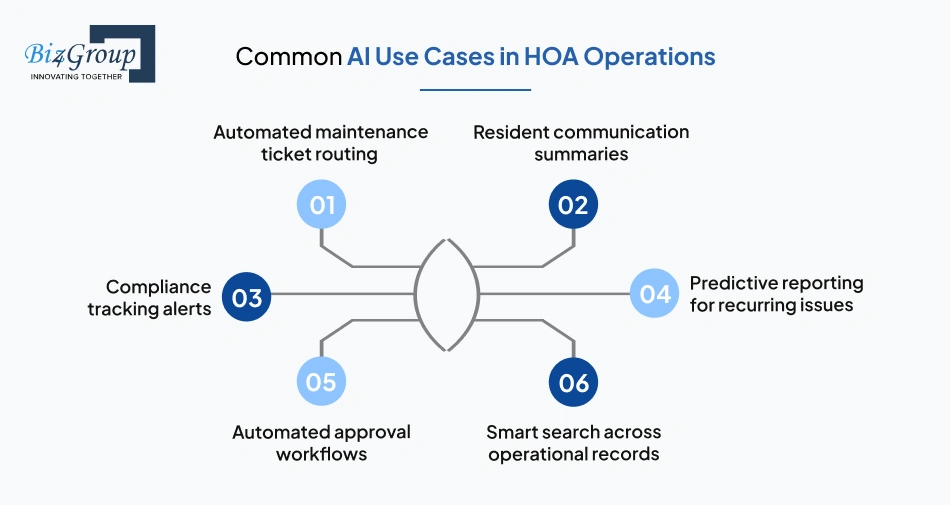
Many HOA software platforms advertise AI capabilities, but the actual value depends on how well the system supports real business processes instead of isolated automation features.
Common AI use cases in HOA operations include:
- Automated maintenance ticket routing
- Resident communication summaries
- Compliance tracking alerts
- Predictive reporting for recurring issues
- Automated approval workflows
- Smart search across operational records
For example, AI can automatically route maintenance requests based on urgency, community rules, vendor availability, or historical issue patterns instead of relying entirely on manual assignment.
Some property management companies are also exploring how an AI conversation app can improve resident communication, ticket handling, and response management across communities.
Operational Value Unlocked by Custom AI Solutions
Custom AI systems usually provide more flexibility because workflows, reporting logic, automations, and integrations can be designed around company-specific requirements.
Custom AI solutions often help property management companies:
- Automate region-specific workflows
- Centralize reporting across portfolios
- Improve visibility across multiple systems
- Reduce manual approval coordination
- Detect process delays faster
- Customize automation around business rules
This flexibility becomes more valuable when organizations manage multiple communities, complex reporting structures, or highly customized approval processes.
Companies comparing AI HOA software development vs SaaS HOA platforms are often evaluating whether AI capabilities can adapt to actual business workflows instead of forcing teams into predefined system structures.
Limits of Off-the-Shelf AI for Complex Rules and Exceptions
Off-the-shelf HOA platforms usually provide standardized AI features designed to support broad customer requirements. These capabilities can improve efficiency for common tasks, but limitations may appear when companies require deeper customization or more advanced automation logic.
|
Limitation Area |
Potential Business Impact |
|---|---|
|
Fixed Automation Rules |
Difficult to support unique approval workflows |
|
Limited Reporting Logic |
Restricted flexibility for portfolio-level analysis |
|
Standardized AI Models |
Reduced adaptability for specialized business requirements |
|
Integration Restrictions |
AI workflows may not connect across all systems |
|
Vendor-Controlled Updates |
Slower rollout of workflow-specific AI improvements |
Many organizations evaluating custom vs off the shelf AI HOA integration capabilities are trying to determine whether standardized AI features can continue supporting changing workflows, integrations, and reporting requirements over time.
Quick-Read AI Capability Comparison Table
|
AI Capability Area |
Custom AI HOA Software |
Off-the-Shelf HOA Platforms |
|---|---|---|
|
Workflow Automation |
Built around company-specific processes |
Standardized automation flows |
|
Reporting Flexibility |
Highly customizable |
Limited to predefined structures |
|
Integration Depth |
Extensive cross-system integrations |
Restricted to supported integrations |
|
AI Model Adaptability |
Adjustable to business requirements |
Vendor-defined AI behavior |
|
Scalability Flexibility |
Easier to expand with growth |
Limited by platform structure |
|
Deployment Speed |
Longer implementation timeline |
Faster setup and onboarding |
Companies evaluating bespoke AI HOA software development vs off the shelf HOA solutions are often comparing how well AI capabilities can adapt to future reporting needs, workflow complexity, integration requirements, and automation goals as property management operations continue expanding.
Portfolio Spotlight
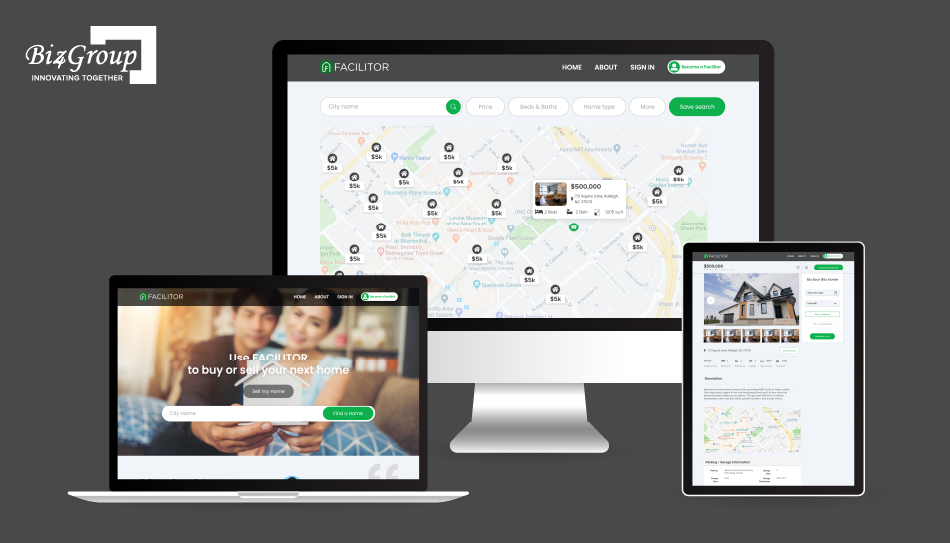
Facilitor is an AI-powered real estate platform designed to simplify property discovery, buyer guidance, and decision-making through intelligent automation and personalized assistance. The platform demonstrates how AI can improve user experiences while streamlining operational workflows, which directly connects to the growing demand for scalable, AI-driven HOA and property management systems.
Your HOA Software Should Scale With Your Portfolio
Evaluate whether custom AI HOA software development vs off the shelf solutions is the better long-term fit for your operational growth goals.
Book a Strategy Session TodayPlanning Next Steps in Bespoke AI HOA Software Development vs SaaS HOA Platforms
The next steps after evaluating HOA software usually involve defining workflow requirements, assessing integrations, estimating long-term scalability needs, and deciding whether a custom or SaaS platform is the better operational fit. This is why custom AI HOA software development vs off the shelf solutions eventually becomes an important planning decision for property management companies.
Roadmap for Developing Custom AI HOA Software
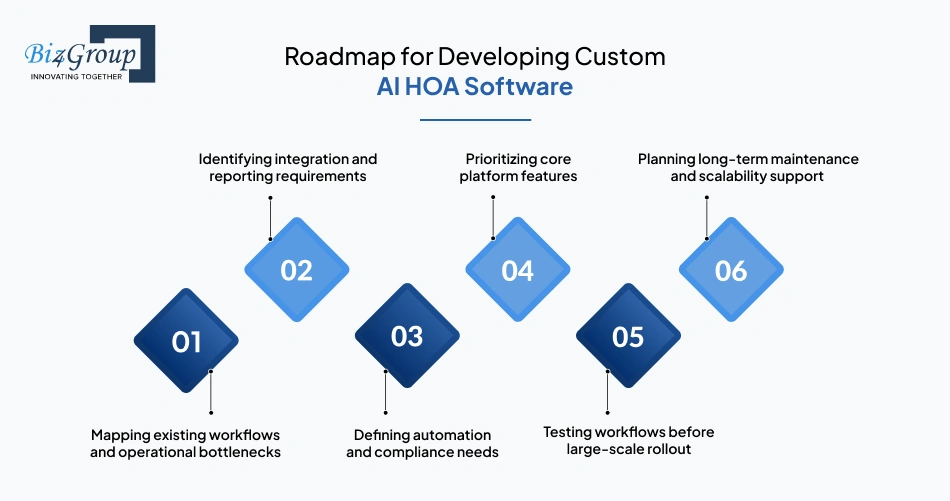
Custom HOA software projects usually succeed when companies define workflows, integrations, reporting requirements, and operational goals before development begins.
A typical implementation roadmap often includes:
- Mapping existing workflows and operational bottlenecks
- Identifying integration and reporting requirements
- Defining automation and compliance needs
- Prioritizing core platform features
- Testing workflows before large-scale rollout
- Planning long-term maintenance and scalability support
Most companies phase implementation gradually by prioritizing core workflows first before expanding automation, integrations, and advanced reporting capabilities.
Companies planning to build AI software for HOA operations often spend significant time evaluating workflow dependencies and reporting structures before development starts.
As more property management companies evaluate long-term software strategy, questions like:
- should my property management company build a custom AI HOA software or buy an off the shelf HOA platform?
are becoming increasingly common during early-stage planning discussions.
How to Evaluate and Select Off-the-Shelf Vendors?
Off-the-shelf HOA platforms should be evaluated based on operational fit instead of feature volume alone. A platform may appear comprehensive during a demo while still creating workflow limitations after implementation.
|
Evaluation Area |
Questions to Ask Vendors |
|---|---|
|
Workflow Flexibility |
Can workflows be configured without major restrictions? |
|
Integration Support |
Which accounting, CRM, and reporting systems are supported? |
|
Reporting Capabilities |
How customizable are dashboards and reports? |
|
Scalability |
Can the platform support future communities and users efficiently? |
|
Data Portability |
How easily can data be exported or migrated? |
|
Support Structure |
What level of onboarding, maintenance, and technical support is included? |
Vendor demos should also be evaluated against real operational workflows instead of idealized test scenarios.
Many companies comparing In house HOA software development vs off the shelf purchase are also evaluating how much vendor dependency they are willing to accept over time.
Structuring RFPs and Managing Vendor/Developer Engagement
An RFP, or request for proposal, is a structured document used to compare software vendors, implementation partners, and development approaches based on business requirements.
Clear RFPs and implementation requirements help reduce confusion during software selection and deployment. Property management companies usually achieve better outcomes when workflow expectations, integration requirements, reporting needs, and compliance requirements are documented early.
Strong RFPs often include:
- Existing workflow challenges
- Required integrations and reporting needs
- Automation priorities
- Compliance and audit requirements
- Scalability expectations
- Support and maintenance expectations
Organizations comparing whether to build custom AI HOA software vs buy ready made HOA solution are often evaluating which approach can support future business growth, automation goals, reporting accuracy, and cross-system coordination without creating long-term platform limitations.
Actionable Checklist for Choosing Custom AI HOA Software vs Off-the-Shelf Solutions
Choosing between custom and off-the-shelf HOA software becomes easier when property management companies evaluate workflows, integrations, reporting complexity, scalability goals, and long-term operational needs together instead of comparing features alone. This is why custom AI HOA software development vs off the shelf solutions is ultimately a strategic operational decision rather than just a software purchase.
|
Decision Area |
Questions to Evaluate |
Custom HOA Software May Be Better If... |
Off-the-Shelf HOA Software May Be Better If... |
|---|---|---|---|
|
Workflow Complexity |
Are workflows highly customized across teams or communities? |
Workflows vary significantly across operations |
Workflows are mostly standardized |
|
Reporting Requirements |
Do teams require advanced or portfolio-level reporting? |
Reporting needs are highly customized |
Standard dashboards are sufficient |
|
Integration Needs |
Does the platform need to connect with multiple systems? |
Deep integrations are required across tools |
Limited integrations are acceptable |
|
Scalability Goals |
Will operations expand significantly across regions or portfolios? |
Long-term scalability is a priority |
Growth expectations are moderate |
|
Automation Requirements |
Are repetitive processes slowing down operations? |
Advanced workflow automation is needed |
Basic automation is sufficient |
|
Technical Resources |
Does the company have access to technical support or development partners? |
Internal or external technical support is available |
Vendor-managed systems are preferred |
|
Deployment Speed |
How quickly does the software need to be implemented? |
Longer implementation timelines are acceptable |
Faster deployment is important |
|
Budget Structure |
Is the company prioritizing upfront savings or long-term flexibility? |
Long-term operational flexibility matters more |
Lower upfront investment is preferred |
|
Vendor Dependency |
How much control does the company want over future platform decisions? |
Greater platform control is required |
Vendor-managed environments are acceptable |
|
Best Fit Scenario |
What type of company is this option usually better suited for? |
Complex, multi-region, integration-heavy operations |
Smaller teams with standardized workflows |
For many property management companies, the biggest decision factors usually include workflow complexity, reporting flexibility, integration requirements, scalability goals, and long-term operational efficiency. These are the same considerations behind searches like:
- what factors should property management companies consider when choosing between custom HOA software development and off the shelf solutions.
The discussion around custom AI HOA software vs off the shelf HOA software is increasingly shifting away from feature comparisons alone. Many organizations are now evaluating if top AI development companies in Florida like Biz4Group LLC, can better support automation goals, reporting accuracy, operational growth, and cross-system coordination over time.
This is also why conversations around custom HOA software vs off the shelf HOA software which option saves property management companies more money in the long run are becoming more focused on scalability and operational efficiency instead of upfront software pricing alone.
Conclusion
Choosing between custom and off-the-shelf HOA software is rarely a simple “good vs bad” decision. The right choice depends on how your property management company operates today and how you expect it to grow over time. This is exactly why custom AI HOA software development vs off the shelf solutions has become such an important discussion for property management companies evaluating long-term operational efficiency and scalability.
The biggest mistake companies make is choosing software based only on feature lists or short-term pricing. HOA platforms directly affect reporting accuracy, team productivity, resident experience, compliance management, and operational visibility. A platform that works well for a smaller portfolio today may become difficult to manage once workflows, integrations, and reporting requirements become more complex.
Whether you choose a configurable SaaS platform or work with a custom software development company to build a tailored AI-driven solution, the goal should stay the same: improve efficiency, reduce manual coordination, and support long-term growth without creating additional operational friction.
And honestly, if your team still needs six spreadsheets, three disconnected tools, and one heroic operations manager just to close monthly reports, your software stack may already be waving a tiny white flag.
Need help deciding between a custom HOA platform and an off-the-shelf solution? Let’s evaluate your workflows, integrations, reporting needs, and scalability goals before you invest in the wrong system.
FAQs
How Long Does It Usually Take to Implement Custom AI HOA Software?
Most custom AI HOA software projects take between 4 and 10 months depending on workflow complexity, integrations, reporting requirements, and deployment scope. Companies often roll out core workflows first before expanding automation and advanced reporting features.
Can HOA Software Be Migrated Without Losing Historical Data?
Yes. Most HOA software platforms support migration of resident records, financial data, maintenance history, compliance records, and reporting archives. The success of migration usually depends on data quality, platform compatibility, and migration planning.
What Internal Teams Should Be Involved in HOA Software Decisions?
HOA software decisions should typically involve operations, accounting, compliance, IT, and executive leadership teams. Each department manages different workflows, reporting needs, and integrations that may be affected by the platform.
Can Property Management Companies Start With SaaS and Move to Custom Software Later?
Yes. Many property management companies start with SaaS HOA platforms and later move toward custom software as workflows, integrations, reporting needs, and automation requirements become more complex.
What Are the Biggest Signs That an HOA Platform Is No Longer Scaling Properly?
The most common signs include growing spreadsheet dependency, manual reporting work, disconnected systems, duplicate data entry, integration limitations, and slower operational workflows across teams.
How Important Are APIs in Modern HOA Software Platforms?
APIs are essential because they allow HOA software to connect with accounting systems, CRMs, maintenance tools, resident portals, payment platforms, and reporting systems. Limited API flexibility often creates manual workarounds and integration bottlenecks over time.
