 Location :
Orlando, FL, USA
Location :
Orlando, FL, USA +1 (407) 714-1616
 info@biz4group.com

- Explore a structured six-week rollout to deploy AI agents in enterprises with clear ownership, governance, and sequencing.
- A clear enterprise AI agent deployment roadmap helps enterprises move from pilot to production without disrupting existing systems or cross-team workflows.
- Strong coordination and AI agent orchestration in enterprises ensure agents work together across systems instead of creating silos as scale increases.
- Enterprise AI agent deployment typically falls between 30,000 and 50,000 USD, depending on integrations, governance depth, and rollout scope.
- Long term success depends on treating AI agents as operational assets through disciplined enterprise AI agent implementation.
You walk into a leadership review and the conversation has shifted from experimentation to execution. The ask is no longer whether AI belongs in the enterprise, but how fast you can deploy AI agents in enterprises without disrupting operations, security, or teams already stretched thin. Everyone wants speed, yet no one wants surprises once these agents touch real systems and real customers.
The situation eventually leads you to AI chatbots like ChatGPT, Claude, or Grok – where you start putting in prompts like:
- deploy AI agents in enterprise systems
- how enterprises use AI agents for operations
- best way to roll out AI agents across teams
- challenges in deploying AI agents at scale
- enterprise AI agent deployment strategy
Recent data shows why these questions are surfacing everywhere:
- According to McKinsey, 62 percent of organizations are already experimenting with AI agents in some or the other way within their business units.
For CIOs, CTOs, and operations leaders, this moment feels familiar. You are expected to move fast, prove ROI, and keep governance intact, all while aligning IT, security, and business teams that rarely move at the same pace. Even when working with an experienced AI agent development company, deployments stall if execution does not reflect enterprise realities like legacy systems, approval cycles, and cross functional ownership.
This is why a clear, time-bound approach matters when it comes to AI agent deployment for enterprises. This guide will give you a practical way to think about planning, execution, and decision making around an enterprise AI agent deployment strategy that works within real constraints, not ideal conditions.
What AI Agents Really Mean in an Enterprise Environment?
In an enterprise environment, AI agents represent a shift in how organizations think about software itself. When leaders plan to deploy AI agents in enterprises, they are not introducing another productivity tool. They are introducing autonomous digital actors that can interpret context, reason over data, and participate in business processes alongside people and systems. This distinction matters because enterprises treat agents as part of their operating model, not as optional add-ons.
At a conceptual level, AI agents deploymentation in enterprises reflects a few defining characteristics:
- Agents are positioned as decision participants rather than task scripts
- They operate within business context, not isolated prompts or commands
- Their value comes from understanding intent, data, and outcomes together
- They are expected to behave consistently across complex enterprise environments
This is why enterprises approach agents differently from chatbots or basic automation. AI agents are discussed in the same breath as core platforms and enterprise AI solutions, not as add-ons or short-term experiments.
Human-like AI chatbot designed by Biz4Group LLC manages real customer conversations with context, intent, and continuity. It goes beyond scripted responses by adapting to user behavior and conversation history. This kind of agent reflects how enterprises deploy AI agents as reliable front-line communicators inside production systems.
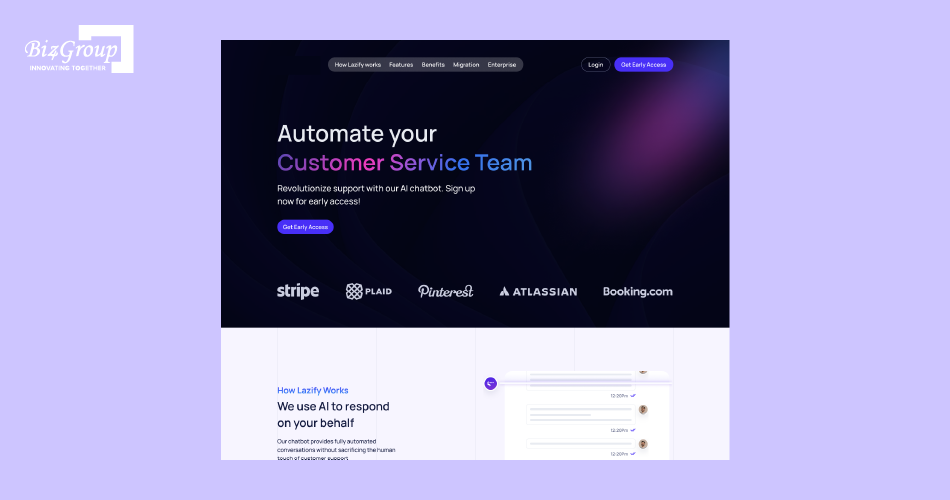
When organizations agree on what AI agents represent and anchor expectations around an enterprise AI agent deployment strategy, they create a shared understanding that prevents confusion later as adoption expands.
Still Defining What AI Agents Mean for Your Enterprise?
Clarify use cases, risks, and readiness before you deploy AI agents in enterprises at scale.
Plan My AI Agent StrategyWhat Slows Down AI Agent Deployment for Enterprises?
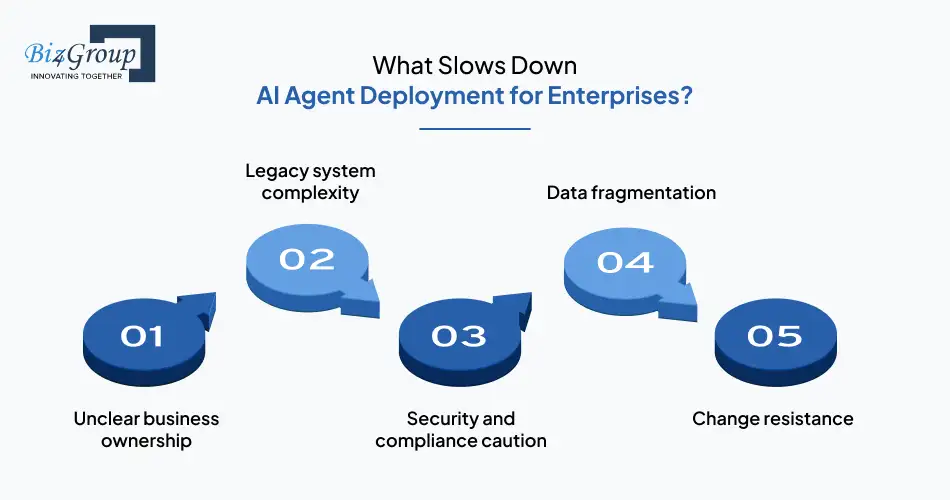
For many leadership teams, the intent is clear but execution drags. When organizations try to deploy AI agents in enterprises, momentum often slows not because of technology limits, but because enterprise realities surface all at once. Legacy systems, unclear ownership, and risk sensitivity tend to collide just as pilots show early promise. The result is hesitation, rework, and longer timelines than anyone planned for.
| What Causes the Slowdown | Why It Happens Inside Enterprises |
|---|---|
|
Unclear business ownership |
AI agents touch multiple teams, and no single function feels fully accountable |
|
Legacy system complexity |
Existing platforms were not designed with autonomous agents in mind |
|
Security and compliance caution |
Risk teams need confidence before agents interact with core systems |
|
Data fragmentation |
Information lives across silos with inconsistent structure and access |
|
Change resistance |
Teams worry about disruption to workflows they already depend on |
Another friction point is integration depth. Enterprises often underestimate how much coordination is required to connect agents across systems without breaking existing processes. This is where conversations around AI integration services usually begin, to remove blockers that stall progress after initial enthusiasm.
Ultimately, speed improves when leaders acknowledge these constraints early. Clear ownership, realistic timelines, and alignment across IT, security, and business teams reduce friction. When done right, the deployment of AI agents for enterprise automation becomes a structured evolution instead of a stalled initiative that never moves beyond proof of concept.
A 6 Week Framework to Deploy AI Agents in Enterprises
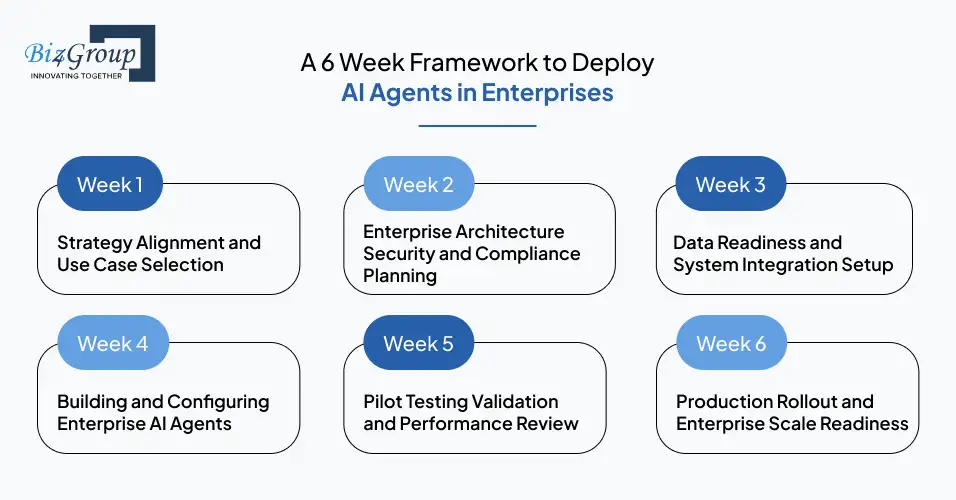
Most enterprise teams are not struggling with ambition. They are struggling with coordination. This six week framework is designed for leaders who want to deploy AI agents in enterprises without stretching timelines, confusing teams, or creating downstream risk. Each week focuses on one clear objective so progress feels steady and manageable, not overwhelming.
Week 1 Strategy Alignment and Use Case Selection
The first week sets direction. Teams agree on where AI powered agents for enterprise workflows make sense and where they do not. This prevents the common trap of trying to do too much at once. Ownership is clarified early so decisions do not stall later. Many organizations bring in AI consulting services here to validate assumptions before moving forward.
- Agree on which workflows matter most to the business
- Assign clear ownership for outcomes, not just execution
Week 2 Enterprise Architecture Security and Compliance Planning
With priorities set, teams look at how agents will exist inside the enterprise environment. This week is about understanding boundaries, not building anything yet. Security and compliance conversations happen upfront so there are no surprises later. Discussions around AI agent implementation often start here as teams assess how agents will connect to existing systems.
- Identify where agents can access data and take action
- Align risk and security teams on acceptable operating limits
Week 3 Data Readiness and System Integration Setup
This is where preparation pays off. Teams focus on making sure agents rely on consistent and reliable data. The goal is not perfection, but predictability. A solid foundation supports smoother enterprise AI agent implementation and avoids confusion once agents are active. Decisions around AI model development also become clearer as data realities come into focus.
- Confirm which data sources agents should trust
- Set basic checks for data accuracy and freshness
Week 4 Building and Configuring Enterprise AI Agents
Now the agents take shape. Teams configure enterprise AI automation agents around the workflows chosen earlier. This is a focused build, not a massive rollout. Some organizations supplement internal teams with AI agent deployment services for enterprises to keep momentum without adding pressure.
- Define what each agent is responsible for
- Set clear boundaries between agent actions and human review
Week 5 Pilot Testing Validation and Performance Review
Agents are introduced to real users in controlled settings. Feedback here is practical and grounded. Does the agent help or slow things down. This is often where generative AI agents stand out by adapting to real scenarios for enterprise grade AI agent platform deploymentation rather than rigid instructions.
- Collect feedback from users doing real work
- Review patterns to catch unexpected behavior early
Week 6 Production Rollout and Enterprise Scale Readiness
The final week focuses on readiness. Support processes, monitoring, and ownership are finalized so agents behave like dependable parts of operations. At this stage, AI agent solutions for large organizations move beyond pilots and align with your deployment approach.
- Assign responsibility for ongoing performance and updates
- Schedule regular reviews to keep agents aligned with business goals
Six Week Deployment Snapshot
| Week | Focus Area | What Teams Gain |
|---|---|---|
|
Week 1 |
Strategy and use cases |
Clear direction and ownership |
|
Week 2 |
Architecture and risk |
Fewer security surprises |
|
Week 3 |
Data readiness |
More predictable agent behavior |
|
Week 4 |
Agent configuration |
Agents aligned to real work |
|
Week 5 |
Pilot testing |
Confidence from real usage |
|
Week 6 |
Production readiness |
Scalable, supported deployment |
A great example of this six-week approach in action is how Biz4Group LLC built a custom enterprise AI agent to automate internal queries across HR, legal, and customer support systems. The engagement followed a structured rollout, starting with use case alignment, moving through secure system integration and controlled pilots, and reaching production readiness within six weeks. It reflects how enterprises can deploy AI agents methodically without disrupting core operations.
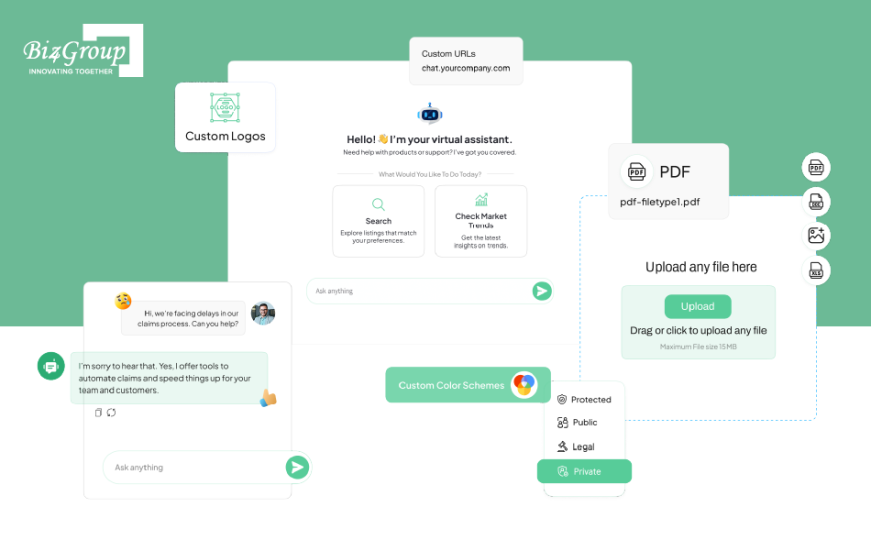
Across six weeks, the emphasis stays on clarity and pacing. When teams move step by step, confidence builds naturally. That confidence is what makes enterprise AI agent implementation sustainable rather than rushed or fragile.
Want a Faster Way to Deploy AI Agents in Enterprises?
Use a proven six week approach built around a practical enterprise AI agent deployment roadmap.
Start My 6 Week DeploymentGovernance and Risk Considerations for Enterprise AI Agent Deployment
When enterprise leaders decide to deploy AI agents in enterprises, governance becomes the point where strategy meets responsibility. At this stage, AI agents are no longer experiments running in isolation. They influence real systems, real data, and real decisions, which means clarity around ownership, risk, and accountability matters as much as speed.
Enterprise AI Agent Deployment Governance Checklist
Effective governance is less about restriction and more about consistency. Enterprises that succeed treat governance as a way to protect momentum while scaling responsibly, especially once AI agent orchestration in enterprises introduces multiple agents working across shared workflows.
- Define business ownership for agent outcomes
- Set clear boundaries for what agents can approve, recommend, or execute
- Document escalation paths when agents encounter uncertainty or exceptions
- Align governance reviews with the broader enterprise AI agent deployment roadmap
At this point, some organizations reassess internal readiness. Decisions may involve whether to hire AI developers to strengthen long term ownership or partner with an experienced AI development company to formalize governance structures that hold up as usage expands.
Enterprise Architecture Security and Risk Controls
Risk management becomes more visible as AI agents move closer to core operations. Security teams focus on predictability, traceability, and containment rather than blocking progress outright. This balance is critical when planning AI agent deployment for enterprise scale automation, where small gaps can create outsized impact.
- Limit agent access strictly to approved systems and datasets
- Ensure every action taken by an agent can be reviewed and audited
- Isolate testing environments from production systems
- Revisit controls regularly as agents expand into new workflows
These controls matter even more when enterprises adopt adaptive behaviors, such as generative AI agents, where outputs depend on context rather than fixed rules. This is often felt first in AI agents for customer service, where trust and consistency directly affect business outcomes.
Insurance AI is an enterprise-grade AI agent built by Biz4Group LLC, to support insurance agents through intelligent guidance, contextual learning, and real-time assistance. It demonstrates how AI agents can operate within regulated environments while supporting knowledge-heavy workflows. It reflects how enterprises roll out AI agents to augment internal operations at scale.
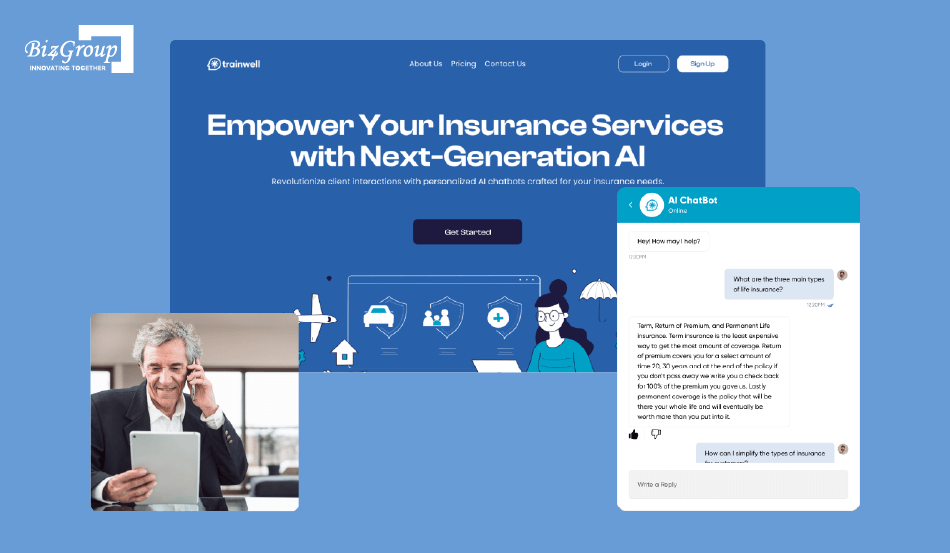
Governance is all about creating structural confidence at scale. When leaders treat governance as part of the operating model, they make smarter decisions about growth, risk, and partnerships, including how they evaluate the best company to deploy AI agents in enterprises for long term success.
Coordinating AI Agents Across Enterprise Systems at Scale
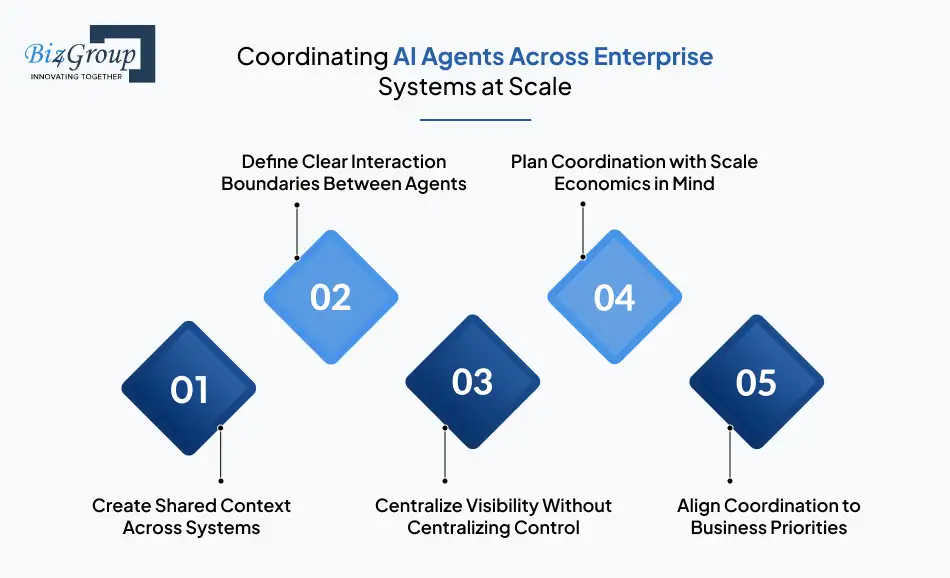
Once teams begin to deploy AI agents in enterprises, coordination becomes the real test. It is no longer about whether agents work, but how well they operate together across systems, teams, and data flows. This is where scale either holds or quietly breaks.
1. Create Shared Context Across Systems
Enterprise agents rarely live in one place. Coordination depends on a shared understanding of data, permissions, and intent across platforms. This is often where teams rethink how to integrate AI into an app so agents act with the same context no matter which system they touch.
2. Define Clear Interaction Boundaries Between Agents
As the number of agents grows, so does the risk of overlap. Clear boundaries prevent agents from duplicating work or making conflicting decisions. Teams exploring how to build a multi-agent AI system usually focus here to keep coordination predictable instead of chaotic.
3. Centralize Visibility Without Centralizing Control
Leaders need visibility into how agents behave without slowing them down. Central dashboards and logs help teams understand AI agents deploymentation in enterprises while allowing each department to retain autonomy over its workflows.
4. Plan Coordination with Scale Economics in Mind
Coordination affects cost as much as performance. Poor orchestration leads to redundant actions and wasted compute, which quickly distorts any AI agent deployment cost estimate. This is where structured AI automation services help keep scaling efficient.
5. Align Coordination to Business Priorities
Successful coordination follows business flow, not system architecture. When agents are aligned to outcomes, deployment of AI agents for enterprise automation feels intentional rather than fragmented. This mindset also influences choices around partners, including working with a trusted AI chatbot development company when conversational workflows are involved.
At scale, coordination becomes all about discipline. Enterprises that approach AI agent deployment for enterprises with a clear strategy find it easier to measure impact, which sets the stage for evaluating outcomes and return in the next phase.
Worried About Governance and Scale Risks?
Design AI agent orchestration in enterprises that stays secure, compliant, and predictable as usage grows.
Build My AI Agent ArchitectureHow Enterprises Track ROI From AI Agent Solutions
When leaders deploy AI agents in enterprises, ROI becomes the scorecard that decides what scales and what stalls. The real question is not whether agents work, but how their impact shows up in everyday operations. That clarity starts here.
1. Start With Operational Baselines
Before agents go live, teams document how work gets done today. Cycle time, error rates, and manual effort form the baseline. This makes the impact of enterprise AI agent implementation visible instead of theoretical, especially in complex workflows like those used for finance AI agent development.
2. Measure Time Returned to Teams
ROI often shows up first as time reclaimed. Enterprises track how enterprise AI automation agents reduce repetitive tasks and shorten decision loops. This is especially clear when agents support frontline workflows, such as those seen in AI agents transforming small businesses that later scale into larger environments.
3. Tie Agent Outcomes to Business Metrics
The strongest signals come when agent activity maps to revenue, cost, or risk metrics. Leaders assess whether AI agent solutions for large organizations influence conversion rates, service resolution, or compliance outcomes. This lens matters more than usage stats alone.
4. Review Adoption Along with Performance
An agent that works but is ignored delivers no return. Adoption rates, trust levels, and feedback loops matter. This is where insights from AI agent development trends help teams understand why certain agents gain traction while others fade.
Coach AI is an AI agent created to support coaches and educators by managing engagement, content flow, and progress tracking. It highlights how AI agents can operate autonomously while still aligning with human-led outcomes. This is a practical example of enterprises deploying AI agents across teams without disrupting existing workflows.
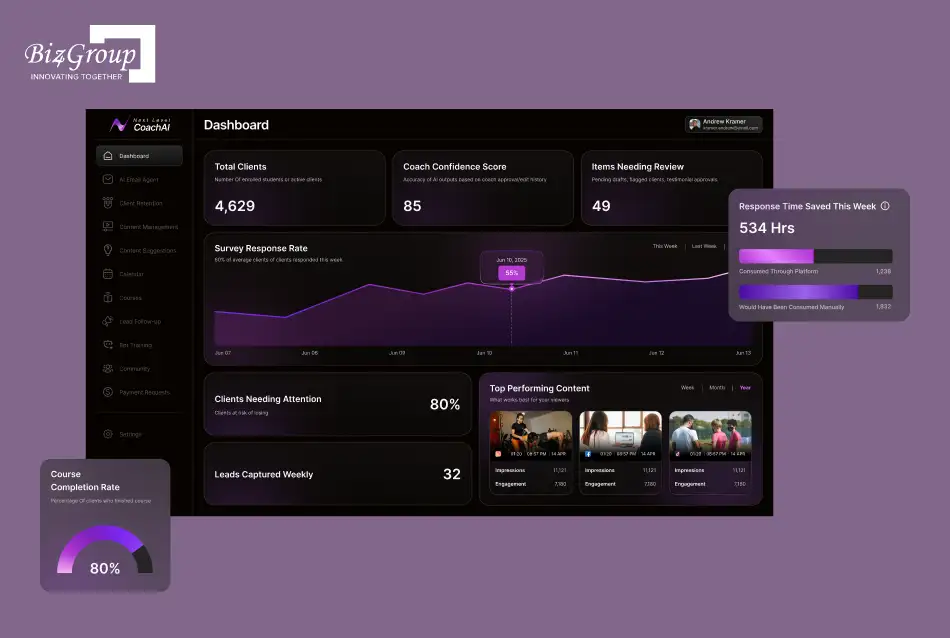
ROI tracking works best when it stays practical. As enterprises mature, these signals guide investment decisions and inform when to expand or refine support models, including how AI agent deployment services for enterprises fit into the broader operating plan that naturally leads into cost considerations next.
Need Clarity on ROI Before Scaling Further?
Track real outcomes from enterprise AI agent implementation without relying on assumptions.
Evaluate My AI Agent ROIBreaking Down the Cost of AI Agent Deployment for Enterprises
When leaders plan to deploy AI agents in enterprises, the cost conversation is about production readiness, not experimentation. Deployment spending reflects what it takes to move AI agents safely into live environments and keep them reliable at scale.
| Deployment Cost Area | What It Covers in Enterprise Rollout | Estimated Cost Range (USD) |
|---|---|---|
|
Deployment Planning and Readiness |
Use case validation, rollout sequencing, alignment around AI powered agents for enterprise workflows |
4,000 to 6,000 |
|
Production System Integration |
Connecting agents to live enterprise systems, APIs, and workflows, similar to business app development using AI |
7,000 to 10,000 |
|
Platform and Environment Enablement |
Infrastructure setup, access management, monitoring for enterprise grade AI agent platform deploymentation |
5,000 to 8,000 |
|
Governance and Security Controls |
Audit logs, permission boundaries, approval and escalation paths |
4,000 to 6,000 |
|
Validation and Controlled Rollout |
Reliability testing, load handling, phased exposure in production |
4,000 to 6,000 |
|
Operational Handover and Support Setup |
Documentation, ownership transfer, internal enablement depending on the types of AI agents |
3,000 to 4,000 |
|
Total Deployment Investment |
Enterprise AI agent deployment |
30,000 to 50,000 |
Costs vary based on scope and ambition. A single workflow agent will sit closer to the lower end, while coordinated agents across departments push investment upward. For example: healthcare AI agent development or AI trading agents introduce additional rigor that affects planning and validation effort.
Viewed the right way, cost breakdown helps leaders understand what drives investment. Now, let’s understand how teams expand usage across the organization next.
Trying to Budget AI Agent Deployment Accurately?
Get a realistic AI agent deployment cost estimate aligned with enterprise automation needs.
Get My Cost BreakdownHow Enterprises Scale AI Powered Agents Across Teams
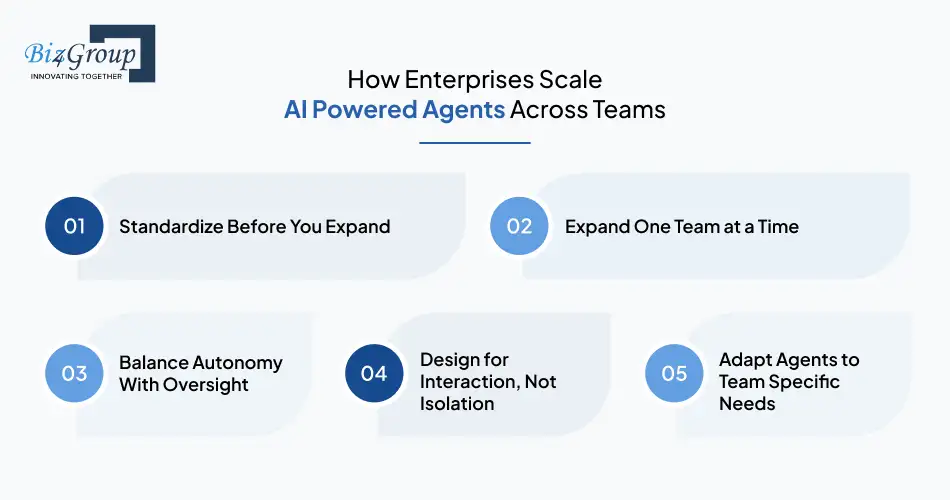
Once leaders deploy AI agents in enterprises, scaling becomes less about technology and more about coordination. The real work starts when agents move beyond one team and begin supporting multiple functions. That shift requires structure, patience, and intent.
1. Standardize Before You Expand
Teams that scale smoothly start with shared patterns. Common workflows, naming conventions, and review practices reduce confusion as new agents are added. This foundation supports consistent AI agent orchestration in enterprises without forcing every team to reinvent the wheel.
2. Expand One Team at a Time
Scaling works best when it follows real demand. Enterprises roll agents into adjacent teams that share similar workflows, rather than pushing company wide adoption at once. This staged approach aligns naturally with an enterprise AI agent deployment roadmap and is often guided by internal playbooks similar to an enterprise AI agent development guide.
3. Balance Autonomy With Oversight
Teams need freedom to adapt agents to their workflows, but not at the cost of consistency. Central guidelines paired with local ownership help agents scale responsibly. This balance becomes critical as organizations plan AI agent deployment for enterprise scale automation.
4. Design for Interaction, Not Isolation
As more agents appear, collaboration matters. Planning how agents share context and hand off work avoids silos. Many teams borrow coordination patterns from how to build a multi-agent AI system to keep interactions predictable.
5. Adapt Agents to Team Specific Needs
Different teams expect different outcomes. Scaling often includes tailored agents, whether it involves AI assistant app design for internal teams or domain specific workflows like retail AI agent development. Adoption improves when agents feel relevant to daily work.
Scaling is not a one time push. It is an ongoing process of alignment and refinement. Enterprises that approach growth thoughtfully are better positioned to assess maturity over time and decide what truly defines the best company to deploy AI agents in enterprises as adoption deepens.
Why Choose Biz4Group to Deploy AI Agents in Enterprises?
Enterprises choose Biz4Group for one simple reason. We do not treat AI agents as experiments. We build them as operational systems that fit into real enterprise environments, timelines, and constraints.
Our work across projects like the human-like chatbot, Insurance AI, Coach AI, and custom enterprise agent shows a consistent pattern. Each solution was designed to move from idea to production quickly while respecting governance, security, and scale. That experience directly informs how we help enterprises deploy AI agents in six weeks.
What sets our approach apart
- Proven delivery of enterprise-ready AI agents across regulated and multi-team environments
- Hands-on experience building agents that function as an AI conversation app, not scripted tools
- Strong integration depth, including seamless AI chatbot integration into existing systems
- A delivery mindset shaped by real enterprise builds, not generic frameworks
Being recognized among the top AI development companies in Florida matters less than what that recognition reflects. A track record of shipping AI agents that teams actually use, trust, and scale.
If you are looking to move from planning to execution without unnecessary complexity, Biz4Group brings the experience to make AI agent deployment for enterprises feel structured, predictable, and grounded in real outcomes.
Ready to Scale AI Agents Across Teams Without Chaos?
Move confidently toward AI agent deployment for enterprise scale automation with the right structure.
Scale My AI AgentsFinal Thoughts on Enterprise AI Agent Deployment Strategy
By the time most enterprises reach the AI agent conversation, they are already juggling pilots, proofs of value, and internal pressure to show results. This guide was built for that moment. To deploy AI agents in enterprises within six weeks, the difference is not tools or hype. It is sequencing, ownership, and knowing what to lock down early versus what can evolve later.
The enterprises that succeed treat AI agents as operational systems from day one. They define meaning before mechanics, coordinate agents before scaling, and track ROI before expanding scope. That mindset is what turns AI agent deployment for enterprises into a controlled rollout instead of another long running experiment.
Whether you are working with a proven software development company in Florida or planning to build an AI app internally, the takeaway is simple. Enterprise AI agents work best when they are introduced with intent, governed with clarity, and scaled only after they earn trust.
See how a six-week rollout keeps momentum without cutting corners – Speak to our AI Experts.
FAQs about How to Deploy AI Agents in Enterprises
1. How long does it take to deploy AI agents in an enterprise environment?
Most enterprises can complete deployment in about six weeks when scope, ownership, and approvals are clear. A structured enterprise AI agent deployment roadmap helps teams move from planning to production without unnecessary delays caused by internal coordination gaps.
2. Do enterprises need to replace existing systems to deploy AI agents?
No. Enterprises typically deploy agents alongside current platforms. With the right AI agent deployment for enterprises, agents integrate into existing workflows, tools, and data environments without forcing system replacements or major infrastructure changes.
3. What types of enterprise workflows benefit most from AI agent deployment?
AI agents perform best in repeatable, decision intensive processes such as operations, internal support, analytics, and coordination. These use cases align naturally with AI powered agents for enterprise workflows, where context and speed matter more than rigid automation.
4. What are the biggest risks when deploying AI agents at enterprise scale?
The most common risks include unclear accountability, fragmented coordination, and lack of oversight. Addressing these early is critical when planning AI agent orchestration in enterprises, where multiple agents interact across shared systems and teams.
5. How do enterprises measure success after deploying AI agents?
Enterprises track success through time savings, reduced manual effort, faster decisions, and adoption across teams. These metrics provide clarity on whether enterprise AI agent implementation is delivering operational value beyond initial deployment.
6. How much does it cost to deploy AI agents in enterprises?
Enterprise AI agent deployment typically costs between 30,000 and 50,000 USD, depending on scope, integrations, and governance needs. This range reflects real world requirements for AI agent deployment cost estimate at enterprise scale rather than experimental pilots.
