 Location :
Orlando, FL, USA
Location :
Orlando, FL, USA +1 (407) 714-1616
 info@biz4group.com

- AI reputation platforms help law firms monitor reviews, track sentiment, and manage public perception proactively across digital channels.
- Firms that develop an AI legal reputation management app gain structured visibility into feedback and respond faster to reputation risks.
- A successful platform combines review monitoring, sentiment intelligence, compliance safeguards, and analytics dashboards to support consistent client trust.
- The cost to develop an AI legal reputation management app typically ranges between $30,000–$150,000, depending on AI capabilities, integrations, scalability requirements, and compliance depth.
- Through AI legal reputation management app development, firms build long-term competitive advantage by improving visibility, referrals, and client confidence.
- Biz4Group LLC delivers secure, scalable solutions tailored to legal workflows, helping firms adopt reputation intelligence with practical implementation guidance.
What makes a potential client trust a law firm before speaking to an attorney?
Most decisions begin online, shaped by reviews, ratings, and public feedback visible within seconds. Clients often form opinions long before scheduling a consultation, which makes reputation one of the most influential business assets a law firm manages today.
Online reviews directly affect client acquisition. Prospective clients read experiences shared by others to judge professionalism, responsiveness, and reliability. Positive feedback encourages inquiries, while unanswered concerns quietly reduce trust. Law firms already recognize the value of intelligent technology across operations:
- 85% of law firms use AI for client communication, with 75% reporting improved client satisfaction
- 73% of firms using AI for case management report improved efficiency in case tracking
- 76% of law firms use AI for contract analysis, with 85% reporting reduced risk
These adoption patterns show how digital intelligence is becoming embedded in legal workflows. Reputation management is following the same path while building AI app. Firms planning to develop an AI legal reputation management app aim to understand client sentiment earlier and respond with clarity instead of reacting late.
When leadership teams AI app, reputation data becomes actionable rather than overwhelming. Many firms integrate these initiatives within broader web and mobile application development efforts to unify client experience systems.
This blog will walk you through how to develop an AI legal reputation management app for law firms. And how working with an experienced AI development company allows organizations to create AI based online reputation management platform for lawyers that strengthen visibility, protects credibility, and support sustainable growth.
Let’s dive in.
What Is an AI Legal Reputation Management App?
An AI legal reputation management app is a software platform that helps law firms monitor, understand, and manage their online reputation in real time. It collects client reviews and feedback from multiple platforms, then analyzes them to identify sentiment, concerns, and reputation patterns. The system uses natural language processing to understand how clients feel and highlight issues that may affect public perception.
Law firms, legal marketing teams, and operations leaders use these tools to maintain trust and respond to feedback efficiently. Organizations that develop an AI legal reputation management app gain structured visibility into client experience instead of relying on manual monitoring. As firms integrate AI into an app, reputation management becomes a continuous business process that supports client acquisition and brand credibility.
An AI legal reputation management app helps law firms:
- Monitor reviews across platforms
- Analyze client sentiment using NLP
- Detect reputation risks early
- Automate compliant responses
- Track brand perception trends
Modern AI legal reputation management app development focuses on turning scattered feedback into measurable insights that guide marketing and client experience decisions.
Why Do Law Firms Need AI Reputation Management App?
Online reputation has become a deciding factor in how clients select legal representation. Most potential clients read reviews before contacting a firm, using public feedback to judge reliability and professionalism. Studies show that:
- 93% of consumers read online reviews before choosing a business
- 91% say reviews directly shape their perception of a company.
- 60% of consumers avoid businesses after seeing negative reviews
Legal technology adoption is also accelerating across the industry. Firms are investing in digital systems that improve communication, operations, and visibility. As competition grows across practice areas and locations, clients often compare multiple firms based on ratings and responsiveness rather than advertising alone. Many leadership teams now treat online reputation monitoring as part of AI integration efforts that support client experience and operational clarity.
Unmanaged feedback introduces real business risk:
- Negative reviews that remain unanswered can shape public perception for months, reducing trust among prospective clients.
- Delayed responses also signal poor engagement, even when service quality is strong.
As client decisions increasingly depend on public feedback, many firms now develop an AI legal reputation management app to maintain visibility over reviews, reduce response delays, and prevent reputation issues from escalating across digital platforms. These initiatives often align with market-ready mobile apps already shaping everyday legal operations.
Still Guessing What Clients Think Online?
Reputation already shapes hiring decisions before consultations begin. See how structured monitoring can turn feedback into measurable business insights.
Talk to Our ExpertsHow an AI Legal Reputation Management Platform Works
An AI legal reputation management platform follows a structured workflow that converts scattered online feedback into organized insight. Each stage focuses on helping legal teams monitor reputation continuously and respond to client sentiment with clarity and speed.
1. Data Collection from Review Platforms
The process begins by gathering reviews and feedback from platforms where clients publicly share experiences. Instead of checking multiple websites manually, the system collects data automatically into one dashboard.
- Pulls reviews from legal directories, search platforms, and social channels
- Captures new feedback in near real time
- Centralizes reputation data for easier visibility
This foundation ensures firms never overlook feedback that may influence future client decisions.
2. NLP Based Sentiment Analysis
Once reviews are collected, the platform evaluates the language used in each comment to understand client sentiments. The system identifies tone patterns that indicate satisfaction, concern, or dissatisfaction.
- Interprets emotional tone within written feedback
- Highlights recurring praise or complaints
This step turns raw text into meaningful insight that teams can act on confidently.
Also Read: NLP vs LLM: Choosing the Right Approach for Your AI Strategy
3. Risk Scoring and Categorization
Each review is assigned a score based on urgency and potential reputation impact. Categorization helps teams focus attention where it matters most.
- Labels feedback as positive, neutral, or high risk
- Prioritizes reviews requiring immediate response
- Organizes feedback into actionable groups
Firms that develop an AI legal reputation management app rely on structured scoring to prevent minor issues from becoming larger reputation concerns.
4. Alert System for Critical Feedback
When sensitive or negative feedback appears, automated notifications are triggered for responsible team members. This reduces delays and keeps responses timely.
- Sends alerts for high-risk reviews
- Assigns responsibility to internal stakeholders
- Uses AI automation to maintain continuous monitoring
Early alerts help firms respond before public perception shifts further.
5. AI Suggested Response Drafting
The platform generates draft responses that follow professional tone expectations while allowing human review before publishing.
- Suggests context-aware replies
- Maintains consistent communication style
- Supports faster response workflows
Organizations that build AI powered legal reputation management app solutions often prioritize this capability to reduce manual workload while maintaining professionalism.
6. Performance Dashboard and Trend Monitoring
All collected data is displayed through dashboards that track reputation performance over time. Leaders gain visibility into patterns that influence client trust.
- Tracks sentiment trends across time periods
- Measures response time and engagement levels
- Identifies recurring service feedback themes
This ongoing monitoring helps law firms understand how public perception evolves and where operational improvements may be needed.
A well-designed platform connects monitoring, analysis, and action into one continuous cycle. By structuring reputation management through clear workflows, firms gain consistent awareness of client sentiment while maintaining control over their digital presence.
Why Now Is the Right Time to Invest in AI Legal Reputation Management App Development?
Digital engagement has expanded how clients discover and evaluate legal services. Many firms now develop an AI legal reputation management app to manage growing volumes of online interactions and maintain consistent visibility across platforms where client opinions actively form.
The following overview highlights how AI reputation investment translates into measurable business and growth outcomes.
|
Benefit |
Business Impact |
Long Term Value |
|---|---|---|
|
Client Trust Improvement |
Builds confidence through timely responses and visible engagement with client feedback, increasing consultation conversions |
Establishes long-term credibility and strengthens brand authority across competitive AI legal markets |
|
Faster Response Time |
Enables teams to address negative feedback quickly, reducing reputational damage and preventing loss of potential clients |
Creates consistent client satisfaction patterns that improve retention and public perception over time |
|
Competitive Positioning |
Improves review ratings and online visibility, helping firms stand out during client comparison and evaluation stages |
Supports clear differentiation that strengthens market presence as digital competition increases |
|
Referral Growth |
Encourages positive client experiences to translate into online recommendations and inbound inquiries |
Drives sustainable lead generation supported by strong reputation signals and client advocacy |
These results become clearer when we look at the digital shifts influencing law firm's reputation today.
1. Growing Digital Engagement
Law firm visibility now extends across multiple digital channels where audiences interact with legal content regularly. AI legal reputation management is shaped not only by reviews but also by ongoing engagement across platforms.
- 41% of Facebook users engage with legal content weekly
- LinkedIn generates 80% of B2B leads for law firms
- Instagram Stories drive 25% more website traffic for firms
As conversations expand across channels, feedback appears faster and spreads wider. A structured legal AI app helps firms monitor how these interactions influence public perception without relying on manual tracking.
2. Expanding Client Communication
Marketing and communication efforts generate steady client interaction, which naturally produces reviews and opinions that affect reputation over time. As per Gitnux 2026 report:
- Email newsletters achieve 42% open rates for law firms
- Content marketing generates 3x more leads than outbound strategies
Higher engagement means more opportunities for both positive and critical feedback. Firms implementing enterprise AI solutions increasingly connect engagement data with reputation monitoring, so responses remain timely and consistent.
3. Need For Structured Oversight
As firms expand digital outreach, unmanaged feedback creates gaps between client experience and public perception. AI Legal reputation management app helps teams track sentiment trends while maintaining operational focus becoming a part of broader business app development using AI,
- Continuous monitoring reduces missed feedback
- Faster responses prevent escalation of concerns
- Centralized insight supports informed decision-making
Organizations investing early recognize that reputation now evolves alongside digital marketing performance. Strategic AI legal reputation management app development for attorneys allows firms to manage trust proactively while supporting long-term brand growth and client acquisition.
Waiting Costs More Than Building Today
Digital reputation compounds daily. A short strategy discussion can help you identify where early investment creates long-term competitive advantage.
Schedule a Strategy CallKey Use Cases of AI Reputation Management in Law Firms
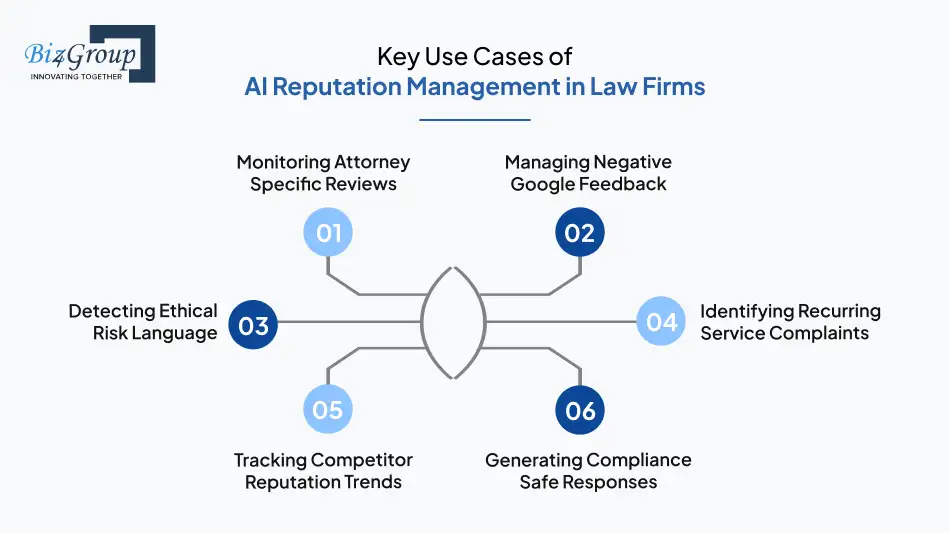
Law firms interact with clients across multiple digital platforms where feedback appears continuously. Understanding practical use cases helps leadership see how reputation intelligence supports daily operations and why firms increasingly develop an AI legal reputation management app to manage trust proactively.
1. Monitoring Attorney Specific Reviews
Individual attorneys often receive feedback tied to responsiveness, communication style, or case handling. Tracking reviews at the attorney level helps firms understand performance trends without relying on scattered manual checks.
- Identifies which attorneys receive consistent praise or concerns
- Helps leadership address service gaps early
- Supports structured insights during performance evaluations
2. Managing Negative Google Feedback
Negative reviews influence client decisions quickly when left unanswered. AI systems help teams detect and respond before feedback shapes wider public perception.
- Flags low-rating reviews immediately after posting
- Suggests timely and professional response actions
- Helps maintain consistent engagement across public platforms
3. Detecting Ethical Risk Language
Certain phrases in reviews may signal ethical concerns or sensitive situations that require careful handling. Development of legal AI brand management app can identify risk-related wording early.
- Detects complaints mentioning misconduct or confidentiality concerns
- Escalates sensitive feedback internally
- Helps firms respond carefully while protecting professional standards
4. Identifying Recurring Service Complaints
Patterns across reviews often reveal operational issues rather than isolated incidents. AI highlights repeated themes so teams can address root causes.
- Groups similar complaints across different platforms
- Reveals delays, communication gaps, or onboarding issues
- Supports improvements guided by real client feedback
4. Tracking Competitor Reputation Trends
Reputation intelligence also extends beyond internal monitoring. Firms gain awareness of how competitors are perceived within the same market.
- Tracks competitor ratings and sentiment changes
- Identifies service expectations shaping client decisions
- Helps firms create AI driven reputation management tools for lawyers focused on market positioning insights
5. Generating Compliance Safe Responses
Responding publicly requires careful language that protects confidentiality and professionalism. Intelligent drafting assistance supports consistent communication aligned with legal standards.
- Suggests structured response drafts aligned with firm tone
- Reduces risk of accidental disclosure
- Works alongside thoughtful AI assistant app, where human review remains part of the workflow
When applied together, these use cases show how reputation management becomes an operational capability rather than a reactive task. Firms investing in legal AI brand management app development gain clearer visibility into client perception while strengthening long-term credibility across competitive legal markets.
Core Features Required to Build an AI Powered Legal Reputation Management App
An AI legal reputation platform for law firms requires more than review tracking. Firms that develop an AI legal reputation management app focus on capabilities that help teams monitor feedback, respond responsibly, and maintain consistent visibility across digital client touchpoints.
|
Core Capability |
Purpose in Legal Reputation Management |
|---|---|
|
Multi-Platform Review Aggregation |
Collects reviews from search engines, legal directories, and social platforms into one unified dashboard |
|
Automated Review Monitoring |
Tracks new feedback continuously so firms never miss reputation-impacting comments |
|
Client Sentiment Intelligence |
Uses sentiment analysis to understand tone, satisfaction levels, and emerging concerns within reviews |
|
Reputation Risk Detection |
Identifies sensitive or negative feedback that may require immediate internal attention |
|
Smart Alert Notifications |
Notifies teams instantly when critical reviews or reputation risks appear |
|
AI Suggested Response Drafting |
Generates structured response drafts that maintain professional communication standards |
|
Compliance-Aware Response Controls |
Helps teams respond publicly while protecting confidentiality and ethical obligations |
|
Attorney-Level Reputation Tracking |
Monitors feedback linked to individual attorneys or practice areas |
|
Performance Analytics Dashboard |
Displays trends in ratings, sentiment patterns, and response performance over time |
|
Competitor Reputation Insights |
Tracks market perception trends to help firms understand positioning within competitive regions |
|
Secure Role-Based Access Management |
Controls who can view, edit, or respond to reviews within the organization |
|
Data Privacy & Security Framework |
Helps build secure AI reputation management platform for legal practices aligned with sensitive client data handling needs |
|
Workflow Automation Tools |
Reduces manual monitoring through structured processes supported by AI logic |
|
Communication System Integration |
Supports limited legal AI chatbot integration for intake alignment while keeping reputation responses human-reviewed |
A well-structured feature set ensures reputation management becomes part of everyday operations rather than a reactive task. Strong capability planning allows firms to build scalable platforms that protect credibility while supporting long-term digital trust and operational consistency.
Also Read: Top 10 AI Chatbot Development Companies for Legal Industry in USA
AI Legal Reputation Management App: Advanced Features That Stand Out
As reputation management matures within legal operations, firms begin looking beyond foundational monitoring capabilities. Platforms built through custom AI legal reputation management app development introduce advanced intelligence that helps teams anticipate reputation risks, understand feedback patterns, and make more confident decisions based on evolving client perception.
|
Advanced Feature |
How It Strengthens Legal Reputation Management |
|---|---|
|
Smart Review Understanding |
Use AI models to interpret long and detailed client reviews, capturing intent and context that basic monitoring tools often miss |
|
Context-Aware Legal Feedback Analysis |
Understands legal terminology and nuanced client language to prevent misinterpretation of sensitive feedback or complex service discussions |
|
Sentiment Trend Intelligence Dashboard |
Tracks sentiment movement over time, helping leadership identify gradual reputation shifts across attorneys, offices, or practice areas |
|
Reputation Risk Prediction Alerts |
Applies predictive analysis to recognize early warning patterns that may signal rating decline or recurring dissatisfaction |
|
Adaptive Response Intelligence |
Uses generative AI to generate context-aware response drafts that adapt to prior communication tone while remaining human-reviewed |
|
Attorney and Practice Mention Tracking |
Detects references to specific lawyers, services, or locations to provide deeper operational insight into reputation performance |
|
Reputation Trend Forecasting View |
Projects future perception trends using historical feedback signals, supporting proactive service improvements |
|
Self-Learning Reputation Monitoring |
Enables firms to develop AI app to manage law firm online reviews through systems that continuously learn from feedback behavior and improve prioritization accuracy |
Advanced capabilities elevate reputation management from observation to foresight. Firms that develop an AI legal reputation management app with intelligent prediction and adaptive insight gain stronger control over brand perception while supporting long-term client trust and sustainable digital credibility.
Features Are Easy. Intelligence Is Hard.
The difference lies in how systems predict risks and guide decisions. Let's map which advanced capabilities actually fit your firm's workflow.
Discuss Your App VisionStep-by-Step Process to Develop an AI Legal Reputation Management App
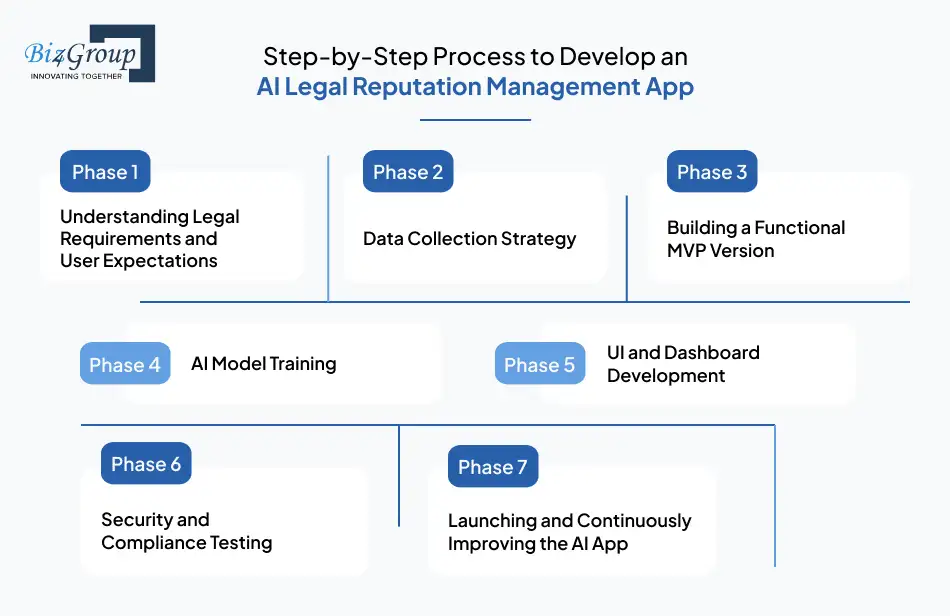
Firms that develop an AI legal reputation management app follow phased implementation to balance compliance, usability, and intelligence while ensuring the system aligns with real legal workflows from the start.
Phase 1: Understanding Legal Requirements and User Expectations
Before development begins, teams study how law firms manage reviews, client communication patterns, and regulatory obligations tied to public responses. This phase ensures that the platform reflects real operational needs rather than assumptions.
- Analyze review platforms commonly used by legal clients
- Identify ethical communication and confidentiality requirements
- Define user roles such as attorneys, marketers, and administrators
- Map reputation risks specific to legal services
Early research reduces redesign effort later and establishes a compliant foundation for development decisions.
Phase 2: Data Collection Strategy
A clear data strategy determines how reviews enter the system and how feedback remains organized. Proper planning prevents fragmented insights and supports continuous monitoring.
- Define supported review sources and integrations
- Establish permissions and data handling policies
- Standardize incoming feedback formats
- Prepare pipelines to later integrate AI models smoothly
Well-structured data collection ensures the platform delivers accurate insights once intelligence layers are introduced.
Phase 3: Building a Functional MVP Version
The initial product focuses on essential workflows that validate real usage before full-scale expansion. During MVP development, teams prioritize usability and monitoring functionality rather than advanced automation.
- Create core review aggregation and alert workflows
- Validate dashboard usability with legal teams
- Test response workflows using real scenarios
- Collaborate with an experienced MVP development company for faster iteration
This stage helps organizations build AI review monitoring app for law firms while minimizing early investment risk.
Also Read: AI-based Custom MVP Software Development
Phase 4: AI Model Training
AI intelligence is introduced after stable workflows exist. Teams first select AI model approaches suited for language interpretation, then train AI model systems using curated legal review datasets.
- Train AI models on legal terminology and sentiment patterns
- Validate accuracy against real feedback samples
- Reduce bias and misinterpretation risks
- Continuously refine outputs through testing cycles
Proper training ensures feedback interpretation remains reliable and aligned with legal communication standards.
Phase 5: UI and Dashboard Development
User interfaces must simplify complex insights into clear actions. Collaboration with a specialized UI/UX design company helps translate analytics into dashboards that attorneys and marketing teams can navigate easily.
- Design sentiment and alert visualization panels
- Build role-based dashboards for different users
- Simplify response workflows and navigation
- Optimize accessibility across devices
Clear interface design encourages adoption and reduces operational friction during daily use.
Also Read: Top UI/UX design companies in USA
Phase 6: Security and Compliance Testing
Legal reputation platforms handle sensitive feedback, making security validation essential before release. Testing ensures that both technical protection and ethical communication safeguards are functioning correctly.
- Verify encryption and secure data storage practices
- Test role-based access permissions
- Validate audit tracking for review responses
- Confirm compliance with legal confidentiality expectations
Thorough testing protects client trust while reducing operational risk.
Also Read: 15+ Software Testing Companies in USA
Phase 7: Launching and Continuously Improving the AI App
Deployment introduces the platform gradually while performance and accuracy are monitored closely. Feedback gathered during early usage guides future improvements.
- Launch controlled pilot rollout with selected teams
- Monitor system performance and alert accuracy
- Track user engagement and workflow efficiency
- Refine intelligence models based on usage patterns
Continuous monitoring ensures the system evolves into a reliable app that can create AI app aligned with long-term operational growth.
Following these phases helps organizations create AI powered review monitoring system for law firms that remains scalable, compliant, and aligned with evolving client expectations.
Technology Stack Considerations for an AI Legal Reputation Management Platform
A well-planned technology stack ensures stability, scalability, and long-term maintainability as firms develop an AI legal reputation management app. The goal is not to use complex tools but to combine reliable technologies that support real-time monitoring, intelligent analysis, and secure legal data handling.
|
Architecture Layer |
Recommended Technology |
Purpose |
|---|---|---|
|
Frontend Interface |
React.js |
Supports responsive dashboards and interactive review analytics through structured ReactJS development for smooth user experience |
|
Server-Side Rendering & Performance |
Next.js |
Enables faster page loading and SEO-friendly dashboards using optimized NextJS development practices |
|
Backend Application Layer |
Node.js |
Manages application logic, authentication, and workflows efficiently through scalable NodeJS development |
|
AI & Data Processing Layer |
Python |
Powers machine learning pipelines and review intelligence workflows through reliable Python development environments |
|
API Communication Layer |
REST / GraphQL APIs |
Handles secure API development for connecting review platforms, dashboards, and AI processing services |
|
Database Layer |
PostgreSQL / MongoDB |
Stores structured reputation data, user roles, and feedback history securely |
|
AI Model Frameworks |
TensorFlow / PyTorch |
Enables sentiment analysis, risk detection, and learning systems for reputation intelligence |
|
Cloud Infrastructure |
AWS / Google Cloud / Azure |
Provides scalable hosting, automated deployment, and secure data processing environments |
|
Real-Time Data Processing |
Kafka / WebSockets |
Supports live alerts and instant feedback updates across dashboards |
|
Authentication & Security |
OAuth 2.0 / JWT |
Protects sensitive legal data with secure user authentication and access control |
|
Monitoring & Logging |
Prometheus / ELK Stack |
Tracks system performance and identifies operational issues early |
|
DevOps & Deployment |
Docker / Kubernetes |
Ensures scalable deployment and consistent environments across development and production |
A balanced stack connects user experience, intelligence, and security into one ecosystem. Strong full stack development practices help organizations build platforms that remain adaptable, scalable, and reliable as reputation intelligence evolves alongside digital legal operations.
Also Read: Why to Choose the Full Stack Development for Modern Business
Compliance, Privacy, and Ethical Considerations for Legal AI Applications
Legal reputation platforms operate within strict professional and regulatory boundaries. Organizations that develop an AI legal reputation management app must design systems that respect confidentiality, protect user data, and ensure ethical communication while managing public feedback responsibly.
1. Client Confidentiality
- The application must avoid exposing case details while analyzing reviews or drafting responses, ensuring sensitive legal information never becomes publicly visible through automated processes.
- Controlled access permissions allow only authorized staff to review or respond to feedback, protecting attorney-client relationships and internal discussions.
2. Data Encryption
- Encryption safeguards review data during transfer and storage so client feedback remains protected from unauthorized access or interception risks.
- Secure encryption standards help maintain trust when reputation data moves between dashboards, integrations, and monitoring systems.
3. GDPR and CCPA Awareness
- Platforms should support privacy rights such as data access requests, deletion controls, and transparent usage disclosures aligned with global privacy expectations.
- Teams that build AI reputation management app for law firms often hire AI developers experienced in implementing privacy-aware system architecture.
4. ABA Advertising Guidelines
- AI-generated responses must follow professional advertising rules and avoid language that may appear misleading or promotional beyond ethical limits.
- Approval workflows ensure attorneys review automated suggestions before publishing responses tied to legal services.
5. Secure Data Storage
- Reputation data should remain stored in protected cloud environments with audit logs that track access and activity history.
- Early planning supported through structured AI consulting services helps firms establish governance policies before scaling platform adoption.
Compliance strengthens trust rather than slowing innovation. Organizations that make AI legal reputation management app with compliance features build systems that protect client relationships, support ethical communication, and enable responsible adoption of AI within modern legal operations.
Compliance Built Later? That's Risky.
Security and ethics work best when designed from day one. A quick consultation can help validate your compliance approach before development begins.
Speak With a Solution ArchitectCost to Develop an AI Legal Reputation Management App
The investment required to develop an AI legal reputation management app depends on feature depth, compliance needs, and intelligence capabilities. Most projects fall within an estimated range of $30,000 to $150,000, depending on scalability goals and automation maturity.
|
Development Level |
Estimated Cost Range |
What It Involves |
|---|---|---|
|
MVP Level AI Legal Reputation Management App |
$30,000 – $60,000 |
Core review monitoring, basic dashboards, alert system, and early workflow validation for firms testing reputation automation concepts |
|
Mid-Level AI Legal Reputation Management App |
$60,000 – $100,000 |
Sentiment insights, response assistance, integrations with review platforms, and structured analytics suitable for growing legal operations |
|
Advanced-Level AI Legal Reputation Management App |
$100,000 – $150,000 |
Predictive reputation intelligence, compliance controls, scalable infrastructure, and enterprise-ready monitoring designed for multi-office firms |
Key Factors Driving Development Cost
Understanding where your investment goes helps align expectations with long-term platform value.
- AI Intelligence and Automation Depth
Advanced analytics, automated insights, and intelligent workflows increase development effort. Higher AI integration costs typically reflect improved accuracy, automation maturity, and long-term scalability.
- Compliance and Security Requirements
Legal applications require encryption, audit tracking, and controlled access systems. These safeguards increase development time but are essential when teams build AI reputation management app for law firms handling sensitive client feedback.
- Platform Integrations and Data Sources
Connecting multiple review platforms and dashboards requires structured APIs and testing. Integration complexity grows as firms expand digital presence across various client engagement channels within modern legal tech ecosystems.
- UI and User Experience Complexity
Dashboards designed for attorneys must remain simple while presenting meaningful insights. Custom visualization and workflow optimization contribute significantly to overall development effort.
- Scalability and Cloud Infrastructure
Systems designed for long-term growth require cloud architecture capable of handling increasing feedback volume and real-time monitoring without performance issues.
Investment decisions should balance immediate functionality with future scalability. Organizations that make AI legal reputation management app with compliance features focus on sustainable architecture, ensuring the platform continues delivering value as digital reputation expectations evolve.
Also Read: AI App Development Cost in 2026
Monetization Strategies for an AI Legal Reputation Management App
Revenue planning becomes essential once organizations develop an AI legal reputation management app and prepare it for real market adoption. A clear monetization model helps align pricing with value delivered while ensuring long-term sustainability for providers and users.
1. Monthly Subscription Model
A recurring subscription remains the most predictable revenue approach for reputation platforms. Law firms prefer manageable operational expenses instead of large upfront investments.
- Fixed monthly fee based on platform access
- Continuous updates and support included
- Encourages long-term product adoption
2. Tiered Pricing Per Attorney
Pricing aligned with firm size allows flexible scaling as legal teams grow. This structure works well during law firm AI reputation management software development, where usage varies across attorneys.
- Charges based on number of attorney profiles monitored
- Scales naturally with firm expansion
- Keeps entry pricing accessible for smaller practices
3. Enterprise License Model
Large firms often require centralized access across multiple offices and departments. Enterprise licensing supports broader adoption with customized agreements.
- Organization-wide platform access
- Advanced analytics and administrative controls
- Dedicated onboarding and support options
4. White Label Model
Agencies and legal consultants may want branded versions of the platform for their clients. White labeling allows providers to monetize AI app capabilities beyond direct law firm sales.
- Custom branding for partner organizations
- Multi-client management dashboards
- Expanded distribution channels without additional development
5. Usage-Based Pricing
Some firms prefer paying based on activity instead of fixed subscriptions. Usage pricing aligns cost with measurable platform value.
- Charges based on reviews analyzed or responses generated
- Suitable for high-volume reputation monitoring environments
- Encourages efficient platform utilization
A balanced monetization strategy supports scalability while maintaining accessibility for different firm sizes. Businesses that create AI driven sentiment analysis app for lawyers succeed when pricing reflects measurable reputation outcomes and long-term operational value.
Also Read: 65+ Software Ideas for Entrepreneurs
KPIs to Measure ROI of an AI Reputation Management App
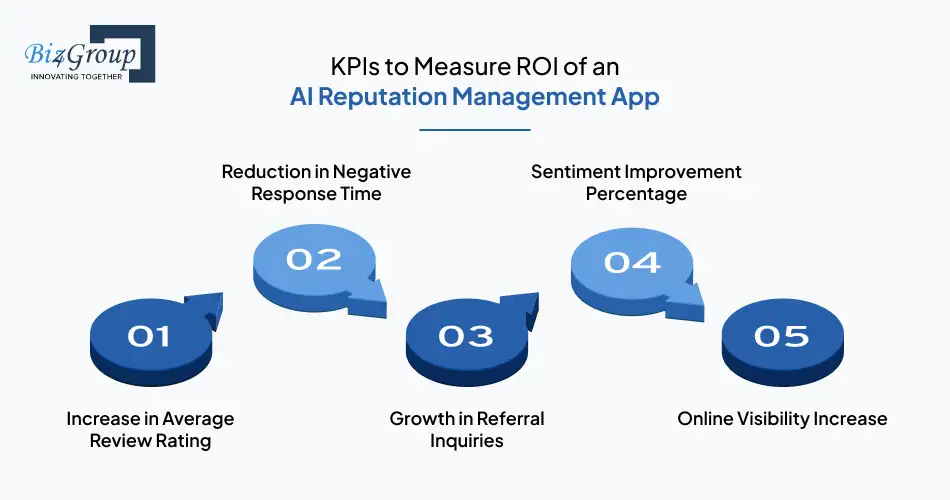
Once firms develop an AI legal reputation management app, success should be measured through operational outcomes rather than assumptions. Clear KPIs help leadership understand whether reputation efforts are improving client perception and contributing to measurable growth.
1. Increase in Average Review Rating
Average rating improvement shows whether response consistency and feedback monitoring are working. A gradual rise indicates better client experiences and stronger public confidence reflected directly in review platforms.
2. Reduction in Negative Response Time
This KPI measures how quickly teams address critical feedback after publication. Shorter response times reduce reputational risk and demonstrate active firm engagement, which directly influences prospective client trust.
3. Growth in Referral Inquiries
Tracking inquiries that reference reviews or online reputation helps connect reputation management with acquisition outcomes. Increased referral conversations often signal improving credibility and stronger client advocacy.
4. Sentiment Improvement Percentage
Sentiment change over defined periods shows whether client perception is improving. Firms monitor positive versus negative feedback ratios to evaluate how effectively recurring service concerns are being resolved.
5. Online Visibility Increase
Higher engagement with reviews improves search presence and listing activity. Growth in impressions, profile visits, and discovery metrics indicates reputation management efforts are contributing to broader digital visibility.
Tracking these indicators turns reputation management into a measurable business function rather than a marketing assumption. Firms that develop AI client sentiment analysis tools for legal firms gain continuous visibility into performance trends that guide long-term operational improvements.
If You Can't Measure, Don't Build
Before investing, define what success should look like. We help firms align KPIs with real operational and growth outcomes.
Define Your ROI StrategyChallenges Law Firms Face During Development (And How to Solve Them)
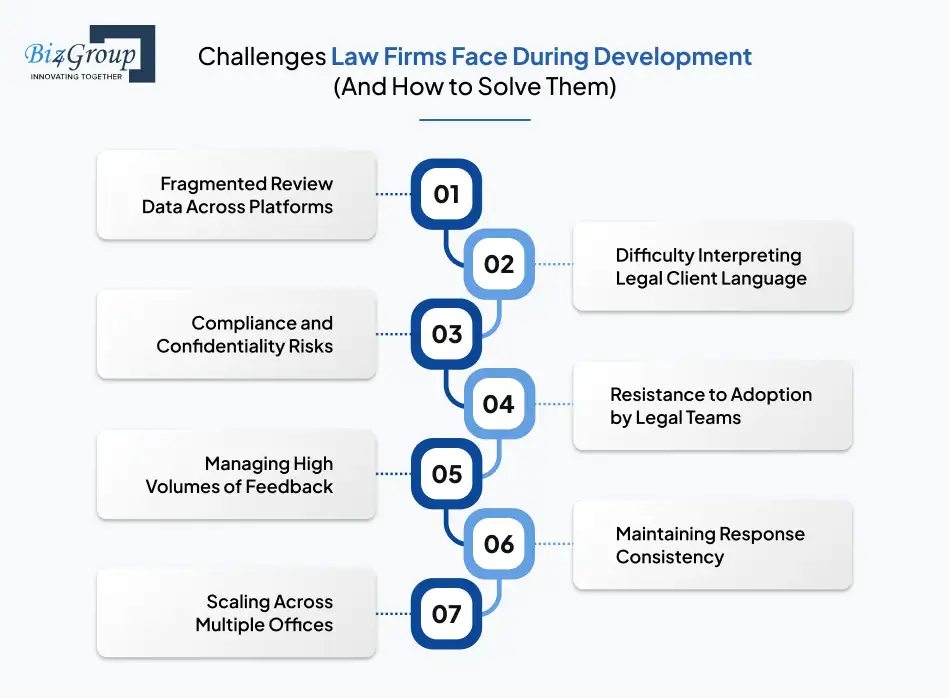
Law Firms that develop an AI legal reputation management app often encounter practical challenges related to data handling, adoption, and compliance, which require structured solutions from the early development stages.
|
Challenge |
Solution |
|---|---|
|
Fragmented Review Data Across Platforms |
Centralize integrations early and define a unified data collection framework, so feedback from multiple platforms flows into one structured system. |
|
Difficulty Interpreting Legal Client Language |
Train AI systems using legal-specific datasets and continuously validate outputs with real feedback to improve contextual understanding over time. |
|
Compliance and Confidentiality Risks |
Implement approval workflows and role-based access controls to ensure responses remain compliant with legal communication standards. |
|
Resistance to Adoption by Legal Teams |
Design simple dashboards focused on clarity and practical workflows so attorneys can use the system without technical learning barriers. |
|
Managing High Volumes of Feedback |
Automate prioritization rules that highlight critical reviews first using AI automation tools. This allows teams to focus attention on where reputation impact is highest. |
|
Maintaining Response Consistency |
Use structured response guidance and internal review processes to ensure tone and messaging remain aligned across all attorneys and offices. |
|
Scaling Across Multiple Offices |
Build flexible architecture that supports role-based management and location-specific analytics as firms expand operations. |
Development challenges are expected when introducing new operational systems. Addressing them early helps firms create stable foundations. This ensures AI legal reputation management platforms remain practical, scalable, and aligned with everyday legal workflows rather than adding operational complexity.
How to Choose the Right AI Development Partner for Legal Reputation Software
A reliable reputation platform requires more than technical execution. Organizations planning to create AI based online reputation management platform for lawyers should evaluate development partners carefully to ensure long-term alignment with legal workflows, compliance expectations, and operational goals.
1. Legal Industry Experience
A partner familiar with legal operations understands confidentiality requirements, attorney workflows, and professional communication standards. Industry exposure reduces learning curves during development and prevents misalignment between technology design and real law firm needs.
- Experience working with law firms or legal platforms
- Understanding of client communication sensitivity
- Awareness of legal compliance expectations
2. AI Expertise
Strong AI capability ensures the platform delivers accurate insights instead of basic automation. Teams should demonstrate practical implementation experience rather than theoretical knowledge.
- Proven work with language understanding and analytics systems
- Ability to design intelligent workflows beyond simple automation
- Experience building features like a controlled legal AI agent used for guided assistance
3. Compliance Knowledge
Legal applications require built-in governance from the start. A qualified legal software development company understands how compliance influences system architecture and response workflows.
- Familiarity with ethical communication guidelines
- Secure approval workflows for public responses
- Documentation practices supporting regulatory accountability
4. Security Practices
Security should be embedded into development rather than added later. Reliable partners prioritize protection of sensitive client feedback and internal data access.
- Role-based access management implementation
- Data encryption and secure storage planning
- Regular security validation during development cycles
5. Post Launch Support
Long-term success depends on continuous improvement after deployment. Reputation platforms evolve as client behavior and review ecosystems change.
- Ongoing monitoring and performance optimization
- Model refinement and feature updates
- Technical support aligned with operational growth
The right development partner acts as a long-term collaborator rather than a short-term vendor. Careful evaluation helps firms develop an AI legal reputation management app that remains secure, scalable, and aligned with evolving legal industry expectations.
Why Choose Biz4group LLC as Development Partner for AI Legal Reputation app?
Organizations aiming to build secure AI reputation management platform for legal practices require a partner that understands both intelligent systems and legal operational sensitivity. Biz4Group LLC focuses on practical execution, combining AI engineering with industry-aware development approaches.
1. AI Development Expertise
We bring deep experience in designing intelligent applications that move beyond basic automation. As an established AI app development company, our team focuses on building scalable systems that translate complex data into usable insights.
- Experience delivering AI-driven enterprise applications
- Strong capability in intelligent workflow design
- Practical implementation of automation aligned with business outcomes
2. Legal Tech Experience
Developing legal platforms requires understanding professional workflows and user expectations. Biz4Group designs solutions that balance functionality with usability, ensuring every AI app with great UI/UX remains intuitive for attorneys and operational teams.
- Familiarity with legal communication environments
- Focus on usability for non-technical professionals
- Experience helping firms develop AI reputation management software for law firms aligned with real operational needs
Portfolio Spotlight
To understand this better, let’s see how this was put into action in Court Calendar
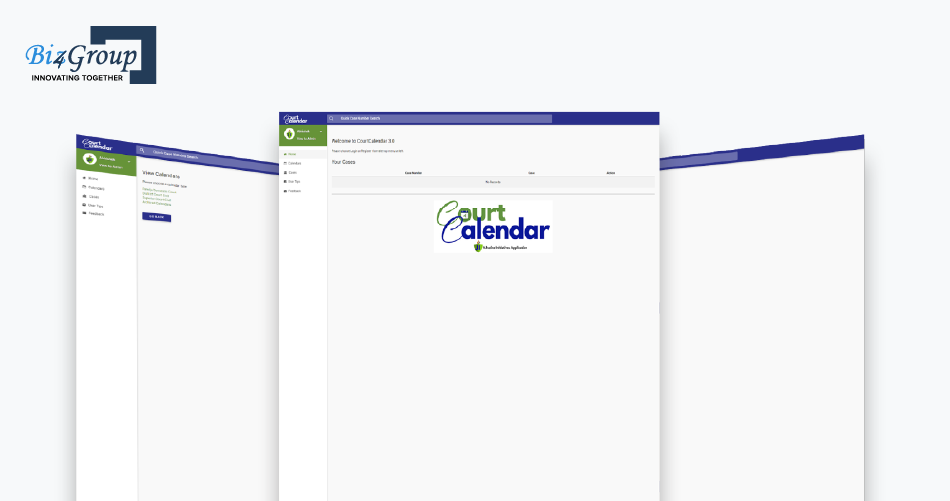
- We developed a judiciary platform designed to help attorneys manage court schedules, case updates, and administrative activities from a unified dashboard.
- Court Calendar enables lawyers to track hearings, share documents, and stay updated on critical legal timelines efficiently.
- Built in collaboration with legal organizations, the solution reflects practical legal workflow understanding, reinforcing Biz4Group’s ability to deliver platforms aligned with real legal operations and reputation-focused applications.
3. Secure Architecture Approach
Security is treated as a foundational requirement rather than an added feature. The team designs systems that protect sensitive data while maintaining performance and scalability.
- Role-based access controls and encrypted data handling
- Secure infrastructure planning from early development stages
- Proven methodologies used to responsibly build AI software handling confidential information
Portfolio Spotlight
Understanding this becomes clearer when we look at how it works inside a real legal platform TrailPoofer

- TrialProofer is a legal collaboration platform built to help attorneys review case materials, annotate documents, and coordinate trial preparation securely within one environment.
- The system emphasized controlled access, protected document handling, and reliable data organization for legal teams.
- Developing this platform required strong security planning and structured permissions, reflecting the same architectural discipline needed when building secure AI-driven reputation management applications for law firms.
4. Custom AI Model Training Capability
AI legal reputation management app requires intelligence tailored to legal language and client behavior. We develop custom-trained models designed around specific workflows instead of relying on generic automation.
- Training AI models using domain-relevant datasets
- Continuous refinement for improved accuracy
- Adaptive intelligence aligned with evolving client feedback patterns
5. Proven Delivery Track Record
Consistency in execution reflects development maturity. Our portfolio demonstrates successful delivery across AI-driven platforms with measurable outcomes and long-term client partnerships.
- Experience delivering scalable digital products
- Structured development lifecycle and transparent collaboration
- Focus on measurable business impact rather than experimental solutions
Selecting the right development partner directly influences long-term platform success. Organizations that develop an AI legal reputation management app with Biz4GroupLLC gain a partner focused on secure execution and sustainable product growth aligned with legal industry expectations.
Ready To Turn Reputation Into Strategy?
If your firm is planning an AI-driven reputation platform, let's discuss timelines, scope clarity, and practical implementation tailored to legal workflows.
Start the ConversationConclusion: Building a Reputation-First Digital Strategy for Modern Law Firms
Digital reputation now influences how clients shortlist law firms before making contact. This guide outlined how structured monitoring, sentiment insights, compliance planning, and measurable KPIs help firms shift from reactive review handling to intentional reputation management. Organizations that develop an AI legal reputation management app with top AI development companies in Florida and beyond gain continuous visibility into client perception and can respond before small issues affect credibility.
Long-term advantages come from scalability. Firms that develop scalable AI reputation management apps for growing law firms create systems that support expansion, multi-office operations, and consistent brand trust across digital channels. Reputation intelligence becomes part of everyday decision-making rather than a marketing afterthought.
If improving client trust and referral quality is part of your growth plan, a focused discussion around your workflows can help define practical next steps and build a roadmap aligned with long-term digital strategy.
FAQs
1. How do you develop an AI legal reputation management app for a law firm?
Developing an AI legal reputation management app typically involves defining review monitoring goals, setting up data integrations, training sentiment analysis models, building dashboards, and implementing compliance safeguards before deployment and continuous optimization.
2. What features should be included when building an AI powered legal reputation management app?
Core features usually include multi-platform review monitoring, sentiment analysis, risk alerts, response drafting assistance, attorney-level performance tracking, and analytics dashboards that help firms understand reputation trends over time.
3. How much does it cost to develop AI reputation management software for law firms?
The cost generally ranges from $30,000 to $150,000, depending on AI capabilities, integrations, compliance requirements, and scalability needs. MVP versions cost less, while enterprise-ready platforms require advanced automation and security investment.
4. Why are law firms investing in AI legal reputation management app development?
Law firms use AI to monitor feedback continuously, respond faster to negative reviews, and gain measurable insight into client sentiment. This helps improve trust, referrals, and overall online visibility without increasing manual workload.
5. Can AI help build secure reputation management platforms for legal practices?
Yes. Modern platforms use encryption, role-based access controls, and compliance-aware workflows to protect sensitive feedback while allowing firms to manage reviews responsibly across multiple digital channels.
6. How does AI client sentiment analysis improve law firm reputation management?
AI analyzes review language to identify patterns in client satisfaction and recurring concerns. These insights help firms address service gaps early and develop scalable AI reputation management strategies aligned with long-term growth.
