 Location :
Orlando, FL, USA
Location :
Orlando, FL, USA +1 (407) 714-1616
 info@biz4group.com

 AI Summary Powered by Biz4AI
- Develop a real estate AI social network platform to seamlessly connect agents, buyers, and investors while enhancing engagement and decision-making.
- AI transforms social networking by improving matchmaking, property recommendations, credibility, and community interactions.
- Platforms work with AI-driven workflows, enabling agent-buyer matching, investor discovery, smart communication, and predictive insights.
- Key features include core networking tools, advanced AI capabilities, mobile and web integration, and scalable architecture, with development costs ranging from $25,000 to $150,000+.
- Overcome data quality, trust, and scalability challenges, leveraging proven expertise like Biz4Group's real estate projects to create an AI social network for real estate that delivers value and a competitive edge.
What if your real estate platform could do more than just showcase property listings? Today's users expect personalized recommendations, instant answers, meaningful networking opportunities, and a seamless experience from discovery to decision-making. That's why businesses are investing in AI real estate social network platforms that bring together property discovery, community engagement, and intelligent automation in one place.
Whether you're a proptech startup, brokerage, or enterprise, building the right platform raises important questions:
- How is a real estate social network platform with AI different from a traditional property portal?
- Which AI features actually improve user engagement and lead conversion?
- How do CRM, MLS, and RAG make recommendations more accurate?
- What does it take to build a scalable platform without overengineering it?
- Which monetization model supports long-term growth?
Answering these questions requires more than technical expertise. Working with an experienced real estate AI software development company can help you align AI capabilities with real business goals, reducing costly development decisions early in the project.
It also helps to partner with a team that understands social media development solutions, since community engagement, user networking, messaging, and content discovery are just as important as property search. When these capabilities come together, you create a platform that users return to throughout their real estate journey, not just when they're looking for their next property.
What Is a Real Estate AI Social Network Platform?
Think of a real estate AI social network platform as a place where property search meets professional networking, community discussions, and AI assistance. Instead of asking users to switch between listing portals, messaging apps, market research tools, and AI for real estate social media, it brings everything together in one experience.
Imagine someone looking for an investment property. They don't just want to browse listings. They may want to compare neighborhoods, ask experienced investors for advice, connect with local brokers, understand market trends, and get instant answers to questions like:
- "Which areas have the highest rental demand?"
- "Is this property priced fairly?"
AI helps tie all of these experiences together, making the platform feel more like a trusted advisor than a search engine.
That shift changes how people use the platform. Instead of visiting only when they're ready to buy or sell, they keep coming back to learn, network, follow market updates, discover opportunities, and build relationships within the real estate community.
How Is It Different from a Traditional Property Portal?
|
Traditional Property Portal |
Real Estate AI Social Network Platform |
|---|---|
|
Users browse property listings. |
Users discover properties, connect with professionals, and join real estate communities. |
|
Search relies on filters and keywords. |
AI understands user intent and recommends relevant properties, people, and discussions. |
|
Engagement usually ends after viewing a listing. |
Users return for networking, market insights, AI assistance, and ongoing conversations. |
|
Primarily supports buying or selling. |
Supports learning, investing, networking, and long-term community engagement. |
|
Offers the same experience to everyone. |
Personalizes recommendations based on each user's interests and activity. |
The biggest difference isn't that AI has been added to a real estate platform. It's that the platform becomes smarter with every interaction. The more users search, connect, ask questions, and participate in discussions, the better it understands what matters to them. That creates an experience that's difficult for traditional property portals to match and gives people a reason to keep coming back, even when they aren't actively searching for their next property.
AI Architecture Behind a Real Estate Social Network Platform
The architecture of an AI-powered real estate social network is built around one goal: delivering personalized experiences at every touchpoint. From recommending the right properties and connecting buyers with agents to moderating discussions and answering user queries, multiple AI components work together behind the scenes. Instead of functioning as separate tools, they continuously share data to make the platform smarter with every interaction.
Building an AI-powered property networking platform naturally raises technical questions like this:
"I am a developer being asked to build a real estate social network platform for a client and they want AI baked into the core of the product, including personalized content feeds, AI-powered connection recommendations between agents and buyers, property recommendations based on user behavior, and market intelligence summaries, what does the system architecture for something like this actually look like and what tech stack should i be using"
A well-designed AI architecture answers exactly these questions by defining how data, AI models, integrations, and user interactions work together to deliver personalized experiences at scale.
|
Architecture Layer |
Purpose |
|---|---|
|
User Experience Layer |
The web and mobile applications where buyers, sellers, agents, and investors browse listings, join communities, message other users, and interact with AI-powered features. |
|
Data Integration Layer |
Brings together data from MLS listings, CRM systems, property databases, user profiles, and community activity to create a unified source of truth. |
|
AI Intelligence Layer |
Uses AI models to deliver personalized property recommendations, intelligent search, lead qualification, content generation, and conversational assistance. |
|
Social & Engagement Layer |
Powers community features like networking suggestions, discussion groups, personalized feeds, content moderation, and user engagement. |
|
Analytics & Decision Layer |
Tracks user behavior, platform performance, and engagement metrics to continuously improve recommendations, marketing campaigns, and business decisions. |
A well-designed architecture allows every part of your platform to work together seamlessly. When your listings, user activity, CRM data, and AI models stay connected, the platform becomes more accurate, more engaging, and easier to scale as your user base grows.
How Does a Real Estate AI Social Network Platform Work?
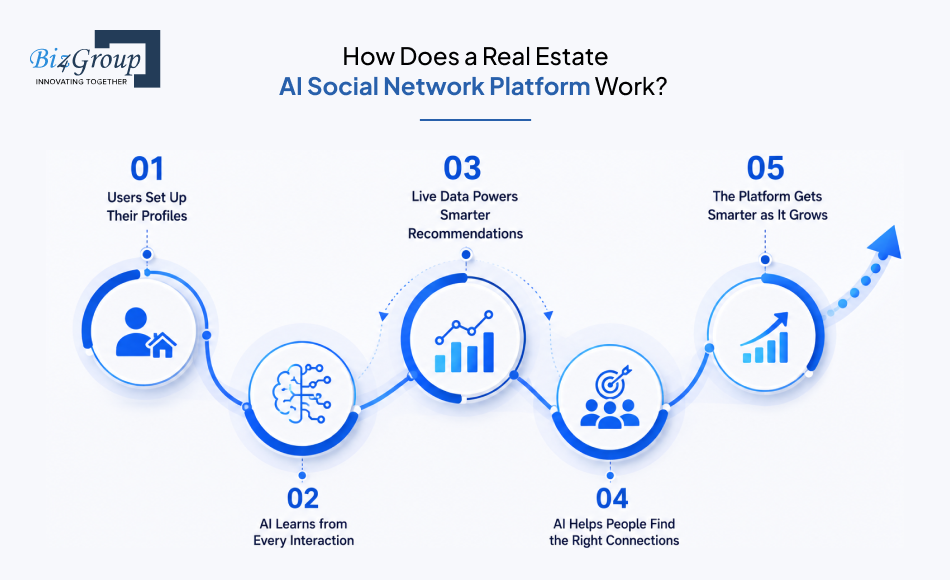
A real estate AI social network platform works by bringing together property data, user activity, community interactions, and AI to create a personalized experience. Instead of showing the same listings and content to everyone, the platform learns what each user is looking for and continuously improves its recommendations based on how they interact with the platform.
Here's how it typically works behind the scenes.
1. Users Set Up Their Profiles
Every personalized experience starts with understanding the user. During sign-up, buyers, sellers, agents, brokers, and investors can share details like their preferred locations, budget, property interests, or investment goals. This gives the platform enough context to deliver relevant recommendations from day one.
Real-world example: A first-time homebuyer searching for family homes and an investor looking for rental properties won't see the same listings, even if they're exploring the same city.
2. AI Learns from Every Interaction
People's preferences change over time, and the platform should keep up. AI looks beyond profile information by analyzing searches, saved properties, communities, conversations, and engagement patterns to understand what users are genuinely interested in.
Real-world example: If a user frequently explores luxury apartments and follows discussions about high-growth neighborhoods, the platform gradually starts prioritizing similar properties and related content.
3. Live Data Powers Smarter Recommendations
Good recommendations depend on more than AI alone. The platform combines user preferences with live property data, market updates, CRM records, and other trusted sources to recommend listings that are relevant today, not based on outdated information.
Real-world example: If a property's price drops or a new listing matches a user's saved search, the platform can recommend it almost immediately instead of waiting for the user to search again.
4. AI Helps People Find the Right Connections
Property listings are only one part of the experience. The platform can also recommend agents, investors, developers, local communities, and industry experts based on shared interests and activity. Those connections often become just as valuable as the properties themselves.
Real-world example: Someone exploring commercial real estate can be introduced to experienced investors and local networking groups that regularly discuss market opportunities.
5. The Platform Gets Smarter as It Grows
Every search, conversation, connection, and property view helps improve future recommendations. As your user base grows, AI becomes better at identifying patterns, predicting user intent, and delivering increasingly personalized experiences. This is also where enterprise AI solutions make a difference, helping large AI platforms for real estate social media process massive amounts of user and property data while maintaining speed, accuracy, and scalability.
Real-world example: A platform serving thousands of daily users can automatically adjust recommendations for each individual, even as property inventory and user interests change throughout the day.
|
Step |
What Happens |
|---|---|
|
User Onboarding |
Users create profiles and share their property preferences and goals. |
|
Behavior Analysis |
AI learns from searches, saved listings, conversations, and user activity. |
|
Smart Recommendations |
The platform matches users with relevant properties, professionals, and communities. |
|
Networking |
Buyers, sellers, agents, and investors connect through discussions, messaging, and groups. |
|
Continuous Learning |
Every interaction helps improve future recommendations and user experiences. |
The real value of a real estate social network platform with is that every interaction makes the platform more useful for the next one. Users spend less time searching, professionals connect with better opportunities, and the platform evolves into a trusted destination that supports the entire real estate journey.
Why Should Your Real Estate AI Social Network Platform Connect with RAG, CRM, and MLS?
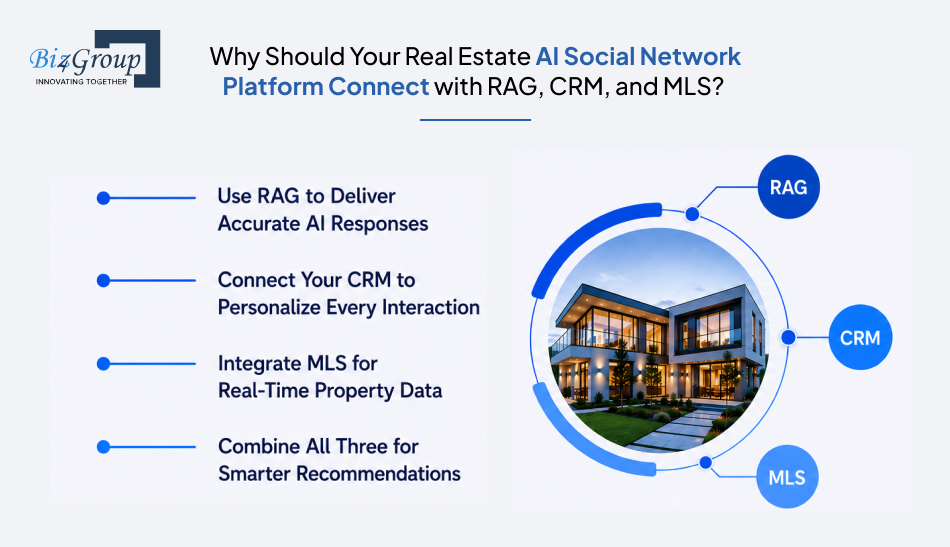
The intelligence of your real estate AI social network platform depends on the quality of data it can access. If your AI only relies on its pre-trained knowledge, it won't know about newly listed properties, updated client records, or changing market conditions. Connecting technologies like Retrieval-Augmented Generation (RAG), CRM systems, and MLS databases ensures your AI responds with accurate, up-to-date, and context-aware information instead of generic answers.
1. Use RAG to Deliver Accurate AI Responses
Large language models are powerful, but they don't automatically know what's happening inside your business. RAG allows the AI to retrieve information from your platform before generating a response, making answers more reliable and relevant. Whether a user asks about investment opportunities, neighborhood trends, or a property's latest status, the AI can respond using your own data instead of outdated training information.
- Real-world example: A buyer asks, "Show me waterfront homes under $700,000 with HOA fees below $200." Instead of guessing, the AI retrieves matching listings from your database and responds with current, searchable options.
2. Connect Your CRM to Personalize Every Interaction
Your CRM already stores valuable information like customer preferences, past conversations, saved properties, and purchase history. Connecting it with your AI allows the platform to remember user context, recommend relevant listings, send personalized follow-ups, and help agents continue conversations without starting from scratch every time.
- Real-world example: A returning buyer who previously searched for family homes can receive new recommendations that match their preferred location, budget, and property type without repeating the same requirements.
3. Integrate MLS for Real-Time Property Data
An AI assistant is only useful if the listings it recommends are accurate. Integrating MLS data gives your platform access to the latest property availability, pricing, photos, and listing updates, helping users make decisions based on current market information instead of outdated inventory.
- Real-world example: If a property goes under contract or its price changes overnight, the AI can immediately reflect those updates when someone searches the next morning.
4. Combine All Three for Smarter Recommendations
RAG, CRM, and MLS become far more powerful when they work together. MLS provides live property data, the CRM supplies user preferences and relationship history, while RAG retrieves the most relevant information before the AI generates a response. Together, they help the platform deliver recommendations that feel personal, timely, and trustworthy.
- Real-world example: An investor looking for rental properties in Austin receives recommendations based on current MLS listings, previous investment interests stored in the CRM, and AI-generated rental yield insights pulled from your knowledge base.
|
Technology |
What It Contributes |
|---|---|
|
RAG |
Retrieves trusted business and property data before the AI generates a response. |
|
CRM Integration |
Personalizes recommendations using customer profiles, preferences, and interaction history. |
|
MLS Integration |
Keeps listings, pricing, and property availability accurate and up to date. |
|
Combined Intelligence |
Delivers context-aware recommendations, smarter conversations, and a more personalized user experience. |
AI becomes significantly more valuable when it understands both your business and your users. Connecting RAG, CRM, and MLS transforms your real estate social network platform with AI from a conversational assistant into an intelligent platform that delivers personalized recommendations, accurate property information, and meaningful interactions every time someone logs in.
Real World Use Cases That Prove AI-Powered Real Estate Social Networks Are More Than a Buzzword
Real estate professionals don't need another social platform. They need one that helps them discover better opportunities, build stronger relationships, and make faster decisions. That's where AI changes the equation. By analyzing user behavior, property preferences, conversations, and market activity, AI-powered real estate social networks deliver experiences that traditional networking platforms simply can't.
The following use cases illustrate how businesses are putting these capabilities into practice.
1. Agent-to-Buyer Matching
Finding the right agent can be a headache for buyers. With AI-powered matchmaking, the platform:
- Connects buyers to agents based on location, property type, and past success rates
- Suggests agents who have handled similar transactions efficiently
- Provides buyers with instant recommendations and contact options
Example: A first-time homebuyer in New York gets matched with an agent who specializes in starter homes in their preferred neighborhood, cutting research time from weeks to hours. This is one way to create an AI social network for real estate that simplifies connections and builds trust.
2. Investor Discovery and Deal Sharing
Investors often miss opportunities because they don't have access to the right deals or networks. A real estate AI social network platform development can:
- Help investors discover off-market properties through AI-driven recommendations
- Allow agents and sellers to share deals with relevant investors instantly
- Enable networking among investors for co-investment opportunities
Example: A commercial property investor receives alerts about upcoming office space listings that match their investment profile. Using an AI real estate app MVP ensures real-time opportunities are delivered efficiently.
3. Neighborhood and Property Intelligence
Understanding neighborhoods and property trends is critical. With a AI real estate community platform development approach, the platform can:
- Aggregate property history, pricing trends, and demographic data
- Offer AI-generated insights into neighborhood development and growth potential
- Provide interactive maps and visualizations for users
Example: A developer evaluating a new residential project can view predicted property appreciation, foot traffic trends, and nearby amenities before making a decision. Solutions like an AI real estate SaaS product make these insights actionable for all stakeholders.
4. Community Engagement Tools for Real Estate Groups
Engaging users beyond transactions builds trust. Features for custom real estate social platform development integrating AI include:
- Discussion groups for buyers, investors, and agents
- Event notifications and property tours
- Content sharing such as market insights, tips, and news
Example: A luxury property buyers' group hosts weekly online discussions about market trends and investment tips, fostering a loyal community. Incorporating real estate AI app ideas can help design these interactive features.
5. Lead Management and Smart Communication Workflows
Managing leads efficiently is a challenge for agencies. A real estate AI social network platform can:
- Prioritize leads based on engagement and likelihood to convert
- Automate follow-ups and reminders
- Track communication history for seamless interactions
Example: A brokerage uses AI-driven notifications to alert agents about high-priority leads. Integrating real estate AI predictive analytics software ensures leads are scored accurately and follow-ups happen automatically. Additionally, AI-powered messaging through a AI chatbot development for real estate website help answer common client queries instantly. This demonstrates how you can make a real estate networking platform with AI that actively drives engagement.
By leveraging these real-world use cases, you can see how a real estate AI social network platform development improves engagement, streamlines workflows, and provides tangible value for agents, buyers, and investors alike.
Features That Make or Break Development of a Real Estate AI Social Network Platform
Most real estate social platforms don't fail because they're missing features. They fail because users stop finding reasons to come back. Messaging, profiles, and property listings may attract signups, but lasting engagement comes from features that continuously surface relevant opportunities, valuable connections, and timely market intelligence. That's where AI has the potential to change how these platforms are used.
The features below are the ones that have the biggest impact on long-term adoption and user engagement.
|
Feature |
Description |
Example / Benefit |
|---|---|---|
|
User Profiles |
Personalized onboarding for agents, brokers, buyers, and investors. Profiles capture preferences, location, and professional details. |
Helps the platform build AI social network platform for real estate agents and brokers that matches users accurately. |
|
Property Listings |
Verified property listings with photos, documents, descriptions, and pricing details. |
Ensure users trust the platform and can easily explore properties. |
|
Advanced Search & Filters |
Search by location, price, property type, amenities, or investor requirements. |
Speeds up discovery and makes the platform intuitive for users looking to create a real estate networking platform using artificial intelligence. |
|
Messaging & Notifications |
Real-time messaging, push notifications, and reminders. |
Improves communication between users and keeps leads engaged. |
|
Smart Matchmaking |
AI-driven algorithms that match buyers with the right agents and investors with suitable deals. |
Part of AI-powered real estate social network development, enhancing engagement and conversions. |
|
Personalized Recommendations |
Property and deal suggestions based on user behavior, preferences, and activity history. |
Users see relevant opportunities instantly, creating a highly engaging platform. |
|
Predictive Analytics |
AI-based analysis to forecast property trends, pricing, and investment potential. |
Tools like real estate AI predictive analytics software empower users to make smarter investment decisions. |
|
Chatbots & Virtual Assistants |
AI-powered chatbots handle routine queries, lead engagement, and instant support. |
Integrating a AI chatbot development company ensures fast and efficient customer service. |
|
AI Image & Content Optimization |
Automatically enhances property images, descriptions, and media content for better presentation. |
Gives listings a professional look without manual editing. |
|
Community & Social Groups |
Forums, discussion boards, and event notifications for agents, buyers, and investors. |
Helps users' network and build trust, making the platform more than just a listing site. |
|
Analytics Dashboard |
Visual insights on user behavior, lead management, property performance, and engagement trends. |
Supports better decision-making for agents and investors. |
|
Integration with MLS & External Data |
Syncs property data from multiple sources to ensure accurate and up-to-date listings. |
A critical step in real estate AI social network platform development for reliable property discovery. |
|
Custom Workflows |
Automates lead management, follow-ups, notifications, and reporting. |
Saves time for agents while increasing conversion efficiency. |
|
UI/UX Design |
Intuitive, engaging, and mobile-responsive interfaces. |
Delivered by UI/UX design experts to improve user adoption and retention. |
|
Custom Software Development |
Tailored development for specific business requirements and platform scalability. |
Developed by a custom software development company to meet unique goals. |
|
AI Product Enhancements |
Future-ready AI modules for predictive recommendations, personalized interactions, and automated analytics. |
Supported by a AI product development company to scale and enhance platform capabilities. |
Building a real estate AI social network platform is no longer just an option; it's a strategic move to stay ahead in the competitive real estate market. By combining smart matchmaking, AI-driven insights, and seamless communication, your platform can connect agents, buyers, and investors more effectively than ever. Whether you are looking to create a real estate networking platform using artificial intelligence or enhance engagement for your existing users, these strategies will help you deliver a scalable, user-focused solution that drives growth and innovation.
Curious Which Features Will Set Your Platform Apart?
From core networking tools to AI-driven recommendations, the right mix can skyrocket engagement. Let's make your platform smarter and more interactive.
Start Your AI JourneySteps to Create an AI Social Network for Real Estate Without Losing Time or Money
If you want to develop a real estate AI social network platform that delivers real value, you need a clear plan. These steps walk you through the essential flow of real estate AI social network platform development, so you build smarter, faster, and with fewer surprises.
1. Discovery and Strategic Planning
Start by shaping the vision of your product. Identify the audience, the real problems you want to solve, and the experience you want users to have. Partnering with an AI development company helps convert this vision into a structured roadmap.
- Define buyer, agent, and investor personas
- Align business goals with user expectations
- Map how AI will support core interactions
2. UX and Product Architecture
Clear architecture is the backbone of successful AI social media platform development for real estate. Wireframes and user journeys help you refine how agents and buyers will move through the platform. This step shapes the foundation for frictionless interaction.
- Build core flows for feed, search, matches, and chat
- Plan mobile and desktop layouts
- Reduce steps needed for listings and conversations
3. MVP Feature Selection
An MVP brings your ideas into the real world. Focus on the must have tools that prove your concept, such as recommendations and simple messaging. If you want to speed up development, you can lean on MVP development services.
- Prioritize features that deliver immediate user value
- Include AI intelligent property matching and listing tools
- Save advanced analytics for later phases
4. AI Model Setup and Data Preparation
This is where your platform becomes intelligent. Prepare your data, train recommendation models, and build early NLP tools. For more advanced autonomy or conversational flows, agentic AI development helps streamline the process while you hire AI developers to support scaling.
- Train property recommendation models
- Build intent detection for chat
- Set quality checks for data and predictions
5. Integration with MLS and Property Data Sources
Accurate property data is the backbone of any platform that tries to create an AI social network for real estate or create a real estate networking platform using artificial intelligence. Make sure your MLS integrations are stable and consistent.
- Connect MLS feeds with automated syncing
- Standardize property fields
- Keep data refresh cycles consistent
6. Development, Testing, Iteration, and Deployment
Here your product becomes real. Work on backend services, user interfaces, and AI modules, then test everything thoroughly. If part of your vision is a mobile centric experience, you can partner with an AI app development company to handle app builds.
- Develop APIs and user flows
- Test under different load conditions
- Deploy to secure and scalable cloud infrastructure
7. Launch Planning and Early Growth
Your launch is the start of the feedback loop. Seed the platform with verified profiles and quality listings, so new users feel immediate value. This step positions your product as a reliable option for anyone working to make a real estate networking platform with AI or build AI social network platform for real estate agents and brokers.
- Prepare onboarding walkthroughs
- Collect early user insights
- Adjust features based on real usage
These steps give you a clear blueprint for how to build a real estate AI-powered social network platform without wasting time or budget. When followed consistently, they support the smooth development of real estate AI social network platform experiences and help you apply smart development strategies for real estate AI social networking platforms that scale with real demand.
The Tech Stack Blueprint to Build an AI Social Network Platform for Real Estate Pros
Building an AI real estate social network platform is all about selecting a stack that can support three demanding workloads simultaneously: real-time social interactions, property data processing, and AI-powered recommendations. Every layer, from the frontend to the AI infrastructure, needs to work together to deliver a fast, scalable, and personalized user experience.
The blueprint below outlines the technologies commonly used to build modern AI-powered real estate networking platforms.
|
Layer |
Recommended Technologies |
How It Helps Your Platform |
|---|---|---|
|
Backend Frameworks |
These frameworks manage users, listings, and social interactions efficiently. They are essential for real estate AI social network platform development. |
|
|
Frontend Frameworks |
React, Next.js, Vue |
Smooth, responsive UI allows you to create an AI social network for real estate that works seamlessly on mobile and desktop. |
|
Databases |
PostgreSQL, MongoDB, ElasticSearch |
Structured and flexible storage for listings, chats, and profiles. Handles large search volumes and AI queries efficiently. |
|
Cloud Infrastructure |
AWS, Google Cloud, Azure |
Reliable hosting with auto-scaling to support AI real estate social media platform development for real estate at any scale. |
|
AI and Machine Learning Tools |
TensorFlow, PyTorch, OpenAI APIs |
Supports recommendation engines, property analysis, and automated insights. |
|
Automation and Integration Tools |
Zapier, Airflow, custom pipelines integrated using AI integration services |
Automates property updates, lead routing, notifications, and workflow management. |
|
Data Pipelines and ETL |
Kafka, Snowflake, BigQuery |
Handles structured and unstructured data from MLS, user activity, and media assets. |
|
Enterprise AI Layer |
Custom enterprise setups powered by enterprise AI solutions |
Supports large datasets, compliance, and advanced predictive analytics. |
|
AI Product Infrastructure |
Custom modules |
Powers pricing insights, image optimization, fraud detection, and predictive recommendations. |
|
DevOps and Scalability |
Docker, Kubernetes, CI/CD pipelines |
Ensure reliable deployments and a stable environment when you build AI social network platform for real estate agents and brokers. |
Choosing the right tech stack is critical to the development of real estate AI social network platform. Proper AI tools used in real estate social network platform enable faster updates, better AI performance, and smooth user experiences. Whether your goal is to create a real estate networking platform using artificial intelligence or scale to thousands of users, this stack lays a solid foundation.
Also Read: React JS Development Services
Cost Breakdown to Develop a Real Estate AI Social Network Platform
The cost to build a real estate AI social network platform generally ranges from $25,000 and $150,000+. Where your project falls within that range depends less on the idea itself and more on the product you intend to launch. AI recommendations, real-time communication, third-party integrations, advanced social features, and enterprise scalability all increase the overall investment.
The following breakdown shows how each development stage contributes to the final cost.
Estimated Cost Breakdown for Real Estate AI Social Network Platform Development
|
Feature Category |
Included Features |
Estimated Cost Range |
|---|---|---|
|
Basic Features for real estate AI social network platform development |
User accounts, profiles, property listings, search filters, saved alerts, simple messaging |
$8,000 to $20,000 |
|
Core Networking Elements |
Agent discovery, user connections, groups, activity feed, lead capture |
$15,000 to $35,000 |
|
AI Features for AI powered real estate social network development |
Smart recommendations, automated insights, conversational support, listing intelligence |
$20,000 to $50,000 |
|
Advanced AI and Predictive Tools |
Deal scoring, behavior mapping, AI driven workflows |
$12,000 to $30,000 |
|
Native Android and iOS apps with notifications and offline support |
$15,000 to $40,000 |
|
|
Website Development for AI social media platform development for real estate |
Responsive UI, property pages, MLS or IDX integrations, secure infrastructure |
$10,000 to $30,000 |
|
UI and UX Design |
Wireframes, visual layouts, prototype testing |
$5,000 to $12,000 |
Factors That Influence the Cost of Development
1. Level of AI Intelligence You Want
Deeper AI functionality generally brings higher investment.
- Basic recommendations cost less
- Predictive modeling requires more training
- High volume data ingestion adds dev time
If you want the flexibility you might find in a white-label AI real estate mobile app, expect additional AI and integration work.
2. Number of Platforms You Plan to Launch
Launching on more platforms increases development cost.
- Web only
- Web plus iOS and Android
- Platform plus admin dashboards and analytics
3. Integrations and External Data Systems
Connecting to MLS, IDX, CRM tools, mapping services, and verification systems adds development hours.
4. Scalability Requirements
AI platforms for real estate social media that need to support thousands of users from the beginning require stronger cloud setups.
- Load balancing
- Distributed databases
- Caching and optimization layers
Hidden Costs Many Teams Overlook
When planning development of a real estate AI social network platform, businesses often miss these predictable add ons.
- AI model tuning and retraining
- Cloud storage fees for images and videos
- Ongoing security and compliance updates
- API usage fees
- Database performance optimization
For teams preparing a web heavy platform, reviewing insights such as AI real estate website development cost helps clarify long term budgeting.
Cost Optimization Tips for Real Estate AI Social Network Platform Development
You can control your expenses without sacrificing functionality.
- Start lean with an MVP to validate your idea
- Add complex AI modules after early traction
- Use reusable UI components across web and mobile
- Keep first version design clean and extendable
- Adopt modular architecture to avoid costly rebuilds
This approach helps you build AI social network platform for real estate agents and brokers while staying on budget and maintaining long term flexibility.
How Can You Monetize a Real Estate AI Social Network Platform?
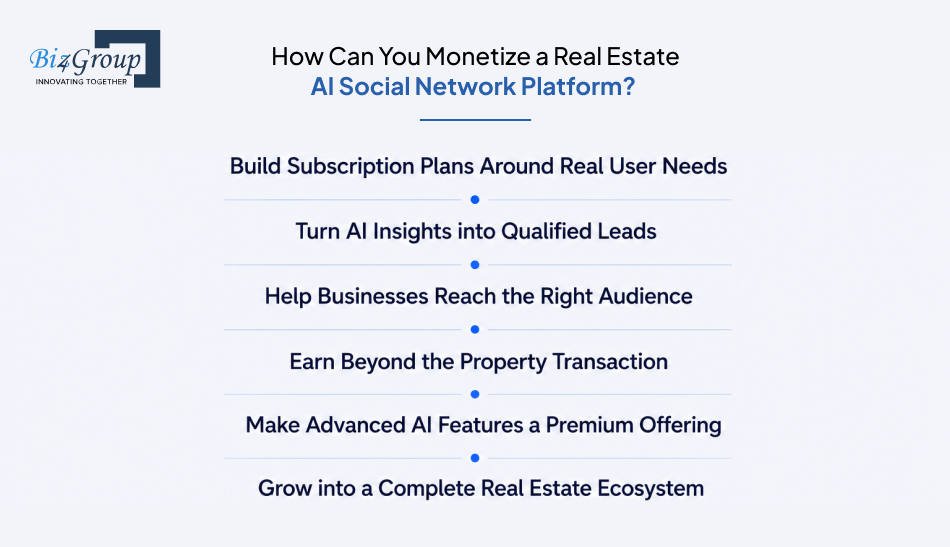
A real estate AI social network platform can generate revenue through multiple streams, including subscription plans, featured listings, advertising, transaction commissions, AI-powered premium features, lead generation, and strategic partnerships. The right monetization model depends on your target audience, but the strongest platforms typically combine several revenue streams instead of relying on just one.
The monetization strategies below explain how each model works and where it fits best.
1. Build Subscription Plans Around Real User Needs
A real estate AI social network platform can generate revenue through multiple streams, including subscription plans, featured listings, advertising, transaction commissions, AI-powered premium features, lead generation, and strategic partnerships. The right monetization model depends on your target audience, but the strongest platforms typically combine several revenue streams instead of relying on just one.
The monetization strategies below explain how each model works and where it fits best.
- Real-world example: LinkedIn didn't become a subscription business by limiting networking. It monetized the features that recruiters, sales teams, and professionals use every day. The same approach works well for agents, brokers, and investors.
2. Turn AI Insights into Qualified Leads
Every click, search, saved property, and conversation tells you something about a user's intent. AI can connect those signals to identify people who are actively looking to buy, sell, or invest, long before they fill out a contact form. Those high-intent leads are significantly more valuable than generic inquiries, making them a strong revenue stream for your platform.
- Real-world example: Many property portals sell leads to agents. The difference here is that AI helps identify serious prospects earlier, giving agents better opportunities and improving conversion rates.
3. Help Businesses Reach the Right Audience
Advertising works best when it feels relevant instead of disruptive. Rather than displaying the same promoted listings to everyone, your platform can recommend sponsored properties, projects, or services based on what users are actually searching for. Better targeting creates a better experience for users while giving advertisers stronger returns on their campaigns.
- Real-world example: Platforms like Zillow attract advertisers because they already have an audience with buying intent. Adding AI makes those advertising opportunities even more valuable by improving who sees each promotion.
4. Earn Beyond the Property Transaction
Finding the right property is only one milestone in a much longer journey. Buyers still need financing, legal support, inspections, insurance, renovation services, and even movers. Bringing these services into your platform creates new partnership opportunities while making life easier for your users.
- Real-world example: Many real estate businesses earn referral income from banks and home service providers. Expanding those partnerships allows your platform to generate revenue even after the property search ends.
5. Make Advanced AI Features a Premium Offering
Not every user needs sophisticated AI tools, and that's exactly what makes them valuable. Features like investment opportunity scoring, price forecasting, personalized market reports, or AI assistants can be offered as premium upgrades for professionals who depend on accurate insights to make faster decisions.
- Real-world example: Tools like Notion AI and Canva AI didn't replace their existing products. They introduced advanced AI capabilities as premium features for users who wanted more value.
6. Grow into a Complete Real Estate Ecosystem
The strongest platforms don't stop at connecting buyers and sellers. They become places where users can also find architects, interior designers, contractors, property managers, photographers, and legal advisors. As more businesses join your platform, new monetization opportunities naturally emerge through subscriptions, featured profiles, referrals, and sponsored placements.
- Real-world example: Houzz started as a platform for home inspiration but gradually evolved into a marketplace where homeowners and service providers connect throughout the renovation journey.
|
Monetization Model |
How It Generates Revenue |
|---|---|
|
Subscription Plans |
Monthly or annual memberships for agents, brokers, investors, and other professionals. |
|
AI-Qualified Leads |
Charge for high-intent buyer and seller leads identified through AI-driven behavior analysis. |
|
Sponsored Listings |
Let AI real estate social network platform developers and agencies pay for better visibility with AI-targeted property promotions. |
|
Partner Services |
Earn referral commissions from mortgage lenders, insurers, legal firms, movers, and other service providers. |
|
Premium AI Features |
Monetize advanced capabilities like property valuation, investment insights, and predictive analytics. |
|
Marketplace Revenue |
Generate income through featured profiles, subscriptions, and referrals from real estate service providers. |
The biggest mistake founders make is trying to monetize too much, too early. Focus on building an active community first, then introduce revenue streams that naturally fit the user experience. When people already trust your platform to discover properties, connect with professionals, and make smarter decisions, paying for premium features or partner services feels like the next logical step instead of an unnecessary upsell.
Challenges in Real Estate AI Social Network Platform Development and How to Solve Them
The biggest challenges in building a real estate AI social network platform aren't limited to writing code. Ensuring AI delivers relevant recommendations, protecting user and property data, scaling real-time interactions, integrating external data sources, and maintaining user trust all require careful planning from the start.
Below are the most common development challenges and the approaches used to solve them.
|
Challenge |
Why It Happens |
Solution |
|---|---|---|
|
Data Quality and Privacy Issues affecting real estate AI social network platform development |
Real estate platforms rely on large amounts of property data, user profiles, and behavioral insights. Poor data quality limits your AI accuracy. |
Establish strict validation rules, encrypt user data, and ensure clean data pipelines. Use privacy compliant AI workflows and regular audits. |
|
AI Fairness and Accuracy when you create a real estate networking platform using artificial intelligence |
Biased or incomplete datasets can lead to inaccurate recommendations, poor matching, or unfair scoring. |
Train AI models with diverse datasets and monitor outputs consistently. Introduce human review layers and transparent feedback loops. |
|
High Volume Media Storage and Performance |
Images, videos, floorplans, and 3D tours consume massive storage and slow down performance. |
Use cloud storage with CDN support, compress media intelligently, and rely on scalable hosting architectures. |
|
Building User Trust and Platform Credibility in AI social media platform development for real estate |
Users hesitate to trust AI-driven suggestions or automated decisions. Lack of transparency reduces engagement. |
Explain how AI works, add verification badges, and provide clear reasoning behind recommendations. Tools like an AI-powered social media assistant can improve transparency and communication. |
|
Balancing Buyers, Agents, Sellers, and Investors |
Each user type expects different features, communication styles, and insights. |
Create tailored UX paths and role-based dashboards. Segment features to match each user group's workflow. |
|
Long Term Scalability and Product Evolution when you make real estate AI social network platform |
As users grow, so does the demand on AI models, servers, and real time features. |
Adopt modular architecture, scalable cloud infrastructure, and continuous optimization cycles. Plan upgrades for AI models and data pipelines. |
By anticipating these hurdles, you can ensure your platform not only works but thrives. Addressing data quality, AI accuracy, media performance, and user trust early allows you to develop a real estate AI social network platform that scales smoothly and delivers value to agents, buyers, and investors alike. With thoughtful planning and tools like an AI-powered social media assistant, your platform can stay ahead of challenges and continue to grow confidently.
Should You Build or Buy AI Features for Your Real Estate Social Network?
If you're developing an AI-powered real estate social network, you don't need to build every AI feature from scratch. In fact, the most successful platforms take a hybrid approach: they build the AI capabilities that create a competitive advantage while integrating proven third-party AI solutions for everything else. This approach helps you launch faster, control development costs, and focus your engineering efforts on the features that truly differentiate your platform.
|
Build It Yourself If... |
Buy or Integrate If... |
|---|---|
|
The AI feature gives your platform a competitive edge, such as personalized property recommendations or investor matchmaking. |
The feature is already mature and readily available through trusted AI providers, such as speech recognition, translation, or OCR. |
|
You need complete control over how the AI works, learns, and evolves with your business. |
Your priority is reducing development time and getting your product to market faster. |
|
The feature relies heavily on your proprietary data, workflows, or business logic. |
The feature supports your platform but isn't what will make users choose you over competitors. |
|
You plan to continuously improve the feature based on user behavior and business growth. |
Building and maintaining the feature in-house would add unnecessary complexity and long-term costs. |
The key isn't choosing between building everything or buying everything, it's knowing where each approach makes the most sense. Invest your development efforts in the AI features that define your platform, and rely on proven AI services for the rest. This balanced strategy gives you the flexibility to innovate where it matters most while keeping your real estate social network scalable, cost-effective, and ready for future growth.
Common Mistakes to Avoid When Developing an AI-Powered Real Estate Social Network
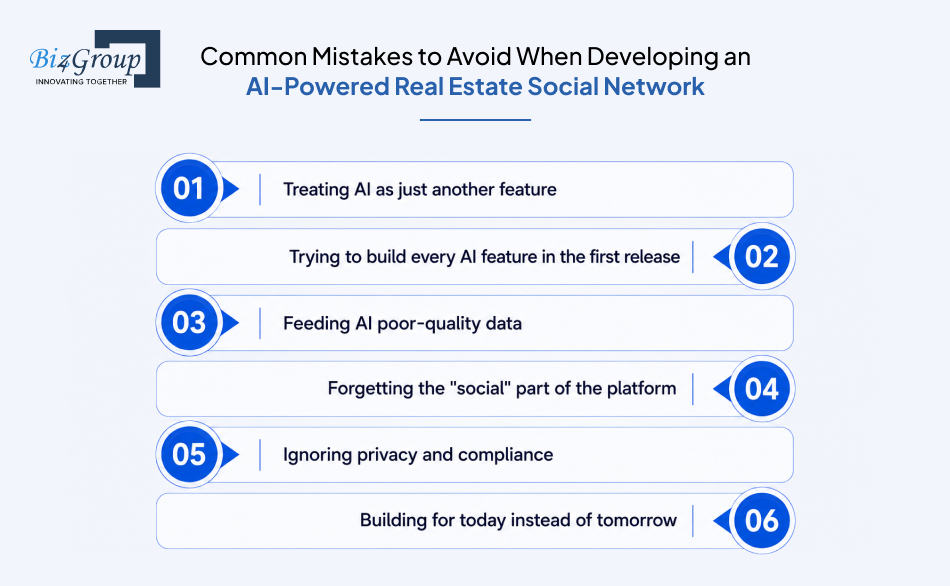
A few early decisions can make or break your AI real estate social network platform. We've seen businesses invest heavily in flashy AI features, only to realize later that poor data, weak community engagement, or an overcomplicated MVP held the product back.
Even with a strong idea, many platforms struggle to gain traction because of product decisions made early in development. Questions like this come up more often than you'd think:
"what makes a real estate social network actually work and get adoption when you are competing against LinkedIn for professional networking and Zillow for property search, i want to build a platform that carves out its own niche by combining community and AI-driven property intelligence but i need to understand what the product decisions are that determine whether a real estate social platform gets engagement or dies after the first 500 users"
The mistakes below address exactly those challenges, helping you build a platform that keeps users engaged instead of losing momentum after the initial launch.
The good news? Most of these mistakes are completely avoidable if you know what to watch out for from the beginning.
|
Common Mistake |
What You Should Do Instead |
|---|---|
|
Treating AI as just another feature |
Make AI part of the core experience by using it for property discovery, recommendations, networking, and lead generation, not just chatbots. |
|
Trying to build every AI feature in the first release |
Focus on an MVP with the features that deliver the most value first, then expand as your users and business grow. |
|
Feeding AI poor-quality data |
Keep your MLS, CRM, and property data accurate and up to date because better data leads to better AI recommendations. |
|
Forgetting the "social" part of the platform |
Encourage discussions, communities, and expert interactions so users have reasons to keep coming back beyond browsing listings. |
|
Ignoring privacy and compliance |
Build secure data handling and user consent into your platform from day one instead of treating them as post-launch fixes. |
|
Building for today instead of tomorrow |
Choose a scalable architecture that can easily support more users, listings, integrations, and AI capabilities as your platform grows. |
At the end of the day, building a successful AI-powered real estate social network isn't about packing in the latest AI features. It's about creating a platform that solves real problems, keeps users engaged, and can grow alongside your business. Avoid these common mistakes early, and you'll save yourself time, development costs, and plenty of headaches as your platform scales.
Biz4Group's Real Estate Expertise: Projects That Inspire Your AI Social Network
Biz4Group has extensive experience building AI-enabled platforms for the real estate sector. Their work demonstrates how technology can transform property interactions, matchmaking, and user engagement, all key elements when you develop a real estate AI social network platform.
1. Homer AI
Homer AI is a conversational platform where buyers and sellers can interact through a smart chatbot, filter and browse listings, schedule property visits, and manage dashboards for both buyers and sellers. This project showcases how social features and marketplace functionality can blend seamlessly, providing a foundation for real estate AI social network platform development.
2. Facilitor
Facilitor is a full-scale AI-driven home-buying platform. It allows users to search properties based on location and budget, receive AI-powered recommendations, arrange visits, and access MLS and GPS data. This demonstrates how to integrate property databases and recommendation engines, essential for anyone looking to create an AI social network for real estate.
3. Renters Book
Renters Book focuses on rental transparency and trust. Landlords and tenants can post reviews, share rental histories, and provide feedback, creating credibility in the rental market. This highlights how social trust, reviews, and community engagement can enhance a network of users, a critical consideration for AI-powered real estate social network development.
4. Contracks
Contracks is a contract management platform for real estate professionals. It uses AI to summarize contracts, manage documents, send milestone notifications, and handle secure payments. This project illustrates the importance of backend workflows, automation, and transactional efficiency, features that can be adapted to development strategies for real estate AI social networking platforms.
These projects show how Biz4Group blends AI, automation, social features, and real estate workflows to deliver robust platforms. By leveraging similar approaches, you can build AI social network platform for real estate agents and brokers that connects users, streamlines interactions, and offers predictive insights, giving your platform a strong competitive advantage.
Ready to Make One for You?
You saw the projects. You saw our capabilities. Now let's build something investors cannot stop talking about.
Let's TalkConclusion: Take the Leap into AI-Powered Real Estate Networking
Building a real estate AI social network platform is no longer a futuristic idea. It is a practical way to connect agents, buyers, and investors while streamlining property interactions and delivering smarter insights. From matchmaking to predictive recommendations, AI-powered real estate social network development is transforming how real estate professionals operate.
Biz4Group has the experience, technical expertise, and real-world project portfolio to guide you every step of the way. With successful platforms like Homer AI, Facilitor, Renters Book, and Contracks, we understand what it takes to merge social networking, automation, and AI into a seamless, user-friendly platform. By leveraging our capabilities, you can develop a real estate AI social network platform that is intelligent, scalable, and highly engaging.
When you create an AI social network for real estate, you are not just building a tool. You are creating a trusted network that connects agents, brokers, buyers, and investors while offering predictive insights and smarter decision-making. Biz4Group's experience ensures your platform delivers both innovation and reliability, giving your business a competitive edge in the evolving real estate market.
Ready to make your platform the next big thing in real estate? Partner with Biz4Group and let's build a network so smart, your users will wonder if it has a sixth sense.
FAQ’s
Q1: What is the typical cost to build a real estate AI social network platform?
The cost depends heavily on scope, features, and complexity. For a basic version you might spend around $25,000–$40,000, while a full-featured, scalable solution with AI-driven search, recommendations, analytics, and mobile support can reach $100,000–$150,000+. Costs rise with advanced AI, custom integrations, and mobile apps.
Q2: What core features should a platform include when you build AI social network platform for real estate agents and brokers?
You need secure user profiles, verified property listings, search and filter tools, messaging or chat, and basic listing functionality. Once those are in place, adding AI-driven recommendations, smart matchmaking, predictive analytics, and automated workflows will make your real estate networking platform stand out and offer high value.
Q3: Can I start small with a basic version and then expand into full real estate AI social network platform development?
Yes, starting with a Minimum Viable Platform helps you validate demand and user behavior with minimal cost. After initial feedback and traction, you can gradually incorporate advanced AI features and social-networking capabilities to evolve into a full-scale solution.
Q4: What challenges come with AI-powered real estate social network development and how can they be mitigated?
Common challenges include data quality and consistency, scalability, overhead performance for media and listings, and ensuring fair matching without bias. Mitigations involve data validation, modular architecture, scalable hosting, transparent AI output, and user verification or review mechanisms to build trust.
Q5: Will an AI-powered real estate social network platform really improve user engagement and conversions compared to traditional listing sites?
Yes. AI helps deliver personalized property suggestions, smarter agent-buyer matching, better search results, and relevant content, all of which improve user experience. This tends to boost engagement, lead generation, and conversion rates compared to generic listing platforms.
Q6: How long does it typically take to build such a platform, from concept to launch?
For a core MVP with basic functionality and minimal AI, development could take 2–4 months. For a fully-featured platform with robust AI, mobile support, integrations, and enterprise-grade scalability, the timeline may extend to 6–9 months.
Q7: What are ongoing costs after launching when you create a real estate networking platform using artificial intelligence?
After launching, you will need to manage cloud hosting, media storage, database maintenance, periodic AI model retraining, and performance monitoring. Also costs for third-party API integrations, licensing (MLS, maps, data feeds), and continuous feature updates should be factored into your operating budget.
