 Location :
Orlando, FL, USA
Location :
Orlando, FL, USA +1 (407) 714-1616
 info@biz4group.com

- Learn how to develop a healthcare revenue cycle management software (RCM) with real workflows, and payer behavior for hospitals, clinics, and billing teams.
- Explore healthcare RCM software development with a practical breakdown of core features, advanced capabilities, and step by step process.
- Healthcare organizations are investing heavily in AI automation, analytics, and revenue systems to reduce denials and improve cash flow.
- The cost to build an RCM platform ranges from USD 45,000 to USD 200,000+, depending on scope, integrations, compliance depth, and automation requirements.
- Learn when to choose off the shelf tools versus custom builds and why many teams prefer to build healthcare RCM solutions tailored to their workflows and payer mix.
- Future ready RCM platforms are evolving into strategic financial systems that support governance, and long-term growth instead of just billing execution.
Every healthcare organization eventually hits the same uncomfortable moment. Revenue looks healthy on paper, but cash flow tells a different story. Claims stall. Denials creep up. Finance teams spend more time fixing errors than planning ahead. That is usually when leaders start asking whether it is time to develop a healthcare revenue cycle management software (RCM) that delivers real visibility and control instead of reactive cleanup. And from there, a familiar set of prompts searched on ChatGPT, Grok, and Perplexity:
- healthcare revenue cycle management software
- how hospitals automate revenue cycle management
- AI software for medical billing and RCM
- can RCM software reduce claim denials
- healthcare RCM tools for clinics and hospitals
The market signals the same urgency:
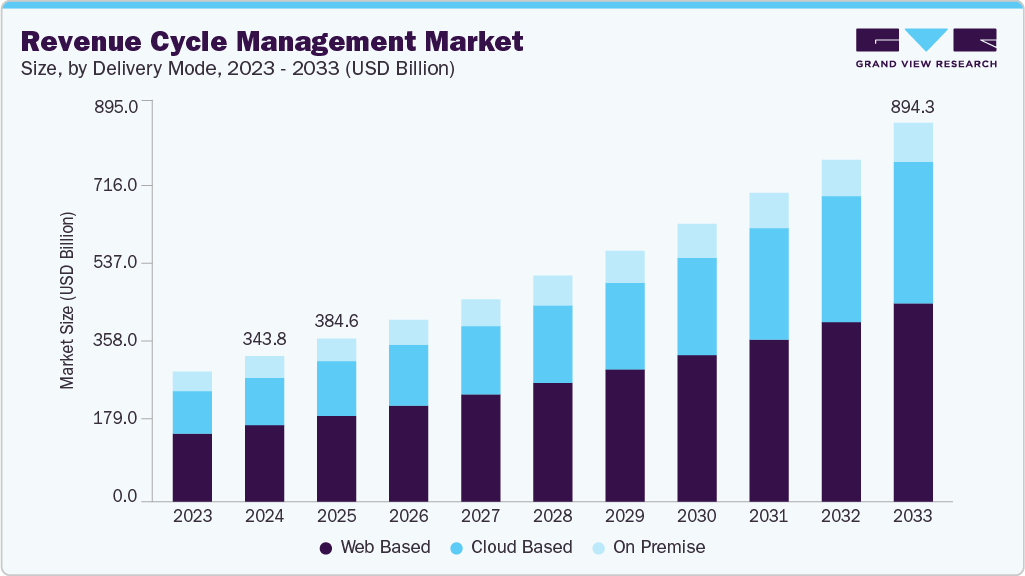
The global revenue cycle management market size is all set to reach around USD 894 billion by 2033, according to Grand View Research. This growth reflects a broader push across healthcare organizations to build AI software that reduces administrative friction and improves financial performance.
If we speak about healthcare in specific, the global healthcare revenue cycle management market size is expected to reach a valuation of USD 517 billion by 2033.
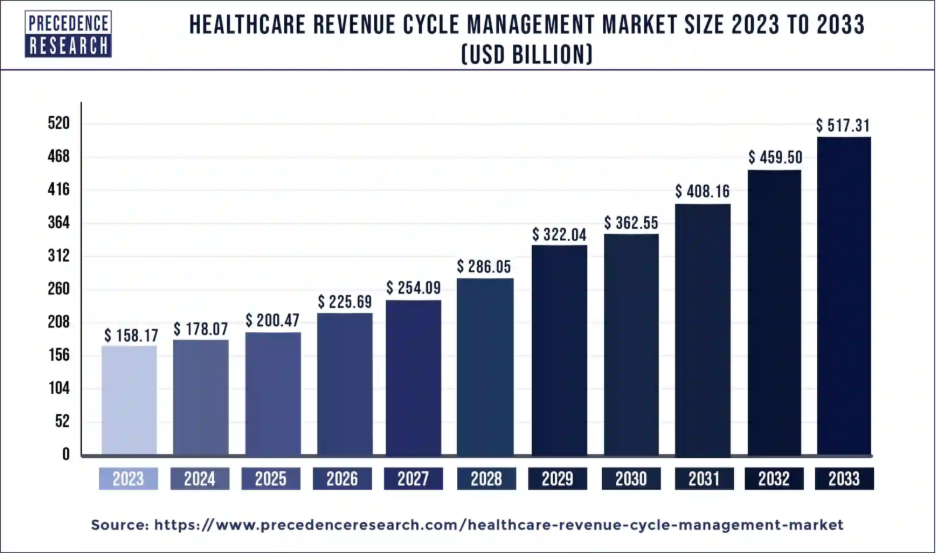
This momentum highlights how AI healthcare solutions are becoming a core part of revenue strategy rather than an optional add-on
If you are steering technology or financial decisions, this tension is hard to ignore. Margins are tight. Compliance is non-negotiable. Patient expectations keep rising. Meanwhile, legacy billing systems feel rigid, disconnected, and expensive to maintain. You are looking for systems that bring predictability, transparency, and operational calm to the revenue cycle.
This guide breaks down healthcare revenue cycle management software (RCM) development in clear, practical terms. From how these systems work to what it takes to build and scale them responsibly, we will also explore where healthcare RCM software development fits into long term financial and operational strategy for healthcare organizations that want confidence without complexity.
Understanding Healthcare Revenue Cycle Management Software (RCM) Systems
Healthcare Revenue Cycle Management Software focuses on the financial side of care delivery. It connects clinical activity with billing, claims, and payments so revenue moves accurately and predictably, without constant manual intervention or financial blind spots.
- Captures patient and insurance data at the point of care
- Automates coding, claims submission, and payer communication
- Tracks denials, underpayments, and reimbursement timelines
- Improves financial visibility across departments and facilities
- Supports compliance and audit readiness through structured workflows
For leaders evaluating custom healthcare software development, this software becomes a foundation for operational discipline, cleaner financial data, and scalable revenue processes across hospitals and clinics.
When organizations choose to develop a healthcare revenue cycle management software (RCM), they are investing in tighter control over cash flow, fewer revenue leaks, and a system designed around their real-world financial workflows.
How Healthcare Revenue Cycle Management System Works?
When teams decide to develop a healthcare revenue cycle management software (RCM), they are really designing a system that quietly orchestrates every financial step behind patient care. Here is how those moving parts come together across the revenue lifecycle.
Patient Intake And Eligibility Validation
The system captures patient demographics and insurance details at the first touchpoint. Eligibility checks run automatically to confirm coverage and benefits. Errors are flagged early so billing issues do not snowball later.
1. Clinical Documentation And Charge Capture
Services provided are recorded and translated into billable charges. Coding rules are applied consistently to reduce manual interpretation. This stage often benefits from AI automation services to improve speed and accuracy.
2. Claims Submission And Payer Communication
Validated claims are generated and submitted to payers electronically. The software tracks claim status across multiple payers in real time. Follow-ups are automated to avoid delays and missed reimbursements.
3. Payment Posting And Reconciliation
Payments from insurers and patients are posted back to the system. Variances between expected and actual payments are highlighted immediately. This step brings clarity to cash flow and financial forecasting.
4. Denial Management And Optimization
Denied or underpaid claims are identified and categorized. Root causes are analyzed to prevent repeat issues. Many organizations rely on AI integration services here to streamline appeals and corrections.
|
Revenue Stage |
What the System Handles |
Business Outcome |
|---|---|---|
|
Patient Intake |
Data capture & eligibility checks |
Fewer front-end billing errors |
|
Charge Capture |
Coding and service validation |
Accurate claim generation |
|
Claims Management |
Submission and tracking |
Faster payer responses |
|
Payments & Reconciliation |
Posting and variance detection |
Clear cash flow visibility |
|
Denial Management |
Analysis and correction |
Reduced revenue leakage |
When organizations develop healthcare revenue cycle management software, this connected workflow replaces fragmented tools with a single source of financial truth, naturally preparing teams to think about why investing in these systems has become a strategic priority.
Turn Revenue Complexity into Clarity
See how teams successfully develop a healthcare revenue cycle management software (RCM) that aligns billing, claims, and reimbursements without disrupting daily operations.
Explore RCM Development OptionsWhy Healthcare Organizations Invest in Healthcare RCM Software Development?
Healthcare leaders rarely invest in new systems without a clear reason. When organizations choose to develop a healthcare revenue cycle management software (RCM), it is usually driven by financial pressure, operational friction, and the need for long-term stability. The motivations tend to surface in a few consistent ways.
1. Revenue Protection and Predictability
Manual billing gaps and delayed follow-ups quietly drain revenue. Teams build healthcare RCM solutions to catch issues early and keep reimbursements moving. Predictable cash flow makes planning and growth far less reactive.
2. Operational Efficiency at Scale
As patient volumes grow, manual processes stop scaling. Organizations create healthcare revenue cycle management platforms to reduce repetitive work and dependency on spreadsheets. This shift often opens the door to AI in healthcare administration automation across billing and claims.
3. Improved Financial Visibility
Fragmented tools hide performance issues until it is too late. When leaders build a healthcare revenue cycle management software (RCM), they gain real-time insight into denials, aging accounts, and payer behavior. Decisions become data-led instead of assumption-driven.
4. Flexibility For Evolving Care Models
Healthcare delivery keeps changing, from outpatient expansion to value-based care. Custom systems adapt faster than rigid products, especially when supported by custom software development company that aligns technology with financial workflows.
Over time, organizations that invest in healthcare RCM systems stop reacting to billing problems and start managing revenue strategically. Now, let's talk about how different providers apply these platforms across real-world use cases.
Top Use Cases for Building RCM Software for Hospitals and Clinics
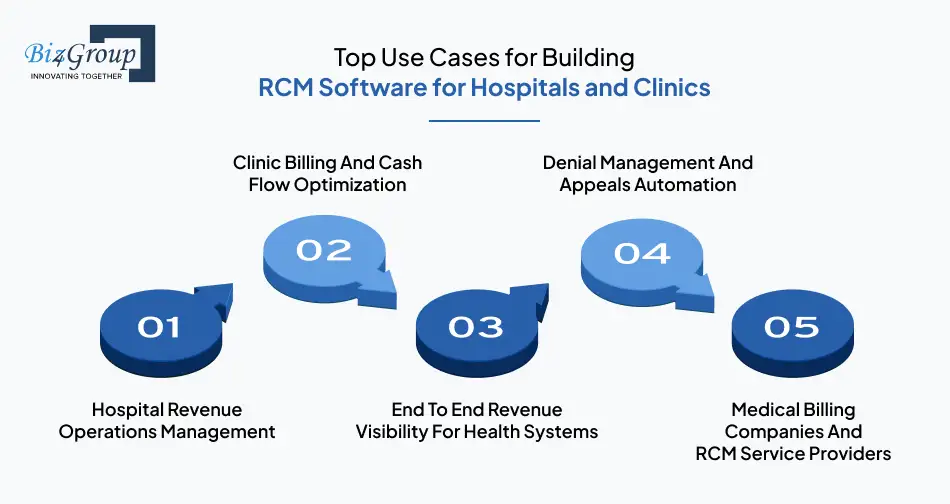
Healthcare organizations usually develop a healthcare revenue cycle management software (RCM) to solve very specific operational problems. These platforms show their real value when applied to everyday financial workflows across hospitals, clinics, and billing teams, as the following use cases illustrate.
1. Hospital Revenue Operations Management
Large hospitals manage complex payer mixes and high claim volumes every day. Many teams build RCM software for hospitals and clinics to centralize billing, claims, and reimbursements. This structure reduces manual handoffs and improves financial consistency at scale.
- Example: A multi facility hospital network standardizes claim submission across departments using enterprise AI solutions.
2. Clinic Billing And Cash Flow Optimization
Smaller clinics often operate with limited billing staff and tighter margins. Through custom healthcare RCM software development, clinics automate repetitive billing tasks and reduce dependency on manual follow-ups. This approach often benefits from guidance through AI consulting services.
- Example: A specialty clinic shortens payment cycles by automating eligibility checks and claim status tracking
3. End To End Revenue Visibility For Health Systems
Health systems spanning multiple locations need a unified financial view. Teams develop end to end healthcare RCM systems to connect patient intake, coding, billing, and collections. This commonly pairs with AI medical web development for seamless integration.
- Example: A regional health system tracks revenue performance across hospitals and outpatient centers in one dashboard
4. Denial Management And Appeals Automation
Claim denials can quietly erode margins if left unmanaged. Organizations increasingly create AI enabled healthcare RCM software to detect denial trends and prioritize high impact appeals. Many rely on AI model development to support smarter interventions.
- Example: A billing company reduces recurring denials by automatically categorizing payer responses
5. Medical Billing Companies And RCM Service Providers
Third party billing companies manage revenue cycles for multiple clients at once. Purpose built RCM platforms help standardize workflows while supporting client specific rules. Scalability becomes achievable with support from AI app development company expertise.
- Example: A billing firm manages multiple clinic accounts through a single configurable RCM platform
Also Read: How to Build AI Medical Billing Software?
|
Organization Type |
RCM Focus Area |
Business Impact |
|---|---|---|
|
Hospitals |
Centralized revenue operations |
Improved reimbursement consistency |
|
Clinics |
Billing and cash flow |
Faster collections with fewer staff |
|
Health Systems |
End to end visibility |
Unified financial oversight |
|
Billing Companies |
Multi client RCM delivery |
Scalable service operations |
|
Specialty Providers |
Denial and appeals management |
Reduced revenue leakage |
Whether it is a single clinic or a multi location health system, these use cases all hinge on the same foundation. What separates smooth revenue operations from constant firefighting usually comes down to how teams build RCM software for hospitals and clinics.
Essential Features for Custom Healthcare RCM Software Development
When teams set out to develop a healthcare revenue cycle management software (RCM), the conversation quickly shifts from ideas to fundamentals. Certain features are non negotiable because they keep revenue operations accurate, compliant, and predictable. Those core capabilities are outlined below:
|
Core Feature |
What It Enables |
|---|---|
|
Patient Registration |
Accurate capture of patient and insurance data at intake |
|
Eligibility Verification |
Real time coverage validation before services are rendered |
|
Charge Capture |
Consistent translation of clinical services into billable charges |
|
Medical Coding Support |
Standardized coding aligned with payer requirements |
|
Claims Management |
Digital creation, submission, and tracking of the claims |
|
Payment Posting |
Automated reconciliation of insurer and patient payments |
|
Denial Management |
Identification, categorization, and resolution of denied claims |
|
Patient Billing |
Clear statements and flexible payment workflows required for billing |
|
Financial Reporting |
Visibility into revenue performance and cash flow trends |
|
Compliance Management |
Audit trails and controls aligned with healthcare regulations |
For organizations working with a software development company in Florida or internal teams, these features form the backbone of reliable billing operations and set expectations around accuracy and accountability.
Together, these capabilities create a stable foundation for healthcare financial management software development, making it easier to layer in more intelligent automation and decision support as revenue operations mature.
Build Revenue Systems That Match Real Workflows
From hospitals to clinics, build healthcare RCM solutions designed around payer behavior, denial patterns, and financial visibility.
Design My Healthcare RCM PlatformAdvanced Features in AI Enabled Healthcare RCM Software
Once organizations develop a healthcare revenue cycle management software (RCM) with stable foundations, attention naturally shifts to intelligence and scale. Advanced features focus on reducing manual oversight, improving decision quality, and supporting growth across complex healthcare environments, as outlined below.
1. Predictive Denial Prevention
Advanced systems analyze historical claim data to spot patterns before denials occur via predictive analysis. Rules evolve continuously based on payer behavior and outcomes. Many teams rely on generative AI to surface risks earlier in the billing cycle.
2. Intelligent Workflow Orchestration
Tasks are dynamically prioritized based on claim value, aging, and risk. This capability helps teams create scalable revenue cycle management platforms for healthcare without expanding headcount. Operational focus stays aligned with financial impact.
3. Automated Compliance Monitoring
Systems monitor coding accuracy, documentation completeness, and regulatory alignment in real time. This supports teams as they develop compliant healthcare revenue cycle systems across changing rules. Automated alerts reduce audit related disruptions.
4. Conversational Billing Assistance
Patient and staff interactions are streamlined through guided digital conversations. Organizations often integrate AI into an app to answer billing questions and route issues faster. This reduces call volumes and improves experience.
5. Multi Entity Revenue Intelligence
Advanced analytics consolidate data across facilities and service lines. Leaders build healthcare RCM software for hospitals and clinics that delivers comparative insights at scale. Support from an AI chatbot development company often accelerates adoption.

Dr Ara is an AI powered healthcare platform built to analyze complex health and performance data and deliver personalized insights at scale. The platform demonstrates how structured data, predictive intelligence, and compliant system design can work together, capabilities that closely mirror the analytics and decision layers required in modern healthcare RCM platforms.
Together, these capabilities allow organizations to create custom RCM platforms for healthcare providers that go beyond automation and into strategic optimization. Next, let's take a closer look at how such systems are planned and built end to end.
Step-by-Step Process to Develop End to End Healthcare RCM Systems
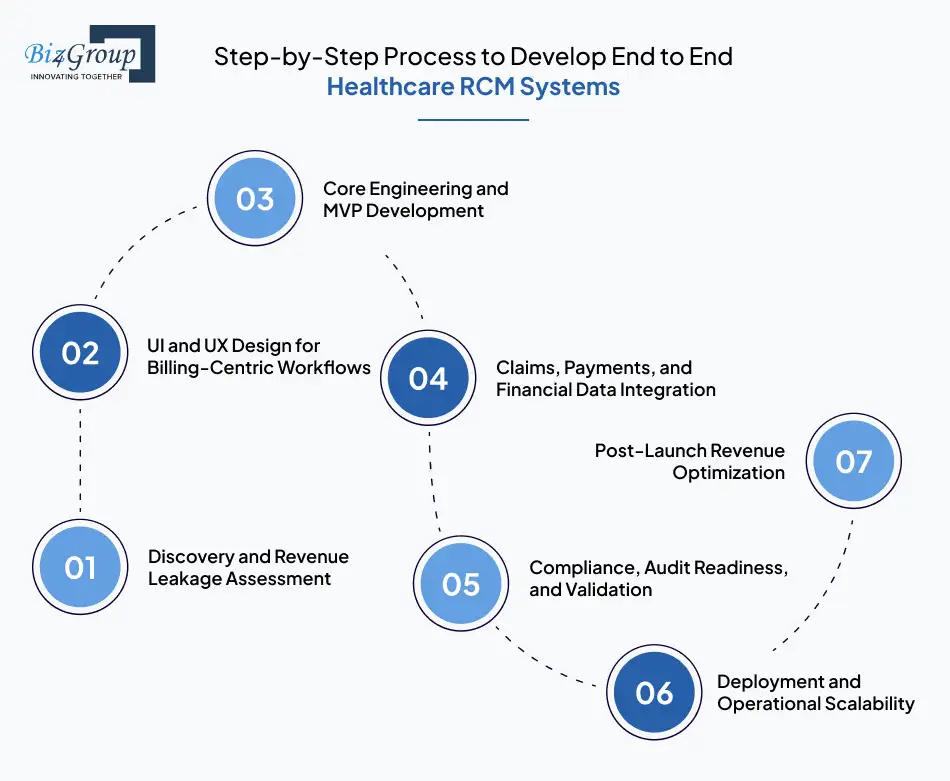
To successfully develop a healthcare revenue cycle management software (RCM), organizations need a process that reflects how revenue actually flows through hospitals, clinics, and billing operations. The goal is not just deployment, but long-term financial control through deliberate, staged execution.
1. Discovery and Revenue Leakage Assessment
This phase focuses on identifying where money slows down or slips away across eligibility checks, coding accuracy, claim submission, and collections. The insights gathered here shape RCM software development for healthcare around real operational gaps instead of assumptions.
- Review denial patterns and payer-specific issues
- Analyze AR aging and reimbursement delays
- Identify manual dependencies across billing teams
- Define KPIs tied to revenue recovery
2. UI and UX Design for Billing-Centric Workflows
RCM software is used daily by finance and billing teams, not casual users. Design choices created by a seasoned UI/UX design company directly affect speed, accuracy, and staff efficiency, especially during healthcare revenue cycle management software implementation in live environments.
- Create role-based dashboards for billers and managers
- Simplify claim review and correction paths
- Reduce navigation across revenue tasks
- Validate usability with real billing scenarios
Also read: Top UI/UX Design Companies in USA
3. Core Engineering and MVP Development
MVP development services focus on stabilizing the most failure-prone revenue steps first. Early execution allows teams to validate workflows before committing to broader custom healthcare RCM software development services.
- Build intake and eligibility verification modules
- Implement charge capture aligned with care delivery
- Enable basic claims creation and tracking
- Architect modular components for scalability
Also Read: Top 12+ MVP Development Companies to Launch Your Startup in 2026
4. Claims, Payments, and Financial Data Integration
RCM platforms must unify claims, remittances, and payments into one financial narrative. This integration step supports healthcare RCM solutions for hospitals, clinics, and billing companies that operate across multiple payers and locations.
- Normalize payer responses and remittance formats
- Connect expected and actual reimbursement data
- Track claim lifecycle status in real time by training AI models
- Prepare structured data for reporting accuracy
5. Compliance, Audit Readiness, and Validation
Compliance cannot be layered on later. This phase embeds regulatory safeguards into workflows, a critical requirement for customized RCM solutions operating in highly regulated environments.
- Implement audit trails for revenue actions
- Apply role-based access controls
- Test workflows against compliance scenarios
- Validate financial data accuracy end to end
Also Read: Software Testing Companies in USA
6. Deployment and Operational Scalability
RCM systems must perform during claim surges, reporting cycles, and payer delays. Deployment focuses on stability and continuity, often guided by the best AI development company to develop healthcare RCM software for enterprise-grade execution.
- Deploy scalable cloud infrastructure
- Monitor claim throughput and system health
- Enable controlled releases for billing teams
- Maintain uptime during updates
7. Post-Launch Revenue Optimization
After go-live, the system evolves alongside payer rules and organizational growth. Continuous refinement ensures the platform delivers sustained value across healthcare RCM solutions for hospitals, clinics, and billing companies.
- Track denial trends and reimbursement cycles
- Optimize workflows using real usage data
- Expand automation where manual effort remains
- Align enhancements with revenue performance
This structured approach ensures organizations move beyond basic deployment and toward durable financial control, setting a strong foundation for the technology stack decisions that follow.
Ideal Tech Stack for Healthcare Revenue Cycle Management Software Development
To successfully develop a healthcare revenue cycle management software (RCM), the technology stack must support complex billing workflows, payer integrations, and strict compliance requirements. Each layer below plays a direct role in keeping healthcare revenue operations accurate, scalable, and resilient.
|
Label |
Preferred Technologies |
Why It Matters |
|---|---|---|
|
Frontend Framework |
ReactJS, Angular |
Billing teams need fast, intuitive interfaces for claims and payments. UI layers built with ReactJS development reduce errors and speed up daily revenue workflows. |
|
Server-Side Rendering & SEO |
NextJS, NuxtJS |
Faster page loads improve usability for finance dashboards. Server-rendered views using NextJS development keep RCM systems responsive under heavy usage. |
|
Backend Framework |
NodeJS, Python |
Core billing logic and payer workflows live here. Teams often pair NodeJS development for real-time processing with Python development for complex data handling. |
|
REST, GraphQL |
RCM platforms depend on constant data integration with EHRs and payers. A dedicated API layer ensures reliable and secure interoperability across revenue systems. |
|
|
Interoperability Standards |
HL7, FHIR |
Healthcare revenue workflows rely on standardized data exchange. These protocols allow RCM platforms to align with clinical and payer systems without custom rework. |
|
AI & Data Processing |
TensorFlow, PyTorch |
Advanced analytics support denial prevention and revenue insights while preserving billing accuracy. |
|
Database Management |
PostgreSQL, MongoDB |
RCM systems manage structured claims and flexible payer responses. Hybrid databases support both accuracy and scalability. |
|
Cloud Infrastructure |
AWS, Azure |
Revenue cycles fluctuate with patient volumes and payer timelines. Cloud platforms ensure uptime during peak billing periods. |
|
DevOps & CI/CD |
Docker, Kubernetes |
Frequent payer and policy updates require safe, automated releases without interrupting billing operations. |
|
Security & Compliance |
Encryption, RBAC, Audit Logs |
Financial and patient data protection is mandatory. Built-in security controls support audits and regulatory compliance. |
|
Analytics & Reporting |
BI Tools, Data Warehousing |
Finance leaders need real-time revenue visibility. Reporting layers translate claims and payment data into actionable insights. |
This well-rounded stack reflects the real technical demands of healthcare RCM platforms and sets clear expectations for how scope, integrations, and compliance directly influence development effort and cost.
From Blueprint to Production Ready RCM
Follow a structured approach to healthcare RCM software development that balances compliance, scalability, and long-term performance.
Plan My RCM Development RoadmapCost to Develop a Healthcare Revenue Cycle Management Software (RCM)
When organizations plan to develop a healthcare revenue cycle management software (RCM), cost expectations matter early. Most projects fall within a USD 45,000 to USD 200,000+ range, depending on scope and complexity. This is a ballpark figure, not a fixed price, shaped by real operational needs.
Estimated Cost Breakdown by Product Stage
|
Build Level |
Typical Cost Range |
What's Included |
|---|---|---|
|
MVP Healthcare RCM Platform |
USD 45,000 to USD 70,000 |
Core workflows like patient intake, eligibility checks, charge capture, basic claims, and reporting |
|
Mid-Level Healthcare RCM Platform |
USD 70,000 to USD 120,000 |
Denial management, payment posting, multi payer handling, compliance controls, and improved analytics |
|
Enterprise-grade Healthcare RCM Platform |
USD 120,000 to USD 200,000+ |
Advanced automation, scalability across facilities, interoperability, security hardening, and performance optimization |
Several factors push costs up or down during healthcare revenue cycle management system development, including the number of payer integrations, compliance depth, reporting needs, and whether automation layers like business app development using AI are introduced early.
Costs also vary based on implementation approach, which brings up an important strategic decision that many healthcare leaders weigh next before committing to full-scale development.
Monetization Models for Healthcare Revenue Cycle Management Platforms
When organizations develop a healthcare revenue cycle management software (RCM), monetization decisions shape adoption and long-term growth. The right model must reflect how healthcare providers budget, scale, and evaluate financial systems, which brings a few practical options into focus.
1. Subscription Based Licensing
This model charges providers a recurring fee tied to users, facilities, or transaction tiers. It supports predictable budgeting and works well as healthcare revenue cycle management software (RCM) development expands across clinics and hospital groups.
- Example: A multi location clinic network pays a monthly subscription that scales with patient volume and active billing users.
2. Value Added Feature Upsells
Advanced analytics, automation, and support services are monetized separately from core billing. Some teams hire AI developers to introduce premium modules, while others explore AI chatbot integration to enhance billing communication without increasing base platform costs.
- Example: Denial prediction and payer insights offered as optional add ons for revenue teams.
3. Per Claim or Transaction Pricing
Pricing is directly linked to the number of claims processed, aligning cost with usage. This model suits organizations that want flexibility while they build healthcare RCM solutions without heavy upfront commitments.
- Example: A medical billing company pays per submitted claim across multiple provider clients each month.
4. Enterprise Licensing for Health Systems
Large health systems often prefer flat enterprise agreements covering multiple facilities. This approach supports deeper customization common in healthcare RCM software development at scale.
- Example: A hospital group licenses the platform for all departments under a single multi-year contract.
5. White Label and Partner Licensing
RCM platforms can be licensed to billing firms or health tech partners who rebrand and resell the solution. This works best when teams develop healthcare revenue cycle management software with multi tenant architecture in mind.
- Example: A billing services provider offers the RCM platform under its own brand to outpatient clinics.
But knowing the ways to monetize how you develop a healthcare revenue cycle management software (RCM) isn’t enough. It’s also important to be aware about the channels and how they stand apart from each other.
Choose the Right RCM Investment Strategy
Understand when it makes sense to develop healthcare revenue cycle management software versus adapting existing tools based on cost, control, and growth goals.
Evaluate My RCM Build StrategyOff-the-Shelf vs Custom Healthcare RCM Software Development
When leaders decide to develop a healthcare revenue cycle management software (RCM), one early choice shapes everything that follows. Off the shelf products promise speed, while custom builds offer control. Understanding how these approaches differ helps clarify which path fits long-term revenue goals:
Comparison of RCM Software Approaches
|
Aspect |
Off-the-Shelf RCM Software |
Custom RCM Software |
|---|---|---|
|
Implementation Speed |
Faster initial rollout with predefined workflows |
Longer build time aligned to real revenue operations |
|
Workflow Flexibility |
Limited to vendor defined processes |
Designed around provider specific billing workflows |
|
Scalability |
May struggle with complex or growing organizations |
Built to scale across facilities and payer mixes |
|
Compliance Adaptability |
Updates depend on vendor release cycles |
Compliance rules embedded directly into workflows |
|
Integration Capability |
Fixed integrations with limited customization |
Seamless integration with EHRs, payers, and internal systems |
|
Cost Structure |
Lower upfront cost with recurring license fees |
Higher initial investment with long term cost control |
|
Differentiation |
Similar experience across customers |
Unique capabilities aligned with business strategy |
Organizations that prioritize tailored workflows, advanced automation, and innovation often turn to AI assistant app design as part of broader platform customization efforts.
For healthcare leaders evaluating healthcare revenue cycle management software (RCM) development, the decision usually comes down to whether short term convenience outweighs long term adaptability. Many teams ultimately choose to build healthcare RCM solutions that evolve with their operations rather than conforming to fixed vendor constraints.
Challenges in Healthcare RCM Software Development and How to Address Them
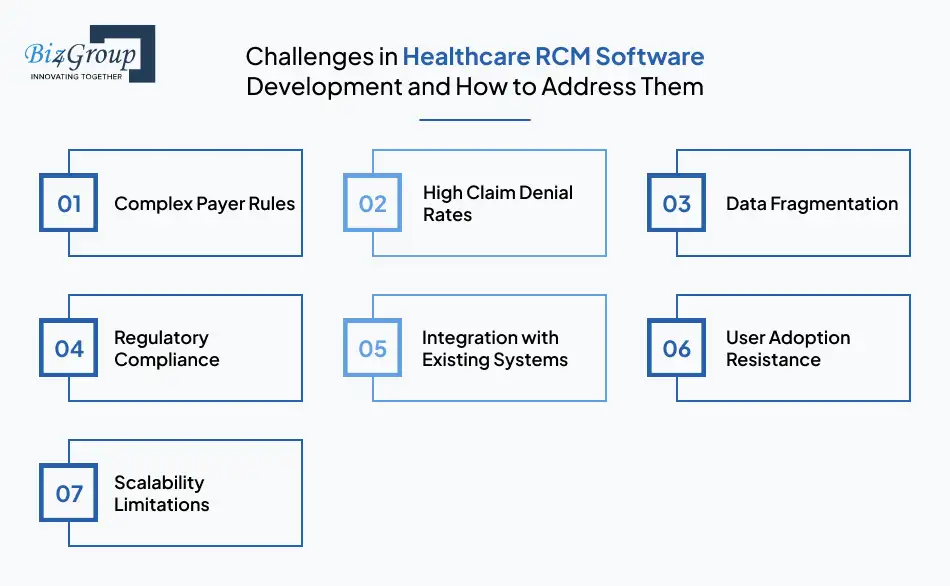
Even the most well planned initiatives face friction. When teams develop a healthcare revenue cycle management software (RCM), challenges often surface at the intersection of compliance, data complexity, and operational change. Understanding these hurdles early makes them far easier to manage:
|
Top Challenges |
How to Solve Them |
|---|---|
|
Complex Payer Rules |
Build configurable rule engines that adapt to payer specific billing requirements |
|
High Claim Denial Rates |
Implement denial tracking and root cause analysis within revenue workflows |
|
Data Fragmentation |
Centralize claims, payments, and eligibility data into unified systems |
|
Regulatory Compliance |
Embed audit trails and role based controls into every revenue action |
|
Integration with Existing Systems |
Use flexible APIs to connect EHRs, clearinghouses, and payer platforms |
|
User Adoption Resistance |
Reduce learning curves with workflows that are inspired by a expert healthcare conversational AI guide |
|
Scalability Limitations |
Architect systems to handle growth across facilities and billing volumes |
For organizations navigating healthcare revenue cycle management software (RCM) development, addressing these hurdles early creates a smoother path toward refining workflows and applying best practices that improve financial performance over time.
Design for What Healthcare Finance Is Becoming
Future-ready teams create healthcare revenue cycle management platforms that evolve with reimbursement models, regulations, and scale.
Future-Proof My RCM SystemBest Practices for Healthcare Revenue Cycle Management System Development
When organizations develop a healthcare revenue cycle management software (RCM), success depends on how well the system reflects real reimbursement behavior, not theoretical workflows. The following practices are shaped by what actually breaks, delays, or leaks revenue in healthcare RCM environments.
1. Start With Payer Behavior, Not Features
RCM performance is driven by payer rules, response timelines, and denial patterns. Design workflows around payer logic first, then build features to support those realities. This approach grounds healthcare RCM software development in measurable financial outcomes.
2. Treat Denials as Product Signals
Denials are not just operational issues, they are feedback loops. Structure the system to capture denial reasons and feed them back into eligibility, coding, and claim validation. Teams that develop healthcare revenue cycle management software this way reduce repeat errors over time.
3. Surface Financial Exceptions Early
Revenue leakage often hides in small mismatches between expected and actual payments. Systems should highlight underpayments and partial reimbursements immediately. Some teams simplify exception handling with patterns inspired by an AI conversation app.
4. Align System Logic With Billing Team Accountability
RCM platforms must reflect who owns each financial step. Clear handoffs between intake, coding, and follow-ups reduce ambiguity and delays. This clarity helps organizations build healthcare RCM solutions that support accountability, not confusion.
5. Design for Reimbursement Timelines, Not Speed Alone
Faster submission does not always mean faster payment. Build workflows that respect payer review cycles, appeal windows, and resubmission rules. This reduces rework and improves net collections.
6. Validate With Real Claim Scenarios Before Scaling
Testing should include rejected claims, missing authorizations, and partial payments. Real claim scenarios expose system gaps early. Larger teams sometimes benchmark these flows using insights from chatbot development for healthcare industry research.
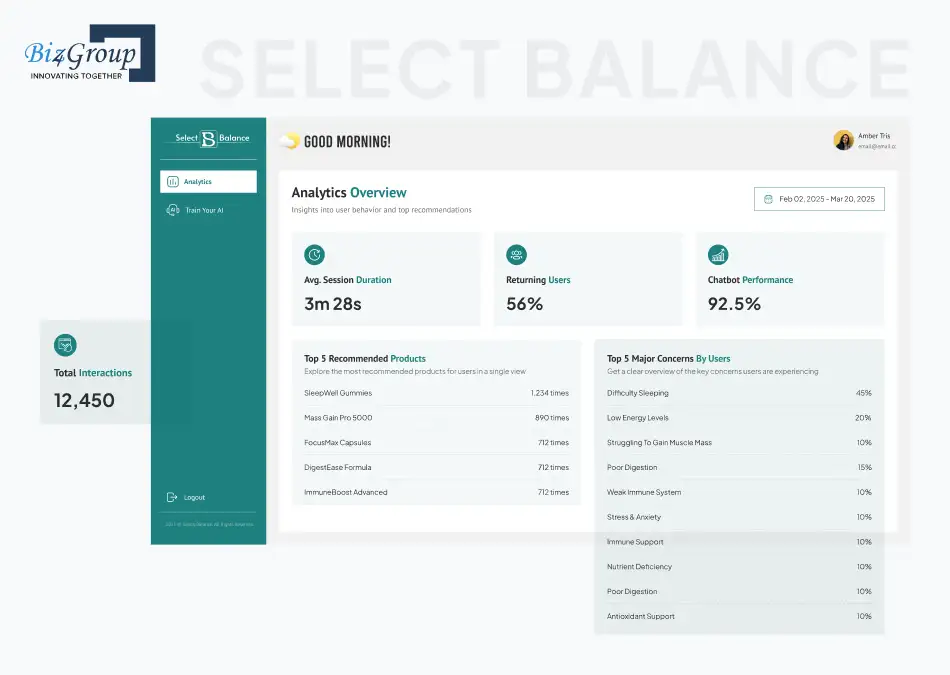
Select Balance is an AI powered health recommendation platform built by Biz4group LLC that uses conversational interfaces and intelligent data analysis to guide users toward personalized supplement choices. The platform showcases how AI driven guidance systems can simplify complex decision paths, an approach that aligns closely with improving usability and clarity within healthcare revenue cycle management software.
When applied consistently, these practices help teams move beyond reactive billing toward predictable financial control, reinforcing why healthcare RCM software development must stay tightly aligned with real world reimbursement dynamics.
What's Next for AI Enabled Healthcare RCM Software?
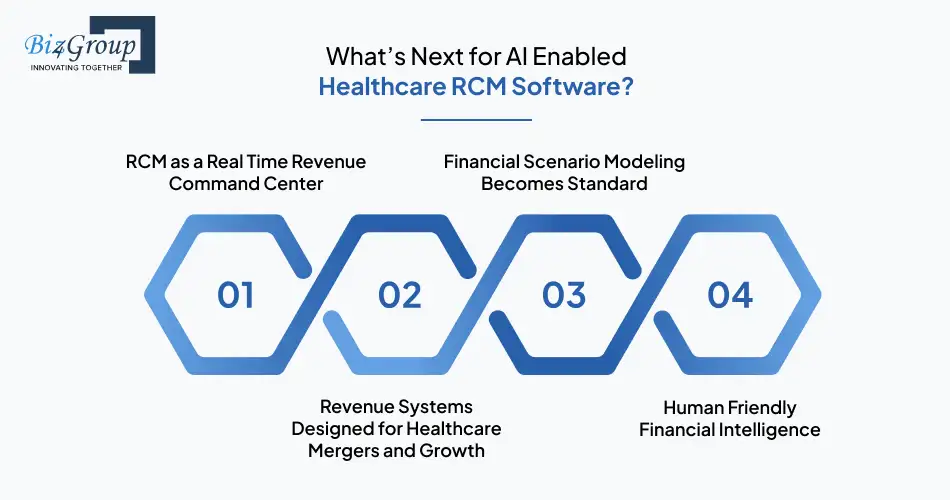
Healthcare finance is entering a phase where revenue systems start shaping decisions. As teams develop a healthcare revenue cycle management software (RCM), the future points toward platforms that influence strategy, opening doors that feel genuinely new.
1. RCM as a Real Time Revenue Command Center
Future RCM platforms will act as live financial nerve centers. Leaders will see how operational choices impact cash flow within days, not months. This shift will redefine how organizations build RCM software for hospitals and clinics.
2. Revenue Systems Designed for Healthcare Mergers and Growth
As consolidation accelerates, RCM platforms will support rapid onboarding of new facilities. Financial normalization across acquisitions will happen faster. Providers working with top AI development companies in Florida are already planning for this reality.
3. Financial Scenario Modeling Becomes Standard
RCM systems will simulate outcomes before decisions are made. Pricing changes, payer mix shifts, or new service lines will be tested financially first. This capability is shaping how teams create healthcare revenue cycle management platforms for executive decision making.
4. Human Friendly Financial Intelligence
Future RCM tools will communicate insights clearly to non financial stakeholders. While inspired by interaction models seen in AI chatbot development for medical diagnosis, the focus will be on explaining revenue impact in plain language.
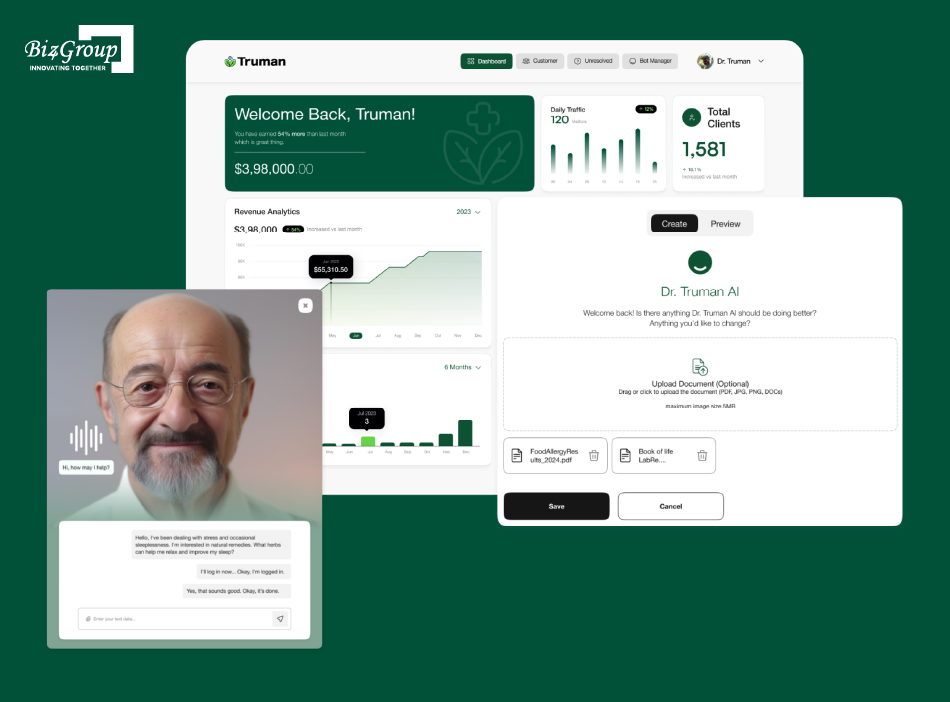
Truman is an AI-enabled wellness platform that continuously processes user data to deliver personalized health guidance and recommendations. Its architecture highlights how large volumes of user interactions and data streams can be managed reliably, a core requirement when designing scalable, data driven systems that support healthcare financial operations and long-term RCM workflows.
Looking ahead, organizations aiming to build a Healthcare Revenue Cycle Management Software (RCM) will not just manage billing more efficiently, they will gain a financial system that helps them move faster, smarter, and with far more confidence in an unpredictable healthcare landscape.
Why Biz4group LLC Is the Best AI Development Company to Develop Healthcare RCM Software?
Building healthcare RCM software demands more than technical execution. It requires a team that understands healthcare data complexity, regulated environments, and how AI driven systems behave in the real world. That is where Biz4group LLC stands apart as an experienced AI development company with deep healthcare exposure.
Biz4group LLC has delivered multiple AI healthcare platforms that handle sensitive data, complex workflows, and continuous user interaction. Solutions like Dr Ara, Truman, and Select Balance demonstrate how AI can translate large datasets into actionable insights, a core requirement for modern healthcare revenue cycle management systems.
Why teams choose Biz4group LLC for healthcare RCM development:
- Proven experience building AI driven healthcare platforms
- Strong understanding of compliance, data security, and healthcare workflows
- Ability to design scalable architectures that support long term growth
- Practical approach to AI that focuses on business outcomes
These portfolios are not standalone experiments. They reflect Biz4group LLC’s ability to design intelligent, compliant, and scalable healthcare systems, the same capabilities required to build reliable RCM platforms that healthcare organizations can trust.
Turn Revenue Operations into a Strategic Advantage
Move beyond billing tools and invest in RCM software development for healthcare that supports visibility, governance, and predictable growth.
Start My Healthcare RCM JourneyFinal Thoughts on Healthcare Revenue Cycle Management Software Development
Healthcare revenue is too important to be left to spreadsheets, disconnected tools, or systems that only work on good days. Building the right RCM software is about clarity, control, and confidence in how money actually moves through care delivery.
When done well, healthcare RCM platforms stop being background systems and start becoming strategic assets. They surface problems early, support smarter decisions, and scale alongside growth without creating new friction. That shift is what separates reactive billing from sustainable financial operations.
For organizations serious about building future ready revenue systems, partnering with an experienced AI product development company can make the difference between software that merely functions and platforms that quietly keep the business healthy, predictable, and resilient.
FAQs on Healthcare Revenue Cycle Management Software Development
1. How long does it take to develop healthcare revenue cycle management software?
Timelines vary based on scope and integrations. A focused MVP may take 3 to 4 months, while a full platform with payer connectivity and reporting often requires 6 to 9 months as part of structured healthcare revenue cycle management system development.
2. Can healthcare RCM software work alongside existing EHR or billing systems?
Yes. Most platforms are built to integrate with existing EHRs and billing tools through APIs, allowing organizations to modernize workflows while preserving current systems during healthcare RCM software development initiatives.
3. How customizable should a healthcare RCM system be at the start?
Initial customization should target high impact workflows like eligibility and claims. Over customization too early can slow progress. Many teams start structured and evolve flexibility as they develop healthcare revenue cycle management software based on usage data.
4. What data ownership considerations matter in healthcare RCM software?
Providers should retain full ownership of claims and financial data. The system should support audit access, portability, and long term reporting, which is critical when organizations build healthcare RCM solutions for compliance driven environments.
5. How much does it cost to develop healthcare revenue cycle management software?
The cost typically ranges between USD 45,000 and USD 200,000+, depending on features, integrations, and compliance scope. This range reflects common investment levels seen in real world RCM software development for healthcare projects.
6. How do providers measure success after RCM software goes live?
Success is measured through reduced denials, faster reimbursements, improved AR days, and clearer financial visibility. These outcomes help validate whether teams chose the right approach when pursuing customized RCM Solutions.
