Location :
Orlando, FL, USA
Location :
Orlando, FL, USA +1 (407) 714-1616
 info@biz4group.com

- How to start an AI sports betting business in USA requires clarity on market demand, AI use cases, legal compliance, and a strong business model from day one.
- The AI sports betting business guide USA starts with understanding how AI powers predictions, odds optimization, and user engagement.
- A successful AI betting business model USA often combines subscriptions, affiliate revenue, and data monetization for long-term growth.
- Cost planning for an online sports betting startup USA guide typically ranges from $35,000-$300,000+ based on platform scope and scale.
- Biz4Group LLC helps founders turn ideas into scalable AI betting platforms with expertise in strategy, development, and real-time systems.
Are you looking at the explosive rise of sports betting in the United States and wondering where AI fits into it? You are not alone.
The US sports betting market is projected to surpass $187 billion by 2030, according to a recent report by Grand View Research. That growth is attracting founders who want a smarter way. If you are figuring out how to start an AI sports betting business in USA, this guide will help you navigate through the important decisions.
Many entrepreneurs today are searching for an AI sports betting business guide USA because traditional betting platforms are becoming saturated. The real opportunity now lies in using AI to predict outcomes, personalize betting experiences, and optimize risk. A report by Statista shows that over 60% of bettors prefer platforms that offer data-driven insights, signaling a strong shift toward AI-powered ecosystems.
At the same time, the barrier to entry remains complex. Regulations vary by state. Licensing can be expensive. Technology decisions can make or break your platform. This is why many founders exploring a sports betting startup USA AI approach often struggle with where to begin, what to prioritize, and how to stay compliant while building something scalable. In fact, many come to us saying, “I want to start an AI sports betting business in the USA but don’t know where to begin or what legal steps are required.”
If you have been asking questions like how to launch online sports betting platform in USA legally or whether your idea can compete in this crowded space, you are in the right place. So, without any further ado, let’s begin with the basics.
How the Ecosystem and AI Models Work in Sports Analytics Betting Business USA
Before building anything, you need clarity on how the industry actually works. Many founders jump into development without understanding the mechanics behind betting platforms, data flows, and AI decision-making. That is where most early-stage ideas fail.
A common concern we hear is, “we are exploring AI in sports betting and want to understand how to build a compliant and scalable business.” The answer starts with understanding how AI fits into the betting ecosystem.
Role of AI in Modern Sports Betting
AI is shaping the betting industry in ways that go far beyond predictions. It influences how odds are calculated, how users interact with platforms, and how risks are managed.
Here is what AI is doing today:
- Analyzing massive historical datasets within seconds
- Adjusting odds dynamically based on real-time inputs
- Detecting unusual betting behavior to prevent fraud
- Personalizing betting suggestions for users
Many startups now actively use AI for sports betting to move ahead in the game instead of relying on static models.
Quick Insight Table
|
AI Function |
Business Impact |
|---|---|
|
Improves win probability models |
|
|
Real-time data processing |
Enables live betting accuracy |
|
Behavioral analysis |
Enhances user retention |
|
Risk modeling |
Reduces financial exposure |
AI is no longer an add-on. It is the backbone of advanced betting platforms.
Market Size and Growth Trends
The US betting market is expanding rapidly, but what matters more is how AI is shaping that growth.
- Over 30 US states now allow some form of sports betting
- Mobile betting accounts for more than 80% of wagers
- AI-driven platforms are seeing higher engagement and retention rates
For founders, this signals one thing. The opportunity is not in entering the market. It is in entering with differentiation.
How the US Sports Betting Ecosystem Works
Understanding the ecosystem is critical before launching. Here is a simplified breakdown:
Core Players in the Ecosystem
- Operators
Licensed entities that accept bets - Platform Providers
Companies that build and manage betting systems - Data Providers
Supply real-time sports data and statistics - Payment Processors
Handle transactions and withdrawals - Regulators
Ensure compliance and legal operation
Reliable data is the foundation of everything. That is why many founders study why top US betting apps rely on multiple sports data providers before making architecture decisions.
Key AI Use Cases in Betting Platforms
To build a strong foundation, you need to understand where AI actually creates value.
- Prediction Engines
AI models evaluate player stats, team performance, weather, and historical trends. - Odds Optimization
Platforms dynamically adjust odds using real-time inputs to stay competitive. - Risk Management Systems
AI flags irregular betting patterns and limits exposure. - Automation and Personalization
With AI automation, platforms deliver tailored betting suggestions and notifications.
Use Case Breakdown
|
Use Case |
Why It Matters |
Startup Advantage |
|---|---|---|
|
Game prediction |
Data-backed decisions |
Higher user trust |
|
Live odds |
Real-time engagement |
Increased betting volume |
|
Fraud detection |
Platform security |
Regulatory compliance |
|
User personalization |
Better UX |
Higher retention |
To go deeper into intelligent systems, many startups are also exploring sports betting AI agent models that can automate decision-making at scale.
Portfolio Spotlight: Real-Time Sports Betting Platform for Major Global League Games
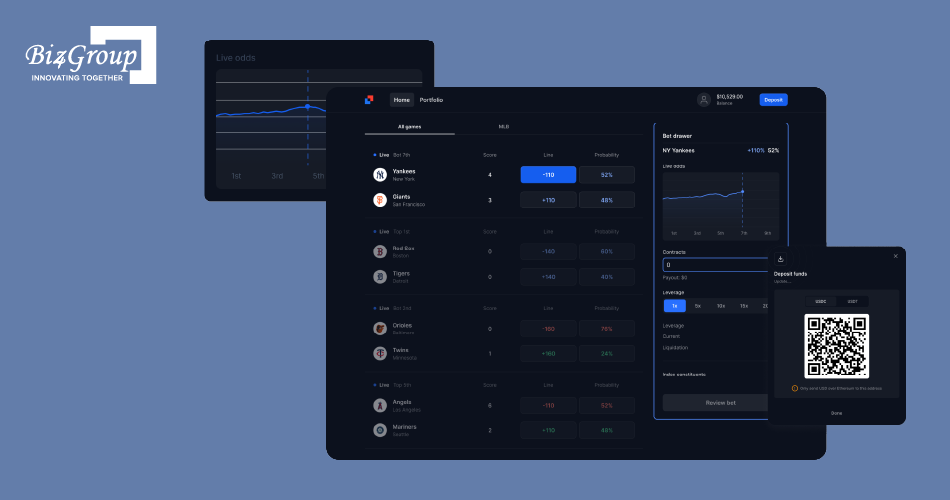
To understand what a production-ready system looks like, let’s look at a real implementation.
Biz4Group built a real-time sports betting platform to handle live betting across major leagues like MLB, CFB, and NFL with high accuracy and speed.
What made this platform stand out
- Real-time game data via socket connections
- AI-driven prediction features for teams and matches
- Market-based pricing for dynamic odds
- Scalable architecture handling high traffic
Core Capabilities
- Multi-sport support across major leagues
- Real-time chart visualization for betting insights
- Seamless synchronization for multiple users
- Secure authentication and data handling
Why it matters for founders
- Real-time accuracy directly impacts user trust
- Scalability determines long-term success
- Data synchronization affects platform reliability
The architecture behind this project followed a layered approach to handle millions of data points without performance drops. That is the level of infrastructure required if you want to compete seriously in this market.
Also read: Why most betting apps fail at real-time match accuracy (and how top apps fix it)
Final Thoughts on Industry Understanding
If you take one thing from this section, let it be this. The AI sports betting industry is not about placing bets. It is about managing data, predictions, and user experience at scale.
Understanding the ecosystem, AI use cases, and market structure gives you clarity before investing time and money. Once you have this foundation, identifying the right business opportunity becomes much easier.
Choosing the Right Startup Idea Among AI Gambling Business Opportunities USA
Once you understand the industry, the next question becomes simple. Where is the real money?
Many founders reach this stage and say, “I am exploring sports betting startup ideas using AI but need help understanding risks and opportunities.” That is exactly where clarity matters. Not every idea works. Not every feature attracts users. And not every audience converts.
This section breaks down how to identify a business opportunity that has real demand, clear differentiation, and long-term potential.
Types of AI Sports Betting Businesses You Can Start
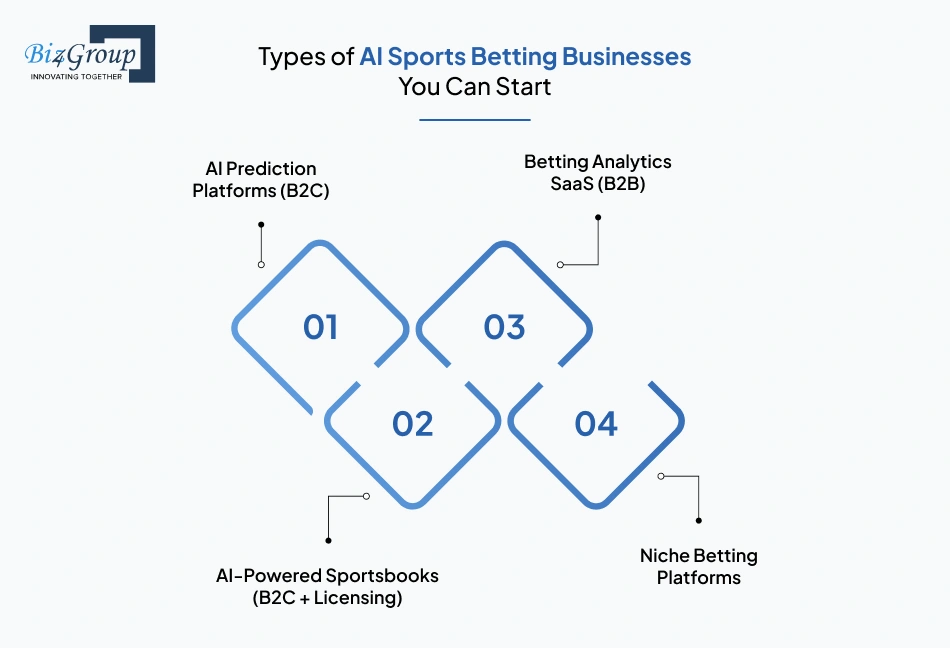
You are not limited to building a traditional sportsbook. AI opens multiple entry points. Here are the most viable business types in the AI sports prediction business USA space:
- AI Prediction Platforms (B2C)
Platforms that provide insights, predictions, and betting suggestions.
- Focus on analytics, not handling bets
- Easier entry from a regulatory standpoint
- Strong demand from data-driven bettors
- AI-Powered Sportsbooks (B2C + Licensing)
Full betting platforms with integrated AI systems.
- Requires licenses
- High investment but high returns
- Offers complete control over user experience
- Betting Analytics SaaS (B2B)
Tools offered to sportsbooks or analysts.
- Subscription-based model
- Lower legal complexity
- Ideal for early-stage founders
- Niche Betting Platforms
Focused on specific sports or formats:
These allow faster entry with focused user bases.
Business Type Comparison
|
Business Type |
Investment Level |
Legal Complexity |
Time to Launch |
Revenue Potential |
|---|---|---|---|---|
|
AI prediction platform |
Medium |
Low |
Fast |
Medium |
|
AI sportsbook |
High |
High |
Slow |
High |
|
Analytics SaaS |
Low to Medium |
Low |
Fast |
Medium |
|
Niche platform |
Medium |
Medium |
Moderate |
Medium to High |
The right choice depends on your capital, risk appetite, and long-term vision.
Features That Actually Make a Betting Product Successful
Many founders think more features mean more users. That assumption leads to bloated platforms.
What matters is selecting features that directly impact engagement and retention.
Core Features You Should Focus On
- Real-time odds and updates
- AI-driven predictions and insights
- Simple onboarding and wallet integration
- Personalized dashboards
- Notifications for live betting opportunities
A strong UI/UX design plays a major role here. If users cannot navigate quickly, they leave within minutes.
Also read: Top 15 UI/UX design companies in USA
Advanced Features That Create Differentiation
- AI-powered bet recommendations
- Social betting or peer challenges
- Leaderboards and gamification
- Micro-betting options
- Parlay betting and multi-bet systems like
Feature Priority Table
|
Feature Type |
Must-Have or Add Later |
Why It Matters |
|---|---|---|
|
Real-time data |
Must-have |
Core betting experience |
|
AI predictions |
Must-have |
Key differentiator |
|
Gamification |
Add later |
Improves engagement |
|
Social betting |
Add later |
Expands user base |
|
Advanced analytics |
Must-have |
Builds trust |
Choosing the right feature set early reduces development cost and speeds up launch.
How to Identify Your Target Audience
A betting platform built for everyone ends up working for no one. You need to define your users clearly.
Primary User Segments
- Casual bettors
Prefer simple interfaces and quick bets - Professional bettors
Look for deep analytics and insights - Fantasy sports users
Interested in prediction-based engagement - B2B clients
Sportsbooks or analysts needing tools
Audience vs Product Fit
|
Audience Type |
What They Want |
What You Should Build |
|---|---|---|
|
Casual users |
Simplicity |
Clean UI and quick bets |
|
Pro bettors |
Data |
Advanced analytics tools |
|
Fantasy players |
Engagement |
Gamified features |
|
Businesses |
Insights |
SaaS analytics platform |
If you are exploring AI fantasy sports app development, this audience mapping becomes even more important.
How to Validate Your Idea Before Investing
Jumping straight into development is risky. Validation helps you avoid costly mistakes.
Practical Validation Steps
- Study existing platforms
- Identify gaps in features or experience
- Run small user surveys
- Build a prototype or MVP
Many founders begin with MVP development to test their concept before scaling.
Also read: Top 12+ MVP development companies in USA
Validation Checklist
|
Step |
Outcome |
|---|---|
|
Market research |
Understand demand |
|
Competitor analysis |
Identify gaps |
|
MVP launch |
Test user response |
|
Feedback loop |
Improve product |
This approach helps you move faster while reducing risk.
Choosing the Right Technology Direction Early
Even if you are not technical, your technology decisions shape your business.
Key considerations:
- Should you build from scratch or use a white-label sports betting platform?
- Do you need custom AI models or existing APIs?
- How will you scale your infrastructure later?
If your platform relies heavily on data, understanding why enterprise sports data APIs like SportRadar matter more than features becomes essential.
Scaling Basics You Must Think About Early
Scaling is not something you plan later. It starts from day one.
Here is what you need to think about:
- Multi-user synchronization
- Data latency handling
- Cloud infrastructure
- Security and compliance
Many startups today build a multi-tenant AI sports betting platform to support growth without rebuilding their system later.
Scaling Readiness Table
|
Factor |
Why It Matters |
|---|---|
|
Infrastructure |
Handles user growth |
|
Data processing |
Ensures real-time updates |
|
Security |
Protects user data |
|
Architecture |
Supports expansion |
Ignoring these early leads to expensive rebuilds.
Build vs Buy vs Partner
Another major decision founders face is how to bring their idea to life.
Option 1: Build from Scratch
- Full control
- Higher cost and time
Option 2: Use Turnkey Solutions
- Faster launch using turnkey sports betting solutions
- Limited customization
Option 3: Partner with Experts
- Balanced approach
- Access to experience and proven frameworks
Most founders choose to hire AI developers to accelerate their roadmap.
Final Thoughts on Finding the Right Opportunity
Starting an AI-based betting platform business USA is less about having an idea and more about choosing the right one.
You need:
- A clear business type
- The right feature set
- A defined audience
- A scalable foundation
If you get these right, everything else becomes easier. The next step is understanding the legal side, which is where most startups face their biggest challenges.
Got the Idea… But Will It Actually Work?
90% of startups fail due to poor market validation. Are you building something users want or something you assume they want?
Build Smart with Biz4GroupHow to Create Legal and Compliant Sports Betting Business in USA?
If there is one area where most startups struggle, it is legal compliance. You can have the best product, strong AI models, and a solid business plan. Without proper licensing and regulatory alignment, your business will not survive.
A common concern we hear is, “we want to start an AI-powered sports betting platform but need clarity on licensing and strategy in the USA.” That concern is valid because the US betting landscape is not centralized. It operates state by state, each with its own rules.
Let’s break down what you must know before entering this space.
Is Sports Betting Legal in the USA?
Yes, but not everywhere and not in the same way.
Since the repeal of PASPA in 2018, individual states gained the authority to legalize sports betting. Today:
- More than 30 states allow sports betting in some form
- Some states allow only in-person betting
- Others allow full online betting platforms
- A few states still restrict or prohibit it
To get a clearer picture, many founders review sports betting regulations across US states before making decisions about market entry.
The key takeaway is simple. Your business model must align with the specific state you plan to operate in.
Licensing Requirements You Cannot Ignore
You cannot legally operate a sportsbook without a license. And getting one is not simple.
Here is what licensing typically involves:
- Partnering with a licensed land-based casino in some states
- Paying significant licensing fees, often in the millions
- Undergoing background checks and financial audits
- Meeting strict operational and reporting standards
If you are building an AI betting business model USA, you may also consider operating as:
- A technology provider
- A data analytics platform
- An affiliate business
These models often have fewer regulatory barriers compared to running a full sportsbook.
Compliance Requirements Beyond Licensing
Licensing is only one part of the equation. Compliance is ongoing and equally important.
Here are the key compliance areas:
- KYC (Know Your Customer) verification
- AML (Anti-Money Laundering) policies
- Data protection and privacy laws
- Responsible gambling measures
- Age verification systems
When AI is involved, you also need to ensure your models are transparent and fair. This is where proper AI integration becomes important, helping align your systems with regulatory expectations.
Role of AI in Compliance and Monitoring
AI is not only used for predictions. It also plays a major role in compliance.
Platforms today use AI to:
- Detect unusual betting behavior
- Flag potential fraud in real time
- Monitor user activity for responsible gambling
- Automate reporting processes
Advanced solutions powered by generative AI are also being explored to enhance monitoring and reporting accuracy. This adds an extra layer of control, which regulators increasingly expect.
Legal Risks You Must Be Aware Of
Entering the US betting market without understanding risks can lead to serious consequences.
Some of the major legal risks include:
- Operating in restricted states
- Non-compliance with licensing terms
- Mishandling user data
- Inaccurate odds or misleading information
- Failure to implement responsible gambling practices
Even technical decisions can impact compliance, which is why your data infrastructure must be reliable and auditable. Many founders explore enterprise-grade sports API for betting app valuations to ensure their systems meet industry expectations.
Alternative Legal Entry Strategies
If full licensing feels overwhelming, there are other ways to enter the market.
Some founders choose:
- Building AI analytics platforms instead of sportsbooks
- Offering SaaS tools to licensed operators
- Launching prediction-based platforms without handling bets
These approaches allow you to enter the ecosystem with lower legal complexity while still building a strong business.
Also read: AI pari-mutuel betting software development guide
Final Thoughts on Legal Compliance
If you are serious about building a sports betting startup USA AI, compliance cannot be treated as an afterthought. It shapes your business model, your technology decisions, and even your go-to-market strategy.
Get this part right, and you build a foundation that investors trust and users rely on. Get it wrong, and even the best idea will struggle to move forward.
In the next section, we will break down the actual cost required to start your AI sports betting business so you can plan your investment wisely.
Think You’re Legally Ready to Launch?
One wrong regulatory step can delay your launch by months or shut it down entirely. Do you know your state-specific requirements yet?
Talk to Compliance ExpertsCost Breakdown and Investment Guide for AI Sports Prediction Business USA
Before you move forward, you need a clear answer to one question. How much does it actually cost to enter this market?
For most founders exploring how to start an AI sports betting business in USA, the investment typically falls between $35,000-$300,000+ depending on scope, features, compliance, and scale. The wide range exists because you can start lean with an MVP or build a full-scale enterprise platform from day one.
Here is a quick breakdown to set expectations:
|
Stage |
What You Build |
Estimated Cost Range |
|---|---|---|
|
MVP |
Core features, basic AI, limited users |
$35,000-$70,000 |
|
Advanced Platform |
Real-time data, strong AI models, scalable backend |
$70,000-$150,000 |
|
Enterprise Platform |
Multi-state readiness, advanced AI, high scalability |
$150,000-$300,000+ |
Many founders come with questions like, “we want to launch a sports betting startup using AI but are unsure about regulations and business model in the USA.” Cost plays a major role in shaping both decisions, so understanding where your money goes is essential.
Key Cost Drivers in an AI Betting Business
Your total investment depends on several moving parts. Each decision you make directly impacts your budget.
|
Cost Driver |
What It Includes |
Estimated Cost Impact |
|---|---|---|
|
Platform development |
Frontend, backend, architecture |
$15,000-$120,000 |
|
AI model development |
Prediction engines, automation |
$10,000-$80,000 |
|
Data integration |
APIs, real-time feeds |
$5,000-$40,000 |
|
Compliance and licensing |
Legal setup, audits |
$20,000-$100,000+ |
|
UI/UX design |
User experience and interface |
$5,000-$25,000 |
|
Cloud infrastructure |
Hosting, scaling, storage |
$3,000-$20,000 annually |
Each of these components scales with your ambition. A basic product stays on the lower end, while a high-performance system moves toward the upper range.
Platform Development Costs
This is where most of your budget goes. It covers everything users interact with and everything running behind the scenes.
At the MVP stage:
- Basic frontend and backend
- Simple dashboards
- Limited scalability
- Estimated cost: $15,000-$40,000
At an advanced stage:
- Real-time features
- Multi-user handling
- Secure payment systems
- Estimated cost: $40,000-$90,000
At enterprise level:
- Multi-state support
- High concurrency systems
- Advanced architecture
- Estimated cost: $90,000-$120,000+
If you are planning long-term growth, many founders choose to build an enterprise AI sports betting platform from the start to avoid rebuilding later.
AI Development and Data Intelligence Costs
AI is what differentiates your platform from standard betting apps. However, it adds a significant layer of cost.
For basic AI models:
- Rule-based predictions
- Limited datasets
- Estimated cost: $10,000-$25,000
For advanced AI systems:
- Machine learning models
- Real-time predictions
- Behavioral analytics
- Estimated cost: $25,000-$60,000
For high-end AI systems:
- Deep learning models
- Continuous training pipelines
- Personalization engines
- Estimated cost: $60,000-$80,000+
Strong AI integration ensures your models work seamlessly with your platform and data pipelines.
Data and API Integration Costs
Your platform relies heavily on sports data. Without accurate data, your product loses credibility.
Basic integration:
- Single data provider
- Limited updates
- Estimated cost: $5,000-$15,000
Advanced integration:
- Multiple APIs
- Real-time updates
- Estimated cost: $15,000-$30,000
Enterprise-grade setup:
- Redundant data sources
- Low-latency pipelines
- Estimated cost: $30,000-$40,000+
Compliance and Licensing Costs
Legal compliance is one of the most expensive components.
Typical expenses include:
- Licensing fees which can exceed $50,000-$100,000+ depending on the state
- Legal consultation costing around $5,000-$20,000
- Compliance systems costing $10,000-$30,000
If you are seriously thinking how to create legal and compliant sports betting business in USA, this is a non-negotiable investment.
Infrastructure and Maintenance Costs
Your platform needs to run smoothly at all times.
Basic infrastructure:
- Cloud hosting
- Basic scaling
- Estimated cost: $3,000-$8,000 annually
Advanced infrastructure:
- Auto-scaling systems
- Load balancing
- Estimated cost: $8,000-$15,000 annually
Enterprise infrastructure:
- High availability systems
- Global scaling
- Estimated cost: $15,000-$20,000+ annually
Hidden Costs Most Founders Miss
At first glance, your budget may look complete. In reality, several ongoing expenses quietly build up after launch. These are often the reason startups run out of runway earlier than expected.
Here are the hidden costs you should actively plan for:
- Continuous AI Model Training and Updates
AI systems are not static. They require constant retraining with new data to stay accurate.
Estimated impact: $2,000-$10,000+ annually depending on model complexity - Sports Data Subscription Renewals
Most data providers charge recurring fees for real-time feeds and historical data access.
Estimated impact: $5,000-$25,000+ annually based on data volume and providers - Security Enhancements and Compliance Audits
As your user base grows, so does the need for stronger security layers and periodic audits.
Estimated impact: $3,000-$15,000 annually - Customer Support and Operations
Live chat, dispute handling, and user queries require dedicated resources or tools.
Estimated impact: $2,000-$12,000 annually - Marketing and User Acquisition Costs
Paid ads, affiliate commissions, and promotions can quickly add up.
Estimated impact: $5,000-$50,000+ depending on growth goals - Performance Optimization and Bug Fixes
Regular updates to improve speed, fix bugs, and enhance user experience are ongoing.
Estimated impact: $3,000-$10,000 annually
When combined, these hidden costs can increase your total spending by 20%-40% over time. Planning for them early prevents financial strain later.
How to Optimize Your Startup Costs
Reducing costs does not mean cutting corners. It means making smarter decisions at the right stage of your journey.
Here is how experienced founders approach cost optimization:
- Start Lean with a Clear MVP Strategy
Focus on solving one core problem first. Launch with essential features, gather feedback, and improve gradually instead of building everything upfront. - Prioritize Revenue-Driving Features First
Invest in features that directly impact user engagement and monetization. Delay secondary features until you have traction. - Use Scalable Architecture from Day One
Even at a smaller scale, choose systems that can grow with your platform. This avoids expensive rebuilds later. - Leverage Pre-Built Modules Where Possible
Instead of building everything from scratch, use existing frameworks or hybrid solutions to reduce development time and cost. - Outsource Strategically Instead of Hiring Full Teams Early
Working with experienced partners can save both time and operational overhead compared to building an in-house team too soon. - Continuously Track Cost vs ROI
Every feature, tool, or campaign should be evaluated based on the value it generates. This keeps your spending aligned with business growth.
A well-optimized budget does not limit your vision. It gives you the flexibility to scale faster and make better decisions as your business evolves.
Final Thoughts on Cost Planning
Starting an online sports betting startup USA guide journey without financial clarity can lead to serious setbacks. Cost planning is not about minimizing expenses. It is about allocating your budget where it creates real value.
Once you understand your investment requirements, the next step is choosing the right business model that can generate sustainable revenue.
Also read: How much does it cost to develop AI sports betting software?
Spending Smart or Burning Budget?
Startups that plan costs strategically see up to 3x better ROI. Are you investing in growth or wasting resources?
Let’s Talk NumbersChoosing the Right Business Model for Sports Betting Startup USA AI
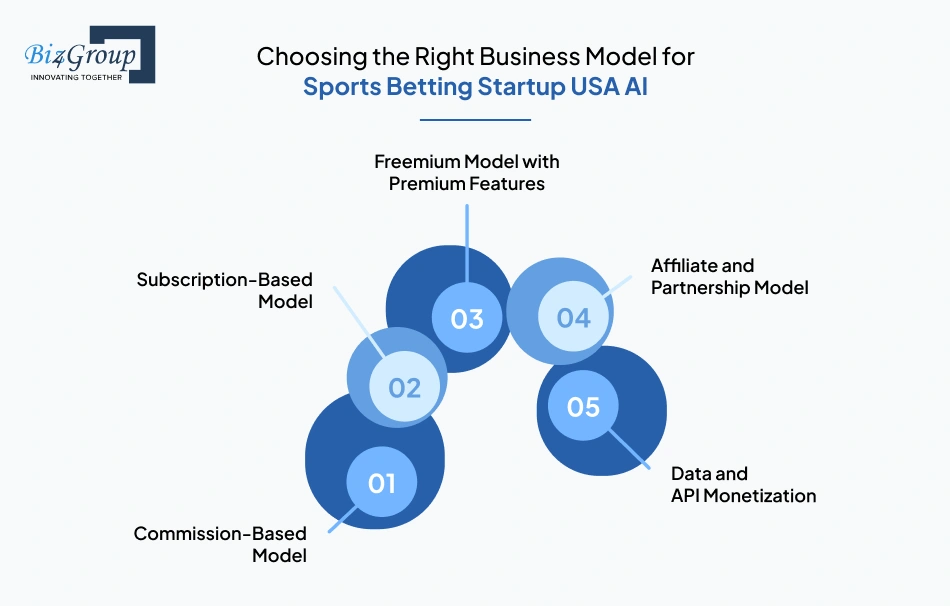
Once your idea is validated and costs are clear, the next big question comes up... How will your business make money?
This is where many founders hesitate. In fact, we often hear, “we want to launch a sports betting startup using AI but are unsure about regulations and business model in the USA.” Choosing the right model early helps you align your product, audience, and growth strategy.
A strong AI betting business model USA is not limited to one approach. Most successful platforms combine multiple revenue streams to build stability and long-term value.
1. Commission-Based Model
This is the most traditional model used by sportsbooks.
How it works
- The platform takes a percentage from each bet placed
- Earnings increase with user activity and betting volume
Why founders choose it
- Predictable revenue flow
- Works well for high-traffic platforms
Considerations
- Requires licensing in most cases
- Needs strong user acquisition strategy
2. Subscription-Based Model
This model is popular among AI-driven platforms that focus on insights rather than handling bets.
How it works
- Users pay monthly or yearly for premium predictions and analytics
- Free tier can be used to attract users
Why it works
- Recurring revenue
- Lower regulatory complexity
Example use cases
- AI prediction dashboards
- Advanced analytics platforms
3. Freemium Model with Premium Features
A hybrid approach that works well for user acquisition.
How it works
- Basic features are free
- Advanced insights, predictions, or tools are paid
Key benefits
- Low entry barrier for users
- High conversion potential with the right features
4. Affiliate and Partnership Model
This is one of the easiest entry points for startups.
How it works
- You refer users to licensed sportsbooks
- Earn commissions on user activity
Many founders start with a sports betting affiliate website to validate demand before building a full platform.
5. Data and API Monetization
If your strength lies in AI and analytics, this model works well.
How it works
- Sell data insights or prediction APIs to other businesses
- Charge based on usage or subscription
Ideal for
- B2B-focused startups
- Analytics-driven platforms
Business Model Comparison
|
Model |
Revenue Type |
Legal Complexity |
Best For |
|---|---|---|---|
|
Commission-based |
Per bet |
High |
Licensed sportsbooks |
|
Subscription |
Recurring |
Low |
AI analytics platforms |
|
Freemium |
Hybrid |
Medium |
User-focused apps |
|
Affiliate |
Commission |
Low |
Early-stage startups |
|
Data/API |
Subscription |
Low |
B2B solutions |
Choosing the right model depends on your entry strategy, target audience, and available resources.
Project Portfolio: Ultimate Sports Pick’em App
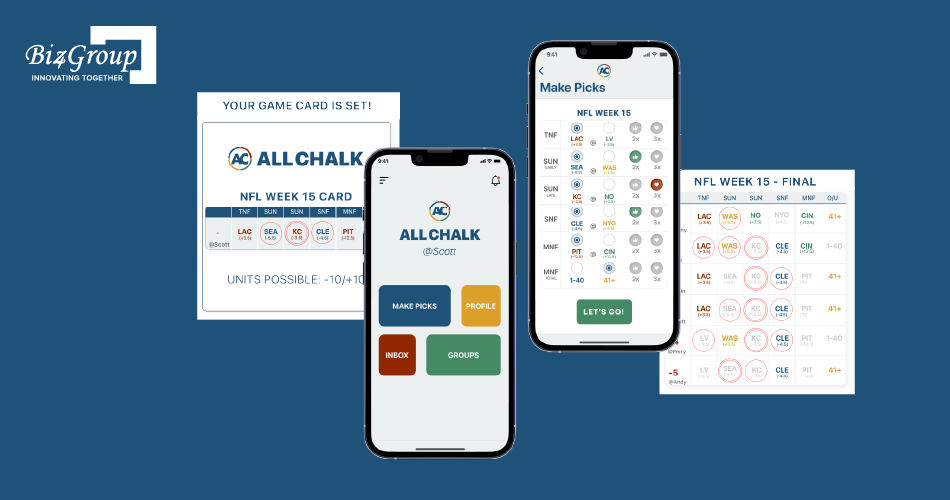
Not every betting platform needs to involve direct money transactions. Biz4Group built a sports pick’em app. This project shows how alternative models can still create strong engagement and revenue opportunities.
What makes this platform unique
- Focus on prediction-based engagement instead of direct betting
- Weekly pick’em format across NFL, NBA, NCAAFB, and MLB
- Leaderboards that track user performance
- Game reminders to boost participation
Key Features
- Leaderboards based on wins, losses, and points
- Upcoming game schedules for planning predictions
- Notifications for deadlines and matches
- Clean and user-friendly interface
Why this model works
- Lower regulatory complexity compared to traditional betting
- High user engagement through gamification
- Opportunities for monetization through ads, subscriptions, or partnerships
This type of platform aligns well with evolving user behavior, where engagement and competition drive retention.
How Top Platforms Combine Multiple Models
Most successful platforms do not rely on a single revenue stream.
They combine:
- Subscription for premium insights
- Affiliate revenue from partnerships
- Ads or sponsorships
- In-app purchases or upgrades
Also read: How do AI sports betting apps like FanDuel make money?
Revenue Planning Based on Your Stage
|
Stage |
Recommended Model |
Why It Works |
|---|---|---|
|
Early stage |
Affiliate or subscription |
Low risk, quick validation |
|
Growth stage |
Freemium + subscription |
Expands user base |
|
Mature stage |
Commission + partnerships |
Maximizes revenue |
Your model should evolve as your platform grows.
Cost vs Revenue Balance
While choosing a model, you must also consider costs.
For example:
- Subscription platforms require strong AI systems
- Commission models need licensing and infrastructure
- Affiliate models require marketing investment
Many founders evaluate cost to develop an AI sports betting app like Rithmm to understand how pricing and monetization align with development costs.
Selecting the right AI betting business model USA is not about copying others. It is about aligning your strengths with market demand.
A clear monetization strategy ensures:
- Sustainable growth
- Better investor confidence
- Stronger long-term positioning
With your business model in place, the next step is understanding the risks and challenges that come with running an AI-driven sports betting business.
Risks That Can Break Your Startup When Considering AI Gambling Business Opportunities USA
Every opportunity comes with its share of risks. The AI betting space is no different. In fact, it is one of the few industries where technical, legal, and operational challenges intersect at every stage.
Many founders admit, “we want to launch a sports betting startup using AI but are unsure about regulations and business model in the USA.” That uncertainty often leads to costly mistakes.
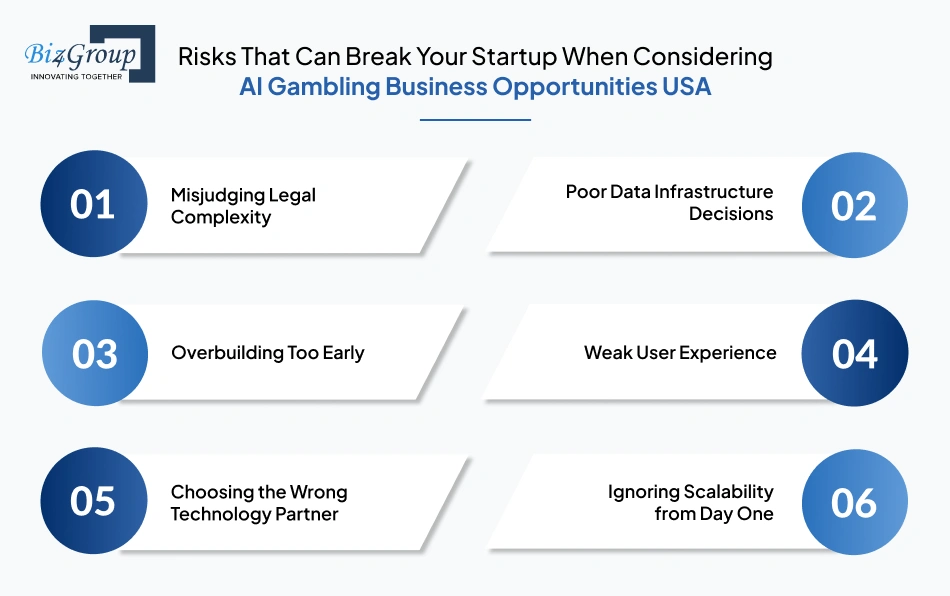
If you are planning to enter the sports betting industry startup guide path, here are the most critical risks you must understand and prepare for.
1. Misjudging Legal Complexity
One of the biggest mistakes founders make is underestimating regulations.
Each state has its own rules. Licensing requirements vary. Compliance is ongoing, not a one-time task. Many startups assume they can “figure it out later,” which often leads to delays or shutdowns.
How to avoid this
- Consult legal experts before building
- Choose your operating state carefully
- Align your business model with legal boundaries
- Keep compliance as a core part of your roadmap
2. Poor Data Infrastructure Decisions
Your platform is only as good as your data. Low-quality or delayed data leads to incorrect odds, poor predictions, and loss of user trust. Many founders fail to realize how complex data handling is until it becomes a problem.
How to avoid this
- Use multiple reliable data providers
- Invest in real-time data pipelines
- Focus on low-latency systems
3. Overbuilding Too Early
It is tempting to launch with every feature possible. That approach slows you down and drains your budget. Startups often spend months building features users may not even need.
How to avoid this
- Start with a focused MVP
- Prioritize core functionality
- Collect user feedback early
- Expand based on actual demand
4. Weak User Experience
Even strong AI cannot save a poor user interface. If users find your platform confusing or slow, they leave quickly.
This is one of the most underestimated factors in early-stage startups.
How to avoid this
- Focus on simple navigation
- Optimize for mobile-first experience
- Test usability with real users
- Continuously improve based on behavior
5. Choosing the Wrong Technology Partner
Your technology partner can make or break your startup.
Inexperienced teams often build unstable systems, ignore scalability, and miss compliance requirements. This leads to expensive fixes later.
How to avoid this
- Work with experienced partners
- Evaluate past projects and expertise
- Choose teams with domain knowledge
Also read: Top 14 sports betting software development companies in the USA
6. Ignoring Scalability from Day One
Some platforms work well with 100 users but fail with 10,000. Scaling issues lead to system crashes, delayed updates, and poor user experience.
How to avoid this
- Design scalable architecture early
- Use cloud-based infrastructure
- Plan for user growth from day one
- Test system performance regularly
Building an AI-based betting platform business USA comes with real challenges. Ignoring them does not make them disappear. It makes them harder to fix later.
The good news is simple. Most of these risks are preventable with the right planning, partners, and execution strategy.
Now that you understand both opportunities and risks, the next step is building the right partnerships that can help you scale faster and enter the market efficiently.
Also read: Challenges in modern sports betting app development
Ready to Avoid the Mistakes Most Founders Make?
The gap between an idea and a successful launch is where most founders get stuck. Want to get it right the first time?
Call Biz4Group TodayKey Partners You Need to Succeed in Sports Analytics Betting Business USA
No AI betting business grows in isolation. Behind every successful platform is a network of partners handling data, compliance, payments, and operations.
Many founders reach this stage and say, “we have an idea for an AI sports betting business and are looking for a US-based company that can help validate and shape it into a scalable startup.” The answer often lies in choosing the right partners early.
If you are building a sports betting startup USA AI, your ecosystem will directly impact your speed, reliability, and long-term growth.
Essential Partnerships for an AI Sports Betting Business
|
Partner Type |
Role in Your Business |
Why It Matters |
When You Need Them |
|---|---|---|---|
|
Data Providers |
Supply real-time sports data, odds, and stats |
Core foundation of predictions and betting accuracy |
From day one |
|
AI & Tech Partner |
Builds AI models, platform, and integrations |
Ensures scalability and performance |
Early stage |
|
Licensed Operators |
Allow legal betting operations in regulated states |
Required for compliance and market entry |
Before launch |
|
Payment Processors |
Handle deposits, withdrawals, and transactions |
Enables smooth financial operations |
Before launch |
|
Compliance & Legal Advisors |
Manage licensing, audits, and regulatory adherence |
Protects business from legal risks |
Early and ongoing |
|
Cloud & Infrastructure Providers |
Support hosting, scaling, and uptime |
Ensures platform reliability under load |
Development stage |
|
Marketing & Affiliate Partners |
Drive user acquisition and traffic |
Essential for growth and revenue |
Post-launch |
|
Analytics & Tracking Tools |
Monitor user behavior and performance |
Helps optimize product and revenue |
Growth stage |
How to Choose the Right Partners
|
Decision Factor |
What to Look For |
Impact on Your Business |
|---|---|---|
|
Experience |
Proven work in betting or AI industry |
Reduces trial and error |
|
Scalability |
Ability to support growth |
Prevents system failures |
|
Compliance Knowledge |
Understanding of US regulations |
Avoids legal issues |
|
Integration Capability |
Smooth API and system compatibility |
Faster development |
|
Support & Reliability |
Ongoing assistance and uptime guarantees |
Ensures stability |
Also read: How to choose top AI sports betting software development company?
Partnership Strategy Based on Growth Stage
|
Stage |
Focused Partnerships |
Why It Matters |
|---|---|---|
|
Idea stage |
AI consultants, market advisors |
Validates concept |
|
MVP stage |
Tech partner, data provider |
Builds foundation |
|
Launch stage |
Operators, payment providers |
Enables go-live |
|
Growth stage |
Marketing, analytics partners |
Drives scale |
Building an AI gambling business opportunities USA venture is not about doing everything yourself. It is about connecting the right pieces at the right time.
Strong partnerships help you:
- Enter the market faster
- Reduce operational risks
- Focus on core business growth
With your ecosystem in place, the next question becomes clear. Who can help you turn your idea into a successful business?
How Biz4Group LLC Helps You Start and Scale an AI Sports Betting Business in USA
At this stage, most founders arrive at a critical realization. Having an idea is one thing. Turning it into a structured, scalable, and compliant business is something entirely different.
We often hear founders say, “I am looking for a US AI company that can help develop strategy for my sports betting startup idea and guide me on compliance and market entry.” That is exactly where Biz4Group LLC steps in.
Biz4Group is a US-based AI development company that has spent years building advanced digital products for startups, enterprises, and entrepreneurs across industries. What sets us apart is not only our technical expertise but our ability to think like business strategists. We understand what it takes to move from an idea to a revenue-generating platform.
With our experience as a sports betting app development company, we understand real-time data systems, AI-driven predictions, compliance considerations, and user engagement patterns. This allows us to guide founders through every stage, from concept validation to launch and beyond.
Why Businesses Choose Biz4Group LLC
Choosing the right partner is often the difference between a successful launch and a failed attempt. Here is why founders and enterprises trust us:
- Proven Industry Experience
We have built multiple betting and analytics platforms, giving us deep insights into how the ecosystem works. - End-to-End Capabilities
From ideation to deployment, we cover everything including strategy, design, development, and scaling. - Strong AI Expertise
Our team builds intelligent systems that go beyond basic automation and deliver meaningful predictions and insights. - Scalable Architecture Approach
We design platforms that grow with your business, avoiding costly rebuilds later. - Domain-Specific Knowledge
We understand the nuances of betting platforms, user behavior, and real-time systems. - Seamless Data Integration
We ensure your platform connects efficiently with live data sources through robust sports betting API integration services. - Client-Centric Execution
We do not offer one-size-fits-all solutions. Every product is customized to your business goals and market strategy.
Working with Biz4Group LLC means you are not building alone. You are partnering with a team that understands both the technical and business sides of the sports betting industry. We help you avoid common mistakes, make informed decisions, and accelerate your path to market.
If you are serious about entering the US betting market with AI at the core, having the right partner can save you time, cost, and uncertainty. With our experience, you gain clarity, direction, and execution strength from day one.
So, without wasting any time, let’s build something phenomenal together.
To Summarize...
Starting an AI-driven betting venture requires a clear understanding of how the industry works, where AI creates real value, and how to navigate regulations, costs, and business models. If you have been researching a step-by-step guide to start an AI sports betting business in USA, the path becomes much clearer when you break it into structured decisions. Choose the right opportunity, align with the right audience, and build with scalability in mind.
The US market offers strong potential, but success depends on execution. From compliance to partnerships and monetization, every decision shapes your outcome. Founders who take time to plan strategically often build platforms that sustain growth and attract loyal users. Those who rush into development without clarity usually face delays, rework, or financial strain.
This is where Biz4Group LLC makes a real difference. As a trusted software development company in the USA, we help founders turn ideas into structured, scalable businesses. With deep expertise in AI, real-time systems, and betting platforms, our team brings both technical strength and business clarity to your journey.
If you are ready to move forward with your AI sports betting idea, now is the time to take action. Connect with our experts and start building a platform that stands out in a fast-growing market.
FAQs
1. Can I start an AI sports betting business in the USA without handling bets directly?
Yes, many founders enter the market without operating a sportsbook. You can build AI-driven prediction platforms, analytics tools, or affiliate-based models that guide users rather than processing bets. This approach reduces regulatory pressure while still allowing you to generate revenue.
2. What makes AI sports betting platforms different from traditional betting apps?
AI platforms rely on data models, pattern recognition, and automation to improve decision-making. Instead of static odds or manual analysis, users get dynamic insights, personalized suggestions, and real-time adjustments based on live data.
3. Do I need technical knowledge to start this business?
No, you do not need to be technical. Many founders partner with experienced development teams who handle the technical side. Your focus should be on business strategy, market positioning, and decision-making.
4. What kind of data is required to build an AI sports betting platform?
You need access to historical match data, player statistics, live game feeds, and betting odds. The quality and speed of this data directly impact the accuracy of predictions and the overall user experience.
5. Can small startups compete with established betting platforms?
Yes, especially by focusing on niche markets, better user experience, or AI-driven insights. Instead of competing directly with large platforms, many startups succeed by offering specialized value that larger companies may overlook.
6. How do AI sports betting platforms attract users in the early stage?
Early-stage platforms typically rely on content marketing, affiliate partnerships, and community-driven growth. Offering free insights, trial features, or prediction tools helps attract and retain initial users.
7. What are the long-term growth opportunities in this industry?
The future includes expansion into new states, integration with wearable and real-time tracking data, and deeper personalization through AI. Emerging formats like micro-betting and interactive experiences are also opening new revenue streams.