 Location :
Orlando, FL, USA
Location :
Orlando, FL, USA +1 (407) 714-1616
 info@biz4group.com

 AI Summary Powered by Biz4AI
- Generative AI for product design helps businesses accelerate innovation, shorten development cycles, and improve product quality by integrating generative AI in product development across the entire product lifecycle.
- Generative AI is transforming every stage of product development, from concept generation and engineering optimization to simulation, documentation, and cross-functional collaboration.
- Successful implementing generative AI in product design depends on high-quality data, strong governance, human oversight, and seamless integration with enterprise systems.
- Implementation costs typically range from $20 to $300/user/month for AI tools, $25,000 to $150,000+ for workflow integrations, and $150,000 to $300,000+ for custom enterprise AI solutions.
- If you are looking to turn your AI vision into reality, Biz4Group helps businesses leverage generative AI for product design to build scalable, secure, and innovative products with measurable business impact.
What if your next breakthrough product doesn't come from hiring a larger design team, but from empowering your existing team to build smarter, faster, and with greater confidence?
The answer is already unfolding across industries. Generative AI for product design is transforming how businesses move from an early idea to a market-ready product by accelerating creativity, improving engineering decisions, and reducing development cycles. Businesses are using AI to generate hundreds of design concepts, optimize prototypes, and improve collaboration across product, engineering, and design teams. The result is faster innovation, better product decisions, and a stronger competitive advantage.
The shift is backed by enterprise adoption of AI. According to McKinsey's 2026 report, based on insights from more than 10,000 senior executives across 15 countries, AI is reshaping how organizations innovate, improve productivity, and redesign core business processes. In addition, McKinsey's state of AI trust in 2026 highlights that enterprises are rapidly moving beyond experimentation and focusing on trusted, scalable AI implementations that deliver measurable business value.
As a generative AI development company, Biz4Group has witnessed this evolution firsthand by helping enterprises build AI-powered products that solve real business challenges. One insight has remained consistent across projects. Successful organizations don't adopt AI just because it's trending. They embrace generative AI in product development to solve real business problems, accelerate innovation, and make better decisions throughout the product design workflow using generative AI.
So, how businesses use generative AI for product innovation is not just an interesting question. It's a strategic one. Here we'll explore what is generative AI in product design and where it delivers the greatest business value.
What Is Generative AI for Product Design and How Does It Work?
Generative AI for product design refers to the application of generative artificial intelligence in designing and developing products. It uses advanced machine learning models to generate original design concepts and engineering alternatives from prompts, design constraints, or existing product data.
For executives, this isn't about replacing designers or investing in another standalone AI tool. It's about enabling product, engineering, and design teams to evaluate more ideas, make informed decisions earlier, and shorten the journey from concept to commercialization.
Although different AI platforms follow slightly different workflows, the overall process remains largely the same. From defining design requirements to validating AI-generated concepts, each stage combines AI capabilities with human expertise to produce practical, production-ready designs.
|
Step |
What Happens |
Role of AI |
|---|---|---|
|
Define Requirements |
Teams provide prompts, sketches, product specifications, goals, and design constraints. |
Understands the design intent and objectives. |
|
Analyze Inputs |
The system processes product data, engineering requirements, historical designs, and constraints. |
Identifies patterns and relationships to guide design generation. |
|
Generate Design Concepts |
AI creates multiple design alternatives based on the provided inputs. |
Produces optimized concepts that satisfy the defined requirements. |
|
Review & Refine |
Designers and engineers evaluate, modify, and validate the generated concepts. |
Assists with iterations and recommends improvements based on feedback. |
|
Prototype & Develop |
The selected design moves into simulation, prototyping, testing, and production planning. |
Supports optimization throughout the remaining product development stages. |
Today, organizations are using generative AI for product design to:
- Generate multiple product concepts from a single idea or business requirement.
- Create UX wireframes, user flows, and interface variations for digital products.
- Optimize engineering designs based on performance, material, and manufacturing constraints.
- Reduce physical prototypes through AI-assisted simulations and virtual testing.
- Automate design documentation, technical specifications, and requirement gathering.
- Improve collaboration between product managers, designers, engineers, and manufacturing teams.
- Accelerate generative AI in product development without a proportionally increasing design or engineering headcount.
Generative AI vs. Generative Design vs. Traditional CAD: What's the Difference?
Generative AI focuses on creating ideas and accelerating decision-making, generative design optimizes engineering solutions based on predefined constraints. Whereas Computer-Aided Design (CAD) software remains in the primary environment for detailed product modeling and production-ready documentation.
Generative AI, generative design, and traditional CAD solve different problems but work best when used together.
|
Capability |
Generative AI |
Generative Design |
Traditional CAD |
|---|---|---|---|
|
Primary purpose |
Creates concepts, designs, documentation, and AI recommendations |
Optimizes engineering geometry |
Creates detailed product models |
|
Powered by |
LLMs, multimodal AI, diffusion models |
Engineering optimization algorithms |
Manual modeling tools |
|
User input |
Prompts, sketches, images, requirements |
Design constraints like weight, cost, material, and load |
Manual design inputs |
|
Typical output |
Product concepts, UX designs, documentation, design suggestions |
Optimized parts and structures |
Production-ready CAD models |
|
Best suited for |
Early-stage innovation, ideation, rapid prototyping, documentation |
Structural optimization and engineering performance |
Detailed engineering design and manufacturing documentation |
Think of these technologies as complementary instead of competing. Many enterprises combine product design using generative AI with generative design tools and CAD platforms to create a faster, more intelligent product development process.
Where Does Generative AI Fit in the Product Development Technology Stack?
Generative AI adds intelligence across the product development lifecycle without replacing existing CAD, PLM, engineering, or manufacturing systems. Instead of introducing an entirely new workflow, it enhances the tools organizations already use by automating repetitive tasks, improving decision-making, and accelerating collaboration.
A simplified enterprise workflow looks like this
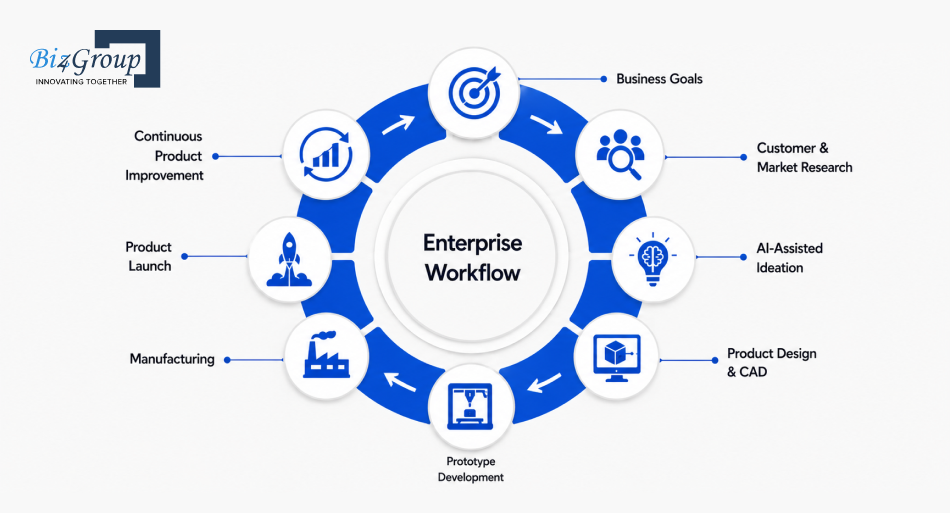
This is why implementing generative AI in product design is not just viewed as a design team initiative alone. It has become a strategic capability that connects product management, engineering, manufacturing, and business leadership through a more intelligent and efficient product design workflow using generative AI. Let's see how generative AI for product design gets used to solve the challenges that occurred while development.
Also Read: 5 Steps to Identify Generative AI Opportunity in Businesses
Still designing products the old way?
Your competitors probably aren't. See how AI can shorten development cycles and unlock faster innovation.
Get StartedHow Does Generative AI for Product Design Solve Today's Product Development Challenges?
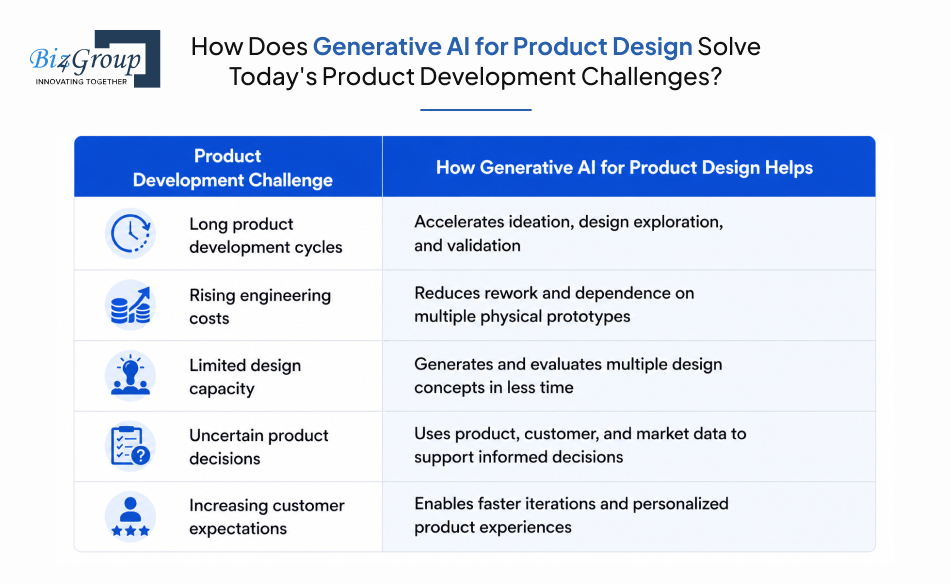
Generative AI for product design helps businesses overcome the challenges that often slow innovation and increase development costs. Rather than replacing existing workflows. It enables product, design, and engineering teams to work more efficiently by accelerating decision-making, reducing manual effort, and identifying opportunities earlier in the product development process.
This often get asked, "Where does AI create the biggest operational impact?"
So, the answer lies in solving the everyday challenges that product teams face, from lengthy development cycles and rising engineering costs to limited design capacity and evolving customer expectations. Here's how generative AI for product design addresses these challenges.
|
Product Development Challenge |
How Generative AI for Product Design Helps |
Business Impact |
|---|---|---|
|
Long product development cycles |
Accelerates ideation, design exploration, and validation |
Faster time-to-market |
|
Rising engineering costs |
Reduces rework and dependence on multiple physical prototypes |
Lower development costs |
|
Limited design capacity |
Generates and evaluates multiple design concepts in less time |
Higher team productivity |
|
Uncertain product decisions |
Uses product, customer, and market data to support informed decisions |
Better investment decisions |
|
Increasing customer expectations |
Enables faster iterations and personalized product experiences |
Improved customer satisfaction |
Every business faces different product development challenges, but the objective remains the same, building better products with fewer delays and greater confidence. Understanding how AI solves these challenges is the beginning, next we'll be exploring the measurable business benefits it delivers across the organization.
How Are Businesses Using Generative AI for Product Design?
Every industry faces different product development challenges, which means the role of generative AI for product design looks different from one business to another. While manufacturers focus on engineering optimization, healthcare organizations prioritize personalization, and software companies emphasize user experience. The common goal isn't just to automate work, but to build products that better meet customer, engineering, and business requirements.
Here are some of the most impactful real-world use cases.
1. Software & Digital Products
Software companies use generative AI for product design to transform product requirements into interactive experiences, generate UX copy, maintain design consistency, and identify usability improvements before development begins.
Real-world example:
Biz4Group has developed an AI-powered social media app that helps businesses and creators generate engaging visual content faster using advanced generative AI technologies.

AI-powered social media platform enables users to generate and share AI-created images and videos using Google Vertex AI (Imagen) for text-to-image generation and Luma AI for text-to-video generation.
Key highlights:
- AI-powered text-to-image and text-to-video generation.
- Intelligent content reuse to reduce AI inference costs.
- Built with Ionic + React, Node.js, and PostgreSQL for scalability.
- Google, Apple, email, and guest authentication.
- AI-generated media customization and privacy controls.
- Seamless experience across mobile and web.
This project shows how businesses can move beyond AI experimentation to build scalable, user-centric products that combine innovation with real business value.
2. Manufacturing & Industrial Design
Manufacturers use product design using generative AI to optimize product geometry, improve manufacturability, reduce material consumption, and evaluate production constraints before a design reaches the factory floor.
Real-world example: Autodesk's Generative Design technology has helped manufacturers develop lighter, stronger components while reducing material waste and production costs.
3. Automotive
Automotive companies that are using AI apply generative AI in product development to explore lightweight chassis designs, optimize EV battery packaging, improve aerodynamics, and validate component performance before physical testing.
Real-world example: General Motors collaborated with Autodesk to redesign seat brackets using generative design, reducing component weight while maintaining structural strength.
4. Healthcare & Medical Technology
Healthcare organizations use generative AI for product design to develop personalized digital health solutions, assistive technologies, and patient-centric applications that adapt to individual needs and improve long-term care.
Real-world example:
Biz4Group has developed an AI-powered mobile application that demonstrates how artificial intelligence can deliver meaningful, human-centered healthcare solutions.
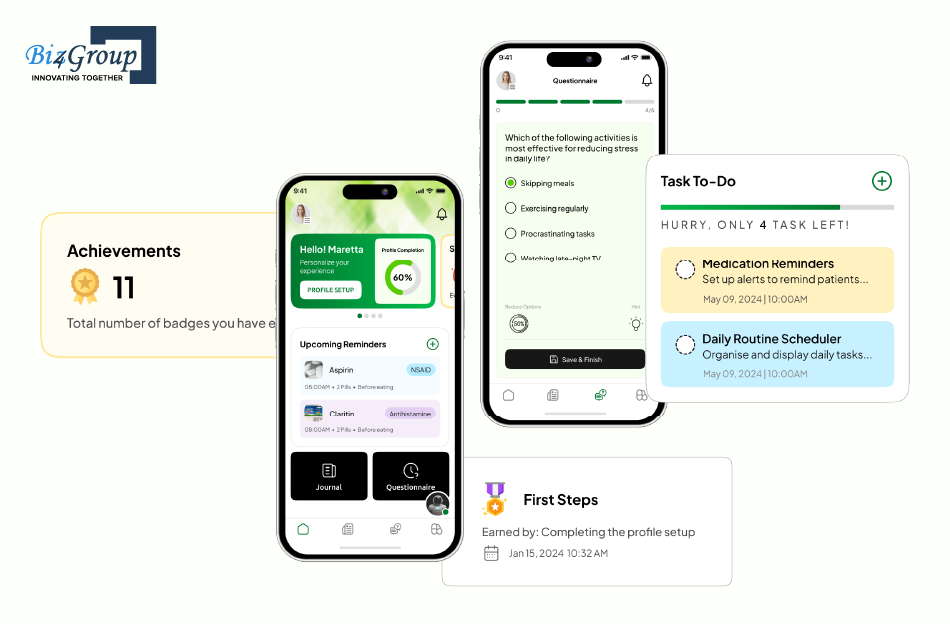
Cognihelp, AI-powered mobile application supports early to mid-stage dementia patients by helping them stay organized, recall important memories, maintain daily routines, and monitor cognitive well-being through personalized AI experiences.
Key highlights:
- Personalized information storage for family details, routines, and important life events.
- Daily journaling with voice-to-text support for easier self-expression.
- AI-powered quizzes tailored to each patient's personal history.
- Smart reminders for medication, daily activities, and cognitive exercises.
- Emotional check-ins through an AI chatbot.
- Cognitive performance monitoring to track changes over time.
This project demonstrates how AI can be designed with empathy at its core, delivering personalized experiences that support healthier lives while showcasing the transformative potential of Generative AI across industries.
5. Consumer Products
Consumer brands use generative AI applications in product design and development to explore packaging concepts, evaluate product variations, and design products that better align with changing consumer preferences and sustainability goals.
Real-world example: Nike applies AI-driven computational design to explore footwear innovations that improve comfort, performance, and material efficiency.
6. Retail & E-commerce
Retail businesses use generative AI in digital product design to create localized product experiences, generate product visuals, and optimize product catalogs based on customer behavior and purchasing trends.
Real-world example: Amazon uses generative AI to help sellers create richer product listings while improving product discovery and customer engagement.
7. Aerospace & Defense
Aerospace companies use implementing generative AI in product design to engineer lightweight aircraft components, optimize structural performance, and balance strength with fuel efficiency while meeting strict safety requirements.
Real-world example: Airbus has applied generative design to develop aircraft partitions that significantly reduce weight without compromising durability.
8. Architecture & Construction
Architecture and construction firms use designing product using generative AI to create climate-responsive building concepts, optimize space utilization, and evaluate thousands of design possibilities based on environmental and structural constraints.
Real-world example: Autodesk's AI-powered design tools help architects generate and compare multiple building layouts based on energy efficiency, site conditions, and project objectives.
These use cases show that generative AI for product design isn't confined to a single industry or workflow. As organizations continue to adopt AI, they're using it to solve industry-specific challenges, create differentiated products, and unlock new opportunities for innovation. Next, we'll look at how generative AI for product gets used across the development process.
Your next product deserves more than guesswork.
Build with insights, not assumptions. Let's discuss how AI can help you design with confidence.
Talk to an ExpertWhere Generative AI for Product Design Creates Value Across the Product Lifecycle?
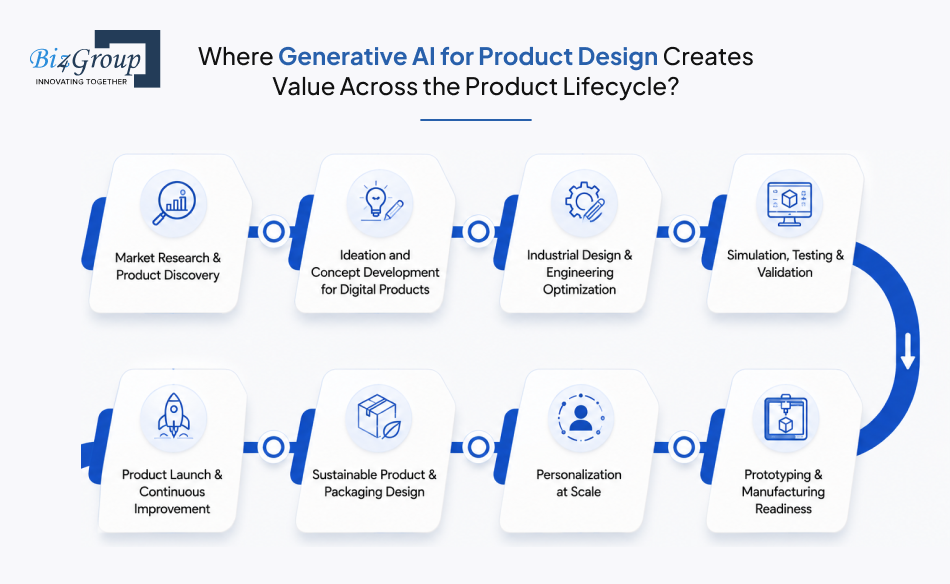
Generative AI creates the most value when it's embedded across the product lifecycle and not just used as a standalone design tool. From identifying market opportunities to improving products after launch, AI helps teams make faster decisions, reduce costly rework, and deliver products that better match customer needs.
A question that many product leaders end up asking, "At what stage should we introduce generative AI into our product development process?"
The answer is easy, the earlier generative AI is introduced, the greater its impact. That doesn't mean replacing existing workflows. It means adding intelligence where teams spend the most time making decisions. Here you will explore how to build generative AI solutions from designing to deployment.
1. Market Research & Product Discovery
Every successful product starts with understanding the customer. Traditionally, product teams spend weeks analyzing surveys, reviews, competitor products, and market reports. However, generative AI speeds up this process by identifying patterns that are difficult to spot manually.
With generative AI in product development, businesses can:
- Analyze thousands of customer reviews in minutes.
- Identify recurring pain points and unmet needs.
- Summarize competitor offerings.
- Generate product opportunity reports.
- Create early product requirement documents.
Real-world example
Amazon uses AI to analyze customer reviews and shopping behavior to identify product trends and improve product recommendations. These insights also influence product planning and assortment decisions.
2. Ideation and Concept Development for Digital Products
Once an opportunity is identified, the next challenge is turning it into a product. This is where product design using generative AI delivers immediate value. Instead of exploring one or two ideas, teams can evaluate dozens before committing development resources.
AI can help teams:
- Generate product concepts from simple prompts.
- Create user stories and feature ideas.
- Produce UX wireframes.
- Suggest interface layouts.
- Generate user flows.
- Draft product requirement documents.
This question is often asked, "Can AI create an app design from just an idea?"
Yes, it can create strong starting points. Product teams still validate usability, customer needs, and business goals before moving into development.
Real-world example
Figma AI helps designers generate interface layouts, rename layers, create content, and accelerate repetitive design tasks, which allows teams to spend more time refining user experiences.
3. Industrial Design & Engineering Optimization
Designing physical products involves balancing performance, cost, manufacturability, and safety. Generative AI helps engineers evaluate more options before investing in physical prototypes.
Organizations are using generative AI product design to:
- Explore multiple design alternatives.
- Recommend lightweight structures.
- Optimize material usage.
- Improve component performance.
- Generate engineering documentation.
Real-world example
Airbus has used generative design technologies to create lighter aircraft components, helping reduce material usage while maintaining structural strength.
4. Simulation, Testing & Validation
Finding design issues late in the process is costly. Generative AI helps teams identify potential problems earlier through simulations and predictive analysis. Instead of relying only on physical testing, organizations can:
- Simulate product performance.
- Predict design failures.
- Compare design alternatives.
- Recommend improvements before production.
This shortens development cycles and reduces engineering rework.
5. Prototyping & Manufacturing Readiness
Building physical prototypes is one of the most expensive stages of product development. Generative AI in product design prototyping helps reduce unnecessary iterations by validating ideas before they reach the workshop or factory floor.
Teams can use AI to:
- Refine prototype designs.
- Identify manufacturing challenges.
- Improve design-for-manufacturing (DFM).
- Generate production documentation.
A question manufacturer often asks, "Can AI replace physical prototypes?"
Not entirely. It reduces the number of prototypes needed by helping teams eliminate weak designs much earlier.
Real-world example
Autodesk Fusion combines generative capabilities with simulation tools, helping engineers evaluate manufacturable designs before production.
6. Personalization at Scale
Customers are expecting products that reflect their preferences. But meeting those expectations manually is difficult. Generative AI makes personalization practical by generating product variations based on customer data, usage patterns, and market preferences.
This is especially valuable in:
- Consumer products
- E-commerce
- Retail
- Digital platforms
- Fashion
- Healthcare
7. Sustainable Product & Packaging Design
Sustainability has become a business objective, not just an environmental initiative. Generative AI helps organizations explore designs that use fewer materials, generate less waste, and improve manufacturing efficiency.
Examples include:
- Material optimization
- Lightweight components
- Sustainable packaging concepts
- Reduced manufacturing waste
Real-world example
Unilever has used AI across product development and innovation initiatives to improve decision-making and support more sustainable product strategies.
8. Product Launch & Continuous Improvement
AI product development doesn't end after launch. Customer feedback creates the roadmap for the next version.
Generative AI helps organizations analyze:
- Customer reviews
- Support tickets
- Product usage
- Feature requests
- Market trends
These insights help teams prioritize updates based on real customer needs instead of assumptions.
The real strength of generative AI for product design lies in its ability to create value throughout the product lifecycle, from the first idea to continuous product improvement.
So, how does that translate into measurable business benefits?
What are the Key Business Benefits of Generative AI for Product Design?
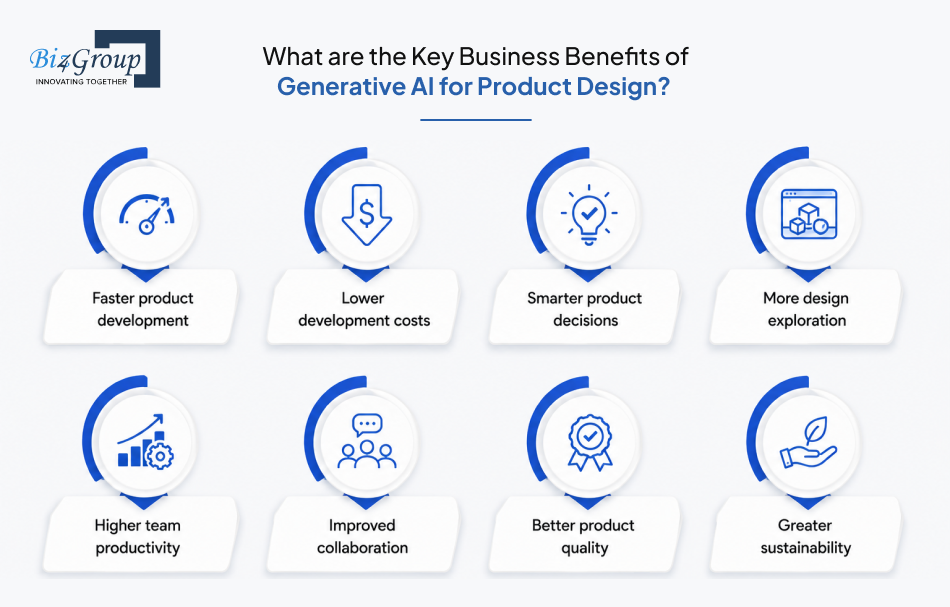
The biggest benefit of adopting generative AI is to better business outcomes. Organizations that are using generative AI into product development can reduce time-to-market, improve decision-making, optimize engineering resources, and deliver products that are more aligned with customer needs.
Here's how those benefits translate into measurable business value.
|
Business Benefit |
What It Means for Your Business |
Real-World Outcome |
|---|---|---|
|
Faster product development |
Automates research, ideation, documentation, and repetitive design tasks so teams spend more time solving complex problems. |
Shorter development cycles and faster product launches. |
|
Lower development costs |
Identifies design issues earlier and reduces the need for multiple physical prototypes or late-stage engineering changes. |
Lower prototyping costs and less rework. |
|
Smarter product decisions |
Analyzes customer feedback, market trends, and historical product data to support better product planning. |
Higher confidence in product investments. |
|
More design exploration |
Generates multiple design concepts in minutes, giving teams more options before committing resources. |
Better product innovation without increasing effort. |
|
Higher team productivity |
Automates repetitive work across design, engineering, and documentation. |
Existing teams accomplish more without adding headcount. |
|
Improved collaboration |
Keeps product managers, designers, engineers, and stakeholders aligned with shared insights and documentation. |
Faster approvals and fewer communication gaps. |
|
Better product quality |
Supports testing, simulation, and validation before production begins. |
Fewer design flaws discovered late in development. |
|
Greater sustainability |
Optimizes materials, reduces waste, and improves design efficiency. |
Lower environmental impact and reduced material costs. |
Generative AI product design creates value by helping organizations build products more efficiently, making better decisions with available data, and deliver stronger business outcomes without fundamentally changing how teams collaborate.
The best time to adopt AI was yesterday. The next best time is now.
Let's build an AI roadmap that delivers measurable business outcomes, not just impressive demos.
Book a Strategy CallWhat Does It Cost to Implement Generative AI for Product Design?
The cost of implementing generative AI depends on the complexity of your use case, the level of customization, and how well it integrates with your existing product development ecosystem. Businesses experimenting with off-the-shelf AI tools can typically get started for $20 to $300 per user per month, while integrating generative AI into existing product development workflows generally costs between $25,000 and $150,000+. For organizations building secure, enterprise-grade generative AI for product design solutions with custom models and integrations across CAD, PLM, ERP, and CRM systems, investments usually range from $150,000 to over $300,000+ depending on scope and complexity.
Here is a question we often hear, "Do we need to spend millions to start using generative AI in product design?"
Not necessarily. Many organizations begin with a focused pilot project. They validate the business value first, then expand their generative AI capabilities over time.
Here is a table that explores the typical investment ranges.
|
Approach |
Best For |
Estimated Investment* |
|---|---|---|
|
Ready-to-Use AI Platforms |
Individuals, startups, small teams |
$20 to $300 per user/month |
|
AI-Enabled Product Development |
Mid-sized businesses and growing product teams |
$25,000 to $150,000+ |
|
Custom Enterprise AI Ecosystem |
Large organizations with complex workflows and security needs |
$150,000 to $300,000+ |
These are indicative ranges. Actual costs vary based on project scope, integrations, security requirements, and customization.
1. Ready-to-Use AI Platforms
This is the fastest and most affordable way to get started. Organizations typically use existing AI platforms for:
- Brainstorming product ideas.
- Creating UI mockups.
- Generating product documentation.
- Summarizing customer research.
- Producing early design concepts.
This approach works well when the goal is improving individual productivity rather than transforming the entire product design workflow using generative AI.
Here are some of the most popular off-the-shelf generative AI platforms businesses use to streamline product development.
|
AI Platform |
Best For |
Key Capabilities |
Ideal For |
|---|---|---|---|
|
Figma AI |
Digital product & UX/UI design |
Wireframes, UI generation, content creation |
Product managers, UX/UI designers |
|
Adobe Firefly |
Creative design |
AI-generated images, product visuals, marketing assets |
Design and marketing teams |
|
Autodesk Fusion |
Industrial product design |
Generative design, CAD, simulation |
Engineers and manufacturers |
|
Siemens NX |
Enterprise engineering |
AI-assisted CAD, simulation, digital manufacturing |
Large engineering teams |
|
Google Vertex AI |
Custom AI applications |
Multimodal AI, model development, enterprise APIs |
Organizations building AI-powered products |
Keep in mind, these tools often have limited customization and may not fit enterprise security or compliance requirements.
2. AI-Enabled Product Development
Many organizations reach a point where standalone AI tools are not enough. Instead of replacing existing systems, they integrate generative AI into platforms they already use.
Examples include:
- CAD software.
- PLM systems.
- Product management platforms.
- Internal knowledge bases.
- Engineering documentation.
- Customer feedback systems.
This approach improves collaboration while minimizing disruption to existing processes.
3. Custom Enterprise AI Ecosystem
Custom development is usually the right choice when generative AI becomes part of a company's competitive strategy. Organizations often choose this route when they need to:
- Protect proprietary product data.
- Build AI around internal design processes.
- Connect multiple enterprise systems.
- Meet industry-specific compliance requirements.
- Create experiences that off-the-shelf tools can't deliver.
While the initial investment is higher, businesses gain greater flexibility, stronger security, and full ownership over how AI supports their product development process.
What Drives Implementation Costs in Generative AI Product Design?
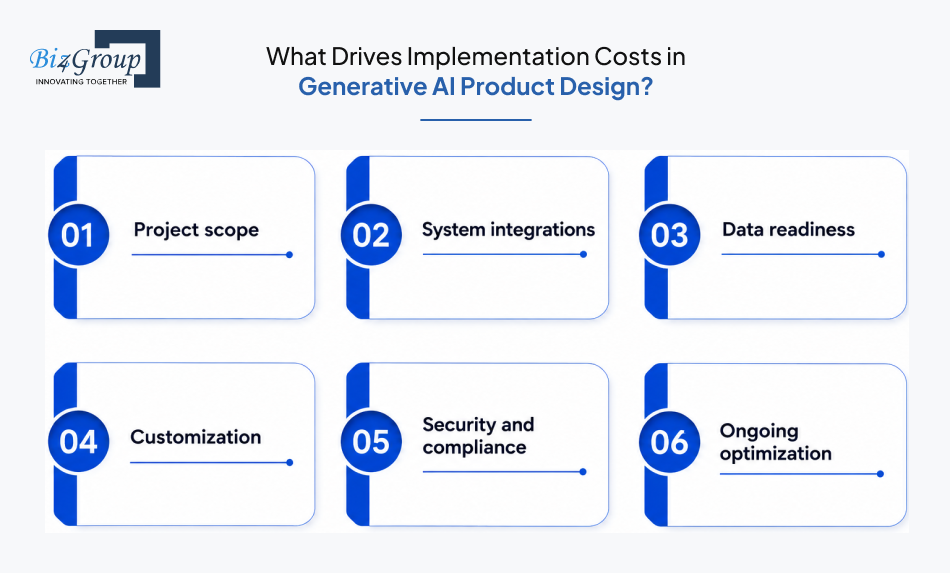
The cost of implementing generative AI for product design varies from one business to another. It depends on factors such as project scope, system integrations, data readiness, customization, and long-term operational requirements.
- Project scope: A focused AI pilot typically costs $25,000 to $75,000, while enterprise-wide implementations spanning multiple workflows can exceed $500,000.
- System integrations: Connecting AI with CAD, PLM, ERP, CRM, or other enterprise platforms increases implementation complexity and development effort.
- Data readiness: Cleaning, organizing, and preparing engineering data, product documentation, and historical design assets often accounts for a significant portion of the project budget.
- Customization: AI solutions tailored to proprietary workflows, design standards, or industry regulations require additional model development and testing.
- Security and compliance: Organizations in regulated industries may need private AI environments, governance frameworks, and compliance controls, increasing infrastructure costs.
- Ongoing optimization: AI models require continuous monitoring, retraining, and performance improvements as products, customer expectations, and business requirements evolve.
How Can You Control Implementation Costs?
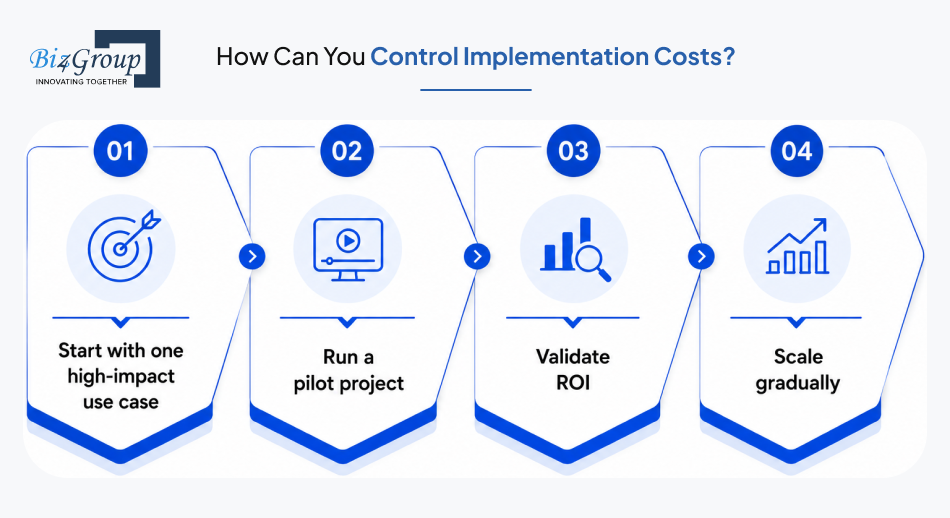
Reducing implementation costs in generative AI for product design is about investing in the right use case at the right time. Organizations that start small often achieve faster ROI while minimizing technical and financial risk.
A practical approach looks like this:
- Start with one high-impact use case instead of transforming the entire product development process.
- Run a pilot project with a budget of $25,000 to $75,000 and define measurable business KPIs from the outset.
- Validate ROI before expanding AI into additional product development workflows.
- Scale gradually, investing in custom AI capabilities only after the initial implementation delivers measurable value.
This phased approach reduces implementation risk, controls upfront costs, and builds internal confidence for larger AI initiatives.
Every technology has a point where its strengths end and human expertise takes over. Generative AI is no different, and understanding those boundaries is essential for using it effectively.
How much is slow product development costing you?
If your teams spend more time iterating than innovating, it's time for a different approach.
Let's Find OutWhat Are the Limitations of Generative AI for Product Design?
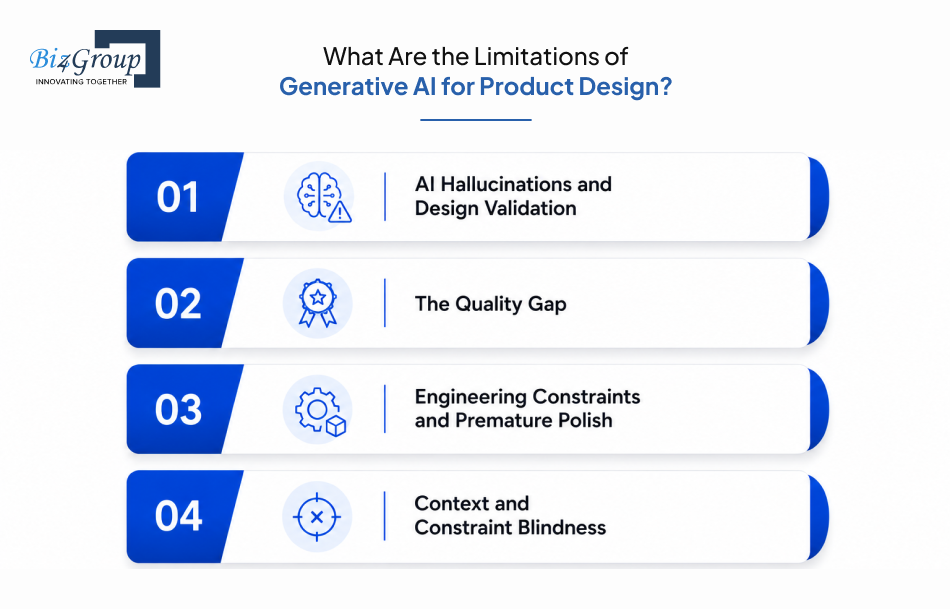
Generative AI for product design is limited by its inability to fully understand business context, validate engineering feasibility, and consistently produce reliable, production-ready outputs without human oversight. While it can generate ideas and accelerate early-stage design work, it still depends heavily on data quality, defined constraints, and expert validation to ensure designs are practical and aligned with real-world requirements.
1. AI Hallucinations and Design Validation
AI hallucinations can produce convincing but inaccurate outputs, from misleading customer insights to engineering suggestions that appear feasible but fail under real-world conditions. That's why every AI-generated concept should be treated as a starting point, not a final answer.
Ask yourself, would you approve a product design that hadn't been properly validated?
The same principle applies to AI-generated designs. Every recommendation should pass through engineering reviews, testing, and business validation before influencing product decisions.
2. The Quality Gap
Generative AI can generate ideas quickly, but speed doesn't always translate into quality. Many design professionals believe AI-generated work can lower the overall standard of design when it's accepted without refinement. While AI is excellent at producing options, it still struggles to match the creativity, judgment, and attention to detail that experienced designers bring to a product.
3. Engineering Constraints and Premature Polish
One of the most overlooked limitations is how polished AI-generated concepts can appear. A realistic rendering or detailed prototype may look production-ready long before it has been tested for manufacturability, safety, performance, or regulatory compliance.
Looking finished isn't the same as being ready for production.
4. Context and Constraint Blindness
Generative AI only works within the information it's given. It doesn't automatically understand your manufacturing tolerances, design history, business priorities, or the lessons learned from previous product failures unless that context is explicitly provided.
The quality of AI-generated designs depends heavily on the quality of the constraints, requirements, and data that guide the model.
Knowing where AI falls short helps teams make better decisions. Governing how AI is used ensures those decisions remain secure, compliant, and accountable as adoption grows.
What Are the Governance Challenges of Using Generative AI for Product Design?
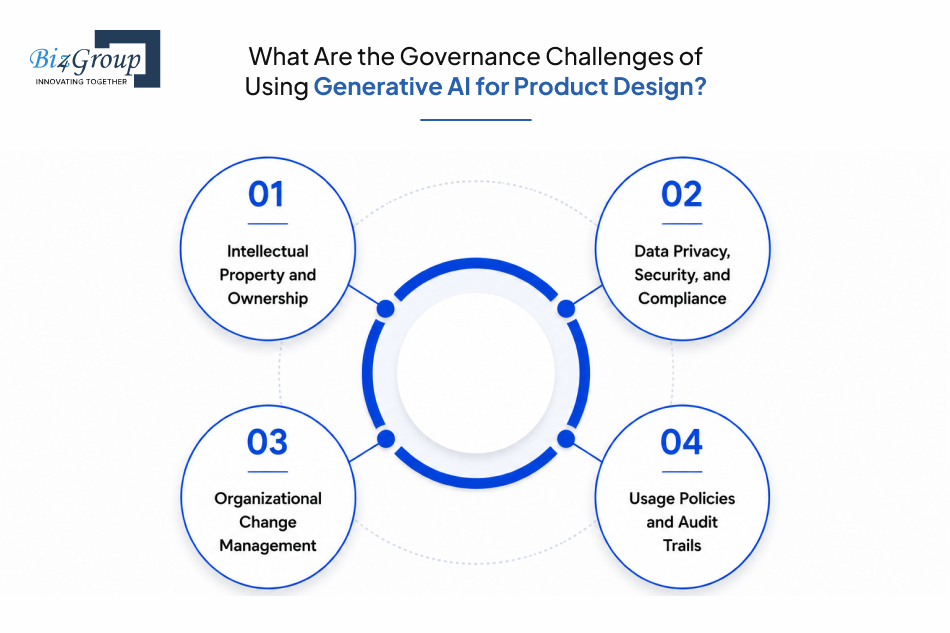
The main AI governance challenges of using generative AI for product design revolve around managing intellectual property, protecting sensitive data, ensuring regulatory compliance, and establishing clear accountability for AI-assisted decisions.
Adopting generative AI successfully isn't just about selecting the right tools. It also requires the right governance framework to protect intellectual property, secure sensitive product data, and ensure AI is used responsibly as it becomes part of everyday product development.
1. Intellectual Property and Ownership
One of the first questions organizations ask is, "Who owns an AI-generated product design?"
The answer depends on the AI platform, its licensing terms, and how the underlying model has been trained. Some platforms, such as Adobe Firefly, are trained on licensed content to reduce intellectual property risks, while others may have different usage policies.
Before deploying any AI solution, establish clear internal policies around ownership, licensing, and the use of proprietary design data instead of waiting until an IP dispute arises.
2. Data Privacy, Security, and Compliance
Engineering drawings, CAD models, product specifications, and early-stage concepts often contain highly confidential information. Sharing this data with third-party AI platforms without understanding how it is stored, processed, or retained can introduce unnecessary security and compliance risks, especially in regulated industries.
Before adopting an AI platform, review its data handling and retention policies just as carefully as its technical capabilities.
3. Organizational Change Management
The biggest challenge with AI adoption is rarely the technology itself. It helps design, engineering, and product teams build confidence in new workflows while adapting to rapidly evolving AI capabilities.
Without organizational buy-in, even the best governance policies are unlikely to deliver meaningful business value.
4. Usage Policies and Audit Trails
As AI becomes part of day-to-day product development, organizations need clear internal standards that define where AI can be used, what requires human approval, and how AI-assisted decisions are documented.
Well-defined usage policies and audit trails become especially important for regulated industries and safety-critical products, where accountability and traceability are just as important as innovation.
Once you've identified where AI can create value, the next decision is how to implement it in a way that aligns with your business goals, budget, and existing product development processes.
Is Your Organization Ready to Implement Generative AI for Product Design?
Organizations don't need perfect AI capabilities to get started. They need the right business problem, reliable data, executive sponsorship, and a clear implementation strategy. Assessing your readiness before investing helps reduce risk and improves the chances of long-term success.
A question many business leaders ask, "How do we know if we're ready to implement AI?"
The answer lies in evaluating a few critical areas of your business.
|
Readiness Area |
Ask Yourself |
Why It Matters |
You're Ready If... |
|---|---|---|---|
|
Business Goals |
Have we identified a specific problem AI should solve? |
AI delivers the most value when tied to measurable business outcomes. |
You have one or two high-impact use cases with clear success metrics. |
|
Product Development Process |
Which stages consume the most time, effort, or budget? |
Identifies where AI can create immediate value. |
You've mapped the product lifecycle and identified bottlenecks. |
|
Data Readiness |
Is our product, engineering, and customer data accurate and accessible? |
AI depends on quality data to produce reliable outputs. |
Your data is organized, secure, and available for AI models. |
|
Technology Stack |
Can AI integrate with our existing CAD, PLM, ERP, and CRM systems? |
Seamless integration improves adoption and minimizes disruption. |
Your core systems support APIs or enterprise integrations. |
|
People & Skills |
Do our teams understand how AI fits into their workflows? |
Adoption depends on people as much as technology. |
Product, engineering, and IT teams are aligned on goals. |
|
Governance & Security |
Have we defined policies for security, compliance, and AI usage? |
Protects intellectual property and reduces business risk. |
Governance processes are in place before deployment. |
|
Executive Sponsorship |
Is leadership committed to driving AI adoption? |
Executive support accelerates adoption and removes roadblocks. |
Leadership is actively involved in planning and decision-making. |
|
Success Metrics |
How will we measure ROI? |
Clear KPIs help justify investment and guide future scaling. |
Metrics such as time-to-market, cost savings, or productivity are defined. |
AI readiness isn't measured by how much technology your business has. It's measured by how clearly you understand the problem you're solving, how prepared your teams are, and how effectively AI can fit into your existing product development process.
What's stopping your next big product idea?
If the answer is time, budget, or complexity, AI might be the missing piece.
Explore the PossibilitiesHow Do You Measure the ROI of Generative AI for Product Design?
The success of AI should be measured by business outcomes, not technology adoption. If AI isn't helping your organization reduce development costs, accelerate product launches, improve product quality, or make better business decisions, it's not delivering meaningful ROI.
If you are wondering, "Our AI pilot looks promising. How do we know it's actually creating business value?"
The answer lies in tracking the right metrics from the beginning. Instead of measuring how often AI is used, measure how your product development process improves after AI is introduced.
|
Success Area |
Key Metric |
Why It Matters |
What Success Looks Like |
|---|---|---|---|
|
AI adoption |
Team adoption rate |
Shows whether product and engineering teams are actively using AI |
AI becomes part of day-to-day workflows |
|
Workflow efficiency |
Time saved per design iteration |
Measures improvements in productivity |
Faster design reviews and shorter iteration cycles |
|
Design quality |
AI-generated concept acceptance rate |
Indicates how often AI outputs are considered production-worthy |
More AI-generated concepts move into development |
|
Business impact |
ROI, cost savings, or revenue impact |
Evaluates whether AI investments create measurable value |
Positive ROI with reduced development costs or faster product launches |
|
Organizational maturity |
Number of AI-enabled workflows |
Measures how successfully AI scales across the organization |
AI supports multiple product development processes |
Measure ROI in Phases
AI adoption is a journey. The metrics you track should evolve as your implementation matures.
|
Timeline |
What to Measure |
|---|---|
|
First 90 days |
User adoption, workflow efficiency, time saved on repetitive tasks |
|
3 to 6 months |
Development costs, design cycle time, prototype reduction |
|
6 to 12 months |
Revenue impact, product quality, customer satisfaction, competitive advantage |
This phased approach helps set realistic expectations while giving leadership a clear view of progress.
Don't measure AI by the number of models deployed or licenses purchased. Measure it by how much better your business builds products.
If your teams are making faster decisions, reducing costly rework, launching products sooner, and delivering greater customer value, your generative AI for product design initiative is creating measurable business impact.
Build, Buy, or Partner: Which AI Strategy Is Right for Your Business?
The right AI strategy depends on your business goals, internal expertise, budget, and long-term vision. Some organizations can achieve quick wins with existing AI platforms. Others need custom solutions tailored to their products and workflows. Many find that partnering with an experienced AI development company offers the fastest path to value.
A question many technology leaders ask, "Should we build our own AI solution, buy an existing platform, or partner with an AI company?"
There isn't a one-size-fits-all answer.
The right choice depends on how critical AI is to your product strategy, the resources you have today, and how quickly you need to deliver results.
Here's how the three approaches compare.
|
Approach |
Best For |
Advantages |
Things to Consider |
|---|---|---|---|
|
Buy |
Businesses looking for quick adoption and lower upfront costs |
Faster deployment, predictable pricing, minimal setup |
Limited customization, vendor dependency, integration constraints |
|
Build |
Organizations with experienced AI teams and unique product requirements |
Full ownership, complete customization, competitive differentiation |
Higher investment, longer development timelines, ongoing maintenance |
|
Partner |
Companies that need custom AI solutions without building an in-house AI team |
Faster implementation, access to specialized expertise, lower execution risk, scalable solutions |
Success depends on choosing a partner with proven AI and product engineering experience |
Why Do Businesses Choose Partners Like Biz4group?
Building successful AI solutions requires more than technical expertise. It demands a deep understanding of product engineering, enterprise ecosystems, and business strategy. Biz4Group LLC, a leading generative AI development company in USA, helps organizations move beyond AI experimentation to build secure, scalable, and production-ready AI solutions that deliver measurable business value.
Our experience is backed by real-world AI products, from an AI-powered social media platform that leverages Google Vertex AI (Imagen) and Luma AI for intelligent content generation to an AI-powered dementia care application that provides personalized cognitive support through smart reminders, journaling, and AI-assisted wellness features.
What sets our expertise apart:
- 20+ years of experience building enterprise software and digital products.
- Expertise in Generative AI, machine learning, cloud technologies, and enterprise system integration.
- Custom AI software development tailored to your business goals instead of one-size-fits-all implementations.
- Seamless integration with CAD, PLM, ERP, CRM, and other enterprise platforms.
- End-to-end support, from AI strategy and product design to development, deployment, and continuous optimization.
Ready to bring your AI vision to life? Connect with the AI experts at Biz4Group to identify high-impact opportunities, build a practical implementation roadmap, and turn your product ideas into scalable, real-world AI solutions.
What's Next for Generative AI for Product Design?
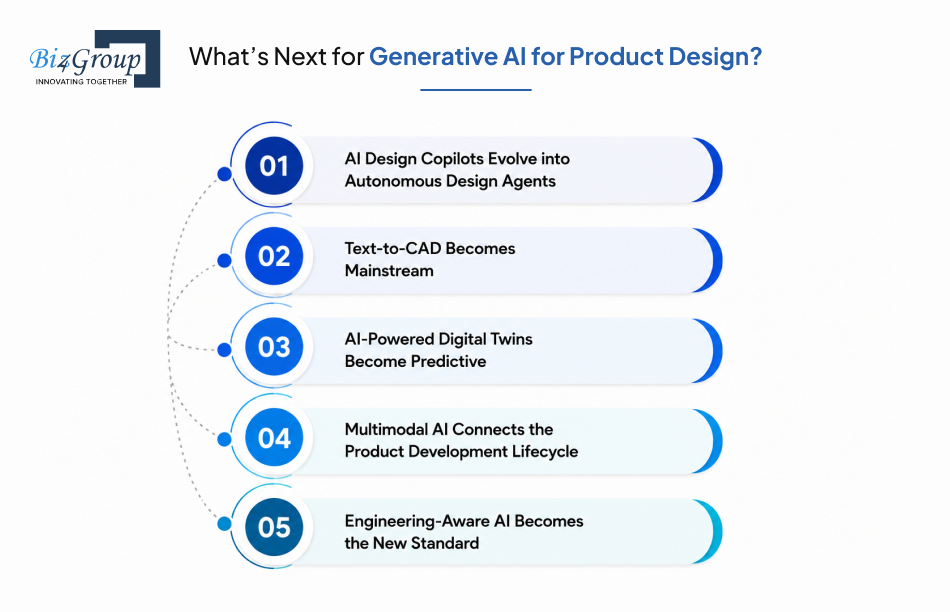
The next evolution of AI in product design isn't about generating more concepts. It's about helping businesses make better decisions, automate complex workflows, and connect every stage of building AI product into a single intelligent ecosystem. Some of these capabilities are already emerging, while others are expected to become mainstream over the next few years.
A question that often occurs is, "Where is AI-driven product design headed next, and how should we prepare?"
The answer is that the biggest shifts are likely to come from these five areas.
|
Emerging Trend |
What's Changing? |
Why It Matters for Businesses |
|---|---|---|
|
AI Design Copilots Evolve into Autonomous Design Agents |
AI is moving beyond single prompts to managing multi-step workflows such as research, concept generation, documentation, design reviews, and reporting, with humans stepping in only at key decision points. |
Teams spend less time coordinating routine work and more time solving high-value product challenges. |
|
Text-to-CAD Becomes Mainstream |
Engineers will increasingly describe components or products in natural language and receive editable CAD models as a starting point. This removes the "blank canvas" problem from early engineering work and speeds up concept development. |
Faster design iterations, shorter engineering cycles, and quicker product launches. |
|
AI-Powered Digital Twins Become Predictive |
Digital twins are evolving from static simulations into intelligent systems that predict failures, recommend design improvements, and continuously optimize products using real-world operational data. |
Better product quality, reduced prototyping costs, and more informed engineering decisions. |
|
Multimodal AI Connects the Product Development Lifecycle |
AI will understand and reason across text, sketches, CAD files, technical documents, images, customer feedback, and simulation data within a single workflow. |
Better collaboration between design, engineering, manufacturing, and product teams while reducing information silos. |
|
Engineering-Aware AI Becomes the New Standard |
Future AI systems will generate concepts while simultaneously evaluating manufacturability, engineering constraints, sustainability, compliance, and cost before presenting recommendations. |
Higher confidence in AI-generated designs and fewer costly revisions before production. |
The biggest competitive advantage won't come from adopting every new AI capability first. It will come from building the right foundation today. Organizations that invest in high-quality product data, modern engineering workflows, and responsible AI governance will be in a much stronger position to adopt these capabilities as they mature.
The future of generative AI for product design isn't about replacing designers or engineers. It's about giving them intelligent systems that remove repetitive work, improve decision-making, and accelerate innovation across the entire product development lifecycle.
Final Thoughts
The conversation around generative AI for product design has moved beyond "Is it worth exploring?" The real question now is "How can we use it to build better products, faster and smarter?"
As you've learned throughout this blog, AI isn't about replacing creativity or engineering expertise. It's about helping teams spend less time on repetitive work and more time solving meaningful problems, validating ideas sooner, and bringing innovative products to market with greater confidence. Businesses that treat AI as a long-term capability, rather than a short-term trend, will be better positioned to adapt, innovate, and compete in the years ahead.
The opportunity is real. The challenge is knowing where to begin and choosing the right path for your business.
If you're ready to turn your product idea into an AI-powered reality, Biz4Group LLC has the expertise to help you move from concept to execution with confidence.
Let's build the next generation of intelligent products together. Get in touch with our AI experts today and discover how your product vision can become your next competitive advantage.
FAQ’s
1. Do I need an AI or data science team to implement generative AI for product design?
Not necessarily. Most businesses can start with existing AI platforms that require little or no coding. An in-house AI team typically becomes important when you're building custom models, integrating AI across enterprise systems, or working with proprietary product data.
2. Can generative AI for product design integrate with CAD, PLM, and ERP systems?
Yes. Modern AI solutions can integrate with CAD, PLM, ERP, CRM, and other enterprise platforms through APIs and custom integrations. This allows businesses to embed AI into existing product design workflows instead of replacing current systems.
3. How does generative AI for product design affect design consistency across large teams?
AI can improve consistency when it's guided by design systems, brand guidelines, and predefined engineering standards. Without those guardrails, AI-generated outputs may vary in style or quality, making governance and standardized prompts essential.
4. Does using generative AI for product design create vendor lock-in risks?
It can. Some AI platforms rely on proprietary file formats, workflows, or integrations that make switching providers difficult. Before investing, evaluate data portability, export capabilities, and integration flexibility.
5. How do businesses use generative AI for product innovation differently in software and physical product development?
Software teams often use AI for UX design, prototyping, and user research, while engineering teams apply it to concept generation, simulation, material optimization, and design validation. The underlying goal is the same: accelerating innovation while reducing development effort.
6. How do you evaluate whether an AI-generated product design is actually good?
Speed alone isn't a measure of quality. The best organizations evaluate AI-generated designs based on usability, engineering feasibility, manufacturability, brand consistency, and business objectives before moving into production.
7. Is generative AI for product design regulated?
AI regulations vary by country and industry. If AI supports products in regulated sectors such as healthcare, automotive, aerospace, or finance, businesses should also consider compliance requirements, data privacy laws, and frameworks such as the EU AI Act.
8. What's a realistic timeline to see ROI from generative AI for product development?
Many organizations see productivity improvements within the first few months of a pilot. However, measurable business outcomes such as lower development costs, faster product launches, or improved product quality often become visible after multiple product development cycles.
9. What types of businesses benefit the most from generative AI for product design?
Organizations that manage complex product development, frequent design iterations, or large engineering teams often see the greatest value. This includes software companies, manufacturers, consumer product brands, automotive firms, healthcare organizations, and industrial equipment manufacturers.
10. How do I choose the right generative AI development company?
Look for a partner with experience in both AI and product engineering, proven enterprise integrations, strong governance practices, and a track record of delivering measurable business outcomes. The right partner should understand your business goals, not just the technology.
