 Location :
Orlando, FL, USA
Location :
Orlando, FL, USA +1 (407) 714-1616
 info@biz4group.com
- Modernize legacy software in healthcare to reduce security risks, improve compliance, and support scalable digital care across hospitals and clinics.
- Legacy healthcare systems such as EHR, telemedicine, billing, and patient engagement platforms often block efficiency and healthcare digital transformation modernization.
- Healthcare IT modernization solutions include rehosting, refactoring, rebuilding, and hybrid approaches chosen based on system risk, cost, and business impact.
- Healthcare legacy modernization cost estimate typically ranges from $35,000 to $300,000+, depending on integrations, data migration, and compliance requirements.
- With Biz4Group LLC as a trusted healthcare software modernization services provider, organizations modernize safely, improve patient experience, and build future ready healthcare systems.
Does it feel like your healthcare systems are getting harder to manage every year?
Simple changes take longer than they should. Integrations feel fragile. Security reviews raise more concerns than clarity.
If that sounds familiar, you are not alone.
In 2025, over 60 percent of U.S. hospitals still rely on at least one mission critical legacy system that lacks modern interoperability and cloud readiness.
Now ask yourself this. What happens when those systems fail or fall behind security expectations? The answer is costly. Healthcare continues to lead all industries in breach impact, with the average data breach costing $9.48 millions.
This is why the push to modernize legacy software in healthcare has moved beyond IT teams and into leadership conversations. These systems shape how safely you operate, how fast you adapt, and how confidently you meet regulatory demands. For many organizations, they are the biggest barrier to meaningful healthcare legacy software modernization.
You have probably seen the warning signs. Teams relying on manual workarounds. Data scattered across disconnected platforms. Innovation slowing down, not because the ideas are missing, but because the systems cannot support them.
We see this often when healthcare leaders partner with an AI development company to untangle legacy environments. The goal is rarely to replace everything. It is to reduce risk, regain control, and move forward with confidence while modernizing healthcare IT systems.
So where do you start without disrupting patient care or daily operations? With the right strategy and proven enterprise AI solutions, modernization becomes a controlled, phased journey rather than a risky overhaul.
Next, let’s clarify something many teams struggle to define clearly. What exactly is a legacy healthcare system, and why does it continue to hold organizations back today?
What Is a Legacy Healthcare System and Why Can’t Healthcare Afford to Stand Still with Legacy Systems?
Let’s get one thing clear first - When we talk about legacy systems, we are not talking about software that is broken. We are talking about software that still runs critical operations but no longer fits how healthcare works today.
So, what is legacy software modernization in healthcare really addressing?
A legacy healthcare system is typically built years ago, often customized heavily, and designed for stability rather than flexibility. It still functions, but it struggles to evolve. Updates are slow. Integrations feel fragile. Scaling becomes expensive and risky.
You might already be working with one.
- Does every change require extra approvals and workarounds?
- Do integrations take weeks instead of days?
- Does innovation feel constrained by the system rather than enabled by it?
Those are common signals.
Many of these platforms were created through early healthcare software product development efforts where the priority was keeping systems operational, not preparing them for today’s digital demands. Over time, these systems became deeply embedded in clinical and administrative workflows.
Now, here is where healthcare cannot afford to stand still.
Legacy Healthcare Systems Create Growing Business Risk Because They:
- Limit interoperability and data exchange across departments and partners
- Increase compliance and security exposure as regulations evolve
- Slow down innovation and digital transformation initiatives
- Raise maintenance costs while delivering diminishing returns
- Make modernization feel risky instead of strategic
This is why healthcare legacy software modernization is no longer optional. Continuing to extend outdated systems often adds complexity instead of solving the root problem.
We often see organizations relying on a general custom software development company to keep patching legacy platforms without addressing architectural limitations. The result is more technical debt, higher costs, and systems that become harder to manage each year. Standing still may feel like a safer choice. In reality, it quietly increases operational, financial, and compliance risk.
In the next section, we will look at the types of legacy healthcare systems still holding back modern care delivery and why they are often the first candidates for healthcare legacy system transformation.
Still trusting systems that cost healthcare $9.48M per breach?
If over 60 percent of hospitals are still running legacy systems, the real question is whether yours is reducing risk or quietly increasing it.
Talk to a Modernization ExpertTypes of Legacy Healthcare Systems Holding Back Modern Care

Once you understand what is legacy software modernization in healthcare, the next step is identifying where the friction actually lives.
For most hospitals and clinics, the challenge is not a single outdated tool. It is a group of core systems that still run daily operations but no longer support modernizing healthcare IT systems. These platforms were built for stability, not speed, scale, or interoperability.
Below are the most common systems involved in healthcare legacy software modernization for hospitals and clinics, along with why they become bottlenecks over time.
1. Electronic Health Record (EHR) Systems
EHRs are the backbone of clinical operations, yet many were designed long before interoperability and real time insights became essential.
You may notice:
- Limited data exchange with newer platforms
- Rigid workflows that slow clinicians down
- Difficulty adding intelligence without disrupting care
This is why many organizations start legacy healthcare application modernization efforts by evolving toward AI EMR/EHR software as part of broader healthcare digital transformation modernization initiatives.
2. Claims Processing Systems
Legacy claims systems often rely on outdated logic and manual reconciliation. Over time, this increases denials, delays reimbursements, and raises compliance risk.
Common issues include:
- Slow payer integrations
- Poor visibility into revenue leakage
- High operational overhead
Modernizing claims workflows is a critical part of legacy system modernization in healthcare, often supported by AI medical billing software.
3. Patient Engagement Systems
Patient portals and engagement tools are frequently added as extensions rather than designed as unified platforms. As digital expectations grow, these systems struggle to deliver consistent experiences.
You may see:
- Low patient adoption
- Disconnected communication channels
- Limited personalization
Replacing them with AI-powered patient management software enables modern solutions to replace legacy healthcare software while improving continuity of care.
Biz4Group LLC in Action: Quantum Fit: A Smart Patient Engagement Solution

One excellent example of modernized patient engagement software is Quantum Fit, developed by Biz4Group.
Quantum Fit is a digital wellness and patient engagement platform that connects patients with health insights, personalized fitness plans, and clinician communication tools. It replaces siloed legacy patient portals with a unified, intuitive experience that supports better long-term health outcomes.
Key Highlights:
- Designed for interactive patient engagement, enabling users to track health goals and follow recommended care plans.
- Integrates intuitive communication features that improve patient-provider connectivity.
- Offers seamless real-time updates and actionable health insights.
This project demonstrates how modern healthcare legacy software modernization can transform passive legacy patient portals into dynamic patient engagement systems that actively support wellness and clinical communication.
4. Telemedicine Systems
Many telemedicine platforms were deployed quickly and never evolved beyond basic virtual visits. As virtual care becomes standard, these limitations become more obvious.
Typical challenges include:
- Scalability constraints
- Weak integration with EHRs
- Limited support for ongoing monitoring
This is where AI remote patient monitoring software plays a key role in healthcare legacy system transformation.
Biz4Group in Action: How Truman Modernized Telemedicine
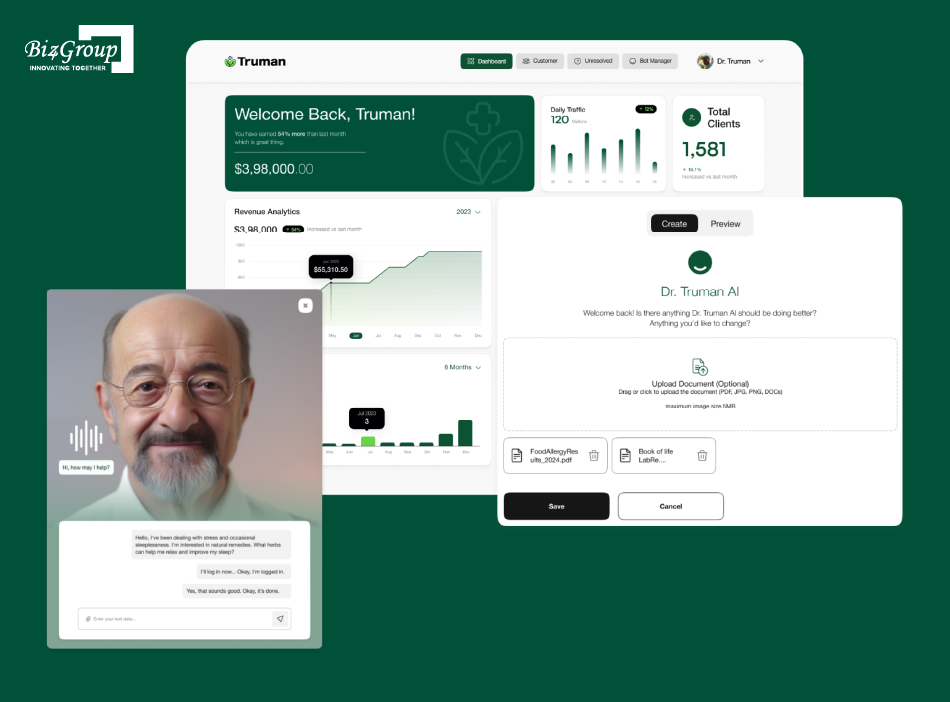
Truman is a modern telemedicine platform developed to support secure, reliable virtual care experiences. The solution brings patient and provider interactions into a single, streamlined system, replacing fragmented tools commonly found in legacy telehealth setups.
Key Highlights:
- Enables secure, real time virtual consultations between patients and providers
- Integrates appointment scheduling and communication into one cohesive platform
- Designed for ease of use, helping clinicians and patients adopt virtual care faster
This project reflects how legacy system modernization in healthcare can turn limited telemedicine tools into scalable, dependable platforms. By modernizing telemedicine systems like Truman, healthcare organizations improve access to care while maintaining workflow efficiency and patient trust.
5. Healthcare Workforce Management Systems
Staffing and scheduling systems are often overlooked, yet they directly impact care delivery and clinician burnout.
Legacy workforce platforms commonly:
- Rely on manual scheduling
- Lack real time staffing insights
- Fail to adapt to fluctuating demand
Modern healthcare workforce management software supports scalable healthcare IT modernization solutions that align staffing with patient needs.
6. Prescription and Clinical Workflow Systems
Older prescribing systems introduce friction across clinical workflows and increase the risk of errors.
When automation and integration are limited, productivity drops and safety concerns rise. This is why E-prescription (eRx) software is often part of efforts to upgrade legacy healthcare software systems.
7. Credentialing and Compliance Systems
Credentialing platforms are frequently fragmented and manual, creating delays in onboarding and increasing compliance exposure.
Modern medical credentialing software helps streamline verification and supports long term healthcare legacy software modernization strategies.
These systems rarely create problems in isolation. The real strain appears when outdated platforms must work together every day. That is why legacy healthcare modernization solutions for hospitals and clinics start by identifying which systems create the most friction, risk, and cost across the organization.
Next, we will look at the real business risks of not modernizing legacy healthcare software, and why delaying action often becomes more expensive than moving forward.
The Real Business Risks of Not Modernizing Legacy Healthcare Software
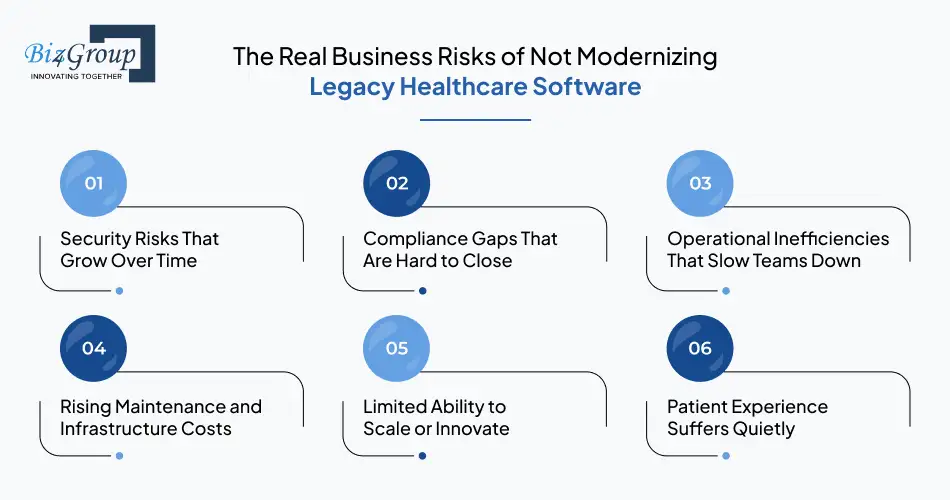
You might be able to keep legacy systems running for now. The real question is what it costs you every day they remain unchanged. These risks rarely appear all at once, but they compound quickly and quietly across the organization.
1. Security Risks That Grow Over Time
Legacy platforms were not built for today’s threat landscape. Outdated architectures, limited patch support, and weak access controls make them easier targets for breaches. As cyber threats evolve, legacy systems struggle to keep pace, increasing exposure across clinical and administrative data.
2. Compliance Gaps That Are Hard to Close
Healthcare regulations continue to change, but legacy systems often lack the flexibility to adapt quickly. This creates gaps in audit trails, reporting, and access controls. Over time, staying compliant becomes a manual process instead of a system driven one, raising the risk of penalties and failed audits.
3. Operational Inefficiencies That Slow Teams Down
When systems cannot talk to each other, people fill the gaps. Manual data entry, duplicate work, and workaround heavy workflows become the norm. These inefficiencies directly affect productivity and make healthcare legacy software modernization feel harder than it should be.
4. Rising Maintenance and Infrastructure Costs
Keeping old systems alive is expensive. Licensing fees, specialized skill requirements, and aging infrastructure drive costs higher each year. Compared to flexible healthcare SaaS solutions, legacy platforms deliver less value while demanding more investment.
5. Limited Ability to Scale or Innovate
Legacy systems resist change. Adding new features, integrating modern tools, or supporting growth becomes slow and risky. This limits your ability to adopt modern healthcare software platforms and delays broader healthcare digital transformation modernization initiatives.
6. Patient Experience Suffers Quietly
Disconnected systems lead to fragmented patient journeys. Delays, inconsistent communication, and limited digital access reduce satisfaction and trust. Over time, this directly impacts retention, outcomes, and reputation across hospitals and clinics.
These risks explain why legacy system modernization in healthcare no longer about future readiness is alone. It is about protecting operations today.
What is the real cost of doing nothing?
Security gaps, compliance stress, and operational slowdowns rarely show up all at once, but they always show up eventually.
Assess My Legacy System RiskNot All Modernization Is the Same: Proven Approaches to Modernize Legacy Software in Healthcare
Once the risks are clear, the next question usually comes up fast. How do you modernize legacy software in healthcare without disrupting patient care, clinical workflows, or compliance?
The truth is, healthcare legacy software modernization is not a one size fits all effort. Different systems require different approaches depending on risk, value, and long-term goals. Below are the most widely used approaches in legacy system modernization in healthcare, explained in practical terms.
1. Rehosting: A Quick Win for Aging Infrastructure
Rehosting moves legacy healthcare applications to modern infrastructure without changing the core code. It helps reduce immediate infrastructure risks and improves system stability. However, it does little to address deeper limitations in flexibility or scalability.
This approach is often used as an entry step in broader healthcare IT modernization solutions when speed matters.
2. Refactoring: Strengthening Systems Without Disrupting Care
Refactoring improves application performance, security, and maintainability while preserving existing workflows. Clinical operations remain stable, which lowers adoption risk. It works well when systems are functionally strong but technically outdated.
Many organizations choose refactoring as part of legacy healthcare application modernization to support incremental healthcare digital transformation modernization.
3. Replatforming: Balancing Modernization and Risk
Replatforming upgrades the underlying platform while keeping application logic largely intact. This allows healthcare organizations to benefit from cloud scalability, better integrations, and improved performance without full redevelopment.
It is a common path for modernizing healthcare IT systems while controlling timelines and operational impact.
4. Rebuilding: When Legacy Healthcare Software No Longer Fits
Rebuilding replaces outdated systems entirely with modern architectures designed for growth. This approach is best when legacy platforms cannot meet compliance, scalability, or innovation needs. While it requires careful planning, it enables long term flexibility.
Many organizations start rebuilding through phased healthcare software modernization services, often beginning with MVP development to reduce risk.
5. Hybrid Modernization: A Practical Path for Hospitals and Clinics
Most healthcare organizations use a mix of approaches across systems. Critical platforms may be rebuilt, while others are refactored or rehosted. This allows teams to prioritize based on business impact and risk.
Hybrid models are common in healthcare legacy modernization solutions for hospitals and clinics, supported by experienced teams that hire AI developers for targeted modernization work.
Choosing the right approach is less about technology and more about outcomes. The goal of modern solutions to replace legacy healthcare software is not change for its own sake, but stronger systems that scale, integrate, and support care delivery.
How Healthcare Organizations Upgrade Legacy Software Systems Without Disruption?
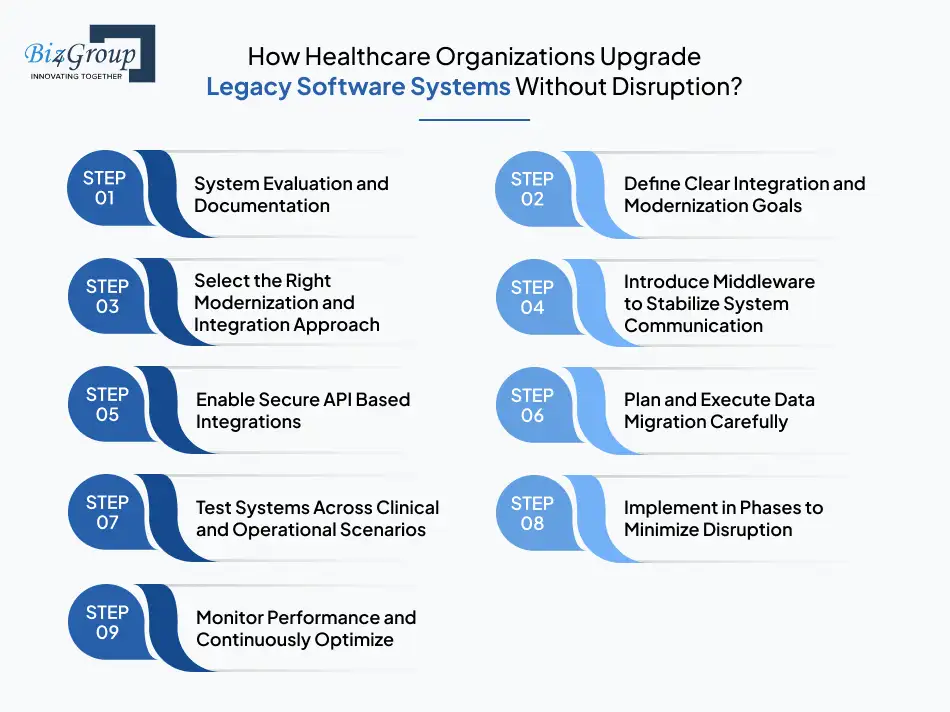
Successfully upgrading legacy systems is not about speed. It is about control. Healthcare organizations that approach legacy system modernization in healthcare with a structured, integration focused plan reduce risk while keeping patient care uninterrupted.
Below is a proven, end-to-end approach used by hospitals and clinics to upgrade legacy healthcare software systems as part of broader healthcare legacy software modernization strategies.
Step 1: System Evaluation and Documentation
Every modernization initiative starts with visibility. You need to understand how existing applications, data sources, and workflows interact before making changes. This step lays the groundwork for healthcare legacy system transformation.
Key activities:
- Assess system dependencies and technical debt
- Document workflows and data ownership
- Identify compliance and security gaps
Step 2: Define Clear Integration and Modernization Goals
Modernization should be driven by outcomes, not technology alone. Clear goals help align technical efforts with operational priorities and long term healthcare digital transformation modernization plans.
Focus areas:
- Clinical efficiency and patient experience
- Regulatory and compliance requirements
- Scalability and future readiness
Step 3: Select the Right Modernization and Integration Approach
Different systems require different levels of change. Some can be optimized, while others need replacement. Choosing the right approach early supports effective healthcare IT modernization solutions.
Decisions include:
- Incremental upgrades or full modernization
- Phased execution or parallel rollout
- Working with a specialized custom software development company
Step 4: Introduce Middleware to Stabilize System Communication
Middleware acts as a bridge between old and new systems. It reduces tight coupling and allows systems to evolve independently, which is critical when modernizing complex healthcare environments.
Key benefits:
- Improved system interoperability
- Reduced dependency risks
- Support for modern healthcare software platforms
Step 5: Enable Secure API Based Integrations
API driven integration replaces fragile point to point connections. This step enables real time data exchange and supports modern solutions for outdated healthcare software. This is where AI integration services help connect legacy platforms with modern healthcare applications.
What this enables:
- Faster system integration
- Stronger access control
- Easier future expansion
Step 6: Plan and Execute Data Migration Carefully
Data migration is one of the most sensitive phases in legacy healthcare application modernization. Errors here can affect clinical decisions, billing accuracy, and compliance.
Critical actions:
- Data cleansing and validation
- Phased migration execution
- Clinical and operational review
Step 7: Test Systems Across Clinical and Operational Scenarios
Testing must reflect real world healthcare use. Beyond technical validation, systems must support daily workflows without friction.
Testing should cover:
- Clinical workflow accuracy
- Performance and scalability
- Compliance and security readiness
Step 8: Implement in Phases to Minimize Disruption
A phased rollout reduces operational risk and builds trust across teams. Gradual implementation supports smoother adoption during healthcare legacy software modernization for hospitals and clinics.
Best practices:
- Pilot deployments
- Parallel system operation
- Clear communication and training
Step 9: Monitor Performance and Continuously Optimize
Modernization is ongoing. Continuous monitoring ensures systems remain secure, efficient, and aligned with evolving needs. Many organizations rely on custom AI healthcare software development to extend value and support continuous improvement.
Ongoing focus:
- Performance monitoring and optimization
- User feedback and adoption
- Long term scalability planning
When executed this way, legacy healthcare modernization solutions for hospitals and clinics become predictable and sustainable. The goal is not disruption, but steady progress toward resilient, future ready systems.
The Modern Tech Stack Powering Healthcare IT Modernization
Modernizing legacy systems is not just about replacing old software. It is about building a flexible, secure foundation that supports modern healthcare software platforms, interoperability, and long term healthcare IT modernization solutions.
The table below breaks down the technology layers commonly used when organizations modernize legacy software in healthcare, along with how each layer contributes to transformation.
|
Technology Layer |
Tools / Technologies Used |
How This Supports Healthcare Modernization |
|---|---|---|
|
Frontend Layer |
React, Angular, Vue, Web Components |
Creates fast, intuitive interfaces for clinicians, administrators, and patients. A modern UI improves adoption and usability during healthcare legacy software modernization initiatives. |
|
Mobile Layer |
React Native, Flutter, Native iOS and Android |
Enables secure mobile access for care teams and patients. Supports virtual care and engagement across modern healthcare software platforms. |
|
Backend Layer |
Powers core workflows and business logic. Modern backend frameworks improve scalability and reliability when organizations upgrade legacy healthcare software systems. |
|
|
API Layer |
REST APIs, GraphQL, HL7, FHIR APIs |
Enables seamless interoperability between legacy and modern systems. APIs are foundational to legacy system modernization in healthcare and data exchange. |
|
Middleware Layer |
Integration engines, message brokers, ESB |
Acts as a stabilizing layer between old and new systems. Middleware supports phased healthcare legacy system transformation by reducing tight system dependencies. |
|
Data Layer |
PostgreSQL, MySQL, MongoDB, Data Warehouses |
Stores clinical and operational data securely. Modern data layers support analytics, reporting, and scalability for healthcare digital transformation modernization. |
|
Data Migration Layer |
ETL tools, custom migration scripts |
Ensures safe and validated data transfer during legacy healthcare application modernization, protecting data integrity and continuity of care. |
|
Cloud Infrastructure |
AWS, Azure, Google Cloud |
Provides scalable, compliant infrastructure. Cloud adoption is a key part of healthcare IT modernization solutions, improving availability and disaster recovery. |
|
AI and Automation Layer |
ML models, workflow engines, orchestration tools |
Introduces intelligence and efficiency across systems. Capabilities like AI integration services reduce manual work and support modern solutions for outdated healthcare software. |
|
Agent Based Intelligence Layer |
Autonomous workflows, decision agents |
Supports advanced use cases such as predictive care and intelligent task orchestration. This layer is often built through agentic AI development using purpose built AI agents for complex healthcare workflows. |
|
Healthcare AI Strategy Layer |
Clinical decision support, operational intelligence |
Enables adaptive systems that learn and respond over time. This approach aligns closely with real world adoption of agentic AI in healthcare. |
|
Security and Compliance Layer |
IAM, encryption, audit logging, zero trust |
Protects sensitive patient data and ensures regulatory readiness. Security by design is essential when modernizing healthcare IT systems. |
|
Monitoring and Analytics Layer |
Observability tools, dashboards, alerts |
Tracks performance, usage, and system health post launch. Continuous monitoring supports long term healthcare legacy software modernization strategies. |
This layered architecture allows healthcare organizations to modernize incrementally rather than all at once. Each layer can evolve independently, reducing risk while supporting innovation at scale.
Also Read: React JS Development Services
Healthcare Legacy Modernization Cost Breakdown and What Impacts the Final Price
Before you commit to modernizing legacy systems, the first question that usually comes up is cost.
In most real-world scenarios, the healthcare legacy modernization cost estimate ranges between $35,000 to $300,000+, depending on scope, system complexity, and the modernization approach you choose. This range varies widely because no two healthcare environments are the same.
Let’s break this down clearly so you know what you are paying for, what can increase costs unexpectedly, and how organizations control spend while modernizing healthcare IT systems.
Core Cost Components in Healthcare Legacy Software Modernization
When organizations invest in healthcare legacy software modernization, costs are typically distributed across the following areas.
|
Cost Component |
What It Covers |
Estimated Cost Range (USD) |
|---|---|---|
|
System Assessment and Planning |
Architecture review, technical debt analysis, compliance and security assessment |
$5,000 – $20,000 |
|
Application Modernization |
Rehosting, refactoring, replatforming, or rebuilding legacy applications |
$15,000 – $150,000+ |
|
Data Migration and Validation |
Data cleansing, mapping, testing, and validation across systems |
$8,000 – $50,000 |
|
Integration and Interoperability |
API development, middleware setup, HL7 and FHIR integration |
$10,000 – $60,000 |
|
UI and Workflow Modernization |
Interface redesign, workflow optimization, usability improvements |
$5,000 – $35,000 |
|
Security and Compliance Enhancements |
Encryption, access controls, audit logging, compliance hardening |
$5,000 – $30,000 |
|
Testing and Quality Assurance |
Functional, performance, security, and compliance testing |
$5,000 – $25,000 |
|
Deployment and Transition Support |
Phased rollout, parallel system support, stabilization |
$3,000 – $20,000 |
|
Post Launch Optimization and Support |
Monitoring, enhancements, performance tuning |
$5,000 – $30,000 annually |
Key Factors That Affect Healthcare Legacy Modernization Cost
Several variables influence how close your project lands to the lower or higher end of the healthcare legacy modernization cost estimate.
- Type of legacy systems involved such as EHR, billing, or patient engagement platforms
- Chosen modernization approach whether incremental upgrades or full replacement
- Level of integration required with third party and internal systems
- Compliance and security requirements based on regulations and data sensitivity
- Scale of users and locations across hospitals and clinics
- Custom workflows and business rules built over time
These factors explain why healthcare legacy software modernization for hospitals and clinics rarely fits a fixed price model.
Hidden Costs Organizations Often Overlook
One reason modernization budgets slip is hidden costs that surface late in the process. Identifying these early helps control spending.
Common hidden costs include:
- Poor data quality requiring rework during migration
- Legacy integrations that were undocumented
- Training and change management for clinical staff
- Temporary parallel system operation
- Ongoing support and optimization post deployment
Ignoring these areas often increases the total cost of legacy system modernization in healthcare more than expected.
Cost Optimization Strategies That Actually Work
Smart organizations focus on reducing risk and cost without cutting corners. These strategies consistently help control budgets while modernizing healthcare IT systems.
- Start with high impact systems instead of modernizing everything at once
- Use phased execution aligned with business priorities
- Reuse existing workflows where possible to reduce rework
- Invest early in data cleanup to avoid downstream delays
- Validate assumptions through pilots before full scale rollout
Many organizations reduce financial risk by partnering with an AI product development company or an AI app development company that understands healthcare domain complexity and cost planning.
Balancing Cost with Long Term Value
The goal of modern solutions for outdated healthcare software is not just lower upfront spending. It is predictable operations, lower maintenance costs, and systems that scale with care delivery needs.
When planned correctly, healthcare software modernization services deliver long term ROI by reducing manual work, improving compliance, and enabling innovation that legacy systems simply cannot support.
Wondering where your modernization budget will actually land?
Whether it is closer to $35,000 or $300,000+, clarity upfront prevents expensive surprises later.
Get a Cost BreakdownCommon Challenges in Healthcare Legacy Software Modernization and How to Solve Them
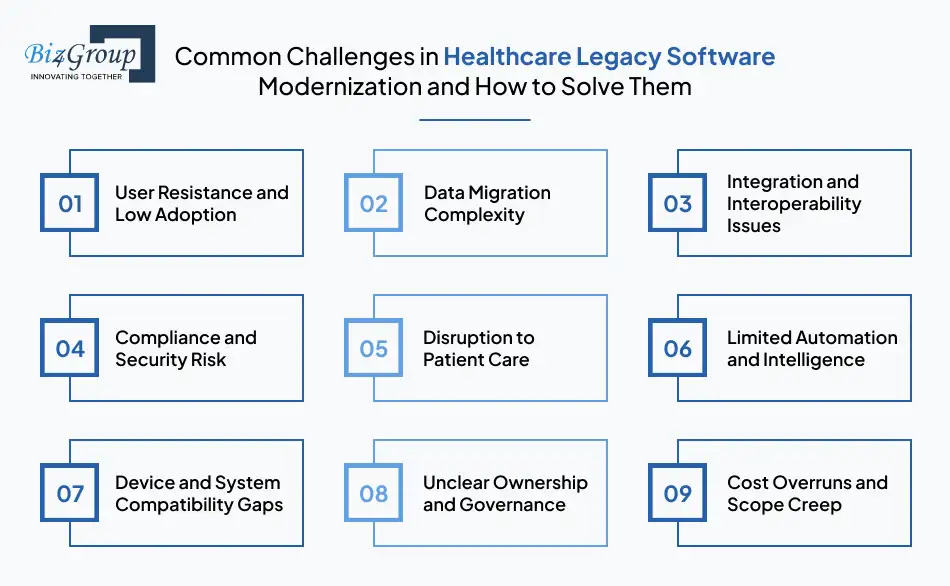
Modernizing legacy systems in healthcare is necessary, but it is rarely simple.
Most challenges do not come from technology alone. They surface at the intersection of compliance, workflows, users, and risk management during healthcare legacy system transformation.
The table below outlines the most common challenges organizations face, why they occur, and practical solutions used in successful healthcare legacy modernization solutions for hospitals and clinics.
|
Challenge Area |
Why This Happens in Legacy Healthcare Systems |
How Healthcare Leaders Solve It |
|---|---|---|
|
User Resistance and Low Adoption |
Legacy systems shaped daily workflows for years. Sudden changes feel disruptive to clinicians and staff, even when systems are outdated. |
Invest early in intuitive UI/UX design, involve users during redesign, and modernize workflows incrementally instead of forcing abrupt change. |
|
Data Migration Complexity |
Legacy systems store data in inconsistent formats with limited documentation. Errors here affect care delivery and billing accuracy. |
Use phased migration with validation checkpoints and clinical review to support safe legacy healthcare application modernization. |
|
Integration and Interoperability Issues |
Older platforms were not built for APIs or real time data exchange, making integration fragile and slow. |
Introduce middleware and standardized APIs as part of healthcare IT modernization solutions to decouple systems and improve reliability. |
|
Compliance and Security Risk |
Legacy architectures lack modern security controls and struggle to adapt to evolving regulations. |
Embed security by design, automate audits, and modernize access controls while modernizing healthcare IT systems. |
|
Disruption to Patient Care |
Big bang upgrades increase downtime risk and clinical uncertainty. |
Use phased rollouts, parallel system operation, and controlled pilots to safely upgrade legacy healthcare software systems. |
|
Limited Automation and Intelligence |
Legacy platforms rely heavily on manual processes, increasing workload and errors. |
Introduce conversational and workflow automation through a specialized AI chatbot development company to reduce administrative burden. |
|
Device and System Compatibility Gaps |
Older systems struggle to integrate with modern medical devices and monitoring tools. |
Extend platforms using compliant AI software for medical devices to support connected and data driven care. |
|
Unclear Ownership and Governance |
Modernization spans IT, clinical teams, compliance, and operations, often without clear accountability. |
Establish cross functional governance early to guide healthcare legacy software modernization strategies. |
|
Cost Overruns and Scope Creep |
Hidden dependencies and unclear requirements surface mid project. |
Use phased execution, fixed scope milestones, and continuous validation to control healthcare legacy modernization cost estimates. |
Every challenge listed above compounds risk if ignored. Addressing them early turns modern solutions for outdated healthcare software into predictable, controlled initiatives rather than reactive fixes.
When challenges are managed with the right structure, tools, and partners, legacy system modernization in healthcare becomes a strategic advantage instead of an operational burden.
Why Healthcare Teams Trust Biz4Group LLC to Modernize What Matters Most?
When you decide to modernize legacy software in healthcare, you are not just choosing a technology partner. You are choosing who you trust with systems that affect patient care, compliance, and daily operations.
That decision deserves more than promises.
... rest of the code remains the same ...Biz4Group is a US based AI software development company that specializes in healthcare legacy software modernization, working closely with founders, CIOs, CTOs, and healthcare IT leaders who need results without disruption. Our role is not to push technology for the sake of it, but to help you apply the right healthcare IT modernization solutions at the right time.
What truly sets us apart is our team. Think of it as a superhuman mix of healthcare domain experts, solution architects, AI engineers, and product designers who work as one unit. We understand how legacy systems behave under pressure, and we know how to modernize them without breaking workflows or trust.
You can see this approach reflected in projects like Quantum Fit, where patient engagement systems were designed for real world adoption, and Truman, where telemedicine was modernized into a reliable, scalable care delivery platform. In both cases, the focus was not just on replacing outdated technology, but on enabling healthcare digital transformation modernization that lasts.
Our credibility is backed by what clients say about working with us. Biz4Group is consistently recognized on Clutch, a leading B2B review platform, with an Overall Review Rating of 4.9. These reviews highlight our ability to handle complex legacy system modernization in healthcare with transparency, accountability, and a strong partnership mindset.
If you are looking for healthcare software modernization services providers who understand both technology and healthcare realities, Biz4Group brings the experience, structure, and people to help you move forward with confidence.
Modernization is not easy. But with the right partner, it becomes manageable, predictable, and aligned with your long-term goals.
Ready to modernize with a team that has done this before?
From patient engagement to telemedicine, Biz4Group helps healthcare leaders modernize without disruption or guesswork.
Start My Modernization JourneyWhat To Take Away!
Legacy systems have carried healthcare organizations a long way. But today, they are often the very thing slowing progress, increasing risk, and limiting innovation. As care delivery becomes more connected, digital, and data driven, the need to modernize legacy software in healthcare is no longer optional.
Throughout this guide, we have seen how outdated systems affect security, compliance, patient engagement, and operational efficiency. We have also seen that healthcare legacy software modernization does not have to mean disruption. With the right strategy, phased execution, and modern technology, organizations can reduce risk while building systems that scale with evolving care models.
This is where experience matters. Biz4Group LLC has spent years helping healthcare organizations navigate legacy system modernization in healthcare with clarity and confidence. From patient engagement platforms like Quantum Fit to telemedicine systems like Truman, our work reflects a deep understanding of healthcare workflows, regulatory realities, and long-term system design.
If your systems are holding you back, the path forward does not need to be overwhelming. With proven healthcare IT modernization solutions and a team that understands what is at stake, modernization becomes a strategic advantage rather than a technical burden.
Still running mission critical systems on yesterday’s technology? Let’s turn them into something your future healthcare model will thank you for.
FAQ
1. What is legacy software modernization in healthcare
Legacy software modernization in healthcare is the process of updating or transforming outdated healthcare systems so they align with modern security, compliance, and performance requirements. It enables healthcare legacy system transformation by replacing rigid architectures with modern healthcare software platforms that support scalability and innovation.
2. Why do hospitals and clinics need healthcare legacy software modernization
Hospitals and clinics need healthcare legacy software modernization to reduce operational risk, improve compliance, and support modern care delivery. Legacy healthcare application modernization helps organizations move away from outdated systems that limit efficiency, integration, and long-term healthcare digital transformation modernization.
3. What are the biggest risks of not modernizing legacy healthcare systems
Not modernizing legacy healthcare systems increases exposure to security breaches, compliance gaps, and system downtime. Over time, delaying legacy system modernization in healthcare leads to higher maintenance costs, reduced agility, and poor patient and clinician experiences.
4. What are the best approaches to modernize legacy software in healthcare
The best approaches to modernize legacy software in healthcare include rehosting, refactoring, replatforming, rebuilding, and hybrid strategies. These healthcare legacy software modernization strategies are chosen based on system complexity, integration needs, and long-term healthcare IT modernization solutions goals.
5. How can healthcare organizations migrate data from legacy systems safely
Healthcare organizations migrate data safely by using phased migration plans, data validation, and parallel system testing. Following best practices for how to migrate data from legacy healthcare systems ensures data accuracy, continuity of care, and compliance during healthcare legacy modernization for hospitals and clinics.
6. What is the healthcare legacy modernization cost estimate
The healthcare legacy modernization cost estimate typically ranges from $35,000 to $300,000+, depending on the number of systems involved, integration complexity, and compliance requirements. Costs vary widely between clinics, hospitals, and large healthcare networks seeking modern solutions for outdated healthcare software.
7. How do I choose the best company for healthcare legacy software modernization
Choosing the best AI company for healthcare legacy software modernization involves evaluating healthcare domain expertise, compliance readiness, integration capabilities, and delivery experience. The right healthcare software modernization services providers focus on scalable solutions that support long term healthcare legacy system transformation.
