 Location :
Orlando, FL, USA
Location :
Orlando, FL, USA +1 (407) 714-1616
 info@biz4group.com

 AI Summary Powered by Biz4AI
- Ohio sports betting rules in 2026 allow online and retail betting at a 20% tax on revenue. College player props are banned, and every wager must come from the regulator’s approved catalog.
- HB 971, the Save Ohio Sports Act, would ban online sports betting, props, parlays and live betting, but it hasn’t reached a House committee yet.
- SB 199 would add a 2% tax on handle (the total amount wagered). At 2025 volumes, that would roughly double what Ohio sportsbooks pay in tax.
- Online sportsbooks earned 98.6% of Ohio’s $1.04 billion in 2025 sports betting revenue, so any online restriction hits the core of the market.
- An Ohio sportsbook platform needs catalog sync, bet-type switches by state, flexible tax logic, account controls that can tighten quickly, and multi-state portability.
- Starting in 2027, operators can deduct 10% of promotional credits wagered, so tax engines need updating before January.
- Biz4Group LLC can help build compliance-first sportsbook platforms that adapt as state rules change, from market kill switches to audit-ready tax reporting.
Regulatory note. This article is for business and technology planning. It is not legal advice. Confirm licensing, tax and wager-type requirements with the Ohio Casino Control Commission and qualified Ohio gaming counsel. Information last verified October 13, 2026.
What would your sportsbook do if Ohio pulled your best-selling bet type by Friday?
That’s not a hypothetical question. Ohio sports betting rules let the regulator restrict a wager type on an emergency basis. And in July 2026, lawmakers filed House Bill 971, a proposed Ohio online sports betting ban.
The stakes are high. Ohio sportsbooks took about $10.3 billion in wagers in 2025 and earned $1.04 billion in revenue, according to the Ohio Casino Control Commission (OCCC). Through August 2026, revenue reached $629.5 million, up about 6% on the same period last year.
So, will Ohio ban online sports betting? Maybe not. But the bigger question is how to build a sportsbook that keeps complying as state rules change, whatever lawmakers decide.
Below, we sort Ohio’s rules into three groups: what’s live, what’s proposed, and what your platform should do about each. At Biz4Group, every sportsbook build starts with a rules map, so that’s the approach we take here.
What Are Ohio’s Sports Betting Rules in 2026?
Ohio sports betting rules let licensed sportsbooks take online and retail bets on approved events, with a 20% tax on revenue. College player props are banned. Every event and wager type must appear in the regulator’s approved catalog. Bigger changes have been proposed, but none of them are law yet.
Here’s where things stand as of October 2026.
Allowed today
- Online betting through licensed Type A proprietors, plus retail betting at Type B sportsbooks
- Player props on professional sports
- Parlays and live betting on approved events
Restricted today
- Player props on college athletes, banned since February 2024
- Any event or wager type missing from the OCCC’s approved catalog
- Pitch-level MLB bets, capped at $200 and kept out of parlays under a league agreement with sportsbooks
- Promotional credits, which can’t be deducted from taxable revenue until 2027
Proposed, not law
- HB 971’s online ban and product limits
- SB 199’s 2% handle tax
Ohio sits among the strictest US markets on product rules. Our overview of sports betting regulations across US states shows how much state rules differ.
Who Can Offer Sports Betting in Ohio?
Ohio splits sports betting into distinct licensed roles. Knowing which role you play tells you which rules apply to you.
|
Role |
What It Does |
Key Limit |
|---|---|---|
|
Type A proprietor |
Offers online sports betting |
Initially capped at 25 licenses |
|
Type B proprietor |
Runs retail sportsbooks |
One facility per license |
|
Type C proprietor |
Offers lottery sports betting through kiosks at bars and restaurants |
Operated through the Ohio Lottery |
|
Mobile management services provider |
Runs the online sportsbook for a Type A proprietor |
Needs its own OCCC license |
|
Sports gaming supplier |
Provides equipment, technology or services |
$10,000 application fee and $15,000 license fee, renewed every three years |
In practice, most big brands operate as an Ohio management services provider for a Type A host. The OCCC reports list pairings like Hollywood Toledo with DraftKings and the Cleveland Guardians with bet365.
Will Ohio Ban Online Sports Betting?
Not right now. HB 971, the Save Ohio Sports Act, would ban online sports betting in Ohio. As of mid-October 2026, though, the official bill tracker shows it as introduced, with no House committee step completed. It would still need to pass both chambers and get the governor’s signature.
Here are the questions operators ask most about the Ohio online sports betting ban.
What would HB 971 change?It would end online and mobile betting and keep only in-person wagering. The bill would also ban props, parlays, live betting and all college sports betting. Bets would be capped at $100, with a limit of eight wagers per bettor every 24 hours.
Who introduced it?Representatives Johnathan Newman and Beth Lear introduced the bill on July 1, 2026.
How much of the market is at stake?Almost all of it. Online sportsbooks earned $1.025 billion of Ohio’s $1.04 billion in 2025 sports betting revenue. That’s 98.6%.
Should operators panic?No, but they should plan. Bills like this can stall, change or come back in later sessions. Planning for that uncertainty belongs in your product roadmap.
The smart move is to make the platform able to absorb a ban of any size, from one bet type to the whole online channel.
How Could Ohio’s Handle Tax and Prop Bet Rules Change Your Sportsbook?
Two forces matter most. SB 199 would add a 2% tax on handle on top of the 20% revenue tax. And Ohio law lets the OCCC restrict any wager type, including on a temporary emergency basis. Your platform has to handle either change without a rebuild.
Here’s how Ohio’s rules have moved so far, and where they could go next.
February 2024. The OCCC removed college player props from the approved catalog after the NCAA requested it.
2025. SB 199 was introduced, proposing a 2% handle tax. If passed, Ohio would become the first state to tax both handle and revenue.
November 2025. MLB and sportsbooks representing more than 98% of the US market capped pitch-level bets at $200 and removed them from parlays. Ohio’s regulator had been drafting its own micro-bet rule and set that work aside.
July 2026. HB 971 was introduced, proposing a full online ban.
January 2027. Ohio sportsbooks can begin deducting 10% of promotional credits wagered. That share rises to 20% in 2032.
Behind all of this sits Ohio Revised Code 3775.02, which lets the OCCC prohibit or restrict a wager type by rule or by emergency process.
The rules in Ohio have changed often and with little warning, so the platform is where you prepare for the next change.
Ohio Can Change a Rule Quickly. Can Your Platform Keep Up?
Prop bans, handle taxes and bet caps all need configuration changes, not emergency code.
Talk to a Sportsbook ArchitectHow Do You Build an Ohio Sportsbook Platform That Adapts to Rule Changes?
Build the platform so every likely Ohio rule change becomes a settings update instead of a platform release. That means catalog sync, bet-type switches, configurable tax formulas, adjustable account limits and multi-state portability. Every Biz4Group sportsbook build includes a rules layer that your operations team can update without waiting on developers.
The clearest way to plan is to walk through each scenario Ohio could realistically face.
If the OCCC Pulls a Bet Type or Event
The regulator can remove a market from its approved catalog, sometimes on short notice. Your platform needs to respond within hours.
What changesA wager type or event drops off the approved list.
What your platform doesIt syncs the catalog, blocks the affected markets for Ohio users, settles or voids open bets under the house rules, and logs who made the change and why.
Our guide to real-time odds engine architecture shows where these controls sit in the stack. When the rule changes, the kill switch should do the work, not your developers.
If a Ban Covers Only Some Bet Types
Ohio already separates college props from pro props. The next restriction could target live betting, parlays or a single league.
What changesOne product category goes dark while the rest stay open.
What your platform doesIt applies rules by state, league, sport and bet type, with effective dates for every rule version.
Parlays are the hardest case, because one restricted leg can invalidate a whole ticket. Our guide to AI parlay betting platform development covers the validation logic. Get this layer right, and a partial ban costs you an afternoon instead of a sprint.
If SB 199 Passes
A handle tax changes what your finance team has to calculate every month. It also stacks on top of the 2027 promotional deduction.
What changesTax is owed on total wagers as well as revenue, and part of your promotional credits becomes deductible.
What your platform doesIt runs configurable tax formulas, tracks promotional credits wagered, and produces monthly reports that reconcile with OCCC filings.
Your tax logic should keep pace with the legislature, not trail it by a quarter.
If Lawmakers Cap Bets and Daily Wagers
HB 971 shows the direction Ohio lawmakers are thinking. They want bet caps, daily wager limits and stricter account rules.
What changesNew limits on how much and how often each bettor can wager.
What your platform doesIt enforces wager caps and daily bet counts by state, requires multi-factor authentication for deposit-enabled accounts, and checks location before every bet.
Location is where most compliance failures start. Our guide to geofencing in sports betting apps explains why accuracy at the state line matters.
If Ohio Ends Online Betting
This is the worst case. It’s also the one where good architecture protects the most value.
What changesYour Ohio online channel closes, and only retail remains.
What your platform doesIt shuts the Ohio channel cleanly, keeps player records intact, and keeps your other states running.
Licensing relationships in Ohio already change. OCCC reports show FanDuel’s online revenue moving from Belterra Park to Hollywood Mahoning Valley in February 2026, and Betr’s Ohio sportsbook reporting in 2025 but missing from the 2026 reports.
A multi-tenant AI sports betting platform keeps each state’s rules separate while sharing one core. If Ohio closes, the rest of your business keeps running.
PredictEX. Live Markets Built on Official Data
PredictEX is a real-time sports betting platform Biz4Group built for MLB, college football and NFL markets. It pulls official Sportradar data through live socket connections, and our team worked directly with Sportradar’s engineers on the integration.
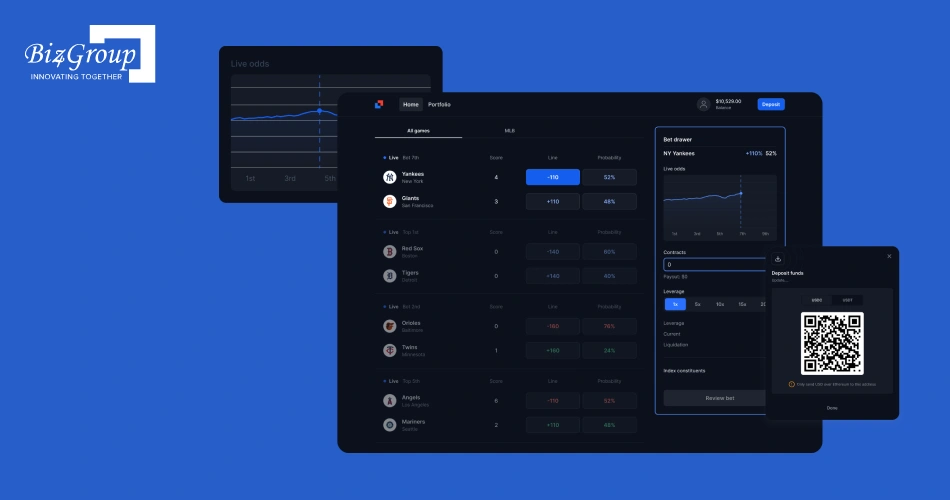
The platform uses a microservices architecture across C#, Go, Python and Node.js, with load balancing, caching and data sharding for game-day traffic. It reported a 78% reduction in live data latency and a 35% increase in live bet participation. That reliability depends on the data source, which is why enterprise sports data APIs like Sportradar matter more than features.
For an Ohio build, that microservices foundation is where state-level rules would live, so live markets could pause in one state without affecting the others. Our comparison of live betting vs. pre-match sportsbook development explains why live markets need their own controls.
PredictEX is a technology reference. It is not an Ohio-licensed product.
Run a Rule-Change Fire Drill on Your Sportsbook
We’ll test how your platform handles a prop ban, a handle tax and a bet cap, before Ohio tests it for you.
Book the DrillWhat Can an Ohio Sportsbook Offer If Props or Live Betting Are Banned?
Pre-match spreads, totals and moneylines carry the lowest regulatory risk in Ohio. Pro props, parlays and live betting carry the highest risk under current proposals. If the Ohio prop bet ban expands, a balanced product mix keeps revenue coming in.
|
Product |
Ohio Status Today |
Risk Under Current Proposals |
|---|---|---|
|
Pre-match spreads, totals, moneylines |
Allowed |
Lowest |
|
Pro player props |
Allowed |
High (HB 971 would ban them) |
|
College player props |
Banned since 2024 |
Already gone |
|
Parlays |
Allowed |
High (HB 971 would ban them) |
|
Live betting |
Allowed |
High (HB 971 would ban it) |
|
Pitch-level MLB markets |
Capped at $200, no parlays |
Medium |
|
Fantasy contests |
Regulated separately by the OCCC |
Separate license path |
Planning in-play products anyway? Our guide to building a micro-betting AI app covers the architecture. In Ohio, pair it with switches that can turn those markets off fast.
The aim is a product mix that still earns if Ohio narrows what you can offer.
All Chalk. Engagement Built on Spreads and Totals
All Chalk is a multi-sport pick’em app Biz4Group built for NFL, NBA, college football and MLB. Users make weekly picks on spreads and totals and follow real-time leaderboards ranked by wins, losses and net points.
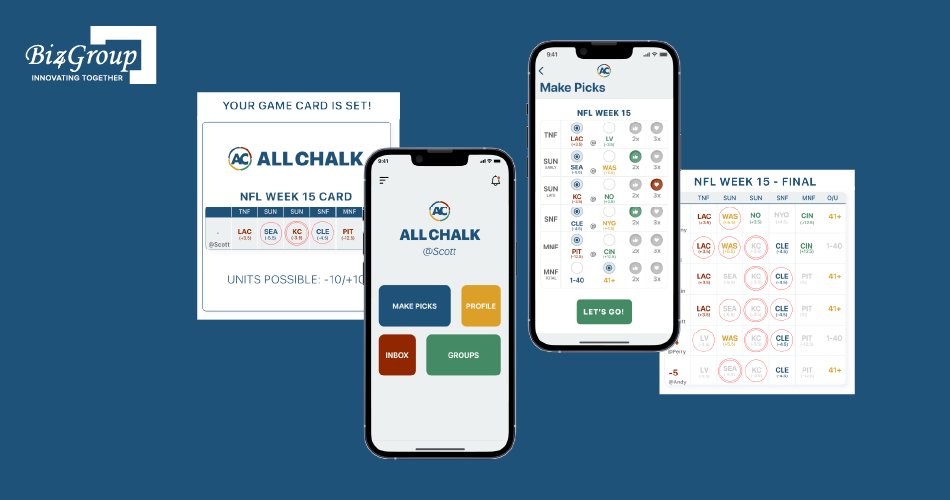
The app includes game schedules, custom reminders and real-time data sync. It runs on Ionic, React.js, Express.js, PostgreSQL and AWS across iOS and Android.
The product keeps users engaged without player props, the type of market Ohio has restricted most. Pick’em contests need their own legal review in Ohio. Brands looking for another lower-risk format can explore AI fantasy sports app development.
How Much Would Ohio’s Sports Betting Tax Changes Cost Your Sportsbook?
Under today’s Ohio sports betting tax, sportsbooks pay 20% of revenue. Adding SB 199’s 2% handle tax would roughly double that bill at 2025 volumes. The 2027 promotional deduction gives a small amount back.
Start with the statewide picture. Taxable revenue in 2025 was about $1.045 billion, so the 20% tax came to roughly $209 million. A 2% tax on about $10.3 billion in handle would add roughly $206 million more.
Now take a single sportsbook. Say your Ohio book takes $50 million in handle at a 10% hold, which gives you $5 million in revenue. Today you’d pay $1 million in tax. Under SB 199, you’d owe another $1 million on handle, so your total tax would reach $2 million, or 40% of revenue.
The 2027 deduction helps a little. Ohio sportsbooks wagered about $330 million in promotional credits in 2025. Ten percent of that is roughly $33 million in deductions, worth about $6.6 million in tax across the whole state.
All three examples are Biz4Group calculations based on OCCC data.
Ohio wouldn’t be the first state to tax betting volume. Illinois already charges a per-wager tax on top of its revenue tax, and our guide to the Illinois sports betting license shows how that has squeezed operator margins.
Then there’s the platform itself. In our planning, a rules engine flexible enough for Ohio usually puts a build in the growth tier ($50K to $120K+) or above. Our sports betting app development cost guide shows what each tier includes.
Model Your Ohio Margins Under Both Tax Scenarios
See what a 2% handle tax would do to your numbers before lawmakers decide for you.
Get a Scoped EstimateHow Do You Choose an Ohio Sportsbook Development Partner?
Choose an Ohio sportsbook development partner that can demonstrate working rule controls in a live demo, not describe them in a sales deck. The table below shows what to ask and how to read the answers.
|
Question to Ask |
Green Flag |
Red Flag |
|---|---|---|
|
Can you switch off a bet type in one state? |
Done in an admin console and logged |
Needs a code release |
|
How does your tax engine handle a new formula? |
Configurable, with a live demo |
“We’ll customize it later” |
|
Who owns player data if we change partners? |
You do, by contract |
The vendor keeps it |
|
Where is your audit trail? |
Every rule change logged with date, reason and user |
Changes tracked in email threads |
Here’s what that looks like on a Biz4Group LLC build. Say the OCCC removes a market on a Thursday afternoon. Your compliance lead updates the rule in an admin console, the change is logged automatically, and the market disappears for Ohio bettors while staying live everywhere else. There’s no hotfix and no app store update. That’s how we design every Ohio build.
Still comparing vendors? Our guide on how to choose the right AI sports betting app development company gives you a fuller checklist.
What Should Operators Do About Ohio Sports Betting Rules Right Now?
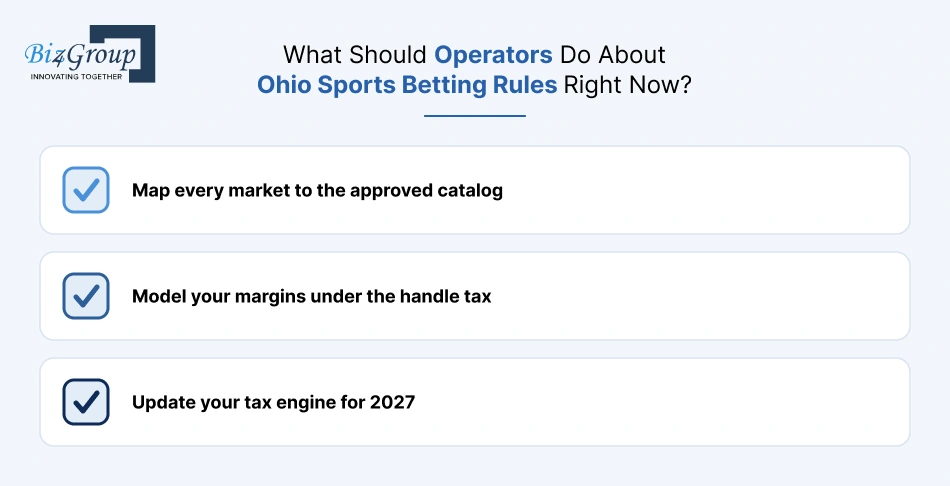
Treat Ohio sports betting rules as a moving target and prepare your platform now. HB 971 may stall, SB 199 may come back, and the OCCC can restrict a bet type whenever integrity concerns call for it. Operators that prepare now will spend far less when the rules change.
Start with three moves this quarter.
- Map every market to the approved catalogYou can’t switch off what you haven’t tagged.
- Model your margins under the handle taxKnow your numbers before Columbus decides them for you.
- Update your tax engine for 2027The promotional deduction starts January 1.
Bring us your Ohio roadmap, and our sports betting app development company team will show you where a rule change would hurt it most and how to fix that before it happens.
FAQs
1. Can you bet on sports in Ohio if you live in another state?
Yes, as long as you’re physically inside Ohio when you place the bet. Ohio law ties online sports betting to physical presence, not residency. A visitor from Michigan can bet from a hotel in Columbus, while an Ohio resident on vacation in Florida can’t bet with an Ohio sportsbook.
2. What is the minimum age to bet on sports in Ohio?
You must be 21 or older to place a sports bet in Ohio, whether online or at a retail sportsbook. Licensed operators must verify each bettor’s age and identity before accepting any wager.
3. Is online casino gambling legal in Ohio?
No. Ohio allows online sports betting, but it doesn’t allow online casino games like slots, blackjack or roulette. Casino games are available only at Ohio’s licensed casinos and racinos. Lawmakers have discussed online casino bills, but none has passed.
4. When did sports betting become legal in Ohio?
Ohio legalized sports betting in December 2021, and wagering went live on January 1, 2023. Online, retail and kiosk betting all launched on the same day, making Ohio one of the largest same-day launches in the US.
5. Where can you find Ohio sportsbook revenue data?
The Ohio Casino Control Commission publishes monthly sports gaming revenue reports on its website. Each report shows gross receipts, winnings paid, promotional credits and taxable revenue for every licensed sportsbook pairing, which makes Ohio one of the more transparent US markets.
6. Can you move an Ohio sportsbook to a new platform without losing players?
Yes, with planning. Successful moves keep player accounts, balances and history portable, run the old and new platforms in parallel, and coordinate approvals with the OCCC. Our guide on migrating from white label to custom sportsbook walks through the process.
Sources
- OCCC, 2025 Ohio Sports Gaming Revenue Report
- OCCC, 2026 Ohio Sports Gaming Revenue Report, through August
- OCCC, Revenue Reports
- Ohio House, House Bill 971, 136th General Assembly
- Ohio Legislature, Senate Bill 199, 136th General Assembly
- Ohio Revised Code Section 3775.02
- OCCC, Response to the NCAA regarding proposition wagers on student-athletes (February 2024)
- MLB, New limits on pitch-level markets (November 10, 2025)
- Ohio Legislative Service Commission, 2021 enactments digest and 2024 state agency fees
Cost ranges, tax scenarios and market-share percentages are Biz4Group planning estimates or calculations based on OCCC data, not official figures.
