Location :
Orlando, FL, USA
 +1 (407) 714-1616
 info@biz4group.com


 AI Summary Powered by Biz4AI
- What are prop bets? They are wagers on a player stat, team result, or game event instead of the final score, and they now anchor every serious sportsbook menu.
- Player, team, game, and novelty props each need different data, limits, and settlement rules.
- Kambi’s 2026 World Cup data shows 65% of bet builder wagers included at least one player prop.
- Settlement is the tricky part. Sportsbooks differ on what counts as “played,” so your house rules must be exact and automated.
- The NBA removed several prop types and parlays for 2026-27, and the NCAA is urging states to ban college props.
- Adding props to an existing sportsbook often costs 10% to 30% of the original build, plus data and compliance fees.
- Biz4Group LLC is a US-based sports betting app development company. Our team has guided 50+ sports betting solutions and can add prop markets to your platform.
This guide is for business planning and education. It is not betting advice, legal advice, or a tip service. We do not offer picks. Rules change often, so confirm requirements with your state regulator and a gaming attorney. Cost figures are planning ranges, not quotes. You must be 21 or older to bet in most states. If you or someone you know needs help, call 1-800-GAMBLER or 1-800-MY-RESET. Last verified October 27, 2026.
If 65% of bet builder wagers now include a player prop, what happens when a league pulls some of those props off the menu?
What are prop bets, and why do sportsbooks build whole product lines around them? A prop bet is a wager on a specific player stat, team result, or game event. This guide explains the types, the pricing and settlement rules, the 2026 league restrictions, and what a platform needs to offer them.
The numbers explain the fuss. Kambi’s 2026 World Cup report found that bet builders made up 35% of wagers on its network, and 65% of those wagers included a player prop, up from 25% in 2022. You can read the details in Gambling.com’s coverage of the Kambi report. A Citizens analyst says player props can exceed 50% of handle in certain sports. That figure comes from InGame’s April 2026 analysis. Then the NBA told its sportsbook partners on October 16 to drop first-basket markets, certain unders, and parlays that stack unders on one player. Sportsbook Review has the list.
So why are prop bets important for sportsbook operators? Player prop betting markets widen your menu, keep users engaged, and feed same game parlays. They also bring integrity, liability, and compliance risks that a basic sportsbook was not built to handle.
You will also see how to add player props to an existing sports betting app, and what it costs. Let’s start with the definition.
What Are Prop Bets in Sports Betting and How Do They Work?
A prop bet is a wager on a specific outcome inside a game that is not tied to the final score. It can be a player’s stat, a team milestone, or an in-game event. Prop is short for proposition, so you will also see them called proposition bets. The name fits, because every prop is a proposed event that may or may not happen.
A few prop bet examples include... A quarterback’s passing yards, an NBA player’s three-pointers made, and whether an MLB player hits a home run are all prop bets.
How do prop bets work? The sportsbook posts a market, a line, and a price. The bettor picks a side. The bet wins if the stat lands on that side. On a 7.5 rebound line at -110 for the over, a $100 wager profits $90.91 if the player grabs at least eight.
Every prop market has seven parts. Each one is something your platform must store and control.
|
Part of the Market |
What It Means |
Example |
|---|---|---|
|
Market |
The stat or event |
Passing yards |
|
Player or team |
Who it applies to |
A named quarterback |
|
Line |
The number to beat |
275.5 |
|
Selection |
The side a bettor takes |
Over or under |
|
Price |
The odds on that side |
-110 |
|
Stat source |
Where the result comes from |
An official data feed |
|
Settlement trigger |
What counts as “played” |
One snap |
How Do Prop Bets Differ from Traditional Sports Bets?
Traditional bets depend on the final score. Prop bets depend on a stat or event inside the game.
|
Bet Type |
What It Depends On |
Example |
|---|---|---|
|
Moneyline |
Who wins |
Team A to win |
|
Point spread |
Winning margin |
Team A at -3.5 |
|
Total |
Combined score |
Over 47.5 points |
|
Prop bet |
A stat or event within the game |
Quarterback over 2.5 touchdown passes |
For a platform, that difference matters. A moneyline needs a score. A prop needs a name, a stat feed, and a rule for what happens if that player never plays.
What Are the Main Types of Prop Bets?
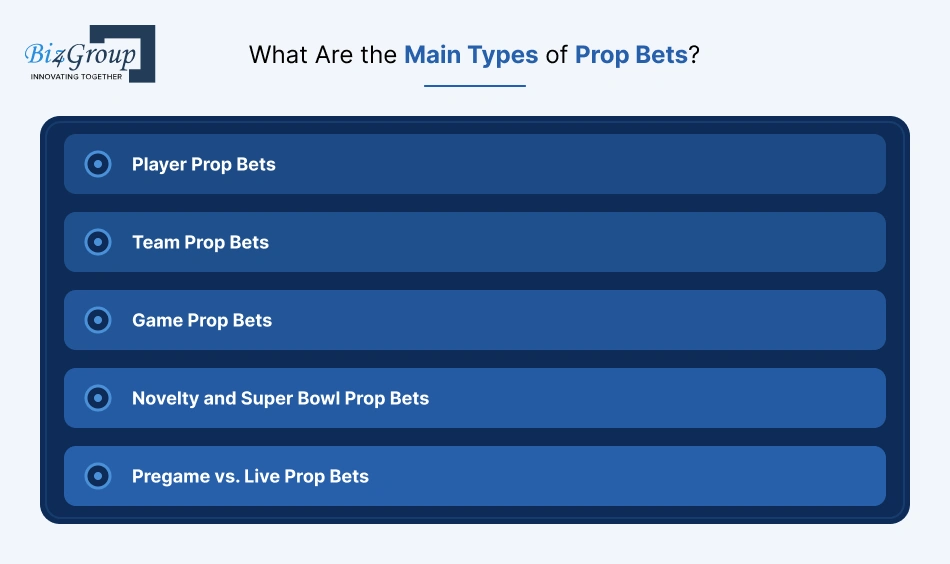
Prop bets fall into four groups. They are player props, team props, game props, and novelty props. Each group can be offered before a game or live. Player props track one athlete. Game props track events that involve both sides.
Player Prop Bets
Player prop bets are wagers on one athlete’s stat. Examples include a quarterback’s passing yards, a basketball player’s points, and a pitcher’s strikeouts.
Platform needs: A single player ID across every data feed, a trusted stat source, and clear participation rules.
Team Prop Bets
Team prop bets are wagers on team outcomes. Think of which team scores first, team rushing yards, or the number of three-pointers a team makes.
Platform needs: Team-level stats and fewer void cases, since a team always plays.
Game Prop Bets
Game prop bets cover events that involve both sides. Whether a game goes to overtime is a classic one.
Platform needs: Event-status rules that handle delays, overtime, and abandoned games.
Novelty and Super Bowl Prop Bets
Novelty props go beyond standard stats. Popular Super Bowl prop bets include the color of the Gatorade shower and whether the coin toss winner wins the game.
Platform needs: Manual market creation, an official source for each result, and tight limits, because no stat feed backs them.
Pregame vs. Live Prop Bets
Pregame prop bets are priced before kickoff. Live prop betting updates odds in real time as the action unfolds.
Platform needs: Faster data, stricter suspension rules, and a view of how live markets differ, which our live betting vs. pre-match guide explains.
Ready to Launch Props Before Kickoff?
Book a free call and leave with a clear rollout plan for your sportsbook.
Plan My RolloutWhich Prop Bets Are Popular in NFL, NBA, MLB, and NHL Betting?
Common props include passing yards and touchdown scorers in the NFL, points and three-pointers in the NBA, strikeouts and home runs in MLB, and goal scorers and goalie saves in the NHL. The table shows what a platform must model for each league. It contains no picks or predictions.
|
League |
Typical Props |
Data a Platform Needs |
Watch-Out |
|---|---|---|---|
|
NFL prop bets |
Passing yards, first touchdown scorer, anytime touchdown scorer |
Play-by-play stats and active and inactive lists |
Late scratches and inactive-list timing |
|
NBA prop bets |
Points, three-pointers made, first basket |
Minutes, box score, and lineup feeds |
The league’s 2026-27 limits on first-basket markets and certain unders |
|
MLB prop bets |
Pitcher strikeouts, home run to hit, innings pitched |
Lineups, starting pitchers, plate appearances |
Pitch-level markets face league limits |
|
NHL prop bets |
Anytime goal scorer, goalie saves |
Shots, goals, saves, and ice-time data |
Rules for overtime and shootout stats vary by operator |
For NBA builds, see our guide on basketball betting platform features.
Can You Parlay Prop Bets?
Yes, at most sportsbooks. Bettors can combine props from different games, or build same game parlay props from one game. Operators decide which props can be combined.
Can you combine props from different games? Yes. A traditional parlay spans several games, and books can multiply the odds because each game is independent.
Can you combine props from one game? Yes, in a same game parlay. Legs from one game can be correlated, so sportsbooks price them with their own models instead of multiplying odds. Some props may be barred from same game parlays when a model cannot price the correlation.
Why do operators care? The Citizens analyst puts parlay hold near 20% and one-sided player prop markets near 10%. That gap explains why apps push parlays. Props supply the legs.
Where can you learn the engine side? Our AI parlay betting guide covers correlation pricing in depth.
Why Are Prop Bets Important for Sportsbook Operators?
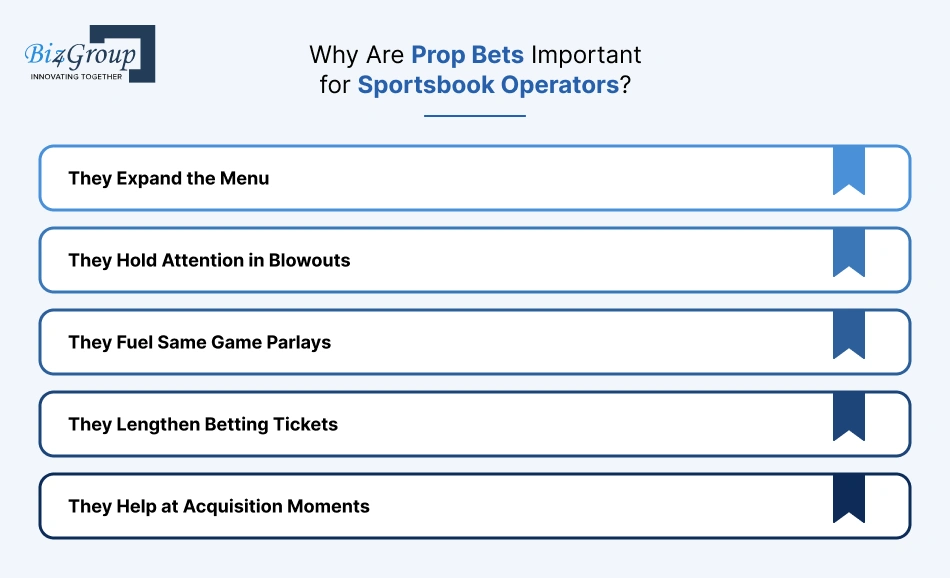
The importance of prop bets in sports betting is simple. Prop bets widen your menu, keep users engaged when a game turns lopsided, and supply the legs for the parlays operators push hardest. They also add integrity and liability risk. Here are five benefits of prop betting markets for sportsbooks.
- They Expand the Menu Props let sportsbooks massively expand their wagering menus. More sportsbook betting markets per game means more market variety and more reasons to open the app.
- They Hold Attention in Blowouts Props keep bettors engaged with game action even when the score is lopsided.
- They Fuel Same Game Parlays InGame calls the single game parlay arguably the most important product in American sports betting, and its legs frequently consist of player props.
- They Lengthen Betting Tickets Kambi found that 48% of World Cup bet builder wagers had at least four selections, up from 30% at the last World Cup.
- They Help at Acquisition Moments Nearly one in four bettors on Kambi’s network placed a first-ever wager during the 2026 World Cup, and props drove much of the growth in bet builders.
Now the catch. Props that depend entirely on one person are ripe for exploitation. One athlete can change the outcome. That is why risk and integrity controls belong in the design from day one. For the revenue side, see how apps like FanDuel make money.
How Are Prop Betting Markets Priced and Risk Managed?
Operators price props from player and team data, then adjust lines for injuries, matchups, and betting action. Sportsbook risk management for props caps exposure per player and per market, and suspends lines when news breaks.
Prop bet odds management starts with inputs. Think of minutes, usage, matchup, recent form, and expected game flow. Our DFS projection guide shows how historical game logs and live feeds shape player estimates. The line then adds the operator’s margin.
Live props need dynamic odds updates. Lines must refresh as data arrives. Stale lines must close, then reopen once data is verified. This odds engine guide covers suspension logic and freshness checks.
Props need controls that game lines do not. These are the ones that matter most.
- Per-player limits One named athlete should never carry unlimited exposure.
- Per-market limits Thin markets need lower caps than deep ones.
- Correlation limits Same game parlay legs must not stack hidden risk.
- News-based suspension Lineup and injury news should pause affected props at once.
- Trader review Stars and high-volume players deserve a human eye.
- Integrity alerts Flag unusual patterns on one player and be ready to share data with leagues. The NBA built an AI-based monitoring platform that studies betting patterns, injury reports, and social media.
Can Your Risk Tools Handle Props?
Our sportsbook team will review your limits, data feeds, and settlement rules with you.
Review My SetupHow Are Prop Bets Settled When a Player Does Not Play?
Most sportsbooks void a prop if the player is inactive or never takes part. Many require a minimum appearance, such as one snap or one plate appearance. Prop bet settlement rules differ by book, so your house rules must be exact. US sportsbooks must post house rules, though many do not spell out every scenario.
No snap, no bet. Here is how the minimum appearance varies.
|
Sport |
What It Takes for a Prop to Stand |
Operator Differences |
|---|---|---|
|
NFL |
One snap at most books |
BetMGM requires quarterbacks to start |
|
MLB |
One plate appearance at DraftKings and FanDuel |
BetMGM requires the player to start |
|
NBA |
The player must play |
Caesars lists basketball as “must play” |
|
NHL |
The player must play |
Caesars lists hockey as “must play” |
|
Soccer |
The player must start |
Extra time and shootout stats are excluded at Caesars |
Source: Action Network’s May 2026 update of operator house rules. Confirm current rules with each operator.
A few scenarios repeat across the industry.
- Inactive before the game Every sportsbook cancels the bet, whether it was an over or an under.
- Hurt during the game The bet stands once the player met the minimum.
- Hurt before play, never appears The bet is voided.
- Plays but records no stats College props usually grade as a loss for overs and a win for unders.
Settlement is also a product choice. Fanatics Sportsbook said its FAIR PLAY injury protection now covers all four quarters of NFL and NBA games this season, with refunds paid in FanCash. You can read the details in Gambling.com’s report.
Your platform should store four things for every prop. They are the participation event and time, the stat source and version, a void reason code, and the rule version in force when the bet was placed.
What Features Does a Sportsbook Need to Support Player Prop Bets?
Player prop betting functionality needs a market catalog, player and stat mapping, line and limit controls, parlay eligibility rules, a settlement engine, and league restriction switches. These are the sportsbook platform features that matter most.
- Market Catalog Templates for each prop type and sport, with names, lines, and eligibility flags.
- Player and Stat Mapping One internal ID for every player, across every real-time sports data feed. Our sports betting API integration services connect those feeds. Many top apps also rely on more than one data provider for coverage and backup.
- Line and Limit Controls Per-player and per-market caps that traders can change fast.
- Bet Acceptance and Validation Check market status, line, and eligibility before accepting any wager.
- Parlay Eligibility Flags Mark which props can be combined and which cannot.
- Settlement and Void Engine Rules by sport and operator, with versions and effective dates.
- League and Regulator Switches Turn markets off by state, league, or player class without a code release.
- Integrity Alerts and Responsible Gaming Prompts Spot odd patterns on one player. Give users limits and reminders.
- Back Office Trading views, settlement logs, and reports for audits.
Quick Start Bets, an NHL Platform with Player-Based and Team-Based Bets
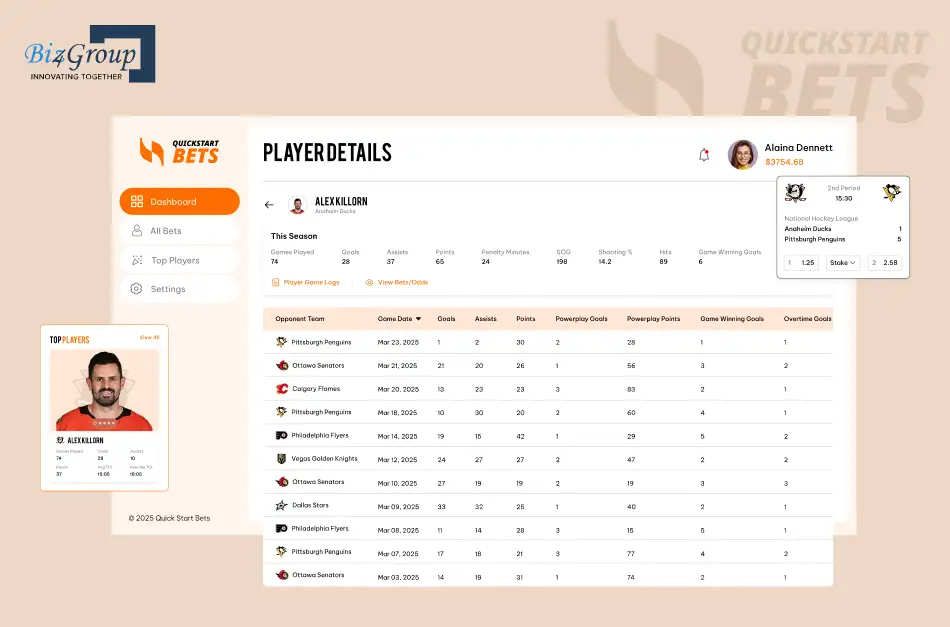
Quick Start Bets gives NHL fans real-time odds, team-based and player-based bet options, detailed player and team stats, game logs, and a dashboard that tracks bets. We used WebSockets to keep odds current. Data from different providers arrived in different formats, so we built a normalization layer to line it all up. That is the same plumbing a prop market needs. The stack runs on Next.js, Node.js, and MySQL.
How Are Leagues and Regulators Changing Prop Betting Markets in 2026?
Leagues and regulators are narrowing prop menus, not removing them. The pressure targets markets that one person can influence, and college props draw the most scrutiny. Here is the timeline.
- November 2025: MLB and its sportsbook partners capped pitch-level bets at $200 and kept them out of parlays after two Cleveland pitchers were indicted. AP’s explainer covers the case. Our micro-betting guide covers next-event markets.
- January 15, 2026: The NCAA asked state gambling commissions to eliminate individual prop bets and first-half unders. It said more than half of the 39 legal states allow some college props, and four commissions (Louisiana, Maryland, Ohio, and Vermont) have banned them since 2024. The NCAA also reported that 36% of Division I men’s basketball players had received harassment from someone with a betting interest. Read the NCAA’s letter.
- April 2026: Lawmakers in New York, Louisiana, Colorado, and Massachusetts were weighing bills to ban or limit player props. Kentucky’s HB 904 bars certain under props on Kentucky college athletes. See Gambling.com’s state tracker.
- October 16, 2026: The NBA told partners to drop first-basket markets, unders for players expected to play fewer than 12 minutes, parlays stacking unders on one player, and certain alternate unders. The WNBA follows in 2027. The changes are not a blanket ban on props.
What should you build? Switches by league, state, player class, and bet type. Log every rule change with a date and a reason. Our Ohio sports betting rules guide shows how one state adapts. Pair that with player-protection tools from our responsible gambling monitoring guide.
For the wider map, use our state-by-state betting laws guide.
Will the Next League Rule Surprise You?
Build market switches by league, state, and player class before the rules change.
Prep My SwitchesHow Can You Add Player Props to an Existing Sports Betting App?
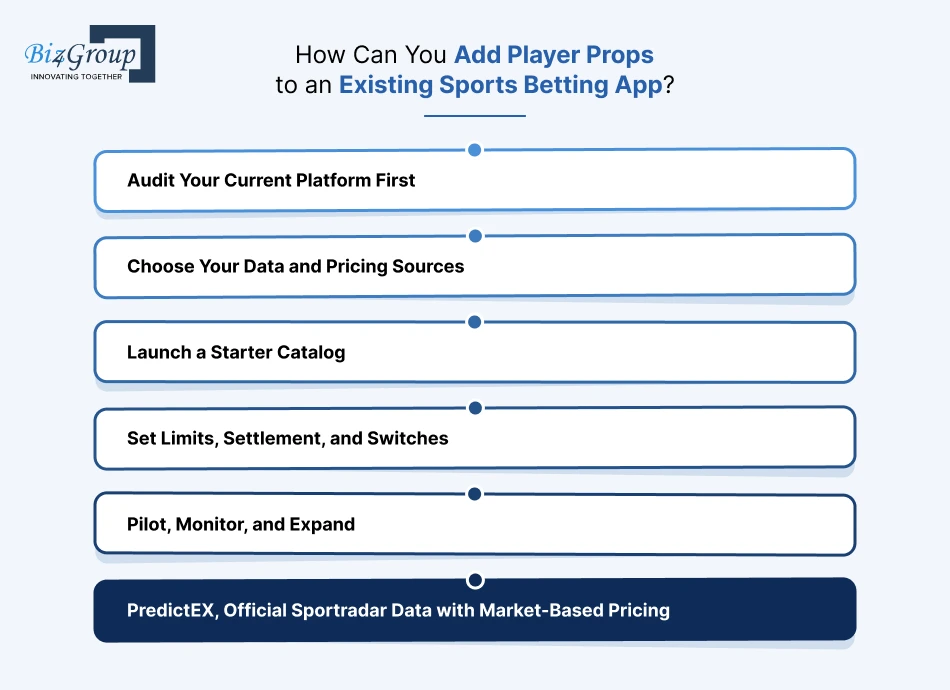
Start with an audit of your data, risk, and settlement layers. Then launch a small catalog in one sport, run it with tight limits, and expand as results come in. That is how operators expand their betting markets without rebuilding their platform.
Here are the five stages.
Audit Your Current Platform First
Check whether your feeds carry stable player IDs. Check whether limits work per player. Check whether void rules are configurable. Gaps here become delays later.
Choose Your Data and Pricing Sources
Decide whether lines come from a provider or from your own traders. Confirm data rights, update speed, and coverage for the sports you plan to launch.
Launch a Starter Catalog
Pick one sport and a small set of high-liquidity props. Our sports betting app MVP guide shows how to scope a first release. A small launch also protects performance, because traffic grows in steps.
Set Limits, Settlement, and Switches
Configure per-player caps, void rules, and league restriction flags before the first bet. Test each one with real scenarios. For live props, also test data delay and suspension rules before launch.
Pilot, Monitor, and Expand
Watch exposure per player, void rates, and data delay. Add sports and markets only when the numbers hold.
PredictEX, Official Sportradar Data with Market-Based Pricing
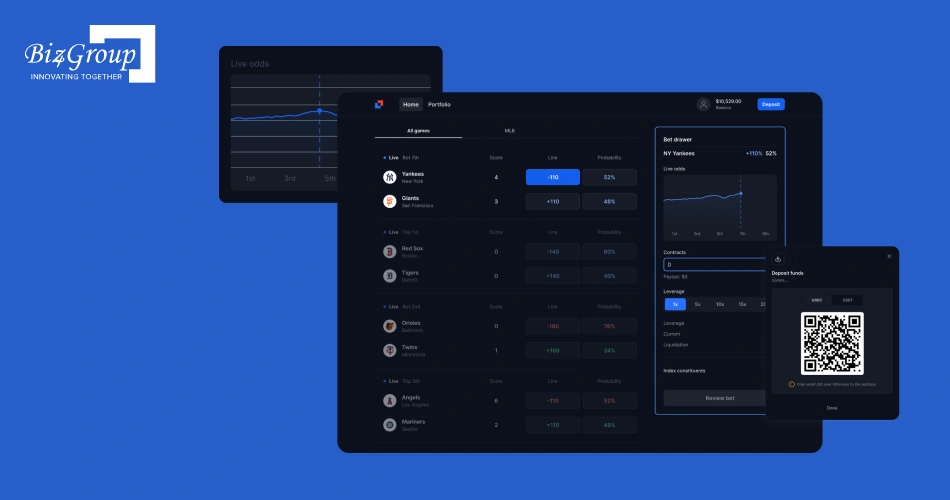
PredictEX delivers real-time betting on MLB, college football, and NFL games, using official Sportradar data through live sockets. Our team worked with Sportradar’s engineers on the integration. Market-based pricing adjusts prices as conditions change. An eight-layer architecture, load balancing, caching, and data partitioning keep updates fast at peak. The project page reports 78% lower live data latency and 35% more live bet participation.
How Much Does It Cost to Add Prop Betting Features to a Sportsbook?
A major feature expansion often costs 10% to 30% of the original build, based on our live vs pre-match guide. The real number depends on what your platform already has. Use the tables below to budget. Our sports betting app development cost guide shows the full ranges.
What Drives Prop Betting Feature Cost?
Data feeds, risk tools, and pricing models drive most of the cost.
|
Component |
Planning Range |
Why It Matters for Props |
|---|---|---|
|
Sports data and odds integrations |
$10,000 to $50,000+ |
Player stats and prop lines need deeper feeds |
|
Additional sports data integration |
$5,000 to $25,000 each |
Every new sport or provider adds mapping work |
|
Risk and trading tools |
$15,000 to $60,000+ |
Per-player limits and exposure views |
|
Projection and pricing models |
$15,000 to $60,000+ |
Player estimates drive prop lines |
|
Parlay correlation and eligibility logic |
$8,000 to $30,000 |
Same game parlays need correlation control |
|
Admin and reporting |
$10,000 to $35,000 |
Catalog, settlement logs, and audits |
|
Live betting functionality |
15% to 30% of development budget |
Live props need faster processing |
|
QA and security testing |
10% to 20% of development budget |
Settlement edge cases need heavy testing |
Which Hidden Costs Hit After Launch?
Data subscriptions, maintenance, and compliance updates add the most after launch.
|
Hidden Cost |
Planning Range |
|---|---|
|
Sports data subscriptions |
$2,000 to $20,000+ per month |
|
Platform maintenance |
15% to 25% of annual development cost |
|
Compliance updates |
5% to 15% of annual development cost |
|
Additional jurisdiction support |
$20,000 to $100,000+ per jurisdiction |
|
Responsible gaming tools |
$2,000 to $15,000+ |
|
Fraud monitoring |
$2,000 to $10,000+ |
|
Small sportsbook operations |
$5,000 to $12,000 per month |
Should You Extend Your Sportsbook or Rebuild It?
Extend if your data and settlement layers are flexible. Rebuild if they are hardcoded.
|
Extend If |
Rebuild If |
|---|---|
|
Player IDs and feeds already map cleanly |
One provider is hardcoded across the platform |
|
Settlement rules are configurable |
Rules are scattered through the code |
|
Risk tools support per-player limits |
Risk works only at event level |
|
The platform handles peak traffic |
You already hit performance limits |
Our build vs. buy framework helps you weigh that choice.
How Can You Keep the Budget in Check?
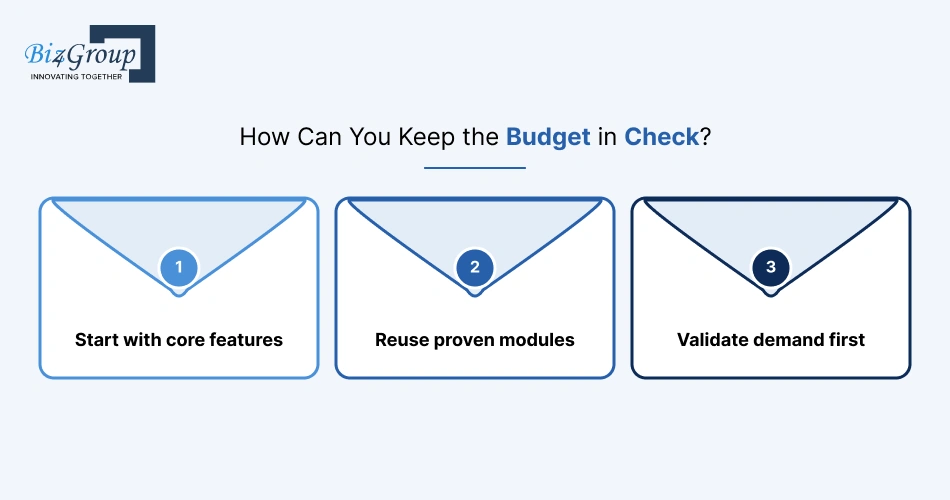
Start small, reuse proven modules, and validate demand before you scale.
- Start with core features One sport and a small catalog can save $5,000 to $20,000.
- Reuse proven modules Login, alerts, and analytics can save $3,000 to $15,000.
- Validate demand first Early validation can cut investment risk by $10,000 to $40,000+.
What Should You Look for in a Sportsbook Development Company for Prop Betting?
Look for proof on player data, settlement rules, risk controls, and live performance. Ask for working demos, not slide decks. Use these eight questions.
|
Question to Ask |
What a Strong Answer Shows |
|---|---|
|
Have you built markets tied to player stats? |
A player model with stat normalization |
|
How do you map players across providers? |
One internal ID and an audit trail |
|
How do you handle settlement and void rules? |
Versioned rules, tested by scenario |
|
Can you switch markets off by state or league? |
An admin console, logged, no code release |
|
How do you test live prop traffic? |
Event simulation and peak-load tests |
|
How do you price or connect pricing? |
Provider lines or custom models, both explainable |
|
How do you support integrity and responsible gaming? |
Alerts, limits, and audit logs |
|
Who owns the code and data? |
Clear terms in writing |
Use our guide on how to choose an AI sports betting app development company for a longer checklist.
How Biz4Group Builds Prop Markets
Biz4Group LLC has guided more than 50 sports betting solutions for operators in regulated US markets. We built Quick Start Bets and PredictEX, so we know how player data, live odds, and risk controls fit together. Meet our sports betting app development company team. If you want AI-driven pricing or alerts, our AI integration services connect models to your platform. Licensing advice stays with your gaming attorney.
Get on a call to discuss.
Key Takeaways on What Prop Bets Are and Why They Matter
What are prop bets? They are wagers on a stat or event inside a game, and they now carry a large share of sportsbook activity. They bring engagement and parlay fuel. They also bring pricing, settlement, and integrity risks.
The best platforms treat every prop as a market with a data source, a limit, and a rule. They plan for league and state restrictions before those arrive. They also start small, measure, and expand.
Biz4Group helps you do exactly that. Talk to our team and turn your prop plan into a launch plan.
FAQs
1. What does 'Over' or 'Under' mean on a prop bet?
Over means the stat finishes above the line. Under means it finishes below. If the stat lands exactly on a whole-number line, the bet pushes and the stake is returned. Books often use half-point lines to avoid pushes, but your engine still needs a push rule.
2. Why is a prop bet called a proposition bet?
A proposition is a proposed event that may or may not happen. The bettor wagers on whether it will. Prop is the short form. The term covers everything from a quarterback’s yards to a coin toss.
3. What is an alternate line on a player prop?
An alternate line moves the number up or down and changes the price. A lower over line pays less. A higher over line pays more. A platform must price and limit each alternate on its own.
4. Can bettors cash out a prop bet early?
Many operators offer cash out on eligible bets. Whether props qualify depends on the operator’s rules and the quality of the live data feed. Cash out also needs a live price for every open bet.
5. How do sportsbooks decide which players get props?
Operators weigh data coverage, expected playing time, betting demand, and league or regulator rules. Reliable stat feeds matter most. A prop without a trusted source cannot be settled cleanly.
6. What happens to a prop bet if the game is postponed or abandoned?
House rules decide. Many books keep bets active when a game is suspended and later resumed. They often void bets if the game ends before it becomes official. Baseball sets minimum innings. Store event status codes and map each one to an action.
7. What is the difference between prop bets and futures?
Prop bets cover events inside one game. Futures cover long-range outcomes, such as a season champion. Props settle in hours. Futures can stay open for months, which changes liability planning.
8. Can you offer prop bets without an in-house trading team?
Yes. Many operators take prop lines from data and odds providers, then add their own limits and rules. Custom pricing needs trading and data science skills. Start with provider lines, then add your own controls.