Location :
Orlando, FL, USA
Location :
Orlando, FL, USA +1 (407) 714-1616
 info@biz4group.com


















Imagine a digital system that doesn’t wait for instructions but instead, understands your business goals, learns from real-time feedback, and takes independent actions to get the job done.
Read More

A fiscal revolution is happening right now, powered by smart, data-driven applications that put financial clarity and control directly into users’ hands. Traditional spreadsheets and manual tracking are becoming relics, replaced by intelligent systems that adapt to real spending behavior.
AI-enabled budget tracking apps reshape how individuals and businesses monitor expenses, optimize savings, and plan financial futures. For organizations looking to build an AI budget tracking app, this shift signals a strategic move toward intelligent financial control.
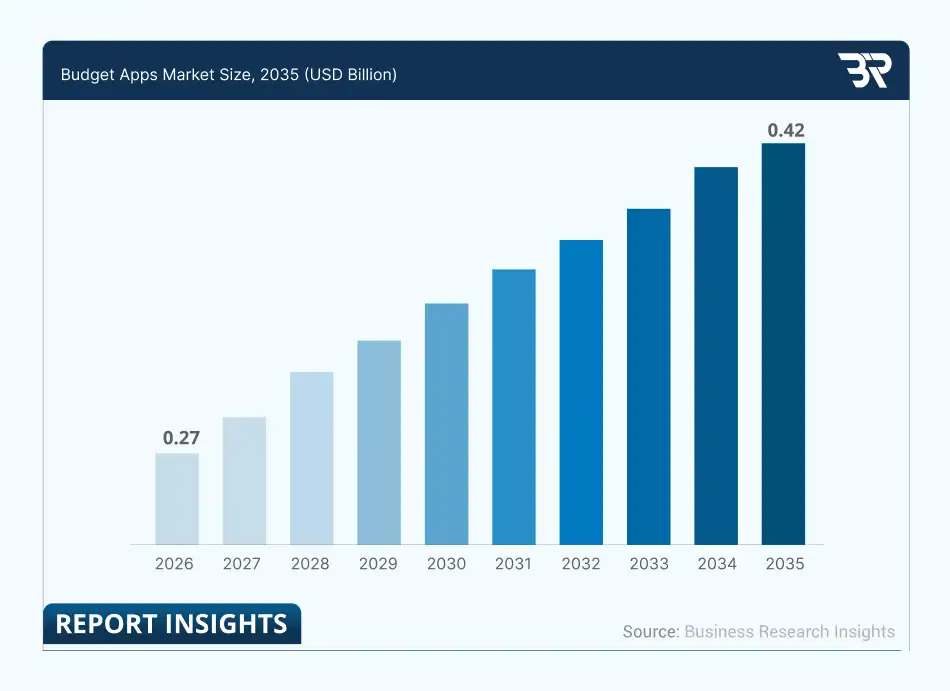
The global budget apps market though still emerging, is accelerating with measurable momentum.
This isn’t just growth for growth’s sake. It’s a fundamental shift in how people and enterprises view money management, moving from reactive tracking to proactive, predictive financial planning.
In this blog, you’ll discover:
Let’s dissect the forces behind this upward trajectory and explore what it means for builders and investors in this space.
When businesses create AI-driven money management app solutions, they move beyond basic expense tracking. The app uses machine learning, predictive analytics, and automation to track income, expenses, and spending patterns in real time. Instead of static reports, it provides adaptive budgets, timely alerts, and practical recommendations.
AI budget tracking apps work across personal finance, fintech platforms, and enterprise environments. Individuals gain better control over spending. Fintech platforms improve engagement and retention. Enterprises achieve clearer expense visibility, stronger forecasting accuracy, and improved operational efficiency, turning budgeting into a strategic function rather than a reporting task.
Understanding this difference is essential for teams that make AI budget tracking apps for personal and business finance. The real value of AI budget tracking emerges when you compare intelligence and automation, outperform static, rule-driven finance tools.
This distinction becomes critical when enterprises decide to build an AI budget tracking app rather than extend legacy finance software.
|
Criteria |
Traditional Budget Apps |
AI Budget Tracking Apps |
|---|---|---|
|
Budgeting logic |
Rule-based, manual |
Self-learning, adaptive |
|
Insights |
Historical summaries |
Predictive and prescriptive |
|
User engagement |
Passive tracking |
Proactive nudges & alerts |
|
Scalability |
Limited personalization |
Scales across users & use cases |
|
Decision support |
Reports only |
Real-time financial guidance |
This shift toward predictive insights and automation often relies on conversational interfaces and smart workflows, like patterns used in
Also Read: Building an AI-Driven Future: How Enterprises Can Stay Ahead with AI Integration?
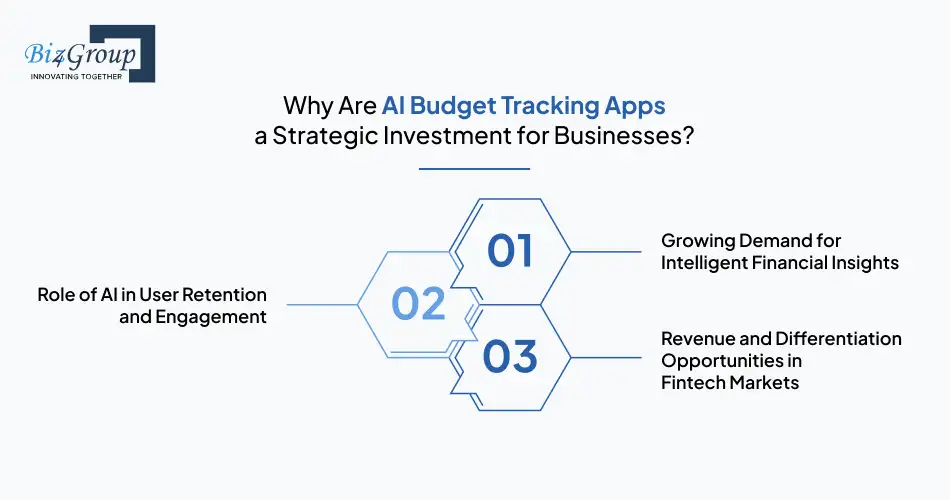
Enterprises no longer create AI driven money management app platforms as passive financial utilities. As fintech ecosystems expand, many organizations develop AI budget tracking apps for fintech platforms to embed intelligence directly into digital financial workflows.
The shift starts when teams create AI powered money management app for startups with insight quality as the priority. Static reports no longer support fast-moving business decisions.
Adoption patterns in the United States reinforce this shift. The U.S. smart budgeting apps market has crossed USD 0.39 billion and is projected to grow at a 16.8% CAGR. This growth reflects sustained demand for tools that move beyond manual tracking and delayed reporting.
This is why budget management app development with AI increasingly aligns with principles used in AI financial forecasting platforms rather than basic expense trackers.
Budgeting fails when users disengage. AI changes that dynamic.
This helps organizations achieve higher retention without adding manual support overhead. In many cases, teams rely on proven AI chatbot integration patterns to maintain accuracy and compliance at a scale.
AI-driven budgeting also creates clear commercial advantages.
This momentum is reinforced by broader global fintech market expansion, as per industry insights it is expected to grow from around USD 394.88 billion in 2025 to over USD 1.12 trillion by 2032, underscoring sustained demand for advanced financial software and analytics.
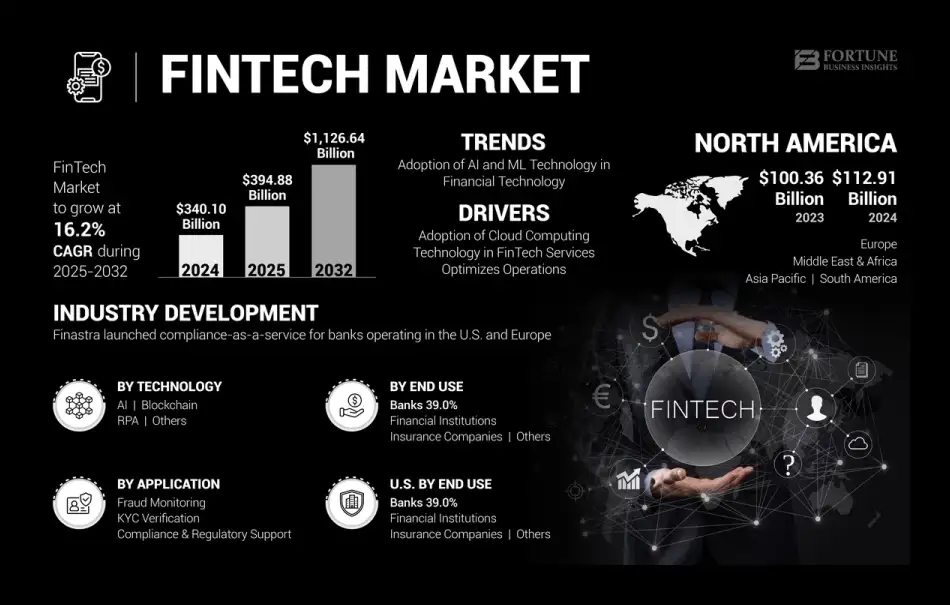
When enterprises develop AI powered budget tracking apps for business, they position budgeting as a value driver, not a cost center. The outcome is measurable efficiency, stronger engagement, and scalable financial intelligence aligned with long-term growth.
Once the business case is clear, the next focus is capability design. Enterprises define only what directly improves accuracy, engagement, and scalability. Each capability outlined below plays a direct role when teams build an AI budget tracking app designed for accuracy, scale, and adoption.
This capability forms the operational foundation of the platform.
Organizations that create AI expense tracking app solutions prioritize intelligence at this foundational layer.
Understanding behavior enables proactive financial control.
This insight supports better planning and smarter interventions.
Budgets must adapt to remain effective.
This helps organizations achieve consistency without rigid constraints.
Savings strategies work only when they remain realistic.
This approach improves long-term adoption and trust.
Prediction turns budgeting into a strategic asset.
This capability enables forward-looking financial decisions at a scale.
Once capabilities are defined, businesses translate them into concrete product features. These are not optional add-ons. They are the functional elements required to ensure accuracy, usability, and scalability. Organizations that develop intelligent budgeting software increasingly align these decisions with broader AI-powered solutions that support automation, insight delivery, and long-term adoption.
|
Feature |
What It Does |
Business Value |
|---|---|---|
|
Automated Transaction Sync |
Connects securely with banks, cards, and wallets |
Eliminates manual data entry and improves data freshness |
|
AI-Based Expense Categorization |
Classifies transactions in real time using generative AI in finance |
Improves reporting accuracy and user trust |
|
Dynamic Budget Management |
Adjusts budgets based on usage patterns |
Keeps budgets realistic and relevant |
|
Overspending Alerts |
Notifies users before thresholds are crossed |
Reduces financial risk and reactive corrections |
|
Savings Goal Tracking |
Tracks progress toward financial goals |
Increases engagement and long-term retention |
|
Cash Flow Forecasting |
Predicts future inflows and outflows |
Supports proactive financial planning |
|
Personalization Engine |
Tailor's insights by behavior and context |
Ensures relevance across user segments |
|
Data Security & Compliance |
Applies encryption and regulatory safeguards |
Protects sensitive financial data at scale |
These core features form the operational backbone of an AI budget tracking app. When implemented correctly, they ensure the system remains accurate, adaptive, and scalable. More importantly, they transform budgeting from a static tracking exercise into an intelligent financial management experience that delivers consistent value to users and enterprises alike.
Once a budgeting application proves stability and adoption, organizations begin evaluating how to extend its impact. At this stage, advanced capabilities become relevant as businesses look to integrate AI into an app to support predictive budgeting, automated insights, and scalable financial control. These features help transform a functional budgeting tool into a strategic financial intelligence platform.
|
Feature |
What It Enables |
Strategic Value |
|---|---|---|
|
Expense Forecasting |
Predicts future spending using historical and real-time data powered by AI model development |
Improves planning accuracy and reduces financial uncertainty |
|
Budget Simulation |
Models budget impact under changing income or expense conditions |
Supports faster, risk-aware decisions |
|
Risk Detection |
Flags abnormal spending and irregular transactions |
Strengthens financial control and fraud prevention |
|
Insight Engine |
Surfaces context-aware financial insights automatically using generative wealth intelligence to support faster, more informed financial decisions. |
Accelerates financial decision-making |
|
Multi-Entity Control |
Manages budgets across users, teams, or business units |
Enables centralized oversight at scale |
|
Behavioral Nudges |
Triggers corrective actions based on spending behavior |
Improves compliance and engagement |
|
Smart Recommendations |
Suggests budget adjustments aligned with defined goals |
Increases platform value through actionability |
Advanced features allow organizations to anticipate outcomes, test decisions before acting, and guide users proactively. As usage grows and financial scenarios become more complex, these capabilities ensure the platform continues to deliver clarity, confidence, and long-term value.
Also Read: What is the Role of AI in Wealth Management?
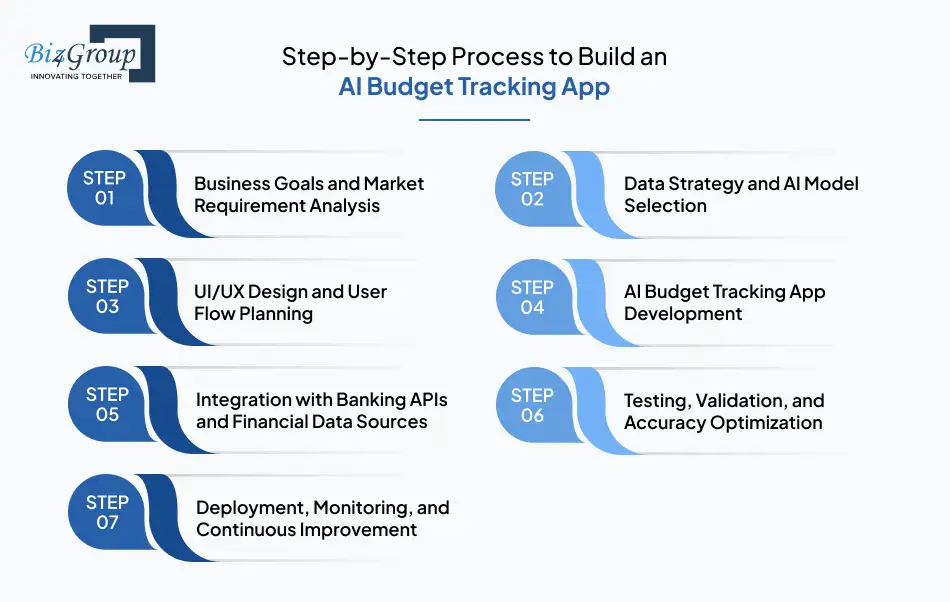
To build AI personal finance application solutions that deliver value, teams need more than development execution. Enterprises that build an AI budget tracking app follow a structured process connecting business intent, data intelligence, user experience, and system reliability.
This step defines what the product must achieve and who it serves. Teams follow a structured approach to build an AI app for budget tracking that balances intelligence depth, system stability, and delivery speed.
This foundation ensures teams that build AI personal finance application platforms align with real operational needs rather than assumptions.
AI accuracy depends on disciplined data planning.
A well-designed data strategy ensures predictions remain reliable as transaction volume grows.
This phase focuses on redefining customer interactions that make financial insights easy to act on.
Engaging a specialized UI/UX design company helps ensure intelligence is delivered without complexity.
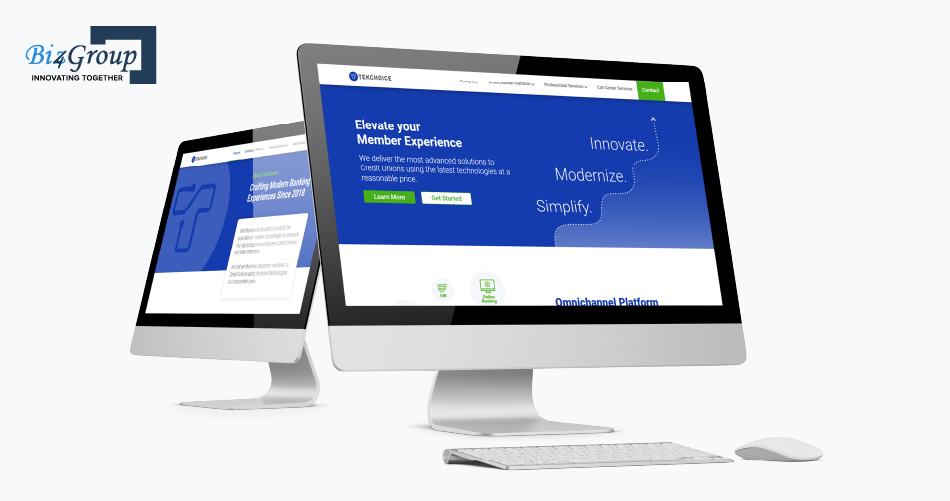
In frontend development for a renowned financial platform called Tekchoice, Biz4Group’s involvement goes beyond delivering UI screens or user flows. After design approval, UI concepts were translated into production-ready frontend components with aligned backend workflows.
This helped in consistent financial data presentation, accurate alert timing, and reliable insight delivery at scale. As development progresses, design decisions continue to support usability, consistency, and reliable user engagement at a scale.
Also Read: Top 15 UI/UX Design Companies in USA: 2026 Guide
This step focuses on building a stable and intelligent product core.
This helps organizations build AI finance tracking application solutions that scale without unnecessary complexity.
Also Read: AI-based Custom MVP Software Development – The Complete Guide
Reliable integrations power accurate insights.
This step directly impacts trust, accuracy, and regulatory readiness.
AI systems require continuous verification, often guided by structured testing practices followed by leading software testing companies in the USA.
This ensures financial insights remain dependable over time.
Deployment marks the start of operational learning.
This approach ensures long-term relevance as financial complexity increases.
When building an AI budget tracking app, the outcome depends less on individual features and more on how deliberately each step is handled. Teams that take time to align goals, data, design, and validation early avoid costly rework.
Also Read: How to Build a Buy Now Pay Later App like Klarna?
Validate architecture, AI strategy, and compliance early to avoid costly rework during later stages of budget tracking app development.
Plan Your BuildWhen teams plan an AI budget tracking app, technology choices are rarely about tools alone. The real question is whether the stack can scale, stay responsive, and adapt over time. That’s why enterprises look at the stack as a connected system, ensuring every layer supports real-time financial data and secure operations as usage grows.
|
Layer |
Technologies |
How They Support the Platform |
|---|---|---|
|
Frontend |
ReactJS, NextJS |
Leveraging ReactJS development with NextJS development helps deliver smooth financial dashboards, real-time updates, and consistent user experiences across devices. |
|
Backend |
NodeJS, Python |
NodeJS development handles APIs, real-time events, and integrations efficiently, while Python development powers financial logic, data processing, and AI model execution. |
|
API Layer |
RESTful APIs, GraphQL |
API development enables secure data exchange between frontend, backend, AI services, and external financial systems, supporting scalability and controlled access across platforms |
|
AI & Data Layer |
Machine Learning Models, Analytics Pipelines |
AI models manage expense categorization, forecasting, and behavioral analysis. Structured pipelines ensure models remain accurate, explainable, and scalable as transaction volume increases. |
|
Data Management |
Relational & NoSQL Databases |
Databases store transactional data, user profiles, and model outputs. Proper data design ensures consistency, speed, and auditability across financial records. |
|
Integrations |
Banking APIs, Financial Data Providers |
Secure APIs connect banks, wallets, and payment systems. This layer ensures real-time access to normalized financial data. |
|
Cloud & Infrastructure |
AWS, Azure, or GCP |
Cloud platforms provide elasticity, security, and high availability. Cloud-native infrastructure supports continuous scaling, monitoring, and disaster recovery. |
|
Security & Compliance |
Encryption, Access Controls, Audit Logs |
Security layers protect sensitive financial data and ensure regulatory compliance. These controls build trust and support enterprise adoption. |
A strong technology stack is less about adding components and more about alignment. Its balance allows the system to evolve alongside user expectations, data volume, and regulatory requirements without constant rework.
Align frontend, backend, AI models, and APIs with long-term performance, security, and compliance requirements before committing to development.
Review Tech Stack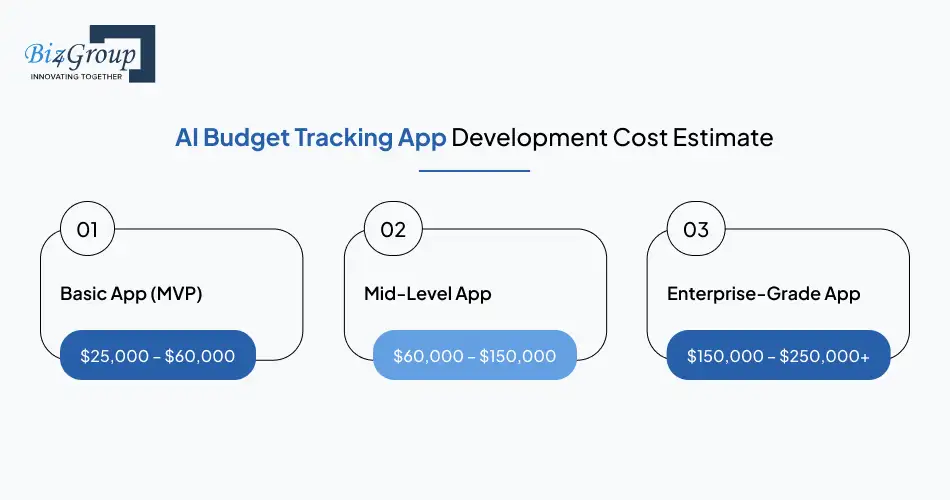
When discussing cost, enterprises focus less on a single number and more on what drives it, with AI budget tracking app development costs typically estimated within a broad, ballpark range of $25,000 to $250,000+, depending on scope, intelligence depth, and scalability requirements. Here’s how businesses approach budgeting for development, based on maturity level and long-term goals.
|
Types |
Estimated Range |
What This Typically Covers |
|---|---|---|
|
Basic App (MVP) |
$25,000 – $60,000 |
Core budgeting flows, basic AI logic, limited integrations, and essential security |
|
Mid-Level App |
$60,000 – $150,000 |
Advanced AI features, improved UX, predictive insights, and scalable backend architecture |
|
Enterprise-Grade App |
$150,000 – $250,000+ |
Full AI intelligence, multi-entity support, compliance readiness, and long-term scalability |
These ranges are indicative, not fixed. Final cost depends on how decisions are made across design, data, and AI complexity.
Cost planning for an AI budget tracking app is a strategic exercise, not a pricing exercise. When approached thoughtfully, development spend supports long-term value instead of short-term delivery, ensuring the platform can evolve as financial complexity and user expectations grow.
Also Read: How to Develop AI Financial Coaching App: Features, Steps and Cost
Understand realistic investment ranges, AI complexity tradeoffs, and scalability considerations before finalizing your budget tracking roadmap.
Get Cost Clarity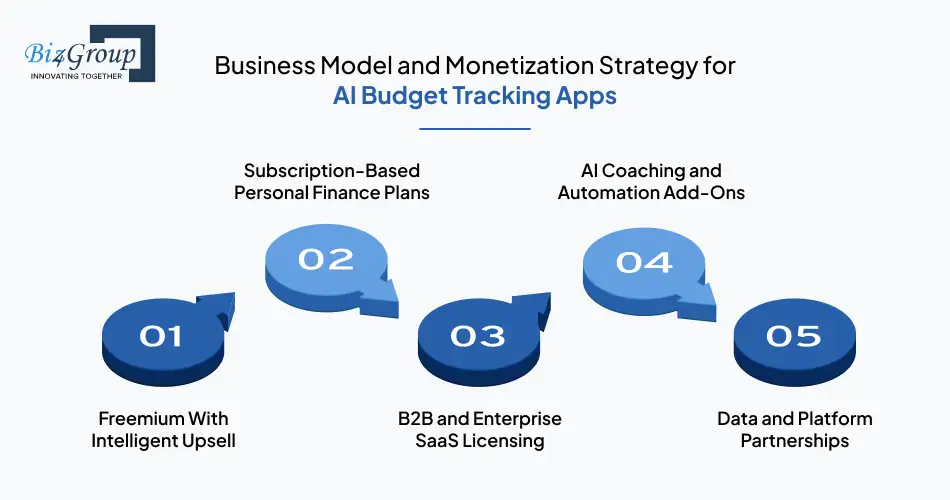
When founders create AI powered money management app for startups, monetization decisions shape how long-term value is sustained. They align the business model for AI finance app development with intelligence depth, user behavior, and long-term scalability. A well-designed approach ensures monetization supports adoption rather than restricting it.
This model lowers the barrier to entry while showcasing real product value. Core budgeting features remain accessible, so users can experience the system’s accuracy and usability.
Advanced capabilities such as forecasting, AI business process automation, and deeper insights are reserved for paid tiers. This approach allows organizations to build trust before asking users to upgrade.
Subscriptions work when users see ongoing value. Predictive insights and personalized guidance provide continuous benefit rather than one-time utility. Recurring pricing becomes justified because the system evolves financial behavior. This helps organizations maintain predictable revenue without aggressive upselling tactics.
Enterprise monetization focuses on scale and operational stability. Pricing typically aligns with users, departments, or data volume. Platforms include governance, reporting, and multi-entity capabilities that support complex financial environments. This model enables long-term contracts and reliable revenue streams.
Advanced intelligence creates opportunities for layered monetization. AI-driven coaching helps users make better financial decisions through guidance and recommendations. Automation reduces manual reviews and corrective actions. Users pay for outcomes and efficiency rather than feature access alone.
As platforms mature, monetization expands beyond direct users. Aggregated insights support analytics services and fintech partnerships. APIs extend value across financial ecosystems. Revenue grows in parallel with platform adoption and data maturity.
A sustainable AI app monetization strategy evolves with the product. When pricing reflects real outcomes and intelligence depth, revenue grows naturally alongside adoption. Enterprises that design monetization early avoid friction later and ensure the platform remains both valuable to users and viable as a long-term business.
When financial data is involved, trust is not optional. A well-designed system ensures data protection, regulatory alignment, and audit readiness from day one, especially when teams develop AI budget tracking apps and fintech solutions operating at scale.
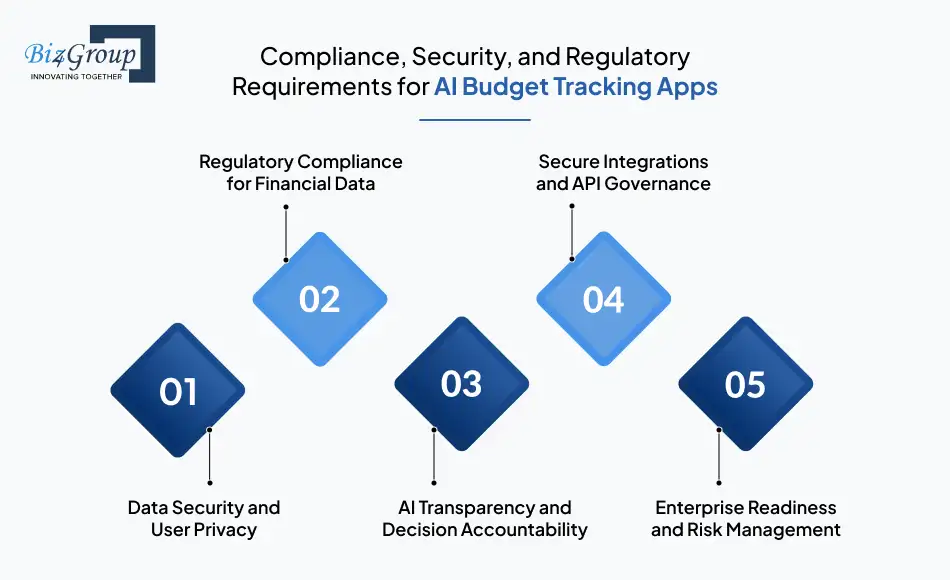
Security begins with disciplined data handling practices. AI budget tracking apps process sensitive financial information, including transaction histories and account metadata. Strong encryption protects data both in transit and at rest.
Role-based access controls restrict exposure across users and internal teams. This helps organizations achieve security without slowing operational workflows.
Regulatory expectations shape how platforms are designed. Depending on geography and use cases, applications must comply with standards such as GDPR, PCI DSS, or local financial regulations. These requirements influence consent management, data retention policies, and audit trails.
AI-driven insights must remain explainable and defensible. Enterprises need clarity on how models generate predictions and recommendations. Transparent decision logic supports audits and internal governance. Many organizations rely on AI consulting services to define explainability frameworks that balance regulatory expectations with model performance.
Integrations introduce additional compliance responsibilities. Secure API governance prevents unauthorized access and reduces dependency risks. A controlled integration layer ensures stability as external connections increase.
Compliance supports scalability when designed correctly. Enterprises plan for continuous monitoring, periodic audits, and structured incident responses. When security and governance align with business app development using AI, compliance frameworks enable growth rather than restrict it.
Compliance and security define whether an AI budget tracking app can scale with confidence. When embedded into architecture and workflows early, they strengthen trust, reduce operational risk, and support enterprise adoption.
Also Read: Fintech in Wealth Management: Powering the New Era of Financial Services
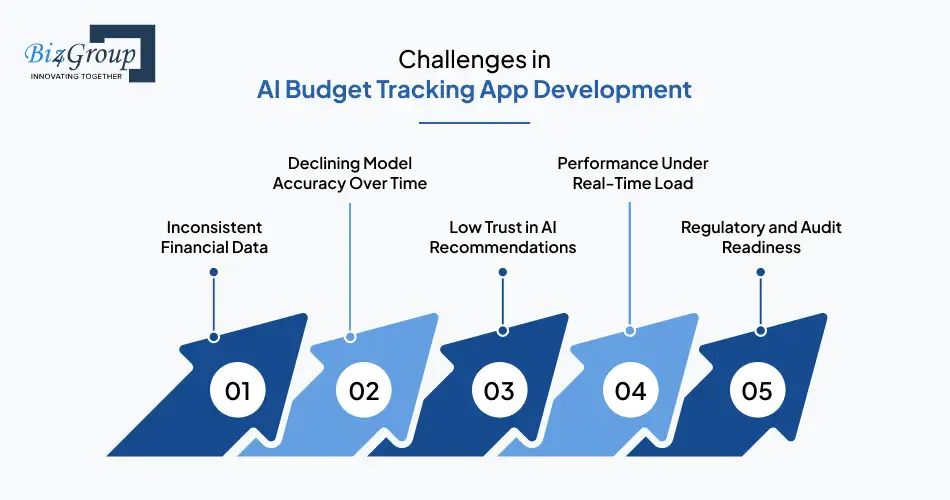
AI budget tracking apps face challenges that traditional finance tools do not. The difficulty lies in maintaining data accuracy, model reliability, and user trust at scale. Enterprises address these challenges through architecture decisions, disciplined planning, and continuous oversight rather than reactive fixes.
|
Challenge |
How Businesses Address It |
|---|---|
|
Inconsistent Financial Data |
Teams introduce data validation and normalization layers before AI processing. This ensures insights remain consistent across banks and data providers. |
|
Declining Model Accuracy Over Time |
Organizations design retraining and monitoring workflows early. They ensure models remain adaptive as spending patterns change by following proven practices to build AI software that evolves with real-world data. |
|
Low Trust in AI Recommendations |
Clear explanations and contextual insights improve confidence. Many platforms apply interaction patterns from AI conversation app design to make recommendations easier to understand and act on. |
|
Performance Under Real-Time Load |
Architects separate AI processing from transactional systems. This keeps alerts and dashboards responsive during peak usage. |
|
Regulatory and Audit Readiness |
Compliance controls are embedded into system design from the start. Audit trails and access governance reduce risk during reviews. |
A structured approach to address challenges ensures the platform remains accurate, trusted, and scalable as financial complexity grows. Teams that plan for data quality, model evolution, and transparency early avoid costly corrections later.
Identify data, model accuracy, and compliance risks early to prevent long-term performance and trust issues in financial applications.
Mitigate AI RisksWhen enterprises evaluate custom AI budget tracking app development services, partner choice matters. An experienced AI development company brings financial domain depth and designs platforms for reliability and scale. Furthermore, proven experience with wealth management software solutions also ensures regulatory alignment and long-term platform readiness of a company.
This is where Biz4Group LLC’s execution approach bridges domain expertise with real-world delivery. We approach custom AI budget tracking app development with a strong foundation in fintech software development, supported by applied AI practices. Teams work across financial data pipelines, model governance, and secure architectures to ensure accuracy and audit readiness.
What typically sets us apart in practice includes:
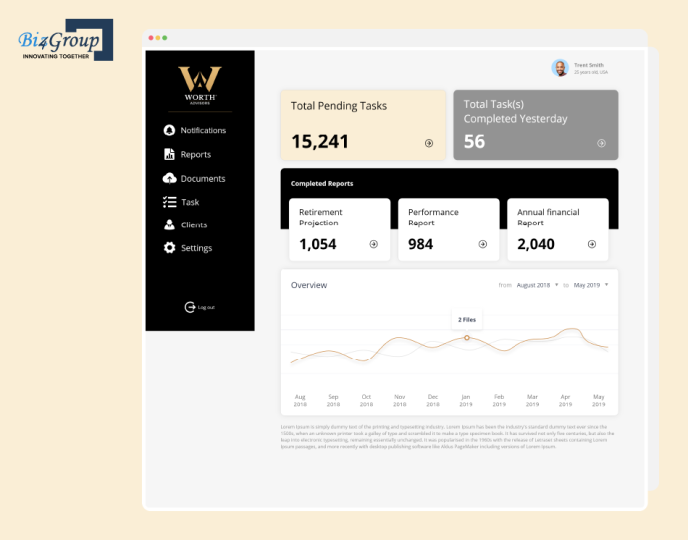
This delivery mindset of our organization is reflected in platforms like WorthAdvisor , where we built a data-driven financial advisory solution by aligning AI-powered insights with scalable backend systems and ongoing optimization. The project demonstrates how AI intelligence, financial logic, and platform stability must work together beyond initial launch. launch.
Enterprises often engage with us as an AI app development company when they need more than implementation. They need accountability across strategy, execution, and evolution. For teams evaluating the best company to build AI budget tracking app, Biz4Group offers continuity, domain experience, and a delivery model shaped by real-world fintech execution. It also accounts for the challenges of hiring fintech software developers for complex financial platforms.
Also Read: How to Choose the Best AI Development Company for Your Wealth Management Project?
Many decision-makers ask whether it is profitable to develop an AI budget tracking app in a competitive fintech landscape? Yes, it is. For organizations ready to build an AI budget tracking app, long-term success depends on disciplined execution, explainable intelligence, and scalable architecture.
Building an AI budget tracking platform is as much a strategic decision as a technical one. Here’s how businesses approach this journey. They focus on data accuracy, transparent decision logic, and long-term system scalability from the start. This helps organizations achieve clarity, trust, and long-term control across financial workflows.
For startups and fintech teams, the opportunity lies in designing AI budget tracking app solutions for startups and fintech companies that grow with users and regulations. Choosing the right partner early reduces rework later. Many decision-makers begin by reviewing benchmarks like those of the top AI development companies in USA to understand delivery maturity and domain depth.to understand delivery maturity and domain depth.
Not only does strategy matter, but execution plays an equally important role. Working with an experienced AI product development company helps ensure security, compliance, and performance remain aligned as complexity increases. As products mature, teams often seek partners that can support continuous optimization, not just initial delivery.
A well-designed system ensures budgeting evolves from tracking to intelligence. If you’re planning your next move, consider scheduling a strategy call discussing scope, risks, and a realistic roadmap before development begins.
AI budget tracking app solutions use machine learning to analyze spending, predict cash flow, and deliver personalized financial insights. For startups and fintech companies, these solutions support faster decision-making and scalable financial control.
The cost of AI budget tracking app development generally ranges from $25,000 to $250,000+, depending on feature scope, AI complexity, and compliance requirements. MVP builds sit at the lower end, while enterprise-grade platforms require higher investment for scalability, security, and long-term reliability.
A custom AI budget tracking app should include expense categorization, budget optimization, predictive forecasting, and explainable AI insights. Enterprise platforms also require auditability and role-based access controls.
AI improves financial decision-making by identifying spending patterns, forecasting outcomes, and delivering timely recommendations. This allows users and businesses to act proactively rather than react to past data.
Startups often face data quality issues, model accuracy drift, and user trust concerns. Addressing these early through architecture and governance planning reduces long-term risk.
Businesses evaluate domain experience, AI expertise, security practices, and long-term support. The best company to build an AI budget tracking app demonstrates proven fintech delivery and structured AI development processes.

with Biz4Group today!
Our website require some cookies to function properly. Read our privacy policy to know more.