Location :
Orlando, FL, USA
Location :
Orlando, FL, USA +1 (407) 714-1616
 info@biz4group.com


















Imagine a digital system that doesn’t wait for instructions but instead, understands your business goals, learns from real-time feedback, and takes independent actions to get the job done.
Read More
What happens when your SaaS product becomes a place where new AI capabilities keep appearing without rebuilding the product every few months?
That question is shaping the next phase of SaaS innovation. Across the industry, AI-powered SaaS platforms are gaining attention as companies embed intelligent services directly into the software their users already rely on. Tasks that once required multiple tools now happen inside the same product environment through AI automation and intelligent assistants.
This shift is driven by a few noticeable changes across SaaS products:
At the same time, SaaS companies are expanding their products into broader ecosystems. A single application is gradually turning into a platform where partners, developers, and internal teams introduce new AI services that extend the value of the product. This shift is pushing many organizations to think seriously about AI marketplace builder platform development as part of their long-term product roadmap.
Many SaaS leaders are also working closely with an experienced software development company to understand how these ecosystems should evolve within their platforms. That exploration often leads toward enterprise AI marketplace builder platform development for SaaS businesses, where AI tools become part of the product environment instead of external add-ons.
Let's dive in together for more insights.
An AI marketplace builder platform is a system that allows SaaS companies to create a marketplace inside their software where AI tools, services, and intelligent assistants can be discovered and used by customers. It lets a SaaS company introduce a dedicated space within its product where users can access different AI-powered solutions. Instead of building every intelligent capability into the core application, the platform can host multiple AI tools that customers activate when they need them.
Think about a SaaS product your team already uses daily. Now imagine opening a section inside that product where helpful AI assistants are available to support common tasks. These tools operate within the same workspace, so users do not need to switch between multiple systems.
In practical terms, the marketplace may include AI tools that help users with everyday work such as:
These tools work inside the SaaS environment and improve how users complete routine activities.
AI marketplaces appear simple to users, yet several intelligent layers operate quietly behind the scenes. These components help AI tools respond to user activity, interpret information, and deliver useful outputs inside SaaS environments.
During AI marketplace builder platform development, these intelligence layers ensure that the marketplace is not just a collection of tools. They allow the system to understand context, surface relevant solutions, and support meaningful interactions with AI services.
The AI model integration layer connects different AI capabilities with the marketplace environment. It allows the platform to bring various AI services into one controlled ecosystem where they can respond to user requests.
Key aspects of this layer include:
This layer allows AI tools to operate smoothly within the marketplace environment.
AI agents act as intelligent assistants that handle routine activities and help users complete tasks more efficiently. Automation engines support these agents by triggering actions when certain conditions occur.
Within smart marketplaces, these components often handle tasks such as:
These systems allow AI tools to move beyond static outputs and assist with real work.
Also Read: AI Agent Development Cost
Recommendation engines help users discover AI tools that match their needs. Instead of manually searching through many options, the marketplace can suggest tools that align with current activities.
This intelligence is usually supported by signals such as:
Recommendation systems make AI tools easier to discover when users need them most.
Search plays a major role in helping users locate useful AI tools quickly. Intelligent search goes beyond simple keyword matching and tries to understand the intent behind a query.
Inside AI marketplaces, search systems often support:
These capabilities help users reach the right AI solution without navigating complex menus.
Personalization AI models help the marketplace adapt to different users over time. As people interact with AI tools, the platform begins to recognize patterns in their behavior and preferences.
These models often support experiences such as:
Personalization helps the marketplace remain relevant for different teams and individuals.
Many AI tools need to interact with multiple steps inside a workflow. AI business workflow automation helps coordinate how different services operate together within a process.
This intelligence layer often enables:
This coordination allows AI tools to support complete workflows rather than isolated actions.
Also Read: Top 10 AI Automation Companies in USA
AI systems rely on information to deliver useful responses. Data pipelines help move relevant data to AI tools so they can interpret activity and generate accurate outputs.
Within an AI marketplace environment, these pipelines typically support:
Reliable data flow ensures that AI tools remain aware of the context in which they operate.
Smart marketplaces depend on these intelligence layers to deliver meaningful AI experiences. For AI marketplace builder platform development for SaaS companies, these components ensure that AI tools respond intelligently to user activity and integrate naturally into everyday workflows.
Add intelligent tools inside your platform and let AI capabilities grow without rebuilding core product
Build My AI Marketplace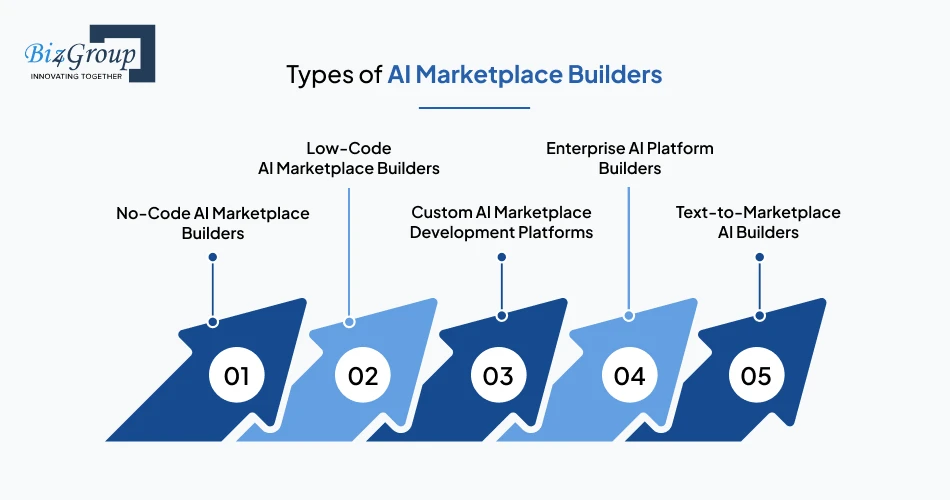
Before we understand what kind of AI marketplace builder platform SaaS companies can build, it helps to look at the different types of AI marketplace builders available today. Each type represents a different way organizations design, structure, or launch an AI marketplace inside their software environment. Some approaches focus on simplicity and speed, while others prioritize customization and ecosystem scalability. Understanding these models helps SaaS leaders choose the direction that fits their product strategy and technical capabilities.
No-code builders allow teams to create an AI marketplace without heavy development work. These platforms provide visual tools that make marketplace setup simple and fast.
Instead of building everything from scratch, teams configure the marketplace using ready-made components. Typical characteristics include:
This approach is usually chosen by companies that want to launch an AI marketplace quickly with minimal engineering effort.
Low-code builders combine visual configuration with developer customization. They provide a balance between ease of use and technical flexibility.
Teams can set up the marketplace structure visually and then extend functionality through code where needed. Key aspects include:
This model works well for SaaS companies that want faster development but still need technical control over the platform.
Some SaaS companies prefer building their marketplace entirely from scratch. In this approach, the marketplace infrastructure is fully designed and developed according to the platform's specific needs.
This allows companies to control every aspect of the marketplace environment. Common characteristics include:
This type is often used by large SaaS platforms that want complete control over their AI ecosystem.
Enterprise AI platforms provide large-scale infrastructure for organizations that want to manage many AI services in one environment. These platforms allow companies to build AI marketplaces that support complex enterprise workflows.
They usually focus on governance, scalability, and system integration. Typical capabilities include:
Organizations often choose this model when building enterprise-grade AI ecosystems inside their platforms.
Text-to-marketplace builders represent an emerging approach where AI helps generate marketplace structures automatically. Instead of manually designing every part of the platform, users describe what they want, and AI helps create the initial marketplace setup.
These tools often support rapid experimentation and early product exploration. Key features include:
This approach is still evolving but is gaining attention as AI-driven product creation becomes more common.
AI marketplace builders come in different forms because SaaS companies have different goals, technical capabilities, and product strategies. Some teams prefer quick marketplace deployment using no-code tools, while others invest in fully customized platforms that support large AI ecosystems. By understanding these builder models, SaaS companies can choose the development approach that best supports their long-term AI marketplace vision and platform growth.
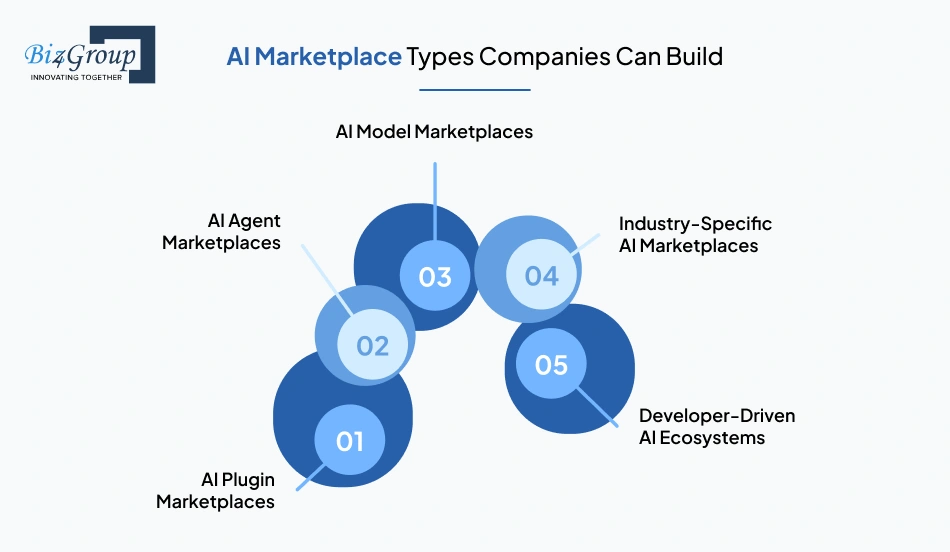
SaaS platforms are gradually expanding beyond single-product environments. Many now introduce marketplaces where AI tools become part of everyday workflows. As AI marketplace builder platform development gains attention, companies are exploring different marketplace models based on how users interact with AI services inside their platforms.
Also Read: Finance AI Agent Development
These marketplace models show how SaaS platforms can organize AI services in different ways. Each approach helps companies introduce intelligent capabilities that align with how users interact with software in their daily workflows.
AI is steadily becoming part of everyday software workflows. SaaS leaders now view marketplaces as a practical way to expand product value through enterprise AI marketplace builder platform development for SaaS businesses, where intelligent tools integrate into the platform environment and support evolving customer needs.
Several industry signals highlight why AI marketplaces are gaining traction across SaaS ecosystems:
These signals show why companies are prioritizing AI marketplace builder platform development as part of long-term platform strategy.
A marketplace allows a SaaS platform to expand beyond a single product experience. External contributors and internal teams can introduce AI services that complement existing workflows.
Marketplaces encourage developer communities to participate in platform innovation. This creates a larger ecosystem around the product and increases the variety of solutions available to users.
A marketplace structure allows new AI capabilities to appear more quickly inside SaaS environments. Innovation does not depend entirely on internal product teams.
Not every capability needs to be created by the core product team. Marketplaces allow external innovation to extend platform functionality.
AI marketplaces create opportunities for platforms to support new forms of digital services within their ecosystem.
Customers prefer platforms that grow alongside their operational needs. Marketplaces help SaaS products remain relevant as users adopt more AI-assisted workflows.
Modern SaaS platforms must adapt quickly as AI capabilities evolve. Marketplaces allow platforms to extend their intelligence layer without redesigning the core product.
SaaS companies now view AI marketplaces as strategic infrastructure for platform growth. These ecosystems allow software products to expand capabilities, welcome external innovation, and support evolving AI-driven workflows within a unified platform environment.
Create a marketplace where developers ship AI tools while your platform grows smarter daily
Launch AI MarketplaceAI marketplaces work best when users can easily discover, activate, and manage intelligent tools within the same platform environment. Platforms focusing on AI SaaS marketplace builder platform development usually prioritize capabilities that make AI services accessible, manageable, and easy to use during daily workflows.
| Core Capability | What It Enables for Users |
|---|---|
| AI App Catalog | A central catalog where users can browse available AI tools and understand what each tool helps them accomplish before activation. |
| Developer Submission Portal | A space where developers submit AI tools so platform administrators can review and approve them before they appear in the marketplace. |
| AI Tool Integration System | Allows AI tools to operate within the SaaS environment so users can access them while performing normal tasks inside the product. |
| Installation and Configuration Workflows | Lets users activate AI tools quickly and adjust settings, so the tools align with their workflow needs. |
| Usage Tracking | Helps users monitor how often AI tools are used and understand which tools support their work most effectively. |
| Monetization and Billing | Enables users to subscribe to or purchase AI services directly from the marketplace without leaving the platform. |
| Marketplace Moderation | Allows platform administrators to review AI tools and maintain quality standards for the marketplace environment. |
| Review and Rating Systems | Users can share feedback on AI tools, which helps others identify useful solutions within the marketplace. |
| Analytics Dashboards | Provides visibility into how AI tools perform within the platform and how users interact with them during daily workflows. |
| AI Tool Discovery and Search | Users can quickly locate AI tools that match their current tasks through simple search and filtering capabilities. |
| User Access Controls | Organizations can decide which teams or individuals can activate certain AI tools within the platform. |
| Update and Version Management | Ensures users always access the most recent version of AI tools without disrupting their ongoing work. |
| Notification and Update Alerts | Keeps users informed when new AI tools appear or when existing tools receive improvements. |
These capabilities help AI marketplace builder platform development efforts focus on practical user experiences. When teams make AI marketplace builder software platform environments with these functional elements, users gain a structured way to access AI tools that support everyday workflows.
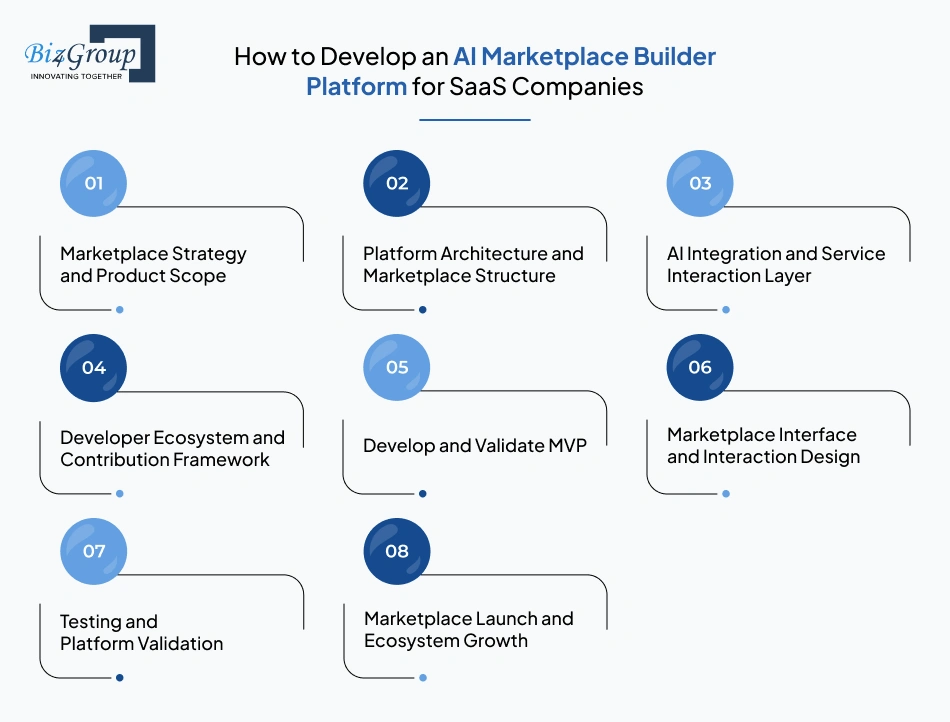
Structured execution is essential when SaaS platforms move toward intelligent marketplaces. If you're wondering how to develop an enterprise AI marketplace builder platform for SaaS companies, then start with a staged lifecycle. This ensures that every phase of AI marketplace builder platform development progresses in a controlled and measurable way. Experienced product teams often collaborate with an AI development company during early planning to align product vision with real platform capabilities.
Align the marketplace vision with the broader AI marketplace builder software development roadmap so the platform evolves with clear direction
Also Read: Top MVP Development Companies in USA
Also Read: Top UI/UX Design Companies in USA
A structured lifecycle helps SaaS teams transform marketplace concepts into operational AI ecosystems. Each phase ensures the platform evolves carefully so AI services integrate naturally into everyday workflows without disrupting the core product experience.
Also Read: SaaS MVP Development: Build, Validate, and Scale Smarter
Our AI engineers design scalable marketplace architectures that evolve with your SaaS ecosystem
Talk With AI Platform ExpertsAI marketplaces rely on several technical layers that work together to support user interaction, AI tool execution, and platform coordination. During AI marketplace builder platform development, these layers ensure the marketplace runs smoothly within a SaaS environment and supports interaction between users and AI services.
| Architecture Layer | Technology Used | Purpose |
|---|---|---|
| Frontend Interface Layer | React.js, Next.js, Tailwind CSS | Creates the user interface where users discover and activate AI tools inside the marketplace. These technologies help deliver a fast and responsive SaaS experience. |
| Backend Application Layer | Node.js, Express.js | Handles platform logic that manages marketplace activity, user actions, and AI tool interactions within the SaaS platform. |
| AI Processing Layer | Python, TensorFlow, PyTorch | Supports the execution of AI tools offered in the marketplace. Many AI services operate in Python environments because they support machine learning and data processing. |
| API Communication Layer | REST APIs, GraphQL | Allows the marketplace, SaaS platform, and AI services to exchange information, so user requests trigger the correct AI actions. |
| Database Layer | PostgreSQL, MongoDB | Stores marketplace data such as AI tool listings, user activity, and interaction records that help the platform operate consistently. |
| Search and Discovery Layer | Elasticsearch, Algolia | Enables users to quickly locate AI tools through search queries and filters within the marketplace interface. |
| Identity and Access Management Layer | Auth0, OAuth 2.0, Firebase Authentication | Controls user authentication and determines which users can access specific AI tools in the marketplace. |
| AI Orchestration Layer | LangChain, Ray | Coordinates multiple AI services, so they respond correctly within SaaS workflows and manage interactions between AI tools. |
| Messaging and Event Processing Layer | Apache Kafka, RabbitMQ | Manages communication between platform services so events such as AI tool activation or user requests are processed efficiently. |
| Monitoring and Observability Layer | Prometheus, Grafana, Datadog | Tracks platform activity and helps teams monitor how AI services and marketplace operations behave during real usage. |
| Cloud Infrastructure Layer | AWS, Google Cloud Platform, Microsoft Azure | Provides the computing infrastructure required to host the marketplace platform and scale services as user activity grows. |
| Containerization and Deployment Layer | Docker, Kubernetes | Helps manage application deployment and ensures the marketplace platform can scale and run reliably across different environments. |
A well-structured stack allows teams to create AI marketplace builder platform for AI tools that integrates smoothly with SaaS platforms. Each layer supports a specific function, so the marketplace can manage AI services, user activity, and platform workflows without disrupting the main product experience.
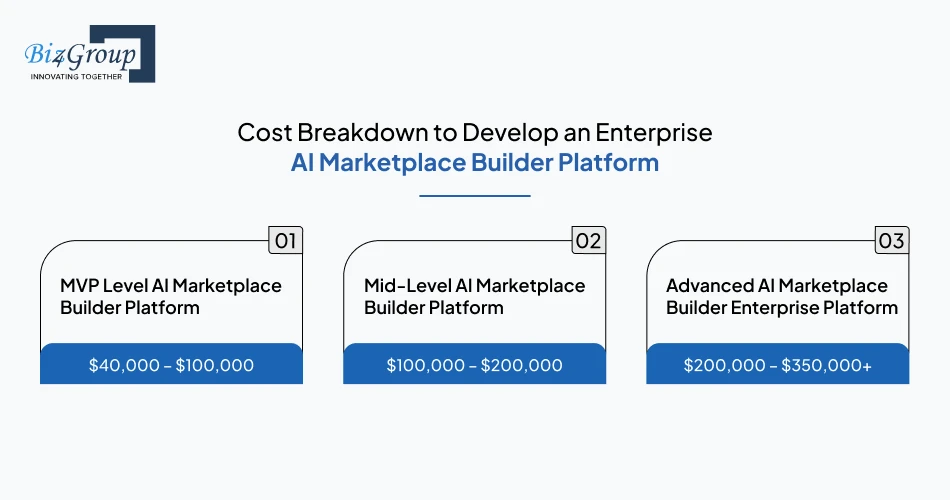
Investment requirements vary depending on platform scope, AI capabilities, and ecosystem complexity. Teams planning AI marketplace builder platform development generally allocate budgets between $40,000 and $350,000+. Companies that build AI marketplace builder platform for SaaS products often scale investment gradually as the marketplace expands, and more AI services enter the ecosystem.
| Development Level | Estimated Cost Range | What This Level Typically Covers |
|---|---|---|
| MVP Level AI Marketplace Builder Platform | $40,000 – $100,000 | A foundational marketplace environment where early AI tools can operate within SaaS workflows. This stage validates product usability and confirms whether the marketplace concept fits real platform needs. |
| Mid-Level AI Marketplace Builder Platform | $100,000 – $200,000 | A more mature marketplace environment with improved interaction, stronger operational stability, and support for multiple AI services working within the SaaS platform. |
| Advanced AI Marketplace Builder Enterprise Platform | $200,000 – $350,000+ | A large-scale marketplace ecosystem designed to support multiple AI tools, developer participation, and high user activity across enterprise SaaS environments. |
Marketplace size and operational complexity influence development effort. Platforms with broader functionality or larger ecosystems often require higher investment, similar to factors that influence overall SaaS product development cost during large platform initiatives.
The number of AI tools connected to the platform directly impacts development effort. Integrating multiple intelligent services increases coordination effort and contributes to rising AI integration costs within the marketplace ecosystem.
Marketplaces that support external contributors require systems that allow developers to introduce new AI services. Managing this environment requires additional development effort to maintain platform stability and ecosystem coordination.
Platforms designed for large user communities often require more development work to ensure marketplace interaction remains simple and efficient during daily workflows.
Enterprise SaaS environments expect marketplaces to support growing user activity and increasing numbers of AI tools. Ensuring the platform scales reliably adds to development investment.
Marketplace environments must protect user data and maintain responsible AI usage. Implementing safeguards and operational oversight contributes to the overall investment required to create AI marketplace builder platform for SaaS copmaines.
A realistic cost estimate depends on how ambitious the marketplace vision is and how many AI services the platform plans to support. Clear scope definition helps SaaS companies align investment with the long-term role the marketplace will play inside their product ecosystem.
Get a realistic roadmap and investment estimate tailored to your SaaS platform vision
Get Cost Estimate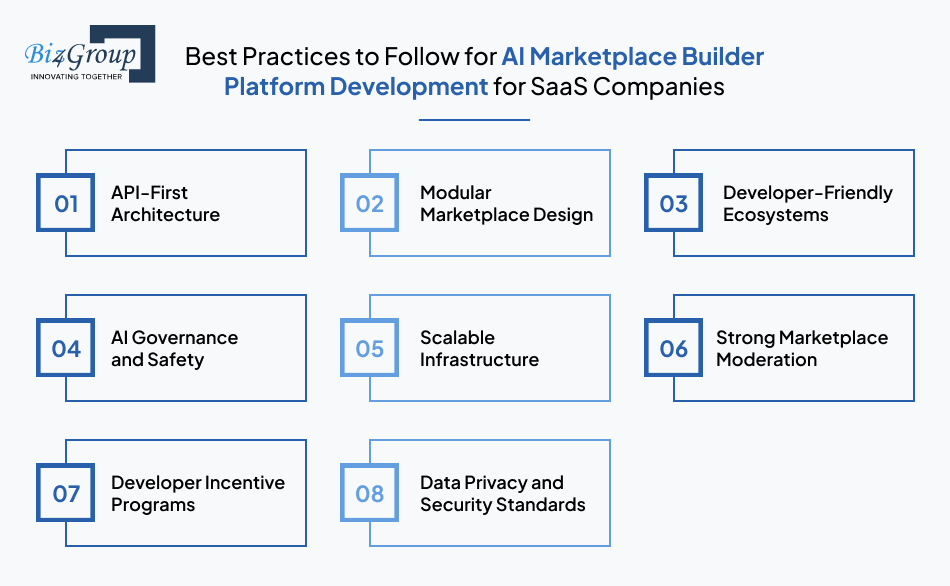
Long-term marketplace success depends on thoughtful platform decisions made early in the lifecycle. Teams working on AI marketplace builder platform development often focus on ecosystem stability, developer participation, and responsible AI practices, so the platform evolves smoothly as adoption grows.
A marketplace functions best when platform services communicate through clear integration pathways. Many SaaS teams adopt an API first architecture approach, so AI services interact consistently with platform workflows.
A modular structure keeps marketplace components independent, so updates or changes do not disrupt the entire platform environment.
Healthy marketplaces grow when developers can easily contribute to AI solutions that support real business tasks.
Responsible AI usage is essential when multiple tools operate inside one platform environment.
Marketplace ecosystems expand as more users and AI services join the platform. Infrastructure decisions should support this growth.
Quality control keeps the marketplace trustworthy and useful for SaaS customers.
Developer participation drives continuous marketplace innovation.
AI marketplaces handle sensitive user and operational data. Clear privacy practices help maintain trust.
Strong strategic planning helps SaaS platforms maintain healthy AI marketplaces over time. When governance, developer participation, and scalable design are prioritized, the platform remains adaptable while supporting the growing role of AI across SaaS ecosystems.
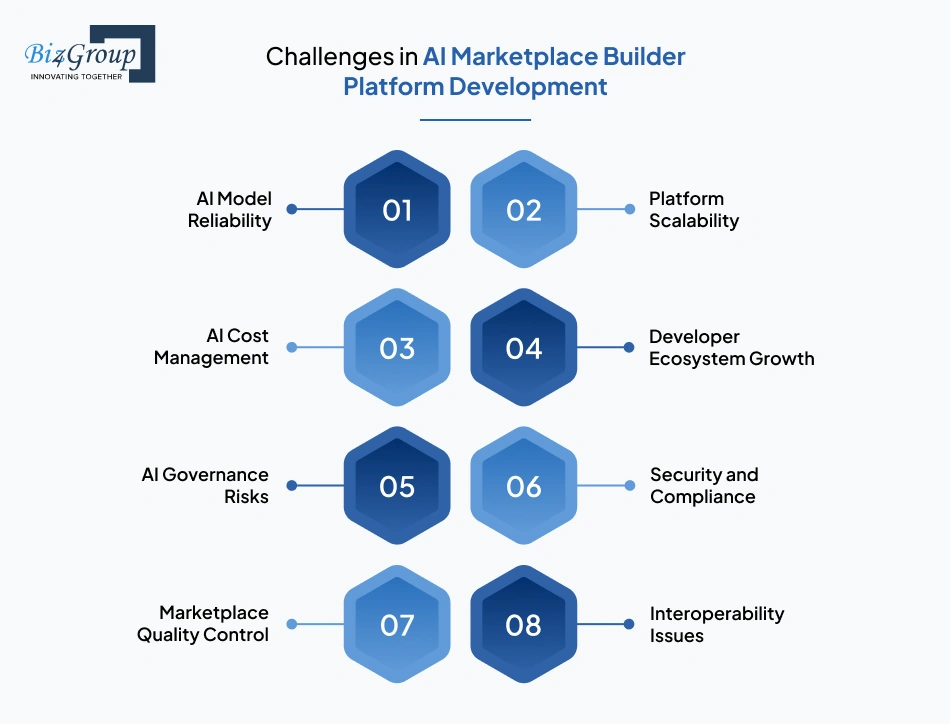
AI marketplaces introduce new layers of complexity inside SaaS environments. Teams involved in AI marketplace builder platform development often face operational and ecosystem challenges as the platform grows, and more AI services become part of the product experience. Organizations that make AI marketplace builder platform for digital platforms must anticipate these challenges early, so the marketplace ecosystem remains reliable, secure, and practical for users who rely on AI tools in daily workflows.
| Challenge | Practical Solution Approach |
|---|---|
| AI Model Reliability | AI tools must produce stable and useful outputs when users interact with them. Regular validation of responses and clear operational boundaries for generative AI services help maintain consistent performance across different user scenarios. |
| Platform Scalability | As the number of AI tools and users grows, the marketplace environment must handle higher activity levels. Gradual expansion strategies and continuous performance monitoring help maintain reliable platform behavior during growth. |
| AI Cost Management | AI services can introduce unpredictable operational costs as usage increases. Tracking how users interact with AI tools and controlling service consumption helps keep operational spending manageable across the marketplace ecosystem. |
| Developer Ecosystem Growth | Marketplaces depend on external developers contributing valuable AI services. Clear onboarding pathways and collaboration programs encourage developers to participate and expand the AI ecosystem over time. |
| AI Governance Risks | AI tools operating inside a marketplace must follow responsible usage guidelines. Platforms often work with experienced AI consulting service providers to establish governance policies that define acceptable AI behavior and usage standards. |
| Security and Compliance | AI services interacting with platform data introduce additional security considerations. Regular security reviews and strict access controls help ensure sensitive information remains protected across the marketplace environment. |
| Marketplace Quality Control | Without careful oversight, marketplaces can become crowded with low-value AI tools. Structured review processes ensure only reliable services enter the platform ecosystem and maintain user trust. |
| Interoperability Issues | AI tools created by different developers must operate smoothly inside the same platform. Collaboration with an experienced AI product development company helps maintain consistent integration standards across services. |
Addressing these challenges early allows SaaS teams to create an AI marketplace builder platform for AI tools that remains stable as adoption grows. Clear governance, ecosystem coordination, and operational oversight help the marketplace evolve into a dependable environment for AI-driven workflows.
Many SaaS founders look for a partner that understands both AI systems and SaaS product ecosystems. At Biz4Group LLC, our work focuses on helping companies move forward with reliable AI marketplace builder platform development while keeping real product needs in focus.
Here's why SaaS companies across USA work with us:
Beyond development, we stay involved throughout product growth. From early planning to platform rollout, our team works alongside SaaS founders to ensure the AI marketplace builder ecosystem continues evolving as user adoption increases.
Partner with engineers who turn SaaS products into thriving AI ecosystems and developer platforms
Start Building with Biz4GroupAI marketplaces are quickly reshaping how SaaS platforms grow and evolve. Instead of expanding through isolated features, platforms now move toward ecosystems where intelligent services work alongside core products. Many teams along with top AI development companies are already exploring how AI marketplace builder platform development supports this shift toward more adaptable and intelligent software environments.
The real opportunity lies in ecosystem thinking. When platforms allow AI services to expand naturally within the product, they open the door to continuous innovation and stronger long-term value. Teams that want to build an AI marketplace builder platform for our SaaS product often start by working with experienced partners like Biz4group LLC. Here the focus stays on practical platform growth rather than short-term experimentation.
AI marketplaces will continue shaping how SaaS platforms scale, adapt, and support new intelligent workflows over time. If this direction aligns with your product vision, lets connect and talk about how your platform can move forward.
Start by defining the AI services your platform should support and how developers contribute tools. Most SaaS companies then partner with specialists to develop AI marketplace builder platform ecosystems that integrate with existing workflows.
The cost for AI marketplace builder platform development usually ranges from $40,000 to $350,000+ depending on platform scope, number of AI tools supported, developer ecosystem requirements, and long-term scalability expectations.
Most SaaS teams require 3–6 months for an MVP marketplace and 6–12 months for enterprise platforms. Timelines depend on ecosystem complexity, number of AI services, and integration depth within the SaaS product.
SaaS businesses usually work with AI engineering teams experienced in AI SaaS marketplace builder platform development and platform ecosystems. These specialists design scalable environments where AI tools integrate smoothly within SaaS workflows.
Platforms often support AI assistants, analytics engines, automation agents, and intelligent workflow tools. Companies develop AI tools marketplace builder platform ecosystems so developers can introduce new AI services as platform capabilities evolve.
SaaS companies invest in enterprise AI marketplace builder platform development for SaaS businesses to expand platform ecosystems, encourage developer innovation, and introduce intelligent services without continuously rebuilding core product features.

with Biz4Group today!
Our website require some cookies to function properly. Read our privacy policy to know more.