 Location :
Orlando, FL, USA
Location :
Orlando, FL, USA +1 (407) 714-1616
 info@biz4group.com

- Cost to develop a HIPAA-compliant AI healthcare software usually starts at $40,000 and can exceed $400,000+, depending on workflow depth and compliance scope.
- The HIPAA-compliant AI healthcare software development cost rises with PHI boundaries, AI workflows, EHR integrations, and multi-team access governance requirements.
- Hidden budget pressure usually comes from drift monitoring, cloud hardening, breach readiness, and access reviews, not the visible delivery estimate.
- Smarter rollout choices, MVP-first validation, workflow consolidation, and phased AI expansion help reduce overspending without compromising compliance.
- Long-term ownership spend depends heavily on team structure, recurring audits, retraining cycles, and hospital-scale deployment goals, beyond the first roadmap budget.
- Biz4Group LLC keeps the cost to build secure AI healthcare software with HIPAA compliance practical through reusable compliance layers and cost-disciplined healthcare workflows.
What does one weak access control decision cost when patient data, AI workflows, and compliance penalties collide?
That question sits at the center of the cost to develop a HIPAA compliant AI healthcare software, because the real budget is shaped long before the first model goes live. IBM's research shows that organizations hit by AI-related incidents lacked proper AI access controls in 97% of cases, while 63% still operated without formal AI governance policies. In healthcare, that gap directly turns into architecture, audit, and security engineering costs.
When you begin planning a HIPPA compliant AI healthcare software product, the first challenge is not model performance. It is defining what secure deployment must include from day one. That usually means PHI-safe data movement, encryption, audit trails, role-based access, and vendor governance entering the roadmap early, which is why the realistic investment often falls between $40,000-$400,000+.
But before the numbers start making sense, let us first look at the critical layers where this budget usually begins to spread:
- security controls for AI prompts, outputs, and stored patient records
- cloud compliance setup, key management, and breach monitoring
- audit-ready access governance and vendor risk controls
Now that the real cost pressures are visible, in the next sections, we'll break down what is included in the cost of HIPAA-compliant AI healthcare software development and how each layer changes the final budget.
What Is HIPAA Compliance and When Does It Apply to AI Software in Healthcare?
Before you estimate the cost to develop a HIPAA compliant AI healthcare software, you need to first know whether HIPAA applies to your product. This is the point where many healthcare teams get confused, because not every AI healthcare tool automatically falls under compliance.
HIPAA compliance means following the rules for how protected health information (PHI) is handled, shared, stored, and secured inside healthcare workflows. PHI includes any patient-identifiable data such as names, reports, prescriptions, lab results, medical images, billing records, or treatment history. If your AI software creates, receives, stores, shares, or processes this data for a healthcare provider, payer, clinic, or hospital, HIPAA applies. The same applies when your AI vendor, cloud partner, or model provider handles PHI as a business associate under a BAA.
A simple way to validate this is to check whether your AI software does any of the following:
- stores patient records, reports, scans, or medical notes
- trains or runs AI workflows on identifiable patient data
- connects with EHR/EMRs software, or hospital APIs
- exchanges PHI between providers, insurers, or care teams
- works on behalf of a covered entity as a vendor or cloud service
The moment even one of these becomes part of your workflow, HIPAA compliance becomes part of the product's scope, and that is where the budget starts becoming real in the sections ahead.
Also Read: AI EHR App Development for Hospitals and Clinics
Why HIPAA Compliant AI Software Development Cost Matters Most for Healthcare Providers?
The real concern for healthcare providers is not just whether AI can improve workflows, but whether it can be trusted with patient data inside daily care operations. Once AI begins interacting with clinical records, communication systems, or provider workflows, HIPAA compliance becomes the deciding factor for safe deployment. More importantly, it directly impacts the overall cost of development, deployment, and long-term maintenance.
That confidence gap is very real in healthcare. With HIPAA Journal tracking over 7,400 major healthcare data breaches since 2009, secure AI implementation is not just a regulatory requirement but a financial safeguard. The cost of non-compliance often exceeds the investment required to build compliant systems from the start.
That provider confidence usually depends on a few non-negotiable outcomes:
- patient trust improves when PHI stays secure across clinical and administrative workflows
- providers reduce exposure to penalties, breach recovery, and legal disruption
- secure workflows make it easier to integrate AI with EHR/EMR systems across departments
- care teams can use automation faster when access roles and audit visibility are already built in
- platforms built for AI health assistant app development can safely manage patient conversations and follow-ups
- compliance readiness improves investor, hospital, and enterprise buyer confidence
- early governance decisions help control the cost to develop a HIPAA compliant AI healthcare software by reducing downstream rework
The bigger advantage is practical and financial: when compliance is embedded into the product architecture from the beginning, healthcare providers gain a system that is not only secure but also cost-efficient to scale. It reduces avoidable risks, prevents expensive corrections, and ensures smoother expansion across patient journeys and clinical operations.
Also Read: HIPAA Compliant AI App Development for Healthcare Providers
With the provider-side impact now clearly in front of us, the next logical step is to translate these compliance and workflow layers into a realistic way to estimate how the budget actually takes shape.
Can Your AI Survive a Breach Audit?
The real cost begins when secure workflows are missing from your first roadmap
Talk to Our ExpertsPractical Formula to Calculate the Cost to Develop HIPAA-Compliant AI Healthcare Software
Once the compliance scope, provider risk, and workflow depth are clear, the budget becomes much easier to estimate when you break it into practical cost layers instead of relying on rough assumptions. For most healthcare teams, the challenge is not the final number itself but understanding which engineering and compliance blocks are actually shaping it.
Cost Estimation Formula for HIPAA-Compliant AI Healthcare Software Development
Total Cost = (Development Hours × Hourly Rate) + AI Model Development Cost + AI Integrations Cost + HIPAA Security Layer + Testing + Post-Launch Support
This formula gives you a structured way to estimate the cost to develop a HIPAA compliant AI healthcare software without guesswork.
How to Use This Formula to Estimate HIPAA AI Healthcare Software Budget
A simple way to use this formula is to calculate the cost layer by layer:
- estimate total development hours based on product workflows, dashboards, and healthcare user roles
- multiply those hours by the hourly development rate to define the base cost
- add AI model development costs for data preparation, training, tuning, and validation
- include AI integration costs for EHR, EMR, FHIR, APIs, and hospital systems
- allocate budget for HIPAA security controls, audit logs, encryption, and access governance
- add testing, compliance validation, and post-launch support
Sample Cost Calculation for HIPAA-Compliant AI Healthcare Software
Let's take ballpark figures for all the components of the formula which are as:
- Development Hours: 1,200
- Hourly Rate: $60
- AI Model Development: $18,000
- AI Integration Costs: $15,000
- HIPAA Security Layer: $10,000
- Testing: $6,000
Estimated Initial Cost: (1200 × 60) + $18,000 + $15,000 + $10,000 + $6,000 = $121,000
Post-launch support is calculated separately because it depends on usage growth and ongoing system improvements after deployment.
This formula turns budgeting into a guided planning exercise. Once these layers are visible, the next step is to see how these numbers change across MVP, growth-stage, and enterprise healthcare software levels.
Detailed Cost Breakdown of HIPAA-Compliant AI Healthcare Software by Development Level
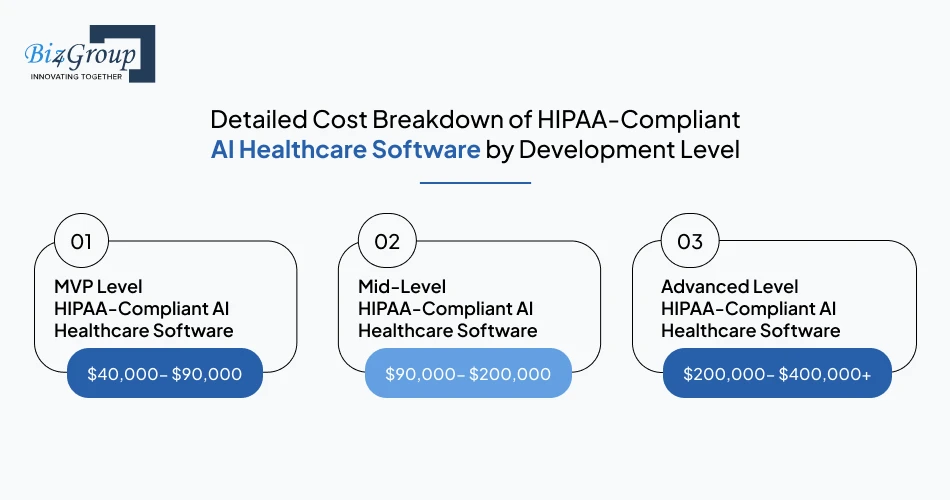
The clearest way to understand the cost breakdown to create HIPAA-compliant AI medical software is to align the budget with the stage of product maturity you actually need. The same healthcare idea can stay lean at pilot level or expand into a multi-system enterprise rollout, and that shift is what moves the investment from $40,000 to $400,000+.
Before we break each level down in detail, lets first look at how the budget typically spreads across product maturity stages.
|
Development Level |
Estimated Cost Range |
Best Fit For |
Budget Behavior |
|---|---|---|---|
|
MVP Level HIPAA-Compliant AI Healthcare Software |
$40,000- $90,000 |
workflow validation, provider usability testing |
focused compliance-safe pilot with one core workflow |
|
Mid-Level HIPAA-Compliant AI Healthcare Software |
$90,000- $200,000 |
multi-workflow automation and care-team expansion |
interoperability, dashboards, stronger governance |
|
Advanced Level HIPAA-Compliant AI Healthcare Software |
$200,000- $400,000+ |
multi-hospital, enterprise-grade rollout |
predictive workflows, cross-system orchestration, enterprise scale |
With the budget spread now clear, the next step is to understand what each maturity level includes from a delivery and compliance standpoint:
1) MVP-Level HIPAA-Compliant AI Healthcare Software
Estimated Cost Range: $40,000-$90,000
At this stage, the budget is meant to validate one focused healthcare workflow inside a secure compliance boundary. The goal is to test provider usability, patient data handling, and one outcome-driven workflow before committing to deeper automation.
Most of the budget usually flows into:
- PHI-safe workflow design and secure user access
- one focused AI healthcare analysis workflow
- limited EHR or provider system connectivity
- lightweight generative AI for summaries or notes
- audit logging, encryption, and HIPAA-ready cloud setup
Also Read: Generative AI App Development for Startups and Enterprises
2) Mid-Level HIPAA-Compliant AI Healthcare Software
Estimated Cost Range: $90,000-$200,000
This is where the product starts moving from validation into operational expansion. Budget increases because multiple workflows, care-team roles, and stronger interoperability begin entering the roadmap.
Most of the spend now expands into:
- multi-workflow automation across care teams
- stronger interoperability and FHIR layers
- patient remote monitoring system integration
- patient communication and alert modules
- stronger monitoring, testing, and workflow governance
Also Read: AI Remote Patient Monitoring App Development Guide
3) Advanced-Level HIPAA-Compliant AI Healthcare Software
Estimated Cost Range: $200,000-$400,000+
At this level, the investment supports scale across hospitals, specialties, and connected provider ecosystems. This is where the roadmap often evolves into broader enterprise AI solutions with predictive workflows and cross-department intelligence.
The higher budget is usually driven by:
- multi-location deployment and governance
- predictive AI healthcare analysis across departments
- complex care orchestration workflows
- deeper enterprise AI integrations across clinical and admin systems
- high-availability infrastructure and executive reporting
This maturity-based view makes AI healthcare software development cost with HIPAA compliance easier to justify because the budget now maps directly to where the product needs to operate next.
HIPAA-Compliant AI Healthcare Software Development Cost by Use Case
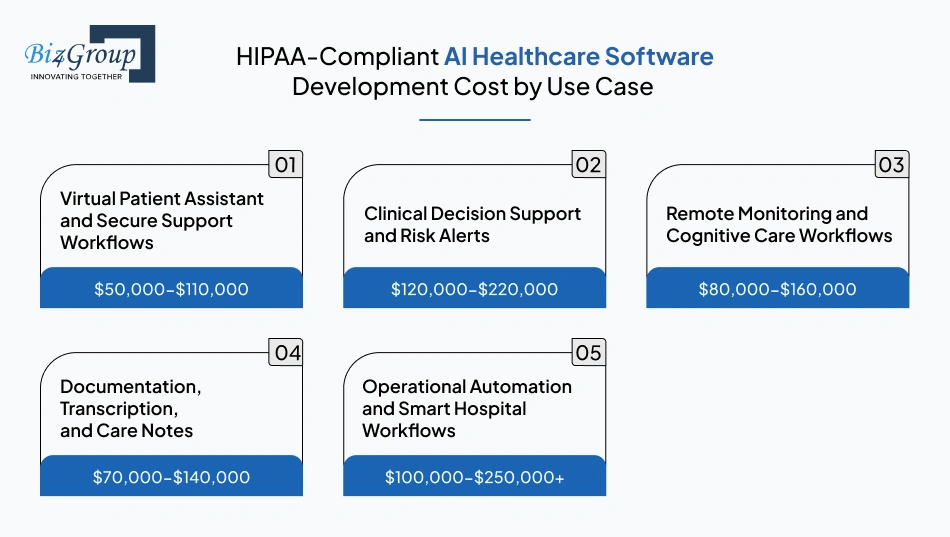
Once the product maturity level is clear, the next budgeting layer depends on the workflow you want AI to handle. This is where teams usually ask what is the total budget required to create compliant AI healthcare software solutions, because the answer changes based on what you are automating in your healthcare operations.
Let's look at cost of HIPAA compliant AI healthcare software by its use cases:
1) Virtual Patient Assistant and Secure Support Workflows
Estimated Cost: $50,000-$110,000
This budget range usually stays focused on secure conversation workflows, escalation logic, and PHI-safe interaction storage. Costs rise further when an AI healthcare virtual assistant needs provider-side visibility, multilingual support, and secure escalation across care teams.
Most of the spend typically goes into:
- secure patient chat and triage flows
- symptom escalation and care routing
- encrypted interaction history
- audit-ready provider dashboards
- role-based communication controls
Portfolio Spotlight: NVHS- AI Chatbot for Personalized Support
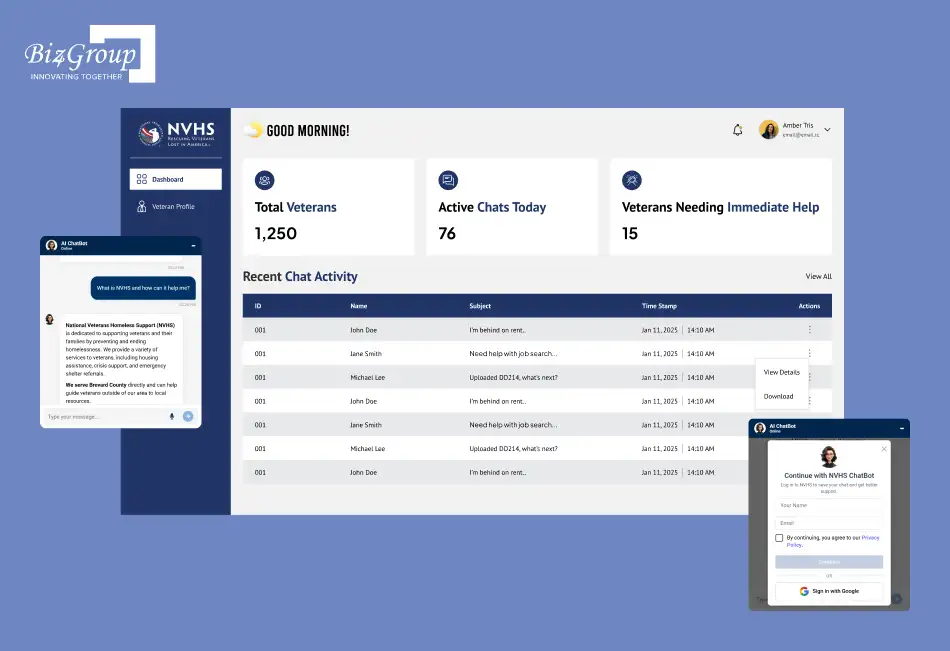
NVHS is an AI-powered virtual support assistant built to help homeless and at-risk veterans who needed fast access to healthcare and crisis assistance through voice or text.
The cost of development was controlled by aligning the process only on one conversational support journey. It focused on intent capture, crisis detection, location-based service matching, and secure case continuity through the admin dashboard. The focused chatbot architecture helped us deliver secure escalation logic and provider-side visibility without expanding the budget into broader multi-workflow healthcare systems,
Also Read: AI Virtual Assistant Development Cost
2) Clinical Decision Support and Risk Alerts
Estimated Cost: $120,000-$220,000
This use case carries higher HIPAA-compliant AI healthtech software development pricing because predictive analysis, provider dashboards, and risk scoring require stronger data pipelines and clinical transparency.
Budget is usually shaped by:
- patient risk scoring workflows
- provider dashboards and alerts
- chronic care prediction layers
- secure model output visibility
- deeper clinical data integrations
3) Remote Monitoring and Cognitive Care Workflows
Estimated Cost: $80,000-$160,000
The pricing of building AI healthcare software with compliance increases here because continuous patient data movement, journaling, alerting, and device-linked workflows expand the compliance boundary.
Most of the budget usually flows into:
- patient monitoring data pipelines
- device and wearable integrations
- memory and journaling workflows
- alert thresholds and caregiver dashboards
- secure long-term patient activity storage
Portfolio Spotlight: CogniHelp- AI-based Solution for Dementia Patients
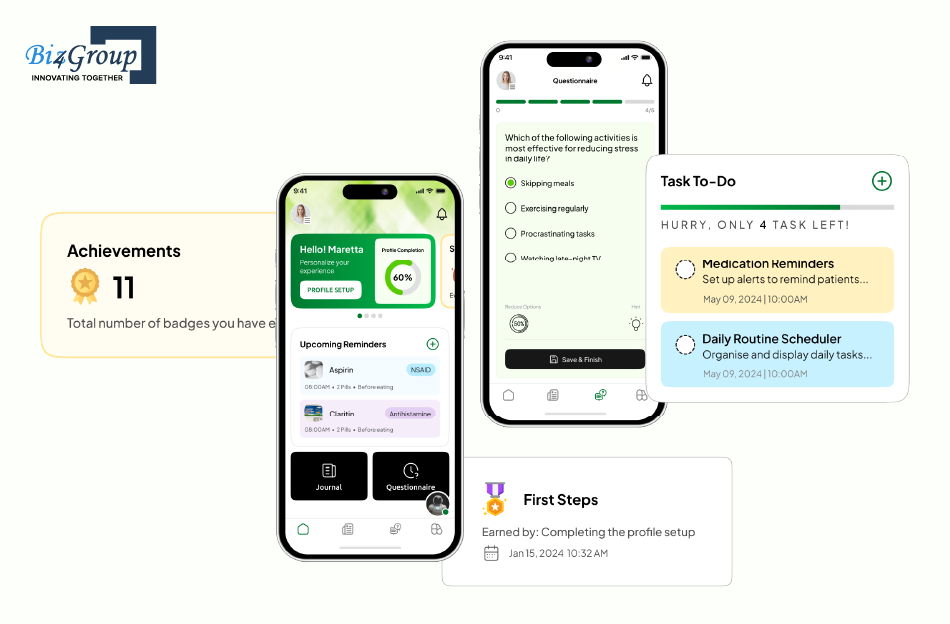
CogniHelp, is an AI-powered cognitive care app for dementia patients that supports memory reinforcement, daily journaling, emotion-aware conversations, and secure caregiver dashboards.
To keep the solution under budget, we deliberately centered the roadmap on one remote cognitive care journey instead of expanding into full hospital-side patient monitoring. This helped us direct the investment only toward journaling workflows, caregiver alerts, and secure long-term activity tracking, keeping the compliance and data-storage cost aligned with the use-case budget.
4) Documentation, Transcription, and Care Notes
Estimated Cost: $70,000-$140,000
This cost range usually increases when secure voice capture, note structuring, and compliant storage all need to work across clinician workflows. The budget rises further when systems must integrate healthcare platforms with AI EHRs for real-time record sync and provider review.
Most of the spend usually flows into:
- secure speech-to-text processing layers
- clinician note structuring and validation workflows
- SOAP note and summary generation
- EHR write-back and medical transcription sync
- audit-safe note storage and retrieval
Also Read: How to Build a Speech Recognition System With AI?
5) Operational Automation and Smart Hospital Workflows
Estimated Cost: $100,000-$250,000+
This budget range expands when AI begins handling scheduling, billing, approvals, and hospital-side coordination. Costs increase faster where agentic AI development supports adaptive routing, cross-team workflows, and real-time operational decisions.
The higher budget is usually driven by:
- scheduling and staffing automation workflows
- claims, billing, and approval routing
- cross-department workflow orchestration
- admin dashboards and reporting visibility
- adaptive decision logic for hospital operations
Also Read: How to Build Agentic AI in Healthcare
This use-case view makes the cost to develop a HIPAA compliant AI healthcare software far easier to map against real healthcare outcomes. When the workflow is clearly defined, the budget stops feeling broad and starts aligning directly with the exact clinical, documentation, or operational problem you need AI to solve next.
Is Your Use Case Budgeted Realistically Yet?
The workflow decides the budget long before engineering hours ever begin
Get a Cost ConsultationWhat Cost Factors Influence HIPAA-Compliant AI Healthcare Software Development
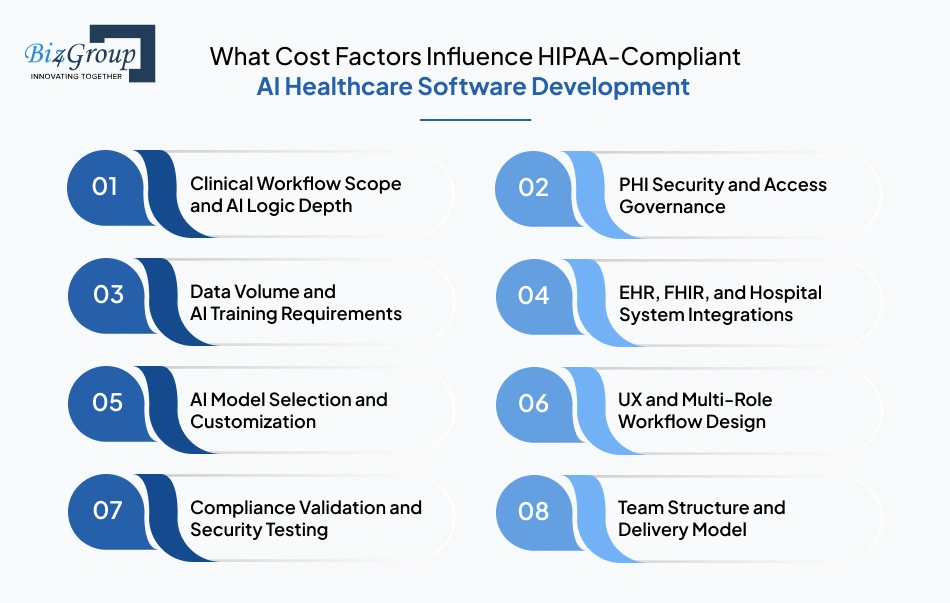
The HIPAA-compliant AI healthcare software development cost becomes easier to estimate when you isolate the decisions that directly expand scope. For hospital administrators and healthtech entrepreneurs, these cost factors are what separate a controlled roadmap from a budget that grows unpredictably.
and healthcare AI developers
1) Clinical Workflow Scope and AI Logic Depth
The number of workflows your platform supports directly affects budget because every added clinical path increases logic validation, user roles, and exception handling. A focused documentation workflow stays lean while triage, monitoring, and risk scoring together increase the engineering depth significantly. The broader the care journey, the more coordination layers must be secured and tested across the system.
Example: A single workflow may stay within $50,000-$80,000, while multi-workflow clinical support can exceed $180,000.
2) PHI Security and Access Governance
Security cost rises with the number of users, departments, and access conditions the platform must support. Role-based permissions, encryption, audit trails, and session controls all add engineering effort because every access point must be traceable and compliant. This factor becomes especially critical in provider environments where multiple teams touch the same patient workflow.
Example: Basic PHI protection may add $8,000-$15,000, while hospital-wide access governance can exceed $30,000.
3) Data Volume and AI Training Requirements
The quality and variety of healthcare data used for AI directly shape data preparation costs. More records, voice inputs, images, and longitudinal patient histories increase cleaning, labeling, validation, and retraining effort. This budget expands quickly when accuracy needs to hold across specialties, age groups, and treatment patterns.
Example: Limited structured datasets may cost $10,000-$18,000, while broader patient pipelines can cross $35,000.
4) EHR, FHIR, and Hospital System Integrations
The more systems your software needs to connect with, the more the budget shifts toward integration engineering and workflow testing. Syncing data across EHRs, FHIR endpoints, imaging systems, and billing tools requires secure field mapping and error recovery logic. This factor often becomes one of the biggest drivers for provider-side deployments.
Example: One EHR connection may add $12,000-$20,000, while multi-system interoperability can exceed $50,000.
5) AI Model Selection and Customization
Costs change depending on whether you fine-tune an existing AI model or introduce custom healthcare reasoning layers. Customization adds validation depth, performance testing, and more control over outputs, which increases development hours. This is where healthcare AI developers usually influence the roadmap most.
Example: Fine-tuning may cost $10,000-$18,000, while custom clinical reasoning layers may add $35,000+.
Also Read: Cost to Hire an AI Software Developer in 2026
6) UX and Multi-Role Workflow Design
Healthcare interfaces must reduce user friction for clinicians, care teams, and admins. The more roles the product supports, the more user journeys, dashboards, and workflow handoffs need design and testing cycles. This factor matters heavily for hospital administrators who require visibility without slowing staff workflows.
Example: Basic role UX may add $6,000-$10,000, while multi-role workflow design can exceed $22,000.
7) Compliance Validation and Security Testing
This layer includes penetration testing, audit readiness checks, access validation, and workflow traceability. The budget rises because HIPAA validation is not standard QA; it requires proof that every secure workflow behaves correctly under real provider usage conditions. For healthtech entrepreneurs, this often decides enterprise readiness.
Example: Standard compliance testing may cost $6,000-$10,000, while enterprise-grade validation can exceed $25,000.
8) Team Structure and Delivery Model
The team model directly affects speed, quality, and long-term support costs. A lean external team may control short-term spending, while a healthcare-specialized delivery partner increases upfront investment but reduces compliance and rework risks. This factor changes how predictable the roadmap stays over time.
Example: A small MVP team may stay within $60,000-$80,000, while a healthcare-focused full delivery model can exceed $150,000.
These 8 cost drivers make the cost to develop a HIPAA compliant AI healthcare software much easier to justify because every budget increase now ties back to a clear product, compliance, or delivery decision.
A Phase-Wise Cost Breakdown of HIPAA-Compliant AI Healthcare Software Development
The most practical way to understand the detailed cost to build HIPAA-compliant AI healthcare system is to follow how the budget moves across each delivery phase. This makes it easier to see where the spend stays strategic and where it starts expanding faster.
1) Discovery and Compliance Scoping
This phase budget stays focused on defining workflow boundaries, PHI scope, and early compliance assumptions. The spend remains controlled because this stage is about reducing scope mistakes before engineering starts.
Most of the budget usually goes into:
- use case and workflow scoping
- PHI boundary mapping
- compliance requirement documentation
- early solution planning
Estimated Cost: $8,000-$15,000
2) Data Risk Assessment and Planning
This phase budget increases around secure data movement, retention planning, and risk visibility. The cost expands here because future AI workflows depend heavily on how data boundaries are defined early.
Most of the spend usually flows into:
- secure data flow mapping
- storage and retention planning
- access and risk review
- dataset readiness assumptions
Estimated Cost: $10,000-$18,000
Also Read: Why AI Projects Fail in Companies That Lack AI Readiness?
3) Secure Architecture Design
This phase cost is driven by infrastructure layout, service boundaries, and cloud readiness. The budget grows here because system scale, access zones, and secure interoperability are decided at this stage.
Most of the cost usually covers:
- service architecture blueprints
- cloud and hosting layout
- system boundaries
- integration readiness planning
Estimated Cost: $12,000-$22,000
4) UI and UX Workflow Design
This budget is shaped by role-based journeys, workflow screens, and provider usability depth. The spend often rises when a UI/UX design company supports complex patient and clinician workflows.
Most of the spend usually covers:
- workflow wireframes
- clinician and patient dashboards
- role-based screen journeys
- usability validation cycles
Estimated Cost: $8,000-$16,000
Also Read: Top UI/UX Design Companies in USA
5) MVP Engineering and Validation
This is the first major engineering phase where MVP development services validate one secure healthcare workflow. Budget stays focused on proving usability and compliance before broader expansion.
Most of the budget usually goes into:
- core workflow engineering
- secure login and roles
- limited API development
- pilot validation
Estimated Cost: $25,000-$50,000
Also Read: Top MVP Development Companies in USA
6) AI and Core Functionality Expansion
This is usually the largest phase because integration of AI models, dashboards, and broader building of AI softwares workflows expand the roadmap quickly. The cost rises further when care automation and AI chatbot integration enter provider workflows.
Most of the spend usually flows into:
- workflow automation layers
- provider dashboards
- AI modules and OpenAI APIs
- care-team communication flows
Estimated Cost: $40,000-$90,000
7) Testing, Deployment, and Continuous Optimization
This final phase budget supports secure release, environment hardening, and workflow stability improvements. The spend here protects performance and compliance confidence after rollout.
Most of the cost usually covers:
- QA and compliance validation
- deployment hardening
- monitoring and logs
- early optimization cycles
Estimated Cost: $12,000-$25,000
Also Read: Software Testing Companies in USA
Quick Summary Table
|
Development Phase |
Estimated Cost |
Typical Timeline |
Budget Focus |
|---|---|---|---|
|
Discovery and Compliance Scoping |
$8,000-$15,000 |
1-2 weeks |
workflow boundaries, PHI scope, requirement clarity |
|
Data Risk Assessment and Planning |
$10,000-$18,000 |
1-2 weeks |
secure data flow, retention, risk visibility |
|
Secure Architecture Design |
$12,000-$22,000 |
2-3 weeks |
infrastructure layout, boundaries, cloud readiness |
|
UI and UX Workflow Design |
$8,000-$16,000 |
1-2 weeks |
provider journeys, patient workflows, usability |
|
MVP Engineering and Validation |
$25,000-$50,000 |
4-6 weeks |
core secure workflow, limited APIs, validation |
|
AI and Core Functionality Expansion |
$40,000-$90,000 |
6-10 weeks |
AI modules, dashboards, automation, integrations |
|
Testing, Deployment, and Continuous Optimization |
$12,000-$25,000 |
2-3 weeks |
compliance validation, release hardening, monitoring |
The phase-wise structure makes the cost to develop a HIPAA compliant AI healthcare software much easier to map because every budget layer now connects directly to a specific delivery stage.
Which Phase Is Draining Your Budget?
The biggest cost leaks usually hide between roadmap phases not inside features
Discuss Your RoadmapHIPAA-Compliant AI Healthcare Software Development Hidden Costs You Should Plan
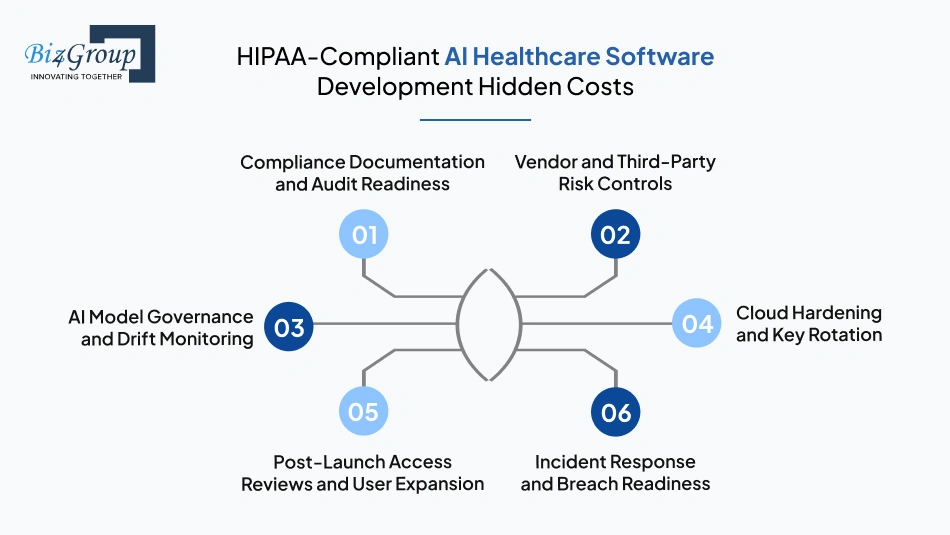
The budget usually feels predictable until the non-obvious cost layers begin surfacing after core development is scoped. This is where the cost to make AI healthcare software with HIPAA standards often expands unexpectedly, because legal, governance, and long-term operational controls introduce spend that rarely appears in early estimates.
1) Compliance Documentation and Audit Readiness
This hidden cost starts showing up when security policies, workflow evidence, and access histories must be formally documented for enterprise buyers and regulated deployments. It becomes more visible when compliance managers require proof-ready artifacts beyond product delivery.
- Policy Documentation: Security policies, audit workflows, and access evidence can quietly add $4,000-$8,000 through documentation cycles and internal reviews.
- Audit Preparation: Preparing logs, user traces, and validation reports for buyer-side due diligence may add another $3,000-$6,000.
2) Vendor and Third-Party Risk Controls
Third-party APIs, cloud vendors, and data processors often introduce extra-legal and monitoring costs after architecture decisions are finalized. These costs rise faster during custom AI healthcare software development where multiple external systems support the workflow.
- Vendor Reviews: Legal reviews, BAA alignment, and external security checks can add $5,000-$10,000 depending on vendor count.
- Ongoing Monitoring: Continuous vendor access reviews and permission validation may add $2,000-$5,000
3) AI Model Governance and Drift Monitoring
Hidden spend appears after deployment when selected AI models require retraining reviews, output audits, and safe performance checks as patient workflows evolve beyond original data assumptions.
- Model Drift Checks: Quarterly performance reviews and retraining triggers typically fall in the $4,000-$7,000
- Output Validation: Human review workflows for sensitive recommendations usually stay within $3,000-$6,000.
4) Cloud Hardening and Key Rotation
The infrastructure layer brings recurring hidden costs tied to secrets lifecycle controls, encrypted backups, and recovery readiness. These costs become more visible for healthcare IT leaders handling multi-team access.
- Key Rotation: Secrets management and secure key lifecycle controls usually stay around $2,000-$4,000 yearly.
- Backup Controls: Encrypted recovery testing and backup governance often sit within $3,000-$6,000.
5) Post-Launch Access Reviews and User Expansion
As provider teams expand, access matrices, workflow permissions, and audit visibility begin creating operational costs that were outside the early rollout estimate.
- Role Expansion: New user groups and permission matrix updates generally stay in the $3,000-$5,000
- Workflow Reviews: Quarterly access reviews and activity trace checks often remain within $2,000-$4,000.
6) Incident Response and Breach Readiness
Even secure systems need a reserve budget for escalation workflows, response playbooks, and breach simulation drills before enterprise-wide rollout.
- Response Planning: Escalation workflows and response playbooks usually remain around $4,000-$7,000.
- Simulation Drills: Internal containment drills and response readiness checks often sit within $2,000-$5,000.
The real budget risk is not the visible roadmap, but the costs that start surfacing after deployment, audits, and team expansion. Planning these hidden layers early keeps the cost to build secure AI healthcare software with HIPAA compliance realistic and prevents avoidable budget pressure later in the lifecycle.
Cost Optimization Strategies That Help Reduce the Budget of HIPAA-Compliant AI Healthcare Software
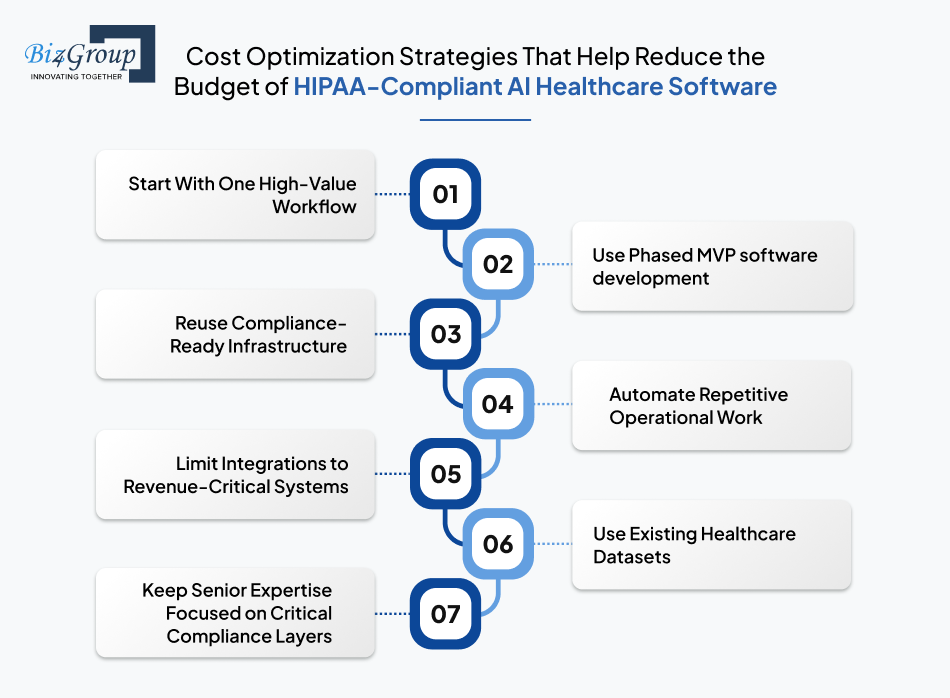
The budget becomes easier to control when cost-saving decisions are made at the roadmap level instead of after engineering begins. If you're also wondering how to reduce cost when developing HIPAA-compliant healthcare software?
Then the answer lies in reducing rework, limiting avoidable integrations, and validating the right workflow depth before the roadmap expands. Have a look:
1) Start With One High-Value Workflow
The fastest way to reduce waste is to limit the first release to one workflow that directly proves provider value. This keeps the cost to create HIPAA-compliant AI healthcare software tied to measurable adoption instead of broad feature assumptions.
A practical way to keep the spend controlled is to focus on:
- one documentation, triage, or patient communication workflow
- role-based access only for essential user groups
- limited PHI movement and smaller validation scope
Cost Savings: This strategy usually keeps 12%–18% of avoidable spend under control, which often protects $12,000–$18,000 in a $100,000 roadmap.
2) Use Phased MVP software development
A phased rollout for MVP software development prevents budget leakage caused by full-scale engineering before provider validation. This is especially effective for healthcare startup founders trying to prove workflow-market fit without overcommitting infrastructure spend.
The budget stays leaner when the first release focuses on:
- core secure workflow only
- limited integrations and dashboards
- feedback-led expansion after provider validation
Cost Savings: A staged rollout generally improves budget efficiency by 15%–20%, translating to roughly $15,000–$20,000 saved on a $100,000 project.
Also Read: How to Build AI EHR MVP for Healthcare Businesses
3) Reuse Compliance-Ready Infrastructure
A large portion of cost overruns comes from rebuilding security controls that can be standardized. Reusing audit trails, access controls, and encryption templates helps reduce repeated compliance engineering.
This optimization usually works best through:
- reusable access governance modules
- standardized audit logging layers
- shared encryption and secrets workflows
Cost Savings: Reusing proven security and audit layers typically preserves 8%–12% of the budget, or nearly $8,000–$12,000 on every $100,000 implementation.
4) Automate Repetitive Operational Work
Manual operational workflows quietly increase long-term budget pressure. This is where AI automation tools reduce repeated support, routing, and internal monitoring costs.
Budget efficiency improves when you automate:
- access review reminders
- workflow alerts and escalations
- recurring documentation checks
Cost Savings: Operational automation often lowers recurring engineering and support spend by 10%–14%, which can protect around $10,000–$14,000 in a $100,000 build.
5) Limit Integrations to Revenue-Critical Systems
AI integrations expand cost faster than most teams expect, especially during early rollout. Keeping only business-critical systems in scope helps avoid integration-heavy rework.
This usually means prioritizing:
- EHR or FHIR essentials only
- one billing or reporting dependency
- staged AI integration services after validation
Cost Savings: Keeping integrations tightly controlled can prevent 10%–16% of unnecessary expansion costs, equal to nearly $10,000–$16,000 on a $100,000 scope.
Also Read: Cost of Implementing AI in Healthcare
6) Use Existing Healthcare Datasets
A large part of unnecessary spending comes from collecting and preparing more patient data than the first workflow actually needs. Keeping early AI model raining limited and already structured datasets helps reduce labeling, cleaning, and retraining costs.
This keeps the budget optimized by focusing on:
- limited workflow-specific training datasets
- staged data expansion after validation
- controlled retraining cycles based on real usage
Cost Savings: Restricting early AI training to one workflow usually reduces data preparation and retraining costs by 9%–13%, preserving roughly $9,000–$13,000 on a $100,000 roadmap.
7) Keep Senior Expertise Focused on Critical Compliance Layers
Budget often slips when high-cost senior resources stay involved in lower-complexity execution work. The smarter optimization is to keep senior architects and compliance specialists focused only on access controls, PHI workflows, and high-risk decision paths.
This improves cost efficiency through:
- senior review only for critical workflows
- lean execution teams for repeatable modules
- specialist checkpoints instead of full-cycle dependency
Cost Savings: Better senior resource allocation typically improves delivery efficiency by 7%–11%, which often translates into $7,000–$11,000 saved on a $100,000 engagement.
A Quick Recap
|
Optimization Strategy |
Primary Budget Benefit |
Estimated Savings |
|---|---|---|
|
Start With One High-Value Workflow |
reduces unnecessary feature scope and validation waste |
12%–18% |
|
Use Phased MVP Rollout |
prevents early overengineering and infra overspend |
15%–20% |
|
Reuse Compliance-Ready Infrastructure |
cuts repeated security and audit engineering |
8%–12% |
|
Automate Repetitive Operational Work |
lowers recurring support and workflow review costs |
10%–14% |
|
Limit Integrations to Revenue-Critical Systems |
avoids unnecessary API and sync complexity |
10%–16% |
|
Use Existing Healthcare Datasets |
controls data preparation and retraining scope |
9%–13% |
|
Focus Senior Expertise on Critical Compliance Layers |
improves specialist resource efficiency |
7%–11% |
For healthcare business owners, the real savings come from reducing unnecessary scope before it turns into engineering effort. That is how you build compliant AI healthcare software without overspending while still protecting long-term scale and compliance confidence.
Still Paying for Preventable Engineering Rework?
Smarter rollout choices often save more than feature cuts ever can
Optimize My BudgetHow Biz4Group Reduces HIPAA AI Software Development Cost Without Compromising Compliance?
When teams ask how to create HIPAA-compliant AI healthcare software within budget, the answer usually depends on how early scope discipline, workflow focus, and reusable compliance layers enter the development roadmap. That is exactly where Biz4Group LLC defines the standards.
In our experience as a healthcare software development company, cost stays controlled when we align the product around one measurable healthcare outcome before expanding the PHI boundary. Here's the proof:
1) Dr. Ara: AI-Powered Athletic Health Solution

Dr. Ara is an AI-powered athletic health intelligence platform that enables users to upload blood reports, receive AI-led interpretation, and get personalized guidance around nutrition, sleep, and recovery.
By keeping Dr. Ara focused on one tightly scoped, high-impact workflow, we were able to keep the budget under control from the start. The PHI boundary stayed limited to uploaded reports and health tracking instead of expanding into broad hospital interoperability. This kept compliance and validation costs far more manageable while allowing the solution to scale gradually after proven returns.
2) Dr. Truman's Avatar: Bringing Personalized Wellness to Life with AI
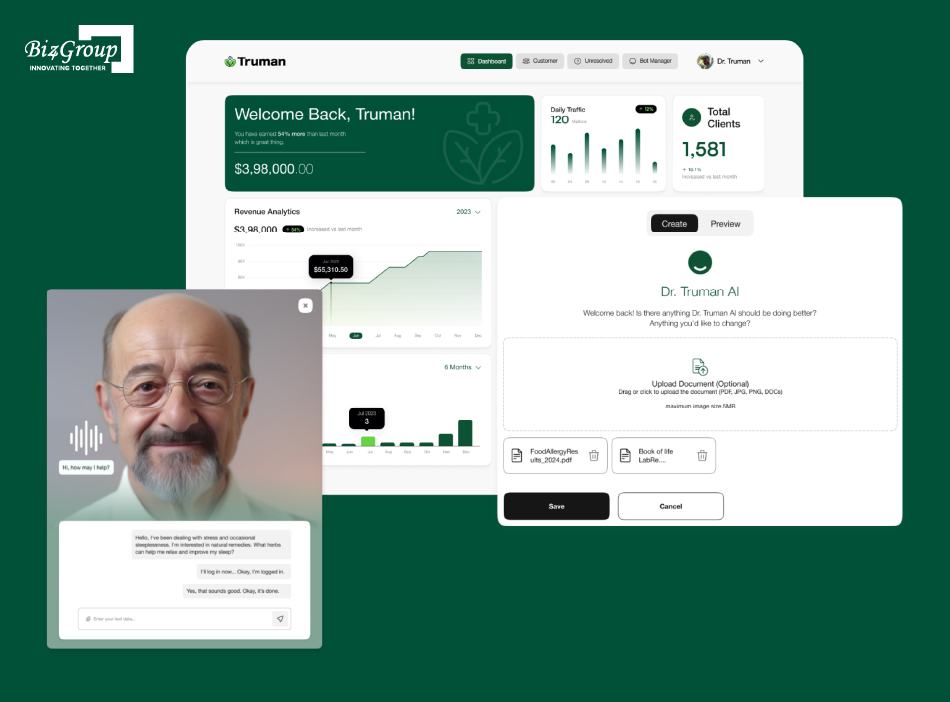
Truman is an AI-powered avatar wellness platform that enables users to interact with a lifelike AI health avatar. The AI avatar delivers personalized supplement recommendations, helps users maintain a secure health history, and supports seamless membership and product transactions within one connected system.
By consolidating consultations, commerce, and user data into a shared architecture, we kept recurring engineering and maintenance costs under control. This reduced duplicated workflow logic, limited repeated validation across disconnected tools, and made long-term scaling far more budget efficient.
This is the same cost discipline we use to reduce the cost to develop HIPAA-compliant AI healthcare software. Keeping consultations, secure health data, and transactions inside one connected workflow help reduce recurring engineering effort by lowering repeated compliance checks and keeping maintenance budgets under control.
What Does Cost Discipline Look Like?
Our healthcare AI delivery model keeps compliance aligned without bloating long-term budgets
Talk to Biz4GroupConclusion
When planning HIPAA compliant AI healthcare software, the real decision is rarely about numbers alone. It is about how confidently you can align compliance, workflow value, and long-term product growth without letting the budget drift into avoidable rework.
This pricing guide to develop HIPAA-compliant AI healthcare software in 2026 will help you think more clearly, not just as a cost estimate, but as a roadmap for making smarter product decisions with the right AI development company. At Biz4group LLC, the most successful healthcare AI products begin with a controlled scope, secure workflow boundaries, and budget discipline that supports measurable outcomes.
When those foundations are set early, compliance becomes easier to sustain, and cost stays aligned with business goals. If you are planning to create secure AI healthcare software with HIPAA and want the roadmap to stay practical from day one, talk to us for shaping the right budget around outcome you need to deliver.
FAQ's
1) Can I Outsource HIPAA-Compliant AI Healthcare Software Development Without Increasing Compliance Risk?
Yes, but the real cost impact depends on whether the delivery partner already has healthcare workflow experience, PHI-safe engineering standards, and reusable compliance controls. For CTOs and compliance managers, outsourcing usually becomes budget-efficient when the team can reduce rework, shorten audit preparation, and avoid architecture mistakes that inflate long-term cost.
2) How Does Team Structure Affect the Cost to Develop a HIPAA-Compliant AI Healthcare Software?
The delivery model changes both speed and budget predictability. A lean cross-functional team keeps the early roadmap efficient, while larger specialist teams increase upfront cost but reduce risk for enterprise healthcare rollouts. For healthcare startup founders, the right structure is the one that matches compliance depth with release maturity.
3) What Is the Ongoing Ownership Cost After Launching HIPAA-Compliant AI Healthcare Software?
The first release budget is only part of the financial picture. Long-term ownership includes compliance audits, model monitoring, cloud hardening, access reviews, and workflow updates. For hospital administrators and healthcare IT leaders, this recurring layer often ranges between 15%–20% of the initial annual build cost.
4) How Long Does It Usually Take to Reach ROI on HIPAA-Compliant AI Healthcare Software?
Return on investment usually depends on how quickly the software reduces documentation load, operational delays, or provider-side inefficiencies. For clinic owners and enterprise decision makers, focused workflows like AI documentation or patient routing often start showing measurable ROI within 6–12 months.
5) Is Custom AI Always Better Than Using Existing Healthcare AI Models?
Not always. The cost decision depends on whether the workflow needs healthcare-specific reasoning, explainability, or unique provider logic. For digital health companies, adapting existing secure models often keeps the HIPAA-compliant AI healthcare software development cost lower during early rollout, while custom models become more valuable after workflow validation.
6) How Do Multi-Region Rollouts Change HIPAA-Compliant AI Healthtech Software Development Pricing?
Budget expands significantly when the HIPPA-compliant AI healthcare software must support multiple hospitals, care networks, or regions with different governance and infrastructure rules. Enterprise decision makers should expect higher spend around access segmentation, deployment environments, audit controls, and legal review when scaling beyond a single provider ecosystem.
