Location :
Orlando, FL, USA
Location :
Orlando, FL, USA +1 (407) 714-1616
 info@biz4group.com

















Imagine a digital system that doesn’t wait for instructions but instead, understands your business goals, learns from real-time feedback, and takes independent actions to get the job done.
Read More

 AI Summary Powered by Biz4AI
Disclaimer: This content is informational only and should not be considered medical, legal, or compliance advice.
How confidently can you improve population health outcomes when critical patient information is scattered across different systems, departments, and care teams?
Many healthcare organizations are facing exactly this challenge. Population health initiatives often struggle because teams are working with fragmented patient records, delayed insights, and limited visibility into who needs intervention before a health issue becomes more serious. When data is difficult to connect and analyze at scale, identifying high-risk populations becomes far more complicated than it should be.
This is where AI population health management software enters the conversation. By bringing together data from multiple sources and turning it into actionable intelligence, these platforms help healthcare organizations uncover risks earlier, prioritize care efforts, and make more informed decisions across patient populations.
Now, why do we propose this solution?
The answer lies in how rapidly healthcare is embracing AI-driven decision-making. Physician adoption of AI increased from 47% in April 2025 to 63% in January 2026 and has now reached 94%, reflecting growing confidence in AI's ability to support clinical and operational workflows.
Healthcare leaders are increasingly looking for solutions that can help them:
With that laid down on table, this guide will walk you through how to develop AI population health management software for hospitals and healthcare systems step by step. Let's dive in.
AI population health management software is a healthcare technology solution designed to help organizations analyze patient populations, identify emerging health risks, uncover care gaps, and support proactive interventions. Instead of simply collecting information, it continuously evaluates clinical, operational, and behavioral data to help care teams focus on the patients who may benefit most from timely outreach and treatment.
Traditional population health management platforms primarily rely on historical reporting and predefined rules to track patient populations. While these systems provide visibility into past and current performance, they often require significant manual effort to identify patterns and prioritize interventions.
AI-enabled population health platforms take this a step further by applying machine learning and predictive analytics to large volumes of healthcare data. Rather than waiting for issues to surface, they help organizations recognize risk patterns earlier and support more informed decision-making across patient populations.
At a high level, these platforms are designed to help healthcare organizations:
The ultimate goal is not simply to generate more data or reports. It is to help healthcare organizations move from reacting to health events toward anticipating them, enabling more coordinated and effective population health strategies.
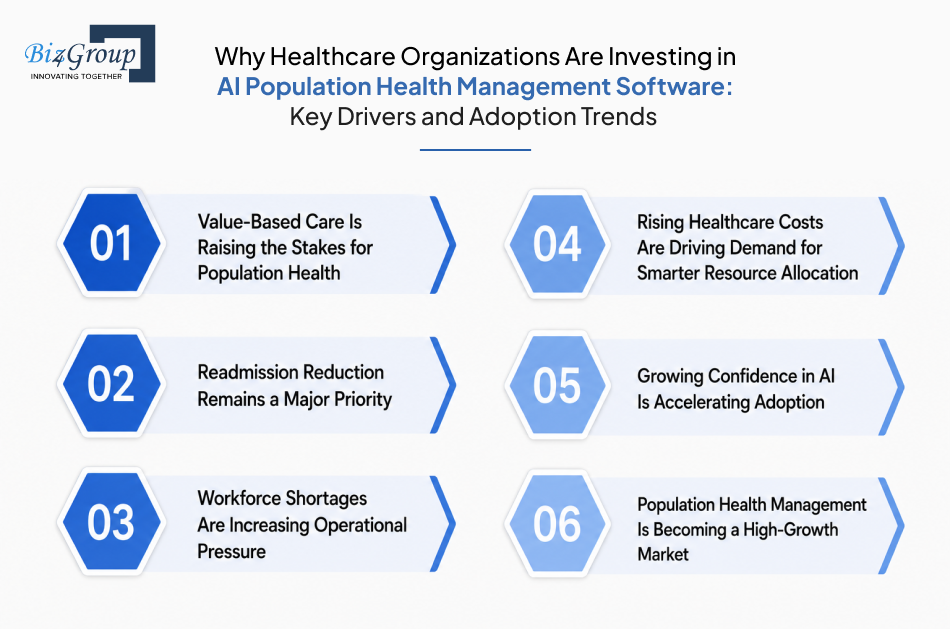
By now, we know the challenges healthcare organizations face when managing large patient populations and how data-driven systems can help address them. But another question naturally follows: why are so many healthcare leaders developing AI-driven population health management software, and what is driving investment decisions across the industry?
Healthcare organizations are increasingly being measured on outcomes rather than the volume of services delivered. As value-based care programs expand, providers are under greater pressure to improve patient outcomes, close care gaps, and reduce preventable utilization. This has made population health management a strategic priority for organizations looking to improve performance across large patient groups.
To support these goals, healthcare leaders are focusing on:
Avoidable readmissions continue to create financial and operational challenges for healthcare organizations. Many hospital systems are looking for better ways to identify patients who may require additional support after discharge and intervene before complications lead to another admission.
This growing focus on proactive patient management is pushing organizations to invest in solutions that help care teams act earlier and coordinate follow-up care more effectively.
Healthcare teams are being asked to manage larger patient populations while dealing with staffing constraints across multiple departments. As workloads increase, manually reviewing records and prioritizing interventions becomes more difficult.
Organizations are searching for ways to:
Controlling costs has become a critical objective for healthcare organizations, especially as patient populations become more complex. Leaders are looking for strategies that help direct resources toward the patients and communities that need them most.
This focus is supported by growing evidence around operational efficiency. McKinsey estimates physician groups could achieve annual savings of $20 billion to $60 billion through workflow optimization, predictive care management, and automation. Not only that, but private payers could also realize annual savings of $80 billion to $110 billion through the implementation of such initiatives.
Investment decisions are also being influenced by changing perceptions among clinicians. According to American Medical Association in 2026, more than three-quarters of physicians reported that AI improves their ability to care for patients, up from 65% in 2023.
As confidence continues to grow, healthcare organizations are becoming more comfortable building AI population health management platform with analytics to support broader population health strategies.
The scale of investment across the industry reflects the urgency of these challenges. The global population health management market was valued at USD 103.6 billion in 2025 and is projected to grow from USD 126.2 billion in 2026 to USD 514.1 billion by 2033, representing a CAGR of 22.2%. North America accounted for 46.0% of the global market in 2025, highlighting the region's continued focus on population health innovation.
Therefore, the momentum behind AI population health management software is being driven by operational realities, financial pressures, and changing care delivery expectations.
See how a population health platform can spot care gaps before they become costly problems.
Assess Your Population Health ReadinessOne concern consistently surfaces whenever healthcare leaders evaluate population health initiatives. "I am running a multi-site health system, and our patient data is scattered across different EHRs, departments, and care settings. How does AI population health management software unify this fragmented data into a single, usable patient record?"
It is a practical question because identifying at-risk patients starts with having a complete and reliable view of the people you serve. Understanding how the AI population health management platform addresses this challenge helps explain what happens behind the scenes before predictions, recommendations, and interventions can take place
Before any prediction can be made, the platform must collect information from multiple sources that often operate independently across a healthcare organization. This data typically arrives in different formats and at different times, making consistency a challenge from the start.
Common data sources include:
One implementation reality many organizations encounter is that accessing data is often easier than matching it correctly to the right patient across multiple systems.
Also Read: A Complete Guide to AI EMR/EHR Software Development
Once data enters the platform, it goes through a normalization process that organizes information into a consistent structure. Without this step, the same patient could appear differently across separate records, leading to incomplete analysis.
This stage focuses on:
Many healthcare leaders initially assume predictive models are the most difficult part of the project. In practice, preparing and organizing data often requires significantly more effort than expected.
After normalization, the system assembles a comprehensive patient profile by combining information from all available sources. Rather than viewing encounters as isolated events, care teams gain a broader picture of an individual's health journey.
A unified profile may include:
This consolidated view creates the foundation for more meaningful analysis and decision-making.
Once patient profiles are established, predictive analytics begins examining patterns that may indicate future health concerns. This is where organizations start seeing the practical impact of using AI for population health management.
The system evaluates:
A properly trained AI model does not simply flag patients based on a single factor. It evaluates combinations of signals that may suggest an increased likelihood of hospitalization, complications, or other adverse outcomes.
Predictions alone rarely drive adoption. Clinicians need to understand why a patient has been identified as high risk before they can confidently act on the recommendation.
To support trust, modern platforms typically provide:
Another implementation reality is that organizations often achieve stronger adoption when clinicians remain part of the decision-making process rather than treating AI recommendations as final decisions.
The workflow behind population health platforms is ultimately about turning fragmented healthcare information into meaningful insights that clinicians can understand and act upon. As healthcare organizations look to develop AI population health management software, success often depends as much on data quality and trust as it does on predictive accuracy.
Many healthcare organizations reach a point where they understand the value of population health initiatives but still face an important decision: which capabilities are genuinely essential and which ones simply add complexity?
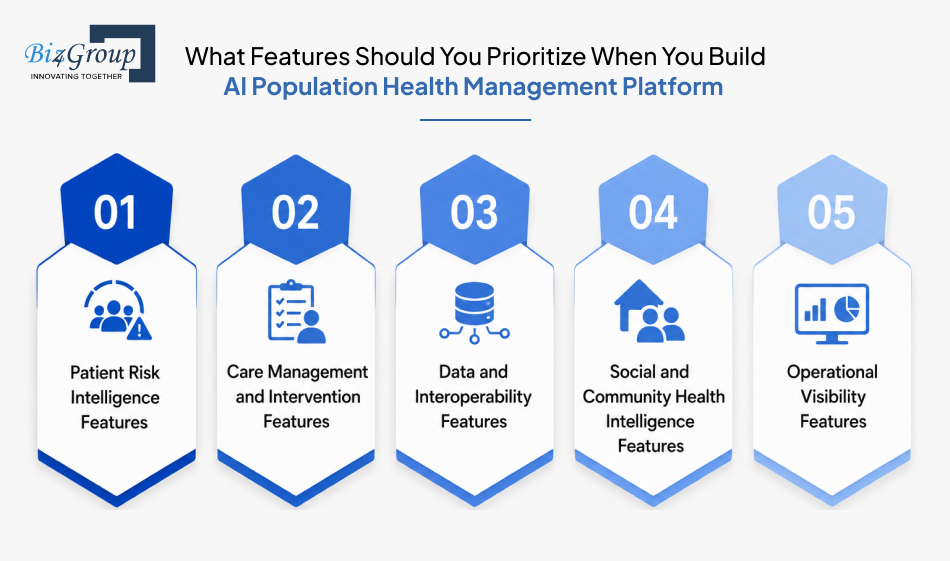
Before you build AI population health management platform, let's focus on features that directly support population-level visibility, prioritization, and care coordination.
These capabilities form the analytical foundation of the platform. They help organizations identify which patients may require attention, monitor changing risk patterns, and support more informed population health decisions.
Feature |
Purpose |
|---|---|
Risk Stratification |
Categorizes patients based on health risk levels to support prioritization efforts |
Predictive Analytics |
Identifies patterns that may indicate future health events or utilization risks |
Population Segmentation |
Groups patients based on clinical, behavioral, demographic, or utilization characteristics |
Disease Progression Monitoring |
Tracks changes in patient health status over time to support proactive interventions |
Identifying risk is only part of the process. Healthcare organizations also need visibility into care opportunities and the ability to coordinate actions across teams and settings.
Feature |
Purpose |
|---|---|
Care Gap Detection |
Identifies missed screenings, preventive services, and follow-up care opportunities |
Care Coordination Workflows |
Supports collaboration between care managers, clinicians, and support teams |
Intervention Prioritization |
Highlights patients who may benefit from immediate outreach or care management efforts |
Patient Outreach Management |
Organizes and tracks engagement activities across targeted populations |
Population health initiatives depend heavily on access to complete and reliable information. These features help ensure that data can be brought together and used consistently across the organization.
Feature |
Purpose |
|---|---|
Connects patient information from multiple EHR environments |
|
Claims Data Integration |
Combines clinical and financial information for broader population visibility |
Data Normalization |
Standardizes information received from different systems and formats |
Unified Patient Profiles |
Creates a consolidated patient record from multiple data sources |
Also Read: Top 10 AI EHR Software Development Companies in USA
Healthcare outcomes are influenced by factors that extend beyond clinical encounters. Organizations managing diverse populations often require additional visibility into these external influences.
Feature |
Purpose |
|---|---|
SDOH Analytics |
Evaluates social and environmental factors that may impact patient outcomes |
Community Risk Mapping |
Identifies population-level trends within specific geographic areas |
Vulnerability Identification |
Highlights populations facing elevated social or access-related challenges |
Resource Referral Tracking |
Monitors connections between patients and community-based support services |
As population health programs expand, leaders need a reliable way to monitor performance, track priorities, and maintain visibility across large patient populations.
Feature |
Purpose |
|---|---|
Population Health Dashboards |
Provides a centralized view of patient population performance and risk trends |
Care Management Reporting |
Tracks ongoing population health activities and intervention progress |
Utilization Monitoring |
Identifies patterns related to admissions, emergency visits, and healthcare utilization |
Outcome Tracking |
Measures changes across targeted patient populations over time |
Not every organization requires the same feature set from day one for AI population health management software. The most effective approach is to align capabilities with your population health goals, data environment, and care delivery model rather than pursuing the longest feature list available.
Across healthcare leadership teams, investment discussions often move beyond capabilities and into outcomes. One concern that we have frequently seen surfacing is: "I am a hospital administrator, who needs to justify the investment in AI population health management software to the board. I want to know what measurable benefits other health systems have achieved."
Well, here are the operational, financial, and strategic values behind AI population health management software that will help you justify the investment:
Unplanned readmissions create pressure on care teams, increase costs, and can impact performance metrics. Organizations that identify high-risk patients earlier are often better positioned to coordinate follow-up care before complications escalate.
The impact extends beyond patient transitions and influences several areas:
Many health issues become significantly more difficult to manage once they progress. Earlier visibility into emerging risks allows healthcare organizations to engage patients before conditions require intensive interventions.
For leadership teams, this often translates into:
Population health initiatives often involve multiple departments, facilities, and care teams. When coordination improves, organizations gain a clearer understanding of who is responsible for interventions and follow-up activities.
This creates value by helping organizations:
Healthcare organizations continue to face growing pressure to improve financial performance while maintaining quality standards. Better visibility into patient needs helps direct resources toward areas where they can have the greatest impact.
This can contribute to:
One challenge many organizations face is determining where limited staff time should be focused. When priorities become clearer, teams can spend less time searching for information and more time acting on it.
Operational improvements often include:
Quality metrics continue to play an important role in reimbursement models, reporting requirements, and organizational performance assessments. Healthcare leaders need reliable ways to monitor and improve these measures across large populations.
Benefits frequently include:
The strongest results come from improving how organizations identify risk, coordinate care, allocate resources, and support long-term performance goals. This broader operational impact is why many organizations continue investing in AI population health management software as part of their larger healthcare transformation and enterprise AI solutions strategy.
Turn fragmented patient data into actionable insights that care teams can actually use.
Map Your AI Population Health Strategy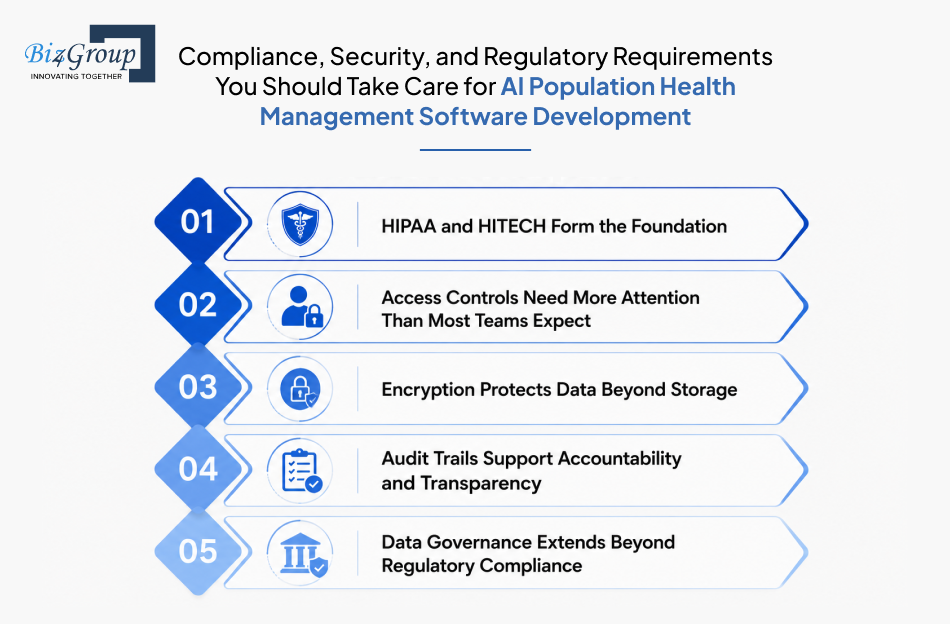
As organizations move closer to implementation, attention often shifts from capabilities to accountability. Conversations around developing AI population health software with compliance and HIPAA regulations usually begin with security requirements, but successful deployments depend just as much on governance, access management, and operational discipline. Let's understand them one at a time:
Population health platforms handle large volumes of protected health information, making HIPAA and HITECH compliance fundamental requirements rather than optional considerations. These regulations establish expectations around privacy, security, data sharing, and breach response.
For healthcare leaders, compliance starts with understanding how patient information is collected, stored, accessed, and monitored throughout the organization. Many organizations focus heavily on data protection while overlooking the processes that govern how information moves between teams and systems.
One lesson that frequently emerges during HIPAA compliant software initiatives is that access management becomes increasingly complex as more departments, providers, and external stakeholders interact with the platform.
Role-based access controls help ensure individuals only see information relevant to their responsibilities. Without clear governance, organizations can unintentionally create excessive access privileges that increase compliance risks and complicate audits.
This is often one of the most underestimated areas during the planning phase.
Also Read: HIPAA Compliant AI App Development for Healthcare
Patient information should remain protected whether it is being stored, transmitted, or accessed across healthcare environments. Encryption helps reduce exposure risks and supports stronger security practices throughout the platform lifecycle.
Many organizations initially view encryption as a technical requirement. In practice, it serves as an important safeguard that helps maintain trust between patients, providers, and healthcare organizations.
Healthcare leaders need visibility into who accessed information, what actions were performed, and when those activities occurred. Audit trails create this accountability by maintaining a record of user activity across the platform.
These records become particularly valuable during investigations, compliance reviews, and internal governance assessments. Organizations that implement strong auditing practices are often better prepared to identify unusual activity before it becomes a larger issue.
Population health initiatives rely on information from multiple sources, making data governance a critical responsibility. Governance policies help define ownership, quality standards, retention requirements, and acceptable data usage practices.
A common mistake is assuming governance becomes important after deployment. In reality, unclear ownership and inconsistent data management practices can create challenges long before a platform goes live.
Across healthcare software initiatives, several patterns appear repeatedly. At Biz4Group LLC with projects such as Truman, Dr. Ara, and CogniHelp some of the lessons that were learned the hard way include:
Strong compliance programs are rarely the result of a single security control. They emerge from consistent governance practices applied throughout the entire lifecycle of the platform.
Meeting regulatory requirements involves far more than satisfying a checklist. Healthcare organizations that invest in governance, accountability, and oversight are better positioned to deploy AI population health management software that supports both innovation and long-term trust.
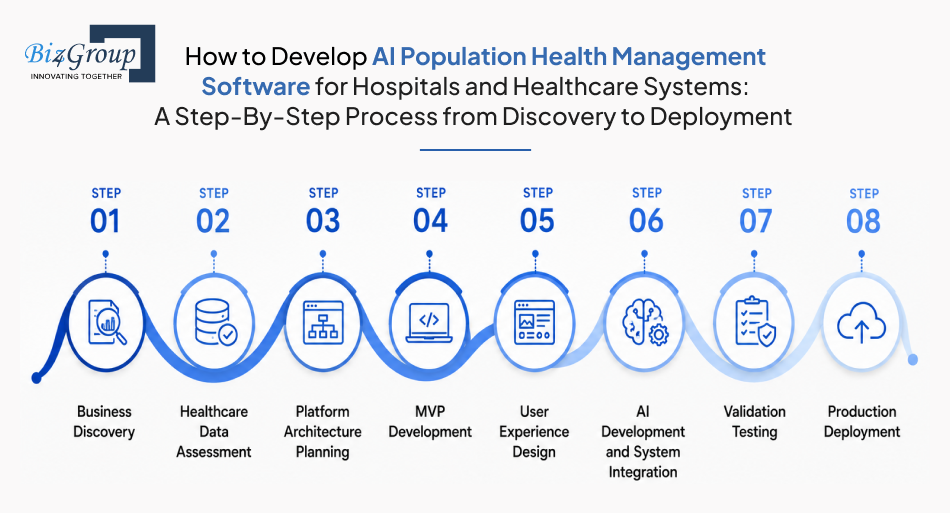
A successful population health platform is rarely the result of a single development effort. Healthcare organizations often discover that the biggest challenges emerge long before deployment, particularly around data readiness, workflow alignment, and system integration. Understanding how each phase contributes to AI population health management software development and helps establish realistic expectations from the outset.
Every project starts by defining the population health objectives the platform is expected to support. This stage focuses on understanding patient populations, operational priorities, reporting requirements, and care management workflows.
Key deliverables typically include:
A common bottleneck at this stage is stakeholder alignment. Different departments often have different expectations regarding what the platform should accomplish.
Before any development work begins, organizations need a clear understanding of the data that will power the platform. This assessment identifies available data sources, quality issues, gaps, and integration requirements.
The assessment generally evaluates:
This phase frequently consumes more time than anticipated because healthcare data is often fragmented across multiple systems and departments. In many projects, data readiness consumes more effort than organizations initially allocate during planning.
Once data readiness is established, the project moves into architecture planning. The goal is to define how information will move across the platform while supporting future scalability, governance requirements, and operational workflows.
Key outputs include:
Organizations commonly underestimate the amount of planning required during this stage. Architectural decisions made here often influence long-term flexibility, future integrations, and overall platform performance.
With requirements and architecture in place, development teams begin building the first functional version of the platform. Many healthcare organizations prefer validating core workflows before expanding into broader functionality.
This stage often involves collaboration with teams providing MVP development services to ensure early releases align with real operational requirements.
Primary deliverables include:
The objective is to validate usability, workflows, and operational fit before larger investments are made.
Also Read: Top MVP Development Companies in USA
Population health platforms serve multiple user groups, including clinicians, care managers, administrators, and operational leaders. User experience planning ensures each group can efficiently access the information needed to perform their responsibilities.
This stage typically focuses on:
Many healthcare organizations engage a specialized UI/UX design company because adoption challenges often stem from workflow friction rather than missing functionality.
Also Read: Top UI/UX Design Companies in USA
After the platform foundation is established, attention shifts toward predictive capabilities and connectivity across healthcare systems. This phase combines model creation with integration activities because both must work together to deliver meaningful outcomes.
Activities commonly include:
Successful AI model development requires close collaboration between technical teams and healthcare stakeholders to ensure outputs remain clinically relevant and operationally useful. At the same time, AI model integration ensures predictions can be embedded into existing workflows rather than operating as a disconnected analytical layer.
This phase is often one of the most time-consuming stages of the project. Healthcare organizations frequently discover that connecting and standardizing data across multiple systems requires more effort than expected.
Before deployment, the platform undergoes extensive validation to ensure reliability, usability, accuracy, and security. The goal is to identify issues before users begin relying on the system for decision-making.
Testing activities commonly include:
Many organizations work alongside experienced internal teams or external software testing companies to strengthen quality assurance efforts before launch.
Also Read: Top AI Software Development Companies in USA 2025
Deployment introduces the platform into live healthcare operations. The focus shifts from development activities to user onboarding, operational monitoring, workflow adoption, and long-term support.
Deployment deliverables generally include:
One of the most underestimated challenges during deployment is change management. Even well-designed platforms require structured onboarding and adoption strategies to achieve their intended impact.
Every phase plays a distinct role in the success of the platform. Organizations that invest sufficient time in discovery and adoption planning are typically better positioned to create AI population health management software that aligns with clinical workflows, operational priorities, and long-term population health goals.
Technology decisions often influence how well a population health platform scales, integrates, and performs over time. While healthcare leaders do not need to evaluate every technical detail, knowing the major components behind AI population health management software development helps create more informed conversations with internal teams and technology partners.
Architecture Layer |
Recommended Tools |
Purpose |
|---|---|---|
User Interface Layer |
React.js, Next.js |
Supports clinician dashboards, care management portals, and responsive healthcare applications through modern ReactJS development and NextJS development practices. |
Application Layer |
Node.js, NestJS |
Manages business workflows, user actions, permissions, and platform operations through scalable NodeJS development. |
API Layer |
REST APIs, GraphQL, FastAPI |
Enables secure communication between healthcare systems, third-party platforms, and internal services through structured API development. |
AI & Machine Learning Layer |
Python, TensorFlow, PyTorch, Scikit-learn |
Supports predictive analytics, patient risk modeling, and population health intelligence using healthcare-focused Python development capabilities. |
Clinical Data Processing Layer |
Apache Spark, Databricks |
Processes large volumes of healthcare data from multiple sources for analysis and model training. |
Data Integration Layer |
Mirth Connect, Apache Kafka, MuleSoft |
Connects EHRs, claims systems, laboratory systems, RPM devices, and external healthcare data sources. |
Interoperability Layer |
HL7, FHIR APIs |
Enables standardized healthcare data exchange across different healthcare systems and vendors. |
Operational Database Layer |
PostgreSQL, MySQL |
Stores structured patient, operational, and platform data required for day-to-day activities. |
Data Warehouse Layer |
Snowflake, Amazon Redshift, BigQuery |
Consolidates large healthcare datasets to support population-level reporting and analytics. |
Analytics & Reporting Layer |
Power BI, Tableau, Looker |
Delivers dashboards, performance tracking, and population health reporting for operational leaders. |
Security & Identity Layer |
Okta, Azure Active Directory, Auth0 |
Supports user authentication, role-based access controls, and identity management. |
Cloud Infrastructure Layer |
AWS, Microsoft Azure, Google Cloud Platform |
Provides scalable infrastructure, storage, security controls, disaster recovery, and platform availability. |
Also Read: Adopt An API-First Architecture for Business Agility
Healthcare organizations often focus heavily on individual technologies during vendor discussions. In practice, long-term success usually depends on how well these layers work together rather than the selection of a single tool.
A population health platform must support secure data exchange, reliable analytics, scalable infrastructure, and clinical workflows simultaneously. Weakness in any layer can affect performance across the entire ecosystem.
Many organizations begin with a limited set of data sources and user groups. As population health programs mature, additional facilities, departments, and healthcare systems often need to be connected.
This is why interoperability, integration flexibility, and cloud scalability are typically considered foundational architectural requirements rather than future enhancements.
The most effective technology stacks are rarely defined by individual products alone. They are designed to support secure healthcare data exchange, reliable analytics, and long-term growth. This is why many healthcare organizations evaluate technology decisions alongside broader full stack development services capabilities when planning population health initiatives.
Also Read: Why to Choose the Full Stack Development for Modern Business
Healthcare organizations often reach a point where the strategic value is clear, but the financial commitment remains uncertain. Discussions around AI population health management software development frequently lead to the same question: what budget should be allocated, and which factors have the greatest influence on the final investment?
The cost of developing a population health platform typically ranges between $40,000 - $300,000+ and depends on the level of functionality, integration requirements, analytics sophistication, and deployment scale.
Development Level |
Estimated Cost Range |
Scope |
|---|---|---|
MVP Level AI Population Health Management Software |
$40,000-$70,000 |
Core population health dashboards, basic risk stratification, limited integrations, user management, reporting capabilities |
Mid-Level AI Population Health Management Software |
$70,000-$150,000 |
Advanced analytics, multiple healthcare integrations, care management workflows, population segmentation, expanded reporting |
Advanced Level AI Population Health Management Software |
$150,000-$300,000+ |
Multi-EHR integration, predictive analytics, SDOH intelligence, enterprise-scale deployment, advanced governance and reporting |
Connecting EHRs, claims platforms, laboratory systems, RPM devices, and external healthcare databases often adds $10,000-$60,000+ to project budgets. A significant portion of overall AI integrations cost is influenced by the number of systems that must exchange data reliably.
Basic reporting requires a lower investment than predictive analytics and risk modeling. Depending on complexity, advanced AI capabilities can increase development costs by $15,000-$80,000+ due to model training, validation, and ongoing refinement requirements.
Population health platforms serve clinicians, administrators, care managers, and operational leaders. The overall UI/UX design cost may contribute an additional $5,000-$30,000+ depending on workflow complexity, accessibility requirements, and interface customization.
Healthcare-specific security controls, audit mechanisms, governance requirements, and regulatory safeguards can increase budgets by $10,000-$50,000+ depending on organizational policies and deployment requirements.
Supporting multiple facilities, larger patient populations, and enterprise-level growth often requires additional infrastructure planning, testing, and optimization. This can add $20,000-$100,000+ to overall project costs.
Many budgeting exercises focus on development activities while underestimating operational requirements that emerge throughout the project lifecycle.
Hidden Cost |
Estimated Cost Impact |
|---|---|
Data cleansing and preparation |
$5,000-$30,000+ |
User training and onboarding |
$3,000-$20,000+ |
Additional integration requests |
$5,000-$40,000+ |
Regulatory and compliance reviews |
$5,000-$25,000+ |
Change management initiatives |
$3,000-$15,000+ |
Post-launch optimization |
$5,000-$50,000+ |
Healthcare organizations can often reduce overall investment without sacrificing long-term value by approaching development in a structured way.
The final investment depends on how extensive the platform needs to be, how many systems must be connected, and how sophisticated the analytics requirements become. Organizations that carefully align scope, integrations, and deployment goals are generally in a stronger position to make AI population health management system investments that balance functionality, scalability, and long-term value.
Also Read: AI Software Development Cost Calculator: Free Estimation
Get a realistic roadmap before costs expand beyond your original expectations.
Estimate Your Project ScopeWith everything clear in the picture, now most healthcare organizations arrive at a decision that has less to do with technology and more to do with long-term strategy.
Should you implement an existing population health platform and adapt your operations around it, or should you invest in a solution designed around your specific workflows, patient populations, and data environment?
The answer depends on what you are trying to optimize. Some organizations prioritize speed to deployment, while others place greater value on flexibility, ownership, and long-term scalability.
Evaluation Factor |
Custom Development |
Commercial Platform |
|---|---|---|
Initial Investment |
Higher upfront investment |
Lower upfront investment |
Deployment Timeline |
Longer implementation timeline |
Faster implementation timeline |
Customization |
Built around organizational workflows |
Limited by vendor capabilities |
Data Ownership |
Full ownership and control |
Data access depends on vendor policies |
Vendor Dependency |
Minimal dependency |
Ongoing dependency on vendor roadmap |
Analytics Flexibility |
Models, reports, and workflows can be tailored |
Restricted to available functionality |
Scalability |
Expansion aligned with organizational goals |
Expansion depends on platform limitations |
Integration Flexibility |
Supports organization-specific integrations |
Limited by vendor-supported integrations |
Long-Term Cost Control |
Greater control over future enhancements |
Recurring licensing and expansion costs |
Many healthcare organizations focus heavily on upfront costs when evaluating options. While budget considerations are important, they rarely tell the complete story.
A platform that appears less expensive during procurement can become more restrictive as population health programs mature. Additional integrations, custom reporting requirements, workflow modifications, and analytics enhancements may require vendor approvals, service fees, or platform upgrades.
The more unique your operational model becomes, the more important flexibility becomes as a decision criterion.
AI population health software evolves continuously. New quality measures emerge; patient populations change, reimbursement models shift, and care delivery strategies adapt over time.
Organizations that expect minimal change may find commercial platforms sufficient for their needs.
Organizations that anticipate significant growth often place greater value on:
These considerations become increasingly important in multi-site health systems, value-based care programs, and organizations managing complex patient populations.
One challenge that receives less attention during platform evaluations is vendor dependency. Once operational workflows, reporting structures, and data processes become embedded within a commercial platform, transitioning away from that ecosystem can become difficult.
This does not automatically make commercial platforms a poor choice. However, organizations should evaluate how future growth plans align with vendor limitations, licensing structures, and roadmap priorities.
A solution that supports today's requirements may not always support tomorrow's strategic objectives.
AI custom software development is often the stronger option when healthcare organizations:
For these organizations, flexibility frequently becomes more valuable than deployment speed.
Commercial platforms are often a practical option when organizations:
The primary advantage is operational convenience rather than strategic flexibility.
The most effective decision framework is not based solely on cost or deployment timelines. It comes down to how much control, adaptability, and ownership your organization will need over the next several years.
Healthcare organizations with complex workflows, diverse patient populations, and ambitious population health goals often find that custom development provides a stronger foundation for long-term growth, while commercial platforms can serve organizations seeking a faster path to implementation.
Finding the right development partner becomes increasingly important when your population health goals extend beyond standard platform capabilities. Healthcare organizations often need a team that understands regulatory requirements, healthcare workflows, interoperability challenges, and AI implementation realities. This is where Biz4Group LLC, a HIPAA-compliant AI healthcare software development company, can support custom population health initiatives.
Our expertise includes:
The focus is not simply on software delivery but on helping healthcare organizations build solutions that align with their operational objectives, compliance requirements, and long-term population health strategies.
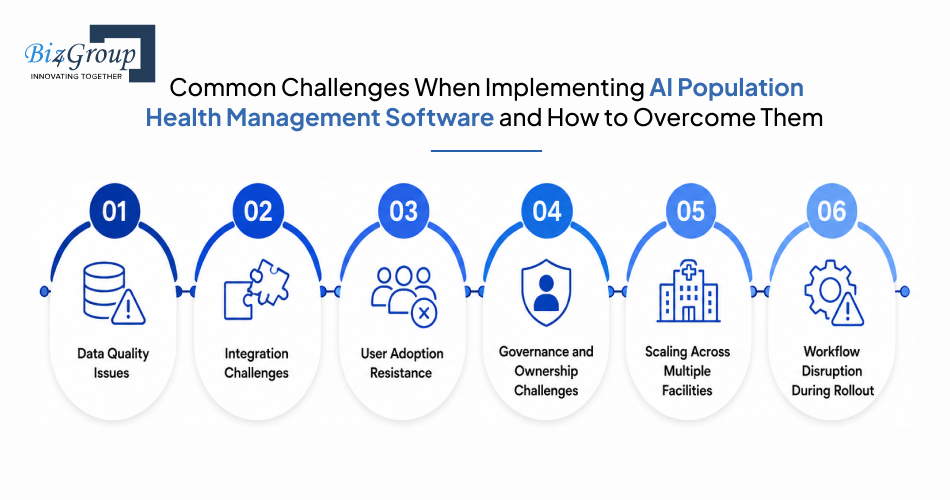
Healthcare organizations often spend significant time evaluating capabilities, technology, and expected outcomes. Yet many implementation challenges appear only after the platform enters real-world clinical and operational environments.
Understanding these realities can help organizations extract greater value from AI population health management software while avoiding setbacks that delay adoption.
Why it happens:
Population health platforms depend on information collected from multiple systems, departments, and care settings. Missing records, duplicate patient profiles, inconsistent coding practices, and outdated information can reduce the quality of insights generated by the platform.
How successful organizations address it:
Rather than treating data quality as a one-time activity, leading organizations establish ongoing data governance processes and continuously monitor data accuracy across connected systems.
Why it happens:
Healthcare environments often contain multiple EHRs, claims platforms, laboratory systems, and third-party applications. Connecting these systems while maintaining consistent data flow can become more complicated than initially expected.
How successful organizations address it:
Organizations typically involve experienced healthcare integration specialists early in the project and work with an established AI development company that understands interoperability requirements and healthcare workflows.
Also Read: Top 29+ AI Development Companies in USA
Why it happens:
Clinicians and care managers already operate within demanding workflows. Introducing new tools without clear workflow alignment can create resistance, even when the technology itself performs well.
How successful organizations address it:
High-performing organizations involve end users throughout implementation, gather feedback regularly, and focus on demonstrating how the platform supports daily responsibilities rather than adding new administrative tasks.
Why it happens:
Questions around data ownership, decision-making responsibilities, model oversight, and workflow accountability often emerge once multiple teams begin using the platform.
How successful organizations address it:
Successful implementations establish governance structures early, clearly define responsibilities, and create oversight processes that support long-term platform management.
Why it happens:
A platform that performs well within a single department may encounter new challenges when deployed across multiple hospitals, clinics, or geographic regions. Differences in workflows and data practices can introduce complexity.
How successful organizations address it:
Organizations often scale in phases, validate adoption at each stage, and expand only after operational processes have been standardized.
Why it happens:
Even well-designed systems can disrupt existing care management processes during implementation. New workflows, reporting structures, and responsibilities may initially create uncertainty among users.
How successful organizations address it:
Healthcare leaders typically prioritize change management, user training, and ongoing support throughout deployment. Many organizations also hire AI developers with healthcare implementation experience to help reduce operational disruption and accelerate adoption.
The success of AI population health management software depends on more than technology alone. Organizations that proactively address data readiness, integration complexity, user adoption, governance, scalability, and workflow alignment are often better positioned to achieve sustainable long-term outcomes.
Population health initiatives ultimately depend on an organization's ability to move from fragmented information to informed action. The healthcare systems achieving the greatest impact are not simply collecting more data. They are using connected, trusted information to identify risks earlier, coordinate care more effectively, and support better decisions across entire patient populations. That is why AI population health management software development continues to gain attention among healthcare leaders focused on long-term operational and clinical improvement.
Success, however, is rarely determined by technology alone. Data readiness, governance, workflow alignment, interoperability, and user adoption all play an important role in shaping outcomes. Organizations that approach these initiatives with a clear strategy and the right implementation partner are often better positioned to create sustainable value. Whether you are evaluating your first population health initiative or planning a more advanced platform, working with an experienced AI product development company can help translate your vision into a practical and scalable solution. When you're ready to discuss your goals, the team at Biz4Group LLC is always available for a conversation.
The timeline depends on the number of EHRs, data sources, integrations, and analytics requirements involved. Most healthcare organizations can expect a timeline of 3–14 weeks. Projects involving multiple hospitals, complex interoperability requirements, and advanced predictive analytics generally require longer implementation periods because data preparation and integration activities often consume significant project time.
The cost to develop a population health platform typically ranges from $40,000 to $300,000+ depending on functionality, integration complexity, scalability requirements, and AI capabilities. An MVP generally falls between $40,000-$70,000, while enterprise-grade platforms supporting multiple facilities and advanced analytics often exceed $150,000.
Yes. Many healthcare organizations use population health platforms to monitor quality measures, identify care gaps, track performance metrics, and support reporting requirements associated with value-based care initiatives. The platform helps organizations maintain visibility into population-level performance while supporting proactive intervention strategies.
Accuracy is typically evaluated using historical patient data, clinical validation processes, ongoing performance monitoring, and outcome tracking. Healthcare organizations often review prediction performance against actual patient outcomes and periodically recalibrate models to ensure recommendations remain relevant as patient populations and care patterns evolve.
Yes. Population health platforms are commonly used to monitor patients with chronic conditions such as diabetes, cardiovascular disease, COPD, and hypertension. By continuously analyzing population-level data, organizations can identify patients requiring intervention, improve follow-up efforts, and support long-term disease management initiatives.
Organizations should assess healthcare domain expertise, interoperability experience, AI capabilities, HIPAA compliance knowledge, implementation methodology, and experience working with complex healthcare data environments. Evaluating previous healthcare projects and the ability to support long-term platform evolution is often just as important as assessing technical capabilities.

Our website require some cookies to function properly. Read our privacy policy to know more.