Location :
Orlando, FL, USA
Location :
Orlando, FL, USA +1 (407) 714-1616
 info@biz4group.com


















Imagine a digital system that doesn’t wait for instructions but instead, understands your business goals, learns from real-time feedback, and takes independent actions to get the job done.
Read More

What happens when thousands of patients contact healthcare providers every day for symptoms that may not even require an ER visit?
For many hospitals, clinics, and telehealth companies, this has become a daily operational challenge. Teams spend hours handling basic symptom-related queries while patients wait longer for guidance.
At the same time, patients expect quick answers and easier access to care without long hold times or unnecessary appointments.
That shift is pushing more healthcare organizations toward AI symptom checker app development.
According to NCQA, nearly 60% of emergency department visits are considered non-urgent and potentially avoidable, creating additional pressure on already overloaded healthcare systems.
This is exactly why healthcare businesses are starting to build AI symptom checker app solutions that can assess symptoms early, guide patients toward the right level of care, and reduce unnecessary clinical workload.
But building these platforms is more complex than adding a chatbot to a healthcare app.
Modern AI medical symptom checker app development requires accurate symptom analysis, intelligent follow-up questioning, secure patient data handling, and smooth integration with existing healthcare systems.
Many providers investing in these solutions are also expanding into connected platforms like AI healthcare app development to improve patient engagement and operational efficiency across the care journey.
So before discussing features, compliance, or development costs, let’s first understand what an AI symptom checker app actually is and why healthcare organizations are rapidly adopting it.
An AI symptom checker app is a digital healthcare solution that allows patients to enter symptoms, answer AI-generated follow-up questions, and receive preliminary health guidance based on clinical logic, symptom severity, and patient responses.
Modern AI symptom checker app development combines technologies like natural language processing (NLP), machine learning, and healthcare data models to improve patient triage and streamline early symptom assessment.
Today, healthcare organizations are increasingly investing in AI medical symptom checker app development because traditional patient triage systems are becoming difficult to scale efficiently.
Here are some of the biggest reasons providers want to build AI symptom checker app solutions:
This growing demand is also increasing investment in connected technologies like AI chatbot development for medical diagnosis and AI health assistant app that support more scalable patient engagement.
As more organizations start developing AI symptom checker for healthcare, the next challenge is understanding how these systems actually work behind the scenes.
Improve outcomes faster with AI-driven adherence systems built for measurable impact
Start Building Smarter Adherence SystemModern AI symptom checker app development combines AI models, clinical workflows, healthcare datasets, and patient interaction systems to assess symptoms and guide users toward the right level of care.
Instead of relying on static forms, today’s platforms can understand patient responses dynamically, ask intelligent follow-up questions, and assess symptom severity in real time. This is why many healthcare organizations are investing in developing AI health symptom checker app solutions to improve patient triage and reduce operational burden.
The process starts when patients enter symptoms through text, voice, or guided questionnaires. The platform collects contextual information like age, medical history, medications, and symptom duration before analysis begins. Most AI medical symptom checker app development platforms collect:
This helps the system understand the patient’s condition more accurately from the beginning.
Once the symptoms are submitted, NLP models analyze patient language and identify medical intent. This allows the system to understand both clinical and non-clinical symptom descriptions.
For example:
can all point toward related medical concerns. This layer is essential when businesses create AI powered symptom checker application platforms that need to feel conversational instead of robotic.
After identifying initial symptoms, the AI engine asks contextual follow-up questions to narrow down possible conditions and determine urgency levels more accurately. This is where many healthcare providers want to build AI symptom checker app solutions that can intelligently guide patients instead of using static decision trees.
The platform may ask about:
This workflow directly supports healthcare organizations asking: “We want to build an AI powered symptom checker app that asks patients follow up questions about their symptoms, assesses urgency levels, and recommends whether they should visit a doctor or emergency room.”
After collecting enough patient information, the system evaluates symptom combinations using clinical logic, AI models, and healthcare datasets to determine possible risk levels.
The platform typically categorizes cases into:
Many organizations investing in AI symptom checker app development also integrate systems like AI medical diagnosis app to strengthen patient assessment and clinical decision-support workflows.
Once the assessment is complete, the platform guides users toward the next appropriate action. This helps healthcare providers improve patient routing while reducing unnecessary appointments and support calls.
Depending on the workflow, the app may:
This is one of the biggest reasons healthcare companies are developing AI symptom checker for healthcare workflows focused on scalable patient triage.
Modern symptom checker platforms are commonly integrated with EHR systems, telehealth platforms, hospital databases, and patient management tools to streamline healthcare operations.
These integrations help providers:
Many healthcare businesses building these systems also invest in AI-powered patient management software to improve workflow automation and patient engagement across digital healthcare ecosystems.
Now that you understand how these systems function behind the scenes, the next challenge is making sure your platform stays compliant with healthcare regulations, patient privacy requirements, and clinical safety standards.
Compliance is one of the biggest challenges in AI symptom checker app development. Healthcare organizations are not just handling symptom data. They are managing protected health information, clinical workflows, patient conversations, and sometimes even emergency recommendations.
That is why security, privacy, and regulatory planning should be part of the development process from day one, not something added later.
Any business planning to develop AI health symptom checker app solutions must follow HIPAA guidelines if the platform stores or processes patient health information. This includes protecting patient records, encrypting healthcare data, controlling user access, and securing all communication channels inside the application. Many healthcare founders entering HIPAA compliant symptom checker app development often ask, “How do I build a HIPAA-compliant AI symptom checker app for my telehealth platform?” The answer usually starts with encrypted infrastructure, secure cloud storage, audit logs, and role-based access control.
FDA requirements depend heavily on how the platform is positioned and what type of medical guidance it provides. Some symptom checker apps operate as informational or wellness tools, while others may fall under Software as a Medical Device (SaMD) regulations if they directly influence diagnosis or treatment decisions. This becomes especially important during AI medical symptom checker app development because healthcare businesses must clearly define whether the platform is offering general health guidance or clinical decision support.
Many healthcare teams also ask, “Does an AI symptom checker app need FDA clearance, and what are the exemptions?” In most cases, low-risk symptom triage tools may avoid strict FDA oversight, but diagnostic-focused platforms usually require deeper regulatory evaluation.
Patient trust depends heavily on how securely healthcare data is handled. Modern how to make AI symptom checker app with HIPAA compliance strategies focus on protecting symptom history, patient conversations, medications, and healthcare records throughout the platform lifecycle. To reduce compliance risks, healthcare companies usually implement encrypted APIs, secure cloud infrastructure, multi-factor authentication, automated monitoring, and restricted access permissions. Businesses building larger digital healthcare ecosystems often combine these systems with HIPAA compliant healthcare applications to maintain centralized security standards.
Strong compliance also requires safeguards around how AI models generate recommendations. Without proper controls, inaccurate symptom assessments or unsafe responses can create serious clinical and legal risks. Many healthcare providers exploring developing AI symptom checker for healthcare solutions ask, “Can AI accurately analyze patient symptoms through a mobile app and provide reliable health guidance without replacing the role of a licensed physician or creating medical liability issues?” This is why modern platforms rely on clinical validation workflows, human review systems, confidence scoring, and escalation protocols to improve reliability and patient safety.
One of the most common mistakes in building custom AI symptom checker app from idea to launch is delaying compliance planning until late development stages. This often creates expensive rework, security gaps, and deployment delays. Some teams use public AI models without healthcare safeguards, while others overlook audit logging, patient consent management, or healthcare data governance entirely. In regulated industries like healthcare, these issues can quickly become operational and legal risks.
Now that the compliance foundation is clear, the next step is understanding where AI symptom checker apps deliver the most value and which healthcare sectors are adopting them the fastest.
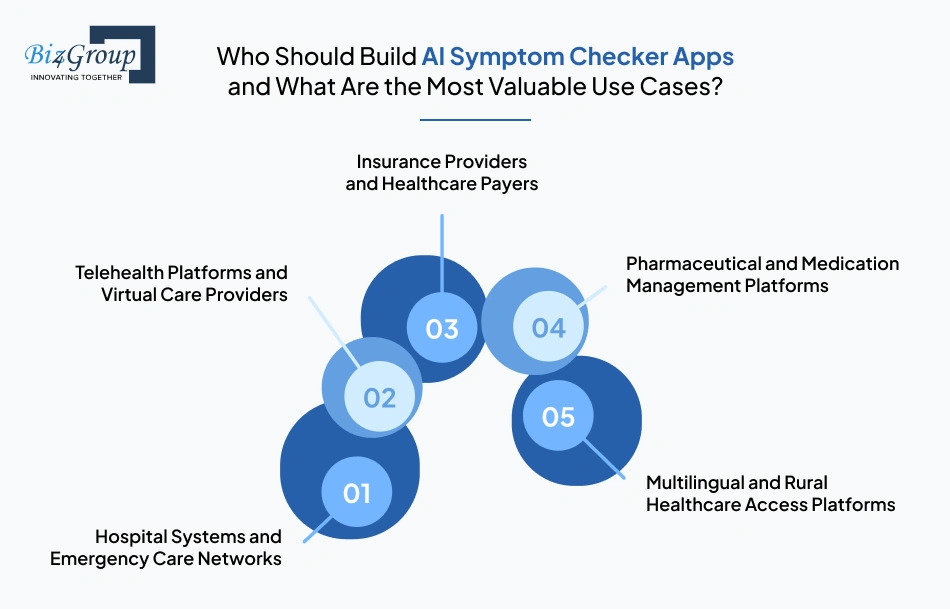
The demand for AI symptom checker app development is growing across multiple healthcare sectors. From hospitals and telehealth companies to insurers and pharmaceutical brands, organizations are using these platforms to improve patient triage, reduce operational workload, and deliver faster healthcare guidance.
The biggest advantage is scalability. Instead of depending entirely on manual support teams, healthcare providers can automate the first layer of patient interaction while still improving care accessibility.
Hospitals are increasingly investing in building AI symptom checker app solutions to reduce unnecessary emergency room visits and manage rising patient inquiry volumes. These systems help patients understand symptom severity before visiting the hospital, allowing healthcare staff to prioritize urgent cases more efficiently. Many hospital administrators exploring developing AI symptom checker for healthcare platforms are focused on reducing non-emergency triage workload and improving patient routing across departments.
Example:
Mayo Clinic has invested heavily in AI-driven digital health systems and remote patient triage initiatives to improve patient access and streamline care coordination across its healthcare network.
Telehealth companies are using building AI symptom checker app for telehealth platform providers strategies to improve virtual consultation workflows. Instead of sending every patient directly to a doctor, AI symptom checkers can assess urgency levels first and route users toward the right care option. This helps reduce unnecessary consultations while improving appointment efficiency and patient experience.
Example:
Babylon Health became one of the most recognized examples of AI-powered virtual symptom assessment through its AI triage and digital consultation platform used across multiple healthcare markets.
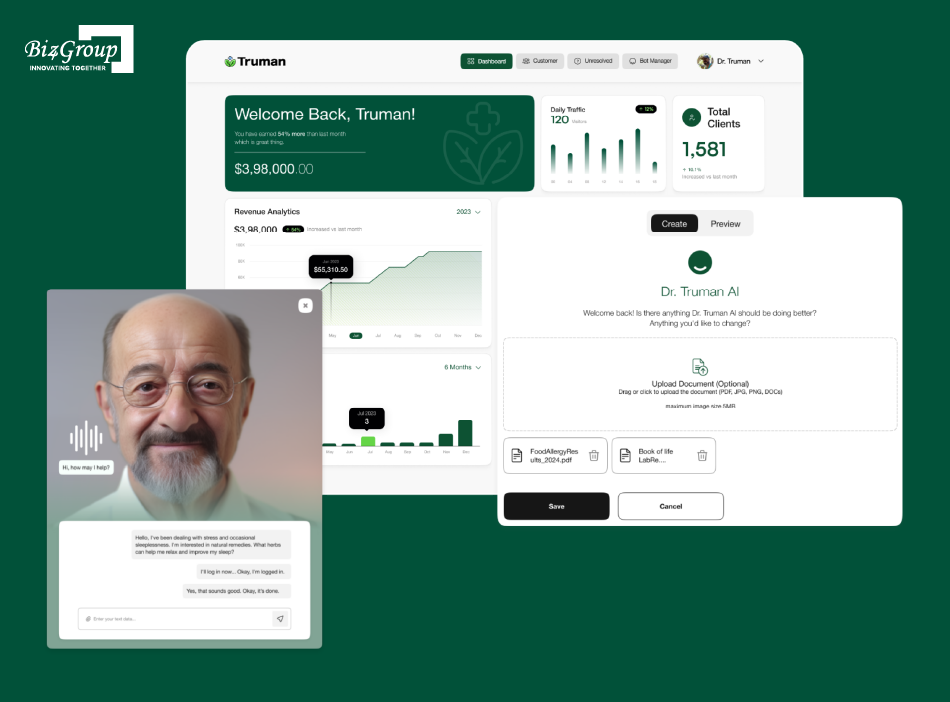
A strong real-world example connected to building AI symptom checker app for telehealth platform providers is the Truman AI wellness platform developed by Biz4Group. The platform features an interactive AI-powered avatar of Dr. Truman designed to provide personalized wellness guidance through conversational interactions.
Users can communicate directly with the AI avatar for health-related advice, wellness recommendations, and guided interactions, creating a more engaging experience than traditional chatbot interfaces. The platform also supports health tracking, medical report uploads, and membership-based wellness services, making it a strong example of how conversational AI and avatar-driven healthcare experiences are evolving beyond basic symptom checkers.
Key Highlights:
This project reflects how modern AI symptom checker app development is moving toward more human-like, conversational healthcare experiences powered by AI avatars and intelligent patient engagement systems.
Insurance companies are adopting AI medical symptom checker app development solutions to reduce avoidable claims costs and improve preventive care engagement. These platforms help members assess symptoms early and guide them toward cost-effective care options before conditions worsen. This approach also helps insurers reduce support center volume while improving member experience through faster digital guidance.
Example:
UnitedHealth Group has expanded AI-driven healthcare initiatives across digital patient engagement, predictive healthcare workflows, and virtual care support systems to improve operational efficiency.
Pharmaceutical companies are increasingly creating AI powered symptom checker application platforms to help patients monitor medication side effects, treatment responses, and symptom progression in real time. Many organizations entering this space ask, “We are a pharmaceutical company and we want to build an AI symptom checker app for patients using our medications so they can monitor side effects and get instant health guidance through our platform.” These systems improve patient engagement while helping providers monitor treatment adherence more effectively.
Example:
Pfizer has invested in AI-powered digital health partnerships focused on patient monitoring, medication adherence, and connected healthcare experiences. Businesses entering this segment also invest in platforms like AI supplement tracker app and chronic disease management software with AI to support long-term patient monitoring.
Healthcare providers serving diverse or underserved populations are using build AI symptom checker app with multilingual patient support capabilities to improve healthcare accessibility. These platforms help patients communicate symptoms in their preferred language and receive faster healthcare guidance without language barriers. This becomes especially important in rural healthcare environments where provider shortages and limited healthcare access continue to create delays in patient care.
Example:
Cleveland Clinic has expanded digital health and virtual care accessibility initiatives to improve patient engagement across broader and more diverse patient populations.
As adoption grows across these healthcare sectors, the next step is understanding which features actually make an AI symptom checker platform useful, scalable, and clinically reliable.
Successful AI symptom checker app development depends heavily on the features included in the platform. A basic symptom input form is no longer enough. Modern healthcare providers want systems that can improve patient triage, automate interactions, and support connected healthcare workflows without compromising patient experience.
The right feature set helps healthcare organizations improve care accessibility, reduce operational workload, and deliver faster health guidance at scale.
This is the core feature of any AI medical symptom checker app development platform. The system should allow patients to enter symptoms conversationally through text or voice while the AI analyzes patient inputs in real time. Instead of static questionnaires, modern platforms use NLP and clinical logic to understand symptom descriptions more naturally and improve assessment accuracy.
An effective symptom checker should ask contextual follow-up questions based on previous patient responses. This helps narrow symptom possibilities and improves urgency detection more accurately. Many healthcare providers planning to build AI symptom checker app solutions ask, “We want to build an AI powered symptom checker app that asks patients follow up questions about their symptoms, assesses urgency levels, and recommends whether they should visit a doctor or emergency room.” This feature is what enables that workflow.
Risk scoring helps the platform categorize cases based on symptom severity and potential medical urgency. The system evaluates symptom combinations, patient history, and risk factors to determine the next recommended action. Most develop AI health symptom checker app platforms classify cases into self-care guidance, telehealth consultation, urgent care, or emergency attention to improve patient triage efficiency.
Modern symptom checker platforms should integrate directly with telehealth systems and appointment scheduling workflows. Once the AI completes symptom assessment, patients should be able to connect with doctors or book consultations immediately. This is especially important for organizations focused on building AI symptom checker app for telehealth platform providers because seamless care routing improves both patient experience and operational efficiency. Businesses developing connected virtual care systems also invest in on-demand doctor app development to support faster healthcare access and consultation management.
EHR integration allows healthcare providers to connect symptom checker workflows with patient medical records and existing hospital systems. This helps doctors access symptom history, previous diagnoses, medications, and treatment data more efficiently. For healthcare companies developing AI symptom checker for healthcare, EHR integration improves care continuity and reduces manual administrative work across healthcare operations.
Healthcare organizations serving diverse populations increasingly need multilingual support inside symptom checker applications. Patients should be able to describe symptoms and receive guidance in their preferred language without communication barriers. This is becoming a major priority for providers planning to build an AI symptom checker app with multilingual patient support to improve healthcare accessibility and patient engagement across broader demographics.
Many symptom checker platforms now include medication tracking and side effect analysis features. These systems help patients monitor symptoms related to prescriptions, chronic conditions, or treatment plans. Pharmaceutical and healthcare organizations often ask, “We are a pharmaceutical company and we want to build an AI symptom checker app for patients using our medications so they can monitor side effects and get instant health guidance through our platform.” This feature directly supports patient monitoring workflows. Healthcare businesses entering this space also invest in solutions like AI supplement tracker app and AI patient software to improve long-term patient engagement and treatment tracking.
Since symptom checker platforms process sensitive healthcare information, strong security features are essential. The application should support secure login systems, role-based access control, encrypted communication, and patient consent management. These security measures are critical during HIPAA compliant symptom checker app development to protect patient records and maintain healthcare compliance standards.
Now that the core functionality is clear, the next step is understanding which advanced features can help your AI symptom checker app stand out in an increasingly competitive healthcare market.
We help healthcare businesses build AI symptom checker app platforms with the right AI workflows, integrations, and compliance-ready architecture.
Book a Free ConsultationCore features help an application function properly, but advanced AI capabilities are what make modern AI symptom checker app development platforms more intelligent, scalable, and clinically valuable.
Healthcare providers are now looking beyond basic symptom assessment. They want systems that can predict risks earlier, support personalized patient interactions, automate workflows, and improve long-term healthcare engagement.
The following advanced capabilities are becoming major differentiators in modern custom AI symptom checker app development.
|
Advanced Feature |
How It Adds Value |
|---|---|
|
Voice-Based Symptom Input |
Allows patients to describe symptoms naturally through voice interactions instead of typing. This improves accessibility for elderly users, visually impaired patients, and users uncomfortable with medical terminology. |
|
Interactive AI avatars create more human-like healthcare conversations and improve patient engagement. Platforms like the Truman AI wellness system show how avatar-driven healthcare experiences can support virtual symptom guidance and wellness interactions. |
|
|
Retrieval-Augmented Generation (RAG) |
RAG helps AI models pull information from verified healthcare databases before generating responses. This improves response accuracy and reduces hallucination risks during AI medical symptom checker app development. |
|
Predictive Risk Detection |
Advanced AI models can identify symptom patterns linked to potential health risks before conditions worsen. This capability is increasingly used in AI predictive diagnosis and disease forecasting software systems for preventive healthcare workflows. |
|
Personalized Healthcare Recommendations |
AI systems can generate recommendations based on patient history, personalized supplement recommendations, lifestyle data, chronic conditions, and previous interactions to improve care personalization. |
|
Real-Time Clinical Decision Support |
Some platforms assist healthcare professionals by surfacing symptom insights, patient summaries, and possible risk indicators during consultations. This supports faster clinical decision-making and triage workflows. |
|
Wearable and Remote Monitoring Integration |
Modern symptom checker platforms can integrate with smartwatches, fitness trackers, and remote monitoring devices to capture real-time health metrics like heart rate, sleep data, oxygen levels, and activity patterns. |
|
Multilingual AI Conversations |
Advanced NLP systems can support symptom assessment in multiple languages while maintaining contextual accuracy. This is becoming increasingly important for businesses looking to build AI symptom checker app with multilingual patient support. |
|
Human-in-the-Loop Validation |
Human review systems allow doctors or healthcare staff to validate high-risk symptom assessments before recommendations are finalized. This improves clinical safety and reduces liability concerns. |
|
AI-Powered Doctor Assistance |
Some healthcare organizations combine symptom checkers with tools like AI assistant development for physicians to help doctors review patient summaries, symptom history, and AI-generated recommendations more efficiently. |
|
Behavioral and Engagement Analytics |
AI can track patient behavior patterns, symptom frequency, and engagement history to improve retention strategies and long-term patient monitoring workflows. |
|
AI Medical Coding Automation |
Advanced systems can automatically structure patient symptom data into standardized medical documentation workflows. Many providers combine symptom analysis with AI medical coding software solutions to improve operational efficiency and reduce manual administrative work. |
|
Chronic Disease Monitoring Workflows |
Symptom checker apps are increasingly being connected with long-term care systems to support chronic disease monitoring, medication adherence, and recurring symptom analysis. This is becoming more common in chronic disease management software with AI platforms focused on continuous patient care. |
|
Conversational Clinical AI Chatbots |
Modern healthcare providers increasingly want conversational AI systems that can guide patients naturally across multiple healthcare workflows. This is one of the biggest drivers behind growing demand for clinical AI chatbot development for telehealth solutions. |
Many healthcare startups exploring build AI symptom checker healthcare app 2026 initiatives are using these advanced AI capabilities to differentiate their platforms in a highly competitive digital healthcare market.
Once the feature planning is complete, the next step is understanding how to structure the actual development process from idea validation to deployment.
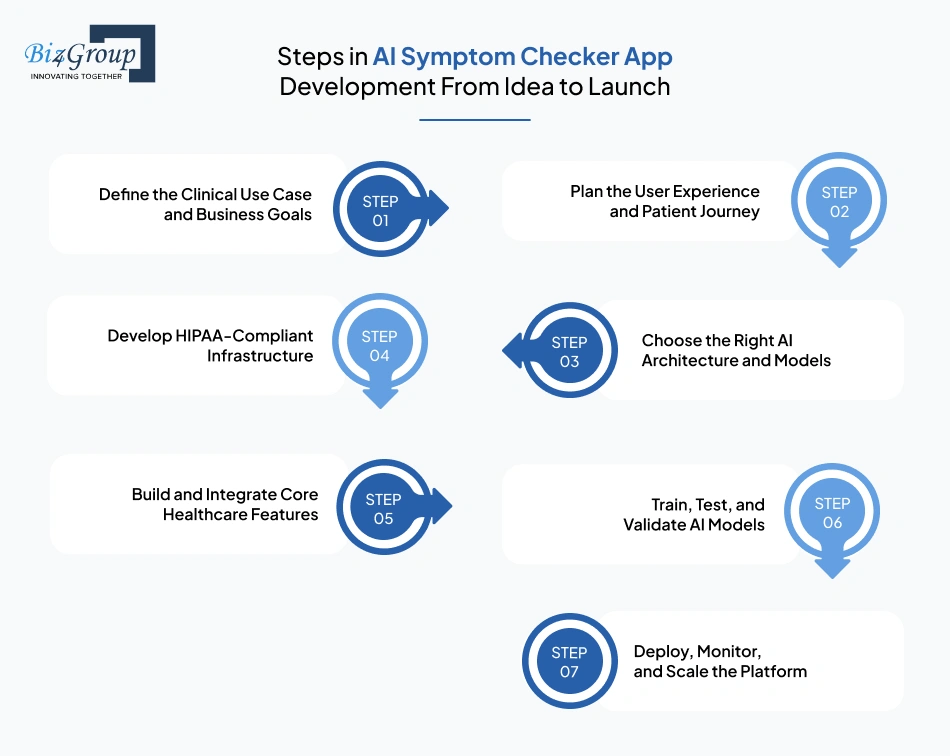
Successful AI symptom checker app development requires much more than training an AI model. Healthcare platforms need proper workflow planning, clinical validation, compliance safeguards, scalable infrastructure, and user-friendly experiences from the beginning.
The development process becomes far smoother when teams focus on solving operational healthcare problems first instead of jumping directly into AI implementation.
The first step is identifying what problem the platform should solve. Some organizations want to reduce non-emergency support calls, while others focus on telehealth triage, medication monitoring, or patient engagement. Healthcare providers entering build AI symptom checker app initiatives usually define:
Many startups also begin with MVP development to validate workflows before investing in full-scale healthcare platforms.
Patient experience plays a major role in healthcare adoption. If the workflow feels confusing or overly clinical, users may abandon the platform before completing symptom assessment. During this stage, teams focus on conversational flows, accessibility, multilingual support, and simplified healthcare interactions. This is especially important for organizations investing in develop AI health symptom checker app solutions targeting large patient populations.
Key focus areas usually include:
Many companies also invest in professional UI/UX design services to improve patient engagement and reduce friction during healthcare interactions.
The AI architecture determines how effectively the platform analyzes symptoms and generates recommendations. Businesses need to decide whether the system will use NLP models, retrieval-augmented generation (RAG), predictive AI, or hybrid healthcare workflows. Many healthcare teams create AI powered symptom checker application platforms to also evaluate conversational AI systems, automation frameworks, and intelligent workflow orchestration.
The AI layer may include:
Organizations building advanced healthcare platforms often combine these systems with AI product strategies to create scalable healthcare AI ecosystems.
Healthcare applications require secure infrastructure from the start. Teams need to implement encrypted databases, secure APIs, access controls, audit logging, and protected cloud environments to maintain compliance. This is one of the most critical phases of HIPAA compliant symptom checker app development because healthcare platforms process sensitive patient information continuously.
Infrastructure planning usually includes:
Many healthcare organizations also rely on AI integration services to securely connect healthcare systems, EHR platforms, and third-party services.
Once the infrastructure is ready, developers start building symptom assessment workflows, follow-up questioning systems, patient routing logic, and healthcare integrations. At this stage, many businesses ask, “Walk me through the steps to launch an AI symptom checker app from idea to deployment.” The answer usually depends on how complex the healthcare workflows, AI systems, and integrations become during development.
Core implementation areas include:
Healthcare businesses building larger ecosystems also combine these platforms with AI automation services to streamline operational workflows and patient interactions.
AI healthcare systems require continuous testing and validation before deployment. Teams need to evaluate symptom accuracy, false positives, escalation workflows, and recommendation reliability using healthcare datasets and clinical review processes. This becomes especially important for organizations developing AI symptom checker for healthcare because inaccurate outputs can directly affect patient safety and trust.
Testing and validation commonly involve:
Many businesses building advanced healthcare workflows also explore agentic AI development capabilities to support more autonomous and adaptive healthcare interactions.
After testing is complete, the platform moves into deployment and ongoing optimization. Healthcare organizations monitor AI performance, patient engagement, symptom accuracy, and operational workflows continuously after launch. Successful AI medical symptom checker app development platforms usually improve over time based on real patient interactions and healthcare feedback loops.
Post-launch optimization often includes:
Businesses scaling these platforms across hospitals and healthcare networks often invest in enterprise AI solutions to support long-term scalability and operational growth.
Now that the development process is clear, the next step is understanding which technologies and frameworks are commonly used to build scalable AI symptom checker platforms.
Choosing the right technology stack is one of the most important decisions in AI symptom checker app development. The tech stack directly affects platform scalability, AI performance, healthcare compliance, system security, and integration capabilities.
For healthcare platforms, the goal is not just building a functional app. The infrastructure must support real-time symptom analysis, secure patient data handling, AI-driven workflows, and seamless healthcare integrations.
Here’s a commonly used tech stack for modern AI medical symptom checker app development platforms.
|
Technology Layer |
Recommended Technologies |
Purpose |
|---|---|---|
|
Frontend Development |
React, Next.js, Angular, Flutter |
Used for building responsive web and mobile interfaces with smooth patient interactions and cross-platform accessibility. |
|
Backend Development |
Handles API management, symptom processing workflows, authentication, and healthcare data operations. |
|
|
AI & Machine Learning Frameworks |
OpenAI, TensorFlow, PyTorch, LangChain |
Powers NLP processing, symptom analysis, conversational AI, and intelligent follow-up questioning. |
|
Natural Language Processing (NLP) |
spaCy, BioBERT, MedPaLM, Hugging Face Transformers |
Helps the system understand patient symptom descriptions and extract medical intent more accurately. |
|
Database Management |
PostgreSQL, MongoDB, Firebase |
Stores patient records, symptom history, healthcare workflows, and operational data securely. |
|
Vector Databases |
Pinecone, Weaviate, FAISS |
Supports semantic search, retrieval-augmented generation (RAG), and contextual healthcare responses. |
|
Cloud Infrastructure |
AWS, Microsoft Azure, Google Cloud |
Provides scalable, HIPAA-ready infrastructure for hosting healthcare applications securely. |
|
Authentication & Security |
OAuth 2.0, JWT, Multi-Factor Authentication |
Secures patient accounts, access permissions, and healthcare system authentication workflows. |
|
Healthcare Integrations |
FHIR APIs, HL7 Standards, Epic APIs |
Enables interoperability with EHR systems, telehealth platforms, and healthcare databases. |
|
Real-Time Communication |
WebRTC, Twilio, Socket.io |
Supports live consultations, chat systems, notifications, and telehealth communication features. |
|
Analytics & Monitoring |
Google Analytics, Mixpanel, Datadog |
Tracks patient interactions, symptom workflows, AI performance, and platform usage metrics. |
|
DevOps & Deployment |
Docker, Kubernetes, GitHub Actions |
Supports scalable deployment, CI/CD pipelines, infrastructure automation, and performance optimization. |
Organizations building scalable healthcare platforms often partner with an experienced AI app development company to choose the right AI architecture, infrastructure, and healthcare integration strategy based on long-term business goals.
Now that the technical foundation is clear, the next question most healthcare businesses ask is: how much does AI symptom checker app development actually cost?
Also Read: React JS Development Services
The cost of AI symptom checker app development usually ranges between $20,000 to $150,000+, depending on the platform complexity, AI capabilities, healthcare integrations, compliance requirements, and customization level.
A basic MVP with limited symptom assessment features costs significantly less than an enterprise-grade healthcare platform with AI-driven triage, multilingual support, EHR integrations, and predictive healthcare workflows.
That is why businesses planning to build AI symptom checker app solutions should evaluate both short-term development costs and long-term operational expenses before starting development.
Different features contribute differently to the total symptom checker app development cost and timeline. The more advanced the AI workflows and healthcare integrations become, the higher the development investment.
|
Feature / Module |
Estimated Cost Range |
Purpose |
|---|---|---|
|
Basic Symptom Checker Workflow |
$5,000 – $12,000 |
Allows patients to enter symptoms and receive initial symptom guidance. |
|
AI-Powered Follow-Up Questioning |
$8,000 – $20,000 |
Supports dynamic questioning and contextual symptom analysis. |
|
NLP-Based Symptom Understanding |
$10,000 – $25,000 |
Helps the system understand patient language and medical intent. |
|
Telehealth Integration |
$7,000 – $18,000 |
Connects users with virtual consultations and appointment systems. |
|
EHR & FHIR Integration |
$10,000 – $30,000 |
Enables secure healthcare data exchange with hospital systems. |
|
AI Avatar Integration |
$12,000 – $35,000 |
Adds conversational avatar-based healthcare interactions. |
|
Multilingual Patient Support |
$5,000 – $15,000 |
Supports healthcare interactions across multiple languages. |
|
Predictive Risk Detection |
$15,000 – $40,000 |
Uses AI models to identify high-risk symptom patterns early. |
|
HIPAA Compliance & Security Layer |
$8,000 – $25,000 |
Covers encryption, audit logs, authentication, and compliance workflows. |
|
Analytics & Reporting Dashboard |
$5,000 – $12,000 |
Tracks patient interactions, AI accuracy, and operational insights. |
Several factors directly influence the overall AI medical symptom checker app development budget. Platforms with advanced AI workflows, enterprise integrations, and compliance requirements naturally require higher investment.
The biggest cost factors usually include:
Businesses planning custom AI symptom checker app development often spend more when building highly personalized healthcare workflows or enterprise-scale infrastructure.
Many healthcare companies underestimate the hidden operational costs involved in developing AI symptom checker for healthcare platforms. Development is only one part of the investment. Ongoing compliance, AI monitoring, infrastructure scaling, and model optimization also add recurring expenses.
Common hidden costs include:
Organizations exploring “What is the best AI model to use for a symptom checker?” should also consider that advanced healthcare AI models often increase operational costs due to higher inference and infrastructure requirements.
Businesses evaluating broader healthcare product strategies also review resources like AI medical diagnosis app development cost to estimate long-term healthcare AI investment planning.
Healthcare companies can reduce development costs significantly by focusing on phased development instead of building every advanced feature at once.
Most organizations start with an MVP focused on core symptom assessment and then expand the platform gradually based on patient feedback and operational goals.
Common optimization approaches include:
Many startups exploring build AI symptom checker healthcare app 2026 initiatives also study top AI healthcare app ideas for the healthcare startups before finalizing product scope and investment priorities.
The development timeline depends heavily on the platform scope and AI complexity. A basic MVP can usually be launched within a few months, while enterprise healthcare platforms often require longer implementation cycles due to compliance, integrations, and testing requirements.
|
Development Stage |
Estimated Timeline |
|---|---|
|
Discovery & Planning |
2 – 3 Weeks |
|
UI/UX Design |
2 – 4 Weeks |
|
MVP Development |
6 – 10 Weeks |
|
AI Model Integration |
4 – 8 Weeks |
|
EHR & Telehealth Integration |
3 – 6 Weeks |
|
Compliance & Security Testing |
2 – 4 Weeks |
|
Deployment & Optimization |
1 – 3 Weeks |
Healthcare businesses planning long-term AI symptom checker app development strategies often ask whether they should build internally or outsource development expertise. That decision becomes even more important when dealing with scalability, compliance, and ongoing AI optimization challenges.
Get a tailored roadmap for your AI medical symptom checker app development project based on your features, AI complexity, and healthcare goals.
Get Cost Breakdown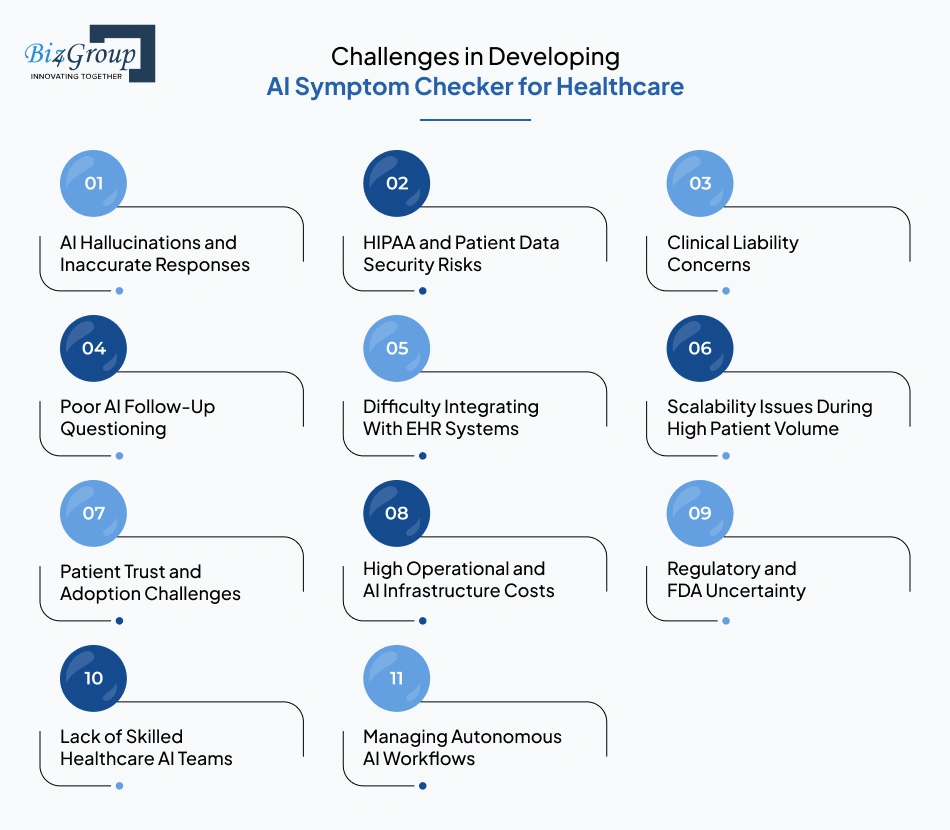
Building a healthcare AI platform involves much more than integrating an AI model into an application. Teams working on AI symptom checker app development often face challenges related to clinical accuracy, healthcare compliance, patient trust, scalability, and system integration.
Many of these issues only become visible after real patient interactions begin, which is why planning for them early can save significant development time and operational costs later.
The table below highlights some of the most common challenges in developing AI symptom checker for healthcare platforms and the best ways to address them.
|
Challenge |
Why It Happens |
Recommended Solution |
|---|---|---|
|
AI Hallucinations and Inaccurate Responses |
AI models may generate incorrect or medically unsafe recommendations if responses are not validated properly. |
Use healthcare-trained AI models, retrieval-augmented generation (RAG), clinical review systems, and human validation workflows to improve response accuracy. |
|
HIPAA and Patient Data Security Risks |
Healthcare platforms process protected health information continuously, making them vulnerable to security and compliance issues. |
Implement encrypted infrastructure, role-based access control, audit logs, secure APIs, and HIPAA-compliant cloud environments. |
|
Clinical Liability Concerns |
Healthcare providers worry about incorrect symptom guidance influencing patient decisions. |
Add clear escalation workflows, physician review systems, confidence scoring, and legal/compliance oversight during development. |
|
Poor AI Follow-Up Questioning |
Static or irrelevant follow-up questions reduce symptom assessment quality and patient trust. |
Train AI models using healthcare datasets and conversational healthcare workflows to improve contextual questioning. |
|
Difficulty Integrating With EHR Systems |
Legacy healthcare systems often use different standards and outdated infrastructure. |
Use FHIR APIs, HL7 standards, and scalable healthcare integration frameworks to simplify interoperability. |
|
Scalability Issues During High Patient Volume |
Healthcare systems may struggle during sudden spikes in patient interactions or symptom assessments. |
Deploy cloud-native infrastructure with scalable backend architecture and load-balancing systems. |
|
Patient Trust and Adoption Challenges |
Patients may hesitate to trust AI-generated healthcare guidance without transparency. |
Use explainable AI, conversational workflows, and human escalation options to improve user confidence. |
|
High Operational and AI Infrastructure Costs |
AI processing, healthcare integrations, and compliance monitoring increase long-term operational expenses. |
Start with an MVP, optimize AI usage, and scale features gradually based on real user demand. |
|
Regulatory and FDA Uncertainty |
AI healthcare regulations continue evolving, especially around diagnostic AI systems. |
Work closely with healthcare compliance experts and define clear product boundaries early in development. |
|
Lack of Skilled Healthcare AI Teams |
Building healthcare AI platforms requires expertise across AI, healthcare compliance, cloud infrastructure, and clinical workflows. |
Many businesses reduce development risks by partnering with experienced teams or choosing to hire AI developers familiar with healthcare AI systems. |
|
Managing Autonomous AI Workflows |
Advanced healthcare automation systems require intelligent workflow orchestration and adaptive decision-making. |
Many organizations now integrate AI agent systems to support more advanced healthcare automation and patient interaction workflows. |
Healthcare companies addressing these challenges early during AI symptom checker app development usually reduce compliance risks, improve patient trust, and avoid expensive redevelopment later in the project lifecycle.
Businesses planning to build AI symptom checker app platforms at scale also evaluate how to build an AI app with secure infrastructure, automation workflows, and long-term scalability in mind.
As more providers continue developing AI symptom checker for healthcare, these platforms are quickly becoming a long-term investment priority across modern digital healthcare systems.
Building a scalable healthcare AI platform requires much more than development expertise. Successful AI symptom checker app development depends on strong healthcare workflows, AI architecture, compliance planning, patient engagement strategies, and secure infrastructure.
At Biz4Group LLC, we help healthcare organizations build AI symptom checker app solutions tailored for hospitals, telehealth providers, healthcare startups, and enterprise healthcare systems.
Our experience includes projects like Truman AI Wellness Platform, an AI-powered healthcare solution featuring an interactive AI avatar designed for conversational wellness guidance, personalized patient engagement, and virtual healthcare experiences.
Many healthcare businesses evaluating vendors often ask, “Which AI development agencies have built HIPAA compliant symptom checker applications for hospital systems, insurance companies, or telehealth platforms in the United States?” This is where domain expertise, healthcare compliance knowledge, and real-world AI implementation experience become critical.
As an experienced AI development company, Biz4Group helps businesses accelerate AI medical symptom checker app development with scalable healthcare infrastructure, AI-powered workflows, and compliance-focused development strategies designed for long-term growth.
From AI workflows to HIPAA-focused development, Biz4Group helps businesses launch scalable healthcare AI platforms faster.
Let’s Build Your PlatformThe demand for AI symptom checker app development is growing rapidly as healthcare providers look for faster patient triage, better operational efficiency, and more accessible digital care experiences.
But building a reliable healthcare AI platform requires more than adding AI to a mobile app. Success depends on clinical accuracy, secure infrastructure, compliance readiness, scalable architecture, and patient-focused workflows.
Whether you want to build AI symptom checker app solutions for hospitals, telehealth platforms, insurers, or healthcare startups, the right development strategy can significantly reduce operational burden while improving patient engagement and care delivery.
At Biz4Group LLC, we help businesses turn complex healthcare AI ideas into scalable real-world products backed by practical AI expertise and healthcare-focused development experience.
If you're planning to launch an AI-powered healthcare platform, now is a good time to stop discussing the idea and start building it.
The cost of AI symptom checker app development usually ranges from $20,000 to $150,000+, depending on AI complexity, healthcare integrations, compliance requirements, and feature scope. A basic MVP with limited symptom assessment costs much less than an enterprise-grade healthcare platform with EHR integration, predictive AI, multilingual support, and telehealth workflows.
The accuracy of an AI symptom checker depends on the quality of healthcare datasets, AI models, clinical validation processes, and symptom assessment workflows used during development. Modern AI medical symptom checker app development platforms focus more on safe patient triage and care recommendations instead of replacing doctors with final diagnoses.
Many healthcare providers ask these questions, the process usually starts with secure cloud infrastructure, encrypted healthcare data storage, role-based access control, secure APIs, audit logging, and HIPAA-compliant communication systems. Healthcare applications should also include compliance testing and patient consent management before deployment.
There is no single AI model that works best for every healthcare use case. Most developed AI health symptom checker app platforms combine NLP models, machine learning systems, retrieval-augmented generation (RAG), and healthcare-specific datasets to improve symptom understanding and triage accuracy. Many enterprise healthcare platforms also use hybrid AI workflows instead of relying entirely on one LLM.
One of the most common questions in AI symptom checker app development is this, and the answer depends on how the platform functions. Apps offering general wellness guidance or low-risk symptom support may avoid strict FDA oversight, while systems influencing diagnosis or treatment decisions may qualify as Software as a Medical Device (SaMD).
Healthcare organizations frequently ask, “Can AI accurately analyze patient symptoms through a mobile app and provide reliable health guidance without replacing the role of a licensed physician or creating medical liability issues?” Modern symptom checker platforms are designed to support patient triage and early guidance, not replace clinical judgment. Most healthcare systems still rely on doctors and healthcare professionals for diagnosis, treatment decisions, and emergency care escalation.
The development timeline depends on platform complexity, AI workflows, healthcare integrations, and compliance requirements. A basic MVP for build AI symptom checker app projects may take 2 to 4 weeks, while enterprise healthcare platforms with telehealth integrations, predictive AI, multilingual support, and compliance layers can take6 to 8 weeks to develop and validate properly.

with Biz4Group today!
Our website require some cookies to function properly. Read our privacy policy to know more.