Location :
Orlando, FL, USA
Location :
Orlando, FL, USA +1 (407) 714-1616
 info@biz4group.com









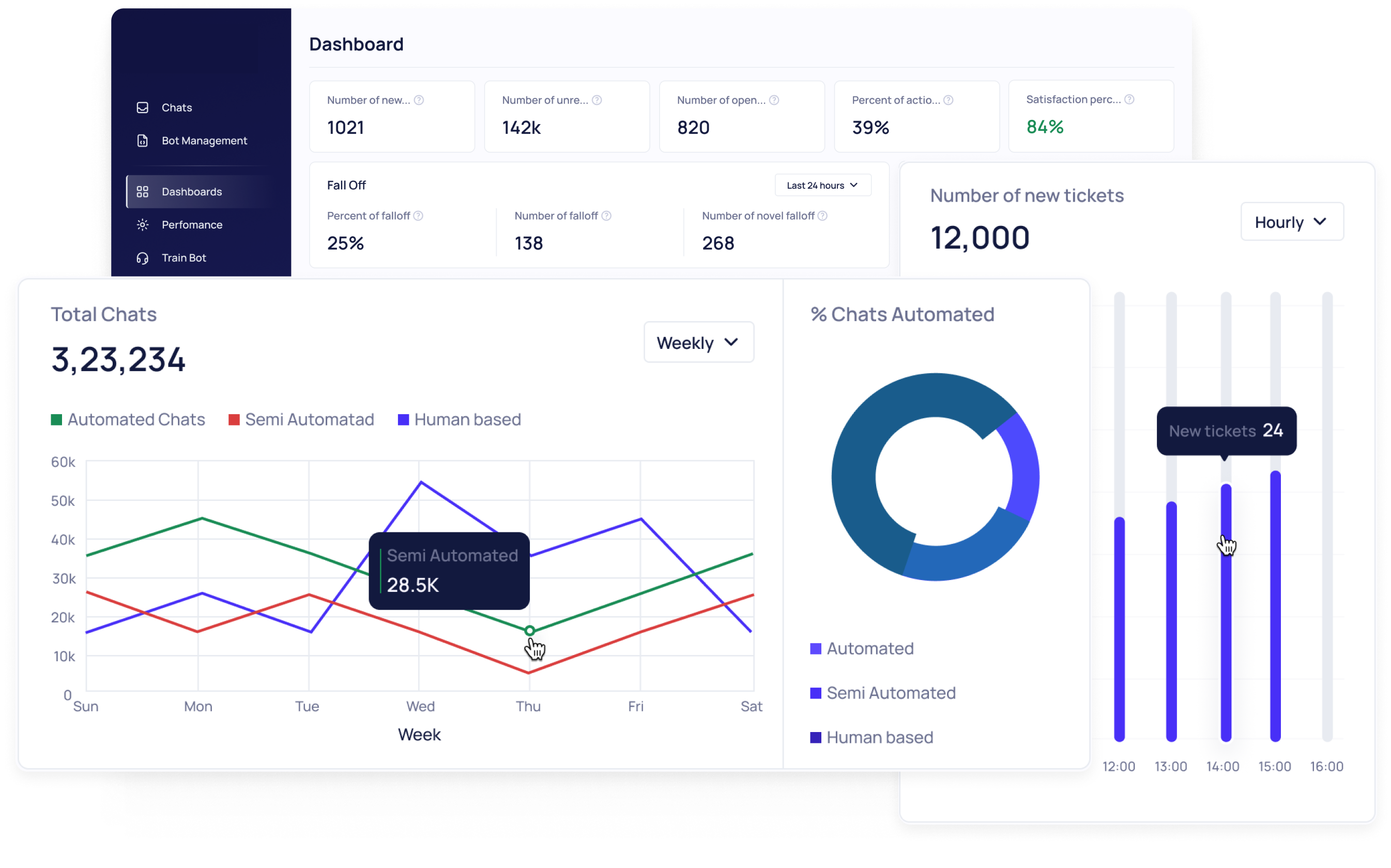









Imagine a digital system that doesn’t wait for instructions but instead, understands your business goals, learns from real-time feedback, and takes independent actions to get the job done.
Read More

Customer experience leaders, CRM managers, and SaaS companies often struggle with one silent problem: losing control over critical client signals as operations scale, and that is exactly where things start slipping without notice. You are not losing accounts overnight. You are losing them in small moments you never see. A missed signal, a delayed response, an opportunity that passes quietly.
The real question is how do you stay ahead when customer behavior changes faster than your team can track? As customer data is scattered, actions depend on manual effort, and consistency starts breaking as you scale. Enterprises and consulting firms may have the right tools, but they do not act on
Customer success has moved far beyond periodic check-ins and manual tracking. Today, it revolves around how quickly you can respond to customer signals without missing critical moments. Now:
An AI agent for client success is a system that continuously tracks customer activity, understands patterns, and takes timely actions without waiting for manual input. It works across onboarding, engagement, and retention by responding to what customers are actually doing, not what teams assume.
Instead of relying on static processes, this AI assistant adapts to each account based on real usage signals. It notices when something changes and reacts in the moment, which keeps customer success efforts aligned with actual behavior.
When businesses decide to build an AI client success agent, the goal is not to replace teams but to remove delays in decision-making. The system handles routine monitoring and actions, so teams can focus on situations that need human judgment.
Now let's understand what changes when intelligence becomes part of the system.
|
Aspect |
AI Client Success Agent |
Traditional Customer Success Models |
|---|---|---|
|
Decision Timing |
Responds instantly based on real-time activity without waiting for review cycles |
Actions are delayed and depend on scheduled reviews or manual checks |
|
Signal Coverage |
Tracks multiple signals across product usage, engagement, and support interactions continuously |
Limited to selected metrics reviewed periodically |
|
Action Execution |
Automatically triggers actions as soon as defined conditions are met |
Requires manual coordination between teams to act |
|
Consistency Across Accounts |
Maintains the same level of response quality for all customers regardless of scale |
Varies depending on team bandwidth and individual handling |
|
Scalability |
Handles growth in customer volume without increasing operational pressure |
Requires proportional hiring to manage more accounts |
|
Data Interpretation |
Interprets patterns from live data and adjusts actions accordingly |
Relies on static reports and past data for decision-making |
|
Adaptability |
Adjusts workflows dynamically as customer behavior changes |
Follows fixed processes that are slow to evolve |
|
Dependency on Teams |
Reduces dependency on manual tracking and routine intervention |
Heavily reliant on human effort for monitoring and execution |
|
Response Accuracy |
Aligns actions closely with actual customer behavior and context |
Decisions may be based on incomplete or delayed information |
|
Operational Visibility |
Provides continuous visibility into account status without gaps |
Visibility is fragmented and often delayed across systems |
Understanding this shift is important before you make AI client success system decisions for your business. It is not just about automation, but about how consistently your system responds to customer activity. That consistency is what starts shaping long-term customer relationships.
Also Read: A Complete Guide on AI Agent PoC
Or ready to shift toward decisions backed by real-time behavior
Move Beyond GuessworkCustomer activity generates a constant stream of signals across different systems. The real challenge is not collecting that data but making sense of it in the moment and responding correctly. This is where the internal logic of the system starts shaping how everything runs. This is how AI client success agent works in real scenarios:
When you build an AI client success agent, the real focus should stay on how these layers connect and operate together. Each part plays a role, but the outcome depends on how smoothly the system processes signals, makes decisions, and executes actions without delays.
Client success today directly influences how revenue grows, how costs behave, and how predictable your business becomes. If your current systems rely heavily on manual tracking, you are likely dealing with hidden inefficiencies. This is where the decision to build an AI client success agent starts becoming a financial strategy, not just a technology upgrade.
Growth does not always come from acquiring new customers. A large portion of revenue potential already exists within your current accounts. The real challenge is identifying when and where to act without delays.
When businesses build AI agent for customer success teams, they start turning everyday customer activity into measurable revenue outcomes without increasing sales pressure.
Retaining a customer is significantly more cost-effective than acquiring a new one. However, retention often fails due to late reactions and scattered visibility.
With structured AI business process automation in place, retention becomes a controlled cost function instead of an unpredictable expense.
Uncertainty in customer behavior makes forecasting difficult. This affects planning, budgeting, and long-term growth decisions.
This level of predictability allows leadership teams to make financial decisions with more confidence and less guesswork.
Customer success teams often spend a large portion of their time on repetitive tasks. This limits their ability to focus on high-value interactions.
Companies notice that resource optimization becomes one of the most immediate financial gains after implementation.
Every investment in customer success should deliver returns quickly. Delays in execution often reduce the actual value of these investments.
This makes enterprise AI solutions more aligned with business expectations, where every system is expected to justify its cost through visible returns.
Scaling customer success operations traditionally requires hiring more people. This creates a direct increase in cost as the customer base grows.
This approach helps businesses scale sustainably while keeping operational expenses under control.
When you look at customer success from a financial lens, the focus shifts from activities to outcomes. The real value comes from how efficiently revenue is protected, expanded, and predicted. That is where a well-structured investment in AI starts showing measurable returns across the business.
Also Read: AI Agent Ideas to Automate Your Business
Or are you still okay reacting after the damage is done
Close the Revenue Gaps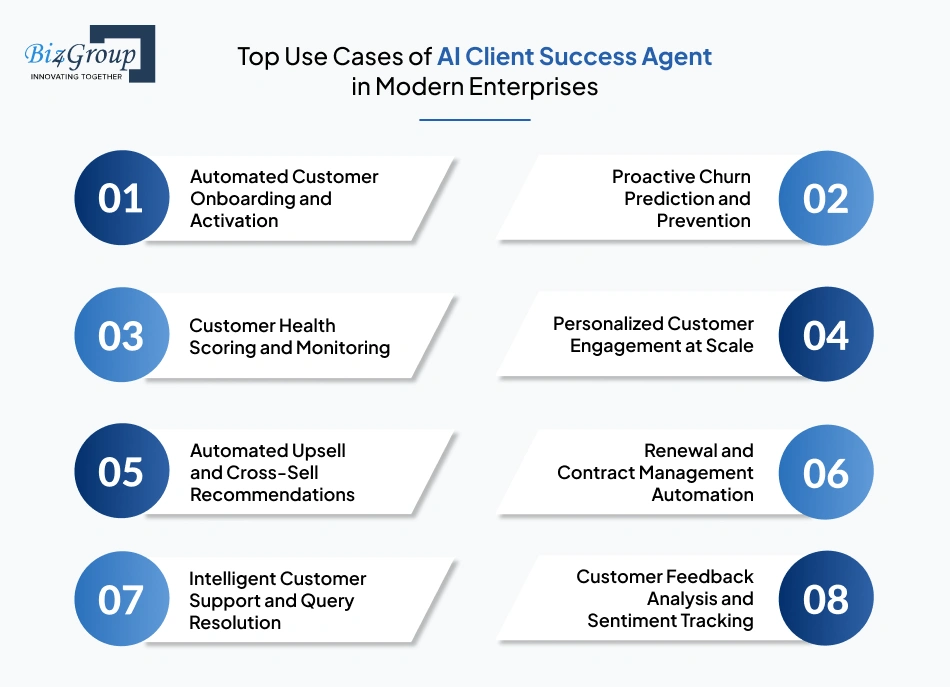
Customer success rarely follows a straight path once you start scaling. Different accounts move at different speeds, and gaps appear across onboarding, engagement, and retention. This is where AI agent for client success starts acting like a system that responds in real time.
We have listed the top use cases of AI client success agent so that you get a better understanding of where it sits inside modern business processes. Here take a look:
AI client success agent monitors how new users interact with the product during the first few sessions and triggers onboarding flows based on actual behavior. If a user skips a key setup step or fails to use a core feature, the system automatically pushes guided walkthroughs or task-based nudges tied to that gap. It also adjusts onboarding paths based on role, account type, and product usage patterns stored in the CRM.
Business Impact:
AI continuously evaluates signals such as sudden drop in feature usage, reduced login frequency, and repeated unresolved support tickets. When a combination of these signals crosses a defined threshold, the system flags the account as high-risk.
AI client success agent then triggers intervention workflows such as alerts, task creation, or automated engagement sequences. These actions are executed through connected business process automation systems to ensure immediate response.
Business Impact:
AI evaluates customer health by combining multiple inputs such as usage trends, engagement levels, and support interactions. It updates scores in real time and provides a clear view of account status across the portfolio. These insights often rely on data pipelines supported by AI automation tools to maintain accuracy and consistency.
This use case operates as a continuous monitoring layer across the entire customer lifecycle.
Business Impact:
The agent tracks user actions such as feature usage, inactivity periods, and milestone completion to trigger targeted communication. For example, if a user frequently uses a feature but avoids an advanced module, the system sends contextual guidance specific to that gap. Messaging is delivered across email, in-app prompts, and chat channels with timing adjusted based on user behavior.
Business Impact:
AI identifies expansion signals such as increased usage limits, frequent feature access, or team growth within an account. When these signals align with predefined thresholds, the system recommends specific upgrades or add-ons directly tied to actual usage behavior. These recommendations are surfaced to sales or triggered within customer workflows without manual analysis.
Business Impact:
AI agent tracks contract timelines, monitors engagement trends before renewal dates, and predicts renewal likelihood based on recent account activity. If risk is detected, the system flags the account and triggers internal workflows for follow-up. It also extracts contract details such as renewal dates and terms using an OCR system to maintain accurate tracking.
Business Impact:
The agent handles incoming queries by analyzing intent, referencing past interactions, and delivering context-aware responses. If a query requires escalation, the system routes it to the appropriate team with full context attached. This use case fits into the support resolution stage, where timely issue handling impacts user satisfaction and retention.
Business Impact:
AI processes feedback from surveys, support tickets, and conversations to detect patterns and customer sentiment. It identifies trends, recurring issues, and areas that require attention using advanced sentiment analysis techniques. These insights help teams understand customer perception without manual review.
Business Impact:
Each use case is not just another automation layer, but a shift in how teams operate daily. Instead of tracking customers manually, the system handles signals, actions, and timing, allowing teams to focus only where human input actually makes a difference.
AI customer success systems start to feel reliable only when the right capabilities are in place. The difference is not in strategy but in execution. AI client success automation for enterprises depends on a set of core features that handle signals, actions, and timing without constant intervention.
|
Must-Have Feature |
Purpose in AI Client Success Agent |
|---|---|
|
Behavioral Onboarding Tracking |
Tracks incomplete setup actions and ensures users move from signup to activation without missing critical steps, forming the foundation of an AI agent for customer onboarding and support. |
|
Real-Time Customer Health Monitoring |
Maintains a continuously updated view of account status to reflect changes in usage, engagement, and activity. |
|
Event-Based Workflow Automation |
Executes predefined actions instantly when specific conditions occur, removing delays caused by manual tracking. |
|
Multi-Channel Engagement System |
Delivers timely communication across email, in-app, and chat based on actual user behavior. |
|
Context-Aware Support Routing |
Directs queries to the right team with full interaction context, reducing resolution time and confusion. |
|
Usage-Based Expansion Detection |
Identifies when accounts are ready for upgrades based on actual usage patterns, helping teams build an AI client success agent aligned with revenue signals. |
|
Renewal Tracking and Alert System |
Monitors contract timelines and flags accounts that require attention before renewal deadlines. |
|
Feedback and Sentiment Processing |
Analyzes feedback to detect recurring issues and surface meaningful patterns. |
|
Unified Customer Data Integration |
Brings together data from CRM, product usage, and support systems into a single view for accurate decision-making. |
|
Action Logging and Performance Tracking |
Records system actions and outcomes to improve workflows over time. |
These features allow the AI client success agent to start handling routine customer signals without constant tracking. Teams can then build AI customer success agent capabilities in a way that scales naturally, while keeping their focus on decisions that actually need human involvement.
Once the core features are in place, the next question becomes clear: how will the system decide what to do when multiple signals appear together? That decision layer is where advanced AI capabilities start shaping how your AI client success agent actually behaves.
These capabilities define how the system makes decisions without constant oversight. Once applied correctly, they allow teams to rely on automation that adapts to real customer behavior while maintaining control over critical outcomes.
Real value starts when your system thinks not just executes predefined actions
Make It Think Smarter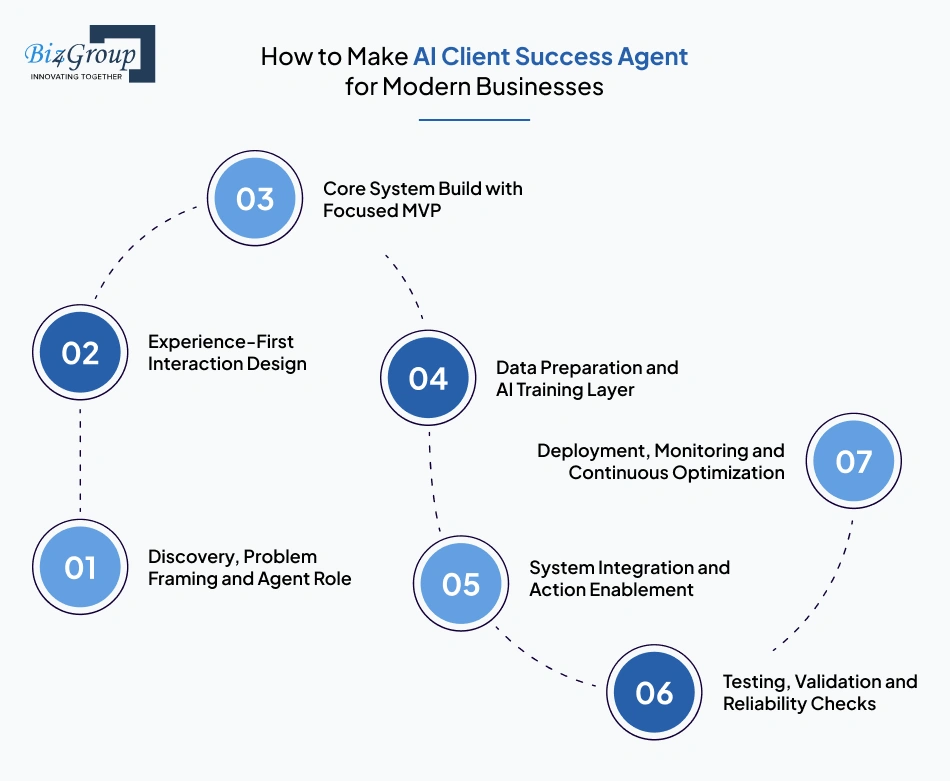
For businesses wondering how to build an AI client success agent for my business, the process is not about plugging a model into your system. It is about shaping how the agent fits into your customer success workflows and improves them step by step. You should focus on building something that thinks, acts, and improves, just like a reliable team member. Here’s the practical roadmap most founders and product leaders follow for AI client success agent development
Start by defining what the AI client success agent will actually handle inside your business. This is where most teams go wrong by trying to solve everything at once. Instead, focus on a clear role across onboarding, engagement, or retention, so the system delivers measurable value from the start.
The AI agent for client success will only work if users can interact easily during real workflows. Focus on how the agent behaves across onboarding, engagement, and supports the workflow instead of overcomplicating the interface.
Also Read: Top UI/UX Design Companies in USA
Avoid building a full-scale system in the first iteration. Start with a limited version that solves one clear problem and expand after validating its usefulness. This approach helps reduce risk and speeds up decision-making.
Also Read: Top MVP Development Companies in USA
The effectiveness of the system depends on how well it understands your customer data. This step ensures that the agent can interpret behavior correctly and respond with accuracy.
Also Read: Top Open Source LLMs for Business Growth
A client success agent should not stop at insights. It must take action within your existing systems, so workflows move without delays. This step connects intelligence with execution.
Before scaling, validate how the system behaves under real conditions. This includes edge cases where inputs are incomplete or unexpected.
Also Read: Software Testing Companies in USA
Once deployed, the system should evolve based on real usage patterns. This is where long-term value is created and where most improvements happen.
These steps to create an AI client success agent for customer retention focus on structured execution and continuous improvement. When applied correctly, they help teams shift from manual tracking to a system that responds consistently across the customer lifecycle.
When you start mapping your system, the real challenge is making sure every part works together in real scenarios. If you want to make an AI agent for customer onboarding and support that actually responds to user actions, think in connected layers, not isolated tools.
That is often considered the best way to develop AI client success automation for enterprises without creating gaps between data, actions, and workflows. The table below breaks down how each layer fits into the system and supports real customer success operations.
|
Architecture Layer |
Recommended Technology |
Purpose |
|---|---|---|
|
Frontend Interface |
Displays onboarding progress, engagement alerts, and account status across web development workflows so teams can act on customer signals without switching tools. |
|
|
Mobile Interface |
Flutter, React Native |
Supports mobile app development use cases where teams track churn risks, onboarding gaps, and alerts on the go without depending on desktop access. |
|
Backend Framework |
Executes core workflows such as onboarding completion checks, inactivity detection, and follow-up triggers based on real-time customer actions. |
|
|
AI Model Layer |
Interprets user inputs and generates responses that guide onboarding steps, resolve queries, and assist during support interactions. |
|
|
Data Storage |
PostgreSQL, MongoDB |
Maintains customer history, usage patterns, and engagement signals so decisions are based on actual behavior instead of assumptions. |
|
Data Processing Layer |
Apache Kafka, Airflow |
Processes events like login drops or feature inactivity instantly so the system reacts without waiting for manual review. |
|
Integration Layer |
REST APIs, GraphQL |
Connects CRM, support tools, and product data so workflows such as alerts and updates run through reliable API connections. |
|
Authentication & Security |
OAuth 2.0, JWT |
Controls access to customer data and ensures only authorized actions are executed during onboarding, engagement, and support processes. |
|
Analytics & Monitoring |
Mixpanel, Google Analytics |
Tracks outcomes such as onboarding completion, response accuracy, and engagement trends to improve system behavior over time. |
|
DevOps & Deployment |
AWS, Docker, Kubernetes |
Ensures the system scales smoothly so teams can build an AI client success agent that handles growing customer activity without performance gaps. |
As these layers are start working together, the system responds to customer activity without delays. That is where full stack development becomes essential, because every layer must stay connected to support real-time decisions across onboarding, engagement, and retention workflows.
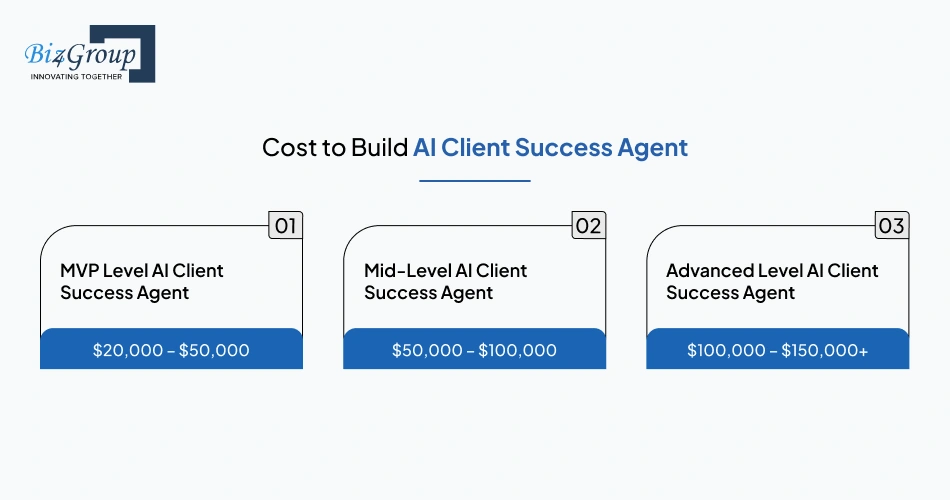
The cost to build an AI client success agent typically ranges between $30,000 and $200,000 plus, depending on scope, complexity, integrations, security needs, training data, and scaling plans. This is a ballpark estimation, not a fixed quote, because every custom AI client success agent has different goals and technical depth:
|
Development Level |
Estimated Cost Range |
Scope |
|---|---|---|
|
MVP Level AI Client Success Agent |
$20,000 – $50,000 |
Covers one focused use case such as onboarding automation or basic support handling with limited integrations and simple workflows. |
|
Mid-Level AI Client Success Agent |
$50,000 – $100,000 |
Includes multiple workflows like onboarding, engagement tracking, and churn signals with moderate integrations and improved system logic. |
|
Advanced Level AI Client Success Agent |
$100,000 – $150,000+ |
Full-scale system with predictive workflows, deep integrations, and real-time automation across onboarding, retention, and support operations. |
Expanding from a single workflow to full lifecycle automation directly increases AI agent development cost. Adding onboarding, engagement, and retention layers can raise development expenses by $10,000–$40,000 depending on workflow depth.
Organizing customer data and refining system responses requires continuous effort. Data structuring and training cycles can add $5,000–$20,000 based on the volume of data and frequency of updates.
Connecting CRM, support tools, and product systems increases AI integrations cost significantly. Each new integration can add $5,000–$15,000 depending on system complexity and real-time data requirements.
Simple automation is affordable, but multi-step workflows with decision layers increase cost. Advanced automation logic can contribute an additional $8,000–$25,000 depending on how dynamic the system needs to be.
Validating real-world scenarios and ensuring stable performance requires dedicated effort. Testing and monitoring can add $5,000–$15,000, especially when handling edge cases across onboarding and support workflows.
When teams focus only on development, they often miss what happens after deployment. The best way to create an AI client success system is to account for these ongoing costs early.
|
Hidden Costs |
Estimated Cost Impact |
|---|---|
|
AI Model updates and refinement cycles |
$5,000 – $15,000 annually |
|
Cloud infrastructure scaling |
$10,000 – $30,000 annually |
|
Maintenance of APIs and integrations |
$5,000 – $12,000 annually |
|
Data storage growth and management |
$3,000 – $10,000 annually |
|
Monitoring and performance improvements |
$5,000 – $15,000 annually |
The actual investment becomes easier to manage when you break it into phases instead of treating it as a one-time build. That approach helps you build AI assistant for customer success in a controlled way while keeping both upfront and long-term costs predictable.
Or keep spending more without knowing what actually drives returns
Take Charge of Investment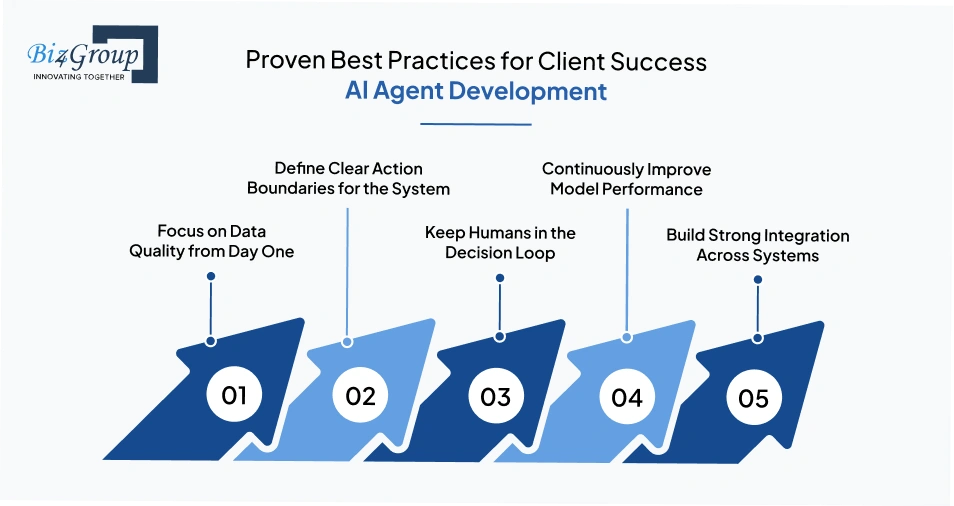
Once the system is live, the real challenge is not setup but consistency. How do you make sure it keeps working as expected every day? Well, AI customer success automation development depends on how well you guide decisions, not just how you configure the system.
These practices define how the system performs once it is live, not just how it is built. When followed consistently, they help teams develop AI powered client success platform capabilities that remain reliable, scalable, and aligned with real customer behavior over time.
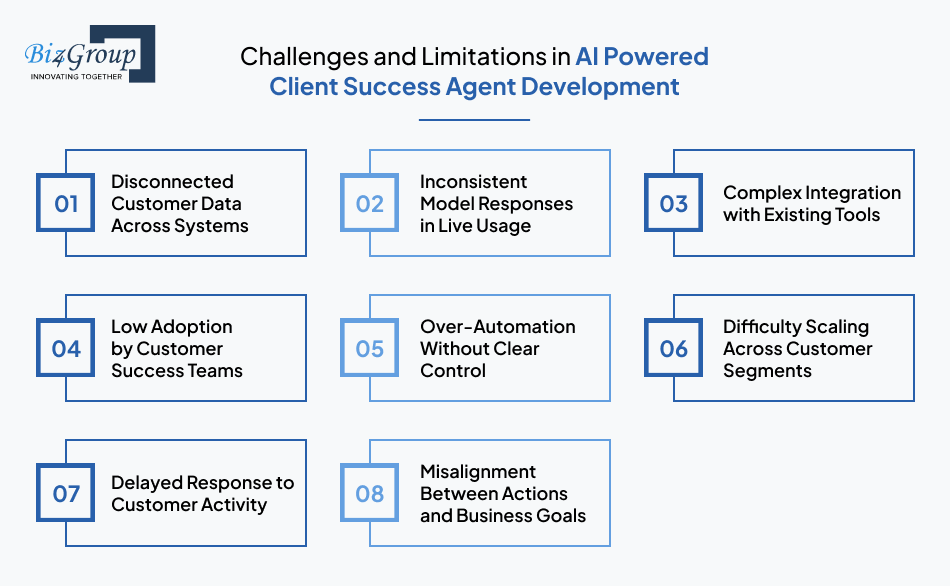
Even when the system looks ready, real issues start appearing once it runs in live environments. AI driven client success agent development often reveals gaps between how the system is designed and how it behaves with real customer data.
|
Challenge |
Solution |
|---|---|
|
Disconnected Customer Data Across Systems |
When customer data is spread across tools, the system struggles to respond accurately. Establish unified data pipelines that bring product, AI CRM, and support data together so decisions are based on complete context. |
|
Inconsistent Model Responses in Live Usage |
Early-stage systems often produce unstable outputs across similar situations. Introduce structured feedback loops and retraining cycles so responses improve with actual usage patterns instead of remaining static. |
|
Complex Integration with Existing Tools |
Integrating multiple systems often slows execution and creates gaps. Define a clear API structure and keep integrations standardized, especially when working with an AI development company that handles multiple system connections. |
|
Low Adoption by Customer Success Teams |
Teams avoid using the system if it feels unpredictable. Simplify how actions are displayed and ensure outputs are easy to understand so teams can rely on it during daily workflows. |
|
Over-Automation Without Clear Control |
Triggering too many automated actions can create confusion instead of efficiency. Work with experienced AI developers to set boundaries, so the system acts only when required and leaves room for manual decisions when needed. |
|
Difficulty Scaling Across Customer Segments |
A setup that works for one group may fail for another. Build flexible workflows that adjust based on account type, especially when you develop an AI client success system for SaaS companies with varied customer profiles. |
|
Delayed Response to Customer Activity |
If signals are processed late, actions lose relevance. Shift to real-time event processing so the system reacts instantly to changes in usage or engagement patterns. |
|
Misalignment Between Actions and Business Goals |
The system may execute actions correctly but still miss business priorities. Define clear outcome-based rules when you build an AI client success agent so every action supports retention, growth, or engagement goals. |
Challenges will always show up once the system is used in real-world scenarios. What matters is how early you identify and address them. That is how teams can make an AI agent for customer success teams that remains stable, useful, and aligned with everyday operations.
When you start thinking about which company can build AI client success agent solutions that actually work in real environments, the answer usually comes down to who understands your workflows, not just the technology. That is where Biz4Group LLC fits in as a practical partner.
We focus on how customer success actually runs inside your business. Instead of forcing a system into your workflow, we align the agent with how your teams handle onboarding, engagement, and retention. This approach helps us build an AI client success agent that feels natural to use from day one. As an experienced AI agent development company in USA, we have worked across different use cases where automation needs to support real decisions, not just generate responses. This experience shapes how we design systems that stay useful beyond initial deployment.
Not only that, but we also keep our process simple and transparent. Our teams work together from the start so design, logic, and workflows stay connected. This helps us deliver systems that remain consistent when used in real scenarios, not just controlled environments. Here’s how this looks in practice.
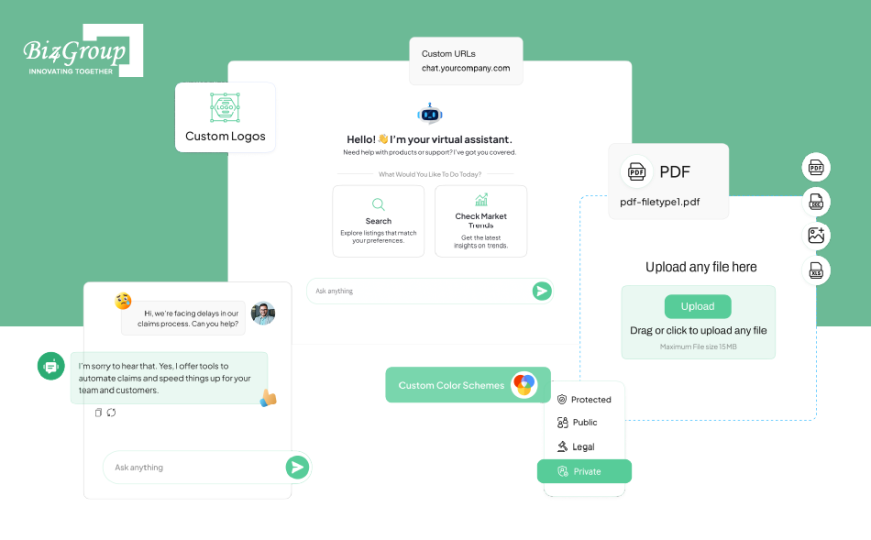
We designed a custom enterprise AI agent to handle complex business workflows across customer interactions, internal operations, and decision support. It connects multiple systems, processes real-time inputs, and triggers actions based on defined logic, reducing manual coordination across teams. It
This reflects how we approach building systems that fit directly into operational workflows rather than acting as standalone tools
Therefore, when you work with us, you are not just building a tool. You are creating a system that keeps improving as your customer success operations grow.
Make sure that you are choosing a partner or just another vendor for you AI client success agent development
Choose Execution First with UsCustomer success is no longer limited to reactive support or periodic check-ins. It is becoming a continuous, data-driven function where timing and relevance matter more than volume. That shift is why many businesses now look at an AI product development company’s approach to bring structure into how customer interactions are handled.
As expectations grow, relying on manual tracking or disconnected tools starts creating gaps. When you build an AI client success agent, the focus should stay on how well it fits into your workflows and supports real decisions. That is where working with Biz4Group LLC, an AI client success agent development company helps you move with clarity instead of complexity.
The goal is not just automation, but consistency in how customer success runs every day. If you are planning to move in that direction, this is the right time to take the next step. Let’s talk.
To build an AI client success agent that works with your CRM, start by connecting customer data sources like usage logs and support history. Then define how the system should respond to key signals. The focus should stay on aligning actions with existing workflows instead of replacing them.
Businesses usually work with an AI client success agent development company that understands both system architecture and customer success operations. The right partner ensures the solution adapts to your workflows instead of forcing process changes.
The cost to develop AI client success agent typically ranges from $20,000 to $150,000+, depending on scope, integrations, and automation depth. SaaS companies with multiple workflows and real-time requirements may fall toward the higher end of this range.
The timeline usually ranges from 8 to 20 weeks. A focused MVP with one use case can be built faster, while a full system with integrations and automation layers takes longer due to testing and refinement.
The system should be designed with flexible logic that adjusts based on account type and behavior. Instead of fixed workflows, it should respond dynamically, so different customer segments receive relevant actions without manual adjustments.
Success depends on how well the system adapts to real usage. Continuous monitoring, feedback loops, and regular updates ensure the agent stays aligned with changing customer behavior and business goals over time.

with Biz4Group today!
Our website require some cookies to function properly. Read our privacy policy to know more.