Location :
Orlando, FL, USA
Location :
Orlando, FL, USA +1 (407) 714-1616
 info@biz4group.com


















Imagine a digital system that doesn’t wait for instructions but instead, understands your business goals, learns from real-time feedback, and takes independent actions to get the job done.
Read More

What if the next breakthrough in betting platforms does not come from better odds, but from smarter systems behind the scenes? Consider this. The global sports betting market is expected to grow to $153.44 billion in 2030.
Now imagine pairing that scale with modern machine intelligence and automated pricing models. That is where AI pari-mutuel betting software development enters the conversation.
Betting platforms today handle millions of wagers, live game data, and dynamic odds simultaneously. Guess what happens when those systems rely on manual trading models? Bottlenecks appear. Operators lose efficiency.
That explains why more companies are moving toward AI pari-mutuel betting platform development.
Recent industry data shows that AI-based trading models already price nearly 48% of bets across major sportsbook networks. The shift is happening quickly and the operators adopting early are ahead of the game.
But what exactly does it take to develop AI powered pari-mutuel betting software that performs at scale? The answer involves more than algorithms. It requires real-time data pipelines, predictive models, automated risk monitoring, and secure transaction systems working together in a coordinated architecture.
In other words, it calls for a platform designed for both speed and trust.
Now, here is the real question. How can businesses build custom AI pari-mutuel betting platform for operators that remain competitive in a fast-evolving market? This guide walks through that and much more.
So, without any further ado, let’s begin with the basics.
Before building advanced platforms, it helps to understand the foundation. Pari-mutuel betting has powered wagering markets for decades, especially in horse racing and pool-based sports betting.
So, what makes it different?
Instead of betting against the house, users bet against each other. Every wager goes into a shared pool. The operator collects a commission. The remaining amount is distributed among the winners.
Simple in theory. Complex in execution.
Modern platforms now develop AI pari-mutuel betting applications that automate pool calculations, manage liquidity, and update payouts instantly.
Let us break down how the system actually works.
Pari-mutuel betting is a pool based wagering system where all bets on a specific event are combined into a single pot.
The operator deducts a small percentage called the takeout. The remaining pool is divided among bettors who predicted the correct outcome.
Key characteristics include:
This model creates transparency for bettors and reduces financial exposure for operators.
For businesses planning to build AI pari-mutuel wagering systems, this structure offers a natural advantage. The platform manages the pool while technology handles calculations and data processing.
At a technical level, the system runs through several coordinated components. Each element must operate in real-time to ensure fairness and accuracy.
Core workflow:
Behind the scenes, sophisticated infrastructure handles every transaction.
Here are the core components of a modern pari-mutuel system:
Accurate data feeds are particularly critical. Many betting platforms struggle with latency issues because they rely on inconsistent data providers. Another factor operators must consider is data quality. Top US betting apps rely on multiple sports data providers to ensure accuracy and redundancy.
Without reliable data pipelines, even the most advanced betting algorithms cannot function properly.
Also read: Why most betting apps fail at real-time match accuracy (and how top apps fix it)?
To understand why many operators prefer pool betting systems, it helps to compare them with traditional sportsbooks.
|
Factor |
Pari-Mutuel Betting |
Fixed Odds Betting |
|---|---|---|
|
Risk Ownership |
Bettors compete against each other |
Operator takes financial risk |
|
Odds Calculation |
Determined by pool size and bet distribution |
Set by sportsbook traders |
|
Payout Variability |
Changes until betting closes |
Locked when bet is placed |
|
Liquidity Impact |
Higher pool size improves payouts |
Odds controlled by bookmaker |
|
Operator Exposure |
Lower risk for operator |
Higher liability for sportsbook |
Because of this structure, many companies now build enterprise AI pari-mutuel betting solutions to create scalable betting environments without assuming the financial risk that traditional sportsbooks face.
Traditional pool betting platforms relied heavily on manual trading systems and static data feeds. Modern platforms operate very differently.
Today, operators develop AI pari-mutuel betting software with real-time analytics to manage complex betting environments. AI plays several roles inside the platform.
Predictive Pool Analysis
Machine learning models monitor betting patterns and estimate pool liquidity before events close.
Dynamic Pricing Insights
AI models analyze user behavior and betting trends to highlight pricing imbalances across betting pools.
Fraud Detection
Algorithms identify unusual betting activity that may signal manipulation or coordinated betting.
Automated Operational Workflows
Through advanced AI automation, betting platforms can streamline tasks such as payout calculations, bet validation, and anomaly detection.
Personalized Betting Insights
Some platforms use recommendation models similar to a sports betting AI agent that helps users analyze probabilities and betting trends.
Operators looking to create scalable AI pari-mutuel betting systems often integrate advanced analytics frameworks and machine learning pipelines into their platforms. These capabilities represent a shift toward intelligent wagering ecosystems.
Next, let us examine why operators are rapidly investing in AI-powered betting platforms and what business advantages they unlock.
Take a moment and look at how quickly wagering technology has evolved.
Major sportsbooks are no longer running on manual trading desks and static odds engines. They rely on advanced automation, predictive analytics, and real-time data processing to manage millions of wagers.
And the numbers confirm this shift.
According to reports, legal sportsbooks in the United States processed more than $164 billion in wagers in 2025 and generated over $16.6 billion in revenue.
That level of activity creates a simple reality... Traditional systems struggle to keep up. Operators therefore move toward AI pari-mutuel betting platform development to automate operations, improve risk control, and scale infrastructure efficiently.
Let’s look at the forces pushing this transformation.
Modern sportsbooks handle massive betting traffic during major events. For example, the NFL season alone was projected to attract around $30 billion in wagers in the US during the 2025 season.
Now consider what happens during events like the Super Bowl or March Madness. Millions of bets arrive within minutes.
This is exactly where businesses begin to develop AI powered pari-mutuel betting software.
AI-based systems analyze bet flows, update pool distributions, and manage transaction pipelines without manual intervention.
Automation in betting technology is no longer experimental. It is operational. Automation is quickly becoming central to sportsbook infrastructure.
Platforms that build AI pari-mutuel wagering systems can
Businesses adopting AI infrastructure today are effectively preparing for the next generation of wagering systems.
Also read: How to use AI for sports betting?
Another major shift comes from the data layer powering betting platforms. Odds engines rely on real-time event feeds, player statistics, and historical performance data. Without accurate data, betting markets collapse.
SportRadar, Genius Sports, and Sports.io provide the underlying data infrastructure used by many global sportsbooks.
SportRadar alone reported $1.5 billion in revenue for 2025 with strong growth driven by betting technology services.
This highlights a growing trend... Betting platforms are becoming data platforms. Businesses that create AI-driven pari-mutuel betting platforms must design systems that integrate multiple data providers and continuously process high frequency updates.
Also read: Why enterprise sports data APIs like SportRadar matter more than features?
Traditional sportsbooks assume liability when setting fixed odds. Pari-mutuel systems change that dynamic.
Since wagers are pooled, the platform acts as the facilitator rather than the counterparty. This reduces financial exposure while maintaining strong engagement among bettors.
For companies exploring new betting models, this structure makes it easier to create scalable AI pari-mutuel betting systems that support high transaction volumes without the same trading risk carried by fixed odds platforms.
One final trend stands out. Betting operators now treat their platforms like technology ecosystems.
They integrate:
Businesses exploring this approach often start by learning how to build an enterprise AI sports betting platform that combines real-time analytics with scalable infrastructure.
|
Industry Shift |
What It Means for Operators |
|---|---|
|
Increasing betting volume |
Platforms must process millions of bets instantly |
|
AI-based trading models |
Automated pricing and risk management |
|
Data provider ecosystems |
Real time odds accuracy and market coverage |
|
Pool-based wagering models |
Lower financial exposure for operators |
|
AI-powered analytics |
Smarter betting insights and personalization |
These forces are shaping how operators develop AI pari-mutuel betting software with real-time analytics.
Now we’ll answer where these systems can actually be applied. Let us explore the most common use cases where businesses build AI pari-mutuel wagering systems today.
Also read: AI sports betting exchange software development guide
Over $164B in wagers were placed in the US in 2025 alone. Operators using AI platforms are moving faster, pricing smarter, and scaling bigger.
Book a Strategy Call Today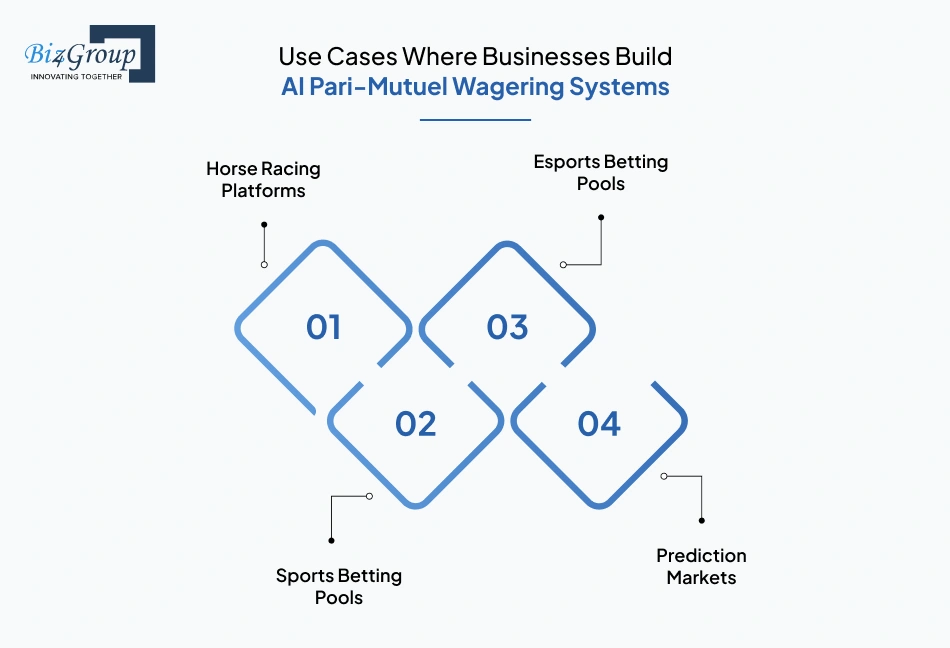
Pari-mutuel betting may sound traditional. The technology behind it has evolved significantly. Operators across multiple industries now build AI pari-mutuel wagering systems to support pool-based betting markets that require transparency, automation, and scalable infrastructure.
The structure works particularly well in environments where outcomes attract large betting pools and real-time data continuously influences wagering behavior.
Below are some of the most common applications where companies create scalable AI pari-mutuel betting systems today.
Horse racing remains the most established environment for pari-mutuel wagering. Racetracks and online operators combine bets from thousands of participants into centralized pools. Odds fluctuate constantly as new wagers enter the system.
Modern horse racing platforms develop AI pari-mutuel betting applications to manage several operational challenges.
AI also improves bettor insights by analyzing past performance data, track conditions, and race statistics.
Also read: AI horse racing betting calculator software development guide
Sports betting has expanded beyond fixed odds. Many platforms now offer pool-based wagering for:
Businesses develop AI-powered pari-mutuel betting software in these environments to manage betting liquidity across large user bases.
Why does this model work well for sports? Because pool-based wagering reduces the financial risk carried by operators while maintaining engaging payout structures for users.
Also read: Football betting app development guide
Esports tournaments generate massive global audiences. Competitive gaming events attract highly engaged fans who actively participate in betting markets.
Platforms that create AI-driven pari-mutuel betting platforms for esports focus on:
AI models evaluate gameplay data and team statistics to improve betting predictions and liquidity distribution. Because esports matches produce large volumes of live data, these systems require strong real-time processing infrastructure.
Prediction markets allow participants to wager on future outcomes. Examples include election results, entertainment awards, financial market trends, and social and cultural events.
Businesses that build enterprise AI pari-mutuel betting solutions often use this model to create transparent markets where users collectively determine probability through wagering behavior.
AI enhances these systems by:
These insights help maintain fair and balanced betting pools.
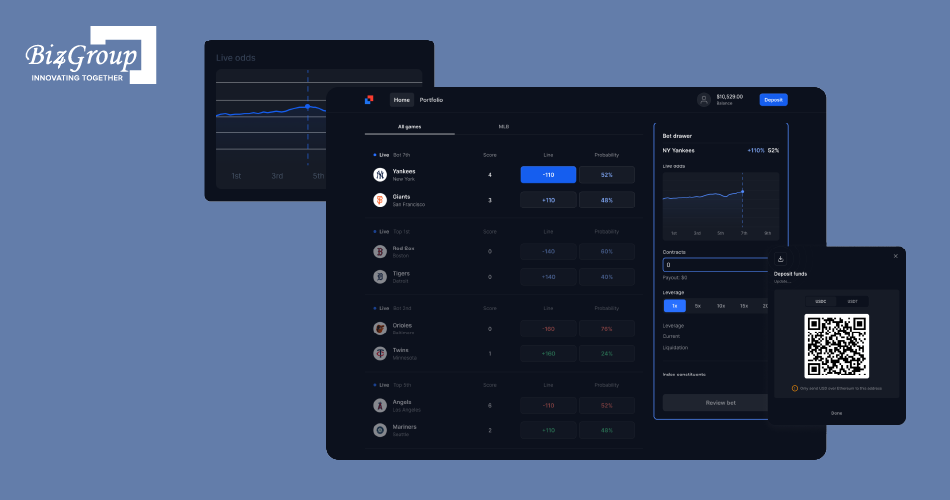
To understand how modern platforms operate, let us look at a real development project. Biz4Group built a high-performance sports betting platform designed for global betting markets.
The platform enables users to place wagers on major sports leagues including MLB, CFB, and NFL. It processes real-time game information through socket-based integrations, ensuring that bettors receive up-to-date data while making decisions.
Key capabilities of the platform:
The platform includes a powerful admin dashboard that enables operators to manage markets, monitor betting activity, and maintain platform performance. From an engineering perspective, the system runs on an eight-layer architecture that ensures reliability even during high traffic betting events.
This type of infrastructure highlights what businesses must consider when they develop AI pari-mutuel betting software with real-time analytics.
Also read: AI fantasy sports app development guide
Every successful betting platform shares one common trait. Thoughtful product design.
When companies develop AI-powered pari-mutuel betting software, they build separate modules for bettors, operators, and platform administrators. Each module focuses on a different set of responsibilities.
Bettors require speed and clarity.
Operators require control and analytics.
Administrators require visibility across the entire system.
These layers work together to create reliable wagering environments that can scale across thousands or even millions of users. Businesses planning to create scalable AI pari-mutuel betting systems often begin by defining features across three primary panels.
Let us explore them.
The user panel represents the front facing side of the betting platform. This is where bettors explore events, join betting pools, and track their wagers.
|
Feature |
Purpose |
Why It Matters |
|---|---|---|
|
User Registration and Profile Management |
Allows users to create accounts and manage preferences |
Ensures secure onboarding and personalized experiences |
|
Event Discovery Dashboard |
Displays upcoming games, races, and betting pools |
Helps bettors quickly find wagering opportunities |
|
Pool Participation Interface |
Enables users to place bets within live betting pools |
Maintains transparency around betting activity |
|
Real Time Odds Visualization |
Displays changing odds based on pool activity |
Improves bettor decision making |
|
Wallet and Payment Management |
Supports deposits, withdrawals, and transaction tracking |
Provides secure financial interactions |
|
Betting History and Performance Tracking |
Shows past wagers and outcomes |
Allows bettors to analyze their strategies |
Modern betting platforms often combine these features with predictive insights powered by generative AI models and behavioral analytics.
The operator panel is where the business side of the platform operates. It allows betting companies to manage pools, monitor activity, and maintain market integrity.
|
Feature |
Purpose |
Why It Matters |
|---|---|---|
|
Pool Creation and Management |
Allows operators to launch and manage betting pools |
Supports dynamic wagering markets |
|
Market Monitoring Dashboard |
Displays live betting activity and pool distributions |
Enables operators to track liquidity and user behavior |
|
Odds Calculation Engine |
Updates odds automatically as bets enter the pool |
Maintains fair and transparent pricing |
|
Risk Monitoring Tools |
Tracks unusual betting patterns |
Helps detect suspicious activity |
|
Revenue and Commission Tracking |
Calculates operator earnings from pool commissions |
Provides financial visibility |
|
User Engagement Insights |
Analyzes user activity trends |
Helps operators refine betting strategies |
Many organizations begin with a white label sports betting platform to validate market demand. As user bases grow, they transition toward custom platforms that support advanced analytics and operational automation.
Also read: Migrating from white label to custom sports betting software development
The admin panel acts as the control center of the entire platform. Administrators oversee security, manage compliance settings, and maintain system stability.
|
Feature |
Purpose |
Why It Matters |
|---|---|---|
|
Platform Configuration Controls |
Allows administrators to manage platform settings |
Ensures system stability and customization |
|
User Management System |
Enables moderation of accounts and permissions |
Maintains platform integrity |
|
Fraud Detection Monitoring |
Tracks abnormal activity across betting pools |
Protects users and operators |
|
Financial Reconciliation Dashboard |
Reviews transactions and payout logs |
Supports financial transparency |
|
Data Analytics Reporting |
Generates operational and performance reports |
Helps administrators monitor platform health |
|
Integration Management |
Oversees data feeds and third-party services |
Ensures reliable platform connectivity |
The features above represent the foundation required to develop AI pari-mutuel betting software with real-time analytics.
However, features alone do not guarantee performance. The real strength of a betting platform lies in its underlying technology infrastructure. The next section explores the tech stack and architecture used to build enterprise grade AI pari-mutuel betting systems that operate reliably under heavy transaction loads.
Also read: How to develop a sports betting platform like Outlier.Bet?
Users abandon betting platforms within seconds if navigation feels slow or confusing. The right features and architecture decide whether your platform becomes a habit or a forgotten tab.
Build Smart with Biz4GroupBuilding a betting platform requires a robust technology foundation that can handle thousands of wagers, real-time data feeds, and complex pool calculations. Businesses that develop secure AI pari-mutuel betting software architecture focus on selecting tools that support performance, scalability, and reliability.
The goal is simple. Process betting activity quickly while maintaining stable platform performance during peak traffic events.
Below is a common technology stack used when companies develop AI pari-mutuel betting applications.
The frontend layer focuses on user experience and responsiveness. Bettors expect fast loading interfaces, live updates, and seamless navigation across devices.
|
Component |
Frameworks or Tools |
Purpose |
|---|---|---|
|
Web Application Framework |
React, Next.js, Vue.js |
Builds responsive betting dashboards |
|
Mobile Development |
Flutter, React Native, Swift |
Supports cross-platform mobile betting apps |
|
State Management |
Redux, Zustand |
Manages real-time UI updates |
|
UI Frameworks |
Tailwind CSS, Material UI |
Creates intuitive betting interfaces |
|
Data Visualization |
Chart.js, D3.js |
Displays odds movements and pool distributions |
Modern betting platforms often treat their frontend as a standalone AI product ecosystem that interacts with backend services through APIs and real-time data streams.
The backend layer manages business logic, betting transactions, and pool calculations. This is where the core wagering engine operates.
|
Component |
Frameworks or Tools |
Purpose |
|---|---|---|
|
Server Framework |
Node.js, .NET Core, Go |
Handles API requests and transaction processing |
|
Microservices Architecture |
Docker, Kubernetes |
Supports modular platform scalability |
|
Database Systems |
PostgreSQL, MongoDB |
Stores user data and wagering records |
|
API Development |
REST APIs, GraphQL |
Enables communication between services |
|
Authentication |
OAuth, JWT |
Secures user identity and transactions |
Backend services also manage interactions with external data providers and payment gateways. Reliable APIs are critical in this environment.
Also read: How enterprise-grade sports APIs power $10M+ betting app valuations?
Artificial intelligence plays a growing role in modern wagering systems. Platforms integrate analytics pipelines that evaluate betting activity and generate predictive insights.
|
Component |
Frameworks or Tools |
Purpose |
|---|---|---|
|
Machine Learning Libraries |
TensorFlow, PyTorch, Scikit learn |
Builds predictive models for betting patterns |
|
Data Processing |
Apache Spark, Pandas |
Processes large volumes of betting data |
|
Recommendation Systems |
Python ML pipelines |
Generates betting insights for users |
|
Behavioral Analytics |
BigQuery, Snowflake |
Analyzes bettor activity and trends |
|
Model Deployment |
MLflow, Kubernetes |
Deploys AI models into production |
These capabilities allow companies to develop AI pari-mutuel betting software with real-time analytics that continuously learns from betting patterns.
Cloud infrastructure ensures the betting platform remains stable during heavy traffic periods such as championship games or major tournaments.
|
Component |
Frameworks or Tools |
Purpose |
|---|---|---|
|
Cloud Platforms |
AWS, Google Cloud, Microsoft Azure |
Hosts platform infrastructure |
|
Containerization |
Docker |
Deploys scalable microservices |
|
Orchestration |
Kubernetes |
Manages containerized services |
|
Event Streaming |
Apache Kafka |
Processes real time betting events |
|
Monitoring Tools |
Prometheus, Grafana |
Tracks system performance |
Companies that plan to build enterprise AI pari-mutuel betting solutions design their infrastructure for horizontal scalability so new servers can be added during traffic spikes.
Once the technology stack is defined, the platform architecture determines how all components interact with each other. A typical system architecture used to create AI driven pari-mutuel betting platforms includes the following layers.
This architecture enables businesses to develop secure AI pari-mutuel betting software architecture capable of handling large scale betting operations.
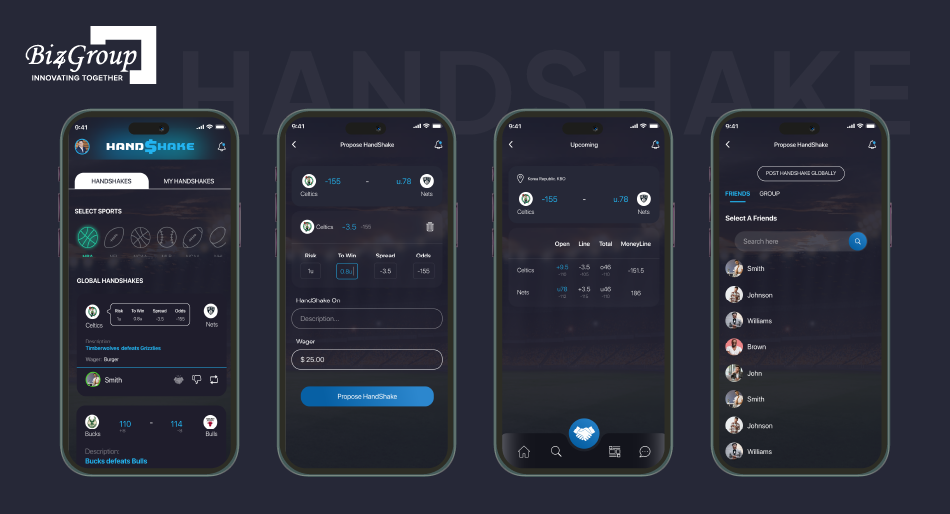
One example of a platform built with scalable betting architecture is a social betting application developed by Biz4Group. The platform was designed to create an engaging betting environment where users could challenge friends or other participants during live sporting events.
The platform supports betting across leagues including NFL, NBA, NHL, PGA, and NCAA competitions. It focuses on simplicity while maintaining strong data processing capabilities.
Key highlights of its system include:
The architecture also supports real-time user interactions and wagering proposals between participants.
This approach demonstrates how companies can build custom AI pari-mutuel betting platform for operators while maintaining a smooth user experience and reliable platform performance.
With the right technology stack and architecture in place, the next step involves turning the concept into a working product. Let us walk through the step-by-step process businesses follow to develop AI pari-mutuel betting software from idea to deployment.
Also read: How to build a sports betting platform like BetDEX?
Building a wagering platform requires careful planning. Betting products operate in high activity environments where user expectations are extremely high. A rushed development process often leads to unstable systems and poor user adoption.
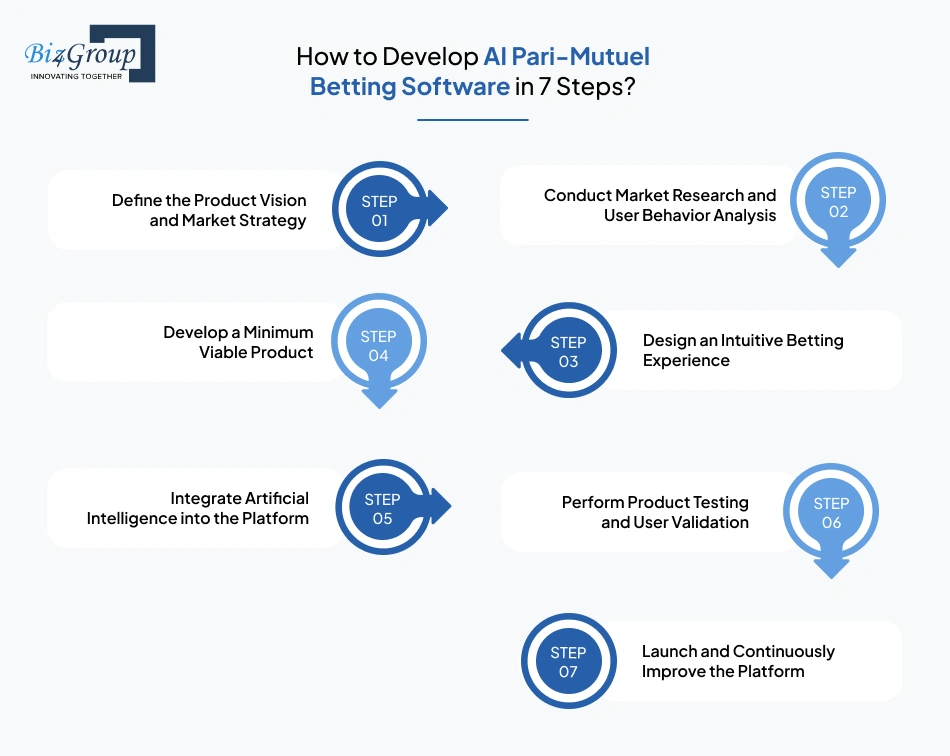
Below is a practical seven-step approach businesses use to build enterprise AI pari-mutuel betting solutions.
Every successful betting platform begins with a clear product direction. Operators must identify:
For example, some businesses focus on sports betting pools while others build platforms around esports or prediction markets.
Understanding how bettors interact with wagering platforms is essential. Product teams usually evaluate:
These insights help companies develop AI powered pari-mutuel betting software that aligns with real user expectations.
Bettors expect simple navigation, clear pool information, and fast bet placement. When businesses develop AI pari-mutuel betting applications, they invest heavily in UI and interaction design to make betting activity effortless.
A professional UI/UX design company considers:
A well-designed interface improves both engagement and conversion rates.
Also read: Top 15 UI/UX design companies in USA
Launching a full-scale betting platform immediately can be risky. Many companies develop an MVP to validate their product idea and gather real user feedback.
An MVP typically includes:
Launching an MVP helps operators validate market demand before expanding the platform.
Also read: Top 12+ MVP development companies in USA
Once the core product proves viable, the next step involves intelligence and automation. Businesses begin to develop AI pari-mutuel betting software with real-time analytics by integrating machine learning models and predictive insights.
These systems can assist with:
The goal is to improve betting intelligence without complicating the user experience. And robust AI integration services help connect predictive models with platform workflows.
Before launching publicly, the platform must undergo extensive testing. Quality assurance teams review:
Testing also ensures that the platform remains stable when large numbers of bettors participate simultaneously. Businesses that create AI driven pari-mutuel betting platforms treat testing as an ongoing process rather than a one-time activity.
Once the system proves stable, the platform can be introduced to the market. However, successful betting products evolve constantly.
Operators monitor:
These insights help businesses develop AI pari-mutuel betting applications that adapt to user behavior and industry trends. Continuous product improvement allows betting platforms to remain competitive in a fast-moving digital wagering ecosystem.
Following this structured roadmap helps organizations build enterprise grade AI pari-mutuel betting systems while reducing development risks. Once the platform is ready to operate, another critical aspect comes into focus. Security and regulatory compliance. Let’s learn about them.
Also read: How to develop a sports betting app like Stake?
With the right development approach, a working betting MVP can launch in 2-4 weeks. The sooner you launch, the sooner your platform starts learning from real bettors.
Contact Biz4Group TodayLaunching a betting platform without strong compliance controls can quickly become a costly mistake.
Online wagering operates under strict regulatory frameworks across most jurisdictions. Operators must follow licensing rules, financial monitoring requirements, and responsible gambling policies.
Companies that create AI-powered pari-mutuel wagering systems with compliance therefore build regulatory safeguards directly into the platform. Compliance cannot be added later. It must be embedded from the beginning.
Operators must confirm:
Businesses that develop AI pari-mutuel betting applications for international markets often work with multiple regulators simultaneously. This requires platforms to maintain region-specific rules and reporting systems.
Without proper licensing, operators cannot legally accept wagers.
Common KYC verification methods include:
Platforms that build enterprise AI pari-mutuel betting solutions integrate automated identity checks to prevent unauthorized access and protect minors from gambling.
These systems also help maintain trust between operators and bettors.
Typical AML controls include:
Businesses that develop AI-powered pari-mutuel betting software often rely on intelligent analytics to detect unusual patterns in wagering behavior.
Automated monitoring systems can flag suspicious activity in real-time.
Common responsible gambling features include:
Companies that create scalable AI pari-mutuel betting systems for global markets implement these safeguards to ensure their platforms promote responsible user engagement.
Responsible gaming compliance also strengthens the platform's credibility with regulators.
Security frameworks typically focus on:
Platforms that develop AI pari-mutuel betting software with real-time analytics often manage extremely high volumes of user data. Strong data protection systems ensure this information remains secure.
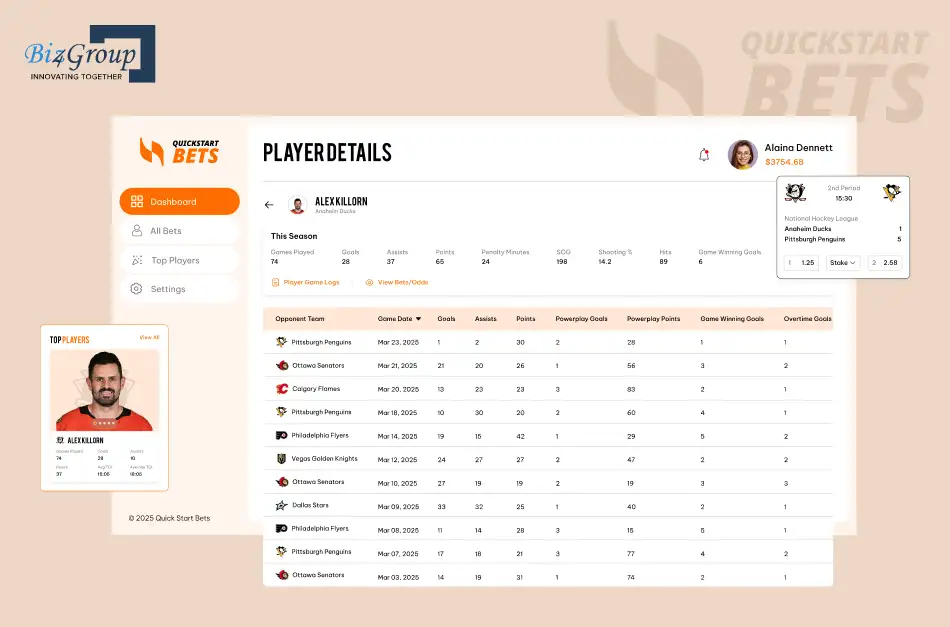
One example of compliance focused platform design is Quick Start Bets, a sports analytics platform developed by Biz4Group. The platform focuses on NHL games and delivers detailed insights that help users evaluate wagering opportunities.
Key platform capabilities include:
The system also maintains detailed records of betting activity and historical performance data. This helps operators maintain accurate reporting and operational accountability.
Quick Start Bets demonstrates how businesses can build enterprise grade AI pari-mutuel betting systems that combine analytics, transparency, and secure data management.
Compliance readiness forms the foundation of any successful betting platform. However, operators must also evaluate the financial investment required to build and maintain these systems.
Also read: Sports betting regulations across US states
Building a betting platform requires careful financial planning. Development costs vary depending on features, analytics capabilities, scalability requirements, and regulatory preparation.
In most cases, companies planning AI pari-mutuel betting software development should expect an investment range between $30,000-$150,000+ for initial platform development. The final cost depends on how advanced the system becomes and how many capabilities are integrated during development.
Businesses that develop AI-powered pari-mutuel betting software typically scale their investment across different development stages.
|
Development Stage |
Estimated Investment Range |
What It Includes |
|---|---|---|
|
MVP Platform |
$30,000-$50,000 |
Core betting pools, user accounts, basic analytics |
|
Advanced Platform |
$50,000-$100,000 |
Expanded features, automation modules, advanced dashboards |
|
Enterprise Platform |
$100,000-$150,000+ |
Scalable infrastructure, predictive analytics, global market readiness |
Also read: Sports betting website MVP development guide
Now, let us examine the major cost drivers involved in pari-mutuel betting software development using AI.
Several technical and business factors influence the overall cost when companies create scalable AI pari mutuel betting systems. Each component contributes differently to development investment depending on platform complexity.
|
Cost Driver |
Estimated Cost Range |
Why It Impacts Budget |
|---|---|---|
|
Platform Design and User Experience |
$5,000-$15,000 |
Custom interfaces and smooth betting workflows require detailed design planning |
|
Core Betting System Development |
$10,000-$40,000 |
Wager processing and pool management require precise logic and testing |
|
AI Analytics and Automation Features |
$10,000-$35,000 |
Predictive models and behavioral analysis increase development complexity |
|
Data Feed Integrations |
$5,000-$20,000 |
Real time sports data providers charge integration and usage fees |
|
Security and Fraud Monitoring Systems |
$5,000-$15,000 |
Secure transaction handling and monitoring systems add development effort |
|
Admin and Operator Management Tools |
$5,000-$15,000 |
dashboards and reporting tools support operational visibility |
These cost drivers highlight how different layers of functionality influence investment levels.
Development costs are only part of the total investment required to launch a betting platform. Many operators underestimate additional expenses that appear after the initial build phase.
Understanding these hidden costs helps businesses create realistic budgets in custom AI pari-mutuel software development.
Also read: How much does it cost to develop an AI sports betting app like Rithmm?
When you develop AI pari-mutuel betting applications, smart planning can significantly reduce platform development expenses without sacrificing performance.
These approaches help businesses build enterprise grade AI pari-mutuel betting systems while maintaining financial efficiency. A well-structured cost strategy ensures the platform remains sustainable as it grows.
However, cost planning alone does not guarantee success. Betting platforms must also anticipate technical and operational risks that can impact performance and user trust.
Also read: How do AI sports betting apps like FanDuel make money?
Operators that validate their betting idea early spend 30-40% less on development than those who rebuild later.
Let's Talk Numbers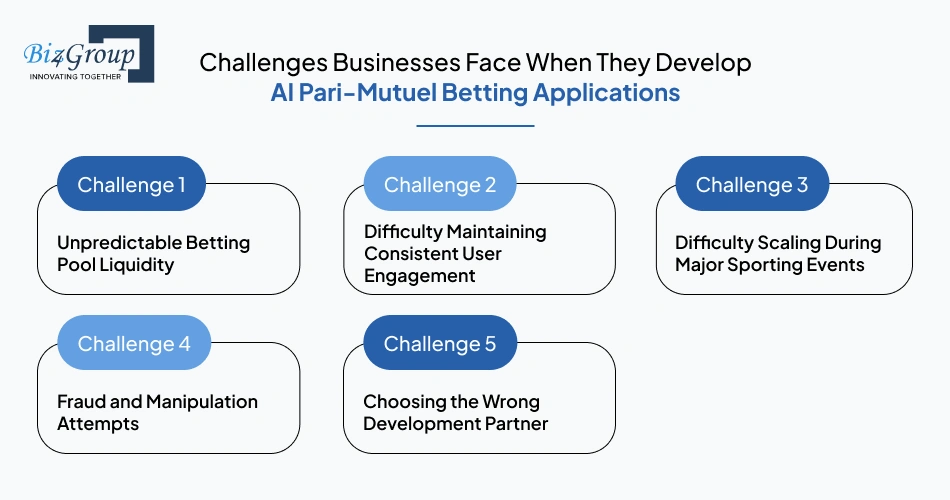
Launching a betting platform may look straightforward on paper. In reality, it involves multiple operational, technical, and market related challenges. Many operators underestimate these challenges during early planning stages. The result is delayed launches, unstable platforms, or poor user adoption.
Below are some of the major challenges companies face when they build enterprise AI pari-mutuel betting solutions, along with practical ways to address them.
Pari-mutuel systems depend heavily on pool participation. If too few users place bets, the payout pool becomes less attractive for bettors. Low liquidity can discourage participation and reduce platform engagement.
Solutions
Operators often combine these strategies with broader enterprise AI solutions to analyze user behavior and identify high engagement betting markets.
Betting platforms require active participation to remain viable. If users lose interest or migrate to competitors, platform activity declines quickly. Maintaining engagement becomes especially difficult when new betting platforms enter the market.
Solutions
Businesses looking to expand their technical capabilities often choose to hire AI developers who specialize in predictive analytics and intelligent platform features.
High profile sports events generate sudden traffic spikes. Platforms that cannot scale quickly may experience slow response times or failed transactions. This can damage user trust and lead to customer churn.
Solutions
Understanding these issues early helps businesses develop AI powered pari-mutuel betting software capable of supporting high volume wagering activity.
Betting environments naturally attract attempts at manipulation. Users may attempt coordinated wagers, exploit pricing anomalies, or abuse promotional offers. Without strong monitoring systems, these activities can harm the platform's reputation.
Solutions
Businesses that develop AI pari-mutuel betting applications increasingly rely on predictive analytics to detect irregular behavior and protect the platform ecosystem.
Many operators underestimate the complexity of betting platform development. Partnering with inexperienced vendors often leads to incomplete products and costly redevelopment. Choosing the top AI sports betting software development company plays a major role in project success.
Solutions
Also read: Top 14 sports betting software development companies in the USA
Successfully addressing these challenges allows businesses to build custom AI pari-mutuel betting platform for operators that remain stable, engaging, and competitive.
Once operators understand the risks and mitigation strategies, the next step becomes selecting a reliable development partner capable of building and scaling the platform effectively.
Speaking of a reliable development partner...
Also read: Challenges in modern sports betting app development
Launching a betting platform demands deep industry knowledge, real world engineering experience, and the ability to build systems that perform reliably in high transaction environments.
That is where Biz4Group stands out.
Biz4Group LLC is a US-based sports betting app development company known for building scalable digital platforms, advanced AI solutions, and enterprise grade software products. Our team has over 20 years of experience building high performance betting platforms, predictive analytics systems, and real-time data processing environments.
What sets Biz4Group apart is the ability to combine technical expertise with practical product thinking. Instead of delivering generic software, the team focuses on creating scalable AI pari-mutuel betting systems for global markets that align with business goals, user behavior, and market dynamics.
Biz4Group also provides specialized sports betting API integration services that connect betting platforms with live sports data feeds, player statistics, and market updates. This ensures that betting platforms built by Biz4Group operate with accurate and reliable information at all times.
Businesses around the world partner with Biz4Group because the company consistently delivers technology solutions that perform under pressure.
If you are planning to develop AI pari-mutuel betting software with real-time analytics, working with an experienced technology partner can make the difference between an average product and a market leading platform.
Let us make that difference for you. We're here to help you launch a market leading platform today.
The betting industry is entering a new phase where technology plays a defining role in how wagering platforms operate. Pool-based betting models offer transparency and operational efficiency, while intelligent analytics make it possible to manage large volumes of wagers with greater precision. Businesses that invest in AI pari-mutuel betting software development are positioning themselves to create platforms that balance betting pools effectively, improve pricing accuracy, and deliver more engaging experiences for users.
Launching a successful wagering platform requires thoughtful planning. Operators must evaluate the right features, platform architecture, compliance frameworks, and development strategy before entering the market. Companies that develop AI-powered pari-mutuel betting software with scalable infrastructure and predictive insights are far better equipped to handle high traffic events and evolving user behavior.
This is where working with an experienced technology partner becomes crucial. Biz4Group LLC, a USA-based software development company, has helped businesses build intelligent betting platforms that combine AI capabilities, real-time analytics, and high-performance infrastructure. With strong expertise in wagering technology, product strategy, and scalable platform engineering, Biz4Group helps organizations build enterprise AI pari-mutuel betting solutions that are designed for long term growth.
If you are planning to launch a modern wagering platform, now is the time to move forward with the right strategy and the right development partner.
Yes. Modern wagering systems can support multiple sports leagues within the same platform. Operators often include football, basketball, baseball, esports, and racing markets in one ecosystem. Each sport can have its own betting pools, event schedules, and payout structures while operating on the same platform infrastructure.
Yes. Many platforms now incorporate social betting elements where users can challenge friends, participate in group betting pools, or compete on leaderboards. These features increase user engagement and encourage repeat participation across major sporting events.
Operators typically grow participation through promotional campaigns, referral programs, tournament style pools, and partnerships with sports communities. Attractive jackpots and competitive payouts also motivate bettors to participate in larger pools.
Development timelines depend on the complexity of the platform. Most full-scale betting platforms take around 3-6 months to build. However, Biz4Group can deliver a functional MVP in as little as 2-4 weeks by using reusable development components and proven frameworks that reduce both development time and cost.
Yes. Modern platforms often analyze user behavior and historical betting activity to provide tailored insights. These insights may include suggested wagers, trend analysis, or performance summaries that help users make informed betting decisions.
Before launching, operators should carefully review platform scalability, data reliability, user experience, compliance readiness, and long term growth strategy. Partnering with an experienced development company also helps ensure the platform performs reliably once it goes live.

with Biz4Group today!
Our website require some cookies to function properly. Read our privacy policy to know more.