 Location :
Orlando, FL, USA
Location :
Orlando, FL, USA +1 (407) 714-1616
 info@biz4group.com

- AI parlay betting software development helps sportsbooks build intelligent wagering platforms that analyze real-time sports data, optimize odds, and manage multi-event bets efficiently.
- Businesses that develop AI-powered parlay betting software typically integrate enterprise sports data APIs, machine learning models, and scalable cloud infrastructure to maintain accurate betting markets.
- The AI parlay betting software development cost breakdown typically ranges from $30,000-$150,000+ depending on platform complexity, AI capabilities, and real-time data integrations.
- Successful operators create AI-powered parlay betting system with compliance by implementing licensing frameworks, KYC verification, AML monitoring, and responsible gambling controls.
- Biz4Group LLC, a USA based betting software development company, helps operators design and launch scalable AI-powered betting platforms with advanced analytics, secure architecture, and real-world sportsbook expertise.
What if a single bet could multiply payouts across several games while giving operators stronger control over odds, margins, and risk? That question is shaping the next wave of sportsbook innovation.
The global sports betting market predicted to increase from USD 124.88 billion in 2026 to approximately USD 325.71 billion by 2035.
Opportunity: Those investing early in AI parlay betting software development can create smarter wagering systems that price odds dynamically, manage exposure, and keep bettors engaged throughout the game cycle.
Traditional systems rely on static pricing models that struggle with live data streams and complex multi-bet combinations. Modern operators want platforms that adapt instantly to player statistics, injuries, and match momentum.
That is where AI parlay betting platform development becomes a serious advantage.
Platforms powered by real-time and predictive analytics allow sportsbooks to offer richer betting markets without increasing operational risk.
Now consider the technical side. Building these platforms requires predictive modeling, data ingestion pipelines, and integrations with sports data providers. The goal is to develop AI-powered parlay betting software capable of processing thousands of live data points per second while maintaining accurate pricing across multiple events.
And how does this translate into real business value for operators? With advanced algorithms, sportsbooks can build custom AI parlay betting platform for operators that personalize wagers, optimize odds, and automate risk management.
Let’s learn how.
Understanding the Basics of AI Parlay Betting Software Development
Let’s start with a simple question.
What exactly makes parlay betting technology different from a typical sportsbook engine?
In a standard wager, a bettor places money on one outcome. A parlay bet combines multiple selections into a single wager. Every selection must win for the bettor to receive the payout.
The reward can be significantly higher. So can the operator’s exposure.
That complexity explains why AI parlay betting software development has become a priority for modern sportsbooks. Operators need systems that calculate odds instantly, adjust markets in real-time, and control risk when thousands of multi-event wagers are placed simultaneously.
What Is AI Parlay Betting Software?
AI parlay betting software is a digital platform that manages multi-event wagers using machine learning models and real-time sports data. The platform analyzes player statistics, match conditions, betting patterns, and historical outcomes to determine the probability of combined events.
The result is a system that can dynamically price parlays instead of relying on static odds tables.
Sportsbooks that plan to build AI parlay wagering systems rely heavily on automated models to process enormous volumes of match data, which helps maintain accurate odds even during high traffic game moments.
Core Components Behind the System
Behind the interface sits a complex technology stack that constantly processes sports data and betting activity.
Key components typically include:
- Real-time sports data ingestion
- Odds calculation engine
- AI prediction models
- Risk management system
- Bet settlement engine
- User analytics dashboard
- Compliance and fraud monitoring modules
And where does the data come from?
Leading sportsbooks integrate APIs from providers such as SportRadar, Genius Sports, and Sports.io to capture real-time scores, player statistics, and match updates. These feeds allow the platform to instantly recalculate parlay odds whenever the game situation changes.
Operators exploring parlay betting software development using AI often prioritize enterprise sports APIs because pricing accuracy depends heavily on reliable data streams.
How the AI Engine Actually Works
Let’s break the process down into a few simple stages.
- Data Ingestion
Sports data providers stream match statistics, player metrics, injuries, and live scores through APIs. - Probability Modeling
Machine learning models analyze historical and real-time data to predict outcomes. - Correlation Detection
AI identifies relationships between events. For example, two player performance bets within the same match may influence each other. - Dynamic Odds Generation
The system calculates the combined probability of all selections and produces the final parlay odds. - Risk Monitoring
Exposure across markets is tracked continuously to protect sportsbook margins.
If this sounds complex, that is because it is.
The biggest challenge lies in maintaining accuracy while thousands of bets arrive every second. Data delays or pricing errors can create massive liabilities for operators. This is why many platforms invest heavily in enterprise grade APIs and redundant data sources.
Also read: Why enterprise sports data APIs like SportRadar matter more than features?
AI-Powered Capabilities That Traditional Systems Cannot Match
Traditional sportsbook engines were designed years ago when betting markets moved slower and data sources were limited. They struggle to keep up with modern wagering volumes.
AI-based platforms introduce several capabilities that older systems lack.
Here are some key differences:
|
Factor |
Traditional Parlay Systems |
AI Parlay Systems |
|---|---|---|
|
Odds calculation |
Fixed probability tables |
Machine learning models |
|
Market updates |
Manual adjustments |
Real-time automated updates |
|
Risk management |
Reactive monitoring |
Predictive risk modeling |
|
Data processing |
Limited data sources |
Multi source data pipelines |
|
Personalization |
Minimal |
AI-driven user insights |
Insight: Some operators even experiment with AI betting assistants that suggest parlays based on data analysis. The concept of a sports betting AI agent is gaining attention as betting platforms move toward automation.
In the next section, we will look at why the market timing for these platforms could not be better and why operators across North America and Europe are racing to launch AI-powered wagering systems.
Also read: AI pari-mutuel betting software development guide
Thinking of Building an AI Betting Platform?
Sportsbooks using AI report 20-35% higher user engagement. Ready to build yours?
Talk to an AI ExpertWhy Are Businesses Investing in AI Parlay Betting Software Development Now?
Sportsbooks are entering a phase where technology decisions determine long-term profitability.
The reason is simple. Betting behavior has changed. Players expect instant odds updates, deeper analytics, and more flexible wagers. Operators who still rely on static odds engines struggle to keep pace with this demand.
This shift explains why many gaming companies now focus on AI parlay betting platform development. AI models allow sportsbooks to price complex wagers faster, detect risk patterns earlier, and personalize betting experiences for different user segments.
Let’s explore the real reasons operators are building these systems now.
Mobile Betting Activity Is Surging
Mobile betting continues to dominate the sportsbook industry. Bettors want the freedom to place wagers from anywhere while watching games live.
According to the reports, bettors wagered $121.1 billion on sports in 2024, and over 94% of those bets were placed online or via mobile apps.
For operators, this trend changes platform requirements. Mobile betting generates:
- Massive volumes of live wagers
- Frequent in game betting activity
- Higher demand for instant odds recalculation
Traditional systems struggle under these conditions. Platforms that create scalable AI parlay betting systems can process real-time betting flows while keeping pricing accurate across multiple sports.
AI Improves Odds Accuracy During Live Games
Live betting markets move quickly. A touchdown in the NFL or a goal in the NHL can shift probabilities within seconds. Operators need systems capable of recalculating odds instantly across hundreds of markets.
AI models analyze real-time sports data, historical match patterns, and player performance to adjust odds automatically.
And how does that help sportsbooks? It reduces pricing errors and protects margins.
Many operators exploring parlay betting software development using AI rely on automated models to maintain accurate odds across leagues such as the NFL, NBA, MLB, and NHL. These models also help detect correlations between bets that could increase exposure.
The importance of reliable sports data sources becomes obvious here. Betting platforms often integrate feeds from providers like SportRadar, Genius Sports, and Sports.io. These integrations allow AI models to react instantly when match conditions change.
Also read: Why top US betting apps rely on multiple sports data providers?
Parlays Generate Higher Margins for Sportsbooks
Let’s address the business reality. Parlay bets often deliver higher profit margins compared with single wagers.
Why?
Because bettors must correctly predict several outcomes in a single ticket.
Even small errors across selections reduce the probability of winning. For operators, this creates a favorable margin structure.
A quick comparison illustrates the difference.
|
Bet Type |
Average Operator Margin |
|---|---|
|
Single bet |
4-6% |
|
Parlay bets |
15-30% |
Because of these margins, sportsbooks increasingly focus on parlay markets. Platforms that develop AI parlay sportsbook applications gain the ability to manage large volumes of multi-event bets without exposing the operator to excessive risk.
Real-Time Analytics Drive Better Betting Experiences
Modern bettors enjoy data.
Player statistics, performance trends, matchup analysis, and predictive insights influence wagering decisions. Platforms that provide deeper analytics tend to keep users engaged longer.
This explains the rise of analytics-driven betting tools and predictive dashboards.
Many operators who develop AI powered parlay betting software integrate analytics engines that analyze:
- Player form
- Team performance trends
- Head-to-head matchups
- Betting market movements
These insights improve decision making for both bettors and sportsbook operators.
Competition Among Sportsbooks Is Intensifying
Major betting brands such as DraftKings, FanDuel, and BetMGM continue investing heavily in technology.
Their platforms provide:
- Same game parlays
- Personalized betting suggestions
- Real-time analytics dashboards
- Advanced mobile experiences
New sportsbooks entering the market face a clear challenge. Competing with established platforms requires advanced technology from day one.
That is why startups and enterprise operators alike now build enterprise AI parlay betting solutions that scale across multiple sports and geographies. These systems combine predictive modeling, data analytics, and automated risk management to compete with industry leaders.
Operators Want More Control Than White Label Platforms Provide
Some sportsbooks launch quickly using white label sports betting platforms. These solutions reduce development time but often limit customization and innovation.
Operators who want advanced features such as AI prediction models or custom analytics eventually move toward proprietary platforms.
The transition from packaged solutions to fully customized platforms often begins with custom AI parlay betting software development.
Also read: Migrating from white label to custom sports betting software development
The betting industry has reached a turning point. Platforms that create scalable AI parlay betting software for global markets can analyze massive data streams, optimize odds instantly, and manage exposure across thousands of wagers.
And that brings us to the next logical question... If operators decide to build an AI powered parlay platform, what capabilities should it include?
AI Parlay Betting Software Development Features Every Modern Sportsbook Platform Needs
Building a betting platform today involves more than displaying odds and accepting wagers. When businesses develop AI-powered parlay betting software, feature planning becomes one of the most important stages of the project.
And let’s be honest. A betting platform can have hundreds of modules. Yet a few core capabilities determine whether the system scales smoothly or struggles during peak game traffic.
The table below outlines the most important features required to build enterprise grade AI parlay betting systems that remain reliable even when thousands of wagers are placed every second.
|
Feature |
What it is |
What it does |
|---|---|---|
|
Multi Event Parlay Builder |
A wagering interface that allows bettors to combine multiple selections from different matches or leagues |
Enables users to create complex wagers while automatically calculating combined odds and potential payouts |
|
Same Game Parlay Engine |
A system that allows several bets from the same match to be bundled into a single wager |
Expands betting opportunities and increases engagement during live games |
|
AI Odds Modeling Engine |
A predictive modeling framework that evaluates probabilities across events |
Generates optimized odds based on historical data and market signals |
|
Correlated Outcome Detection |
Analytical logic that identifies relationships between bet selections |
Prevents risk exposure caused by highly related outcomes within a parlay |
|
Live Market Adjustment System |
A mechanism that recalculates betting markets when match conditions change |
Maintains accurate odds during fast paced matches and prevents pricing errors |
|
Real-Time Sports Data Processing |
Infrastructure that processes continuous streams of match statistics and player updates |
Ensures betting markets reflect the latest game developments |
|
Risk Exposure Monitoring Dashboard |
Operator interface that visualizes liabilities across markets |
Allows trading teams to monitor betting volumes and manage risk effectively |
|
Player Behavior Analytics |
AI models that analyze wagering habits and user engagement patterns |
Helps operators personalize betting markets and promotions |
|
Intelligent Bet Recommendation Engine |
Machine learning models that generate suggested wagers based on trends |
Encourages deeper engagement and higher average bet values |
|
Fraud and Arbitrage Detection System |
Security mechanisms that identify suspicious betting activity |
Protects the platform against coordinated betting strategies |
|
Wallet and Transaction Management |
Secure payment infrastructure supporting deposits and withdrawals |
Enables seamless financial transactions for bettors |
|
Administrative Control Panel |
Central management interface for operators and trading teams |
Allows market creation, odds adjustment, and user monitoring |
Why Feature Planning Matters for Operators
Features determine how well a platform performs under real-world betting conditions.
For example, live sports events generate unpredictable betting surges. A championship match can trigger thousands of wagers within minutes. Platforms designed without scalable analytics and data pipelines often struggle to maintain pricing accuracy during these moments.
This explains why operators planning AI parlay betting product development services prioritize advanced analytics and automated decision systems.
Also read: How enterprise-grade sports APIs power $10M+ betting app valuations?
Another factor to consider is betting accuracy. Even small delays in match updates can create incorrect odds and expose sportsbooks to losses. Platforms that handle real-time sports data efficiently avoid this risk.
Also read: Why most betting apps fail at real-time match accuracy (and how top apps fix it)?
The Role of Artificial Intelligence in Feature Expansion
Many sportsbooks now extend these core modules using advanced analytics and automation.
Examples include:
- Automated odds monitoring
- Predictive performance analytics
- Bettor segmentation tools
- Automated trading alerts
- Predictive wagering recommendations
These systems transform betting platforms from simple wagering interfaces into advanced analytical environments.
Operators that invest in custom AI parlay betting software development often integrate AI automation frameworks to streamline operations and improve market responsiveness.
Feature selection shapes the long-term scalability of any betting platform. But features alone do not determine platform success. Behind every successful sportsbook sits a carefully designed technology stack that processes data, trains AI models, and scales infrastructure across multiple regions.
That technical foundation is exactly what we will explore in the next section.
The Right Features Drive Betting Volume!
Platforms with advanced bet builders see 2x more wagers per user. Want those features?
Book a Strategy Call TodayTech Stack and System Architecture for Enterprise AI Parlay Betting Systems
A powerful feature set means very little without the right technology foundation.
Sportsbooks handle enormous volumes of data during live games. Player statistics change every few seconds. Thousands of wagers arrive at the same time. Odds must update instantly.
And how do modern betting platforms manage all of that?
Through carefully designed infrastructure that combines real-time data pipelines, machine learning models, and scalable cloud architecture. Companies that develop secure AI parlay betting software architecture focus heavily on the underlying tech stack to ensure speed, reliability, and flexibility.
Below is a breakdown of the technology layers commonly used when businesses create scalable AI parlay betting software for global markets.
Frontend Technology Stack
A well-designed interface improves betting speed and user engagement. Sportsbooks aiming to build AI parlay wagering systems often invest heavily in intuitive dashboards that simplify complex betting options.
|
Layer |
Frameworks and Tools |
Purpose |
|---|---|---|
|
Web Interface |
React, Next.js, Vue.js |
Delivers responsive sportsbook dashboards and betting interfaces |
|
Mobile Apps |
Flutter, React Native, Swift, Kotlin |
Enables cross platform betting applications for iOS and Android |
|
UI Components |
Tailwind CSS, Material UI, Bootstrap |
Provides responsive layouts and interactive betting interfaces |
|
State Management |
Redux, Zustand |
Synchronizes live data updates across the application |
Backend Technology Stack
Backend architecture determines how efficiently a sportsbook processes wagers and market updates.
|
Layer |
Frameworks and Tools |
Purpose |
|---|---|---|
|
Application Server |
Node.js, Go, Java Spring Boot |
Handles betting logic, transactions, and API requests |
|
Microservices Architecture |
Docker, Kubernetes |
Enables modular services that scale independently |
|
API Gateway |
GraphQL, REST APIs |
Connects the betting platform with external data services |
|
Messaging Queues |
Kafka, RabbitMQ |
Processes high volume event streams during live matches |
Platforms that develop AI parlay sportsbook applications typically rely on event-driven microservices because betting activity spikes unpredictably during major sporting events.
AI and Data Engineering Stack
This layer powers the intelligence behind the platform.
|
Layer |
Frameworks and Tools |
Purpose |
|---|---|---|
|
Machine Learning |
TensorFlow, PyTorch, Scikit learn |
Builds predictive models for outcome probabilities |
|
Data Processing |
Apache Spark, Pandas |
Analyzes large volumes of historical match data |
|
Data Pipelines |
Airflow, Kafka Streams |
Automates data ingestion and transformation |
|
Feature Engineering |
Python, SQL pipelines |
Extracts insights from player stats and match history |
Organizations that develop AI powered parlay betting software use machine learning pipelines to analyze millions of match events and betting patterns. Some advanced platforms also experiment with generative AI to produce predictive insights and betting suggestions.
Infrastructure and Cloud Stack
Cloud infrastructure allows sportsbooks to handle traffic surges during high profile games such as the Super Bowl or the NBA Finals.
|
Layer |
Frameworks and Tools |
Purpose |
|---|---|---|
|
Cloud Hosting |
AWS, Google Cloud, Microsoft Azure |
Provides scalable computing resources |
|
Containerization |
Docker |
Packages services for consistent deployment |
|
Orchestration |
Kubernetes |
Automatically scales services based on demand |
|
Monitoring |
Prometheus, Grafana |
Tracks performance metrics and system health |
Businesses planning to build enterprise AI parlay betting solutions often deploy cloud-based clusters that expand automatically as betting volumes increase.
Architecture of AI Parlay Betting Platforms
Technology stacks support the architecture that connects all system components together. A typical architecture for AI parlay betting platform development includes several interconnected layers.
Data Ingestion Layer
Sports data providers deliver live updates through APIs and streaming services. These feeds supply:
- Match scores
- Player statistics
- Injuries and lineup changes
- Betting market movements
This information flows into the platform through high throughput streaming pipelines.
Betting Engine Layer
The betting engine acts as the core logic center of the platform. Responsibilities include:
- Generating betting markets
- Calculating combined parlay odds
- Validating wagers
- Updating markets during live events
When operators create AI driven parlay betting platforms, this layer must process thousands of concurrent wagers without latency.
AI Modeling Layer
This layer handles predictive analytics and probability modeling. Machine learning models analyze:
- Historical match performance
- Player statistics
- Team dynamics
- Betting market patterns
The insights generated here feed directly into the odds engine.
Also read: How to use AI for sports betting?
Risk Management Layer
Sportsbooks constantly track exposure across betting markets. This layer monitors:
- Total liability per event
- Correlated bet combinations
- Unusual betting patterns
If exposure crosses certain thresholds, automated safeguards adjust odds or restrict betting markets.
Payment and Wallet Layer
Secure financial infrastructure manages deposits, withdrawals, and transaction histories. Modern betting platforms integrate payment gateways, digital wallets, and fraud detection systems to maintain financial security.
Analytics and Reporting Layer
Operators rely on detailed dashboards to monitor platform performance. Key metrics typically include:
- Betting volume across leagues
- User engagement trends
- Market profitability
- Bettor behavior insights
Advanced analytics platforms help sportsbooks refine their trading strategies over time.
Portfolio Spotlight: Real-Time Sports Betting Platform for Major Global League Games
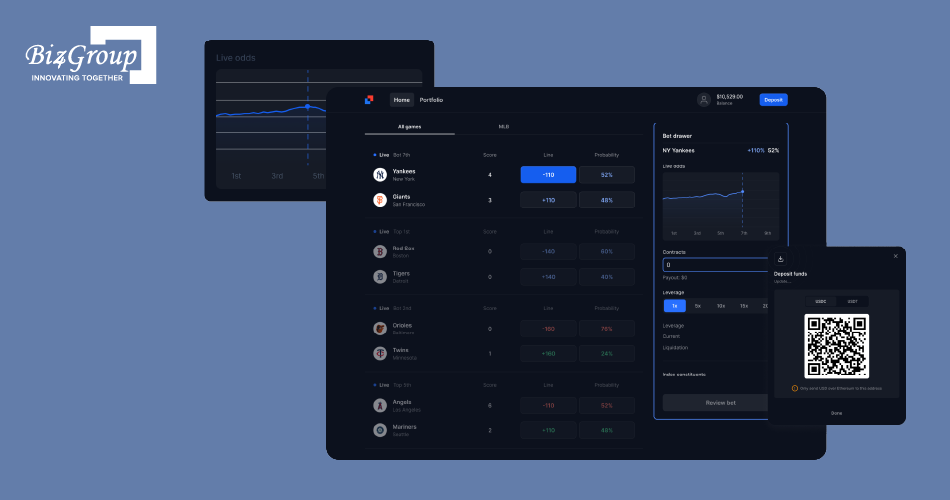
Biz4Group developed a real-time sports betting platform built to support large scale wagering across major global leagues. The platform demonstrates how AI parlay betting software development principles translate into production ready systems.
Key Highlights of the Platform
- Real-time game data streaming across MLB, CFB, and NFL
- Dynamic pricing models that adjust betting markets based on live conditions
- Scalable architecture capable of handling high traffic during peak games
- Interactive betting dashboards built with Next.js
- Multi-language backend infrastructure using Node.js, Go, Python, and C#
The system also includes an administrative control panel that allows sportsbook operators to monitor betting activity, manage markets, and analyze performance metrics in real-time.
Technical Implementation
This platform uses a layered architecture designed to support real-time betting environments. Core architecture features include:
- Socket based data streaming for live match updates
- Distributed backend services for faster processing
- Synchronized data management across user sessions
- Predictive analytics modules for performance insights
The platform demonstrates how sportsbooks can create scalable AI parlay betting systems that remain responsive even during major sporting events with thousands of simultaneous users.
A well-designed tech stack provides the foundation for advanced betting platforms. Yet technology alone does not guarantee success.
The next challenge lies in turning these systems into a working product. That means planning development stages carefully, selecting the right integrations, and validating performance before launch.
Also read: How to build an enterprise AI sports betting platform?
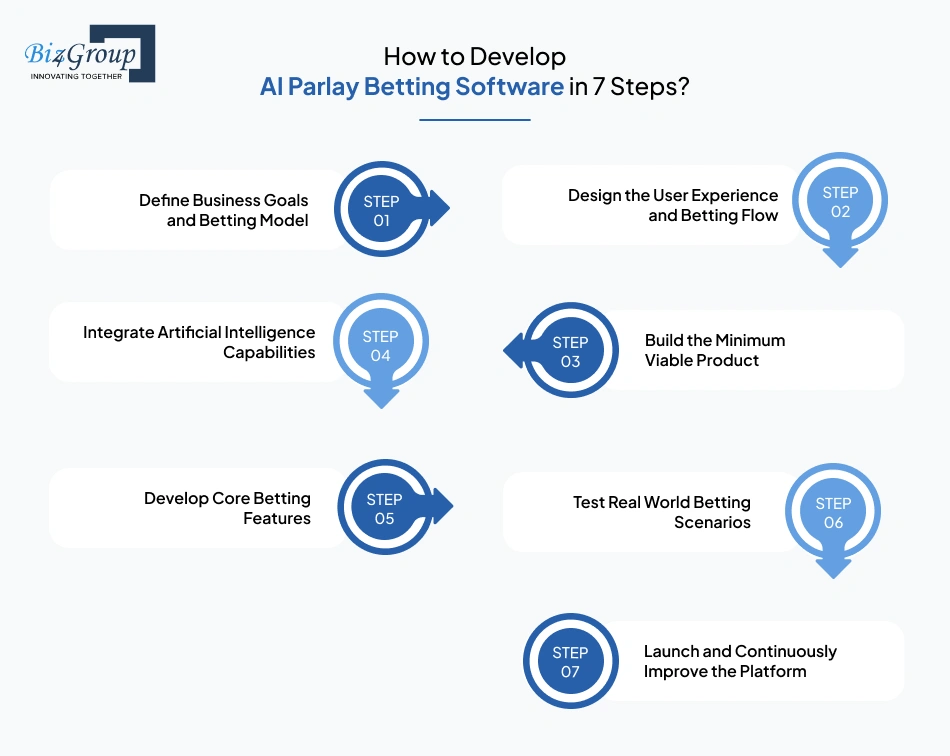
How to Develop AI Parlay Betting Software in 7 Steps?
Sportsbooks operate in a fast-moving environment where performance, accuracy, and user experience directly affect revenue. Teams that develop AI powered parlay betting software follow a structured development roadmap to reduce risks and accelerate product launch.
And how do experienced product teams approach this?
They focus on clear planning, iterative releases, and strong collaboration between product managers, engineers, and betting domain experts.
Below is a practical seven step roadmap used when businesses create scalable AI-driven parlay betting platforms.
Step 1. Define Business Goals and Betting Model
Every successful platform begins with a clear strategy. Operators must determine:
- Target markets and sports leagues
- Types of bets offered
- Revenue models and margin targets
- Competitive positioning
This step helps teams identify whether the platform will focus on same game parlays, multi league wagers, predictive betting insights, or social betting mechanics.
Step 2. Design the User Experience and Betting Flow
Let’s be honest. Even the most advanced betting engine fails if the user experience feels confusing. Bettors want fast navigation, intuitive bet builders, and smooth payment flows. Designing these interactions early prevents costly redesigns later in the project.
Key UI/UX design considerations include:
- Parlay bet creation workflow
- Match browsing experience
- Odds display and payout calculations
- Account and wallet management
This stage typically involves wireframes, interactive prototypes, and usability testing. Sportsbook teams must ensure that the interface remains intuitive even when handling complex wagers.
Also read: Top 15 UI/UX design companies in USA
Step 3. Build the Minimum Viable Product
Launching a full-scale betting ecosystem from day one can slow down innovation. Instead, many operators start with developing a Minimum Viable Product that focuses on essential features.
An MVP typically includes:
- User registration and wallet system
- Core betting markets
- Basic parlay builder
- Administrative dashboard
This approach allows teams to test real user behavior before expanding the platform.
Also read: Top 12+ MVP development companies in USA
Step 4. Integrate Artificial Intelligence Capabilities
Machine learning models can analyze match statistics, player performance, and betting trends to generate probability insights and dynamic pricing signals.
Typical AI capabilities include:
- Predictive outcome modeling
- Automated odds adjustments
- Bettor behavior analytics
- Intelligent wager recommendations
Companies offering AI integration services help integrate machine learning frameworks into betting platforms without disrupting existing infrastructure.
Step 5. Develop Core Betting Features
Once the MVP and AI modules are in place, teams expand the platform with additional functionality.
Feature expansion usually includes:
- Advanced parlay builders
- Analytics dashboards
- Promotional campaign tools
- Multi-league betting markets
Step 6. Test Real World Betting Scenarios
Testing goes far beyond standard software validation. Sportsbooks simulate real betting scenarios to ensure the platform performs correctly during peak activity.
Testing scenarios typically include:
- High traffic match simulations
- Multiple simultaneous wagers
- Odds fluctuation events
- Payout verification
These simulations help identify vulnerabilities before the platform goes live.
Step 7. Launch and Continuously Improve the Platform
Product launch marks the beginning of continuous improvement. Sportsbooks analyze real user behavior, betting trends, and market responses to refine platform capabilities.
Common post launch improvements include:
- New betting markets
- Additional sports leagues
- Predictive analytics enhancements
- Personalized betting experiences
Operators who create scalable AI parlay betting software for global markets often evolve their platforms into broader betting ecosystems that include exchange betting, fantasy sports, and predictive analytics tools.
Developing a betting platform requires structured planning and disciplined execution. Yet technology and process represent only part of the equation. In the next section, we explore how sportsbooks create AI-powered parlay betting systems with compliance while protecting both users and operators.
Also read: How to develop a sports betting platform like Outlier.Bet?
From Idea to MVP in Weeks!
Most betting platforms take 3-6 months. We can deliver an MVP in 2-4 weeks.
Launch Smarter with Biz4GroupSecurity and Compliance Requirements for AI Parlay Betting Platform Development
Sports betting platforms operate in one of the most tightly regulated digital industries.
A single oversight in security or compliance can lead to license suspension, financial penalties, or permanent platform shutdown. This is why companies that create AI powered parlay betting system with compliance place regulatory planning at the center of the development process.
Let’s take a practical view.
A betting platform must protect user funds, verify identities, monitor suspicious behavior, and ensure wagering only happens in approved jurisdictions. These requirements affect every layer of AI parlay betting platform development, from account creation to payout processing.
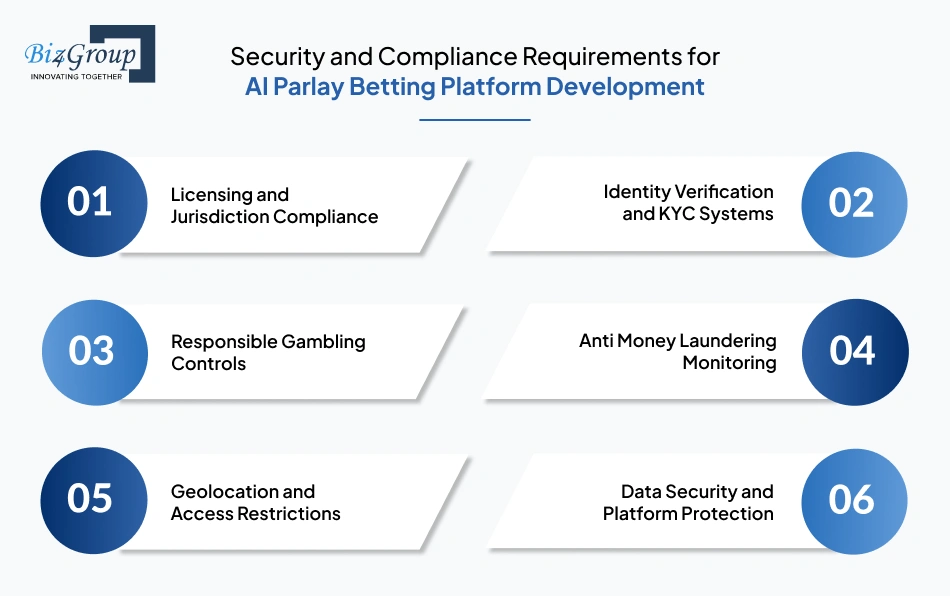
Below are the critical compliance pillars operators must address when they build enterprise grade AI parlay betting systems.
Licensing and Jurisdiction Compliance
Every sportsbook must operate under a valid gaming license issued by a recognized regulatory authority. Examples include:
- Nevada Gaming Control Board
- New Jersey Division of Gaming Enforcement
- UK Gambling Commission
- Malta Gaming Authority
Each jurisdiction sets unique requirements for betting operators. This includes rules related to taxation, reporting, advertising, and player protections.
Identity Verification and KYC Systems
Sportsbooks must verify every user before allowing real money wagering. This process is known as Know Your Customer verification. Typical identity verification checks include:
- Government issued ID validation
- Age verification
- Address confirmation
- Device fingerprinting
Platforms that develop secure AI parlay betting software architecture often integrate automated identity validation systems to streamline this process while maintaining regulatory compliance.
Responsible Gambling Controls
Responsible gambling measures protect users from harmful betting behavior. Regulators require sportsbooks to provide built in safety tools such as:
- Deposit limits
- Self-exclusion options
- Session time reminders
- Wager caps
These tools encourage safe betting habits while ensuring operators meet regulatory standards.
Anti Money Laundering Monitoring
Sports betting platforms handle large financial transactions daily. This makes them potential targets for financial crimes such as money laundering. To prevent abuse, betting platforms must monitor transactions and report suspicious activities.
AML monitoring typically involves:
- Transaction pattern analysis
- High value wager alerts
- Suspicious activity reporting
- Integration with financial monitoring systems
Advanced analytics systems help operators identify irregular betting activity early, protecting both the platform and its users.
Geolocation and Access Restrictions
Online sportsbooks must ensure that betting occurs only in jurisdictions where it is legally permitted. This requirement is enforced through geolocation technology. Geolocation systems use:
- GPS verification
- IP address analysis
- Device location services
If a bettor attempts to place a wager from an unauthorized location, the platform blocks the transaction automatically. Operators who create scalable AI parlay betting software for global markets often implement multi-layer geolocation validation to prevent compliance violations.
Data Security and Platform Protection
A modern sportsbook stores large volumes of personal data, payment details, and wagering history. Any breach could damage user trust and trigger legal consequences.
Security frameworks commonly include:
- End-to-end encryption for transactions
- Secure payment gateway integrations
- Role based access control
- Continuous system monitoring
Also read: Sports betting regulations across US states
Portfolio Spotlight: Ingenious Betting App for Sports Enthusiasts
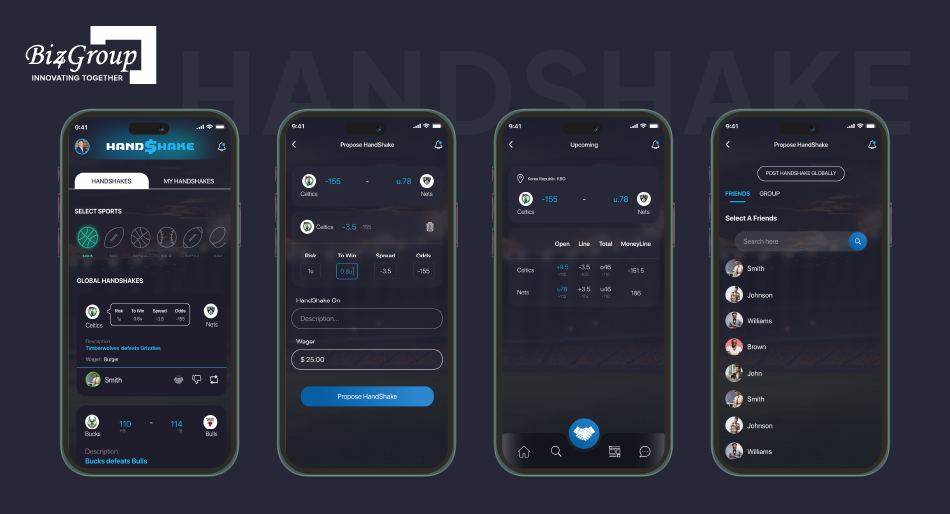
Biz4Group developed a social sports betting platform designed to connect bettors through peer-to-peer wagering and interactive engagement. The project highlights how AI parlay betting product development services can balance user engagement with operational safeguards.
Key Capabilities of the Platform
- Real-time match scores and updates across multiple sports leagues
- AI-powered betting suggestions based on historical performance trends
- Peer-to-peer wager creation between individual users
- Group betting features and social interaction tools
- Push notifications for match updates and betting alerts
The platform supports wagers across leagues including the NFL, NBA, NHL, and MLB while maintaining seamless user interactions.
Security and Operational Safeguards
To ensure reliable operation, the platform includes
- Verified user registration workflows
- Administrative monitoring tools for platform moderation
- Secure settlement tracking for peer wagers
- User reputation scores based on betting history
These safeguards create a transparent wagering environment while encouraging social engagement among sports fans.
Compliance and security form the foundation of trustworthy betting platforms. Yet operators planning AI parlay betting software development must also consider another crucial factor before launching their product.
Cost.
Also read: Comprehensive guide to building a sports betting platform like BetDEX
AI Parlay Betting Software Development Cost Breakdown for Sportsbook Platforms
So, how much do you think it actually costs to build a modern AI-powered betting platform?
The answer depends on scope, technology complexity, and regulatory requirements. However, most businesses entering this space should expect an average AI parlay betting software development cost between $30,000-$150,000+ .
Why the wide range?
Because betting platforms can vary dramatically.
Below is a simplified cost overview for companies planning AI parlay betting platform development.
|
Platform Level |
Typical Scope |
Estimated Cost Range |
|---|---|---|
|
MVP Platform |
Core betting features, limited sports coverage, basic AI models |
$30,000-$60,000 |
|
Advanced Platform |
Expanded betting markets, predictive analytics, real-time data systems |
$60,000-$120,000 |
|
Enterprise Platform |
Global sportsbook ecosystem with advanced AI trading systems |
$120,000-$150,000+ |
Organizations that build enterprise AI parlay betting solutions usually expand their platforms gradually, starting with a functional MVP and scaling toward enterprise capabilities over time.
Also read: Sports betting website MVP development guide
But what actually drives these costs? Let’s break down the main investment factors.
Key Cost Drivers in AI Parlay Betting Software Development
Several technical and operational elements influence the final project budget. Each component adds complexity and development effort.
|
Cost Driver |
What It Involves |
Estimated Cost Impact |
|---|---|---|
|
Platform Interface Design |
Designing dashboards, bet builders, and mobile interfaces |
$4,000-$12,000 |
|
Core Betting Logic |
Development of wagering systems, payout calculations, and bet validation |
$6,000-$20,000 |
|
AI Modeling Systems |
Training machine learning models for outcome prediction and analytics |
$8,000-$30,000 |
|
Real-Time Data Integration |
Connecting sports data feeds and event streams |
$6,000-$18,000 |
|
Wallet and Payment Systems |
Secure transaction processing and financial management |
$4,000-$12,000 |
|
Admin and Risk Management Tools |
Monitoring dashboards for market exposure and trading activity |
$5,000-$15,000 |
|
Testing and Performance Optimization |
Stress testing systems under simulated betting traffic |
$3,000-$10,000 |
For example, operators who develop AI parlay betting software with real-time analytics typically allocate a larger portion of the budget toward predictive modeling and analytics infrastructure.
Hidden Costs Many Operators Overlook
Even experienced founders sometimes underestimate the operational expenses that accompany sportsbook development. And let’s be honest. These hidden costs often appear after the platform launches.
A few common examples include:
Sports Data Licensing
Enterprise sports data providers charge licensing fees for live match feeds and player statistics. These costs often range from $2,000-$10,000 per month depending on the number of sports and leagues covered.
Infrastructure and Cloud Hosting
Real-time betting platforms require scalable servers that handle unpredictable traffic spikes during major games. Cloud infrastructure costs typically fall between $1,000-$5,000 per month during early stages, with larger platforms spending significantly more as user numbers grow.
Ongoing AI Model Maintenance
Machine learning models require regular retraining as new match data becomes available. Maintaining predictive systems can cost $3,000-$8,000 per month depending on model complexity and data volumes.
Regulatory and Licensing Expenses
Depending on jurisdiction, gaming licenses, legal audits, and compliance certifications can cost $15,000-$50,000+ annually.
Companies planning custom AI parlay betting software development should account for these recurring expenses early in the planning stage.
How Operators Optimize Development Costs?
Experienced development teams focus on strategic cost optimization without sacrificing long-term scalability. Businesses that create scalable AI parlay betting systems often follow several practical strategies.
- Launch a focused MVP before expanding betting markets. Early releases often cost $30,000-$50,000, allowing operators to validate user demand.
- Use modular platform architecture so features can be added gradually instead of building everything at once. This approach reduces early development expenses by 20%-35%.
- Prioritize the most profitable betting markets first. Supporting fewer leagues during early stages can reduce initial integration costs by $5,000-$15,000.
- Automate operational workflows such as odds monitoring and risk alerts. Automated systems can lower long-term operational costs by 15%-25%.
- Partner with experienced product teams that specialize in AI parlay betting product development services to avoid costly architectural mistakes.
Also read: Sports betting app MVP development guide
AI betting platforms represent a serious investment. Yet the return potential can be substantial when platforms attract active betting communities and scale across multiple sports markets.
Cost, however, is only one piece of the puzzle.
Even well-funded platforms can struggle if risk management systems are weak or betting markets are poorly designed. In the next section, we explore how sportsbooks make AI parlay betting platforms profitable by optimizing revenue models and bettor engagement strategies.
Also read: How much does it cost to develop an AI sports betting app like Rithmm?
Wondering What Your Platform Will Cost?
AI betting platforms typically start around $30K+. Build yours without overspending.
Let's Talk NumbersRevenue Opportunities When You Build Custom AI Parlay Betting Platform for Operators
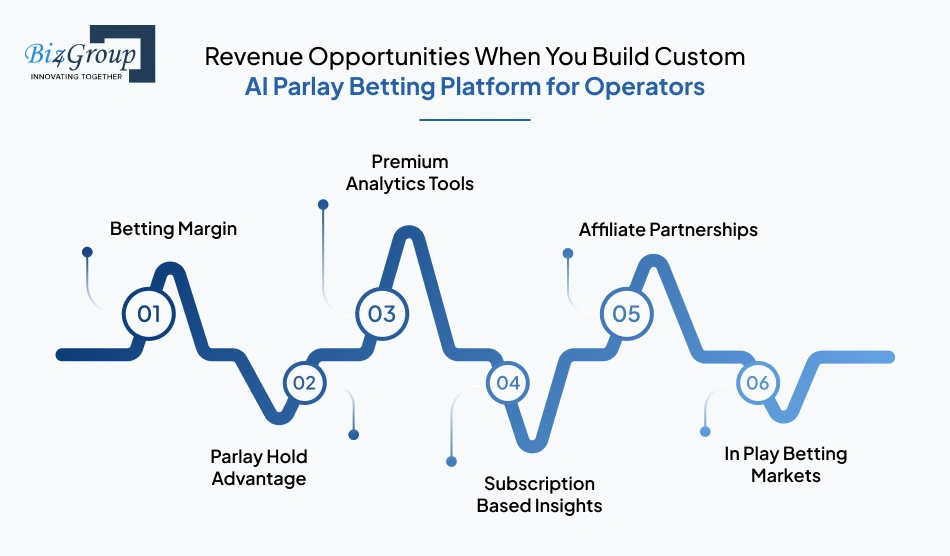
Building a betting platform requires significant investment. Naturally, operators want clear revenue pathways before launching their product.
And how do sportsbooks generate profit from these systems?
It comes down to structured wagering margins, premium features, and smart engagement strategies. Businesses that build custom AI parlay betting platform for operators often design multiple monetization channels from the beginning so revenue grows as user activity increases.
Below are the most common revenue streams used when companies create AI-driven parlay betting platforms.
|
Revenue Model |
How It Works |
Operator Advantage |
|---|---|---|
|
Betting Margin |
Operators apply a margin to odds across wagers |
Generates consistent profit from every betting market |
|
Parlay Hold Advantage |
Multi event wagers increase sportsbook margins |
Higher profitability compared with single bets |
|
Premium Analytics Tools |
Advanced prediction dashboards offered as paid features |
Attracts experienced bettors seeking data insights |
|
Subscription Based Insights |
Bettors pay monthly for analytics tools or AI predictions |
Recurring revenue stream |
|
Affiliate Partnerships |
Sports content platforms drive bettors to the sportsbook |
Expands user acquisition channels |
|
In Play Betting Markets |
Live wagers placed during matches |
Increases betting activity and engagement |
Operators that develop AI powered parlay betting software often combine several of these models to create diversified revenue streams.
Also read: How to build a sports betting affiliate website?
Revenue Example for a Mid-Scale Betting Platform
|
Metric |
Estimated Scenario |
|---|---|
|
Active Users |
40,000 monthly bettors |
|
Average Monthly Bets per User |
8 wagers |
|
Average Bet Value |
$20 |
|
Estimated Monthly Betting Volume |
$6,400,000 |
|
Average Operator Margin |
8% |
|
Estimated Monthly Revenue |
$512,000 |
This simplified example shows how even mid-sized platforms can generate significant revenue once user activity reaches scale.
Profitability in sportsbook platforms depends on volume, engagement, and pricing accuracy.
However, launching a profitable betting platform still comes with risks. Technical mistakes, poor data pipelines, or weak market design can quickly reduce margins. Let's talk about some of the most common ones now.
Also read: How do AI sports betting apps like FanDuel make money?
Challenges in AI Parlay Betting Platform Development and Their Practical Solutions
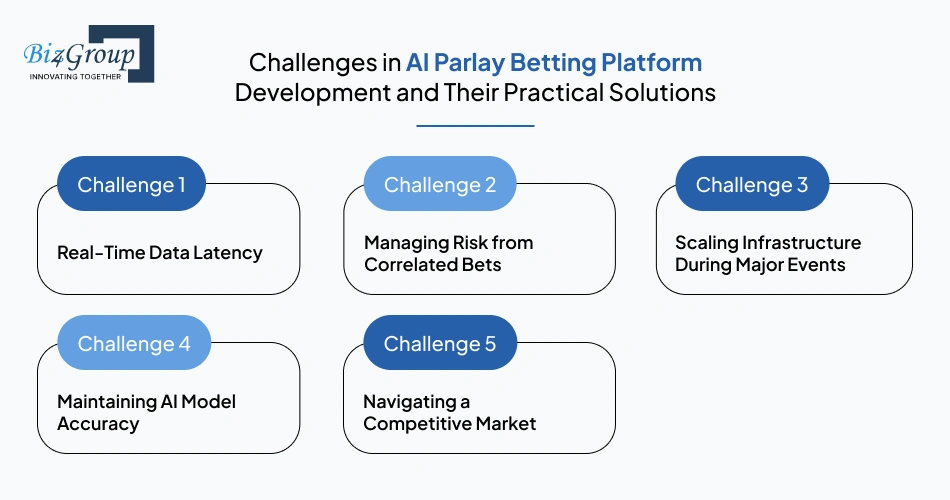
Sports betting systems operate under intense pressure. Markets move rapidly. Thousands of wagers arrive simultaneously. Odds must remain accurate while protecting operator margins. Ignoring them often leads to unstable systems, financial exposure, or poor user experience.
Below are the most common obstacles businesses encounter when they develop AI powered parlay betting software, along with practical solutions used by successful sportsbook platforms.
Challenge 1: Real-Time Data Latency
Live betting depends entirely on real-time match data. Even a delay of a few seconds can create incorrect odds and expose operators to risk.
This challenge becomes even more complex when sportsbooks support multiple leagues and global events simultaneously.
Solutions
- Integrate multiple sports data providers to reduce dependency on a single source
- Implement real-time streaming systems for instant updates
- Build redundant data pipelines that maintain continuity during outages
Challenge 2: Managing Risk from Correlated Bets
Parlay bets combine multiple selections into a single wager. Some selections may influence each other. For example, player performance bets within the same match can create hidden correlations that increase exposure for the sportsbook.
Without proper monitoring, these combinations can produce significant liabilities.
Solutions
- Implement automated correlation detection models
- Monitor betting volumes across related markets
- Configure automated limits for high-risk bet combinations
Challenge 3: Scaling Infrastructure During Major Events
Major sporting events generate sudden spikes in betting traffic.
Super Bowl games, playoff series, and international tournaments can attract thousands of concurrent wagers within seconds.
Solutions
- Deploy cloud infrastructure that scales automatically during traffic spikes
- Separate platform services using microservice architecture
- Conduct load testing before major sporting events
Organizations adopting enterprise AI solutions often use distributed infrastructure to maintain platform performance during these high demand moments.
Challenge 4: Maintaining AI Model Accuracy
AI models power probability predictions and analytics insights. However, sports performance changes constantly. Player injuries, team transfers, and strategy shifts can affect model accuracy.
If models are not updated regularly, predictions may become unreliable.
Solutions
- Retrain models regularly using updated match data
- Implement automated model monitoring tools
- Evaluate prediction accuracy across multiple seasons
Companies often hire AI developers with strong data science expertise to maintain and improve these predictive systems.
Challenge 5: Navigating a Competitive Market
The sports betting industry has grown rapidly. Major platforms such as DraftKings and FanDuel dominate several markets.
New operators entering the space must compete with established brands that already offer advanced features and large user bases.
Solutions
- Focus on specialized betting experiences or niche sports
- Invest in predictive analytics and user personalization
- Choose top AI sports betting software development company
Also read: Top 14 sports betting software development companies in the USA
Portfolio Spotlight: Quick Start Bets
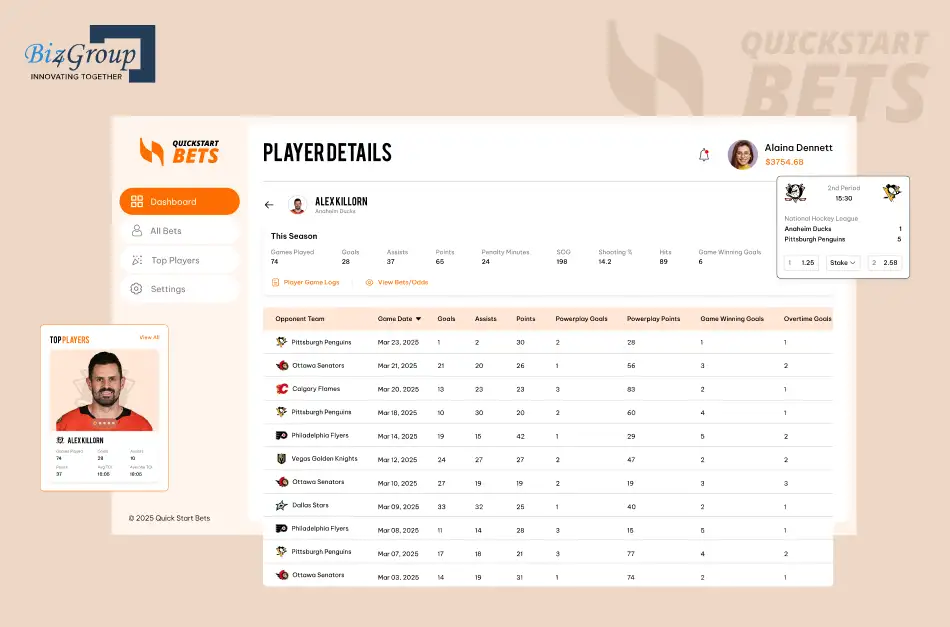
Biz4Group developed Quick Start Bets, a sports analytics platform designed for NHL fans who want deeper insights before placing wagers. The platform demonstrates how AI parlay betting platform development can support data driven betting experiences.
Key Capabilities:
- Real-time odds updates for NHL games
- Detailed player and team statistics dashboards
- Historical game data and performance trends
- Bet tracking and user analytics dashboards
The system consolidates match data, betting insights, and user activity into a centralized interface that helps bettors analyze performance trends quickly.
Technical Highlights:
- Low latency data pipelines for real-time updates
- Advanced statistics dashboards for player and team analysis
- Historical data engines for performance comparisons
- Centralized dashboards that track betting activity and predictions
By focusing on analytics and data visualization, the platform gives users a deeper understanding of betting opportunities while maintaining high performance during live games.
Also read: Challenges in modern sports betting app development
The difference between successful sportsbooks and struggling platforms often lies in preparation. Teams that create scalable AI parlay betting software for global markets anticipate these obstacles and design systems capable of handling complex betting environments.
Avoid the Mistakes That Kill Betting Apps!
Over 60% of betting platforms struggle with real-time data accuracy. Don't be one of them.
Contact Biz4Group NowWhy Biz4Group LLC Is the Leading AI Parlay Betting Software Development Company in USA?
When operators decide to build a sportsbook platform, one decision matters more than anything else... Choosing the right technology partner.
AI-powered betting platforms require expertise in real-time data processing, predictive analytics, risk monitoring systems, and scalable infrastructure capable of handling millions of wagers.
That is where Biz4Group stands apart.
Biz4Group LLC is a US based technology consulting and product development firm with more than two decades of experience building high performance digital platforms. Businesses partner with Biz4Group when they want to develop AI powered parlay betting software that performs reliably under real world betting conditions.
Our engineering teams combine expertise in machine learning, sports data pipelines, and cloud architecture to deliver robust sportsbook platforms. As a recognized AI development company, we design intelligent systems that analyze match data, optimize betting markets, and provide operators with full control over risk exposure and trading operations.
What truly differentiates Biz4Group is our product driven mindset.
Organizations looking for a reliable sports betting app development company often choose Biz4Group because of our experience building real world betting platforms and analytics systems. Our portfolio includes platforms which demonstrate our ability to deliver scalable betting products across different markets.
Why Businesses Choose Biz4Group LLC
Modern betting systems depend on real-time data from multiple providers, payment services, and analytics tools. Biz4Group offers specialized sports betting API integration services that connect sportsbooks with enterprise sports data providers, betting exchanges, and financial systems while maintaining high performance and reliability.
Other services we offer:
- Experienced AI engineers who specialize in predictive analytics and machine learning systems
- Proven expertise in building scalable betting platforms and real-time data pipelines
- End-to-end product development from strategy and design to deployment and scaling
- Cloud native infrastructure capable of supporting global betting audiences
- Transparent development processes and collaborative product partnerships
Our approach focuses on building platforms that perform well beyond launch day. We help operators design systems that grow with their user base while maintaining accuracy, security, and operational efficiency.
For companies planning AI parlay betting software development, partnering with a team that understands both technology and sportsbook operations can make all the difference.
We are that team for you.
Let's build something amazing together. Let’s talk.
Wrapping Up
AI is reshaping the way sportsbooks operate, and parlay betting sits at the center of this transformation. Modern operators need platforms that can analyze large volumes of match data, process wagers instantly, and maintain accurate odds during high traffic events. That is exactly why AI parlay betting software development has become a strategic investment for sportsbook founders and gaming enterprises. With the right system in place, operators can manage complex multi event wagers, optimize betting margins, and deliver engaging experiences that keep bettors coming back.
Throughout this guide, we explored what it takes to build such platforms. From core features and technology infrastructure to development processes, compliance requirements, and cost considerations, launching a successful betting platform requires careful planning and experienced execution. Businesses that develop AI powered parlay betting software with scalable architecture and predictive analytics capabilities position themselves ahead of competitors in an industry that moves quickly.
This is where Biz4Group comes in. As a USA-based software development company with deep expertise in AI, real-time systems, and sportsbook platforms, Biz4Group helps businesses transform innovative betting concepts into reliable, high-performance products. Our teams combine technical expertise with strong product thinking to deliver scalable betting platforms that support real world wagering environments.
Ready to turn your sportsbook idea into a powerful AI driven platform? Connect with Biz4Group and start building a next generation betting ecosystem designed for growth, performance, and profitability.
FAQs
1. What makes parlay betting different from standard sports betting platforms?
Parlay betting allows bettors to combine multiple selections into one wager. The payout increases because every selection must win. For operators building AI based platforms, this creates a need for advanced systems that evaluate multiple outcomes simultaneously and maintain accurate probability calculations across combined events.
2. Which sports leagues are commonly supported in AI-based parlay betting platforms?
Most platforms begin with high engagement leagues such as the NFL, NBA, MLB, NHL, and major soccer competitions. Once the system proves stable, operators often expand into esports, tennis, MMA, and international tournaments to attract a broader betting audience.
3. How long does it take to develop AI parlay betting software?
Most platforms take 3-6 months to reach a stable launch depending on complexity and integrations. Biz4Group, however, can deliver a functional MVP in 2-4 weeks by using reusable components and proven development frameworks. This approach reduces both development time and overall cost.
4. What type of sports data is required to run an AI betting platform?
Sportsbooks rely on several categories of data including live match scores, player statistics, team performance history, injury reports, and betting market movements. These data streams feed predictive models and help maintain accurate betting markets across different sports events.
5. Do betting platforms require partnerships with sports data providers?
Yes. Reliable sports data feeds are essential for real-time wagering systems. Operators typically partner with enterprise data providers that supply live match updates, historical statistics, and event notifications. These integrations ensure that betting markets stay synchronized with live game activity.
6. Can AI betting platforms support multiple sports simultaneously?
Yes. Modern systems are designed to handle multiple leagues and events at the same time. Platforms can manage wagers across football, basketball, baseball, hockey, soccer, and other sports while maintaining accurate odds calculations and market updates.
