Location :
Orlando, FL, USA
Location :
Orlando, FL, USA +1 (407) 714-1616
 info@biz4group.com


















Imagine a digital system that doesn’t wait for instructions but instead, understands your business goals, learns from real-time feedback, and takes independent actions to get the job done.
Read More

What happens when a claims platform must handle intake, review, fraud signals, and compliance without losing control of cost?
That is the pressure point for many insurers, TPAs, and self-insured employers. Building AI workers compensation claims management software starts with a real budget problem, because scope changes fast once workflows, integrations, and security enter the plan.
A well-planned claims platform helps organize claim activity, support faster decisions, and reduce manual effort across the process. Teams often know they need the platform, but they are not aware of what it costs to build AI workers compensation claims management software.
At the budget stage, leaders usually need to account for:
So, what is the typical price range to build an enterprise grade AI workers compensation claims management platform for a large insurance carrier? For most enterprises, the cost sits around $40,000-$350,000+, based on scale, integration work, and control requirements.
The next sections break down the total cost of developing a full featured workers compensation claims automation software with fraud detection, so you can plan with more clarity and fewer budget surprises.
Unexpected software costs can slow down claims modernization plans faster than most insurance providers anticipate. The cost to build AI workers compensation claims management software matters because it directly affects budgeting confidence, rollout decisions, and long-term operational planning. Before moving into development, leadership teams need clarity on where the investment will impact the business most.
Insurance providers are not just funding software development. They are planning a long-term operational system that affects claims handling, scalability, and future technology investments. That is why understanding the real cost to develop workers compensation claims software becomes a critical business decision early in the process.
Budget conversations usually become difficult when the claims vision is clear but the investment range is not. That is where an estimator becomes useful. Instead of waiting for long discovery discussions, it gives insurance leaders a practical way to understand the cost to create AI workers compensation platform based on workflow depth, AI capabilities, integrations, compliance needs, and rollout scale.
For insurers planning a modern claims system, an early estimate also helps connect business expectations with technical scope before development decisions move too far ahead.
Estimated Cost = Base Platform Cost + AI Feature Cost + AI Integration Cost + UI/UX design cost + AI model development + Security & Compliance Cost
Estimated Cost: $55,000+$30,000+ $18,000+$14,000+$22,000+$11,000 = $150,000
AI workers compensation software development cost estimation helps decision-makers understand how platform scope changes the investment range before vendor discussions become complicated. It also supports stronger internal planning, clearer feature prioritization, and more realistic budgeting conversations.
That is why an early estimator becomes valuable when evaluating the cost to build AI workers compensation claims management software for long-term operational use.
Get a realistic cost projection aligned with workflows automation and operational scale goals
Estimate My Platform Budget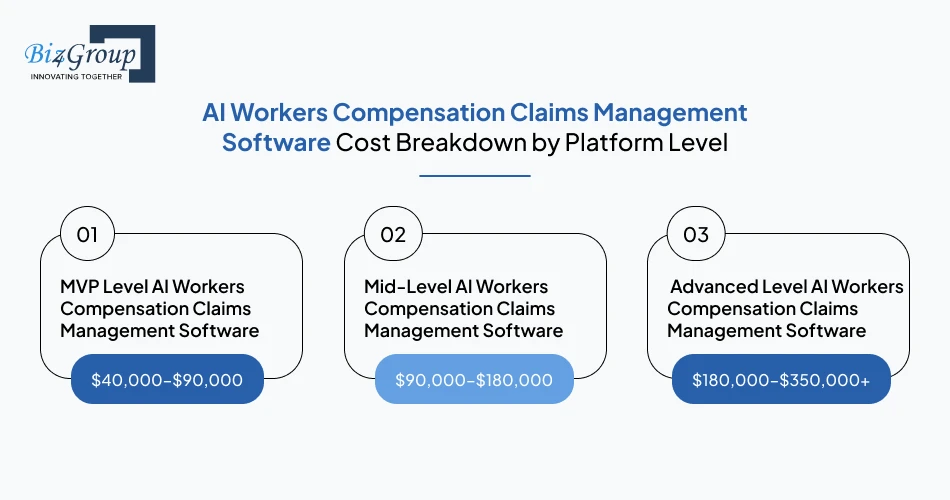
Budget clarity gets easier when the platform is broken into levels instead of treated as one large number. For insurers planning real-time claims tracking and reporting, each stage carries a different scope, team load, and investment pressure.
That is why the estimated development cost of an AI workers compensation platform with real time claims tracking and reporting should be viewed level by level before you commit to a build.
Estimated Cost Range: $40,000–$90,000
This level is built for early rollout and controlled validation. It gives insurance teams a practical starting point without stretching the budget into features they may not need yet. The main goal is to support the core claims journey and test how the workflow performs in real operations. Some businesses also use early-stage MVP development services at this level to reduce initial investment pressure.
What Is Typically Covered:
How It Differs: The MVP stage keeps automation limited and focused. It does not try to solve every claims challenge at once. Instead, it helps decision-makers validate the process, confirm user adoption, and control the first investment cycle with less budget risk.
Also Read: Top MVP Development Companies in USA
Estimated Cost Range: $90,000–$180,000
The level is for organizations that have already validated the core workflow and now need stronger operational support. The budget rises because the platform starts handling more data, more users, and more decision layers across the claims process.
What Is Typically Covered:
How It Differs from MVP Level Platform: This stage goes beyond basic digitization. The platform begins to reduce manual handling in visible ways. It also supports faster review cycles and better internal coordination. That added operational depth is what pushes the budget above the MVP level.
Estimated Cost Range: $180,000–$350,000+
This level is built for large insurance carriers and enterprise claims environments. It supports higher claim volume, deeper control, and more advanced intelligence across the platform. The budget grows here because the system is expected to work as a strategic business asset, not just a digital workflow tool.
What Is Typically Covered:
How It Differs from Mid-Level Platforms: This stage is designed for scale, control, and long-term operational value. AI becomes part of active claims decision support. The platform also needs stronger infrastructure and tighter governance. That is why the cost moves into enterprise territory.
|
Development Level |
Estimated Cost Range |
Scope |
Best Fit |
|---|---|---|---|
|
MVP Level AI Workers Compensation Claims Management Software |
$40,000–$90,000 |
Core claims workflow and basic tracking |
Teams validating the concept |
|
Mid-Level AI Workers Compensation Claims Management Software |
$90,000–$180,000 |
Workflow automation and document support |
Growing insurance operations |
|
Advanced Level AI Workers Compensation Claims Management Software |
$180,000–$350,000+ |
Enterprise automation and predictive controls |
Large carriers and TPAs |
A level-wise breakdown gives business leaders a clearer way to plan. It links scope to spending and keeps the discussion grounded in operational reality. That makes the cost to build AI workers compensation claims management software much easier to evaluate with confidence.
Architecture decisions affect software cost much earlier than most insurance teams expect. The structure you select determines how claims data moves, how systems scale, and how expensive future changes become. Which is why workers compensation automation software cost should always be evaluated alongside architecture planning, not after development starts.
For insurers handling long-term claims operations, the right architecture is less about technical preference and more about operational fit, expansion readiness, and maintenance control.
A monolithic structure keeps the entire claims platform connected inside one unified system. Claim intake, document handling, reporting, user management, and workflow actions all operate together within the same environment.
Cost You Can Expect: $50,000–$100,000
Best Fit When You Need:
The cost stays lower because deployment and maintenance remain simpler during the early stages. This setup works best for organizations focused on operational rollout before large-scale expansion becomes necessary.
A modular structure separates important business functions into connected service blocks. Claims workflows, reporting, notifications, document handling, and compliance management can operate independently while still working together as one platform.
Cost You Can Expect: $100,000–$180,000
Best Fit When You Need:
The budget increases because every module requires separate testing, deployment planning, and maintenance oversight. However, it also reduces the operational risk of rebuilding the full platform later.
This architecture separates every major platform function into independent services while adding a dedicated AI processing layer for claims intelligence. Fraud checks, document review, risk scoring, and workflow decisions can process in real time across different services.
Cost You Can Expect: $180,000–$280,000
Best Fit When You Need:
The cost rises because the platform requires continuous communication between multiple services, AI engines, and data pipelines. Infrastructure monitoring and operational management also become more advanced.
This setup distributes the platform across multiple cloud regions to support enterprise continuity, regional compliance handling, and higher uptime reliability. It is commonly used by large insurance carriers managing distributed claims operations.
Cost You Can Expect: $280,000–$350,000+
Best Fit When You Need:
This carries the highest investment because infrastructure duplication, failover systems, and regional deployment controls require continuous operational support.
|
Architecture Choice |
Best Business Situation |
Cost Range |
Budget Impact |
|---|---|---|---|
|
Monolithic |
Early operational rollout |
$50,000–$100,000 |
Lower upfront spending |
|
Modular Service-Based |
Expanding operational workflows |
$100,000–$180,000 |
Better long-term flexibility |
|
Microservices with AI Layer |
Advanced automation environments |
$180,000–$280,000 |
Higher infrastructure investment |
|
Cloud-Native Multi-Region |
Enterprise-scale insurance operations |
$280,000–$350,000+ |
Strongest scalability readiness |
Architecture planning should match your operational roadmap, not just your launch timeline. Insurance providers expecting moderate claim growth often control costs better with simpler structures during the early years.
When long-term expansion, AI-led claims handling, and enterprise-scale reporting become part of the roadmap, more advanced architectures usually prevent expensive rebuild cycles later. Larger carriers also benefit from stronger uptime planning and regional infrastructure control once operations expand across multiple markets.
The right structure is the one that supports future operational goals without pushing unnecessary infrastructure costs too early. That is what keeps the cost to make AI workers compensation software aligned with real business growth instead of avoidable technical rework.
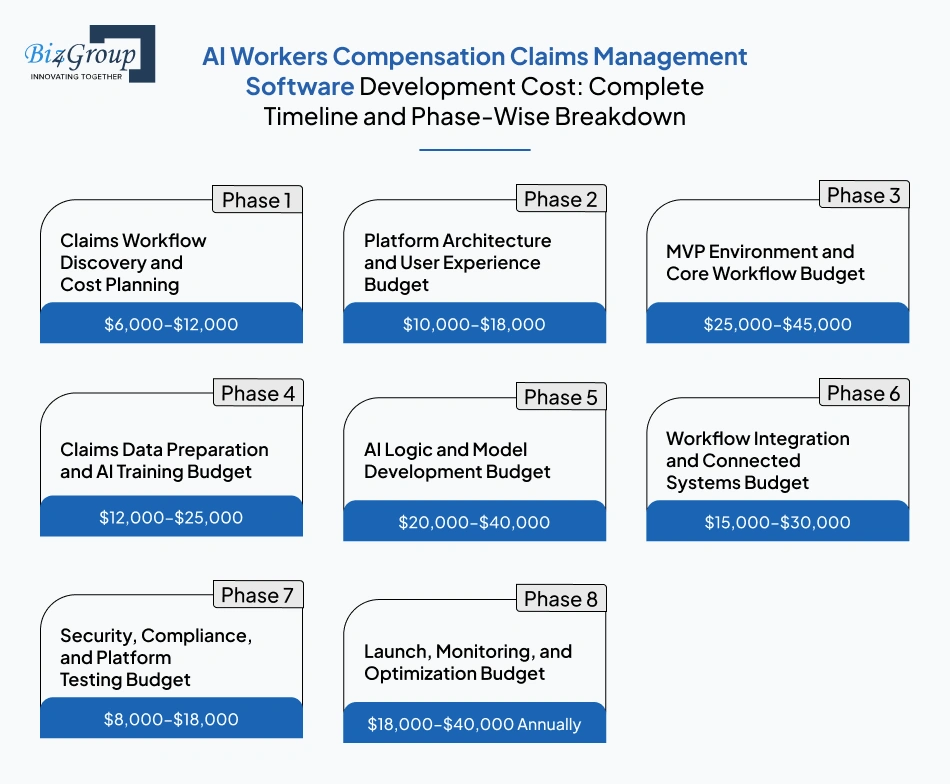
A large software estimate feels difficult to evaluate when every expense is grouped into one final number. Insurance providers usually need a clearer financial picture before approvals move forward.
That is why teams asking, “what is the exact cost breakdown for building a fully functional AI powered workers compensation claims management software for a mid-sized insurance company that processes around 10000 claims per month?” often look for a phase-wise view instead of a rough quote.
Once the project is divided into operational stages, the investment becomes easier to plan and justify internally.
Estimated Timeline: 1–2 Weeks
Estimated Cost: $6,000–$12,000
This phase shapes the financial direction of the entire project. Insurance teams spend heavily here on understanding how claims currently move across intake, investigations, approvals, settlements, and reporting environments. The budget is usually tied to workflow analysis sessions, process mapping, operational planning, compliance reviews, and feature prioritization discussions.
Projects that skip deep planning often face expensive mid-development changes later. A workflow adjustment made after development starts usually costs significantly more than resolving it during planning. That is why this early investment helps reduce avoidable budget expansion during later stages.
Estimated Timeline: 2–3 Weeks
Estimated Cost: $10,000–$18,000
Claims systems handle large amounts of information every day. Adjusters, investigators, supervisors, and compliance teams all depend on quick access to claims data. This stage focuses on structuring dashboards, navigation flows, reporting visibility, and operational accessibility in a way that supports faster claims handling.
A major portion of the budget here usually goes toward workflow usability planning and interface structure. Many insurers work with an experienced UI/UX design company during this stage because poor operational layouts often create long-term productivity issues and expensive redesign work later.
Also Read: Top UI/UX Design Companies in USA
Estimated Timeline: 4–6 Weeks
Estimated Cost: $25,000–$45,000
This stage usually becomes one of the largest cost blocks because it funds the operational backbone of the platform. The budget supports core claims handling systems such as case creation, claim intake workflows, document storage, centralized tracking, role management, notifications, and administrative controls.
Costs increase here because these workflows directly affect how claims teams operate daily. Every approval path, escalation flow, and document movement must function reliably before advanced automation can even begin. Larger organizations often spend more during this stage due to broader workflow complexity across departments.
Estimated Timeline: 2–4 Weeks
Estimated Cost: $12,000–$25,000
AI-driven claims systems depend heavily on clean operational data. Historical claims records are rarely organized in a way that supports direct AI processing. A large share of the budget during this phase goes toward cleaning inconsistent records, structuring fraud investigation histories, organizing settlement outcomes, and preparing medical claim datasets.
The financial impact becomes larger when insurers maintain years of fragmented claims information across multiple systems. More historical data usually means more preparation work before AI systems can deliver reliable outcomes.
Estimated Timeline: 3–5 Weeks
Estimated Cost: $20,000–$40,000
This phase introduces the intelligence layer responsible for fraud scoring, claim prioritization, predictive evaluations, and document review automation. Costs rise here because AI systems require continuous testing, tuning, and operational validation before they can support real claims decisions.
The budget is not only tied to model creation. Significant spending also goes toward improving prediction quality, reducing inaccurate classifications, and refining workflows after early testing cycles. Once deeper AI model integration becomes part of active claims operations, the investment requirement usually increases further.
Estimated Timeline: 2–4 Weeks
Estimated Cost: $15,000–$30,000
Claims platforms rarely function in isolation. They often need to exchange information with billing systems, policy databases, medical review systems, reporting tools, and communication platforms. This phase funds the work required to connect those operational environments together.
Costs become higher when insurers rely on older systems that require custom synchronization work. Many projects also allocate budget here for secure external API’s because disconnected workflows can create operational delays and reporting inconsistencies later.
Also Read: A Complete Guide to OpenAI API Integration for AI Applications
Estimated Timeline: 2–3 Weeks
Estimated Cost: $8,000–$18,000
This stage focuses on reducing operational risk before deployment begins. Claims systems process highly sensitive information, so the budget here supports workflow testing, compliance validation, role-based access verification, security checks, and AI output accuracy testing.
Insurance providers often collaborate with experienced software testing companies during this phase because unresolved operational issues can lead to reporting problems, workflow interruptions, and compliance exposure after launch.
Also Read: Top AI Software Development Companies in USA
Estimated Timeline: Ongoing
Estimated Cost: $18,000–$40,000 Annually
The financial commitment does not end after deployment. Claims environments continue changing, which means workflows, fraud patterns, reporting structures, and AI logic require ongoing refinement. This operational budget usually covers hosting, AI retraining, system monitoring, workflow optimization, support scaling, and security updates.
Organizations that underestimate post-launch ownership costs often struggle with platform performance and long-term operational efficiency after rollout.
|
Phase |
Timeline |
Cost Range |
|---|---|---|
|
Claims Workflow Discovery and Cost Planning |
1–2 Weeks |
$6,000–$12,000 |
|
Platform Architecture and User Experience Budget |
2–3 Weeks |
$10,000–$18,000 |
|
MVP Environment and Core Workflow Budget |
4–6 Weeks |
$25,000–$45,000 |
|
Claims Data Preparation and AI Training Budget |
2–4 Weeks |
$12,000–$25,000 |
|
AI Logic and Model Development Budget |
3–5 Weeks |
$20,000–$40,000 |
|
Workflow Integration and Connected Systems Budget |
2–4 Weeks |
$15,000–$30,000 |
|
Security, Compliance, and Platform Testing Budget |
2–3 Weeks |
$8,000–$18,000 |
|
Launch, Monitoring, and Optimization Budget |
Ongoing |
$18,000–$40,000 annually |
A phase-wise breakdown gives insurance leaders a more practical way to evaluate spending because the investment becomes tied to operational outcomes instead of a single rough estimate. That makes workers compensation claims management system development cost with AI easier to control across approvals, rollout planning, and long-term ownership decisions.
Get a phase wise development roadmap aligned with claims workflows operational scale and rollout priorities
Break Down My Project Cost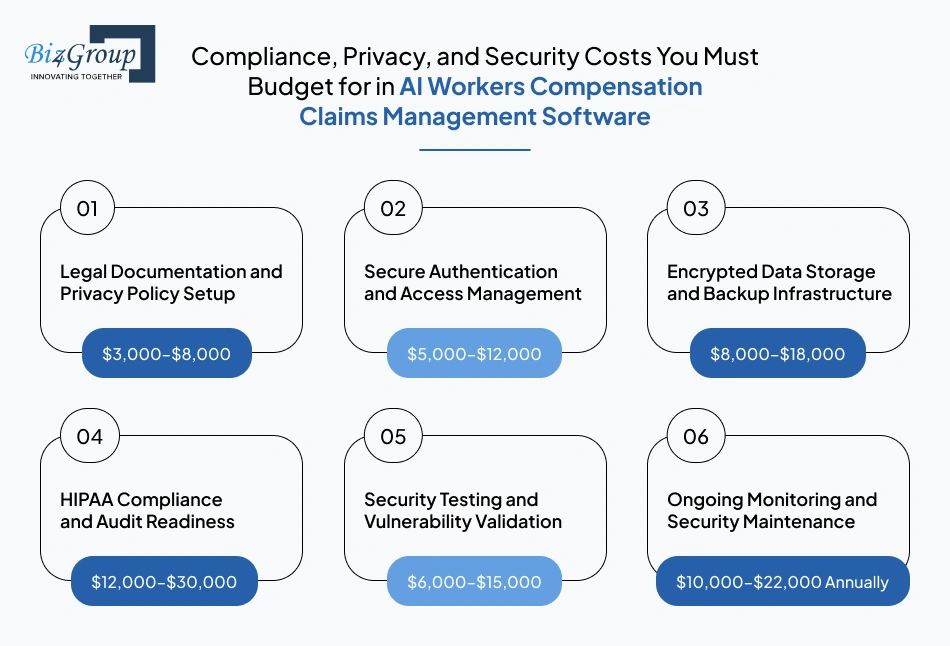
Compliance costs usually become visible much later than feature costs, yet they often have a major impact on the final investment. For insurers handling claimant records, medical details, and settlement information, development pricing of AI workers compensation system increases once privacy controls, audit readiness, and security protections enter the scope.
These expenses are not optional additions. They are part of protecting operational continuity, legal readiness, and long-term platform trust.
Estimated Cost: $3,000–$8,000
This budget covers the legal and operational documentation required before the platform goes live. Workers compensation systems process highly sensitive information, so insurers often spend more on data handling disclosures, consent language, retention policies, and operational usage terms.
Common spend areas include:
Estimated Cost: $5,000–$12,000
Claims platforms usually involve multiple user roles including adjusters, investigators, supervisors, employers, and administrators. This phase funds the security controls that decide who can access claims information and what level of visibility each role receives.
Typical inclusions are:
Estimated Cost: $8,000–$18,000
Workers compensation claims systems often store medical records, injury reports, payment histories, investigation notes, and settlement data for long periods. Budget allocation here supports secure storage environments and recovery systems that reduce operational risk during outages or data incidents.
Costs commonly go toward:
Estimated Cost: $12,000–$30,000
Healthcare-related claims workflows usually require deeper privacy and audit controls before enterprise deployment begins. The cost to build a HIPAA compliant AI workers compensation claims management system in the USA often rises during this stage. As insurers implement stronger tracking, reporting, and operational safeguards across the platform.
For organizations planning HIPAA compliant AI software for workers compensation claims management, this budget may include:
Also Read: Cost to Develop HIPAA-Compliant AI Healthcare Software
Estimated Cost: $6,000–$15,000
Security testing helps insurers identify operational weaknesses before deployment. Budget increases when platforms include larger claim volumes, multiple integrations, or broader user access across departments.
Typical services include:
Estimated Cost: $10,000–$22,000 Annually
Security spending continues after deployment because claims environments constantly evolve. Ongoing operational costs usually support monitoring, threat detection, patch updates, access reviews, and incident response planning.
Recurring spend often covers:
These costs support much more than technical protection. They help insurers reduce compliance exposure, protect sensitive claimant information, and maintain operational reliability over time. That is why compliance and security planning should remain part of the development budget of AI workers compensation software from the earliest stages.
The final budget often shifts because of operational and business decisions made long before development begins. Insurance providers usually notice this when the scope starts expanding around workflows, automation depth, reporting visibility, and long-term operational goals.
That is why custom AI workers compensation system development cost can vary significantly even between platforms serving similar claims environments. Understanding these cost drivers early helps leadership teams avoid unrealistic budgeting assumptions and reduce expensive scope adjustments later.
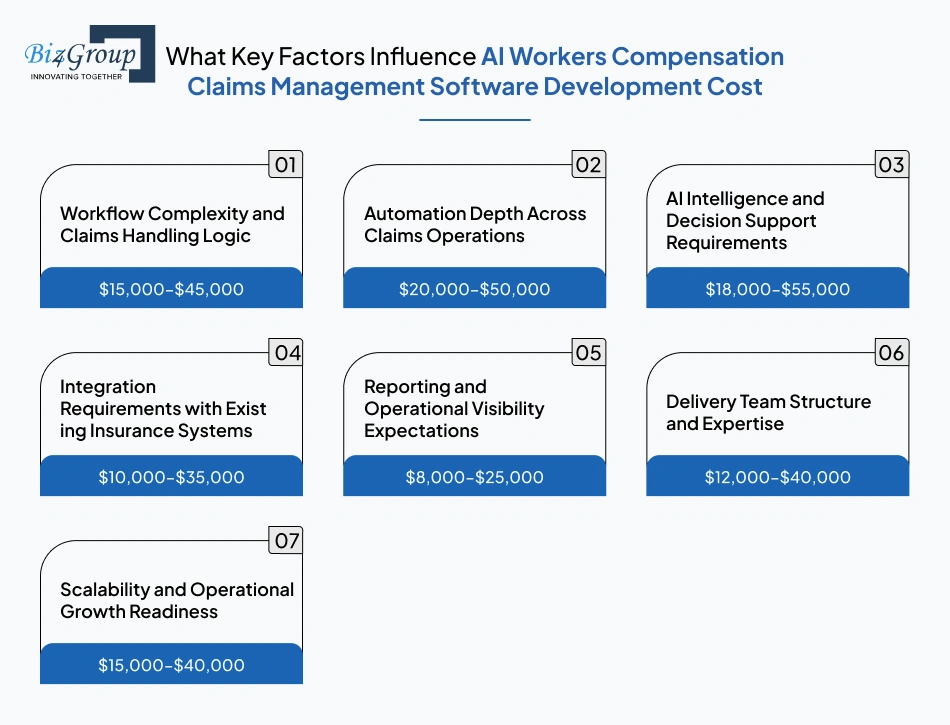
The way claims move through intake, reviews, investigations, approvals, settlements, and escalations has a direct impact on development spending. Platforms with more layered workflows usually require more configuration, testing, and operational validation.
Typical Cost Impact: $15,000–$45,000
This factor usually increases budget through:
Automation requirements significantly affect pricing because every automated workflow requires operational logic, testing cycles, and exception handling. Costs rise further once insurers want automation across multiple operational areas instead of isolated tasks.
Many insurers working with experienced AI automation service providers usually allocate larger budgets here because deeper automation requires stronger operational planning.
Typical Cost Impact: $20,000–$50,000
Budget expansion commonly happens through:
The level of AI involvement directly changes the development estimate. Basic automation keeps costs lower, while predictive recommendations, fraud scoring, and operational insights require larger investment due to testing, tuning, and validation work.
Typical Cost Impact: $18,000–$55,000
This factor usually grows through:
Claims platforms often need to exchange information with policy systems, payment environments, employer databases, medical review tools, and reporting platforms. Every additional integration adds synchronization work and operational dependency management.
Insurance providers usually rely on reliable AI integration services here because integration failures often create long-term workflow disruptions.
Typical Cost Impact: $10,000–$35,000
This factor commonly increases through:
Leadership teams often require deeper visibility into claims activity, settlement timelines, operational delays, and adjuster performance. More advanced reporting environments usually require larger development allocation due to dashboard customization and real-time data processing needs.
Typical Cost Impact: $8,000–$25,000
This factor often includes:
Project cost also changes based on the experience level and structure of the delivery team. Insurance-focused development teams generally improve planning accuracy and reduce operational rework during implementation.
Organizations planning larger claims environments often increase spending while hiring dedicated AI development team resources. Enterprise-scale operations usually require broader technical coverage, stronger coordination, and deeper implementation support across workflows and integrations.
Typical Cost Impact: $12,000–$40,000
The pricing difference usually reflects:
Future operational growth affects pricing even before deployment starts. Platforms expected to support higher claim volumes; larger teams, and expanding workflows usually require stronger infrastructure planning from the beginning.
Typical Cost Impact: $15,000–$40,000
This factor generally expands through:
|
Cost Factor |
Budget Impact |
Why It Changes Pricing |
|---|---|---|
|
Workflow Complexity |
High |
More operational logic and testing |
|
Automation Depth |
High |
Broader workflow automation requirements |
|
AI Intelligence Requirements |
High |
More AI validation and refinement |
|
Integration Requirements |
Medium-High |
Connected operational systems |
|
Reporting Visibility |
Medium |
Larger reporting environments |
|
Delivery Team Expertise |
Medium |
Better execution and planning |
|
Scalability Readiness |
High |
Future operational expansion |
When these business and operational factors are evaluated early, AI workers compensation software development cost becomes easier to forecast because every major investment ties directly to workflow efficiency, operational control, and long-term scalability planning.
Identify the exact operational decisions increasing development costs before implementation spending expands further
Audit My Cost Drivers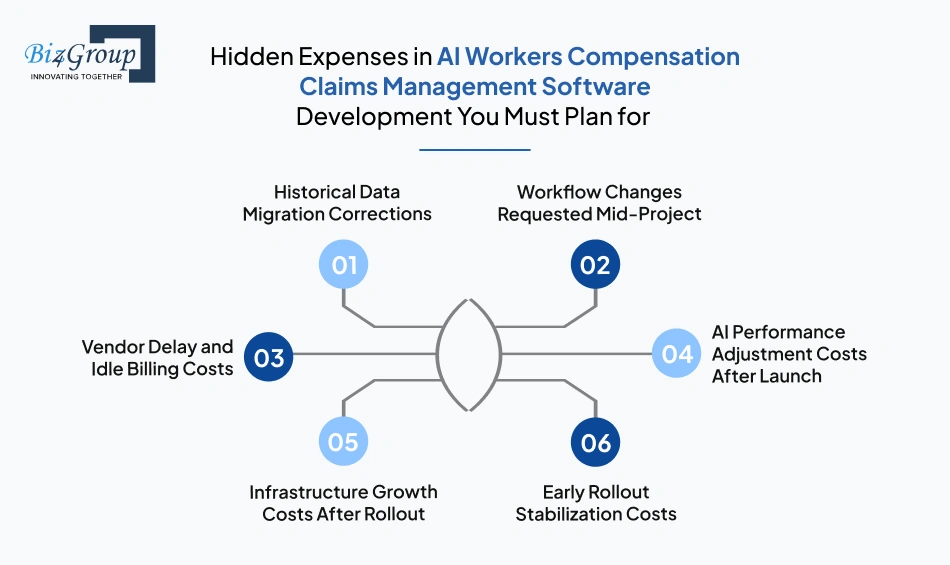
Initial project estimates often cover visible development work while several secondary expenses stay unnoticed until implementation is already underway. That is one reason the cost to build AI workers compensation claims management software can increase after approvals, even when the original scope looked financially controlled.
Most hidden expenses appear through operational delays, infrastructure growth, workflow revisions, and live system adjustments that were underestimated during early planning. These budget leak points are some of the most common areas insurers overlook.
Claims records stored across older systems rarely move perfectly into a new platform. Missing fields, inconsistent formats, and duplicate claim histories often create additional cleanup work after migration begins.
a. Data Validation and Repair Costs: $4,000–$14,000
This expense usually appears once teams begin verifying migrated claims records and discover inconsistencies affecting reporting or workflow accuracy.
b. Legacy File Conversion Costs: $3,000–$9,000
Older claim attachments, scanned reports, and archived records often require extra formatting and restructuring before they function properly inside the new system.
Claims operations usually evolve once stakeholders begin testing real workflows inside the platform. Even small process changes can reopen development and testing cycles.
a. Approval Flow Modification Costs: $5,000–$16,000
Adjustments to settlement approvals, investigation routing, or escalation paths often increase both delivery time and implementation effort.
b. Additional Reporting Request Costs: $4,000–$12,000
Executives and operational teams frequently request new reporting views after reviewing early dashboards, which can create unplanned development hours.
Large claims platforms often depend on outside vendors for enterprise AI integrations, verification tools, and operational access. Delays from external providers can quietly expand project budgets.
a. Integration Access Delay Costs: $2,000–$7,000
Delivery teams may remain assigned to the project while insurers wait for credentials, sandbox access, or third-party approvals.
b. Compliance Review Waiting Costs: $3,000–$8,000
Legal or compliance sign-offs can pause deployment timelines while allocated technical resources continue generating billing hours.
Also Read: How to Create Enterprise AI Strategy: Step-by-Step Guide
AI systems usually require refinement once real claim activity begins flowing through live workflows. Operational behavior in production environments often differs from testing conditions.
a. Fraud Detection Tuning Costs: $4,000–$13,000
Fraud scoring models may require retraining once insurers start reviewing actual investigation outcomes and false alert patterns.
b. Claims Recommendation Optimization Costs: $3,000–$10,000
Claim prioritization systems often need adjustment after adjusters begin interacting with live recommendations during daily operations.
Live claims environments usually consume more storage, processing power, and cloud resources than expected during planning. These expenses often appear gradually after adoption increases.
a. Cloud Usage Expansion Costs: $5,000–$15,000 Annually
Higher claim volumes, larger document uploads, and increased reporting activity can significantly raise infrastructure expenses over time.
b. Backup and Storage Scaling Costs: $3,000–$9,000 Annually
Long-term retention requirements for medical records, claim documents, and audit logs often create larger recurring storage costs than initially estimated.
The first operational weeks after deployment often require additional support that was not fully included in the original estimate.
a. Controlled Rollout Monitoring Costs: $3,000–$8,000
Insurers frequently allocate extra support resources during phased launch periods to resolve workflow issues before full deployment.
b. Emergency Fix and Hotfix Costs: $2,000–$6,000
Unexpected workflow disruptions, reporting failures, and urgent operational corrections commonly create short-term support expenses after launch.
The hidden budget areas are often what expand the cost of developing an AI powered workers compensation claims management software beyond the original estimate. Planning for them early gives insurers stronger budget control and reduces financial surprises during implementation and live operational scaling.
Once the major spending areas become clear, the next priority becomes controlling unnecessary cost expansion without slowing operational goals. The cost of developing an AI powered workers compensation claims processing system for insurance companies becomes easier to manage when optimization decisions focus on reducing rework.
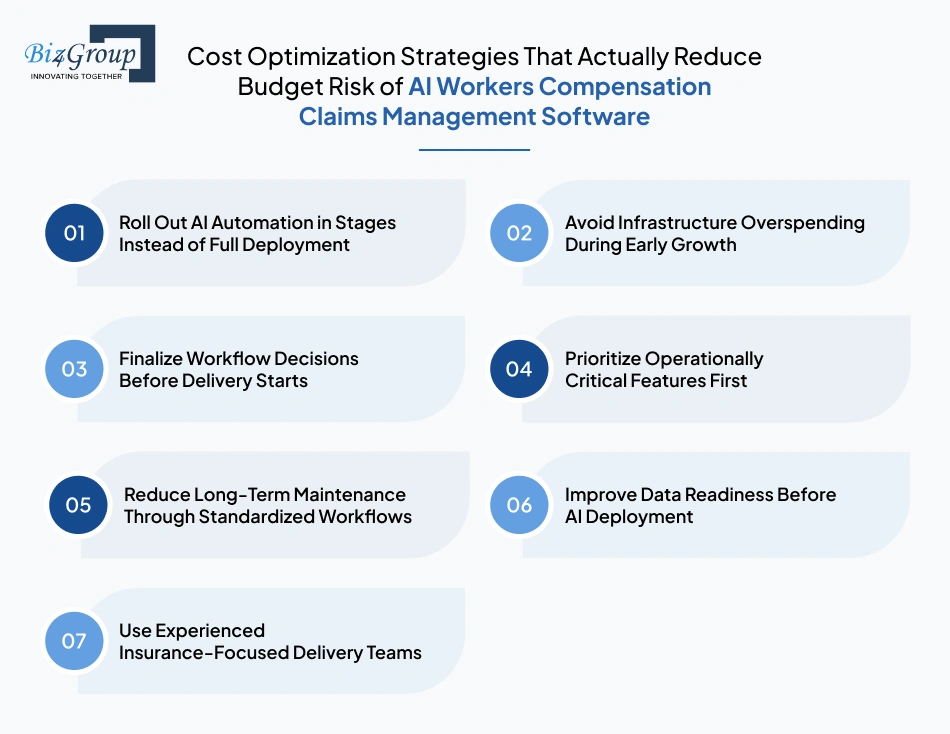
This allows them to control infrastructure growth and avoid oversized implementation early in the roadmap. Here are the strategies that usually create the strongest financial control during development and long-term platform ownership.
Many insurers increase budgets too quickly by applying AI across every claims workflow during the first release. A more controlled rollout starts with operational areas carrying the highest manual workload such as claim triage, fraud review, or document extraction.
This optimization usually saves cost through:
This staged approach can reduce AI implementation spending by 15%–25% (around $15,000–$30,000 on a $150K project). It also keeps operational validation easier during the first deployment cycle.
Large infrastructure environments are often purchased long before operational demand actually requires them. Many insurers reduce ownership costs by scaling cloud resources gradually based on live claims activity instead of projected peak volume.
Savings usually come from:
This strategy can reduce infrastructure-related spending by 20%–30% during the first operational years. It creates healthier long-term operational budgeting.
Budget overruns often begin when approval flows, investigation rules, or reporting structures continue changing after implementation work is already active. Late-stage operational revisions usually trigger redesign, retesting, and deployment delays.
This optimization protects budget through:
This process discipline can reduce spending by 8%–15% (roughly $8,000–$18,000 depending on workflow complexity). It keeps delivery timelines more predictable.
Some claims features create far more operational value than others. Releasing only the workflows that directly improve claim handling efficiency helps insurers avoid spending heavily on low-usage modules during the first phase.
The savings usually come from:
This roadmap strategy can reduce initial development spending by 10%–20% (approximately $10,000–$25,000 on mid-scale implementations). It improves budget efficiency without slowing core operations.
Highly customized operational logic often increases future support costs because every workflow change requires additional maintenance and testing. Standardizing repetitive claims processes wherever practical usually reduces long-term ownership spending.
This optimization generally works through:
This approach can reduce yearly maintenance overhead by 10%–18% depending on operational scale and workflow depth.
Poor claims data quality often increases AI tuning costs after launch. Insurers that organize claim histories, investigation records, and document structures earlier usually spend less on retraining and workflow correction later.
The savings generally come from:
This preparation strategy can reduce AI adjustment costs by 10%–15% annually depending on claim volume and automation depth.
Operational misunderstandings quietly increase implementation spending through delays, workflow corrections, and repeated revisions. Teams familiar with insurance claims environments usually reduce those inefficiencies early in the project lifecycle.
Savings commonly come from:
Organizations also reduce long-term delivery waste by hiring AI software developers with experience in regulated claims operations because operational familiarity improves execution accuracy from the start. This delivery advantage can reduce correction-related budget leakage by 5%–12% across enterprise implementations.
Also Read: Cost to Hire an AI Software Developer in 2026
These optimization strategies improve financial control because the savings come from smarter rollout planning, lower operational rework, and disciplined infrastructure scaling. That makes the cost to build AI workers compensation claims management software more predictable without reducing long-term operational reliability.
Discover smarter rollout strategies that protect operational scalability without inflating long term development spending
Optimize My Development BudgetFor insurance providers planning long-term claims modernization, controlling budget expansion is often as important as platform capability itself. That is where Biz4Group LLC helps reduce the cost to build AI workers compensation claims management software.
We focus on phased execution, controlled workflow planning, and scalable delivery decisions instead of oversized implementation from day one. As an experienced AI development company our focus stays on reducing avoidable rework, limiting unnecessary infrastructure expansion, and aligning development efforts with real operational priorities.
Here are the portfolio-backed examples that shows how cost optimization was carried in AI powered insurance automation software solution through smarter delivery decisions.
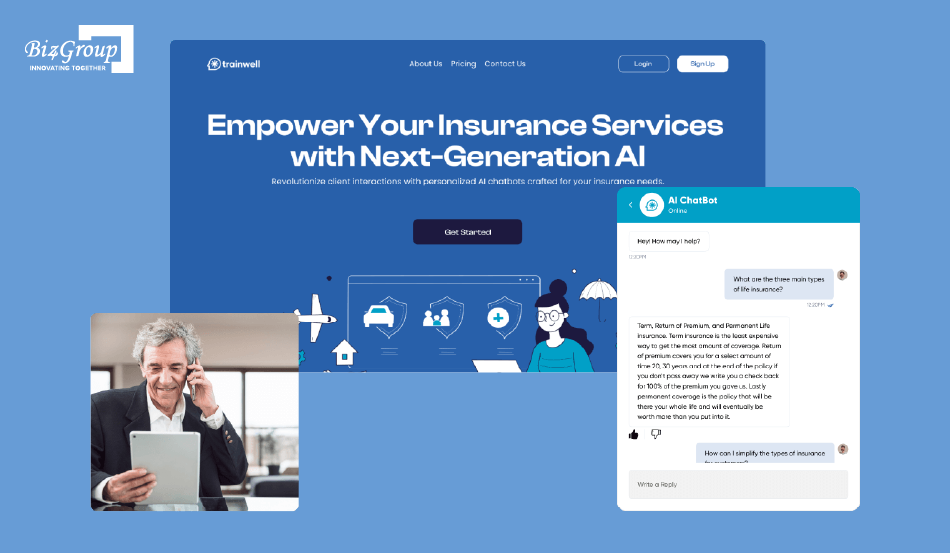
It was developed to help insurance teams improve agent training, policy guidance, and customer interaction workflows through AI-powered conversations and avatar-based support. The platform focused on scalable training delivery while reducing repetitive onboarding and manual coordination costs.
We focused on following to tackle hidden charges and keep cost under control:
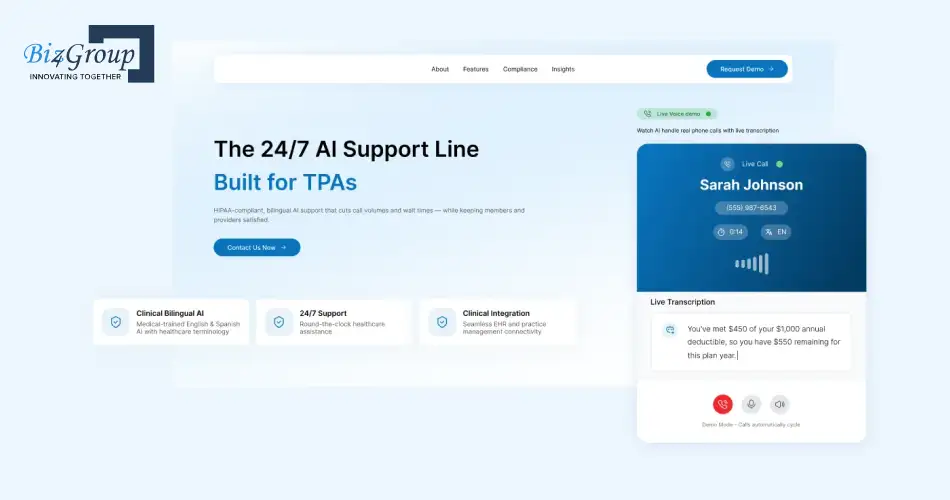
It was developed to automate high-volume healthcare and insurance-related calls through intelligent voice interactions, smart routing, and real-time response handling. The solution focused on reducing manual call center dependency while improving operational response efficiency for third-party administrators and healthcare support teams.
We focused on following to tackle hidden charges and keep cost under control:
Here’s what we offer more to help optimize development budgets:
Now that being said, with the right execution partner like Biz4Group, the cost of developing AI workers compensation software becomes more predictable, efficient, and easier to scale without wasting budget on avoidable mistakes.
Work with a team focused on controlled delivery smarter execution and long term operational scalability
Discuss My Claims Platform VisionBudget planning for claims automation becomes far more practical when every cost driver is understood before development begins. The cost to build AI workers compensation claims management software is rarely shaped by features alone. Workflow complexity, AI depth, integrations, compliance planning, scalability goals, and long-term operational ownership all influence the final investment.
That is why insurers working with an experienced custom AI software development company usually focus on controlled rollout planning instead of oversized implementation from the beginning.
The total cost of developing a full featured workers compensation claims automation software with fraud detection becomes easier to manage when delivery decisions stay aligned with operational priorities and long-term scalability.
With practical execution experience across insurance automation workflows, Biz4Group LLC helps organizations reduce avoidable spending while keeping future expansion flexible. To discuss your project requirements and budget roadmap, connect with us.
The average investment usually falls between $80,000 and $220,000 depending on workflow complexity, claims volume, automation depth, reporting requirements, and integration needs. Platforms handling larger operational workloads or advanced fraud detection generally require higher implementation budgets.
Most mid-scale platforms require around 4–16+ weeks for planning, workflow setup, AI implementation, integrations, testing, and deployment. Timelines usually increase when insurers need custom workflows, enterprise reporting, or large-scale operational migration.
Enterprise carriers usually manage more departments, higher claim volumes, deeper approval structures, and stricter operational controls. That increases implementation effort across workflows, integrations, reporting visibility, security planning, and AI training requirements.
Fraud detection functionality can increase development budgets by $20,000–$60,000 depending on prediction complexity, historical data preparation, AI training scope, and real-time risk scoring requirements across claims workflows.
Post-launch expenses usually include cloud hosting, AI model optimization, security updates, workflow refinements, infrastructure scaling, technical support, and operational monitoring. Annual ownership costs often range between 15%–25% of the original development budget.
Higher claim volumes usually require stronger infrastructure, faster processing environments, broader reporting systems, and more advanced workflow automation. Insurers processing large claim volumes often spend more on scalability planning and operational performance optimization.

with Biz4Group today!
Our website require some cookies to function properly. Read our privacy policy to know more.