Location :
Orlando, FL, USA
Location :
Orlando, FL, USA +1 (407) 714-1616
 info@biz4group.com


















Imagine a digital system that doesn’t wait for instructions but instead, understands your business goals, learns from real-time feedback, and takes independent actions to get the job done.
Read More

How much money slips through your workers’ compensation process before a claim is even reviewed properly?
For many insurers and claims administrators, the biggest problem is not claim volume. It is the growing operational pressure behind every claim. Adjusters spend hours reviewing paperwork, validating medical records, and correcting billing errors that should never reach manual review queues. In many organizations, claims teams lose nearly 30% of their working time to repetitive administrative tasks like data entry and document handling. That delay directly affects claimant experience, especially when 60% of dissatisfied claimants blame slow settlements for their frustration.
The financial impact becomes even harder to ignore when inaccurate medical billing enters the process. Nearly 30–40% of workers’ compensation medical bills contain errors during manual review. Upcoding, duplicate charges, and incorrect billing classifications quietly increase claim costs while teams struggle to detect them early.
That operational pressure is pushing insurers toward AI workers compensation claims management system development as a more practical way to control fraud, improve processing speed, and reduce unnecessary payouts.
Instead of relying heavily on manual validation, modern platforms use automation to analyze claims data, flag suspicious activities, accelerate approvals, and streamline investigations before delays grow into larger financial risks.
As organizations look for faster and more accurate claims operations, workers compensation automation software development using AI is becoming a serious business priority. The rest of this blog breaks down how these systems work, what capabilities matter most, and what it takes to build them successfully.
Most workers’ compensation teams are not struggling because of claim volume alone. The real pressure comes from outdated workflows that cannot keep up with rising operational demands. Many organizations are still relying on rules-based environments that were designed for smaller workloads and simpler claim scenarios.
Before discussing AI workers compensation system development, it is important to understand why traditional claims operations lose efficiency so quickly under scale.
These operational gaps explain why insurers are actively reevaluating how claims systems handle scale, accuracy, workload pressure, and long-term cost control. Now let’s understand how AI workers compensation claims management system changes the picture.
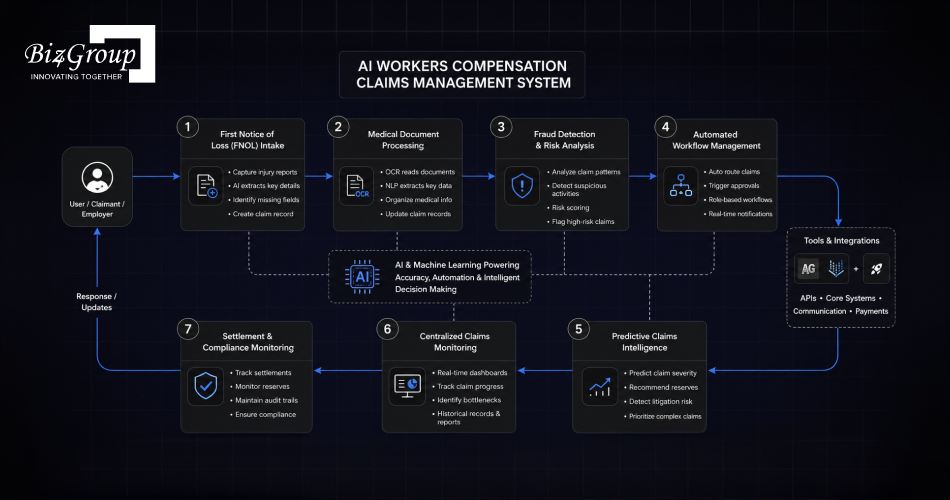
An AI workers compensation claims management system is a platform that automates and improves how workers’ compensation claims are processed, reviewed, tracked, and resolved. It uses technologies like machine learning, document intelligence, predictive analytics, and workflow automation to reduce manual workload across the claims lifecycle.
The system helps insurers, third-party administrators, and claims teams manage claim intake and medical reviews. It also helps them with document fraud detection, claim approvals, compliance tracking, and settlement coordination from one centralized environment.
To understand how the platform operates in real claims environments, it is important to look at how each stage of the claims lifecycle is managed inside the system.
Also Read: NLP vs LLM: Choosing the Right Approach for Your AI Strategy
This operational structure is why many insurers are now prioritizing workers compensation automation software development using AI to improve processing speed, claim accuracy, and long-term operational control.
See how intelligent claims workflows reduce operational pressure and improve claims visibility across teams
Map My AI Claims WorkflowNow that the system workflow is clear, the next step is understanding how AI-driven claims operations differ from traditional workers’ compensation processing environments handling growing claim complexity and workload pressure.
|
Comparison Area |
Traditional Claims Processing |
AI-Based Workers Compensation Claims Processing |
|---|---|---|
|
Claim Intake |
Manual data entry and verification processes |
Automated FNOL data extraction and validation |
|
Document Handling |
Paper-heavy document reviews and uploads |
OCR-based medical and billing document processing |
|
Fraud Detection |
Fraud investigations start after manual suspicion |
AI flags suspicious claims during early processing stages |
|
Workflow Coordination |
Multiple disconnected systems manage workflows |
Centralized platforms coordinate claims activities in real time |
|
Claims Routing |
Static workflows route claims manually |
Intelligent workflows route claims dynamically based on risk and severity |
|
Reserve Estimation |
Adjusters estimate reserves manually |
Predictive models recommend reserve estimates automatically |
|
Claims Visibility |
Limited visibility across departments and claim stages |
Real-time dashboards monitor claims progress continuously |
|
Decision-Making |
Heavily dependent on manual reviews |
AI-assisted insights support faster operational decisions |
|
Administrative Workload |
High dependency on repetitive paperwork |
Workflow automation reduces manual administrative tasks |
|
Processing Speed |
Delays caused by manual coordination and approvals |
Automated workflows accelerate claim processing timelines |
The comparison clearly shows why traditional claims environments struggle under growing workload pressure while AI-driven systems improve visibility, coordination, processing speed, and operational control across workers’ compensation claims management.
Fraud rarely appears as one obvious red flag. It usually hides across billing records, injury timelines, medical documents, claimant statements, and repeated claim patterns that manual reviews struggle to connect quickly. Here’s something you should know:
That growing complexity is why AI workers compensation claims management system development is becoming important for insurers handling large claim volumes and rising investigation pressure.
Now, let’s look at how AI helps detect fraudulent workers compensation claims:
AI continuously analyzes claimant behavior, reporting timelines, treatment frequency, and activity patterns to identify unusual claim activity. Claims that suddenly deviate from expected recovery timelines or treatment behavior are flagged for deeper review before payouts move forward.
AI workers compensation claims management system compares incoming claims against historical databases, employer records, injury reports, and claimant information to identify duplicate submissions. This helps investigation teams detect repeated claims filed under modified details or across different jurisdictions.
AI reviews billing records to identify upcoding, duplicate charges, excessive treatments, and inconsistent procedure combinations. Suspicious billing activities are automatically highlighted for adjusters and Special Investigation Units during claim reviews.
AI-based document analysis tools examine uploaded reports, prescriptions, invoices, and injury images for manipulation indicators. Altered medical records, edited forms, and inconsistent image metadata can be detected much faster than manual verification processes.
Natural language processing models analyze written statements, medical narratives, and incident descriptions to identify inconsistencies across claim records. Conflicting injury details and unusual reporting patterns become easier to identify during investigations.
AI studies historical fraud cases, settlement trends, and investigation outcomes to generate fraud risk scores for active claims. High-risk claims are prioritized faster, helping insurers reduce false payouts and improve SIU investigation efficiency.
This level of fraud intelligence is becoming a critical focus area in workers compensation claims management software development as insurers look for faster investigations, better fraud visibility, and stronger control over rising claim costs.
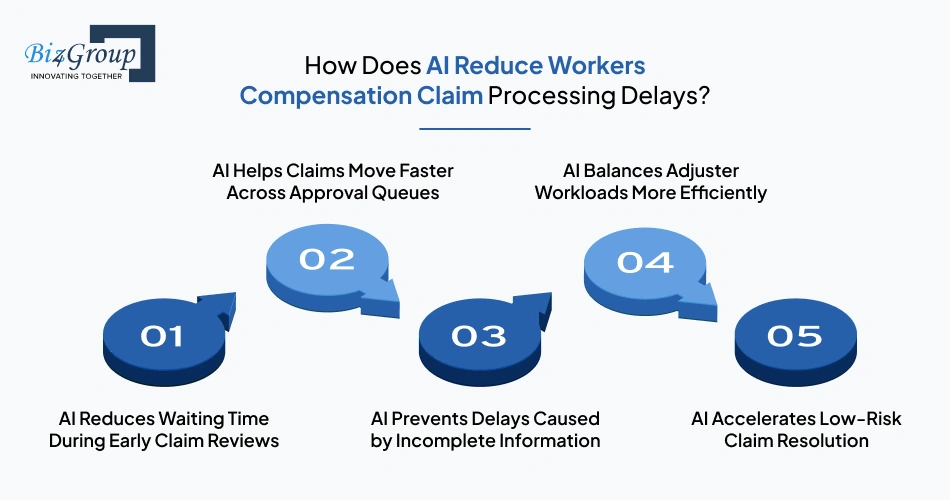
Most claim delays do not begin with complex investigations. They usually build slowly through review queues, pending approvals, incomplete records, and overloaded adjuster workloads. Automated workers compensation system development allows insurers trying to reduce settlement timelines and improve claims responsiveness.
Manual reviews often slow claims during the first stages of processing. AI helps reduce that waiting time by identifying missing information, incomplete submissions, and review gaps much earlier. Claims move into active processing faster instead of remaining stuck in administrative queues.
Claims frequently remain inactive while waiting for manual reassignment or approval decisions. AI reduces those delays by prioritizing urgent cases automatically and helping claims move through approval stages without unnecessary idle time between departments.
Missing documents and inconsistent claim records often trigger repeated follow-ups between employers, claimants, medical providers, and adjusters. AI helps identify information gaps early so teams can resolve issues before they interrupt processing timelines later in the claim cycle.
Overloaded adjusters are one of the biggest reasons claims remain delayed for long periods. AI monitors workload distribution continuously and helps organizations prevent claim backlogs by balancing assignments more efficiently across available teams.
Not every claim requires extended reviews or multiple approval layers. AI helps organizations identify lower risk claims earlier, so they can move through settlement stages faster without creating unnecessary processing delays for straightforward cases.
These operational improvements are helping insurers reduce claim cycle times, improve adjuster productivity, minimize processing backlog, and accelerate settlements through intelligent workers compensation platform development focused on faster claims resolution.
Identify workflow bottlenecks slowing settlements before backlog pressure starts affecting operational performance
Fix My Claims BottlenecksFaster claims handling is only one part of the business impact. The larger value comes from how AI improves operational economics across fraud losses, staffing pressure, administrative overhead, reserve planning, and settlement efficiency.
That shift is why insurers planning to build AI claims management system for workers compensations are focusing heavily on measurable operational outcomes instead of isolated automation features.
Fraud-related losses continue increasing across workers’ compensation environments due to billing manipulation, duplicate claims, and delayed investigations. AI-driven fraud analytics and real-time claim analysis are helping insurers reduce long-term financial leakage across the claims lifecycle.
Growing claim volumes often force insurers to increase staffing costs across claims operations. AI allows organizations to scale claim processing capacity without proportionally increasing administrative teams.
Reserve inaccuracies can significantly affect claim forecasting and financial planning. AI helps insurers improve reserve management by analyzing historical claim behavior, injury complexity, treatment duration, and settlement patterns more consistently.
Delays, inconsistent communication, and administrative backlogs directly affect claimant experience. AI helps insurers improve operational responsiveness while allowing adjusters to focus more on active claim management instead of repetitive administrative coordination.
The measurable business outcomes above are AI workers compensation claims management system development, a strategic investment for insurers focused on long-term operational efficiency, financial control, and scalable claims management performance.
Strong claims automation depends on how different operational capabilities work together. When organizations plan to develop workers compensation software integrating AI, feature planning becomes important because every capability directly affects claims accuracy, operational visibility, and processing control.
|
Feature |
Purpose |
|---|---|
|
Claim Intake Management |
Captures claimant details, injury reports, employer records, and supporting documents in one workflow |
|
Case Management Dashboard |
Centralizes claim tracking, status updates, and adjuster activities across active cases |
|
Medical Record Management |
Organizes treatment records, prescriptions, invoices, and medical histories for faster reviews |
|
Reserve Management |
Tracks reserve allocations and claim-related financial updates throughout the claim lifecycle |
|
Settlement Tracking |
Monitors settlement progress, approvals, and payment coordination across claims |
|
Audit Trail Management |
Maintains activity records for investigations, reporting, and compliance reviews |
|
Feature |
Purpose |
|---|---|
|
Fraud Risk Scoring |
Identifies suspicious claims using behavioral patterns and historical fraud indicators |
|
Predictive Claim Analysis |
Estimates claim complexity, recovery timelines, and potential financial exposure |
|
AI Document Intelligence |
Analyzes uploaded documents and identify missing or inconsistent information |
|
NLP-Based Statement Analysis |
Detects inconsistencies across claimant narratives, medical notes, and incident reports |
|
Automated Claim Prioritization |
Ranks claims based on urgency, severity, and operational impact |
|
Anomaly Detection Engine |
Highlights unusual billing activities, duplicate submissions, and irregular treatment patterns |
|
Feature |
Purpose |
|---|---|
|
Automated Task Assignment |
Distributes claims and reviews across teams based on workload availability |
|
Approval Workflow Automation |
Reduces manual approval delays across settlement and review stages |
|
Real-Time Notifications |
Alerts teams about pending actions, escalations, and claim updates instantly |
|
SLA Monitoring |
Tracks processing timelines and identify delayed claims automatically |
|
Escalation Management |
Triggers escalations for high-risk or stalled claims requiring faster attention |
|
Feature |
Purpose |
|---|---|
|
HIPAA Compliance Controls |
Protect medical records and claimant information during claim processing |
|
Role-Based Access Control |
Restrict system access based on user responsibilities and permissions |
|
Regulatory Reporting Tools |
Support state-level workers’ compensation reporting requirements |
|
Data Encryption |
Secure sensitive claim data across storage and communication channels |
|
Compliance Monitoring Dashboard |
Track audit readiness, reporting activities, and policy violations centrally |
|
Feature |
Purpose |
|---|---|
|
Claims Performance Reporting |
Monitors settlement timelines, backlog levels, and operational efficiency |
|
Fraud Analytics Dashboard |
Provides visibility into insurance fraud detection trends, investigation status, and claim risks |
|
Adjuster Productivity Tracking |
Measures workload distribution and claim handling performance |
|
Financial Loss Analysis |
Tracks claim leakage, payout trends, payment fraud detection and reserve utilization patterns |
|
Custom Business Reports |
Generates operational reports for insurers, administrators, and compliance teams |
Operational efficiency in claims environments depends heavily on how these features are structured across fraud oversight, workflow coordination, compliance tracking, and reporting visibility. This is why AI workers compensation claims management system development requires feature planning that supports long-term scalability instead of isolated automation capabilities.
Build a claims platform that supports fraud oversight compliance tracking and scalable claims operations
Plan My Claims Platform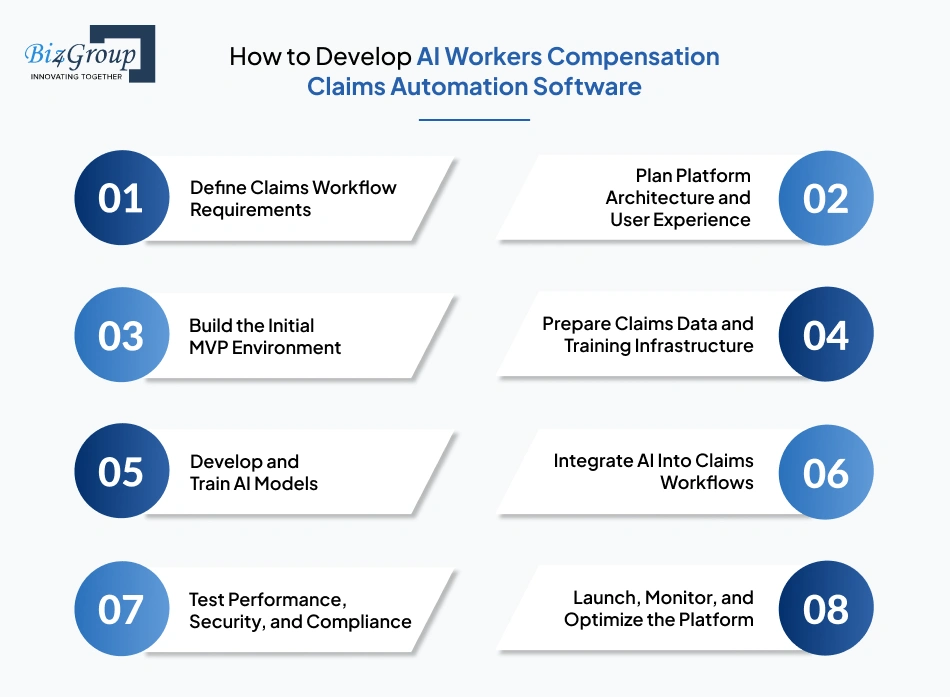
Claims automation platforms require more than workflow setup and dashboard configuration. The development process moves from claims logic planning to real-time operational coordination.
That complexity is why organizations investing in developing AI fraud detection software for workers compensation claims usually follow a phased implementation approach instead of deploying everything at once.
Start by mapping how claims currently move across intake, reviews, approvals, investigations, settlements, and reporting stages.
Key activities usually include:
The next step focuses on dashboard structure and claims accessibility across departments. Many organizations work with an experienced UI/UX design company to simplify operational workflows for adjusters, investigators, supervisors, and compliance teams.
Planning activities usually include:
Also Read: Top UI/UX Design Companies in USA
Most insurers begin with core operational modules before scaling advanced AI capabilities. This is where structured MVP development services help organizations validate workflows and operational requirements before full deployment.
Early-stage modules generally include:
Also Read: Top MVP Development Companies in USA
AI systems depend heavily on properly structured claims data. Historical claim records, billing information, settlement outcomes, medical reports, and investigation histories are prepared during this phase, so models can learn from accurate operational data.
Data preparation activities generally involve:
This stage focuses on AI model development for fraud scoring, claim prioritization, document analysis, and predictive claim evaluation. The development team also finalizes AI model selection based on operational goals, claims complexity, and data availability.
Development work usually includes:
Once models are validated, teams integrate AI model capabilities directly into claims operations. The focus here is making AI outputs usable inside active workflows instead of keeping them isolated within analytics systems.
This integration stage typically includes:
Claims automation systems require extensive validation before deployment because operational errors can directly affect settlements, reporting, and compliance obligations. Many organizations collaborate with experienced software testing companies to verify workflow stability and data accuracy.
Testing activities generally include:
Deployment usually begins gradually across selected claims teams before expanding organization wide. Once the platform becomes operational, insurers continuously monitor performance, claim outcomes, AI accuracy, and workflow efficiency.
Post-launch optimization often includes:
Successful claims automation platforms depend heavily on how well operational workflows, AI intelligence, compliance controls, and claims infrastructure are aligned during development. This is why building an AI workers compensation management system requires long-term planning beyond basic workflow automation deployment.
A strong stack matters because claims platforms need reliable performance, secure data handling, and flexible AI integration across many teams. In custom workers compensation AI software development, the right tools should support fast interfaces, stable workflows, accurate model output, and safe system connections.
|
Architecture Layer |
Recommended Tools |
Purpose |
|---|---|---|
|
Frontend Layer |
React.js, Next.js, TypeScript |
Supports ReactJS development for responsive claim dashboards and NextJS development for fast, secure pages that load well for adjusters and administrators. |
|
Backend Layer |
Node.js, Python, .NET |
Handles NodeJS development for business logic, claim processing rules, automation tasks, and service orchestration with stable performance across high-volume claims. |
|
AI and Machine Learning Layer |
Python, TensorFlow, PyTorch, scikit-learn |
Powers Python development for fraud scoring, claim prediction, document analysis, and model training with flexible AI workflows. |
|
API and Integration Layer |
REST APIs, GraphQL, API Gateway, Postman |
Supports API development for connecting claims platforms with billing systems, document sources, medical records, and third-party tools. |
|
Data Layer |
PostgreSQL, MongoDB, Redis, Snowflake |
Stores structured claim records, unstructured documents, fast lookup data, and reporting datasets with reliable performance and retrieval speed. |
|
Document Intelligence Layer |
Tesseract OCR, AWS Textract, Google Document AI |
Extracts text from medical bills, claim forms, and scanned records so teams can process documents with less manual effort. |
|
Security and Compliance Layer |
OAuth 2.0, JWT, role-based access control, encryption tools |
Protects sensitive claimant and medical data while controlling access across adjusters, investigators, and compliance users. |
|
Cloud and DevOps Layer |
AWS, Azure, Docker, Kubernetes, GitHub Actions |
Supports scalable deployment, environment management, monitoring, and release automation for enterprise-grade web development environments. |
|
Analytics and Reporting Layer |
Power BI, Tableau, Metabase |
Turns claim activity into usable dashboards that help leaders track fraud trends, backlog levels, and operational performance. |
This stack gives product teams a practical path for building secure claims software that can scale with data, automation, and AI. It also keeps full stack development aligned with enterprise needs, from the interface layer to model deployment and reporting.
Also Read: Why to Choose the Full Stack Development for Modern Business
Compliance requirements in workers’ compensation environments extend far beyond basic data protection. Claims platforms handle medical records, financial data, injury reports, investigation histories, and state-level reporting obligations that require strict operational controls.
This is why businesses creating workers compensation compliance software for USA must address compliance requirements from the earliest planning stages instead of treating them as post-deployment additions.
Workers’ compensation claims systems regularly process protected health information during medical reviews, billing verification, and settlement coordination. Platforms must secure claimant records through encryption, access controls, activity monitoring, and protected data storage practices.
The system should also maintain:
Also Read: HIPAA Compliant AI App Development for Healthcare Providers
Workers’ compensation laws differ significantly across US states. Claims platforms must support state-level filing rules, reporting timelines, documentation requirements, and claim handling procedures without operational conflicts.
This usually includes:
Claims environments require long-term storage of claim records, investigation documents, settlement histories, and communication logs. The platform must maintain accurate audit trails showing how claims were processed and reviewed throughout their lifecycle.
Compliance controls generally include:
Not every user should access all claim information. Claims systems must restrict visibility based on operational roles such as adjusters, investigators, administrators, supervisors, and legal teams.
Security requirements often involve:
AI-driven claims systems must maintain visibility into how automated recommendations and fraud indicators are generated. Organizations need review mechanisms to validate AI outputs during investigations and claim handling activities.
This usually requires:
Claims systems process sensitive personal, medical, and financial information daily. Data encryption must protect records during storage, transmission, and third-party integrations.
Infrastructure compliance generally includes:
Compliance readiness plays a major role in claims system planning because regulatory gaps can directly affect investigations, reporting accuracy, data protection, and operational accountability. This is why organizations developing AI systems to detect workers compensation fraud must align automation strategies with compliance controls from the beginning.
Align claims workflows with HIPAA reporting rules audit tracking and multi-state operational requirements
Review My Compliance Readiness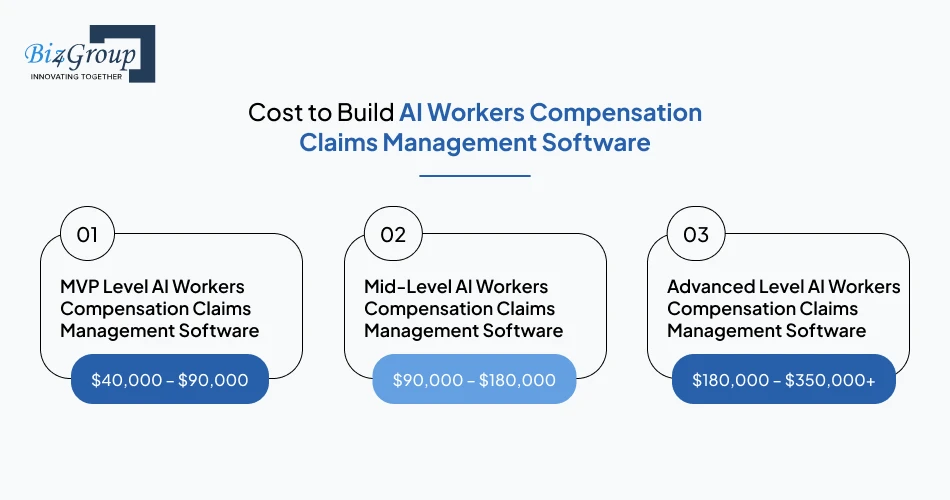
The development cost for AI workers compensation claims management system development in USA ranges between $40,000 and $350,000+ depending on how advanced the platform needs to become across fraud analysis, automation and infrastructure layers.
|
Development Level |
Estimated Cost Range |
Scope |
|---|---|---|
|
MVP Level AI Workers Compensation Claims Management Software |
$40,000 – $90,000 |
Covers basic claim intake workflows, document management, dashboards, user authentication, and limited automation features for early-stage operational validation. |
|
Mid-Level AI Workers Compensation Claims Management Software |
$90,000 – $180,000 |
Includes fraud scoring, workflow automation, claims reporting, compliance tracking, third-party integrations, and AI-powered document analysis capabilities. |
|
Advanced Level AI Workers Compensation Claims Management Software |
$180,000 – $350,000+ |
Supports predictive analytics, large-scale workflow orchestration, real-time fraud intelligence, advanced reporting, cloud scalability, and enterprise-grade compliance infrastructure. |
Budget planning becomes more accurate when organizations define operational priorities, automation depth, compliance scope, and integration requirements early in the project lifecycle. This helps insurers estimate the real cost to build AI workers compensation claims management software without underestimating infrastructure and long-term AI maintenance requirements.
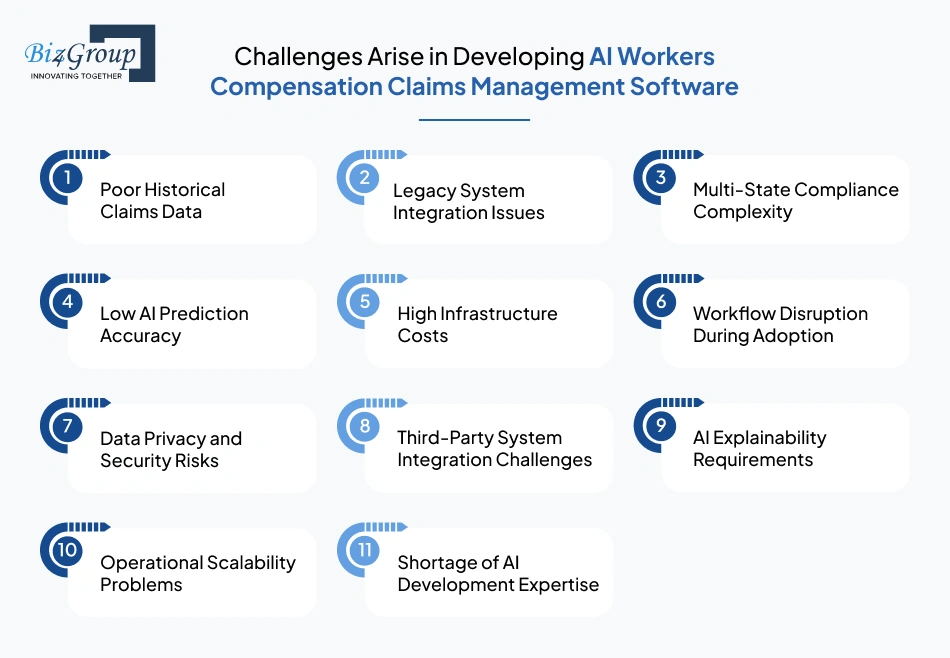
Claims automation projects involve much more than AI model deployment and workflow configuration. Most operational challenges appear during data preparation and real-world claims handling. Which is why organizations developing AI systems to detect workers compensation fraud often face implementation barriers long before deployment reaches production scale.
|
Challenge |
How to Solve It |
|---|---|
|
Poor Historical Claims Data |
Clean and organize historical claim records before AI training begins. Structured datasets improve fraud analysis accuracy and operational reliability. |
|
Legacy System Integration Issues |
Use scalable AI integration services and API-based architecture to connect older claims platforms with modern automation systems. |
|
Multi-State Compliance Complexity |
Configure workflows separately for state-level reporting, filing timelines, and regulatory documentation requirements. |
|
Low AI Prediction Accuracy |
Retrain AI models continuously using updated claims data, investigation outcomes, and settlement records. |
|
High Infrastructure Costs |
Start with phased deployment and scale infrastructure gradually based on claim volume and operational demand. |
|
Workflow Disruption During Adoption |
Seek AI automation services gradually across departments so adjusters and claims teams can adapt operationally. |
|
Data Privacy and Security Risks |
Implement encryption, role-based access controls, audit logging, and continuous monitoring across claims environments. |
|
Third-Party System Integration Challenges |
Standardize data formats and use AI workflow automation tools that support flexible system connectivity. |
|
AI Explainability Requirements |
Maintain clear audit trails and human review checkpoints for fraud scores and automated recommendations. |
|
Operational Scalability Problems |
Design infrastructure that can handle growing claims volume without slowing workflow performance. |
|
Shortage of AI Development Expertise |
Hire AI developers with experience in insurance workflows, claims operations, and fraud analytics systems. |
Operational success depends heavily on how early these challenges are identified during planning and implementation stages. AI workers compensation claims management system development requires careful planning across infrastructure, workflows, data readiness, and operational scalability from the beginning.
Also Read: Cost to Hire an AI Software Developer in 2026
At this point with operational challenges and development scope already clear, the next step is finding a team that can execute the platform correctly without disrupting claims operations.
Many insurers eventually reach the stage where they start asking, “which AI development company can build a custom workers compensation claims management system for our insurance firm?” Well, Biz4Group LLC is the answer you’re looking for.
As an experienced custom AI software development company, we work with enterprises looking for long-term automation systems instead of isolated workflow tools. Our team combines AI consulting services, insurance workflow understanding, and scalable engineering support under one delivery structure.
This becomes even more important for organizations searching for a software development agency that can create an end-to-end AI workers compensation claims management solution for mid-sized insurance carriers. Here’s what we bring to the table:
Claims environments involve reporting pressure, fraud oversight, settlement coordination, and operational dependencies across multiple teams. We have experience delivering AI powered insurance automation software solutions that align with real insurance workflows instead of generic automation structures. Here’s the proof:
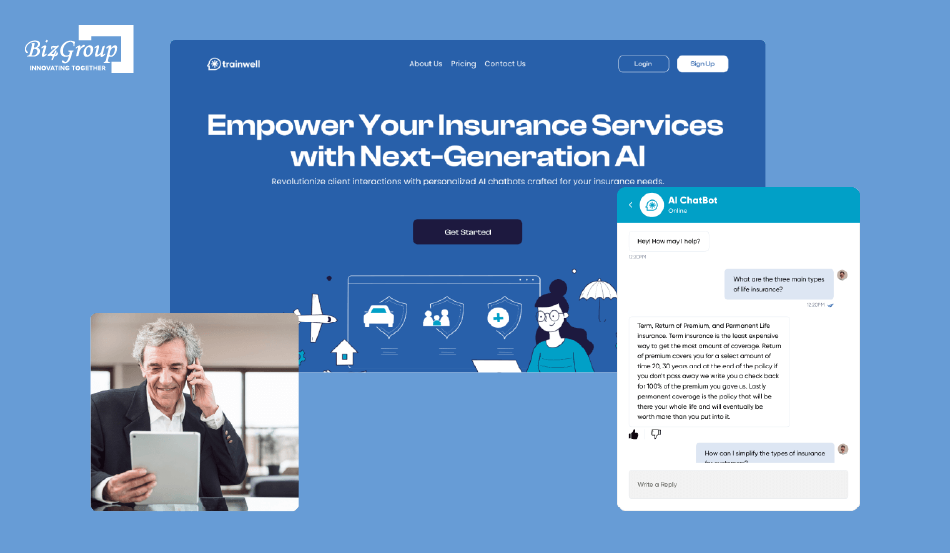
Insurance AI is an advanced AI chatbot built for a senior insurance leader to support insurance agent training and daily questions. It replaces repetitive Zoom sessions and lengthy training documents with instant, accurate responses. Built with GPT-4o and GPT-3.5, it also includes feedback-based improvement and simple web integration which helps in post launch optimization.
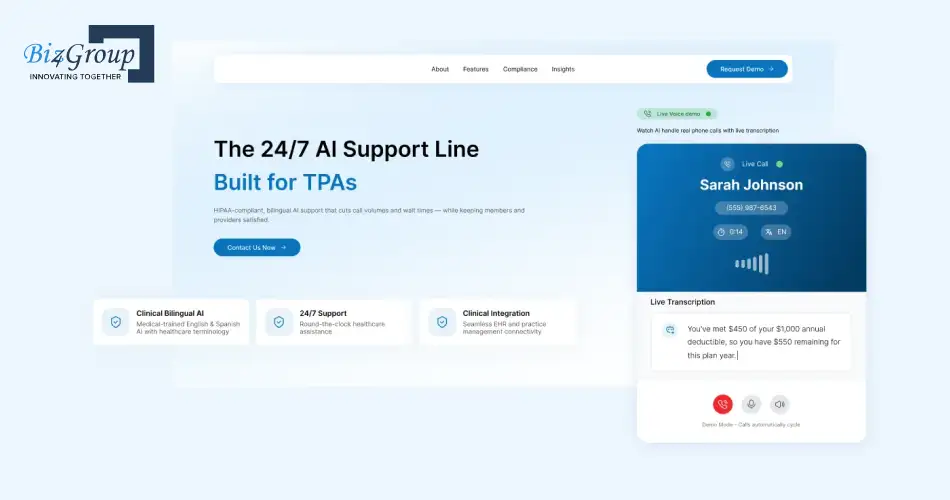
This AI driven IVR support platform for third party administrators is a fully automated, HIPAA compliant voice system. It answers eligibility checks, claim status, benefits guidance, and provider questions with natural responses. It reduces repetitive calls, supports English and Spanish with live translation, and escalates unresolved calls with context for smoother handoffs.
Many automation projects become difficult when infrastructure planning is handled separately from operational workflows. Our team focuses on enterprise AI solutions that support scalability, reporting visibility, compliance readiness, and long-term operational stability from the beginning.
Claims automation projects usually involve dashboards and reporting infrastructure. We handle AI product development services across architecture planning, engineering, testing, deployment, and post-launch optimization through one connected execution process.
AI systems become operationally useful only when they fit naturally into existing claims processes. We work on workflow-level automation, system integrations, and operational coordination instead of limiting implementation to standalone AI features or disconnected tools.
Modern claims environments increasingly require predictive automation, intelligent reporting, and document analysis working together inside one system. Our expertise across generative AI development supports long-term scalability for insurers managing growing claims complexity and operational workload.
Execution quality plays a major role in claims automation success because operational gaps can affect fraud oversight, reporting accuracy and long-term scalability. This is why AI workers compensation claims management system development requires an execution partner like Biz4Group LLC with experience across insurance operations and enterprise workflow implementation.
Turn complex claims operations into scalable AI-driven workflows built for long-term operational control
Talk To Claims AI ExpertsWorkers’ compensation teams are already dealing with growing claim pressure, operational delays, fraud exposure, and rising administrative costs. That is why many insurers are now working with an experienced AI development company to create a custom workers compensation claims system with AI. This supports faster decisions, better operational visibility, and stronger claims control without increasing manual workload.
AI workers compensation claims management system development requires more than workflow automation alone. Long-term success depends on how well claims operations, compliance requirements, fraud oversight, and AI infrastructure work together inside one scalable environment. Biz4Group LLC helps organizations align those operational and technical requirements through practical enterprise AI implementation strategies.
Ready to discuss your claims automation goals? Schedule a strategy call with us today.
Accuracy depends heavily on historical claims data quality, fraud pattern training, and operational tuning. Most enterprise-grade systems continuously retrain models using investigation outcomes, billing behavior, settlement records, and claim history to improve fraud scoring accuracy over time.
Most platforms require integration with medical billing systems, EHR platforms, document management systems, payroll platforms, CRM tools, state reporting databases, and third-party claims administration software to maintain centralized operational visibility.
Yes. Modern claims platforms can support state-specific filing workflows, reporting timelines, audit tracking, documentation requirements, and compliance monitoring across multiple jurisdictions through configurable compliance management modules.
Development timelines usually range between 4 to 16+ weeks depending on workflow complexity, AI capabilities, integration requirements, compliance scope, and operational scale. Enterprise-level systems with predictive analytics and fraud detection generally require longer implementation timelines.
The average cost typically ranges between $40,000 and $350,000+ depending on AI model complexity, automation depth, infrastructure requirements, integrations, compliance controls, and reporting capabilities included in the platform.
AI fraud models usually require historical claim records, investigation outcomes, billing histories, treatment patterns, settlement data, injury reports, claimant activity records, and medical documentation to identify suspicious claim behavior accurately.

with Biz4Group today!
Our website require some cookies to function properly. Read our privacy policy to know more.