 Location :
Orlando, FL, USA
Location :
Orlando, FL, USA +1 (407) 714-1616
 info@biz4group.com

- The cost to build a real estate app like Realtor.com typically ranges from $30,000 to $250,000+, depending on features, scalability, and platform scope.
- MVP, mid-tier, and enterprise builds follow the same development steps, but differ in execution depth, which impacts the development cost of a real estate app like Realtor.com.
- Key cost drivers include MLS integration, advanced search, scalable backend architecture, and real estate mobile app development cost like Realtor.com expectations.
- Hidden costs such as ongoing MLS fees, infrastructure scaling, security updates, and post-launch improvements directly affect the development budget of a real estate app like Realtor.com.
- Smart planning, strong cost optimization strategies, and partnering with Biz4Group help control how much investment is needed to make a real estate marketplace app like Realtor.com while building for long-term growth.
You might have asked yourself this more than once: how much does it cost to build a real estate app like Realtor.com that can actually compete in 2025?
Everyone seems to quote different numbers without explaining the logic behind them. Some say it could be $30,000. Others estimate $250,000 and beyond. That leaves you wondering what is real and what is guesswork.
Before we go further, let’s ground this conversation in real 2025 data. The global real estate software market is expected to reach around USD 13.6 billion in 2025, driven by the growing dependence on digital platforms for buying, selling, and managing properties.
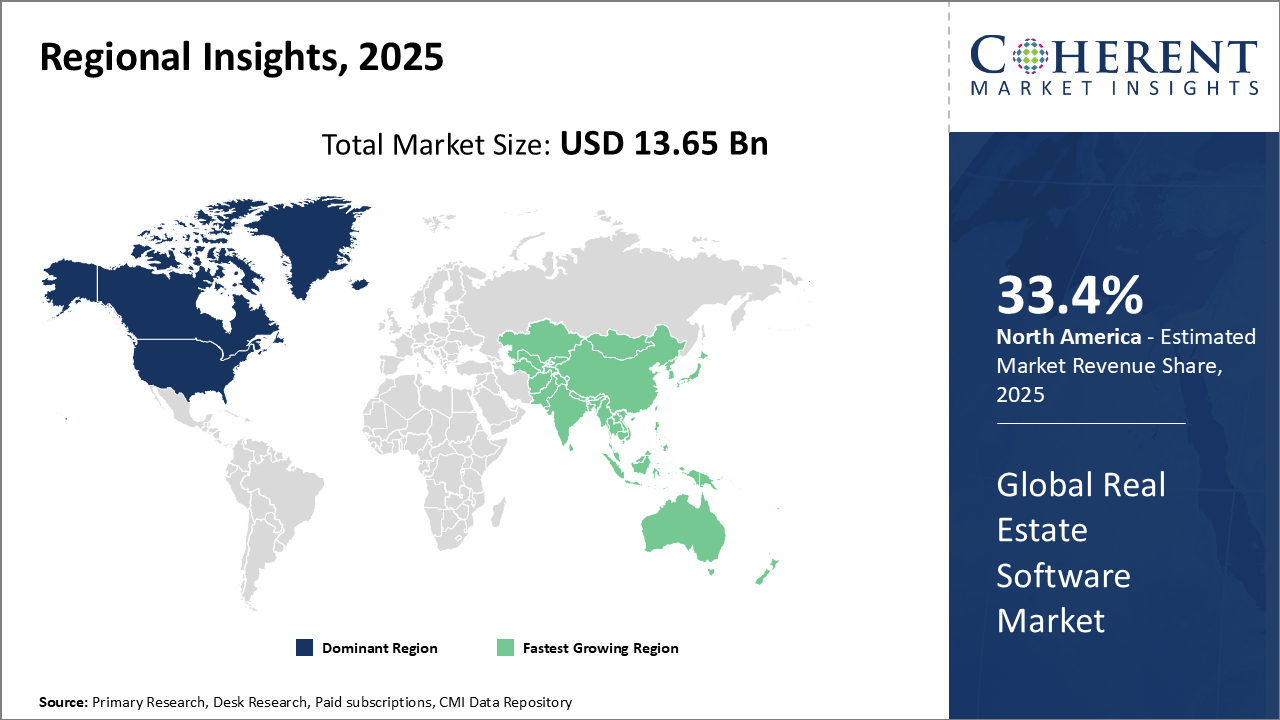
At the same time, U.S. housing data shows that active property listings increased by more than 15 percent year over year, reflecting renewed buyer and seller activity across online real estate platforms.
These numbers highlight a simple truth. Real estate marketplace apps are no longer optional tools. They are core business infrastructure.
If you are planning a serious platform, you are likely thinking beyond basic listings. You are considering how to support live MLS data, fast property search, reliable performance at scale, and user experiences that buyers and agents actually trust. All of that directly influences the cost to build a real estate app like Realtor.com.
Many teams start by exploring real estate AI app ideas and quickly realize how features like intelligent search, automated lead handling, and pricing insights raise both opportunity and complexity. That evolution plays a major role in what it realistically costs to build a Realtor.com-style application.
In this guide, we will break the topic down in a practical way. You will see how costs differ across MVP, mid-tier, and enterprise-grade platforms, what drives those differences, and where budgets often stretch further than expected.
By the end, you will have a clear understanding of:
- What truly goes into building a Realtor.com-level property platform
- Why cost ranges vary so widely
- How to plan your development budget with long-term growth in mind
Now, let’s look at what actually sets Realtor.com apart and why those differences matter so much when estimating development costs.
Thinking About Building a Realtor.com-Style App in 2025?
Over 70% of homebuyers start their search online, and platforms with faster search and accurate listings win attention first. If you are evaluating the cost to build a real estate app like Realtor.com, the right planning can save months and thousands of dollars.
Talk to Our ExpertsWhat Sets Realtor.com App Apart and Why It Impacts Development Cost More Than You Think?
Before diving into features and numbers, it is important to be clear on one thing.
What exactly do we mean when we say a Realtor.com app?
A Realtor.com app is not just a place where users browse homes. It is a full-scale real estate marketplace platform that connects buyers, sellers, and agents through live property data, intelligent search, and lead-driven workflows. Understanding this definition is critical because it directly shapes the cost to build a real estate app like Realtor.com.
Now let’s break this down step by step.
What a Realtor.com App Actually Is
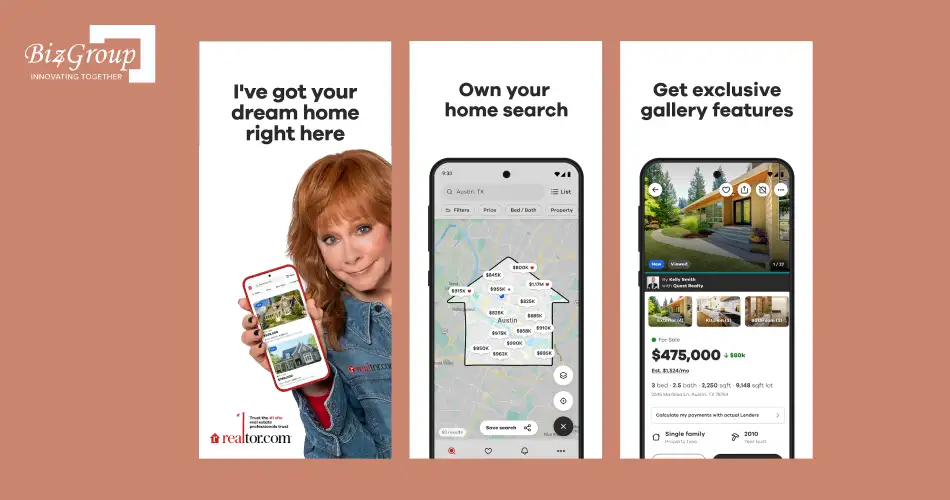
At its core, a Realtor.com-style app is designed to manage and present real-time property listings sourced directly from MLS systems, combined with tools that help users make decisions and help agents generate and manage leads.
This typically includes:
- Live property listings with accurate status and pricing
- Advanced search and filtering based on location, budget, and preferences
- Buyer and seller user journeys tailored to different goals
- Agent-facing dashboards to manage inquiries and performance
Because of this scope, the development cost of a real estate app like Realtor.com is very different from a simple listing or directory app.
A Marketplace Platform, Not a Single-User App
One major factor that drives the cost to develop a real estate app like Realtor.com is that it operates as a multi-sided marketplace.
You are not building for one type of user. You are building for:
- Property buyers searching and saving listings
- Sellers showcasing homes and tracking interest
- Agents managing leads, visibility, and responses
Each audience needs its own workflows, permissions, and data access. This marketplace complexity adds layers to architecture, testing, and ongoing maintenance, which directly affects the development budget of a real estate app like Realtor.com.
MLS Integration and Data Accuracy Raise the Bar
Another defining trait of a Realtor.com app is deep MLS integration. Listings update frequently. Changes in price, availability, or status need to reflect quickly and accurately.
From a cost perspective, this involves:
- Secure MLS access and licensing compliance
- Data synchronization logic and validation
- Monitoring and fallback systems when feeds fail
This alone can account for a significant portion of the cost to build an MLS integrated real estate app like Realtor.com, and it is often underestimated during early planning.
Search, Filters, and Intelligence Are Core Features
Users expect fast, relevant results even when searching across large property datasets. That means advanced filters, location-based search, saved alerts, and personalized recommendations.
To meet these expectations, many platforms evolve into an AI real estate mobile app that uses data-driven logic to improve discovery and engagement. These capabilities increase performance requirements and infrastructure costs, contributing to the overall real estate mobile app development cost like Realtor.com.
Agent Tools and Lead Intelligence Add Business Value and Cost
A Realtor.com-style platform is also a revenue engine for agents. Lead generation, tracking, and prioritization are built into the experience.
Many of these capabilities align with what you see in the best AI tools for real estate agents today. Building similar intelligence into your platform adds long-term value, but it also increases the property marketplace app development cost like Realtor.com.
Enterprise-Level Trust, Security, and Scalability
Finally, Realtor.com sets expectations around reliability. Users trust the data. Agents trust the platform. That trust comes from strong security, compliance with US regulations, and infrastructure that scales during traffic spikes.
These enterprise requirements influence architecture decisions from day one and play a major role in the Realtor.com like real estate app development cost.
When you combine marketplace complexity, MLS data, intelligent search, agent tooling, and enterprise-grade reliability, it becomes clear why the cost to build a real estate app like Realtor.com is higher than many expect.
In the next section, we will look at actual cost ranges across MVP, mid-tier, and enterprise builds so you can see where your idea realistically fits.
Cost Overview: How Much Does It Cost to Build a Real Estate App Like Realtor.com at Different Stages
If you are trying to pin down the cost to build a real estate app like Realtor.com, here is the honest reality.
There is no one-size-fits-all number.
What matters most is how much functionality you need upfront and how scalable the platform must be from day one. This is why the development cost of a real estate app like Realtor.com can vary widely across businesses.
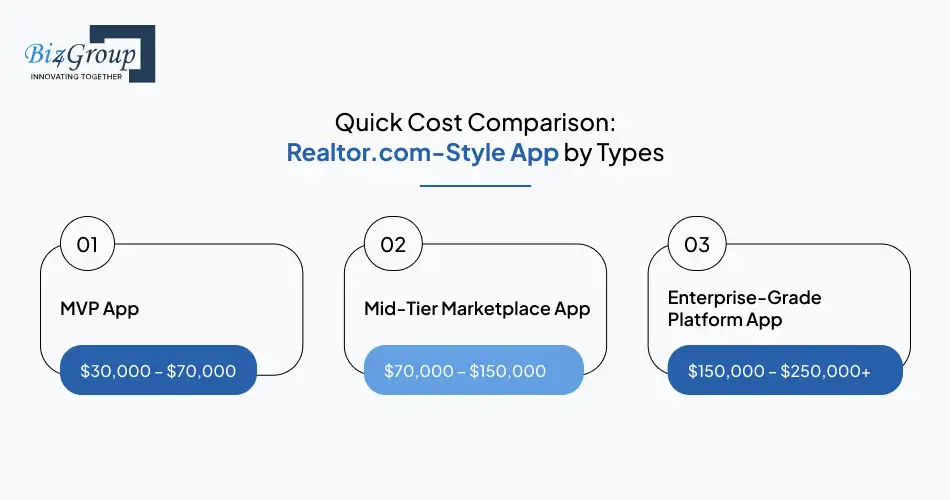
To make this easier to understand, here is a quick comparison before we break it down further.
Quick Cost Comparison: Realtor.com-Style App by Types
|
App Stage |
Estimated Cost Range |
Best Suited For |
What You Get at a High Level |
|---|---|---|---|
|
MVP App |
$30,000 – $70,000 |
Startups, early validation |
Core listings, basic search, limited MLS, simple UI |
|
Mid-Tier Marketplace App |
$70,000 – $150,000 |
Growing businesses |
Advanced search, MLS integration, agent tools |
|
Enterprise-Grade Platform App |
$150,000 – $250,000+ |
National platforms |
Real-time MLS, analytics, scalability, enterprise security |
This snapshot gives you a fair idea of the Realtor.com like real estate app development cost at each stage. Let’s look at what each tier actually involves.
MVP Cost: Validating the Idea Without Overbuilding ($30,000 to $70,000)
An MVP focuses on learning quickly without committing to unnecessary complexity.
At this stage, you are usually building:
- Core property listings
- Basic search and filters
- Simple user accounts
- Limited MLS data integration
- Clean, functional UI
This approach works well if your goal is market validation or early investor traction. It is often the first step for founders evaluating how much does it cost to develop a real estate app like Realtor.com without taking on enterprise-level risk.
If you plan to include intelligent features early, it helps to reference benchmarks around AI real estate app development cost, since even light automation or smart search can influence budget.
An MVP keeps initial investment controlled, but it should still be designed to grow into a larger platform.
Mid-Tier Cost: Building a Competitive Marketplace ($70,000 to $150,000)
This stage is where your platform starts functioning as a true property marketplace.
A mid-tier build commonly includes:
- Stronger MLS integration with frequent updates
- Advanced filters and location-based search
- Saved searches, alerts, and favorites
- Agent profiles and lead capture tools
- Improved performance and security
Here, the cost to develop a real estate app like Realtor.com increases because the system supports multiple user roles, heavier data loads, and monetization workflows. This tier often represents the most balanced property marketplace app development cost like Realtor.com for growing businesses.
Teams at this level also explore smart lead handling or recommendation features, which is why the cost to build an AI realtor app become part of the budgeting conversation.
Enterprise-Level Cost: Competing at Scale ($150,000 to $250,000+)
Enterprise platforms are built for long-term scale and reliability.
This level typically includes:
- Full MLS coverage with real-time syncing
- High-performance search across large datasets
- Agent dashboards with analytics and insights
- Advanced security and regulatory compliance
- Scalable cloud infrastructure and monitoring
At this stage, the development budget of a real estate app like Realtor.com reflects architectural decisions as much as features. You are investing in performance, trust, and future-proof scalability.
This is also where the cost to develop a scalable property listing and search app like Realtor.com becomes a realistic discussion rather than an estimate.
Choosing the Right Investment Level
Instead of asking how little you can spend, focus on how far your platform needs to go in the next 12 to 24 months.
An MVP helps you validate quickly.
A mid-tier platform helps you compete and generate revenue.
An enterprise build positions you for national scale.
Next, we will break down what really drives the cost to build a real estate app like Realtor.com, so you can see exactly where your budget goes and where smart planning makes the biggest impact.
What Really Drives the Cost to Develop a Real Estate App Like Realtor.com?
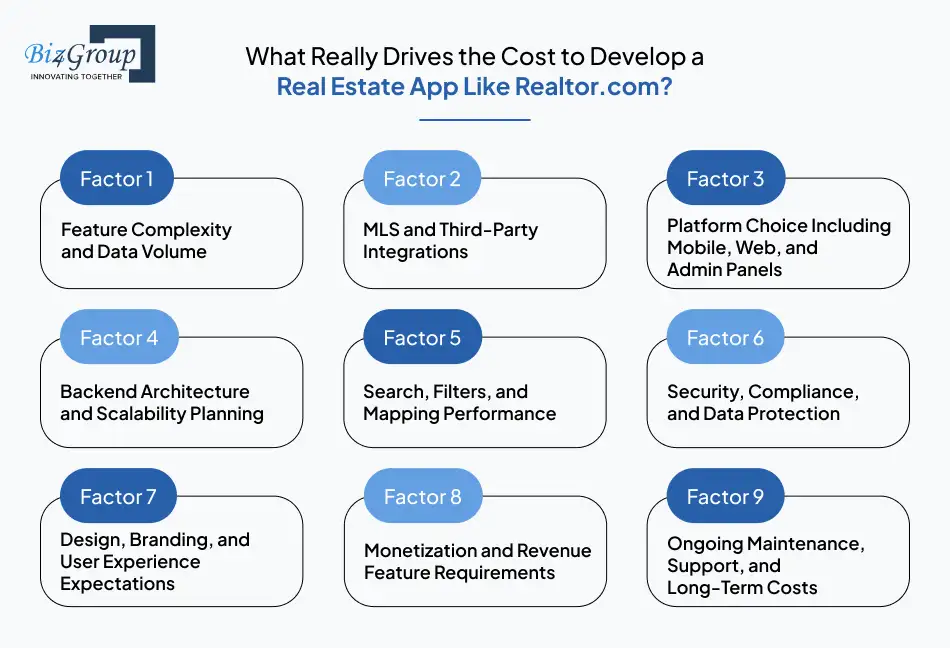
When you start estimating the cost to build a real estate app like Realtor.com, surface-level feature lists only tell part of the story. The real cost is shaped by decisions that affect architecture, data handling, performance, and long-term scalability.
Every major capability you add brings supporting requirements behind it. More listings mean heavier data loads. Better search means stronger infrastructure. Agent tools introduce new workflows and permissions. Over time, these elements stack up and directly influence the development cost of a real estate app like Realtor.com.
Understanding these cost drivers early helps you avoid unrealistic budgets, rushed compromises, and expensive rebuilds later. Let’s start by looking at the biggest contributor to overall effort and spend:
Factor 1: Feature Complexity and Data Volume
Before we talk theory, let’s look at what actually drives effort and budget. The table below outlines common features in a Realtor.com-style app and how each one influences the cost to build a real estate app like Realtor.com.
|
Feature Category |
Typical Features Included |
Estimated Cost Impact |
|---|---|---|
|
Property Listings |
Listing display, media galleries, property details |
$5,000 – $12,000 |
|
Advanced Search & Filters |
Location search, price range, filters, sorting |
$6,000 – $15,000 |
|
Map Integration |
Interactive maps, clustering, geo-search |
$4,000 – $10,000 |
|
User Accounts |
Buyer and agent profiles, saved searches |
$3,000 – $8,000 |
|
MLS Integration |
Live data sync, validation, compliance |
$10,000 – $30,000 |
|
Agent Tools |
Lead capture, dashboards, inquiry tracking |
$6,000 – $18,000 |
|
Alerts & Notifications |
Email and push notifications |
$2,000 – $5,000 |
|
Analytics & Insights |
User behavior, listing performance |
$4,000 – $12,000 |
|
Performance Optimization |
Caching, fast loading, scalability |
$5,000 – $15,000 |
These ranges are directional, but they reflect real effort involved in building a Realtor.com like real estate app development cost model.
Why Feature Complexity and Data Volume Drive Cost So Quickly
When you build a basic real estate app, features often feel isolated. In a Realtor.com-style platform, features are deeply connected.
- Search interacts with MLS data.
- Filters affect performance.
- Saved searches trigger alerts.
- Agent tools rely on user behavior.
Each connection adds logic, testing, and edge cases.
Data volume makes this more demanding. As listings grow into the thousands or millions, your platform must:
- Deliver results instantly
- Keep pricing and availability accurate
- Handle traffic spikes without slowing down
This is where many teams underestimate the development cost of a real estate app like Realtor.com. It is not just about adding features. It is about making sure they continue to work smoothly as your platform scales.
Trying to postpone scalability usually backfires. Retrofitting performance fixes later often costs more than building them correctly upfront. That is why the cost to develop a scalable property listing and search app like Realtor.com increases early in well-planned projects.
The smart approach is prioritization. Not every feature needs to launch on day one. Deciding what is essential now and what can wait gives you control over the development budget of a real estate app like Realtor.com without compromising future growth.
Next, we will move to another major cost driver that deserves equal attention: MLS and third-party integrations.
Factor 2: MLS and Third-Party Integrations
One of the fastest ways to build a real estate app like Realtor.com climbs is through integrations. MLS data is not a plug-and-play feed, and third-party services add layers of coordination, compliance, and ongoing upkeep. Getting this right is essential for accuracy and trust, which is why it carries real cost.
|
Integration Area |
What It Typically Involves |
Estimated Cost Impact |
|---|---|---|
|
MLS Access & Licensing |
Application, approvals, compliance reviews |
$3,000 – $8,000 |
|
MLS Data Sync |
Real-time or scheduled updates, normalization |
$7,000 – $18,000 |
|
Data Validation & Error Handling |
De-duplication, conflict resolution, fallbacks |
$3,000 – $8,000 |
|
Mapping Services |
Google Maps or Mapbox, geocoding |
$2,000 – $6,000 |
|
CRM and Lead Systems |
Lead routing, tracking, agent assignment |
$4,000 – $10,000 |
|
Notification Services |
Email and push providers |
$1,500 – $4,000 |
|
Analytics and Tracking |
User behavior and conversion tracking |
$2,000 – $6,000 |
These ranges reflect common realities teams face when estimating the cost to build an MLS integrated real estate app like Realtor.com.
Why MLS and Integrations Carry Ongoing Cost
MLS feeds come with rules. You must comply with data usage policies, update frequencies, and display requirements. That means engineering time upfront and monitoring over time. Changes to MLS schemas or access rules require updates, testing, and redeployment.
Data accuracy is another driver. Listings change status, price, and availability frequently. Your system must reconcile conflicts, handle partial updates, and keep search results consistent. This is a major contributor to the development cost of a real estate app like Realtor.com because it affects both backend logic and performance.
Third-party services amplify this complexity. Mapping, analytics, notifications, and CRMs each have their own APIs, limits, and pricing models. Integrations often rely on AI integration services to connect data sources, automate workflows, and keep systems in sync. While these capabilities add value, they also introduce maintenance responsibilities when providers update or deprecate features.
The key to controlling the development budget of a real estate app like Realtor.com here is selectivity. Integrate what you need for launch, design the architecture to add more later, and avoid hard dependencies that lock you into costly changes.
Next, we will look at how platform choices including mobile, web, and admin panels shapes timelines and budgets, often more than teams expect.
Factor 3: Platform Choice Including Mobile, Web, and Admin Panels
Platform decisions shape the cost to build a real estate app like Realtor.com more than most teams expect. It is not just about choosing iOS or Android. A Realtor.com-style product is an ecosystem that spans mobile apps, web experiences, and internal admin tools.
Each surface adds functionality, testing effort, and long-term maintenance.
|
Platform Component |
What It Includes |
Estimated Cost Impact |
|---|---|---|
|
Native iOS development, UI standards, testing |
$10,000 – $25,000 |
|
|
Native Android development, device support |
$10,000 – $25,000 |
|
|
Shared codebase using Flutter or React Native |
$15,000 – $35,000 |
|
|
Web App |
Responsive web experience for browsers |
$8,000 – $20,000 |
|
Admin Panel |
Listing moderation, user management, analytics |
$6,000 – $15,000 |
|
Agent Dashboard |
Lead management, performance insights |
$5,000 – $12,000 |
These figures are typical contributors to the real estate mobile app development cost like Realtor.com and should be considered early in planning.
Why Platform Scope Has a Big Cost Impact
Mobile apps get most of the attention, but they are only part of the picture. Realtor.com users expect a seamless experience across devices. Agents and admins expect powerful tools behind the scenes.
Building separate native apps for iOS and Android increases cost because each platform requires:
- Dedicated UI adaptations
- Platform-specific testing
- Ongoing updates with OS changes
Cross-platform development can reduce upfront cost and speed up delivery, but it may require additional optimization to meet performance expectations at scale. These trade-offs influence the cost of developing a Realtor.com style property app.
Web platforms and admin panels are often underestimated. Yet they are essential for content control, data management, and business operations. Without them, teams struggle to scale efficiently. This is where working with a custom software development company becomes valuable, as these systems need to be tailored to your workflows rather than copied from templates.
Another overlooked factor is design consistency. Maintaining a unified experience across mobile and web surfaces requires thoughtful planning and coordination with UI/UX design teams. Skipping this step often leads to fragmented experiences and higher redesign costs later.
Platform choices should be guided by your audience, growth plans, and internal capabilities. Making these decisions early gives you better control over the development budget of a real estate app like Realtor.com.
Factor 4: Backend Architecture and Scalability Planning
Backend architecture is where long-term success is either secured or quietly undermined. When teams underestimate this layer, the cost to build a real estate app like Realtor.com may look reasonable at launch, then spike sharply as usage grows. A Realtor.com-style platform must handle heavy data loads, frequent updates, and unpredictable traffic without slowing down.
|
Backend Component |
What It Covers |
Estimated Cost Impact |
|---|---|---|
|
Core Backend Development |
Business logic, APIs, data processing |
$12,000 – $30,000 |
|
Database Architecture |
Property data modeling, indexing, optimization |
$6,000 – $15,000 |
|
Cloud Infrastructure Setup |
Hosting, load balancing, environments |
$5,000 – $12,000 |
|
Scalability Planning |
Auto-scaling, caching, performance tuning |
$6,000 – $18,000 |
|
Security Layers |
Authentication, authorization, data protection |
$4,000 – $10,000 |
|
Monitoring and Logging |
Error tracking, performance monitoring |
$3,000 – $8,000 |
These elements together form a major portion of the development cost of a real estate app like Realtor.com, especially for platforms planning regional or national reach.
Why Backend Decisions Shape Long-Term Cost
The backend is responsible for everything users never see but constantly rely on. Every search request, listing update, saved alert, and agent inquiry passes through it. As listings and users increase, inefficient architecture becomes expensive very quickly.
A Realtor.com-style platform needs:
- Fast response times even during traffic spikes
- Consistent performance across regions
- The ability to add new features without breaking existing ones
This is why the cost to develop a scalable property listing and search app like Realtor.com is higher than building a short-term solution. Scalability requires planning, not patches.
Many growing platforms adopt cloud-native designs, distributed services, and intelligent data handling. This is where enterprise AI solutions often play a role, helping automate workflows, optimize performance, and manage large data volumes efficiently. While these approaches increase upfront cost, they reduce operational risk and rework later.
Another common mistake is tying the backend too closely to current features. When architecture is rigid, even small updates become costly. Flexible backend design gives you room to grow without constantly expanding the development budget of a real estate app like Realtor.com.
If your goal is to compete seriously, backend architecture is not an area to minimize. It is one of the most important investments you will make.
Factor 5: Search, Filters, and Mapping Performance
Search is the heartbeat of any property platform. If results feel slow, inaccurate, or irrelevant, users leave. This is why search, filters, and maps play a major role in the cost of building a real estate app like Realtor.com. What looks simple on the screen is usually one of the most complex systems behind it.
|
Search Component |
What It Includes |
Estimated Cost Impact |
|---|---|---|
|
Core Property Search |
Keyword search, basic sorting |
$4,000 – $10,000 |
|
Advanced Filters |
Price, location, property type, amenities |
$5,000 – $14,000 |
|
Location-Based Search |
Radius search, neighborhood logic |
$4,000 – $10,000 |
|
Map Integration |
Interactive maps, pins, clustering |
$4,000 – $10,000 |
|
Search Indexing |
Fast indexing for large listing datasets |
$6,000 – $15,000 |
|
Personalization Logic |
Relevant results based on behavior |
$5,000 – $12,000 |
Together, these elements make up a significant part of the real estate mobile app development cost like Realtor.com.
Why Search Performance Drives Cost and Retention
Real estate users expect instant results, even when filtering through thousands of listings. Delays of even a second can impact engagement and trust. To meet these expectations, platforms must go beyond basic database queries.
A Realtor.com-style platform requires:
- Optimized search indexes for speed
- Efficient handling of location data
- Consistent results across devices and sessions
As data volume grows, search systems must scale without degrading performance. This directly affects the development cost of a real estate app like Realtor.com, especially when combined with live MLS updates.
Personalization adds another layer. Modern platforms increasingly rely on intelligent systems to surface relevant properties based on browsing patterns, saved searches, and user intent. Many teams use an AI agent to support this logic, helping automate ranking decisions and improve discovery. While this improves user experience, it also increases complexity and testing effort.
Mapping performance is equally critical. Clustering, zoom-level behavior, and real-time updates must work smoothly across regions. Poor map performance often leads to higher infrastructure costs later when teams are forced to rework core systems.
If search and maps are treated as afterthoughts, costs tend to rise unexpectedly. Planning them early gives you more control over the development budget of a real estate app like Realtor.com and protects user experience as your platform scales.
Factor 6: Security, Compliance, and Data Protection
Security is not a background concern in real estate platforms. It is a core requirement. When users share personal details, saved searches, inquiries, and communication history, they expect that data to be protected at all times. This expectation directly affects the cost to build a real estate app like Realtor.com.
Unlike smaller apps, Realtor.com-style platforms must meet higher standards because of their scale, visibility, and regulatory exposure.
|
Security Area |
What It Covers |
Estimated Cost Impact |
|---|---|---|
|
User Authentication |
Secure login, password management, sessions |
$3,000 – $8,000 |
|
Role-Based Access Control |
Buyer, agent, admin permissions |
$3,000 – $7,000 |
|
Data Encryption |
Encryption at rest and in transit |
$2,000 – $6,000 |
|
Compliance Readiness |
Privacy policies, data handling standards |
$3,000 – $8,000 |
|
Fraud and Abuse Prevention |
Spam control, misuse detection |
$4,000 – $10,000 |
|
Backup and Recovery |
Data backups, failover planning |
$3,000 – $7,000 |
These safeguards form a meaningful part of the development cost of a real estate app like Realtor.com, especially as the platform grows.
Why Security and Compliance Increase Development Cost
Real estate platforms deal with more than listings. They handle user identities, communication between buyers and agents, and business-critical data. Any breach can damage trust and brand credibility overnight.
From a development perspective, this means:
- Building strong access controls so users only see what they should
- Protecting data from unauthorized access or leaks
- Preparing for audits, policy updates, and regulatory changes
Compliance requirements also evolve. Privacy expectations in the US continue to tighten, and platforms must adapt without disrupting users. This ongoing responsibility contributes to the development budget of a real estate app like Realtor.com, not just at launch but throughout its lifecycle.
Fraud prevention is another often overlooked area. Fake listings, spam inquiries, and automated abuse can degrade platform quality quickly. Addressing this requires monitoring systems, validation checks, and response workflows that add complexity and cost.
Many mature platforms rely on intelligent automation to monitor unusual activity and reduce manual intervention. While this improves efficiency, it also raises the bar for architecture and testing. These decisions influence the cost of developing a scalable property listing and search app like Realtor.com far more than basic security setups.
Security is not where you want to experiment or cut corners. Investing early protects your users, your data, and your long-term roadmap.
Factor 7: Design, Branding, and User Experience Expectations
In real estate, perception matters. Users decide within seconds whether a platform feels trustworthy and easy to use. That is why design and user experience play a direct role in the cost to build a real estate app like Realtor.com. This is not about visual polish alone. It is about clarity, confidence, and conversion.
|
Design Area |
What It Includes |
Estimated Cost Impact |
|---|---|---|
|
UX Research |
User flows, behavior analysis, wireframes |
$3,000 – $8,000 |
|
UI Design |
Visual design, component libraries |
$4,000 – $10,000 |
|
Mobile UX Optimization |
Navigation, gestures, responsiveness |
$3,000 – $7,000 |
|
Web UX Consistency |
Cross-device design alignment |
$3,000 – $7,000 |
|
Branding and Customization |
Colors, typography, white-label needs |
$2,000 – $6,000 |
|
UX Testing and Iteration |
Usability testing, refinements |
$3,000 – $8,000 |
These elements together influence a meaningful portion of the real estate mobile app development cost like Realtor.com.
Why UX and Design Drive Real Business Outcomes
A Realtor.com-style platform serves a broad audience. First-time buyers, experienced investors, and agents all interact with the same system in different ways. If navigation feels confusing or cluttered, users disengage quickly.
Good UX design helps:
- Reduce friction during search and inquiry
- Make complex filters easy to understand
- Guide users toward meaningful actions like saving or contacting agents
This is where collaboration with experienced UI/UX design teams becomes important. Design decisions influence not just appearance but how efficiently users move through the platform.
Branding also plays a role in trust. A consistent, professional look signals reliability, especially in high-value transactions. For platforms planning partnerships or franchising, customization and white-label flexibility often become necessary. These requirements increase the development cost of a real estate app like Realtor.com, but they also support long-term growth.
Another factor is iteration. User behavior reveals what works and what does not. Platforms that invest in testing and continuous improvement tend to convert better over time. While this adds to the development budget of a real estate app like Realtor.com, it often delivers measurable returns through higher engagement and lead quality.
Design is not decoration. It is a strategic investment that shapes how users perceive and use your platform.
Factor 8: Monetization and Revenue Feature Requirements
How you plan to make money has a direct impact on the cost to build a real estate app like Realtor.com. Monetization is not something you bolt on after launch. It shapes workflows, permissions, data tracking, and even user experience from day one.
A simple lead form costs far less than a full marketplace with subscriptions, featured listings, and analytics. The more revenue paths you support, the more development effort is required.
|
Monetization Feature |
What It Enables |
Estimated Cost Impact |
|---|---|---|
|
Lead Capture Forms |
Buyer inquiries, contact requests |
$2,000 – $5,000 |
|
Agent Subscriptions |
Paid plans, access tiers |
$4,000 – $10,000 |
|
Featured Listings |
Sponsored placement, priority visibility |
$5,000 – $12,000 |
|
Payment Processing |
Billing, invoices, renewals |
$4,000 – $10,000 |
|
Usage Tracking |
Lead counts, clicks, performance data |
$3,000 – $8,000 |
|
Reporting Dashboards |
Revenue and agent performance insights |
$4,000 – $10,000 |
These capabilities contribute meaningfully to the property marketplace app development cost like Realtor.com, especially as your platform grows.
Why Monetization Choices Affect Development Early
Revenue features touch nearly every part of the system. When an agent pays for visibility, the platform must control placement logic, track performance, and ensure fair delivery. That requires coordination between search, listings, analytics, and billing systems.
Subscription models add another layer. You need:
- Role-based access tied to plans
- Accurate usage tracking
- Reliable billing and renewal flows
These elements raise the development cost of a real estate app like Realtor.com because they introduce financial accuracy and accountability requirements.
Another common mistake is underestimating reporting. Agents expect transparency. They want to see how many leads they received and what value they are getting. Building these insights requires clean data pipelines and thoughtful dashboard design, which adds to the development budget of a real estate app like Realtor.com.
The key is alignment. Your monetization strategy should match your product maturity and audience size. Overbuilding revenue features too early can slow adoption. Underbuilding them can limit growth.
When monetization is planned alongside core functionality, it supports sustainable revenue without unnecessary rework.
Factor 9: Ongoing Maintenance, Support, and Long-Term Costs
One of the most common budgeting mistakes is treating launch as the finish line. In reality, launch is where ongoing costs begin. Maintenance, support, and continuous improvement are essential to keeping a Realtor.com-style platform reliable, competitive, and secure. These efforts directly influence the cost to build a real estate app like Realtor.com over time.
|
Ongoing Area |
What It Includes |
Estimated Cost Impact |
|---|---|---|
|
App Maintenance |
Bug fixes, minor updates |
$2,000 – $5,000 per month |
|
Infrastructure Costs |
Hosting, scaling, bandwidth |
$1,500 – $6,000 per month |
|
MLS Feed Updates |
Schema changes, compliance updates |
$1,000 – $4,000 per month |
|
Security Monitoring |
Vulnerability scans, patches |
$1,000 – $3,000 per month |
|
OS and Platform Updates |
iOS, Android, browser changes |
$1,000 – $3,000 per update cycle |
|
Feature Enhancements |
Iterative improvements |
Variable based on scope |
These ongoing expenses are a core part of the development budget of a real estate app like Realtor.com, not optional extras.
Why Long-Term Costs Add Up Quickly
Real estate platforms operate in a dynamic environment. MLS rules change. Operating systems update. User expectations evolve. Ignoring these shifts can lead to performance issues, broken features, or security risks.
Maintenance ensures:
- Stable performance as traffic grows
- Compatibility with new devices and OS versions
- Continued compliance with MLS and privacy standards
Support is equally important. As users increase, so do questions, edge cases, and unexpected behavior. Quick response times protect trust and prevent churn, which is especially important for revenue-generating agents.
Many teams reduce manual effort through AI automation services, using intelligent workflows for monitoring, alerts, and routine tasks. While automation improves efficiency, it still requires oversight and tuning, which contributes to long-term costs.
Another often overlooked area is feature evolution. New filters, improved analytics, or smarter lead handling can keep your platform competitive. These upgrades may be incremental, but over time they represent a meaningful share of the cost to develop a scalable property listing and search app like Realtor.com.
Planning for ongoing costs early helps avoid budget surprises and rushed decisions later. A well-maintained platform protects your original investment and supports steady growth.
Wondering Which Features Are Worth the Investment?
Not every feature deserves your budget on day one. Understanding what truly drives the development cost of a real estate app like Realtor.com helps you avoid overbuilding and focus on what actually delivers value.
Get a Cost ConsultationReal Estate App Development Cost Breakdown Like Realtor.com Based on Development Stages: Where the Budget Goes

Once you understand what affects pricing, the next logical question is where your money is actually spent. The real estate app development cost breakdown like Realtor.com follows a predictable set of development steps.
Whether you are planning an MVP or a large-scale marketplace, the steps remain the same. Only the depth of execution changes, which is why the cost to build a real estate app like Realtor.com varies so widely.
Below is a clear, step-by-step breakdown.
Step 1: Discovery and Planning
This is where your product vision is translated into a clear execution plan. Teams define goals, technical feasibility, and constraints before any design or development begins. Strong discovery reduces rework and keeps the development budget of a real estate app like Realtor.com under control.
Includes
- Business and technical requirements
- Data source evaluation
- Architecture planning
Typical cost
- $5,000 to $15,000
Step 2: Feature Selection and Scope Definition
Feature selection determines what makes it into your first release and what waits. This step directly impacts timeline, complexity, and the development cost of a real estate app like Realtor.com.
Smart prioritization helps avoid overbuilding early.
Includes
- Core feature prioritization
- User role definition
- Release scope finalization
Typical cost
- $3,000 to $8,000
Step 3: Design (UI and UX)
Design shapes trust and usability. Realtor.com-style platforms must present complex property data in a way that feels simple and intuitive across devices. This phase strongly influences engagement and conversion.
Many teams work with experienced UI/UX design specialists to align design with user behavior.
Includes
- Wireframes and user flows
- Visual design for mobile and web
- Usability validation
Typical cost
- $8,000 to $20,000
Step 4: Core Development (MVP Build)
This is where the actual product takes shape. Frontend and backend systems are built to support listings, search, and user interactions. This phase represents the largest share of the real estate mobile app development cost like Realtor.com.
Working with an experienced AI app development company helps ensure scalability is not compromised early.
Includes
- Frontend development
- Backend APIs and logic
- Core listing and search features
Typical cost
- $25,000 to $90,000
Step 5: MLS and Third-Party Integrations
Integrations connect your platform to MLS feeds, maps, and external systems. This step is essential for accuracy and trust, and it significantly impacts the cost to build an MLS integrated real estate app like Realtor.com.
This work often requires a software development company to handle compliance and data complexity.
Includes
- MLS access and compliance
- Data synchronization and validation
- Maps and notification services
Typical cost
- $10,000 to $40,000
Step 6: Deployment and Testing
Before launch, the platform is tested across devices, data scenarios, and user roles. This step ensures stability and protects the overall Realtor.com like real estate app development cost from post-launch issues.
Includes
- Functional and performance testing
- Security checks
- Cloud deployment setup
Typical cost
- $5,000 to $15,000
Step 7: Launch and Ongoing Maintenance
Launching is not the end. Maintenance keeps the platform secure, compliant, and competitive as usage grows. These ongoing efforts are part of the development budget of a real estate app like Realtor.com over time.
Teams building long-term platforms often partner with an AI product development company to support continuous improvement.
Includes
- Bug fixes and updates
- Infrastructure and hosting
- Feature enhancements
Typical ongoing cost
- $2,000 to $10,000 per month
This step-based view clearly shows the cost of developing a real estate app like Realtor.com and how that investment is distributed. It also explains why MVP, mid-tier, and enterprise platforms differ in price even though the development steps remain the same.
Next, we will move into Hidden Costs, the expenses that rarely appear in initial estimates but often impact the total cost to make a real estate marketplace app like Realtor.com the most.
Hidden Costs of Building a Realtor.com-Like Real Estate App Most Teams Miss
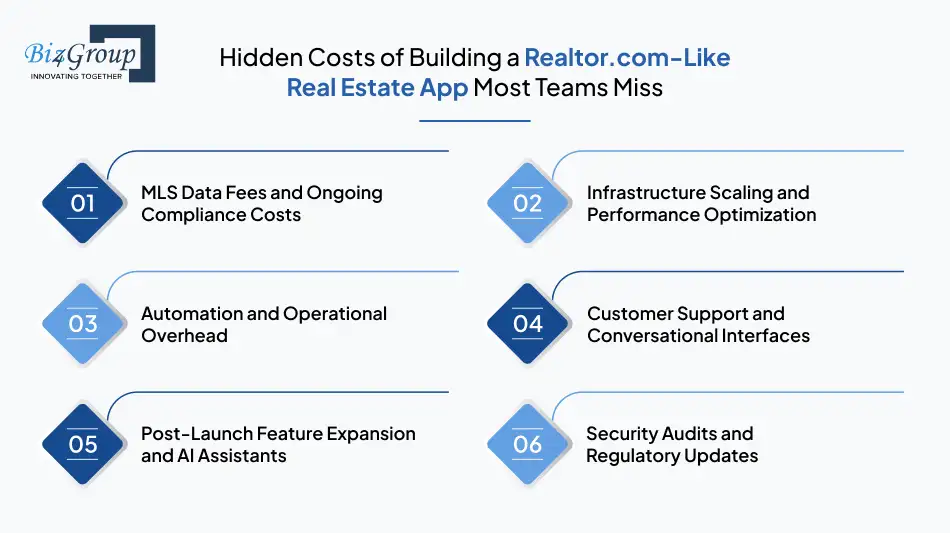
Hidden costs rarely show up in early proposals, yet they often decide whether a project stays on budget. When estimating the cost to build a real estate app like Realtor.com, these expenses surface after launch or during scale, catching teams off guard. Below are the most common areas where budgets quietly expand.
1. MLS Data Fees and Ongoing Compliance Costs
MLS access is not a one-time setup. Most providers charge recurring fees and require ongoing compliance updates as data rules change. Over time, these obligations add a steady operational layer to the cost to build an MLS integrated real estate app like Realtor.com.
Typical cost impact ranges from $1,000 to $4,000 per month depending on coverage and update frequency.
2. Infrastructure Scaling and Performance Optimization
As listings grow and traffic increases, infrastructure must scale to maintain fast search and reliable access. What works for an MVP often breaks under real demand, forcing upgrades that increase the development cost of a real estate app like Realtor.com.
Scaling and optimization typically add $2,000 to $8,000 per month as usage grows.
3. Automation and Operational Overhead
Manual workflows do not scale well in real estate platforms. Tasks like listing moderation, alert handling, and system monitoring often require automation to control long-term cost. Many teams introduce AI automation services at this stage to reduce manual effort, but implementation still carries cost.
Automation setup and tuning usually adds $5,000 to $15,000 initially, with smaller ongoing expenses.
4. Customer Support and Conversational Interfaces
As users increase, support volume rises quickly. Basic email support often becomes insufficient, leading teams to implement chat-based assistance. Working with an AI chatbot development company helps manage inquiries, but these systems require integration, training, and maintenance.
Support automation and chatbot deployment commonly cost $4,000 to $12,000 upfront, plus monthly upkeep.
5. Post-Launch Feature Expansion and AI Assistants
User feedback often pushes platforms toward smarter experiences such as virtual assistants, recommendations, or guided searches. These additions are rarely included in initial budgets but directly affect the property marketplace app development cost like Realtor.com. Many teams later evaluate benchmarks like AI real estate assistant development cost to plan these upgrades.
Feature expansion and assistant development can add $10,000 to $30,000 depending on scope.
6. Security Audits and Regulatory Updates
Security and compliance do not stop at launch. Periodic audits, vulnerability fixes, and policy updates are necessary to maintain trust and legal alignment. These efforts quietly increase the development budget of a real estate app like Realtor.com over time.
Security reviews and updates typically cost $3,000 to $10,000 per year, sometimes more for larger platforms.
These expenses explain why two platforms with similar launch budgets can diverge dramatically over time. Planning for hidden costs early gives you a more realistic view of what is the cost of developing a real estate app like Realtor.com and helps avoid reactive spending later.
Hidden Costs Catching You Off Guard?
MLS fees, infrastructure scaling, and post-launch updates quietly increase the development budget of a real estate app like Realtor.com. Planning for them early keeps your roadmap realistic and your spend under control.
Plan Your Budget SmartlyHow to Optimize the Cost to Build a Real Estate App Like Realtor.com Without Compromising Quality?
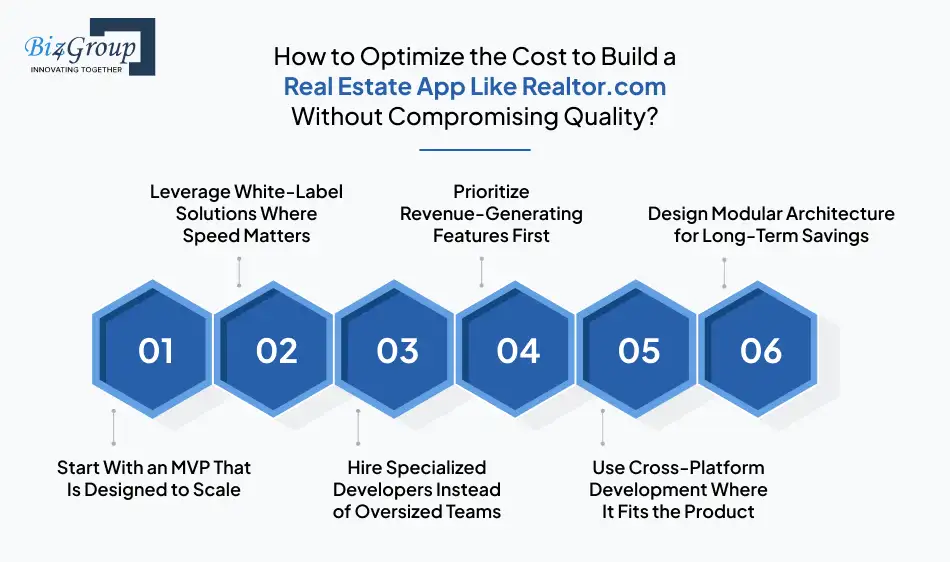
Optimizing the cost to build a real estate app like Realtor.com is less about cutting corners and more about making the right decisions at the right time. With smart planning, teams can reduce spending significantly while still building a scalable, competitive platform.
Here are the most effective ways to control costs, along with realistic savings you can expect.
1. Start With an MVP That Is Designed to Scale
Many teams overspend by building enterprise-level features too early. A focused MVP helps you validate demand while keeping architecture flexible for future growth. This approach avoids expensive reworks later.
Teams that follow a structured MVP development approach typically reduce upfront costs by 25 to 40 percent, often saving $20,000 to $60,000 in the first phase.
2. Leverage White-Label Solutions Where Speed Matters
Building everything from scratch is not always necessary. For certain use cases, starting with a white-label AI real estate mobile app can dramatically shorten timelines and lower engineering effort.
This strategy can reduce development costs by 30 to 50 percent, especially for MVPs and regional platforms.
3. Hire Specialized Developers Instead of Oversized Teams
Using large, generalist teams often leads to inefficiencies. Smaller teams with focused experience in real estate platforms and AI-driven systems deliver faster and cleaner results.
Companies that hire AI developers strategically often optimize 15 to 25 percent of total development cost by reducing rework and speeding up delivery.
4. Prioritize Revenue-Generating Features First
Not every feature adds immediate business value. Launching features that directly support lead generation, agent engagement, or subscriptions prevents wasted effort on low-impact functionality.
This prioritization typically saves 10 to 20 percent of the development budget of a real estate app like Realtor.com in early releases.
5. Use Cross-Platform Development Where It Fits the Product
When performance requirements allow, cross-platform frameworks reduce duplicated effort across iOS and Android. This approach lowers both build and long-term maintenance costs.
Teams commonly save 20 to 30 percent on real estate mobile app development cost like Realtor.com by avoiding separate native builds.
6. Design Modular Architecture for Long-Term Savings
Reusable components and modular services reduce the cost of adding new features later. Instead of rebuilding, teams extend existing systems.
Over time, modular architecture can cut 15 to 25 percent from long-term development and maintenance expenses.
Most cost overruns happen because optimization is treated as a fix, not a strategy. Decisions made during planning and MVP stages have the biggest impact on the cost to develop a scalable property listing and search app like Realtor.com.
With the right approach, you can reduce risk, protect budget, and still build a platform ready for growth.
How Biz4Group Helps Optimize Cost to Build a Realtor.com-Like Real Estate App ?
Choosing the right partner can make a dramatic difference in both quality and cost for real estate platforms. Biz4Group blends domain expertise with efficient engineering to help teams launch faster, reduce rework, and avoid hidden expenses that often inflate the cost to build a real estate app like Realtor.com.
Below are real projects that showcase how we deliver solutions while optimizing cost and maximizing business value.
1. Homer AI: AI-Powered Property Management Platform
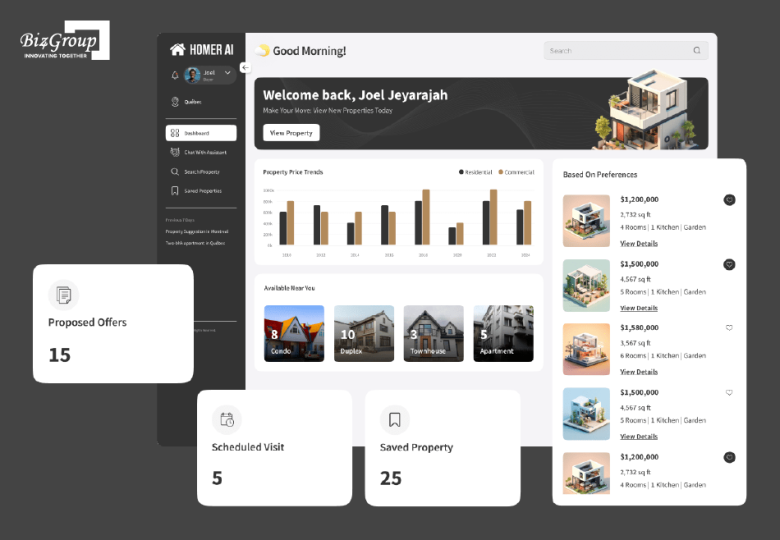
In Homer AI, Biz4Group built an AI-enabled solution that serves as a one-stop platform for buyers and sellers in the property market. The system offers features such as Map View, Property Details, Schedule Visit, Chatbot Interaction, and Buyer/Seller Dashboards. This comprehensive approach integrates intelligent assistance with a user-centric interface, reducing manual touchpoints, and improving engagement.
How we optimized cost
By leveraging conversational AI logic early, reuse of core components, and clear scope definition, Biz4Group kept development focused on high-value user interactions rather than costly feature bloat.
What this means for you
When the core features align with real user needs, you save on unnecessary development hours and improve platform adoption without inflating the development cost of a real estate app like Realtor.com.
2. Facilitor: Guided Real Estate Purchase Experience
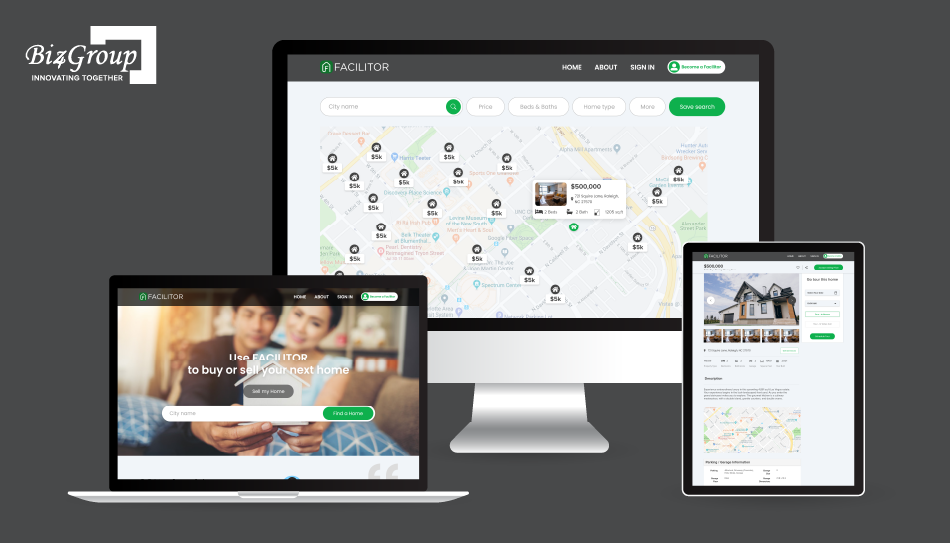
Facilitor is a full-scale platform built to help homeowners and first-time buyers navigate the property purchase journey with guided steps and secure exploration tools. The system simplifies complex buying workflows and reduces dependence on intermediaries while delivering an intuitive end-to-end experience.
How we optimized cost
We prioritized essential workflows in discovery and scoped secondary enhancements for later phases. This helped keep the real estate app development cost breakdown like Realtor.com transparent and aligned with business goals.
What this means for you
Focusing initial spend on the most impactful features helps validate your product with real users and minimizes the risk of overspending on underused functionality.
3. Renters Book: Review and Transparency Platform for Tenants and Landlords
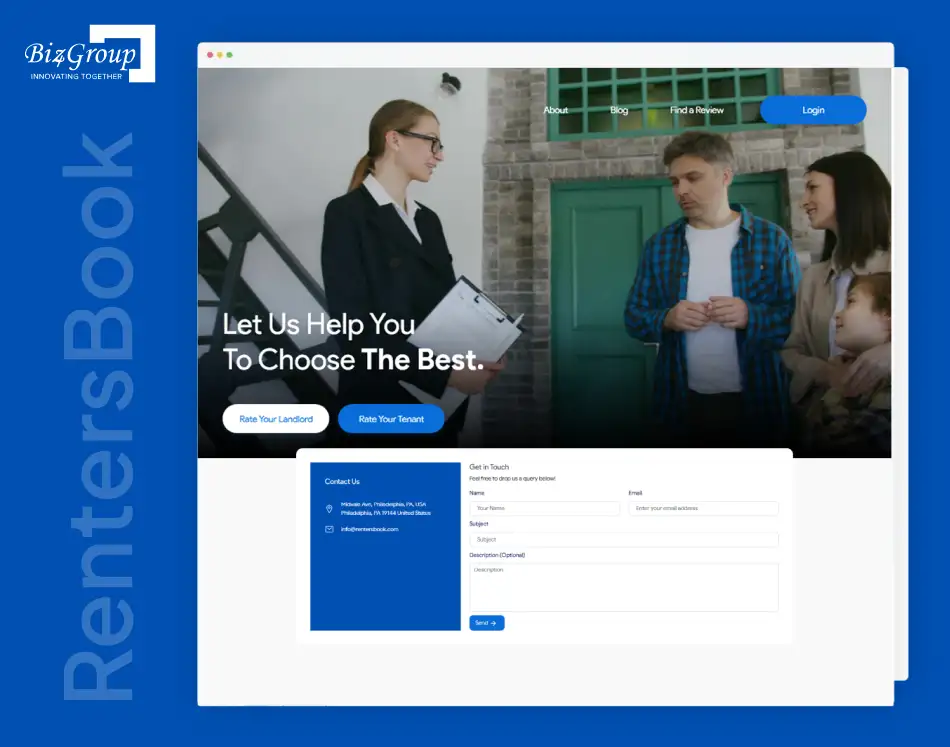
Renters Book is a platform designed to bring verified credibility to rental decisions by enabling tenants and landlords to rate and review each other based on real experience. This real-world feedback loop helps users trust one another before entering agreements, significantly enhancing transparency in the rental market.
How we optimized cost
Instead of building all desired features at once, Biz4Group structured the platform so core rating and review workflows launched first, with a clear path for later enhancements. This strategy reduces front-loaded development expenses while maintaining a strong user experience.
What this means for you
A staged approach to monetization and community features helps control the cost to develop a scalable property listing and search app like Realtor.com, allowing you to expand functionality over time without heavy upfront investment.
4. Contracks: AI-Powered Contract Workflow Automation
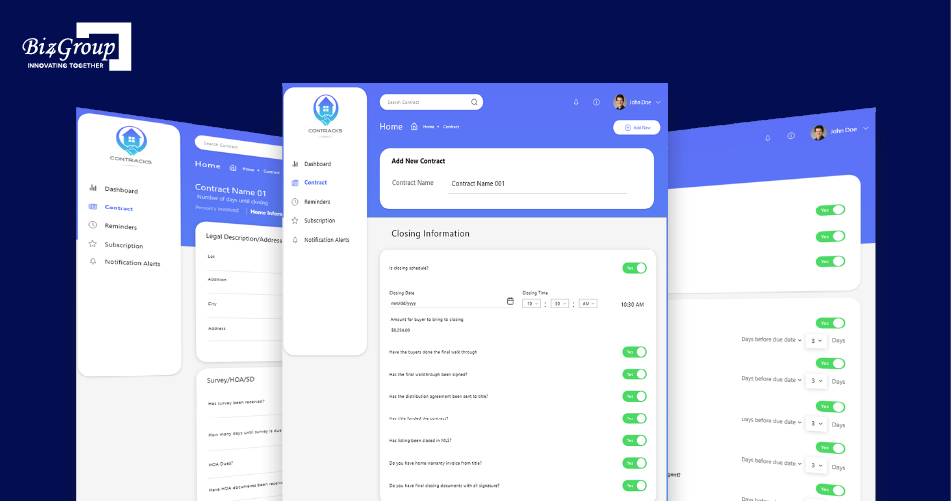
Contracks is an intelligent system that automates the creation, review, and management of contracts in real estate transactions. By streamlining legal and compliance workflows, it reduces risk and saves time for buyers, sellers, and legal teams.
How we optimized cost
We applied reusable contract logic and modular automation patterns that can scale to other features without rewriting major portions of the system. This modularity is a key cost driver for advanced systems.
What this means for you
Investing in smart automation early can reduce long-term operational costs and avoid expensive rework later, lowering the overall development budget of a real estate app like Realtor.com while boosting productivity.
Why Biz4Group Is the Right Partner for Your Real Estate Platform
Biz4Group does more than deliver code. We optimize cost through structured discovery, prioritized features, modular architecture, and smart integrations. Our work across projects like Homer AI, Facilitor, Renters Book, and ConTracks demonstrates that cost-effective development is possible without sacrificing performance or user experience.
Whether you are building an MVP or a full-scale marketplace, we help teams make choices that balance innovation and budget, so you can launch with confidence and scale with clarity.
Ready to Build a Real Estate Platform That Scales Without Wasting Budget?
Biz4Group helps founders and enterprises design, build, and optimize platforms with a clear view of how much investment is needed to make a real estate marketplace app like Realtor.com and how to spend it wisely.
Start Your Project With Biz4GroupWrapping Up!
Building a platform on the scale of Realtor.com is not about chasing the lowest quote. It is about understanding the cost to build a real estate app like Realtor.com, knowing where that investment goes, and making informed decisions that support growth instead of limiting it. From discovery and feature selection to MLS integration and long-term maintenance, every step influences the final outcome.
As this guide shows, the development cost of a real estate app like Realtor.com is shaped by scope, scalability, data accuracy, and execution quality. Teams that plan early, prioritize wisely, and optimize continuously are far better positioned to control the development budget of a real estate app like Realtor.com while still delivering a competitive product.
This is where Biz4Group brings real value. As a U.S.-based AI development company with deep expertise in real estate platforms, marketplaces, and AI-driven systems, we have delivered solutions that balance innovation with cost efficiency. Our experience building scalable property platforms, intelligent automation tools, and secure transaction systems gives us a clear advantage when it comes to reducing risk and avoiding expensive rework.
Whether you are estimating how much does it cost to develop a real estate app like Realtor.com or planning the next phase of a growing marketplace, having the right technology partner changes everything. We help you invest where it matters, optimize where it counts, and build with confidence from MVP to enterprise scale.
FAQ
1. What factors most influence the cost to build a real estate app like Realtor.com
The biggest factors affecting the cost of building a real estate app like Realtor.com include feature complexity, MLS integration, data volume, platform choice, and scalability requirements. Advanced search, real-time listings, agent dashboards, and security standards significantly increase the development cost of a real estate app like Realtor.com compared to basic listing apps.
2. How much does it cost to develop a real estate app like Realtor.com
The cost to develop a real estate app like Realtor.com typically ranges from $30,000 for a basic MVP to $250,000 or more for an enterprise-grade platform. The final real estate mobile app development cost like Realtor.com depends on scope, integrations, performance expectations, and long-term scalability.
3. Is it possible to reduce the cost by starting with an MVP
Yes. Starting with an MVP is one of the most effective ways to control the development budget of a real estate app like Realtor.com. An MVP focuses on essential features such as listings, search, and basic MLS data, allowing you to validate demand before investing in a full-scale property marketplace app development cost like Realtor.com.
4. How long does it take to build a Realtor.com-style property app
Timelines vary based on complexity. An MVP version may take 3 to 5 months, while a fully featured platform can take 6 to 12 months or longer. The timeline directly affects how much investment is needed to make a real estate marketplace app like Realtor.com, as longer builds require more development effort and testing.
5. Does cross-platform development reduce the real estate app development cost like Realtor.com
In many cases, yes. Cross-platform development can reduce the cost of making a real estate marketplace app like Realtor.com by allowing shared code for iOS and Android. However, highly complex or performance-heavy features may still require native development, which influences the cost of developing a Realtor.com style property app.
6. What ongoing costs should be planned after launching the app
Post-launch expenses are often overlooked. These include hosting, infrastructure scaling, MLS feed updates, security monitoring, and feature enhancements. Over time, these ongoing expenses become part of the total development cost of real estate app like Realtor.com, not optional add-ons.
7. How much investment is needed to add AI features to a real estate app like Realtor.com
Adding AI features such as intelligent search, recommendations, or automated lead handling increases the overall cost to develop a scalable property listing and search app like Realtor.com. While AI raises upfront investment, it often improves engagement and operational efficiency, making it a strategic addition for competitive platforms.
