 Location :
Orlando, FL, USA
Location :
Orlando, FL, USA +1 (407) 714-1616
 info@biz4group.com

- AI HOA accounting and reporting software development automates reconciliations, board reporting, reserve tracking, and financial workflows for HOA management companies.
- Modern AI HOA accounting software development reduces spreadsheet dependency, reporting delays, and accounting errors across large HOA portfolios.
- Key features include AI-powered reporting, delinquency tracking, reserve fund management, payment portals, and workflow automation.
- Custom HOA accounting software development costs typically range from $35,000 to $250,000+ based on features, integrations, and AI complexity.
- Scalable HOA accounting and reporting software development integrating AI requires the right tech stack, security controls, and an experienced partner like Biz4Group.
Last quarter, did your accounting team spend more time fixing reports than actually reviewing financial performance?
That’s becoming a serious problem for HOA management companies handling large community portfolios. Many firms still rely on manual spreadsheets, disconnected exports, and outdated workflows instead of investing in AI HOA accounting and reporting software development that can automate reporting and reduce financial errors at scale.
One broken Excel formula can throw off reserve balances across multiple associations. One delayed reconciliation can push board reporting back by days. And when financial packets go out late or contain errors, boards notice immediately.
Your team feels that pressure every single month.
As more communities demand faster reporting and greater financial transparency, manual accounting workflows are becoming harder to manage. According to a report, the U.S. now has over 377,000 community associations managing nearly 80 million residents. Yet many HOA accounting teams still depend on spreadsheets and repetitive manual processes instead of adopting community association accounting automation solutions.
That approach may work for 10 communities. What happens when you’re managing 100?
This growing operational strain is exactly why property management companies are investing in AI HOA accounting software development to automate reconciliations, generate accurate board-ready reports, reduce month-end close timelines, and eliminate spreadsheet-related financial risks.
With modern HOA accounting and reporting software development integrating AI, accounting teams can automate reserve tracking, dues collection, budget variance reporting, and financial statement generation without relying on manual Excel workflows that slow everything down.
Many firms exploring AI HOA management software development are now focusing heavily on financial automation because outdated accounting operations are limiting portfolio growth, increasing reporting risks, and creating burnout across finance teams.
So, what does an AI-powered HOA accounting platform actually look like in practice, and why are more management companies building custom solutions around their financial workflows?
What Is AI HOA Accounting and Reporting Software Development, and Why Are Property Management Companies Building It Now?
If your accounting team still spends days exporting data into Excel, reviewing formulas manually, correcting reserve balances, and preparing board packets community by community, you’re not alone.
In fact, many property management firms are now actively searching for how to create a custom AI HOA financial reporting software that automatically generates accurate monthly financial statements for HOA boards because traditional accounting workflows are becoming harder to manage as portfolios grow.
So, what exactly is AI HOA accounting and reporting software development?
It’s the process of building intelligent accounting systems that automate the financial operations HOA management companies struggle with most. That includes reconciliations, board reporting, reserve fund tracking, dues management, delinquency monitoring, financial analysis, and month-end close workflows across multiple communities.
Unlike traditional accounting platforms that rely heavily on manual oversight, modern AI HOA accounting software development solutions continuously process financial data, detect inconsistencies, organize reporting workflows, and improve accounting accuracy in real time.
That difference matters when your finance team is responsible for hundreds of communities, thousands of homeowners, and millions of dollars in reserve funds.
Many firms are also investing in building an AI HOA accounting system that eliminates the audit failures caused by inconsistent manual spreadsheet accounting practices because spreadsheet dependency continues creating reporting delays, reconciliation problems, and financial inconsistencies that affect board trust.
Why are companies building these systems now?
Because operational pressure is increasing from every direction:
- Accounting teams are managing larger HOA portfolios without additional staff
- Board members expect faster and clearer financial reporting
- Spreadsheet-based accounting creates avoidable financial risks
- Manual month-end close cycles slow down operations every month
- Existing HOA software often lacks intelligent reporting automation
- Delayed financial reports are affecting client retention and board confidence
This growing demand for automation is also pushing firms toward scalable financial platforms powered by enterprise AI solutions that can support large HOA accounting operations without increasing manual workload.
But what actually happens behind the scenes once an AI-powered HOA accounting system starts processing reconciliations, reserve funds, homeowner dues, and board reporting workflows automatically?
Still Spending More Time Fixing Reports Than Growing Your HOA Portfolio?
Let Biz4Group build an AI HOA accounting and reporting software development solution that replaces manual spreadsheets with scalable financial automation.
Talk to Our AI ExpertsHow Does an AI Powered HOA Accounting Platform Development Actually Work Behind the Scenes?
Modern AI powered HOA accounting platform development works by connecting accounting data, reporting workflows, banking systems, and automation models into one centralized financial ecosystem. Instead of relying on accountants to manually process reports during month-end close, the platform continuously analyzes financial activity, validates records, and automates reporting workflows across multiple HOA communities.
This approach allows HOA accounting automation software development to reduce operational delays, improve reporting accuracy, and support larger community portfolios without increasing accounting overhead.
1. Automated Data Collection and HOA Platform Integration
A modern HOA accounting and reporting software development integrating AI solution connects directly with HOA accounting platforms, banking systems, payment gateways, and homeowner databases through APIs and secure integrations. This removes the need for manual exports and spreadsheet consolidation across multiple communities. The platform also validates incoming data before it reaches reporting workflows.
- Connects with TOPS One, AppFolio, and banking APIs
- Syncs homeowner dues and transaction records
- Centralizes financial data across communities
Many property management companies use AI automation services to streamline these integrations and reduce manual accounting dependencies.
2. AI-Based Transaction Classification and General Ledger Mapping
In AI HOA accounting software development, machine learning models automatically classify transactions based on HOA accounting rules, historical records, reserve structures, and vendor activity. This improves financial consistency while reducing manual journal entry work. The system also identifies transactions that need accountant verification.
- Categorizes operating and reserve fund expenses
- Detects duplicate or mismatched entries
- Automates HOA general ledger mapping
This process plays a major role in HOA general ledger software development integrating AI for large-scale HOA portfolios.
3. Intelligent Bank Reconciliation Workflows
A well-designed intelligent HOA accounting system development platform continuously compares banking activity with internal accounting records to detect balance mismatches, missing transactions, and reconciliation inconsistencies automatically. Instead of reviewing statements manually line by line, accounting teams only review flagged exceptions.
- Matches transactions automatically
- Flags reconciliation discrepancies instantly
- Reduces month-end reconciliation delays
4. Automated HOA Financial Reporting Engine
The reporting engine within AI HOA financial reporting automation development compiles accounting data into board-ready reports using predefined templates, approval workflows, and community-specific financial structures. This creates consistent financial reporting across every HOA community.
- Generates balance sheets and income statements
- Creates reserve fund and delinquency summaries
- Standardizes monthly board reporting formats
This is a core capability of developing AI HOA financial reporting system projects designed for multi-community HOA management companies.
5. AI-Powered Variance and Financial Anomaly Detection
Advanced machine learning HOA accounting system development platforms use anomaly detection models to identify unusual spending activity, reserve inconsistencies, duplicate vendor payments, and abnormal budget variances before reports are finalized. This helps accounting teams reduce reporting risks proactively.
- Detects financial outliers automatically
- Flags unusual reserve fund activity
- Identifies reporting inconsistencies before board delivery
Some firms also combine these workflows with an AI bookkeeping chatbot to simplify transaction lookups and internal accounting support workflows.
6. Workflow Automation and Financial Approval Management
Modern community association accounting automation platforms route reconciliations, approvals, reviewer comments, and audit logs through automated workflows instead of relying on email-based coordination. This improves operational visibility across accounting teams handling large HOA portfolios.
- Automates report approval workflows
- Tracks audit history and reviewer activity
- Reduces bottlenecks during month-end close
7. Predictive Financial Forecasting and Risk Monitoring
Advanced AI HOA financial management platform development systems analyze historical accounting data to forecast delinquency trends, reserve funding gaps, recurring vendor expenses, and cash flow risks across communities. This allows finance teams to make proactive decisions before operational issues escalate.
- Forecasts homeowner delinquency risks
- Identifies reserve contribution gaps
- Tracks portfolio-level financial trends
So where are property management companies seeing the biggest operational impact after implementing automated HOA accounting software development solutions across their financial reporting workflows?
Still Managing HOA Financial Operations Manually? Here’s Where AI HOA Financial Reporting Automation Development Creates the Biggest Impact
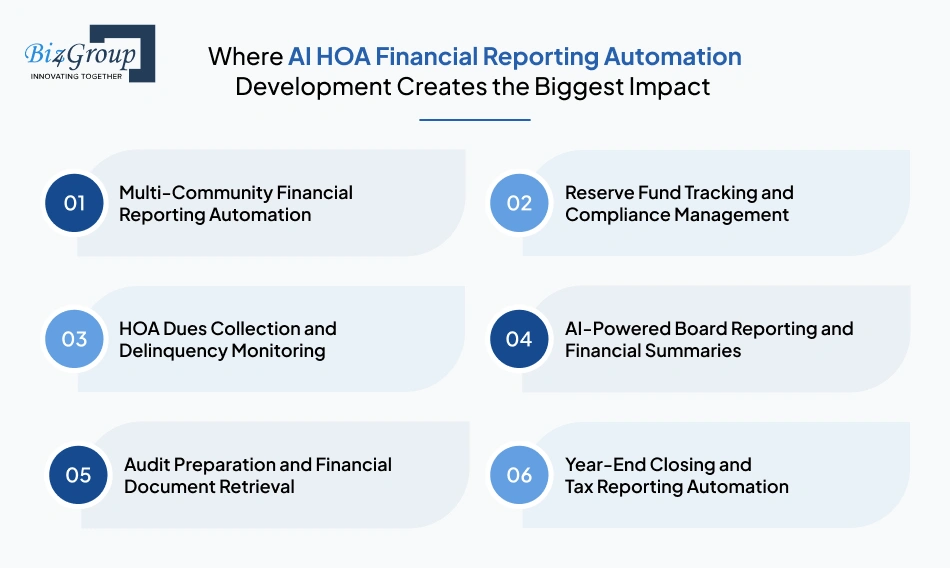
Manual accounting workflows may seem manageable at first. But once your team starts handling dozens of HOA communities, reporting delays, reconciliation errors, reserve tracking issues, and audit preparation quickly become operational bottlenecks.
That’s why many firms are now searching for how to create a custom AI HOA financial reporting software that automatically generates accurate monthly financial statements for HOA boards to automate high-effort accounting tasks and improve reporting consistency across large portfolios.
Here are the key areas where AI HOA financial reporting automation development is delivering measurable impact for modern HOA management companies.
1. Multi-Community Financial Reporting Automation
Managing financial reports across dozens of HOA communities manually creates reporting delays, inconsistent formats, and higher review workloads for accounting teams. With AI HOA financial reporting automation development, financial statements, balance sheets, reserve summaries, and delinquency reports are generated automatically using standardized workflows and real-time accounting data. This becomes especially valuable for property management companies managing large community portfolios with small accounting teams.
Example
In 2024, FirstService Residential expanded its use of automated accounting and reporting systems across large HOA portfolios to improve financial reporting consistency and reduce operational delays for community associations across the U.S. Their automation initiatives focused heavily on centralized reporting and scalable financial operations for high-volume communities.
2. Reserve Fund Tracking and Compliance Management
Reserve fund management becomes difficult when accountants track contribution schedules, reserve balances, and capital expenses manually across multiple communities. Modern HOA financial management software development platforms automate reserve calculations, contribution monitoring, and compliance tracking based on reserve study schedules and HOA financial policies. This helps reduce reporting inconsistencies and improves financial oversight for reserve-heavy communities.
Example
California HOA regulations under Civil Code Section 5550 require associations to review reserve funding disclosures regularly. Many large HOA management companies operating in California now use automated reserve tracking systems integrated with accounting software to simplify disclosure preparation and improve reserve visibility during annual reviews.
3. HOA Dues Collection and Delinquency Monitoring
Late homeowner payments create cash flow pressure for HOA communities and increase manual follow-up work for accounting teams. With AI HOA bookkeeping software development, payment activity, delinquency patterns, and homeowner balances are monitored continuously to automate reminders, payment tracking, and collection workflows. This allows accounting teams to identify payment risks earlier without manually reviewing aging reports every week.
Example
HOA management platforms like AppFolio and Vantaca have introduced automated delinquency tracking and homeowner payment workflows to help property management companies reduce manual collection efforts and improve payment visibility across larger portfolios.
4. AI-Powered Board Reporting and Financial Summaries
Board members often struggle to interpret large financial reports filled with accounting terminology and raw transaction data. Modern custom HOA financial reporting software development with AI can generate simplified financial summaries, highlight unusual variances, and organize financial insights into standardized board-ready formats. This improves reporting clarity for non-financial board members.
Example
Enumerate introduced AI-enhanced reporting capabilities for HOA management firms to improve board communication and streamline financial packet generation for community associations managing complex reporting structures.
5. Audit Preparation and Financial Document Retrieval
Annual audits often force accounting teams to manually gather invoices, reserve records, reconciliations, and approval histories from multiple systems. An automated HOA document retrieval system connected with financial workflows centralizes audit trails, supporting documents, and historical accounting activity in one searchable environment. This significantly reduces audit preparation time.
Example
Large property management companies handling regulated community portfolios increasingly use centralized financial document management systems to organize invoices, approvals, and reserve documentation before external audits begin. This has become especially common among firms managing communities in Florida and Nevada where financial disclosure requirements are stricter. Companies implementing an automated HOA document retrieval system are seeing faster audit preparation cycles and improved document traceability.
6. Year-End Closing and Tax Reporting Automation
Year-end close processes often create reporting bottlenecks because accountants must manually verify balances, organize tax records, and prepare closing statements across multiple communities. Modern automated HOA accounting software development platforms streamline these workflows using centralized financial validation and automated reporting pipelines. This improves reporting speed while reducing manual review dependency during peak accounting periods.
Example
Several enterprise HOA management firms operating multi-state portfolios now use automated year-end accounting workflows integrated with their HOA accounting systems to simplify tax preparation, year-end reconciliations, and annual financial reporting for community associations.
These use cases highlight why more firms are adopting AI HOA financial management platform development to improve reporting accuracy, reduce manual workload, and scale HOA operations more efficiently.
So, what features should you prioritize while building a modern AI HOA accounting and reporting software development solution?
What Features Should You Prioritize in an AI HOA Accounting and Reporting Software Development Solution?
The success of an AI HOA accounting and reporting software development platform depends heavily on the features built into the system. Property management companies handling large HOA portfolios need more than basic accounting functionality. They need automation, financial visibility, reporting accuracy, compliance support, and scalable workflows that reduce operational pressure on accounting teams.
Here are the core features modern HOA management companies prioritize while investing in custom HOA accounting software development and AI HOA financial management platform development.
|
Feature |
How It Helps HOA Management Companies |
Business Impact |
|---|---|---|
|
Automated Bank Reconciliation |
Automatically matches bank transactions with accounting records to reduce manual reconciliation work and identify discrepancies faster. |
Faster month-end close and fewer reconciliation errors |
|
AI-Based Transaction Categorization |
Uses machine learning to classify expenses, reserve allocations, vendor payments, and homeowner transactions automatically. |
Improves accounting consistency across communities |
|
Board-Ready Financial Reporting |
Generates balance sheets, income statements, reserve summaries, and delinquency reports using standardized templates. |
Delivers faster and more consistent board reporting |
|
Reserve Fund Tracking and Forecasting |
Tracks reserve contributions, expenses, funding gaps, and reserve study alignment across HOA communities. |
Improves reserve visibility and compliance management |
|
Budget vs Actual Variance Analysis |
Identifies unusual spending patterns and budget deviations using intelligent financial analysis models. |
Helps accounting teams detect financial issues earlier |
|
Delinquency Monitoring and Dues Automation |
Tracks overdue homeowner balances, automates reminders, and manages collection workflows. |
Improves cash flow and reduces manual follow-up work |
|
Online Homeowner Payment Portal |
Allows homeowners to pay dues, review account history, and access financial information through a centralized portal. |
Enhances homeowner experience and payment transparency |
|
AI-Powered Financial Anomaly Detection |
Detects duplicate transactions, abnormal vendor payments, reserve inconsistencies, and reporting anomalies automatically. |
Reduces financial reporting risks |
|
Workflow Automation and Approval Routing |
Automates report approvals, accounting reviews, escalation workflows, and audit tracking. |
Reduces operational bottlenecks during reporting cycles |
|
Multi-Community Financial Dashboard |
Provides centralized visibility into financial performance across multiple HOA communities. |
Simplifies portfolio-level financial oversight |
|
Audit Trail and Financial Document Management |
Stores invoices, approvals, reconciliations, and financial history in one searchable environment. |
Speeds up audits and improves financial traceability |
|
Year-End Closing and Tax Reporting Automation |
Automates closing workflows, financial validation, and tax-ready reporting preparation. |
Reduces accounting workload during year-end cycles |
|
General Ledger Automation |
Automates ledger mapping and HOA-specific accounting structures using AI-powered workflows. |
Supports accurate HOA fund accounting operations |
|
Predictive Delinquency and Cash Flow Forecasting |
Analyzes homeowner payment trends and future cash flow risks using predictive financial models. |
Helps teams make proactive financial decisions |
|
Role-Based Access and Financial Permissions |
Restricts access to sensitive financial data based on user roles and responsibilities. |
Strengthens financial security and operational control |
|
Integrated Communication Workflows |
Connects accounting teams, board members, and homeowners through centralized notifications and reporting updates. |
Improves operational coordination and transparency |
Many firms also combine these platforms with an AI HOA self service resident portal to simplify homeowner communication, payment access, and account management within one connected HOA ecosystem.
The next major concern for most property management companies is security. After all, when financial data, reserve funds, and homeowner information are centralized into one platform, protecting that data becomes critical.
How Much Time Could Your Accounting Team Save Every Month?
Automate reconciliations, board reporting, reserve tracking, and financial workflows with a scalable AI-powered HOA platform.
Build Your HOA Accounting PlatformCan AI HOA Accounting and Reporting Software Development Stay Secure, Compliant, and Audit-Ready?
Financial automation only works when property management companies can trust the system handling their accounting operations. Since HOA accounting involves reserve funds, homeowner payment data, vendor transactions, and board-facing financial reports, security and auditability become critical parts of any AI HOA accounting and reporting software development strategy.
Modern platforms are designed to maintain financial control, improve reporting transparency, and support compliance requirements without slowing down accounting workflows.
1. Role-Based Financial Access Control
A modern intelligent HOA accounting system development platform restricts access to financial data based on user responsibilities and approval authority. Accounting teams, board members, vendors, and community managers only see the information relevant to their role, reducing unauthorized financial access across large HOA portfolios.
2. Audit Trails and Financial Activity Logging
Every financial action inside the platform is recorded automatically, including reconciliations, approvals, report edits, reserve adjustments, and transaction updates. This creates a traceable financial history that simplifies audits and improves accountability across accounting operations.
3. AI-Assisted Compliance Monitoring
Modern HOA accounting and reporting software development integrating AI can continuously monitor reserve allocations, reporting workflows, delinquency activity, and financial inconsistencies against predefined accounting and compliance rules. This helps accounting teams identify potential compliance issues earlier.
4. Human Review and Approval Workflows
Even with automation in place, accounting teams maintain control over financial approvals and board-facing reports. AI-generated reconciliations, financial summaries, and reporting outputs move through configured review workflows before final delivery, reducing the risk of unverified financial reporting.
5. Secure Cloud Infrastructure and Data Encryption
Modern custom HOA financial reporting software development with AI platforms use encrypted cloud infrastructure, secure APIs, multi-factor authentication, and protected financial databases to secure sensitive accounting information and homeowner records across connected systems.
6. Financial Document Retention and Retrieval
The platform stores invoices, reconciliations, reserve documents, approvals, contracts, and financial reports in a centralized environment with searchable retrieval workflows. This improves document accessibility during audits, board reviews, and financial investigations.
7. HOA Reserve Fund Compliance Management
Reserve fund compliance workflows help accounting teams track contribution schedules, reserve balances, funding gaps, and disclosure requirements across multiple communities. This improves financial visibility while supporting state-specific reserve reporting obligations for HOA management companies.
As security and compliance expectations continue rising, property management companies also need a clear understanding of what it actually costs to build and maintain a scalable AI HOA financial management platform development solution.
What Does AI HOA Accounting and Reporting Software Development Actually Cost in 2026?
The cost of AI HOA accounting and reporting software development typically ranges from $35,000 to $250,000+, depending on platform complexity, integrations, automation workflows, reporting requirements, and AI capabilities. A lightweight HOA reporting platform costs far less than a large-scale system designed to automate reconciliations, reserve tracking, delinquency monitoring, board reporting, and homeowner payment management across multiple communities.
For companies searching for building an AI HOA accounting software with automated year end closing and tax preparation reporting capabilities or developing an AI HOA accounting software with online payment portal integration that allows homeowners to pay dues online and view their account history, development costs usually increase because of advanced integrations, compliance workflows, AI models, and financial automation requirements.
Feature-Wise Cost Breakdown for AI HOA Accounting Software Development
|
Feature |
Estimated Development Cost |
What’s Included |
|---|---|---|
|
Automated bank reconciliation |
$8,000 to $20,000 |
Bank feed integrations, transaction matching, reconciliation alerts |
|
AI-based transaction categorization |
$10,000 to $25,000 |
Expense classification, reserve tagging, vendor mapping |
|
Board-ready financial reporting engine |
$12,000 to $30,000 |
Balance sheets, income statements, PDF report generation |
|
Reserve fund tracking and forecasting |
$15,000 to $35,000 |
Reserve calculations, contribution schedules, funding analysis |
|
HOA dues collection automation |
$10,000 to $25,000 |
Automated reminders, aging reports, payment tracking |
|
Online homeowner payment portal |
$15,000 to $40,000 |
Homeowner login, dues payment, account history access |
|
AI-powered anomaly detection |
$20,000 to $50,000 |
Variance detection, duplicate payment alerts, risk monitoring |
|
Predictive delinquency monitoring |
$18,000 to $45,000 |
Payment trend analysis, delinquency forecasting, alerts |
|
Workflow approvals and audit logs |
$8,000 to $20,000 |
Approval routing, activity tracking, audit history |
|
Multi-community financial dashboards |
$15,000 to $35,000 |
Portfolio-level analytics, reporting dashboards, KPI visibility |
|
API integrations with HOA platforms and banks |
$10,000 to $40,000 |
TOPS One integration, AppFolio sync, banking API connectivity |
Factors Affecting the Cost of AI HOA Financial Reporting Automation Development
The final cost of custom HOA financial reporting software development with AI depends heavily on the operational complexity of your accounting workflows and reporting requirements.
The biggest cost drivers include:
- Number of HOA communities managed
- Integration complexity with TOPS One, AppFolio, or banking systems
- AI model sophistication and automation depth
- Compliance and audit workflow requirements
- Reporting customization for HOA boards
- Homeowner portal and payment gateway functionality
- Security and financial access controls
- Real-time analytics and forecasting requirements
Hidden Costs in Automated HOA Accounting Software Development
Many property management companies underestimate the long-term operational costs involved in maintaining financial automation systems.
Hidden costs often include:
- Third-party API and banking integration fees
- Cloud hosting and infrastructure scaling
- AI model optimization and retraining
- Compliance updates and regulatory modifications
- Legacy data migration and cleanup
- Staff onboarding and workflow adaptation
- Ongoing maintenance and technical support
Cost Optimization Strategies for Build AI HOA Accounting Software Projects
Most successful build AI HOA accounting software projects begin with high-impact accounting workflows first and expand gradually as operational needs evolve.
Cost optimization strategies include:
- Starting with an MVP-based reporting automation system
- Integrating with existing HOA software instead of rebuilding infrastructure
- Prioritizing reconciliation and reporting automation first
- Using modular architecture for phased feature expansion
- Automating repetitive accounting tasks before predictive AI modules
Many firms evaluating custom AI HOA software development vs. off-the-shelf solutions discover that phased custom development provides better scalability and operational flexibility for growing HOA portfolios.
Custom HOA Accounting Software Development vs Off-the-Shelf HOA Platforms
|
Comparison Area |
Custom AI HOA Accounting Platform |
Off-the-Shelf HOA Software |
|---|---|---|
|
Financial workflow customization |
Designed around your accounting process, approval structure, and reporting requirements |
Limited to fixed workflows and predefined modules |
|
AI automation capabilities |
Supports custom automation for reconciliations, reserve tracking, and anomaly detection |
Basic automation with limited flexibility |
|
HOA board reporting |
Fully customizable board packets, financial summaries, and dashboards |
Generic templates with restricted customization |
|
Integration flexibility |
Connects with existing HOA software, banks, CRMs, and payment systems |
Integration support may be limited or vendor-controlled |
|
Scalability across large portfolios |
Built to support expanding HOA portfolios and operational growth |
Performance and workflow limitations may appear as portfolios grow |
|
Ownership and control |
Full ownership of workflows, data handling, and platform roadmap |
Vendor controls updates, feature access, and roadmap priorities |
|
Long-term operational efficiency |
Higher operational flexibility and automation potential |
Lower flexibility for complex HOA accounting operations |
|
Upfront investment |
Higher initial development cost |
Lower starting subscription cost |
|
Long-term ROI |
Better ROI for PMCs managing large or growing portfolios |
Lower adaptability can increase operational inefficiencies over time |
Companies investing in scalable community association accounting automation platforms are increasingly prioritizing operational control, reporting flexibility, and long-term scalability instead of relying solely on generic HOA software subscriptions.
So once budgeting is clear, what does the actual development process for a modern AI HOA accounting and reporting software development platform look like from planning to deployment?
Paying for Manual Accounting Errors Every Month Anyway?
Let’s build a phased AI HOA accounting software development roadmap aligned with your budget and operational goals.
Get a Custom Cost EstimateHow to Build a Scalable AI HOA Accounting and Reporting Software Development Platform Step by Step
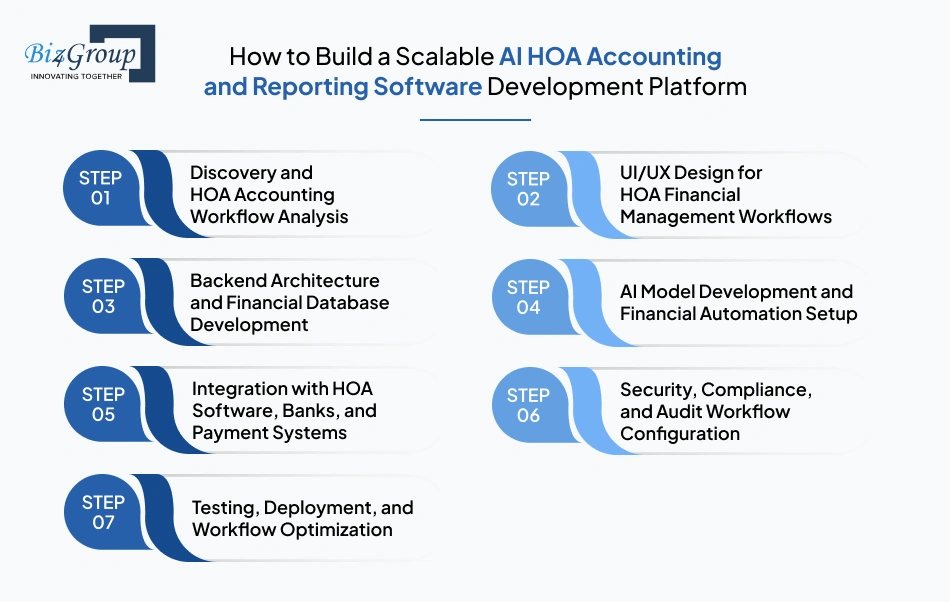
Building a scalable AI HOA accounting and reporting software development platform requires more than adding automation to traditional accounting software. The system must support reserve fund management, board reporting, reconciliations, dues collection, audit workflows, and multi-community accounting operations without creating additional operational complexity.
That’s why many property management companies searching for how to create a custom AI HOA financial reporting software that automatically generates accurate monthly financial statements for HOA boards follow a phased development strategy focused on workflow automation, financial accuracy, and long-term scalability.
Step 1: Discovery and HOA Accounting Workflow Analysis
The first phase of custom HOA accounting software development focuses on understanding how accounting teams currently handle reconciliations, reserve tracking, delinquency workflows, board reporting, and month-end close operations. This stage helps identify operational bottlenecks and define which accounting workflows should be automated first. A detailed discovery process prevents reporting and workflow issues later in development.
- Analyze HOA accounting operations and reporting flows
- Identify spreadsheet-heavy financial workflows
- Define automation priorities and compliance requirements
Many firms start with an MVP development strategy to validate high-impact financial workflows before scaling the platform further.
Step 2: UI/UX Design for HOA Financial Management Workflows
A successful AI HOA financial management platform development project depends heavily on usability. Accounting teams, board members, and community managers need dashboards and reporting interfaces that simplify financial operations instead of adding more complexity. This phase focuses on improving reporting visibility and workflow efficiency.
- Design accounting dashboards and reporting layouts
- Create board-friendly financial reporting interfaces
- Simplify approval and reconciliation workflows
Many firms prioritize strong UI/UX design to improve adoption across finance and operations teams.
Step 3: Backend Architecture and Financial Database Development
The backend infrastructure powers transaction processing, workflow orchestration, financial calculations, reserve management logic, and reporting pipelines. During HOA accounting automation software development, this layer must support large transaction volumes across multiple HOA communities while maintaining financial consistency. Scalable architecture becomes critical for growing portfolios.
- Build accounting logic and automation workflows
- Configure financial databases and reporting engines
- Support multi-community accounting structures
Step 4: AI Model Development and Financial Automation Setup
This stage focuses on building automation models for transaction categorization, reconciliation validation, variance analysis, delinquency monitoring, and predictive financial insights. In advanced machine learning HOA accounting system development, models are trained using HOA-specific accounting workflows and historical financial data. The goal is to reduce repetitive accounting work while improving financial visibility.
- Train AI models using accounting datasets
- Configure anomaly detection and forecasting systems
- Automate repetitive financial workflows
Many firms also integrate workflows powered by AI agent systems to automate internal accounting operations more efficiently.
Step 5: Integration with HOA Software, Banks, and Payment Systems
A scalable HOA accounting and reporting software development integrating AI platform must integrate with HOA management software, banking APIs, homeowner databases, and payment gateways. This integration layer removes manual exports and keeps financial records synchronized across systems. Reliable integrations are essential for real-time accounting accuracy.
- Integrate with TOPS One, AppFolio, and Enumerate
- Connect banking APIs and payment gateways
- Sync homeowner and accounting data automatically
Companies specializing in AI integration services often help streamline these complex financial integrations.
Step 6: Security, Compliance, and Audit Workflow Configuration
During this phase, developers configure audit trails, approval workflows, role-based permissions, reserve fund compliance tracking, and financial encryption systems. This ensures the platform supports secure and traceable HOA accounting operations across multiple communities. This stage is especially important for reserve-heavy HOA portfolios.
- Configure role-based financial access controls
- Enable audit logging and approval workflows
- Implement encrypted financial data handling
Step 7: Testing, Deployment, and Workflow Optimization
Before launch, the platform undergoes reconciliation testing, reporting validation, workflow reviews, and financial accuracy checks. Many firms deploy building an AI HOA accounting software with automated year end closing, and tax preparation reporting capabilities begin with pilot communities before scaling platform usage across the entire portfolio. Continuous optimization continues after deployment.
- Validate accounting workflows and financial reports
- Test reconciliation and automation accuracy
- Optimize performance across larger HOA portfolios
Many property management companies partner with an experienced AI development company to ensure the platform aligns correctly with complex HOA financial operations and reporting requirements.
So once the development process is clear, the next question becomes equally important. Which technologies and frameworks power a scalable AI HOA accounting software development platform behind the scenes?
Which Tech Stack Powers a Scalable AI HOA Accounting and Reporting Software Development Platform?
The performance of an AI HOA accounting and reporting software development platform depends heavily on the technologies used behind the scenes. Since these systems handle financial workflows, reconciliations, board reporting, reserve tracking, homeowner payments, and AI automation across multiple communities, the tech stack must support scalability, security, real-time processing, and financial accuracy.
For companies planning AI HOA financial management platform development, choosing the right architecture also affects long-term maintenance costs, integration flexibility, reporting speed, and future AI expansion capabilities.
|
Technology Layer |
Recommended Technologies |
Purpose in AI HOA Accounting Software Development |
|---|---|---|
|
Frontend Development |
Builds responsive accounting dashboards, reporting portals, and homeowner interfaces |
|
|
Backend Development |
Handles accounting workflows, APIs, reporting logic, and automation processing |
|
|
Database Management |
PostgreSQL, MySQL, MongoDB |
Stores financial records, reserve data, homeowner information, and audit logs |
|
AI and Machine Learning |
TensorFlow, OpenAI APIs, Scikit-learn, PyTorch |
Powers transaction categorization, anomaly detection, forecasting, and financial automation |
|
Workflow Automation |
Apache Airflow, n8n, Zapier |
Automates approvals, reporting workflows, reconciliation tasks, and notifications |
|
Cloud Infrastructure |
AWS, Microsoft Azure, Google Cloud |
Supports scalable hosting, encrypted storage, backups, and financial system availability |
|
Banking and Payment APIs |
Plaid, Stripe, Dwolla |
Enables payment processing, bank synchronization, and homeowner dues collection |
|
Reporting and Analytics |
Power BI, Tableau, Metabase |
Generates financial dashboards, variance reports, and portfolio-level analytics |
|
Authentication and Security |
OAuth 2.0, JWT, Okta, Auth0 |
Secures user authentication, permissions, and role-based financial access |
|
Document Management |
AWS S3, Firebase Storage, SharePoint APIs |
Stores invoices, audit records, reserve documents, and financial statements |
|
Real-Time Communication |
WebSockets, Firebase, Twilio APIs |
Enables live notifications, alerts, and workflow updates |
|
Mobile Accessibility |
React Native, Flutter |
Supports mobile access for community managers and board members |
|
API Integration Layer |
REST APIs, GraphQL |
Connects HOA software, banking systems, payment gateways, and external services |
|
AI Chat and Financial Assistance |
GPT APIs, LangChain, RAG pipelines |
Supports financial summaries, accounting assistance, and reporting insights |
Many firms building scalable community association accounting automation platforms also integrate solutions powered by AI product frameworks to support long-term automation, reporting intelligence, and operational scalability across large HOA portfolios.
But even with the right technology stack in place, building a successful HOA accounting automation software development platform comes with several operational and technical challenges that property management companies must plan for early.
What Challenges Do Companies Face During AI HOA Accounting and Reporting Software Development, and How Can They Solve Them?
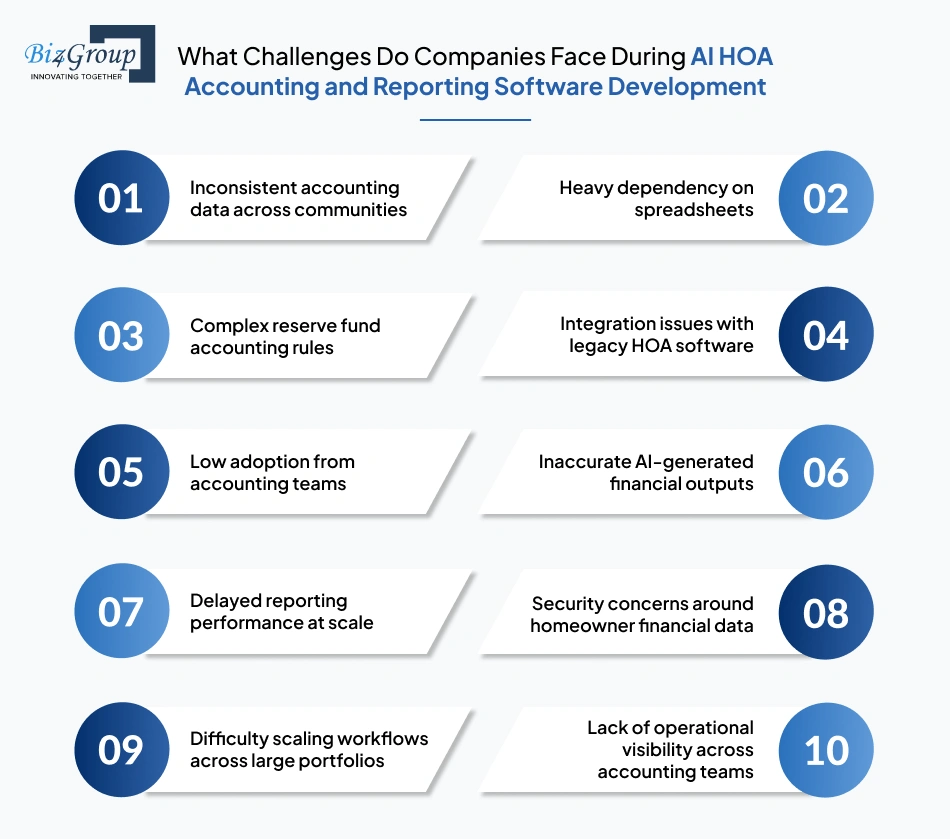
Building a scalable AI HOA accounting and reporting software development platform involves more than connecting accounting data with automation tools. HOA financial operations contain complex reserve structures, fragmented accounting workflows, inconsistent reporting formats, and legacy system dependencies that often create implementation challenges during development.
The key is identifying these challenges early and solving them with the right architecture, workflows, and automation strategy.
|
Challenge in HOA Accounting Automation Software Development |
Why It Happens |
Recommended Solution |
|---|---|---|
|
Inconsistent accounting data across communities |
Different HOAs often follow different reporting formats, ledger structures, and reserve allocation methods |
Standardize financial data models and automate data normalization workflows |
|
Heavy dependency on spreadsheets |
Many accounting teams still rely on manual Excel workflows for reconciliations and reporting |
Replace spreadsheet-heavy processes gradually through phased automation |
|
Complex reserve fund accounting rules |
Reserve calculations, contribution schedules, and compliance requirements vary by community and state |
Build configurable reserve management logic into the platform |
|
Integration issues with legacy HOA software |
Older HOA systems may have limited APIs or disconnected financial workflows |
Use middleware and API integration layers to centralize financial data |
|
Low adoption from accounting teams |
Teams used to traditional workflows may resist automation changes initially |
Focus on intuitive workflows and operational training during rollout |
|
Inaccurate AI-generated financial outputs |
AI models trained on poor-quality accounting data can create unreliable reporting results |
Use supervised financial validation and human approval workflows |
|
Delayed reporting performance at scale |
Multi-community accounting systems process large volumes of financial transactions simultaneously |
Build scalable cloud infrastructure and optimized reporting pipelines |
|
Security concerns around homeowner financial data |
HOA accounting systems handle sensitive payment, reserve, and homeowner records |
Implement encrypted storage, role-based access, and audit tracking |
|
Difficulty scaling workflows across large portfolios |
Processes that work for small HOAs often fail across hundreds of communities |
Design modular automation architecture for portfolio-level scalability |
|
Lack of operational visibility across accounting teams |
Disconnected reporting workflows create communication and tracking gaps |
Centralize approvals, reporting, and workflow management in one platform |
Many property management firms working with a specialized real estate AI software development company are now prioritizing phased automation strategies to reduce implementation risk while modernizing large HOA accounting operations.
As AI adoption continues growing in HOA financial management, choosing the right development partner becomes equally important as choosing the right technology stack or automation strategy.
What Makes Biz4Group LLC a Trusted Partner for AI HOA Accounting Software Development?
Building a scalable AI HOA accounting and reporting software development platform requires much more than technical development expertise. Your development partner must understand HOA financial operations, reserve fund structures, board reporting workflows, compliance requirements, and the operational pressure property management companies face while managing large community portfolios.
That’s where Biz4Group stands out.
As one of the trusted real estate AI software development companies in USA, Biz4Group specializes in building intelligent automation platforms for HOA management, financial operations, and real estate workflows. Their expertise spans AI HOA accounting software development, workflow automation, predictive financial systems, homeowner portals, AI-powered reporting platforms, and large-scale real estate technology solutions designed for operational scalability.
Biz4Group also maintains a strong 4.9 rating on Clutch, reflecting its reputation for delivering reliable AI and software development solutions across complex enterprise projects.
Companies evaluating top AI HOA management software development companies in USA often prioritize partners with both AI expertise and deep understanding of HOA operational workflows because financial automation projects require far more than generic software development capabilities.
Whether you are planning custom HOA accounting software development, advanced community association accounting automation, or a fully scalable AI HOA financial management platform development solution, partnering with a team that understands both AI systems and HOA financial operations can significantly reduce implementation risk and accelerate long-term ROI.
Ready to Scale HOA Operations Without Scaling Financial Chaos?
Work with Biz4Group to build secure, automation-first HOA accounting systems tailored for growing community portfolios.
Contact UsClosing Thoughts!
Manual spreadsheets, delayed reconciliations, disconnected reporting workflows, and inconsistent financial visibility are becoming major operational barriers for growing HOA management companies. As portfolios expand, relying on traditional accounting processes makes it harder to maintain reporting accuracy, board confidence, and long-term operational efficiency.
That’s why more firms are now investing in AI HOA accounting and reporting software development to automate financial workflows, improve reporting consistency, strengthen reserve tracking, and reduce accounting overhead across multiple communities.
Many property management companies searching for "I am looking for an experienced development team that can build a custom AI HOA accounting and reporting software for our property management company that automatically handles bank reconciliation dues collection financial statement generation budget vs actual reporting and reserve fund tracking across all of our 200 community association clients without requiring manual spreadsheet management" are prioritizing development partners with both AI expertise and deep HOA operational knowledge.
As an experienced real estate AI software partner, Biz4Group helps property management companies build scalable financial automation platforms tailored to complex HOA accounting operations, reporting requirements, and long-term portfolio growth.
Because at some point, the real question stops being: “How long can your accounting team manage spreadsheets?” and becomes: “How much longer can your business afford to?”
Ready to replace spreadsheet chaos with scalable HOA financial automation? Let Biz4Group build an AI-powered accounting platform your finance team can actually grow with.
FAQ
1. What is AI HOA accounting and reporting software development?
AI HOA accounting and reporting software development involves building intelligent financial management platforms for HOA management companies that automate reconciliations, reserve tracking, board reporting, dues collection, delinquency monitoring, and financial analysis using AI and workflow automation. These systems help reduce spreadsheet dependency, improve reporting accuracy, and support large multi-community HOA portfolios more efficiently.
2. Why are HOA management companies replacing spreadsheets with AI-powered accounting systems?
Manual spreadsheets create reconciliation delays, reporting inconsistencies, reserve fund errors, and audit risks as HOA portfolios grow. Modern community association accounting automation platforms centralize financial workflows, automate repetitive accounting tasks, and improve financial visibility across multiple communities. This has become a major operational priority for property management companies managing large HOA portfolios.
3. How much does AI HOA accounting software development cost?
The cost of AI HOA accounting software development typically ranges from $35,000 to $250,000+ depending on features, integrations, AI capabilities, reporting complexity, security requirements, and the number of communities being managed. Platforms with predictive analytics, homeowner portals, reserve forecasting, and advanced financial automation generally require larger development investments.
4. Can AI HOA accounting systems integrate with AppFolio, TOPS One, and banking platforms?
Yes. Modern HOA accounting and reporting software development integrating AI usually includes API integrations with HOA management software, payment gateways, banking systems, accounting tools, and homeowner databases. These integrations allow financial data, payments, and reporting workflows to sync automatically without relying on manual exports or spreadsheet consolidation.
5. How does AI improve HOA financial reporting accuracy?
AI-powered financial systems continuously validate transactions, detect unusual financial activity, identify reconciliation mismatches, and automate financial reporting workflows before reports reach HOA boards. This reduces human error, improves consistency, and shortens month-end close timelines for accounting teams handling multiple communities.
6. What features should a modern AI HOA financial management platform development solution include?
A scalable AI HOA financial management platform development solution should include automated bank reconciliation, reserve fund tracking, board-ready reporting, homeowner payment portals, delinquency monitoring, audit trails, workflow automation, anomaly detection, and multi-community financial dashboards. Many modern platforms also support AI-powered reporting summaries and predictive financial insights.
7. How do I choose the right company for custom HOA accounting software development?
The right development partner should understand HOA financial workflows, reporting automation, reserve management, and large-scale property management operations. Companies evaluating vendors for AI HOA accounting software development often prioritize firms like Biz4Group that combine AI expertise with real estate and HOA technology experience.
