Location :
Orlando, FL, USA
Location :
Orlando, FL, USA +1 (407) 714-1616
 info@biz4group.com

 AI Summary Powered by Biz4AI
- You can launch a sportsbook in New Jersey without owning a casino by signing a skin deal with a licensed Atlantic City casino or racetrack.
- NJ sports betting skins are capped at three per property and 33 statewide, so open seats are limited and worth securing early.
- A New Jersey sportsbook platform needs geolocation, KYC, responsible gaming controls, audit trails, dependable odds feeds and portable player data, because the DGE tests every system before launch.
- The New Jersey online sports betting tax is 19.75% plus a 1.25% additional tax, which is 21% of gross revenue before market access fees.
- Platform builds typically cost $20,000 to $350,000+, depending on whether you choose a turnkey, white-label or custom sportsbook.
- Biz4Group LLC builds compliance-first sportsbook platforms for regulated US markets and helps brands get their technology ready before they sign a New Jersey skin deal.
Regulatory note. This article is for business and technology planning. It is not legal advice. Confirm licensing, tax and approval requirements with the DGE and qualified New Jersey gaming counsel. Information last verified October 13, 2026.
What if you could open a sportsbook in one of America’s busiest betting markets without owning a single slot machine?
That’s the promise of a skin deal. In New Jersey, the numbers make it hard to ignore.
Bettors in the state wagered more than $7.2 billion through August 2026, according to the Division of Gaming Enforcement (DGE). Sports wagering gross revenue reached $1.18 billion in 2025, up 7.5% from 2024. Online sportsbooks generated about 97% of sports wagering revenue in August 2026.
So, can you launch a sportsbook in New Jersey without owning a casino? Yes. You sign a New Jersey sportsbook skin deal with a licensed casino or racetrack and run your brand under its license.
The catch is that seats are limited. The state caps online sports wagering skins at 33, and 15 were live as of July 31, 2025.
This guide covers how skin deals work, the six steps to launch, what your sportsbook platform needs before you sign, and what it all costs in 2026. At Biz4Group, we build compliance-first sportsbook technology for regulated US markets. So we’ll keep one eye on the deal and the other on the tech stack.
Can You Launch a Sportsbook in New Jersey Without Owning a Casino?
Yes. You can launch a sportsbook in New Jersey without owning a casino by signing a skin deal with a licensed Atlantic City casino or racetrack. Your brand runs online under that partner’s license. You still need DGE approvals, a compliant platform, and a commercial agreement covering fees and responsibilities.
Still sounds too easy? Here are the questions founders usually ask next.
Who holds the sports wagering license?The casino or racetrack. It owns the market access, and you pay for a seat.
Who runs the sportsbook?You do, under your own brand. The DGE still expects your company to hold the right approvals for the role it plays.
Does this model work at scale?Ask FanDuel. Its New Jersey sportsbook runs through the Meadowlands racetrack and earned $262.1 million in online sportsbook gross revenue through August 2026, the highest in the state.
So, the door is open. The real questions are which door you walk through and what you bring with you.
How Do NJ Sports Betting Skins Work?
A skin is a branded online sportsbook that operates under a licensed casino’s or racetrack’s sports wagering license. New Jersey allows up to three online sports wagering skins per property. With nine casinos and two racetracks, that caps the market at 33 skins.
The DGE sorts every skin into one of four business models. Here’s how they compare.
|
Skin Type |
Who Runs It |
How the Money Moves |
New Jersey Example |
|---|---|---|---|
|
Casino skin |
The casino itself |
Casino books all revenue and costs |
Bally Bet, Ocean |
|
Affiliate skin |
A sister company of the casino |
Casino may receive distributions or nothing |
Caesars Sportsbook, Hard Rock Bet |
|
Third-party skin |
An outside brand with a market access contract |
Brand pays the license holder a market access fee |
FanDuel, DraftKings, bet365 |
|
Joint venture skin |
A venture between a casino group and an online operator |
BetMGM operates, and Borgata reports no online revenue |
BetMGM, Borgata |
Source: DGE Internet Gaming and Sports Wagering presentation
Which model wins? The DGE’s own numbers make it clear.
- Third-party brands took 66% of combined online casino and sportsbook gross revenue through August 2026.
- bet365, a third-party skin under Hard Rock, grew online sportsbook revenue 37.8% to $51.8 million over the same period.
- Casino brands held only 2.4% of combined online revenue.
In short, outside brands lead New Jersey. They do it on someone else’s license and their own technology. If you’re comparing states before you commit, our breakdown of sports betting regulations across US states shows how rare this model is.
Found a Casino Partner? Check Your Platform Before You Sign.
Three skins per property, and zero room for a platform that stalls in testing.
Book a Skin-Readiness CallWhat Are the Steps to Start a Sportsbook in New Jersey Through a Skin Deal?
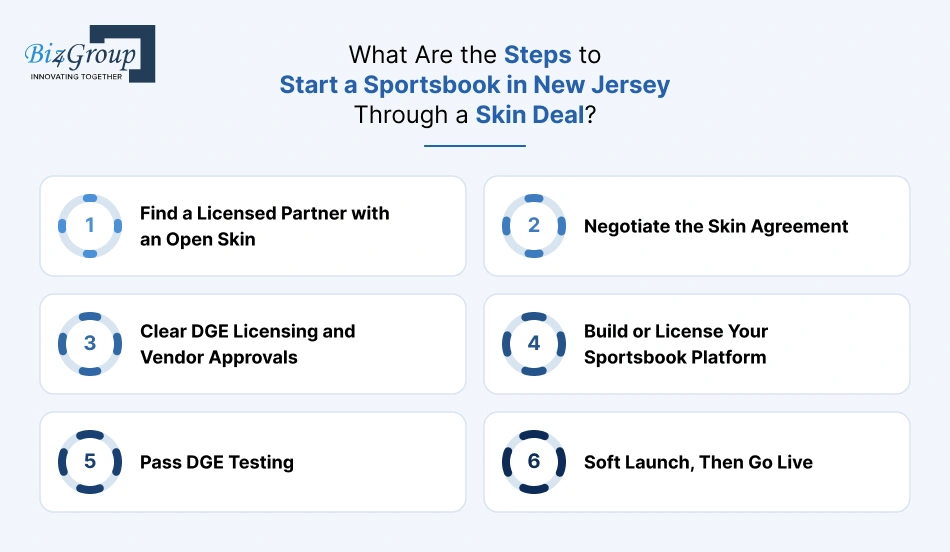
You start a sportsbook in New Jersey in six moves. Secure a licensed partner, negotiate the skin agreement, clear DGE approvals, build or license your platform, pass DGE testing, and go live after a controlled soft launch. Most delays happen in steps three to five, so run them in parallel.
Step 1. Find a Licensed Partner with an Open Skin
Everything starts with a seat. Each casino or racetrack holds three skins, and many are already taken by big names.
Shortlist two or three partners with open capacity. Racetracks count too, as FanDuel proved at the Meadowlands. More than one option keeps your negotiating position healthy.
Which New Jersey casinos have open sportsbook skins? The DGE’s monthly revenue report lists every live online sportsbook brand by casino or racetrack. Compare that list against the three-skin limit to spot properties with room.
Step 2. Negotiate the Skin Agreement
This contract is your New Jersey sportsbook market access agreement, and it shapes your margins for years. How does revenue share work in a sportsbook skin deal? The license holder gets paid through a market access fee. That fee can be a percentage of revenue, a minimum guarantee, an upfront payment or a mix. The DGE confirms these terms stay confidential.
Pin down five things before signing.
- Fee structure and minimum guarantees
- Who owns player data
- Who supplies and maintains the technology
- Compliance responsibilities on each side
- Exit and transition terms
Read the exit clause twice. Brands do leave.
Step 3. Clear DGE Licensing and Vendor Approvals
The DGE’s Service Industry Licensing Bureau registers or investigates every enterprise that supplies goods or services to casinos.
Companies directly tied to gaming activity typically need a Casino Service Industry Enterprise (CSIE) license. Lighter-touch suppliers may only need vendor registration.
Have your gaming counsel map who needs what before your team writes a line of code.
Step 4. Build or License Your Sportsbook Platform
Your brand lives or dies here. You’ll choose between custom, white-label and turnkey technology, which we compare below.
Bettors will judge your app against FanDuel’s within a minute. Working with an experienced UI/UX design company helps your skin feel like a brand people choose, not a template they tolerate.
Get the product right, and the marketing budget works harder.
Step 5. Pass DGE Testing
The DGE tests Internet gaming platform systems before use. Expect close checks on location controls, account flows and reporting.
This is where weak builds get exposed. Test early, test often, and document everything.
Also read: Challenges in modern sports betting app development
Step 6. Soft Launch, Then Go Live
New launches typically start with a limited soft-play period. Use it to monitor wagers, payments and geolocation under real traffic.
Fix issues quickly, then open the doors. Launch day is a milestone, and compliance stays a daily job after it.
What Does a New Jersey Sportsbook Platform Need Before You Sign?
A New Jersey sportsbook platform needs six layers working before you sign. Those are New Jersey geolocation, KYC and age checks, responsible gaming controls, wager-level audit trails, dependable odds feeds, and portable player data. Casino partners ask about these during negotiations, and the DGE checks them during testing.
Geolocation That Holds Up at the State Line
New Jersey sits next to New York and Pennsylvania, and bettors cross state lines daily. Your platform must confirm every bettor is inside New Jersey before a wager is accepted.
- Location checks at login and before each wager
- Detection of VPNs and location spoofing
- Logs showing how each location decision was made
Our guide to geofencing in sports betting apps explains why a few meters of error can cause real trouble.
KYC, Age Verification and AML
Every account must belong to a verified adult aged 21 or older. Every deposit must be traceable.
- Identity and age verification at signup
- Payment method checks before withdrawals
- Monitoring for suspicious activity patterns
Strong onboarding also reduces fraud losses, so it pays for itself.
Responsible Gaming Controls That Survive an Audit
The DGE enforces these rules with real penalties. In August 2026, it fined Caesars Sportsbook $251,250, plus $45,465 in disgorgement, for responsible gaming non-compliance.
More is likely coming. Rules proposed in September 2025 would require a responsible gaming lead and phased interventions that can end in account closure.
- Deposit, wager and time limits
- Self-exclusion and cool-off tools
- Automated flags for risky play patterns
AI integration services can help your team spot risky patterns early, before they show up in a DGE order.
Audit Trails and Regulatory Reporting
Your numbers will be public. Since January 2025, the DGE has reported online gross revenue by skin in its monthly press release.
Your platform should record every wager, settlement and adjustment with a clear trail. Reports for your casino partner and the DGE should come straight from the system, not from a spreadsheet someone fixes at midnight.
Odds Feeds, Risk Controls and Integrations
Parlays drive New Jersey’s market. They produced about 64% of sports wagering win through August 2026, at an 18.2% hold.
That makes parlay pricing and correlation risk controls central to the business. Our guide to real-time odds engine architecture covers the stack.
Many operators also explain why top US betting apps rely on multiple sports data providers for failover.
Portable Player Data and Clean Exit Paths
Skin deals change over time. The DGE’s August 2026 report even carries a line for brands that ceased operations in 2025.
Own your player data, keep it exportable, and write the transition into your contract. If you ever switch partners or platforms, you shouldn’t lose your customers in the move.
At Biz4Group, we treat these six layers as day-one architecture. Two of our builds show how that works in practice.
PredictEX: Real-Time Betting Infrastructure on Official Sportradar Data
PredictEX is a real-time sports betting platform Biz4Group built for MLB, college football and NFL markets. It runs on official Sportradar data, and our team worked directly with Sportradar’s engineers on the integration. That experience shows why enterprise sports data APIs like Sportradar matter more than features.
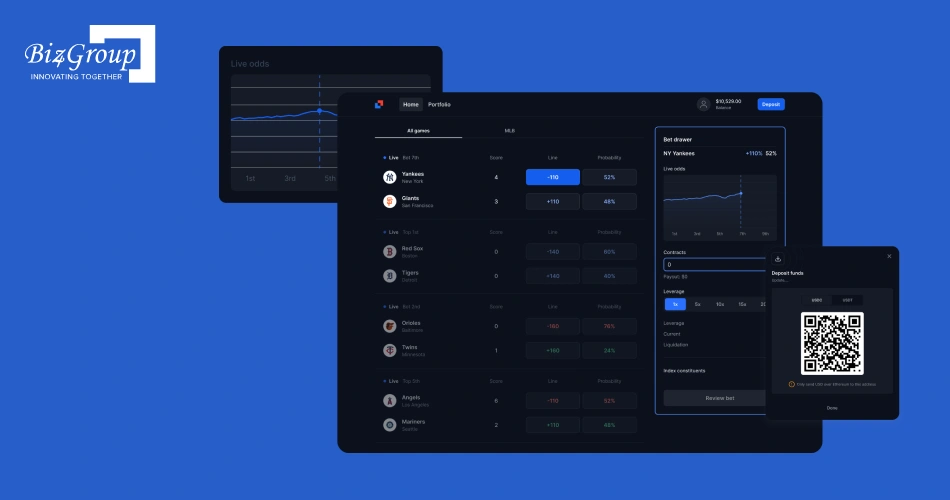
To handle game-day spikes, we used load balancing, server clustering, caching and data sharding. The platform reported a 78% reduction in live data latency and a 35% increase in live bet participation.
PredictEX is a technology reference. It is not a New Jersey licensed product.
Stackr: Age Checks, Secure Wallets and State Location Rules
Stackr is a social casino platform, not a sportsbook. Its build still tackled problems every New Jersey skin faces.
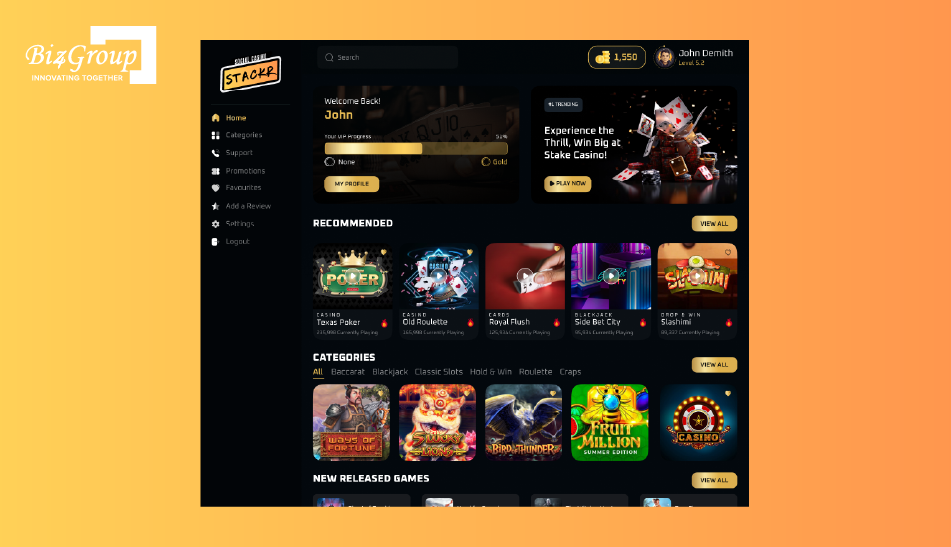
Our team delivered secure wallets, three iGaming-friendly payment gateways, AgeChecker verification, and location restrictions across US states. The platform also keeps detailed records of gaming activity and transactions.
Curious about the business side of that model? Read how social casinos make money. Stackr uses virtual currency and is not regulated sports wagering.
Six Layers, One DGE Test. Is Your Stack Ready?
Get a platform readiness review before your casino partner asks the hard questions.
Request a Readiness ReviewShould You Choose a Custom, White-Label or Turnkey Sportsbook Platform in New Jersey?
Choose a turnkey sportsbook in New Jersey for the fastest launch, and a white-label sportsbook for a branded product on proven infrastructure. Custom sportsbook development in New Jersey takes longer but gives you full control over product and long-term margins. Many brands launch on licensed technology and move to custom once their volume justifies it.
|
Factor |
Turnkey |
White-Label |
Custom |
|---|---|---|---|
|
Speed to market |
Fastest |
Fast |
Slowest |
|
Brand control |
Low |
Medium |
Full |
|
Approvals |
Provider usually holds them |
Shared |
Planned from scratch |
|
Ongoing platform fees |
Revenue share |
Licensing fees |
Lower over time |
|
Player data ownership |
Limited |
Varies by contract |
Full |
|
Best fit |
Testing the market |
Media and sports brands |
Multi-state growth plans |
There’s no universally right answer. There’s only the right answer for your budget and timeline.
Still undecided? Our build vs. buy a sportsbook platform framework scores 12 criteria.
Custom or Turnkey? Get a Number, Not a Guess.
Share your launch plan, and we’ll scope the build against New Jersey’s real requirements.
Get a Scoped EstimateWhat Does It Cost to Launch a Sportsbook in New Jersey in 2026?
Budget for four layers. These are state taxes of 21% on online gross revenue, the market access fee in your skin agreement, licensing and compliance costs, and the platform itself. Platform builds typically run from $20,000 to $350,000+, depending on scope.
1. State taxes. Online sports wagering pays a 19.75% gross revenue tax plus a 1.25% additional tax. The rate rose from 13% on July 1, 2025. Retail lounge wagers pay 8.5%.
2. Market access fees. Your skin agreement sets this number. Expect some mix of revenue share, minimum guarantees and upfront payments.
3. Licensing and compliance. Budget for DGE investigations, gaming counsel, audits and ongoing responsible gaming staff.
4. Platform development. Biz4Group planning estimates look like this.
- Lean MVP. $20K to $50K+ for core betting flows and limited integrations
- Growth sportsbook. $50K to $120K+ with payments, KYC, geolocation and odds feeds
- Enterprise platform. $100K to $150K+ with advanced risk controls and analytics
- Highly bespoke build. $150K to $350K+ for heavy integrations and multi-state readiness
Here’s how the tax math works. Say your skin earns $10 million in online gross revenue. State taxes take about $2.1 million, leaving $7.9 million before market access fees, data, payments and marketing. (Biz4Group illustration.)
For a deeper breakdown, see our sports betting app development cost guide. To see how market leaders turn that math into profit, read how sportsbooks like FanDuel make money.
How Do You Choose a New Jersey Sportsbook Platform Provider?
Choose a New Jersey sportsbook platform provider that builds geolocation, KYC, responsible gaming, odds feeds and audit-ready reporting into the first sprint and can show proof of past builds. Ask for regulated-market experience, documented testing and clear data ownership terms.
That’s exactly how Biz4Group LLC works.
We’ve delivered real-time betting platforms, official data integrations and verification-heavy gaming products for clients across the US. That experience shapes how we plan every New Jersey build.
Every engagement starts with a scoped review. We map your skin agreement’s technology duties, your partner’s reporting needs and the DGE’s testing expectations. Then we price the build against those requirements, not guesses.
You get a platform designed for the market you’re entering, with records you can defend in an audit.
Comparing vendors? Use our checklist on how to choose the right AI sports betting app development company. When you’re ready, our sports betting app development company team is a call away.
Is a New Jersey Sportsbook Skin Deal Worth It in 2026?
For most new brands, yes. New Jersey offers proven demand, a moderate 21% tax load and a working skin model. New York is much harder to enter, and Illinois costs more to run.
|
State |
Entry Route |
Online Tax |
Main Question |
|---|---|---|---|
|
New Jersey |
Skin deal with a casino or racetrack |
19.75% plus 1.25% |
Who do you partner with? |
|
New York |
Limited licenses, no open window |
51% of GGR |
Can you get in at all? |
|
Illinois |
$15M online license or tethered partner |
20% to 40% plus per-wager tax |
Can your margins survive? |
Read our full guides to the New York sports betting license and the Illinois sports betting license for the details.
When you launch a sportsbook in New Jersey, the skin agreement gets you in the door. Your platform decides how long you stay. Secure the right partner, model the 21% tax honestly, and build technology that passes DGE testing the first time.
Planning a New Jersey launch? Let’s turn the rules into a spec before they turn into surprises. Talk to Biz4Group.
FAQs
1. How many sportsbook skins can a New Jersey casino have?
Each Atlantic City casino and New Jersey racetrack can run up to three online sports wagering skins. With nine casinos and two racetracks, the statewide cap is 33 skins. Open seats depend on each property’s existing agreements.
2. How long does it take to launch a sportsbook in New Jersey?
It depends on licensing reviews, contract talks and platform readiness. Teams that already have approved technology move fastest. A focused sports betting app MVP can be ready in about 2-4 weeks, while DGE reviews and testing set the final launch date.
3. What is the online sports betting tax in New Jersey in 2026?
Online sports wagering in New Jersey pays a 19.75% gross revenue tax plus a 1.25% additional tax, for an effective 21%. The rate increased from 13% on July 1, 2025. Retail lounge wagers are taxed at 8.5%.
4. Does a skin operator need its own license in New Jersey?
Usually, yes. Companies directly tied to gaming activity typically need a Casino Service Industry Enterprise license, while some suppliers only need vendor registration. Your exact category depends on your role, so confirm it with the DGE and New Jersey gaming counsel.
5. Can you switch sportsbook platforms after launching a skin?
Yes, if you plan for it. Keep player data portable and write transition terms into your contracts. Many brands launch on licensed technology and later move to their own stack, a path we cover in migrating from white label to custom sports betting software development.
Sources
- NJ DGE, August 2026 Gaming Revenue Results (September 16, 2026)
- NJ DGE, December 2025 Gaming Revenue Results
- NJ DGE, Understanding the Internet Gaming and Sports Wagering Business in New Jersey (2025)
- NJ DGE, Order No. 3070, Caesars Sportsbook (August 2026)
- New Jersey Register, Proposed responsible gaming rules (September 15, 2025)
- NJ DGE, Vendor Registration and Casino Service Industry Licensing
- NJ DGE, Division of Gaming Enforcement overview
Cost ranges and worked examples are Biz4Group planning estimates and illustrations, not official figures.