Location :
Orlando, FL, USA
Location :
Orlando, FL, USA +1 (407) 714-1616
 info@biz4group.com



















Imagine a digital system that doesn’t wait for instructions but instead, understands your business goals, learns from real-time feedback, and takes independent actions to get the job done.
Read More

A single phone call can shape how a policyholder views an insurer. Someone may call to confirm coverage details. Another may need a quick update about a claim. These conversations happen every day across insurance service teams, and each interaction needs clear answers and reliable information.
Many insurers are introducing the top AI voice agents for insurance companies to support these conversations at scale. AI voice agents respond to common questions, guide callers through structured interactions, and keep customer communication organized across service operations. The success of these systems often depends on how well they are designed, which is why insurers collaborate with an experienced AI product development company when introducing voice-driven solutions.
Insurance teams typically focus on practical communication challenges when evaluating voice automation:
This guide reviews the best AI voice agents for insurance industry environments and outlines the platforms insurers examine when modernizing voice-based customer support.
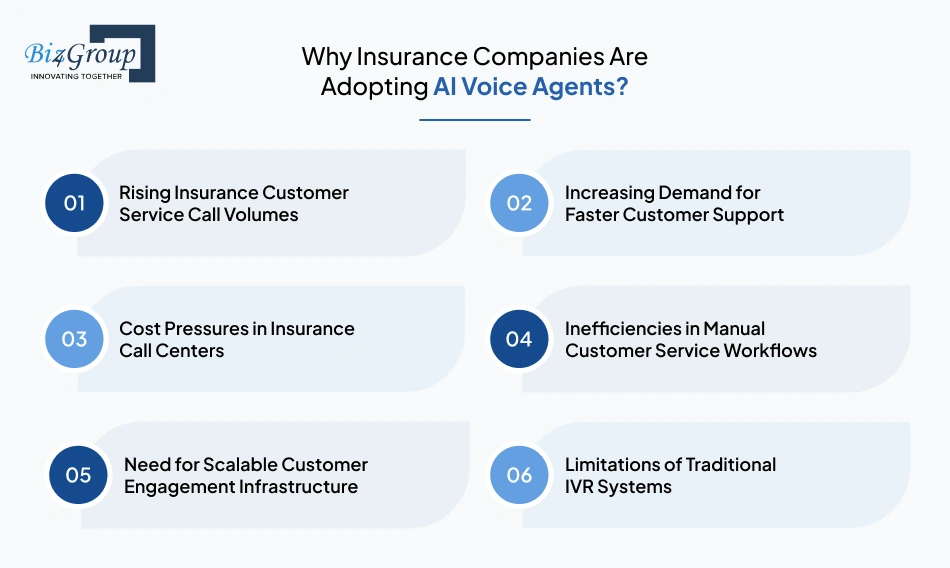
Insurance companies handle large volumes of customer interactions every day. Policyholders reach out for coverage questions, billing support, and policy updates. As service demand grows, insurers are reassessing how customer communication is managed across call centers and support teams. Conversational AI voice agents for insurance are gaining attention because they help insurers respond to these operational pressures while maintaining consistent service experiences.
Insurance support teams often deal with thousands of customer calls each day. Policy inquiries, billing clarification, and coverage questions generate continuous call traffic across customer service lines. These interactions increase during renewal periods or major claim events.
Policyholders expect quick answers when contacting insurance providers. Long wait times can quickly impact satisfaction and retention. Faster response times have become a priority for insurers trying to improve customer experience.
AI powered voice agents for insurance support are being considered to maintain prompt responses while handling growing communication volumes.
Running large insurance call centers involves significant operational costs. Hiring and training support staff requires ongoing investment, especially as call volumes grow. Insurers are now evaluating how automation can help balance service quality with cost control.
For many insurers, discussions about service automation naturally include evaluating the cost to develop AI voice agent solutions compared to continuously expanding call center teams.
Insurance support agents often handle repetitive questions throughout the day. These routine interactions consume time that could be used for more complex customer needs. Many insurers are now reviewing how these workflows affect service efficiency.
Insurance organizations are modernizing their operations with solutions such as AI insurance software to reduce these inefficiencies and improve overall service productivity.
Also Read: How Much Does It Cost to Develop AI Insurance Software?
Insurance companies must handle customer communication across multiple channels and products. Demand can increase suddenly during major claim events or catastrophic incidents. Scaling customer support quickly becomes a challenge for traditional service models.
Conversational AI agents for insurance are increasingly viewed as part of a broader strategy to maintain reliable customer engagement as insurance operations continue to expand.
Also Read: Cost to Develop Conversational AI Agent
Many insurance call centers still rely on traditional IVR systems to route customer calls. These systems follow fixed menu structures that often frustrate callers. Customers may spend several minutes navigating options before reaching the correct support team.
These limitations have pushed insurers to look for more natural ways to manage customer conversations.
Insurance companies are gradually shifting toward service models that can handle increasing communication demands without sacrificing customer experience. As operational pressures grow, AI powered voice agents for insurance support are becoming a practical step toward maintaining responsive and scalable insurance customer service.
Also Read: A Guide to AI Conversation App Development
Discover how AI voice systems can streamline policyholder conversations and support operations at scale
Talk to Our AI ExpertsInsurance companies communicate with customers through many digital channels. Two of the most common technologies used today are voice agents and chatbots. Both help insurers respond to customer questions, but they operate through very different interaction formats.
Understanding how these tools differ helps insurance leaders decide which approach fits specific customer service situations. While chat interfaces work well in some scenarios, insurance customer service AI voice agents are designed for real-time phone conversations where customers prefer speaking rather than typing.
The primary difference between these technologies lies in how customers communicate with the system. AI voice agents operate through spoken conversations, while chatbots rely on typed messages.
Voice interaction feels more natural for many customers calling their insurance provider. A caller can explain their question in a normal conversation without navigating multiple text prompts.
Because insurance support often begins with a phone call, many insurers adopt insurance customer service AI voice agents to manage voice-based interactions more effectively.
AI voice agents are designed to hold real-time conversations during incoming calls. Customers speak normally and receive immediate spoken responses without switching channels.
Chatbots operate differently. They respond to typed messages and often work best in structured conversation flows where customers follow prompts step by step.
Many insurers deploy AI voice bots for insurance companies to maintain smooth customer conversations when phone support demand increases.
Insurance customers often prefer calling their provider when discussing coverage, billing, or account questions. AI voice agents are designed to operate directly within phone-based service environments.
Chatbots are usually placed on websites, customer portals, or messaging apps. They provide assistance within those digital interfaces but do not manage voice calls.
Some insurers combine voice systems with broader digital tools through AI integration services so customer interactions remain consistent across communication channels.
AI voice conversations provide a familiar way for policyholders to interact with their insurance company. Customers can ask questions in a natural way without needing to type detailed explanations. This interaction style can feel more comfortable for customers who prefer speaking with support teams rather than navigating text conversations.
Because of this preference, insurance customer service AI voice agents are increasingly used in service environments where voice remains the primary customer contact channel.
Chatbots continue to play an important role in digital customer service. They assist customers who prefer interacting through websites or mobile applications rather than making phone calls. Many insurers opt for AI chatbot integration to provide support for customers browsing within their digital platforms.
In some cases, insurers also introduce an AI chatbot for insurance sales to answer product questions from website visitors before they speak with a human agent.
Also Read: Insurance AI Chatbot Development Cost
The key differences between AI voice agents and chatbots in insurance customer service are summarized in the table below:
|
Aspect |
AI Voice Agents |
Chatbots |
|---|---|---|
|
Interaction Method |
Communicate through spoken conversations during phone calls |
Communicate through typed messages on websites or apps |
|
Customer Channel |
Used primarily in call center and phone-based support |
Used on websites, mobile apps, and messaging platforms |
|
Conversation Style |
Real-time voice conversation that feels like speaking with human agent |
Structured text responses based on typed queries |
|
Best Customer Scenario |
Customers who prefer calling their insurer for assistance |
Customers browsing online who want quick answers |
|
Typical Insurance Use |
Phone-based customer service interactions |
Website support and digital customer engagement |
AI voice agents and chatbots support different parts of insurance customer service. While chatbots assist customers on digital platforms, voice solutions handle real-time phone interactions. For insurers managing high call volumes, AI voice bots for insurance companies provide a practical way to maintain consistent and responsive customer support.
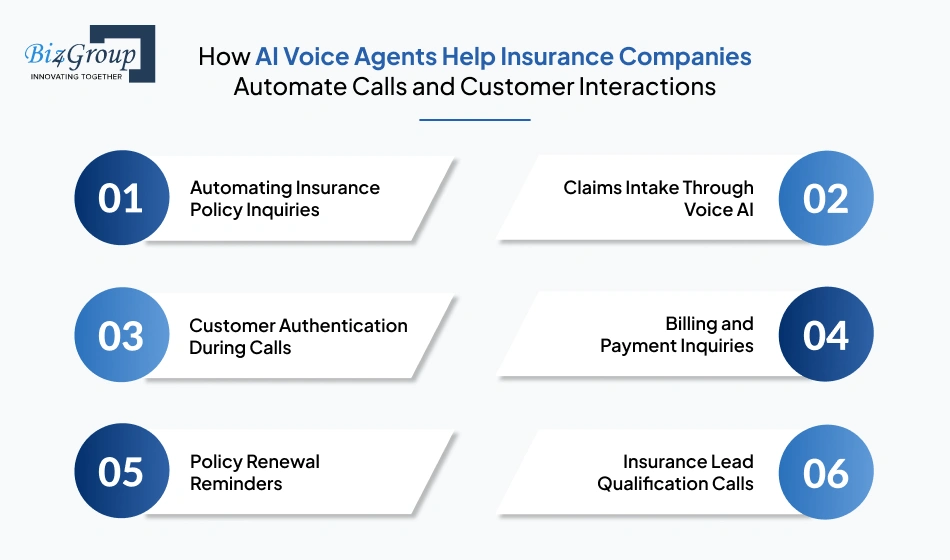
Insurance customer service involves many routine conversations that occur every day across call centers. Policyholders call to check coverage details, ask about billing, report incidents, or confirm policy updates. These repeated interactions consume large portions of support teams’ time.
AI voice automation for insurance operations is helping insurers handle these everyday conversations more efficiently. Instead of routing every request to human agents, voice systems can manage routine service interactions while keeping customer communication consistent and responsive.
Policyholders frequently call their insurer to ask simple questions about their coverage. In traditional workflows, these requests reach customer support agents who must verify the caller’s information before providing policy details.
AI voice automation tools for insurance businesses help manage these inquiries by responding to common policy questions during phone interactions. This reduces support workload while keeping service responses consistent.
Let’s take a closer look at how structured AI systems manage policy knowledge and coverage information in insurance operations.
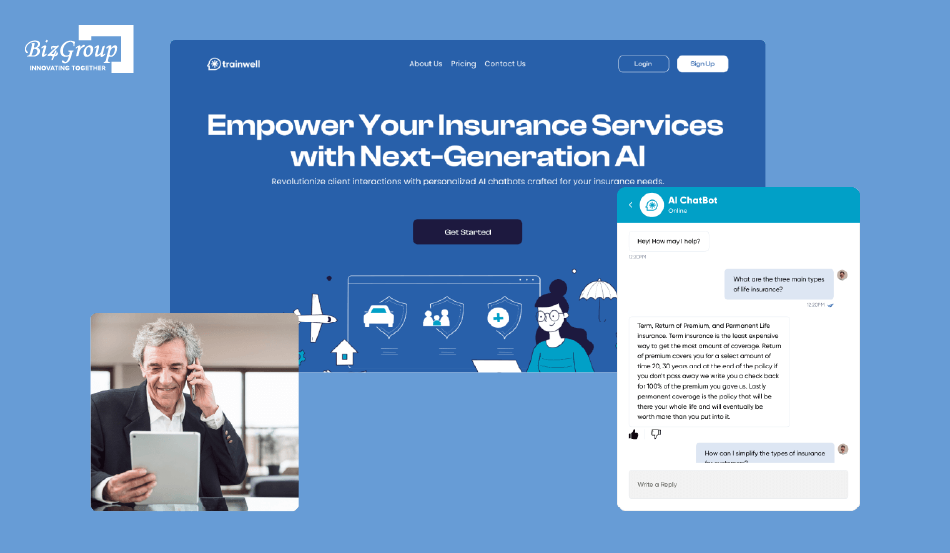
Insurance AI is an intelligent knowledge assistant designed for insurance operations. It connects internal policy documentation, training materials, and operational guidelines into a conversational system that retrieves accurate information through natural language queries. Insurance teams use it to quickly locate coverage rules, policy terms, and service procedures without manually reviewing documents. Access to structured policy knowledge in this way supports faster responses when customers call to confirm coverage details, policy conditions, or benefits associated with their insurance plans.
When customers report incidents, the first step is collecting essential information to begin the claims process. Traditionally, a support representative gathers these details during a phone call and records them in internal systems.
AI voice automation for insurance operations allows insurers to capture claim information during the initial call. Many insurers introducing AI insurance automation software use these capabilities to handle large volumes of incoming claim reports.
Also Read: Voice AI Agent Development for Insurance Claim Fraud Detection
Before discussing policy information, insurance companies must confirm the caller’s identity. Customer service teams typically ask several verification questions during each interaction.
Voice-driven systems can guide callers through identity verification steps before the conversation continues. Many insurers implement these capabilities alongside AI business process automation that streamline repetitive service tasks.
Insurance billing questions are another common reason customers contact support teams. Policyholders call to confirm payment status, understand billing cycles, or update payment information.
AI voice automation tools for insurance businesses can manage these conversations by guiding customers through billing information requests. This approach helps insurers maintain responsive service without increasing call center staffing.
Policy renewals generate large numbers of customer interactions. Support teams often contact policyholders to remind them about upcoming renewal dates or required updates.
AI voice automation for insurance operations allows insurers to manage renewal communication at scale. As insurers evaluate top AI voice agents for insurance companies, many focus on how these systems help maintain consistent customer outreach during renewal cycles.
Insurance providers often receive inquiries from potential customers interested in coverage options. These calls require basic information gathering before transferring leads to licensed agents.
Many insurers use voice-driven AI automation systems to handle initial lead qualification. This helps sales teams focus on conversations that require deeper consultation while routine information collection is handled automatically.
Insurance companies handle thousands of routine conversations each day across policy servicing, claims reporting, and billing support. AI voice automation tools for insurance businesses help streamline these interactions so customer service teams can focus on more complex requests while maintaining consistent service experiences.
See how voice automation organizes inquiries and keeps policyholder communication running smoothly
See Voice AI in ActionInsurance companies evaluating voice automation platforms often focus on solutions that support customer communication across policy servicing, claims coordination, and support operations. Several platforms now offer specialized voice capabilities designed to manage large volumes of phone interactions in insurance environments.
The platforms below represent some of the top conversational AI voice agents for insurance industry environments. Each solution provides voice-driven communication tools that insurers deploy across customer support teams and operational service channels.
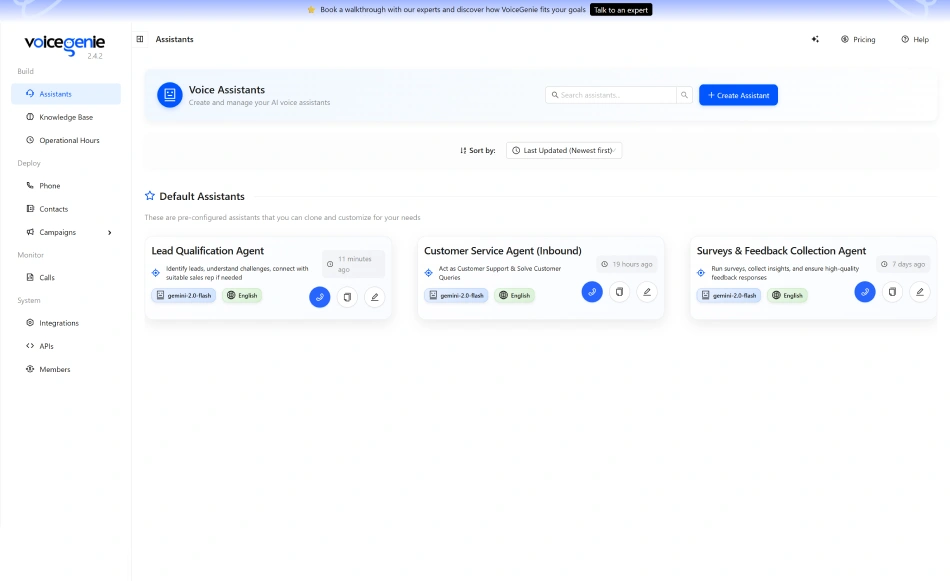
VoiceGenie is a conversational voice AI platform designed to automate phone interactions between businesses and customers. The product focuses on handling large volumes of customer conversations through AI-driven voice agents that engage callers and manage real-time dialogue during phone interactions.
Insurance Use Cases:
Key Capabilities:
Why Insurers Adopt It: Insurance organizations evaluating AI voice agent solutions for insurance call centers often consider VoiceGenie because it supports structured customer conversations while helping service teams manage high call volumes efficiently.
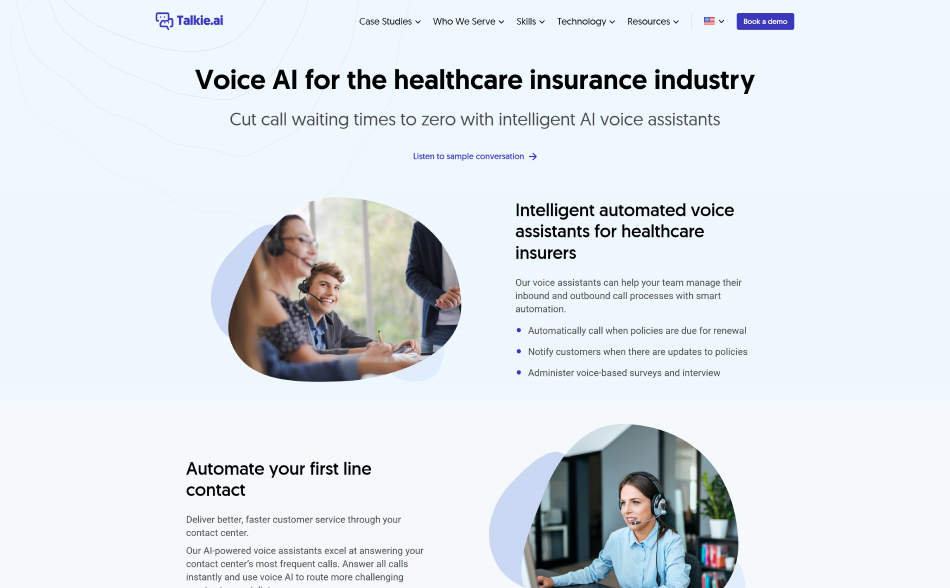
Talkie.ai is an enterprise conversational voice platform that enables organizations to deploy AI-powered voice assistants for managing customer phone conversations. The platform focuses on delivering natural voice interactions that support large-scale customer communication operations.
Insurance Use Cases:
Key Capabilities:
Why Insurers Adopt It: Talkie.ai is often considered among the best AI voice agents for insurance customer service as it supports large-scale customer communication while maintaining consistent conversational experiences within the insurance environments.
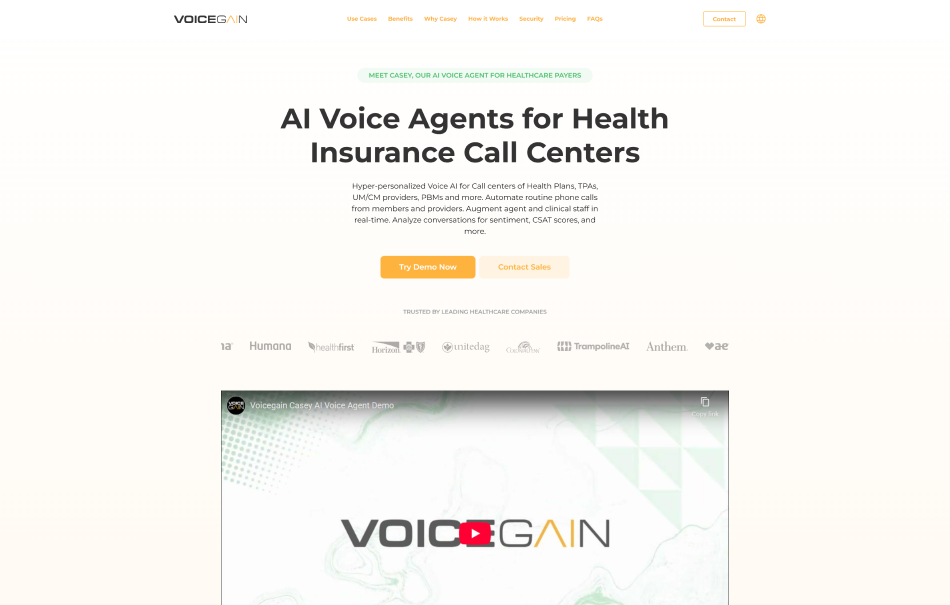
Voicegain is a speech AI platform that provides voice recognition technology and conversational voice infrastructure for automated phone interaction systems. The platform powers voice-enabled applications that manage customer conversations through speech-based interfaces.
Insurance Use Cases:
Key Capabilities:
Why Insurers Adopt It: Insurance technology teams implementing enterprise AI solutions often deploy Voicegain when expanding voice communication infrastructure across customer service operations.
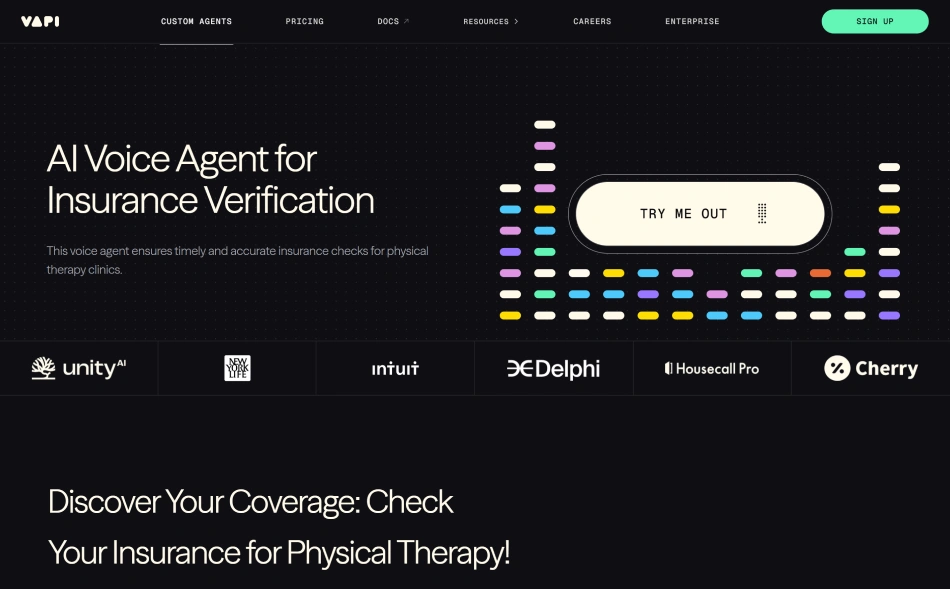
Vapi is a developer-focused voice AI platform designed for building and deploying programmable voice agents. The platform provides infrastructure for creating voice-driven applications that support conversational phone interactions used by carriers, agencies, and other coverage providers.
Insurance Use Cases:
Key Capabilities:
Why Insurers Adopt It: Insurance product teams planning to integrate AI into an app use Vapi when implementing programmable voice communication features inside digital insurance products.
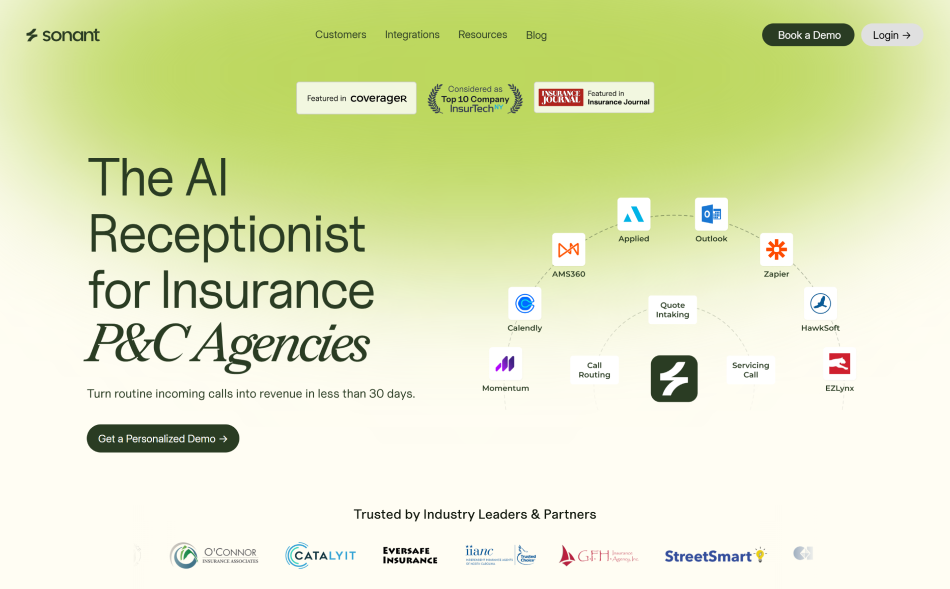
Sonant is an AI voice receptionist platform designed specifically for agencies and brokerages that manage policyholder communication through phone channels. The platform is positioned as a virtual receptionist that supports inbound caller interactions for organizations handling coverage and policy-related inquiries.
Insurance Use Cases:
Key Capabilities:
Why Insurers Adopt It: Sonant is listed among the best AI voice agents for improving insurance customer experience because it focuses specifically on call handling workflows common within insurance agencies.
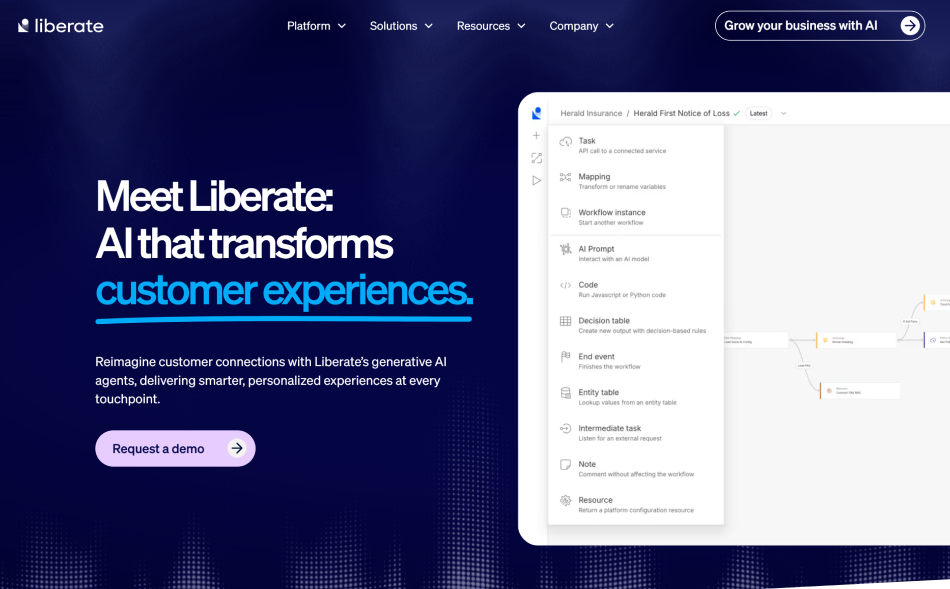
Liberate is a conversational voice AI platform designed for organizations that manage large volumes of policyholder communication. The platform focuses on deploying AI voice agents that support conversations between carriers, agencies, and the customers they serve.
Insurance Use Cases:
Key Capabilities:
Why Insurers Adopt It: Liberate is often included among the top AI voice agents for insurance companies because it supports voice communication tailored specifically for insurance service environments.
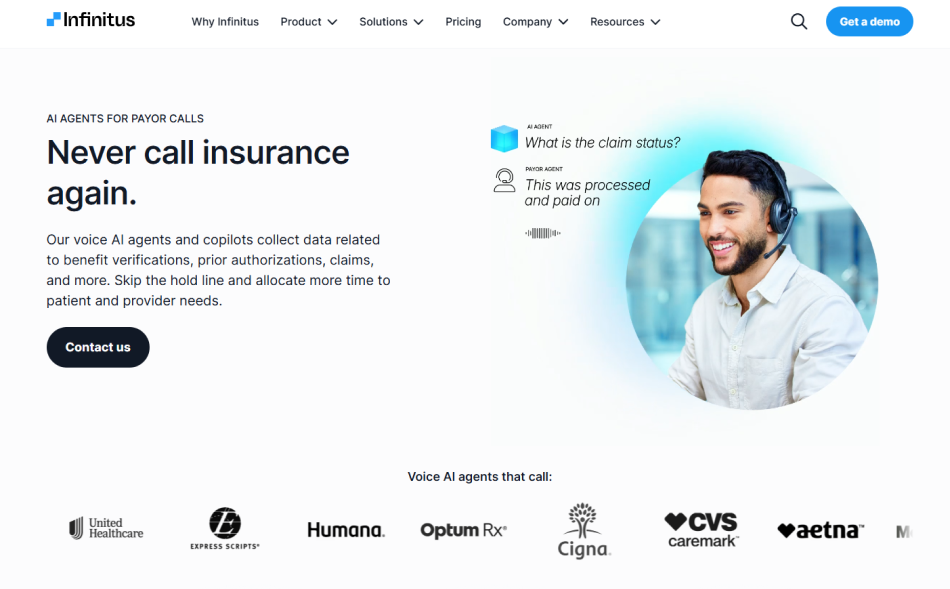
Infinitus is a AI voice agent designed to conduct structured phone conversations involving insurance and healthcare communication. Insurance organizations use the platform for automated calls that require information exchange and coordination.
Insurance Use Cases:
Key Capabilities:
Why Insurers Adopt It: The platform helps manage high volumes of coordination calls involving verification, documentation, and operational communication across partner networks.
PolyAI is an enterprise conversational voice assistant platform designed for large-scale customer service operations. The platform enables organizations that manage policyholder communication to deploy AI voice assistants capable of handling high volumes of spoken conversations.
Insurance Use Cases:
Why Insurers Adopt It: PolyAI supports high-volume customer interaction management across enterprise call centers and is widely recognized among the best AI voice agents for insurance customer service.

TalkerIQ is a conversational voice AI platform designed to deploy intelligent voice agents for automated phone conversations. The platform supports organizations that manage customer communication across agencies, brokers, and coverage providers.
Insurance Use Cases:
Why Insurers Adopt It: Insurance teams planning to deploy an insurance AI agent often evaluate TalkerIQ when expanding voice-based customer engagement within service operations.
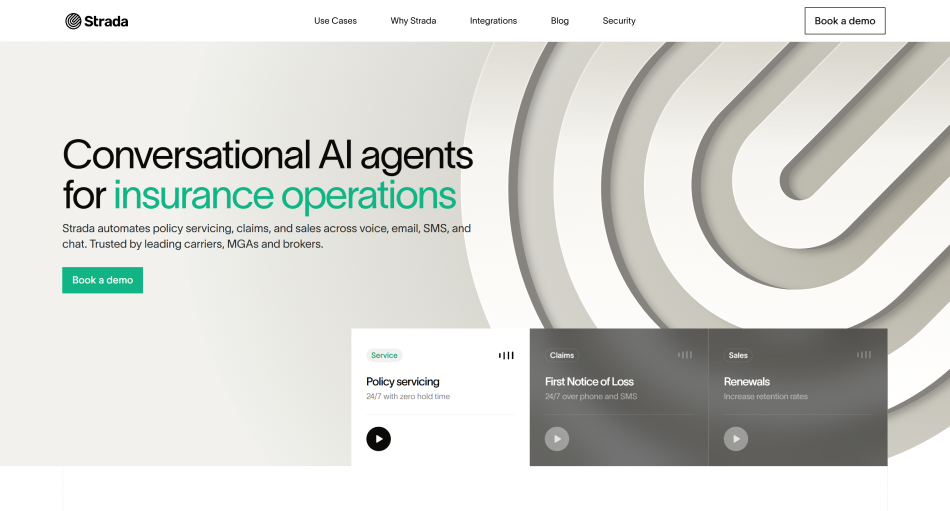
Strada is an AI voice agent platform designed to handle automated phone conversations between businesses and their customers. Insurance organizations use the platform to handle inbound and outbound policyholder interactions through voice conversations.
Insurance Use Cases:
Key Capabilities:
Why Insurers Adopt It: Insurance providers adopt Strada when they need a platform that supports automated phone conversations and structured voice communication across customer service operations. Teams that later hire AI developers often use platforms like Strada as the foundation for implementing voice-driven interaction systems.
Insurance leaders evaluating the top AI voice agents for insurance companies often look for platforms that align with their communication infrastructure and operational workflows. The solutions listed above represent some of the most widely adopted AI voice agent used today.
Discuss how custom voice agents can align with your policy workflows and service infrastructure
Start Your Voice AI Plan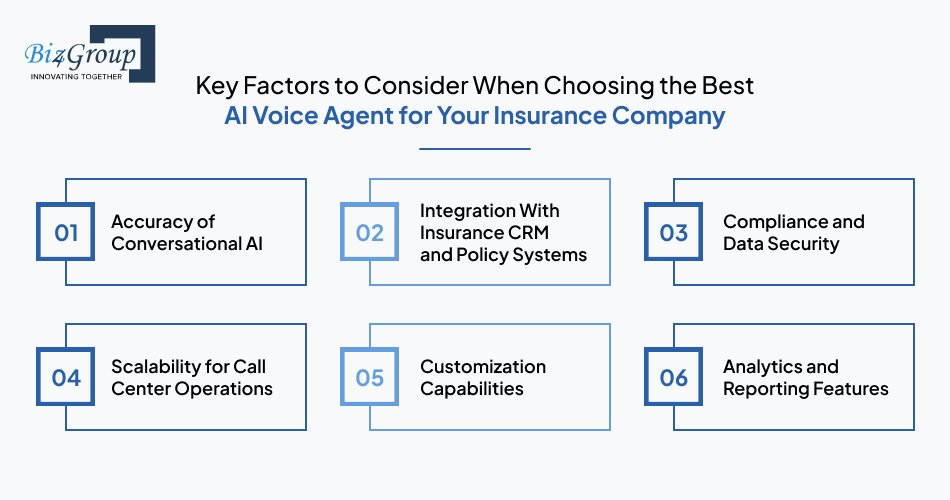
Insurance leaders evaluating voice automation platforms often review several technical and operational factors before committing to a solution. A structured evaluation helps ensure the platform aligns with communication needs, compliance requirements, and long-term service operations.
The following criteria can guide insurers as they assess the top AI voice agents for insurance companies and determine which solutions fit their service infrastructure and customer interaction model.
AI voice agents must understand customer requests clearly during phone conversations. Inaccurate responses can lead to customer frustration and repeated calls to support teams.
High conversational accuracy is especially important when evaluating AI voice agents for insurance call centers, where large volumes of customer conversations occur daily.
AI voice agents should connect smoothly with internal systems that store policyholder and account information. Without proper integration, service teams may still rely on manual processes during phone interactions.
Insurance organizations often involve specialists providing AI consulting service support when evaluating how AI voice agent will connect with existing systems.
Also Read: Artificial Intelligence in CRM
Insurance operations require strict protection of customer information. AI voice agents must follow security standards that safeguard sensitive policyholder data.
Strong compliance capabilities are essential when AI voice agents handle conversations involving customer records and policy information.
Insurance service demand can increase quickly during renewal cycles or major claim events. AI voice agent should support large volumes of calls without affecting service quality.
This capability is particularly relevant for insurers deploying AI voice agents for insurance claims support, where sudden spikes in customer calls often occur.
Insurance organizations often require voice platforms that align with their internal processes and customer communication standards.
Work with specialized voice AI agent development companies to tailor voice platforms around internal operational requirements.
Clear reporting helps insurance teams monitor how voice interactions perform across service operations. Reliable insights allow leaders to understand customer communication patterns and operational efficiency.
Consistent analytics allow insurers to track how voice automation supports service operations and customer communication.
Insurance teams evaluating the leading AI voice assistants used by insurance companies often rely on structured criteria like these to guide their decision process. Careful evaluation helps ensure the selected platform aligns with operational needs and long-term customer communication strategies.
Insurance companies introducing voice automation often focus on technology capabilities while overlooking practical implementation challenges. Many deployment issues occur when operational realities are not considered early. Understanding these risks helps insurers avoid AI automation pitfalls and deploy insurance AI voice assistant platforms more effectively
Organizations evaluating the top AI voice agents for insurance companies should also pay attention to the common mistakes that slow adoption or create operational friction during implementation.
|
Common Implementation Mistake |
How to Avoid the Problem |
|---|---|
|
Using generic voice AI tools without insurance context |
Deploy platforms trained for policyholder communication and insurance terminology |
|
Poor integration with existing policy and CRM systems |
Plan system connections early and test data flow across internal platforms |
|
Limited conversational training data |
Train the system using real customer interaction data and support scenarios |
|
Ignoring regulatory and compliance requirements |
Ensure the platform follows security and compliance standards for customer information |
|
Expecting full automation from day one |
Begin with controlled deployment and expand automation gradually |
|
Lack of internal operational readiness |
Prepare support teams and internal processes before deploying voice automation |
|
Insufficient testing before production launch |
Run controlled testing environments to identify conversation errors early |
|
Overlooking call escalation processes |
Design clear pathways for transferring complex calls to human agents |
|
Poor monitoring of voice interactions after launch |
Continuously review call performance and conversation outcomes |
Insurance leaders introducing voice automation often realize that technology alone does not guarantee smooth deployment. Organizations that already follow structured product planning through business app development tend to approach voice implementation with clearer operational readiness and better long-term communication planning.
Insurance teams often need voice systems that work smoothly with existing policy and claim platforms. Biz4Group LLC designs AI voice agents for insurance companies that fit real operational workflows instead of generic automation scripts.
As an AI agent development company we work closely with insurers to design conversational systems that handle policyholder communication, claim inquiries, and structured data capture during phone interactions. Heres what sets us apart:
Now take a look at how these capabilities were put together in a real-world implementation:
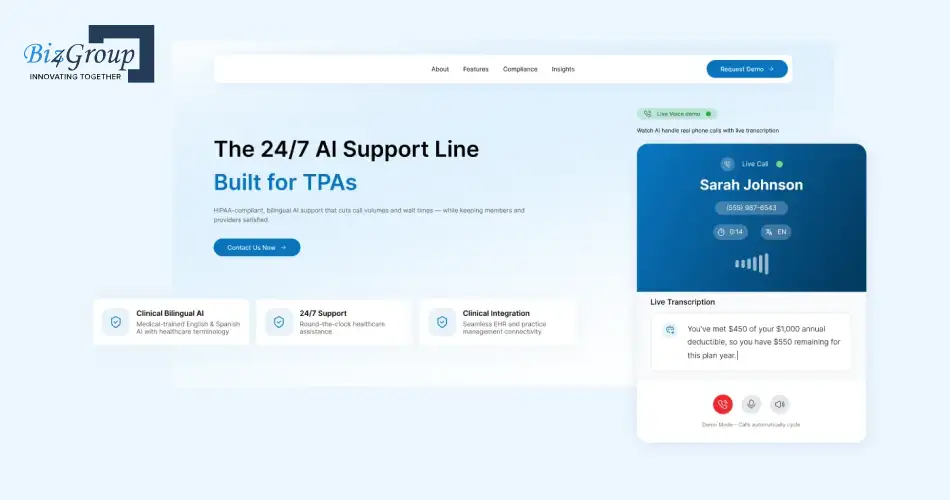
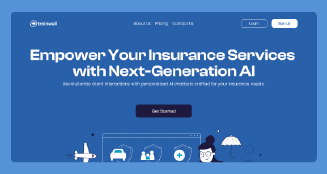
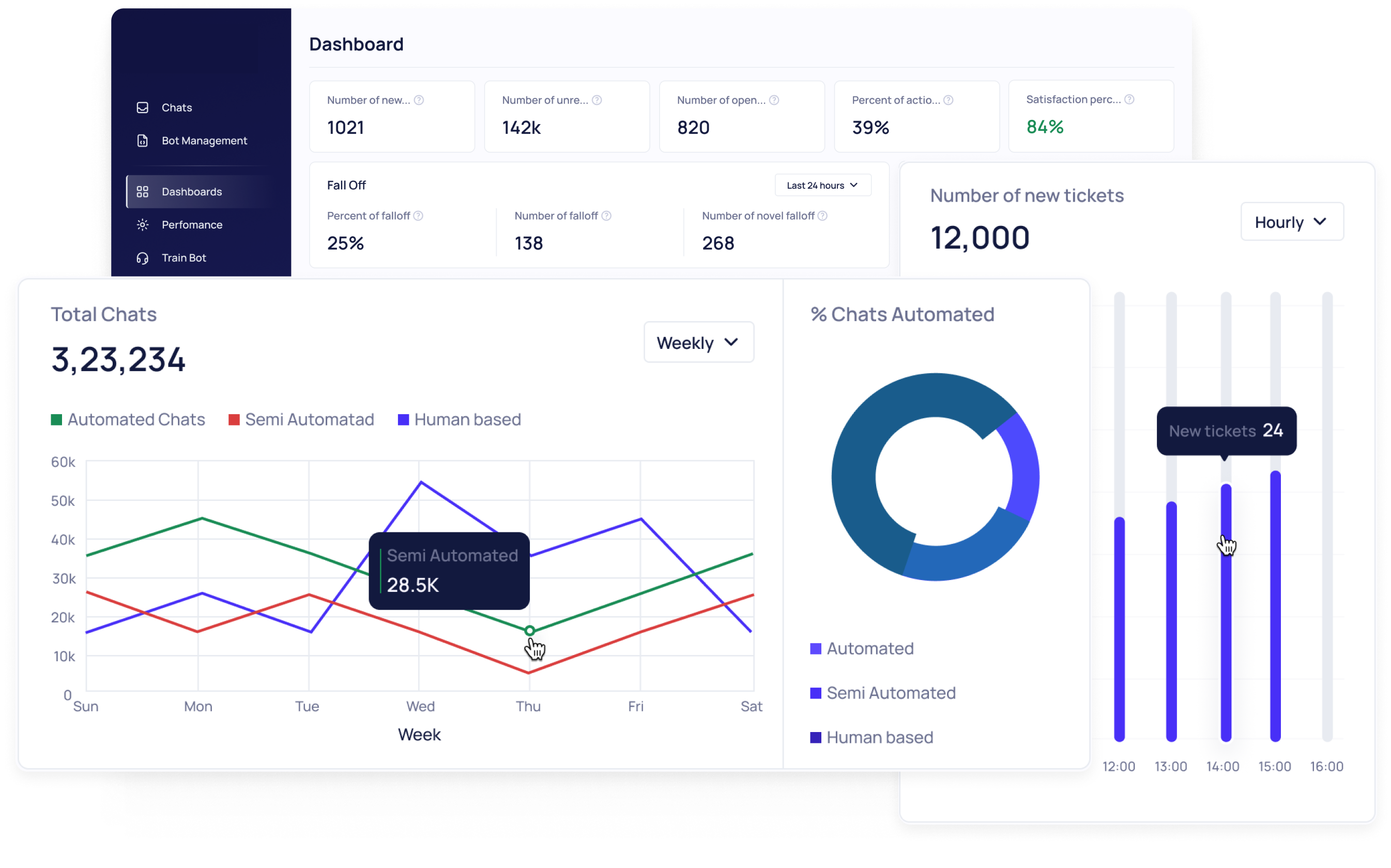
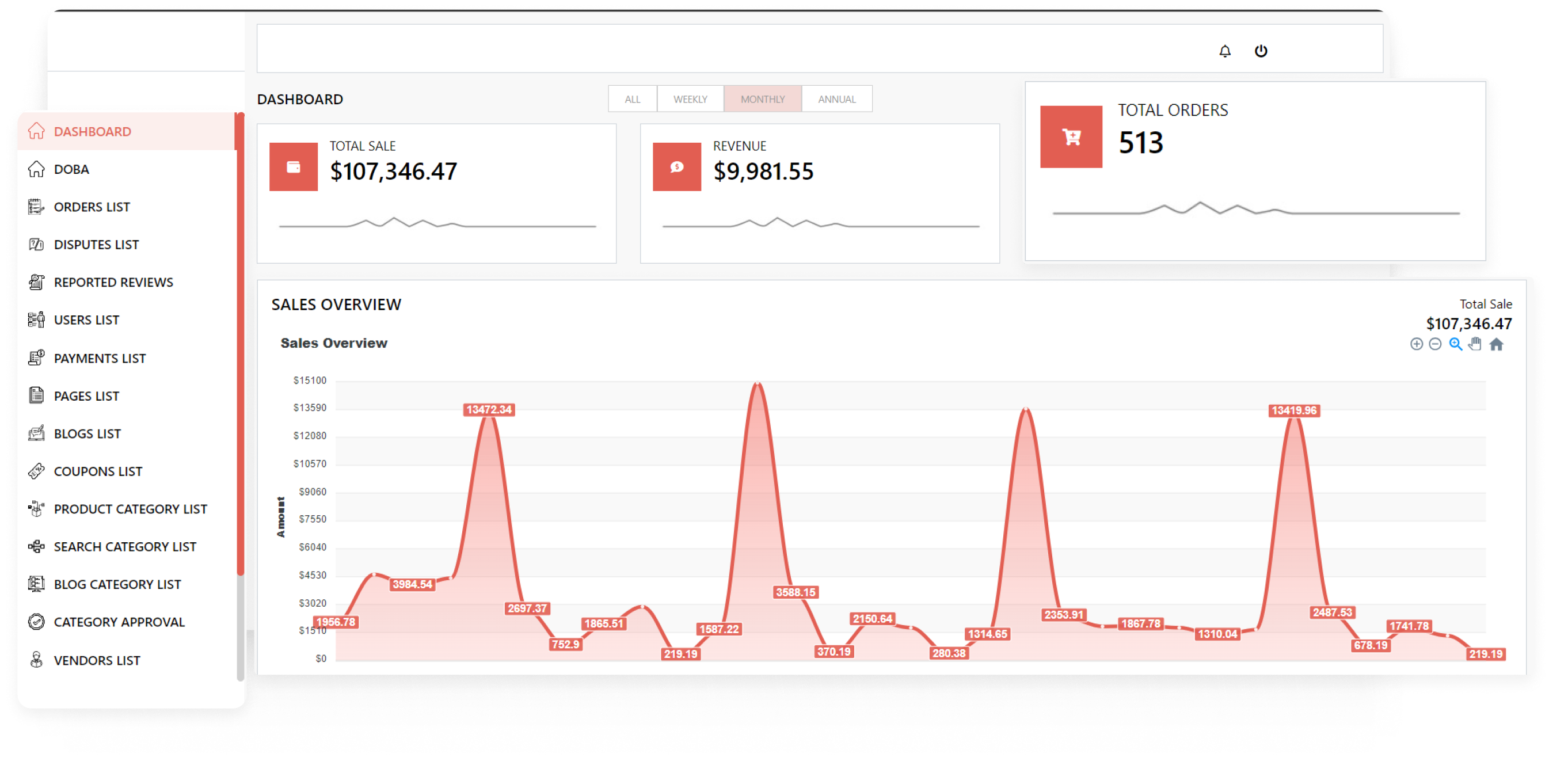
We developed an AI IVR platform for healthcare insurance sector that handles policy inquiries, service requests, and claim-related conversations through automated voice interactions.
Insurance teams evaluating top AI voice agents for insurance companies often require solutions tailored to their existing service infrastructure. Thus, Biz4Group helps insurers design practical AI voice agents for insurance companies aligned with their operational workflow.
Let's design a voice solution tailored to your policy workflows and customer communication needs
Schedule a Strategy CallAI voice automation is quickly becoming part of how insurers manage everyday customer communication. As service expectations rise, many teams are adopting the top AI voice agents for insurance companies to maintain faster response times while keeping customer conversations consistent and organized.
Platforms that handle voice interactions well also improve operational efficiency. The best AI voice agents for insurance industry environments help insurers manage large volumes of calls while allowing support teams to focus on complex customer needs. Organizations working with an experienced AI development company often see smoother implementation because the voice system is designed to fit existing claim and policy workflows.
Voice technology will continue to evolve as insurers expand automation across service operations. If your team is evaluating voice solutions and wants practical guidance on implementation, schedule a call with Biz4 Group now to discuss how these systems can support your customer communication goals.
Insurance leaders usually assess platforms based on conversational accuracy, integration with policy and claims systems, compliance readiness, and scalability for call volumes. Many insurers also run pilot programs to evaluate how the voice system performs with real policyholder conversations before full implementation.
Most platforms are deployed for routine communication tasks such as policy inquiries, billing questions, claim status updates, and call routing. These AI voice automation tools help insurers manage high call volumes while allowing human agents to focus on complex customer interactions.
Voice agents respond instantly to incoming calls, guide customers through structured conversations, and retrieve policy information from internal systems. This helps reduce wait times and ensures policyholders receive consistent responses during high-demand service periods.
Yes. Many insurers deploy voice systems to collect structured information during claim reporting or verification calls. These conversations capture details in a consistent format so investigation teams can review claim information more efficiently.
Insurance organizations usually prioritize platforms that support policy data integration, secure handling of customer information, and flexible conversation design. Voice systems must also adapt to different insurance workflows such as policy servicing, claims support, and customer inquiries
Most enterprise platforms connect with internal systems through APIs. This allows voice assistants to retrieve policy details, update interaction records, and log customer conversations within CRM or claim management systems used by insurance teams.

with Biz4Group today!
Our website require some cookies to function properly. Read our privacy policy to know more.